There’s a great song from the movie Cabaret that goes something like this: “Money makes the world go ’round, the world go ’round, the world go ‘round.” I like it because it says so much in such a short lyric and is understood by everyone. For buyers and sellers in this real estate market, the money is represented by mortgage interest rates which change so quickly your head could go ‘round and ‘round.
At the July meeting of the Federal Reserve, they raised interest rates by another quarter percent, which was expected, but they did indicate the possibility of easing towards the end of the year. According to Forbes on Aug. 2, the average residential 30-year fixed rate mortgage was 7.47%, not making buyers feel warm and fuzzy.
Interest rates are impacting the real estate sales market as frustrated home shoppers are facing high rates combined with a shortage of available properties that are not moving substantially down. Sellers are happily sitting tight on their 3% mortgages with Cheshire cat smiles on their faces for being so smart.
According to the National Association of Realtors, June sales fell 18.9% nationally compared to June of last year. Manatee County had 17.7% more sales for single-family homes compared to June of last year.
Sale prices are down slightly but still historically high. The national median existing-home price fell 0.9% in June from last year to $410,200, and the Manatee County median sale price for single-family homes was down 4.5% to $525,000. However, based on the new listings coming out daily, I wouldn’t be too worried about our values taking a deep dive any time soon.
There is another way for buyers and those sellers who want to sell to come together despite high rates that may be disqualifying some buyers. Sellers could offer or buyers could suggest that sellers finance a buyer’s purchase of their home. This is called taking back a mortgage and is more common for investment properties but could also offer a solution for some buyers with an interested seller.
Seller financing helps buyers increase their purchasing power by saving on closing costs, setting up escrow accounts, and application fees or paying lower interest rates. It could also help sellers who want buyers to make a full-price or higher offer on the home and are concerned about the property appraising through a conventional bank lender. The transaction is similar to closing with a lender; the buyer receives title to the property at the closing as with a traditional mortgage.
Sellers are assuming the larger risk of taking back a mortgage on their property. If the buyer defaults or doesn’t pay their real estate taxes or insurance, the seller will need to proceed with a foreclosure which is expensive and time-consuming. It’s all a little complicated and risky for all parties including getting a tax advisor involved and, of course, an attorney.
Anxious sellers who have properties that have been on the market for some time could consider holding the mortgage. This could also produce a steady stream of income for the seller if they are in a financial position to delay receiving the proceeds from the sale.
Typically, buyers can negotiate an interest rate lower than the prevailing rate, however, there is a minimum interest rate regulated by the IRS to consider. Sellers could wait out the higher rates hoping for a future decline then apply for a conventional mortgage and pay off the seller.
Money makes the world go ‘round and trying to understand it can make your head explode. Proceed with caution.
BRADENTON – Horses are not the only source of bacteria and seagrass damage in Palma Sola Bay, an expert told the Bradenton City Council.
In a July 26 water quality presentation, Dr. Dave Tomasko, executive director of the Sarasota Bay Estuary Program (SBEP), stopped short of naming horses as a primary cause of elevated bacteria levels and loss of seagrass, instead saying that there are likely multiple causes.
Horseback riding on the north side of the bay has long been debated by the council, the Palma Sola Scenic Highway Committee and water quality organizations.
“People damage the bay by enjoying the bay, we’re not against that at all,” Tomasko said. “SBEP is for access and recreating on the bay but that does cause damage to the bay.”
In his slide presentation to the council, he raised the question, “Do horses pose a risk to the health of Palma Sola Bay? Is this something that might be bothering some people, or is it something that puts the system at risk?”
Two businesses provide horseback riding in the water on the north side of the bay.
Tomasko discussed four metrics related to water quality and health of the bay, and talked about each of their possible sources: Nutrient enrichment, pathogens, physical damage and nitrogen.
“We generate nutrients through our fecal material, through passing urine. We generate nutrients by fertilizing our lawns, not picking up after our dogs,” he said. “We’re going to look at whether or not there is a nutrient-related problem in Palma Sola Bay and if there is, how important might horses be for that.”
Pathogens can be quantified, Tomasko said.
“Pathogens are things that can make you sick. We test for bacteria. We have three types of fecal indicator bacteria – e. coli, enterococci and fecal coliform, and none of those are just specific to humans, to mammals or to animals,” he said. “I can get you millions of fecal coliform bacteria from decomposing grass in a bucket of water. Our indicators are not specific to a source. So, if you find elevated levels of bacteria, it doesn’t mean you know why they’re there. “
Two different locations, one on the north side where horses are ridden and one on the south side where they are not are both sampled by laboratories, he said.
The Florida Department of Health collected more than 50 samples of south-side data and 84% of them were good, Tomasko said.
“On the north side, the values are poor more than any other category. Elevated levels are found more on the north side than the south side,” he said. “The south side doesn’t show elevated levels (of bacteria) except on occasion.”
“Enterococci bacteria is not necessarily from humans or pets or horses. It could be, but it could also be coming from decomposing seagrass meadows,” Tomasko said, noting that seagrass is absent from the south side of the bay.
Tomasko suggested that there is a good way to find out where the bacteria is coming from and that is through quantitative testing.
“My suggestion would be to try find what the bacteria is coming from to know what you should act upon, if anything,” he said. “If I have 3,000 bacteria and one is due to a human, that’s a lot different than if I have 3,000 bacteria and 1,500 is due to a human. There’s a quantitative way to do this.”
Evidence of physical damage to seagrass is apparent, Tomasko said, but could be caused by multiple sources.
“If we walk through seagrass meadows, or run through with a boat propeller, you’re going to scar the grass a little bit,” he said. “Horses are 1,500-2,000 pounds, they’re kind of heavy, but they also have buoyancy. A submerged horse will have some of its weight offset by buoyancy in the water.”
“It’s important to keep in mind we’ve been doing a lot of things to physically damage these habitats. And horses are causing a trail, true, but there’s a lot of boat propeller scars there too.”
With regard to nitrogen levels he said, “If you want your lawn to grow fast or your trees to look green, add nitrogen. So, we’re trying to keep the amount of nitrogen under control in the water.”
Five or six times a year, volunteers go out to measure microalgae in the bay.
“This was a healthier bay 10-15 years ago. We had a 28% increase in seagrass, we had lower nitrogen, we had lower algae and lower phytoplankton,” Tomasko said. “Palma Sola Bay continues to be healthy, looking at the seagrass status, the phytoplankton, the water clarity, it continues to be classified as a healthy system.”
“Would removing these horses reduce some of these issues?” he asked. “Yes, probably in a local sense, but the bay remains healthy and it doesn’t appear that the bay is in some kind of tipping point or close to it.”
ANNA MARIA – City officials are concerned about ground-level storage spaces in vacation rental homes being illegally converted and used as additional bedrooms.
Mayor Dan Murphy addressed these concerns with the city commission on Aug. 3.
“New single-family homes are being built with storage areas included. It appears some of these storage areas conveniently could be converted into bedrooms. Storage areas should not be converted into bedrooms,” Murphy said, noting that it violates state and city building codes and FEMA flood insurance regulations.
According to the notice of violation the city issued on Aug. 1, the vacation rental home in violation is located at 614 Gladiolus St. and is owned by Windemere residents Jose and Judith Calderon.
According to the violation notice, the home was inspected as a vacation rental on July 24 and the city inspector discovered a ground floor garage/ storage area had been enclosed and converted into a bedroom and/or habitable area. The notice also states the enclosed room is labeled as a bedroom on the sketch required as part of the city’s vacation rental registration program.
According to the notice, the property is currently in violation of several city and state building code regulations.
The notice of violation states the owners had until noon on Aug. 4 to apply for a city-issued demolition permit to bring the property into compliance with its previously issued building permit.
The homeowners were scheduled to meet with the city building official Monday afternoon.
When addressing the commission, Murphy noted the city’s annual vacation rental registration program requires an annual inspection of each dwelling to be used as a vacation rental. While the state preempts the regulation of vacation rentals to itself, the city has the authority to enforce state building codes, he said.
“A bedroom on the ground floor is a violation of Florida Building Code,” Murphy said in regard to new construction. “It was also done without a permit, which is also a violation of the Florida Building Code. They cannot use this as a vacation rental. We have notified them they have the alternative of getting a demolition permit to demolish that,” Murphy told the commission.
“This is not the only one. There are others we suspect,” he added. “As we do these vacation rental inspections, we expect to come across more. Our position is going to be the same: You cannot rent the house out as a vacation rental because you failed the inspection.”
Murphy said any vacation rentals homeowners found to have unpermitted additional bedrooms, bathrooms or living spaces found to violate state, city and/or FEMA regulations will be told they have to demolish the illegal space in order to use the dwelling as a vacation rental.
Murphy said violating FEMA regulations could result in flood insurance rates increasing for property owners citywide.
“That affects all of us,” Commissioner Mark Short said.
Commissioner Charlie Salem asked if contractors who illegally install unpermitted ground-level bedrooms, bathrooms and living spaces could also be penalized.
In response, Murphy said, “That’s a bridge I don’t want to cross yet. Where we are is enforcing it against the homeowner. Some people have done this themselves; other people probably have used a contractor. I don’t know how far I can go legally in finding out who did the work, but I do know who owns the property. That’s cut and dry.”
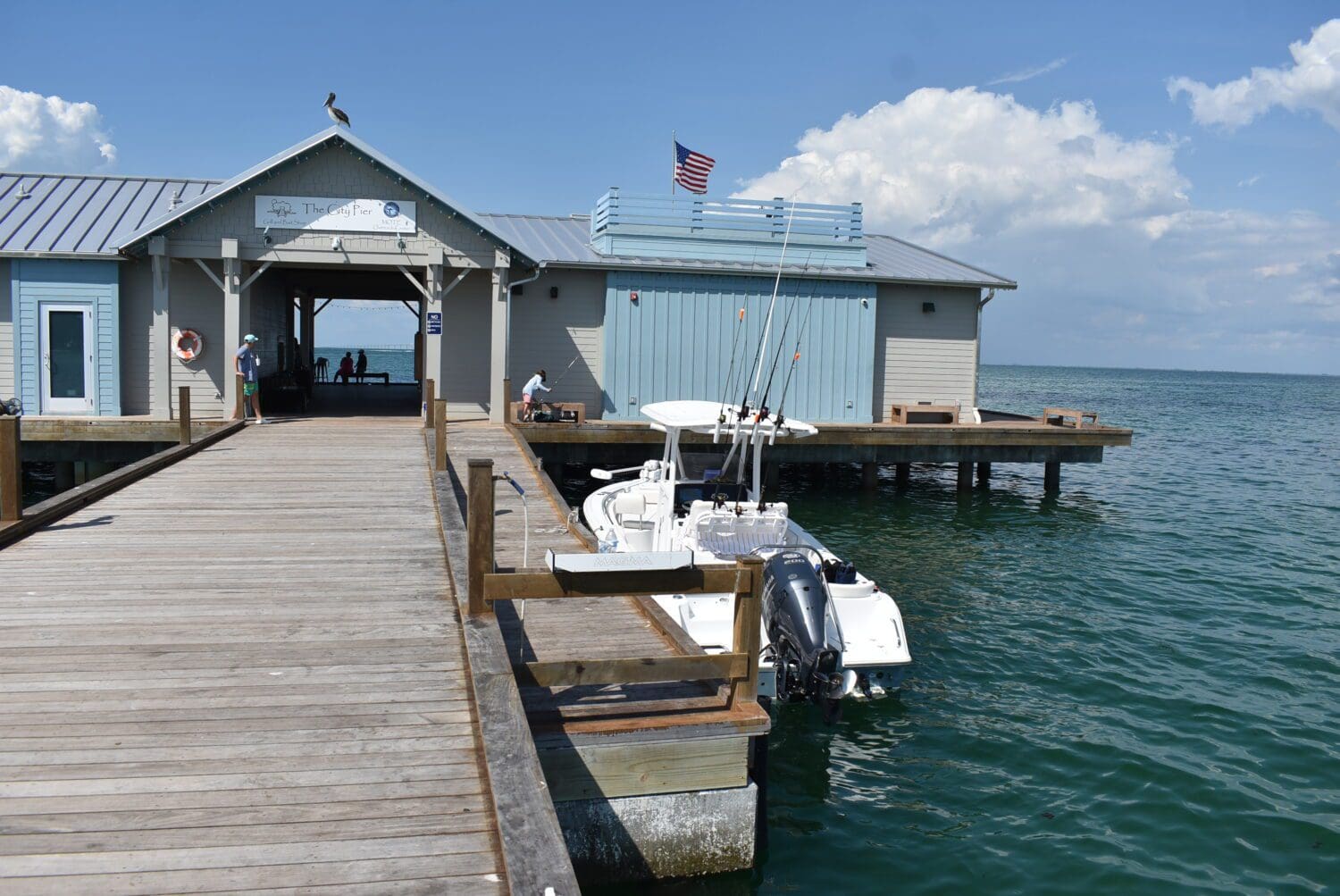
ANNA MARIA –City officials rejected Manatee County’s proposed water taxi-related modifications to the City Pier, but negotiations remain ongoing.
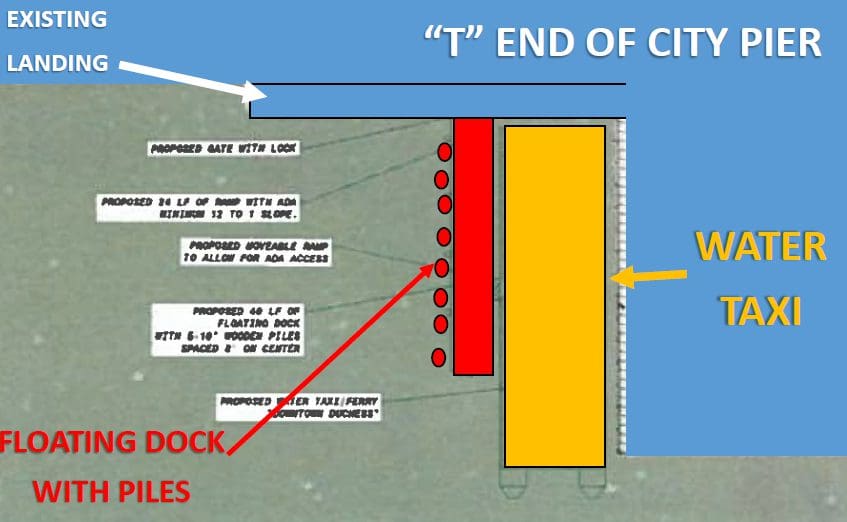
On Aug. 3, Mayor Dan Murphy presented the county’s proposed pier modifications to the city commission. The modifications rejected by the mayor and commission included a floating finger dock with submerged pilings attached perpendicular to the existing boat landing at the T-end of the pier. The county also proposed railings and a locked gate that would have provided exclusive access to the county water taxis.
The county’s rejected plan proposed a floating finger dock (in red), and an exclusive water taxi landing area (in yellow) at the T-end of the pier (in blue). – Manatee County | Submitted
The county-funded water taxis will initially be operated from 10:30 a.m. to 9:30 p.m. on Fridays, Saturdays and Sundays between downtown Bradenton, Anna Maria and Bradenton Beach by the county-contracted Gulf Island Ferry company.
“When I saw this, I was not happy with it at all,” Murphy told the commission.
Murphy said the proposed pier modifications would cost the county $300,000, but the city would have to reimburse the county for that amount if the city later decided to opt out of the water taxi program.
Murphy said Anna Maria, like Bradenton and Bradenton Beach, will now agree to pay for the ongoing maintenance of any county-funded pier modifications approved by the city commission.
The mayor and commission are also concerned that the county has not yet provided specific details pertaining to any additional water taxi-related safety modifications needed to comply with the Americans with Disabilities Act (ADA).
Murphy said the proposed finger dock would require several pilings that would require permitting by the Army Corps of Engineers, which could be a lengthy process.
Murphy said he met with Manatee County Commission Chair Kevin Van Ostenbridge and Bradenton Area Convention and Visitors Bureau Executive Director Elliott Falcione on Aug. 1, before the Council of Governments (COG) meeting later that afternoon.
“I told them this is not an acceptable proposal for the city of Anna Maria,” Murphy said. “You need to keep this simple, short, sweet and very cost-effective with minimal or no cost to the city if we decide to cancel,” Murphy said.
“My proposal back to them was just to dock parallel to the existing landing. If there’s any modification that needs to be made, make them to your boat. It’s a lot cheaper to modify a boat than it is to do all this and it requires no permit,” he said.
Murphy said the proposed pier modifications were designed by the county’s contracted engineering firm without any consultation with the city.
He said Van Ostenbridge and Falcione agreed with his simplified approach for the water taxi landing area and will proceed in that direction.
“With what I proposed, they literally could be in business in a couple of days. There’s no rocket science here. Somehow, I think this will come to fruition,” he said.
Regarding the service itself, Murphy said, “I told them this is not the focus of what our city wants for a water taxi, based upon the hours of operation and the days of operation. It’s not what we view as an endgame, but it’s a start in the right direction. I endorse that start and recommend that start because I truly believe there’s a future here in the water taxi to serving this city, particularly as it relates to bringing employees out here. Make it fast, make it economical, make it attractive to employees to bring them out and drop them off here or down in Bradenton Beach. It would have to be efficient and timely. Three days a week with the hours they propose is not going to attract many employees,” Murphy said.
Murphy said Falcione and Van Ostenbridge agreed and they recognize this is just a starting point for a service that will hopefully later be expanded.
“If it works, it works. If it doesn’t work, I don’t want to have to pay a ransom to walk away,” Murphy said.
Commissioner Deanie Sebring said the county’s proposed plan didn’t consider that fishing is a primary use of the City Pier. She said the proposed railing and gated area made no sense.
As an alternative, Murphy said the commission could adopt a city resolution that prohibits unattended boats from being tied up to the pier landing area. Commissioner Charlie Salem said if the water taxis run on a regular schedule, docking at the landing could be prohibited during those 15 intervals.
When commenting on the proposed modifications, Commission Chair Mark Short said, “I hate this. I hate tying up one corner of the pier by putting a fence up. I hate the logistics of putting a dock in. They’re proposing wooden pilings that won’t last in Tampa Bay. Bringing it in sideways makes way too much sense to me. There’s rarely a boat that docks there anyway.”
Short reiterated Commissioner Jon Crane’s concerns that the county still hasn’t presented any proposed ADA compliance modifications and he questioned whether that could include a proposal to install safety railings along the entire length of the pier walkway, where none currently exist.
Echoing Murphy’s comments, Short said the service schedule and rates are not going to encourage Island employees to use the water taxis to commute from the mainland.
“I don’t see any incentive for someone who would want to take this to come out here and work. Maybe that’s the next step,” Short said.
Future expansion
During Tuesday’s COG meeting, Falcione discussed the anticipated future expansion of the water taxi/ferry service. He said the county plans to apply for a grant to purchase a larger, high-speed ferry to transport passengers between downtown Bradenton and Anna Maria, with the two pontoon boats then traveling between the City Pier, the Bradenton Beach Pier and the Coquina South boat ramp.
The Gulf Island Ferry water taxis were recently placed in the water in Cortez. – Manatee County | Submitted
Falcione envisions water taxi/ferry service someday taking place seven days a week with an expanded route and additional stops, including stops near the Bradenton Area Convention Center in Palmetto and the new Marriot hotel currently being built next to it, and at the Powel Crosley Estate near the Sarasota-Bradenton International Airport.
Falcione said the initial water taxi service is now expected to begin this fall, to be followed in early 2024 with a program that incentivizes employee ridership. Falcione said the county has already committed $1.4 million to the water taxi/ferry service.
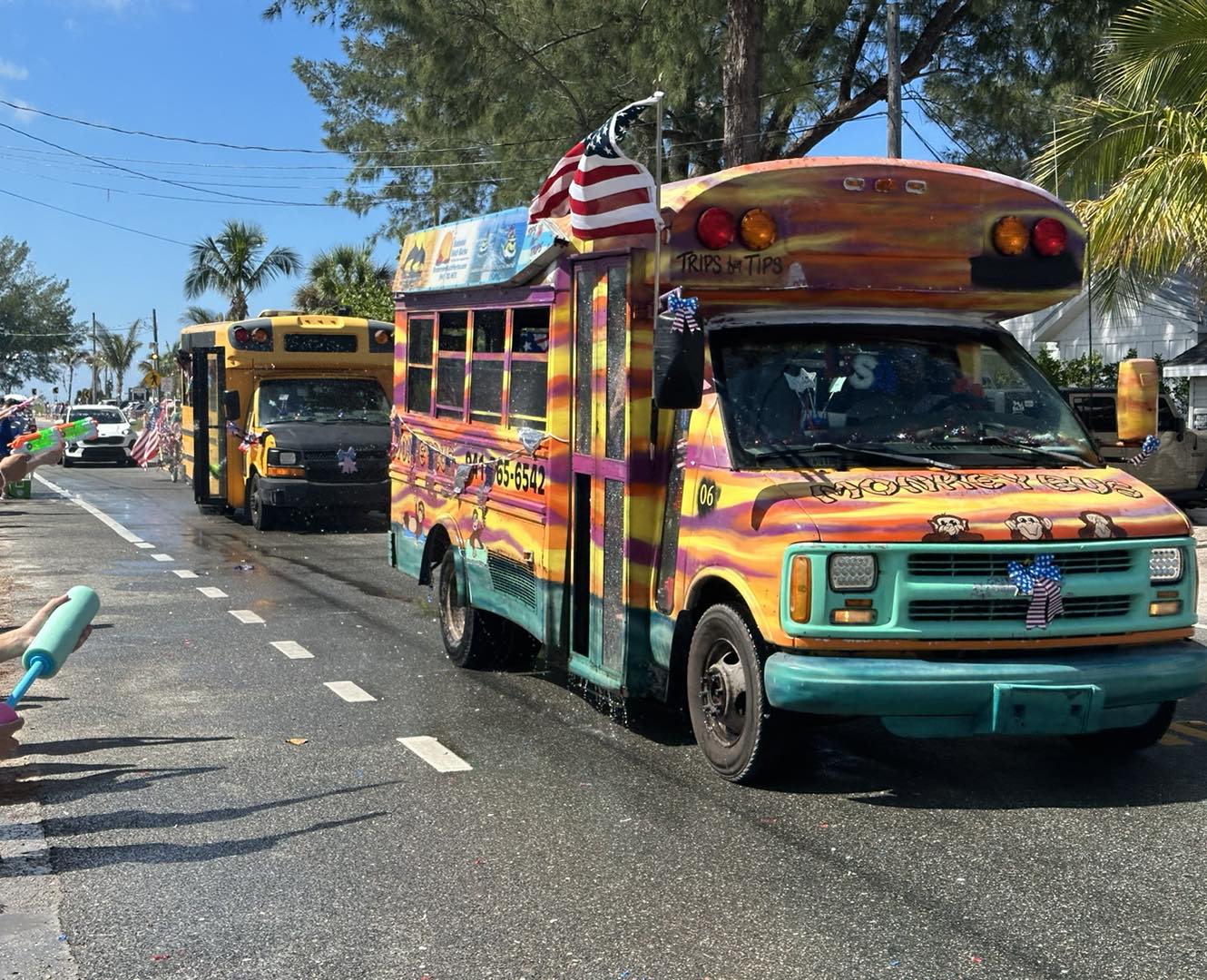
ANNA MARIA ISLAND – Due to increased insurance costs, the popular Monkey Bus shuttle service on and around the Island has been suspended with the hope of resuming operations soon.
Sally Dirbas and her son, Mitchell Gross, bought the Monkey Bus business from its previous owners in June 2022. According to Dirbas, the Monkey Bus suspended service a few minutes before midnight at the close of business on Aug. 2.
The next day, the following announcement was posted on the Monkey Bus Facebook page: “Since the new ownership took over the Monkey Bus a year ago, we have worked incredibly hard to improve our service with new buses, well-qualified drivers, tens of thousands of dollars in maintenance, new stereos, security cameras in every bus and much more.
“Despite our efforts to run this business in a way not only us, but the community also can be proud of, we continue to fight a battle that has been longer than we could have ever expected. That battle is insurance costs, which have risen so high that we cannot continue to run until we restructure and come to a long-term agreement with a company that we can afford.
“The Monkey Bus is a local, family-owned ‘mom and pop’ company and we will get everything worked out. We are not going out of business, and we are not leaving the community we love and call home. Thanks for your support, 99% of all the messages and feedback we get are positive and we are beyond appreciative. We will keep you updated on progress and hope to have this resolved quickly,” the announcement says.
“I have to have commercial transportation insurance because the liability of having passengers is so much more than a regular vehicle,” Dirbas told The Sun.
Elty Fox, left, Rick Thress, Ben Kendrick, Sally Dirbas, Mitchell Gross and Robert Powell admired the fleet of Monkey Buses after the business changed hands in June 2022. – Jason Schaffer | Sun
After acquiring the business in 2022, Dirbas obtained an insurance policy from Progressive Insurance. But, when later reading that policy’s fine print, she realized the policy didn’t allow the Monkey Buses to pick up passengers at a residence, condo or hotel.
“I could only drive them from business to business,” she said.
In February, Dirbas took out a new insurance policy with the National Indemnity Company (NICO). The new policy initially cost $300 more per month than the previous policy but appeared to provide all the needed coverage. Two weeks later, Dirbas was informed that her new policy was increasing from $2,195 a month to nearly $20,000 a month because the insurance company re-categorized the Monkey Bus’s insurance needs to be more akin to that of a commercial bus line.
According to Dirbas, NICO is one of only three insurance underwriters nationwide that write the type of insurance policy she needs. While trying to resolve the extreme rate hike, Dirbas said she paid the $20,000 monthly insurance bill out of her pocket for six months before canceling the policy and allowing it to expire on Aug. 3.
Dirbas tried but could not get another policy quote while holding her current policy. She was told she needed to cancel her existing policy and wait at least 15 days before a new quote could be given.
“We had no choice. We had to close that policy to maybe get a more affordable policy,” she said.
Until recently, the Monkey Bus, which has been in service since 2014, operated as a free, tips-only business, with additional revenues generated by business advertisements placed on the buses. To help offset the increased insurance, maintenance and fuel costs, the Monkey Bus recently started charging passengers a $5 fare.
Dirbas said the only income she earns from the business for herself are the tips she receives while driving one of the buses. She said all revenues received from advertisers are used to cover operating expenses. “I’m like all the other drivers. That’s how I get paid. I also do the office work,” she said.
Dirbas said the Monkey Bus provides income for eight people including herself, her son, a Sun employee and a paraplegic person who answers the phone. Everyone who works at the Monkey Bus is an independent contractor.
“He’ll be homeless next month without a job,” she said of the paraplegic person.
“The Monkey Bus is not a service anyone is going to get rich off. We bought it because we want to do this as a community service for all the business owners, bars, residents and visitors,” Dirbas said.
Dirbas said there was a possibility of taking on an additional business partner or finding an “angel investor” to assist with the costs. Despite the challenges, Dirbas is confident the Monkey Buses will soon roll again.
“The Monkey Bus will be back on the road next weekend or soon after that,” she said. “I’m a fighter, I’m not going to give up. I’ll make sure we get back on the road doing what we do,” Dirbas said.
Community support
As of Friday evening, the Monkey Bus Facebook post had received more than 560 likes and had generated 120 comments.
Casey Phillis wrote: “You guys are an Island staple and have to stay open. Wishing you the best of luck.”
Anita C Beale Diaz wrote: “Get that Go Fund Me page set up. I’ll contribute annually! Most definitely gotta keep the Monkey Bus running! I love its practicality; no rental car is needed while I’m on Island.”
Francesca Cole wrote: “Well, that makes me extremely sad! You are one of the top reasons I chose to vacation there this week! I was super comfortable with the thought of turning my small group of 21-year-olds loose on the Island knowing they would be well taken care of and have your service as part of their experience.”
Cathy Strouse Rukstelo wrote: “You guys are a big part of what makes Anna Maria Island so special and different from other islands in Florida! I hope it all works out!”
Grant Smith wrote: “We love the service and the Monkey Bus family. We hope you can reach an agreement with a company that will allow you to resume this outstanding service.”
Lori Michelle wrote: “Monkey Bus put my mind at ease when my kids would go out. They had a safe ride home. Thank you!”
Dena Johnston wrote: “You do a fabulous job and service to our community. As a local, we will continue to support you.”
Bonita Norris wrote: “We used Monkey Bus several times two weeks ago and it was such a treat! Great service, on time and great music! Hoping you all can work through this bump in the road and get back to cruising up and down AMI.”
The Monkey Bus announcement was shared on the Island Ratz Unite Facebook page and generated several more comments there.
Slicker’s Eatery owner Bob Slicker wrote: “Please let us know if/how we can help!”
Tera Gunter Lemus wrote: “You are keeping our community safer by keeping drunks off the roads. This is so sad.”
Shelly Crouse wrote: “Insurance in Florida is out of control in every aspect.”
A GoFundMe page has been set up for the Monkey Bus.
COQUINA BEACH – Nearly a year after the Bradenton Area Convention and Visitors Bureau took over the management of the Coquina Beach Market from the previous market director, a new manager and opening date for the market have been announced.
Manatee County commissioners unanimously approved Dottie Deerwester from Ready Set Go Tour and Travel as the new market manager on July 25.
“Right now, I am collecting names of possible vendors and will be sending out information by the end of August,” Deerwester said on Aug. 5. “Any interested vendors should text me and I will be in contact with them.”
Deerwester said there will be a maximum of 80 vendors at the market.
The market is expected to open on Oct. 4 at South Coquina Beach and will have year-round operations, according to Manatee County Information Outreach Manager Bill Logan.
Market hours will be Sundays, beginning around 4 to 6 hours before sunset and ending just before sunset, and Wednesdays and Fridays from 10 a.m. to 4 p.m.
Vendors wishing to be considered for space at the market may text Deerwester at 707-972-5055 with their name, company name, email and type of product to be sold. Alternatively, an email can be sent to dottie@rdysetgo.com
The county received three proposals – from Deerwester, Florida Marketplace Group, LLC and Your Tampa Markets LLC, according to the county license agreement.
“To enhance and promote Manatee County as a unique community, and provide for the comfort in and enjoyment of the use of the park by its patrons, the county hereby grants unto licensee the right and privilege to provide the county with market vendor coordinator services in accordance with the terms, conditions and limitations of this agreement,” according to the franchise license agreement between the county and Deerwester.
The agreement may be terminated at any time with 30 days written notice, according to the license agreement.
The discussion about the market began on Aug. 2, 2022, the county announced in a press release that it would take over the beach market from Nancy Ambrose, its director for the past decade. The release stated in part: “Artisans and other vendors will be back along the Coquina Beach South promenade, once again, when the 2022-23 seasons opens in November as oversight for the market shifts to Manatee County.”
That opening was delayed following Hurricane Ian in September 2022.
“As crews have been deployed around the county to clean up and repair other parks properties, the site prep and rehab work to get the new site (further south on Coquina Beach) ready have been put on hold temporarily,” according to a Manatee County press release. “The official opening date has been delayed from the originally planned Nov. 1.”
It seems a little unfair that short-sighted decisions made by politicians in 2023 can have such a profound effect on the future of those who still have no voice in those choices. That’s why it’s important to give them a voice, and why Reel Time is donating space this week to 15-year-old Brice Claypoole.
I am 15 years old and live in Manatee County. More than anything, I enjoy exploring our local environment, our land and waters. I love to watch ospreys dive for fish and spoonbills squabble in mangrove swamps.
Sometimes, when I talk with long-time residents of our area, they tell me that I should have seen Manatee County 50 years ago. Back then, there were bountiful fish, few toxic algal blooms, expansive wetlands and an overall healthier landscape. Reckless and greedy developers have since torn out many of our wildlands, resulting in loss of biodiversity, increased storm damage and polluted waters. Our seagrass has declined hugely, our mangroves have all but disappeared, and red tide tortures our communities for unprecedented lengths of time.
To perpetuate this sad situation where corporate profits are valued over community well-being, developers spend hundreds of thousands of dollars slandering smart-growth politicians and promoting their own candidates. Every one of Manatee’s current county commissioners has strong ties to the development industry. Determined to refill their campaign coffers before the next election, the Board of County Commissioners (BCC) has opened the floodgates to uncontrolled development and environmental destruction. They have approved countless ruinous developments, weakened our comprehensive plan and overridden the decisions of local governments. But their latest scheme promises to be one of the most disastrous yet. It’s a systemic change that threatens to allow the unregulated destruction of Manatee’s remaining natural lands.
15-year-old Brice Claypoole wants your attention. – Submitted
Manatee County’s Land Development Code (LDC) and Comprehensive Plan are responsible for laying out regulations and procedures for land use. The goal of the LDC and comp plan is to plan land use and protect communities and resources. The county commission will soon vote on changes to the LDC and comp plan that were requested by the Manatee-Sarasota Building Industry Association (BIA).
Emails reveal that BIA president Jon Mast, multiple county employees, Commissioner Amanda Ballard’s husband and then-county administrator Scott Hopes met in January to discuss changes the BIA wanted to the LDC and comp plan. The meeting and changes were kept secret. The proposed changes, targeted mainly at gutting environmental protections, were written by local land use attorney Scott Rudacille. Rudacille is connected to local builders, including political power broker Carlos Beruff, who has contributed thousands of dollars to the campaigns of county commissioners. Before the redlined (proposed) LDC was leaked, the county intended to present changes as if their staff – not the industry which would benefit – had initiated them.
The content of the redlined documents is disturbing – protections for wetlands, our most valuable natural resources, have been removed. Along with deleting the comp plan’s policy 3.3.1.1., which prohibits the destruction of wetlands, county staff slashed much of policy 3.3.1.3. This means developers would be allowed to destroy wetlands without taking any action to mitigate the devastation.
Staff also removed the county’s requirements for wetland buffers of up to 50 feet, stripping protections down to the state’s bare minimum of a 25-foot average. Larger, more functional wetland buffers would no longer be required between developments and outstanding Florida waters or aquatic preserves. Studies show this would lead to increased water pollution and degrade Manatee residents’ quality of life. The buffers currently required by the LDC are already inadequate to safeguard natural resources and avert declining water quality. Buffers must be at least 100 feet to be fully functional. The state’s minimum 25-foot average does nothing to safeguard resources.
Denying this unjustified gutting of our LDC and comp plan should be an easy decision. However, the BCC has a massive conflict of interest in this matter, one that appears strong enough to make this Faustian board disregard their constituents’ wellbeing. Commissioner Mike Rahn is the former president of the BIA. BIA Treasurer Raymond Turner was just appointed to fill a vacant seat on the board. Commissioner Ballard’s husband worked for BIA. Floridians United for a Sustainable Economy PAC, which is funded by the BIA, has donated to the campaigns of all the commissioners. The BIA’s members include developers Patrick Neal and Carlos Beruff, who have poured thousands of dollars into the campaigns of our BCC. Convincing the commissioners to do the right thing won’t be easy.
As red tide and gumbo algae make life miserable for local communities, as starving manatees and poisoned sea turtles wash up on our beaches, we are experiencing the effects of bad governance. Now developers are demanding we turn bad governance into no governance and allow them to trade our future for profit.
In 10 years, what will life be like in Manatee County? How much worse will our lives be as seagrass dies, fisheries collapse, our tourism industry fades away, manatee and dolphin populations go extinct, and severe red tides become a year-round phenomenon?
It sounds like Rachel Carson’s dystopian essay, “A Fable for Tomorrow,” in which she imagined the demise of both nature and humanity at the hands of pesticide corporations. That threat has so far been averted, in no small part due to Carson herself, but the threat of overdevelopment now takes its place. The only thing that made a difference, the only thing that stopped the slow poisoning of the Earth by DDT, was a public outcry.
Public outcry. That is how we make a difference in this world.
I asked former 22-year Manatee County Commissioner Joe McClash what could convince the BCC not to cater to the BIA’s demands. McClash, a smart-growth proponent who lost his seat on the commission after a large-scale, developer-funded smear campaign, answered without hesitation. “The public needs to get out and tell the commission that this isn’t supported by science, that it isn’t supported by the community,” he said.
Our nature, our waters, and our communities cannot withstand this abuse. Without the LDC and comp plan regulations, our natural resources will collapse.
Will you tolerate our quality of life being sold to developers? Contact the commissioners (https://www.mymanatee.org/government/board_of_county_commissioners) and tell them that you won’t put up with this destruction.
Sign Suncoast Waterkeeper’s petition against BIA’s demands.
Attend the first commission hearing on the LDC and comp plan changes on Thursday, Aug. 10 at 9 a.m.
ANNA MARIA – The final week of regular season adult co-ed flag football play energized The Center gridiron last Thursday night. For the four teams in the middle of the pack, every play and every second mattered.
By the end of the night, team Solid Rock Construction captured the third-seed position in the first round of the playoffs, narrowly defeating the Salty Printing squad with a score of 14-12.
Despite a late-game injury, Tuna McCracken and the Solid Rock team won by two points in what proved to be a defensive battle. With 36 total flag pulls recorded by both teams, Evelyn Long led the league in flag pulls for the week.
Long’s eight flag pulls Thursday night put her in third to end the regular season in defensive stops. Her 29 total pulls were only topped by teammates Tyler Brewer and McCracken, each with 30 in the seven-game season.
With McCracken on the sideline, receiver Connor Ludwig took the snaps for the last several minutes of the game. Throwing for a touchdown to Brewer and receiving for one from McCracken, Ludwig helped clinch the team’s playoff position.
On the flip side, Brandon Rolland had the only offensive scoring for Salty while teammate Zaon William scored six points on defense for his team.
Williams also finished the season tied with Long for third in flag pulls with 29 big stops.
Making the scoring difference for Solid Rock Construction was Brewer’s two one-point conversions, giving the squad a marginal lead. Brewer had seven catches in the game, leading his team and adding to his season total of 38 receptions.
Solid Rock’s win put them in the third quarterfinal game bracket with Sandbar Seafood & Spirits. Sandbar lost to #7 Gulf Drive Café in the first game of the night, giving the Gulf Drive team only their second win of the season.
Playing in the last game this Thursday night against the second seed Moss Builders team, team Gulf Drive Café will need to play strong and with no mistakes.
Salty’s loss placed them in fifth position behind Cortez Deep Sea Fishing. In the second playoff game Thursday night at 7 p.m., the two teams will face off for a spot in the semifinal next week.
Playing in the heat of the 6 p.m. game, the underdogs of #8 The Banks Home Lending Team hope the curse of the first-place team continues to rear its ugly head as they face the top-seed Luxury Services team.
As the quarterback, Luxury’s Chase Richardson leads the league in passing touchdowns with 32 this season. Between them, The Banks Home Lending’s Cruz Rodriguez and Cory Banks managed to pass 20 total touchdowns in seven games.
Luxury Services also closed out the season number one and three for receiving touchdowns with Tim Holly finishing with 13 TD catches and Alonzo Lemus securing 11 scoring nabs.
The team’s regular season dominance continued on defense with Holly’s 11 QB sacks, as well as a total of 12 interceptions by teammates Derrick Carey, Jasmine Muldoon and Richardson, each with four picks.
This week’s play will see if the top team prevails or if the undefeated Luxury Services team has their championship hopes stopped short Thursday night.
Last week we talked about the insurance nightmare affecting all homeowners in the state of Florida. However, there is one group of residents having a more difficult time resolving their insurance issues, and those homeowners are seniors.
As I pointed out last week, homeowner’s premiums are increasing rapidly for everyone and that’s assuming your current company even offers you a renewal. Also, properties with aging roofs are a target of insurance companies. They will either not renew your policy if you have an old roof or give you a time frame in which to replace the roof.
This impacts everyone in the state, but seniors are hurt the most since they may not have the resources to replace roofs, and I don’t just mean the funds, I also mean the ability to go through the process of roof replacement and interfacing with insurance companies. Nevertheless, this is something that has to be done not only in order to have insurance on your property but also in the event that you need to sell, a situation many seniors are finding themselves in.
Even if your insurance company hasn’t asked for a roof replacement yet, when you want to sell your property, a home inspector will point out to prospective buyers the age of the roof and the liabilities involved in having an aging roof. Most buyers will not proceed without some guarantee of roof replacement, and most won’t even enter into a contract without the roof being replaced. This is only further complicated by the shortage of replacement roofing materials, particularly when they are dictated by condo documents, and the shortage of workers, resulting in long lead times for roof replacements.
In Manatee County, we have many seniors living in over-55 condo communities. As previously stated, condos have been particularly hard hit by new roof requirements, and many of the older communities with older populations have not adequately set aside reserves for this purpose, resulting in assessments to residents. Florida living, which attracted senior citizens because of the affordability of properties and living expenses, is suddenly making living in Florida unaffordable for the most vulnerable of our population.
Seniors can also anticipate the possibility of repairs based on the milestone inspections the state has approved for condominiums based on location, height and age. Again, not all community associations have done their due diligence in maintaining properties and this law could impact these senior communities where people have lived for decades.
Everyone in the state needs to budget for the possibility of maintenance issues and repairs in their single-family homes or condos, but seniors particularly need to educate themselves on how this may affect their wealth and lifestyle. Certainly, younger family members should be made aware of these issues and start making plans to assist this generation.
Manatee County has elder law legal aid and pro bono services available, but not all seniors will qualify for this service. The state has a legal helpline that is free to all seniors over 60 with limited ability to answer complicated issues, but they could point you in the right direction. It’s called The Department of Elder Affairs Florida Senior Legal Helpline at 888-895-7873. However, if you have the financial ability, the best thing for seniors to do when facing one of these problems is to hire a private elder attorney.
Undoubtedly life isn’t fair, and seniors who may not have had a real estate transaction in decades are finding out they can’t sell their home until they have a new roof, then finding out the new roof could take months. Plan ahead and ask for help is my best advice; the insurance issues will not go away anytime soon.
HOLMES BEACH – Four turtle hatchlings that had fallen into a hole on the beach were found by Holmes Beach Code Enforcement staff on the morning of July 16.
While entrapped, the turtles were using up energy they needed for their long swim to the floating sargassum line where they will spend the next few years.
“You can prevent this,” Anna Maria Island Turtle Watch and Shorebird Monitoring posted on its Facebook page. “Fill in your holes and spread the word that by filling our holes and leaving the beach flat, we can all help share the beach with sea turtles!”
A code enforcement officer called Turtle Watch at 941-301-8434 to report the hatchlings, which were later safely released to the Gulf of Mexico.
“We’ve had at least two nests this season that have had hatchlings trapped in holes on their way to the water,” Turtle Watch Executive Director Kristen Mazzarella said.
Besides unfilled holes in the sand, another ongoing hazard to turtles is beach furniture that is left out overnight.
“We are in contact with all (three) municipalities on the Island,” Mazzarella said. “We let them know when we see beach furniture left out overnight and they usually come to attend to it – either remove it or speak to the folks that left it out.”
She said all of the municipalities are very responsive when they hear from Turtle Watch volunteers.
“We do not tag or remove furniture that’s been left out,” she said. “We leave that to code enforcement. Beach furniture has definitely been a problem on the entire Island, but since hatching season started, our focus has been primarily on lighting and disorientations.”
Lights facing the beaches can disorient turtle hatchlings on their way to the water.
Mazzarella said tent canopy structures with sandbags on the legs have been left on the beach often, with the structure left flat on the ground.
“I don’t think people realize that this is still an entanglement hazard for nesting turtles and needs to be removed just like all the other furniture,” Mazzarella said.
LONGBOAT KEY – A portion of the Greer Island beach will be closed through the beginning of September as a dredging project continues.
According to the Town of Longboat Key’s Public Works Department, an area along the west side of Greer Island, also known as Beer Can Island, is undergoing dredging of the sandspit near the dock area.
The Greer Island Spit Management Project’s tentative schedule, including the mobilization of upland equipment and dredging, began July 17-28, followed by upland clearing and excavation from July 24-31.
From July 31 through Aug. 14, hydraulic dredging of the Greer Island Spit is set to occur followed by hydraulic dredging of Canal 1A from Aug. 5-8.
Beach tilling is scheduled from Aug. 21-23, with the demobilization of the project set from Aug. 23 through Sept. 4.
The Longboat Key website notes that the schedule is tentative and subject to change.
In June 2022, the Longboat Key Town Commission permanently restricted the anchoring and beaching of motorized vessels in two areas of the southeast portion of Greer Island, along the east side of the Longboat Pass Bridge, across the bay from Jewfish Key.
Those areas are limited to beachgoers, waders, kayakers, paddleboarders and other non-motorized vessels, according to a 2022 town press release.
Boaters who violate those restrictions are subject to a $250 penalty for the first offense and $500 for subsequent offenses.
ANNA MARIA ISLAND – The Island’s evolution into a vacation rental destination and the resulting lack of affordable housing has displaced many former permanent residents who rented their homes. Alex Bounds, Matt Bauer, Dawn Mathisen, Tracy Eckert and Rick Lewis have left the Island, while long-time renter Sharon Bell is among those managing to stay. Here are their stories.
Alex Bounds, Matt Bauer
In September 2022, after living on the Island for about 15 years, Matt Bauer, a two-time leukemia survivor, moved from a rental home in Bradenton Beach to an apartment in the Arium Bristol Bay complex in Bradenton. His friend and roommate, Bounds, moved with him and they now live less than three miles from the Island they used to call home. Bauer owns Reel Clean Marine Maintenance and Management and most of his clients are on the Island.
Before they moved off-Island, Bauer and Bounds rented a house on Avenue B they knew was slated for demolition to make room for a new vacation rental house. At the time, they were paying $1,800 a month in rent and The Sun interviewed them regarding their struggle to find an annual rental on the Island.
“I used to live next to three of my best friends. I had two more up the street. Now I only have a couple friends that live out here,” Bauer said. There’s a growing lack of community. It’s a lot of investors trying to make a quick buck renting or flipping their properties and housing on the Island has been monopolized by vacation rentals.
“I have friends that own businesses on the Island and it’s hard for them to find employees because there’s nowhere to live. And if you live off-Island, you spend so much time stuck in traffic,” he said.
“I was born in 1993. My first house was on the Island,” Bounds said. “I lived out here until I was 4 years old. We lived in one of those little cottages in Bradenton Beach. In all my baby pictures, I’m on the beach. To be on the Island is so important to me and it’s sad to see what’s going on.”
Bauer said he and Bounds are still living at Arium and are doing well.
“It’s kind of weird getting used to living in an apartment with the dogs and everything, but I can’t complain. I’m still close to the Island. I work out there just about every day, but once I get off work I don’t hang out on the Island much anymore. I usually just go home.”
Bauer hopes to live on the Island again someday.
“Our lease is up in September. I don’t know if I’m going to stay or find something else. I’m still trying to find a long-term rental but some don’t allow dogs. I’d like to rent a house out there for a year or two and then maybe buy one someday. Business has been really good and it’s growing a lot since I took over,” Bauer said.
Dawn Mathisen
Mathisen now lives in the Pine Bay Forrest condominium near 75th Street and Manatee Avenue, about five miles from the Island. She sells and rents electric bikes at Beach’N Bikes on Cortez Road, just east of the Cortez Bridge, and often rides her E-bike out to the Island. On Saturday, she took one of the new semi-recumbent trikes for a test ride on the Island.
When asked how she’s adjusted to living off-Island, she said, “To avoid cognitive dissonance, I make the best of it.”
The Sun first interviewed Mathisen in 2022, after she’d been displaced from the Island.
Former Island resident Dawn Mathisen frequently E-bikes to the Island. – Joe Hendricks | Sun
“I lived on Anna Maria Island for four years. I started in Holmes Beach, living with a friend from Indianapolis. I’ll never forget the first time I came across the Cortez Bridge. That was magical. After my housemate got married, I met my next housemate, English Jim. He’d been on the Island for 15 years and I lived with him for about three years, until he got cancer, moved back to England and passed away,” she said.
She then moved to the other side of the Intracoastal Waterway and rented a mobile home in Cortez Park, near the east end of the Cortez Bridge.
“I lived there until the mobile home was sold. I was there three years and that was my first place here without a roommate.”
When asked what she loves about the Island, she said, “I loved everything about it. The natural beauty, meeting the local people and being able to walk to the local pubs. Everyone can see how it’s changed. There are so many more monstrosity-sized vacation rentals and Airbnb’s. The very charm of Anna Maria Island that the gatekeepers like to sell is being destroyed.
“We’ve lost most of our affordable housing on the Island and it’s happening all across the county too. There’s going to be repercussions: staffing shortages and overworked employees. There’s a lot of young people busting their humps working at the restaurants and bars. They make good money but they can’t afford to live on the Island. Don’t treat the local residents like the Native Americans of the past and tell us to take our things and get out,” she said.
“I was renting for $600 a month when I first moved to the Island,” she said, adding that she now considers $1,200 to $1,400 a month to be affordable housing.
Would she ever live on the Island again?
“Probably not, but I want to because I still love the Island and the people. As unhappy and uneasy as I am with the progression of capitalism on the Island, there are still a lot of things to appreciate – seeing a local band at a local bar, seeing people you’ve known for many years and meeting people you’ve never met,” she said, noting that a return to the Island would probably require roommates and a second job.
Tracy Eckert
Tracy Eckert, a retired emergency room nurse, now owns a mobile home in a large mobile home park in St. Petersburg.
He moved to St. Pete in April 2021 after spending 17 years as a rental resident on Avenue B in Bradenton Beach.
He spent 11 years in his first rental unit and paid $850 a month. He voluntarily left that location because the building was dilapidated and was later demolished and replaced by a vacation rental home. He spent five years at his second rental unit and one year at his third rental unit on Avenue B.
Former Island resident Tracy Eckert misses walking to the beach. – Submitted | Tracy Eckert
“In May 2021, after five years there, my landlord gave me written notice that I had to move out. This was during the height of COVID and I was treating COVID patients at the hospital in St. Pete. It put me in a bind trying to find an affordable place to rent on the Island. It was a hardship financially and emotionally during the height of COVID. I was paying $1,150 a month. The place I found after that was $1,700 and it too was later slated for demolition to make room for a vacation rental.”
Eckert and his dog, Martini, then moved off the Island and into an apartment at Perico Bay Club on Manatee Avenue for a few months before moving to St. Pete.
“I like having my own yard and garden, a hot tub, a billiards room, a pool and it’s not too far from the beach, but it’s not the Island. I miss the Island life. I lived there for about a third of my adult life. I got to know so many people in my 17 years there. I miss my friends. I miss walking across the street to get to the beach. I miss the Island, but its best days have passed and greed has taken over.
“When I moved to the Island, there were 12 residences and two vacation rentals on my block. Now it’s like 10 vacation rentals and four residences. The restaurants are getting more expensive and everything is now geared toward the tourists and not the locals. The ‘old Florida’ experience is gone. It’s more reasonable living off the Island and you get a lot more bang for your buck,” he said.
“I’ll always have good memories of my time on the Island. Everybody seemed to know each other and everybody knew your name. There was a great sense of community but we’ve lost a lot of that. I remember when we were begging for more tourists. Now we have too many. I had a great 17-year run, but unfortunately, it came to an end,” Eckert said.
He still visits the Island but doesn’t expect to live there again.
“I can’t afford it.”
Rick Lewis
Former Island resident Rick Lewis grew up in northwest Bradenton and had a lifelong connection to the Island.
“I was out here a lot. This was part of our playground,” he said.
Lewis now lives on his monthly Social Security benefits and his last Island home was a rented living area in an Anna Maria home he helped care for while the owners were away.
“I was there for three or four years and I moved out last June, in 2022. On Memorial Day weekend, the owners told me they were going to put the house up for sale. I didn’t have a lease. It was just kind of a monthly thing. In early June, I was told I had to be out by the end of the month,” he said.
Rick Lewis recently visited his canine friend, Baxter, in Pine Island before Baxter passed away. – Submitted | Rick Lewis
Lewis stayed with a friend in Port Charlotte for a few months and then relocated to a friend’s home in Parrish. He also travels back and forth to Pine Island to care for a home while his friends are vacationing. He also helped care for their dog, who recently passed away.
Last week, Lewis was back on the Island taking care of a house in Holmes Beach while the owner was on vacation.
“I’ve been bouncing around doing that but I don’t have a stable place,” he said.
A few months ago, Lewis bought a rooftop tent for his old Toyota pickup truck. After he clears up a medical issue, he plans to take his truck and tent to North Carolina to try living there. He also hopes to take some road trips in his mobile rig.
Before moving to Anna Maria, Lewis rented a studio apartment in Holmes Beach for about eight years.
“I lived on the Island for 10 or 11 years. I can’t afford to live out here anymore. When I first moved to the Island, my studio apartment in Holmes Beach was $550 a month, plus electricity. Then it went up to $600. My landlord died and his son took over and sold the place. Then I found the place in Anna Maria that I lived in until last year. There’s still a few hidden gems around, but they’re hard to find and you have to get lucky,” Lewis said.
When asked what he misses most about living on the Island, Lewis said, “Being able to ride my bike to wherever I want to go. And the salt air. I need to be around water. I’m happier around water,” he said.
Lewis doesn’t think he’ll live on the Island again.
“I’d like to, but I can’t afford $1,200 to $1,600 a month for a one-bedroom, and that’s the market rate almost everywhere else too. In the old days, people worked on the Island and lived on the Island. Now they can’t afford it, or they need three or four people living together to afford a place. Normal working people can’t afford to live out here and we’ll never have that again,” Lewis said.
Sharon Bell
Sharon Bell recently moved from her previous apartment on Avenue C to a two-bedroom apartment on Avenue C where she now pays $1,850 a month in rent. Bell tends bar at The Doctor’s Office in Holmes Beach, where she mixes and serves martinis and other craft cocktails.
“It’s the most rent I’ve ever paid, but it’s still a good deal. The reason I have the place is the guy who lived here for 22 years before me, Don White, recommended me. His girlfriend, Cindy, has an apartment in the same building and they decided to consolidate into one apartment. I don’t think I would have got this place without his reference,” Bell said.
Sharon Bell still lives and works on the Island. – Submitted | Sharon Bell
“I moved to the Island in early 2018 after I started working at the Drift In in Bradenton Beach. I moved into one of the ‘Carter Cottages’ on Third and Highland that have since been mowed down. There were four units. Charlie Woods lived back there. So did David Marshall and Martha Kelley. Jen from Island Time too. I paid $650 a month – $600 if I paid before the first of month. I could walk to work and live on the Island.
“Then I moved to Avenue B and 24th Street on a 10-month lease, then I moved to a triplex near the entrance to Seaside Gardens in Holmes Beach and lived there until it was sold. Then I spent a couple years in a four-plex behind the Anchor Inn until the owner sold it. I was paying $1,350, then $1,450 a month. It sat vacant for six months or so and someone just told me it’s now renting for $2,000 a month,” Bell said.
Although her monthly rent consumes a considerable chunk of her earnings, Bell’s grateful she still lives on the Island.
“I feel blessed. Most places are going for more, even off the Island. Thank God I don’t have any big outstanding debts. I drive a car that I own and I keep my bills low. I have a small second bedroom but I prefer to live by myself. The longest I stayed somewhere was the two years in the four-plex. It’s hard moving all the time, but I love it out here and I don’t want to go anywhere else. Good timing and being part of the community has saved me so far,” Bell said.
When asked if she ever considered leaving the Island, Bell said, “Yes, but this is where my people are. Rent’s gone up everywhere and I’m paying the same as a lot of people are paying in town. I don’t think there’s another employee I work with that has a place on the Island. They don’t even think it’s possible anymore.”
As for what she loves about the Island, Bell said, “The people, the water and it’s a really great community. I’ve had a lot of loss in the past few years and that’s what carries me. One of the things I love about my industry is people come here to make a memory – to get married or celebrate a birthday. They work a whole year to be here for a week. I’m blessed to be here for the whole year surrounded by positivity, sunshine and the water.”
BRADENTON BEACH – City staff recently answered an inquiry regarding single-room rentals in vacation rental homes with a definite “No.”
On July 19, Prime Vacations Compliance Specialist Rina Hernandez sent an email to Deputy City Clerk Ruth Stief and City Treasurer Shayne Thompson that said, “Can each bedroom in a five-bedroom property be advertised and rented as individual units or does the property have to be advertised and rented as a whole?”
According to the Prime Vacations website, the company Hernandez represents manages seven boutique hotels in Florida, including The Bali Hai Beach Resort and The Anna Maria Beach Resort in Holmes Beach and The Anna Maria Island Inn in Bradenton Beach. The Prime Vacations website also lists affiliations with the AMI Locals and Anna Maria Vacations real estate and property management companies.
After consulting with City Attorney Ricinda Perry, Thompson sent Hernandez an email response: “It is the opinion of the city attorney and the building official that this is not a
permissible use for properties in areas that are zoned residential.”
In response, Hernandez wrote, “So, this wouldn’t fall under the jurisdiction of shared housing?”
Thompson suggested Hernandez contact Building Official Steve Gilbert for more information.
In an email, Gilbert provided Hernandez with the following information: “Renting by the room is a ‘boarding house,’ either transient or permanent, and with or without meals, by definition. The Florida Building Code treats such structures as commercial buildings. You would need two separate means of egress, non-combustible construction or at least fire-rated assemblies, perhaps a full sprinkler system, and full ADA compliance for all sleeping rooms, bathrooms, cooking facilities, and vertical access, including a commercial elevator.
“From a zoning perspective, boarding houses, bed and breakfasts, and multi-unit buildings, including those with multiple sleeping rooms as defined in the Florida Building Code, are permitted uses in the C2 zone district. They would not be a permitted use in either single-family (R1) or two-family (R2) zone districts,” Gilbert wrote.
“From a zoning perspective, the advertisement to rent is for a single-family or perhaps a two-family dwelling, not individual sleeping rooms. From a life safety and building code perspective, advertisement is for a single-family or perhaps a two-family dwelling, not individual sleeping rooms,” Gilbert wrote.
“From a local licensing perspective, the advertisement is for a single-family or perhaps a two-family dwelling, not individual sleeping rooms. From a state DBPR (Department of Business and Professional Regulation) licensing perspective, the advertisement is for a vacation rental, not a hotel/motel, not a transient boarding house, and not a bed and breakfast. The state licenses and inspection requirements are very different for these more intensive uses. In sum, you may not advertise rentals by the room,” Gilbert wrote.
In response to Gilbert, Hernandez then wrote: “Thank you for clarifying. We had a guest that had a reservation booked with us and canceled because they were able to book an individual room with another management company.”
Hernandez included in her email a link to an Airbnb vacation rental home in Bradenton Beach that advertised single-room rentals.
The Playa Esmeralda Boutique Inn is advertised on the Airbnb website. – Airbnb | Submitted
“Is this something that is going to be addressed? Please let us know if there’s something we can do about it to avoid losing future guests,” Hernandez wrote.
The Airbnb link Hernandez provided referenced the Playa Esmeralda Boutique Inn located at 206 Church Ave. in Bradenton Beach. According to the Manatee County Property Appraiser’s office, D&C Properties of Tampa LLC owns the home and property, and the Florida Division of Corporations lists Maria Trim as the Tampa-based LLC’s registered agent and Mark Dexter as an authorized person.
The Airbnb link Hernandez provided offered for rent a single-bed bedroom with a private bath for $229 per night.
The Playa Esmeralda Boutique Inn is advertised on the GuestReservations.com website. – GuestReservations.com | Submitted
The Playa Esmeralda Boutique Inn is also advertised on the independent Guest Reservations website. That website offers the boutique inn’s “superior king room,” “king room with balcony,” “king room with garden view,” “standard king room” and more.
The Playa Esmeralda Boutique Inn’s bedroom types are advertised at GuestReservations.com. – GuestReservations.com | Submitted
When contacted by The Sun, a Prime Vacations representative confirmed Prime Vacations does not manage the Playa Esmeralda Boutique Inn.
Commission discussion
Hernandez’s inquiry became the subject of a brief discussion during the July 20 city commission meeting.
While providing her attorney update, Perry said, “We are now being asked if you had a home with seven bedrooms could seven different renters rent out those bedrooms separately?”
“That would almost be like a boarding house,” Mayor John Chappie said.
This aerial photo of the vacation rental home at 206 Church Ave. is included in the Airbnb advertising. – Airbnb | Submitted
Commissioner Ralph Cole asked if the city can enforce its prohibition on single-room vacation rentals.
In response, Perry said, “The fire department has a lot more power than code enforcement does. They have the actual authority to go into the property and investigate it. We do not.”
Perry reiterated some of the information Gilbert provided Hernandez and she noted the city has existing zoning prohibitions in the R-1 and R-2 residential zone districts that relate to this particular type of bedroom use. She said the city is further protected by the state’s fire and building codes.
In response to a question from Cole, Perry said the single-room rental prohibition does not apply to several people sharing a rented home as their full-time residence.
“Staff’s working on this and will report back,” Chappie said.
“It was a formal request,” Perry said. “We had to respond to it and Steve did an outstanding job outlining why it’s prohibited.”
HOLMES BEACH – A new website invites owners to place portions of their property for rent at an hourly rate, but city officials say that’s not an allowable use for residential properties in Anna Maria Island’s largest city.
The issue was brought up to Mayor Judy Titsworth by a group of concerned residents after a local vacation rental owner put a pool up for rent on the site Swimply.com. The website allows property owners to rent out anything outside of their house or vacation rental, including parking, pools, backyards, sports courts and even experiences, like a home art studio, for an hourly fee.
The Holmes Beach pool rental popped up on the website the week of July 24. The listing, which was removed by July 29, offered the use of onsite parking and a backyard pool in Holmes Beach for $50 per hour. The host, simply identified as “Craig” in the listing, offered the use of the residential property’s pool area on Swimply.com when not in use by the owner or vacationers renting the entire property.
When The Sun spoke with Titsworth on July 28, she said she had recently been made aware of the website and that renting pools and other amenities without renting the entire property was not allowed in the city. She added that the city’s code compliance officers had been alerted to the situation and were responding. There were no other listings on Anna Maria Island on the website at press time for The Sun.
In Holmes Beach, Titsworth explained, city codes do not allow for only a piece of a property to be rented, such as a pool, for an hourly rate. The city’s vacation rental regulations allow for residential properties in the R-1 residential zone to be rented for a minimum of 30 days to the same renter. In other residential zones in the city, properties can be rented for no less than 7 days. The city’s code defines a “day” as a 24-hour period for property rental purposes. Only hotels and motels are exempt from the regulations and are allowed to rent daily. And while part of a property, one half of a duplex for example, can be rented independently from the rest of the property, owners are not allowed to rent out single bedrooms in their homes to different groups of people or rent only amenities, such as pools, without renting the rest of the property or unit.
MANATEE COUNTY – Gov. Ron DeSantis has appointed Ray Turner to replace Vanessa Baugh on the Manatee County Commission.
The governor’s appointment was to take effect Aug. 1. Turner takes over for embattled District Five Commissioner Vanessa Baugh, who recently announced her resignation effective at the end of July.
Turner
“I’m honored to be appointed by Governor DeSantis,” Turner said in the press release the county issued on July 27. “I will do the very best job I can to serve the people of Manatee County. I look forward to hitting the ground running.”
According to the press release, Turner has been a Manatee County resident for more than 20 years and was a member of the Manatee County Planning Commission at the time of his appointment. Turner, the secretary of the Manatee Sarasota Building Industry Association, began his real estate career in 1991 selling custom homes and later transitioned into real estate finance, international marketing and executive management.
Turner was scheduled to be sworn into office at an Aug. 1 workshop.
Baugh departs
In June, Baugh announced her resignation effective at the end of July, citing family as her reason for resigning. She participated in her final county commission meeting on July 25 and then vacated effective Aug. 1 the remainder of her current four-year term.
During her abbreviated final term, Baugh, a Lakewood Ranch resident, faced intense media scrutiny and was the subject of an ethics complaint and a Florida Commission on Ethics investigation for her role in organizing a pop-up COVID-19 vaccine clinic in early 2021.
Baugh
The pop-up clinic Baugh helped organize provided vaccines for a small number of people on her own personal shortlist and for residents living in two specific Lakewood Ranch zip codes.
In January, the ethics commission investigation led to Baugh agreeing to an $8,000 settlement as a penalty for her role in organizing the clinic. When reaching the settlement in January, Baugh admitted she used her position as an elected official to the benefit or privilege of herself or others.