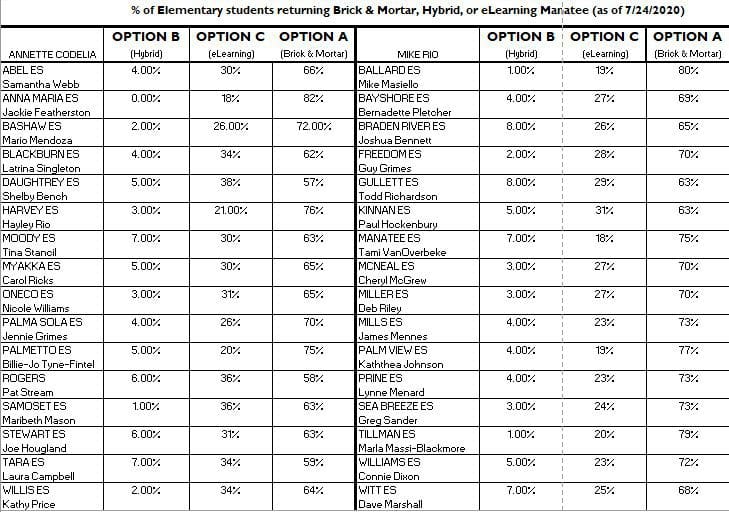
HOLMES BEACH – Eighty-two percent of Anna Maria Elementary school students plan to attend school using the in-person, brick-and-mortar learning option if the new school year begins on Monday, Aug. 17 as planned.
That is the highest percentage in Manatee County, according to the school district. Countywide, the average for all 32 elementary schools combined is 69% for those who selected the brick-and-mortar learning option.
Just 18% of AME students will use the at-home, online eLearning option, the District reported, and none opted for the hybrid learning option – a combination of in-school and at-home learning.
At 80%, Ballard Elementary has the second-highest percentage of students who selected the brick-and-mortar method. At 57%, Daughtrey Elementary has the lowest.
At 38%, Daughtrey has the highest percentage of students who selected the eLearning option. At 18%, Anna Maria Elementary and Manatee Elementary have the lowest. Countywide, 27% of elementary students selected eLearning.
Braden River Elementary and Gullett Elementary have the highest percentage of students who selected the hybrid option – 18%.
Anna Maria Elementary is the only school that reported no students selecting the hybrid option.
“All three options, including hybrid, were offered to our parents. I spoke with three or four parents that inquired about the hybrid option but chose to do eLearning or return to brick-and-mortar instead,” Anna Maria Elementary Principal Jackie Featherston said via email.
The next lowest elementary schools in terms of hybrid option selections are Samoset Elementary, Ballard Elementary and Tillman Elementary at 1%. Countywide, 4% of elementary students selected the hybrid option.
This chart illustrates the elementary school learning option selections made countywide. – School District of Manatee County | Submitted
Anna Maria Island’s three cities have differing requirements for wearing face coverings during the COVID-19 pandemic.
Anna Maria
Every person working, living, visiting or doing business in the city of Anna Maria shall properly wear a face covering in any indoor location, other than their home or residence, and maintain social distancing from other people, excluding family members or companions.
Exceptions:
Children under the age of 2;
People for whom a face covering would cause impairment due to an existing health condition;
People working in a business or profession who do not have interactions with other people;
People working in an office when all interactions with others are done with social distancing as recommended by the CDC;
People eating and/or drinking at a restaurant; provided, however, that face coverings must otherwise be worn in restaurants.
People exercising and social distancing at fitness centers.
Bradenton Beach
Bradenton Beach commissioners have not passed a mandate on masks, and unless they do, a Manatee County resolution is in effect in Bradenton Beach.
Everyone must wear a face covering while inside a business.
Exceptions:
Situations in which individuals maintain 6 feet or more distance between persons. This exception does not apply to employees who are present in the kitchen or other food and beverage preparation areas of a business establishment. Nor does it apply to employees serving food or beverages.
Children under the age of 6.
People who have trouble breathing due to a chronic pre-existing condition or people with a documented or demonstrable medical problem.
Public safety, fire, and other life safety and health care personnel who are already governed by their respective agencies.
Restaurant and bar patrons while eating or drinking. Face coverings must be worn when entering and exiting the establishment and while otherwise standing within 6 feet of other patrons.
Individuals inside a lodging establishment, including hotel and motel rooms, vacation rentals and timeshares.
Holmes Beach (expires Aug. 25)
Owners, managers, employees, customers or patrons of businesses must wear a face covering while in that business.
Exceptions:
Restaurant customers or patrons while dining and/or consuming beverages while seated at a table;
Gym patrons in a workout or class where at least 6 feet of distancing exists with the next closest person;
Barbershop or beauty salon customers or patrons when wearing a face covering would reasonably interfere with receiving services;
Business owners, managers and employees who are in an area of a business that is not open to customers, patrons or the public, provided that 6 feet of distance exists between employees. This exception does not apply to employees who are present in the kitchen or other food and beverage preparation area of a restaurant or food establishment. When an owner, manager or employee is in their place of employment but not within 6 feet of another person, that owner, manager or employee does not need to wear a mask;
Bar patrons while consuming beverages and/or food;
A lodging establishment guest when inside of the lodging unit including but not limited to a hotel room, motel room, vacation rental unit, timeshare unit or similar unit.
When a customer of a business asserts that he or she has a disability that prevents the individual from wearing a mask, the owner, manager or employee of the business may exclude the individual, even if they have a disability, as they pose a direct threat to the health and safety of employees and other customers, even if asymptomatic, and shall accommodate the disabled individual in a manner that does not fundamentally alter the operations of the business or jeopardize the health of the business’s employees and other customers, such as providing curb service or delivery or other reasonable accommodation.
UPDATED July 27 at 11:15 p.m. – MANATEE COUNTY – Manatee County now has a mandatory face-covering resolution in place.
On Monday, county commissioners voted 4-3 in favor of adopting and implementing a county resolution that makes face coverings mandatory inside many business establishments and allows for certain exceptions. The face-covering resolution does not apply to outdoor spaces.
Commissioners Reggie Bellamy, Betsy Benac, Misty Servia and Carol Whitmore supported the face-covering resolution. Commissioners Vanessa Baugh, Steve Jonsson and Priscilla Trace opposed it.
The resolution was adopted during the special county commission meeting at the Bradenton Area Convention Center in Palmetto. Monday’s actions were preceded by a similar 4-3 vote on Wednesday, July 22, when the commission majority requested a face-covering resolution be presented at Monday’s meeting, with a more formal and time-consuming face-covering ordinance to follow.
However, after adopting the resolution, the commission voted unanimously to not pursue a face-covering ordinance at this time. Chief Assistant County Attorney Bill Clague said an ordinance that carries greater legal weight could be pursued later if the resolution is challenged in court.
At the recommendation of Clague, the Manatee County resolution is based on the Leon County mask ordinance that recently withstood a court challenge. During Monday’s meeting, Clague said mask mandates in Palm Beach County and Alachua County have also withstood legal challenges.
Dr. Jennifer Bencie and Dr. Edwin Hernandez, of the Manatee County Health Department, addressed the commission and expressed support for a countywide mask mandate.
“If everybody wore a mask it would greatly reduce that potential spread in all of these settings we’ve talked about today,” Bencie said.
After nearly five hours of discussion and public input, Commission Chair Betsy Benac said, “We should not have to mandate this, but the reality is we do have to mandate it because people are not wearing masks. It is about public safety.”
The resolution
As adopted, Resolution R-20-116 states: “It is in the best interest of the county, and furthers the public health, safety and welfare of the county, to require the wearing of face coverings and the displaying of signs in business establishments to reduce the spread of COVID-19.”
According to the resolution, “An individual in a business establishment must wear a face covering while in that business establishment.”
The requirements do not apply to:
Situations in which individuals maintain 6 feet or more of distance between persons. This exception does not apply to employees who are present in the kitchen or other food and beverage preparation areas of a business establishment. Nor does it apply to employees serving food or beverages.
Children under the age of 6.
People who have trouble breathing due to a chronic pre-existing condition or individuals with a documented or demonstrable medical problem.
Public safety, fire, and other life safety and health care personnel who are already governed by their respective agencies.
Restaurant and bar patrons while eating or drinking. Face coverings must be worn when entering and exiting the establishment and while otherwise standing within 6 feet of other patrons.
Individuals inside a lodging establishment, including hotel and motel rooms, vacation rentals and timeshares.
“Every business establishment shall display conspicuous signage notifying all persons of the requirement to wear a face covering,” the resolution says.
According to the resolution, the term “business establishment” includes transportation companies such as Uber and Lyft and also applies to mass transit, taxis, limousines, rental cars and other passenger vehicles for hire. It also includes locations where non-profit, governmental and quasi-governmental entities facilitate public interactions and conduct business, and to places of worship.
The resolution defines face coverings as “A material that covers the nose and mouth and that fits snugly against the sides of the face so there are no gaps. It can be made of a variety of materials, such as cotton, silk or linen. Coverings with materials made of multiple layers are highly encouraged. A cloth face covering may be factory-made or sewn by hand or the cloth face covering can be improvised from household items.”
Clague said plastic face shields are not included because the CDC does not recommend face shields as substitutes for cloth face coverings.
Enforcement and applicability
According to the adopted resolution, a face-covering violation would be a noncriminal infraction that does not authorize the search or arrest of an individual. At the request of the commission, the revised resolution states the first offense of the mask resolution will result in a warning. A second offense could result in a citation that carries a $50 fine, with a $125 fine for a third offense and $250 for each subsequent offense.
“This emergency resolution shall apply countywide within both unincorporated and incorporated areas, provided that any municipal resolution or ordinance addressing the issue of face coverings – either more restrictively or less restrictively – shall supersede this emergency resolution within the applicable incorporated area,” the resolution states.
Clague said the county resolution does not supercede local mask mandates adopted by city governments.
The cities of Anna Maria and Holmes Beach already have emergency mask ordinances in place.
The city of Bradenton Beach recommends masks but, as of Monday, did not have a formal mask policy in place. Pending future action by the Bradenton Beach City Commission, the county resolution applies to Bradenton Beach businesses and patrons.
“This emergency resolution shall take effect immediately upon its adoption. This emergency resolution shall remain in full force and effect for so long as the local state of emergency for the COVID-19 pandemic remains in effect,” the resolution states.
Public input
Dr. Cassandra Hafner was one of several physicians who provided public comment in support of a mask mandate.
“Our hospitals are full. Our ICU units are full. We have no Remdesivir. Things are dire in the hospital,” she said.
Emergency room physician Dr. Alicia Rech expressed similar concerns about the lack of local ICU beds.
She then said, “I feel that is a small sacrifice to make to wear a mask to protect other people. I’m afraid to kiss my husband and my kids. It’s terrifying. I’m scared when I see people without masks because I don’t want them to spread it to me.”
Ellenton resident Gary Guerin was one of many who spoke in opposition to a mask mandate.
“It’s not about the masks, it’s about the mandate. This is our freedom you’re talking about here. The word mandate should scare you. How dare you even think about mandating something like this. This is not the way to go,” he said.
Election concerns
During Wednesday’s meeting, Manatee County Supervisor of Elections Mike Bennett pleaded with the commission to enact a mask mandate before the county elections in August.
Bennett said due to the COVID-19 pandemic, he’s already reduced the number of voting precincts for the August elections from 70 to 60, and he’s prepared to go to 55 if needed.
“We’re having such a hard time getting clerks and poll workers for the elections. I have lost close to 50% of the clerks for the elections in Manatee County who are refusing to come because Manatee County doesn’t have an ordinance to make it safe for them. If you want a good election, let’s not suppress the vote. Give me all the help I need,” Bennett said.
Sun protection is a topic worth repeating, especially this time of the year! If you’ve been on the water over the last few years, you’ve noticed anglers covered head to toe even on the hottest and sunniest days. They’re wearing long pants, long-sleeved shirts, gloves, face protection and hats. Years ago, anglers were limited to hats, long heavy cotton clothing and greasy lotions that reflected the sun’s harmful rays.
The damaging effects of sun exposure are one of the most important things for an angler to understand. Sunlight is primarily composed of infrared, visible and ultraviolet light. The ultraviolet light (UV) is potentially harmful and is the wavelength that causes sunburn. Sunburn is a form of radiation burn that results from exposure to this property of light. Symptoms of overexposure in humans consist of red or reddish skin that is hot to the touch and can include general fatigue and mild dizziness. An excess of UV radiation can be life-threatening in extreme cases.
Maximizing your protection from UV light rays is important because the harmful effects of the sun are cumulative over your lifetime. While potentially harmful, the sun is primarily an angler’s friend. If the sun is shining there’s a good chance the weather will allow you to be on the water. If you sight fish, it assures you’ll have a better chance of seeing your quarry and increases your odds of hooking up.
Many part-time fishermen and visitors from the north don’t fully appreciate the potentially harmful effects of the sun, especially in Florida and the southern regions of the northern hemisphere. The most intense exposure to the sun occurs from 10 a.m. until 4 p.m. – prime time for fishing Florida’s fertile waters.
Modern sunscreens are rated according to their SPF or sun protection factor. The theory is that if you can stay out in the sun for 15 minutes without getting burned a sunscreen with SPF 10 will help you resist sunburn for 10 times that amount of time, which calculates to about 150 minutes. Our skin has natural SPF depending on the amount of melanin (pigment) it contains. Generally, the darker your complexion the more melanin you have. No matter what your skin color, the best solution is to avoid the sun as much as possible by applying a high SPF sunscreen and covering the skin, vital protection from the damaging effects of ultraviolet radiation. Another important factor to consider especially in Florida is if the sunscreen is reef safe, and if not waterproof, make sure you reapply after a swim or shower.
Fortunately, there is also a plethora of high-tech clothing available to anglers that is cool, breathes and contains a UPF (the rating for clothing is expressed as Ultraviolet Protection Factor) factor as well. Companies like Patagonia and Simms offer clothing with UPF ranging from 30-50, with 50 being the highest rating. A rating of 50 translates to approximately 97% protection. These same companies also offer gloves to protect the hands and headgear that protects the head, ears, face and neck. There are constantly new innovations coming out that make these moisture-wicking fabrics even more functional for anglers. Early face protection devices functioned to protect the skin but caused moisture from the breath to fog sunglasses. Now they are designed with breathing openings that virtually eliminate that problem.
One innovative company, TASC, has even harnessed the natural properties of bamboo to create a clothing line with an impressive list of natural properties. They blend the soft inner fibers of the bamboo with organic cotton to create a fabric that has a UPF of 50+ and is moisture-wicking, breathable, lightweight and chemical-free.
There really is no reason not to protect your skin from the sun with the array of sunscreens and clothing available today. It’s a far cry from what was available to anglers a short two decades ago. Locally, AMI Outfitters has the same (branded) clothing at a substantial savings. They also carry hats, gloves and masks. Protect that skin – it’s the only one you’ll ever have, and now you can do it in style. It’s the cool thing to do!
Thank you to Commissioners Kihm and Rash for supporting the residents with their vote on the parking decal issue. We personally have not had parking issues in our neighborhood, but for residents who do, we certainly can relate to being the recipients of negative impact, and we will support them on this issue.
Obviously at $15 per decal, this issue for the residents is not about the money, and it should not be considered a “user fee” when residents are merely desiring to live a normal quality of life. There is a bigger picture for them and that is that we are wanting to achieve a balance to preserve our neighborhoods and all the sense that neighborhoods and community bring. We fully understand the mayor’s point of abuse of “freebies.” So the suggestion of the first permit being free, and charging for permits thereafter, was a great, smart compromise proposed by Chair Kihm and concurred on by Commissioner Rash.
For several years many citizens have spent countless hours on research, communications, and attendance at meetings for the betterment of the city. We are familiar with prior issues where there would be a 5-0 preliminary, informal, consensus vote, but then with intervention between the informal vote and formal vote, the concept of preservation of neighborhoods fell through the cracks.
In this same meeting where the decal fees were discussed, residents listened as the city considered $7,300 for reefs, and paying the city planner his hourly wage to review prospects for someone to pocket money from land use not even designated in our code. All of this is occurring during a very tenuous economic climate. This is disheartening to the involved residents to see a reversal of votes, and ultimately have only two of six people on the dais who see the bigger issue and are willing to support a compromise.
This decal issue is much bigger than the dollar amount that is minuscule compared to other escalating city expenditures now up for discussion in our budget. It is about the few residents remaining who are looking for ways to regain balance in order to live a normal quality of life. It is about residents who have made a commitment to community and preservation of our neighborhoods.
HOLMES BEACH – Commissioner Pat Morton has been on the city’s dais for 17 years and he’s hoping that voters give him two more when they cast their ballots in the Nov. 3 election.
Morton, a 26-year resident of Holmes Beach along with his wife, Gailene, was first elected to the city commission in November 2003. He and his wife are members of CrossPointe Fellowship. If you haven’t been to a commission meeting but Morton looks familiar, you might have also seen him working at the local ACE Hardware.
On the commission, Morton serves as the city’s liaison to Waste Pro, the Manatee County Emergency Operations Center and the Holmes Beach Police Pension Board. He’s also a member of the Florida Emergency Preparedness Association and has been certified by FEMA’s Emergency Management Institute.
With two seats on the city commission up for grabs in the Nov. 3 election, Morton faces off against incumbent Commissioner Kim Rash and former commissioner Rick Hurst along with fellow Holmes Beach resident Jayne Christenson. To help voters get to know each candidate a little better, The Sun asked each candidate to answer the same four questions. Here are Morton’s answers.
What do voters need to know about your involvement in the community?
Having served as a commissioner for 17 years and currently as vice chair, I think I am most proud of my commitment in enacting legislation in helping to restore balance in our residential neighborhoods. Retaining our residents is crucial as we try to keep our churches, schools, professional offices and small mom-and-pop stores and our Community Center.
I have participated in the adoption of land area ration, strengthened the definition of what constitutes a duplex and helped create a more effective noise control ordinance. I strongly recommended increasing setbacks for polls, the implementation of the vacation rental ordinance and the regulation of front yard encroachments. I helped in the implementation of the formula business ordinance, low speed vehicle ordinance and electronic scooter ordinance. I supported the regulation in earth moving and fertilizers, including the addition of the international property maintenance code in our city. I am currently working on changes to our landscaping/native tree ordinance and adding a permit parking ordinance to our city.
Staying safe through the COVID-19 pandemic has been challenging for our residents and business owners. I have fully supported all directives in response to this crisis and fully support the face mask mandates.
Why are you running for Holmes Beach City Commission?
I have a strong regard for the city of Holmes Beach and a commitment to civic duty. Having served in both the military and now in office, it has allowed me the opportunity to make a difference. I would like to continue to give back and be the voice of the citizens, of whom I have the privilege of speaking to every single day.
If elected, what would be your priority to work on with your fellow commissioners?
I would continue to improve our city amenities, which include resiliency in all our continued capital improvements.
What do you think is the biggest challenge facing the city today?
HOLMES BEACH – Commissioners voted three-to-two to pass an ordinance enacting permit parking in some residential neighborhoods west of the city’s main roadway corridor.
The discussion featured one large change from the previous discussion – the cost of the permits for on-street parking will be paid by the residents.
Commissioners Pat Morton, Terry Schaefer and Carol Soustek all voted in favor of the second and final reading of the ordinance, instituting a price of $15 for each permit.
Commissioners Jim Kihm and Kim Rash voted against the ordinance, both arguing that the cost of the permits should not be paid entirely, if at all, by the residents. Rash offered a compromise of giving one permit to each residential household with subsequent permits charged at the $15 rate. Kihm said he’d like the funding to come from somewhere other than an additional charge to residents, suggesting that if his fellow commissioners weren’t in favor of taking the money from funds produced from parking fines as previously discussed that the costs be paid for out of ad valorem tax proceeds.
Though commissioners had previously discussed increasing the city’s parking violation fine from $50 to $75 and using the proceeds to pay for the permit parking passes, Mayor Judy Titsworth said after further reflection she didn’t think it was a good idea. Titsworth said that using the monies derived from issuing parking fines implies that Holmes Beach police officers have a quota of parking fines that they need to write to pay for the program.
She also said she doesn’t think the permits should be free to residents because it will cause an influx of permit parking applications that would cause a strain on city staff to process and issue quickly. By charging, she said it allows current staff to be able to handle the applications and she said it’s an added benefit for residents.
While Morton, Schaefer and Soustek all agreed with the mayor’s reasoning, Kihm said he didn’t like charging residents for something that they could previously do for free – park on the street.
How permit parking works
The permits will be available to all Holmes Beach residents and property owners.
Residents living outside the permit parking zone can still park on the street in front of their homes, but will be able to get up to two passes at $15 each to use for street-side beach parking.
Owners of vacation rentals within the permit zone will be able to secure two permits at the $15 rate, but only for their vehicles. Renters will not be able to use the permits.
Residents living inside the permit parking zone who wish to park on the street will be required to have a permit, but the $15 permits are only available for vehicles registered to Holmes Beach addresses. Roommates or visiting children, parents or friends with vehicles registered outside the city will not be eligible for a permit. Those vehicles will have to be parked in designated parking areas on the property, though vehicles with permits can be moved to the street to allow for more parking on the property.
A new map shows where open parking will be available to residents and beachgoers, marked in yellow, and where resident permit-only parking is planned to be located, marked in blue. – Submitted | City of Holmes Beach
Permits will be required for any vehicle parked on the street in the permit-only zone from 9 a.m. to 5 p.m. daily, including low speed vehicles and golf carts that are registered with the state. A regular golf cart, one that doesn’t require registration with the Florida Department of Motor Vehicles, can be parked in the permit zone and does not require a permit.
The permits are expected to be renewable annually.
Holmes Beach Police Chief Bill Tokajer said with the ordinance approved, he would move to order the new signs for the permit-only zone, located west of the city’s main thoroughfare of Gulf/Marina/Palm/East Bay drives, and get the permit parking program up and running as soon as possible.
Most street parking on the east side of the main thoroughfare remains open, though that could change if public parking becomes a problem in those neighborhoods.
Soustek said she’d like residents to keep in mind that the approved ordinance is still a work in progress and that adjustments to the program and permit-only parking areas may be changed in the future as needed.
I really hate to use this much-overused opening line from A Tale of Two Cities, but it works and I have no shame. “It was the best of times, it was the worst of times” perfectly describes the residential real estate mortgage market we find ourselves in as another by-product of the coronavirus pandemic.
It’s the best of times for individuals who have the ability to purchase homes since the rate for 30-year conventional home mortgages has fallen to the lowest point on record. In a year that already has massive “firsts” here’s another. About two weeks ago the average rate on a 30-year fixed-rate mortgage fell to 2.98%, per Freddie Mac. Rates are at the lowest level in almost 50 years of record keeping. This was the third consecutive week and the seventh time this year that rates on these loans have fallen.
At the beginning of the year before the pandemic hit, the 30-year mortgage was about 3.72%, an extremely good rate. Those of us who remember the early 1980s may remember a high of 18% residential home mortgage rates, an unthinkable number now. In addition, Jumbo loans, those typically larger than $510,400, are around 3.77% in most markets. However, lenders have placed more restrictions on these non-government-backed loans, considered to be risky compared to loans backed by Fannie Mae and Freddie Mac.
So why is this happening and why may it be considered “the worst of times?” Mortgage rates are influenced by the 10-year Treasury note since they compete for the same type of investor interested in stability. Because we’re in a very volatile financial time, investors are looking to protect their assets by buying long-term Treasury bonds, narrowing the gap between bonds and mortgage rates. Therefore, mortgage rates dropping like a rock may not be as great as it sounds for the economic health of the country.
Again, if you have the capacity to purchase at this time, the mortgage rates are fabulous. However, you will still have a rocky road ahead because of the lack of available inventory and increasing asking prices. Although mortgage applications were up 17% in June from a year earlier, according to the Mortgage Bankers Association, prices have also accelerated nationally by 4.7% from last June; at the same time the number of homes on the market fell 27.4% per Realtor.com. Some of this can be offset by the lower mortgage rates allowing buyers to qualify for a larger mortgage.
Overall, historically low interest rates may look like a good thing, but it can actually be an indicator that the real estate and financial markets are functioning at borderline crisis levels. Also, home purchasing is out of the question for many Americans who have lost their jobs and may not return for years. Even those who can afford to purchase may shy away from making a life-changing commitment during such unpredictable times.
In spite of everything I just said, Anna Maria Island is a specialized region and hopefully somewhat immune to big national swings. Real estate decisions always have to be viewed through the lens of the future, and unfortunately right now the immediate future is hard to predict. Best of times, worst of times, certainly difficult times. Stay safe.
MANATEE COUNTY – Manatee County commissioners are expected to vote on whether to mandate face coverings countywide on Monday, July 27.
Monday’s meeting will take place at the Bradenton Area Convention Center in Palmetto at 1:30 p.m. The meeting will be streamed live and broadcast on Spectrum channel 644.
On Wednesday, July 22, county commissioners voted 4-3 to direct the county attorney’s office to draft, schedule and advertise the necessary resolutions and ordinances to put in place a mask mandate as soon as possible.
That motion was made by Commissioner Misty Servia and supported by commissioners Reggie Bellamy, Betsy Benac and Carol Whitmore. Commissioners Vanessa Baugh, Steve Jonsson and Priscilla Trace opposed Servia’s motion.
A small group of protestors greeted county commissioners Wednesday morning. – Submitted
County face-covering resolution
On Friday, the proposed face-covering resolution, R-20-116, was posted on the county website.
If adopted by the commission majority on Monday, the face-covering resolution would serve as a short-term measure while the more formal and time-consuming ordinance adoption process is completed.
Legal notice of a prospective mask ordinance was scheduled to appear in a local daily newspaper on Sunday. As of Saturday, a public hearing for the adoption of a face-covering ordinance had not yet been scheduled.
Resolution R-20-116 notes, “It is in the best interest of the county, and furthers the public health, safety and welfare of the county, to require the wearing of face coverings and the displaying of signs in business establishments to reduce the spread of COVID-19.”
According to Section 3 of the proposed resolution, “An individual in a business establishment must wear a face covering while in that business establishment. The requirement in this section does not apply to:
“Situations in which individuals maintain 6 feet or more of distance between persons. This exception does not apply to employees who are present in the kitchen or other food and beverage preparation area of a business establishment. Nor does it apply to employees serving food or beverages.
A child under the age of 6.
Persons who have trouble breathing due to a chronic pre-existing condition or individuals with a documented or demonstrable medical problem. It is the intent of this exception that those individuals who cannot tolerate a facial covering for a medical, sensory or any other condition which makes it difficult for them to utilize a face covering and function in public are not required to wear one.
“Public safety, fire, and other life safety and health care personnel, as their personal protective equipment requirements will be governed by their respective agencies.
“Restaurant and bar patrons while eating or drinking. It is the intent of this exception that a face covering will be worn while traversing a business establishment for ingress and egress, to use the facilities, and while otherwise standing when persons are unable to maintain at least 6 feet of distancing.
“An individual in a lodging establishment who is inside of the lodging unit, including, but not limited to, a hotel room, motel room, vacation rental unit, timeshare unit, or similar unit.”
The resolution notes, “Every business establishment shall display conspicuous signage notifying all persons of the requirement to wear a face covering.”
Definitions
The resolution defines face coverings as “A material that covers the nose and mouth and that fits snugly against the sides of the face so there are no gaps. It can be made of a variety of materials, such as cotton, silk or linen. Coverings with materials made of multiple layers are highly encouraged. A cloth face covering may be factory-made or sewn by hand or the cloth face covering can be improvised from household items.”
The resolution states the term “business establishment” includes transportation companies such as Uber and Lyft and it also applies to mass transit, taxis, limousines, rental cars and other passenger vehicles for hire.
“The term ‘business establishment’ includes locations where non-profit, governmental and quasi-governmental entities facilitate public interactions and conduct business. The term ‘business establishment’ also includes places of worship,” the resolution says.
Enforcement and applicability
Section 4 of the county resolution says a violation of the emergency resolution is a noncriminal infraction and does not authorize the search or arrest of an individual. Prior to the issuance of a citation, the individual will be asked to comply with the emergency resolution or explain how an exception applies to them. The fine is $50 for a first offense, $125 for a second offense and $250 for every subsequent offense.
The ordinance would apply in cities within the county that do not have a mask ordinance, such as Bradenton Beach: “This emergency resolution shall apply countywide within both unincorporated and incorporated areas, provided that any municipal resolution or ordinance addressing the issue of face coverings – either more restrictively or less restrictively – shall supersede this emergency resolution within the applicable incorporated area,” the resolution states.
On Anna Maria Island, the cities of Anna Maria and Holmes Beach already have emergency mask ordinances in place. The city of Bradenton Beach recommends masks but does not have a formal mask/face covering resolution, order or ordinance in place.
“This emergency resolution shall take effect immediately upon its adoption. This emergency resolution shall remain in full force and effect for so long as the local state of emergency for the COVID-19 pandemic remains in effect,” the resolution states.
Commission discussion
The county commission’s 4-3 request for a mask resolution and ordinance occurred during the discussion of ongoing issues relative to the COVID-19 emergency as the final agenda item for the commission’s Wednesday, July 22 land use meeting.
Chief Assistant County Attorney Bill Clague told commissioners if they wished to pursue a countywide mask mandate, he recommended it be based on the Leon County emergency mask ordinance that recently withstood a court challenge.
Leon County includes Tallahassee, where the state capital is located.
“From a legal standpoint, the best way to do this is by ordinance. The Leon example was an ordinance. Ordinances have the force of law in a way that resolutions and orders often do not. It carries with it greater weight with the courts as a legal requirement that everyone has to follow. If you decide to do this, the best model to use is the Leon model,” Clague said.
Before making her motion for a mask mandate, Commissioner Servia referenced the COVID-19 update Manatee County Public Safety Director Jake Sauer had provided a few minutes earlier.
“We heard from Jake that deaths are up 15% in the last 30 days. We heard that hospitalizations are up 159 in the last 30 days. The daily positive rate is over 10%. Hospitals are at near capacity, or at capacity, and the outlook for those hospitals doesn’t look to be improving,” Servia said.
“Today, as we sit here and talk, my stepdad is at Manatee Memorial Hospital dying in the COVID unit,” Servia said.
“We on the board all have a friend who is on a ventilator and in critical condition because of COVID,” she added.
“I don’t like to wear a mask, but I do it to keep people safe, and I do it to try and keep our businesses open. I really worry about our businesses,” Servia said, expressing similar concerns about restaurants.
In response to a question and suggestion from Commissioner Bellamy, Clague said the commission could first adopt a mask resolution and later adopt a mask ordinance.
Commissioner Whitmore mentioned a letter the commissioners received from the Manatee County Medical Society which was signed by more than 100 local physicians seeking a countywide mask mandate.
In reference to an ordinance requiring 10 days’ notice, Whitmore said she just received a text from one doctor that said, “10 days is more deaths.”
Commissioner Trace suggested Sheriff Rick Wells attend Monday’s meeting and provide his input. When a mask mandate was previously discussed in late June, it was noted Wells opposed a mask mandate and did not think it was enforceable.
“We need to recognize it’s up to law enforcement how aggressively they want to enforce something like this. Typically they build in some time for people to come into compliance,” Clague noted.
Commissioner Steve Jonsson was the only commissioner who participated in Wednesday’s meeting remotely rather than in person.
Chief Assistant County Attorney Bill Clague provided his legal insight on the commission’s pursuit of a mask mandate. – Joe Hendricks | Sun
“The businesses have to help us, and I think it’s their responsibility as private entrepreneurs. I don’t think it’s the government’s responsibility to dictate what we should be doing to prevent people from doing stupid things. I don’t personally believe that a face mask is 100% protective. You’ve got to do a lot more than just a face mask,” Jonsson said.
In response, Commissioner Benac said, “Steve, everything you’re saying about personal decisions makes so much sense, but we have to deal in reality. I think we have to take leadership. Why? Because I’ve heard from my constituency. The vast majority of people want us to do something. I don’t think anything the government is going to do is going to propel people who think it’s their right to not wear a mask to wear a mask. But I think the government is supposed to provide leadership. That is our job.”
During Wednesday’s meeting, several people spoke in favor of and in opposition to a countywide mask mandate.
Public support
David Klement, a 45-year county resident, spoke first.
“To Commissioner Jonsson, who said it’s not our role to prevent people from doing stupid things, I would say it is exactly your role. Preventing stupid people from doing stupid things saves my life. Why do you have a speed ordinance in a school zone? Why do we have a seat belt law? People of my generation are 80% more likely to have complications and die from one exposure. That is why we need an ordinance,” he said.
Bradenton resident and retired nurse Linda Crepeau said she was recently afraid to enter a local UPS store to return a package because there were six people, including the clerk, inside that limited space who were not wearing masks.
“I could not go safely into the store. There was no way for me to socially distance. I’m depending upon our government to stand up and require mandatory masks for all businesses in Manatee County,” Crepeau said.
Recently retired school nurse Mary Ann Jensen said, “On Saturday and Sunday when we’re all at home, your health care professionals will be in the hospitals watching people die, many of them alone. And all they’re asking for is your support. Please give us an ordinance because it does help.”
Impact on elections
Manatee County Supervisor of Elections Mike Bennett pleaded with the commission to enact a mask mandate before the county election in August – to be followed by the general election in November.
Manatee County Supervisor of Elections Mike Bennett said he needs a countywide mask mandate before the August elections. – Joe Hendricks | Sun
“I cannot stop somebody from coming into my office and saying, ‘No, I’m coming in without a mask.’ What am I going to do? Am I going to suppress the vote? I’m not. I’m going to say the Manatee County commissioners decided they were going to suppress the vote because they weren’t going to pass an ordinance that would allow me to keep my people safe,” Bennett said.
Bennett said he’s already reduced the number of voting precincts for the August elections from 70 to 60 and he’s prepared to go to 55 if needed.
“We’re having such a hard time getting clerks and poll workers for the elections. Yesterday, I closed the precinct at Freedom Village – all senior citizens, the smallest one we’ve got – because I don’t have a clerk. I need your help. I need that ordinance,” Bennett said.
He cautioned that the absence of a mask mandate could lead to the lowest voter turnout Manatee County has ever experienced.
“I have lost close to 50% of the clerks for the elections in Manatee County who are refusing to come because Manatee County doesn’t have an ordinance to make it safe for them. If you want a good election, let’s not suppress the vote. Give me all the help I need,” Bennett said.
Public opposition
When expressing her opposition to a mask mandate, Bradenton resident Andra Griffin questioned why all 403,553 residents of Manatee County – according to the 2019 census – would be forced to adhere to mask guidelines when less than 2% percent of the county’s population has tested positive for COVID-19.
Bradenton resident Andra Griffin opposes a countywide mask mandate. – Joe Hendricks | Sun
Griffin also referenced a warning label that appears on a box of disposable face masks and said, “It clearly states these masks do not prevent COVID-19.”
Mixon Fruit Farms owner Janet Mixon said she and her staff use UV wands to sanitize the fruit farm’s indoor public spaces, but masks are not required.
“We don’t make it mandatory. Some of our people wear masks. Some of the people coming in wear masks. At some point, we all have to make our own decision. We have to decide what keeps us safe,” Mixon said, noting that wearing a mask for a long time gives her a headache.
“Let us make our own decisions. If you start doing stuff like this, we just don’t know when it’s going to end,” she added.
County Commission candidate James Satcher said, “This is a solution looking for a problem. The free market and businesses are already making their rules. I may not like their rule, but I don’t argue that they have the right and the ability to do that. I can take my business elsewhere. Government’s different. We have a responsibility to uphold personal freedoms and the Constitution and that’s why we should not pass this ordinance.”
Additional commission comments
After public comment, Servia said, “Masks are not the silver bullet. Please don’t think that I think that those masks are going to make this virus go away. It’s not. We need to socially distance, we need to hand wash, we need to avoid large crowds. It is another tool, a simple thing that’s going to help keep this community safe.”
Commissioner Vanessa Baugh recommends mask wearing but does not feel the county commission should make it mandatory. – Joe Hendricks | Sun
Commissioner Baugh said, “I don’t think that’s what we need to be doing as a government entity. America is a free country. We have the right to make our own decisions and to stand by them. We have personal responsibility that does comes into play. I wear a mask. My husband wears a mask. I recommend it highly – and I think the key word is ‘recommend.’ ”
UPDATED July 26, 2020 – MANATEE COUNTY – The School District of Manatee County has determined the percentages of middle school and high school students who intend to begin the school year using in-person brick-and-mortar learning, at-home online eLearning, or a hybrid of both.
Parents were given until Thursday, July 23 to inform their children’s school which learning method their child or children would use to begin the school year in 10 middle schools and eight high schools in Manatee County.
The middle schools are Braden River Middle School, Buffalo Creek Middle School, Haile Middle School, Johnson Middle School, King Middle School, Lee Middle School, Lincoln Middle School, Mona Jain Middle School and Sugg Middle School.
The high schools are Bayshore High School, Braden River High School, Lakewood Ranch High School, Manatee High School, Parrish Community High School, Palmetto High School, Southeast High School and Horizons.
As of Friday afternoon, data regarding selections made by elementary school students and their parents was not yet available.
On Friday, the School District of Manatee County provided The Sun with this learning option selection data. – School District of Manatee County | Submitted
Middle school selections
As of Friday, 46.2% percent of the responding middle school students and their parents chose to start the school year as currently proposed on Monday, Aug. 17 with in-person, brick-and-mortar learning five days a week inside a school building.
On average, 27% of these middle school students and their parents selected at-home eLearning and 26.8% selected the hybrid option that includes a weekly mix of both in-school and at-home learning.
At 60%, Lincoln Middle School has the highest percentage of brick-and-mortar students among middle schools, followed by Johnson Middle School at 57%. At 38%, Nolan Middle School has the lowest percentage of brick-and-mortar students, followed by Mona Jain Middle School at 40%.
At 34%, Johnson Middle School has the highest percentage of eLearning students, followed by Braden River Middle School and Lee Middle School at 30%. At 19%, King Middle School has the lowest percentage of eLearning students, followed by Nolan Middle School at 22%.
At 40%, Nolan Middle School has the highest percentage of hybrid students, followed by King Middle School at 37%. At 9%, Johnson Middle School has the lowest percentage of hybrid students, followed by Lincoln Middle School at 13%.
High school selections
On average, 29% of high school students and their parents chose in-person, brick-and-mortar learning. Slightly more than 22% selected at-home eLearning and approximately 49% selected the hybrid learning model.
At 48%, Parrish Community High School has the highest percentage of brick-and-mortar high school students, followed by Lakewood Ranch High School and Manatee High School at 35%. At 13%, Southeast High School has the lowest percentage of brick-and-mortar students, followed by Horizons at 15%.
At 25%, Palmetto High School has the highest percentage of eLearning students, followed by Parrish Community High School at 24%. At 19%, Horizons has the lowest percentage of eLearning students, followed by Lakewood Ranch High School at 20%.
At 66%, Horizons has the highest percentage of hybrid students, followed by Southeast High School at 65%.
At 28%, Parrish Community High School has the lowest percentage of hybrid students, followed by Manatee High School at 42%.
PERICO ISLAND – The brand-new Compass by Margaritaville hotel on Anna Maria Sound opened its doors July 15 with the first guests checking in mere minutes after opening.
Hotel staff, management, ownership and representatives from Margaritaville, Hostmark, Compass, the Bradenton Area Convention and Visitors Bureau and the Anna Maria Island Chamber of Commerce gathered the afternoon of July 17 to celebrate the soft opening of the hotel. The ribbon was cut, marking the official opening before all of the dignitaries retired to the lobby where they enjoyed non-alcoholic margaritas and received coins to mark the occasion. The coins feature the Compass logo and the exact coordinates of the hotel when one stands in the center of the logo inlaid in the lobby floor.
A grand opening celebration is tentatively planned to take place in August when the hotel and the adjacent Floridays Woodfire Bar and Grill are both open to the public. The restaurant is expected to open later in July.
Already open is the Compass Bar and Chill, an indoor restaurant located near the pool area where guests can be served outside or enjoy breakfast, lunch, drinks and light bites on the pool deck. The pool, with its view of the marina at One Particular Harbour and Anna Maria Sound already featured the first of its Friday and Saturday night live music shows when local favorite Eric Von played the first show July 17.
The hotel features 113 hotel rooms along with 10 suites, many with views of the marina and balconies where guests can enjoy the sunset over nearby Anna Maria Island.
Located at the entrance to the One Particular Harbour development on Perico Island, the Compass hotel is the first of its kind and is just over the bridge from Gulf beaches.
In addition to the pool and restaurant options, the hotel also features a meeting room, gym and lounge area with a snack bar where guests can grab a drink or light bite on the go.
For more information, or to book your stay, visit Compass.
Since the Ocean Conservancy was founded in 1972, it has changed names several times. With the support of conservation-minded individuals, they’ve accomplished many incredible things, starting with protecting whales and progressing to other wildlife and marine communities that create the web of our oceans.
One of their first initiatives was the Whale Protection Fund, which focused on saving whales and protesting commercial whaling by Russia and Japan. The Ocean Conservancy raised support from concerned citizens to invest in scientific research, launched petitions and ran ads in papers across the nation to raise awareness about the whaling industry. That commitment paid off when the International Whaling Commission finally banned commercial whaling in 1982.
In the early years, their work focused on species like whales, seals and sea turtles. While the Ocean Conservancy has been a part of many success stories, they realized they couldn’t protect species without protecting their habitat. Thinking bigger, the organization shifted to a more ecosystem-based approach. They were also one of the first environmental organizations to engage industries in conservation – a key part of their mission to this day.
In the 1980s, the Conservancy fought for key habitats to be protected under the Marine Sanctuary Program, and their staff started the very first International Coastal Cleanup in 1986.
Over the years, their mission grew and solidified to make them who they are today, a science-based organization that stands on the absolute conviction that each individual can make a positive difference for our oceans.
By working together with concerned citizens, the Ocean Conservancy seeks solutions for a healthy ocean and the wild communities that depend on it.
Today, The Conservancy is dedicated to finding solutions to the biggest threats facing our oceans. And they know that they can’t solve these problems without our support. The Conservancy realizes we all depend on a healthy ocean for the air we breathe, the water we drink and the food we eat.
The Ocean Conservancy tackles the greatest global challenges facing our ocean today.
Even more, they focus on long-term solutions that promote a healthy ocean, abundant wildlife and thriving coastal communities.
The Ocean Conservancy realizes that what happens to the ocean impacts all of us. The ocean is everyone’s responsibility and the Ocean Conservancy can’t do it alone—they need to join forces with people around the world to keep our ocean and our coastal communities healthy and prosperous.
On Monday, July 20, I took part in a Zoom meeting (also presented as a Facebook live event) hosted by J.P. Brooker, director of Florida Conservation for the Ocean Conservancy, with Florida Department of Environmental Protection Secretary Noah Valenstein. During the presentation, Brooker interviewed the secretary about the next steps for Senate Bill 712, which was signed into law by Florida Gov. Ron DeSantis. Titled the Clean Waterways Act, SB 712 passed the 2020 Florida Legislature with bipartisan support and carries a wide range of water quality protection provisions aimed at minimizing the impact of known sources of nutrient pollution, realigning the state’s resources to enhance the protection of Florida’s environment and strengthening regulatory requirements.
Also discussed were outcomes from this year’s legislative session and other marine and coastal environmental issues that currently face the state. To access the meeting, visit the Ocean Conservancy or YouTube.
With the doors of The Center reopening, the second week of the adult co-ed soccer season sprang into action with Solid Rock Construction sitting the bench during their bye week.
Sato Real Estate started the night’s action against Gulfview Windows and Doors. Game play was briefly interrupted by a downpour.
Murat Akay led his team with a hat trick in the game, accompanied by single goals from Connor Bystrom, Josh Sato and Hakan Toka. An additional goal by the Sato squad resulted in a 7-2 win.
Daniel Adan was credited with a goal for Gulfview in the game, along with seven saves by goalkeeper Brandin Holcomb.
Blalock Waters and Vintage Beach ended their game in a tie with the score 3-3. Vintage Beach’s Nick Bouchard and Sean Flynn found the net. Ryan Hogan, Matt Staggs and Jessica Williams each scored goals in the tie game.
Game three kept Moss Builders at the top of the ranking with a win over Signature Granite. The four goals by Moss Builders were scored by Tim Holly and Brent Moss, with two successful strikes by Aaron Parkin.
Zack Lieb hit the only goal for Signature Granite.
Beach Bums ran away with the last game of the night against Ross Built Construction.
Kevin Roman and Robert Fellowes each landed the soccer ball in the Ross Built goal, while Connor Haughey and Amy Ivin each scored a single point for their team in the win.
Ross Built avoided the shut out with an all-important goal by Jake Ross.
At the end of week two, Joey Hutchinson still tops the leader board with four goals in the season. Aaron Parkin has three recorded assists topping the statistical chart.
Three players are on top as goalies with 10 saves: Ryan Moss, Diego Felipe and Clancy Vaughn. There is still plenty of season left to watch the key players and teams maneuver through the games to the championship.
There’s no getting around it; what we’re living through is one for the history books. When we finally come to the end of the dark tunnel called COVID, there will be changes to our lifestyle in ways we never imagined. The real estate market is changing too, and one of the leading voices on real estate in the country recently gave an interview that I was fortunate to see.
You might know Barbara Corcoran from the popular TV show, “Shark Tank,” but before she was known nationally, Corcoran started and ran one of the best high-end real estate companies in New York City, The Hamptons and Southeast Florida. Her story of creating Corcoran in the early 1970s is a master class in becoming an entrepreneur through hard work and natural ability; that’s why when Barbara Corcoran talks about real estate, we should all pay attention.
When asked about the future of homeownership in America and how the pandemic will change that, she was very clear – it won’t. Homeownership is the lifeblood of our economy and personal lives; it is essential for communities to thrive and support education and is the primary way for average Americans to build equity and fund retirement. She also thinks that Realtors will not be phased out and replaced exclusively by online business since real estate sales is still dependent on human-to-human contact.
She went on to say that all residential real estate purchases have an element of emotion, and with what is going on now, the emotions are building to an even higher level. After being locked down for months, homeowners are starting to see flaws in their homes they never noticed before, whether it’s the workable flow of the home, the age of the home or the size of the home. This is resulting in homeowners looking for a change they never knew they wanted.
As I’ve stated since the pandemic began, there is a shortage of inventory and what looks to be a national trend of increasing values with the exception of some of the big cities. Some of this activity may be fueled by this feeling of change that families are looking for, resulting in a robust real estate market, surprising many economists.
Her analysis of the commercial real estate market, particularly in big cities, is not quite so positive. In fact, she states that the combination of employees working from home and the high cost of living and working in big cities is making employers rethink the level of office space they actually need. We already have seen several big companies and government workers being offered the ability to permanently work from home and we can anticipate this to continue.
Again, this can only be good news for the state of Florida. As we have recently seen, there is a large number of out-of-state people looking to relocate permanently to Florida or at least purchase properties here, escaping large congested cities. When Barbara Corcoran was asked a question about Florida real estate on the east coast, she said since the east coast of Florida is almost built out, the inevitable result will be prices increasing. All you need to do is take a look around Manatee County and all the new construction going up or in the planning stages to understand this is an ongoing trend on our coast as well.
Finally, since she is a New Yorker and is bullish on the city, she does think it will eventually return – museums, restaurants and the arts will always entice people. I hope she’s right and I hope that New York City’s future attracts more permanent residents than tourists; we already have enough of that right here. Stay safe.
BRADENTON BEACH – Longtime Bradenton Beach Code Enforcement Officer Gail Garneau is retiring at the end of the month, with July 31 being her final day.
On behalf of the city and the city commission, Mayor John Chappie and City Clerk Terri Sanclemente honored Garneau with a proclamation and a bouquet of red roses during the Thursday, July 16 commission meeting.
After inviting Garneau to come forward, Chappie read the proclamation aloud.
“Whereas Gail Garneau has submitted her resignation as code enforcement officer; Whereas Gail Garneau has served as a code enforcement officer for 15 years; Whereas Gail Garneau served with such dedication and devotion to her position of code enforcement officer; Whereas Gail Garneau remained unselfishly dedicated to her position and her performance of her duties as a code enforcement officer; Now, therefore, we the municipal council of the city of Bradenton Beach, do hereby commend Gail Garneau for her excellent record of service as the code enforcement officer and extend the thanks of the citizens of the city of Bradenton Beach for a job well done,” Chappie said.
“Thank you, Gail,” Chappie added before giving her a socially distanced air-hug.
“It’s a wonderful farewell and I thank you very much. It’s been a pleasure working for the city and this is a new chapter in my life,” Garneau said.
Mayor John Chappie and City Clerk Terri Sanclemente presented Gail Garneau with a city proclamation and a bouquet of roses. – Joe Hendricks | Sun
She said her arrival with the city was similar to longtime Building Official Steve Gilbert’s arrival in 2007, when he thought he was starting a temporary two-week assignment.
“Like Steve, I started here 15 years ago, and it was only in a temporary position for a couple weeks. Fifteen years later, I’m still here. I’m looking forward to trying something different, like sleeping in, and I’ll miss everyone that I’ve worked with all these years,” Garneau said.
“You’re part of our family and we greatly appreciate it,” Chappie said.
“It makes me cry to think you’re going to be leaving us,” Commissioner Jan Vosburgh said. “You’re such a big part of the city. You’ve been absolutely wonderful.”
Garneau thanked Vosburgh and said she’s looking forward to following city matters without a code enforcement officer emblem on her shirt.
Participating by phone, Commissioner Ralph Cole said, “Thank you very much for your service.” Cole extended his wife, Beth’s, thanks as well.
Later that day, Garneau provided via email some additional thoughts on her retirement.
“My 15 years working as the code enforcement officer for Bradenton Beach has been a challenging and rewarding period in my career. I have been working in the legal field for 45 years now and it’s time now to retire from this type of work and concentrate on the next chapter in my life. It has gone by fast. I am looking forward to traveling when the opportunities arise,” she wrote. “I offer my thanks to my colleagues for their support. And what’s more, I’ve come to regard those I work with as almost a second family. I also want to thank the community of Bradenton Beach, and I count myself lucky to have served the residents and business owners during my tenure. I have made a lot of friends in Bradenton Beach and look forward to spending more relaxing time in the city.”
Successor sought
Later in the meeting, the commission authorized the advertising for a new code enforcement officer to serve as Garneau’s successor. Chappie said the position pays between $32,704 and $49,000 annually, depending on experience, and requires a 40-hour workweek. Chappie said Gilbert and City Attorney Ricinda Perry would help craft the advertisement and Gilbert would interview the applicants.