

Tag: vacation rental

City approves structure as non-compliant use

City approves structure as non-compliant use

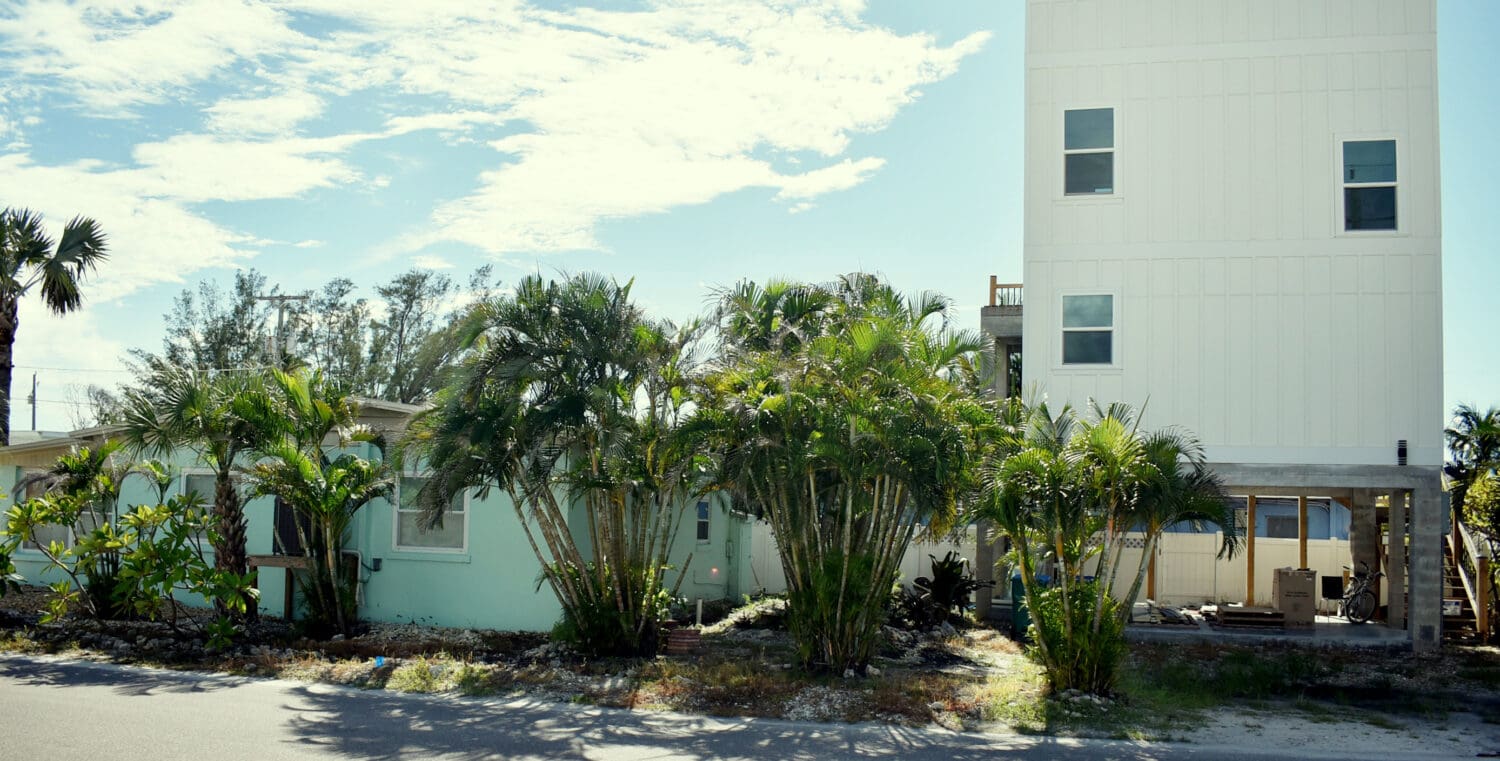
BRADENTON BEACH – Following discussions that spanned several city commission meetings, commissioners tentatively approved a separate but attached structure at 106 23rd St. N. as a non-compliant use at the Sept. 18 meeting.

The addition, which was constructed in place of a garage that was removed, had been permitted by the former city building official and land planner and was nearly completed when city Building Official Bill Palmer said it did not meet city code.

Palmer deemed the new structure as a utility building but said home­owner Neal Morse did not want utility occupancy, and instead requested it to be approved as living space.

“The utility building fits very well because it’s a bonus room and a game room. The only limitations are that it can’t be used as a dwelling,” Palmer said at the Sept. 18 commission meeting. “You can’t live in it, you can’t sleep in it and it can’t be a permanent residence.”

Palmer said for the structure to be classified as a duplex, there would need to be a common roof.

“You couldn’t attach a new building to an existing building and say that’s a duplex,” Palmer said. “The sticking point is that he plans on using this as a dwelling.”

Palmer also said the maximum lot coverage limit was exceeded and could be remedied if some pavers were removed from the 4,200-square-foot lot.

“The rooms are listed as a game room and a bonus room,” Palmer said. “The Land Development Code requires two parking spaces for the first 1,200 square feet plus one parking space for each additional portion of 600 square feet, so basically for those structures we would need two parking spaces for each unit.”
City approves structure as non-compliant use
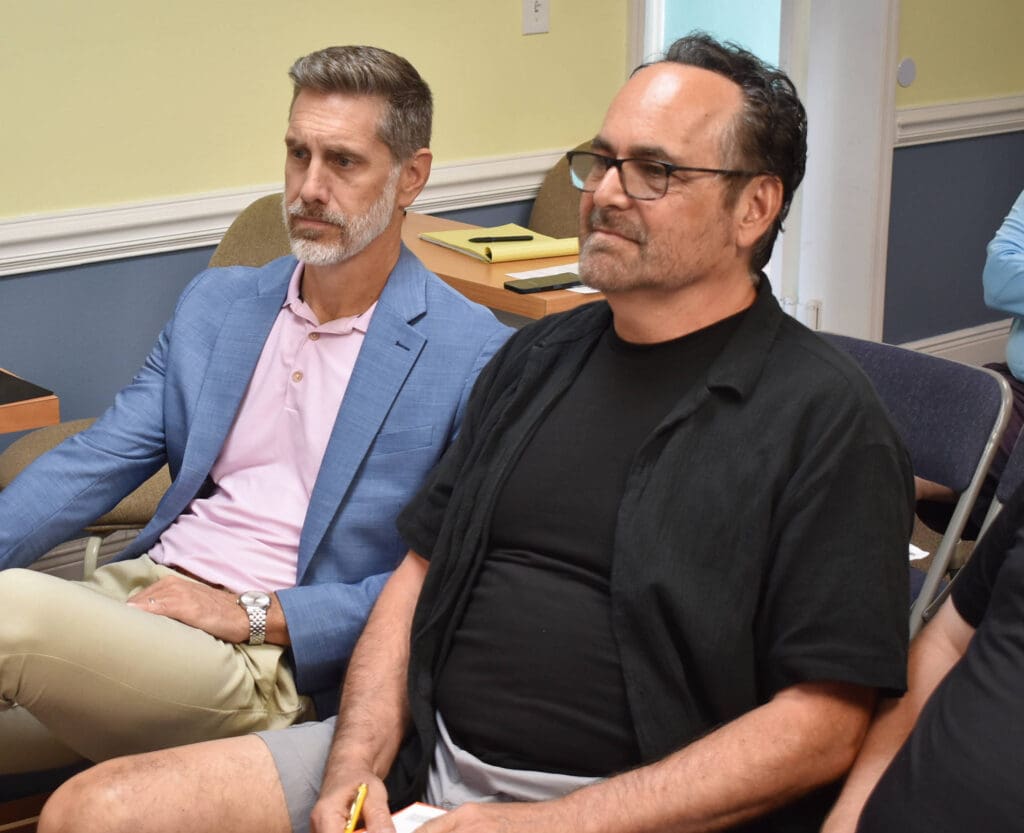
Attorney Scott Rudacille, left, is representing the property owner, Neal Morse. – Joe Hendricks | Sun

Attorney Scott Rudacille, represent­ing Morse, spoke to commissioners at the Sept. 18 meeting.

“It’s not going to be a perfect solu­tion but there needs to be a solution to move it forward,” Rudacille said.

Rudacille described the background of the project.

“This is a process that started several years ago when Steve Gilbert was the building official,” he said. “The concept of having living space in a separate structure, because you have to remember, here is an existing ground level cottage, there was an existing ground level garage that had a non-conforming unit in it, and the options to add living space are limited by FEMA restrictions.”

He said prior to construction, the project was reviewed not only by Gilbert, but by City Planner Luis Serna and former Building Official Darin Cushing.

“And the concept was, separate structure but same dwelling that can’t be rented separately, it’s all part of the residence,” Rudacille said. “And that was the way it was constructed. The property was surveyed to demonstrate it met all the setback requirements. There was a question about the height. There was concern about having two electrical meters, so the property owner has agreed to have electrical service relocated so that it can run through the cottage.”

“I don’t understand the issue; the property owner has also agreed that the two structures will be treated as one. They agree they won’t be rented separately,” he said. “They’ve got enough parking spaces even if you count those as bedrooms.”

Vice-Mayor Deborah Scaccianoce expressed concern about how the dwelling is designated.

“If it’s a bonus room and game room, OK,” she said. “If they were going to replace the garage that was damaged from the storm they would not have been allowed to put a non-conforming dwelling on top of it again. They would have been allowed to build a garage. I want to make sure we’re clear on what the use of this is going to be. I’m not comfortable with it being used as a dwelling or sleeping accommodations.”
City approves structure as non-compliant use
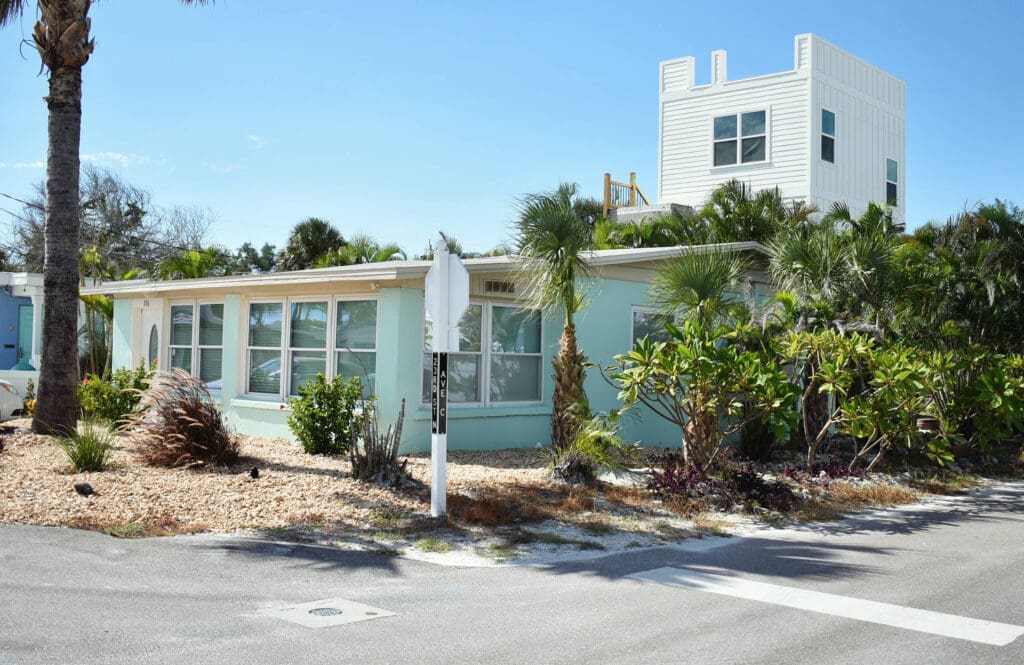
The property at 106 23rd St. N. contains two separate residential structures. – Joe Hendricks | Sun

Commissioner Scott Bear said, “I have concerns as well since we’re not labeling either of the spaces as a bedroom. If it was listed as a bedroom, then there would be a limitation of how many people per room.”

“The concerns I’m hearing sound more like concerns with your vacation rental ordinance that with this property,” Rudacille said. “They could have cleared the lot and have built the exact same space with bonus rooms and bedrooms. They have the same amount of square footage there as if they had started from scratch.”

Rudacille said the added space will be used in conjunction with the house, and is living space, but not a separate dwelling unit.

“You can say it’s R-2, it’s residential, but they didn’t permit it that way,” Scaccianoce said. “I don’t think it was handled correctly. Now we’re changing all that on the fly.”

“If it was connected none of these things would be an issue. The only reason we’re discussing any of this is because there’s a gap between the buildings,” Rudacille said.

Mayor John Chappie said he was concerned about setting a bad precedent.

Commissioner Ralph Cole noted that a permit for the project was issued by the city.

“In fairness, I think it should be deemed a non-compliant build­ing with some stipula­tions,” Cole said.

Scaccianoce asked if the permit could be amended so it reflects the actual use of the property.

“It depends on how you want to go. If you want it to be an R-2 occupancy type, then it would require bedrooms and kitchen,” Palmer said.

Chappie recom­mended that Rudacille and the city attorney create language so there is a clear understanding that if approved, it is a non-compliant structure and if the building is destroyed, it would have to be brought back into full compliance.

City Attorney Ricinda Perry, since retired, weighed in.

“The question is how can the city protect from setting precedent to have what was approved by our building official after Steve Gilbert reviewed it and said you can’t have two residential dwelling units on one substandard lot,” she said. “We have the new set of plans and as Debbie Scaccianoce pointed out, it didn’t have anywhere on the plans that it said bedrooms. There are two residential dwelling units per our building official on this property.”

“I can give you a solution to avoid set­ting precedent,” Perry said. “Non-conforming structures do that. You can’t add on. The other part about a non-conforming structure is if some­thing happens to it, you have to come into compliance with the codes.”

She said if all par­ties are agreeable to setting limitations on the property, a settlement agreement between the city and the homeowner can be drafted to spell out details.

“You clearly spell out what this building should have been, what it is, what the unusual circumstances are and what the limitations are on it,” Perry said. “My recommendation is you accept it via a resolution. It lays out it’s an unusual set of circumstances, and is not intended to set precedent moving forward. I think the city would be in a good position to say no to the next one that walks in the door.”

Palmer said he would be comfortable having the structure classified as an R-2 oc­cupancy as long as the additional rooms are labeled as bedrooms.

Commissioners reached a consensus agreeing to have a settlement agreement drafted that spells out all stipulations.

Manatee County Sheriff's Office

Repeat offender arrested for vacation rental trespassing

ANNA MARIA – Devon Keith Guidry, 28, of Bradenton, was arrested on Nov. 11 after being observed entering a residence at 107 Maple Ave. in Anna Maria.

According to a press release issued by the Manatee County Sheriff’s Office (MCSO), the arrest followed a tip from a resident who saw Guidry enter the property wearing black pants and no shirt. The vacation rental home at which Guidry was ar­rested is owned by the 107 Maple LLC that lists developer Shawn Kaleta as its manager.

According to the probable cause affidavit (PCA) filed by arresting officer James McDermott Jr., Guidry was arrested on the third-floor balcony after deputies observed him exiting a bedroom.

Repeat offender arrested for vacation rental trespassing
Devon Keith Guidry was arrested in Anna Maria on Nov. 11. – MCSO | Submitted

According to the PCA, “The residence is a licensed vacation rental that costs $1,500 a night, with a cleaning fee of $750. The total loss for occupying the property would be $2,250. It was determined through the property manager that the offender obtained lodging and accommodations having a value greater than $1,000 at the licensed vacation rental with the intent to defraud the owners and management company.”

After being trespassed from the Maple Avenue property, Guidry was transported to the Manatee County Jail, where he remained incarcerated as of Nov. 17. He is charged with a third-degree felony count of obtaining food or lodging with intent to defraud ($1,000 or more).

The PCA notes Guidry has a history of being arrested for similar crimes.

Previous arrests

On March 19, Guidry was arrested by an MCSO deputy in Anna Maria and charged with trespassing on a residential property at 403 North Bay Blvd. in Anna Maria – an offense to which he later pled no contest.

On July 29, MCSO Anna Maria Unit leader Sgt. Brett Getman arrested Guidry for trespassing on a vacation rental property at 313 Poinsettia Road in Anna Maria. He was charged, and later convicted, on a first-degree misdemeanor count of trespassing on property other than a structure or conveyance.

On June 6, 2023, Guidry was arrested by the Holmes Beach Police Department after having been previously trespassed from the Benderson-owned shopping center at 3302 East Bay Drive. As a result of that 2023 arrest, Guidry was convicted on a third-degree felony charge of carrying a concealed firearm and convicted on a third-degree felony charge of armed trespass on property other than a structure or conveyance.

Holmes Beach logo

Commissioners oppose bill, hire new lobbyist

HOLMES BEACH – City leaders are hoping to reinforce their position in the battle against state politicians infringing on the city’s home rule.

During a Jan. 11 meeting, commissioners agreed to draft a letter opposing Florida Senate Bill 280, which would take away local municipalities’ ability to regulate vacation rentals and give the sole rights to the state.

Local regulations that would be removed if the bill passes the state Legislature and earns the approval of Gov. Ron DeSantis include the Holmes Beach vacation rental ordinance, all locally-enforced vacation rental safety regulations – including those mandated by West Manatee Fire Rescue under the Florida State Fire Code – and all local occupancy requirements.

While the bill mandates occupancy by the number of sleeping areas in a rental, City Attorney Erica Augello said it doesn’t specify that those sleeping areas be bedrooms, as required by the Holmes Beach vacation rental ordinance, which specifies two people per bedroom or six per unit, whichever is greater, is maximum occupancy.

Augello said she feels the bill is well-written enough that it may have a better chance of passing where vacation rental pre-emption bills have failed at the state level in the past.

Commissioners also decided to enter into an agreement with Sunrise Consulting Group for legislative consulting services at a cost of $4,500 per month.

Rather than replacing the city’s current lobbyist firm in Tallahassee, Mayor Judy Titsworth said the city’s team at Sunrise would work with the city’s lobbyist at the state level. One of their main tasks, she said, would be to represent the city’s interests at the local level with Manatee County representatives for project funding and other issues affecting the city.

Anna Maria officials oppose rental bill

Anna Maria officials oppose rental bill

ANNA MARIA – Anna Maria Mayor Dan Murphy traveled to Tallahassee last week to express the city’s opposition to Senate Bill 714.

SB 714 is the Florida Legislature’s most recent move to further limit local government’s ability to regulate short-term vacation rentals, giving more authority to the state. House Bill 883 serves as the companion bill. Both pieces of proposed legislation are currently working their way through various Senate and House committee stops. If SB 714 and HB 883 successfully pass through their respective committee stops, they would then be placed before both houses of the Legislature for final votes. If the Senate and House both adopt similar bills, the legislation will be sent to Gov. Ron DeSantis to sign into new state law or veto.

Murphy arrived in Tallahassee on Wednesday and returned to Anna Maria on Friday. While in Tallahassee, he hand-delivered to key state legislators copies of the city resolution the Anna Maria City Commission adopted on March 9. The resolution expresses the mayor and commission’s opposition to taking away the city’s ability to regulate short-term vacation rentals at the local level.

When discussing SB 714 on March 9, Murphy said, “The only people this benefits is Airbnb and Vrbo. They’re the ones pushing this. Airbnb and Vrbo would like nobody between them and the person renting the house: No realtor, no government agency, no city. Everything’s mechanized and there’s no need for any humans to be involved. That’s what this is all about.”

On Wednesday afternoon, Murphy sent an email update to city commissioners that noted SB 714 successfully passed through the Senate’s Regulated Industries Committee the previous day.

“An amendment was added during that meeting which clarifies fees and tax liability, none of which helps our cause of killing this bill,” Murphy stated in email.

“The good news is that our website (www.homerulefl.com) generated over 2,500 emails to senators on that committee, all speaking out in opposition to SB 714. What’s more, we added 250 new subscribers to our website and our distribution list. We are now very much a statewide website with subscribers throughout the state. We will continue to track SB 714 as it goes to its next two committees in the Senate and we will have campaigns ready to address the bill,” Murphy wrote.

On Saturday, Murphy provided The Sun with more details about his trip.

“I was able to meet the president of the Senate, Kathleen Passidomo, and I left her a copy of our resolution. I also discussed the pitfalls of this pending legislation, including taking away our right to limit the occupancy of vacation rentals,” Murphy said.

“I met with the bill’s sponsor (Sen. Nick DiCeglie, R-St. Petersburg) and told him our concerns about ‘party houses’ and the catastrophic impact this bill will have on our Island community. Later, I met with Sen. Jim Boyd and State Rep. Will Robinson Jr. to discuss our concerns. My final meetings were with the House speaker’s office and the chairperson of the Commerce Committee, State Rep. Bob Rommel,” Murphy said.
“As an Island community, we need to bombard the Legislature with our concerns through phone calls and emails. We can utilize the HomeRuleFL.com website to send instant emails to the legislators as the bill moves through the House and the Senate. We are at a very serious and critical crossroads with this bill. Failure to speak up now could have long-term negative implications on our quality of life on Anna Maria Island,” Murphy said.

Fire department plans vacation rental changes

MANATEE COUNTY – At the urging of members of the district’s fire prevention bureau, West Manatee Fire Rescue’s board has approved changing the status of short-term rentals in the district from residential to commercial.

Fire Marshal Rodney Kwiatkowski first presented the idea to the district’s commissioners during a January meeting. He said that under the Florida Fire Code, the district has the ability to reclassify the properties for assessment and enforcement purposes. Under the code, short-term rental properties are known as transient lodging, a commercial classification.

Changing the classification of the properties is estimated to bring in an additional $1 million annually in assessment revenue. The funds will be used to implement an inspection program.

All short-term rental properties in the district will be inspected for fire safety, including where smoke alarms are placed throughout the property, availability and location of fire extinguishers, an easily visible floorplan of the structure with exits clearly identified and other safety measures. Kwiatkowski said that while owners may need to implement some new fire safety measures, they shouldn’t expect to have to do something costly, such as install sprinkler systems.

With the new program comes the hiring of a new fire inspector and administrative assistant for the fire prevention arm of the district to handle the increased workload. The district plans to post the jobs immediately with hiring and onboarding anticipated in July. Kwiatkowski said that there is enough money in the current fiscal year to cover salaries and purchase of new equipment for the new hires until the Oct. 1 beginning of the new fiscal year, when inspections are anticipated to begin.

During a Feb. 21 commission meeting, Kwiatkowski said that he had received good feedback from stakeholders in the local rental industry. The main negative feedback he said he’d received was concerning the percentage increase, not the dollar increase,

in annual fire assessment rates. The rate for commercial properties is about twice what it is for residential properties in the district.

District personnel also will be working with already-established vacation rental inspection programs, such as the one in Holmes Beach, to make sure there’s no overlap of efforts and rental owners’ businesses are disrupted as little as possible.

Rental issues lead to penalties

HOLMES BEACH – Special Magistrate Michael Connolly is giving the family of one property owner time to come into compliance with city codes before facing fines, but not much time.

Connolly ruled against property owner Daniel Spitzer who stood accused of violating the city’s vacation rental ordinance by renting his R-1 zoned property for stays of less than 30 days and advertising for short-term stays. Code Compliance Officer James Thomas said the issues with the property date back to June 2016 and that he has been trying to get Spitzer to come into compliance for years.

Spitzer was unable to attend the July 26 hearing due to being hospitalized with a serious condition, however, his daughter-in-law Marissa Spitzer attended by telephone in his absence. She said that she had only recently found out about the issues with the property when she was notified of the code violation posting at the rental home by a neighbor. She agreed to work to bring the property into compliance but said it might be difficult given her location in New Jersey and lack of access to her father-in-law’s online advertising accounts.

Connolly said that she has until the end of day on Monday, Aug. 8 to remove or alter any advertising for less than 30-day rentals, get a new vacation rental certificate from the city, cancel any short-term rentals booked through the end of the calendar year and provide proof to code officers that all scheduled stays of less than 30 consecutive days have been canceled.

If the property remains out of compliance, the owner could face fines of up to $250 per day.

While Spitzer said she believes she can meet the deadline, she added that she feels it’s unfair to require residential properties zoned R-1 to be rented for a minimum of 30 days while other properties in the city can be rented for seven days. She said her father-in-law relies on the rental income from the property.

City Attorney Erica Augello said that while she understands the family’s plight, the code issues have existed on the property for years with the owner’s knowledge.

Unregistered vacation rental owner faces potential fines

Unregistered vacation rental owner faces potential fines

ANNA MARIA – The owner of a large home and smaller cottage at 714 Jacaranda Road has until Wednesday, Aug. 10 to register his vacation rentals or face a retroactive daily fine of up to $250 per day.

If the rental units are brought into compliance by Aug. 10, the daily fines will not be imposed.

If the fines are imposed, they will accrue from June 4 until the date the vacation rental home and cottage are registered with the city. If the fines are not paid, the city can place a lien on the property and collect the accruing fines if and when the property is sold.

These matters were discussed during the code enforcement hearing at city hall on July 28 with special magistrate Gerald Buhr presiding.

According to Anna Maria Code Enforcement Manager Sandy Olson, Odessa, Florida resident Yosmany Cuellar purchased the home and adjacent cottage in September 2021 and has been using both structures as non-registered short-term vacation rentals. Cuellar did not attend the July 28 hearing.

According to Olson, Cuellar was notified of the ongoing vacation rental violations on June 4 and again on June 22 and as of July 28 had not responded to the city notices or registered his vacation rental units.

During the hearing, the city sought and received from Buhr an order for Cuellar to comply with the city’s vacation rental registration requirement on or before Aug. 10, with total allowed occupancy of eight guests for the home and cottage combined. The city also sought and was granted the award of $150 in administrative fees and $15.95 in postage fees.

Olson said she was made aware of the illegal vacation rental activities by the city’s contracted online monitoring service.

She said no address was listed in the rental advertisement, but she recognized the home and drove over to confirm that the home and cottage being advertised were located at 714 Jacaranda Road. Olson said the property was being illegally rented when she made her site visit.

Olson included in her evidentiary exhibits a screenshot of an online aircover advertisement for the main home being offered to 12 guests for $1,473 per night, and reviews posted by guests who previously stayed in the house since Cuellar bought it. Olson also included a screenshot of an online aircover advertisement that offered the cottage to four guests for $285 per night, along with reviews posted by previous cottage guests.

Retired firefighter to perform Citrus Bowl coin toss

Retired firefighter to perform Citrus Bowl coin toss

HOLMES BEACH Vrbo (Vacation rental by owner) has selected Holmes Beach vacation rental owner Mike Wilcox to perform the coin toss at the Vrbo Citrus Bowl game in Orlando.

The Vrbo Citrus Bowl game between the Kentucky Wildcats and the Iowa Hawkeyes will be played at Camping World Stadium in Orlando at noon on New Year’s Day. The game will be televised nationally on ABC.

The coin toss honor has been bestowed upon Wilcox because he offered his vacation rental home to a local first responder at no cost during the COVID-19 pandemic.

Before retiring as a fire lieutenant in Miamisburg, Ohio, Wilcox and his wife, Jennifer, purchased a vacation rental home on 4th Avenue in Holmes Beach, which they named Casa Coconut AMI.

During the COVID-19 pandemic, the couple lost three months of vacation rental income while travel came to a temporary halt. Despite the lost income, Wilcox offered his vacation rental as free housing for first responders who needed to quarantine. A short time later, a local first responder from Southern Manatee Fire Rescue needed a place to quarantine and did so at the couple’s vacation rental home.

“We wanted to recognize Mike for his generosity and resilience during the pandemic. It’s inspiring and humbling to see Vrbo hosts go above and beyond for their communities,” said Kevin Locraft, Vrbo vice president of partner success.

“Having served as a fire lieutenant, I know firsthand the challenges that first responders have when it comes to exposure to the virus while on the job,” Wilcox said. “I have friends on the frontlines. I wanted to help in this tough situation and I was in a position to provide a solution.”

Wilcox said he was impressed with how the various fire departments and police departments in Manatee County responded to the daily challenges presented to first responders during the onset of the pandemic.

Retired firefighter to perform Citrus Bowl coin toss
Mike and Jennifer Wilcox own a vacation rental home in Holmes Beach that is rented through the Vrbo advertising platform. – Submitted | Mike Wilcox

He and his wife now reside full-time in Bradenton. He works at Pirate City, where the Pittsburgh Pirates baseball team trains. She now works as a Realtor at Preferred Shore Real Estate in Sarasota after returning as an education administrator whose career also included teaching.

Wilcox said he’s researched past pregame coin tosses and has been practicing his own. He said there have been some notable coin toss errors, including Super Bowl XLVIII in 2014, when former New York Jets quarterback Joe Namath tossed the coin before heads or tails had been called. The quick-thinking referee caught the coin in mid-air and Namath had to toss the coin a second time.

“I’m excited to do this and I’m honored that they picked me,” Wilcox said.

Castles in the Sand

Is your dream a vacation home?

Owning a dream vacation home is kind of like owning a dream boat, until you actually own one. The idea of it is so exciting that you spend hours every day looking at what’s available to buy. You imagine yourself lounging away the day with little to do but enjoy the best decision you ever made. Well, guess what – it’s not that easy when stuff happens.

There are 7.5 million second homes in the United States, and for many of those millions of homeowners, their second homes have been an escape during the COVID-19 pandemic. But during normal times, owning a second home can become a burden as much as an escape.

Anna Maria Island (and the surrounding waterfront property in Manatee County) is one of the most popular regions in the state of Florida to buy a second home. Our beautiful beaches, pristine water and island charm have been attracting people from around the world for decades. However, owning a vacation property also comes with a litany of problems, especially if yours is set up as a rental property as well.

If you’re renting your property when you’re not using it or are just having someone oversee it while you’re not there, get ready for phone calls. Broken and leaking appliances, roof leaks, mold, air and heating equipment malfunctions, termites and who knows what other critters who may decide to invade your nice, quiet home while no one is there are just a few of the potential issues. And, of course, the Florida curse of hurricane season, where for almost half a year you will hold your breath and stay glued to the Bay News 9 weather cones.

Owning a vacation property has as much to do with your financial ability as it has to do with your personality. If you like being free and exploring different and varied places around the world, going back to the same beach house every year can make you feel stifled and unimaginative.

If your personality is one where you want everything working properly all the time with nothing out of place when you arrive, better rethink your decision. No matter how hard you try, something will go wrong, whether you’re renting your property or not, so maybe you’re better off being the one who rents, keeping your stress level down.

If, however, you’re pretty easygoing and want to find a second home for your family to return to every year and create memories, then a second home will fit your personality and lifestyle better. Getting involved in the community and making friends with local shop owners and restaurant owners will not only enhance your second home experience, it will also give you someone to fall back on if you have a problem getting local repair people, landscapers and housekeepers. Make it more than just your second home, make it part of your life.

If renting your second home is part of your plan in order to offset expenses, consult with your financial and tax advisor. As we know, tax laws have changed in the last couple of years and some of that may affect your personal tax position and frequency of personal use. Unless you live near your second home, hiring a property manager to handle rentals as well as maintenance will make ownership a lot less stressful. Many homeowners successfully use websites like VRBO and Airbnb for their rentals, but that requires being more hands on than you may want to be.

So, should you buy a second home for Christmas? There is a multitude of pros and cons involving finance and personality. Be honest with yourself, because, like owning a boat, owning a second home may not be that exciting once you get off the lounge chair. Stay safe.

Vacation rental bills progressing

TALLAHASSEE – Two bills filed by Florida legislators during the 2020 legislative session seek to strip local governments of their ability to regulate vacation rentals.

As was the case in recent years, with no success, the matching House and Senate bills again seek to give the Florida Department of Business and Professional Regulation (DBPR) the sole authority to regulate short-term vacation rentals.

This year’s efforts also include a new twist – providing the state and DBPR the sole authority to regulate vacation rental advertising, with a focus on online rental platforms such as Airbnb and VRBO.

To become state law, matching bills must be adopted by the House and Senate during the 60-day legislative session scheduled to end on March 13.

Bills’ progress

Filed by Sen. Manny Diaz Jr., R-Miami/Dade, Senate Bill 1128 was ruled favorable by the Florida Senate’s Committee on Innovation, Industry and Technology by an 8-2 vote on Jan. 13. It was then referred to the Senate’s Commerce and Tourism Committee chaired by Joe Gruters, R-Sarasota.

Diaz

As of Monday, Feb. 3, the Commerce and Tourism Committee had not yet discussed SB 1128, nor was it on the agenda for the committee’s Tuesday, Feb. 4 meeting.

LaRosa

Co-sponsored by State Rep. Jason Fischer, R- Jacksonville, and State Rep. Mike LaRosa, R-St. Cloud, HB 1011 is the House companion to the SB 1128. HB 1011 was ruled favorable by the House’s Workforce Development and Tourism Subcommittee on Jan. 21 by a 10-5 vote margin. It was then referred to the Government Operations and Technology Appropriations Subcommittee and included on the agenda for that committee’s Tuesday, Feb. 4 meeting.

Fischer

Senate bill discussed

When introducing his bill on Jan. 13, Diaz said, “Unlike years past, the goal of this vacation rental bill is to bring accountability over the Florida vacation rental industry by ensuring for the first time that only properly registered and licensed vacation rentals are listed on advertising platforms and that the state and local governments have the information they need to ensure taxes are remitted.”

Diaz said this would be achieved by defining what an advertising platform is and placing those advertising platforms under DBPR regulation. Diaz said his bill would require vacation rental advertising platforms to provide local tax collectors the information they need to ensure that all rental-related taxes are paid.

Diaz said this would be achieved by requiring sales tax registration and tourist development tax numbers to be included in any public advertising of a vacation rental. Quarterly reports submitted to DBPR would also be required.

Diaz claimed his legislation would not diminish the power of local governments to address vacation rental issues because it would preserve grandfathered vacation rental prohibitions or restrictions enacted before June 2011.

However, Diaz made no mention of preserving cities’ home rule rights by preserving the 2014 state legislation that returned to local governments the ability to enact local vacation rental regulations and registration programs, while maintaining the 2011 provisions that prevent local governments from prohibiting vacation rentals or regulating the frequency or length of those rentals.

“Local governments can continue to pass good neighbor policies within sections of their municipalities to deal with all properties, as long as all properties in those areas are treated the same,” Diaz said.

State law currently allows local governments to adopt local laws and regulations that pertain specifically to short-term vacation rentals.

Diaz said his legislation would also preserve homeowner associations’ and condominium associations’ ability to regulate and/or prohibit short-term rentals.

FLC opposition

Florida League of Cities’ Legal Advocate Casey Cook is among those who opposed the proposed legislation as introduced. Cook offered the Senate committee suggestions on how SB 1128 could be improved.

Cook stressed the need to distinguish between traditional home-sharing properties and investor-owned rental properties. He said the senior citizen or single parent who rents out a spare bedroom to supplement their limited income should be exempt from local rental regulations, as should other homesteaded properties.

Contrary to Diaz’s legislation, Cook suggested DBPR be authorized to subcontract local governments to enforce state-imposed rental regulations.

“There have been a number of articles showing that DBPR is overworked, understaffed, they can’t meet their performance benchmarks currently on the books and they need help. We think locals are positioned to help them on the enforcement side, on the inspection side and going after unlicensed activity,” Cook said.

“I think that you should clarify that noise and trash ordinances should be applied across all residential properties. That makes sense. I don’t know that it works for parking,” he added.

Cook suggested vacation rental-related fines be standardized statewide and be based on a percentage of the nightly rent.

“The $40 bedroom in Wauchula would pay a lower fine than the $10,000-a-night mansion in Miami Beach,” Cook said.

He also said fines and penalties should escalate for repeat violators, to the point where the ability to use the property as a short-term rental could eventually be lost.

City takes home three wins in court

City takes home three wins in court

BRADENTON – After a brief recess, Manatee County Circuit Court Judge Edward Nicholas submitted a ruling Jan. 8 in three Bert Harris cases brought against the city of Holmes Beach.

When giving his ruling from the bench, Nicholas said that he finds that at the time of purchase of the three properties included in the cases, purchased and developed between 2009-2013, there was no limitation on the number of occupants. He said he also agrees that there is a financial disparity between a vacation rental property that can rent to an unlimited number of people and one that has a limit on occupancy.

However, he ruled in all three cases in favor of the city’s motion for summary judgment based on the idea that while the city’s occupancy regulations, two people per bedroom or six people per unit, whichever is greater, does put a burden on the property owners, he did not find it to be the inordinate burden required under the Bert Harris Jr. Act.

The three properties involved in the Jan. 8 hearing are referred to as Coral Escape, Mojito Splash and AMI Breeze LLC.

The Coral Escape property, located at 132 50th St. in Holmes Beach and owned by Brian Wein as a vacation rental investment property according to court records, is a six-bedroom home. The complaint states that Wein purchased the property in 2009 and redeveloped it to its current size with the intent to rent it as a short-term vacation rental. Attorney Aaron Thomas, arguing on behalf of Wein and investor Shawn Kaleta who owns the other two properties involved, said that the city’s regulations reduced occupancy in the rental from 14 to 12 people. The claim lists an appraised loss in value of $240,000 due to the occupancy reduction.

The Mojito Splash property, located at 304 65th St. and owned by local developer and investor Kaleta, was purchased in 2008 according to the complaint filed by Thomas. The complaint goes on to say that Kaleta developed the property as a five-bedroom vacation rental and that the city’s regulations reduced occupancy from 12 to 10 people. The claim lists an appraised loss in value of $275,000 due to the reduction in occupancy.

The AMI Breeze LLC property, also purchased and developed by Kaleta as a vacation rental, is located at 209 54th St. The complaint states that the property was purchased by the LLC in 2013 and developed as an eight-bedroom property to be used as a vacation rental. Due to the city’s regulations, the claim states a reduction in occupancy from 20 to 16 guests and a reduction in value of $690,000.

Before ruling on the three cases, Nicholas said that he understands the impact and significance of the decision he was making and how his ruling could affect the two dozen other Bert Harris cases pending against the city. He added that he also respects and understands the difference between an undeveloped property and one that the owner has gone to the expense of redeveloping.

“I don’t think the plaintiffs have come close to establishing anything that could be considered an inordinate burden,” Nicholas said, adding that he doesn’t believe the city’s occupancy restrictions to be unreasonable or that city leaders are acting arbitrarily.

“I don’t believe the reduction of two tenants is a significant enough act that the Act (Bert Harris Jr. Act) applies and a dollar amount should be considered,” he said. Nicholas added that he expects an appeal to his ruling to be filed by the plaintiffs and that he would be interested in hearing what an appeals court has to say on the issue.

For her part, Holmes Beach Mayor Judy Titsworth was “very, very, very happy” with the outcome in court.

“This was huge,” she said, adding that she didn’t expect a same-day ruling. “I’m very excited.”

Related Coverage:

Bert Harris cases go back to court


It’s a Bert Harris win for Holmes Beach

Holmes Beach logo OLD

Holmes Beach adds monthly rentals to VRC

HOLMES BEACH – City commissioners may have dropped the business tax receipt requirement for residential rental homes and units, but they’re considering reclaiming some control by adding longer-term rentals to the vacation rental certificate program.

Under the city’s VRC program, short-term rentals, those rented for less than 30-day periods, typically seven days, are required to pay a fee and obtain a certificate to be posted at the rental property after passing an inspection from code compliance officers. Commissioners are moving forward an ordinance to add monthly rentals to that program as well.

Currently, vacation rentals must undergo an inspection and renewal of the rental certificate every two years. To lessen the blow to monthly rental property owners, Commissioner Carol Soustek, who owns a property that’s rented seasonally, suggested finding a way to make the program accessible to owners who may not make as much money from their properties as vacation rental owners. She said that with so few monthly rentals still available on the Island, she doesn’t want to push owners to move toward selling their properties or offering them as vacation rentals.

After a little back and forth between her fellow commissioners, Soustek suggested having monthly rental certificates renewed every three years instead of every two years.

Earlier in the evening, commissioners voted to approve an increase in cost for VRC initial inspections and renewals to $695. With monthly rentals included in the program, Mayor Judy Titsworth provided a cost analysis from city Treasurer Lori Hill that put those costs at $545 for monthly and vacation rentals.

City leaders estimate there are between 1,100 and 1,200 vacation rental properties and around 300 monthly rental properties in Holmes Beach. At $545, Hill estimated that the cost of the VRC program would be equal to the cost, $751,008 for two years.

Before commissioners move forward, they asked Titsworth to go back to Hill and make sure that the $545 fee could support the program with renewals for vacation rentals at two years and monthly rentals every three years.

Related coverage

Holmes Beach budget talks begin

Commissioners consider exemption for rental homes

Jean Peelen

Jean Peelen moves on

HOLMES BEACH – Jean Peelen arrived on Anna Maria Island from the Washington D.C. area 10 years ago. Her sister had died from cancer and friends told her to visit Anna Maria Island.

“They told me I should walk the beach,” she said.

She rented a place, saw what life was like with the beaches –  the slow pace, and the friendly people, and she never looked back.

“The people were warm and welcoming, and the people I met then are still friends,” she said. “It was a lovely place to live.”

Unfortunately, as things progressed and so many homes were razed to make way for vacation rentals in residential neighborhoods, she became alarmed.

“That’s when I decided to run for office,” she said. “I have been active all my life in trying to help people and I saw so many residents decide they couldn’t live with all the disturbances.”

Peelen said a lot of those residents were retirees who had saved their money and bought a place to live out their lives. She said the majority of them lived here fulltime, enjoying and contributing to the lifestyle. Then there were the part-time residents, the snowbirds who came down in the fall and left in the spring.

“Those people are almost all gone,” she said.

Peelen said when she got elected, one project was the dog park.

Then she joined two other elected officials, Carol Carter of Anna Maria and Janie Robertson of Bradenton Beach, to form Home Sweet Home.

The group’s mission is to convince people to move and live fulltime on the Island. The group acquired non-profit accreditation and it is looking for properties that would make good, affordable homes that could benefit the donors with tax breaks as well.

It sponsored a gathering of residents at the Anna Maria City Park that was well attended. She said she thought it was a success as far as spreading the small town feeling that the Island was known for.

Peelen has mixed feelings about leaving, but she doesn’t stay in one place for too long.

“Every 10 years I reinvent myself,” she said. “I’m moving to Flat Rock in the North Carolina mountains and it will be a good experience, living in the mountains.”

She’s living in a small house.

“I think I’ll like that where everything is close at hand,” she said. “I won’t have room for clutter.”

She’ll miss the lifestyle here too.

“I loved island living with the beaches nearby,” she said. “I will miss the friends that I have made. I’ll always remember them.”

Anna Maria Bert Harris

Bert Harris counteroffers made

ANNA MARIA – City commissioners recently approved three more Bert Harris claim settlement offers, including one for a beachfront home at 107 Elm St. owned by Graham and Hazel Hansen.

The Hansens requested a 10-person occupancy limit for their rental home. The city originally offered an eight-person occupancy limit that the Hansens rejected. On March 22, the commission voted 4-1 in support of increasing the occupancy offer to 10. Commissioner Carol Carter opposed that action. She said the home is very narrow and the bedrooms are very small and she questioned the need for the extra occupancy.

The commission unanimously approved a 14-person occupancy offer for a home at 211 Chilson Ave. owned by Lakeland-based O&S Holdings.

The commission unanimously approved a counteroffer for a 14-person occupancy limit at 211 Willow Ave. The home is owned by Allen Weinstein and Alison Boak. One of the city’s previous counteroffers included an offer to buy the home for $1.79 million. The owners rejected that offer.

According to City Clerk LeAnne Addy’s monthly report, the city has settled 93 Bert Harris claims, is awaiting client decisions on six settlement offers and is awaiting client signatures for 13 accepted settlement offers.

The city has made settlement offers on all 122 of the Bert Harris claims received in 2016 and 2017. The period to file a claim expired in early 2017. The claims were filed in response to the eight-person occupancy limit contained in the vacation rental ordinance adopted in late 2015.

The Bert Harris claims are an attempt to offset lost rental income or reduced property value as a result of the city’s vacation rental occupancy limits.

Holmes Beach legislative session

Commissioners prepare for state legislative session

HOLMES BEACH – Lobbyist Cari Roth is heading back to Tallahassee to fight for the right of municipalities to govern vacation rentals during the upcoming Florida legislative session.

Roth visited Holmes Beach to meet one on one with city leaders and present her plans to fight against state removal of home rule over vacation rental properties on the city’s behalf. Her goals for the upcoming legislative session, she said, are to continue collaborative efforts with the Florida League of Cities and pursue vacation rental legislation that allows for a grandfathering of “reasonable” existing municipality regulations.

Roth said that after review, she feels the city’s vacation rental ordinance, which requires owners of short-term rentals to undergo inspection and licensing, qualifies as reasonable regulation. In preparing for the January start of the 2018 legislative session, Roth is compiling data from both city code enforcement and the Holmes Beach Police Department on issues found in vacation rentals and officer response to resident complaints.

Other allies Roth hopes to work with to combat local deregulation of vacation rentals are the lobbyists representing the hotel industry. While online rental company Airbnb has put $1 million in a PAC fund to remove local regulations, Roth said the hotel industry is helping to fund the movement to “level the playing field” and create regulations that treat vacation rentals as businesses, forcing them to adhere to the same regulations and tax payments hotel owners face.

Last year’s vacation rental bill, which passed the state House of Representatives by a narrow margin of 63 to 56 votes, has been refiled for consideration during the 2018 legislative session by Rep. Mike La Rosa. With 2018 being an election year, Roth said she expects the topic of vacation rental regulations to be a prominent item during the 60-day session.

“There are a lot of extra politics in the mix this year,” she said.

Mayor Bob Johnson said he believes the key to success in Tallahassee will be having “representatives who communicate well within the Legislature.” He said by working with the feedback received from the previous session and keeping lines of communication open between Tallahassee and interested parties on the local level, he hopes the voices of municipal leaders will be heard by state leaders.

The 2018 legislative session begins on Tuesday, Jan. 9.