Tag: Reel Time

Reel Time: Fly casting fundamentals

Teaching fly casting has taught me some valuable lessons. Chief among them is the fact that it’s most often easier to learn from scratch using the fundamentals (physics) of the cast than it is to correct bad habits that have been developed over time. That became apparent to me when I gave lessons to someone who had been fly casting for a long time but who had ingrained, bad techniques. When I showed them how to properly move the rod tip in a straight line to form a “tight” wind penetrating loop they understood the concept immediately. The eye-opener for student and teacher was when they tried to repeat the proper casting stroke and their ingrained bad habit overpowered their new understanding.

This isn’t bad news for long time casters who have been using improper techniques but points out the necessity of practice to “reteach” the brain how to move the rod. The same applies to proficient casters who are learning to cast with their non-dominant hand. Try this and you’ll see what I mean instantly. If you’re a right-handed caster, putting the rod in the left hand is like handing it to another being where the mind knows the cast but the body doesn’t cooperate. The good news is that by learning the fundamentals of the cast and practicing them regularly anyone can become adept.

Besides learning and practicing the “Essentials of Fly Casting” it’s important to realize that there is no right or wrong “casting style.” Casting is governed by physics and there are some essentials that every fly caster must master, no matter what their individual skills or styles. This is the difference between the Art (style) and Science (physics) of the cast. Fly casting is a lifelong learning experience that you can practice at 9 or 90. Different people learn at a different pace. Some people pick up casting quickly and then plateau. Others start slow, but when they finally “get it” they’ve “got it.”  It can be compared to learning how to ride a bike. To become a good caster you need to practice, but that practice will reward you with a lifetime of pleasure and provide the opportunity of the company of good friends.

Fly casting differs from spin or bait casting where the weight of the lure or bait “loads” the rod. The rod then transfers the stored energy of the rod to the lure or bait which carries it to the target. In fly casting, the weight of the line loads the rod and the line takes the leader and flies to the target.

The basic casting stroke consists of the rod being held in the hand at the base of the fingers with the thumb on top of the cork. The stroke is a combination of moves of the wrist, the forearm and the upper arm. In the “ready” position with the thumb on the cork, the wrist is straight and the butt of the rod is at a 45-degree angle to the forearm. The wrist travels from this “straight” position to a 45-degree down angle then returns to the straight position. The forearm and the upper arm complete the motion.

There are five basic movements that make up what is referred to as the “Essentials:”

  1. There must be a pause at the end of each casting stroke, which varies in duration with the amount of line beyond the rod tip. This allows the line to straighten for the next cast.
  2. Slack line should be kept to an absolute minimum. Slack line prevents the rod from loading and applying the proper power to the cast. The most common mistake that creates slack line happens when the rod is started too high, forming a belly in the line between the rod tip and the water. To prevent this, start your cast with the rod tip pointing at the water.
  3. In order to form the most efficient, least air resistant loops and to direct the energy of the cast toward the target, the rod tip must move in a straight line. Practice tracing a horizontal line like a roof eve.
  4. The length of the casting stroke must vary with the amount of line past the rod tip. If you are making a short cast there is only a small amount of line needed (which only weighs a small amount). As the length of line increases, the stroke must be increased to load the rod.
  5. Power must be applied in the proper amount at the proper place in the stroke. In general, the power is applied slowly at first, gradually increasing to a peak at the end of the stroke. There should be a crisp stop at the end of the stroke, forcing the rod to come out of its bend. This is commonly referred to as the “speed-up and stop. In my experience, the only way to master fly casting is to practice on a regular basis. Create a practice schedule that you can stick to. Start by practicing at least three times a week for 10 minutes. Any additional time will, of course, be a bonus but the importance of a regular practice schedule cannot be overemphasized. There are lots of resources on the internet to help you perfect your cast, and lessons with a caster trained by the Fly Fishers International can be invaluable. Some of the best videos to search for online are those by master casters and instructors Joan Wulff and Lefty Kreh. Locally, anglers can research rods and tackle at AMI Outfitters on Anna Maria Island.  I’ve created some lessons and links to good videos I’ve found at my website. Learning and applying the fundamentals of fly casting will help you avoid learning bad habits or help you overcome them!

Reel Time: Orange Hammock Ranch

I first heard of Orange Hammock Ranch from Jon Thaxton, a former Sarasota Commissioner and a longtime champion of conservation efforts in southwest Florida. I remember him saying that if this almost 6,000-acre property is preserved, it will represent a crowning achievement in his lifelong efforts. That got my attention as I respect Thaxton, now the Senior Vice President for Investment at the Gulf Coast Community Foundation, for his decades of service to the environment. I was heartened when I learned that in early February, the Florida Cabinet had approved the purchase. Under the terms of the agreement, the state agreed to pay $19.5 million through the Florida Forever program and the Sarasota County-based Conservation Foundation of the Gulf Coast committed to $1.5 million for a total of $21 million. The Florida Fish and Wildlife Conservation Commission has been designated as the managing agency for the property. According to Foundation President Christine Johnson, “Saving Orange Hammock Ranch has been a conservation priority for our community for decades! This property is a breathtaking slice of old Florida and holds the trifecta of land conservation benefits – protecting drinking water, preserving wildlife habitat, and providing exceptional public access.”

Orange Hammock Ranch is located north of Interstate 75 in the city of North Port. Besides the inherent ecological value of the property itself, it is important because It connects RV Griffin Preserve with the Longino Preserve through approximately 6 miles of shared boundaries, and bolsters the 120,000-acre buffer along the Myakka River and the connection between the Myakka and Peace rivers. An estimated 60-75% of the property is wetlands or within a 100-year floodplain. The rainfall that collects on the property feeds Snover Waterway and the Myakkahatchee Creek, both of which are critical sources of North Port’s drinking water. On this property there are hundreds of acres of wetlands intermixed with pine flatwoods, globally-imperiled dry prairie as well as other native habitats. The property is home to quail, indigo snake, the Florida black bear and will be a viable habitat for the Florida panthers that are being bred in the nearby Babcock-Webb Wildlife Management Area.

The importance of purchases like this really hit home when I read a letter written by a 12-year-old neighbor, Brice Claypoole. Brice’s mom, Ali, had read an op-ed on Orange Hammock in a local newspaper by New College Professor Jono Miller and knew Brice would be interested.  Brice loves all things nature and is a familiar face at every Sarasota Bay Watch event. At a recent Sister Keys Invasive Clean-Up, he met Manatee County’s Environmental Programs Manager, Damon Moore. Moore was so impressed with Brice’s enthusiasm that he enlisted him to help with a county restoration project at Coquina Beach. While I correctly view projects like this for the value they represent in the here and now, I was suddenly struck by the importance of these wild places to future generations of Floridians like Brice. Protecting the wild areas of Florida like Orange Hammock Ranch, critically endangered by rampant development, should be a top priority for all Floridians. if we are to assure that children like Brice (and future generations) have the opportunities we’ve had, we need to contribute our time and money to their protection and make sure our legislators know that projects like this are a priority to us. And let us not forget the importance to the water that surrounds us and the fish we pursue!

Reel Time

The quality of our fishing future

Fishing and the outdoors experiences that my love for the sport have occasioned have played a pivotal role in my life for almost seven decades. This infatuation has also made me passionate about working to protect the natural world that provides me with sport, inspiration and a desire to see future generations have some of the same opportunities that I’ve had.

That’s why I keep coming back to what I think is a crucial responsibility, being aware of how elected officials voted when it comes to the quality of the air I breathe, the water I drink and the water that the fish I love to pursue swim in. It’s become painfully apparent to me that the politicians we elect all too often have a different agenda than what they present to us when they want our vote. That’s why I have decided that I’m not a Republican or a Democrat. I don’t vote red or blue, liberal or conservative. What I am is an environmental voter.

What does that mean? It means I research how a politician who wants my vote has voted on issues, not what they promise. In this day of the internet, there’s really no excuse for not getting information based on facts instead of innuendo. A word of caution of course. All too often we make the mistake of looking for information that supports views we already hold rather than a search for the facts. Both are available in spades so be selective when choosing your sources and check to make sure they have no underlying (alternative) agenda. Here are a couple of resources you might want to explore.

Florida Conservation Voters has a scorecard that tracks how politicians have voted on important issues like clean water and clean air. Their mission is to elect lawmakers who protect our environment and healthy communities for everyone. Their vision resonates with mine: “Our vision for Florida’s future is one where our environment is recognized as the irreplaceable foundation of our economy, culture, and quality of life. It’s a future where our economic development, energy innovation, and conservation goals align. We envision a government that reflects the people it serves and lawmakers who vigorously fight for policies that protect our environment and create a healthy, sustainable future for all Floridians.”

There are also resources on the internet that, with a little research, will reveal how a senator or representative has voted on varying issues. Check them out at www.senate.gov and www.congress.gov.

Floridians, especially those who are blessed to live on a barrier island, can see firsthand the effects of poor policy and pollution on the waters that surround our homes. If you haven’t noticed, take a look at all the algae that is accumulating in our bays right now. Yes, some of that is a natural occurrence, but personally I’ve never seen so much so early in the season.

Bottom line, do a little homework going forward and see how those who claim to have your interests at heart actually voted and where their true allegiance lies. It’s a vital component of an informed electorate and will affect the quality of life and fishing we are leaving our children, grandchildren and future generations.

Reel Time: The bike angle

Reel Time: The bike angle

I like to bike and I love to fish. It occurred to me a long time ago that I might be able to access some great fishing spots by bike. More often than not though, my fishing adventures involved a boat. That is until I started pedaling to Longboat Pass to fish from the bridge and to the bay to explore local public docks. What I discovered was a way to get in some excellent fishing without having to do the work to get a boat in and out of the water, with all that’s involved.

That didn’t keep me from boating, but it opened up a new avenue for getting my fishing fix and a bike ride too. For anglers who don’t have easy access to a boat, a bike can take you to some excellent angling opportunities. A good example is Robinson Preserve in Manatee County. The park is a treasure for walkers, bikers, kayakers and anyone who enjoys the outdoors. It also provides access to Perico Bayou and Tampa Bay. In addition, it also holds a maze of canals that, based on recent observations, hold some pretty terrific fishing. On a bike ride to the park recently, I encountered a number of anglers who had used their bikes to access the bridges that span the preserve’s canals and outlets to Tampa Bay. When I reached a favorite spot for a water break near the bay, I saw two anglers far out on a shallow flat I’ve fished many times from my boat. Nearby, leaning against a picnic table were their two bikes with rod holders. I took some pictures along the shoreline and eventually the two anglers waded to shore nearby. They had experienced a productive morning of fishing, seen no other angers and landed a number of big redfish and trout.

Although it doesn’t take more than a medium-light spinning rod rigged with an artificial lure to get in the game, I saw other bikers transporting live shrimp and even cast nets for catching bait. My preferred rig is an 8-pound spinning outfit or 8-weight fly rod with a 25- or 30-pound leader. I’m confident in the flies, plugs and jigs I fish, so that’s what I use and what I catch fish on. I double my standing line with a Bimini twist or a spider hitch and then tie my leader to the double line with a blood knot. After tying on a fly, top water plug or jig with a Non-Slip Mono Loop, I stick a spool of leader and a couple of extra flies or lures in my pocket and I’m good to go.

This time of the year is perfect for a world of wade fishing that a bike gives access to. All you’ll need is a pair of wading boots or old tennis shoes and a change of pants for the ride home. Bikes can quickly get you to places you’d find hard to reach even by boat. You can plan your outing by consulting access points (Google Maps) online. Then pack your gear and use your bike to explore some local less-accessible fishing gems. Try using your bike to expand your fishing horizon. Whether it’s a quick ride to a local pass or to one of a number of local parks near Anna Maria Island, you’ll be surprised at the opportunities it will open up for you.

Reel Time: The cobia

Reel Time: The cobia

As local water temperatures fluctuate between seasons in the spring and fall, savvy anglers know to start looking for cobia in area waters.

Often mistaken for sharks whose shapes and coloration they resemble, cobia are long and streamlined with a broad, flattened head. Their upper body is brown with a dark lateral line that extends through the eye to the tail. The brown fades to white on the belly.

Cobia range up to 6 feet in length and can weigh more than 100 pounds. While most anglers target cobia in the Gulf, cobia range widely throughout local bays as well, particularly near local passes. They spawn in the spring and early summer and feed on crabs, small fish and squid.

Several changes to the management of cobia in state waters in the Gulf of Mexico went into effect Feb. 1. These changes were approved at the Florida Fish and Wildlife Conservation Commission (FWC) meeting last December.

The changes strive to enhance sustainable management of this fishery and were developed in coordination with anglers, charter captains and the Coastal Conservation Association, which had expressed concern about the fishery. The changes will apply to all state waters north of the Monroe-Collier county line. Those changes include:

  • Making the recreational and commercial bag limits for cobia in Gulf state waters the same by reducing the commercial limit from two to one fish per person.
  • Reducing the recreational and commercial vessel limit in Gulf state waters from six to two cobia per vessel, per day. The 33-inch minimum size limit changed to 36-inch fork measurement in March.

Cobia have a way of surprising anglers, so it’s wise to have a rig ready should you encounter one.

Fly anglers who target cobia opt for at least a 10-weight outfit, although it’s possible to land smaller cobia on lighter outfits. A favorite fly is a black bunny tied to resemble a small eel, one of their favorite foods. Anglers fishing conventional tackle most often use live baitfish and live crabs, another of their favorite foods. Cobia will also hit a variety of plugs and lures that imitate baitfish.

This is the beginning of tarpon season and anglers targeting tarpon should be on the alert for cruising cobia. Last week AMI Outfitters owner Steve Traves anchored his boat and jumped on my bow (following social distancing guidelines) on a sand bar bordering Tampa Bay. It wasn’t long before I spotted a cruising stingray with a nice cobia riding his back. Cobia use rays as camouflage darting off them to eat prey that rays spook. After positioning the boat ahead of the ray, Traves made a cast that landed just in front of the ray. He then stripped it to intercept the two fish and the cobia rushed over and ate the fly. Unfortunately, the cobia came straight at the boat and Traves was unable to set the hook.

Later that day I was anchored up along another edge when a manatee came cruising down the bar with a 30-pound plus cobia “glued” to his back. I made a cast to intercept the cobia but hooked the manatee instead. Fortunately, I was able to pull my anchor and get in front of the manatee, freeing my fly. I was able to get several casts to the cobia but this one wasn’t interested in eating.

Captain Justin Moore has been seeing cobia while tarpon fishing and advises anglers to pay attention to any floating objects like flotsam and buoys as well as structure including markers and artificial reefs. Cobia are a worthy adversary for local anglers. They can show unexpectedly and be hard to target but put up a terrific battle and the smaller ones make great table fare.

Reel Time: For the Birds

Reel Time: For the birds

Who hasn’t been stirred by the sight or song of a bird? The haunting sound of a nightingale signaling the arrival of spring, the flamboyant plumage of a spoonbill or egret and the elaborate rituals of herons, terns and other sea birds in breeding season. Have you ever marveled at the graceful flight of a formation of black skimmers, their bills tracing paths across the water’s surface at sunset?  Birds not only inspire and uplift us, they also provide a significant boost to Florida’s economy and are a major reason the state ranks as one as the nation’s top wildlife viewing destinations.

With all that birds provide us, it’s alarming to learn that specieswide, we’ve lost the equivalent of one in four birds in the last 50 years. The major reason is loss of habitat and the seabirds we treasure are particularly vulnerable due to the loss of mangroves for nesting and the practice of many seabirds to lay their eggs and raise their young just above a barrier island’s high-water line.

Birds need our help and there are specific things that anglers and outdoor enthusiasts alike can do to help them. One of the most heartbreaking things anyone can experience is a dead or dying bird garroted in the mangroves by an unsuspecting fisherman’s line. Anglers who fish the coastal waters of Florida will invariably come into contact with the seabirds that inhabit the estuaries of our state. Often that encounter is deadly to seabirds if anglers don’t know the basics of avoiding contact with or caring for hooked birds. Birds live here, it’s their home, and they aid savvy anglers as they search for food. The birds get into trouble when they come in contact with discarded fishing line in the mangroves, or they take line to their roosts after becoming hooked.

The incidence of anglers hooking birds can be reduced or eliminated by following a few simple rules. First, never feed birds. This trains birds to look for a handout and leads them to often unsuspecting anglers. Secondly, while you’re fishing, be aware of birds that might be eyeing your bait or lure. It’s easy to pull it out of harm’s way at the last second before a bird dives on it.
If you do hook a bird make sure that you fight them just like you would a trophy fish to prevent them from breaking the line. Trailing line can be a death sentence for the birds when they return to their roost at night. Care should be taken when handling birds due to their fragile, hollow bones and sharp beaks. First, place a towel over the bird’s head. This will calm them and protect the angler from sharp bills. You can then cautiously remove hooks and unwind line before releasing them.

During nesting season (peaking here May through June) birds are particularly vulnerable, especially those that nest on the beaches of our barrier islands. It’s crucial that humans avoid breeding colonies on public beaches and especially the few places designated as off-limits because of their critical nesting potential. Locally protected areas like Egmont Key and Passage Key are often threatened by unsuspecting and careless beachgoers who endanger eggs and young hatchlings. The birds don’t have a voice and it’s left to those of us who appreciate and benefit from them to be their advocates.

If while fishing you see a hooked or tangled bird in an active rookery, don’t approach them during nesting season. Our well-meaning intentions can cause more harm than good by causing startled young birds to fall from the nest.

Taking care of the environment that feeds our passion is everyone’s responsibility. Follow these simple guidelines: be aware of the presence of seabirds, take care in handling them, and never feed birds. If you see a bird in distress and it’s not nesting season, you can free them. If they swim or fly away on their own that’s all you’ll need to do. If you believe they are too weak to recover on their own, contact one of the local organizations that rescue and rehabilitate sea birds. On Anna Maria Island you can call Wildlife Inc. at 941-778-6324. To our south call Save Our Seabirds on City Island in Sarasota at 941-388-3010. Audubon’s Coastal Island Sanctuaries has an informative web site and can be reached at 813-794-3784. You can also join Sarasota Bay Watch’s Annual Fishing Line Cleanup in the fall.

Birds of all kinds are a critical component and bellwether of a healthy environment. Let’s all work together to create a vibrant and safe place – for the birds.

Reel Time: Tarpon time is coming

Reel Time: Tarpon time is coming

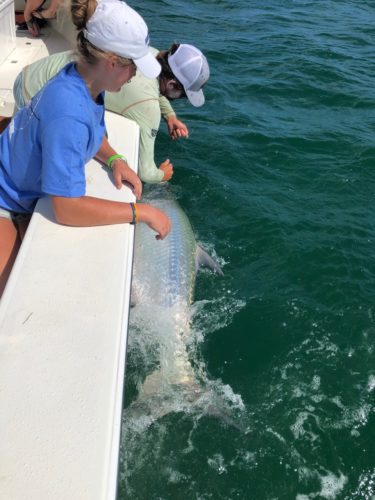
The weather hasn’t cooperated in a long time but as soon as it does, I’ll be out hunting tarpon. It’s a little early for the migration but while I’m waiting for the weather to change, I’ll be planning for the season. The boat is getting cleaned up, I just got the trolling motor tuned up and the outboard serviced. I’m rerigging my spin and fly tackle and tying flies in anticipation of one of my favorite times of the year. Tarpon are one of the premier gamefish that swim local waters and a noble adversary on any tackle. The migration gets into full swing during the month of May and generally runs into August and September for die-hard anglers. These fish are a test of any angler and tackle, running to over 200 pounds. The average runs an astounding 80 to 100 pounds.

We are blessed with some of the best tarpon fishing in the world and the local bars and inshore waters host some of the finest fly and spin fishing to be found anywhere. This isn’t a game of numbers and to the anglers who pursue tarpon it’s the hunt and the action that keep them on the bow for six to eight hours in the hot summer sun.

Tackle should match the size of the quarry and most anglers opt for a 20- to 30-pound spin outfit and 11 to 12 weight fly rod, line and reel. A heavy bite tippet is required because of the size of tarpon and their rasp-like mouth. Fly anglers generally use a 60- to 80-pound tippet while spin anglers choose 80- to 100-pound test. While it might seem like a difficult task to land a tarpon on the fly, or any tackle for that matter, anglers who knows the limits of their tackle can actually land a tarpon in a surprisingly short time. The key is to apply maximum pressure from the hookup never letting up. Neophyte anglers have a tendency to “baby” their tarpon in a misguided attempt to land them. The truth is that the longer you fight a tarpon the better chance you have of losing it.

A properly (IGFA approved) tied tarpon leader used by fly fishers usually runs between 10 and 12 feet and is tapered to properly deliver the fly. The leader includes a class tippet (weakest link) from 16 to 20 pounds that is doubled at both ends to soften the (shock) impact to the class tippet and bite tippet. Key to the whole equation is to have a very sharp hook as tarpon have extremely tough mouths.  Conventional leaders vary from angler to angler, but a doubled standing line tied to a leader and then to the bite tippet with a blood knot or Albright Special is recommended.

Flies vary from the classic splayed feather “Keys” style to more complex designs like the “Toad,” and various baitfish imitations. Some fly anglers are not concerned with actually landing a tarpon, preferring to just enjoy the hunt, the hook up and the jumps that usually follow the hook set. They use light bite tippets which allow the tarpon to work through the leader with their abrasive mouths. The key to landing tarpon on the fly is accuracy. The fly must be placed perfectly, move in a precise direction relative to the fish and be at the proper (fishes’) depth. Even when all of these factors come together, there’s still about a 50% chance that the tarpon will reject the fly.

The go-to bait for spin anglers is a live crab. Small blue crabs can be purchased from bait shops and pass crabs can be dipped from the local passes on a falling tide. Other effective baits include pinfish, threadfin herring and pilchards. Artificial lures like the DOA Bait Buster and the 4- and 6-inch shrimp, jigs and even top water plugs can be effective. Patience is a critical factor when fishing for tarpon, especially when fly fishing. The most successful anglers find the edge of a sand bar or other underwater feature that tarpon track, anchor in casting range and wait. Sometimes tarpon come at a steady rate but just as often there are long periods of time when the only thing to look at is the water. This really separates the good anglers from the great anglers. There are times when you need to move but knowing when and where is a skill that is developed and never mastered.

Once set up, the angler must be able to make a 40- to 50-foot cast to a location the size of a dinner plate. Placement of the fly cannot be overemphasized, because tarpon will seldom vary a foot or two from their path to eat a fly. Although there is always the rare exception, a fly must never travel in a path towards the intended target. A tarpon’s prey species wouldn’t survive long if it moved towards its aggressor, and tarpon know it. Besides moving away from the fish, the fly must move at the proper pace, be at the proper depth and never slow down when a tarpon is tracking it. Conversely you can’t move the fly too fast, taking it out of a tarpon’s range. If all this wasn’t demanding enough, once a tarpon decides to eat the fly an angler’s mettle is really tested.

Conventional anglers usually look for rolling fish in the near-shore Gulf and motor well ahead of them to intercept their path. Trolling motors can be effective for following a school in deep water but will spook them in the shallows. One thing that all tarpon anglers should practice is courtesy. Often a boat has been working long and hard to get properly set up for a shot and a boat running up on the fish will spoil the day for everyone. Tarpon are not trout and attempting to raise the rod to set the hook is a cardinal mistake. Fortunately, once a tarpon decides to eat there’s no need to make a lightning-fast hook set. When fly fishing, the right set is called a “strip strike,” which involves letting the line come tight and immediately setting the hook with a combination of the line hand and the rod. Conventional anglers should also have the patience to let the line come tight before attempting to hook the fish. Then the angler must at once work to set the hook in the cement-like jaw while being ready for the fish to bolt away from the boat.

After a fly angler’s initial hook set, attention must go immediately to clearing (getting the loose line off the deck) the line. In most cases the angler has been stripping in line when the fish bites and the hook is set. That line can easily foul on the angler, the rod or the reel. The protocol is to take your attention from the fish to the line at your feet. Hold the rod away from your body and let the excess line pass through your stripping hand in a circle made with the thumb and the forefinger. Once the line is “on the reel” set the hook with several more strip strikes, using the rod. Conventional anglers often use circle hooks which don’t require a hook set. They just need to let the line come tight and enjoy the action. In any case, a tarpon cannot be aware of the angler on the other end until the hook set.
While it’s important to exert maximum pressure on the tarpon during the fight, anglers must yield on jumps. On the jump the standard maneuver is to thrust the rod forward to relieve pressure on the line. This prevents the tarpon from breaking off if it lands on a taught line. This maneuver is known as “bowing to the king.”

It’s customary to start the engine and get as close to the tarpon as possible after the initial and subsequent long runs. This allows the angler to apply maximum pressure. If a tarpon is a hundred yards from the boat, the stretch of the line makes it impossible to apply any real pressure.

If you’re looking for a good jump shot here’s a great tip. When a tarpon makes any long run, motor close to it, applying only enough pressure to make sure the hook doesn’t dislodge. As soon as you are in place, frame the shot you want and then have the angler apply maximum pressure. Most times the tarpon will make a jump that’s close enough to the boat to get the angler and the fish in the shot. It’s not a sure thing, but when it works it can present an awesome photographic opportunity. Finally, don’t try and rush the tarpon when it gets near the end of the fight. Keep the pressure on but don’t clamp down and try to force the fish to the boat. In the end it’s a game of odds. Every time I think I’ve discerned a pattern, the tarpon teach me a new lesson! Good action can be found right through July and beyond for fly anglers while the best month for conventional anglers is generally June. Tarpon fishing is a challenging endeavor, but it’s well worth the effort when you finally get that first scale-rattling jump.

Now repeat after me, “I’ll remember all this, learn it and reread so I don’t make any mistakes.” Good luck with that, but I guarantee you those are some of the most exciting mistakes you’ll ever make.


Reel Time: Finding the silver lining?

There are a couple of old adages about finding a silver lining under a crisis. Right now, that might seem to be a bit Pollyannaish given the severity of the problem and the uncertain nature of the future. Still, I think it’s fair to say that most people are making the best of a bad situation, however that might be framed.

It was obvious on the curbs of my neighborhood on Monday, the day we have our trash and recyclables picked up. Piles of trash and overflowing recycling bins made it obvious that I wasn’t the only one taking the opportunity of cleaning, reorganizing and rethinking a number of personal options that being at home occasioned. Here are a couple of “epiphanies’” I had over the past two weeks.

I spend a lot of time at my desk both productively as in writing and editing images and video, and unproductively, i.e. scrolling through news stories, blogs and often questionable posts. Before the pandemic changed life as we had known it, I had planned an office remodel to free up space and make my working area more comfortable and functional. When COVID-19 changed everything, I was forced to rethink my space and my plans. The result was amazing; after cleaning, reorganizing and spending some time rethinking my options I found I had created a more functional and comfortable space with a lot less work and money. I started by replacing the handles on all the drawers and cabinets in my office, moving my mouse from the right side to the left side of my keyboard and purchasing a portable standing/sitting desk unit. The “desk” sits on my existing countertop, increased my effective space and allowed me to easily work standing up or sitting down. Another purchase was intended to keep my feet comfortable and warm. When I went online looking for a rug I found an ergonomic footrest that accomplished the intended task but also corrected my posture and made sitting for long periods of time less stressful. The bottom line was that my knee-jerk reaction to remove and replace had been replaced with a rethink and reuse paradigm.

That solution proved workable while social distancing at home but being an avid angler, I was also presented with the opportunity to rethink my need to get on the water. That led to outfitting my bike with a rod holder and exploring easily accessible options that only required a short bike ride. Suddenly I was bypassing closed boat ramps and finding action on local piers, bridges and beaches that didn’t require launching a boat, buying gas and all the other minutia a fishing trip often entails. Instead of committing most of a day to fishing I was getting out when the tide was right for fishing the pass and making short forays to local docks and piers. The new “lifestyle” also presented me with opportunities to organize and maintain my tackle, tie flies and practice my fly casting.

This new paradigm also made me rethink how to approach fly casting instruction in a time when one on one interaction is not advisable. It led me to the realization that I could encourage neophyte fly casters and experienced fly anglers who want to improve their craft to practice regularly while I provide teaching tips through www.rustychinnis.com/fly online videos.

As anglers we’re blessed that social distancing, a vital component of addressing this pandemic, doesn’t preclude us from getting out in the outdoors and pursuing our passion. I choose to fish alone. You’ll have to make that choice but I would encourage others to do the same except in the case of family members who we spend time with anyway. We certainly can’t frame this experience as positive and should consider helping others who aren’t as fortunate as us, but that doesn’t mean we can’t look to find some “silver linings” among the chaos.

It’s only common sense

Reel Time: It’s only common sense 

I’ve resisted writing about the Covid-19 threat and how it affects fishing and our lives here in Florida. Until now. Why the change? I think it’s incumbent on everyone to have a frank discussion of the potential threat this disease poses and to attempt to disseminate some information and ideas about the possible effects of the pandemic on those who love the outdoors.

It’s only common sense
Boaters trespassed on Passage Key this weekend. – Rusty Chinnis | Sun

If you’re like me – and I assume you are since you’re reading this column – you try to get out and enjoy the Suncoast at every opportunity. The unusually long stretch of beautiful weather and clear blue waters increases the volume on that siren song. Herein lies the problem and the need for exercising what seems to be in short supply, personal responsibility and common sense.

Consider the issue of boating and the closing of local boat ramps. While this move by local officials was deemed (correctly in my opinion) necessary to help stem the potential for the spread of the disease, it’s far from a perfect or complete solution. For one, it isn’t and probably never could be equitable to all parties. While some commercial interests are allowed to use a couple of local launch locations, working guides can’t. Add to that equation the fact that many boaters have vessels on lifts and access to private ramps and the tip of an ominous “iceberg” looms large over the boating community.

I’ve personally observed some troubling scenes this past week. On Saturday and Sunday hordes of boaters descended on popular spots like Passage Key, a restricted National Wildlife Sanctuary in Tampa Bay, and the Longboat Pass sandbar near Jewfish Key. While many boaters did respect the call to social distance, a distressing number of boaters did not, potentially endangering not only themselves but anyone they might come in contact with. This behavior threatens those who do follow the rules, not only with infection but their ability to responsibly enjoy the outdoors.

Here are a couple of suggestions of ways to safely and responsibly appreciate the weather and outdoors we’ve been blessed with. If you own a boat and have access to the water, go out by yourself or with no more than one or two other anglers if you have a large boat. If you do fish with someone else remember how easily this disease spreads and follow CDC guidelines and take the proper precautions.

If you’re an Island resident, try walking the beach. Besides snook in the surf you might encounter pompano, flounder and redfish, especially around structure. The same goes for access points in the bay where you can wade the flats for redfish, trout, snook (catch and release only) and a host of other species. There are also the local bridges that provide access to some excellent fishing opportunities for all local species including Spanish mackerel, which are excellent eating when prepared fresh.

Whatever your passion, please be cognizant of the threat this disease poses if we are not vigilant. So far, we’ve been spared from the full effects of the global pandemic but I fear the worst is yet to come. How we conduct ourselves now can have far-reaching effects in the future. Of course, there’s the possibility that we might be spared the worst of the outbreak. I hope I’m wrong about the threat, but I’d rather be wrong and safe than dismissive of the risk and reap the potential grim results. A quote by the fly fishing savant Lefty Kreh keeps coming to mind – “It’s only common sense, only common sense ain’t so common.”  Please do your part, it could mean your life or the life of one you love.

Reel Time: Any given kind

Some of my fondest memories over the years have been spending time with and experiencing the wit and wisdom of some of fishing’s most talented and engaging personalities.

One of those people was Vic Dunaway, longtime fishing editor of the Miami Herald and a co-founding editor of Florida Sportsman Magazine. I’ll always remember his quip when someone ask him what his favorite rod was. The author and humorist with a twinkle in his eye would answer, “Any given kind.”  Unfortunately, outdoor writers have been branded over the years as a group of individuals (sometimes warranted) that write favorable articles for products given to them by tackle companies hoping for a good review in the outdoor press. Dunaway could get away with that joke because he didn’t fit that mold. To Dunaway, his readers were far more important than any tackle, however it was obtained.

Any given kind
The Bull Bay Sniper rod did an admirable job of subduing this snook (released after the picture) while telegraphing the excitement of the catch. – Rusty Chinnis | Sun

That memory resurfaced recently when I decided that I needed to upgrade my spinning tackle. I’d been following the advances in rod materials and design with regards to my fly tackle but I hadn’t gotten a new spinning outfit in over a decade. During a conversation about fly fishing with my good friend and tackle representative Rick Hess, I brought up my need to upgrade my spinning tackle and he mentioned a rod company whose line he was representing. I had forgotten that conversation until about a month ago when I attended the Manatee Chapter of the Coastal Conservation Association banquet in Palmetto. I thought that would be a perfect opportunity to buy a new outfit while supporting the iconic conservation organization. I purchased a new Shimano spinning reel there but never found an outfit that matched my needs.

I had heard of Bull Bay Rods but had never seen or used one when Hess told me not to buy a rod until I had a chance to try one. I instantly loved the fit and feel of the Sniper Series rod he picked and it matched my reel perfectly. On my first time out, a quick bike ride to the Longboat Pass Bridge, I caught three mackerel and was sold. The rod is beautifully made, light and responsive for all fish, has fast action and the backbone to fight bigger fish.

Bull Bay Rods was founded as a custom rod company by father and son team Kelly and Dustin Phillips in 2012. The Phillips had been disappointed in the service they had received after the breakage of some off the shelf tackle they had purchased. A few years later they partnered with Mike Anderson, host of the Reel Animals Fishing TV and Radio show, and in 2015 they launched their first custom line. Since then they have expanded into multiple lines servicing inshore, offshore and freshwater anglers. The rod Hess suggested for me was their Sniper Series that, as its name implies, was built for long, accurate casts. Although I didn’t have to pay for the rod, I made sure that there were no strings attached. I made him aware that I would never represent a product to my readers that I wouldn’t use myself. I had no problem like that with this rod. On my second outing, I sight fished a nice snook and really got to test the rod. As advertised, the rod allowed me to make an accurate cast, and when the snook hit my jig I was impressed with the way it handled the runs and jumps while telegraphing the best of the experience. I can in good faith offer a positive endorsement to my readers. Since we all have individual tastes and needs, I would advise readers to try one and make their own decisions. If you want more information on Bull Bay Rods, visit their website. You can experience the feel and purchase a rod locally at Discount Tackle in Bradenton.

Protecting paradise

I don’t think it’s a stretch to call where we live paradise. I hear first-time visitors say that all the time. Many, including me, never leave and that’s part of the problem that can and needs to be part of the solution.

Pulitzer Prize-winning author to speak

When I read Jack Davis’ book “Gulf, The Making of an American Sea,” I was amazed to learn what a paradise this was at one time. After reading Davis’ book, one might at first change their opinion of the area to “paradise lost” if not for the message of hope that it portrays. Consider the fact that some areas of the Gulf coast including Tampa Bay at one time had lost over 80% of their vital seagrass habitat. That was due mostly to wastewater discharges from sewage plants and dredging for ports and residential waterfronts. Today the seagrasses have recovered to almost historical levels. That’s the good news; the bad news is that the trend is starting to reverse. That’s concerning, especially when you consider that some 2.3 million people live in the counties bordering Tampa Bay (including Anna Maria), nearly six times the 1950 population of around 400,000 people. The current population has increased by 13% in just 10 years and is projected to increase at a faster rate.

Protecting paradise
Pulitzer Prize-winning author Jack Davis addresses “Brunch For The Bay” supporters. – Rusty Chinnis | Sun

That’s why I was attending Suncoast Waterkeeper’s yearly fundraiser, “Brunch for The Bay,” on Sunday, March 8 at the Bradenton Yacht Club. Suncoast Waterkeeper (suncoastwaterkeeper.com) is a Sarasota-based organization that is leading the way in helping to hold polluters of our coastal waters accountable. Davis was the event’s guest speaker and his talk echoed the message of the book. If I had to sum it up in a few words it was there’s hope, but only if the people who call this paradise home get involved. That’s just what Suncoast Waterkeeper’s “Sick of Sewage” campaign is doing. In the last three years the organization, founded by environmental attorney Justin Bloom, has successfully filed lawsuits holding municipalities including Sarasota, St. Petersburg and Safety Harbor accountable under the statutes of the Clean Water Act.

The problem now is the aging infrastructure that has resulted, in Sarasota County’s case, in the release during the last decade of over a billion gallons of partially-treated, nitrogen-rich wastewater into Philippi Creek and Sarasota Bay. When confronted with the issue, the county did the right thing settling with the stipulation that they would convert to an advanced wastewater system and contribute to organizations like the Sarasota Bay Estuary Program that work to enhance and protect the bay.

One of the big takeaways I got from listening to Davis speak was that we should all refrain from using the term red tide and instead refer to it as what it is, a harmful algae bloom. The term red tide has been used to dismiss these devastating events as natural and therefore attempting to absolve those responsible for the increased nutrients that have led to over a 500% increase in the number of blooms, their intensity and duration since 1950. That’s a number directly proportional to the population growth, according to marine researchers.

The take-home message was that we all need to get involved in protecting paradise. The solution begins at home by limiting the use of fertilizers and pesticides and eliminating grass on our lawns. At the same time, we should all support groups like Suncoast Waterkeeper, which are holding polluters accountable, initiating water testing in public waterways used by the public and committing to environmental education. The same goes for Sarasota Bay Watch, an organization with plans to release 1 million clams in the bay in 2020 that work to clean our waterways and bay islands. Their motto, “A Healthy Bay is Everybody’s Business,” rings true. Paradise lost should never be an option.

Manatee CCA banquet a huge success

Manatee CCA banquet a huge success

I attended the 2020 Manatee County Coastal Conservation Association (CCA) banquet at the Manatee County Convention Center in Palmetto on Feb. 27. That night, close to 1,000 anglers and conservationists were in attendance to show their support for one of the CCA’s largest and most active chapters.

It was great to see the commitment local sportsmen have for not only the fish that swim Florida’s salt waters but the habitat that supports them. The fact that this organization had its beginnings right here on Anna Maria Island made the experience all the more satisfying.

The CCA is a non-profit organization with 17 coastal state chapters spanning the Gulf of Mexico, the Atlantic seaboard and the Pacific Northwest. CCA had its beginnings in 1977 after commercial overfishing along the Texas coast decimated redfish and speckled trout populations.

In response, 14 concerned recreational anglers created the Gulf Coast Conservation Association (GCCA) to combat overfishing. The stewardship started with a Save the Redfish campaign, and by 1985, chapters had formed along the Gulf Coast. That year I joined Captain Scott Moore, Cindy McCartney, Captain Jim O’Neill, Pete Turner, Mac Smith and other concerned anglers to form the Manatee Chapter of the then Florida Conservation Association (FCA), which became the state’s fifth chapter. The timing was auspicious as GCCA organizer Bruce Cartwright was in Florida organizing state chapters and helped guide us in absorbing and disseminating the group’s message.

In 1986, FCA successfully intervened in lawsuits filed by commercial interests opposing Spanish mackerel recovery plans establishing the FCA as a force for positive change that would make huge strides toward protecting and enhancing coastal fisheries.

In 1987, the CCA was also successful in stopping purse-seining of spawning redfish in the Gulf of Mexico in response to the “blackened redfish” craze. That year the FCA merged with the Everglades Protection Association and joined with CCA in efforts to bring about a management plan to protect billfish from longline fishing vessels.

In 1988, the FCA won a four-year battle to achieve gamefish status for Florida’s depleted redfish stocks. Redfish became the first species since 1957 to be removed from Florida’s market. That same year, the U.S. Secretary of Commerce signed an FCA-supported management plan for billfish, marking the first time federal authorities have declared a gamefish in federal water.

By the early 90s, the mid-Atlantic region and New England all had active chapters. Washington and Oregon chapters were formed in 2007. The CCA has participated in virtually every national marine fishery debate since 1984. In the federal court system, CCA’s legal defense fund has been used to defend net bans, fight for the implementation of bycatch reduction devices, support pro-fisheries legislation and battle arbitrary no-fishing zones.

Now in the 21st century, the CCA network is engaged in hundreds of local, state and national projects supporting conservation efforts. The CCA has been a strong supporter of Sarasota Bay Watch’s clam restoration project and donated at the recent Scallopalooza Fundraiser to increase the impact of their “A Million Clams in 2020” initiative. CCA funding has initiated scientific studies, funded marine-science scholarships, built artificial reefs, created finfish hatcheries, supported hydrologic and contaminant studies, monitored freshwater inflows, supported local marine law enforcement and much more.

Through broad-based recreational angler support, a strong legal and legislative presence, decades of experience and an unwavering vision for the future of U.S. and global marine resources, the CCA battles for the sustainable health of our coastal fisheries and for recreational anglers’ interests. You can support the Coastal Conservation Association’s mission; join the Manatee Chapter.

Reel Time Scallopalooza It's Clamtastic

Reel Time: Scallopalooza, It’s Clamtastic

Sarasota Bay Watch (SBW) held its 10th Annual “Scallopalooza, It’s Clamtastic” fund-raising event at their new venue, Sarasota’s Hyatt Regency Hotel. on Saturday, Feb. 15. The yearly event sold out and exceeded all expectations as close to 450 people showed up to demonstrate their support for the group’s efforts to protect and enhance the health of Sarasota Bay. Attendees from Sarasota and Manatee counties were represented as well as officials from both counties and environmental groups including the Sarasota Bay Estuary Program, Mote Scientific Foundation, START, Suncoast Waterkeeper, Longboat Key Turtle Watch, Save Our Seabirds, Coastal Conservation Association, The Gulf Coast Community Foundation, Mote Marine Laboratory, The Gulf Shellfish Institute, Science and Environmental Council of Southwest Florida, New College and Saint Stephen’s just to name a few.

A number of annual attendees commented that they were “blown away” by the outpouring of support for an organization that was formed in 2007 in the aftermath of one of the area’s massive red tide events. SBW’s event coordinator, Ronda Ryan, worked with event planner Laura Detwiler, the SBW board and Scallopalooza Committee Chairs Brian Jung, Al Jeffery, John Ryan and Ernesto Lasso De La Vega to organize an event that had a seasoned activist overheard commenting that SBW was “more than a little found!”

The evening began with live music, an open bar and a huge silent auction including artwork, event tickets and merchandise of every description as participants mingled to share their passion for Sarasota Bay. Event Chair Brian Jung welcomed the crowd and thanked them for their support while keeping everyone apprised of the auction items and encouraging them to visit the tables. John Ryan, a founding member of Sarasota Bay Watch, was next and explained the purpose of the event as well as SBW’s many projects including island cleanups, student educational activities, plans for the future as well as updating participants on the group’s program in progress to introduce 1 million clams into Sarasota Bay in 2020. This effort got a huge boost in 2019 with a $106,000 donation from the Marjory and Charles Barancik Foundation. Jung related the impact of clams on the health of the bay and how funds raised at the event will support those efforts.

In an emotional speech, Sarasota’s Barbara Sucoff, an SBW supporter who learned about the group’s efforts at a “Friend Raiser” event at the VUE condominium with her late husband Jim Ninivaggi, spoke of the legacy he wanted to and did leave supporting SBW’s efforts. WWSB TV’s Channel 7 weatherman Bob Harrigan, one of the area’s most popular and respected broadcasters and the emcee for the live auction gave a rousing speech lauding the group’s efforts and encouraging them to bid on a trip with award-winning local celebrity Captain Scott Moore and a package of premier tickets to the Tampa Bay Bucs football games. Harrigan has been promoting the group’s efforts since the beginning and recounted the segment he did with Sarasota’s Captain Jonnie Walker during SBW’s first-ever Scallop Search in 2008. Moore then took the stage and recounted his life-long love affair with Sarasota Bay and his commitment to protecting it, beginning with the formation of the Manatee County Chapter of the Florida Conservation Association in the 1980s until today. He then proceeded to up his offering from one day to two, offering trips from Sarasota Bay to Charlotte Harbor.

Both auction items were heavily bid on and raised thousands of dollars for the group’s efforts. At press time the totals of the evening’s proceeds that will be put to work in Sarasota Bay were not available but early estimates are that they will far exceed those of previous events.

To get involved with the work SBW is doing to protect Sarasota Bay and support its mission, visit their website. As they say, “A Healthy Bay is Everybody’s Business,” literally and figuratively!

Reel Time: “Fish farm” proposal troubling

On Tuesday, Jan. 28, I attended an EPA public comment session at Mote Marine Laboratory. The hearing gave the public an opportunity to speak to a proposed draft permit to test the raising of almaco jacks in a pen anchored in 140 feet of water off the coast of Sarasota.

Kampachi Farm LLC’s project, known as Velella Epsilon, would be the first of its kind in the nearshore Gulf waters. I stayed late to listen to the comments that included close to 70 speakers, each having three minutes to express their opinion. The vast majority spoke against the project, most passionately. Of those that spoke in favor, the majority had an interest in the project, most financially. I too spoke, not against aquaculture in general (although I have some problems here as well) but specifically to locating this project in an area that experiences major harmful algae blooms.

Reel Time
Citizens prepare to address EPA officials presiding over the public comment session at Mote’s WAVE Center. – Rusty Chinnis | Sun

Most of the speakers had similar issues, expressing their skepticism that an operation that concentrates fish (up to 20,000) and the associated waste generated would even be considered in such an area. Then there is the use of antibiotics and other potential issues that might develop with the interaction of farm and native species as well as hurricanes. The operations that feature the technology being considered are generally deployed in ocean waters hundreds of feet deep with better circulation patterns and even those have a spotty environmental record. This one would be in only 140 feet.

By far most objections centered around the possibility that red tide blooms might be exacerbated by the operation. Many also pointed to the fact that, if approved, the technique could be deployed at scale creating even more and larger operations. Most who spoke seemed incredulous that this kind of operation would even be considered given the insults the Gulf has already experienced and experiences on a regular basis such as the Deepwater Horizon oil spill and the Dead Zone at the mouth of the Mississippi River.

Given that it’s possible to do this kind of farming in land-based, closed systems where water is filtered and reused, it seems that this is not a good option. Then there’s the issue of how this is being handled and the review process itself. Justin Bloom of Suncoast Waterkeeper gave a compelling presentation about the legal as well as environmental ramifications surrounding the EPA process and how it’s not being given the review it deserves.

It will be interesting to see how this develops as I’ve heard people state that the project is a “done deal” and the state and the EPA are just going through the motions with the hearings. I can tell you from my experience that the people who cared enough to be there and comment were overwhelmingly against the project. Those of us who live, work and play in and on Suncoast waters should be aware of this and other potential threats to the Gulf and Bay. The outcome will affect the waters that provide us recreational opportunities and enrich our lives, but also our livelihoods, whether we are waterfront restaurant owners or carpenters driving nails in Lakewood Ranch.

Then there’s the biggest question of all, what are we leaving our children and future generations?

Reel Time: Get in on the hot winter action

Until recently, Gulf water temperatures have been surprisingly warm. It’s always been typical for a cold front to send water temperatures plummeting, after which a warming trend will send them back into as warm as the mid-70s on the flats. For most anglers, the first cold front of the season means getting out of the water and away from some of the hottest action of the year.

If you think of wade fishing as a summertime activity, you’re missing the boat. Winter wading can be extremely productive and will give you a definitive advantage over your boat-bound comrades. When you get out of the boat and in the fish’s domain in the winter, you gain the same advantages you do in the spring, summer or fall and then some. When the water is cold it is often very clear, and the fish can be very wary. Proper winter wading allows you to keep a low profile and make a stealthy approach while staying warm and dry.

Get in on the hot winter action
Captain Bryon Chamberlin prepares to release a winter red in upper Tampa Bay. – Rusty Chinnis | Sun

When the fish are particularly spooky, I employ another tried and true winter wading technique – standing still! If you find that the fish you’re stalking see you, just before you see them, try this method. Start by locating an area that is holding your quarry. Anchor well away from the action, get out of the boat, and stake out a pothole or sand area. By staying a long cast away, you can easily see the fish when they enter a hole or pass across the white sand bottom. Position yourself off to the side in the grass where you’re less visible, keep a low profile and be still. By just waiting them out, you can target reds, trout and snook as they wander the flat. Don’t make any quick moves, and make your casts low and slow. It takes patience but can be very productive.

If the visibility isn’t great, or you’re fishing early or late, target the edges where grass and sand meet. These sandy areas (the seams) and potholes are perfect ambush spots. Start with presentations about 2 feet outside the sandy area. Make sure you target the deep grassy ends of the potholes. These areas can be very productive and always warrant a couple of casts.

After working the ledges of the holes and the seams, begin casting into the sandy areas. When fly fishing, try a clear sink tip line with a relatively (6-8 foot) short leader. The clear tip allows you to fish the far side of a hole without spooking the fish. If you’re fishing live bait plugs or jigs, work up to the leading edge and then cast well past the hole or seam and skip your bait back into the hole or the edge of the seam.

Over the last two winters, we have been having some excellent success with big trout on cold, low tide mornings. The fish will come into some extremely shallow water to feed, so start shallow and work your way towards the deeper edges. As with other times of the year, stay vigilant for surface action, wakes or feeding birds.

The key to productive and comfortable winter wading is, of course, staying warm. A good pair of waders, wading boots, sweatpants and insulating socks will do the trick. Add a pair of polarized glasses, a hat with a dark under-brim, a wade vest or pack, and you’re in business. Give winter wade fishing a try. It gets you out of the boat, provides some exercise, and some excellent angling opportunities.

Related coverage


Reel Time: Scallopalooza: It’s Clamtastic!