Tag: red tide

Red tide health alert issued for three locations

BRADENTON BEACH – The Florida Department of Health in Manatee County (DOH-Manatee) has issued health alerts due to the presence of red tide at the 10th Street Pier, 100 10th St. S. and the Coquina Beach South Boat Ramp, 1465 Gulf Drive S. in response to water samples taken on Nov. 18.

The red tide health alert issued on Nov. 15 for the former location of the Rod and Reel Pier, 875 N. Shore Drive, Anna Maria, remains in effect.

The red tide organism, Karenia brevis, was observed at very low to medium concentrations in Manatee County by the Florida Fish and Wildlife Conservation Commission (FWC) on Nov. 18.

Medium concentrations were reported at the Longboat Pass Boat Ramp. Low concentrations were reported near the former location of the Rod & Reel Pier and at Coquina Beach and Cortez Beach. Very low concentrations were reported at the Palma Sola Bay Bridge.

Fish kills suspected to be related to red tide were reported to FWC’s Fish Kill Hotline over the past week offshore of Manatee County, according to the FWC.

Residents and visitors are advised to take the following precautions if near affected areas:

• Look for informational signage posted at most public beaches and/or check current water quality status at Protecting Florida Together;

• Do not wade or swim in or around red tide. Red tide can cause skin irritation, rashes, and burning/sore eyes;

• Wash your skin and clothing with soap and fresh water if you have had recent contact with red tide, especially if your skin is easily irritated;

• Remain cautious and stay away from these locations, especially if you have chronic respiratory conditions;

• Residents living in beach areas are advised to close windows and run the air conditioner. Make sure the air conditioner filter is maintained according to manufacturer’s specifications; and

• Do not harvest or eat molluscan shellfish or distressed or dead fish from these locations. If caught alive and healthy, finfish are safe to eat as long as they are filleted and the guts are discarded. Rinse fillets with tap or bottled water.

Red tide can cause illness and death of other animals, such as pets and livestock. Keep animals away from and out of the water and away from dead marine life. If your pet swims in waters with red tide, bathe it with soap and water as soon as possible.

More than $3.5 million approved for manatees, red tide research

WASHINGTON – Federal funding is coming to Florida to support two environmental initiatives critical to the state – the protection of manatees and harmful algal bloom research.

A press release from Congressman Vern Buchanan’s office announced that the U.S. House of Representatives unanimously passed two of his amendments to the Interior and Environment government funding bill.

The first proposal dedicates $1.15 million for the rescue and rehabilitation of manatees.

In October, the Florida Fish and Wildlife Conservation Commission (FWC) began the process to consider reclassifying manatees from “threatened” to the more critical “endangered” status under the Endangered Species Act (ESA). Buchanan introduced the Manatee Protection Act to officially uplist the marine mammal in 2021.

According to the FWC, almost 2,400 manatees have died in Florida since 2021, and the U.S. Fish and Wildlife Service (FWS) estimates that there are approximately only 6,500 West Indian manatees in Southeastern U.S. waters.

The ESA defines a threatened species as “any species which is likely to become an endangered species within the foreseeable future throughout all or a significant portion of its range.” Threatened species receive protection through separate regulations issued under Section 4(d) of the ESA.

The ESA defines an endangered species as “any species which is in danger of extinction throughout all or a significant portion of its range.” Endangered species are automatically protected by prohibitions of several types of “take,” including harming, harassing, collecting or killing, under Section 9 of the ESA.

According to the National Oceanic and Atmospheric Administration (NOAA), a species must be listed if it is threatened or endangered due to any of the following five factors:

1. Present or threatened destruction, modification or curtailment of its habitat or range;

2. Overutilization for commercial, recreational, scientific or educational purposes;

3. Disease or predation;

4. Inadequacy of existing regulatory mechanisms; and

5. Other natural or human-made factors affecting its continued existence.

In 2016, Buchanan objected to the FWS downgrading the manatee’s designation from endangered to threatened, saying the FWS may have been using outdated data to support the reduction in protection. The manatee had been listed as an endangered species since 1966.

The second proposal will provide $2.5 million to the National Water Quality Program to enhance research into harmful algal blooms, including red tide.

“Over the last several years, the Gulf Coast has experienced severe levels of red tide,” Buchanan said. “Red tide is caused by toxin-producing algae that is extremely deadly to fish and other marine life and adversely affects tourism in the Suncoast region.”

In 2022-23, Manatee County cleared nearly 5 tons of dead fish and debris from area beaches due to a red tide outbreak.

“These commonsense proposals will help ensure the survival of the iconic Florida manatee and combat red tide, which for too long has wreaked havoc on marine life, our waters and the many businesses that rely on Florida’s tourism-based economy,” Buchanan said. “I am very pleased to see these measures pass with broad bipartisan support and look forward to working to see them enacted into law.”

According to Buchanan’s office, he also introduced the Protecting Local Communities from Harmful Algal Blooms Act, which would amend the Stafford Disaster Relief and Emergency Assistance Act to include algal blooms in the definition of a “major disaster.” This change would require the Federal Emergency Management Administration (FEMA) to provide both technical and financial assistance to states suffering from outbreaks of harmful algal blooms like red tide.

Reel Time: If we don’t do it, who will?

Reel Time: If we don’t do it, who will?

Red tide; two words that nobody wants to hear but everyone needs to understand. The term is just the common expression of the much deeper problem best described as harmful algae blooms (HABs). Someone who owns a resort hotel, has a restaurant on or near the beach or runs a business that takes people fishing or sightseeing obviously depends on clean, healthy water for their livelihood. It’s easy for the average person to see that these businesses will be negatively affected by HABs or even the mere mention of them. What’s less obvious is that poor water quality and habitat loss (seagrasses, mangroves) affects everyone, from fishing guides to developers, realtors, builders and all the allied trades and suppliers they all depend on.

We seem to only focus on the things that directly impact us in the present, finding it easier to “kick the can down the road.” Maybe we should consider how we’ll feel when our children and grandchildren look us in the eye and ask, “What did you do to make sure I had some of the same opportunities that you did?”

Second Place
Serious Column (Sally Latham Memorial award)
2024

Things took a devastating turn five years ago with a massive and long-lived harmful algae bloom (red tide) that devastated coastal waters from Naples to St. Petersburg, rendering Sarasota Bay a virtual wasteland. Since that event, Sarasota Bay has lost more grass than had regrown in the prior 40 years.

On top of that, a release of over 200 million gallons of polluted process water from the legacy phosphate facility at Piney Point in late March 2021 led to the worst algae bloom in Upper Tampa Bay since the 1970s, killing thousands of tons of sea life.

Resident anglers have seen firsthand the decrease in water quality and the resulting loss
of habitat, seagrass and its negative effect on local fisheries. Unfortunately, those who recently relocated here have no understanding of what has been lost and what that means for future anglers. The concept of “shifting baseline” describes a gradual change in the accepted norms for the condition of the natural environment due to a lack of past information or lack of experience of past conditions.

It’s critically important that we vet the politicians who represent us and are charged with enacting rules and regulations to protect our natural resources. A good source of that information is the League of Conservation Voters (lcv.org). The LCV is non-partisan and tracks the voting records of members of the Senate and Congress on environmental issues in its National Environmental Scorecard. This is a clear indication of how those tasked with representing our interests vote. It’s critical that we take decisive action now.

Research candidates before you cast your vote and consider joining and working with advocates like Suncoast Waterkeeper and their Eyes On The Suncoast Program, Vote Water and Sarasota Bay Watch. If we don’t do it, who will?

Local crews keeping beaches clean

Local crews keeping beaches clean

ANNA MARIA ISLAND – After more than three weeks of west winds pushing red tide and subsequent dead fish toward local Gulf of Mexico beaches, an easterly wind shift on Thursday gave some beachgoers a slight respite.

“We’ve been fighting the west wind for weeks,” said Mark Taylor, Manatee County Natural Resources employee and the operator of a mechanical beach-cleaning rake. “We appreciate a little break, the east wind is our friend.”

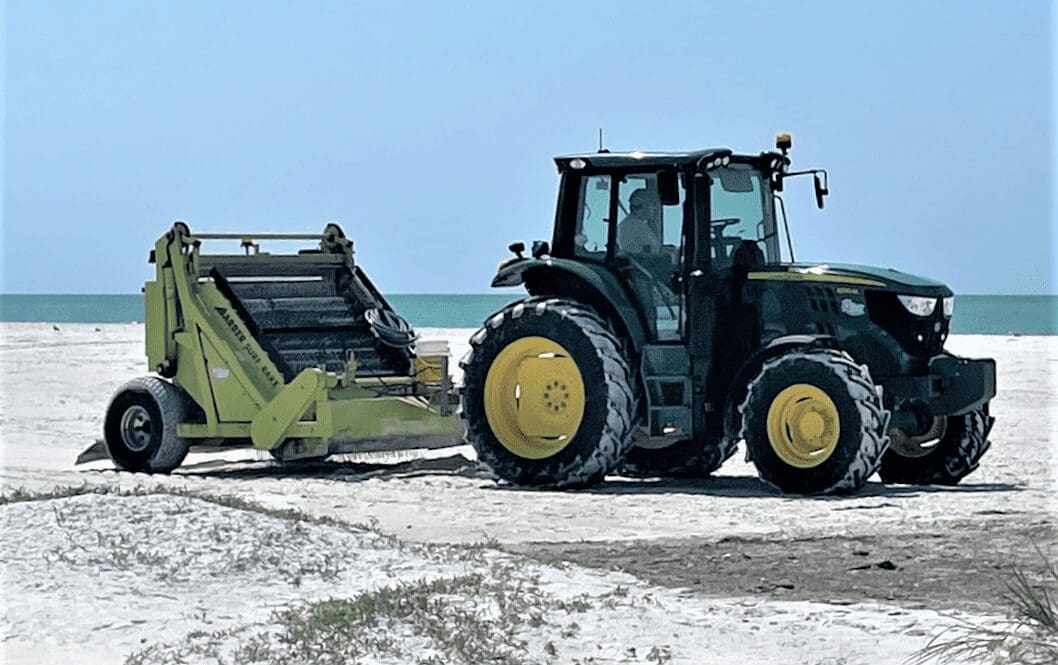
The beach rake that Taylor drives along the beaches has a spring-loaded conveyer with stainless steel tines that scratch the surface of the sand and pick up debris, including dead fish.

“We try to do the public beaches first,” he said. “That’s our priority always. They populate early with fish and it’s been a heavy amount of them.”

The fish go up the belt and are dumped into a 2-yard hopper on the back of the apparatus.   When the hopper is full, Taylor backs up the vehicle to dumpsters at Manatee Beach, Coquina Beach and Bayfront Park and empties the load.

Rather than doing his normal run along Manatee and Coquina beaches, Taylor was sent to the northwest end of Anna Maria Island on Thursday, where the beaches were littered with dead fish.

“The wind is pushing it in today to Bean Point from the rocks and to Bayfront Park,” he said Thursday.

The predominant types of fish Taylor is seeing on the shore are catfish, pinfish and baitfish.

“The eels, the catfish and the baitfish come first,” Taylor said. “I’m seeing Spanish mackerel, pelagic, and grouper. Today I dumped a load of fish and one large grouper was in there, probably about 3-foot long.”

At Bean Point on Thursday, dead fish were scattered from the shore to the dune lines more than 60 feet away.

“The full moon we had recently and the huge tides washed the fished up to about a 100-foot span,” said Liza Click, supervisor of the Manatee County Property Management Grounds Division. “We’re seeing sheepshead, trout, catfish, dogfish, a lot of mullet and an occasional big grouper washed up on the sand.”

The county has four rakes to cover the local beaches and has been operating three of them recently.

“This past Sunday we had three beach rakes going off,” Click said on Thursday. “Winds play a big part in our day. Today was a great day.”

Click, who operates a beach rake, said her day begins at 4:30-5 a.m.

“The good thing is, we’re not in turtle season so I can get out there early,” she said. “I start at Coquina and once I get to Cortez, I’m closer to the buildings and I can get done by 6 or so.”

Click said the dumpsters where the fish are disposed of are emptied three times a week, and the county is getting ready to put down lime under the dumpsters to alleviate the odors of dead fish.

Taylor said that so far the fish kills are less than he saw during the heavy red tide of 2018.

“It’s not as bad as ’18 was,” he said. “In ’18 we had much larger quantities of fish on the beach.  We’re able to manage right now. We had to bring everybody out in ’18. I worked 28 12-hour nights and days then.”

In 2018, Taylor said there was a run of dead horseshoe crabs along with the fish.

“What’s interesting is at Bayfront is primarily bay species. It’ll be mullet and trout and sheepshead,” he said. “And then out front (in the Gulf), you’ll get the grouper and the mackerel and maybe a pompano even.”

Taylor said thus far, the fish cleanups have been manageable for county crews.

“At some point, we have the beach clean each day right now,” he said.

Red tide intensifies

For the first time this year, some local waters are showing high levels of red tide.

Water samples taken on March 10 at Longboat Pass showed high concentrations of the red tide organism Karenia brevis, according to the Florida Fish and Wildlife Conservation Commission (FWC). High levels can cause respiratory irritation, shellfish harvesting closures, probable fish kills, water discoloration and detection by satellite.

Red tide levels were reported as medium at Kingfish Boat Ramp on Anna Maria Sound just east of Anna Maria Island and at the Rod and Reel Pier in Anna Maria. Medium levels can cause respiratory irritation, shellfish harvesting closures, probable fish kills and detection by satellite.

Palma Sola Bay registered low levels of red tide.

According to the FWC, red tide was observed at low to high concentrations in 12 samples collected in Manatee County, background to high concentrations in 38 samples collected in Pinellas County and background to high concentrations in 51 samples collected in Sarasota County.

For updated information on red tide, visit the Red Tide Respiratory Forecast at RedTideForecast.com, which tells beachgoers what red tide impacts are expected to be at individual beaches at different times of the day. The forecast is also available in Spanish at PronosticoMareaRoja.com.

Beachgoers also can get updates at visitbeaches.org, the Mote Marine Laboratory beach conditions reporting system, which documents respiratory irritation and fish kills at local beaches.

Call 866-300-9399 from anywhere in Florida to hear a recording about red tide conditions throughout the state.


Onshore winds, strong currents stir up red tide on AMI

Onshore winds, strong currents stir up red tide on AMI

HOLMES BEACH – What a difference a few days and some strong winds can make.

While red tide reports from several days earlier showed low concentrations of Karenia brevis, the organism that causes red tide blooms, conditions changed on Sunday.

With winds out of the west at more than 23 mph churning up the blooms in the Gulf of Mexico and pushing them toward Anna Maria Island beaches, the unmistakable smell – and feel – of red tide permeated a largely empty Manatee Beach.
One visitor from New York was coughing profusely as she left the beach Sunday morning.

“I wanted to see the beach, but I have asthma and I couldn’t stay long,” she said. “I started coughing almost immediately. This is too much for me.”

Some people experience respiratory irritation (coughing, sneezing, tearing and an itchy throat) when red tide is present and winds blow onshore, according to the Florida Fish and Wildlife Conservation Commission (FWC), while offshore winds can keep respiratory effects experienced by those on the shore to a minimum.

Red tide produces toxins capable of killing fish, birds and other marine animals. The toxins can also cause health problems in humans, including respiratory irritation when wave action breaks open red tide cells and the toxins become airborne, according to the FWC.

The Florida Department of Health advises people with severe or chronic respiratory conditions, such as COPD, emphysema or asthma, to avoid areas with red tide.

Red tide affects Manatee County waters

ANNA MARIA ISLAND – The Florida Department of Health in Manatee County has issued an alert for the presence of red tide in local waters.

Based on samples taken Nov. 7, a red tide bloom in varying degrees was shown at Bayfront Park, Coquina Beach South, Longboat Pass/Coquina Boat Ramp and Rod & Reel Pier in Anna Maria.

The Florida Fish and Wildlife Conservation Commission (FWC) red tide status map on Nov. 17 showed a range in concentrations from very low at Rod & Reel Pier to medium at Longboat Pass.

Red tide is a type of algal bloom caused by high concentrations of Karenia brevis, a microscopic algae found in the Gulf of Mexico.

Wind and wave action can break open K. brevis cells and release toxins into the air, according to the health department. People should monitor conditions and use caution when visiting affected water bodies. Those in coastal areas can experience eye, nose and throat irritation during a red tide bloom. Some individuals with chronic respiratory conditions, like asthma or chronic lung disease, might experience more severe symptoms.

Red tide typically forms naturally offshore, commonly in late summer or early fall, and is carried into coastal waters by winds and currents. Once inshore, nutrient sources may fuel growth, according to the health department.

Soon after Hurricane Ian hit, some areas to the south of Manatee County experienced high levels of the toxic algae and local water quality experts were uncertain whether or not it would spread to the north.

“I never predict,” Dr. David Tomas- ko, executive director of the Sarasota Bay Estuary Program, told The Sun in October. “Hopefully, this doesn’t get bigger. The wind is out of the west pushing water toward shore – that’s not going to help us.”

According to the FWC on Nov. 17, “Reports of fish kills suspected to be related to red tide were received over the past week in Southwest Florida in Manatee, Sarasota, Charlotte and Lee counties.”

Also on Nov. 17, the FWC website stated that respiratory irritation suspected to be related to red tide was reported over the past week in southwest Florida in those same areas.

“Red tide toxins can also affect the central nervous system of fish and other marine life, which can lead to fish kills and increased wildlife strandings or mortalities,” a DOH press release stated. “Eating contaminated seafood can cause neurotoxic shellfish poisoning in humans.”

“Please note that it is safe to eat shellfish that are commercially harvested and sold in fish markets, restaurants and other outlets,” the Mote Marine website states. “Florida has a well-established monitoring program for all commercial shellfish beds and these beds are closed when affected by red tide or other environmental conditions.”

For local shellfish harvesting status results, visit the Florida Department of Agriculture and Consumer Services.

The FWC collects and analyzes red tide samples and results are updated daily. Status updates are issued twice weekly during blooms.

To hear a recording about red tide conditions throughout the state, call the toll-free hotline at 866-300-9399.

To report fish kills, contact the Florida Fish and Wildlife Research Institute on the FWC reporter app, call 1-800-636-0511, or report online.

The DOH warns the public to take the following precautions in and around affected areas:

• Look for informational signage posted at most beaches.

• Stay away from the water.

• Do not swim in waters with dead fish.

• Those with chronic respiratory problems should be especially cautious and stay away from affected locations as red tide can adversely affect your breathing.

• Do not harvest or eat shellfish, distressed or dead fish from affected locations. If caught live and healthy, finfish are safe to eat as long as they are filleted and the guts are discarded. Rinse fillets with tap or bottled water.

• Wash your skin and clothing with soap and fresh water if you have had recent contact with red tide.

• Keep pets and livestock away from and out of the water, seafoam and dead sea life. If your pet swims in waters with red tide, wash your pet as soon as possible.

• Residents living in beach areas are advised to close windows and run the air conditioner, making sure that the A/C filter is maintained according to manufacturer’s specifications.

• If outdoors near an affected location, residents may choose to wear masks, especially if onshore winds are blowing.

To get answers to questions about red tide and its effects, contact the health department in Manatee County at 941-748- 0747.

Red tide numbers high south of Manatee County

Red tide numbers high south of Manatee County

ANNA MARIA ISLAND – While the waters off Manatee County show only background concentrations of Karenia brevis, the bacteria that causes red tide, some areas to the south are experiencing high levels of the toxic algae.

Two local water quality experts agree that while predicting whether the bloom will reach local waters is difficult, nutrients in local waters would likely exacerbate the red tide if it does arrive.

“The reality is in just a few days, red tide (in the south) went from low levels to high enough to kill fish,” said Dr. David Tomasko, executive director of the Sarasota Bay Estuary Program. Respiratory irritation suspected to be related to red tide was reported in Sarasota County on Oct. 19-20 at Nokomis, Venice North Jetty and Venice beaches.

“I never predict,” Tomasko said. “Hopefully, this doesn’t get bigger. The wind is out of the west pushing water toward shore – that’s not going to help us. Water temperature has dropped about 10 degrees Fahrenheit, so that might slow it down.”

Hurricane Ian in late September was an unusual event, he said, creating an environment conducive to red tide growth.

“We’ve never seen a storm as big and widespread. It’s hard to tell what’s going to happen,” he said. “We loaded a huge amount of nitrogen into the eastern Gulf. We can make it worse by adding nutrients.”

He said that high levels of bacteria are in the southern part of Sarasota Bay due in part to wastewater discharges following the storm.

“If you have nutrients in the water and red tide comes toward it, you get a bigger red tide,” he said.

Tomasko said that red tide originates offshore and sometimes will stay offshore.

“The lesson learned from Ian is that we have to get our water quality together and if we do, we’ll be experiencing a lesser red tide,” Tomasko said.

Dr. Robert Weisberg, USF professor of physical oceanography and co-director of the Coastal Ocean Modeling and Prediction System, said depending on currents and winds, red tide may or may not impact Manatee County.

“Right now, the cells observed are showing up in the southern part of Sarasota Bay through Venice,” he said. “The circulation is taking it southward.”

Weisberg said the origin of this red tide is offshore about 100 miles on the continental shelf and the next few months will determine how much the bloom will take off.

“The bad news right now is we have a lot of runoff from land,” Weisberg said. “Once there is a red tide, it makes use of nutrients. If red tide is large enough, it kills fish and the decaying fish feed red tide.”

Weisberg said that with Ian driving offshore red tide inshore in southwest Florida, northern counties could be spared.

“The next period of months will determine how much offshore it is and how the bloom takes off,” Weisberg said.

The USF College of Marine Science and Mote Marine Laboratory have each deployed gliders equipped with sensors to better understand conditions offshore, according to the Florida Fish and Wildlife Conservation Commission Center for Red Tide Research. The information collected will help direct future forecasting efforts.

Reel Time: The price of inaction

Reel Time: The price of inaction

Red tide. They’re probably the two words that nobody on or near Florida’s west coast wants to hear and I can understand why, sort of.

Someone who owns a resort hotel, has a restaurant on or near the beach or runs a business that takes people fishing or sightseeing depends on clean, healthy water for their livelihood. It’s easy for the average person to see that these businesses are negatively affected by red tide or even the mere mention of it.

What’s less obvious is that poor water quality affects everyone, from fishing guides to developers, realtors and builders, right down to the plumber sweating pipes in Lakewood Ranch. Humans seem to focus only on the things that directly impact us in the present, finding it easier to “kick the can down the road.” I suggest looking your children and grandchildren in the eye and asking yourself, “What part am I taking in creating and protecting the world they will inherit?”

We only must look back at the last five years for two haunting cases in point, starting with the harmful red tide algae bloom that devastated coastal waters from Naples to St. Petersburg and rendered Sarasota Bay a virtual wasteland. The result? In the last five years, Sarasota Bay lost most of the seagrass than had regrown in the past 20 years plus, if not more.

As if we needed another example, the disastrous release of over 200 million gallons of polluted process water from the legacy phosphate facility at Piney Point in late March 2021 led to the worst algae bloom in Upper Tampa Bay since the 1970s, killing thousands of tons of sea life. Piney Point is the perfect example of kicking the can down the road and running out of road.

Resident anglers have seen firsthand the decrease in water quality and the resulting loss of habitat, seagrass and its negative effect on local fisheries. Unfortunately, anglers and residents who recently relocated here see “the new normal.” Is it possible that we might consider what we’re leaving for future generations instead of how it affects self-interest in the here and now? This is not a new problem and I’m sure there were others saying the same thing when we first arrived here. But this is now and the time to act is slipping away.

If you want to see how the officials we elect represent us in enacting rules and regulations to protect our natural resources, consult the League of Conservation Voters.

The LCV is non-partisan and tracks the voting records of members of the Senate and Congress on environmental issues in its National Environmental Scorecard. This is a clear indication of how those tasked with representing our interests actually vote. Who we elect is critical to facing this problem. Politics is more divisive now than I can remember, but it’s critical that we elect politicians who represent our interests, not those with no vision who are concerned with division.

In the end, we all suffer the consequences. Vote, and consider joining and working with advocates like Suncoast Waterkeeper, Vote Water and Sarasota Bay Watch, groups working to educate the public, get them involved and hold politicians and municipalities accountable for their votes and action or inaction.

The time to act is the only time there ever is, right now. It won’t happen overnight, but it’s critical we begin now.

Committee to focus on prevention

Clean water group poses solutions to algae blooms

HOLMES BEACH – As members of the city’s Clean Water Ad-Hoc Committee seek solutions to water quality issues already plaguing the area, Mayor Judy Titsworth wants them to shift focus to their overall goal – prevention.

Committee members met recently to get water testing results, review feedback from city commissioners and hear from Suncoast Waterkeeper Chair Rusty Chinnis, The Sun’s outdoors columnist.

During the meeting, Titsworth stepped up to the podium to talk about different devices that could be used to remediate algae problems around Anna Maria Island. She said that none of the devices she’s seen so far are really impressive in their capabilities. She also added that while using a device to churn the water and push lyngbya algae mats out of canals and into the bay would help improve the quality of life for residents, it doesn’t solve the problem, which is preventing the algae blooms in the first place.

“It’s a Band-Aid,” she said of the devices. “The big goal is prevention.”

Members of the committee agreed, but some said they’d like to look into the possibility of using skimmers to remove the algae mats from the top of the water. The problem with those, Titsworth said, is that once captured, the algae needs to be disposed of. She said that some of the skimmers would break up algae, which would also cause it to sink, decomposing on the bottom of waterways and creating excess nitrogen, which causes waterways to deteriorate.

“We have to fix the water,” committee member Scott Ricci said. “If we fix the water, the algae goes away.”

Committee to focus on prevention
Environmental advocate Rusty Chinnis spoke to members of the Holmes Beach Clean Water Ad-Hoc Committee during a June 8 meeting. – Kristin Swain | Sun

Chinnis told the committee that local waterways have lost approximately 15 years’ worth of seagrass in just three years, illustrating the issue of deteriorating water quality. He encouraged committee members to do everything possible to get in front of politicians to demand change and work to prevent problems rather than focus on dealing with the aftermath.

Chinnis said that he doesn’t think using equipment to push algae blooms around or to skim them off the top of the water will help. With such large algae mats forming, along with fish kills and red tide algae, he said that even with skimming some off the top, too much material will still sink and decompose, leading to higher nitrogen levels that encourage more lyngbya and red tide blooms.

Steve Swan gave committee members the results of a water quality test conducted in the 59th Street canal in Holmes Beach. He said that not only is the nitrogen level in the sample very high at over 12 milliliters per liter, but the algae level also is extremely high. The test to see how much oxygen is in the water showed that the area’s waterways are very stressed, with oxygen levels depleted, Swan said.

Committee members agreed to put more of their $30,000 budget toward water sampling, testing drinking water and algae remediation efforts. They also plan to provide freelance employee support to the city, if needed, to manage a website giving tips and advice to the public on how to change actions to prevent excess nutrients and algae in area waterways.

Piney Point closure date set

Piney Point closure date set

PALMETTO – The environmentally unstable Piney Point site will be closed by December 2024, according to a plan approved by the Florida Department of Environmental Protection (FDEP) on March 30.

One year ago, FDEP authorized the emergency discharge of 215 million gallons of wastewater from the former phosphate plant into Tampa Bay to avoid a potential flood after a leak was discovered in the waste storage system. Surrounding homes and businesses were evacuated.

From March 30 to April 9, the wastewater poured into the bay, adding an estimated 186 metric tons of nitrogen, exceeding typical annual nitrogen loads in a matter of days, according to a new report released by the Tampa Bay Estuary Program. The nutrient exacerbated toxic cyanobacteria blooms that peaked in June, followed by a bloom of toxic red tide algae that caused fish kills, triggering the cleanup of more than 1,600 metric tons of dead fish, according to the report.

Piney Point receiver Herbert Donica, of Tampa-based Donica Receivership Services, recommended a phased approach to closing the Piney Point wastewater holding ponds built on the crest of phosphogypsum stacks less than two miles from Tampa Bay, near two state aquatic preserves.

Since the leak was repaired, more than 19 million gallons of wastewater have been removed from the site by trucking and piping it to nearby wastewater facilities, and a system of spray nozzles continues to accelerate evaporation. About 265 tons of nitrogen and 240 tons of phosphate have been removed from the wastewater onsite, according to FDEP.

State environmental officials issued a permit in December for Manatee County to build a deep injection well to hold the remaining 258 million gallons of wastewater in the gyp stacks, which prompted a lawsuit by The Center for Biological Diversity, Tampa Bay Waterkeeper, Suncoast Waterkeeper, ManaSota-88 and our Children’s Earth Foundation against Piney Point owner HRK Holdings LLC, Gov. Ron DeSantis, FDEP Secretary Shawn Hamilton and the Manatee County Port Authority to stop the well. The case has been stayed until Oct. 17.

The 3,300-foot-deep well is under construction near Piney Point at 3105 Buckeye Road and is expected to be completed by next spring.

Once all wastewater is removed from the ponds, fill material will be added to the gyp stacks with a 2-foot-thick soil and vegetative cover system that will be sloped to enable runoff of rainwater into the existing stormwater management system, according to the plan.

Meanwhile, repairs are ongoing at a new leak discovered in January in a wastewater pond liner.

There continues to be no indication of any concern with the integrity or stability of the stack system,” according to an April 1 FDEP report.

Related coverage


Work continues to locate, fix Piney Point leaks


More leaks appear at Piney Point


Piney Point deep well permit approved


Piney Point deep well injection permit on fast track


Piney Point ‘closure’ not the last word


Piney Point deep water injection well draft permit issued


Piney Point under new management


Rainfall could prompt second discharge at Piney Point


Florida DEP sues Piney Point owner


Conservation groups sue over Piney Point discharge


Piney Point-algae link explored


Piney Point spill leads to lawsuit


Piney Point pollution spreading, affecting dolphins


Piney Point wastewater spreading

Final vote pending on proposed clam, seagrass projects

Final vote pending on proposed clam, seagrass projects

ANNA MARIA – A final city commission vote on a $50,000 funding request for proposed clam and seagrass restoration projects is expected on Thursday, March 24.

During the Anna Maria City Commission’s March 10 meeting, Mayor Dan Murphy said he expects to receive by Friday, March 18 a final, formal written proposal from local restaurateur, businessman and environmental activist Ed Chiles and the group that includes representatives from the Gulf Shellfish Institute, The Diatom Initiative and Sea & Shoreline.

The group seeking the funds believes the projects would significantly improve the water quality in the offshore and inland waters where they would be conducted.

Regarding the final proposal and pending commission vote, Murphy said, “We’ve been talking about this for quite some time and it’s time to come to a conclusion.”

First presented to the commission on Jan. 13, the funding request that Chiles said could produce up to an additional $100,000 in matching funds from private donors has been met with continued opposition from Commissioner Jon Crane. Crane questions the effectiveness of clams when it comes to filtering red tide (Karenia brevis) and other harmful elements from the natural waters in which they’re placed.

Final vote pending on proposed clam, seagrass projects
Commissioner Jon Crane opposes the $50,000 funding request. – Joe Hendricks | Sun

The group’s original proposal called for a total of 20,000 southern hard clams and sunray Venus clams to be placed in the proposed project areas in Tampa Bay and Bimini Bay. On Jan. 26, Diatom Initiative founder and clam hatchery operator Curt Hemmel proposed placing 1-2 million southern hard clams in those waters instead, with sunray Venus clams no longer part of the proposal.

Final vote pending on proposed clam, seagrass projects
Retried marine biologist Randy Edwards appeared before the commission in February. – Joe Hendricks | Sun

When appearing before the commission in early February, retired marine biologist Randy Edwards expressed his opposition to the expenditure of American Rescue Plan (ARP) funds for a clam restoration project. Edwards’ opposition is based on his belief that clams possess limited water filtration capabilities and effectiveness.

As an alternative, Edwards recommended using $50,000 in ARP funds on a nutrient removal project that would target nitrates and phosphates from rainwater and tidal waters before they enter the water.

At the request of Commissioner Robert Kingan, the commission later discussed using the $50,000 to install additional vertical infiltration drainage trenches, but no final decision was made regarding the use of federal funds to do so.

Commissioner Deanie Sebring has expressed her continued support for the proposed restoration projects and the funding request.

The March 24 commission meeting will begin at 6 p.m.

Related coverage


Anna Maria Commission discusses nutrient removal project


Marine biologist opposes clam restoration project


Commission considering clam, seagrass restoration request

Marine biologist opposes clam restoration project

Marine biologist opposes clam restoration project

ANNA MARIA – Clams are not the solution to red tide pollution, retired marine biologist Dr. Randy Edwards told city commissioners who are considering a proposed clam restoration project in and around Anna Maria.

Having heard from Edwards during the Feb. 10 city commission meeting, the Anna Maria Commission has not yet made a final decision regarding a $50,000 funding request for clam and seagrass restoration projects recently proposed by local restaurateur Ed Chiles and representatives of The Gulf Shellfish Institute, The Diatom Initiative and Sea & Shoreline.

Led by Chiles, that group seeks $50,000 of the approximately $850,000 in American Rescue Plan (ARP) funds the city has and will receive from the federal government over a two-year period.

Edwards’ appearance at the Feb. 10 meeting served as a follow-up to the letter he previously sent Commissioner Jon Crane. In that letter, Edwards addressed Crane’s concerns regarding the degree to which clams remove red tide cells (Karenia brevis) from the waters in which they live. The toxic algae can cause respiratory irritation, shellfish poisoning and fish kills during its bloom phase.

Marine biologist opposes clam restoration project
City Commissioner Jon Crane has expressed doubts about the effectiveness of clams mitigating red tide. – Joe Hendricks | Sun

After hearing Edwards’ scientific positions and personal views on clams’ impact on red tide mitigation, Commissioner Robert Kingan suggested, and the commission supported, directing city engineers to research potential stormwater mitigation/nitrate reduction runoff improvements as possible alternative uses of the $55,000 in ARP funds included in the city’s current fiscal year budget for water quality/environmental projects.

Edwards’ views

Edwards, a Bradenton resident, told the commission he has nearly 50 years of experience in marine biology and ecology. He said he holds a master’s degree in marine science and earned a Ph.D. based on his study of nutrient dynamics in Florida’s estuaries.

Edwards said he served as a research scientist at the University of Miami, where he directed a large aquaculture/fish species project that included a saltwater fish stocking program. He said he was then hired by Sarasota-based Mote Marine Laboratory to lead Mote’s fish stocking program.

He said he later focused his efforts on research pertaining to the ecology of fish and fish habitats in Florida’s bays and estuaries and directed studies for the Sarasota Bay Estuary Program, multiple Florida water management districts, the Florida Fish and Wildlife Conservation Commission, the National Marine Fisheries Service and the U.S. Geological Survey.

“I have no dog in the fight. I’m free to speak the truth because I have no strings attached,” he said when noting he has no financial stake in the proposed restoration projects.

“I do believe that locally environmentally concerned citizens that have been involved in promoting clams as a way to mitigate red tide and nitrogen pollution actually do so out of very good intentions. The same applies to local organizations such as START (Solutions To Avoid Red Tide) and Sarasota Bay Watch. Almost all really believe that they are doing something very good for the environment. However, the scientific realities are that they have somehow become misinformed, or at least under-informed, and there seems to be some involved partially because of self-interest,” Edwards said.

“But clams are not the solution to pollution. The scientific fact is that even large populations of clams will not remove significant amounts of nitrogen. In some specific situations, clams could increase nitrogen and have negative impacts,” Edwards said, noting that clam waste contains ammonia that other organisms can convert into nitrogen.

“The main problem that we have facing our waters is the increasing nitrogen pollution in our bays, estuaries and coastal waters – nitrogen loading that continues to increase because of man-made increases mainly due to population growth and inadequate pollution control. That nitrogen increase causes severe ecological changes to our bays and estuaries, including increased phytoplankton blooms that shade out seagrasses and reduce water quality. The nitrogen also stimulates the growth of microalgae and seaweeds. That nitrogen increase surely contributes to red tides becoming more frequent and more severe,” Edwards said.

“I can say this with scientific confidence: There has been no scientific validation or evidence that stocking clams can or may significantly impact ride tide. There’s no science behind it. There is no evidence yet that clams have or will provide substantial mitigation. They won’t reduce red tide, they won’t reduce nitrogen,” Edwards said, when calling into question whether the proposed restoration projects are an appropriate use of the federal funds.

Edwards also addressed the assertion that a single clam can filter 4.5 gallons of water per day. He estimated there are approximately 100 billion gallons of water in Sarasota Bay, Anna Maria Sound and the local areas of Tampa Bay. For mathematic simplicity, he postulated that if a single clam could filter and clean 10 gallons of water per day, 10 billion clams would be needed for adequate filtration purposes in those local waters.

He cautioned that placing a large number of clams in Bimini Bay and its surrounding canals could act as a trap for the organic matter clams produce as waste products.

“I don’t think people really want that,” Edwards said.

In reference to Edwards’ comments, Commissioner Kingan said later in the meeting, “Having heard Dr. Edwards today, and knowing the other proposal that we had, it seems to me pertinent to consider talking to our own city engineers and seeing what they might propose for environmental mitigation and runoff treatment. We could ask the mayor to engage with them and see if they have a proposal that would be efficient, effective and something we could do to use this money we have.”

The commission reached consensus in support of Kingan’s suggestion.

Gulf Shellfish Institute Executive Director Stephen Hesterberg attended Thursday’s meeting but did not address the commission. Chiles did not attend the meeting. The group’s funding request was not included on the meeting agenda so no action was taken.

Related coverage


Decision still pending on clam, seagrass restoration funds


Reel Time: All Clams On Deck


Commission considering clam, seagrass restoration request

More leaks appear at Piney Point

More leaks appear at Piney Point

PALMETTO – Three more leaks from an unknown source have emerged in one of the gypsum stacks holding contaminated water at the closed Piney Point phosphate plant.

The Florida Department of Environmental Protection (FDEP) reports that the leaks, discovered on Jan. 5, are “low-volume,” seeping less than three gallons of water per minute combined.

A more serious leak in March 2021 resulted in FDEP approving the dumping of 215 million gallons of contaminated water into Tampa Bay to prevent flooding of homes and businesses in the event the stack might collapse. The contaminated water discharged in March and April spread throughout Tampa Bay and Sarasota Bay, transporting nitrogen and phosphorus that spurred a bloom of the toxic algae red tide that lasted from April to November, causing fish kills and respiratory irritation.

Since then, about 265 tons of nitrogen and 240 tons of phosphate have been removed from the Piney Point wastewater ponds as a precaution.

“Currently, there is no indication of any concern with the integrity or stability of the stack system, and there will be no offsite discharges at this time,” according to the FDEP’s report. “Seepage volume remains low and is completely contained within the on-site lined stormwater management system.”

If the leak worsens, the leaked wastewater will be pumped back into the pond on top of the gyp stack, according to FDEP, whose engineers and regulatory staff are coordinating with contractors to determine the cause and source of the leak.

The current storage capacity for additional rainfall at the site is approximately 18.3 inches, FDEP reports. Expected rainfall through the end of May 2022 is approximately 15 inches.

The wastewater eventually will be injected into a deep well now under construction at 3105 Buckeye Road. The FDEP issued a permit in December for Manatee County to build the 3,300-foot-deep well, despite objections from five environmental groups concerned about the potential for contaminating underground drinking water in the Floridan aquifer.

Related coverage


Piney Point deep well permit approved


Piney Point deep well injection permit on fast track


Environmental groups sue over deep well injection plan


Piney Point ‘closure’ not the last word


Piney Point deep water injection well draft permit issued


Piney Point under new management


Rainfall could prompt second discharge at Piney Point


Florida DEP sues Piney Point owner


Conservation groups sue over Piney Point discharge


Piney Point-algae link explored


Piney Point spill leads to lawsuit


Piney Point pollution spreading, affecting dolphins


Piney Point wastewater spreading

Manatee County free of red tide

ANNA MARIA ISLAND – For the first time since April, Manatee County – and Sarasota and Pinellas counties to the south and north – are free of red tide, according to Friday’s Florida Fish and Wildlife Conservation Commission weekly report.

Water samples collected in Manatee County from Oct. 28 to Nov. 1 showed no red tide, which may have been pushed out to sea by recent storms or stifled by recent cold weather.

Despite the absence of red tide in local water samples, fish kills and respiratory irritation related to red tide were reported in Manatee and Sarasota counties, possibly due to airborne algae from other locations.

The toxic algae bloom has plagued Florida’s central west coast since April, when 215 million gallons of contaminated water was discharged into Tampa Bay from Piney Point, a former phosphate plant.

The water contained the nutrients nitrogen and phosphorus, which act as fertilizer for red tide. The discharge was approved by the Florida Department of Environmental Protection (FDEP) to prevent contaminated water in a holding pond on top of a compromised gypsum stack from flooding the area. Piney Point is the subject of three pending lawsuits and is in receivership. Remaining contaminated water on the site is intended to be stored in a deep injection well; a permit is pending with FDEP.

Red tide produces a neurotoxin called brevetoxin that can cause respiratory irritation, coughing, and more serious illness for people with severe or chronic respiratory conditions such as asthma, emphysema or COPD, according to the Florida Department of Health.

Health officials recommend that people experiencing symptoms stay away from the water and go inside to an air-conditioned space with closed windows and a clean A/C filter. Wearing masks, especially during onshore winds, is also advised.

Health officials warn against swimming near dead fish, and advise keeping pets away from dead fish and seafoam, which can contain high concentrations of red tide. Pets are not allowed on Anna Maria Island’s beaches but are allowed on the Palma Sola Causeway on Manatee Avenue.

Officials also warn that consuming shellfish exposed to red tide can cause neurotoxic shellfish poisoning.

Updated forecasts are available at habforecast.gcoos.org and at visitbeaches.org.

Red tide cleanup efforts earn park operations manager tourism award

Red tide cleanup earns park manager tourism award

BRADENTON – Through his hard work and dedication to the cleanup effort during this year’s red tide outbreak in Manatee County, Carmine DeMilio was awarded the first-ever Outstanding Contribution to Tourism Award by the Manatee County Tourist Development Council at its Oct. 18 meeting.

DeMilio, the Manatee County Parks and Grounds Maintenance manager, was presented the award by Elliott Falcione, executive director of the Bradenton Area Convention and Visitors Bureau.

“If it wasn’t for their hard work, tourism would have dropped off in this last red tide episode,” Falcione said, as he presented the award to DeMilio. 

Although a person in DeMilio’s position may seem like an unlikely recipient of a tourism award, his efforts to clean up the dead marine life on area beaches made a huge difference in visitors’ decisions to stay on the Island rather than cancel their trips. 

During the summer, thousands of dead fish and other marine life littered Island beaches. Red tide is still present in area waters.

While red tide is a natural occurrence, the discharge of millions of gallons of water high in nitrogen content into Tampa Bay from the Piney Point phosphate plant is believed to have been a major contributor to this year’s bloom.