Tag: red tide

Reel Time: The elephant in the bay

Reel Time: The elephant in the bay

It’s not with any pleasure that I sit down and write an outdoors column on water quality issues and red tide at one of my favorite times of the year. I’d rather be spending this time talking about tarpon, snook, redfish, trout and the plethora of other fish that swim area waters. Unfortunately, there’s an elephant in the bay.

Although area waters are clear again and the red tide is currently absent, we don’t seem to have made any significant progress in addressing the problems that plagued us last year and pose a threat into the future. It’s hard to fathom that after last year’s unprecedented killing field event that featured daily images of dead fish, dolphin, turtles and manatees, policymakers failed to act to address the core problem.

Third Place
Environmental news
2020

In fact, the Florida legislative session that just ended was characterized as “a disaster for our environment,” by the public interest group Florida Conservation Voters. If it takes numbers to convince you, consider the bottom line. This year’s environmental funding is only 0.003 percent more than last year.

This isn’t a red vs. blue issue as major initiatives (blocked by leadership) were advanced from both sides of the aisle. Three of these blocked bills were championed by local politicians Rep. Will Robinson (R-Bradenton), Rep. Margaret Good (D-Sarasota) and Sen. Joe Gruters (R-Sarasota).

If you live on or anywhere near the Gulf and are a homeowner, business owner or tourist, last summer’s explosion of red tide and blue-green algae was a blunt wake-up call. At risk is everything we value including our marine environment, quality of life and businesses. Florida Conservation Voters reminds us, “Democracy isn’t a spectator sport; it requires participation to work.” It also cautions that “Legislators regularly sponsor bills that seek to limit, restrict or hinder many of the principals we hold most dear.”

A case in point: This past session a bill was passed by both chambers that would make it much more difficult for voters to exercise their constitutional right to pass a citizen’s imitative. I don’t know about you, but I want to have the ability to pass a ballot initiative if necessary to protect my property, my business and the marine environment that has sustained me for the past three decades.

If there’s a bright spot in this bleak session, it’s another record year for Everglades funding and other associated water quality projects up and down the coasts, funding made possible by the voter-approved 2014 Water and Land Conservation Amendment (Amendment One). Unfortunately, the Legislature once again severely underfunded the state’s most important suite of land conservation programs, commonly referred to as Florida Forever. The leadership decided to spend only $33 million on a program that had received $300 million for decades.

We as citizens of a barrier island surrounded by water cannot afford to let this become yet another out of sight, out of mind event. Legislators are touting the $3 million a year that was allocated to study red tide for the next five years. Those familiar with the causes and effects know that the real answer is to limit the nutrients that fuel severe and extended blooms.

Unfortunately, interests opposed to addressing the root cause because of financial impacts continue to sway legislators. Meanwhile, the blooms are more frequent and severe and will cost us far more in the future for our failure to act now in any significant way. While the bay and Gulf have a remarkable ability to recover, my three-plus decades point to a diminishing resource that’s less resilient and taking much longer to recover than in the past.

The bottom line is that we have too much at stake to hope for a good result. We all need to lobby our legislators to resist the special interests for which the bottom line is today and next year. They were elected to serve the residents who live, work and raise families here.  There’s an elephant in the bay, one we can’t wish away. Let’s all work together to protect this special place we call home.

More Reel Time:

Reel Time: Dragonfly on the Soque
Reel Time: Stripers on the Hooch

Reel Time: Exploring the Ten Thousand Islands

Mini reefs installed at Mar Vista

Mini reefs installed at Mar Vista

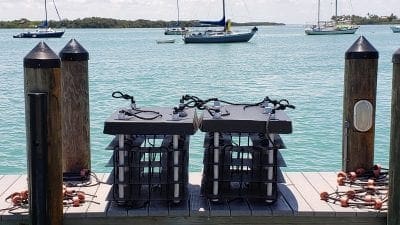
LONGBOAT KEY – Ten mini reefs installed Friday under the docks at Mar Vista Dockside Restaurant will help fight red tide, START Director Sandy Gilbert said.

The structures improve water clarity and increase oxygen levels in the water, he said, adding, “They will show people they can make a difference.”

Mini reefs installed at Mar Vista
The mini reef cleans more than 30,000 gallons of water daily, according to Ocean Habitats. – Cindy Lane | Sun

START – Solutions To Avoid Red Tide – and Lucky’s Market in Sarasota funded the 10 mini reefs, which can clean more than 30,000 gallons of water daily and grow more than 300 fish and 200 crabs annually, said David Wolff, president of Ocean Habitats, who installed the mini reefs.

The lightweight structures float underneath docks, where they are tethered out of the way of boats, he said, adding that the mini reefs do not require state permits to install.

Besides attracting fish, the reefs also attract oysters, which themselves filter water, and a bonus for dock owners – dolphins that feed on the fish, Gilbert said.

Mini reefs installed at Mar Vista
David Wolff, president of Ocean Habitats, prepares a mini reef for installation at Mar Vista docks Friday. – Cindy Lane | Sun

“We’re very excited to be a test market,” said Chuck Wolfe, CEO of The Chiles Group, owner of Mar Vista. “The docks are a big part of our business.”

Most of the more than 2,000 mini reefs in Florida are under residential docks, but START is working to expand their use by businesses, and lobbying local officials to encourage their use.

The mini reefs, which sell for $250 apiece, can last decades, Wolff said. A 10% discount is available at Ocean Habitats with the code START10.

Mini reefs installed at Mar Vista
The mini reefs are tied underneath a dock, where they float and attract marine life. – Cindy Lane | Sun
Blue-green algae remains

Non-toxic blue-green algae remains

ANNA MARIA ISLAND – Non-toxic blue-green algae lingers in local waters and showed up in a new place this week – Warners Bayou in Bradenton – according to today’s report from the Florida Department of Environmental Protection (DEP).

Filamentous cyanobacteria (Lyngbya-like) was found in a Warners Bayou canal on Tuesday, May 28, according to today’s report.

The same type of blue-green algae was found on Monday, May 20 in Anna Maria Sound at Key Royale and in the Intracoastal Waterway south of Grassy Point, and in Palma Sola Bay near San Remo Shores. A different type of blue-green algae, Lyngbya majuscule, was found on Wednesday, May 8 in Sarasota Bay near Whitfield Avenue.

No toxins have been detected in any of the blue-green algae samples collected in Manatee County through May 31, according to DEP.

Report algae blooms to DEP at 855-305-3903.

Report fish kills to FWC at 800-636-0511.

The two algae species found in Manatee County waters are not the same species that has plagued Lake Okeechobee, microcystis aeruginosa, according to DEP.

Of the 22 sites tested statewide from May 23-30 by DEP, seven were positive for toxins.

Blue-green algae can be blue, green, brown or red and emit a foul, rotten egg odor caused by the production of hydrogen sulfide gas, according to DEP, which advises staying out of water where algae are visibly present as specks, mats or water is discolored pea-green, blue-green or brownish-red. Additionally, pets or livestock should not be allowed to come into contact with the algal bloom-impacted water, or the algal bloom material or fish on the shoreline.

Even non-toxic blooms can harm the environment by depleting oxygen levels in the water column and reducing the amount of light that reaches submerged plants, according to DEP.

The growth of blue-green algae typically increases in the spring and summer months when water temperatures and daylight hours increase.

Red tide report

No significant red tide is forecast in Manatee County waters through Monday, June 3, according to today’s Florida Fish and Wildlife Conservation Commission (FWC) report.

Background concentrations of red tide were found in water samples off the Anna Maria Island Rod & Reel Pier in lower Tampa Bay and the Coquina Beach south boat ramp in Sarasota Bay on Tuesday, May 28, according to the report.

Background concentrations of the algae that causes Florida red tide, Karenia brevis, have no discernable effects on people or marine life, according to the FWC. In very low concentrations and above, red tide cells emit a neurotoxin when they bloom that can cause shellfish closures and respiratory irritation in people, especially those with asthma, COPD or emphysema. In low concentrations and above, red tide can be deadly to marine life.

No fish kills were reported this week.

Scientists say that salinity, currents, temperature and light play a part in the formation of red tide blooms, as do nutrients from Florida’s natural phosphate and limestone deposits, Caribbean seawater brought to Florida’s west coast on the Loop Current, the Mississippi River, Saharan dust blown across the Atlantic Ocean to Florida’s waters, and fertilizer and animal waste runoff.

To help keep algae growth at bay, Florida law bans the use of phosphorus and nitrogen fertilizers during the rainy season, June 1 through Sept. 30.

Non-toxic blue-green algae lingers

Non-toxic blue-green algae lingers

ANNA MARIA ISLAND – Blue-green algae lingers in local waters, but is non-toxic, unlike some places in Florida, according to a Friday, May 24 report from the Florida Department of Environmental Protection (DEP).

The report shows that blue-green algae was found in Holmes Beach waters on Monday, May 20 in Anna Maria Sound at Key Royale and in the Intracoastal Waterway south of Grassy Point. The same type of algae, filamentous cyanobacteria (Lyngbya-like), also remained in Palma Sola Bay near San Remo Shores. A different type of blue-green algae, Lyngbya majuscule, persists in Sarasota Bay near Whitfield Avenue.

The algae are less prevalent than in the previous May 9 report, according to DEP, which indicated that no toxins have been detected in any of the blue-green algae samples collected in Manatee County through May 20.

Blue-green algae can be blue, green, brown or red and emit a foul, rotten egg odor caused by the production of hydrogen sulfide gas, according to DEP.

Non-toxic blue-green algae lingers
Blue-green algae, which can appear brown, was evident near Key Royale on May 9. – Christine Wright | Submitted

The two algae species found in Manatee County waters are not the same species that has plagued Lake Okeechobee, Microcystis aeruginosa, according to DEP. About one-third of Lake Okeechobee may have blue-green algae present, according to the report, which states that the algae can be seen from space.

Of the 22 sites tested statewide from May 17-23 by DEP, seven were positive for toxins. Inland waters in Putnam and St. Johns counties near St. Augustine on Florida’s east coast tested positive for toxic algae, the report shows, citing an unconfirmed report that a dog died after swimming in Lake Broward in Putnam County.

Even non-toxic blooms can harm the environment by depleting oxygen levels in the water column and reducing the amount of light that reaches submerged plants, according to DEP.

The growth of blue-green algae typically increases in the spring and summer months when water temperatures and daylight hours increase.

Red tide report

Background concentrations of red tide were found in water samples off Beer Can Island in Longboat Pass on Sunday, May 19 and 4.6 miles off Coquina Beach in the Gulf of Mexico on Tuesday, May 21, according to the Florida Fish and Wildlife Conservation Commission (FWC).

Background concentrations of the algae that causes Florida red tide, Karenia brevis, have no discernable effects on people or marine life, according to the FWC. However, in very low concentrations and above, red tide cells emit a neurotoxin when they bloom that can cause shellfish closures and respiratory irritation in people, especially those with asthma, COPD or emphysema. In low concentrations and above, red tide can be deadly to marine life.

No fish kills were reported this week.

Very low concentrations of red tide are predicted in Longboat Key waters through at least Monday, May 27, according to the University of South Florida/Florida Fish and Wildlife Conservation Commission Collaboration for Prediction of Red Tides.

Scientists say that salinity, currents, temperature and light play a part in the formation of red tide blooms, as do nutrients from Florida’s natural phosphate and limestone deposits, Caribbean seawater brought to Florida’s west coast on the Loop Current, the Mississippi River, Saharan dust blown across the Atlantic Ocean to Florida’s waters, and fertilizer and animal waste runoff.

To help keep algae growth at bay, Florida law bans the use of phosphorus and nitrogen fertilizers during the rainy season, June 1 through Sept. 30.

Report algae blooms to DEP at 855-305-3903 or online. Report fish kills to FWC at 800-636-0511.

Blue-green algae and red tide found in local waters

Red tide, blue-green algae persist in local waters

Updated Friday, May 17, 2019 – ANNA MARIA ISLAND – Red tide and blue-green algae persist in local waters, according to today’s reports from state and federal environmental agencies.

Very low concentrations of red tide documented on May 13 are predicted to remain at least until Monday, May 20, according to today’s report from the University of South Florida/Florida Fish and Wildlife Conservation Commission Collaboration for the Prediction of Red Tides.

Red tide, blue-green algae persist in local waters
The red tide forecast through May 20 shows low concentrations on the southern half of Anna Maria Island.

No fish kills or respiratory irritation were reported in today’s Florida Fish and Wildlife Conservation Commission (FWC) report.

Report algae blooms to DEP at 855-305-3903 or online.

Report fish kills to FWC at 800-636-0511.

Red tide was found in water samples at the Coquina Beach South boat ramp on May 13 in very low concentrations, according to the FWC.

The report was the first sign of red tide since February, when a bloom disappeared that originated in October 2017 in Southwest Florida, appearing in Island waters in August 2018.

Background concentrations of the algae that causes Florida red tide, Karenia brevis, have no discernable effects on people or marine life. However, in very low concentrations and above, red tide cells emit a neurotoxin when they bloom that can cause shellfish closures and respiratory irritation in people, especially those with asthma, COPD or emphysema. In low concentrations and above, red tide can be deadly to marine life.

Red tide, blue-green algae persist in local waters
The FWC shows Manatee County as the only place in the state with detectable levels of red tide.

Scientists say that salinity, currents, temperature and light play a part in the formation of red tide blooms, as do nutrients from Florida’s natural phosphate and limestone deposits, Caribbean seawater brought to Florida’s west coast on the Loop Current, the Mississippi River, Saharan dust blown across the Atlantic Ocean to Florida’s waters, and fertilizer and animal waste runoff.

Blue-green algae tests negative for toxins

Blue-green algae also remains present in local waters but has tested negative for toxins, according to the Florida Department of Environmental Protection (DEP).

Blue-green algae was detected in water samples in Anna Maria Island canals, Holmes Beach bayside and Palma Sola Bay on May 9. Tests released on Thursday, May 16 show that in all three locations, the “filamentous cyanobacteria (Lyngbya-like)” growths are not toxic.

The algae is not the same blue-green algae species that plagued Lake Okeechobee for several months last year, microcystis aeruginosa, according to DEP.

However, non-toxic blooms can harm the environment by depleting oxygen levels in the water column and reducing the amount of light that reaches submerged plants, according to DEP.

Some blue-green algae can produce toxins that can make people and pets sick if swallowed, and can cause skin and eye irritation if contacted, according to DEP, which advises beachgoers and their pets to stay out of the water if algae is visible as specks or mats, or if the water is discolored pea-green, blue-green or brownish-red.

Toxins also can be inhaled. If people or animals splash or if boats create wakes in water bodies with blue-green algae, the cyanotoxins in the algae can release into the air. The toxins mix with water droplets and spray, making them easily inhaled by people and animals, according to the Florida Department of Health (DOH).

For some people, blue-green algae can cause rashes, stomach cramps, nausea, diarrhea and vomiting. People who are very sensitive to smells can experience respiratory irritation. Sometimes, high exposures of toxin can affect the liver and nervous system, according to DOH.

The World Health Organization considers toxin levels under 10 micrograms per liter to represent a low-level risk for adverse health outcomes from short-term recreational exposure; however, they advise that certain sensitive populations, including children, the elderly and immunocompromised individuals may still be at risk even at low concentrations and should avoid any exposure.

Filamentous cyanobacteria (blue-green algae) are found worldwide and are a natural part of freshwater, brackish, and marine environments in Florida, according to Mara Gambineri, director of communications at DEP.

The growth of blue-green algae typically increases in the spring and summer months when water temperatures and daylight hours increase, she said.

Filamentous cyanobacteria are photosynthetic organisms, like plants, meaning they can convert sunlight into energy. To do so, they need nutrients like carbon, nitrogen and phosphorus from their environment. Higher levels of these nutrients in the water and sediment can lead to higher levels of filamentous cyanobacteria growth, according to DEP.

For this and other reasons, Florida law bans the use of phosphorus and nitrogen fertilizers during the rainy season, June 1 through Sept. 30.

Other factors that contribute to blooms include warm temperatures, reduced water flow and lack of animals that eat algae, Gambineri said.

Blooms of filamentous cyanobacteria can form brownish floating blobs or mats that begin to decay and emit a foul, rotten egg odor caused by the production of hydrogen sulfide gas and other organic breakdown byproducts, she said.

A different type of growth, Lyngbya majuscule, was detected in water samples from Sarasota Bay at Whitfield Avenue in south Manatee County on May 8; no toxins were found.

Red tide detected off Manatee County coast

Updated April 5, 2019 – The April 5 FWC report shows background concentrations of red tide off Hillsborough and Sarasota counties, but none off Manatee County.

ANNA MARIA ISLAND – While swimmers enjoyed crystal clear water today at Anna Maria Island beaches, today’s Florida Fish and Wildlife Conservation Commission (FWC) report shows that background concentrations of red tide have returned to nearby waters about two miles southwest of Egmont Key.

Karenia brevis was observed at background concentrations last week in one sample collected offshore of Manatee County, one sample collected offshore of Charlotte County and one sample collected offshore of Lee County.

Respiratory irritation also was reported in Manatee and Sarasota counties over the past week, according to the FWC. NOAA’s latest report predicts no respiratory irritation locally.

No fish kills suspected to be related to red tide were reported this past week.

Background concentrations of the algae that causes Florida red tide, Karenia brevis, have no discernable effects on people or marine life. Higher concentrations of red tide cells emit a neurotoxin when they bloom that is deadly to marine life. It can make shellfish unfit to eat and can cause respiratory irritation in people, especially those with asthma, COPD or emphysema.

The last red tide bloom began in October 2017 in Southwest Florida. It appeared locally in August 2018, lasting until February 2019.

Scientists say that salinity, currents, temperature and light play a part in the formation of blooms, as do nutrients from Florida’s natural phosphate and limestone deposits, Caribbean seawater brought to Florida’s west coast on the Loop Current, the Mississippi River, Saharan dust blown across the Atlantic Ocean to Florida’s waters, and fertilizer and animal waste runoff.

Reel time red tide

Reel Time: Clear water hides looming problem

The red tide is gone! I don’t know anybody that isn’t elated that the most recent harmful algae bloom is absent from local waters. Cross any bridge, look out at the bay and you’ll be convinced that all is well. The water is clear and there are large areas of flats that appear covered with seagrass.

Unfortunately, things are not what they seem. While it’s true that the water in the bay is crystal clear, this same clear water is revealing what may be a “ticking time bomb.” Large areas of Sarasota Bay, even some close to the passes and enjoying daily flushing, are choked with algae. The clear water also affords a look into the bay and my experience over the last few weeks has been discouraging. In areas that are generally flush with mullet, you could sit and count off the minutes without seeing one of the ubiquitous fish jump. There are signs of recovery, as bait enters the bay and mullet are again starting to make an appearance. Still, after dealing with red tide events since the early 80s this is one of the slowest recoveries I can remember.

If there’s a “proverbial” pony anywhere, it’s that people who in the past quickly reverted to the “out of sight, out of mind” school of thought, are asking important questions. When Realtors and developers realize that the price of inaction on water quality incurs a serious cost we may be finally rounding a corner towards awareness.

The first line of defense lies with our local politicians who enact the laws that protect our water, air and land. Let’s not forget that they work for us. Unfortunately, the public, and I include myself, has not been as engaged as they need to be in this decision-making process. Hopefully, that’s changing. Residents of Manatee County need to get behind commissioners who are working to address water quality issues. They are currently tackling the need to establish a dedicated source of funding to improve water quality. Residents are encouraged to learn about this initiative and get involved in assuring that common sense rules, regulations and infrastructure support us economically as well as protecting the quality of life that we enjoy.

Still, with the apparent “new will” and understanding of the problem in Tallahassee, there is resistance to doing the “right thing.” A good example is legislation that Manatee County state Rep. Will Robinson has introduced, with a companion bill by state Sen. Joe Gruders of
Sarasota, to monitor and inspect septic tanks, thought to be a leading problem in water pollution. The bills would require the state health department to identify all onsite systems in the state and compile that information in a database. Beginning in 2022, the bill would require onsite systems to be inspected at least once every five years unless the system is covered by an operating permit.

What appears to be common sense legislation is being intensely lobbied by entities like state restaurant and homeowner associations. The arguments seem to be the same – that the bill would be too expensive and cause economic hardship to the interested parties. What’s missing from this reasoning is the understanding that not addressing these issues will actually be more expensive for those that oppose it, not to mention future generations of Floridians. It’s time that we all take a more proactive role in addressing these critical issues.

More Reel Time:

Reel Time: Innovators – Architects of modern saltwater fly tackle, part 2

Reel Time: Innovators – The architects of modern saltwater fly tackle

Reel Time: Release program promotes fishery recovery

No red tide in short-term local forecast

Updated March 8, 2019 – ANNA MARIA ISLAND – Today’s Florida Fish and Wildlife Conservation Commission (FWC) report shows no red tide predicted in Manatee County waters through at least Monday, March 11.

NOAA’s latest report predicts no respiratory irritation locally.

Statewide over the past week, background concentrations of the harmful algae were reported in one water sample offshore of Hillsborough County and one sample offshore of Lee County, while reports of respiratory irritation were limited to Lee County, according to the FWC.

Background concentrations of red tide, or Karenia brevis, have no discernable effects on people or marine life, and are an ordinary component of Gulf of Mexico waters.

FWC reported no fish kills suspected to be related to red tide over the past week.

The red tide bloom began in October 2017 in Southwest Florida. It appeared locally in August 2018, gradually diminishing over the past few weeks to normal levels.

Florida red tide, or Karenia brevis, emits a neurotoxin when it blooms that is deadly to marine life. It can make shellfish unfit to eat and can cause respiratory irritation in people, especially those with asthma, COPD or emphysema.

Scientists say that salinity, currents, temperature and light play a part in the formation of blooms, as do nutrients from Florida’s natural phosphate and limestone deposits, Caribbean seawater brought to Florida’s west coast on the Loop Current, the Mississippi River, Saharan dust blown across the Atlantic Ocean to Florida’s waters, and fertilizer and animal waste runoff.

Reel Time: Release program promotes fishery recovery

Reel Time: Release program promotes fishery recovery

On Tuesday, Feb. 26, the Coastal Conservation Association (CCA), in conjunction with Duke Energy and the Florida Fish and Wildlife Conservation Commission, released adult and juvenile redfish at Robinson Preserve in Manatee County. The redfish were donated by Duke Power and raised at its Mariculture Center in Crystal River, Fla. There are a number of releases scheduled in southwest Florida, which will include about 2,000 juvenile fish and 25 to 30 adult redfish per county, all of which will come from the Duke Energy Mariculture Center. In February, the group also released redfish in Pasco, Hillsborough, Pinellas and Sarasota counties.

Additional tentative release dates and locations include Lee County, March 12 at 11 a.m.; Tropical Point Park, 3401 Tropical Point Drive, St. James City, Fla.; Collier County, March 15 at 11 a.m.; Shell Island Boat Launch, 10 Shell Island Road, Naples, Fla.; Charlotte County, March 19 at 11 a.m.; and Ponce De Leon Park, 3400 Ponce de Leon Parkway, Punta Gorda, Fla.

Brian Gorski, CCA Florida executive director, weighed in on the effort. “We’re extremely excited to release these fish now that the waters are determined to be safe,” he said.  “Between these releases, encouraging anglers to catch-and-release and promoting conservation, we’re going to see this fishery improve and we’re honored to be a part of it.”

Catherine Stempien, Duke Energy Florida president, stated that “Duke Energy is committed to helping protect and preserve Florida’s natural environment.” She added, “Our Mariculture Center advances environmental stewardship throughout the state by partnering with state and local agencies and universities on restoration projects. The redfish we are donating will have long-term positive environmental impacts in the affected areas and we’re proud to play a small part in the solution to the recent red tide occurrence.”

Eric Sutton, FWC executive director, also was proud to be a partner. “We are thankful for the leadership and efforts of CCA and Duke Energy on making this redfish enhancement possible,” he said. “The efforts to help struggling fisheries in the aftermath of such an intense and devastating red tide is welcome, and anglers should do their part by adhering to the closure and respecting size and bag limits. They can go further by handling their catches responsibly and practicing catch and release after the closure is lifted. All the partners in the effort are to be commended for not only adding to depleted fish stocks but also raising awareness.”

The CCA has come a long way since it came into Florida as the FCA in the early 80s. In 1985, I joined a few local residents, including Captain Scott Moore, Captain Jim O’Neil, Pete Turner, Jim Knowles and Cindy McCartney, and met with Gulf Coast Conservation Association organizer Bruce Cartwright. That meeting of six concerned citizens led to the formation of the Manatee Chapter of the then-FCA. I attended the Manatee CCA Banquet last Thursday night at the Manatee County Convention Center, where more than 1,000 members and guests showed their support for fisheries conservation.

The exponential growth of an organization concerned with the health of our waters and fishery is a reason for optimism but points to a larger issue that can’t get lost in the media buzz of hatchery releases. If we truly want a healthy habitat and robust fishery we have to address the root of the problem. While it is often mentioned that the red tide is a natural occurrence, what you don’t hear is that the occurrence and severity of red tide are 15 times greater than it was 50 years ago. More often the natural occurrence storyline is parroted by groups, corporations and state agencies responsible for the increase of nutrients and lack of enforcement of common sense laws that help feed the red tide.

The most recent red tide event may have hopefully awakened citizens and lawmakers to the severity of the issue. A new state administration taking action is encouraging. While significant funds are becoming available to address the problem, as long as the emphasis is on mitigating and killing red tide instead of addressing point (sewage spills) and nonpoint (agricultural runoff) source pollution we’ll miss an important opportunity to begin taking effective action towards a lasting solution.

Related coverage

https://amisun.com/2019/02/26/redfish-released-for-red-tide-recovery/

More Reel Time:

Reel Time: Pothole savvy, Part 2

Reel Time: Fly fishing strategy – pothole savvy

Reel Time: New dimensions in trolling motors

Beaches free of red tide

ANNA MARIA ISLAND – Today’s Florida Fish and Wildlife Conservation Commission (FWC) red tide report shows no red tide in Manatee County waters over the past week, and a clear red tide forecast for Anna Maria Island through Monday, March 4.

For the first time in months, the report also reflects no respiratory irritation or fish kills in the county over the past week.

Red tide has gradually disappeared in Manatee County waters over the past month, and remains only in background concentrations in Southwest Florida and Northwest Florida, according to the report. Background concentrations have no discernable effects on people or marine life.

The red tide bloom began in October 2017 in Southwest Florida and appeared locally in August 2018.

Florida red tide, or Karenia brevis, emits a neurotoxin when it blooms that is deadly to marine life. It can make shellfish unfit to eat and can cause respiratory irritation in people, especially those with asthma, COPD or emphysema.

Scientists say that salinity, currents, temperature and light play a part in the formation of blooms, as do nutrients from Florida’s natural phosphate deposits, Caribbean seawater brought to Florida’s west coast on the Loop Current, the Mississippi River, Saharan dust blown across the Atlantic Ocean to Florida’s waters, and fertilizer and animal waste runoff.

Redfish released for red tide recovery

BRADENTON – More than 2,000 juvenile redfish and 31 hefty adults were released this morning in the waters of Robinson Preserve to restock the fishery, decimated by six months of red tide.

Local waters have been mostly free of the toxic algae for more than a month, making this a good time to maximize the survival of the gamefish, according to officials at the Crystal River Mariculture Center at Duke Energy, where the fish were raised.

The large, satellite-tagged fish were released one at a time, carried in bags by different participants in the project from the holding tanks to the center’s Rhett Gehring, who guided them gently into the water. Medium-sized fish were transported by hand in small tubes and released.

Juvenile fish had quite a different journey, pushed through a black pipe from the holding tanks to the water. They swim against the “current” inside the pipe during the transit so they are not banging against each other, Gehring said.

One last straggler in the holding tank was carried by hand to the water at the Robinson Preserve kayak launch.

[embedyt] https://www.youtube.com/watch?v=_tmYZDAd16A[/embedyt]


A few dozen people watched the release at Robinson Preserve, a Manatee County park. Robinson’s waters are a healthy ecosystem with sheltered waters that are an excellent choice for the juvenile fish to mature, according to Melissa Nell, division manager of programming and education for the county Parks and Recreation Department.

More than 8,000 juvenile and adult redfish donated by the center already have been released in cooperation with the Florida Fish and Wildlife Conservation Commission and the Coastal Conservation Association Florida in Sarasota, Pinellas, Hillsborough and Pasco counties. More releases are planned in Charlotte, Lee and Charlotte counties in March.

Duke Energy officials hope anglers will practice catch-and-release of the redfish, a popular gamefish.

“Duke Energy is committed to environmental stewardship,” Eric Latimer, Duke Energy Florida Mariculture Center manager, said in a press release. “Fish mortalities associated with the current red tide bloom in southwest Florida have broad impacts, both to our state’s interconnected biological systems and to the people that make a living from and enjoy our natural resources. We are proud to play a small part in the solution by restocking fish that will contribute to the overall restoration of the affected areas.”

“We’re all aware of the devastation the red tide has caused our fisheries and we’re thrilled to partner with Duke Energy for this amazing redfish stock enhancement initiative,” said Brian Gorski, CCA Florida executive director.

“We appreciate the valuable support from CCA Florida and Duke Energy in helping enhance our world-class redfish fishery,” Eric Sutton, FWC executive director, said in a press release. “This team effort will benefit conservation, outdoor recreation and the state’s economy in many ways.”

The FWC’s latest report shows background traces of red tide – a normal occurrence – statewide, but no discernable effects on people or marine life are predicted.

The bloom began in Southwest Florida waters in October 2017, reaching local waters in August 2018.

Rhett Gehring of the Crystal River Mariculture Center at Duke Energy releases redfish at Robinson Preserve to restock the fishery after red tide. – Cindy Lane | Sun

Rhett Gehring of the Crystal River Mariculture Center at Duke Energy releases redfish at Robinson Preserve to restock the fishery after red tide. – Cindy Lane | Sun

One last straggler is carried by hand to the water during the redfish release. - Cindy Lane | Sun

One last straggler is carried by hand to the water during the redfish release. - Cindy Lane | Sun

Related coverage

Red tide forecast clear

Red tide forecast clear

ANNA MARIA ISLAND – The red tide forecast for Anna Maria Island is clear through Sunday, Feb. 24, according to today’s NOAA report and the Feb. 20 report from the Florida Fish and Wildlife Conservation Commission (FWC).

Background concentrations of red tide continue to drift in area waters, causing respiratory irritation that was reported in Manatee County last week. Red tide also can be carried on the wind to areas where the water is free of the microalgae.

Florida red tide, or Karenia brevis, emits a neurotoxin when it blooms that is deadly to marine life, can make shellfish unfit to eat and can cause respiratory irritation in people, especially those with asthma, COPD or emphysema.

Scientists say that salinity, currents, temperature and light play a part in the formation of blooms, as do nutrients from Florida’s natural phosphate deposits, Caribbean seawater brought to Florida’s west coast on the Loop Current, the Mississippi River, Saharan dust blown across the Atlantic Ocean to Florida’s waters, and fertilizer and animal waste runoff.

Red tide in air; water clear

Updated Feb. 15, 2019 | ANNA MARIA ISLAND – No red tide is predicted for Manatee County waters through Monday, Feb. 18, according to today’s report from the University of South Florida/Florida Fish and Wildlife Conservation Commission’s (FWC) Collaboration for Prediction of Red Tides.

Manatee County waters have remained clear of the toxic algae since Jan. 11, however, respiratory irritation was reported in Manatee County over the past week, according to the FWC and NOAA. Red tide can be carried on the wind to areas where the water is free of the algae.

Statewide over the past week, red tide was observed at background concentrations offshore of Charlotte County in Southwest Florida, where the bloom began in October 2017, reaching Anna Maria Island waters in August 2018.

Florida red tide, or Karenia brevis, is a type of microalgae that emits a neurotoxin when it blooms. Deadly to marine life, red tide also can make shellfish unfit to eat and can cause respiratory irritation in people, especially those with asthma, COPD or emphysema.

According to scientists, salinity, currents, temperature and light play a part in the formation of blooms, as do nutrients from Florida’s natural phosphate deposits, nutrients from Caribbean seawater brought to Florida’s west coast on the Loop Current, nutrients flowing into the Gulf of Mexico from the Mississippi River, iron-rich Saharan dust blown across the Atlantic Ocean to Florida’s waters, and fertilizer and animal waste runoff.

COVID-19 impact on 2020 visitation slight

Red tide down, tourism promotion up

Updated Feb. 14, 2019 – BRADENTON – Local officials are accelerating tourism promotion efforts to overcome the stigma left by red tide since it appeared in area waters in August 2018.

Red tide was one reason that tourism decreased by .8 percent last year, Walter Klages, of Tampa-based Research Data Services, told the Manatee County Tourist Development Council (TDC) on Monday.

But compared to other Florida destinations, Manatee County is doing well, said Klages, Manatee County’s tourism consultant.Bradenton Anna Maria Island Longboat Key

Tourism’s economic impact on the county approached $1 billion in 2018 – $973,798,800 to be exact, he said.

While red tide has decreased locally in the past month, “The stigma continues to haunt us,” he said, adding that letting people know about the improvement is “an important part of the message we are promoting.”

The last time the Florida Fish and Wildlife Conservation Commission reported red tide in area waters was Jan. 11. Respiratory irritation has been reported each week since then; winds can blow red tide to areas where the water is clear.

County accepting TDC applications

Manatee County is now accepting applications for a vacancy on the Tourist Development Council (TDC), a citizens advisory committee that makes recommendations to county commissioners on the expenditures of tourist tax revenues.

The nine-member board is seeking one member who is an owner/operator/general manager of a motel, hotel, recreational vehicle park or other tourist accommodation in the county subject to the 5 percent tourist tax in Manatee County. Eligible applicants also must be registered voters of Manatee County.

Applications are due by July 10 and may be found online.

The TDC meets on the third Monday of every other month at 9 a.m. at various locations throughout Manatee County. The term for the vacant seat expires June 30, 2021.

For more information, call Monica Luff at the Bradenton Area Convention and Visitors Bureau, 941-729-9177 ext. 3944  or email her at Monica.Luff@mymanatee.org.

Another reason for the “contraction” in tourism is that the number of vacation rentals, including hotel and motel rooms, condominiums and homes, has increased, causing a 5.8 percent decline in occupancy, he said.

A slowdown in the growth of the county’s tourism-related social media audience also can be traced to red tide, consultant Kevin McNulty said.

“The entire state had impacts from the red tide,” he said. “Because of red tide we had to pause a lot of advertising.”

“We stepped down for almost two months but we are ramping up hard,” including publicity campaigns in New York and the UK, said Elliott Falcione, director of the Bradenton Area Convention and Visitors Bureau (CVB).

Increased traffic on area roads is a good indication that seasonal tourism is thriving again, Klages said.

TDC Chair Carol Whitmore agreed, saying that one day last week, it took her an hour and a half to get from the Longboat Key bridge in Bradenton Beach to Publix in Holmes Beach.

Airbnb tourist tax collections

Whitmore, also a county commissioner, told TDC members that the commission is considering following the lead of other Florida counties that collect tourist taxes from Airbnb vacation rental owners through the state Department of Revenue (DOR), rather than the county tax collector.

She recounted an online search by a relative that found four such vacation rentals on Anna Maria Island, all sleeping 16 people and charging at least $15,000 a week.

“We are not getting that revenue,” she said, noting that one rental is not even fully constructed yet.

The same problem exists in the 11 tourist destinations that Klages works with, he said.

A Manatee County ordinance requires the tax collector to collect the 5 percent tourist tax from owners of accommodations rented for six months or less who charge the tax to their renters, in most cases, tourists.

With no practical way to identify rental owners using Airbnb to offer rental lodging on websites and mobile apps, Manatee County Tax Collector Ken Burton Jr. sued Airbnb in April 2017 to enforce collections.

Airbnb owners are on the honor system to report and pay their tourist taxes.

Manatee County commissioners unanimously voted on Jan. 29 to investigate working with the DOR to collect tourist taxes from vacation rental owners using Airbnb, rather than wait for the lawsuit to conclude.

In other business:

  • The TDC learned that a concert series at The Center of Anna Maria Island will conclude on April 1 with the Marshall Tucker Band.
  • The council was updated on the eight-story Sheraton hotel that is planned at the Bradenton Area Convention Center in Palmetto, which will include retail stores and may include a second hotel and an outdoor event area. “This is the most important project we have on the table,” Falcione said, adding that the project is unique from St. Petersburg to Fort Myers.

Red tide stays away

ANNA MARIA ISLAND – No red tide is predicted for Manatee County waters through Monday, Feb. 11, according to the Florida Fish and Wildlife Conservation Commission (FWC).

Manatee County waters were clear of the toxic algae and no red tide-related fish kills were reported locally over the past week.

However, respiratory irritation was reported in Manatee County, according to the report. Red tide can be carried by winds to areas where the water is clear of the algae.

Statewide, background concentrations were found in four water samples in Southwest Florida, where the bloom began in October 2017.

Red tide has been in Anna Maria Island waters on and off since Aug. 3.

Florida red tide, or Karenia brevis, is a type of microalgae that emits a neurotoxin when it blooms. Deadly to marine life, red tide also can make shellfish unfit to eat and can cause respiratory irritation in people.

Scientists say that salinity, currents, temperature and light play a part in the formation of blooms, as do nutrients from Florida’s natural phosphate deposits, the Loop Current, which brings Caribbean seawater to Florida’s west coast, the Mississippi River, iron-rich Saharan dust blown across the Atlantic Ocean to Florida’s waters, and fertilizer and animal waste runoff.