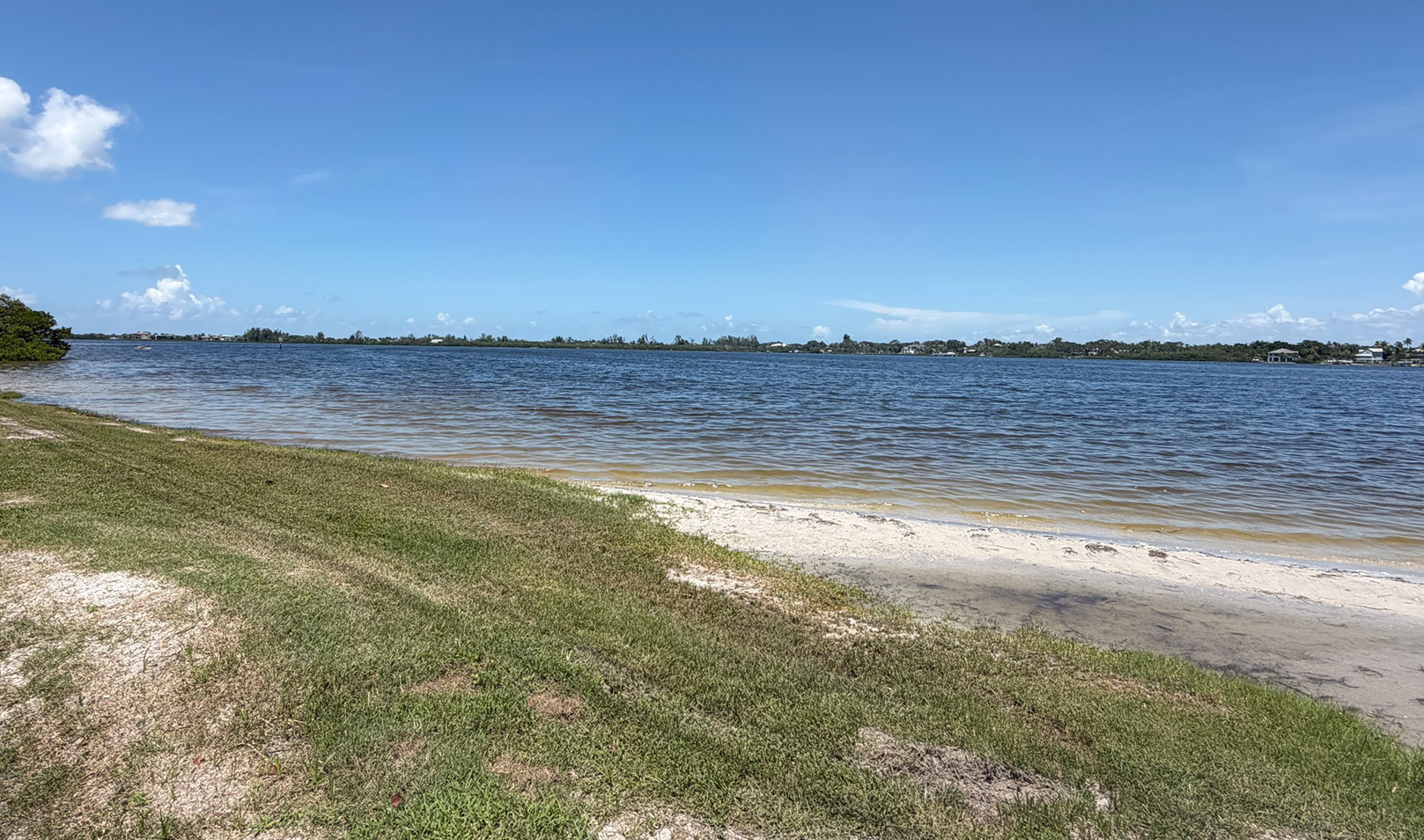
BRADENTON – According to Suncoast Waterkeeper water quality specialist Pia Ronquillo-See, the Florida Department of Environmental Protection (FDEP) has confirmed that Palma Sola Bay fails state bacteria standards and might require a plan to reduce pollution.
Ronquillo-See presented those findings during the Aug. 12 meeting of the Palma Sola Scenic Byway organization.
She said the FDEP notified Suncoast Waterkeeper by email in January that the bay does not meet water quality standards and needs a Total Maximum Daily Load (TMDL) pollution cleanup plan.
She said an impairment designation is driven by enterococci bacteria counts that have repeatedly exceeded state thresholds, according to the weekly sampling Suncoast Waterkeeper has conducted on the bay’s northeast side since 2022.
“Section 303(d) of the Clean Water Act authorizes the U.S. Environmental Protection Agency (EPA) to assist states, territories and authorized tribes in listing impaired waters and developing total maximum daily loads for these waterbodies. A TMDL establishes the maximum amount of a pollutant allowed in a waterbody and serves as the starting point or planning tool for restoring water quality,” according to the FDEP website.
The Florida Administrative Code sets two bacteria thresholds for Class II/III marine waters like Palma Sola Bay: a monthly geometric mean (average) of 35 enterococci and no more than 10% of samples exceeding a count of 130 enterococci over any 30-day period.
“Since we’ve been monitoring, we’ve found the 10% value is constantly being exceeded,” Ronquillo-See said.
Suncoast Waterkeeper’s data show exceedance rates above that threshold in recent years. Ronquillo-See said there were exceedances in Palma Sola in 23 of 46 samples taken in 2023, 20 of 47 samples taken in 2024 and 20 of 48 samples taken in 2025.
“So far this year we have nine exceedances out of 26 samples,” she said.
She said FDEP is finalizing a water quality assessment covering January 2019 through June 2026 and plans to submit it to the EPA between November 2026 and April 2027.
“Suncoast does not know how long EPA review will take, and TMDL development will not begin until after the EPA accepts the assessment,” Ronquillo-See said.
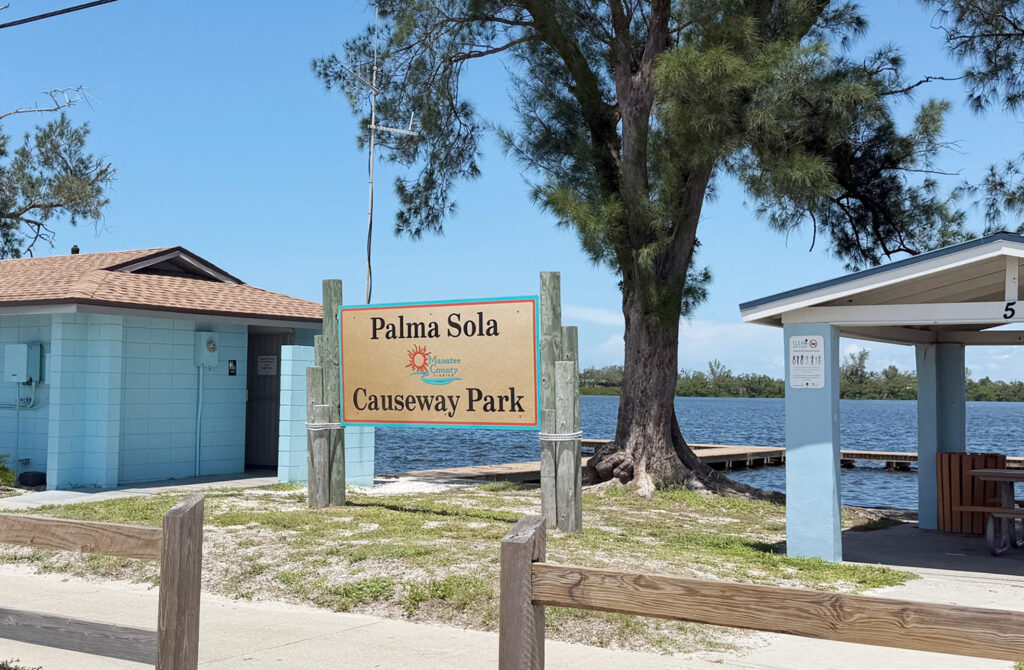
A dispute ensued during the meeting regarding the sampling done in January by the Florida Department of Health (FDOH) near a fishing pier and pavilion at Palma Sola Causeway Park, on the bay’s northwest side. FDOH’s results showed zero exceedances in 19 samples, compared with Suncoast Waterkeeper’s 9 of 26 rate during the same testing period.
The health department tests the water quality near the Palma Sola Causeway Park fishing pier. – Leslie Lake | Sun
“The DOH results are mostly good and they haven’t had any swim advisories this year,” Ronquillo-See said.
She questioned the validity of the comparison, saying the health department’s testing site is in deeper water used for fishing rather than swimming. She said FDOH samples 18 inches below the surface. She said she wades above the knee and samples about 10 inches down in an area where people swim. One of the meeting attendees said they asked FDOH if they could observe their sampling methods and that request was denied.
She said an impairment designation could be reversed by three consecutive years of data that meets state standards.
“I would question the credibility of their collection site,” board member Mike Meehan said. “That is not a swimming area, that is a fishing area. I never see anyone swimming off that pier.”
Suncoast Waterkeeper water quality values can be found at the Suncoast Waterkeeper Safe to Swim web page. FDOH testing values can be found at the Florida Healthy Beaches web page.
BRADENTON – The city of Bradenton plans to review its existing regulations pertaining to vendors operating along the Palma Sola Causeway.
The Palma Sola Causeway is part of the Florida Department of Transportation-designated scenic highway that stretches from 75th Street West and Manatee Avenue in west Bradenton to Manatee Beach in Holmes Beach.
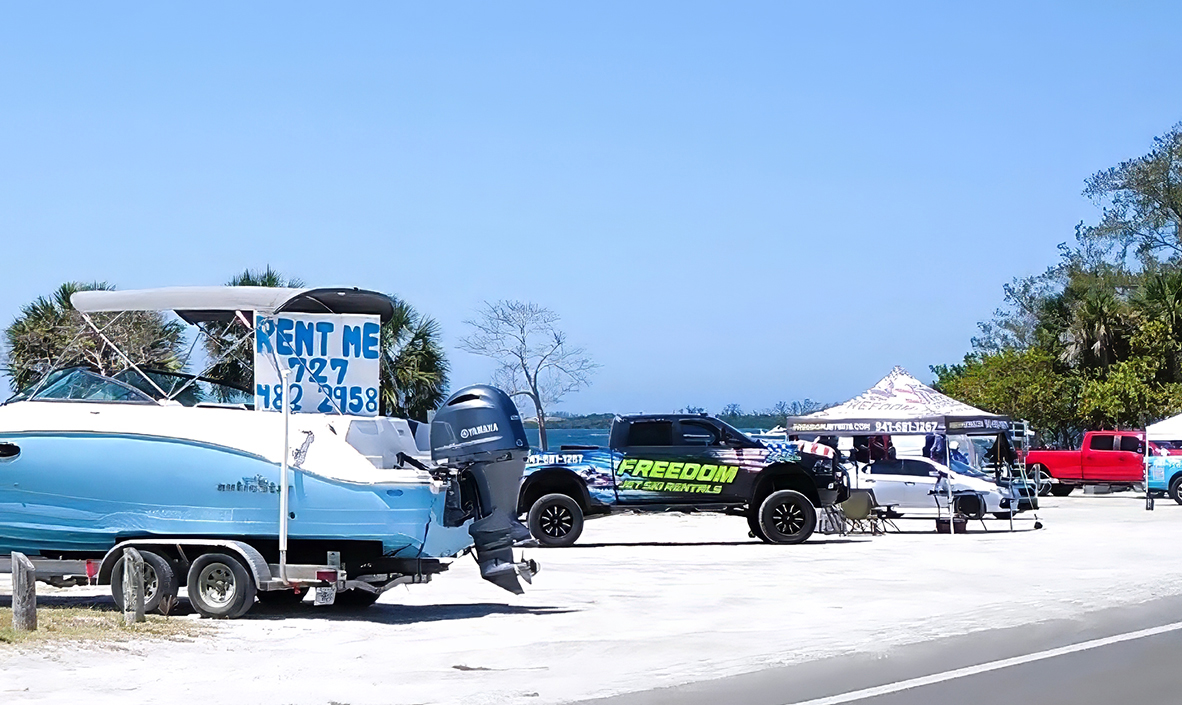
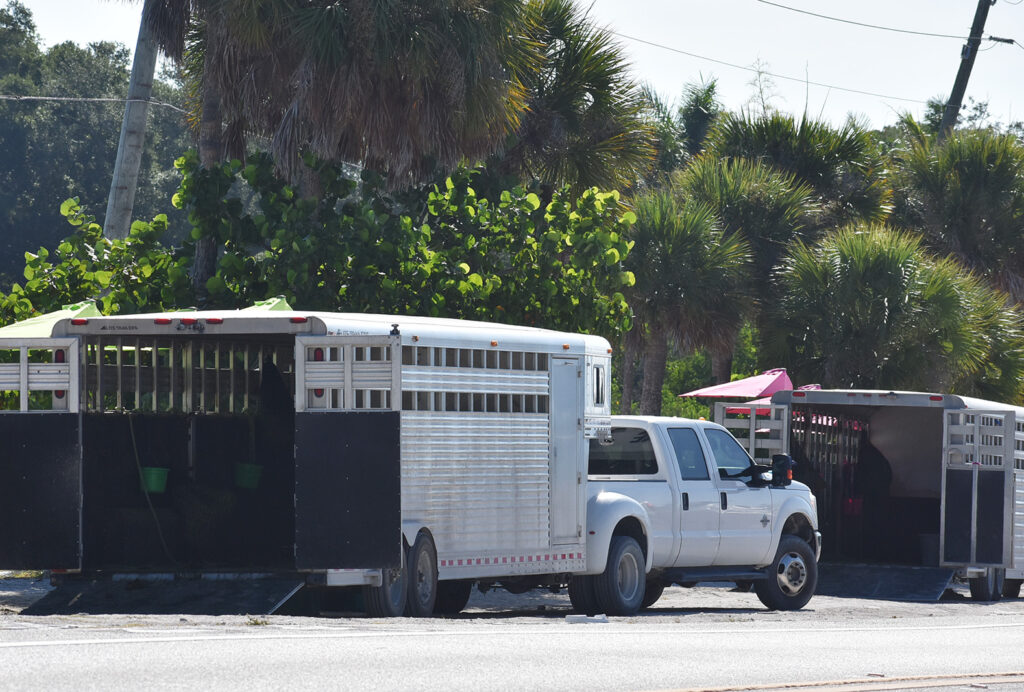
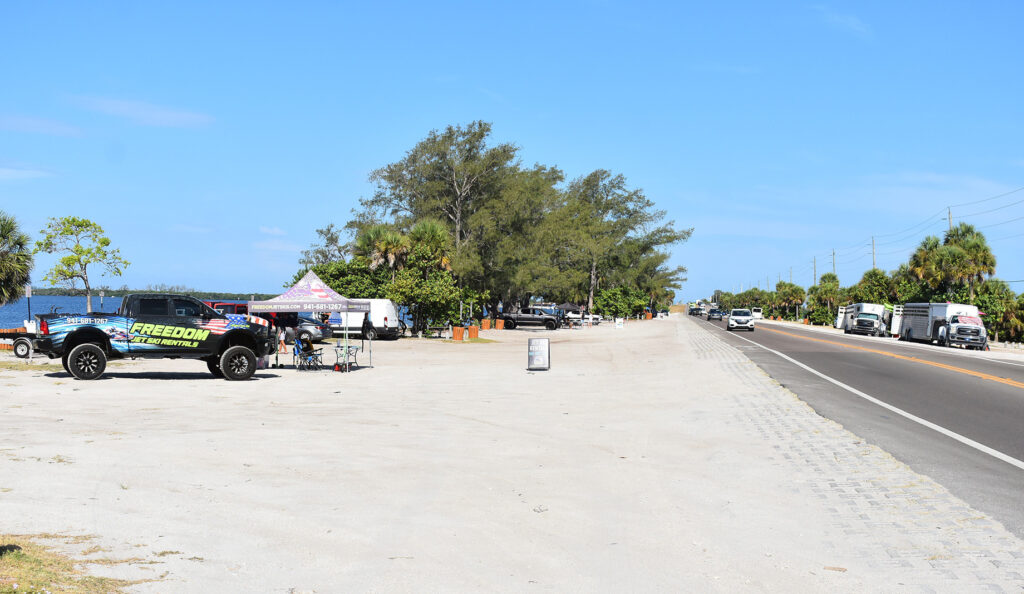
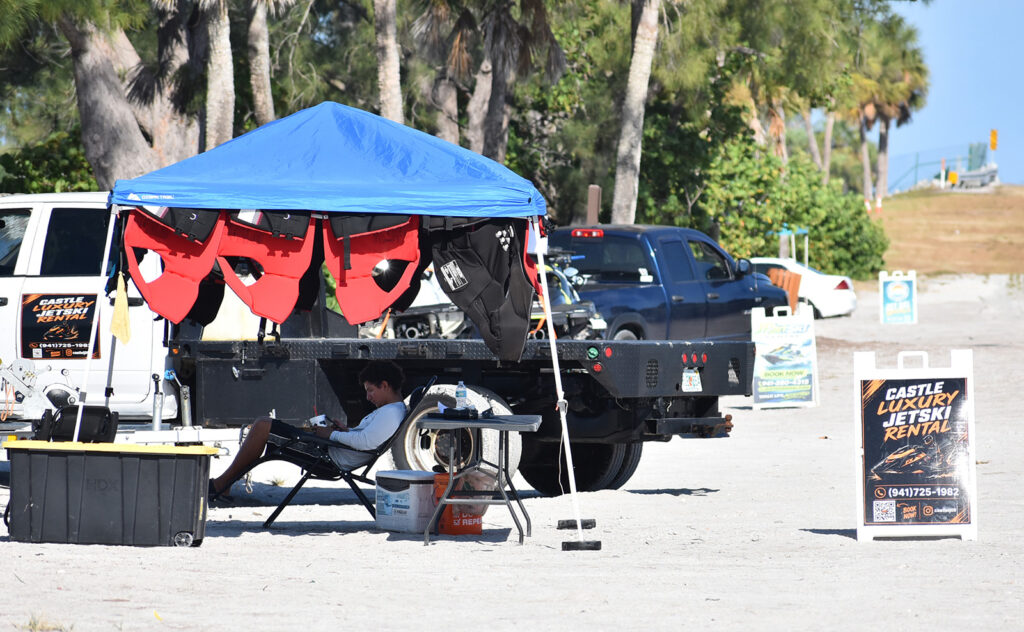
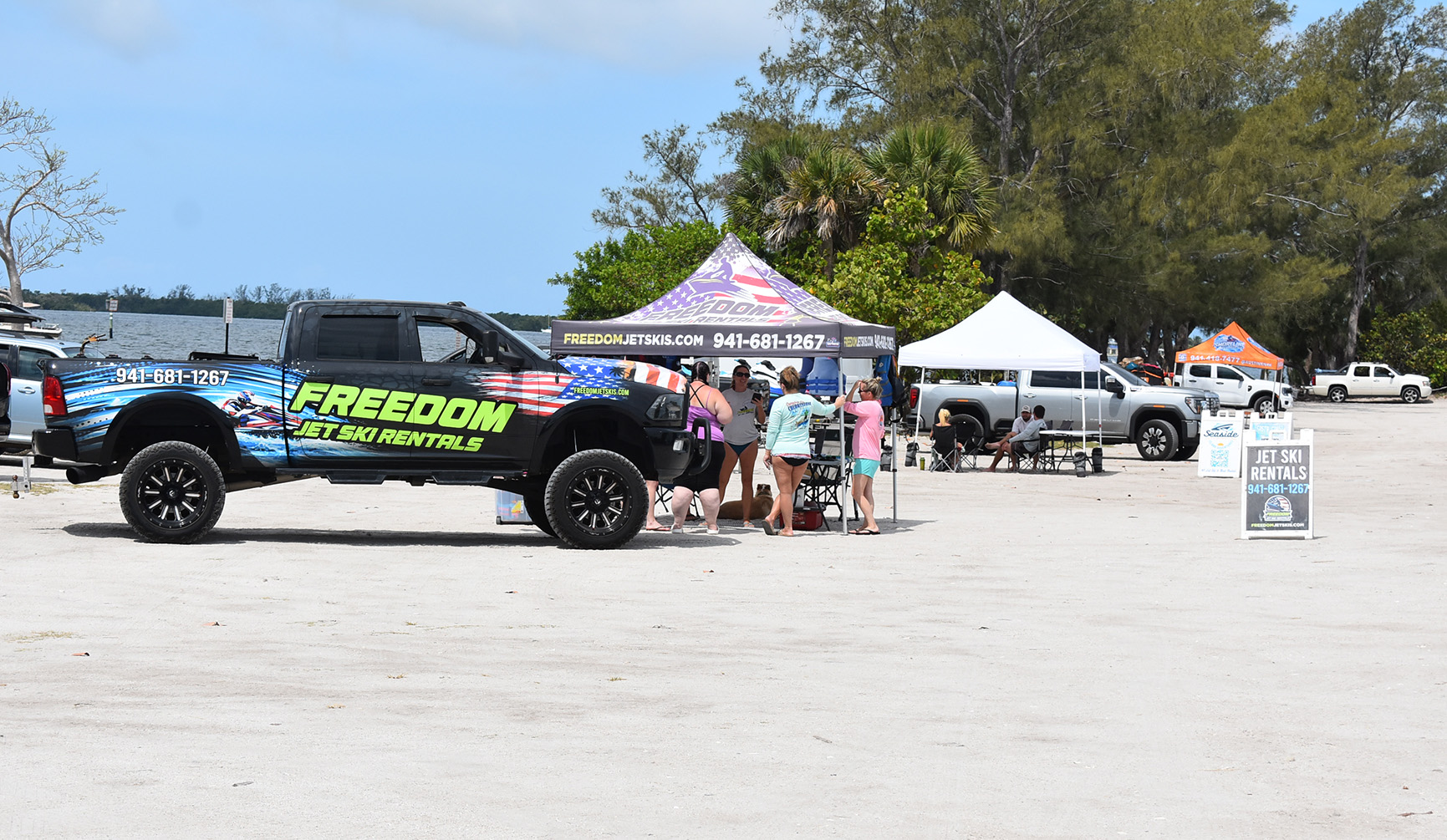
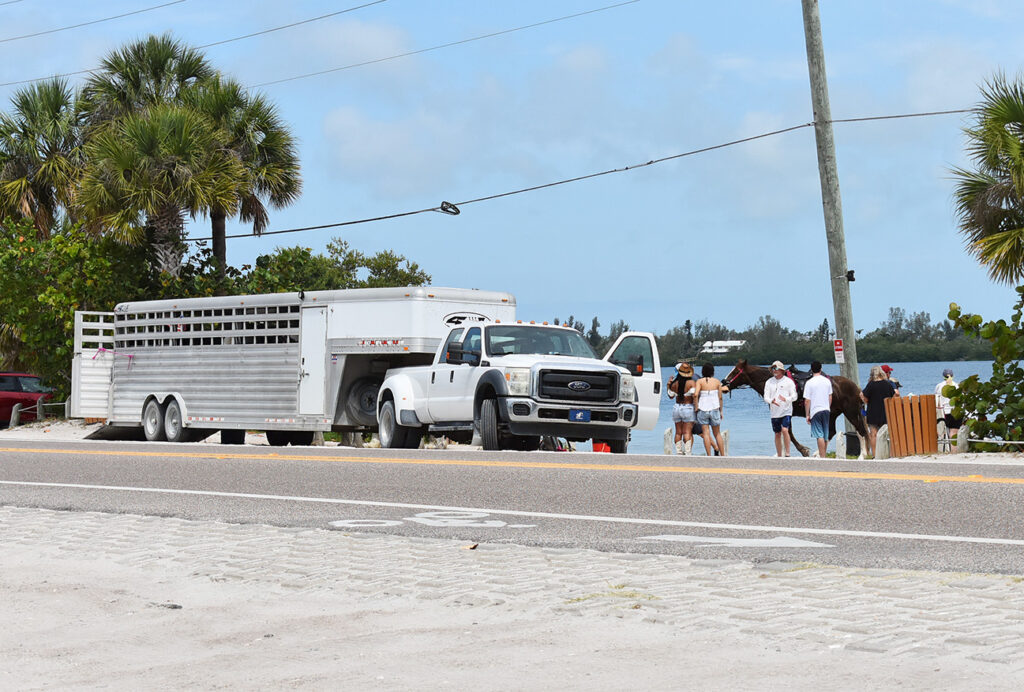
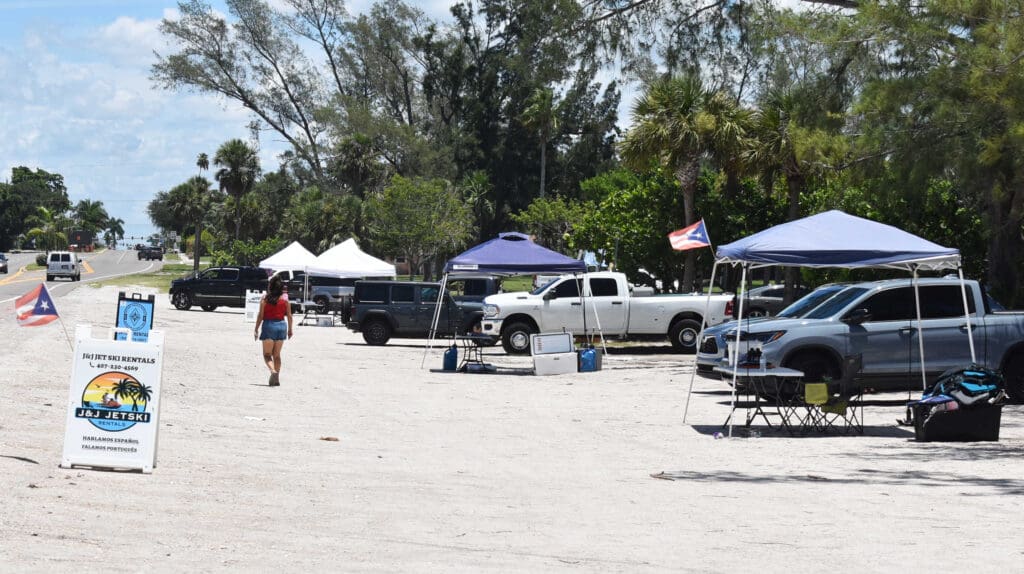
In recent years, the causeway has become heavily populated by business operators offering personal watercraft rentals, boat rentals, horse rides and more. In recent months, Palma Sola Scenic Highway Byway Organization Vice Chair Ingrid McClellan has been emailing city, county and state officials seeking enforcement of the rules and regulations in place.
On July 24, Bradenton Police Chief Josh Cramer sent McClellan an email that said, “The Bradenton Police Department and city code enforcement have been working together with our legal teams and are working on an ordinance that should go before council in the very near future. The ordinance will fill gaps identified in our current regulations. In the interim and beyond, we will continue to enforce traffic and code violations as observed and reported.”
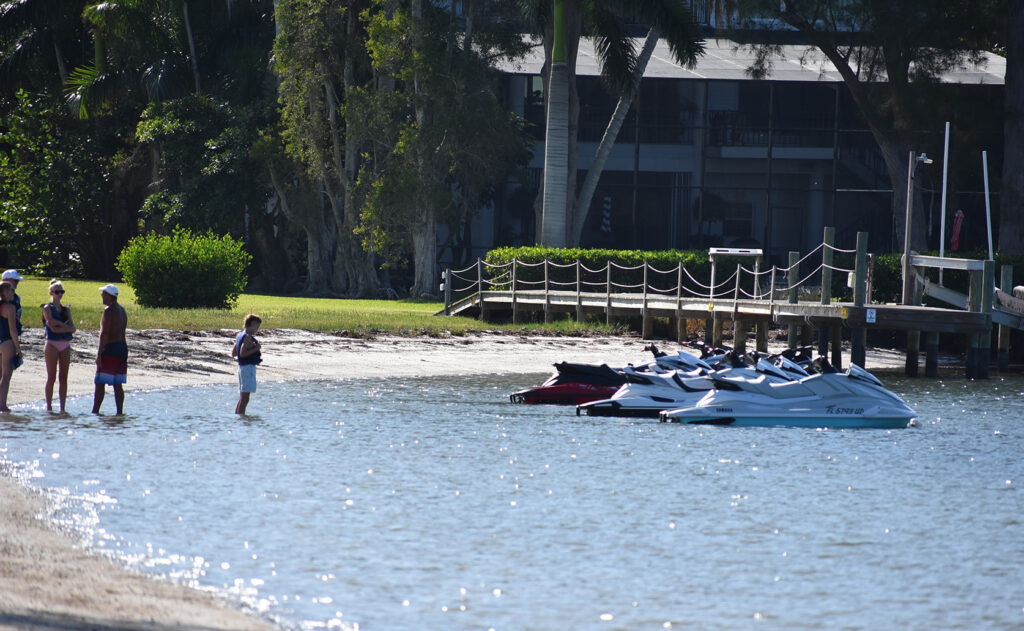
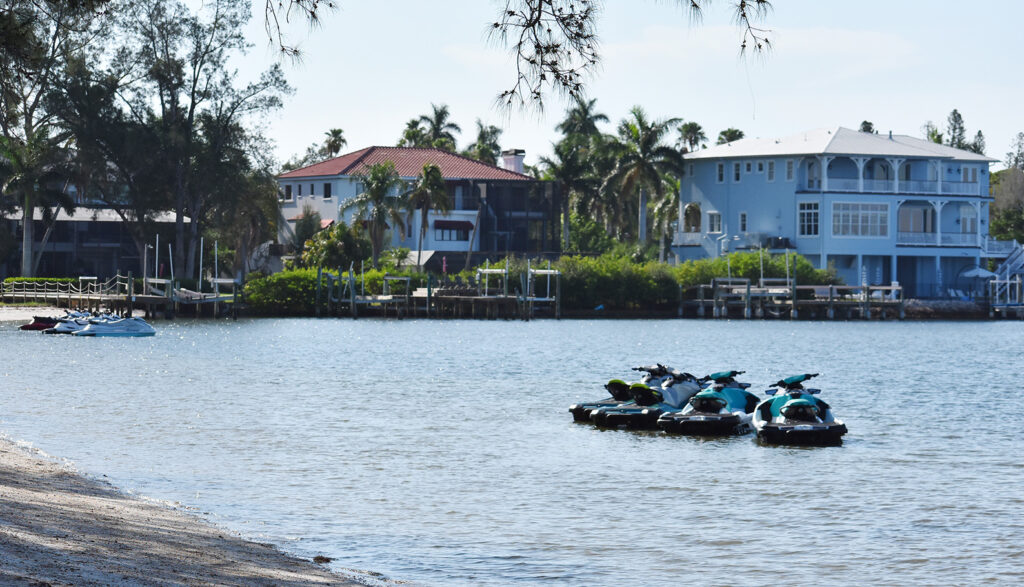
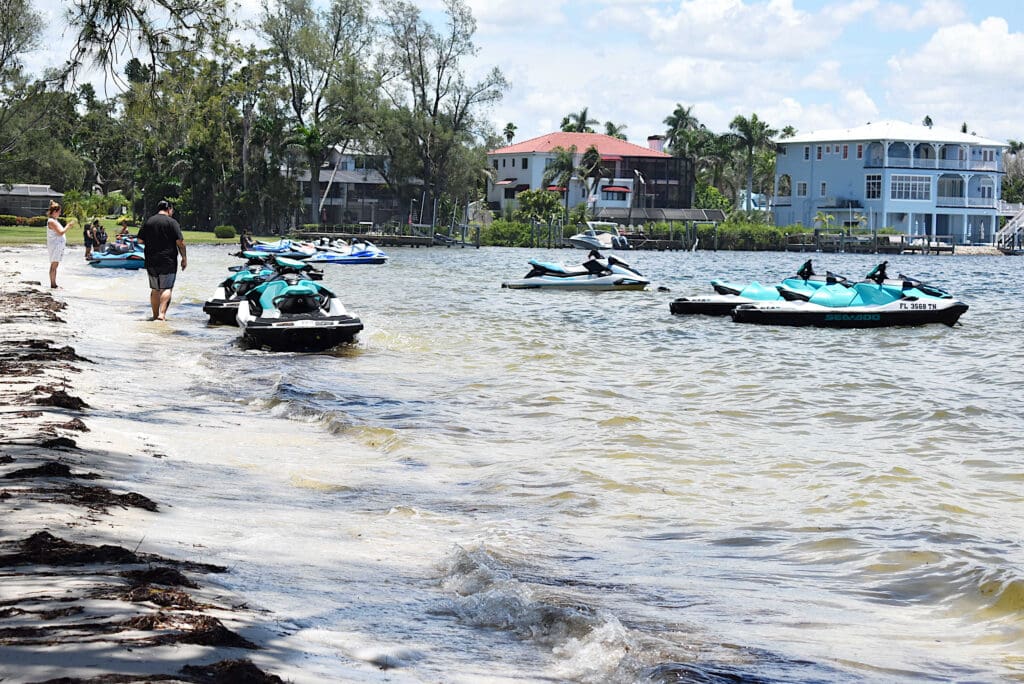
Some personal watercraft rentals occur near a residential dock. – Joe Hendricks | Sun
Cramer’s email was written in response to a July 24 email he received from McClellan, in which she wrote, “Is Bradenton Code Enforcement or the Bradenton Police Department responsible for enforcing prohibitions of vendors and advertising in the FDOT (Florida Department of Transportation) rights of way, where Manatee County Code Enforcement does not do so?”
She also wrote, “Unlawful vendors and advertisements are occurring daily on FDOT rights of way on the southeast side of Palma Sola Causeway.”
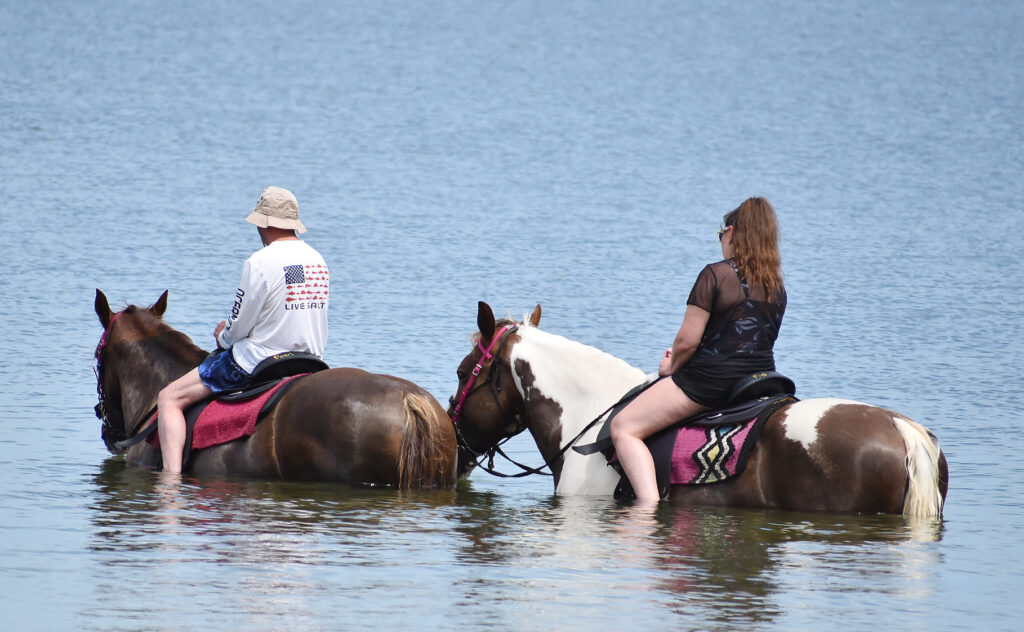
Horse rides are offered along the causeway. – Joe Hendricks | Sun
In recent months, McClellan has repeatedly shared with city, county and state officials her views that the commercial activities taking place along the causeway violate Bradenton’s sign regulations, the state of Florida’s right-of-way use regulations and the outdoor advertising prohibitions set forth in the federal Highway Beautification Act.
On July 31, she sent Cramer and Bradenton Code Enforcement Manager Volker Reiss TikTok videos of a personal watercraft rental operator soliciting business, changing oil and repairing watercraft at the causeway.
Earlier this year, McClellan sent an email to Cramer, Reiss, Manatee County Sheriff Rick Wells and Manatee County Code Enforcement Chief Tom Wooten that noted the Palma Sola Scenic Highway Byway Organization has been working to enhance that portion of the scenic highway since 2004. And she requested enforcement from the applicable county and city agencies.
That email referenced an FDOT encroachment brochure that lists the following prohibited uses of an FDOT-designated scenic highway: “Any use which interferes with the safety and efficiency of the road; display of advertising of any sort; solicitation, display or free distribution of any merchandise, goods, property or services.”
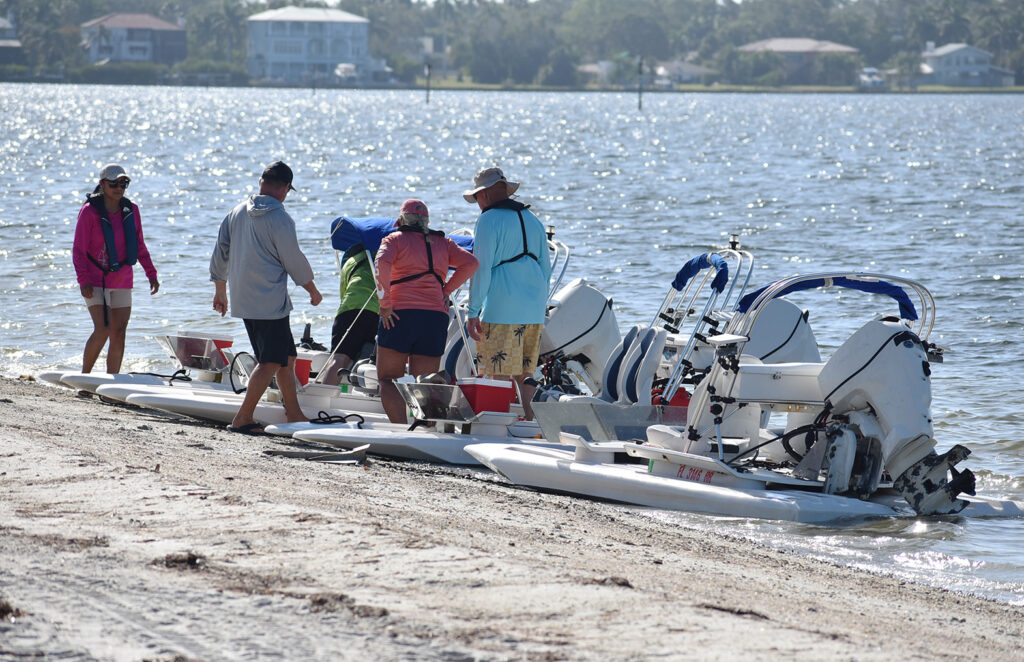
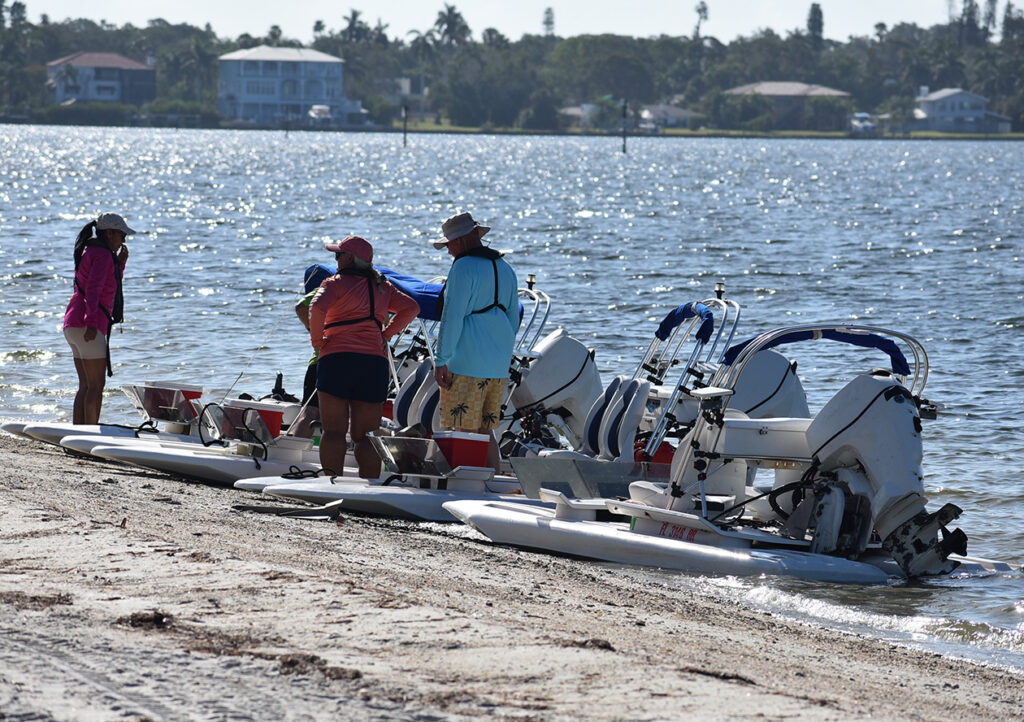
These are among the watercraft offered for rent. – Joe Hendricks | Sun
According to the brochure, “Regulation of activities occurring within the right of way is necessary to help prevent distractions to motorists; unsafe pedestrian movement within travel lanes; sudden stoppage or slowdown of traffic; rapid lane changing; increased vehicular accidents and motorist and pedestrian injuries and fatalities.”
“The Byway organization looks forward to the swift enforcement of our laws and regulations on Palma Sola Causeway, as we have provided the information and evidence to do so,” McClellan told The Sun on July 31.
MANATEE COUNTY – The Palma Sola Causeway is part of the Florida Department of Transportation (FDOT)-designated scenic highway that stretches from 75th Street W. and Manatee Avenue in Bradenton to Manatee Beach in Holmes Beach.
Designated scenic highways have a defined set of rules regulating commercial activity, yet on any given day, there are multiple personal watercraft rental operations openly advertising and operating their businesses along the causeway.
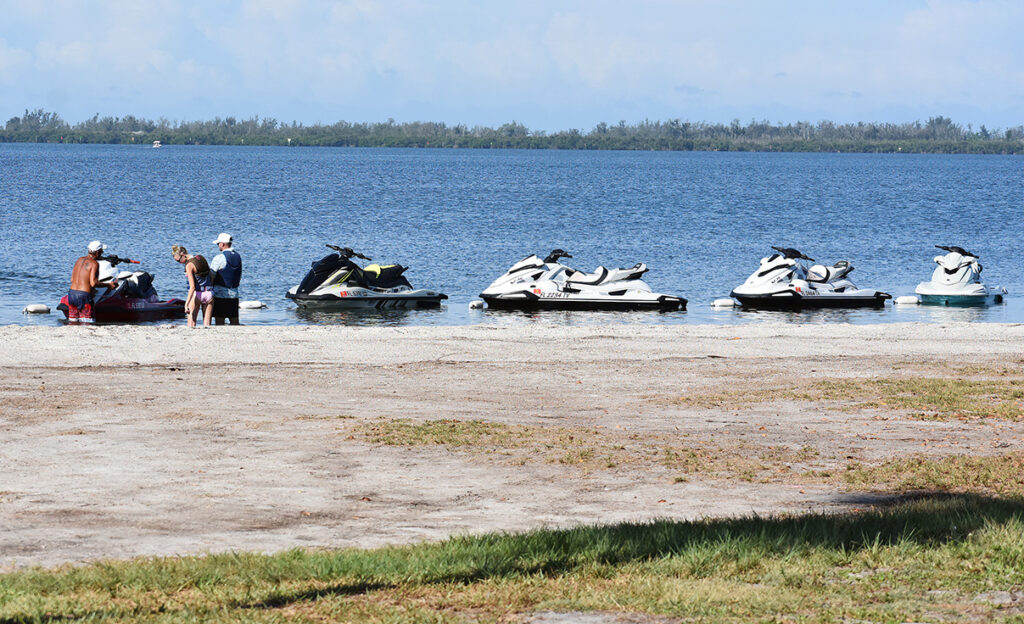
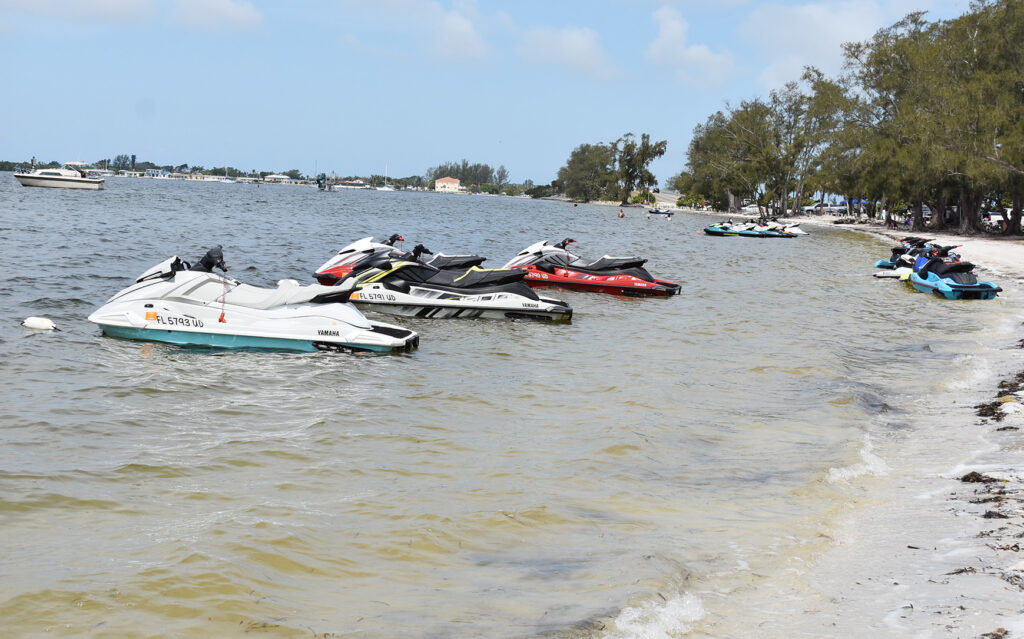
The rental watercraft line the east end of the causeway shoreline. – Joe Hendricks | Sun
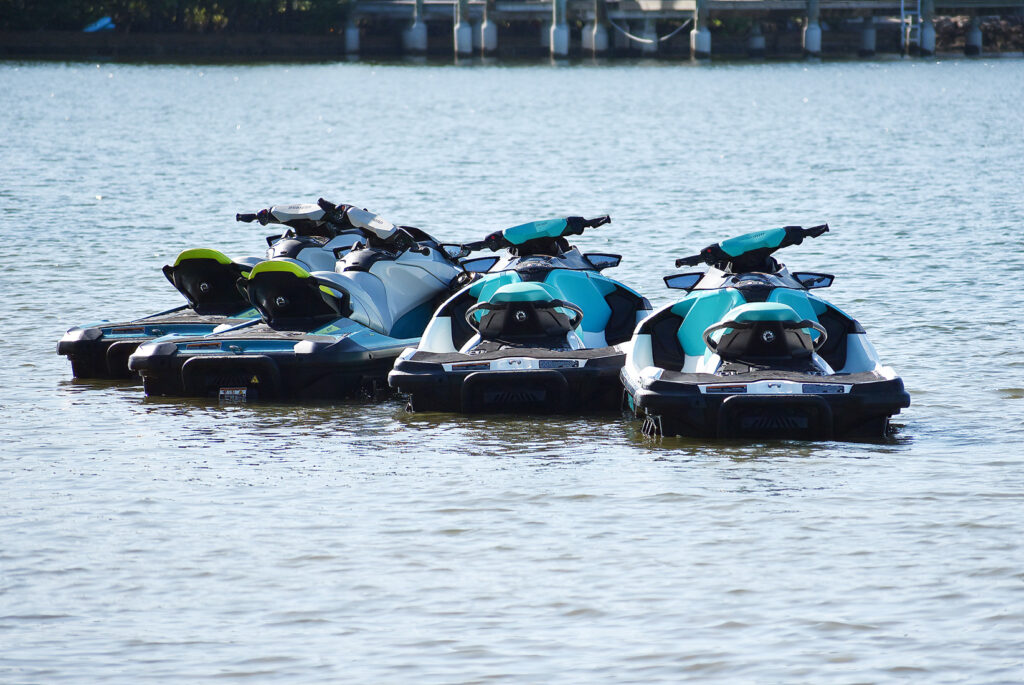
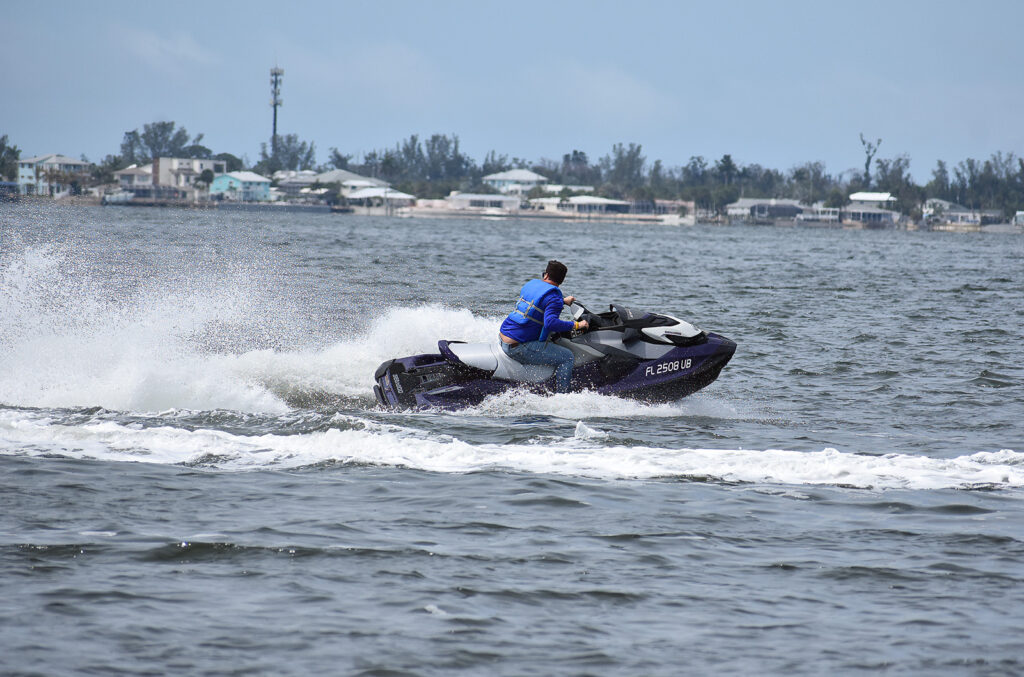
The rented watercraft include Yamaha WaveRunners, Sea-Doo and Kawasaki Jet Skis. The rental activities have become a concern for nearby residents; a concern for traditional brick-and-mortar personal watercraft rental companies; and a concern for the Palma Sola Scenic Highway Byway Organization and the organization’s vice chairperson, Ingrid McClellan.
On April 6, McClellan sent an email to Manatee County Sheriff Rick Wells, Bradenton Police Chief Josh Cramer, Bradenton Code Enforcement Manager Volker Reiss and Manatee County Code Enforcement Chief Tom Wooten.
McClellan’s email notes the Palma Sola Scenic Highway Byway Organization has been working to enhance that portion of the scenic highway since 2004.
Her email requests compliance and enforcement of the city of Bradenton’s sign regulations, the state of Florida’s right-of-way use regulations, and the outdoor advertising prohibitions set forth in the federal Highway Beautification Act.
McClellan’s email also referenced an FDOT encroachment brochure that lists the following prohibited uses of an FDOT-designated scenic highway: “Any use which interferes with the safety and efficiency of the road; display of advertising of any sort; solicitation, display or free distribution of any merchandise, goods, property or services.”
According to the FDOT brochure, “Regulation of activities occurring within the right of way is necessary to help prevent distractions to motorists; unsafe pedestrian movement within travel lanes; sudden stoppage or slowdown of traffic; rapid lane changing; increased vehicular accidents and motorist and pedestrian injuries and fatalities.”
According to the brochure, courts may impose a fine of up to $500 or imprisonment for up to 60 days, or both, for each offense, and local ordinances may impose additional fines.
Watercraft rentals are offered on one side of the causeway and horse rides are offered on the other side. – Joe Hendricks | Sun
In addition to FDOT, a patchwork of entities share jurisdiction of the causeway.
“The causeway is an intersection of one owner (FDOT) and three management clearances, depending on where you sit, literally, on the causeway,” Manatee County Director of Natural Resources Charlie Hunsicker explained in a July 9 email to the Sun.
According to Hunsicker, the state of Florida owns and manages the causeway. Manatee County operates and maintains the boat ramp and its parking lot to the south. Bradenton city limits encompass the entire causeway and law enforcement falls to the Bradenton Police Department.
The rental activities are most prevalent at the east end of the causeway, but there are also some concerns about commercial activity taking place at the county-controlled portion of the causeway area farther to the west.
These watercraft were offered for rent just east of the Palma Sola Causeway Boat Ramp parking lot. – Joe Hendricks | Sun
“Manatee is allowed to utilize this state-owned property under a formal lease agreement for the boat ramp and parking area with FDOT,” Hunsicker stated in his email. “Manatee County is aware of unpermitted commercial uses of the Palma Sola boat ramp and is considering means to address that within the boundaries of the ramp and parking lot, which we maintain under our FDOT lease.”
RESIDENT’S CONCERNS
Flamingo Cay resident Keith Burchett recently emailed multiple city, county and state officials as part of his email campaign aimed at stopping the commercial activity occurring near his home.
Burchett said he feels that when a citizen takes the time to write to their local leaders, those leaders should provide a response — and, if necessary, direct the resident to the people and agencies that can help address the concerns.
“Overall, my involvement in correcting things on the causeway has failed,” Burchett stated in a July 9 email to The Sun.
The watercraft rentals occur near these waterfront homes. – Joe Hendricks | Sun
Burchett recently emailed the city of Bradenton regarding his concerns about local enforcement of the sign regulations applicable to the causeway business activities. He shared with the Sun the email he received from Bradenton Public Information Manager Tiffany Shadick. “The city does enforce its sign regulations on the causeway. Code compliance addresses sign violations as they are identified, including prohibited signs that do not comply with city regulations,” Shadick stated in her email to Burchett.
“The city currently has a code enforcement officer assigned to work one weekend day. The division does not routinely operate during overnight hours. As you have noted through your outreach to various agencies, the causeway involves multiple jurisdictions and agencies, each with differing responsibilities and authority. The city continues to coordinate with the appropriate parties as issues arise,” she stated in her email.
The personal watercraft offered for rent are tethered just offshore. – Joe Hendricks | Sun
Regarding the Fourth of July activities, Burchett wrote, “Traffic was backed up, the horse trailers posted signs saying their spaces have been reserved. The sign ordinances were all ignored by the jet ski vendors and code compliance.”
He also stated some of the rented watercraft were driven “with abandon.”
“I think the causeway will continue to be the butt of jokes and nothing will be done. The bottom line is the causeway will continue to decline,” he wrote.
BUSINESS OWNERS’ CONCERNS
Bill Diggens operates Anna Maria Jet Skis from Parrot Cove Marina in Cortez, and he questions why public property is being allowed for use by commercial ventures.
“The city is allowing this to transpire,” Diggens said. “Why is there so much protection for these guys?”
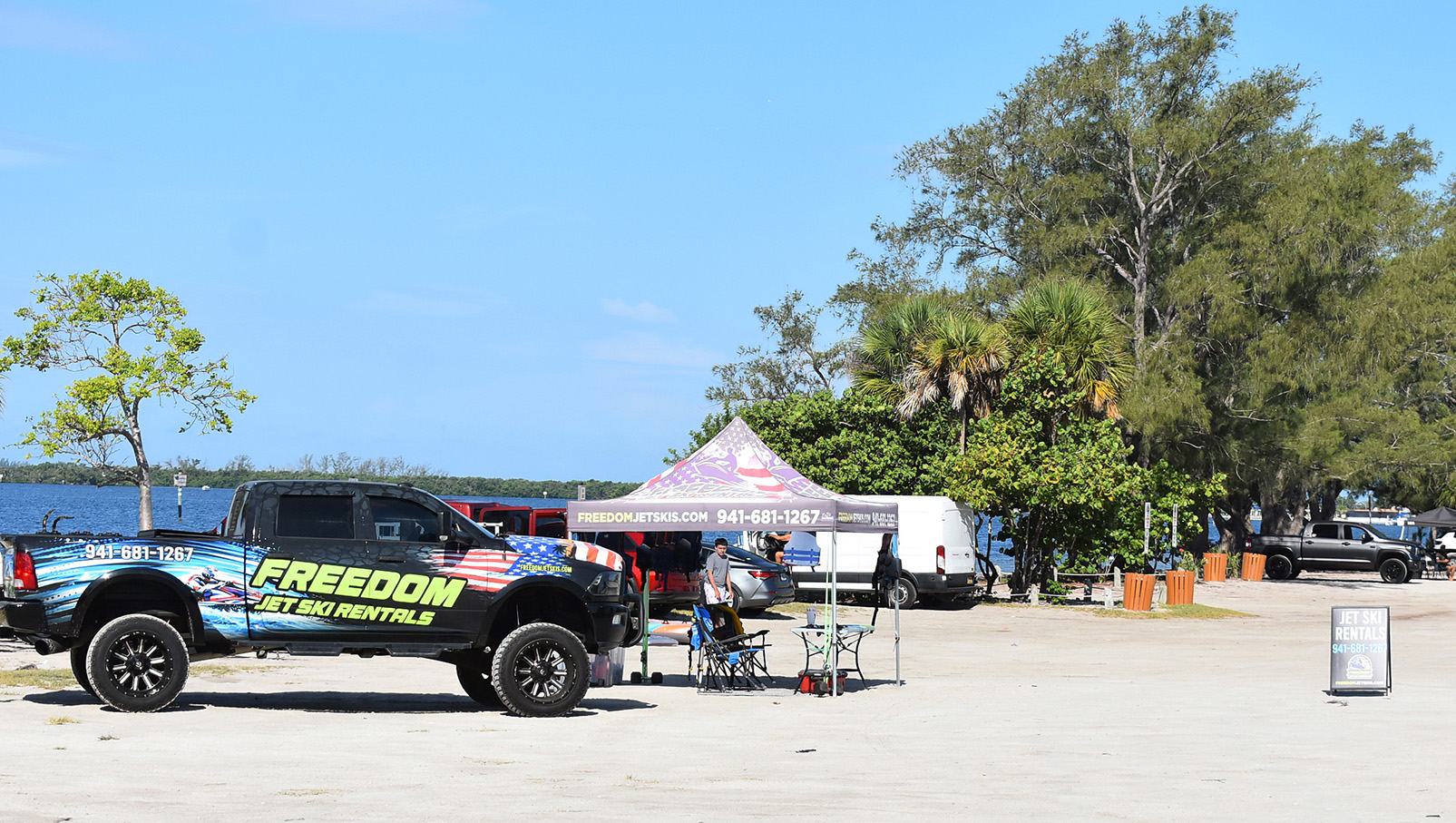
The watercraft rental companies operate from their tents in the causeway parking lot. – Joe Hendricks | Sun
He said his business is fully insured, which protects not only him but also the owner of the marina he launches from.
“My insurance is astronomical and difficult to obtain. We carry a million-dollar policy,” Diggens said. “If somebody gets hurt over there, they’ll come after the city or the county because they allowed it to happen.”
Diggens said a personal guide is sent out with anyone who rents a jet ski from him, and riders must follow that guide for safety reasons and to ensure protection of environmentally sensitive areas.
“How do you compete with someone that doesn’t pay rent?” Diggens asked.
He estimated his business has gone down by at least 60% in the past year.
“If we were doing 15 a day, with 12 competing companies now we’re down to nothing,” Diggens said.
“The jet ski industry has really taken a tank for brick-and-mortar businesses,” John Cadmus, owner of Cortez Watersports, said. “The causeway has become a carnival, and the county has allowed it.”
“They get the best real estate in Manatee County to operate their business from and do not pay rent. They leave trash and they take over the same spot consistently day after day. You can’t even use that boat ramp because people just park in it. They think it’s theirs after a certain period,” Cadmus said.
“They’ve been notified by the scenic highway people that they’re breaking federal law, they’re breaking city law and they’re breaking county law. And they’re still allowed to continue to operate,” Cadmus said.
BRADENTON – On April 8, Palma Sola Scenic Highway Byway Organization Vice Chairperson Ingrid McClellan sent a letter to several city, county and state officials alleging violations of city, county, state and federal laws and regulations regarding the commercial activities taking place along the Palma Sola Causeway, along Manatee Avenue/ State Road 64 in west Bradenton. The commercial activities include personal watercraft rentals, horseback rides and more.
In 2004, the Florida Department of Transportation (FDOT) designated that section of SR 64 as the Palma Sola Scenic Highway. The scenic highway designation also includes SR 789/East Bay Drive in Holmes Beach.
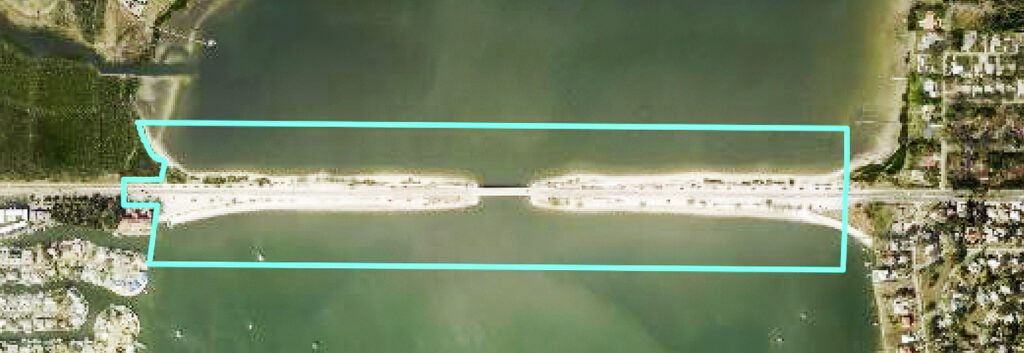
The Palma Sola Causeway serves as the main roadway connection between Bradenton and Holmes Beach – Submitted
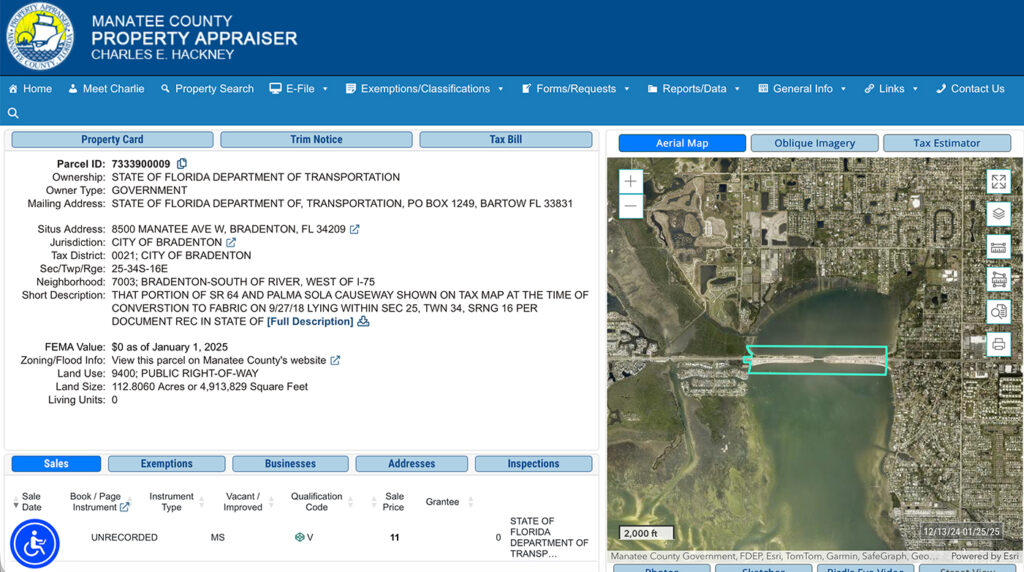
The Manatee County Property Appraiser website lists the “State of Florida Department of Transportation” as the owners of the causeway and right of ways located along the 8500 block of Manatee Avenue West/ SR 64.
The Property Appraiser’s Office lists the state of Florida as the causeway owner. – Submitted
When meeting with Manatee County officials last year, Holmes Beach officials were told the city of Bradenton is responsible for the enforcement of the commercial activities occurring along the causeway.
Since then, “We don’t want our beaches to look like the causeway” has become a common statement made by Holmes Beach and Anna Maria city officials when discussing the regulation of commercial activities on city-controlled public beaches on Anna Maria Island.
SCENIC HIGHWAY LETTER
The Palma Sola Scenic Highway organization’s letter includes the heading, “Rights of way uses compliance request on Palma Sola Causeway.”
The letter recipients included Manatee County Sheriff Rick Wells, Bradenton Police Chief Josh Cramer, Bradenton Code Enforcement Manager Volker Reiss, Bradenton Code Enforcement Chief Tom Wooten, Bradenton Mayor Gene Brown, Holmes Beach Mayor Judy Titsworth, Holmes Beach Police Chief Bill Tokajer, County Commissioner Tal Siddique and FDOT representatives Trisha Hartzell, Dean Stoddart and Darryl Richard.
The Palma Sola Scenic Highway Byway Organization’s letter requests the various agencies help ensure compliance with the city of Bradenton’s sign prohibitions, the state of Florida’s use of rights-of-way prohibitions and the federal code that addresses outdoor advertising on scenic highways.
“We have observed up to 17 businesses on the one mile of Palma Sola Causeway’s rights of way, which extends 500 feet into Palma Sola Bay north and south. These businesses have violations in prohibited signs/ advertising and use of state rights of way,” the letter says.
Horseback rides are offered along the Palma Sola Causeway. – Joe Hendricks | Sun
The letter alleges some causeway business operators are violating city, state and federal regulations.
“We ask for your help to enforce them,” the letter says.
Citing the city of Bradenton’s land use regulations, the letter questions the legality of the business signage placed along the causeway.
The letter also references the Florida Statute that regulates prohibited uses of the rights of way and says, “The FDOT encroachment brochure identifies the prohibited uses of the rights of way that include any use which interferes with the safety and efficiency of the road, display of advertising of any sort, solicitation including for charitable purposes, sale/display/free distribution of any merchandise, goods, property or services.
The letter says, “According to the Florida Scenic Highway Program Manual, once a highway has been designated, the policy on outdoor advertising signage must be complied with for designated Scenic Highway corridors. The policy precludes outdoor advertising on designated scenic highways/byways.”
McClellan said the only responses she received from the letter recipients came from Holmes Beach Mayor Judy Titsworth and Holmes Beach Police Chief Bill Tokajer.
The causeway horseback rides have been the subject of past debate. – Joe Hendricks | Sun
In her email to McClellan, Titsworth wrote, “Thank you for this most appropriate demand letter. I appreciate the entire Scenic Highway Committee for taking action, as our many voiced concerns have fallen on deaf ears.”
BUSINESS OPERATORS’ PERSPECTIVE
On April 30, The Sun spoke with three personal watercraft rental operators at the causeway who preferred not to be named.
One operator noted the causeway is owned by the state of Florida.
Regarding their business signage, the business operators said Bradenton Code Enforcement officers regularly visit the area.
“They regulate the code which allows us to have an A-frame sign,” one operator said.
“And they told us this year we’re allowed to have the tents,” another operator said.
The personal watercraft made available to rent are staged along the Palma Sola Bay shoreline. – Joe Hendricks | Sun
The business operators noted their rental operations require state-issued livery permits.
According to the Florida Fish and Wildlife Conservation Commission (FWC) website, “Liveries need a state-issued, no-cost livery operator permit if they are renting motorboats, personal watercraft, paddlecraft, sailboats or houseboats being operated on the waters of the state. Liveries that operate in Florida without a valid livery operator permit are in violation of Florida statutes, which is a first-degree misdemeanor subject to a $1,000 fine.”
Florida law requires livery permit holders to carry insurance coverage with a minimum of $500,000 per person and $1 million per incident.
State regulations require personal watercraft rental operators to provide their clients with a pre-rental and pre-ride instruction checklist and attestation form that addresses operator responsibilities, navigation rules and aids, waterway hazards, weather awareness and operating instructions. FWC’s pre-ride checklist contains specific personal watercraft safety requirements regarding personal flotation devices, the use of a kill switch, the minimum age to legally operate a personal watercraft (14 years old) and the minimum age to rent a personal watercraft (18 years old).
Those who rent personal watercraft are required by law to receive pre-ride instructions. – Joe Hendricks | Sun
According to the FWC website, “These forms must be completed and signed by both the renter and instructor. The completed forms must be maintained by the livery for 90 days and must be made available to law enforcement upon request.
“Any person delivering pre-rental or pre-ride instructions must have successfully completed a boating safety education course approved by the National Association of State Boating Law Administrators and the state of Florida. Proof of completion must be maintained at the rental/business location.”
COUNTY INSIGHTS
The Sun also sought insight from Manatee County Natural Resources Director Charlie Hunsicker.
“The causeway is an intersection of one owner and three management clearances depending on where you sit, literally, on the causeway. The state of Florida owns and manages the entire causeway. Manatee County operates and maintains the boat ramp and the boat ramp parking lot on the south side of the causeway and the public restroom, shelters and associated parking lots on the north side of the causeway (at Palma Sola Causeway Park),” Hunsicker stated in an email to The Sun.
“Manatee is allowed to utilize this state-owned property under a formal lease agreement for the boat ramp and parking area with FDOT. The existing restroom and picnic table area are also operated and maintained at FDOT consent.
Manatee County is aware of unpermitted commercial uses of the Palma Sola Causeway Boat Ramp and are considering means to address that within the boundaries of the ramp and parking lot which we maintain under our FDOT lease,” Hunsicker wrote.
“FDOT carries continuous concerns over traffic safety, speeds and problems associated with random and uncontrolled automobile entry and exit from the causeway on to the state road and the wear and tear on the state highway road pavement edges and shoulders.
The city of Bradenton city limits encompass the entire causeway and any business or commercial use on either side of the causeway is subject to approval by the city of Bradenton,” Hunsicker wrote.
ANNA MARIA – While discussing beach cabana rentals and other commercial activities occurring on public beaches, Mayor Mark Short said city code prohibits all commercial activity in beach areas that carry the city’s coastal conservation or recreation open space zoning designations.
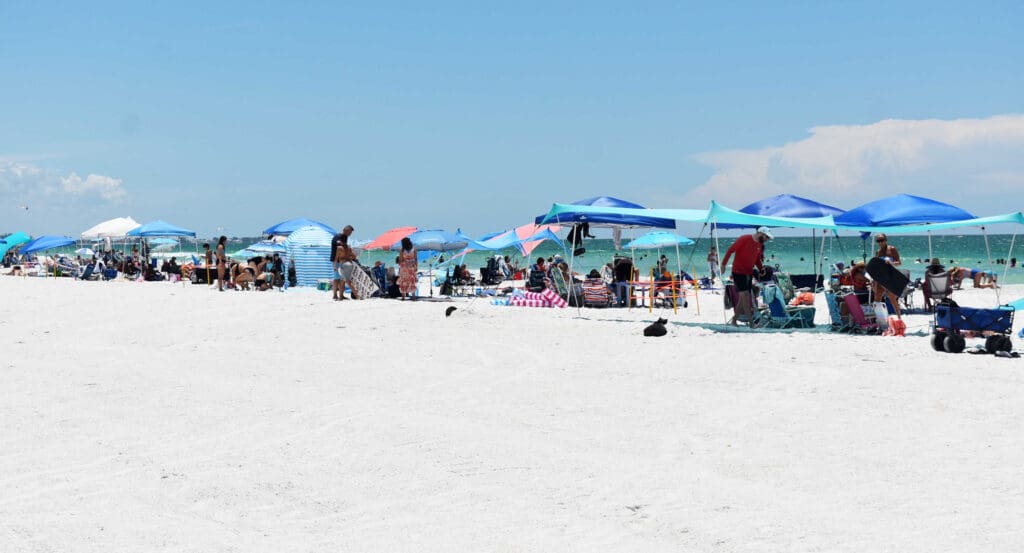
During the July 24 Anna Maria City Commission meeting, commissioners, cabana rental company owners and employees and the public were also informed that multi-legged cabanas and tents of any kind, commercial or personal, are not allowed in coastal conservation-zoned areas.
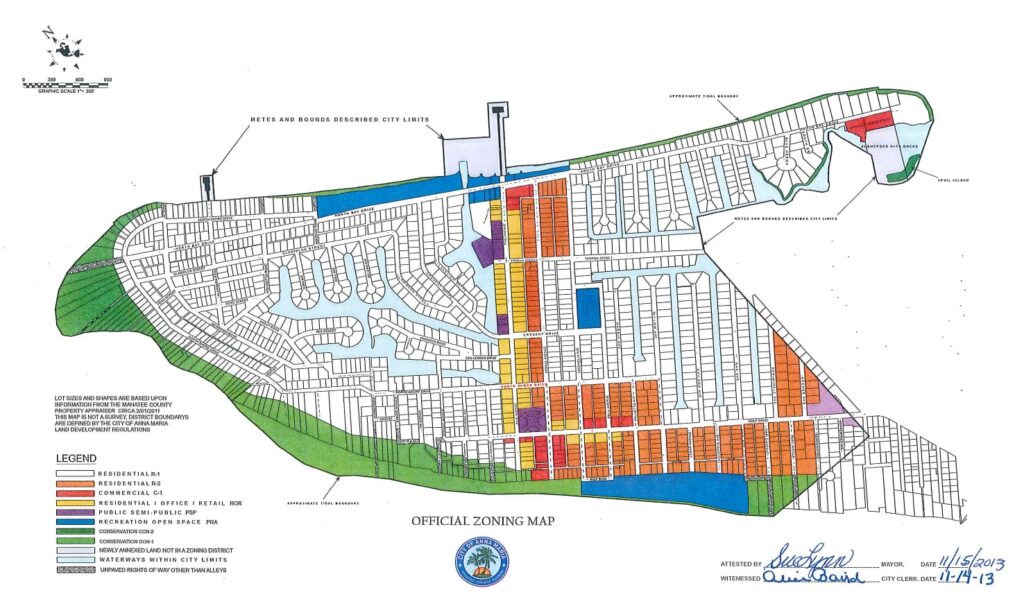
According to the color-coded zoning map included in the meeting packet, the coastal conservation zones highlighted in green include the entire public shoreline from Magnolia Avenue to the northern tip of Bean Point. The recreation open space zones highlighted in blue include the Bayfront Park and City Pier shorelines.
The areas highlighted in green are zoned coastal conservation and the areas highlighted in blue are zoned recreation open space. – City of Anna Maria | Submitted
“We have an ordinance on the books that addresses what is permitted in the blue and green areas. The ordinance does not provide for the conduct of any commercial activity in either the coastal conservation zone area or the recreational zone area,” Short said.
Mayor Mark Short doesn’t want Anna Maria’s beaches to resemble the commercial-heavy Palma Sola causeway along Manatee Avenue. – Joe Hendricks | Sun
Participating by phone, City Attorney Becky Vose said the city controls the public beaches and state and federal laws don’t restrict a city’s ability to regulate commercial activities. In regard to privately-owned beaches not regulated by the city, Vose said the upland property owner owns the land up to the mean high-water line and rented or personally-owned tents and cabanas can be set up on privately-owned beachfront property.
Vose said her law firm represents six beach communities throughout the state and each one regulates commercial beach activities differently. She said the city of Cocoa Beach allows a limited number of beach vendors to enter into 7-year agreements with the city and if they don’t comply with the city’s insurance, operational and cleaning requirements, those agreements are nullified and offered to another vendor.
Regarding city-regulated beaches, Vose said the city has a great deal of flexibility and can pretty much do what it wants.
“Right now, you do not permit any commercial activity,” she said. “The city has not been enforcing those requirements, but that doesn’t mean you couldn’t start. You need to decide how you want to handle these and give direction to staff. We can either draft new ordinances or we can enforce what we have. There is no compulsion under state law or city code to allow any commercial uses on the beach.”
Commissioner Charlie Salem asked Vose to explain any restrictions that apply specifically to the coastal conservation-zoned areas. Vose said the only shelter-like item allowed in a coastal conservation zone is a single-pole umbrella or something similar. She said multi-legged tents and cabanas are not allowed in coastal conservation zones but that’s something the commission could change.
Current city code prohibits tents and cabanas in beach areas with coastal conservation zoning designations. – Joe Hendricks | Sun
Regarding commercial activity, Vose said any changes desired by the mayor and commission need to be clearly written to continue prohibiting any unwanted commercial activity such as food vendors and other types of rentals.
“You can regulate all of those things and you can prohibit them also,” Vose said.
Participating by phone, Commissioner John Lynch said, “We have a multi-layer problem that we’re trying to solve. We’re not current enforcing the current code, so I think there’s a bunch of work we need to do.”
When opening the discussion for public input, Salem said, “Think of this as your opportunity to help us start thinking about the issues involved on any side of this issue.”
In response to a question from city resident Wendy Smith about boat-based vendors, Short said the city’s jurisdiction only extends 10 feet into the water, with the exception of the vessel exclusion zone offshore of Bayfront Park where motorized vessels are prohibited.
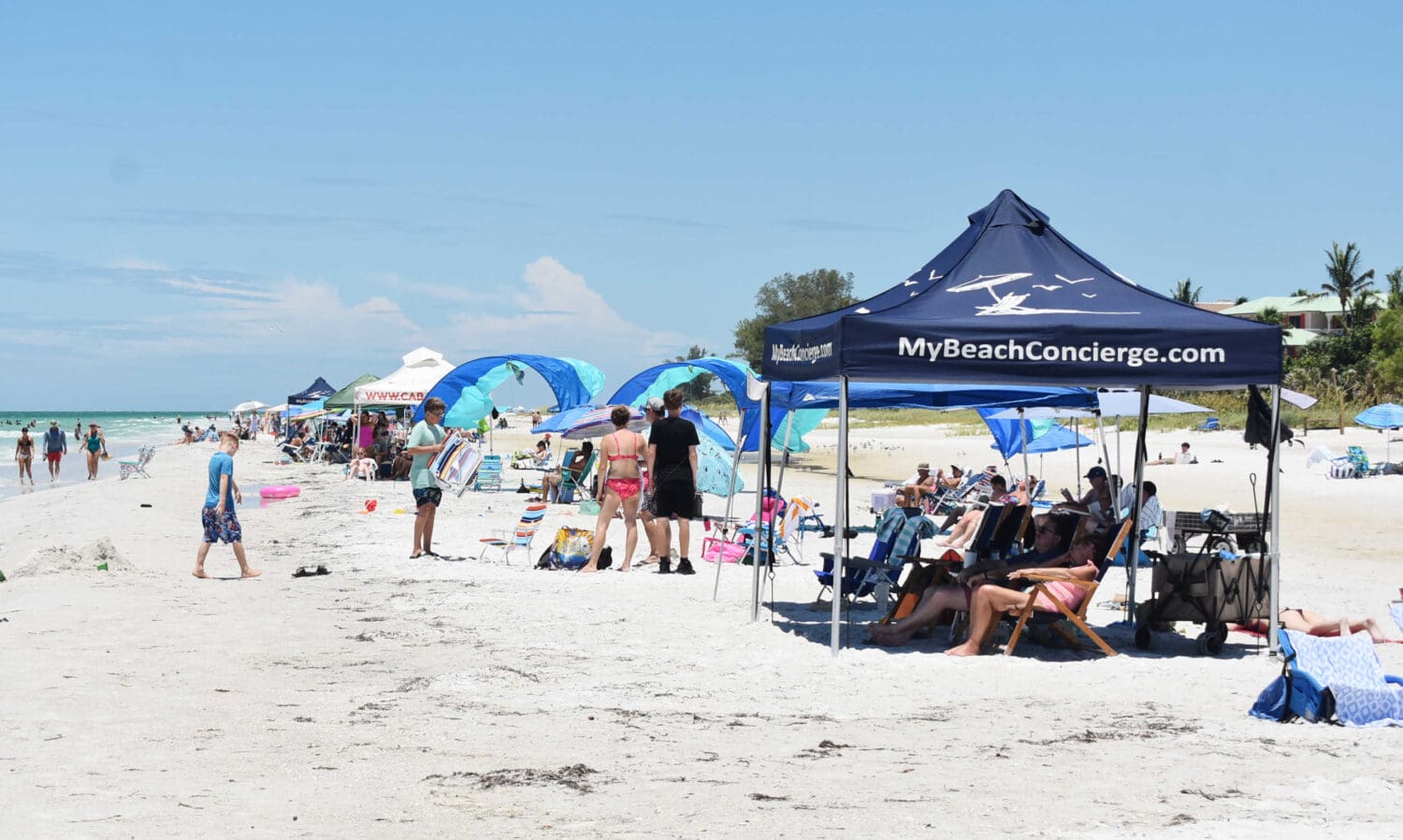
My Beach Concierge owner Peery Heldreth addressed the mayor and commissioners. – Joe Hendr
Addressing a concern previously raised in Holmes Beach, My Beach Concierge owner Peery Heldreth said none of the cabana vendors in the commission chambers that day are setting up cabanas that aren’t reserved in advance. Heldreth said his company has a state license, pays monthly sales taxes, carries liability insurance and workers’ compensation insurance. Peery said his company doesn’t set up cabanas on Bean Point. He said his cabanas are commercial grade and he pays his employees $20 an hour, plus tips. He requires his employees to pick up any trash they see on the beach and they’re instructed to stay clear of sea turtle nests. Heldreth asked the mayor and commission to allow the current cabana rental activities to continue while the commission works through these issues.
Anna Maria resident David Ridley said cabanas and tents help protect people from getting skin cancer.
Commissioner Gary McMullen said the city is not enforcing the ordinances on the books and the city hasn’t prevented anyone from putting up a cabana or a tent, but the commission now needs to decide if the existing regulations will be enforced or changed. Short said the commissioners must first decide at a future meeting if they want to keep the current regulations.
The Palma Sola causeway in west Bradenton is a popular place for beach vendors. – Joe Hendricks | Sun
Several vendors offer Personal watercraft rentals at the Palma Sola Causeway in west Bradenton. – Joe Hendricks | Sun
“I do want to be clear about one thing. This is not about just the cabanas. This is about commercial activity in general on the beaches,” Short said. “I don’t want our beaches to turn into the Manatee Avenue causeway. I don’t want horses on the beach. I don’t even want dogs on the beach.”
Dogs are not allowed on Anna Maria Island beaches.
BRADENTON – The Bradenton Police Department (BPD) and the Manatee County Homicide Task Force are investigating the shooting death of a teenager near the Palma Sola Causeway early Saturday morning.
According to a press release from BPD, shortly after 1 a.m., a Bradenton Police Department officer responded to a report of gunshots in the 8600 block of Manatee Avenue West. The officer located the body of 16-year-old Martavious Carter.
Detectives believe Carter was picked up at another Manatee County location and driven to a secluded area of the causeway where the crime occurred.
During the police investigation, the causeway and Manatee Bridge were closed until 5:30 a.m. Detectives say this is an isolated incident.
The investigation is ongoing and police are asking anyone with information to contact Detective Brian Sands at brian.sands@bradentonpd.com or 941-932-9300. Callers may remain anonymous and be eligible for a cash reward by contacting Manatee Crime Stoppers at 866-634-8477 (TIPS) or online at ManateeCrimeStoppers.com.
BRADENTON – Horses are not the only source of bacteria and seagrass damage in Palma Sola Bay, an expert told the Bradenton City Council.
In a July 26 water quality presentation, Dr. Dave Tomasko, executive director of the Sarasota Bay Estuary Program (SBEP), stopped short of naming horses as a primary cause of elevated bacteria levels and loss of seagrass, instead saying that there are likely multiple causes.
Horseback riding on the north side of the bay has long been debated by the council, the Palma Sola Scenic Highway Committee and water quality organizations.
“People damage the bay by enjoying the bay, we’re not against that at all,” Tomasko said. “SBEP is for access and recreating on the bay but that does cause damage to the bay.”
In his slide presentation to the council, he raised the question, “Do horses pose a risk to the health of Palma Sola Bay? Is this something that might be bothering some people, or is it something that puts the system at risk?”
Two businesses provide horseback riding in the water on the north side of the bay.
Tomasko discussed four metrics related to water quality and health of the bay, and talked about each of their possible sources: Nutrient enrichment, pathogens, physical damage and nitrogen.
“We generate nutrients through our fecal material, through passing urine. We generate nutrients by fertilizing our lawns, not picking up after our dogs,” he said. “We’re going to look at whether or not there is a nutrient-related problem in Palma Sola Bay and if there is, how important might horses be for that.”
Pathogens can be quantified, Tomasko said.
“Pathogens are things that can make you sick. We test for bacteria. We have three types of fecal indicator bacteria – e. coli, enterococci and fecal coliform, and none of those are just specific to humans, to mammals or to animals,” he said. “I can get you millions of fecal coliform bacteria from decomposing grass in a bucket of water. Our indicators are not specific to a source. So, if you find elevated levels of bacteria, it doesn’t mean you know why they’re there. “
Two different locations, one on the north side where horses are ridden and one on the south side where they are not are both sampled by laboratories, he said.
The Florida Department of Health collected more than 50 samples of south-side data and 84% of them were good, Tomasko said.
“On the north side, the values are poor more than any other category. Elevated levels are found more on the north side than the south side,” he said. “The south side doesn’t show elevated levels (of bacteria) except on occasion.”
“Enterococci bacteria is not necessarily from humans or pets or horses. It could be, but it could also be coming from decomposing seagrass meadows,” Tomasko said, noting that seagrass is absent from the south side of the bay.
Tomasko suggested that there is a good way to find out where the bacteria is coming from and that is through quantitative testing.
“My suggestion would be to try find what the bacteria is coming from to know what you should act upon, if anything,” he said. “If I have 3,000 bacteria and one is due to a human, that’s a lot different than if I have 3,000 bacteria and 1,500 is due to a human. There’s a quantitative way to do this.”
Evidence of physical damage to seagrass is apparent, Tomasko said, but could be caused by multiple sources.
“If we walk through seagrass meadows, or run through with a boat propeller, you’re going to scar the grass a little bit,” he said. “Horses are 1,500-2,000 pounds, they’re kind of heavy, but they also have buoyancy. A submerged horse will have some of its weight offset by buoyancy in the water.”
“It’s important to keep in mind we’ve been doing a lot of things to physically damage these habitats. And horses are causing a trail, true, but there’s a lot of boat propeller scars there too.”
With regard to nitrogen levels he said, “If you want your lawn to grow fast or your trees to look green, add nitrogen. So, we’re trying to keep the amount of nitrogen under control in the water.”
Five or six times a year, volunteers go out to measure microalgae in the bay.
“This was a healthier bay 10-15 years ago. We had a 28% increase in seagrass, we had lower nitrogen, we had lower algae and lower phytoplankton,” Tomasko said. “Palma Sola Bay continues to be healthy, looking at the seagrass status, the phytoplankton, the water clarity, it continues to be classified as a healthy system.”
“Would removing these horses reduce some of these issues?” he asked. “Yes, probably in a local sense, but the bay remains healthy and it doesn’t appear that the bay is in some kind of tipping point or close to it.”
BRADENTON – Florida Department of Health in Manatee County (DOH-Manatee) has issued a no-swim advisory for the beach on the south side of the Palma Sola Causeway along Manatee Avenue.
“A no-swim advisory is issued when enterococci bacteria levels exceed Federal Guidelines for safe swimming. It is thought that contact with the water at the site could make beachgoers sick,” a DOH-Manatee press release said.
The advisory will be in effect until the water meets Environmental Protection Agency (EPA) safety guidelines.
No other Manatee County beaches are under the no-swim advisory.
As a participant in the Healthy Beaches Program, DOH-Manatee collects water samples at select beaches each week. The samples are then sent to labs to determine if the levels of enteric bacteria (enterococci) – which can bring human disease, infections or rashes – are acceptable based on EPA standards.
If levels are read as unacceptable, a no-swim advisory is issued; a no-swim advisory is lifted once the levels read as acceptable.
DOH-Manatee received test results from samples taken at Palma Sola South on June 19 and June 22 that show an elevated level of enterococci bacteria.
Additional information about the Healthy Beaches program can be found by calling (941) 714-7593, or by visiting the Florida Department of Health’s website at www.FloridaHealth.gov and selecting Beach Water Quality under the Environmental Health tab of the navigation bar.
ANNA MARIA – The city won’t enact any additional prohibitions or regulations pertaining to commercial activity in city rights of way and other public spaces.
The Anna Maria City Commission reached this unanimous decision on June 8 after further discussing concerns that Commission Chair Mark Short raised during the commission’s May 25 meeting.
On May 25, Short said he didn’t want Anna Maria’s rights of ways and public spaces being overrun with commercial activity similar to what’s occurring along Manatee Avenue at the Palma Sola Causeway in west Bradenton, where multiple commercial entities offer horseback rides, personal watercraft rentals, kayak and paddleboard rentals and more.
Several businesses conduct commercial activity along the Manatee Avenue causeways in Bradenton. – Charlie Trygg | Submitted
After the May 25 meeting, Mayor Dan Murphy asked City Attorney Becky Vose and City Planner Ashely Austin to review how the city currently addresses commercial activity in rights of ways and public spaces and what more could be done if the commission identified specific problems to address.
During the June 8 meeting, Murphy reminded the commission that additional enforcement efforts might require additional personnel and/or equipment.
Austin said the city’s code of ordinances already prohibits commercial activity in city-owned rights of way, but things get trickier when regulating commercial activity on the beaches. She noted the city already prohibits motorized vessels, including personal watercraft, within 300 feet of Anna Maria’s public beach areas. She said the city also prohibits using a cart or vehicle on a public beach to offer goods and services.
The city of Anna Maria owns the shoreline near the City Pier and along Bayfront Park. – Joe Hendricks | Sun
Vose told the commission there’s state legislation in the form of Senate Bill 170 awaiting Gov. Ron DeSantis’ signature. If adopted as state law, the state legislation would require local governments to prepare business impact estimates before adopting new regulatory ordinances. The state legislation would also allow courts to award the recovery of attorney fees for those who challenge a new local ordinance. If enacted, the new state law would take effect Oct. 1. Vose advised the commissioners to act before then if they want to adopt any new regulatory ordinances.
Providing a potential solution to the commission’s commercial activity concerns, Vose said the city of Cocoa Beach previously created small, designated areas where commercial activity is allowed on those public beaches.
Short asked if all of Anna Maria’s beaches are public. Murphy said the majority of the beaches in Anna Maria are privately owned, and those who own beachfront property that hasn’t been renourished by the county have property rights that in some cases extend into the water.
The city of Anna Maria owns several beach access points, including this one near Bean Point. – Joe Hendricks | Sun
“It’s not wet sand, dry sand,” Murphy said regarding the private ownership of non-renourished beaches.
Austin said private ownership creates a gap in the city’s ability to regulate beach activities.
Murphy said the city owns the beach area near the City Pier, the beach area at Bayfront Park and several beach access points and can regulate commercial activity in those areas.
Murphy reminded the commission that Anna Maria residents are among the beachgoers who use beach cabana and beach equipment delivery and set up services and food delivery services, and that those service providers are local business owners.
The discussion ended with the commission reaching a unanimous consensus not to take any additional regulatory action.
CORTEZ – When Gale Tedhams was visiting her mother at a Cortez Road condo last May, she immediately recognized the signs of a manatee calf in distress.
“There was a mother and baby in the canal behind the (Mount Vernon) condo,” she said. “You could see boat strike injuries and the baby couldn’t dive to nurse.”
Tedhams, who volunteers at the Bradenton Beach-based Wildlife Education and Rehabilitation Inc., called Mote Marine and the Florida Fish and Wildlife Conservation Commission (FWC) to see if someone could help.
“They told me they knew about them and have been trying to get them for two weeks, but by the time they got to them they were already gone,” Tedham said. “About 30 people (from FWC) came out in a boat and stretched a net around them and were able to take mom and the baby. The mom was huge.”
The calf had an infection and the mother and calf were kept together and brought to SeaWorld Orlando for treatment. SeaWorld has a rehabilitation center for treating wildlife that is ill, injured or orphaned, including manatees, sea turtles, birds and other marine animals.
On Aug. 3, the mother and calf were released back into the water at the Palma Sola Causeway Boat Ramp.
“They brought them down (from Orlando) in a huge box truck,” Tedhams said. “They were laying in the back. Once they were put in the water, they just swam right off together.”
In a recent study, FWC researchers found that one out of every four adult manatee carcasses analyzed showed evidence of 10 or more watercraft strikes.
“With only 4% of adult manatees devoid of watercraft-related scars, it appears exceedingly rare for an adult manatee to not be struck multiple times in its life,” according to the FWC website.
Manatees and the law
Manatees are protected by the Marine Mammal Protection Act of 1972, the Endangered Species Act of 1973 and the Florida Manatee Sanctuary Act of 1978.
It is illegal to feed, harass, harm, pursue, hunt, shoot, wound, kill, annoy or molest manatees. According to the FWC, “Examples of illegal activities include: Giving food or water to manatees, or using food or water to attract manatees, separating a mother and calf, disturbing manatee mating herds, or pursuing or chasing manatees either while swimming or with a vessel.”
Call the FWC’s Wildlife Alert Hotline: 888-404-FWCC (3922), #FWC on cell phones, or text Tip@MyFWC.com to report manatee deaths, injuries, harassment, accidents, or orphaned or distressed manatees.
BRADENTON – Anyone traveling down Manatee Avenue the afternoon of Friday, Feb. 19 was treated to an interesting sight as the nine-person crew of the Exuma Trader, a Sarasota-based marine salvage vessel, worked to remove the Viva! Viva! from the shallows of Palma Sola Bay, where it ran aground early this month.
The entire operation took more than two hours and required an assist from Sea Tow to get the boat bobbing.
The boat was a minor tourist attraction this month on the southeast side of the Palma Sola Causeway until its owner could have it removed. Thanks to the help of Catherine Schultz of Catherine’s Florida Charters and Bahia Mar West Marina, the vessel was removed at no cost to the owner, who lives part-time aboard the Viva! Viva!
Florida Fish and Wildlife Conservation Commission officers, along with officers from the Bradenton Police Department, secured the site and watched over a small group of onlookers.
At the end of the afternoon, the Viva! Viva! was returned to its customary anchorage position in Palma Sola Bay on the north side of the causeway along Manatee Avenue.
The crew of the Exuma Trader out of Sarasota pulled the Viva! Viva! from the shallows of Palma Sola Bay on Friday. - Kristin Swain | Sun
MANATEE COUNTY – The boat that’s been a fixture on the south side of the Palma Sola Causeway beach on Manatee Avenue for several days is expected to soon be gone.
Manatee County Information Outreach Manager Nicholas Azzara said that the owner of the beached vessel, the “Viva! Viva!,” has been located by the county’s marine resources team and confirmed that the owner does have plans to repair and remove the vessel from the public beach as quickly as possible.
Azzara said that in conversations with the boat owner, county representatives determined that there were extenuating circumstances leading to the boat’s prolonged stay on the sand. Because the vessel isn’t considered abandoned or derelict, there are no plans for Manatee County or Florida Fish and Wildlife Conservation Commission officials to remove the boat.
To help reduce the owner’s liability due to the public curiosity the beached vessel has garnered, Azzara said the owner has arranged for caution tape and signage to be placed on the vessel noting that it is private property. The public is asked to not trespass on the beached vessel.
If the blue and white boat looks familiar, it’s the same one that has floated at anchor on the north side of the causeway for the past few years. The boat appeared on the beach after a windstorm the week of Feb. 1 and has been there ever since. While no date has been announced for the removal of the boat, the situation is expected to be remedied by the boat’s owner as quickly as possible. At this point, Azzara said Florida state boaters’ rights limit the county to working with the boat owner to limit public access to the vessel and on the removal of the boat.
BRADENTON – The horseback riding operations along the Palma Sola Causeway on Manatee Avenue West are again under scrutiny, this time by Bradenton City Council members.
During an Aug. 19 emergency meeting, council members voted unanimously to have City Attorney Scott Rudacille look into what the city can do to help mitigate issues caused by the riding operations. Issues discussed include the damage to seagrass, which could potentially lead to erosion and cause damage to the roadway, pollution from animal excrement and safety hazards from having so many horses on the side of the road in an area where families come to relax on the beach.
The same issues were discussed the week before in a Palma Sola Scenic Highway Corridor Management Entity meeting when two Palma Sola Bay residents, Robert Lombardo and Clif Gaus spoke. The two also appeared at the Bradenton City Council meeting.
The Sarasota County Water Atlas lists both the north and south sides of Palma Sola Bay as impaired according to the Florida Department of Environmental Protection’s impaired waters rule. Impairments listed include fecal coliform and other bacteria. The latest water tests were done in late December 2019. Seagrass coverage for the area is listed as regressing from continuous to patchy in the north side area where the horses are ridden.
The issue of the horses was brought up in late 2019 before Manatee County commissioners who decided not to pursue regulation. Under Manatee County law, the horses also are labeled as a form of transportation, allowing them to be ridden on the causeway. Though the business is conducted in FDOT’s right of way, the city of Bradenton is charged with enforcement in the area.
While the horses aren’t a new fixture on the north side of the causeway, recent barriers to the practice in Pinellas County have led to more companies moving their riding businesses to the causeway. During the Palma Sola CME meeting, one member stated that 10 companies now advertise horseback riding on the causeway.
Maps from the Florida Department of Transportation show that the department lays claim to the right of way stretching 75 feet from the center of the roadway. A 2012 letter from Lance Grace with FDOT in response to concerns about the riding businesses states that while the department’s concern is for the “safety of the traveling public,” it allows for use of the right of way on the causeway for public recreation purposes and cannot block one recreation use while allowing others to continue. The letter suggests pursuing the issue with local governmental agencies and the Manatee County Department of Health, which monitors water quality in Palma Sola Bay.
View from the saddle
While some of the riding operators who have spoken to The Sun are not opposed to some type of regulation over the businesses using the causeway, they don’t want to see riding banned as it was in Pinellas County.
Carmen Herrmann Hanson of C Ponies, one of the companies offering horseback rides along the causeway, said that she feels the uptick in the number of horses on the roadside beaches is due partially to the COVID-19 pandemic. With people trying to find safe, outdoor activities, she said she feels more people are coming out to play on the causeway, from riding Jet Skis to riding horses or just relaxing on the sand.
As for her business, she said her employees know where the seagrass is and they stick to the harder, sandy areas where it’s not so soft that it could cause the horses to stumble. She suggested that the city or FDOT put signs in the area to specify that horses or small watercraft are not allowed to launch where the seagrass is, noting that the watercraft used on the south side of the causeway at low tide cause serious damage to seagrasses.
Hanson said she’s not opposed to some type of regulation for the riding businesses and even suggested that the horse operators and other companies doing business on the causeway contribute to a seagrass mitigation fund to help repair some of the damage to the area’s seagrass, though she added that the suggestion didn’t go anywhere with area leaders.
MANATEE COUNTY – The horses being ridden for profit along the causeway are again causing a stir, this time with members of the Palma Sola Scenic Highway Corridor Management Entity (CME) and some nearby residents who live along Palma Sola Bay.
The subject of horseback riding in the bay came up during an Aug. 12 meeting of the CME. The group discussed the matter themselves and heard from two residents who live on the bay.
Robert Lombardo and Clif Gaus, two long-time bay residents, both spoke during public comment, asking for help from CME members in seeking regulation for the horse riding businesses.
Lombardo, who has lived for nearly 40 years on the bay, said that he initially became concerned about the businesses when he saw the horseback riding take off in 2016. After speaking with local elected officials and not garnering any interest in the issue, he said he backed off, only to renew his efforts in October 2019.
“I can’t ignore it anymore,” he said, noting that he’s seen a steady increase in the horse riding excursions and the number of companies operating on the causeway. Lombardo’s concerns include water quality and the destruction of seagrasses where the horses are ridden in the water off the beach. He said that he sees horse excrement float by his dock regularly which leads to concerns for him about fishing and swimming in the water.
Lombardo said that he spoke about his concerns with Julie Espy, Program Administrator of the Water Quality Assessment Program with the Florida Department of Environmental Protection. While he said Espy agreed that there is cause for concern with both environmental and water quality impacts, she said the issue needs to be handled at a local level.
While Lombardo said he doesn’t want to put anyone out of business, he wants a structure in place that helps protect the area’s natural resources, including seagrasses, from destruction.
Gaus said that having so many businesses operate along the causeway corridor takes away from the beauty of the scenic highway and also reduces the number of people who can enjoy the causeway beaches. In addition to excrement and broken seagrasses, he said he’s also seen a horse break loose and run close to children playing on the beach. With so many horses, he said it discourages people from using the causeway and it creates issues with swimming in the water and using the beaches with excrement floating through the water and washing up on beaches.
Gaus presented members with two aerial photographs, one of the north side of the causeway from 2016 and another from 2019. While he assumes that the difference in coloring is due to sand being exposed rather than seagrasses being present, he said that the 2019 map clearly shows a difference where the horses commonly walk.
Shawn Duytschaver, a CME member and owner/operator of Surfer Bus, said that he’d previously proposed the idea of an equestrian trail along the side of the causeway that would keep the horses in one section that is clearly marked. He said that the issue is the way that the horses walk in the water digs up not only seagrass but also sand and would eventually create a channel, requiring the trail to be moved to another area.
Co-chair Ingrid McClellan said that before the CME group approaches any elected officials, they need to have concrete data to show the damage to the area. She suggested going to the Southwest Florida Water Management District and the Sarasota Bay Estuary Program to get seagrass data from the past several years.
Member Mike Meehan suggested that all of the trailers parked on the side of the causeway, some on sidewalks, with horses blocking or constantly crossing the sidewalk could create a safety hazard that would need to be addressed.
Nancy Simpson with the Sarasota/Manatee Metropolitan Planning Organization said that there potentially are several issues for her organization to address, including beach erosion caused by damage to seagrasses that could potentially damage the roadway, travel time concerns along Manatee Avenue with the trailers backing in and out, and drivers slowing down to look at the horses and horses breaking free of their handlers.
Simpson also said that getting the Manatee County Department of Health in on the conversation could shed some light on how the horse excrement affects E. coli, or fecal bacteria, in the bay.
She offered to work with Lombardo and Gaus as a private citizen on presentations for the city of Bradenton’s planning and city commissioners.
Regulation, she said, is a “no-brainer,” adding that it’s wrong for businesses to profit from taxpayer-funded property without paying anything toward the maintenance of the property or remediation necessary because of the business use.
Previously, a representative from Beach Horses, one of the 10 companies that advertise horseback riding on the causeway, spoke to the CME group, suggesting that the businesses be regulated through a registration process similar to taxis. Each horse would be assigned a medallion and only a certain number of horses would be allowed at one time. While the plan was well-received by the group, it didn’t make it any further toward becoming a reality.
Currently, the horses are considered a method of transportation and are therefore allowed on the causeway. The companies that conduct the horseback riding trips along the beach and through the water are not required to have any special permits to operate but are not allowed to take cash onsite for services due to a prohibition against conducting business in a Florida Department of Transportation (FDOT) right of way.
The boundaries between what is a Manatee County park, what is owned by the city of Bradenton and what is an FDOT right of way are blurred and result in an enforcement issue for the area. CME co-chair Craig Keys said he would look into who has authority over the area and report back to the group.
After conversations ended, Gaus said he was happy with how discussions with the CME group had gone.
“I was pleased with their willingness to explore solutions with the city of Bradenton,” Gaus said. “The designated “Scenic Highway” at the entrance to Anna Maria Island is not a scenic highway in reality. Given the state environmental people will have nothing to do with preventing the seagrass destruction, I think we are left with the city as a remedy. I just can’t believe our state government would not want to even try to regulate a massive destruction of seagrass, the very thing they are charged with doing. It sets a horrible precedent for protecting our bays anywhere in the state. If this is their response, we might as well eliminate the entire Florida Department of Environmental Protection.”
BRADENTON – Members of the Palma Sola Scenic Highway Corridor Management Entity met Feb. 2 with one big item on their agenda: the horse riding operations that take place on the north side of the causeway.
Tim Maddox of The Real Beach Horses was on-hand during the meeting to help provide an insider’s look at how the horse riding businesses operate on the causeway. Because the businesses operate in a Florida Department of Transportation right of way, no money can be exchanged on the site but the businesses can operate with limited oversight and no permits needed. Issues that have been brought up during previous meetings include damage to seagrasses, damage to palm trees from tying up the horses and waste problems both on the causeway and in the water.
Maddox said that his ride operators are careful to only conduct rides during low tide when the seagrass along the beach area is visible and the horses can be led around the grasses rather than through them. He added that his staff also cleans up behind the horses while they’re on land though he added that other horse ride operators are not always so careful to preserve the local environment. Maddox also stated that he has commissioned water quality testing to make sure that the horse excrement isn’t adversely affecting the water in Palma Sola Bay. He said that the tests all came back well within normal levels and that four testing areas were used in close timing to when horse rides were taking place to get the best samples possible.
Though he said that his company is very mindful of how they leave the north side of the causeway, some of the other ride operators are not and it’s taking a toll on his employees who are encouraged to clean up after other businesses’ horses.
“I really think our industry needs regulation,” he said.
Maddox suggested that Palma Sola CME members approach the county about regulating the six or more ride operators that bring horses to the causeway for commercial purposes, including instituting a medallion system where businesses would have to apply for a permit per horse, similar to how some cities regulate taxis, and would have to meet certain standards or risk having the medallions revoked. Maddox suggested $500 per medallion to help pay for enforcement of the program. Currently, he said there are no permits, business taxes or regulations required. Ride operators only have to pay sales tax for monies collected.
Manatee County parks representative Mike Elswick said that if the property is owned by the city, even though it is an FDOT right of way, it could fall under the city of Bradenton’s parks department with rules and regulations determined by the parks department director. Maddox said that he feels the only way to create enforcement is to institute something like the medallion program because it’s a contract with strings attached and the threat of taking away the ride operator’s ability to have horses on the causeway.
“A slap on the wrist won’t work,” he said.
Co-chair Ingrid McClellan said she would work on achieving compliance with the current ride operators on the causeway while working with the Palma Sola CME group to come up with a recommendation to present to Bradenton city leaders.
Privacy choicesWe use Google Analytics to understand readership and improve the website. Analytics cookies are optional and can be accepted or declined.Privacy Policy