Tag: environment

Concerns raised over horse waste in bay

Concerns raised over horse waste in bay

PALMA SOLA BAY – With red tide fresh in local memory and blue-green algae hanging around since May, everything that produces nutrients that feed harmful algae blooms is under the microscope.

That includes the horse waste floating in Palma Sola Bay.

The Tampa Bay Regional Planning Council asked the Florida Department of Environmental Protection and the Pinellas County Commission in June to ban recreational horseback riding in Tampa Bay along the Sunshine Skyway Bridge causeway to reduce nitrogen and phosphorus from animal waste and to protect seagrass.

Some of the same horses that are rented at the Skyway also carry tourists up and down beaches on the Palma Sola Bay causeway and swim in the bay.

“We need cooperation from the public who bring horses and dogs to the bay,” said Darcy Young, director of planning and communications for the Sarasota Bay Estuary Program.

Palma Sola Bay has seagrass beds on both sides of the causeway as of last year’s survey, Young said, including in the northeastern section where most commercial horseback rentals occur.

“It’s possible, even likely, that the horses are walking on it,” she said, adding that people trample seagrass too.

“Bacteria, parasites and viruses can lead to poor water quality,” Young said. “If the situation gets bad enough in a concentrated area, you do start to worry.”

Horses are vegetarians, and don’t produce the same bacteria that carnivores – like dogs – do, said Charlie Hunsicker, director of the Manatee County Parks and Natural Resources Department.

“But horse poop is horse poop,” he said. “Whether or not it’s generating harmful levels, we don’t know.”

Concerns raised over horse waste in bay
Horsesurfing takes horseback riding in the bay to another level. – Cindy Lane | Sun

Jennifer Hoffman, executive director of Keep Manatee Beautiful, said the organization’s members are concerned about the impact the horses may be having on water quality in Palma Sola Bay, and rely on the Manatee County Healthy Beaches Program to advise of any issues.

The Florida Healthy Beaches Program lists good water quality in Manatee County except for Palma Sola Bay on May 13 and June 11, due to enterococcus bacteria from fecal matter. Enterococcus also can be a result of runoff or sewage spills in the bay.

Other bacteria like leptospirosis, which can be carried by horses and dogs – also allowed on the causeway – can be spread to people through contact with water, especially cuts in the skin, and from soil containing urine from an infected animal, according to the Florida Department of Health.

The Palma Sola Scenic Highway Corridor Management Entity also has discussed the horses at the causeway.

Horses and dogs historically used the causeway beaches long before companies began using it for commercial purposes, Co-chair Ingrid McClellan said.

While there have been issues with the companies that rent horses on the causeway leaving waste on the shoreline, companies now scoop it from the shore, McClellan said.

“We have signs saying, ‘leave only hoofprints behind,’ ” she said, adding that representatives from one of the horse rental companies told the group that horses do not defecate in the water.

Manatee cause of death uncertain

Waste in the bay was blamed on social media on July 5 for the death of a juvenile manatee photographed at the boat ramp at Palma Sola Bay with the title, “Palma Sewar at its finest.”

The Manatee County Utilities Department confirmed no spills of untreated sewage in Palma Sola Bay in the 48 hours following the appearance of the manatee carcass, Hunsicker said.

The carcass was retrieved by the Florida Fish and Wildlife Marine Patrol and transported to the boat ramp, but it is not known if the manatee died in the bay or was retrieved from elsewhere, he said.

Home sweet shell

Home sweet shell

Seashells are fun to find, but should you take them home?

It’s actually illegal to take some shells, and it may be bad for the beach to take shells that are legal.Coast Lines logo - border

In Manatee County, which includes Anna Maria Island, it’s illegal to take more than two shells per day containing living organisms of any single species, and you must have a Florida recreational saltwater fishing license in order to take them, even from the shoreline, according to the Florida Fish and Wildlife Conservation Commission (FWC).

The two-shell limit applies to shells with animals living inside, like hermit crabs, as well as sand dollars and starfish, which are animals themselves.

It’s easy to tell if you have a live sand dollar – live ones are brown and fuzzy; white and smooth ones have gone on to the big beach in the sky. Live starfish have flexible arms; dead starfish don’t. You can often find dead sand dollars and starfish where there are live ones; take those, and let the living ones propagate.

Home sweet shell
Starfish – Cindy Lane | Sun

The two-shell limit does not apply to oysters and hard clams, but they have bag limits and are subject to regulations on closed seasons, size limits and approved harvesting areas.

The two-shell limit also does not apply to sunray venus clams or coquinas. But wherever there are live coquinas, look nearby for empty coquina shells, which look like butterfly wings – you may not have to take live ones. And keep in mind that the color of coquinas, like most other live shells, will fade when the animal is no longer in residence.

It’s also illegal to take Bahama starfish, live bay scallops or queen conch, but you can take empty queen conch shells as long as you didn’t kill or remove living queen conch to make them empty.

[embedyt] https://www.youtube.com/watch?v=uvySeLNOeBA[/embedyt]

The law allows taking a shell “if the shell does not contain a live shellfish at the time of harvest and a live shellfish is not killed, mutilated, or removed from the shell prior to the harvest of the shell.”

But even when it’s legal, it may not be wise to take shells from the beach, according to a 2014 study on the effects of tourism on seashell loss.

Shell collecting causes beach erosion because shells help stabilize the beach, according to the study, led by Michael Kowalewski of the University of Florida’s Florida Museum of Natural History and the University of Barcelona.

The study says that shell collecting also negatively impacts birds and invertebrates that live on the beach because birds use shells as nest-building material, and marine organisms use shells to hide from predators.

Some countries recognize the negative effects of shell removal, including the Bahamas, which limits the quantity of shells tourists can export without special permits, the study says.

The study suggests that all shells on the beach should be left where nature intended.

So legal or not, living or not, free or not, please don’t take bagfuls of shells home; they’re better off on the beach than in the basement.

Blue-green algae warning signs coming

Blue-green algae warning signs coming

BRADENTON – The Florida Department of Health plans to post caution signs at the boat ramp on the Braden River at State Road 64 warning people, “Blue-green algae may be in these waters. There may be toxins.”

While toxins were not detected in water samples taken in the area by the Florida Department of Environmental Protection on Tuesday, July 2, the signs are necessary “to help educate folks utilizing the county facilities of the current algae bloom and steps they can take to assure they are not impacted from this event,” Tom Larkin, environmental manager for the Florida Department of Health in Manatee County, wrote Charlie Hunsicker, head of the Manatee County Parks and Natural Resources Department in an email today.

The signs advise people to avoid swimming and eating shellfish from the area, to keep water out of their eyes, nose and mouth, and to keep pets away from the water, Hunsicker said, noting the irony that the tests show no toxins.

“We are dealing with causes that are stressful and sometimes fatal to fish. But it should not deter anyone from enjoying Robinson Preserve or any preserve, because toxins have not been detected.” – Charlie Hunsicker, Manatee County Parks and Natural Resources Department

Fish stressed

Fish were gasping for air in the mouth of the Manatee River today like koi in a pond, but not because of blue-green algae, he said, attributing the behavior to low dissolved oxygen in the water caused by high water temperatures and sunlight.

The county took six water samples around Robinson and Perico preserves for testing but the Florida Fish and Wildlife Research Institute will not have results for at least a week, he said.

“In general, it looks like fish were stressed and dying within the preserves and more severely in upper reaches like the boat ramp and tidal nodes, near the fishing pier,” wrote Damon Moore, the division manager of the Ecological and Marine Resources division of the Manatee County Parks and Natural Resources Department in an email to Hunsicker today.

Blue-green algae warning signs coming
Dead and dying fish at the Robinson Preserve kayak launch today. – Manatee County Parks and Natural Resources Department | Submitted

Algae caused a fish kill in the Lower Manatee River, Perico Bayou and Perico Preserve last month, according to the Manatee County Environmental Protection Department. Booms were deployed to help keep algae mats out of the preserve.

“We are dealing with causes that are stressful and sometimes fatal to fish,” Hunsicker said. “But it should not deter anyone from enjoying Robinson Preserve or any preserve, because toxins have not been detected.”

Swimming and wade fishing are not allowed in county preserves, Hunsicker reminds visitors.

Today’s reports

Three of nine samples taken statewide the first week of July showed non-toxic algae blooms, according to the Friday, July 5 Florida Department of Environmental Protection (DEP) report, including the July 2 sample in the Braden River and another showing “mixed algae” in Perico Bayou.

“The Manatee River conditions have improved with no new reports. DEP staff report that conditions look much better except in the Bradenton area,” according to the report.

No samples were taken in waters off Anna Maria Island this week. DEP’s jurisdiction is primarily freshwater, Hunsicker said, so the agency is concentrating on local rivers.

The Florida Fish and Wildlife Conservation Commission (FWC) has jurisdiction over saltwater, he said. Red tide was not present in water samples taken in Manatee County last week by the FWC, according to its Friday, July 5 report.

Blue-green algae called Filamentous cyanobacteria (Lyngbya-like) was first detected on May 9 in Anna Maria Sound at Key Royale, in the Intracoastal Waterway south of Grassy Point, and in Palma Sola Bay near San Remo Shores.

The algae found in Manatee County waters are not the same species that has plagued Lake Okeechobee, the toxic Microcystis aeruginosa, according to DEP.

Blue-green algae can be blue, green, brown or red and emit a foul, rotten egg odor caused by the production of hydrogen sulfide gas, according to DEP, which advises staying out of water where algae are visible as specks, mats or water is discolored pea-green, blue-green or brownish-red. Additionally, pets or livestock should not come into contact with the algal bloom-impacted water, or the algal bloom material or fish on the shoreline.

Even non-toxic blooms can harm the environment by depleting oxygen levels in the water column and reducing the amount of light that reaches submerged plants, according to DEP.

The growth of blue-green algae typically increases in the spring and summer months when water temperatures and daylight hours increase.

To help keep algae growth at bay, Florida law bans the use of phosphorus and nitrogen fertilizers during the rainy season, June 1 through Sept. 30.

Report algae blooms to DEP at 855-305-3903. Report fish kills to FWC at 800-636-0511.

Florida flotsam washes up on European beaches

Florida flotsam washes up on European beaches

Updated July 5, 2019 – ANNA MARIA ISLAND – Visitors to this resort island say it all the time when meeting folks from far-flung hometowns – “Small world!”

Second Place
Humorous Column
2020

How small is it?

A blue plastic cup from the Anna Maria Island Beach Café in Coquina Beach washed up 3,350 miles away in Sao Miguel, an island in the Azores, and was discovered in December 2018 by a man named Elio.

Not to be outdone, a red plastic cup from the Anna Maria Island Beach Café washed up 4,199 miles away in Cascais, Portugal, and was discovered in February 2019 by Miguel Lacerda.

A cup of an unknown color from the Anna Maria Island Beach Café went farther still, washing up 4,250 miles away in Cornwall, England, and was discovered in June 2019.

And the winner – a green plastic cup from the Anna Maria Island Beach Café washed up 4,299 miles away on a beach in Brest, France, and was discovered in March 2019 by Gilbert Mellaza.

Four cups, four destinations, seven months, 16,098 miles.


The Florida flotsam has European beachcombers hypothesizing all over social media.

Third Place
That is so… Florida
2020

The plastic tumblers could have tumbled off a cruise ship. They could be victims of Hurricane Irma. They could have been left on the beach and grabbed by a high tide. They could have been bought as souvenirs by European tourists who dropped them back home on European beaches.

The buzz, an inadvertent European advertising campaign for the restaurant, has made it back to the café managers on email and social media.

Florida flotsam washes up on European beaches
This blue plastic cup from the Anna Maria Island Beach Café in Coquina Beach may have floated 3,350 miles to Sao Miguel, an island in the Azores, discovered in December 2018 by a man named Elio.

Miguel Lacerda posted a video on Facebook, tracking the red cup he found in Portugal back to the Anna Maria Island restaurant “to encourage them to respect the environment.”

Manager Maria Steffens said that the café does respect the environment, and doesn’t even allow straws in drinks, to protect wildlife.

“The whole purpose of the cups is that they’re reusable and environmentally friendly,” said Tanner Enoch, the general manager of the Anna Maria Island Beach Café, which has two locations at Manatee Beach and Coquina Beach on Anna Maria Island. “We encourage people to reuse them by giving them a discount.”

Melazza, who has been in touch with two other recipients of the flotsam on his Facebook page, says it’s not about placing blame, “It’s more about how it happened.”

How did it happen?

You may not have heard of Dr. Curt Ebbesmeyer, formerly a Mobil Oil oceanographer, but you probably know the term he coined – “The Great Pacific Garbage Patch” – defining the plastic and other trash floating in the Pacific Ocean.

Dr. Ebbesmeyer tracks flotsam in ocean currents, and became famous for documenting sightings of rubber duckies and other toys that spilled into the Pacific Ocean in 1992, and for tracking a 1990 container spill of thousands of Nike sneakers into the Pacific that washed up a year later on North America’s west coast.

“We rarely get flotsam reported in Europe from the Gulf of Mexico,” he told The Sun. “We had a duck decoy and a channel marker, but this will go in the newsletter (beachcombersalert.org).”

He estimates it took about a year for the cups to get from Florida to their destinations.

But did they really come from Florida?

“Finding three cups from the same little island is almost beyond coincidence,” Ebbesmeyer agreed. “It boggles the imagination. It’s the same pattern as the lost Nikes. Maybe they were lost in shipping.”

He suggested checking the bottom of the cups for any stamped information, and after a couple of Facebook messages from The Sun, the answers came back from Portugal and France.

“Hand Wash Only.”

“Made in China.”

“Plainville USA.”

“Progressive Glass.”

Dean Rosow, owner of Plainville, Connecticut-based Progressive Glass, which has factories in Pennsylvania and Nevada as well as overseas, did not confirm any shipping difficulties.

Florida flotsam washes up on European beaches
This red plastic cup from the Anna Maria Island Beach Café may have floated 4,199 miles to Cascais, Portugal, discovered in February 2019 by Miguel Lacerda.

But back on Anna Maria Island, Enoch remembered something.

“We lost a container last year, in March of 2018, in rough weather between Charleston and Norfolk,” he said.

Tom Pitchford, another ocean plastic tracker on social media, says that was the Maersk Shanghai, based in Liberia, which lost more than 70 containers in early March, including one containing sulfuric acid.

The BBC reported last month that Nike sneakers (again) from the spill were being found in the Azores, England and France.

The Virginian-Pilot reported in April that among the lost containers of the Maersk Shanghai were flip-flops with “Outer Banks NC” stamped on them that are washing ashore in England, France and Ireland, apparently the same route as AMI’s plastic cups took – which means that Europeans might be getting more of the free souvenirs any day now.

The good news is that if they bring them to either café on Anna Maria Island, they will get a drink discount.

The better news is that people like Ebbesmeyer are keeping an eye on plastics in the sea.

“It’s up to us to save the ocean,” Ebbesmeyer said.

Algae causes fish kill in Manatee River

Algae causes fish kill in Manatee River

BRADENTON – Blue-green algae persists in Robinson and Perico Preserves, and has caused its first fish kill.

“Blue-green algae and brown algae have become pervasive in the Lower Manatee River, Perico Bayou and Perico Preserve, resulting in a modest fish kill, primarily mullet, as a result of heavy algae bloom concentrations,” according to the latest report from the Manatee County Environmental Protection Department.

Manatee County crews skimmed and contained floating blue-green algae mats near Robinson Preserve’s waterway connection to the Manatee River and directed it back into the river on an outgoing tide, according to a recent email update to county commissioners from Charlie Hunsicker, director of the Manatee County Parks and Natural Resources department.

Algae causes fish kill in Manatee River
From left, Will Robinson, for whose family Robinson Preserve is named, Manatee County Commissioner Carol Whitmore and Congressional Rep. Vern Buchanan were among several officials at Robinson Preserve on Monday to see the algae bloom up close. Carol Whitmore | Submitted

“A floating turbidity boom, normally set in place to protect surface waters from turbidity and sedimentation, was deployed under the footbridge at that tidal connection to keep additional floating algae mats from coming back into the preserve on the incoming tides. This will not prevent all algae mats from entering the preserves from other Manatee River or Perico Bayou connection points, however, this will reduce the algae coverage in what the media has photographed to be the worst places where algae build-up has occurred,” according to Hunsicker.

“These efforts will have a positive effect on reducing the build-up of additional algae in the preserve and reduce, but not prevent, the accumulation of additional marine detritus which will continue to degrade at the bottom of many of Robinson’s internal waterways linked by tides to the outside bays and Manatee River,” according to Hunsicker.

Non-toxic algae blooms were detected in 18 water samples along the Manatee River in June, according to a Friday, June 28 Florida Department of Environmental Protection (DEP) report.

Parts of the river, and Robinson Preserve, which borders it to the south, are “experiencing a large bloom of the cyanobacteria species Aphanizomenon flos-aquae,” which so far has tested non-toxic, according to the report. No samples were taken off Anna Maria Island this week.

Red tide did not show up in any water samples in Manatee County last week, according to the Friday, June 28 Florida Fish and Wildlife Conservation Commission (FWC) report.

Filamentous cyanobacteria (Lyngbya-like) was first detected in Holmes Beach waters on Thursday, May 9 in Anna Maria Sound at Key Royale and in the Intracoastal Waterway south of Grassy Point, and in Palma Sola Bay near San Remo Shores.

The algae found in Manatee County waters are not the same species that has plagued Lake Okeechobee, the toxic Microcystis aeruginosa, according to DEP.

Blue-green algae can be blue, green, brown or red and emit a foul, rotten egg odor caused by the production of hydrogen sulfide gas, according to DEP, which advises staying out of water where algae are visible as specks, mats or water is discolored pea-green, blue-green or brownish-red. Additionally, pets or livestock should not come into contact with the algal bloom-impacted water, or the algal bloom material or fish on the shoreline.

Even non-toxic blooms can harm the environment by depleting oxygen levels in the water column and reducing the amount of light that reaches submerged plants, according to DEP.

The growth of blue-green algae typically increases in the spring and summer months when water temperatures and daylight hours increase.

To help keep algae growth at bay, Florida law bans the use of phosphorus and nitrogen fertilizers during the rainy season, June 1 through Sept. 30.

Report algae blooms to DEP at 855-305-3903. Report fish kills to FWC at 800-636-0511.

Non-toxic blue-green algae at Robinson Preserve

Non-toxic blue-green algae at Robinson Preserve

BRADENTON – Non-toxic blue-green algae is present at Robinson Preserve, according to today’s report from the Florida Department of Environmental Protection (DEP).

Filamentous cyanobacteria (Lyngbya-like) was found on Monday, June 10, according to the report.

Non-toxic blue-green algae at Robinson Preserve
Non-toxic blue-green algae is present at Robinson Preserve, according to DEP. – Florida Department of Environmental Protection | Submitted

The same type of blue-green algae was first found locally in Holmes Beach waters on Thursday, May 9 in Anna Maria Sound at Key Royale and in the Intracoastal Waterway south of Grassy Point, and in Palma Sola Bay near San Remo Shores.

No toxins have been detected in any of the blue-green algae samples collected in Manatee County through Friday, June 14, according to DEP.

The two algae species found in Manatee County waters are not the same species that has plagued Lake Okeechobee, microcystis aeruginosa, according to DEP.

Of eight sites tested statewide from June 7-13 by DEP, one – in Hillsborough County – was positive for toxins.

Blue-green algae can be blue, green, brown or red and emit a foul, rotten egg odor caused by the production of hydrogen sulfide gas, according to DEP, which advises staying out of water where algae is visible as specks, mats or water is discolored pea-green, blue-green or brownish-red. Additionally, pets or livestock should not come into contact with the algal bloom-impacted water, or the algal bloom material or fish on the shoreline.

Even non-toxic blooms can harm the environment by depleting oxygen levels in the water column and reducing the amount of light that reaches submerged plants, according to DEP.

The growth of blue-green algae typically increases in the spring and summer months when water temperatures and daylight hours increase.

Red tide report

No significant red tide is forecast in Manatee County waters through Monday, June 17, according to today’s Florida Fish and Wildlife Conservation Commission (FWC) report.

Background concentrations of red tide were found in water samples off Mead Point at Robinson Preserve in Bradenton on Tuesday, June 11, according to the report.

Background concentrations of the algae that causes Florida red tide, Karenia brevis, have no discernable effects on people or marine life, according to the FWC. However, in very low concentrations and above, red tide cells emit a neurotoxin when they bloom that can cause shellfish closures and respiratory irritation in people, especially those with asthma, COPD or emphysema. In low concentrations and above, red tide can be deadly to marine life.

No fish kills were reported this week.

Scientists say that salinity, currents, temperature and light play a part in the formation of red tide blooms, as do nutrients from Florida’s natural phosphate and limestone deposits, Caribbean seawater brought to Florida’s west coast on the Loop Current, the Mississippi River, Saharan dust blown across the Atlantic Ocean to Florida’s waters, and fertilizer and animal waste runoff.

To help keep algae growth at bay, Florida law bans the use of phosphorus and nitrogen fertilizers during the rainy season, June 1 through Sept. 30.

Report algae blooms to DEP at 855-305-3903 or online. Report fish kills to FWC at 800-636-0511.

Blue-green algae remains

Non-toxic blue-green algae remains

ANNA MARIA ISLAND – Non-toxic blue-green algae lingers in local waters and showed up in a new place this week – Warners Bayou in Bradenton – according to today’s report from the Florida Department of Environmental Protection (DEP).

Filamentous cyanobacteria (Lyngbya-like) was found in a Warners Bayou canal on Tuesday, May 28, according to today’s report.

The same type of blue-green algae was found on Monday, May 20 in Anna Maria Sound at Key Royale and in the Intracoastal Waterway south of Grassy Point, and in Palma Sola Bay near San Remo Shores. A different type of blue-green algae, Lyngbya majuscule, was found on Wednesday, May 8 in Sarasota Bay near Whitfield Avenue.

No toxins have been detected in any of the blue-green algae samples collected in Manatee County through May 31, according to DEP.

Report algae blooms to DEP at 855-305-3903.

Report fish kills to FWC at 800-636-0511.

The two algae species found in Manatee County waters are not the same species that has plagued Lake Okeechobee, microcystis aeruginosa, according to DEP.

Of the 22 sites tested statewide from May 23-30 by DEP, seven were positive for toxins.

Blue-green algae can be blue, green, brown or red and emit a foul, rotten egg odor caused by the production of hydrogen sulfide gas, according to DEP, which advises staying out of water where algae are visibly present as specks, mats or water is discolored pea-green, blue-green or brownish-red. Additionally, pets or livestock should not be allowed to come into contact with the algal bloom-impacted water, or the algal bloom material or fish on the shoreline.

Even non-toxic blooms can harm the environment by depleting oxygen levels in the water column and reducing the amount of light that reaches submerged plants, according to DEP.

The growth of blue-green algae typically increases in the spring and summer months when water temperatures and daylight hours increase.

Red tide report

No significant red tide is forecast in Manatee County waters through Monday, June 3, according to today’s Florida Fish and Wildlife Conservation Commission (FWC) report.

Background concentrations of red tide were found in water samples off the Anna Maria Island Rod & Reel Pier in lower Tampa Bay and the Coquina Beach south boat ramp in Sarasota Bay on Tuesday, May 28, according to the report.

Background concentrations of the algae that causes Florida red tide, Karenia brevis, have no discernable effects on people or marine life, according to the FWC. In very low concentrations and above, red tide cells emit a neurotoxin when they bloom that can cause shellfish closures and respiratory irritation in people, especially those with asthma, COPD or emphysema. In low concentrations and above, red tide can be deadly to marine life.

No fish kills were reported this week.

Scientists say that salinity, currents, temperature and light play a part in the formation of red tide blooms, as do nutrients from Florida’s natural phosphate and limestone deposits, Caribbean seawater brought to Florida’s west coast on the Loop Current, the Mississippi River, Saharan dust blown across the Atlantic Ocean to Florida’s waters, and fertilizer and animal waste runoff.

To help keep algae growth at bay, Florida law bans the use of phosphorus and nitrogen fertilizers during the rainy season, June 1 through Sept. 30.

Non-toxic blue-green algae lingers

Non-toxic blue-green algae lingers

ANNA MARIA ISLAND – Blue-green algae lingers in local waters, but is non-toxic, unlike some places in Florida, according to a Friday, May 24 report from the Florida Department of Environmental Protection (DEP).

The report shows that blue-green algae was found in Holmes Beach waters on Monday, May 20 in Anna Maria Sound at Key Royale and in the Intracoastal Waterway south of Grassy Point. The same type of algae, filamentous cyanobacteria (Lyngbya-like), also remained in Palma Sola Bay near San Remo Shores. A different type of blue-green algae, Lyngbya majuscule, persists in Sarasota Bay near Whitfield Avenue.

The algae are less prevalent than in the previous May 9 report, according to DEP, which indicated that no toxins have been detected in any of the blue-green algae samples collected in Manatee County through May 20.

Blue-green algae can be blue, green, brown or red and emit a foul, rotten egg odor caused by the production of hydrogen sulfide gas, according to DEP.

Non-toxic blue-green algae lingers
Blue-green algae, which can appear brown, was evident near Key Royale on May 9. – Christine Wright | Submitted

The two algae species found in Manatee County waters are not the same species that has plagued Lake Okeechobee, Microcystis aeruginosa, according to DEP. About one-third of Lake Okeechobee may have blue-green algae present, according to the report, which states that the algae can be seen from space.

Of the 22 sites tested statewide from May 17-23 by DEP, seven were positive for toxins. Inland waters in Putnam and St. Johns counties near St. Augustine on Florida’s east coast tested positive for toxic algae, the report shows, citing an unconfirmed report that a dog died after swimming in Lake Broward in Putnam County.

Even non-toxic blooms can harm the environment by depleting oxygen levels in the water column and reducing the amount of light that reaches submerged plants, according to DEP.

The growth of blue-green algae typically increases in the spring and summer months when water temperatures and daylight hours increase.

Red tide report

Background concentrations of red tide were found in water samples off Beer Can Island in Longboat Pass on Sunday, May 19 and 4.6 miles off Coquina Beach in the Gulf of Mexico on Tuesday, May 21, according to the Florida Fish and Wildlife Conservation Commission (FWC).

Background concentrations of the algae that causes Florida red tide, Karenia brevis, have no discernable effects on people or marine life, according to the FWC. However, in very low concentrations and above, red tide cells emit a neurotoxin when they bloom that can cause shellfish closures and respiratory irritation in people, especially those with asthma, COPD or emphysema. In low concentrations and above, red tide can be deadly to marine life.

No fish kills were reported this week.

Very low concentrations of red tide are predicted in Longboat Key waters through at least Monday, May 27, according to the University of South Florida/Florida Fish and Wildlife Conservation Commission Collaboration for Prediction of Red Tides.

Scientists say that salinity, currents, temperature and light play a part in the formation of red tide blooms, as do nutrients from Florida’s natural phosphate and limestone deposits, Caribbean seawater brought to Florida’s west coast on the Loop Current, the Mississippi River, Saharan dust blown across the Atlantic Ocean to Florida’s waters, and fertilizer and animal waste runoff.

To help keep algae growth at bay, Florida law bans the use of phosphorus and nitrogen fertilizers during the rainy season, June 1 through Sept. 30.

Report algae blooms to DEP at 855-305-3903 or online. Report fish kills to FWC at 800-636-0511.

Blue-green algae and red tide found in local waters

Red tide, blue-green algae persist in local waters

Updated Friday, May 17, 2019 – ANNA MARIA ISLAND – Red tide and blue-green algae persist in local waters, according to today’s reports from state and federal environmental agencies.

Very low concentrations of red tide documented on May 13 are predicted to remain at least until Monday, May 20, according to today’s report from the University of South Florida/Florida Fish and Wildlife Conservation Commission Collaboration for the Prediction of Red Tides.

Red tide, blue-green algae persist in local waters
The red tide forecast through May 20 shows low concentrations on the southern half of Anna Maria Island.

No fish kills or respiratory irritation were reported in today’s Florida Fish and Wildlife Conservation Commission (FWC) report.

Report algae blooms to DEP at 855-305-3903 or online.

Report fish kills to FWC at 800-636-0511.

Red tide was found in water samples at the Coquina Beach South boat ramp on May 13 in very low concentrations, according to the FWC.

The report was the first sign of red tide since February, when a bloom disappeared that originated in October 2017 in Southwest Florida, appearing in Island waters in August 2018.

Background concentrations of the algae that causes Florida red tide, Karenia brevis, have no discernable effects on people or marine life. However, in very low concentrations and above, red tide cells emit a neurotoxin when they bloom that can cause shellfish closures and respiratory irritation in people, especially those with asthma, COPD or emphysema. In low concentrations and above, red tide can be deadly to marine life.

Red tide, blue-green algae persist in local waters
The FWC shows Manatee County as the only place in the state with detectable levels of red tide.

Scientists say that salinity, currents, temperature and light play a part in the formation of red tide blooms, as do nutrients from Florida’s natural phosphate and limestone deposits, Caribbean seawater brought to Florida’s west coast on the Loop Current, the Mississippi River, Saharan dust blown across the Atlantic Ocean to Florida’s waters, and fertilizer and animal waste runoff.

Blue-green algae tests negative for toxins

Blue-green algae also remains present in local waters but has tested negative for toxins, according to the Florida Department of Environmental Protection (DEP).

Blue-green algae was detected in water samples in Anna Maria Island canals, Holmes Beach bayside and Palma Sola Bay on May 9. Tests released on Thursday, May 16 show that in all three locations, the “filamentous cyanobacteria (Lyngbya-like)” growths are not toxic.

The algae is not the same blue-green algae species that plagued Lake Okeechobee for several months last year, microcystis aeruginosa, according to DEP.

However, non-toxic blooms can harm the environment by depleting oxygen levels in the water column and reducing the amount of light that reaches submerged plants, according to DEP.

Some blue-green algae can produce toxins that can make people and pets sick if swallowed, and can cause skin and eye irritation if contacted, according to DEP, which advises beachgoers and their pets to stay out of the water if algae is visible as specks or mats, or if the water is discolored pea-green, blue-green or brownish-red.

Toxins also can be inhaled. If people or animals splash or if boats create wakes in water bodies with blue-green algae, the cyanotoxins in the algae can release into the air. The toxins mix with water droplets and spray, making them easily inhaled by people and animals, according to the Florida Department of Health (DOH).

For some people, blue-green algae can cause rashes, stomach cramps, nausea, diarrhea and vomiting. People who are very sensitive to smells can experience respiratory irritation. Sometimes, high exposures of toxin can affect the liver and nervous system, according to DOH.

The World Health Organization considers toxin levels under 10 micrograms per liter to represent a low-level risk for adverse health outcomes from short-term recreational exposure; however, they advise that certain sensitive populations, including children, the elderly and immunocompromised individuals may still be at risk even at low concentrations and should avoid any exposure.

Filamentous cyanobacteria (blue-green algae) are found worldwide and are a natural part of freshwater, brackish, and marine environments in Florida, according to Mara Gambineri, director of communications at DEP.

The growth of blue-green algae typically increases in the spring and summer months when water temperatures and daylight hours increase, she said.

Filamentous cyanobacteria are photosynthetic organisms, like plants, meaning they can convert sunlight into energy. To do so, they need nutrients like carbon, nitrogen and phosphorus from their environment. Higher levels of these nutrients in the water and sediment can lead to higher levels of filamentous cyanobacteria growth, according to DEP.

For this and other reasons, Florida law bans the use of phosphorus and nitrogen fertilizers during the rainy season, June 1 through Sept. 30.

Other factors that contribute to blooms include warm temperatures, reduced water flow and lack of animals that eat algae, Gambineri said.

Blooms of filamentous cyanobacteria can form brownish floating blobs or mats that begin to decay and emit a foul, rotten egg odor caused by the production of hydrogen sulfide gas and other organic breakdown byproducts, she said.

A different type of growth, Lyngbya majuscule, was detected in water samples from Sarasota Bay at Whitfield Avenue in south Manatee County on May 8; no toxins were found.

Turtle watch volunteers ready for season

Turtle Watch volunteers ready for season

ANNA MARIA ISLAND – As the first day of turtle nesting season approaches and shorebirds begin pairing up and making nests, volunteers with Anna Maria Island Turtle Watch and Shorebird Monitoring are making ready to protect them.

Turtle watch volunteers ready for season
Suzi Fox, right, director of Anna Maria Island Turtle Watch and Shorebird Monitoring, briefs volunteers last week about their tasks during the six-month turtle season that begins on May 1. – Amy Waterbury | Submitted

The group’s volunteers need protecting too, Director Suzi Fox told them last week at CrossPointe Fellowship.

Turtle watch volunteers ready for season
Blue Water Beach Club is letting guests know about sea turtle nesting season, asking them to bring beach chairs off the beach at night. – Anna Maria Island Turtle Watch and Shorebird Monitoring | Submitted

Each volunteer walks the beach at least two miles at dawn once a week. Fox told her group that the Florida Fish and Wildlife Conservation Commission (FWC) is asking Turtle Watch to have each beach walker take two days instead of one beginning next season, and that anyone unable to walk that much without assistance should think about making way for new volunteers to participate.

Other volunteer positions include staffing the Turtle Watch booth at festivals, giving Turtle Talks, fundraising and staffing school events.

Turtle season begins on May 1 and lasts through Halloween, but turtles can start showing up any time now, Fox said. The organization’s volunteers already are making sweeps up and down Island beaches to check for nesting of turtles and shorebirds, which begin nesting earlier than turtles.

Turtle Tips

  • Turn off lights visible from the beach and close blinds from sundown to sunrise; lights confuse nesting sea turtles and may cause them to go back to sea and drop their eggs in the water, where they won’t hatch. Light can also attract hatchlings away from the water.
  • Don’t use flashlights, lanterns or camera flashes on the beach at night.
  • Remove all objects from the sand from sundown to sunrise; they can deter sea turtles from nesting and disorient hatchlings.
  • Fill in the holes you dig in the sand before leaving the beach; they can trap nesting and hatching sea turtles, which cannot live long out of the water.
  • Don’t use wish lanterns or fireworks; they litter the beach and Gulf.
  • Do not trim trees and plants that shield the beach from lights.
  • Never touch a sea turtle; it’s the law. If you see people disturbing turtles, call the Florida Fish and Wildlife Conservation Commission’s Wildlife Alert hotline at 888-404-FWCC (3922).

Bird tips

  • Never touch a shorebird chick, even if it’s wandering outside a staked nesting area.
  • Teach kids not to chase birds – bird parents may abandon nests if they’re disturbed.
  • Don’t feed birds – it encourages them to fly at people aggressively and is not good for their health.
  • If birds are screeching and flying at you, you’re too close.
  • Avoid posted bird nesting areas and use designated walkways to the beach.
  • Keep pets away from bird nesting areas.
  • Keep the beach clean; food scraps attract predators such as raccoons and crows to the beach, and litter can entangle birds and other wildlife.
  • If you see people disturbing nesting birds, call the Florida Fish and Wildlife Conservation Commission’s Wildlife Alert hotline at 888-404-FWCC (3922).
Earthy ideas from The Sun

Earthy ideas from The Sun

Odette Katrak was sitting at her computer in Bengaluru, India Googling “Imagine There’s No Plastic,” a song based on John Lennon’s “Imagine” that she had recently recorded and posted on YouTube.Coast Lines logo - border

What popped up was The Anna Maria Island Sun’s Coast Lines column headlined “Imagine there’s no plastic,” published July 24, 2018.

She reached out from the other side of the Earth and wrote to us.

We both noted how interesting it is that ideas often pop up at the same time across the universe.

“So delighted to read your article titled ‘Imagine there’s no plastic’ which I chanced upon just now,” she wrote. “I too am bothered about the untold amounts of plastic in our lives.”

Third Place
Commentary
2019

While Bengaluru (Bangalore) and Bradenton Beach are quite different – the former has 12 million people, for starters, and it only seems like that many here during tourist season – it turns out that we also have quite a lot in common.

Earthy ideas from The Sun
Odette Katrak, co-founder of Beautiful Bengaluru.

Bengaluru has water shortages, just as we do in Florida.

Called an eco-warrior by her local newspaper, the Deccan Chronicle, Odette’s response to water shortages was to send out one message a day during March about saving water.

India also has plastics washing up on the beaches of the Indian Ocean and the Bay of Bengal, just as we do on the beaches of the Gulf of Mexico and Palma Sola Bay, including plastic pieces of an oil rig that appeared on Bradenton Beach in 2015.

That was the year Odette co-founded Beautiful Bengaluru, a group working for “a clean, green, safe city and a greener planet.”

She’s a lot like the subject of The Sun’s story, Capt. Bill Brooker, who picks up plastic from Sarasota Bay during his lessons and charters.

“Today, one of my core raison d’etre’s is to eliminate plastic  – not from my life (it’s gone already and we are a zero-waste family) – but from the lives of people who don’t even realize it is harming them,” she wrote.

Beautiful Bengaluru will be publishing a new website soon that will include a startling poster with a piece of plastic covering a bird’s head and long neck. The photo was taken by American photographer John Calcolosi, who gave Odette permission for it to be used for the “Imagine there’s no plastic” video.

“This is fortunate, as this stunning visual sends out a powerful message on a vital worldwide environment theme. It will be one of many teaching tools “relevant to any city in the world,” she wrote.

Earthy ideas from The Sun
This “Imagine There’s No Plastic” poster will be one of many on the forthcoming Beautiful Bengaluru website.

Maybe someday we can keep our plastic trash from washing up on each other’s shores, with a little help from our friends.

Earth Day

A good day to pick up plastic trash from the beach is Monday, April 22, Earth Day.

Back in 1970 when Earth Day was founded, few had any earthly idea about the things that were about to happen to the Earth. Climate change. The Exxon Valdez. Melting glaciers. Fracking. Repetitive red tides. Blue-green algae.

Deepwater Horizon.

April 20 marks the ninth anniversary of the Deepwater Horizon explosion and oil spill, the worst environmental disaster in the history of the Gulf, which killed 11 people, injured 17, and killed millions of fish, marine mammals, sea turtles and shorebirds. An estimated 4.9 million barrels of oil leaked into the Gulf of Mexico, treated with a chemical dispersant that broke down the oil, but did not eliminate it.

While we didn’t see any oil wash up on local beaches, Manatee County qualified for RESTORE Act funding, fines that BP paid for the disaster.

Local RESTORE Act projects include the Gulf Shellfish Institute Sea Farm to Table project for research on shellfish production and the Coastal Watershed Management Program to address flooding and drainage problems, including nutrient runoff in local waters that worsens red tide.

To observe the Deepwater Horizon anniversary and Earth Day, help “restore” a beach and pick up some plastic from a local patch of sand.

And enjoy the Earth.

Red tide detected off Manatee County coast

Updated April 5, 2019 – The April 5 FWC report shows background concentrations of red tide off Hillsborough and Sarasota counties, but none off Manatee County.

ANNA MARIA ISLAND – While swimmers enjoyed crystal clear water today at Anna Maria Island beaches, today’s Florida Fish and Wildlife Conservation Commission (FWC) report shows that background concentrations of red tide have returned to nearby waters about two miles southwest of Egmont Key.

Karenia brevis was observed at background concentrations last week in one sample collected offshore of Manatee County, one sample collected offshore of Charlotte County and one sample collected offshore of Lee County.

Respiratory irritation also was reported in Manatee and Sarasota counties over the past week, according to the FWC. NOAA’s latest report predicts no respiratory irritation locally.

No fish kills suspected to be related to red tide were reported this past week.

Background concentrations of the algae that causes Florida red tide, Karenia brevis, have no discernable effects on people or marine life. Higher concentrations of red tide cells emit a neurotoxin when they bloom that is deadly to marine life. It can make shellfish unfit to eat and can cause respiratory irritation in people, especially those with asthma, COPD or emphysema.

The last red tide bloom began in October 2017 in Southwest Florida. It appeared locally in August 2018, lasting until February 2019.

Scientists say that salinity, currents, temperature and light play a part in the formation of blooms, as do nutrients from Florida’s natural phosphate and limestone deposits, Caribbean seawater brought to Florida’s west coast on the Loop Current, the Mississippi River, Saharan dust blown across the Atlantic Ocean to Florida’s waters, and fertilizer and animal waste runoff.

No red tide in short-term local forecast

Updated March 8, 2019 – ANNA MARIA ISLAND – Today’s Florida Fish and Wildlife Conservation Commission (FWC) report shows no red tide predicted in Manatee County waters through at least Monday, March 11.

NOAA’s latest report predicts no respiratory irritation locally.

Statewide over the past week, background concentrations of the harmful algae were reported in one water sample offshore of Hillsborough County and one sample offshore of Lee County, while reports of respiratory irritation were limited to Lee County, according to the FWC.

Background concentrations of red tide, or Karenia brevis, have no discernable effects on people or marine life, and are an ordinary component of Gulf of Mexico waters.

FWC reported no fish kills suspected to be related to red tide over the past week.

The red tide bloom began in October 2017 in Southwest Florida. It appeared locally in August 2018, gradually diminishing over the past few weeks to normal levels.

Florida red tide, or Karenia brevis, emits a neurotoxin when it blooms that is deadly to marine life. It can make shellfish unfit to eat and can cause respiratory irritation in people, especially those with asthma, COPD or emphysema.

Scientists say that salinity, currents, temperature and light play a part in the formation of blooms, as do nutrients from Florida’s natural phosphate and limestone deposits, Caribbean seawater brought to Florida’s west coast on the Loop Current, the Mississippi River, Saharan dust blown across the Atlantic Ocean to Florida’s waters, and fertilizer and animal waste runoff.

Clams restored in Sarasota Bay

BRADENTON BEACH – Seventy bushels of hard-shelled (Mercenaria mercenaria) quahog clams were delivered and dispersed near the historic Bradenton Beach Pier today.

The Bradenton Beach Community Redevelopment Agency (CRA) spent approximately $36,000 to purchase 200,000 clams as the initial phase of its ongoing efforts to create a living shoreline project along and near the historic pier.

The CRA authorized CRA member and local restaurant owner Ed Chiles to head up this portion of the living shoreline project that may also one day include finger docks, reef balls, educational kiosks and more. Clams are an important component of the living shoreline project because they naturally filter out waterborne pollutants and Karenia brevis, the red tide organism. Clams also promote seagrass growth.

Chiles turned to Chiles Group Chief Operating Officer Robert Baugh to help lead the efforts. Using the Chiles Group truck, Baugh and his son, Elijah, drove down to Pine Island this morning to retrieve the clams raised by clam farmer Carter Davis. The Baughs delivered the clams to the South Coquina Boat Ramp about 1 p.m.

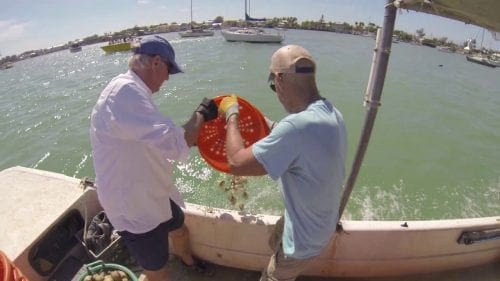
Aaron Welch III, from Two Docks Shellfish, was among the local clam farmers who helped transport the clams by boat to the designated release areas near the pier, assisted by volunteers from the Sarasota Bay Watch organization. Sarasota Bay Watch acting Past President Larry Stults helped coordinate the volunteer efforts.

Chiles was on hand Saturday, as was Charlie Hunsicker, director of Manatee County’s Parks and Natural Resources Department, and Bradenton Beach Mayor and CRA member John Chappie.

“Being out there on the boat and watching the clams spiral down into the water column was so cool,” Chiles said.

The clams delivered today make up just a portion of the total number of clams to be dispersed near the pier. Baugh said another delivery is scheduled for Saturday, March 9 and will be followed by as many additional Saturday shipments as needed. Chiles guessed it might take six trips to complete those efforts.

Big clams

Chiles said the clams purchased for the CRA project are much larger than the clams typically used for clam restoration projects. He also said the harvesting of clams is regulated and harvesting restrictions are enacted during red tide outbreaks in order to keep the clams in the water where they naturally filter out the red tide and other pollutants.

“It’s been worse down there and his clams get too big,” Chiles said of Davis’ clams.

“The market is for consumption clams – middlenecks, littlenecks, topnecks. Once they get too big and too heavy, they lose a lot of value. These clams have grown during that time of the forced harvesting closure and he hasn’t been able to get them off the bottom. He hasn’t been able to sell them because they’re too big. Those big fat, heavy, hard, mature clams are too heavy to be valuable to restaurants. You don’t sit around and eat a bowl full of large quahogs – you chop them up and put them in stuffed clams. But that calcium-carbon shelled, big, heavy, predator-proof clam, brood stock quahog clam will live another 33 years and produce multiple spawns a year with millions of larvae,” Chiles said.

Davis told Chiles that each of the large clams delivered to Bradenton Beach will filter approximately 20 gallons of water per day, compared to five gallons per day for a littleneck clam.

Chiles said he first became interested in clam restoration about a dozen years ago after reading a newspaper story about Curt Hemmel, the founder of the Bay Shellfish Co. bivalve hatchery in Terra Ceia. In 2015, Hemmel, Chiles and others formed the Gulf Shellfish Institute to help promote the use of best practices for aquaculture projects throughout Florida and the Gulf region.

The Chiles Group truck brought 22,000 clams to the Coquina South Boat ramp today to plant them in Sarasota Bay. - Cindy Lane | Sun

The Chiles Group truck brought 22,000 clams to the Coquina South Boat ramp today to plant them in Sarasota Bay. - Cindy Lane | Sun

Clams are offloaded from the Chiles Group truck on their way to Sarasota Bay. - Cindy Lane | Sun

Clams are offloaded from the Chiles Group truck on their way to Sarasota Bay. - Cindy Lane | Sun

Ed Chiles, John Chappie and Larry Stults helps carry clams to the Coquina South boat ramp today to plant them in Sarasota Bay. - Cindy Lane | Sun

Ed Chiles, John Chappie and Larry Stults helps carry clams to the Coquina South boat ramp today to plant them in Sarasota Bay. - Cindy Lane | Sun

Charlie Hunsicker, director of the Manatee County Parks and Natural Resources Department, hauls clams to the boat at the Coquina South boat ramp. - Cindy Lane | Sun

Charlie Hunsicker, director of the Manatee County Parks and Natural Resources Department, hauls clams to the boat at the Coquina South boat ramp. - Cindy Lane | Sun

Aaron Welch of Two Docks Shellfish gets ready to launch. - Cindy Lane | Sun

Aaron Welch of Two Docks Shellfish gets ready to launch. - Cindy Lane | Sun

Charlie Hunsicker, director of the Manatee County Parks and Natural Resources Department, Bradenton Beach Mayor  John Chappie and Aaron Welch of Two Docks Shellfish take the clams out into Sarasota Bay. - Cindy Lane | Sun

Charlie Hunsicker, director of the Manatee County Parks and Natural Resources Department, Bradenton Beach Mayor John Chappie and Aaron Welch of Two Docks Shellfish take the clams out into Sarasota Bay. - Cindy Lane | Sun

These clams found a new home in Sarasota Bay today. - Cindy Lane | Sun

These clams found a new home in Sarasota Bay today. - Cindy Lane | Sun

Beaches free of red tide

ANNA MARIA ISLAND – Today’s Florida Fish and Wildlife Conservation Commission (FWC) red tide report shows no red tide in Manatee County waters over the past week, and a clear red tide forecast for Anna Maria Island through Monday, March 4.

For the first time in months, the report also reflects no respiratory irritation or fish kills in the county over the past week.

Red tide has gradually disappeared in Manatee County waters over the past month, and remains only in background concentrations in Southwest Florida and Northwest Florida, according to the report. Background concentrations have no discernable effects on people or marine life.

The red tide bloom began in October 2017 in Southwest Florida and appeared locally in August 2018.

Florida red tide, or Karenia brevis, emits a neurotoxin when it blooms that is deadly to marine life. It can make shellfish unfit to eat and can cause respiratory irritation in people, especially those with asthma, COPD or emphysema.

Scientists say that salinity, currents, temperature and light play a part in the formation of blooms, as do nutrients from Florida’s natural phosphate deposits, Caribbean seawater brought to Florida’s west coast on the Loop Current, the Mississippi River, Saharan dust blown across the Atlantic Ocean to Florida’s waters, and fertilizer and animal waste runoff.