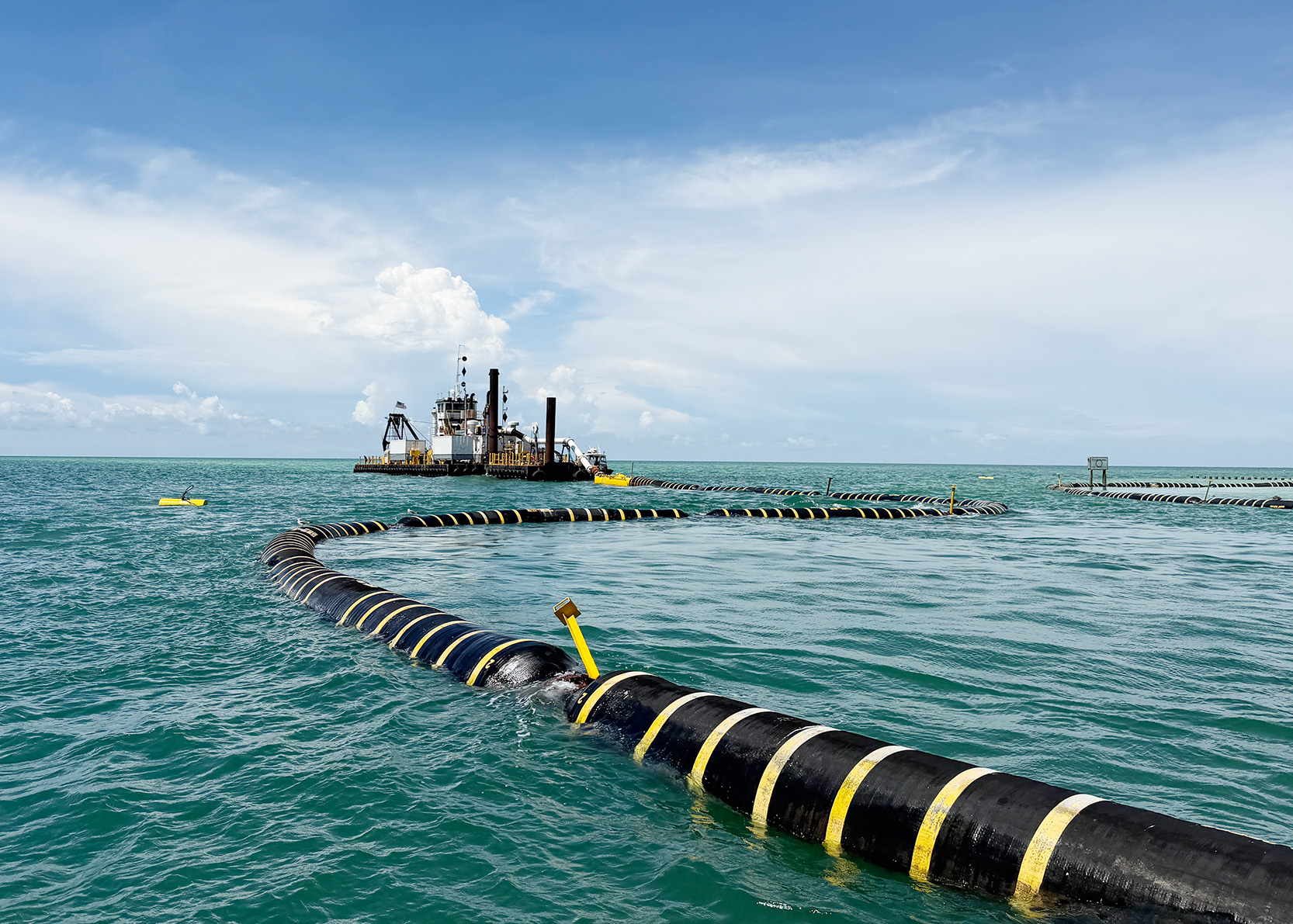
BRADENTON BEACH – Dredging crews began work Sept. 9 on a project to restore a nearly mile-long stretch of Coquina Beach with sand that was lost during Hurricane Idalia in 2023.
The Coquina Beach Hurricane Idalia Storm Damage Repair Project will place approximately 63,450 cubic yards of sand along about 0.9 miles of shoreline, stretching from just south of 13th Street South in Bradenton Beach to Longboat Pass.
A second and larger beach renourishment project is expected to begin in November.
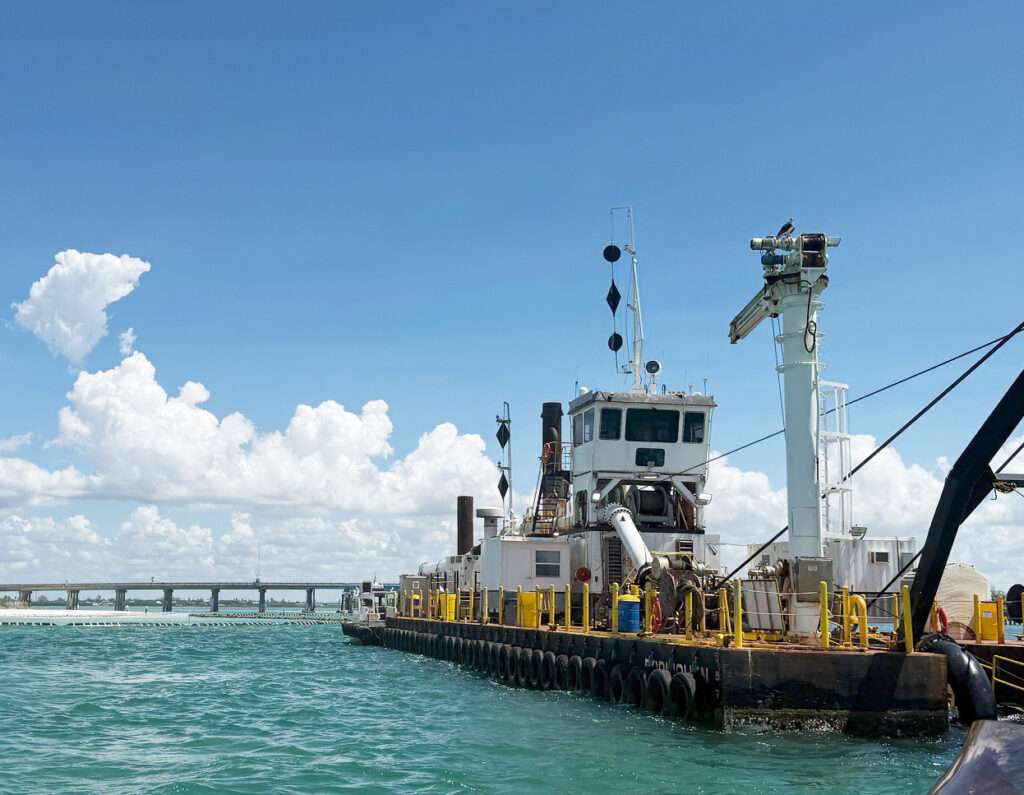
The sand is being dredged from the Longboat Pass navigation channel and hydraulically pumped onto the beach. The sand is tested for compatibility with the native beach before placement. Dredging the channel also restores navigable depth through the pass, according to the Manatee County project website. The project is expected to cost more than $1.92 million.
The Federal Emergency Management Agency (FEMA) is paying 75% of the project cost, with Manatee County and the Florida Department of Environmental Protection (FDEP) each contributing 12.5%.
This barge was working offshore of Coquina Beach. – Leslie Lake | Sun
The sand placement began near the southern end of the beach and will move northward in the coming weeks.
Sections of the beach within the active work area will be temporarily closed while the new sand is placed and graded, but those closures will be localized and will typically last only a few days at each location.
The rest of Coquina Beach will remain open during the renourishment project. Only the active work zone and the south-end staging area will be closed.
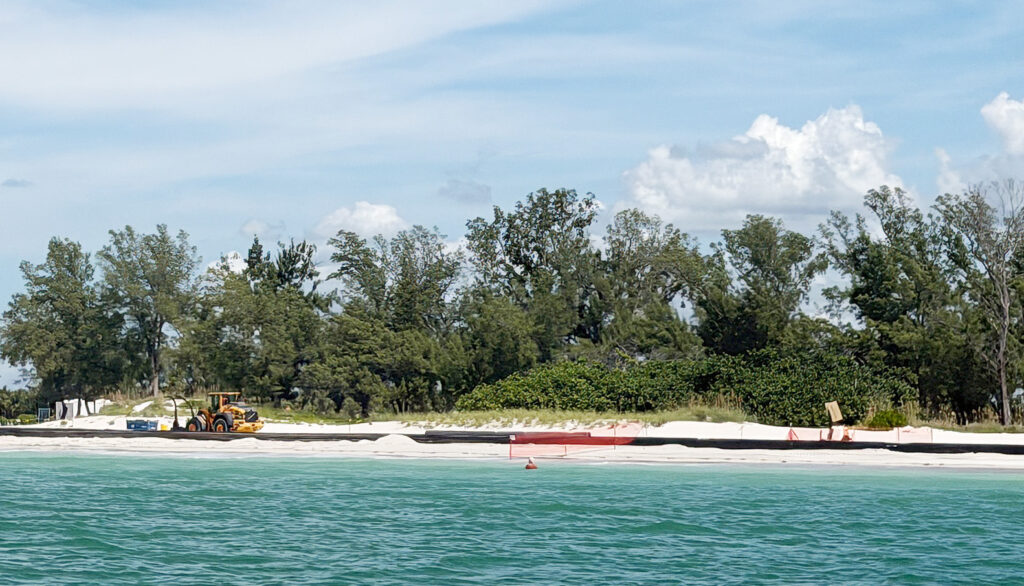
A staging area for crews and equipment has been set up at the south end of the beach, near Longboat Pass. That area, along with the adjacent beach-access points, will remain fenced off and closed to the public for the duration of the project. The Coquina Bayside South Boat Ramp and the new Gulf Islands Ferry stop there will remain accessible.
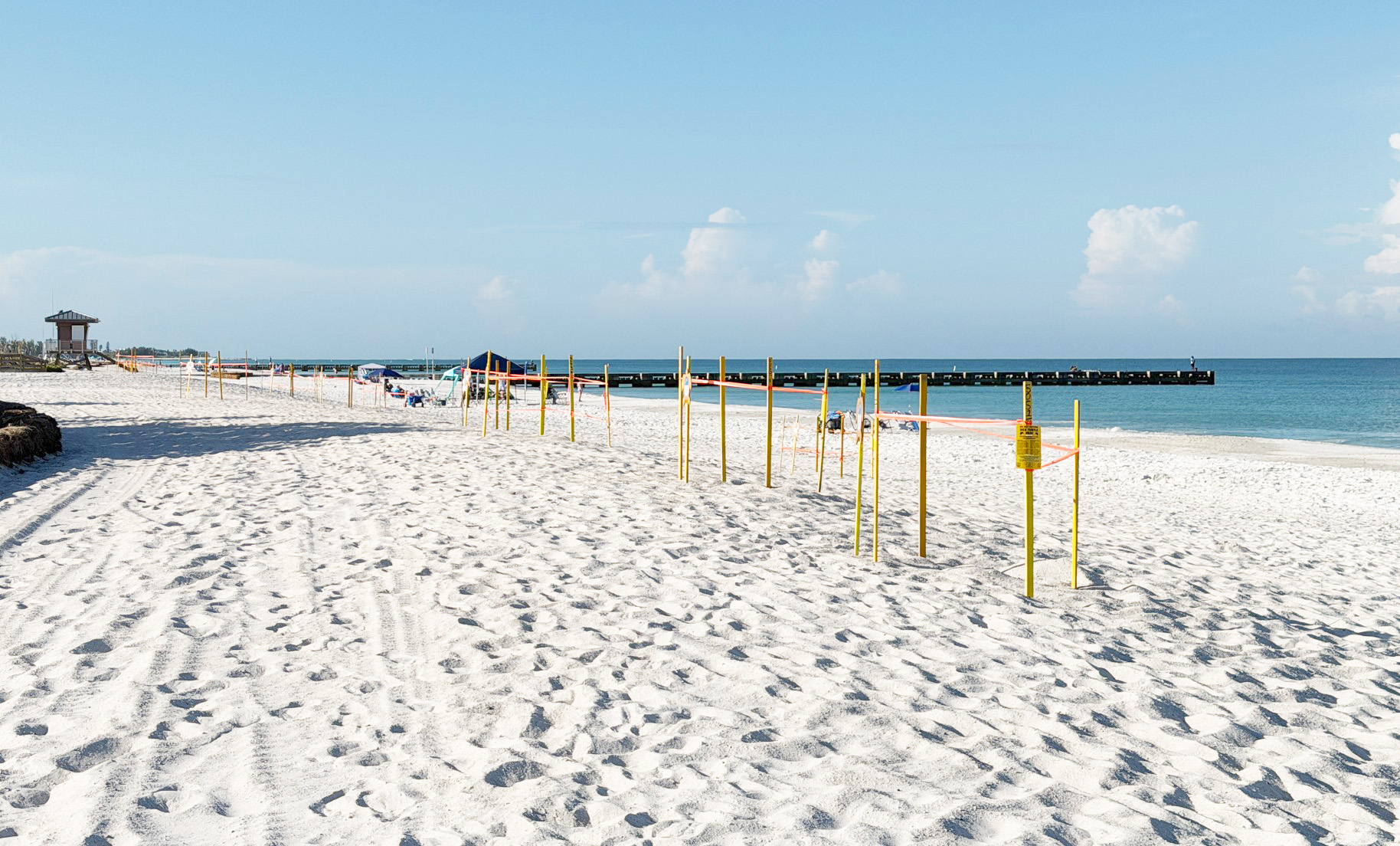
The project is subject to state and federal permits intended to protect sea turtles and shorebirds. Anna Maria Island Turtle Watch is conducting daily sea turtle nesting surveys throughout the project area as required under those permits.
Heavy machinery and pipes are present along the Coquina Beach shoreline. – Leslie Lake | Sun
Beachgoers are being asked to stay clear of the dredge pipeline, equipment and fenced-off work zones; to follow posted signage and fencing; and to use designated pedestrian detours around active construction. Marked sea turtle nests should not be disturbed.
In addition to Manatee County serving as the project sponsor and property owner, the project team includes FDEP as the funding partner and permitting agency, Coastal Protection Engineering, and Sea Hawk Maritime as the project contractor. The Anna Maria Island Turtle Watch and Shorebird Monitoring organization is assisting with sea turtle-related matters.
The work crews will be working 24 hours a day, seven days a week, with anticipated completion by the end of October.
Project updates can be found at coquina-nourishment-2026.coastalprotectioneng.com.
BRADENTON BEACH – To recover from sand loss on local beaches due to multiple hurricanes, two beach renourishment projects are scheduled for this year.
The first project, beginning in August, will reconstruct the beach sand losses from Hurricane Idalia in 2023 on Cortez Beach and Coquina Beach in Bradenton Beach. That project will draw sand from nearby Longboat Pass.
In a June 25 email to The Sun, Manatee County Director of Natural Resources Charlie Hunsicker wrote, “There was a small but measurable sand loss along this part of the beach and FEMA (Federal Emergency Management Agency) has agreed to (eventually) repay 75% of the cost of this project, with the state reimbursing 12.5% of the total cost and the county’s TDC (Tourist Development Council) beach renourishment fund paying for the remaining 12.5%. Due to the small amount of sand and proximity of the borrow area this project should take less than a month to complete.”
Hunsicker said there was also measurable sand loss from Hurricane Idalia across the federal portion of the beach.
“The Corps (U.S. Army Corps of Engineers) has decided to include Hurricane Idalia’s sand losses into the larger project they hope to begin in November 2026 and extend into April or May of 2027,” Hunsicker wrote. “The Corps will be combining Hurricane Idalia, Debby, Helene and Milton sand losses in their project. When they conclude their project at the federal limits and continue into the Cortez and Coquina beach segments (likely in the 2027 timeframe of the project), the amount of sand renourishment they will be delivering there will be the loss amounts documented from Hurricanes Debby, Helene and Milton.”
Turtle nest relocations
Preliminary work has not yet started on either renourishment project, but Anna Maria Island Turtle Watch and Shorebird Monitoring volunteers have been busy relocating sea turtle nests in the project area.
“As of today, we have relocated 42 nests for the Coquina renourishment project,” Turtle Watch Executive Director Kristen Mazzarella wrote in a July 2 email to The Sun.
The relocation of the nests involves an effort to recreate the depth and width of natural sea turtle nests before placing the eggs inside.
“We are working with Turtle Watch on nest relocations in advance of the Coquina/Cortez renourishment project set to begin in about two months from now,” Hunsicker wrote. “Anna Maria Island Turtle watch is under contract with the Natural Resources Department. That’s how we are working together, giving the organization specific tasks which the county is paying for.”
The source of funding for the contract payments to Turtle Watch is the beach renourishment fund portion from the tourist development tax.
Renourishment funds
Regarding the larger renourishment project slated to begin in November, Hunsicker said, “As in the Idalia-only project, FEMA will again be reimbursing 75% of the total cost of the Cortez and Coquina beach segments and the state will be reimbursing 12.5% and the County Tourist tax fund for beaches making up the remaining 12.5%.”
According to Hunsicker, the U.S. Army Corps will be funding practically 100% of the renourishment costs within their federally authorized area.
“The county payment of $6,181,600 to the Corps is to cover the cost of the work they will be completing on the county’s behalf at our request over the Cortez Beach and Coquina beach area,” Hunsicker wrote. “I say ‘practically’ because the county will also be covering (at a county and state 50/50 cost share) a small amount of sand added into the federal project that did not meet the federal criteria for their payment, requiring a county payment of $276,000 for this sand in the federal project area – not really enough funding to make a difference when describing the incredible cost savings to the county and state for this federal cost share commitment is likely to exceed $22 million.”
MANATEE COUNTY – Anna Maria Island beach renourishment is scheduled for 2026-27 at federal expense, but Manatee County must pay to stabilize Gulf Drive, install offshore erosion control breakwaters and repair the Longboat Pass jetty, the county’s beach official said.
During a joint meeting of the Manatee County Commission and the Town of Longboat Key on May 7, Manatee County Natural Resources Director Charlie Hunsicker gave a presentation on storm recovery and beach renourishment.
“Our contract with the federal government says if we lose the beach to a hurricane or a single major event, what’s called an emergency condition… the federal government will return to rebuild your project at 100% federal cost including putting in dunes to replace the ones lost,” Hunsicker said. “So we’re in a very fortunate position Island-wide, but that still leaves us with the full burden of cost for these other features at Coquina and Cortez Beach.”
Beach renourishment
The first Anna Maria Island beach renourishment was in 1992.
“Up until 1992, 9 miles of Anna Maria beaches left us only 30% of the beaches you could walk at high tide,” Hunsicker said. “If you weren’t here then and you see our healthy beaches now, you wonder why are we in this strong effort to keep these beaches healthy and continue to nourish. Because this is the end point when our nourishment stops. The erosion effects on our Island is day to day. Storm or no storm, we are losing about 10 feet a year to erosion.”
“We’ve continuously stayed with the projects ever since, with help from our federal partners as well as state partners. Of course, we have a program with the city of Anna Maria, Holmes Beach and Bradenton Beach area that is supported by the Army Corps of Engineers,” Hunsicker said. “The Bradenton Beach area called Coquina and Cortez Beach are not federally supported because they are recreational beaches. There’s really no value behind that sand for a federal interest to protect.”
Hunsicker said there is talk that FEMA may not participate in funding recreational beaches.
“That would be a dramatic shift in responsibilities to the State of Florida and local governments who have recreational beaches,” he said. We have to ponder that as we think about our future budgets.”
Gulf Drive stabilization
Hunsicker addressed Gulf Drive stabilization to protect against storm surge and damage such as that caused by Hurricane Helene in September 2024.
“The Gulf Drive stabilization, this was and still is a non-engineering structure. It’s there to protect wave runoff and protect this road from getting washed away,” Hunsicker said.
He said the current structures were placed in the early 1960s and he showed a slide which stated that Hurricane Helene storm surge and overwash caused severe damage to dunes, the revetment and the roadway.
“Because they were not engineered with a planning permit, we’re not going to get any assistance from FEMA or any government agencies to replace what was there,” Hunsicker said. “So we’re going to need to come back with an engineered structure designed to accommodate our knowledge of rising sea levels over decades and also provide the protection we’re going to need.”
Hunsicker said the choice of materials to protect the road is either rock or seawall.
“The downside is we can’t get through any of these processes without committing about $20 million along that Cortez Beach road section,” he said. “So we put in for a grant application and other activities. We’re going to be trying very hard to make that happen, but remember that $20 million is for that section of Cortez Beach. We really don’t have an alternative.”
Cortez Beach groins, Longboat Pass jetty
In 1957-58, perpendicular erosion control structures called groins were placed on the shoreline of Coquina Beach, Hunsicker said.
“They have deteriorated to the point where it’s not only an embarrassment from the standpoint of a beautiful beach, but is actually a safety hazard,” he said. “If a small child is on this side and the lifeguard tower is on this side, you can’t see them.”
The county is working on a plan to build four offshore breakwaters to deter erosion.
“We have to provide the same erosion protection and our plan coming up next year is to remove all these structures and substitute an offshore breakwater system that will continue to protect the beach but will give a complete and free clear run for public safety, for beach enjoyment, all the way to our central holding pier,” Hunsicker said.
At the south end of Coquina Beach, “The jetty is almost 70 years old. This has held up about as long as it can. We’re going to be removing some of the cross ties, putting in additional rock and a sheetwall right here behind it to be able to continue to rely on this jetty from keeping Coquina Beach from washing up into Longboat Pass,” Hunsicker said. “That’s the purpose of this jetty, to protect the navigational integrity of Longboat Pass to the Gulf of Mexico.”
HOLMES BEACH – Holmes Beach Mayor Judy Titsworth declined Manatee County Commissioner Kevin Van Ostenbridge’s request to meet and discuss the city’s past elimination of street-side parking spaces.
Titsworth rejected Van Ostenbridge’s request to meet in part because Van Ostenbridge’s invitation did not extend to Holmes Beach Police Chief Bill Tokajer.
As the District 3 county commissioner, Van Ostenbridge represents all three Anna Maria Island cities. Van Ostenbridge was sworn into office on Nov. 17. During the county commission work meeting held later that day, Van Ostenbridge threatened to withhold future beach renourishment funding from the city of Holmes Beach because of the city’s parking reductions in response to the COVID-19 pandemic.
“Mayor Titsworth and the Holmes Beach City Commission have jeopardized future beach renourishment projects in their city. I will not support county participation in beach renourishment projects in Holmes Beach until on-street parking levels are returned to pre-COVID-19 levels. I am drawing a line in the sand,” Van Ostenbridge said, during his first county meeting.
Meeting sought
Vida Gordon is the executive administrative assistant to the county commission. On Tuesday, March 23, Gordon sent Titsworth an email on behalf of Van Ostenbridge which said, “Commissioner Van Ostenbridge would like to meet with you and staff regarding: Public parking on city streets in the city of Holmes Beach. Manatee County participation in future beach renourishment projects.”
Within 30 minutes, Titsworth sent Gordon her response.
“Please ask the commissioner to take the time to witness the high traffic in our city on our many sunny weekends prior to scheduling this meeting. I see no reason to have a meeting until he takes the time to see it for himself. Saturdays would be a great time, as our rather large resort housing industry turns over each Saturday and traffic is at a standstill. If we are going to have real discussions with real solutions, I find it important that he witness this first-hand,” Titsworth stated in her email.
Holmes Beach Mayor Judy Titsworth will not meet to discuss parking concerns without the police chief present. – Kristin Swain | Sun
“I would also ask that he drive through the residential neighborhoods to take note of the beach access parking we currently provide so that he can more easily understand the issues. This may allow him a better perspective to see the limits the city is facing in accommodating all our county residents and tourists who want to arrive by car,” Titsworth wrote.
“As for the Manatee County participation in beach nourishment, I am well advised as to the interlocal agreement we have with the county and the city’s continued participation to provide beach access public parking. If he would like to discuss any proposed changes to this agreement at this meeting, please advise prior, as I would ask that Charlie Hunsicker be present to inform us of any changes in requirements at the state level. The chief and I are available on April 12. Please ask him to come to city hall,” Titsworth wrote.
A short time later, Gordon sent Titsworth Van Ostenbridge’s response.
“I have seen first-hand the traffic challenges on AMI at peak hours. I look forward to hearing from the mayor in our meeting. I am hoping for a constructive meeting that will enable the mayor and myself to lay out our respective positions. The end goal I have in mind is to create a more welcoming environment on AMI and increase accessibility to our public beaches. My hope is that this meeting will be a productive first step,” Van Ostenbridge wrote.
“Mr. Hunsicker has been invited to the meeting as well as county attorney (Bill) Clague. If she would like to remove either of those invitees from the meeting, I will oblige her request. That said, my invitation does not extend to the Holmes Beach Police Chief,” Van Ostenbridge wrote.
Upon receipt of that message, Titsworth informed Gordan that she would not be meeting with Van Ostenbridge.
“If the meeting does not extend to the police chief who has first-hand knowledge on why parking was eliminated on certain streets, then I see no reason to have the meeting. Per the commissioner’s email, he feels he has all the experience he needs on the traffic, congestion and parking constraints. Unfortunately, he does not have the credentials to determine where parking works and where it does not. If I am to accept a meeting with the commissioner to discuss parking in the neighborhoods, I will expect the chief to attend. As for the county attorney, I see no reason why his services would be needed at this time,” Titsworth wrote.
“With all due respect, any comments made by the commissioner up to this point have been threatening in nature. I understand his position, as he does mine. There is no reason to take up any additional time in laying out our positions. Any proposed additional parking in Holmes Beach will require a traffic study by FDOT, including a viable plan for bringing additional cars on and off the Island. Any additional parking will need to include restroom facilities,” Titsworth wrote.
“If a meeting cannot be agreed to, I would suggest the commissioner attend a city meeting so he can express his concerns regarding the ‘unwelcoming environment’ and the accessibility to the beaches. I am certain the board would welcome hearing his suggestions, being that he is our new district representative,” Titsworth wrote.
Titsworth then received an email from Gordon that stated Van Ostenbridge would be happy to meet with the mayor in the county commissioners’ conference room or in his office in downtown Bradenton.
In response, Titsworth wrote, “If he is unwilling to come visit the city he represents, I will have to decline to attend the meeting. I can already see where it is heading. Commissioner Kruse was happy to meet me and the chief at our city. My door is always open.”
Chief’s comments
When contacted Friday, Tokajer said, “For Commissioner Van Ostenbridge to invite the mayor to a meeting that dictates which staff is allowed to attend is another example of his abuse of the perceived power of his position. I do not see our mayor and commission being bullied by empty threats about future beach renourishment.”
Holmes Beach Police Chief Bill Tokajer played a significant role in the development of the city’s current parking plan. – Kristin Swain | Sun
“As a city, we’ve more than upheld our requirements set forth in the interlocal agreement with Manatee County on parking. Do you really think the county is going to stop receiving federal funds for beach renourishment for the largest tourist destination in Manatee County? Are they going to stop advertising Anna Maria Island as a tourist destination? If the county is not going to do beach renourishment, they can give the city back the millions of dollars in the tourist tax revenues they collect from the Holmes Beach community,” Tokajer said.
“The city’s residential areas should not be made into a parking lot. The county needs to come up with some other ideas as to where people can park – and the places they come up with need to have facilities such as bathrooms, changing stations and lifeguards. We need to do something to balance the amount of people coming into our residential areas,” Tokajer said.
“Right now, there are 1,264 parking spaces that are open to the public, and 500 of those are dedicated to meeting beach renourishment parking requirements. We have an additional 645 spaces for residential parking by permit. The city’s parking plan is truly working in the manner in which we thought it would,” he added.
Tokajer doesn’t anticipate the city restoring its parking capacity to pre-pandemic levels.
“The commission has already voted numerous times on this parking plan and they unanimously support the plan we have now. No matter what this commissioner does, I don’t see them going back to that,” he said.
Citing data collected by license plate readers positioned along the city’s main thoroughfares, Tokajer said, “From March 1 through noon today, March 26, we had 621,569 vehicles that came on and off Island in Holmes Beach during that 26-day period. That’s an average of 24,675 vehicles per day. Even if we opened up the 2,400 parking spaces we had before COVID, that’s still leaves another 22,000 cars a day that have nowhere to park.
“Commissioner Kruse was willing to come here to Holmes Beach and sit down with the mayor and I to discuss things and learn why we did what we did. If Commissioner Van Ostenbridge wants to dictate who the mayor’s going to bring to a meeting, then I guess we’re not going to have it,” Tokajer said.
MANATEE COUNTY – Manatee County has a FEMA-funded, county-managed beach renourishment project planned for Coquina Beach in early 2021.
The county is also partnering with the Town of Longboat Key on a beach renourishment project that includes the construction of five permeable rock groins.
The Town of Longboat Key also plans to conduct an emergency dredging operation on Greer Island, also known as Beer Can Island, at the northern tip of the key.
These projects were presented and discussed at the Tuesday, Dec. 15 Manatee County Commission meeting.
Coquina Beach renourishment
Tom Pierro, principal engineer with Coastal Planning and Engineering, presented the county’s Coquina Beach renourishment plan.
The county-owned beach is located in Bradenton Beach at the southern end of Anna Maria Island. Pierro said the Coquina Beach renourishment project pertains to a mile-and-a-half stretch of beach in that area.
Pierro said the beach area is managed locally by the county and does not contain the required infrastructure elements to have been included in the recently-completed Anna Maria Island beach renourishment project that received significant federal funding.
Pierro said the beach sand lost during Hurricane Hermine in 2016 and Hurricane Irma in 2017 qualified the Coquina Beach renourishment project for FEMA funds.
About 200,000 cubic yards of sand can be removed from Longboat Pass, he said, adding that the county plans to use about 70,000 cubic yards of that available sand for the Coquina Beach renourishment project. He said the rest could possibly be made available to the Town of Longboat Key to renourish the beach at the end of Gulfside Road.
Pierro estimated the Coquina Beach renourishment project will cost approximately $3 million. He said the project plans are complete, and expects the contract to be awarded in January and the work to begin in February or March. Pierro said the project must be completed by the end of May to preserve the FEMA funds.
Greer Island dredging
Representing the Town of Longboat Key, Senior Project Manager Charlie Mopps presented the Greer Island emergency dredging plan.
Mopps said the purpose of the dredging operation is to improve and restore boat and kayak access to Greer Island lagoon near the Longboat Pass Bridge. Mopps said the emergency dredging project calls for the removal of about 1,000 cubic yards of sand in a 30-foot stretch of the lagoon.
The Greer Island lagoon will be dredged to improve accessibility for boaters and kayakers. – Joe Hendricks | Sun
Mopps said the dredging contract has been awarded to Duncan Seawall, Dock & Boat Lift. The dredging project is expected to begin soon and take only a few days to complete once started. Mopps said the sand removed from the lagoon will be stored for later use with the Longboat Key beach renourishment project.
This photographic comparison illustrates how the Greer Island channel opening has narrowed over the past two decades. – Joe Hendricks | Sun
Beach renourishment and groins
On behalf of the Town of Longboat Key, Al Browder, vice president of the Olsen Associates firm, provided county commissioners with an overview of the Longboat Key beach renourishment project.
The project is divided into three segments. Occurring first, segment 1 will include the north end of the key and Greer Island. The segment 1 plans call for the installation of five permeable groins and the addition of approximately 200,000 cubic yards of beach sand.
Browder said the beach renourishment sand will come from the town’s permitted borrow areas more than a mile offshore of Passage Key.
Browder said the low-crested permeable rock groins will complement two existing concrete groins located near the street end at North Shore Road. He said the goal is to slow the rate of sand flow and erosion in that area.
The existing concrete groins near the north end of Longboat Key will be joined by five new permeable rock groins.- Joe Hendricks | Sun
“The purpose here is to maintain sandy beach conditions along the Gulf. It has been a running battle to protect the north tip of Longboat Key and maintain the recreational value and the environmental habitat in the lagoon itself,” Browder said.
Browder said the segment 1 project is anticipated to start in February or March and take about 180 days to complete. When the segment 1 work is complete, some additional dune vegetation and mangrove restoration will take place along the Greer Island lagoon.
The segment 2 plan calls for 350,000 cubic yards of beach sand to be placed in the center section of the key’s Gulfside beach areas.
Listed in the Town of Longboat Key’s presentation as optional and dependent on available funds, the segment 3 plans call for 160,000 cubic yards of beach sand to potentially be placed at the south end of the key.
These discussions resulted in the county commission authorizing the county administrator to execute an interlocal agreement with the Town of Longboat Key that provides $2.69 million as the county’s contribution to the town’s renourishment project.
The accompanying adoption of Resolution 20-199 authorized a short-term loan not to exceed $1.99 million from the county’s general fund to its beach erosion control fund. The remaining $700,000 of the county’s contribution to the town project will come from the county’s beach renourishment reserve fund.
The commission also approved the town’s request for the easements needed for groin installations.
PALMETTO – During his first day as a Manatee County commissioner, Kevin Van Ostenbridge warned that the city of Holmes Beach risks losing beach renourishment funding if they don’t restore recently-reduced public beach parking.
Tuesday morning, Van Ostenbridge, James Satcher and George Kruse were sworn in to four-year terms as the newest county commissioners. Returning Commissioner Vanessa Baugh was also sworn in. Joined by commissioners Reggie Bellamy, Misty Servia and Carol Whitmore, the reconfigured commission then engaged in a work session at the Bradenton Area Convention Center in Palmetto.
The afternoon session included discussion about beach parking on Anna Maria Island and the importance of maintaining an adequate number of beach access parking spaces to remain eligible for state and federal funding for future beach renourishment projects.
Earlier this year, in response to the COVID-19 pandemic, the Holmes Beach Commission eliminated parking spaces to reduce crowding in the city and on the beaches.
Van Ostenbridge, who represents Anna Maria Island and much of west Bradenton as the District 3 commissioner, said, “Mayor Titsworth and the Holmes Beach City Commission have jeopardized future beach renourishment projects in their city. I will not support county participation in beach renourishment projects in Holmes Beach until on-street parking levels are returned to pre-COVID-19 levels. I am drawing a line in the sand.”
Baugh, Satcher and Whitmore later expressed support for Van Ostenbridge’s position.
Tuesday’s discussion included a presentation by Deputy County Administrator John Osborne, with additional insight provided by Manatee County Parks and Natural Resources Director Charlie Hunsicker and county consultant Erica Carr-Betts.
A PowerPoint slide contained in Osborne’s presentation stated on-street neighborhood parking in Holmes Beach has been reduced by 45%.
Whitmore, a Holmes Beach resident and the city’s former mayor, said, “The city of Holmes Beach had 2,500 parking spaces before COVID. Today, they have maybe 500. They eliminated 2,000.”
Whitmore also mentioned a vacant bank property near Manatee Beach in Holmes Beach as the possible parking garage location.
At-large Commissioner Carol Whitmore expressed appreciation for Van Ostenbridge’s comments. – Joe Hendricks | Sun
Thatcher, the new District 1 commissioner, later repeated the parking figures cited by Whitmore.
While Tuesday’s work session was in progress, Holmes Beach Police Chief Bill Tokajer provided The Sun with parking figures that differed from those being stated by county officials. Tokajer reconfirmed those figures by phone this morning.
With Tokajer’s support, the Holmes Beach commission permanently eliminated 497 on-street parking spaces, he said. As a result, there are currently 1,261 on-street parking spaces available in Holmes Beach that do not require a city-issued parking permit and 642 permit-only parking spaces that become available to the public after 5 p.m., seven days a week, according to Tokajer.
Regarding claims that 2,500 parking spaces were reduced to 500, Tokajer said, “That’s false. We started with 2,400 spots. The 500 number, which has been explained, is merely the number of spaces designated for beach renourishment. We have a lot more spots than that available. The numbers I provided are accurate as of today. Those are the same numbers we provided to Charlie Hunsicker, Cheri Coryea (county administrator) and Erica Betts.”
Renourishment funding
During the work session, Hunsicker said state and federal grants that help fund beach renourishment projects are based on the number of parking spaces located within a quarter-mile of the beach access points that extend the length of the Island.
“Everything happening between the water and that quarter-mile, that’s where we focus on maintaining a minimum number of parking spaces for each access point out to that beach. Beyond the quarter-mile, it doesn’t count, no matter how many spaces we have,” Hunsicker said.
“As cities change their allowances, if it’s happening outside of a quarter-mile it doesn’t affect our federal grant availability or our state grant availability. If we mess up inside that quarter-mile zone, it means millions of dollars of local cost. It doesn’t prevent you from having a beach renourishment program. It just increases your local share proportionate to the loss of public parking spaces,” Hunsicker explained.
Hunsicker said the per-quarter mile parking requirements are not offset by the large parking lots at Coquina Beach, Manatee Beach and elsewhere on the Island.
“The state and the federal governments believe access within a reasonable walking distance is important. So, it’s not maintaining the maximum total spaces along your length of shoreline, but a minimum of 50 spaces within a quarter-mile of each access point. If you have 40 spaces within a quarter-mile, you’re not going to meet the public access requirements to maintain full grant funding,” Hunsicker said.
Parks and Natural Resources Director Charlie Hunsicker explained in detail the beach renourishment parking requirements. – Joe Hendricks | Sun
Kruse, the new District 7 at-large commissioner, asked how many designated parking spaces for beach renourishment currently exist in Holmes Beach. Carr-Betts estimated that number to be approximately 460.
“We worked with the chief of police in Holmes Beach and we were right on the cusp of not having full eligibility. He worked with me and we were able to get full eligibility for that portion of the shoreline. With spaces being taken away, we have to be very careful at this point to make sure the spaces are adequately distributed along the shoreline,” Carr-Betts said.
“Literally, on a street-by-street basis. That’s why I’m very concerned,” Hunsicker added.
Hunsicker said there were instances when Tokajer was told a street with five proposed public parking spaces needed six.
“We used to have hundreds of spaces of leeway before the COVID actions happened, but now we’re tight, so we have to pay much more attention to it,” Hunsicker said.
Tuesday evening, Hunsicker provided The Sun with some additional information pertaining to beach renourishment parking requirements.
“In Holmes Beach, 479 is the bare minimum number of public parking spaces and equivalent public spaces provided by public trolley stops and bicycle racks, as provided by state statute to maintain 100% grant eligibility for state and federal renourishment,” Hunsicker said.
“Due to the opportunities for a small number of eligible spaces to change frequently, we ask each Island city to also provide a buffer of 10-20% of additional spaces within a quarter-mile of each public access point if at all possible. In our discussion with the Holmes Beach mayor and police chief, 500 spaces were offered, translating to 21 additional spaces. While this was short of the buffer desired, we accepted this offer as a good faith effort to provide buffer where needed,” Hunsicker said.
“The cities of Bradenton Beach and Anna Maria each have their own different and unique equivalent minimum parking space requirements covering their respective shoreline lengths of renourished beachfront as well,” he noted.
During the work session, Chief Assistant County Attorney Bill Clague also commented on the parking requirements.
“This is driven by the public purpose requirements of state and federal law. We’re supposed to use public dollars for public purposes. The tourist development tax statute we use for beach renourishment says it’s for beaches that have public access and public use. The reason it’s such a big issue for the county is that we take responsibility for the entire shoreline of Anna Maria Island. There’s a lot of private properties along that Island. It’s great that they have beaches, but it’s questionable whether we can use public dollars to renourish beaches in front of private homes. There has to be a public use there as well,” Clague said.
Van Ostenbridge opines
“I’ve spoken to many residents of Holmes Beach. A lot of them are embarrassed by the actions of their city. It’s extremely unwelcoming. It’s very disappointing,” Van Ostenbridge told the commission, noting his family’s roots on the Island date back to the 1930s.
Van Ostenbridge said many District 3 residents don’t live in Holmes Beach but work or own businesses there.
“I ran on a pro-business platform. I support those workers and those businesses, and I know this hurts them,” he said.
“The beach belongs to everyone. It’s the gem of the entire county. It belongs to every county taxpayer. If you want us to participate in renourishing that beach and caring for it and maintaining it, you have to provide them access to it,” Van Ostenbridge said.
“The state has minimum required levels of parking for the state and the feds to participate in beach renourishment funding. I would like this county to set much higher standards. I would like us to set pre-COVID levels of parking. If you’re looking for a number, 2,500 parking spaces is the minimum in Holmes Beach if they want us to participate in beach renourishment funding. I’m going to take a very aggressive approach with this,” Van Ostenbridge said.
“The vast majority of residents and business owners in Holmes Beach, they’re kind, welcoming people. They know they live in a destination city and they want people to come to their city. And those who are staunchly against this, you knew you moved to a destination city when you moved there. It is not a private Island. It is open to the public. It’s open to everyone in this community regardless of whether they live in Samoset or Palmetto or west Bradenton. The beach belongs to everyone,” Van Ostenbridge said.
He also alluded to the 5% tourist development tax collected on hotel, motel and vacation rental stays in Manatee County, most of which occurs on Anna Maria Island.
All three Island cities have utilized county commission-approved tourist development tax funds in recent years to help fund city projects, including the construction of the new Anna Maria City Pier.
Van Ostenbridge suggested the future use of tourist tax funds – spent on the advice of the Tourist Development Council (TDC) and the approval of the county commission – could be jeopardized by parking reductions.
“There are many other areas in this county that would love TDC funding – millions and millions of dollars,” he said.
Van Ostenbridge said he’d like to see Coryea enter into negotiations with some of the Island churches regarding the possible weekend and holiday use of their parking lots. He suggested reimbursing participating churches with tourist tax funds or some other funding source. He also asked Coryea to reach out to the school district regarding the possible weekend and holiday use of the parking spaces at Anna Maria Elementary School in Holmes Beach.
Additional commission comments
Whitmore, an at-large commissioner who lives in District 3, thanked Van Ostenbridge for his comments about the Holmes Beach parking reductions.
“I am so happy that you’ve done what you’re doing. I don’t have it in me to be as direct as you, but you’re my commissioner and I’m happy that somebody in the leadership of Manatee County that represents that district has actually said it publicly,” Whitmore said.
She suggested Van Ostenbridge meet with Tokajer and Holmes Beach Mayor Judy Titsworth.
“I know Judy. She’s a very good person,” Van Ostenbridge said. “We disagree politically on this issue.”
District 1 Commissioner James Satcherr expressed support for pursuing the construction of a parking garage on Anna Maria Island. – Joe Hendricks | Sun
“I don’t feel like we picked a fight,” Satcher said. “I feel this issue should not be put upon us, but it has, so I’m looking at other options to solve the problem. The one that I can see is to build a parking deck within that quarter-mile if we can get it.”
That prompted Van Ostenbridge to say, “Mr. Satcher, I would just caution you on moving too quickly on a parking garage. That would be detrimental to the character of the Island.”
Regarding the Holmes Beach parking reductions, Baugh said, “I totally agree with Commissioner Van Ostenbridge. I feel like it’s gotten out of hand in Holmes Beach. I think they have forgotten that we all work together as a team.”
Baugh said she, too, would like to see more communication between the county and the Holmes Beach mayor and police chief.
“We need to get back to the way things were. If not, they’re going to look real funny if their beaches don’t continue to be renourished. I don’t know if they realize that or not, but they certainly can’t afford to pay for the dredging. Hopefully, they’ll remember that and try to meet us halfway,” Baugh said.
Commissioner Vanessa Baugh also opposes Holmes Beach’s parking reductions. – Joe Hendricks | Sun
No formal votes were taken during the work session, but Van Ostenbridge offered his assessment of the commission majority’s position on potentially withholding future funds.
“I know we’re not counting heads here, but I think it’s pretty obvious that multiple commissioners are entertaining the idea. You might want to relay that message,” he said.
Holmes Beach responds
During the county work session, Holmes Beach Mayor Judy Titsworth texted Whitmore. She later shared that text with The Sun.
In part, Titsworth’s text said, “Why are you allowing your commissioners to state untruths? You also should have invited me to attend. I was not aware of this work session.”
Speaking by phone after the work session ended, Titsworth said when she learned about the discussion taking place, she tuned in in time to hear Van Ostenbridge threatening to withhold future beach renourishment funds.
“No one called me to make sure they had the latest numbers. They didn’t make sure they had the correct information to give their commissioners. We offer more parking places than what’s required for beach renourishment. It’s surprising to me how they can speak about an issue and give strong opinions about an issue without trying to get educated on an issue,” Titsworth said.
“We had a meeting with Charlie. He was comfortable with the 500 spaces. We have it in our interlocal agreement. We adhere to the requirement for beach renourishment and will not jeopardize that,” Titsworth said.
“If he (Van Ostenbridge) wants to withhold funding, he should base it on us not upholding agreements that we have, and not just some fictional number,” she added.
Titsworth disputed the PowerPoint slide that said, “All on-street right of way and beach access parking in residential areas will close.”
“That’s not true. It looks like they were given bad information,” she said.
“Commissioner Van Ostenbridge has never reached out to me except for the one time he asked me if I’d support him if he ran for office. He has not called me since. If he has any concerns about anything, I have an open-door policy and he can see me any time.”
Tokajer also disputed the claim that 45% of Holmes Beach’s public parking spaces were eliminated.
“That is false, it has not been reduced by 45%. The parking numbers you have are the true and accurate numbers of today – which are the same numbers that were provided to Charlie Hunsicker in the meeting we had with Cheri Coryea and Erica Betts. It was not an adversarial meeting and every parking space they requested was given. The numbers given to them for beach renourishment were approved by them, as well as the state. We in no way would jeopardize the parking required for beach renourishment. It would have been nice for the commissioner, who is new, to have reached out to get the facts,” Tokajer said.
He also mentioned the figures cited by Whitmore and Satcher.
“We started with 2,400 spots, not 2,500. With the regular parking, the open parking and the permit parking, we have at least 1,903 spots. That shows a reduction of just under 500 spots total,” Tokajer said.
According to Tokajer’s statement, the city eliminated 21% of its pre-COVID parking spaces.
“That does not mean that in that quarter-mile area that we only have 500 spots. We have 1,261 spaces within that quarter-mile area. If the state and the feds were to come back and say for beach renourishment we need 600 spots designated, we already have them. They’re just not designated,” Tokajer said.
“We are not picking a fight. We are trying to weigh the needs of our residents and bring things back to some semblance of normalcy for them. The beach is for everyone, we’re in total agreement with that. But Holmes Beach’s residential areas should not be made into the county parking lot as if it was the UTC mall just because they want people to come to the beach. The county needs to come up with some other scenario where there is available parking without ruining the character and the residential areas of Holmes Beach,” Tokajer said.
Updated Nov. 23, 2020 – ANNA MARIA ISLAND – Before the arrival of Tropical Storm Eta, Manatee County Parks and Natural Resources Director Charlie Hunsicker shared his thoughts on the anticipated loss of the sand that would occur on Anna Maria Island’s recently renourished beaches.
The beach widening portion of Anna Maria Island’s beach renourishment project is complete as of Nov. 18, and the U.S. Army Corps of Engineers’ contractor, Marinex Construction, began building dunes on Nov. 20 with an expected completion date of Nov. 30. The $17 million project began July 8 at 78th Street in Holmes Beach and ended at Longboat Pass in Bradenton Beach. Tropical Storm Eta and Hurricane Zeta delayed the project’s original Oct. 31 deadline, and pulled some newly-placed sand off the beach into the Gulf of Mexico (pictured) as anticipated by project engineers. Pipelines are off the beach except for a storage area at Coquina Beach. – Cindy Lane | Sun
“Many people who follow beach renourishment see the sand go away during a storm and say, ‘It all washes away. It’s a waste of money.’ I want everyone to understand the sands there are sacrificial. The beaches are intended to wash away. Mother Nature will come in with the energy she has and extract the sand, or take something from the Island. If it’s not the sand, it’s homes, roads and utilities,” Hunsicker said.After the Tuesday, Nov. 3 county commission meeting ended, Hunsicker discussed the public criticism that sometimes accompanies the storm-related loss of renourished beach sand.
“Many people look at that as a waste of money, but that’s exactly the plan. Sacrificial sand is what we put there. Recreation is an added attribute, but its first and foremost job is to protect the Island. That’s why it’s done and that’s what it does,” Hunsicker said.
“They were significant. But I want everyone to remember that the beach we build is titled theThe loss of beach renourishment sand was also discussed Thursday morning during the county’s post-Tropical Storm Eta virtual press conference, when Hunsicker was asked what losses were sustained in terms of beach sand.
‘Anna Maria Island Shore Protection Project’ by the (Army) Corps of Engineers. The primary purpose of our beaches is for coastal protection, to dissipate the energy of the storms. We also have very real recreation benefits and habitat benefits as well for nesting shorebirds and marine turtles,” Hunsicker said.
“We lost depth and width of beach to a near-shore and offshore sand bar. It did not wash away to the middle of the Gulf or Texas. It’s nestled below sea level about 50-60 yards offshore. It will stay that way over the winter, and in the summer, the gentler waves will slowly move it back on shore. Not all of it. We lost sand, and even under normal conditions, Anna Maria Island loses about 10 feet of width every single year,” Hunsicker said.“If a sandy beach washes away, it’s done its intended job. Without the beach, we’d be looking at Gulf-facing roads, utilities and ultimately homes that would absorb the brunt of the storm and be washed away. In this circumstance, we are quite pleased. The erosional losses we saw were the measured benefit of having the beach in place for storms just like this one,” Hunsicker said.
“I want everyone to understand the sands there are sacrificial. The beaches are intended to wash away.” – Charlie Hunsicker, Manatee County Parks and Natural Resources Director
“We fully expect the beach to respond the way it did. It’s the breaking tide that does most of the damage. When high tide rolls up over the beach it moves sand around, but it doesn’t drag it out like grabbing hold of a bedsheet and pulling it off a bed. Actually, high tides and flooding on the beach is a good thing. We lose the back berms and dunes, but that sand is pulled from the dunes and distributed across the beaches,” Hunsicker said.
“We’ve been asked to assess damages like any other tropical storm or hurricane, and to rough estimate the volume lost. If there is a congressional add to the budget to address damages from this hurricane season, our beaches there will be eligible for the Corps to return with a new contractor and put that sand back on the beach. That isn’t very often, but that’s how, after Hurricane Sandy (in 2012), we got relief. If you remember Hurricane Irma (in 2017), that is why the Corps is here now, to return the whole beach back to its starting elevations and widths that were there before the storm,” Hunsicker said.
“We may go through yet another episode if congressional money is available. We won’t be able to afford paying for it ourselves – or the state of Florida for that matter. But we’re always optimistic. Certainly, there were damages up and down the southwest coast of Florida and on the east coast – Miami and Key West. So, if there’s a hurricane relief bill coming to Congress, the Army Corps will make efforts to apply that funding to restore the lost sand we just suffered in the last three days,” Hunsicker said.
BRADENTON BEACH – Gulf View condominium residents and rental owners Yvette and Harry Abrahamson say they appreciate the beach renourishment efforts, but they had been concerned about a staging area that was finally relocated on Friday.
The Abrahamsons own two condos at 104 Gulf Drive S.; they live in one unit and use the other as a vacation rental. According to Yvette, a staging area containing several unused pipes had been sitting on the beach in front of their condos since Oct. 5.
Until Friday, the pipes, staging area and temporary plastic fencing impeded beach access for Gulf View residents and rental guests. The Abrahamsons said this resulted in recent rental guests requesting and receiving partial refunds.
The couple recently emailed representatives of the U.S. Army Corps of Engineers and Manatee County in hopes of getting the staging area relocated to a less impactful area. They also emailed their concerns to Bradenton Beach Mayor John Chappie.
The $17 million beach renourishment project is being conducted by the Army Corps of Engineers with an anticipated completion date of Oct. 31. Construction began on July 8 at 78th Street in Holmes Beach and continues to move toward Longboat Pass in Bradenton Beach. Along the way, the threat of hurricanes stalled the project more than once, causing impacts to property owners, including the Abrahamsons.
In mid-October, the couple asked the Corps to move the pipes that blocked beach access for their renters.
When contacted by The Sun on Oct. 19, Corps spokesman David Ruderman said the pipes remained longer in one place than planned because the work was slowed by the three erosion control groins near the Abrahamsons’ condos.
“Once they get past the groins they will move more rapidly and shrink the staging area for the pipe sections more quickly,” Ruderman wrote.
Ruderman noted the project contractor, Marinex Construction Inc., was trying to accommodate impacted residents and had installed a sand ramp over the pipes near the Beach House restaurant to accommodate a wedding ceremony.
“Despite the delays and other obstacles, the beach construction is still tracking to be complete by the first week of November, possibly a bit earlier,” Ruderman said.
On Oct. 19, Harry Abrahamson asked Ruderman to install a sand walkover bridge across the pipeline in front of the Gulf View condos.
“I feel our LLC business should be afforded the same kindness of consideration as the Beach House business,” Abrahamson noted in his email.
The requested sand walkover was installed last week.
A sand walkover now provides Gulf View guests and residents with easier access to the beach and water. – Joe Hendricks | Sun
Mayor’s assistance sought
On Thursday, Oct. 22, the Abrahamsons attended a special city commission meeting and asked the mayor and commission for assistance.
They were joined at Thursday’s meeting by Joel Werginz and his wife, Denise Taylor. Werginz and Taylor own a condo in the Sandcastle condominium complex to the south. Werginz said their condo is primarily used as a vacation rental but they sometimes stay there when it’s not rented, which was the case last week.
Yvette Abrahamson addressed the commission first.
“I would like to say how great the beach renourishment looks and I appreciate the hard work involved by all. That said, I do have a complaint. Our building has had the beach blocked for 21 days. We were informed before the project started that it would take about three days in each location. We also understood that Hurricane Delta caused the work to be paused for four days in front of our condos,” she said.
“The issue is that when they completed the work in this area, they decided to make it a staging area. Pipes have been sitting there blocking access to the walkover for two weeks now. The Beach House was able to get their requested walkover for weddings, but our building has lost revenue for three weeks’ worth of guests. Our next arrival is Friday and I can’t believe we’ll be headed into a fourth partial refund,” she said.
“I’ll look into it. I promise. It’s a county project. I will see what I can find out and get back with you,” Chappie responded.
“We’ve called everyone and all we’re asking for is one section in front of Gulf View to be moved to the south,” Harry Abrahamson told the mayor and commission.
Werginz said the Sandcastle condos were not as impacted as the Gulf View condos, but guests and residents still had to walk around the pipes to access the beach.
“Earlier this week, they put those berms over the long pipe, which we understand is needed, but why can’t these guys move these pipes 100 yards further south where there would be no financial impact?” Werginz asked.
Werginz noted the staging area was negatively impacting vacation rental owners whose taxes help fund beach renourishment. He also expressed concern about rental guests having a bad vacation experience.
Situation resolved
On Friday afternoon, the Abrahamsons told The Sun the staging area and temporary fencing had been removed and all that remained was the main pipe still in use.
This beach renourishment pipe remained in front of the Gulf View condos as of Sunday. – Joe Hendricks | Sun
“We thank everybody, including Mayor Chappie, who helped get the staging area relocated. If we hadn’t gone to the commission, I don’t think this would have happened,” Yvette said. Werginz sent a similar text expressing appreciation for the relocation efforts.
When contacted Sunday, Chappie explained that in response to the condo owners’ concerns, he asked Lt. John Cosby from the Bradenton Beach Police Department to speak directly to the renourishment crew.
“I didn’t have to go any further than that,” Chappie said. “They realized there was a problem when we approached them directly and they didn’t have a problem moving the staging area. I’m pleased with the cooperative effort. It’s always nice to start at the local level first. That’s why we’re here.”
Chappie said he also reached out to the condo owners to let them know the staging area would be relocated.
HOLMES BEACH – Pipes are being moved this week to set up for the next section of beach scheduled to get new sand in the renourishment project that began in July.
The $17.3 million project is designed to replace sand eroded by storms, protecting buildings and roads from future storms along 5.5 miles of beach in Holmes Beach and Bradenton Beach.
The beach from 78th Street to 33rd Street is complete, according to David Ruderman, of the U.S. Army Corps of Engineers in Jacksonville.
For the next section, the contractor, Marinex Construction, Inc., is scheduled to move the submerged pipeline landing location to 34th Street this week. It will take 7-10 days to complete the move, during which no beach work can be done.
The offshore dredge also has moved, and Marinex is reconnecting the dredge to the pipes.
Meanwhile, pipe is being stored on the beach between 34th and 37th streets with beach access available landward and seaward of the storage area. Portions of the beach will be closed during active construction, preventing the public from accessing that area of the shore.
The sand is dredged from offshore borrow areas by a hydraulic cutter suction dredge, then pumped through a pipeline to the beach as a water/sand slurry. The submerged pipeline comes ashore onto the beach at designated landing locations and connects to the pipeline, which runs laterally along the beach. The sand slurry is discharged from the pipeline and bulldozers push the sand into the water to enlarge the beach and pile it higher on dry land.
By Oct. 1, the project is anticipated to be at Fourth Street. Construction is estimated to end at Longboat Pass in mid-November.
ANNA MARIA ISLAND – As sea turtle nesting winds down this season, nesting statistics are down from last year’s record of 544 nests to 332 nests.
Among the possible reasons – COVID-19.
When the coronavirus arrived on the Island, Anna Maria Island Turtle Watch and Shorebird Monitoring Director Suzi Fox decided to sharply reduce the number of volunteers who walk the beaches finding and staking off nests and excavating them after they hatch to count the eggshells.
“We have to be safe,” she said, asking that beachgoers avoid approaching Turtle Watchers on the beach and call 941-778-5638 instead.
With a reduced workforce, Fox decided not to count turtle nests or hatchlings in the city of Anna Maria this year, only keeping statistics on Holmes Beach and Bradenton Beach nesting and hatching. The permit under which Turtle Watch operates does not require the organization to keep nesting statistics for beaches that are not renourished, she said, and Anna Maria is not included in the beach renourishment project now underway and scheduled to end in October or November.
Renourishment replaces sand on the beach that has been lost to erosion, protecting it from future erosion from storms, and protecting upland buildings and roads.
Nests laid on the bayside of the Island – which is also not being renourished – are not being counted either, and may account for another 50 to 60 nests, she estimated.
Turtles also may be avoiding nesting on the Island’s beaches when they sense renourishment activities, which includes heavy equipment working 24 hours a day under bright lights at night, when turtles nest. Sea turtles typically avoid lights, often returning to the Gulf of Mexico without nesting if they see lights from beachfront buildings, parking lots or streets.
While nesting is not approaching last year’s record, it is still above the 20-year average of 252 nests, according to Turtle Watch statistics.
Statistics on hatchings also are down from record numbers at the start of hatchling season, with 3,095 hatchlings documented so far as having made it to the Gulf from their nests. The record, set in 2018, is 35,788 hatchlings. The 20-year average is 13,123.
The renourishment project has necessitated relocating turtle nests in Holmes Beach and Bradenton Beach to one beach in Anna Maria unaffected by renourishment, but Fox said that should not affect the number of hatchings.
The hatchlings have three more months to go to catch up – sea turtle season lasts from May 1 to Oct. 31 on Anna Maria Island.
The 5.5-mile, $17.3 million Anna Maria Island beach renourishment project is underway as of last week, beginning at 78th Street North in Holmes Beach and traveling south to the end of the Island at Longboat Pass at the rate of about 300 feet per day.
Portions of the beach will be closed during construction, preventing beachgoers from accessing that area of the shore, however, a sand walkway will be maintained landward of the project for north/south pedestrian access.
The sand is dredged from an offshore borrow area about 2,000 feet offshore of the north end of the Island, near Passage Key, then pumped through a pipeline to the beach as a water/sand slurry. The submerged pipeline connects to a shore pipeline that runs laterally along the beach. The sand slurry is discharged from the pipeline and bulldozers push the sand into the water, making the beach larger, and onto the existing beach, making it higher.
Work will continue 24 hours a day barring bad weather.
The sand restores beaches eroded by storms and provides protection from future storms for upland buildings and roads.
The project should be completed by October or November, according to the U.S. Army Corps of Engineers.
Residents and business owners who have questions about the project may reach David Ruderman in the USACE Corporate Communication Office by email at david.j.ruderman@usace.army.mil or by calling 904-232-1623.
ANNA MARIA ISLAND – COVID-19 will keep most Anna Maria Island Turtle Watch and Shorebird Monitoring volunteers off the beaches as sea turtle and bird nesting seasons begin, according to Director Suzi Fox.
Turtle nesting season begins officially on May 1, but Turtle Watch volunteers usually take to the beach on April 1 each year to catch any early nesters, and already, an early loggerhead nest has been discovered on Florida’s east coast, she said.
“We need to make sure we don’t miss any nests,” said Fox, who, with another volunteer, will monitor the beaches by ATV and let the organization’s other volunteers remain safely at home for the near future.
Depending on the progress of the coronavirus, a “skeleton crew” of about a dozen volunteers on ATVs could be deployed in May, she said.
You can follow Turtle Watch’s activities on its newly-redesigned website, www.islandturtlewatch.com.
“We have to make sure the workers are safe,” Fox said. “I don’t want volunteers on the beach until this thing has passed.”
COVID-19 has affected Turtle Watch financially, too, she said, with a large source of donations drying up with the cancellation of the Farmer’s Market.
In addition, Turtle Talks have been suspended until further notice, she said, adding, “We will not be meeting face to face for at least the next two months.”
The group also monitors spring bird nesting, roping off nesting areas to keep eggs and chicks safe.
So far this year, Fox has seen black skimmers gathering at Coquina Beach and some royal terns “looking amorously at each other,” she said, adding that no snowy plovers have appeared on local beaches yet.
Ruddy turnstones, which leave by summer, are active, and a lesser black back gull has been spotted, she added.
One or two of the gulls, which are noticeably larger than most other birds on the beach, usually come each spring and leave by summer, Fox said.
Turtle Watch will be coordinating with Manatee County on the upcoming beach renourishment project, which will be done during sea turtle nesting season, she said.
The start date for the beach renourishment project is not confirmed, according to Charlie Hunsicker, director of the Manatee County Parks and Natural Resources Department, but the coronavirus has not yet affected other dredge operations in the U.S., he said.
The beach renourishment project originally slated to begin in February was delayed until April by an Army Corps of Engineers requirement that Manatee County prove its title to a section of the beach.
The six-month, two-phase project will add sand to the beach between 78th Street North in Holmes Beach to Fifth Street South in Bradenton Beach, and between Fifth Street South and Longboat Pass.
County funds for the project, estimated between $13-$16 million, come from the tourist tax; state and federal funds also are allocated to the project.
ANNA MARIA ISLAND – The beach renourishment project originally slated to begin in February has been pushed back to April, according to Charlie Hunsicker, director of the Manatee County Parks and Natural Resources Department.
The delay is necessitated by an Army Corps of Engineers requirement that Manatee County do a title search on the beach from the northernmost erosion control groin on Cortez Beach to the northern boundary of the county beach, he said.
The project will add sand to the beach in two phases, between 78th Street North in Holmes Beach to approximately Fifth Street South in Bradenton Beach, and to Coquina Beach beginning from Fifth Street South to Longboat Pass.
County funds for the project, estimated between $13-$16 million, come from the tourist tax; state and federal funds also are allocated to the project. Conducting the two projects back to back will save the cost of a second contractor mobilization, around $5 million, Hunsicker said.
The project is expected to take six months to complete, with Gulf-front properties being impacted no more than three days each, he said.
HOLMES BEACH – Under advice from the city attorney, commissioners reluctantly agreed to add a provision to the noise ordinance allowing a waiver for necessary projects, primarily beach renourishment.
The issue came up during a Nov. 19 work session when commissioners were discussing making changes to the city’s noise ordinance. Attorney Patricia Petruff informed commissioners that she had been approached by Manatee County Parks and Natural Resources Director Charlie Hunsicker to obtain a waiver for the noise ordinance requirements for work due to beach renourishment. Petruff said that equipment would need to take up the city’s 50-foot-wide right of way at the 68th Street beach access and that work would need to take place 24 hours a day for however long the project takes. She added that if a waiver or exception to the noise ordinance was not provided by the city that it was inferred that beach renourishment activities would skip that area.
Commissioners agreed to add the provision to changes already underway in the noise ordinance but said that they want more information on the project and exactly what residents in the area will have to deal with from construction noise and how long it will take. They agreed to ask Hunsicker to attend their Dec. 10 meeting to provide a presentation on the planned beach renourishment activities and answer questions from commissioners and the public.
Commissioners also said they want to make sure that residents along the 68th Street access are properly notified before any work begins.
ANNA MARIA ISLAND – Island beaches are scheduled to get new sand, beginning with a minor repair to Coquina Beach this year, followed by a major project on Coquina Beach and Holmes Beach next year.
Sand from the dredging of Longboat Pass will be placed on Coquina Beach this year, Manatee County Parks and Natural Resources Director Charlie Hunsicker told Manatee County commissioners last week.
For nearly 30 years, the sand from maintenance dredging of the pass has been shared with the Town of Longboat Key. Last time, Longboat Key got all the sand, he said; this time, Anna Maria Island probably will need most of it.
Longboat Key plans to build five groins on its northernmost beach to protect homes threatened by erosion, Hunsicker said.
Early next year, Coquina Beach and Holmes Beach will be renourished in two major projects. The Coquina Beach project is estimated to cost $6.5 million ($3.25 million in state funds and $3.25 million in local funds) and the Holmes Beach project is estimated to cost $16 million ($8 million in federal funds, $4 million in state funds and $4 million in local funds), said Thomas Pierro, principal engineer for APTIM, the county’s beach consultant.
Coquina Beach is not eligible for federal funding because there are no homes there, and the federal government does not assist with renourishment for recreational properties, Hunsicker said, adding that one-fifth of tourist taxes collected in the county are reserved for renourishment. The state helps the county with state funding because Coquina Beach provides ample parking for beachgoers, he added.
Other projects include replacing the jetty, or terminal groin, at the southernmost tip of Anna Maria Island in Longboat Pass, replacing the groins on Coquina Beach and building a 2-acre limestone boulder mitigation reef.
Mitigation efforts
Renourishment impacts the seabed and its marine life, covering hardbottom areas with sand, said Lauren Floyd, senior marine biologist with APTIM.
While Anna Maria Island does not have hard coral reefs like those in the Florida Keys, soft corals live on the exposed hardbottom, a rich habitat for sea life.
The county builds artificial reefs in areas not impacted by renourishment to give marine life a place to go when their habitats are covered with sand, she said.
Project managers also work with Anna Maria Island Turtle Watch and Shorebird Monitoring to avoid impacting shorebird nests, making buffers around bird nesting areas, Floyd said.
Why renourish?
Beach renourishment protects property, roads and lives, makes nesting grounds for sea turtles and shorebirds and provides a beautiful place for beachgoers to enjoy, Hunsicker said.
In renourishment projects, a freighter sucks up sand from the bottom of the seabed and pumps it through pipes onto a beach, where it is bulldozed out into the shallow water, creating a wider beach. Without renourishment, the beaches would lose an average of 10-12 feet of sand annually, he said.
Manatee County began renourishing beaches in 1992-93, when Island beaches were severely eroded, with seawalls and rocks exposed and water lapping at the foundations of homes. Subsequent major projects in 2002, 2005-06, 2011 and 2013-14 and several smaller projects, including the recent replacement of the three erosion control groins at Twin Piers in Cortez Beach, have continued to keep homes and roads high and dry.
“We can resist up to four feet of sea level rise,” because of renourishment, Hunsicker said.
The 2013-14 beach renourishment project on Anna Maria Island had a heavy impact on beachgoers. - Cindy Lane | Sun
2013 beach renourishment- Cindy Lane | Sun
The 2013-14 beach renourishment project on Anna Maria Island. - Cindy Lane | Sun
The 2013-14 beach renourishment project on Anna Maria Island. - Cindy Lane | Sun
The 2013-14 beach renourishment project on Anna Maria Island. - Cindy Lane | Sun
Charlie Hunsicker - Cindy Lane | Sun
Hurricanes have historically caused beach erosion on the Island. - Cindy Lane | Sun
Hurricanes have historically caused beach erosion on the Island. - Cindy Lane | Sun
The sand on Anna Maria Island’s beaches is a major tourist draw. - Cindy Lane | Sun
Privacy choicesWe use Google Analytics to understand readership and improve the website. Analytics cookies are optional and can be accepted or declined.Privacy Policy