Tag: red tide

New red tide treatment for manatees in works

Florida International University and Mote Marine Laboratory are developing new and more efficient ways to treat manatees exposed to the toxic red tide.

Through a $428,000 grant from the National Oceanic and Atmospheric Administration’s ECOHAB program, FIU and Mote are launching a three-year project to improve veterinary care for rescued manatees by studying how the cells in their immune systems respond to certain antioxidants. The goal is to identify antioxidants that may work better than the current treatment, which uses anti-inflammatory substances.

FIU chemist Kathleen Rein and Mote marine immunology expert Cathy Walsh are leading the research team.

“The current approach is simply to give palliative care and wait for them to clear the toxin and get better,” Rein said. “This new treatment could accelerate the healing process. If this treatment is successful, it could be used with many other animals including dolphins, turtles and birds.”

Red tide toxins can compromise a manatee’s immune system, causing a harmful phenomenon known as oxidative stress, leaving the animal vulnerable to illness. Manatees can become sick or even die from eating tainted vegetation or inhaling contaminated air.

“We’re identifying what compounds are the most promising in minimizing oxidative stress levels so they can be tested in a veterinary setting with these animals in the future,” Walsh said. “The need for better treatment is underscored by the current, long-lasting bloom of Florida red tide and its intense impacts on Florida manatees.”

The current bloom of Karenia brevis — the microscopic algae causing the Florida red tide — is the worst the state has seen since 2005. Seven counties are currently in a state of emergency with no predictions on how long the current red tide bloom will last.

Red tide is to blame for 10 percent of manatee deaths over the last 10 years. During bloom years, that number jumps to 30 percent. More than 575 manatees have already died this year including 103 suspected or confirmed red tide cases, according to the Florida Fish and Wildlife Conservation Commission. This surpasses the year-long total of 538 from 2017.

Just two years ago, the U.S. Fish and Wildlife Service changed the manatee’s status from endangered to threatened. Rein and Walsh’s research, if ultimately applied successfully to veterinary care, may help keep manatees from plummeting back to endangered status.

FWC: Red tide increasing

Red tide is increasing again in the Gulf of Mexico off Anna Maria Island, according to today’s report from the Florida Fish and Wildlife Conservation Commission (FWC).

The Sept. 7 report shows that red tide levels are from 5 percent to 25 percent higher than last week.

Low concentrations of red tide were found in water samples taken at the Rod & Reel Pier in Anna Maria. Medium concentrations were found in water at Longboat Pass and at Cortez Beach, both in Bradenton Beach, and background concentrations were found at the Palma Sola Bay bridge.

Background concentrations of red tide cause no anticipated effects. Low levels can cause respiratory irritation, shellfish harvesting closures and possible fish kills. Medium levels can cause respiratory irritation, shellfish harvesting closures and probable fish kills. High levels can cause all of the above, plus water discoloration.

Respiratory irritation was reported from Aug. 30 to Sept. 5 at Coquina Beach (Bradenton Beach) and from Aug. 30 to Sept. 2 and again on Sept. 4 at Manatee Beach (Holmes Beach).

The last reported fish kill in Manatee County was on Aug. 31 in Bradenton Beach.

Persistent surface currents before, during and after the passage of Tropical Storm Gordon likely played a role in transporting Karenia brevis red tide cells to the northwest, according to FWC.

Red tide is a type of algae that emits a neurotoxin when it blooms. Deadly to fish, sea turtles, marine mammals and shorebirds that feed on affected fish, red tide makes shellfish unfit to eat, and can cause respiratory irritation in people, especially those with asthma, COPD or other respiratory diseases.

Call 866-300-9399 in Florida to hear a recording about red tide conditions. Callers outside of Florida, call 727-552-2448.

Red tide takes toll on marine life

Dolphins

Red tide is suspected of killing 41 dolphins in August in Southwest Florida, according to the National Oceanic and Atmospheric Administration.

It is the first “unusual mortality event” since the 2005-06 red tide killed about 190 dolphins in the region.

In July and August, 49 bottlenose dolphins have stranded in Southwest Florida, 48 of them dead, including one in Anna Maria Island waters, according to NOAA. Of the 10 carcasses necropsied, all had high levels of red tide toxin.

If you find a stranded, dead or sick dolphin, call NOAA’s emergency strandings number at 1-877-WHALE HELP (1-877-942-5343) or contact the U.S. Coast Guard on VHF Channel 16.

Sea turtles

The Florida Fish and Wildlife Conservation Commission (FWC) has documented 287 sea turtle deaths in Gulf of Mexico waters in Southwest Florida coast since the toxic red tide bloom began in October 2017.

135 sea turtles are reported dead in Manatee and Sarasota counties from July 20 through Aug. 31 due to red tide.

A dozen dead sea turtles have been found in Anna Maria Island waters, with two more in rehabilitation, according to Anna Maria Island Turtle Watch and Shorebird Monitoring Director Suzi Fox.

Manatees

At least 127 manatees have died during the red tide bloom that has plagued Southwest Florida since October 2017, and which reached Anna Maria Island on Aug. 3.

To date, 30 dead manatees tested positive for red tide, and red tide is suspected in 103 manatee deaths, according to the FWC.

Five manatee deaths have been recorded in Manatee County so far this year, none confirmed from red tide.

So far this year, 575 manatees have died in state waters, compared to 538 in all of 2017.

Rolling With The Tide on Saturday

Rolling With The Tide on a Saturday typical refers to a University of Alabama football game, but this weekend it will take on a different and more localized meaning.

Anna Maria resident and Full Throttle Magazine employee Laurie Jo Higgins has organized the Rolling With The Tide event as a means of encouraging local and regional bikers and motorcycle enthusiasts to visit Anna Maria Island on Saturday, Sept. 8.

The purpose of the event is to support the Island businesses and assist in the ongoing efforts to recover from the financial setbacks created by the red tide that began impacting the Island and its businesses in early August.

Rolling With The Tide will feature a $10 poker run, two bike shows, and an Island-wide scavenger hunt.

rolling tide event poster
Event poster

The poker run will begin at the Anna Maria Beach Cafe at the Manatee Public Beach in Holmes Beach at 11 a.m. and the last hand will be dealt at 4 p.m. at The Freckled Fin in Holmes Beach.

Proceeds from the poker run will benefit To Inform Families First (TIFF), a statewide program longtime Rod & Reel Pier waitress Christine Olsen initiated after her daughter Tiffany and Tiffany’s boyfriend were killed in a motorcycle accident in 2005. It took more than six hours for Christine to be notified of her daughter’s accident.

“With the support of Florida State Representative Bill Galvano, The Florida Department of Highway Safety and Motor Vehicles, and law enforcement agencies, a voluntary Emergency Contact Information program went into effect on October 2, 2006, in the state of Florida,” says the TIFF website, www.ToInformFamiliesFirst.org.

TIFF programs have also been established in Colorado, Florida, Illinois, New Jersey, Ohio, and Tennessee.

There will be a 4 p.m. bike show at the Freckled Fin and an 8 p.m. bike show in the Drift In and Sport’s Lounge parking lot in Bradenton Beach as part of the Full Throttle Magazine party that will conclude the day’s festivities.

For more information, call Higgins at 941-448-5642.

red tide canal shores

Canal cleanup revisited

MANATEE COUNTY – Manatee County paid APTIM approximately $140,000 for a week’s worth of canal cleaning services, according to Information Outreach Manager Nick Azzara.

During a Monday, Aug. 27, press conference, county officials announced APTIM’s services had been discontinued

“The contractor was able to manage to have all those fish picked up in a week,” County Administrator Ed Hunzeker said.

Hunzeker and Commissioner Steve Jonsson also announced the county was transitioning to a voluntary “Nets to Neighbors” maintenance program that involved hand nets, buckets and dumpsters being placed in some waterfront neighborhoods.

Dated Aug. 17, the county’s contract with APTIM’s Boca Raton office included a not to exceed amount of $468,988. The contract stated APTIM would collect biological debris along the Bradenton Beach, Holmes Beach and Anna Maria bayside shorelines as well as the mainland shorelines along the Palma Sola and Sarasota Bay. The contract stated APTIM wouldn’t cleanup along the Gulf of Mexico, Longboat Key or the Manatee River shorelines.

The contract stated APTIM would provide three 26-foot marine work vessels manned by a captain and two deckhands who would manually skim the surface with nets to remove the floating debris. The contract also called for a survey vessel and a dedicated collection vessel to transport the collected debris to offloading areas for transport to the county landfill.

APTIM’s fee proposal listed $145,680 in labor costs, $35,698 in equipment costs and $287,610 in direct costs if the contract was carried out in full. APTIM’s projected direct costs included $272,580 for SWS Environmental Services – a national firm with locations in Tampa and St. Petersburg that offers on-water spill response services. SWS comprised 95 percent of APTIM’s projected direct costs.

APTIM’s work assignment sheet listed daily rates for engineers, managers, surveyors, a hydrographer, biologists, geologists and more. In addition to survey boats, the daily equipment rates included cameras, a pitch and roll compensator, tidal gauges, a fathometer, a navigation system and more. The direct cost rates consisted of meals, lodging, and mileage.

On Saturday, Aug. 25, Manatee County Environmental Program Manager Damon Moore sent an email to County Commission Executive Assistant Sheri Smith explaining his decision to discontinue APTIM’s services.

“We were relying on this contractor to remove large mats of floating rotting fish in canals and boat accessible shorelines. By midday Friday they had worked through the existing large contiguous masses mostly within the areas of Coral Shores, Bowlees Creek, and Trailer Estates. With the lack of accessible floating masses and fish rotting to the extent that they could not effectively be removed via the nets, I made the decision that this waterside approach was no longer an effective or wise use of funds at over $25k per day. I did this after a report from the helicopter survey on Friday of no more significant floating masses in the bay and speaking with Ed (Hunzeker) and Dan (Schlandt),” Moore’s email said.

On Aug. 21, county commissioners amended the fiscal year budget and appropriated $750,000 in county funds for red tide response. In turn, the county has a received a funding commitment for a $750,000 FDEP grant.

During the press conference, Hunzeker said the cleanup costs were $250,000, but he provided no details. Azzara said later that figure included APTIM’s fees, overtime pay for county employees and other costs associated with the county’s red tide response.

Canal conditions

A Wednesday, Aug. 29, visit to the Coral Shores neighborhood on Cortez Road revealed only small amounts of dead fish and horseshoe crabs floating in the canal ends. Two weeks ago, those canal ends were filled with dead and rotting fish, and the smell was nearly unbearable.

A dumpster had been placed along the main entry road, accompanied by a sign that said, “Fish Disposal Only.” A peek inside the dumpster revealed no dead fish.

red tide canal dumpster
The county placed this dumpster in the mainland Coral Shores neighborhood. – Submitted | Sun

A visit to the neighboring Mt. Vernon community revealed similar canal conditions.

On Sunday, Coral Shores resident Lindy Gallagher said she didn’t see dead fish in her canal, but black algae had appeared. Resident Kelly Strom said there was a bad odor in the air, and she was seeing sheets of green algae floating in the canal.

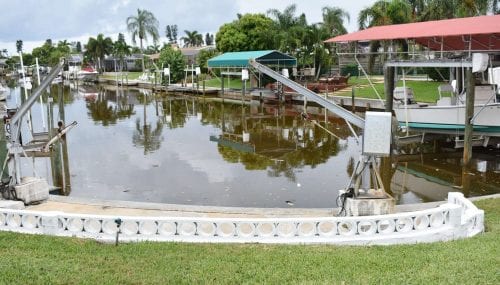
An Aug. 29 visit to a residential canal at 20th Place North in Bradenton Beach revealed a bayside canal end covered with seagrass, dead fish, eels and horseshoe crabs, with flies and maggots congregating on the decomposing marine life.

One block over, the 21st Place North canal contained only a few floating fish and crabs.

When contacted, County Commissioners Carol Whitmore and Steve Jonsson said they were not aware of APTIM doing any work along the Island shorelines, and Whitmore said none of the Island mayors requested assistance.

Related coverage

Red tide lessens

Red tides, lost summers

Red tide FAQs

‘Nets to Neighbors’ next phase of red tide cleanup

red tide business challenges

Businesses working hard to offset red tide

The Sun reached out to the local business community on Sunday to see how their Labor Day weekend was going as they continue to rebound from the red tide’s economic impacts.

“Business has picked up a little, but our employees are stressed because they need to pay their rent. We just need everyone to know it’s not bad out here. We had people sitting outside all day yesterday,” said Shannon Dunnan, manager at the Bridge Tender Inn & Dockside Bar in Bradenton Beach.

“A good rebound, however, the absence of a cleanup program in Sarasota Bay is not helping as the east winds are driving seagrass and dead fish into the canals and eastern shores of Longboat Key. But people are out, and it’s definitely improved since last week,” said Robert Baugh, chief operating officer for the Mar Vista, BeachHouse and Sandbar restaurants in Longboat Key, Bradenton Beach and Anna Maria.

“Business picked up last night. The week was slow, but our employees are hanging in there,” said Jason Suzor, owner of The Waterfront restaurant in Anna Maria.

“It’s definitely slowed down, but we’ve been doing OK. I was asking around the Island, and it seems this weekend everybody’s had a little boost in sales,” said Brad Lisk, bartender at D Coy Ducks in Holmes Beach.

“Business is picking up. It’s nowhere near last year’s Labor Day weekend yet, but we’re running Maine lobsters for $14.99 to help bring guests into our restaurants. Our staff really appreciates the guests coming in, and they’re hanging in there,” said John Horne, president of the Anna Maria Oyster Bar in Bradenton Beach.

“Business was good yesterday, but it’s still down over 25 percent for September. We’re having all-you-can-eat snow crab today, and it’s beautiful out,” said Bob Slicker, general manager of the Swordfish Grill in Cortez.

“The weekend has seen a good turnout with positive vibes. The employees are feeling nervous about what the next few months will hold during a slower season with red tide and all the media coverage. We are doing creative promos and specials to bring locals and tourists in and the locals are providing positive support,” said Scott Lubore, owner of the Freckled Fin in Holmes Beach.

“Our week leading up to Labor Day weekend was down about 25 percent over last year, but the good news is through two days of the holiday weekend we’re flat in our year-over-year comparison. We’re seeing people and their feedback has been positive about how clean the beaches are and no red tide smell. I had to lay off three part-time associates last week. Hopefully, that will be temporary. My full-time associates took an extra unpaid day off last week and will again this week,” said Brian Seymour, owner of the Anna Maria General Store.

“We had lots of cancellations prior to the weekend because people were reacting from the two weeks prior, but we had a handful of check-ins. Everyone’s supporting each other and keeping spirits up as they know this is out of their control. I just hope business picks up soon, so we can keep the wheels on the bus turning,” said Duncan Real Estate owner Darcie Duncan.

“Business was very quiet until Saturday and Sunday. This weekend we had a lot of Florida visitors. My sales are way down compared to last year, and all the businesses are struggling,” said Gayden Shell, owner of The Uptown Lot in Bradenton Beach.

“Business is better and the staff’s morale is swinging upward,” said Kit Bradman, general manager of Island Time Bar & Grill and Bridge Street Bistro in Bradenton Beach.

“We had our best Friday and Saturday in what feels like a month. Our employees have been hurting deeply in their pockets. Hopefully, some good publicity and the red tide passing will bring business back to our beautiful Island and help return us to normal,” said Doreen Flynn, manager of Drift In in Bradenton Beach.

“The red tide’s been a lot better the last few days. Today was pretty good. The week was spotty: one day would be good and the next day it wouldn’t. Hopefully, it’s on the upswing,” said Karen Bell, owner of the Starfish Co. Market & Restaurant in Cortez.

“The fish house has been fine. The guys have been fishing more to the north and the offshore guys aren’t really affected,” she said of the AP Bell Fish Co.

“We’re hanging in there. The special we ran this week helped get our locals out and they’ve been so supportive and generous. We were able to open the outside seating again on Friday. It’s not been as busy as usual for Labor Day weekend, but there’s definitely been an increase so we’re staying positive and optimistic,” said Staci Stern, bartender at Tide Tables in Cortez.

“We had a great weekend. It’s been a little slower than normal, but’s always slow this time of year. Our employees could use a few more shifts, but everyone is hanging in there – and our winter friends will soon be coming back,” said Adam Ellis, owner of the Blue Marlin Grill in Bradenton Beach.

red tide diver crab

A scuba diver’s view of red tide

The recent red tide produced fish kills that littered the Island’s Gulf-side beaches and this begs the question: Are there any fish left in this part of the Gulf?

Sarasota-based professional underwater cinematographer, photographer and explorer Curt Bowen has some answers to that question.

On Aug. 29, Bowen conducted four dives in the Gulf of Mexico at various depths offshore of the Island.

He compiled his underwater footage into a short video titled, “Red Tide: The Death of our Shores” and posted it on his Facebook page.

“What I found was both shocking and hopeful,” he wrote in his post.

Bowen’s video begins with footage shot at site 1, one mile offshore of the Bradenton Beach/Holmes Beach border in murky water that was 15-feet deep and offered a foot of visibility. Other than plants and plankton, no living creatures are seen.

The embedded text says, “Estimated loss of life 98 percent.”

The site 2 footage was shot three miles offshore of Bradenton Beach in water 24-feet deep with eight to nine feet of visibility and an estimated loss of life 40 percent. The footage includes a decomposing fish that falls apart in Bowen’s hands, a dead crab resting on the bottom and some live fish swimming around.

The site 3 footage was shot seven miles offshore of Longboat Pass, in water 41-feet deep, with 10 to 15 feet of visibility and an estimated 10 percent loss of life. Many varieties of fish are seen swimming at this site, but Bowen also picks up a lifeless shell that somewhat resembles a sand dollar.

Site 4 was one mile offshore from the northern end of Longboat Key in murky water 18 feet deep with 12 to 18 inches of visibility and an estimated the loss of life of 99 percent. Bowen is seen picking up several lifeless clam and scallop shells. He also picks up a lifeless sea urchin and finds a dead stone crab tangled in an underwater plant.

Diver’s observations

When contacted Sunday, Bowen shared more observations.

“It was hit really hard at one mile out, and it slowly got better farther offshore. I calculated the percentages according to what I saw alive and dead. That doesn’t mean that some of the fish didn’t swim away, but I didn’t see anything alive at one mile. Then again, I could only see for 15 inches,” he said, noting the plankton and dead particles in the water greatly reduced visibility.

“That’s why you couldn’t see for more than a foot at one mile out,” Bowen said.

“At seven miles out, I saw a few things dead, but there were a lot of live fish. At 15 miles, I would imagine it’s not affected at all,” he added.

Regarding the dead scallops and clams he discovered, Bowen said, “They’re usually buried in the sand, but they must’ve tried to unbury themselves to get away from the red tide. They obviously didn’t make it because I’ve never seen clams scattered across the bottom like that – and I’ve been diving in the Gulf for 30 years.

Regarding the fish population, Bowen said, “The red tide floats on the surface. The deeper you go, the better it’ll be – which is good, because those fish will come back in and repopulate the shallow water once the red tide goes away. It’ll take a couple years. We had a big red tide kill in 2005, and it took two years to get to almost normal. It wasn’t as bad as this one, but it was pretty close. I’ve never seen it this bad.”

red tide diver fish
This dead and decomposing fish was found three miles offshore from Bradenton Beach. – Curt Bowen | Submitted

“We’re on the north end of the kill. The currents that come out of Tampa Bay typically run south, so it could have been keeping the red tide from killing stuff at 10 or 15 miles. Out of Fort Myers and Port Charlotte, the currents go outwards, so I’m thinking there’s going to be a worse kill in deeper water than there was in Anna Maria. We got lucky because of the Tampa currents. I’m trying to get a boat out of Fort Myers and go down there to see how many miles offshore that kill was,” Bowen said.

He also plans to repeat his Island dives in the coming months to continue monitoring the underwater conditions.

Bowen is the owner and publisher of Advanced Diver Magazine, and he’s worked with several television networks including National Geographic and the Discovery Channel. He’s also the founder of the ADM Exploration Foundation, and you can visit him online.

Related Coverage

Red tide lessens

Red tides, lost summers

Red tide FAQs

Red tide sunset

Red tide lessens

Red tide is lessening off Anna Maria Island, according to today’s report from the Florida Fish and Wildlife Conservation Commission (FWC).

Red tide is a type of algae that emits a neurotoxin when it blooms. Deadly to fish, sea turtles, marine mammals and shorebirds that feed on affected fish, red tide makes shellfish unfit to eat, and can cause respiratory irritation in people, especially those with asthma, COPD, emphysema or other respiratory diseases.

The report shows medium levels of red tide at the Rod & Reel Pier in Anna Maria, low levels at Longboat Pass in Bradenton Beach and none at the Palma Sola Bay bridge, down from high levels at all three locations as of the FWC’s Wednesday, Aug. 29 report.

The Aug. 31 report also shows that red tide levels dropped by as much as 25 percent in the past week, Aug. 25-31, compared to the previous week of Aug. 18-24.

Red tide was detected in Manatee County in background to medium concentrations, an improvement from the previous report which noted high concentrations of the marine algae in Gulf waters.

The report notes that respiratory irritation was reported from Aug. 23-30 at Coquina Beach and Manatee Beach. The last reported fish kill was horseshoe crab and blue crab on Aug. 28 at Longboat Pass in Bradenton Beach.

Forecasts by the USF-FWC Collaboration for Prediction of Red Tides for Pinellas to northern Monroe counties, including Manatee County, predict northwestern movement of surface waters and southeastern movement of subsurface waters over the next three days.

For more information, visit The Sun’s Red Tide Resources.

Related coverage

‘We’re still open’

Red tide ‘flu’ nothing to sneeze at

Red tide lingers

Nets to Neighbors next phase of red tide cleanup

Red tides, lost summers

Red tide FAQs

TDC votes to recommend more money for red tide cleanup

Minnie’s crew sings about red tide blues

Restaurateurs combat red tide

Mote working on ozone solution to red tide

County funding shellfish to fight red tide

Manatee County works to clean impacts from red tide

Governor declares state of emergency due to red tide

Red tide bloom can affect your health

red tide beach

Red tide lingers

ANNA MARIA ISLAND – Today’s red tide update from Manatee County indicates improving conditions on some Anna Maria Island beaches, but red tide levels remain high in the water at both ends of the Island, according to the Florida Fish and Wildlife Conservation Commission.

Red tide levels remain high at the Rod & Reel Pier in Anna Maria, the Longboat Pass boat ramp in Bradenton Beach and the Palma Sola Bay Bridge, according to Wednesday’s report from the Florida Fish and Wildlife Conservation Commission.

Red tide was present in very low to high concentrations in 11 water samples collected from Manatee County. Levels ranged from 5-25 percent higher in Manatee County from Aug. 18-24 compared to the previous week, according to the FWC.

Respiratory irritation was reported from Aug. 16-23 at Coquina Beach and Manatee Beach, and fish kills continue.

Aerial surveys from Pinellas to northern Charlotte counties, including Manatee County, also indicate the presence of offshore blooms of the marine cyanobacterium Trichodesmium, which is not harmful to people.

According to today’s Manatee County beach update:

  • Beaches are open
  • Coquina Bayside, Coquina Beach and Cortez Beach north to Bean Point are clean
  • Bayfront Park has minor seaweed
  • Coquina North and South Boat Ramps are clean
  • Crews are working to rake the beaches as needed
  • Red tide signs are posted at affected beaches and will remain until the red tide bloom is over.

Manatee County beach rake operator Mark Taylor said the beaches today are “Much better. The water still doesn’t look right because that stuff is just offshore.”

As for the type of dead marine life on the beach Thursday morning, Taylor said, “Just a few catfish, horseshoe crabs, queen crabs, etc. But it’s very light. The east wind is definitely our friend for now.”

RTU AM Beach
This jogger enjoyed a run on a clean beach in Anna Maria this morning. – Chantelle Lewin | Sun

After taking a walk on the beach in Anna Maria this morning, Sun Advertising Director Chantelle Lewin said that area of beach was clear.

“All’s good. Looks like an awesome weekend,” Lewin said.

As has been the case since the red tide reached Anna Maria Island on Aug. 3, the impacts of red tide vary from day to day and location to location.

On Thursday morning, Bradenton Beach resident Steve Schewe said, “It smells in Bradenton Beach and it stinks on Longboat Key.”

Residential canals

On Wednesday, the residential canal at 21st Place North contained only a few dead and floating fish, but a block away the end of the residential canal at 20th Place North was filled with dead fish and horseshoe crabs. One of the floating fish was filled with maggots and flies were active on several others.

RTU BB Canal II
This residential canal on 20th Place North in Bradenton Beach remains filled with dead marine life and seagrass. – Joe Hendricks | Sun

On the mainland, the Coral Shores canals along Cortez Road that looked horrific two weeks ago had only a handful of floating fish still remaining Wednesday afternoon.

Last week, the Coral Shores canals were among those cleaned by APTIM – the Boca Raton firm contracted by Manatee County at a cost of $140,000 for one week’s worth of cleanup services. APTIM’s services were discontinued at the conclusion of the workday on Aug. 24.

RTU Coral Shores Canal
On Wednesday, this Coral Shores canal looked much better than it did two weeks ago. – Joe Hendricks | Sun

The canals at the nearby Mt. Vernon community were also free of any large masses of dead fish on Wednesday, but a couple of dead horseshoe crabs were spotted floating in one of the canals.

On Monday, the county announced that it was transitioning to a voluntary “Nets to Neighbors” maintenance and light cleanup program that includes nets, buckets and dumpsters provided by the county in certain areas. The Coral Shores dumpster contained no dead fish or red tide debris as of Wednesday afternoon.

RTU Coral Shores Dumpster
On Wednesday, this dumpster in the Coral Shores neighborhood contained no dead fish. – Joe Hendricks | Sun

Local fishermen

After being contracted by the city of Anna Maria for a second time, Cortez fishermen Nathan Meschelle, Tanner Pelkey, Matt Smith and Michael Dolan spent Monday, Tuesday and Wednesday down at the former and future site of the Anna Maria City Pier cleaning seagrass and a very few number of dead fish off the beach.

Pelkey said the presence of seagrass is a normal occurrence. Meschelle said he thinks the red tide is dissipating and he hopes to return to fishing as soon as possible. Over the past weekend, Meschelle was contracted to do some canal cleanup for the Wild Oak Bay community on Cortez Road.

“That was some pretty nasty stuff down there,” Meschelle said. “We cleaned over 1,000 square yards of carnage that had drifted in.”

RTU Cortez Fishermen
These Cortez fishermen spent three days cleaning a stretch of city beach in Anna Maria. – Joe Hendricks | Sun

 – Cindy Lane contributed to this report.

For more information, visit The Sun’s Red Tide Resources.

Related coverage

Red tide ‘flu’ nothing to sneeze at

Nets to Neighbors next phase of red tide cleanup

Red tides, lost summers

Red tide FAQs

TDC votes to recommend more money for red tide cleanup

Restaurateurs combat red tide

Mote working on ozone solution to red tide

County funding shellfish to fight red tide

Manatee County works to clean impacts from red tide

Governor declares state of emergency due to red tide

Red tide bloom can affect your health

Reel Time: The good, the bad and the ugly

This past Sunday morning I launched my boat to check out the red tide situation and look for places to fish. In the process what I found both discouraged and encouraged me.  The condition of local waters is deplorable, but we’re blessed with access to some healthy water and fish just to the north along the edges of Tampa Bay.

I started on north Longboat and worked my way to Port Manatee in Tampa Bay. The boat ramp on Longboat was awash in dead sea grass that was thick with dead fish and horseshoe crabs. Longboat Pass and the Bay had a few dead fish but very little signs of life. The same held true for Palma Sola Bay and north to the mouth of Tampa Bay. I explored Perico Bayou and began seeing seabirds, mullet and some baitfish.

reel time red tide fish
Red tide might not be killing only local fish but other sea life as well including seagrass. – Rusty Chinnis | Sun

On the west side of the river on the Bulkhead, I saw someone land a nice trout. Terra Ceia and Miguel bays looked normal with jumping mullet and diving terns. On the east side of the Skyway near Joe Island, the water was clear and full of life. I found similar conditions all the way to the port and in Clam Bar Bay and Bishop’s Harbor.

That’s the good news. On the way back, I decided to run the beach from Bean Point to Longboat Pass. That was a mistake. The water in the Gulf started out bad and got worse the farther south I went.  It was devoid of life, smelled terrible and you couldn’t see more than 6 inches deep.  On my return to the Bay, I noticed grass piled up all along the shoreline leading me to believe the red tide and anoxic conditions are killing seagrass too.

If you’re like me, you’re tired of and frustrated with the barrage of articles, newscasts and posts on the red tide bloom and would like to do something about it.  While there are many things about a red tide bloom we have no control over, there is something we do have control over – how we respond. That response includes actions we can take like the following. Sarasota Bay Estuary Program has compiled a list of eight things people can do personally to help keep the harmful and red tide feeding nutrients out of the bay.

  1. Reduce or eliminate fertilizer use;
  2. Properly dispose of pet waste;
  3. Keep leaves and grass clippings out of the bay – leave them on your yard as natural fertilizer;
  4. Keep rainwater out of the Bay. Direct downspouts into flower beds and the lawn;
  5. Drive less to lower nitrogen and CO2 emissions, which ultimately get into our waters;
  6. Keep your septic system in tip-top shape to avoid nutrient leaks;
  7. Plant native trees and plants to reduce irrigation and help soak up stormwater;
  8. Use a commercial car wash to reduce water use and manage wastewater disposal.

Secondly, we can join an organization like Sarasota Bay Watch that is working to restore populations of scallops and clams that benefit the Bay by filtering and cleaning the water column. Sarasota Bay Watch and other resource minded groups work to integrate youth outreach, experiences, education and leadership opportunities into their activities. This will help ensure that tomorrow’s leaders learn how to love and care for Sarasota Bay and our environment.

Thirdly we can educate ourselves and cast a vote for politicians that don’t put personal and corporate profits ahead of the health of the environment. If you do the research and keep an open mind, I believe the choice will be clear. Hopefully, if there’s the proverbial “pony under here somewhere,” it’s that we will pay attention to our power at the polls and will once again institute reasonable safeguards to our air and water.

Red tides, lost summers

By Katie Tripp, Ph.D.

Director of Science & Conservation, Save the Manatee Club

Martin County, located along Florida’s southeast coast, adopted the term “Lost Summer” in 2013 to describe the disaster caused by discharges from Lake Okeechobee into coastal communities. Posted signs warned against swimming, fishing or otherwise coming in contact with the water that was covered in guacamole-thick algae. The moniker was unfortunately applicable again in 2016 and now again in 2018.

On Florida’s west coast, red tide has killed nearly 1,100 manatees over the last 23 years, and because blooms now occur so frequently, they are no longer characterized as unusual mortality events for these protected marine mammals. The organism that causes red tide is naturally-occurring. The input of human-generated pollution into our coastal waters, which causes that organism to bloom and wreak havoc, is far from natural. The same is true for the various algae blooms that have occurred in the Indian River Lagoon in recent years, resulting in the deaths of manatees, dolphins, fish, and seabirds and the loss of tens of thousands of acres of vitally-important seagrass.

Florida’s waters are in crisis, and we need leaders who will protect our natural environment. Too many of our decision-makers and residents continue to be in denial about our state’s long-running addiction to growth at any cost and the toll it takes on our environment. Politicians have won election and re-election by campaigning on lower taxes and reduced oversight, but they have neglected the need to protect and invest in our natural environment. Too often, voters make decisions without having properly researched candidates, or they fail to vote at all. Until more citizens engage in their democracy and vote with the future in mind, Floridians can expect continued lost summers and lost opportunities to fix our ailing waterways.

Dr. Tripp has been Save the Manatee Club’s Director of Science and Conservation since May of 2008. She received her Ph.D. in Veterinary Medical Sciences from the University of Florida, where she conducted research on manatee physiology.

‘We’re still open’

ANNA MARIA – The beach behind the Sandbar restaurant was busier Sunday evening than it has been since the recent outbreak of red tide, with more than 160 people turning out for a dinner on the sand, courtesy of a group of local restaurants whose message is, “We’re still open.”

The red tide has hit Anna Maria Island businesses hard, from food service to vacation rental accommodations, as vacationers and mainlanders avoided the smell and sight of dead, rotting sea life and irritation from the single-cell organism known as Kerenia brevis.

The weather cooperated Sunday as the diners moved from the reception inside the Sandbar to the tables that sat near the shore. There was a storm in the distance, but the air was fresh, the beach was clean, and the Gulf waters were clear.

At the reception, Anna Maria Oyster Bar owner John Horne praised the attendees.

“This is a great crowd, and our message to diners is, ‘We’re still here, we’re still open.’”

JoAnne Tressley, of Bradenton, wasn’t sure she could attend.

“I have asthma, but we came out early and it didn’t annoy me,” she said.

Realtor Darcie Duncan said the real estate business is really slow.

“I’m the chair of the Manatee County Chamber of Commerce, and I want to run a series of public service announcements to promote business on the Island,” she said.

Ashley Chiles, daughter of Sandbar owner Ed Chiles, praised the local businesses that helped put on the dinner.

“It’s another example of businesses coming together for the good of the community,” she said.

Proceeds from the dinner and an auction will go toward Mote Marine and Solutions to Avoid Red Tide (START).

Red tide FAQs

What is red tide?

A red tide is a higher-than-normal concentration of a microscopic alga (plantlike organism). In the Gulf of Mexico, it is Karenia brevis, often abbreviated as K. brevis. At high concentrations, the organisms may discolor the water, sometimes red, light or dark green, brown or the water may appear clear.

What causes red tide?

A red tide bloom develops when biology (the organisms), chemistry (natural or man-made nutrients for growth) and physics (tides, winds, currents) work to produce the algal bloom. No one factor causes the development of a red tide bloom.

Where can I check the status of red tide at my local beach?

Florida Fish and Wildlife Conservation Commission (FWC) Red Tide Current Status:

https://myfwc.com/REDTIDESTATUS and Mote Marine Laboratory: https://visitbeaches.org/

Are red tides new?

No. Red tides were documented in the Gulf of Mexico as far back as the 1700s and along Florida’s Gulf Coast since the 1840s. While red tides and other algal blooms occur worldwide, K. brevis is found almost exclusively in the Gulf of Mexico but has been found on the east coast of Florida and off the coast of North Carolina.

How long does a red tide last?

Red tide blooms can last days, weeks or months and can also change daily due to wind conditions and ocean currents.

Is it safe to swim in water affected by red tide?

While people swim in red tide, some individuals may experience skin irritation and burning eyes. If your skin is easily irritated, avoid red tide water. If you experience irritation, get out of the ocean and thoroughly wash off with fresh water.

Can red tide affect me when I am not on the beach?

People in coastal areas near the shoreline may experience varying degrees of eye, nose, and throat irritation. When a person leaves an area with red tide, symptoms usually go away. If symptoms persist, please seek medical attention.

Are there people who are more sensitive to the toxins caused by red tide?

People with respiratory problems (like asthma, emphysema or bronchitis) should avoid red tide areas, especially when winds are blowing on shore. If you go to the beach and have one of these conditions, you should be very cautious. If you have symptoms, leave the beach and seek air conditioning (A/C). If symptoms persist, seek medical attention.

What can I do to lessen the effects of red tide?

People usually get relief from respiratory symptoms by being in air-conditioned spaces. This is also true when driving: keep your car windows up and the A/C or heat on. For people without asthma or any other chronic respiratory problems, over-the-counter antihistamines may relieve symptoms. People with chronic lung ailments should be especially vigilant about taking prescribed medications daily. Always seek medical care if your symptoms worsen.

Can red tide affect pets?

Just like people, pets may be affected by red tide. If you live close to the beach, consider bringing outdoor pets inside during a bloom to prevent respiratory irritation. If you are at the beach with your pets, do not allow them to play with dead fish or foam that may accumulate on the beach during or after a red tide. If your pet swims in the red tide, wash it off with fresh water as soon as possible.

Is seafood in the area safe to eat?

Clams and oysters (mollusks) can contain red tide toxins that cause neurotoxic shellfish poisoning. Check local harvesting status before collecting at FreshFromFlorida.com. Finfish caught live and healthy can be eaten if filleted and rinsed thoroughly. The edible meat of crabs, shrimp, and lobsters (shellfish) can be eaten (do not eat the tomalley—the green digestive gland—of shellfish). Do not eat distressed or animals found dead under any circumstances.

Source: Florida Department of Health

Red tide ‘flu’ nothing to sneeze at

Sore throats, coughing, sneezing, shortness of breath, headache, eye irritation, rashes – people on Anna Maria Island with some of these symptoms are complaining they have the “red tide flu.”

There’s no such thing, according to Brad Dalton, deputy press secretary for the Florida Department of Health.

“To our knowledge there are no medical conditions referred to as the ‘red tide flu,’ ” he said.

But a growing body of scientific research proves that red tide has human health effects, and not just on people with respiratory problems.

Studies show that red tide affects healthy lifeguards, increases emergency room admissions, can have lasting effects on some people for days after they leave the beach, and affects people up to four miles inland. One study also indicates a possible antidote for red tide.

The culprit: Red tide toxin

The algae known as Karenia brevis, which began blooming in overabundance in the Gulf of Mexico and inland waters in Collier County last October, kills fish, marine mammals, sea turtles and shorebirds and makes shellfish unfit for consumption. It drifted north to Anna Maria Island on Aug. 3, and people have been suffering symptoms here ever since.

The symptoms are triggered by a neurotoxin, called brevetoxin, that is stirred up by wave action and winds. When it becomes airborne, particularly blowing towards land, it can cause watery eyes, tickly throats and coughing, especially in people with respiratory issues such as asthma, emphysema or COPD, said Tom Larkin, environmental health director for the Manatee County Health Department.

“The aerosolized product can cause asthma attacks to flare,” he said. “If you go to the beach and experience those symptoms, leave and go to another beach, because it can be at one beach and not another. If you live here, stay inside air conditioning and limit your outside exposure,” he said, adding that an “N-95” mask, available at hardware stores, can help filter out red tide.

Studies confirm that using a surgical mask decreases inhalation of brevetoxin by up to 45 percent.

But inhaling the brevetoxin is not the only way you can be exposed to red tide, according to the Centers for Disease Control (CDC).

Symptoms can follow ingesting red tide water by swallowing or even by breathing in tiny water particles in the air, eating contaminated shellfish or through skin contact while swimming or wading.

“Marine Harmful Algal Blooms (HABs) can cause a variety of illnesses in people,” both immediate and recurring, according to the CDC.

Red tide antidote

A promising recent development is a study on sheep that has identified brevenal, an antidote to brevetoxin, in Karenia brevis itself. Experiments showed that brevenal helps clear the lungs of mucus produced by inhaling red tide. Researchers noted in “Pathophysiologic Airway Responses to Inhaled Red Tide Brevetoxin in Allergic Sheep” that it is the first documented case of a toxin-producing organism also producing its own antidote.

Red tide affects people inland

A study, “Inland Transport of Aerosolized Florida Red Tide Toxins,” shows that red tide can travel four miles inland from a red tide-affected beach. In addition, “People may still be exposed environmentally to the aerosolized brevetoxins even after they leave the beach,” according to the study. “Indeed, if people remain on a barrier island where no point is greater than 1.6 km (about 1 mile) from a coast, they will most likely be continuing their exposure in any outdoor setting and from all directions if the inland waters also contain K. brevis blooms.”

Inland waters including the Manatee River, Palma Sola Bay and Sarasota Bay all have shown evidence of red tide this month.

“Currently, the public health message in communities with onshore Karenia blooms has only recommended leaving the beach area to avoid aerosol exposure; this message needs to be re-evaluated based on these new findings to take into account the possibility of inland environmental exposure to brevetoxins, particularly for persons with underlying lung diseases such as asthma,” the study concluded.
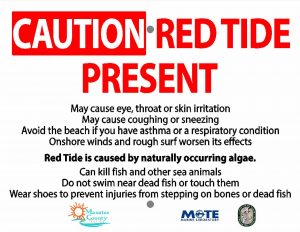
Red tide worse for people with asthma

People with asthma experience “objectively measurable adverse changes in lung function from exposure to aerosolized Florida red tide toxins,” particularly among those requiring regular therapy with asthma medications, according to the study, “Aerosolized Red-Tide Toxins (Brevetoxins) and Asthma.”

The study “Florida Red Tide Toxins (Brevetoxins) and Longitudinal Respiratory Effects in Asthmatics” found that only one hour of exposure to Florida red tide aerosols can cause increased symptoms and decreased respiratory function lasting for at least several days after exposure.

“We recommend persons with underlying respiratory disease (and their healthcare providers, emergency medical facilities and public health officials) be aware of the onshore activity of Florida red tide blooms, and avoid visiting coastal areas with strong onshore winds during onshore blooms. This appears to be particularly important for poorly controlled asthmatics, and those with relatively little regular brevetoxin exposure (for example, those who live inland or visitors).”

ER visits up during red tide

Emergency room admissions for respiratory problems increases with red tide, according to a study called “Environmental Exposures to Florida Ted Tides,” which noted “a significant increase in the rates of respiratory disease admissions to an ER for coastal residents during a year when there was a red tide bloom over several months compared to respiratory disease admissions during no red tide.”

Red tide affects healthy people

Studies show that red tide also affects people without underlying respiratory problems.

In one study, “Occupational Exposure to Aerosolized Brevetoxins during Florida Red Tide Events: Effects on a Healthy Worker Population,” 28 healthy Florida lifeguards exposed to red tide toxins at work reported airway irritation including eye irritation, nasal congestion, cough and headaches.

Island lifeguards are coping with red tide with masks and air-conditioned lifeguard stands, Manatee County Marine Rescue Chief Joe Westerman said. The beach flag system does not specifically address red tide, but if it is bad enough that swimming is not advisable, beaches will be closed with a double red flag, as they have been a few days this month, he said.


Nets to neighbors

‘Nets to Neighbors’ next phase of red tide cleanup

BRADENTON – After one week, Manatee County has ended its contracted canal and waterway cleanup efforts with APTIM and is transitioning to a voluntary “Nets to Neighbors” cleanup and maintenance campaign.

The cleanup services provided by APTIM were costing the county approximately $25,000 per day.

This announcement was made a county press conference on Monday afternoon.

“As of today, the contractor operations ended and the purpose of today’s meeting it to announce the county’s plans moving forward to a neighborhood and volunteer-based solution,” Commissioner Steve Jonsson said, noting that nearly 241 tons of red tide debris had been removed from county parks, beaches and canals.

“We’re transitioning to a program where we will provide nets and buckets to the neighborhood sites that have dumpsters. You and your neighbors can assist by picking up residual fish,” County Administrator Ed Hunzeker said.

Hunzeker said 50 dumpsters have been or will be placed countywide as part of the red tide cleanup and maintenance efforts. Parks and Grounds Operations Manager Carmine DeMilio said most of the red tide debris dumpsters would be emptied daily and some would be emptied upon request.

Hunzeker was asked what happens if the recently-cleaned canals become filled with dead fish again.

“If that happens we’ll be prepared to deal with it. We’ve been prepared to deal with everything that’s come our way so far,” he replied.

When asked if a cleanup contract could be initiated again, Hunzeker said, “Perhaps.”

On Tuesday, Aug. 21, the County Commission adopted a budget amendment that allocated $750,000 in county funds for red tide cleanup. The commission also authorized staff to apply for a $750,000 grant from the Florida Department of Environmental Protection.

On Monday, Hunzeker said the grant application was made and the county has received a funding commitment but no grant money was received yet.

A press release issued after the press conference stated nets and buckets were taken to the Coral Shores, Wild Oak Bay and Trailer Estates neighborhoods and more would be available at the G.T. Bray Recreation Center on Wednesday.

Post-conference revelations

Not everyone is satisfied with APTIM’s efforts.

On Monday afternoon, Coral Shores resident Lindy Gallagher said, “They came through my canal one time and we never saw them again.”

When asked if she was satisfied, Gallagher said, “Oh, hell no.”

It appears that APTIM was fired.

When contacted, Jonsson said he spoke with other Coral Shores residents who were pleased with the efforts and he was not given the impression that APTIM was fired.

But a subsequent inquiry to the county produced email exchanges that occurred Saturday and began with County Commission Executive Assistant Sheri Smith emailing DeMilio about the contractor’s Friday evening update report.

“The response crew was instructed that recovery activities were going to end at the close of the day and at 4 p.m. the crews started to demobilize,” that report said.

“Did the contractor quit? What am I supposed to tell these people when they call and ask when their canal is going to be cleaned?” Smith asked DeMilio.

“They were let go and we are looking at different strategies, Damon Moore can explain further,” DeMilio responded, noting the county strategy would be readdressed Monday morning.

Moore, the county’s Environmental Program Manager, sent Smith an email that said, “By midday Friday they had worked through the existing large contiguous masses mostly within the areas of Coral Shores, Bowlees Creek and Trailer Estates. With the lack of accessible floating masses and fish rotting to the extent that they could not effectively be removed via the nets, I made the decision that this waterside approach was no longer an effective or wise use of funds at over $25k per day.”

When contacted Monday afternoon, County Information Outreach Manager Nick Azzara said, “From the start of the contractor effort we tried to manage expectations and let residents know that not every fish would be captured. If residents weren’t satisfied with the contractor cleanup, and if they’re not interested in the nets campaign, they’re welcome to call one of the local fishermen searching for work,” he said.

The county website contains a list of local fishermen and others who can be contracted for cleanup services.