PALMA SOLA BAY – As captain of Anne’s Calmwater Charters, Anne Huber enjoys sharing her knowledge about manatees, dolphins and the local waters, but there is one question she’s often asked that’s difficult to answer.
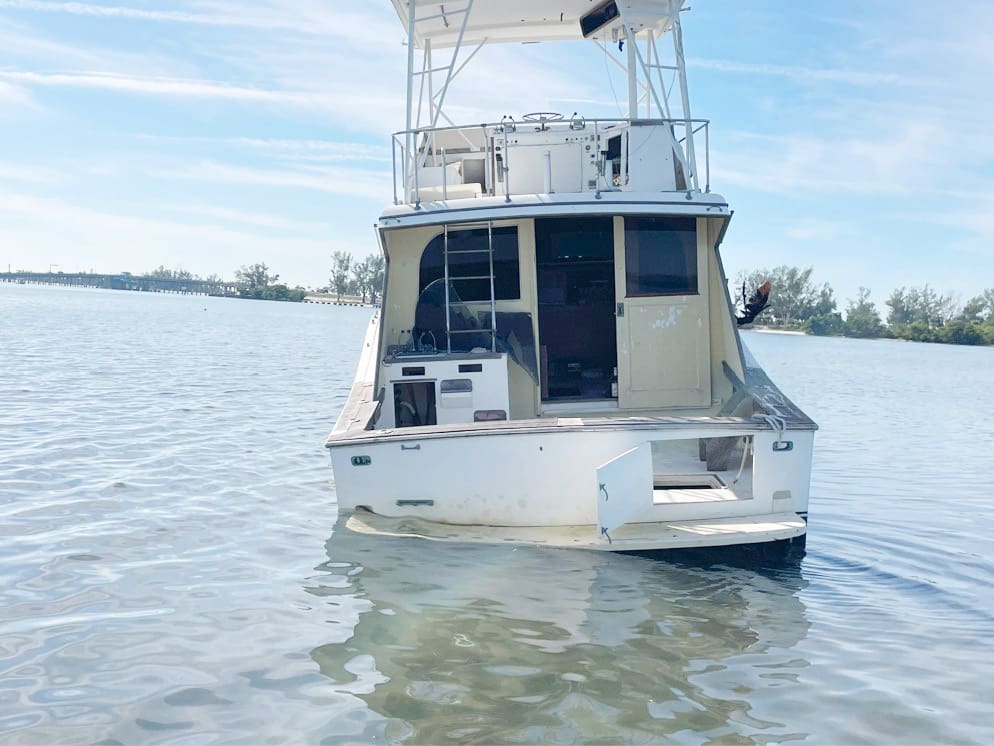
On a recent boat tour of Palma Sola Bay, Huber pointed out a number of moored boats – some were taking on water, some partially sunken and many with registration numbers removed.
“Sometimes people will ask me about these boats,” Huber said. “I just tell them they’ll be removed eventually and crushed.”
Huber pointed out seagrass in shallow waters and mangroves lining the shoreline that can be destroyed by drifting unmanned vessels.
Residents of nearby Flamingo Cay ask the same question as Huber’s customers: Why do the apparently derelict boats remain?
“The derelict boats have been an increasing concern to our neighborhood, as well as other neighborhoods around the beautiful Palma Sola Bay,” Flamingo Cay resident Keith Burchett wrote in an email to The Sun.
“I would say that the problem appeared to be worse once the county started to make preparations to replace the Cortez bridge,” he wrote. “As of this morning, there is a sunk boat in the bay without lights that is causing a safety hazard and another boat drifted to the beach last week. It has since been removed from the beach, but I do not know when or by whom.”
Burchett said at least one of the boats was listed on a short-term rental website.
“Twice people came to my door asking how to get on the boat,” Burchett wrote. “We have never seen the rented derelict boats move. One has to wonder what is happening to the wastewater after the rental. I shudder to think they might be dumping the waste into the bay.”
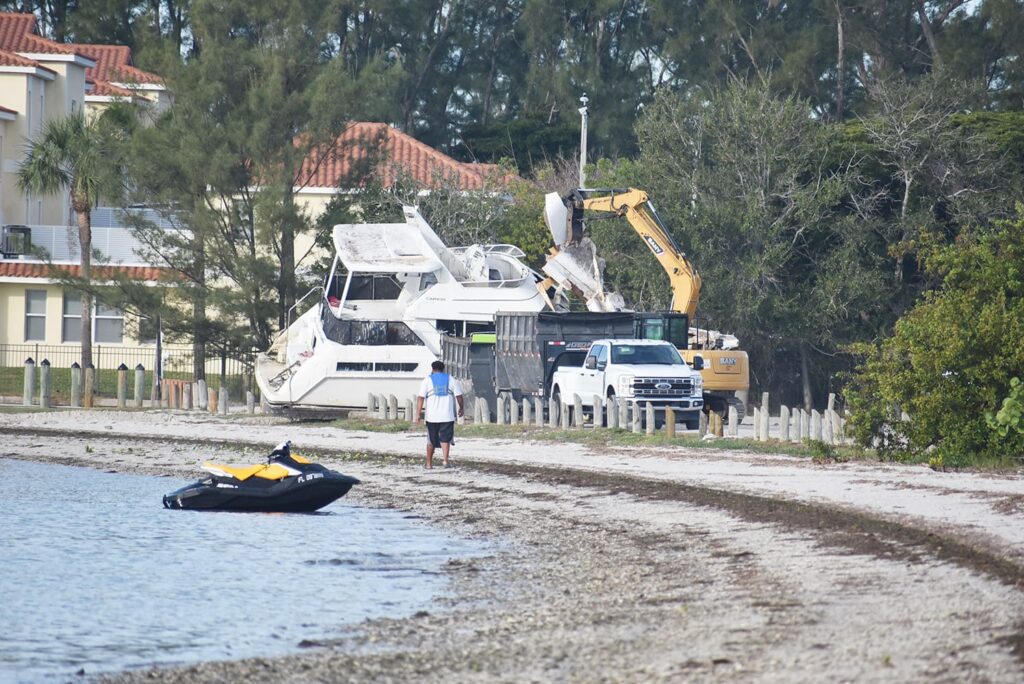
This cabin cruisier was recently demolished and removed at the Palma Sola Boat Ramp. – Joe Hendricks | Sun
Burchett said government agencies are aware of the problem, but do not claim jurisdiction over the derelict boats.
“Unfortunately, this is a problem for all of Manatee County. Palma Sola Bay has a long history of reported pollution creating unsafe conditions for swimming,” Burchett wrote. “These boats contribute to the problem due to human waste, gas, and oil being leeched every time a derelict boat sinks or comes adrift onto the beach. I am not an expert, but everyone knows if a boat has become too expensive for the owner, and it is legal just to anchor the boat in the water and leave it, the problem becomes the taxpayers’ problem at the end of the day.”
Another Flamingo Cay resident who asked not to be named spoke to The Sun.
“I’ve called FWC (Florida Fish and Wildlife Conservation Commission), but nobody seems to want to do anything about this because they (the boats) are not blocking the channel,” he said.
Derelict boats come under the jurisdiction of the FWC and local law enforcement agencies.
“Derelict and at-risk vessels are a concern because they can endanger marine life and habitat, pose threats to public safety and cause property damage as they drift on or beneath the water’s surface. Derelict vessels that block navigable waterways can also pose a navigational hazard. Law enforcement officers with the FWC, as well as state, county and local officers, conduct periodic inspections and take appropriate actions to reduce the risk these vessels present,” according to the FWC website.
Derelict boats are tagged by local agencies and reported to FWC.
Intentionally dumping a vessel is a third-degree felony punishable by up to five years in prison and/or a $5,000 fine, according to FWC. It can also result in restitution to the state for the cost of removal, along with fines.
BRADENTON – Dr. Abbey Tyrna, executive director of Suncoast Waterkeeper (SCWK), spoke to the Palma Sola Scenic Highway committee on Nov. 12 about the water quality in Palma Sola Bay.
Tyrna presented a graph showing that from 2001-11 the water quality on the north side of the Palma Sola Causeway exceeded the acceptable threshold of state water quality standards 20 times. In 2024 alone, however, in that same body of water, the threshold was exceeded 20 times.
“So we went from 20 exceedances in an 11-year period to 20 exceedances last year, so the question was what was happening here,” Tyrna said.
Palma Sola DNA source tracking results show elevated levels of horse DNA several times between April 2024 and August 2025; human DNA in July 2024 and bird DNA in April, September and October 2025.
“So, what has changed? I don’t think the number of birds has changed because what I’ve learned is that birds are actually declining,” Tyrna said.
She said the best way to figure out what is happening is through DNA testing.
“What we can see is what’s in our water samples and is detectable has been horses, humans and birds, so what can we say is causing enterococci levels in Palma Sola Bay? We can say all of them,” Tyrna said. ”If you want to know how much humans matter, how much horses matter, that’s impossible to know. There are no tests for that right now. So, we can never get there, and we should never try. And all we can do is a qualitative analysis in a robust lab. We certainly can’t do much about birds, we can do something about humans and we can do something about horses.”
Enterococci normally inhabit the intestinal tract of humans and animals. The presence of enteric bacteria can indicate fecal pollution, which can come from stormwater runoff, pet and wildlife waste products and human sewage spills. If these bacteria are present in high concentrations in recreational waters and are ingested while swimming or enter the skin through a cut or sore, they may cause illness or infections, according to the SCWK website.
“According to studies conducted by the EPA, enterococci have a greater correlation with swimming-associated gastrointestinal illness in marine and fresh waters than other bacterial indicator organisms, and are less likely to die off in saltwater. If an enterococci result exceeds 70 cells per 100 milliliters of marine water sampled, then an advisory should be issued for the sampling site,” the SCWK website states.
SCWK conducts regular monitoring of bacterial levels at 11 area recreational sites. The Benchmark EnviroAnalytical lab examines the samples for enterococci. The results are posted weekly on Suncoast Waterkeeper social media feeds.
“When one use supersedes another use, we find that to be a problem. This is why we advocate for a permit and signage system,” Tyrna said. “Suncoast Waterkeeper’s goal is to clean up the water.”
Tyrna said one of the horse ride providers at Palma Sola Bay has taken a best management practice approach to cleanup by using a boat with a paddle that brings horse manure into a net and out of the water.
“Whether or not that’s going to reduce our readings remains to be seen,” Tyrna said.
Tyrna speculated that some of the human readings could be related to sewage and possibly derelict boats.
“You don’t find a pump-out boat going to the derelict vessels so it’s logical,” she said.
PALMA SOLA BAY – The month-long pause in horseback riding in Palma Sola Bay and along its northern shoreline ended on Oct. 6 and the Sarasota Bay Estuary Program (SBEP) has released the results of its water quality testing.
Prior to and during the horses’ absence from the bay, SBEP sampled the water five times and received results from four of those tests by Oct. 8.
The role of the horses in the high bacterial numbers in the bay will require further evaluation, according to SBEP Executive Director Dr. David Tomasko.
“For all four times, the levels of enterococci – the state’s default “fecal indicator” bacteria – exceeded the bathing beach standard at the site where the horse ride operations occur,” Tomasko wrote in an Oct. 8 email to The Sun.
He said the results of the tests show there are sources of “fecal indicator” bacteria other than the horses.
“For the first two sampling events, the horse ride vendors were out there, and although we had detections of DNA sequences of bacteria that were from horses, the numbers were too low to be quantified. That is called a DNQ event “Detected, Not Quantifiable,” Tomasko wrote. “For the next two sampling events, the horse ride vendors were off the causeway, and we didn’t even have detections of the DNA sequences of bacteria from horses.”
Tomasko stated SBEP still has three more sampling events to work through, all with the horses now back on the causeway.
“When we have all the data together, the SBEP will have a better understanding of how to interpret the results from this study,” Tomasko wrote. “But what seems fairly clear – and which has been clear for a while now – is that there are sources of “fecal indicator” bacteria other than horses out there. We have hits for birds, but not humans.”
Tomasko said some of the “fecal bacteria” indicators may not be from fecal sources at all.
“We know that each of the three fecal indicator species used by the State of Florida can arise from decomposing vegetation, but we don’t know what role – if any – that potential source could have on what we’re finding in Palma Sola Bay,” he wrote.
Suncoast Waterkeeper has been monitoring water quality in the bay and posted the following on its website: “Our monitoring results reveal persistent exceedances of the state’s water quality standards for enterococci bacteria:
2022: 22 samples collected, 6 exceeded the FDEP threshold of 130/100 mL (no more than four should exceed);
2023: 46 samples collected, 23 exceeded (no more than eight should exceed);
2024: 43 samples collected, 20 exceeded (no more than eight should exceed); and
2025 to date: 32 samples collected, 16 exceeded (no more than six should exceed).”
Further testing showed the following results:
April 2024: Horse DNA was detected and quantified in both water and sediment; no human DNA was detected;
July 2024: Horse DNA was again quantified in water samples; human DNA was detected, but at levels below quantification; and
April 2025: Avian DNA was detected at low levels; neither horse nor human DNA was detected in the sample.
“These findings demonstrate that horses are a measurable source of bacterial pollution in Palma Sola Bay north of the causeway; however, they are not the sole contributor,” Suncoast Waterkeeper Executive Director Abbey Tyrna wrote on the organization’s website. “The scientific literature emphasizes that microbial contamination in coastal waters frequently originates from multiple sources, including wildlife, domestic animals, and human infrastructure, and that distinguishing between these inputs and their relative contributions is inherently challenging.”
Tyrna does not support removing horses from the bay, but recommends the following:
“Install Public Signage – Post clear warning signs alerting residents and visitors that enterococci levels exceed state water quality standards, so that people can make informed decisions about their health and recreation;
Establish a Horse Vendor Permit System – Create a permit program that caps the total number of horse vendors and requires best management practices (BMPs) designed to protect water quality and seagrass meadows. Such BMPs should include ensuring horses remain in shallow water for the majority of the ride, only wading in past their hindquarters for a short duration at the beginning, and requiring the use of waterproof horse diapers. The permit should also stipulate the area where the horses can ride to protect the seagrasses.”
PALMA SOLA – The Florida Department of Health in Manatee County (DOH-Manatee) has issued a water quality advisory for Palma Sola South due to high bacteria levels.
Tests on May 6 and 8 indicate that the water quality at Palma Sola South does not meet the recreational water quality criteria for Enterococcus bacteria recommended by the Florida Department of Health.
Palma Sola South is at the east end of the Palma Sola Causeway and the north side of Manatee Avenue West.
DOH-Manatee advises against any water-related activities at this location due to an increased risk of illness in swimmers. Sampling conducted during water quality monitoring showed that the level of bacteria exceeds the level established by state guidelines.
Water testing on May 6 also showed a bacterial water quality level of “poor” at Coquina Beach North, but no advisory was issued. Test results on May 8 show a “moderate” level of the bacteria at both Coquina Beach North and South, one step below “good.”
Enterococci are enteric bacteria that normally inhabit the intestinal tract of humans and animals. According to DOH-Manatee, “The presence of enteric bacteria can be an indication of fecal pollution, which may come from stormwater runoff, pets and wildlife and human sewage. If they are present in high concentrations in recreational waters and are ingested while swimming or enter the skin through a cut or sore, they may cause human disease, infections or rashes.”
The advisory at Palma Sola South will continue until bacteria levels are below the accepted health level. Test results are available at FloridaHealth.gov/HealthyBeaches. For more information, call 941-714-7596 or visit Manatee.FloridaHealth.gov.
BRADENTON – Horses are not the only source of bacteria and seagrass damage in Palma Sola Bay, an expert told the Bradenton City Council.
In a July 26 water quality presentation, Dr. Dave Tomasko, executive director of the Sarasota Bay Estuary Program (SBEP), stopped short of naming horses as a primary cause of elevated bacteria levels and loss of seagrass, instead saying that there are likely multiple causes.
Horseback riding on the north side of the bay has long been debated by the council, the Palma Sola Scenic Highway Committee and water quality organizations.
“People damage the bay by enjoying the bay, we’re not against that at all,” Tomasko said. “SBEP is for access and recreating on the bay but that does cause damage to the bay.”
In his slide presentation to the council, he raised the question, “Do horses pose a risk to the health of Palma Sola Bay? Is this something that might be bothering some people, or is it something that puts the system at risk?”
Two businesses provide horseback riding in the water on the north side of the bay.
Tomasko discussed four metrics related to water quality and health of the bay, and talked about each of their possible sources: Nutrient enrichment, pathogens, physical damage and nitrogen.
“We generate nutrients through our fecal material, through passing urine. We generate nutrients by fertilizing our lawns, not picking up after our dogs,” he said. “We’re going to look at whether or not there is a nutrient-related problem in Palma Sola Bay and if there is, how important might horses be for that.”
Pathogens can be quantified, Tomasko said.
“Pathogens are things that can make you sick. We test for bacteria. We have three types of fecal indicator bacteria – e. coli, enterococci and fecal coliform, and none of those are just specific to humans, to mammals or to animals,” he said. “I can get you millions of fecal coliform bacteria from decomposing grass in a bucket of water. Our indicators are not specific to a source. So, if you find elevated levels of bacteria, it doesn’t mean you know why they’re there. “
Two different locations, one on the north side where horses are ridden and one on the south side where they are not are both sampled by laboratories, he said.
The Florida Department of Health collected more than 50 samples of south-side data and 84% of them were good, Tomasko said.
“On the north side, the values are poor more than any other category. Elevated levels are found more on the north side than the south side,” he said. “The south side doesn’t show elevated levels (of bacteria) except on occasion.”
“Enterococci bacteria is not necessarily from humans or pets or horses. It could be, but it could also be coming from decomposing seagrass meadows,” Tomasko said, noting that seagrass is absent from the south side of the bay.
Tomasko suggested that there is a good way to find out where the bacteria is coming from and that is through quantitative testing.
“My suggestion would be to try find what the bacteria is coming from to know what you should act upon, if anything,” he said. “If I have 3,000 bacteria and one is due to a human, that’s a lot different than if I have 3,000 bacteria and 1,500 is due to a human. There’s a quantitative way to do this.”
Evidence of physical damage to seagrass is apparent, Tomasko said, but could be caused by multiple sources.
“If we walk through seagrass meadows, or run through with a boat propeller, you’re going to scar the grass a little bit,” he said. “Horses are 1,500-2,000 pounds, they’re kind of heavy, but they also have buoyancy. A submerged horse will have some of its weight offset by buoyancy in the water.”
“It’s important to keep in mind we’ve been doing a lot of things to physically damage these habitats. And horses are causing a trail, true, but there’s a lot of boat propeller scars there too.”
With regard to nitrogen levels he said, “If you want your lawn to grow fast or your trees to look green, add nitrogen. So, we’re trying to keep the amount of nitrogen under control in the water.”
Five or six times a year, volunteers go out to measure microalgae in the bay.
“This was a healthier bay 10-15 years ago. We had a 28% increase in seagrass, we had lower nitrogen, we had lower algae and lower phytoplankton,” Tomasko said. “Palma Sola Bay continues to be healthy, looking at the seagrass status, the phytoplankton, the water clarity, it continues to be classified as a healthy system.”
“Would removing these horses reduce some of these issues?” he asked. “Yes, probably in a local sense, but the bay remains healthy and it doesn’t appear that the bay is in some kind of tipping point or close to it.”
BRADENTON – Florida Department of Health in Manatee County (DOH-Manatee) has issued a no-swim advisory for the beach on the south side of the Palma Sola Causeway along Manatee Avenue.
“A no-swim advisory is issued when enterococci bacteria levels exceed Federal Guidelines for safe swimming. It is thought that contact with the water at the site could make beachgoers sick,” a DOH-Manatee press release said.
The advisory will be in effect until the water meets Environmental Protection Agency (EPA) safety guidelines.
No other Manatee County beaches are under the no-swim advisory.
As a participant in the Healthy Beaches Program, DOH-Manatee collects water samples at select beaches each week. The samples are then sent to labs to determine if the levels of enteric bacteria (enterococci) – which can bring human disease, infections or rashes – are acceptable based on EPA standards.
If levels are read as unacceptable, a no-swim advisory is issued; a no-swim advisory is lifted once the levels read as acceptable.
DOH-Manatee received test results from samples taken at Palma Sola South on June 19 and June 22 that show an elevated level of enterococci bacteria.
Additional information about the Healthy Beaches program can be found by calling (941) 714-7593, or by visiting the Florida Department of Health’s website at www.FloridaHealth.gov and selecting Beach Water Quality under the Environmental Health tab of the navigation bar.
CORTEZ – When Gale Tedhams was visiting her mother at a Cortez Road condo last May, she immediately recognized the signs of a manatee calf in distress.
“There was a mother and baby in the canal behind the (Mount Vernon) condo,” she said. “You could see boat strike injuries and the baby couldn’t dive to nurse.”
Tedhams, who volunteers at the Bradenton Beach-based Wildlife Education and Rehabilitation Inc., called Mote Marine and the Florida Fish and Wildlife Conservation Commission (FWC) to see if someone could help.
“They told me they knew about them and have been trying to get them for two weeks, but by the time they got to them they were already gone,” Tedham said. “About 30 people (from FWC) came out in a boat and stretched a net around them and were able to take mom and the baby. The mom was huge.”
The calf had an infection and the mother and calf were kept together and brought to SeaWorld Orlando for treatment. SeaWorld has a rehabilitation center for treating wildlife that is ill, injured or orphaned, including manatees, sea turtles, birds and other marine animals.
On Aug. 3, the mother and calf were released back into the water at the Palma Sola Causeway Boat Ramp.
“They brought them down (from Orlando) in a huge box truck,” Tedhams said. “They were laying in the back. Once they were put in the water, they just swam right off together.”
In a recent study, FWC researchers found that one out of every four adult manatee carcasses analyzed showed evidence of 10 or more watercraft strikes.
“With only 4% of adult manatees devoid of watercraft-related scars, it appears exceedingly rare for an adult manatee to not be struck multiple times in its life,” according to the FWC website.
Manatees and the law
Manatees are protected by the Marine Mammal Protection Act of 1972, the Endangered Species Act of 1973 and the Florida Manatee Sanctuary Act of 1978.
It is illegal to feed, harass, harm, pursue, hunt, shoot, wound, kill, annoy or molest manatees. According to the FWC, “Examples of illegal activities include: Giving food or water to manatees, or using food or water to attract manatees, separating a mother and calf, disturbing manatee mating herds, or pursuing or chasing manatees either while swimming or with a vessel.”
Call the FWC’s Wildlife Alert Hotline: 888-404-FWCC (3922), #FWC on cell phones, or text Tip@MyFWC.com to report manatee deaths, injuries, harassment, accidents, or orphaned or distressed manatees.
BRADENTON – The horses ridden in the waters off the side of the Palma Sola Scenic Highway made their way back onto the agenda for the Corridor Management Entity’s April meeting and were a point of contention among members and the people who gathered in person and online for the meeting.
The conversation that began as lively soon became acrimonious as people on both sides of the issue attempted to argue their point to either keep the horse riding in Palma Sola Bay going or remove the horses.
The co-chair of the committee, Craig Keys, interrupted the debate several times to remind all those gathered that the CME has no jurisdiction over whether horse riding can continue or be banned from the causeway. He added that the group is not even an advisory committee to any governing body.
The group’s primary purpose is beautification and maintenance of the side of the roadway along the designated scenic highway, currently from 75th Street in Bradenton west along Manatee Avenue to the intersection with East Bay Drive in Holmes Beach. There is an application being submitted by the group to the Florida Department of Transportation to extend the Palma Sola Scenic Highway to the end of Manatee Avenue at Manatee Beach and to the north from East Bay Drive to the Holmes Beach city border with Bradenton Beach.
Some members of the CME and the public made the argument that the horses are a danger to the public by blocking access to sidewalks and preventing multi-modal transportation through the area on the northeast side of the causeway. There also were environmental concerns such as horse excrement in the water, damage to seagrasses and damage to trees due to tying the horses to palm trees along the sidewalks.
Representatives from Beach Horses, C Ponies and other supporters of horse riding on the causeway said the horses do not adversely affect the environment. Carmen Hanson, of C Ponies, suggested horse-riding operators be allowed to install hitching posts for their personal use along the causeway at their own expense to alleviate the issue of damaging trees to which the horses are tied.
Co-chair Ingrid McClellan said one of the objectives of the CME is to maintain a pet-friendly recreational area along the causeway, including users with horses. She said that along the causeway, different types of users have different areas where they can enjoy their favorite recreational activities, from horse riding to biking, use of small watercraft and swimming, among others.
McClellan said the city of Bradenton has legal jurisdiction over the causeway beach and members of the Bradenton City Council had, in late 2020, instructed their attorney, Scott Rudacille, to investigate what their options are, if any, concerning the horse-riding operations on the causeway. As of press time for The Sun, an update had not been placed on the city’s council’s agenda for discussion.
Keys encouraged everyone with concerns about the horses to contact their elected officials, including city council members and county commissioners, to discuss their issues.
In other business, Darryl Richard said he would work with FDOT and Manatee County to address erosion along the causeway beaches before other members of the CME worked to restore bollards knocked over along the corridor by tidal waters and vehicles.
McClellan said it was back to the drawing board for Manatee County representatives trying to create a plan to revitalize Kingfish Boat Ramp in Holmes Beach. She said the group working on the project hit a roadblock with the landscaping plans and is starting the design work over from scratch before resubmitting plans for permits from FDOT. Richard, the CME’s representative from FDOT, said the plans are not yet ready for official permit review by the department.
BRADENTON – Anyone traveling down Manatee Avenue the afternoon of Friday, Feb. 19 was treated to an interesting sight as the nine-person crew of the Exuma Trader, a Sarasota-based marine salvage vessel, worked to remove the Viva! Viva! from the shallows of Palma Sola Bay, where it ran aground early this month.
The entire operation took more than two hours and required an assist from Sea Tow to get the boat bobbing.
The boat was a minor tourist attraction this month on the southeast side of the Palma Sola Causeway until its owner could have it removed. Thanks to the help of Catherine Schultz of Catherine’s Florida Charters and Bahia Mar West Marina, the vessel was removed at no cost to the owner, who lives part-time aboard the Viva! Viva!
Florida Fish and Wildlife Conservation Commission officers, along with officers from the Bradenton Police Department, secured the site and watched over a small group of onlookers.
At the end of the afternoon, the Viva! Viva! was returned to its customary anchorage position in Palma Sola Bay on the north side of the causeway along Manatee Avenue.
The crew of the Exuma Trader out of Sarasota pulled the Viva! Viva! from the shallows of Palma Sola Bay on Friday. - Kristin Swain | Sun
PALMA SOLA BAY – Taking a cue from Pinellas County, Manatee County commissioners have voted 7-0 to have the county attorney’s office investigate regulating horseback riding in sensitive waters in the county, including Palma Sola Bay.
Pinellas commissioners banned horses from aquatic preserves in that county last month, impacting several tourism businesses, including C Ponies, which also rents horses at Palma Sola Causeway.
They were persuaded by evidence, including aerial photos, that horses trample fragile seagrass in the aquatic preserve in Tampa Bay near the Sunshine Skyway Bridge where horses are rented, and that horse manure and urine in the water pose a risk to human health.
Second Place
In-Depth Reporting
Lucy Morgan Award
2020
Google Maps shows similar seagrass damage in Palma Sola Bay in Manatee County, and the bay has had poor water quality based on enterococcus bacteria from fecal contamination on the south side of the bay four times in the past five weeks, according to the Florida Department of Health’s Healthy Beaches Program.
Manatee County Commissioner Betsy Benac made the request on Thursday, Nov. 7.
“I want to know if it’s something we can do,” she said. “We’ve been told previously we can’t do that. Well, I don’t believe that.”
Commissioners had been advised that regulation was not possible based on ancient precedent protecting the use of horses as a mode of travel to convey people and goods, Manatee County Attorney Mitchell Palmer said, adding that “horses being used for recreational purposes in a sensitive body of water” is not the same thing.
“There’s little doubt in my mind that we can regulate horseback riding for purposes of water quality,” said Palmer, who suggested the “sensitive waters” language to avoid impacting horseback riding in rivers and lakes in east Manatee County and elsewhere.
“We have a copy of the Pinellas County ordinance,” Palmer said, explaining that his office had already begun looking into the issue prior to Thursday’s vote, and has requested the last five years’ worth of Palma Sola Bay water quality records from the Manatee County Health Department.
“I think it’s very important that this be done because the (sea)grass is being trampled,” Commissioner Vanessa Baugh said. “The grass helps to keep the water clear and is also food for the manatees.”
Palma Sola Bay has seagrass beds on both sides of the causeway as of last year’s survey, including in the northeastern section where most commercial horseback rentals occur, according to the Sarasota Bay Estuary Program, which has expressed concern about the issue in recent months, along with Keep Manatee Beautiful, the Palma Sola Scenic Highway Corridor Management Entity, the Manatee Council of Governments and Sarasota Audubon.
Updated Oct. 25, 2019 | PALMA SOLA CAUSEWAY – Pinellas County commissioners have banned horses from aquatic preserves in the county, impacting a popular tourism business that also rents horses at Palma Sola causeway in Manatee County.
C Ponies offers rides in an aquatic preserve in Tampa Bay near the Sunshine Skyway Bridge in Pinellas County, and in Palma Sola Bay and along its narrow causeway beach in Manatee County. Activities include beach rides, water rides and “horse surfing,” standing on horses while they swim. Other horse rental businesses in Pinellas County also are affected.
“We only have one body of water to protect. We only have one planet to save. Once it’s destroyed, it’s destroyed,” said Pinellas County Commissioner Janet Long, a former competitive horseback rider.
The commission pinned its 5-1 decision Tuesday on evidence – including aerial photos – that horses trample fragile seagrass in the aquatic preserve, and that horse manure and urine pose a risk to human health.
Citing support for the ordinance from the Florida Department of Environmental Protection (DEP), the Tampa Bay Regional Planning Council, the Tampa Bay Estuary Program and the City of St. Petersburg, the commission also prohibited the unpermitted damage of seagrass in aquatic preserves.
Recognizing the value of the horseback riding businesses to tourism, commissioners voted unanimously to direct county staff to investigate other locations for horseback riding.
Horsesurfing takes horseback riding in the bay to another level. – Cindy Lane | Sun
Manatee County officials have contacted Kelli Levy, Pinellas County’s Environmental Management division director, for a copy of the ordinance, Levy told commissioners, adding, “They will be looking into it as well.”
Bacteria happens
Simply put, horseback riding in the water decreases water quality, Levy told commissioners.
“It’s the wrong activity in the wrong place,” she said.
Tests by DEP and the Florida Department of Health show increased fecal bacteria in waters frequented by horses, Levy said, adding that the bacteria can cause gastrointestinal illness in people exposed to contaminated water through their eyes, ears, nose or cuts.
Florida Department of Agriculture best practices on horseback riding include staying at least 25 feet from water bodies, and the Florida Administrative Code discourages “activities that degrade the aesthetic, biological or scientific values or quality or utility of a preserve,” she said.
Water testing has shown increases in fecal bacteria in the areas where horses are ridden, said Heather Young, an environmental planner for the Tampa Bay Regional Planning Council.
Water Quality Report
Bayfront Park North Poor
Bradenton Beach Good
Coquina Beach North Good
Coquina Beach South Good
Manatee Beach North Good
Palma Sola South Moderate
Source: Florida Department of Health
“Nutrients and bacteria are the same thing our local governments are working incredibly hard to reduce,” she said, adding that seagrass restoration has been a group effort among many organizations and governments. “These riding operations are being allowed without permission or oversight. There is no guarantee water quality is not being impacted.”
Seagrass at stake
Randy Reynolds, DEP’s aquatic preserve manager for Tampa Bay, said he has studied the Pinellas County horseback riding area for two years, initially snorkeling, then deciding against it due to the water quality.
He observed damage to shoal grass inconsistent with boat propeller scarring, and damage to turtle grass beds in deeper water.
“I’m convinced it’s the horseback riding, not boats,” he said. “They’re punching holes in the seagrass.”
Water horses are popular on Palma Sola Bay. – Cindy Lane | Sun
Jessica Bibza, a marine biologist and member of the National Wildlife Federation and the Tampa Bay Estuary Program Technical Advisory Council, told commissioners that one in five jobs are directly tied to the health of Tampa Bay.
“I don’t know why this one activity should be exempt,” she said. “We’ve all invested a lot of time and energy and money to restore the bay.”
Horseback riding defended
Commissioner Kathleen Peters defended the businesses, saying she took an anonymous ride to see things for herself.
“They picked up everything” using several rakes and buckets. “The beach was pristine,” she said.
“Many of these horses are rescue horses. These people are taking in abused horses and are giving them an opportunity to exercise in the water,” Peters said, suggesting in vain that commissioners compromise by imposing a permit fee and allowing only one water trail.
Jennifer Osterling, a guide for C Ponies, brought trash to the commission meeting that she said she collected from the bay during trail rides, including six-pack holders and plastic bottles.
Guides educate riders about the environment, she said, while helping veterans, cancer patients, and the horses.
Kimberly Kult of C Ponies said only 10% of the horse waste is deposited in the water, and guides use pool nets and buckets to remove it.
The U.S. Environmental Protection Agency excludes horse waste from the definition of “solid waste,” she said, because horse waste is primarily composed of grass.
The exclusion means that horse waste is not required to be disposed of at a hazardous waste landfill, Levy said, adding, “It can be disposed of in the trash, but it doesn’t mean it’s fit for human health.”
Local concerns
Much like the Sunshine Skyway causeway, the Palma Sola Bay causeway attracts people who enjoy other recreational activities besides horseback riding, including swimming, boating, kayaking, paddleboarding and kitesurfing.
An aerial image from Google Earth show the area where horseback riding is concentrated in Palma Sola Bay.
A representative from the Sarasota Bay Estuary Program told The Sun in July about concerns that horses are impacting seagrass beds in Palma Sola Bay on the northeastern corner of the causeway, where most commercial horseback rentals occur.
Other local organizations that have discussed concerns about horseback riding at Palma Sola Bay include Keep Manatee Beautiful, the Palma Sola Scenic Highway Corridor Management Entity, the Manatee Council of Governments and Sarasota Audubon.
“We do have concerns about horses and dogs on the causeway,” said Ann Paul, a biologist with Audubon’s Florida Coastal Islands Sanctuaries, days before addressing Pinellas County commissioners.
“They’re peeing and pooping, and there’s no cleansing of the water before it gets in the estuary,” she said. “Where they are walking through seagrass, they’re punching holes in the seagrass. People would like to use that stretch of beach and can’t because of horse poop.”
The Florida Department of Health’s Healthy Beaches Program lists moderate water quality in Palma Sola Bay as of the most recent test on Oct. 23. Tests showed poor quality on Oct. 21 based on enterococcus bacteria from fecal contamination on the south side of the bay, which horse proponents point out is across Manatee Avenue from the horseback riding businesses.
BRADENTON – The south side of Palma Sola Bay continues to test positive for moderate levels of enterococcus bacteria from fecal matter, according to the Florida Department of Health.
The moderate level has persisted since Aug. 26. Poor water quality was discovered on Aug. 12 and 13, briefly improving on Aug. 19.
That afternoon, an estimated 180,000 of reclaimed water spilled at 59th Street West and 21st Avenue West near Blake Medical Center when a contractor struck a water line, causing reclaimed water to rush down the street into a storm drain that leads to the bay, according to a Florida Department of Environmental Protection (DEP) report.
A health advisory at Bayfront Park in Anna Maria has been lifted since water samples tested good on Sept. 3, the most recent water test available. Poor readings on Aug. 26 and 28 prompted the advisory.
The Florida Healthy Beaches Program uses a three-point scale – poor, moderate and good – in evaluating water safety. Tests detect the presence of enterococci – bacteria that normally inhabit the intestinal tract of humans and animals, which can be an indication of fecal pollution.
The bacteria may originate from sewer pipe breaks, stormwater runoff, wildlife, pets or horses.
The Tampa Bay Regional Planning Council asked DEP and the Pinellas County Commission in June to ban recreational horseback riding in Tampa Bay along the Sunshine Skyway Bridge causeway to reduce nitrogen and phosphorus from horse waste. Some of the same horses that are rented at the Skyway also carry tourists up and down beaches on the Palma Sola Bay Causeway and swim in Palma Sola Bay. The Sarasota Bay Estuary Program and Keep Manatee Beautiful also have expressed concerns about horse waste in the bay.
If fecal pollution is ingested while swimming or penetrates the skin through cuts, it can cause infections, rashes and disease, according to the health department.
The federal Environmental Protection Agency (EPA) recommended that states adopt the bacterial testing as a saltwater quality indicator. According to EPA studies, enterococci have a greater correlation with swimming-associated gastrointestinal illness in both marine and fresh waters than other bacterial indicator organisms and are less likely to die off in saltwater.
I appreciate your article in the Anna Maria Island Sun dealing with potential health concerns of horse fecal matter on the Palma Sola Causeway. In fact, your article also brought up for me another concern in addition to horse poop. I initially expressed my concerns by written letter to Bradenton City Councilman, Ward One, Gene Gallo in February. He sent me a short reply basically saying “tough luck ol’ boy,” the horse folks are on state right of way, and no one around here has any jurisdiction.
These horses have become a real problem for those of us who wish to fish on the north side of the causeway. At 76 years old, my wife Lucy, and I enjoy only a few activities, and wade fishing on the causeway is fun for us, for we are also catching food for the dinner table. Unfortunately, due to red tide and bans on keeping our fish of choice, we’ve retired the rods until the ban is lifted.
My concerns/gripes follow: What started as a one-horse trailer some time ago has expanded to three trailers, meaning more horses in the water, or so it seems. Lucy and I were fishing one day a few hundred yards west of the trailers, i.e., towards the island, with about 20 yards or so of line in the water. I saw several horses coming our way, and as they were getting closer, I tried to wave them off for obvious reasons. The lady in the lead was starting to invade our space and I told her we were fishing. She smiled, turned around towards the others, and made an arm gesture to continue forward. They started to run over our lines. I screamed at them, took another rod and tried to cast a plug at them and it hung up in the rod (thank goodness…I didn’t want to hurt anyone but I was angry). When they realized my anger, they turned around and went back the way they came, and the seagrasses that the horses trod over, perhaps 20 feet from the shoreline, broke loose and the surface of the water was filled with grass cuttings. The water no longer looked pristine, it was a mess. It was a horrible mess…no apology from the lead horsewoman was forthcoming, it was like she owned the place!
And yes, there is horse poop in the water.
It’s getting to where folks have to fish only on the south side of the causeway when the horses are there. I feel like these farmers/ranchers with horses are increasingly taking advantage of the situation, and I’d like to see their enterprise kept within a minimum area… truly I’d like to see them gone. If anything, they could be more respectful of their surroundings and the other folks that also want to enjoy the north side of the causeway. It’s hard to fish on the north side when you see the horses several hundred yards from the trailer along the road. Who wants to stop and wade out in the water with potential horse crap in it and knowing the horses have trodded over the area cutting the grasses, and causing the fish to leave their grass surroundings and seek other areas.
Only very seldom do you see families parked on the north side with kids playing in the water. The news is out… it’s probably not safe! Is the one or two ranchers and some tourists more important than the multitudes who enjoy the causeway. The north side is basically dead to us who live here, as well as the tourists who spend their vacation monies in several neighboring businesses. The horse folks make money from the tourists, I assume. Yes, some tourists are obviously happy about that, BUT you don’t see them swimming in that water!
We all had better start taking more of an action-related stand towards our water resources in these days of uncertain climates. Simply waiting for bacterial samples to reach an acceptable level while continuing to indulge in the practices that likely resulted in high bacterial counts should be unacceptable for all folks who genuinely care about our environment.
Edward (Ed) Segerson, Bradenton
My wife and I noticed recently “50 fun things to do in Manatee and Sarasota, one of which is horseback riding in Palma Sola Bay. We have lived adjacent to the bay since 2000, and have enjoyed swimming, fishing and boating in the bay since 1974.
When we first heard that a business providing horseback riding in the bay, primarily on the north side, was going to be allowed, I called several elected officials of the county and city and noted my concerns regarding the potential water quality issues. I was familiar with the fact that individual horse owners, over the years, had ridden their horses in the bay, but never as a business.
The officials were helpful and explained the jurisdiction issues on the causeway, but it appeared that businesses would be allowed to operate. I understand free enterprise and as a small business owner, I had mixed feelings about objecting to the business, that was, until just after the businesses started, and I was fishing off my dock, and saw the horse turds floating by.
Numerous riding businesses now have many horses in the bay on the north side. I know that they are being responsible for any droppings on the shore, and I respect that. It’s clearly not stopping the amount of horse urine and feces in that area of the bay, when the horses are walking along the shoreline and in the bay along the east shoreline.
What we all need to consider is the total effect of these private business operations on the public. I have seen a decline in the use of the north shore since the horseback riding businesses were allowed. I know I wouldn’t want to be lounging along that shoreline or have a small child there when horses are walking in the same area.
With all the horses now using the east shoreline and proceeding north along that area, well in the water, what if any effect has the walking in that water had to the seagrasses in that area. I don’t see how the horses have not obliterated the grasses by now.
So I ask the appropriate elected officials, should we continue to ignore the negative impact on the public from the private businesses operating the horseback riding in the bay, including any negative impacts to the horses themselves, or after several years of allowing these businesses to, once and for all, look into the possible negative impacts, to the bay and the public that enjoys the bay.
PALMA SOLA BAY – With red tide fresh in local memory and blue-green algae hanging around since May, everything that produces nutrients that feed harmful algae blooms is under the microscope.
That includes the horse waste floating in Palma Sola Bay.
The Tampa Bay Regional Planning Council asked the Florida Department of Environmental Protection and the Pinellas County Commission in June to ban recreational horseback riding in Tampa Bay along the Sunshine Skyway Bridge causeway to reduce nitrogen and phosphorus from animal waste and to protect seagrass.
Some of the same horses that are rented at the Skyway also carry tourists up and down beaches on the Palma Sola Bay causeway and swim in the bay.
“We need cooperation from the public who bring horses and dogs to the bay,” said Darcy Young, director of planning and communications for the Sarasota Bay Estuary Program.
Palma Sola Bay has seagrass beds on both sides of the causeway as of last year’s survey, Young said, including in the northeastern section where most commercial horseback rentals occur.
“It’s possible, even likely, that the horses are walking on it,” she said, adding that people trample seagrass too.
“Bacteria, parasites and viruses can lead to poor water quality,” Young said. “If the situation gets bad enough in a concentrated area, you do start to worry.”
Horses are vegetarians, and don’t produce the same bacteria that carnivores – like dogs – do, said Charlie Hunsicker, director of the Manatee County Parks and Natural Resources Department.
“But horse poop is horse poop,” he said. “Whether or not it’s generating harmful levels, we don’t know.”
Horsesurfing takes horseback riding in the bay to another level. – Cindy Lane | Sun
Jennifer Hoffman, executive director of Keep Manatee Beautiful, said the organization’s members are concerned about the impact the horses may be having on water quality in Palma Sola Bay, and rely on the Manatee County Healthy Beaches Program to advise of any issues.
The Florida Healthy Beaches Program lists good water quality in Manatee County except for Palma Sola Bay on May 13 and June 11, due to enterococcus bacteria from fecal matter. Enterococcus also can be a result of runoff or sewage spills in the bay.
Other bacteria like leptospirosis, which can be carried by horses and dogs – also allowed on the causeway – can be spread to people through contact with water, especially cuts in the skin, and from soil containing urine from an infected animal, according to the Florida Department of Health.
The Palma Sola Scenic Highway Corridor Management Entity also has discussed the horses at the causeway.
Horses and dogs historically used the causeway beaches long before companies began using it for commercial purposes, Co-chair Ingrid McClellan said.
While there have been issues with the companies that rent horses on the causeway leaving waste on the shoreline, companies now scoop it from the shore, McClellan said.
“We have signs saying, ‘leave only hoofprints behind,’ ” she said, adding that representatives from one of the horse rental companies told the group that horses do not defecate in the water.
Manatee cause of death uncertain
Waste in the bay was blamed on social media on July 5 for the death of a juvenile manatee photographed at the boat ramp at Palma Sola Bay with the title, “Palma Sewar at its finest.”
The Manatee County Utilities Department confirmed no spills of untreated sewage in Palma Sola Bay in the 48 hours following the appearance of the manatee carcass, Hunsicker said.
The carcass was retrieved by the Florida Fish and Wildlife Marine Patrol and transported to the boat ramp, but it is not known if the manatee died in the bay or was retrieved from elsewhere, he said.
On Saturday, April 13, the 41st Annual Bottle Boat Regatta brings wet and wild fun to the waters south of the Palma Sola Causeway from 10 a.m. to 2 p.m. The Bottle Boat Regatta is part of the Hernando de Soto Historical Society’s celebration of the area’s history.
The boats may be simple, or they may be fancy, but they share two things – buoyancy from empty plastic bottles and propulsion by oars.
Teams of kids and adults build them for a sponsor and they share the joy of victory or the agony of defeat trying to keep the rudderless watercraft from going off-course. Hernando de Soto will be there to give the teams his blessing and his court will be there to cheer them on.
It’s fun, it’s free and there will be food and liquid refreshments. Don’t forget to bring a beach chair.
Privacy choicesWe use Google Analytics to understand readership and improve the website. Analytics cookies are optional and can be accepted or declined.Privacy Policy