
Month: June 2025

Prepare your pets for hurricanes

Prepare your pets for hurricanes

Make a plan for your dogs, cats, birds, turtles and other pets when preparing for an approaching hurricane.

Where will your pets ride out a hurricane?

  • Motels/hotels
  • Veterinarian
  • Kennel
  • Friends/relatives
  • Pet-friendly evacuation shelters requirements are:
    • First come, first served
  • Pets must remain in carrier or cage except for scheduled exercise times
    • Current rabies vaccination certificates
    • Two family member limit in pet-friendly area
    • Owners must stay with pets at all times
    • Owners must provide food and supplies
    • Owners must not permit other shelter occupants to handle or approach pets
    • Owners are responsible for the care, feeding and handling of their pets

Pet supply kit

  • ID collar and rabies license tag
  • Photo ID of pet
  • Carrier or cage
  • Water and food bowls
  • Food and water supply to last about three days
  • Manual can opener
  • Leash or harness
  • Medications
  • Potty pads/plastic bags/litter box/litter for waste disposal
  • Pet bed
  • Toys and comfort items
  • Muzzles, if necessary
  • First aid supplies
  • Cleaning wipes
  • Grooming items
  • ID on all belongings
  • Current photos and description of your pets in case you get separated
  • Pet information sheet including:
    • the name and address of your vet
    • immunization records
    • rabies license tag number
    • microchip number
    • feeding schedules
    • medical conditions and medication list
    • special care instructions
    • behavioral issues (in case you must temporarily leave your pets in someone else’s care)

What not to do

  • Don’t leave your pet alone in your home
  • Don’t leave your pet tied or chained outside your home
  • Don’t leave your pet in a vehicle
  • Don’t let your pet wander outside after the storm
New take on hurricanes

I love to write. I didn’t come to writing from anything I learned in “J” school, where I never went, but rather in the school of hard knocks, working in business in New York City. Funny thing about writing, when I look back at the words I put on paper, my reaction is, “Who wrote that?” Sometimes writing is like an out-of-body experience; you know you wrote it but have no memory of doing it.

When I wrote last year’s hurricane column, we were experiencing a down real estate market and the idea of the hurricane season approaching wasn’t making that fact any easier to accept. Based on the April sales statistics in last week’s column, we’re still in a slow market, which may be a serious understatement. It’s been a challeng­ing year for real estate, and we won’t know what happens next until we get into the fall and the buyers and sellers have had a year to forget and relax.

Since real estate sales is such a vital component to the economy as a whole, everyone is holding their breath waiting to see what storms we may be looking at. I have decided not to read any of the predictions and close my eyes and ears every time I hear the Colorado State University forecast as my personal self-preservation tactic. That’s not to say when one gets close, we don’t still all need to prepare.

After last year, if you live on the Island and along the coast, have your evacuation plan in place. Food, medications, first aid kit, flashlights, batteries, radios, cash and some clothing. I remember last year there was a chance the water supply may not be available a few days after the storm so store some drinking water and water for flushing and washing. Last year for the first time, I took my homeowner’s and auto insurance policies when I evacuated and actually looked at them the day after the storm. I’m guessing this year generators will be a hot item to purchase, so if you’re planning on getting one, do it now.

When you leave, secure your prop­erty – lock everything tight – because last year, there was so much damage residents couldn’t get home and there were reports of vandals. Get out or roll down your window and door protections and put away any outdoor furniture or plants that can become airborne. Turn off utilities, particularly gas, and don’t leave your refrigerator and freezer with any raw meat that could damage your refrig­erator if power is off for several days.

Manatee County’s website has extensive information and guidance for after the storm. And remember that the FEMA value of your property now appears on county records along with tons of information going forward if you have damage.

Hurricane Helene was Sept. 24, 2024 and Hurricane Milton was Oct. 5, 2024. These were historic events that we pray won’t repeat themselves. Whatever the predictions are, don’t tell me the stress of anticipation is almost as bad as the actual storm. Florida is a big state, so storms have a very long coastline to choose from when striking.

I’m sure when I reread this column next year, I again won’t believe I wrote these words. If I can stick to my not listening to predictions vow, it will be a miracle.

The apex of angling

The apex of angling

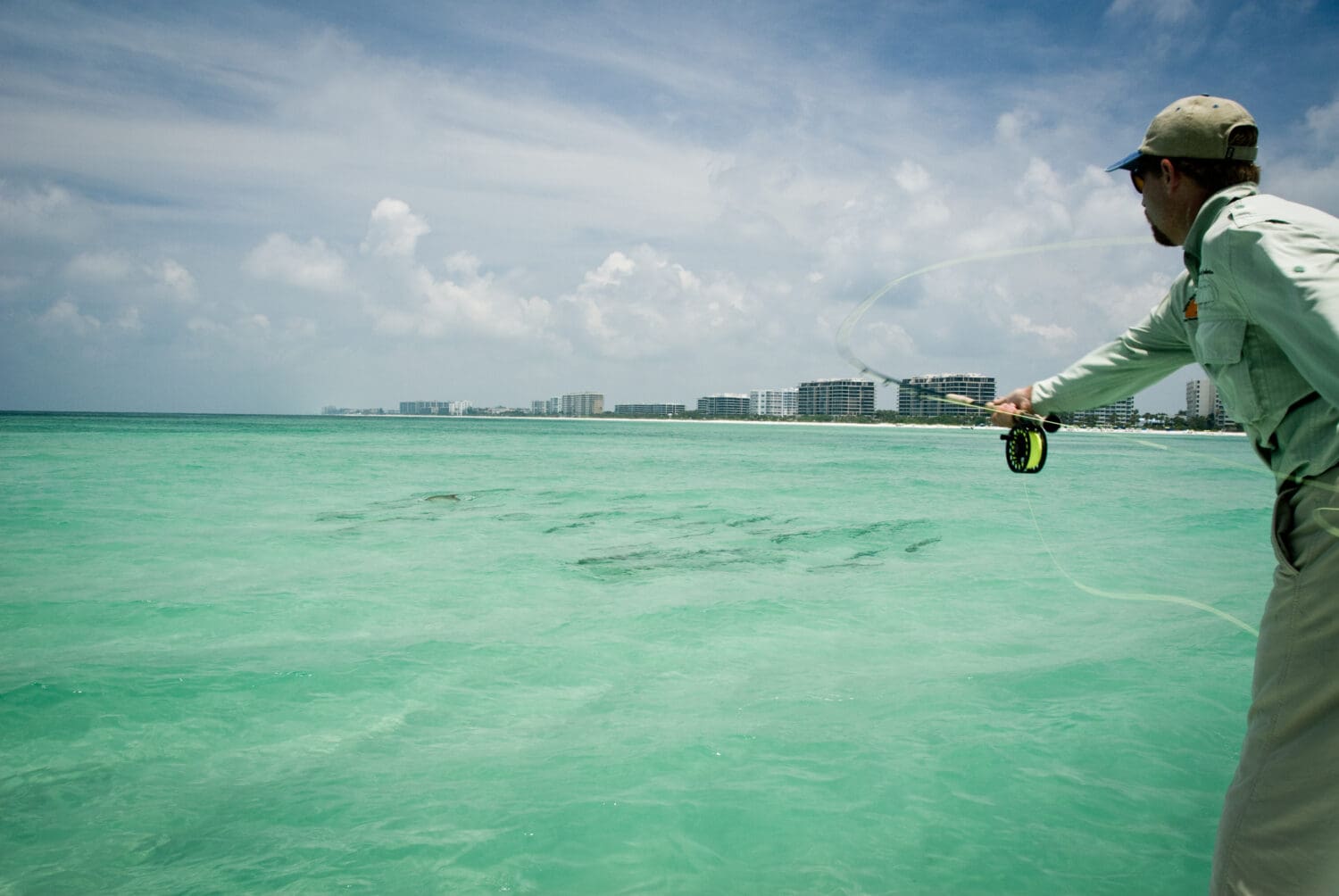
Tarpon, the premier gamefish that swim local waters in late spring and summer, can weigh over 200 pounds and average from 80-100 pounds. While most anglers pursue them on conventional tackle, a grow­ing number of fly fishers are targeting them in Tampa Bay along the shallow Gulf coast and the local sandbars that bookend the local passes. Tarpon on fly tackle isn’t a game of numbers and the anglers who pursue them often spend hours on the bow in the hot summer sun for a chance at a hookup.

Fly tackle should be stout enough to challenge these powerful gamefish that are renowned for their spectacular aerial acrobatics and long fast runs. Serious anglers hoping to land one opt for an 11- or 12-weight outfit and carefully tied leaders with 60- to 80-pound bite tippet. While it might seem like a difficult task to land a tarpon on the fly, someone who knows the limits of their tackle can actually land a tarpon in a surprisingly short time. The key is to apply maximum pressure from the hookup and never let up. Too many anglers “baby” their tarpon in a misguided attempt to land them. The truth is that the longer you fight a tarpon the better chance you have of losing them.

A properly tied tarpon leader usually runs between 10-12 feet and is tapered. It includes a class tippet from 16-20 pounds that is doubled at both ends to soften the (shock) impact of the larger leader (40-60 pounds) it’s tied to. Flies vary from the classic splayed feather “Key’s” style to more complex designs like the “Toad,” and the wildly popular Palolo worm fly. Although the worm hatch is a Florida Keys phenomenon, tarpon everywhere seem attracted to them. This fly and many others are best presented to a tarpon with a two-handed strip. Some fly anglers are not concerned with actually landing a tarpon, preferring to just enjoy the hunt, the hook up and the jumps that usually follow the hook set. They use light bite tippets which allow the tarpon to work through the leader with their abrasive mouths. The key to getting the bite is a properly tied fly that tracks naturally and the accuracy of the cast. The fly must be placed perfectly, move in a precise direction relative to the fish and be at the proper (fishes’) depth. Even when all of these factors come together, there’s still about a 50% chance that the tarpon will reject the fly.

Patience is another critical factor when fly fishing for tarpon. The most successful anglers find the edge of a sandbar or other underwater feature that tarpon track, deploy a release anchor in casting range and wait. Sometimes tarpon come at a steady rate, but just as often there are long periods of time when the only thing to look at is the water and the bottom. This really separates the great anglers from the good anglers. There are times when you need to move but knowing when and where is a skill that is developed, if ever mastered. There are times when poling might be more effective but experience has taught me to only move when a school of fish requires a short distance off anchor for a shot. Next week: Part Two.

Prepare your hurricane kits now

MANATEE COUNTY – With the start of hurricane season on June 1, Manatee County reminds residents to stock disaster supply kits.

Recommended items are:

  • First aid kit with bandages, antiseptic, tape, compresses, aspirin and aspirin-free pain relievers, antacid and important phone numbers;
  • Flashlights and batteries for each family member;
  • Portable radio and batteries;
  • Mosquito repellent;
  • Whistle and distress flag;
  • Emergency charger for cell phones and other devices;
  • Cash, as ATMs may not be operating;
  • Charcoal, matches and grill (for outdoor use);
  • Generator and fuel;
  • Ice chest/cooler and ice;
  • Plastic tarp, window screening, tools and nails;
  • Non-electric can opener;
  • Instant tire sealant;
  • Fire extinguisher;
  • Water purification kit;
  • Clean-up supplies;
  • Garbage can or bucket with tight-fitting lid and cat litter;
  • Toilet paper, paper towels and pre-moistened towelettes or baby wipes;
  • Up-to-date list of family medicines and dos­ages, along with a two-week supply of prescription medicines;
  • Enough non-perishable food to feed your family and pets for at least 7 days, including special dietary foods or baby food and formula;
  • One gallon of drinking water per person, per day, plus water for cooking and washing for 7 days;
  • Extra batteries.

Hurricane shelters

The following hurricane shelters in Manatee County may be open depending on the direction and size of the storm. There are no assigned shelters, and few are furnished, so bring lawn chairs, cots, bedding and folding tables.

BRADEN RIVER MIDDLE SCHOOL

6215 River Club Boulevard, Bradenton

BRADEN RIVER HIGH SCHOOL

6545 S.R. 70 E., Bradenton

BUFFALO CREEK MIDDLE SCHOOL

7320 69th St. E., Palmetto

DAUGHTREY ELEMENTARY

515 63rd Ave. E., Bradenton

FIRST BAPTIST CHURCH

1306 Manatee Ave. W., Bradenton

FREEDOM ELEMENTARY SCHOOL

9515 S.R. 64 E., Bradenton

GULLETT ELEMENTARY SCHOOL

12125 44th Ave. E., Bradenton

HAILE MIDDLE SCHOOL

9501 S.R. 64 E., Bradenton

HARVEY ELEMENTARY SCHOOL

8610 115th Ave. E., Parrish

JOHNSON SCHOOL

2121 26th Ave. E., Bradenton

KINNAN ELEMENTARY SCHOOL

3415 Tallevast Road, Sarasota

LEE MIDDLE SCHOOL

4000 53rd Ave. W., Bradenton

MANATEE HIGH SCHOOL

1000 32nd St. W., Bradenton

MCNEAL ELEMENTARY SCHOOL

6325 Lorraine Road, Bradenton

MILLER ELEMENTARY SCHOOL

601 43rd St. W., Bradenton

MILLS ELEMENTARY SCHOOL

7200 69th St. E., Palmetto

MONA JAIN MIDDLE SCHOOL

12205 44th Ave. E., Bradenton

MYAKKA CITY ELEMENTARY SCHOOL

37205 Manatee Ave., Myakka City

NOLAN MIDDLE SCHOOL

6615 Greenbrook Blvd., Bradenton

ONECO ELEMENTARY SCHOOL

5214 22nd St. Court E., Bradenton

PRINE ELEMENTARY SCHOOL

3801 Southern Parkway, Bradenton

ROGERS GARDEN ELEMENTARY

515 13th Ave. W., Bradenton

SEABREEZE ELEMENTARY SCHOOL

3601 71st St. W., Bradenton

TILLMAN ELEMENTARY SCHOOL

1415 29th St. E., Palmetto

WILLIAMS ELEMENTARY

3404 Fort Hamer Road, Parrish

WILLIS ELEMENTARY SCHOOL

14705 The Masters Ave., Bradenton

WITT ELEMENTARY SCHOOL

200 Rye Road, Bradenton.

Stay connected

Here’s how to connect with local officials to receive up-to-date information about severe weather.

  • Buy a weather radio, preferably one that uses batteries and has crank-power capabilities. Radio stations broadcast continuous updates and weather-related safety information from the closest National Weather Service office.
  • Call the Florida Division of Emergency Management State Assistance and Infor­mation Line, or SAIL, at 800-342-3557. FDEM activates the toll-free hotline during emergencies.
  • Connect with FDEM on social media. Follow FDEM on Twitter @FLSERT and find them on Facebook at facebook.com/FloridaSERT.
  • Connect with local emergency managers on social media. Every Florida county has an emergency management office and many are active on social media. Floridians may search for and follow their community’s office on Twitter or Facebook to interact with them and get severe weather updates.
  • Enable Wireless Emergency Alerts on mobile devices. Many cell phones are capable of receiving automatic WEAs that provide local emergency alerts. Floridians can receive WEAs at all times since cell network congestion does not affect messages and providers offer the service for free.
  • Download the FEMA mobile app on your phone and set it to receive notifica­tions.
  • Pay attention to local media. Local radio, television and websites are great sources for continuous weather updates and advisories.

More hurricane tips

It’s easy to forget things when a hurricane is coming. Here are some reminders:

  • Plan where you will evacuate in advance, and tell friends or family in other states.
  • Register special needs residents in advance for county transportation to evacuation shelters.
  • Check your insurance policies – wind, flood and liability – to make sure they are in effect.
  • Find the elevation of your home and your evacuation zone at www.my.manatee.org.
  • Anna Maria Island residents and business owners should obtain or locate their re-entry tags from their city before evacuating. They are available at Anna Maria City Hall, Bradenton Beach City Hall and the Holmes Beach Police Department. One tag per residence or business is issued.
  • Consider buying a generator; ethanol-free gas to power generators is available at marinas.
  • Find out where sandbags will be provided and stock up.
  • Vacation rental agents should provide a hurricane guide in each rental unit during hurricane season.
  • Bridges to Anna Maria Island may be closed as a hurricane approaches and water and electricity may be shut off, so evacuate when ordered.
  • Turn off water, electric and gas mains when you leave to avoid broken pipes.
  • Bring medicines, cash – both paper and coins for vending machines – and disaster kits to shelters.
  • Research how to turn your cell phone into a wi-fi hotspot before you lose cell service.
  • Research how to extend battery life on your cell phone before the battery goes dead or buy a spare battery pack for your phone; remember, you can also charge your phone in your car.

Prepare your home

Here’s some tips to secure your home, pool and yard before a storm.

HOME PREPARATION

  • Install shutters on all openings, including windows, doors, sliding glass doors, French doors and garage doors
  • If using plywood, pur­chase 5/8″ thick plywood well before a storm arrives, pre-measure, pre-drill and label each piece, or buy clips to attach plywood to window frames
  • Install impact resistant windows
  • Caulk or install weather stripping around windows
  • Install three door hinges on outside doors
  • Install deadbolts that extend one inch into the door jamb on outside doors
  • Repair loose or missing roof shingles
  • Inspect soffits for adequate fasteners
  • Replace loose or missing soffits
  • Outside, seal openings from air conditioning re­frigerant lines, water heater pressure relief lines, water pipes, cable and satellite TV wires, telephone wires, Internet wires and exhaust fan vents from bathroom, kitchen, clothes dryer
  • Inside, seal around electrical boxes and circuit breaker panels, electrical outlets, exhaust fan vents
  • Bring loose items inside, including garbage cans, lawn furniture, decorations, hoses, hanging plants, grills
  • Turn off or disconnect electric, gas, water and sewer before evacuating.

MOBILE HOME PREPARATION

  • Inspect, repair or add tie-down straps and anchors according to Florida Department of Highway Safety and Motor Vehicles standards
  • Make sure straps are properly aligned and not on an angle
  • Check to be sure the proper number of tie-downs have been installed properly
  • Verify that ground anchors and stabilizer plates have been installed properly
  • Be sure support piers are in contact with the frame
  • Replace straps or ground anchors that show signs of corrosion or damage.
  • Inspect and repair wood rot and termite damage in wall-to-floor connections, wall-to-roof connections, perimeter joists and trusses
  • Inspect fasteners if home has a roof-over
  • Close shutters
  • Secure loose outdoor objects
  • Turn off or disconnect electricity, gas, water and sewer
  • Establish a community evacuation plan for your mobile home park
  • Make a list of residents’ phone numbers, altern ate addresses
  • Assign each neighbor a partner to help