BRADENTON – Dr. Abbey Tyrna, executive director of Suncoast Waterkeeper (SCWK), spoke to the Palma Sola Scenic Highway committee on Nov. 12 about the water quality in Palma Sola Bay.
Tyrna presented a graph showing that from 2001-11 the water quality on the north side of the Palma Sola Causeway exceeded the acceptable threshold of state water quality standards 20 times. In 2024 alone, however, in that same body of water, the threshold was exceeded 20 times.
“So we went from 20 exceedances in an 11-year period to 20 exceedances last year, so the question was what was happening here,” Tyrna said.
Palma Sola DNA source tracking results show elevated levels of horse DNA several times between April 2024 and August 2025; human DNA in July 2024 and bird DNA in April, September and October 2025.
“So, what has changed? I don’t think the number of birds has changed because what I’ve learned is that birds are actually declining,” Tyrna said.
She said the best way to figure out what is happening is through DNA testing.
“What we can see is what’s in our water samples and is detectable has been horses, humans and birds, so what can we say is causing enterococci levels in Palma Sola Bay? We can say all of them,” Tyrna said. ”If you want to know how much humans matter, how much horses matter, that’s impossible to know. There are no tests for that right now. So, we can never get there, and we should never try. And all we can do is a qualitative analysis in a robust lab. We certainly can’t do much about birds, we can do something about humans and we can do something about horses.”
Enterococci normally inhabit the intestinal tract of humans and animals. The presence of enteric bacteria can indicate fecal pollution, which can come from stormwater runoff, pet and wildlife waste products and human sewage spills. If these bacteria are present in high concentrations in recreational waters and are ingested while swimming or enter the skin through a cut or sore, they may cause illness or infections, according to the SCWK website.
“According to studies conducted by the EPA, enterococci have a greater correlation with swimming-associated gastrointestinal illness in marine and fresh waters than other bacterial indicator organisms, and are less likely to die off in saltwater. If an enterococci result exceeds 70 cells per 100 milliliters of marine water sampled, then an advisory should be issued for the sampling site,” the SCWK website states.
SCWK conducts regular monitoring of bacterial levels at 11 area recreational sites. The Benchmark EnviroAnalytical lab examines the samples for enterococci. The results are posted weekly on Suncoast Waterkeeper social media feeds.
“When one use supersedes another use, we find that to be a problem. This is why we advocate for a permit and signage system,” Tyrna said. “Suncoast Waterkeeper’s goal is to clean up the water.”
Tyrna said one of the horse ride providers at Palma Sola Bay has taken a best management practice approach to cleanup by using a boat with a paddle that brings horse manure into a net and out of the water.
“Whether or not that’s going to reduce our readings remains to be seen,” Tyrna said.
Tyrna speculated that some of the human readings could be related to sewage and possibly derelict boats.
“You don’t find a pump-out boat going to the derelict vessels so it’s logical,” she said.
PALMA SOLA BAY – The month-long pause in horseback riding in Palma Sola Bay and along its northern shoreline ended on Oct. 6 and the Sarasota Bay Estuary Program (SBEP) has released the results of its water quality testing.
Prior to and during the horses’ absence from the bay, SBEP sampled the water five times and received results from four of those tests by Oct. 8.
The role of the horses in the high bacterial numbers in the bay will require further evaluation, according to SBEP Executive Director Dr. David Tomasko.
“For all four times, the levels of enterococci – the state’s default “fecal indicator” bacteria – exceeded the bathing beach standard at the site where the horse ride operations occur,” Tomasko wrote in an Oct. 8 email to The Sun.
He said the results of the tests show there are sources of “fecal indicator” bacteria other than the horses.
“For the first two sampling events, the horse ride vendors were out there, and although we had detections of DNA sequences of bacteria that were from horses, the numbers were too low to be quantified. That is called a DNQ event “Detected, Not Quantifiable,” Tomasko wrote. “For the next two sampling events, the horse ride vendors were off the causeway, and we didn’t even have detections of the DNA sequences of bacteria from horses.”
Tomasko stated SBEP still has three more sampling events to work through, all with the horses now back on the causeway.
“When we have all the data together, the SBEP will have a better understanding of how to interpret the results from this study,” Tomasko wrote. “But what seems fairly clear – and which has been clear for a while now – is that there are sources of “fecal indicator” bacteria other than horses out there. We have hits for birds, but not humans.”
Tomasko said some of the “fecal bacteria” indicators may not be from fecal sources at all.
“We know that each of the three fecal indicator species used by the State of Florida can arise from decomposing vegetation, but we don’t know what role – if any – that potential source could have on what we’re finding in Palma Sola Bay,” he wrote.
Suncoast Waterkeeper has been monitoring water quality in the bay and posted the following on its website: “Our monitoring results reveal persistent exceedances of the state’s water quality standards for enterococci bacteria:
2022: 22 samples collected, 6 exceeded the FDEP threshold of 130/100 mL (no more than four should exceed);
2023: 46 samples collected, 23 exceeded (no more than eight should exceed);
2024: 43 samples collected, 20 exceeded (no more than eight should exceed); and
2025 to date: 32 samples collected, 16 exceeded (no more than six should exceed).”
Further testing showed the following results:
April 2024: Horse DNA was detected and quantified in both water and sediment; no human DNA was detected;
July 2024: Horse DNA was again quantified in water samples; human DNA was detected, but at levels below quantification; and
April 2025: Avian DNA was detected at low levels; neither horse nor human DNA was detected in the sample.
“These findings demonstrate that horses are a measurable source of bacterial pollution in Palma Sola Bay north of the causeway; however, they are not the sole contributor,” Suncoast Waterkeeper Executive Director Abbey Tyrna wrote on the organization’s website. “The scientific literature emphasizes that microbial contamination in coastal waters frequently originates from multiple sources, including wildlife, domestic animals, and human infrastructure, and that distinguishing between these inputs and their relative contributions is inherently challenging.”
Tyrna does not support removing horses from the bay, but recommends the following:
“Install Public Signage – Post clear warning signs alerting residents and visitors that enterococci levels exceed state water quality standards, so that people can make informed decisions about their health and recreation;
Establish a Horse Vendor Permit System – Create a permit program that caps the total number of horse vendors and requires best management practices (BMPs) designed to protect water quality and seagrass meadows. Such BMPs should include ensuring horses remain in shallow water for the majority of the ride, only wading in past their hindquarters for a short duration at the beginning, and requiring the use of waterproof horse diapers. The permit should also stipulate the area where the horses can ride to protect the seagrasses.”
On Dec. 14, Suncoast Waterkeeper, Suncoast Aqua Ventures, the Sarasota Bay Estuary Program, the Tampa Bay Estuary Program, Tampa Bay Waterkeeper, the Organized Fishermen of Florida and Sarasota Bay Watch jointly worked to clean up marine debris in the waterways and mangroves in the Manatee River from Blenker Boatworks and Marina in Bradenton and in Terra Ceia Bay from Tropic Isles Marina in Palmetto.
Kayakers, the Suncoast Waterkeeper patrol boat, numerous boat owners and shoreline helpers collected over four dumpsters of rubble at the two locations. Each site hosted over three dozen volunteers who were provided gloves, pickers and garbage bags to collect hurricane debris.
A large part of the debris consisted of destroyed docks and aluminum from lanais and pool cages as well as all manner of items from residential areas that was washed into the mangroves from Hurricane Helene’s storm surge in September and Hurricane Milton’s winds in October. Volunteers ranged in age from 16-80 and included a group of students from the Manatee School of The Arts. I was impressed with the willingness of the students and volunteers to get wet and team up to remove large sheets of aluminum and other detritus from the mud and mangroves.
Hurricanes, sewage spills and all the insults that local waters are exposed to should be a wake-up call to all of us who enjoy recreation on our local waters and understand their importance to the local economy. There are many ways that you can help. Write letters to your local representatives, congressmen and senators to let them know that you’ll consider their votes on water quality and resource protection when you vote. Attend local commission meetings, write opinion pieces and get involved with these nonprofits who work, day in and day out, to protect our marine resources. Check their websites and learn about upcoming events and how you can be a part of protecting what makes the Suncoast so special.
Brunch for The Bay will feature speakers that will address current threats to our island environment.
Suncoast Waterkeeper is holding its annual brunch for the bay fundraiser at a different venue this year. Get ready for an inspiring and impactful event featuring a powerhouse lineup of expert speakers at the Sarasota Yacht Club! Here’s what you can look forward to on Sunday, Nov. 3 at 11 a.m.
Justin Bloom, Esq. – Founder of Suncoast Waterkeeper and leader of the Sick of Sewage campaign, Justin will reveal how grassroots action has begun to turn the tide on pollution (including their suit against the City of Bradenton) and share critical lessons learned from the 2024 hurricane season.
Dr. Gary Mitchum – Associate Dean of USF’s College of Marine Science, Dr. Mitchum will shine a spotlight on extreme weather events and sea level rise, offering insights on what the Suncoast can expect now and in the future.
Dr. Colin Polsky – Founding Director at FAU’s School of Environmental, Coastal and Ocean Sustainability, will explain how the Florida Wildlife Corridor is a vital model for intentionally designing regional spaces for climate resilience.
Alexis Meschelle – Executive Director of Organized Fishermen of Florida, Alexis will talk about her work to ensure commercial fishermen and women are represented at all levels of government. She will discuss the impact of extreme weather events on Florida fishermen, their livelihood and the fisheries we depend on.
Don’t miss this opportunity to engage with leading voices on climate action, water protection, and environmental resilience. This fundraising brunch will also include delectable food, drinks, and the chance to connect with fellow advocates committed to protecting and preserving the waters of our beloved Suncoast!
Suncoast Waterkeeper’s mission is to ensure the Suncoast has swimmable, drinkable and fishable water for all. Their mission, which has never been more important, is to defend our coastline through advocacy, monitoring, community engagement and legal action.
This is an excellent opportunity to learn about Suncoast Waterkeeper’s work, get involved and help ensure that current and future generations can enjoy a healthy environment. Let’s join forces and fight for our beautiful coastline! If we don’t do it, who will?
I knew that the citizens of Manatee County cared about water quality and preserving the coastal ecosystem. That was apparent when they voted to tax themselves for the Vote Water and Land Referendum in 2020. The measure passed by over 70% despite the fact that one political party opposed the initiative. As the Bradenton Herald reported at the time, “The measure will have a positive impact on generations of Manatee County families, allowing them to enjoy some of Florida’s most precious landscapes and resources.”
That was cause for celebration, but in the ensuing four years, a political shift caused me to question what I knew to be true. When voters in 2020 elected a slate of commissioners completely aligned with the development community, Manatee County’s path seemed dire in the eyes of this angler.
As I’ve mentioned in prior columns, at a time when we all need to be concerned about water quality and protecting the environment that provides us solace and is the basis of the local community, the government was taking us backward. This was a time when the county commission disregarded the will of the people and their own planning commission and labeled those who cared enough to show up and fight these draconian measures as Communists or radical climate organizers.
During the most recent election cycle, when those politicians backed by massive war chests from special interests looked to solidify their hold on the Manatee County Commission, I admit I was concerned. I worried that those who weren’t paying attention might vote for politicians with the largest and most political posters. That didn’t happen as every current commissioner save one lost to challengers who made water quality and environment a part of their platform. The lone commissioner who kept his seat was challenged by a current commissioner whose popularity was so low he changed districts to try and defeat the only voice of reason on the current board.
Now that we will have a majority on the commission who understands the value of water and natural resources come Jan. 1, maybe there’s an opening. Perhaps there’s the possibility of getting the development community on board to help address this elephant in the room.
Reel Time was conceived as a fishing column, a way to spread information on a passion that you and I as anglers and environmentalists share. I include environmentalists because with time, you begin to understand that protecting the resource is protecting the quality of the fishing we love. We all take up rod and reel in the hopes of catching fish, but for most anglers, just being “out there” is a big part of the experience. That experience has evolved for me, as reflected in this column’s emphasis on advocacy.
Now another threat has arrived in the form of huge sewage and wastewater releases occasioned by storms that bring rainfall amounts that easily overwhelm the failing infrastructure. While these have been referred to as 100-year storm events, the reality is they are increasing all over the world as temperatures rise. Case in point, the two “unprecedented” rain events that occurred in the last month. Then-Tropical Storm Debby alone resulted in 25 million gallons of wastewater and sewage being released into the Manatee River.
Raw sewage bubbles from a manhole on its way to the Manatee River during the passing of then-Tropical Storm Debby. – Submitted | Alex Conyers
Suncoast Waterkeeper Executive Director Abbey Tyrna was right on target when she made the following statement, “Florida’s wastewater technology is alarmingly unprepared for the increasingly frequent extreme weather events. The recent tropical storm with torrential rainfall is not an isolated incident; we’ve seen the devastating aftermath of Hurricanes Ian and Idalia, which led to massive amounts of sewage entering our surface waters. The pressing question is: how are state and local governments preparing wastewater infrastructure for the next extreme weather event? The state should collaborate with local governments to elevate infrastructure, create additional storage, ensure adequate backup power at lift stations, innovate filtration technology and reduce inflow and infiltration. Regrettably, these necessary actions are not being taken. Instead, the state is drafting rules that will place this outdated industry in charge of our drinking water supply. For more details, refer to the FDEP rulemaking site here and our comment letter here.
“Florida’s history of prohibiting references to climate change has set us back decades. We remain unprepared and will continue to be until we have leaders who prioritize resiliency on the Suncoast and throughout Florida. How many more storms must we endure before meaningful action is taken? We need leaders who have the vision to comprehend what needs to be done to protect our waters and can marshal the forces to make the changes.”
Tyrna is right on target and this need for leaders with vision circles right back to you and me, the voters. Unless and until we vet our candidates, and demand action and accountability, we’ll see the continued loss of the resources that enrich our lives and are the foundation of our economy. Vote water.
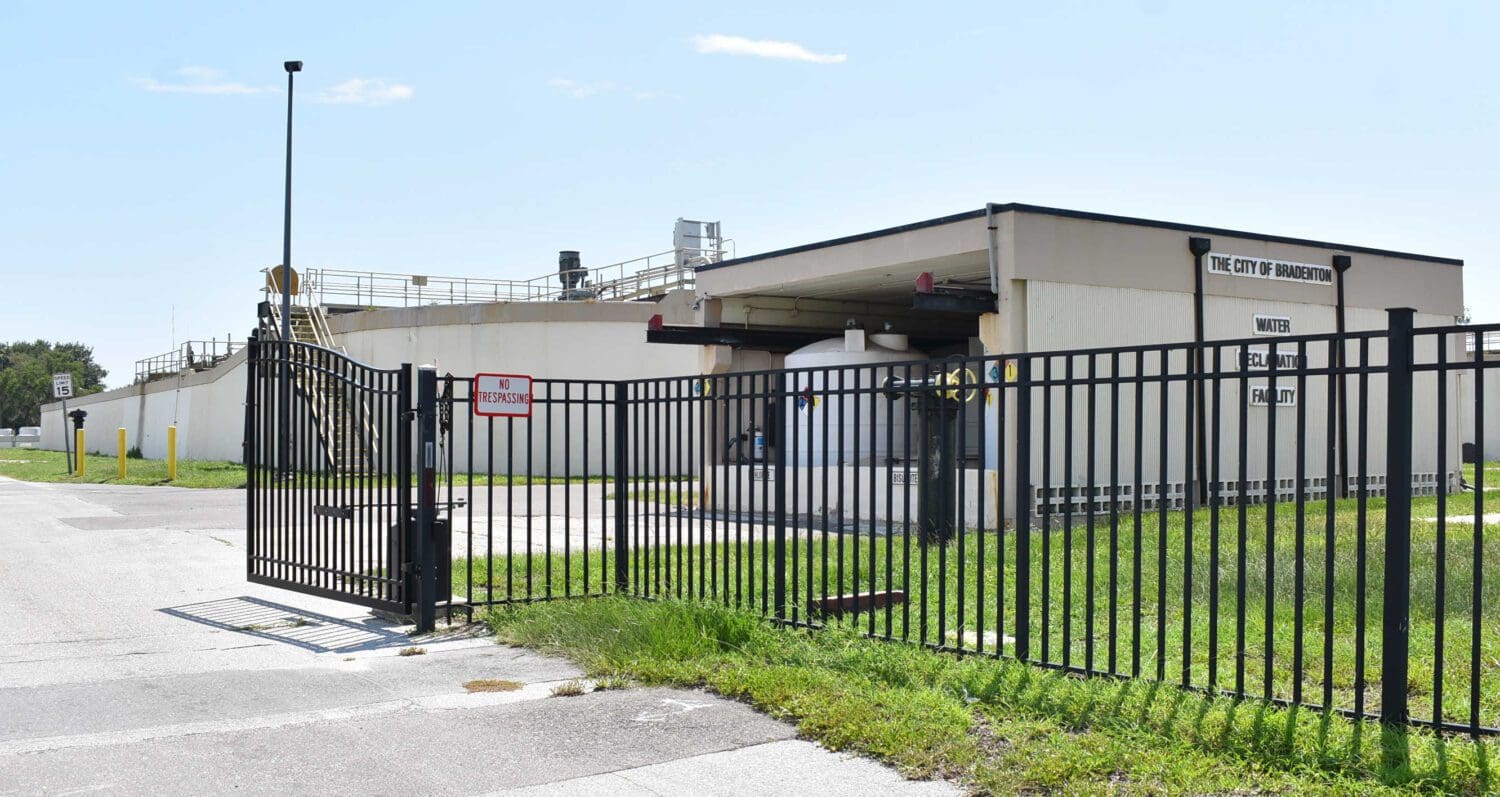
BRADENTON – During and after what was then Tropical Storm Debby, the city’s water reclamation facility discharged an estimated 25 million gallons of raw and partially treated sewage into the Manatee River, according to department officials.
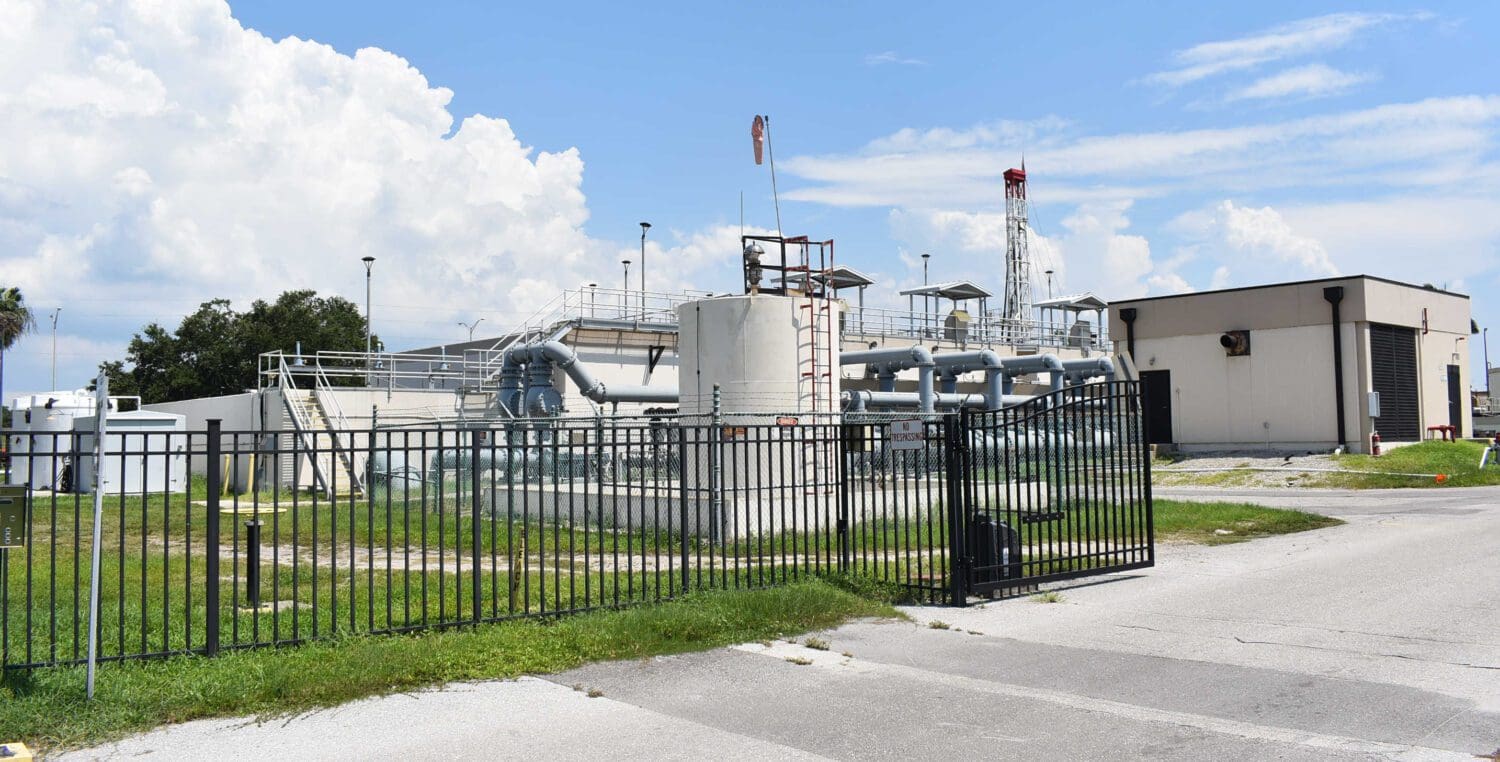
The neighboring city of Sarasota discharged nearly 18 million gallons of raw and partially treated sewage into that city’s stormwater system, which connects to Sarasota Bay, according to department officials.
In total, the Bradenton and Sarasota water reclamation facilities discharged nearly 43 million gallons of sewage into local waterways.
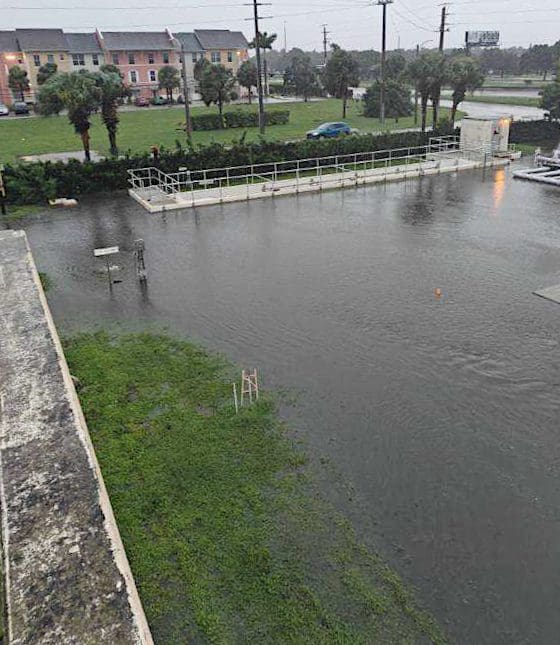
The rain associated with Tropical Storm Debby exceeded the Bradenton water reclamation facility’s storage capacities. – City of Bradenton | Submitted
Despite the influx of sewage into waters surrounding Anna Maria Island, the enterococcus bacteria levels in most areas were deemed “good” when last tested by the Florida Department of Health (FDOH) on Aug. 13.
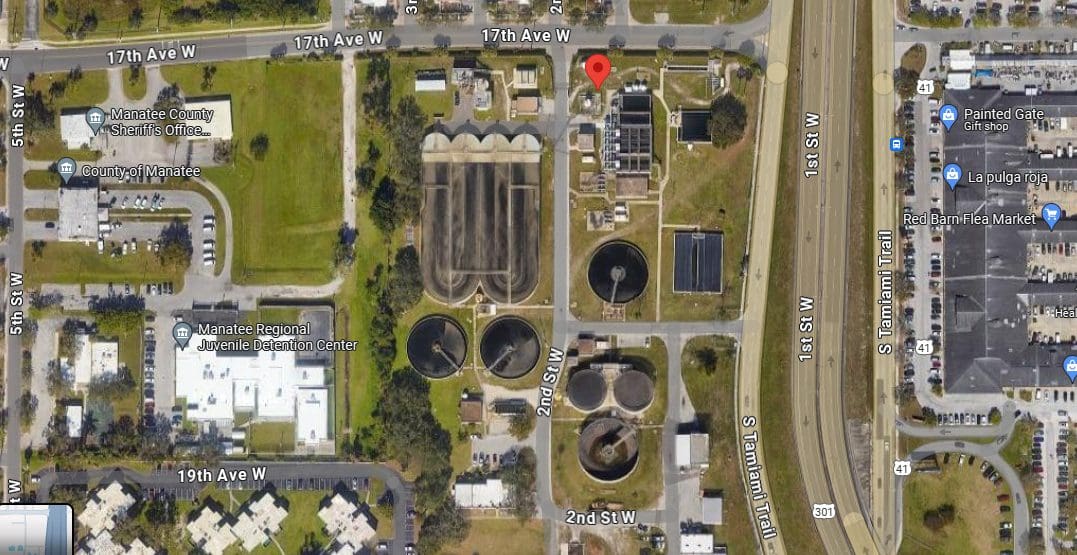
The Bradenton water reclamation facility is located across the street from the Red Barn Flea Market. – Google Maps | Submitted
According to the city’s report, “It’s estimated that the total volume bypassed from 08/04 – 08/07 was 25MG (million gallons).”
When contacted by The Sun on Aug. 12, Suncoast Waterkeeper board member and attorney Justin Bloom said, “According to the city’s own records, in which they’re reporting sewage spills to FDEP (the Florida Department of Environmental Protection), they discharged, directly to the Manatee River 25 million gallons of sewage between August 4th and August 7th. Suncoast Waterkeeper is concerned about the impact this significant amount of sewage will have on the Manatee River.”
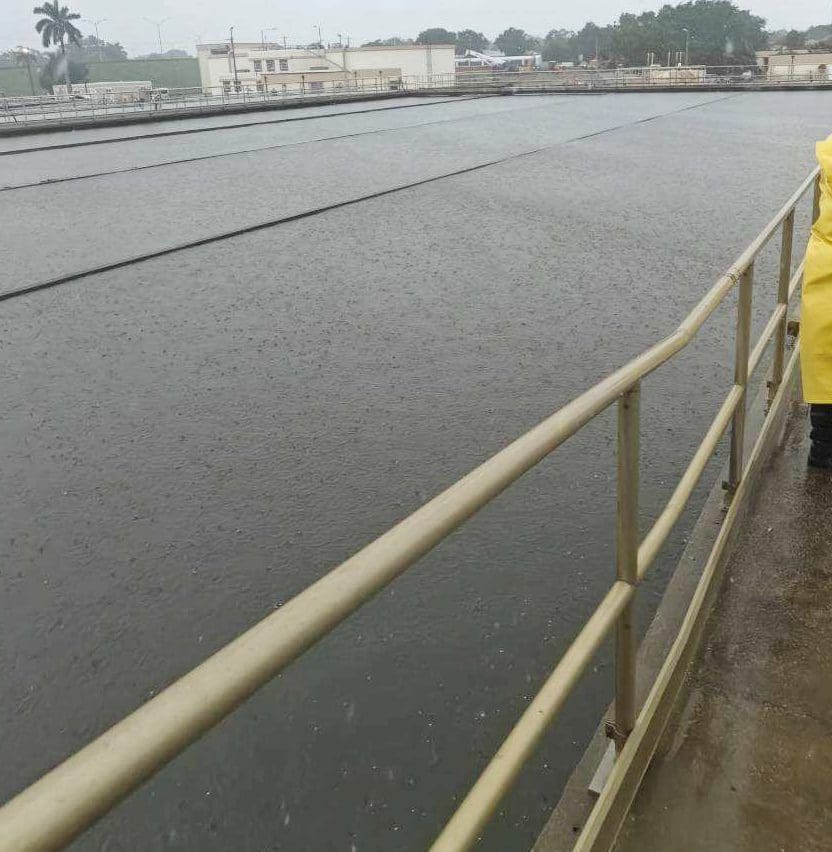
The Bradenton water reclamation facility was overwhelmed by rain associated with Tropical Storm Debby. – City of Bradenton | Submitted
The mouth of the Manatee River empties into Tampa Bay near the northern tip of Anna Maria Island.
The city’s report states, “The event was caused by the heavy rain and high flow associated with Hurricane Debby and was unavoidable. As with utilities state-wide, the WRF staff did everything possible to not have to bypass, but with between 17-19 inches of rain during the storm it was unavoidable.”
The city’s report also includes the following information:
“On 08/04, the aerators were taken offline at 2 p.m. in anticipation of high flow.
On 08/04, the WRF experienced extremely high flow into the plant beginning around 17:00. By 18:30, the aerators, headworks, clarifiers, and filters began overflowing and bypass began.
On 08/05, the WRF bypassed the filters and wet well due to continual heavy rain and high flow.
Manatee River spill sample collection began on 08/06.
On 08/06, the plant experienced random high flow events causing the outfall and clear well to overflow.
On 08/08, two aerators were turned back online.”
In addition, report notes: “Sample collection is ongoing, preliminary results from 08/06 have been received but no official laboratory report has been. The city will continue to update FDEP as data is received and upon the conclusion of sampling.”
Bradenton’s water reclamation facility features numerous wastewater treatment and storage components. – Joe Hendricks | Sun
In an email exchange with Bradenton resident and concerned citizen Ernie Vanderwalt, FDEP Southwest District Office Director Kelley Boatwright acknowledged the sewage discharge.
“Department staff confirmed that the city of Bradenton had sanitary sewer overflows that total approximately 25,000,000 gallons due to Hurricane Debby. Staff are tracking the reports, evaluating the data, and will determine next steps,” Boatwright stated in his Aug. 12 email to Vanderwalt.
Sarasota overflow
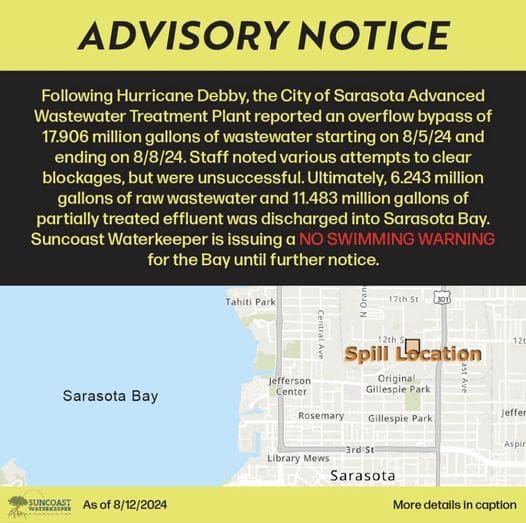
According to the incident description report provided by the city of Sarasota, “During the event, approximately 6.243 million gallons of raw wastewater was discharged to Sarasota Bay. In addition, approximately 11.483 million gallons of partially treated effluent was discharged to Sarasota Bay. Samples will be collected.”
According to the incident description, “The city of Sarasota’s advanced wastewater treatment plant was severely impacted by excessive flow from Hurricane Debby. Operations staff did everything in their power to control the flow coming into the facility. Due to the incredible flow volume coming to the plant, up to 44.29 MGD (million gallons daily) in a single day, plant staff were unable to prevent spills from the headworks at the treatment plant. Staff made every effort to contain and control the spill, but the volume was too significant to avoid the mixture of rainwater and untreated sewage entering the stormwater collection system.”
Water quality tests
According to the FDOH website, “Enterococci are enteric bacteria that normally inhabit the intestinal tract of humans and animals. The presence of enteric bacteria can be an indication of fecal pollution, which may come from stormwater runoff, pets and wildlife and human sewage. If they are present in high concentrations in recreational waters and are ingested while swimming, or enter the skin through a cut or sore, they may cause human disease, infections or rashes.”
FDOH analyzes water samples for total bacteria counts and rates the results as good, moderate or poor.
Good: 0–35.4 enterococci per 100 milliliters of marine water
Moderate: 35.5–70.4 enterococci per 100 milliliters of marine water
Poor: 70.5 or more enterococci per 100 milliliters of marine water
If the results indicate poor water quality, FDOH issues public notices and may post warning signs at impacted beaches that state swimming or other water activities are not recommended.
According to FDOH water quality testing results, the enterococcus levels in the water at Bayfront Park in Anna Maria were listed as good for Aug. 7, 11 and 13. Before Tropical Storm Debby, the enterococcus levels at Bayfront Park tested poor on July 22, July 29 and July 31. FDOH issued a water quality notice for Bayfront Park on July 31 but has not issued any additional Bayfront Park notices.
On Aug. 7, 11 and 13, the enterococcus levels at Manatee Beach in Holmes Beach were listed as good. When tested on Aug. 7, 11 and 13, the enterococcus levels at Coquina Beach North, Coquina Beach South and Cortez Beach (all in Bradenton Beach) were all listed as good.
When tested on Aug. 7, 11 and 13, the enterococcus levels at the Broadway Beach Access in Longboat Key were listed as good.
When tested on Aug. 7, 11 and 13, the enterococcus levels at Palma Sola Causeway South were listed as poor on each of those days, and also on July 29 and July 31. FDOH advisories were issued on July 31 and Aug. 7, 11, and 13.
According to FDOH, several locations in Sarasota were tested on Aug. 12 and the enterococcus levels at those locations were listed as good.
On Facebook, some Island residents and visitors reported strong odors and possible human waste discovered in the waters along some Anna Maria Island beaches.
On Aug. 12, the Suncoast Waterkeeper organization issued a “No Swimming” warning for Sarasota Bay that was to remain in effect until further notice.
On Aug. 12, The Suncoast Waterkeeper organization issued a no-swim advisory for Sarasota Bay. – Suncoast Waterkeeper | Submitted
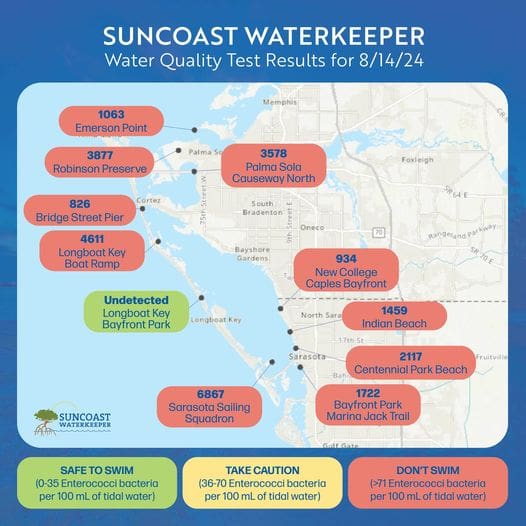
On Aug. 16, Suncoast Waterkeeper posted a Facebook message that said, “On August 14th, the enterococci survey was conducted during a falling tide. Salinity levels ranged from 18-29 ppt. The impact from Debby was still evident in the water quality on Wednesday and will likely continue throughout the weekend.”
Suncoast Waterkeeper released this water quality test results map on Aug. 16. – Suncoast Waterkeeper | Submitted
The Aug. 16 Facebook post was accompanied by a water quality test result graphic that indicated 10 locations in Bradenton, Anna Maria Island and Sarasota that Suncoast Waterkeeper considered to be “Don’t Swim” areas, including the Bradenton Beach City Pier on Bridge Street, Palma Sola Causeway North, Robinson Preserve and the Longboat Key boat ramp.
As of Aug. 19, The Sun was unable to obtain any additional water quality testing results from FDEP.
On July 14, I had the pleasure of working with Damon Moore from Oyster River Ecology (ORE) and a film crew from the Ringling College digital filmmaking program to document and install 1,050 vertical oyster garden anchors (VOGAs) on ORE’s restoration aquaculture lease site known as the Eileen Reef in the upper Manatee River. This 10-acre site is the beginning of an effort to bring bivalve restoration to a scale that can noticeably clean local waters. The following is the schedule that Moore set up for the day’s effort.
• 7 a.m. – ORE boat only; tow VOGAs on work floats over to Eileen Reef from Colony Cove staging area (staged the day before).
• 8:30 a.m. – Make final go or no go call on the weather. (The weather was perfect!)
• 9:30 a.m. – Everyone:
– Arrive at Fort Hamer Boat Ramp;
– Confirm participants have signed waivers;
– Safety meeting/questions/etc.
• 10 a.m. – All boats depart Fort Hamer Boat Ramp for Eileen Reef
• 10:30 a.m.
– Arrive at Eileen Reef and anchor boats at the staked-out area.
– Provide task instructions
• 11 a.m. – Work as a team to install 1,050 VOGAs within the marked area.
• 12:30 p.m. – Complete installation and enjoy snacks/drinks/lunch. Please bring your own.
• 1 p.m. – Depart Eileen Reef for Fort Hamer Boat Ramp. ORE boat to return work floats and empty bins to Colony Cove staging area then return to Fort Hamer Boat Ramp.
• 1:30 p.m. – Arrive at Fort Hamer Boat Ramp and group dismiss.
• 3-4 p.m. – Damon to retrieve the cargo trailer and floats from the Colony Cove staging area.
Vessels used in the project included ORE’s 18.4 coastal skiff, which was used to tow the work floats with VOGAs to the site, the Suncoast Waterkeeper (SCWK) patrol boat with board members Rob Brown and Orion Morton, which carried the camera crew, their equipment and several volunteers, and Mike Elswick, who brought a boat with SCUBAnauts volunteers.
The planting was a huge success, and everyone was impressed with the speed with which volunteers worked.
MANATEE COUNTY – If you’re noticing a musty or earthy taste or odor in your drinking water, it’s being caused by algae that grows in all lakes, including Lake Manatee, the source for two-thirds of the county’s drinking water, according to county officials.
“Customers of Manatee County Utilities may notice a temporary and non-harmful change in their water taste or odor. Algae blooms are regular seasonal occurrences in Lake Manatee but vary in frequency and duration,” according to a June 21 press release from Manatee County.
“Current conditions favor a bloom, and tests conducted over the past several days indicate the presence of algae at elevated concentrations in Lake Manatee. This can create an earthy and/or musty taste or odor in the treated drinking water. While the odor or taste may be noticeable, the water remains safe to drink.”
“We will continue monitoring and conducting treatment efforts until water quality returns to normal,” Manatee County Utilities Deputy Director Katie Gilmore said. “It is our hope that by informing the public of this algal bloom, we can alleviate any concerns that may arise should a customer experience taste or odor issues in their drinking water.”
The county has implemented a treatment process that involves the addition of powdered activated carbon.
“This process is very effective in the removal of taste and odor-causing compounds. However, when the levels reach quantities that exceed the limit of the systems’ removal capability, customers may notice a slight earthy/musty taste to their water,” the press release stated.
“The water remains entirely safe for consumption. If desired, customers can utilize a carbon filter hooked up to the faucet to the water system of the refrigerator or a filter pitcher designed for taste and odor removal to help minimize the off-taste and/or odor,” the release said.
According to the Manatee County online Water Odor and Taste Fact Sheet, “Certain algae and bacteria produce compounds (MIB Methyl-Isoborneol and geosmin) as part of their metabolism that impart the earthy/musty odor/taste to the water (These same compounds are produced by bacteria in soil and make ‘dirt smell like dirt.’). The compounds do not affect the safety of the water but produce odors at very low levels (part per trillion).”
The algae blooms occur most frequently in late spring and early summer. They occur two to three times a year and last between two and four weeks.
Readers of this column are well aware of the critical state of our coastal waters in Manatee County and beyond. The Dapis (lyngbya) blooms that have persisted from 2020 to this year have brought the issue front and center as the harmful algae bloom choked waters and fouled the air and seagrass beds from the Manatee River to Palma Sola Bay and beyond.
I’ve mentioned in recent columns that these insults to Florida’s environment point to the lack of political will to effect the changes that are necessary to preserve our environment and the economy it supports. The recent move by the Manatee County Commission (Commissioner George Kruse being the lone dissenter) to allow developers to build closer to wetlands at a time when we should be doing just the opposite defies reason. At a state Waterkeeper weekly Zoom meeting a couple of years ago, Florida Sportsman Editor Blair Wickstrom addressed their most recent efforts to elicit support for their Vote Water Initiative. The efforts dovetail perfectly with what groups like Waterkeeper are seeking to address. This advocacy is a continuation of the magazine’s long involvement in protecting Florida anglers’ interests. Florida Sportsman Founder Karl Wickstrom and the magazine have been on the front lines continually lobbying for common sense rules and regulations.
Their plan resonated with me immediately, so I reached out to Wickstrom to hear more about Vote Water’s goals. He responded quickly with a passionate and well-reasoned argument. “If you had to pick one reason for the lack of success in protecting our state’s water from continual degradation, it would have to be lack of political will from our elected officials to get something done,” said Wickstrom, vice president of Vote Water.
“What we have in the state of Florida (and Manatee County) is a political problem, not a party issue, but when it comes to fixing the state’s water, the political problem requires a political solution,” Vote Water President Ray Judah emphasized. “Democracy isn’t a spectator sport. If you truly want to have clean air, clean water and public officials that represent the public interest instead of the special interest, the people that vote need to be informed.”
That’s the same argument I’ve used on these pages, pointing out the shared responsibility we as voters have to effect much-needed change.
The Vote Water initiative highlights not only politicians’ votes but also the amount of money they accepted from special interests. That “dirty money” is a part of the Voter Guide that the organization wants to spend more time on going forward. As the adage says, you have to follow the money. It’s clearly the case in politics.
“In order for people to be represented, to have a true democracy, we need to help make taking money from a special interest, such as the phosphate industry, toxic,” emphasizes the organization.
Don’t be fooled into believing what candidates promise, especially as the election approaches. If you care about our coastal resources don’t vote Democrat or Republican. Check the candidates’ voting records on the water we drink and that the fish we pursue swim in. If we don’t, we may well be voting against our self-interest. The future of fishing in Florida and the economy hangs in the balance. VOTE WATER!
Suncoast Waterkeeper (SCWK) has seen phenomenal growth over the last several years. In that time, they have hired an accomplished wetlands scientist as executive director, hired a marketing and communication specialist, acquired a Waterkeeper boat, and launched their Mangrove Rangers and Eyes on The Suncoast initiatives, which encourage and provide resources for citizens to report illegal mangrove trimming, pollution, fish kills and algae blooms. The organization is being funded by various local charities and foundations.
Dr. Abbey Tyrna, an experienced educator and scientist, joined Suncoast Waterkeeper in 2022. She grew up in Cape Coral and focused her education on learning about wetlands and protecting Florida waters. Tyrna has a doctorate in geography from Pennsylvania State University, where her research focused on measuring the effects of development on wetlands. Before joining SCWK, she worked with the Sarasota County government and the University of Florida to help bring scientific knowledge and expertise to the public as the water resources agent for UF/IFAS Extension and Sustainability. Before receiving her doctorate in 2015, Tyrna earned a master’s in environmental science from LSU in 2008, concentrating on wetland science and management, and a bachelor’s in environmental studies from Florida State University in 2001. SCWK has tackled many significant pollution problems, which have curtailed over 1 trillion gallons of polluted water from entering our bays and driven hundreds of millions of dollars in infrastructure investments. Not resting on her laurels, Tyrna, working with Communications Specialist Samantha Wassmer, is seeking to expand investments in SCWK operations to take on the water quality threats prevalent across our bays and waterways.
To do this, SCWK will launch a new campaign, Love Your Bays Consciously, to recruit, manage and train volunteers in Manatee and Sarasota counties with the goal of proactively and reactively tackling the ever-growing threats to clean water. Through the campaign, SCWK will seek partnerships with bayfront communities, marinas, boat storage facilities, Realtors and local businesses. There are three actions necessary for joining Love Your Bays Consciously – protect aquatic habitats, reduce pollution and help your community.
From this effort, they expect:
• Increased adoption of clean water behaviors – success would entail a noticeable increase in the number of waterfront homes, boaters and marinas actively posting information about clean water behaviors and implementing these best practices. This could be documented through surveys, interviews or direct observation of adopted behaviors;
• Growth in engagement – the success of the Love Your Bay Consciously campaign would be evident through an increase in the number of volunteers actively engaging with residents and visitors to promote clean water behaviors. This could be measured by tracking volunteer participation rates, the number of individuals reached through outreach efforts and feedback collected from those engaged;
• Effective pollution monitoring and reporting – the project’s success would also be reflected in the effectiveness of the special team of ambassadors trained to spot, monitor and report pollution incidents. This could be documented through the number of pollution events reported, the timeliness of reporting and the responsiveness of relevant agencies to address reported incidents; and
• Progress towards environmental goals – ultimately, the success of the project would contribute to progress towards the overarching goal of achieving fishable, swimmable and drinkable waters for all. This could be assessed by monitoring water quality indicators over time, tracking improvements in the health of aquatic ecosystems and gathering feedback from community members on their perceptions of water quality.
To be a part of these exciting programs, consider donating during this year’s 2024 Giving Challenge taking place April 9-10. Matched donations will allow SCWK to expand its outreach efforts and increase the number of community members adopting best practices. This increased funding will also enable the organization to tackle complex challenges with greater resources and effectiveness, ultimately leading to a healthier and more sustainable environment for generations to come. Consider joining Suncoast Waterkeeper at www.suncoastwaterkeeper.org/membership.
BRADENTON – Shortly after noon on Feb. 28, the City of Bradenton’s water reclamation facility experienced an operational failure, causing 1.2 million gallons of partially treated wastewater to be discharged into the Manatee River, according to a Florida Department of Environmental Protection (FDEP) pollution notice.
The mouth of the Manatee River flows into the Intracoastal Waterway and the Gulf of Mexico at the north end of Anna Maria Island.
According to FDEP, the filter system at the facility at 1810 First St. W. had a blockage, causing the bypass of the water into the river. The bypass was closed at 5:10 p.m. and river water sampling was started.
City staff cleaned the areas affected and normal operation resumed, according to FDEP.
A Feb. 29 City of Bradenton Instagram post stated: “City of Bradenton’s Wastewater Treatment Facility faced an operational failure, leading to a 90-minute tank overflow due to blockages. A seized bypass valve was manually reopened, and the surrounding curb and gutter area on 17th Avenue, approximately 200 yards, swiftly returned to normal after cleaning and treatment. The city is investigating the system malfunction and collaborating with environmental agencies on discharge and drainage issues.”
“At a time when cities are working to reduce nitrogen overflow into the waters to curb red tide and algae blooms, this spill of partially treated wastewater is high nitrogen water filled with bacteria entering a public water body,” Suncoast Waterkeeper Executive Director Anney Tyrna said.
In 2022, Suncoast Waterkeeper and other environmental groups sued the City of Bradenton following a prior spill. The settlement stipulated that the city improve the wastewater treatment system.
“The city is working toward improving the infrastructure so this doesn’t happen again,” Tyrna said. “The infrastructure is old and in need of repair. Repairs are long overdue, but it takes time to make these repairs.”
Tyrna said with the latest spill, and based on the 2022 settlement terms of the lawsuit, there may be stipulated penalties due from the city to the Tampa Bay Estuary Program.
ANNA MARIA – Damon Moore outlined his vision for local oyster habitat restoration during a Feb. 21 presentation at The Center of Anna Maria Island.
Moore, the founder and executive director of Oyster River Ecology Inc., began with the historical abundance of oysters in local waters and their subsequent decline.
“The oldest reference I could find to the Manatee River was in 1792,” Moore said, when explorers referred to the river as the “River of Oysters.”
From 1876 to 1897, he said the waters went from “oysters, oysters, everywhere to totally depleted” due to the commercial oyster trade.
“It gets worse. A lot worse. Manatee Avenue was originally a sandy road which was paved with oyster shells which were taken from the river,” Moore said. “For several months after, the oyster meat rotted and Manatee Avenue was the most odiferous street in the whole United States.”
From 1931 to 1962 the Bradenton Dredging and Shell Company removed more than 650,000 cubic yards of shell from the Manatee River, he said.
Moore said the current decline in the oyster population is due to water quality issues including water pollution, altered freshwater flows and increased erosion and sedimentation.
“When you put a big dam on the Manatee River that changes how much fresh water comes in, I call it the Goldilocks zone of salinity,” Moore said. “When you’re an oyster, if it’s too fresh, you close up and you don’t open, you will starve to death. If it’s too salty, you’re fine with that but so are all of your predators.”
Moore said the problem locally was overharvesting of hard material that oysters need to thrive and create oyster beds.
“What restoration projects generally consist of is returning that hard material into the water column to allow them to grow,” Moore said. “We don’t have to seed them. We’re lucky there’s enough of an existing population growing in mangrove roots. There’s plenty of larval oysters.”
“When I’m talking about restoration I’m talking about restoring a population of oysters that existed in the Manatee River,” he said, adding that restoration can take place through both community-driven and contract-driven projects.
“Vertical oyster gardens are very popular,” he said. “This is something you can do on your own dock. The docks on Anna Maria Island, you’re in really high salinity waters. If on docks or seawalls, the predators can’t jump which gives the oysters an extra level of protection.”
A vertical oyster garden is typically a string of recycled shell which can be hung from a dock where oysters can grow. Once they’ve reached a certain size, they will fall off into the water and coalesce into an oyster reef, Moore said.
He compared barge and backhoe placement of 6 inches of limerock at a per acre cost of $635,000 to the $216,000-per-acre cost of 12-inch metal pin vertical oyster gardens.
“That’s a significant savings,” Moore said.
“Restoration targets are 300 acres by 2050 for Tampa Bay in the 2020 Tampa Bay Estuary Habitat Management Plan,” he said. “For 300 acres, the cost is $190,680,000 for barge and backhoe compared to $64,947,960 for 12-inch metal.”
ANNA MARIA – In an uphill battle against corporate interests to maintain healthy water quality, Capt. Chris Wittman said mobilized individuals can make a big difference.
Wittman, co-founder of Captains for Clean Water, spoke at The Center of Anna Maria Island on Jan. 23.
Noting many attendees at his talk were “some heavy-hitter fishermen,” he told his story of the quest to fight for clean water in Florida.
“I grew up in Sanibel and became a fishing guide,” Wittman said. “I saw water quality impacts to other fishermen and to my way of life.”
Despite witnessing the impacts that red tide and algae blooms had on the fishing industry and tourism, Wittman said it was years before he took action.
“I was 16 years into my guide business and had not played a role and was not active in trying to fix it. I didn’t see how as an individual l could make an impact on these huge issues, like the Lake Okeechobee runoff,” he said. “I cared a lot; I was directly impacted. But without having a pathway to make an impact I simply adapted.”
He adapted by picking up clients in other areas and avoiding the problem sites until the widespread red tide of 2016 became his wake-up call.
“In 2016, my 16th year guiding, we came into a water crisis many of the guys in this room remember,” Wittman said. “We had this horrendous red tide. It was so toxic that it was killing sea turtles, grouper, dolphins, tarpon, snook, cobia, redfish, you name it. A 27-foot whale shark washed up on the beach of Sanibel Island.”
That was when Wittman decided things had to change.
“If we continued down this path, my life as I know it would not exist in the way that I knew it,” he said. “The program that I built for 16 years – my clients would save up all year to come fish with me for a week at a time – would cease to exist.”
He talked to fellow fishing guides and teamed up with Capt. Daniel Andrews to co-found Captains for Clean Water.
“The more we talked to people, the more we realized there were tens of thousands of people just like myself that were impacted by water quality and were aware of water quality issues, but were not active in driving solutions for those issues because they didn’t have an outlet, they didn’t have a path,” Wittman said.
He said that development and a sewage infrastructure that couldn’t keep up with the rate of growth were factors in diminished water quality, but he said the discharges from Lake Okeechobee were what was crippling the fishermen’s way of life.
“That red tide shut down everything,” Wittman said. “Sanibel and Fort Myers Beach were at a 90-95% vacancy in March – the peak of the season.”
Wittman learned there was a plan put in place in 2000 to fix the areas affected by Lake Okeechobee runoff.
Captains for Clean Water co-founder Chris Wittman speaks about water quality at The Center of Anna Maria Island. – Leslie Lake | Sun
“Those same issues that were affecting me in Sanibel were affecting my friends over in Stuart and St. Lucie, in the Florida Bay… all these issues were connected,” he said. “Water from the Everglades systems which would naturally flow from the Kissimmee River all the way to Lake Okeechobee through the river of grass all the way down to the Keys could no longer do so. That system was compartmentalized, it was drained, it was diverted, it was controlled.”
Wittman referenced the bi-partisan Comprehensive Everglades Restoration Plan of 2000.
“It’s the largest ecosystem restoration project ever undertaken in the history of the world. Sixty-eight projects would reconnect the flow of water to the Everglades,” Wittman said. “There was this plan to fix it and it was estimated it would take 30 years to complete 68 projects. Massive reservoirs, taking down of canals. All these projects would work in concert together to reconnect the hydrological flow back to Florida Bay.”
“Who could guess how many of the 68 projects had been completed by 2016?” Wittman asked attendees. “Zero, not a single one.”
“There was no political will, there was no passion to change the water management system in Florida,” he said. “The more we looked into this, we figured out there were two drivers, a lack of political will because there was a lack of public pressure and because the lawmakers who were charged with funding these projects were being influenced by the industrial sugar industry, one of the top two political donors in Florida.”
“The only way we can combat that is not dollar for dollar or lobbyist for lobbyist,” Wittmann said. “The way we can do it is to create public pressure. If we can get everyone to understand how important their voice was and to give them a mechanism to use their voices.
“If we can educate people on these issues, they’re more likely to use their voices and create educational and outreach meetings like this,” Wittman said. “Advocacy creates public pressure, and that is what we can leverage to influence policy.”
He encouraged attendees to email their legislators and attend meetings.
I consider myself extremely lucky to have spent the last 40-plus years on an island in an area celebrated as the Suncoast. As an ardent angler, I’ve explored the bays, estuaries, islands and Gulf and feel incredibly blessed for the opportunities I’ve had. Like other anglers, I share the desire to “give back,” to work to protect this incredibly rich and diverse habitat after experiencing our effects on its health over time.
When I arrived here in 1981 the waters of the Suncoast were beginning to recover from decades of unregulated dredge and fill projects, stormwater runoff, overfishing and inadequate sewage systems. Over four decades I saw bag and size limits created to protect fish stocks and watched as waters begin to recover as insults were addressed. Seagrass was growing back and there was cause for hope and celebration. Red tides and algae blooms still occurred, and nitrogen levels increased, but we seemed to be on a hopeful track.
Hudson Fisher caught his first redfish in Longboat Pass with his grandfather, Michael Riter, also known as Pickle. Will his children have the same opportunity? – Submitted | Michael Riter
Unfortunately, all that was so laboriously gained over half a century has been lost in just the last six years. Seagrass beds disappeared, lyngbya blooms, late summer occurrences since the 1980s, exploded in early spring and blanketed the already stressed grass beds and left shorelines lined in anoxic milky white water. Populations of some fish species plummeted and businesses suffered.
One of the advantages anglers have living in and fishing an area over time is the ability (given your eyes and mind are open) to gain insight into the seemingly inexorable changes that occur around you over time. As I’ve worked with like-minded individuals to protect mangroves, fish stocks and the waters of our bays and Gulf, I always wondered why harmful algae blooms, a/k/a red tides, were reported by the Spaniards in the 16th and 17th centuries. There wasn’t overpopulation to throw the system off balance. The answer to that question came to me as I read the accounts of those same Spaniards, Cuban fishermen and indigenous Indians in Jack Davis’ Pulitzer Prize-winning book “The Gulf, The Making of an American Sea.” In those pages, I learned about accounts relating to instances of the skies turning dark as thousands of seabirds passed overhead on a cloudless day, of fish schools so thick that it wasn’t much of an overstatement that you could walk their backs across broad stretches of the inland bays.
Suddenly it became clear to me (caveat, I’m no scientist) that the same red tides that polluters discount with “it’s natural” (like cancer’s normal is my retort) may have been nature’s way of attempting to keep the waters balanced. Before man left his scars on the ecosystem, the explosion of life was kept in check by this organism that’s triggered by excess nitrogen. It dawned on me that harmful algae blooms may function like forest fires in a natural system. Now the same marker nitrogen, produced by human activity, triggers longer and more intense outbreaks that track population growth.
Every time I’m at the beach and see young children splashing in the surf with gleeful enthusiasm and fishing the local piers I have to wonder, what kind of world will we leave these kids? My experiences, the lessons I’ve learned, and the camaraderie of friends on the Suncoast have been an incentive to give back for all we’ve been given. To be sure in these strange and uncertain times these efforts can verge on being depressing. That’s why I have to constantly remind myself of the words of the Dalai Lama, “If you work to save the world and the world is lost, no regrets.”
Privacy choicesWe use Google Analytics to understand readership and improve the website. Analytics cookies are optional and can be accepted or declined.Privacy Policy








 As I’ve mentioned in prior columns, at a time when we all need to be concerned about water quality and protecting the environment that provides us solace and is the basis of the local community, the government was taking us backward. This was a time when the county commission disregarded the will of the people and their own planning commission and labeled those who cared enough to show up and fight these draconian measures as Communists or radical climate organizers.