SARASOTA – Suncoast Waterkeeper filed a formal Notice of Intent to Sue U.S. Recycling Company on Oct. 3 for alleged ongoing violations of the federal Clean Water Act at its industrial facility located at 1310 Industrial Court.
The environmental watchdog organization claimed that U.S. Recycling has unlawfully discharged polluted stormwater and other contaminants into Hog Creek and Sarasota Bay, waterways that are protected for recreation, wildlife and shellfish harvesting.
“Protecting Sarasota Bay and its tributaries is at the heart of our mission,” said Dr. Abbey Tyrna, executive director of Suncoast Waterkeeper. “When industrial pollution threatens those waters and regulatory enforcement falls short, it’s our duty to act. This notice is about safeguarding the health of our community and the integrity of the bay.”
According to a press release issued by Suncoast Waterkeeper, “The notice outlines numerous alleged violations of the Clean Water Act and the National Pollution Discharge Elimination System (NPDES) permit issued by the Florida Department of Environmental Protection (FDEP). Among these violations are failure to develop and/or implement a proper Storm Water Pollution Prevention Plan (SWPPP), failure to monitor and report discharges as required by law, and the release of non-stormwater pollutants into nearby drainage channels.”
“Sampling conducted by Suncoast Waterkeeper found elevated levels of pollutants such as aluminum, iron, total suspended solids (TSS), and chemical oxygen demand (COD) that exceeded federal guidelines for industrial facilities,” according to the press release. “These pollutants can harm fish and wildlife, degrade water quality, and pose risks to human health. According to research on similar concrete crushing plants in the U.S., it is likely that this operation is harming the Bay with pollutants beyond what the preliminary sampling from Suncoast Waterkeeper revealed.”
Hog Creek, which receives runoff from the U.S. Recycling facility, is listed by the State of Florida as an impaired water body and flows into Sarasota Bay.
“The Clean Water Act allows citizens and environmental organizations to enforce the law when regulatory agencies fail to do so,” the release stated.
Suncoast Waterkeeper intends to file suit in federal court no sooner than 60 days after the notice date unless U.S. Recycling takes immediate and effective action to correct violations, according to the press release.
“U.S. Recycling is just one of many industrial facilities in the region that fail to comply with regulations that are designed to protect the environment,” said Justin Bloom, Suncoast Waterkeeper founder and environmental attorney. “Actions like this are geared towards attaining compliance and ensuring accountability. Recycling concrete is an important activity in a growing community like ours, but it has to be done in a way that protects the environment and the community that relies on clean air and water.”
ANNA MARIA ISLAND – Water quality concerns persist as the city of Bradenton continues to discharge partially-treated sewage into the Manatee River.
During and immediately after Tropical Storm Debby in early August, the city discharged an estimated 25 million gallons of untreated and partially-treated sewage and wastewater into the Manatee River. According to reports posted at the city’s website, the sewage discharge remained ongoing as of Sept. 6, with more than 1,000 gallons per day being discharged into the river.
During and after the storm, which became a hurricane after it passed the Island, the city of Sarasota discharged an estimated 18 million gallons of sewage and wastewater into Sarasota Bay.
On Sept. 6, the Florida Department of Health (FDOH) issued water quality advisories for Bayfront Park in Anna Maria and south Palma Sola Bay in west Bradenton. According to the advisory, tests on Sept. 3 and Sept. 5 indicated the water quality did not meet recreational water quality criteria for enterococcus (fecal) bacteria recommended by FDOH, which “advises against any water-related activities at these locations due to an increased risk of illness in swimmers.”
After Debby, Mote Marine Laboratory scientists recorded a significant spike in Sarasota Bay concentrations of nitrate and ammonia, which can serve as an increased source of nutrients for aquatic bacteria and algae such as red tide.
Red tide was observed at background concentrations in one sample from Manatee County, at the Rod and Reel Pier in Anna Maria, the Florida Fish and Wildlife Conservation Commission reported on Sept. 6.
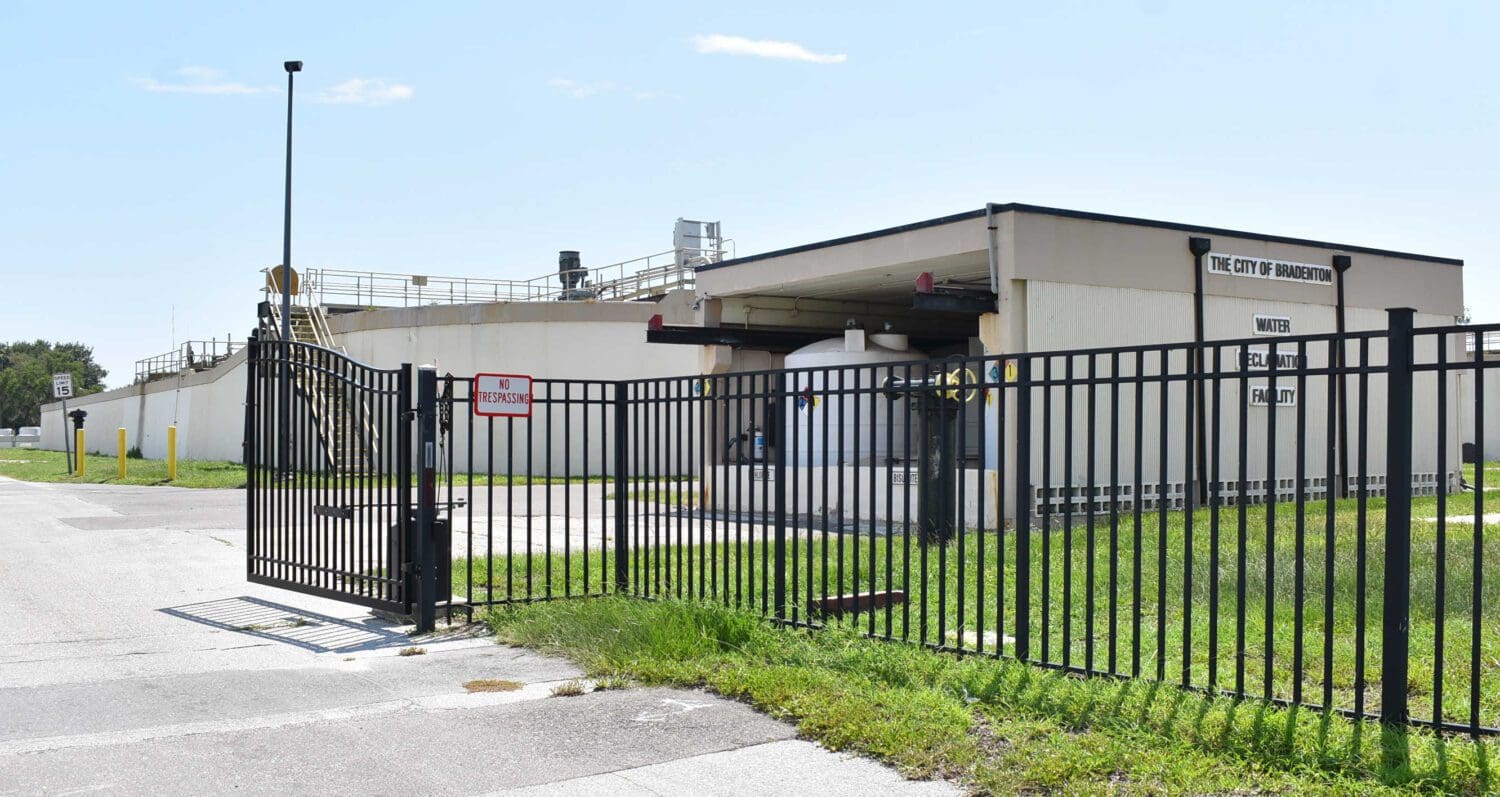
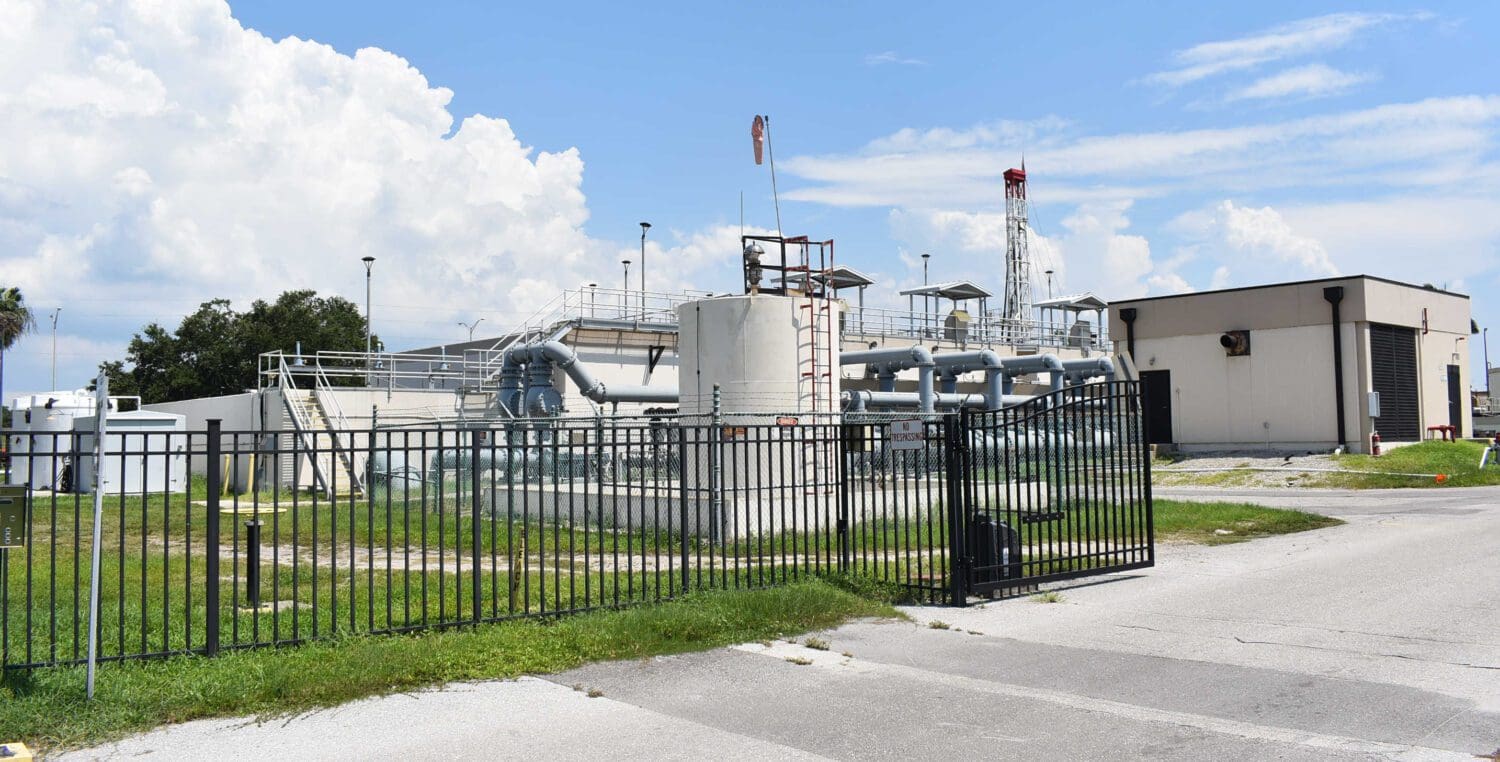
BRADENTON – During and after what was then Tropical Storm Debby, the city’s water reclamation facility discharged an estimated 25 million gallons of raw and partially treated sewage into the Manatee River, according to department officials.
The neighboring city of Sarasota discharged nearly 18 million gallons of raw and partially treated sewage into that city’s stormwater system, which connects to Sarasota Bay, according to department officials.
In total, the Bradenton and Sarasota water reclamation facilities discharged nearly 43 million gallons of sewage into local waterways.
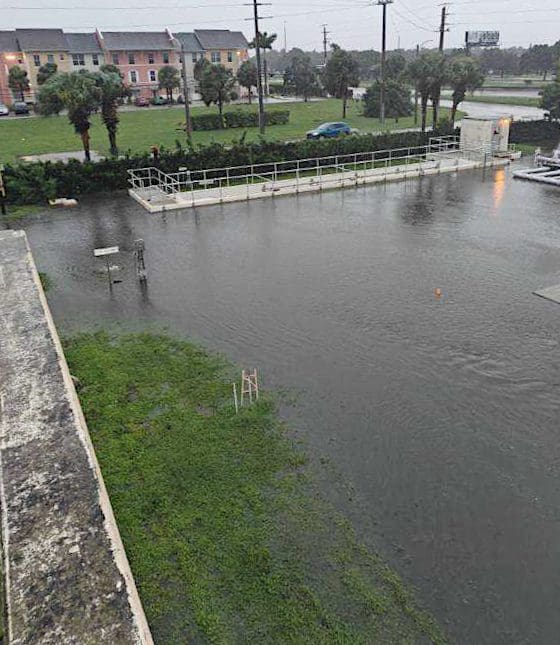
The rain associated with Tropical Storm Debby exceeded the Bradenton water reclamation facility’s storage capacities. – City of Bradenton | Submitted
Despite the influx of sewage into waters surrounding Anna Maria Island, the enterococcus bacteria levels in most areas were deemed “good” when last tested by the Florida Department of Health (FDOH) on Aug. 13.
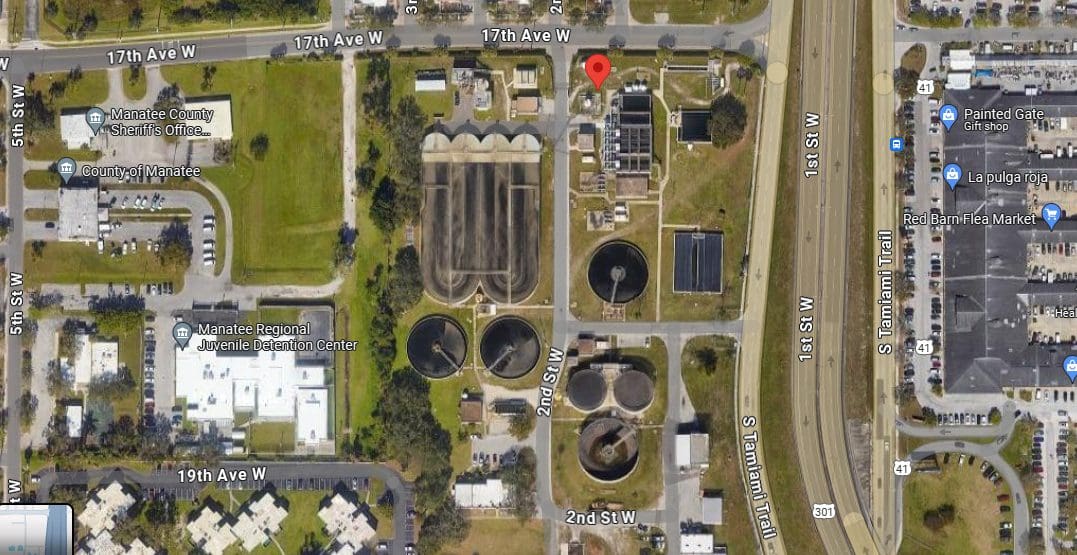
The Bradenton water reclamation facility is located across the street from the Red Barn Flea Market. – Google Maps | Submitted
According to the city’s report, “It’s estimated that the total volume bypassed from 08/04 – 08/07 was 25MG (million gallons).”
When contacted by The Sun on Aug. 12, Suncoast Waterkeeper board member and attorney Justin Bloom said, “According to the city’s own records, in which they’re reporting sewage spills to FDEP (the Florida Department of Environmental Protection), they discharged, directly to the Manatee River 25 million gallons of sewage between August 4th and August 7th. Suncoast Waterkeeper is concerned about the impact this significant amount of sewage will have on the Manatee River.”
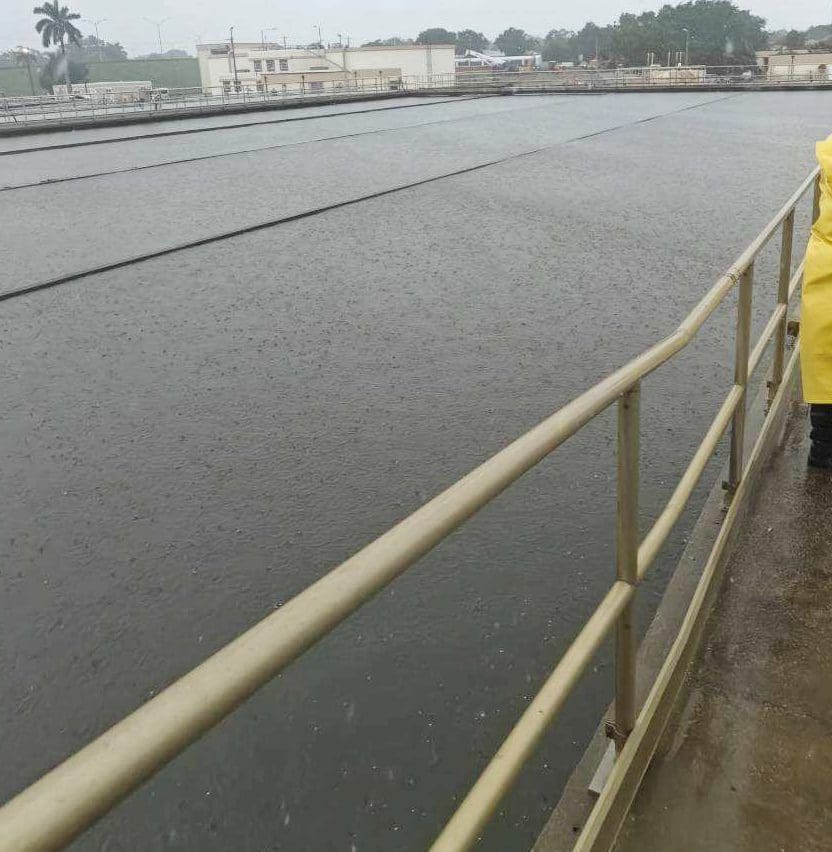
The Bradenton water reclamation facility was overwhelmed by rain associated with Tropical Storm Debby. – City of Bradenton | Submitted
The mouth of the Manatee River empties into Tampa Bay near the northern tip of Anna Maria Island.
The city’s report states, “The event was caused by the heavy rain and high flow associated with Hurricane Debby and was unavoidable. As with utilities state-wide, the WRF staff did everything possible to not have to bypass, but with between 17-19 inches of rain during the storm it was unavoidable.”
The city’s report also includes the following information:
“On 08/04, the aerators were taken offline at 2 p.m. in anticipation of high flow.
On 08/04, the WRF experienced extremely high flow into the plant beginning around 17:00. By 18:30, the aerators, headworks, clarifiers, and filters began overflowing and bypass began.
On 08/05, the WRF bypassed the filters and wet well due to continual heavy rain and high flow.
Manatee River spill sample collection began on 08/06.
On 08/06, the plant experienced random high flow events causing the outfall and clear well to overflow.
On 08/08, two aerators were turned back online.”
In addition, report notes: “Sample collection is ongoing, preliminary results from 08/06 have been received but no official laboratory report has been. The city will continue to update FDEP as data is received and upon the conclusion of sampling.”
Bradenton’s water reclamation facility features numerous wastewater treatment and storage components. – Joe Hendricks | Sun
In an email exchange with Bradenton resident and concerned citizen Ernie Vanderwalt, FDEP Southwest District Office Director Kelley Boatwright acknowledged the sewage discharge.
“Department staff confirmed that the city of Bradenton had sanitary sewer overflows that total approximately 25,000,000 gallons due to Hurricane Debby. Staff are tracking the reports, evaluating the data, and will determine next steps,” Boatwright stated in his Aug. 12 email to Vanderwalt.
Sarasota overflow
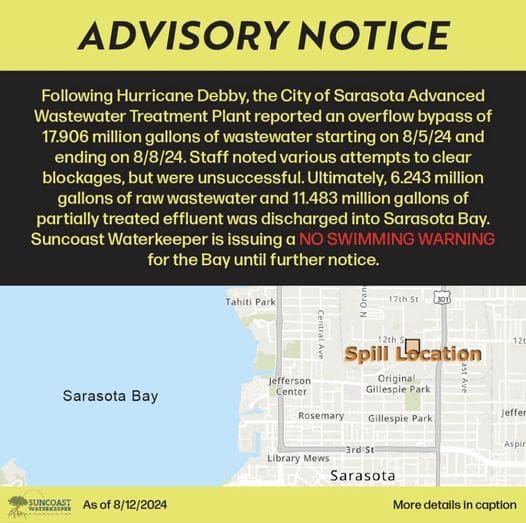
According to the incident description report provided by the city of Sarasota, “During the event, approximately 6.243 million gallons of raw wastewater was discharged to Sarasota Bay. In addition, approximately 11.483 million gallons of partially treated effluent was discharged to Sarasota Bay. Samples will be collected.”
According to the incident description, “The city of Sarasota’s advanced wastewater treatment plant was severely impacted by excessive flow from Hurricane Debby. Operations staff did everything in their power to control the flow coming into the facility. Due to the incredible flow volume coming to the plant, up to 44.29 MGD (million gallons daily) in a single day, plant staff were unable to prevent spills from the headworks at the treatment plant. Staff made every effort to contain and control the spill, but the volume was too significant to avoid the mixture of rainwater and untreated sewage entering the stormwater collection system.”
Water quality tests
According to the FDOH website, “Enterococci are enteric bacteria that normally inhabit the intestinal tract of humans and animals. The presence of enteric bacteria can be an indication of fecal pollution, which may come from stormwater runoff, pets and wildlife and human sewage. If they are present in high concentrations in recreational waters and are ingested while swimming, or enter the skin through a cut or sore, they may cause human disease, infections or rashes.”
FDOH analyzes water samples for total bacteria counts and rates the results as good, moderate or poor.
Good: 0–35.4 enterococci per 100 milliliters of marine water
Moderate: 35.5–70.4 enterococci per 100 milliliters of marine water
Poor: 70.5 or more enterococci per 100 milliliters of marine water
If the results indicate poor water quality, FDOH issues public notices and may post warning signs at impacted beaches that state swimming or other water activities are not recommended.
According to FDOH water quality testing results, the enterococcus levels in the water at Bayfront Park in Anna Maria were listed as good for Aug. 7, 11 and 13. Before Tropical Storm Debby, the enterococcus levels at Bayfront Park tested poor on July 22, July 29 and July 31. FDOH issued a water quality notice for Bayfront Park on July 31 but has not issued any additional Bayfront Park notices.
On Aug. 7, 11 and 13, the enterococcus levels at Manatee Beach in Holmes Beach were listed as good. When tested on Aug. 7, 11 and 13, the enterococcus levels at Coquina Beach North, Coquina Beach South and Cortez Beach (all in Bradenton Beach) were all listed as good.
When tested on Aug. 7, 11 and 13, the enterococcus levels at the Broadway Beach Access in Longboat Key were listed as good.
When tested on Aug. 7, 11 and 13, the enterococcus levels at Palma Sola Causeway South were listed as poor on each of those days, and also on July 29 and July 31. FDOH advisories were issued on July 31 and Aug. 7, 11, and 13.
According to FDOH, several locations in Sarasota were tested on Aug. 12 and the enterococcus levels at those locations were listed as good.
On Facebook, some Island residents and visitors reported strong odors and possible human waste discovered in the waters along some Anna Maria Island beaches.
On Aug. 12, the Suncoast Waterkeeper organization issued a “No Swimming” warning for Sarasota Bay that was to remain in effect until further notice.
On Aug. 12, The Suncoast Waterkeeper organization issued a no-swim advisory for Sarasota Bay. – Suncoast Waterkeeper | Submitted
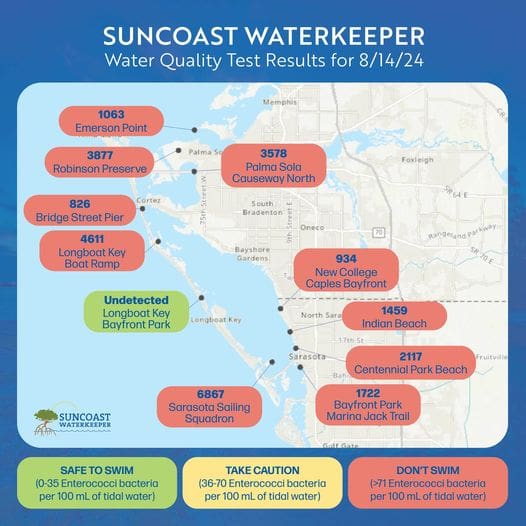
On Aug. 16, Suncoast Waterkeeper posted a Facebook message that said, “On August 14th, the enterococci survey was conducted during a falling tide. Salinity levels ranged from 18-29 ppt. The impact from Debby was still evident in the water quality on Wednesday and will likely continue throughout the weekend.”
Suncoast Waterkeeper released this water quality test results map on Aug. 16. – Suncoast Waterkeeper | Submitted
The Aug. 16 Facebook post was accompanied by a water quality test result graphic that indicated 10 locations in Bradenton, Anna Maria Island and Sarasota that Suncoast Waterkeeper considered to be “Don’t Swim” areas, including the Bradenton Beach City Pier on Bridge Street, Palma Sola Causeway North, Robinson Preserve and the Longboat Key boat ramp.
As of Aug. 19, The Sun was unable to obtain any additional water quality testing results from FDEP.
The Rotary Club of Longboat Key is nearing completion of a short documentary film series created in collaboration with Ringling College of Art and Design’s film department. Partners include the Rotary Club of Sarasota Bay, Save our Seabirds, Longboat Key Turtle Watch, Mote Marine Laboratories, the Town of Longboat Key, Oyster River Ecology (ORE) and Suncoast Waterkeeper.
On March 24, I had the pleasure of working with seniors in the film department as part of the series highlighting the work of the Sister Keys Conservancy and Longboat Key in protecting the islands and the work of Suncoast Waterkeeper (SCWK). I picked up the SCWK patrol boat early that morning and, after an interview about the Sister Keys and Suncoast Waterkeeper, we took a boat ride on Sarasota Bay and a tour of the Sister Keys.
As part of the project, an introductory short film is being developed regarding Rotary’s initiative to network with conservation organizations in support of environmental sustainability and stewardship via educational outreach. Once completed, the films will be available to organizations including district Rotary clubs, other civic and conservation organizations, and academic institutions. Exemplary people in action will be highlighted. Two additional short films will illuminate the unique grassroots history and real-time examples of sea turtle and shorebird conservation, research and education services provided by the Longboat Key Turtle Watch, Mote Marine Laboratories, Save Our Seabirds, SCWK, ORE and other environmental groups.
The effort intends to establish a multi-year film documentary program with the Ringling film department to highlight contemporary coastal ecology and sustainability issues and solutions. Additional future topics anticipated include micro-foresting, eco-restoration and Sarasota Bay conservation.
A summer internship at Ringling College is being established to facilitate the development of short film documentaries and provide students with a meaningful work/study experience.
I’ll keep readers apprised of the progress of the series and the date the film series will be premiered.
Salon (noun) – a conversational gathering of notables held at the home of a prominent person.
On Saturday afternoon, Suncoast Waterkeeper held its Suncoast Salon fundraiser at the Sarasota home of Anna Maria residents Bill and Debbie Partridge. The event was a sellout and attracted some of the area’s most ardent protectors of the Sarasota Bay watershed, including the event sponsors, Beachside Management, The Mikki and Walter Frank Family Charitable Fund, Manatee Community Foundation, Whistanfox LLC and the Gulf Coast Community Foundation. The event was held on the lawn behind the oldest home on Sarasota Bay and was greeted with fabulous weather, a full moon and a beautiful sunset. Tents were placed on the lawn and themed with the organization’s work to protect the Sarasota Bay watershed. The event was catered by Harry’s Continental Kitchen and a wonderful evening of music was provided by The Hedges. The Salon aimed to spark intrigue, excitement and increase commitment to the area’s natural resources. This invite-only event created a unique opportunity for clean water supporters to engage on important local issues and speak to local leaders.
The mission at Suncoast Waterkeeper (SCWK) is to protect and restore the waters on the Florida Suncoast for the benefit of all through community and stakeholder engagement, environmental monitoring, advocacy and responsible legal action. Our goal is clean water for all.
SCWK has curtailed sewage spills, stopped industrial pollution, informed the public about the safety of recreational waters and tackled one of the largest local environmental disasters of our time – Piney Point. Since 2019, the organization’s members have settled eight Clean Water Act citizen suits; five acted against municipalities illegally spilling over 1 trillion gallons of sewage and three aimed to stop industrial facilities from illegally discharging heavy metal-laden stormwater. Combined, the suits contributed more than $500,000 for environmental projects and hundreds of millions of dollars to improve infrastructure.
The salon proved a wonderful opportunity for like-minded protectors of Sarasota and Manatee waters to get together for an evening of discussion, food, music and camaraderie on Sarasota Bay. It also raised funds for the organization to continue its efforts to protect the area’s eco-system and economy. To help with the mission, join the organization, volunteer and donate at www.suncoastwaterkeeper.org.
CORTEZ – The Florida Department of Environmental Protection (FDEP) is proceeding to have Raymond “Junior” Guthrie remove his net camp from Sarasota Bay just off the Cortez commercial fishing docks.
“This case is still in the post-judgment phase to compel compliance with the court’s final judgment, which ordered Mr. Guthrie to remove the unauthorized structure,” FDEP spokesperson Brian Humphreys wrote in a March 14 email to The Sun. “In November, Mr. Guthrie was ordered by the court to show cause by March 5, 2024, as to why this final judgment should not be enforced and why sanctions should not apply. “
Humphreys said the deadline has passed and there has been no response from Guthrie, and FDEP is evaluating its next steps.
“As this process is ongoing, we are limited in our ability to comment further,” Humphreys wrote.
The civil suit against Guthrie was filed by FDEP on Feb. 6, 2018 in the 12th Judicial Circuit Court when the agency claimed that Guthrie had constructed an unauthorized enclosed docking structure on sovereign submerged lands in Sarasota Bay, and ordered its removal.
Guthrie maintained that his family previously had a net camp in that spot and the structure was protected under the 1921 Butler Act, which awards title of submerged lands to adjacent waterfront property owners who made permanent improvements on the submerged lands.
A judgment was granted in favor of the FDEP on Feb. 25, 2019, and Guthrie was ordered to remove the structure.
On May 4, 2023, 12th Judicial Circuit Court Judge Edward Nicholas signed an order dismissing the case due to failure to prosecute, but on Nov. 2 it was reopened at the request of FDEP, which claimed it had not been given proper notice.
Suncoast Waterkeeper teamed up with Sarasota Bay Watch last weekend when they conducted their 2023 Annual Sister Keys Cleanup. The event was a collaboration of the two non-profit organizations, the Town of Longboat Key and Mar Vista Dockside Restaurant. Close to 50 volunteers worked for four hours on the island and around the mangrove fringes collecting trash and recyclable items. This year’s harvest was especially large, fueled by the storm surge that hit the area during Hurricane Idalia. One of the most unusual items in the cleanup’s 15-year history was uncovered during the event, an 18-foot wooden “sharpie” sailing craft. John Hoover made another impressive find when he uncovered a blown glass sphere. In all, volunteers collected over 1,000 pounds of trash from the islands.
The Sister Keys were originally slated for development in the early 60s as the Shangri Isle Club and were once again threatened in 1989 when they went up for sale at $1 million. That spurred a group of citizens to form the Sister Keys Conservancy to buy and preserve the islands as a nature preserve. The Town of Longboat Key purchased the islands in 1994 with a stipulation that the keys would never be developed.
The islands underwent a million-dollar mitigation in 2007 that removed all invasive species, planted native flora and created a 2-acre wetland. Today, mature mangroves dominate the waterways and are rich with crustaceans, minnows, juvenile finfish and wading birds. Native species planted on uplands, first created from the dredging of the Intracoastal Waterway in the late 1800s, have matured, making the islands one of the best examples of a thriving native marine environment in coastal Florida.
The cleanup is part of a continuing two-pronged effort to clear the islands of trash and prevent the resurgence of invasive species.
Kayakers and those without a boat were ferried to the island by volunteer boaters Benny Parrish, Mark McBride and Tim Thurman.
Back at the Longboat Key Boat Ramp, event volunteers loaded the debris to be retrieved by the town’s public works employees. All plastics and cans were collected in separate green bags provided by SBW and recycled. The volunteers were treated to a box lunch and beverages provided by the Mar Vista Dockside Restaurant and the Chiles Group, who have been supporters of the event from the beginning.
The Sister Keys Clean Up is just one of many projects that SBW is involved in. In 2021, SBW planted clams in the bay in an ongoing restoration effort. Other cleanups are conducted at various locations throughout the bay, including an annual monofilament cleanup and more.
Suncoast Waterkeeper is a Sarasota-based advocacy non-profit committed to protecting and restoring Florida Suncoast’s waterways through enforcement, fieldwork, advocacy and environmental education for the benefit of the communities that rely upon these precious coastal resources. Their efforts have been responsible for major initiatives to hold municipalities responsible for mandates established in the landmark 1982 Clean Water Act. SCWK also conducts bi-monthly water testing of inland coastal waters. For more information on the groups’ missions and to become a member, visit their websites, www.sarasotabaywatch.org and www.suncoastwaterkeeper.org.
Sarasota Bay Watch, a local nonprofit, is dedicated to educating and enlisting the Sarasota Bay community to act to preserve and protect our waters. Some community efforts include cleanups, above and below the water’s surface, to remove trash and entangling debris, and initiate vegetative and shellfish restoration. The organization also creates programs that promote youth education and leadership.
Sarasota Bay Watch has been conducting its annual Scallop Search for over 13 years. Unfortunately, in recent years, COVID-19 and red tides have canceled the searches.
Why are scallops important? Scallops serve as canaries in the coal mine, providing a good indicator of water quality since they are affected by storms, water salinity, red tide and predation. In addition, during the search, a great deal of information is collected on various shellfish like clams, seagrasses, and other marine organisms.
This citizen science approach (community information gathering) not only benefits the organization but also educates the community on life in our waters. Changes in populations, temperatures, and pollution are reflected in the marine environment. Educating the community with this hands-on activity is the goal of the search. To be a proponent of water quality protection, a basic understanding of the marine environment is essential. This is one of the event’s main objectives.
Last Saturday, Sarasota Bay Watch hosted this year’s Scallop Search at the Sarasota Sailing Squadron. Participants in the family-friendly boating event were tasked with collecting information on the state of Sarasota Bay from north to south. Boaters were essential to the success of the event, bringing their crews and additional volunteers out on the bay.
Students received community service hours for their involvement in the search. Participants were assigned to an area and provided equipment. They then snorkeled in their designated area and recorded what they saw.
Gathering for lunch after the event was a wonderful opportunity to meet and be inspired by like-minded individuals.
Sarasota Bay Partners Grants are competitive awards for projects in the Sarasota Bay watershed that promote habitat and water quality restoration, environmental education, community involvement and stewardship to improve the overall quality of Sarasota Bay and its tributaries. Stormwater runoff, sewage spills, leaking septic tanks and a thousand other insults threaten the health of Sarasota Bay. Add in warming temperatures, rising sea levels and altered weather patterns, all of which will continue to impact our natural and built environments.
I’m often asked what an individual or a group can do to be part of the solution instead of part of the problem. One way to make a difference is to take advantage of the Sarasota Bay Estuary Program’s Bay Partners Grants. The SBEP was formed with the aim to protect Sarasota Bay and its environment, the economic engine of the region and the reason most of us live here. Local actions like this help prepare our communities and estuary for these changing conditions. There are many opportunities to engage. These include but are not limited to:
Planting shade trees in highly paved urban areas;
Installing rain gardens and bioswales to filter runoff from impervious surfaces;
Diverting gutter downspouts from impervious surfaces to planter boxes, garden beds or other permeable areas, or to rainwater harvesting systems like rain barrels and cisterns; and
Implementing living shorelines or seawall modifications that will allow mangroves to “migrate upslope.”
Recently, Banyan Bay Condominium on Longboat Key took advantage of a grant to turn an area they had nicknamed the “swamp” into a vibrant area that beautified the grounds, created a natural pollinator garden for birds and insects and helped protect the section of Sarasota Bay that fronts the property. The project was led by residents Terri and Dr. Jeff Driver. Their experience and the outcome are best expressed in Terri’s own words. According to Driver, “We had some uncertainty about whether our proposed project would fit the requirements for a grant from SBEP Partners. A friend recommended we call SBEP and simply ask if they would look at our space and situation and see if it was appropriate for a grant proposal.
“On a very tight timeline and on short notice (because the proposal was due in about two and a half weeks), SBEP grant manager Darcy Young visited our property and evaluated our proposed site, agreeing that it was exactly what would help Sarasota Bay if re-planted to native species. SBEP was very helpful in response time and providing guidance to complete our grant application.
“SBEP recommended a couple of native plant nurseries, but Annie Schiller at Florida Native Plant Nursery was very responsive. On very short notice, Annie visited, evaluated our proposed renovation area and very quickly provided a list of plant species and number to be planted specific to our wet and dry areas. She also reminded us about mulch requirements. We called Annie the morning our proposal was due to make changes and Florida Native Plant Nursery provided updated estimates two hours before our proposal was due. They were very responsive to changes. Once we received the grant, Florida Native Plant Nursery brought the plants in and helped with recommended placement. Our community members planted all 134 plants, creating a new native forest at The Banyan Bay Club.”
On Feb. 27, members of the press and the condo association attended a ribbon-cutting ceremony to dedicate the new space and celebrate their investment in protecting Sarasota Bay while improving the condominium grounds, a true win/win experience.
Although the next grant deadline is a year away (2024), now is an excellent time to plan how you can take advantage of this program and make a difference while enhancing your place in the bay’s watershed. For more information and to apply for a grant, go to https://sarasotabay.org/get-involved/apply-for-a-grant/.
The waters on the Suncoast need the protection of those who love them. You can help Suncoast Waterkeeper (SCWK) do that with a new program the nonprofit launched recently by keeping your “Eyes on the Suncoast” and reporting what you see.
Whether you’re boating, biking, swimming, fishing or walking, everyone on or near the water can help SCWK remind residents and visitors why the Suncoast’s marine ecosystem is worth protecting. Suncoast Waterkeeper can’t be everywhere at once, that’s why your contributions are vital to their efforts.
You can help Suncoast Waterkeeper by report- ing conditions such as this light-colored plume in area waters. – Rusty Chinnis | Sun
SCWK has designed a platform that makes it easy for you to submit and share what you see. Sharing what you see using your phone, social media and the hashtag #eyesonthesuncoast can be invaluable in efforts to preserve water quality and habitat.
Here are two ways you can report what you see:
1. Use the form on their website for bad conditions or pollution reports only. The form will let you post an image, add a description and give the location of the report.
2. Post to Facebook or Instagram. Here is the perfect place to post what you love about the Suncoast and why it’s important to help organizations like SCWK keep it sustainable. A YouTube video walks you through the process on the webpage. Follow these four easy steps to post to your social media platform:
• Upload a picture;
• Include a description of what you’re reporting;
• Provide the latitude and longitude for your location using your phone’s compass or by dropping a pin on a map app; and
• Add #eyesonthesuncoast.
Need a couple of tips on what to report?
Post the things that inspire and amaze you – wildlife sightings, clear/clean water, a special sunrise and/or sunset, healthy seagrass or marine scenery.
Post the things we need to be aware of like trash/debris, excessive mangrove trimming, including dead mangroves, fish kills, dead or sick aquatic animals, discolored, foamy
or foul-smelling water, sewage spills, algae blooms, gas, oil or grease spills, runoff from construction sites, direct pollution or chemical spills, invasive species as well as other concerns.
Don’t underestimate the impact that your contributions can make.
As Margaret Mead, the famous cultural anthropologist said, “Never doubt that a small group of thoughtful committed individuals can change the world. In fact, it’s the only thing that ever has.”
Have you been looking for a way to meet new friends who share your passion for the environment and work to keep it healthy? An upcoming event will provide you with that opportunity. Join Sarasota Bay Watch, Suncoast Aqua Ventures and Suncoast Waterkeeper on Saturday, Feb. 25 from 8 a.m. to 1 p.m. at the Harbor Cove Community, 499 Imperial Drive in North Port. Hurricane Ian blew a tremendous amount of debris into the Myakka River, our area’s premier wild and scenic river. Join the effort in removing debris and restoring this natural treasure.
You can sign up at the Sarasota Bay Watch website. The event starts at 8:15 a.m. with a safety meeting followed by the cleanup, which begins at 8:30 a.m. Lunch will be provided at noon at the end of the cleanup. Fourteen kayaks will be provided for those who want to participate but don’t own a kayak. Sign up early to reserve a seat. Participants can, of course, bring their own kayak or shallow draft boat. Work gloves, trash bags, maps and equipment will be provided. Non-boaters are needed to retrieve trash or clean areas from land. Parking is limited, so carpool if possible. If you have questions, contact Ronda Ryan at 941-232-2363. Other sponsors include North Port Friends of Wildlife and the Harbor Cove Community.
As you may be aware, Hurricane Ian had a huge impact over a wide swath of waterways across the state. While the news has moved on to more immediate stories, the debris left by the storm remains in some of the Suncoast’s most important natural areas. On their first event held on Dec. 11, 2022, the organizations cleaned up the waterways in the community of Holiday Estates. A particularly hard-hit area on the Suncoast, Lemon Bay sits at the southern end of the watershed monitored by Suncoast Aqua Ventures, Sarasota Bay Watch and Suncoast Waterkeeper. With the assistance of Lemon Bay Conservancy and the Coastal and Heartland National Estuary Program, they worked to clean up the canals of Ainger Creek, a major tributary of Lemon Bay.
This is a great opportunity to learn about and participate in the important work of these organizations, as well as an opportunity to spend a day making a difference and meeting new friends. Join in to keep the Suncoast the special place it is for this and future generations.
On Saturday night, Feb. 11, Sarasota Bay Watch (SBW) will hold its 13th annual major fundraising event, “Scallopalooza: Welcome to The Clam Jam,” at the Sarasota Hyatt Regency Hotel. Last year’s event was a sellout with over 400 community supporters in attendance and, if history is any indication, this year will be too.
SBW’s Executive Director Ronda Ryan, who has been with Sarasota Bay Watch since 2007, continues to spearhead the group’s education and restoration efforts. Sarasota Bay Watch’s shellfish restoration efforts resulted in nearly 1 million clams being released in 2022 alone. Their work highlights the need for action to protect the local marine ecosystem. As a part of that “natural system,” clams filter algae that have been growing in excess and affecting water quality and clarity in the bay. Reduced water quality and clarity negatively affect seagrass growth, a necessary component for a healthy ecosystem. Seagrass beds provide essential habitat and food to all creatures in the bay, including humans.
Sarasota Bay Watch Board President Brandon Taaffe and members of the event committee, Brian Jung, Al Jeffery, John Ryan and Ernesto Lasso De La Vega, helped Ryan organize an event that highlights the importance of and support for local nonprofits stressing the significance of clean water.
The evening’s activities will include live music, an open bar and a large silent auction that includes artwork, event tickets, and merchandise of every description. After dinner, a live auction will feature packages including travel, fishing trips and much more.
One of the best parts of the event is the opportunity to mingle with some of the region’s most passionate environmental supporters and to share the common mission for protecting Sarasota Bay. De La Vega, who leads the clam restoration efforts, will be back to update participants on SBW’s projects, which include the first-ever clam lease in Sarasota Bay that is dedicated to restoration.
To get involved with the work SBW is doing to protect Sarasota Bay and support their mission, visit the group’s website. As their motto says, “A healthy bay is everybody’s business,” literally and figuratively!
To local fishers, the importance of mangroves is evident. Intertwined with the twisted roots, there’s a web of life that’s inextricably bound to the snook, redfish, trout, flounder, grouper and a plethora of other gamefish that they seek. What can be less apparent to those that make a living elsewhere is the importance of mangroves as a critical source of food and protection for fish and people.
These ancient coastal forests provide an abundance of food for manatees, dolphins and sea turtles as well as sustenance and nesting areas for critically endangered seabirds. All these links in the chain of life provide the ineffable sense of beauty and wonder that continue to attract people to this region. They also protect and sustain a vibrant economy in ways that might not be as apparent.
What’s less well understood, and just beginning to be appreciated, is the protection mangroves provide against powerful hurricanes and rising waters that longtime residents have seen firsthand. With all that mangroves provide for us and our quality of life, it would seem they would be revered and protected at all costs.
Unfortunately, just the opposite seems to be the case.
When local fishing guides began to question me about what they considered extensive mangrove trimming along the Sarasota Bay shoreline, I went to investigate. What
I observed shocked and angered me. That was April 4 of this year, and I flew a drone and walked the shoreline to document what I witnessed. There were numerous large mature mangroves that had been cut, were denuded of leaves and appeared dead. There also was a large amount of cut debris in the water, including branches that were of greater diameter and longer than allowed under Florida Department of Environmental Protection (FDEP) guidelines.
When I reached out to FDEP in April to file a complaint, I was informed that Karen Willey, a local environmental advocate and business owner, had filed a protest two months earlier in February 2022. When I questioned Willey, she said she had been reading the Washington Post and had seen an ad for Aqua by the Bay that featured an image looking west with an unobstructed view of Sarasota Bay she had never seen before.
When I called FDEP to inquire why no actions had been taken, the response I received indicated that they had sent a letter to the permit holder about the complaint and had not heard back from them. They also stated that they couldn’t get on the property to inspect without permission from the property owner. After raising the issue with Florida state Rep. Will Robinson, Sen. Jim Boyd and the Manatee County Commission, an inspection was done which claimed that the conditions of the permit had been met.
Astonished, I sent an email challenging the FDEP inspection report with images showing my concerns.
At her request, I sent GPS-tagged images to Hannah Westervelt, FDEP Compliance Assurance Manager, and received a reply indicating that inspectors were being sent back to the site to investigate.
Subsequently, Westervelt contacted me to say that two inspections were conducted that confirmed our concerns. The permit holder was given until Aug. 12 to reply to the letter and we are currently waiting for the response.
It’s unfortunate and ill-advised that state regulators are not performing their duty in a timely manner to protect the citizens and businesses of Florida, present and future. But it wouldn’t be fair to lay the blame only with the FDEP. People I have spoken to who deal with state regulators on a regular basis fault prior Gov. Rick Scott with eviscerating the FDEP and spawning a mass exodus of the brightest and most committed regulators.
The people I spoke to at the agency, including Westervelt, were responsive to my questions and concerns and ultimately addressed the issue. My guess is the agency is struggling with a limited budget and staff. That’s where we the voters come in. It’s incumbent on the citizens of Florida and Manatee County to elect officials with a proven record of protecting our most important and vulnerable resources.
How this is resolved is still to be seen, but rest assured that groups like Suncoast Waterkeeper will make sure it doesn’t become just a cost of doing business for the developer. I don’t have a crystal ball but I’m guessing that future developers, builders and your children and grandchildren will judge us for the decisions we make and actions we take.
ANNA MARIA – While Sarasota Bay is healthier than it was in the 1970s and 1980s, it’s not as healthy as it was 15 years ago.
That little-known fact is a serious concern to Dave Tomasko, executive director of the Sarasota Bay Estuary Program.
“We are the only estuary program whose number one goal is to protect water clarity,” Tomasko said during the December meeting on the Island of the Manatee County Tourist Development Council. “People want to throw out the anchor on their boat, jump in the water and see their feet.”
Tomasko said there are three main reasons to worry about water quality in Sarasota Bay. One of them is quality of life, since people don’t like spending their time in murky water or covered in algae. Both locals and tourists choose this area because of optimal swimming and boating conditions. Tomasko stressed how much the quality of the water has to do with our economy.
“People pay a premium to live here,” Tomasko said. “If you want to have cheap waterfront communities, go to Merritt Island. You’ll pay a lot less per square foot than you will here or on Siesta Key or Longboat Key. The water is not good there.”
There are 20,000 jobs associated with the bay, he said, including not just the fishing industry, but service industry people like bartenders and servers, bayfront businesses and their owners and staff. The list goes on, he added, saying that water quality is a major factor in keeping these people employed.
“The final thing is Florida’s wildlife heritage. This is the worst year on record for manatee deaths in the state of Florida,” said Tomasko. “Over a thousand dead, and halfway through this year we were already in the worst year. The previous worst year was a red tide year in 2013.”
According to data gathered by Tomasko and the program, the reason for the manatee deaths is very simple; they’re starving to death. Decreased water quality has caused the seagrass meadows, which are the primary food source for manatees, to die off by at least 60% in the Indian River Lagoon. To help save the starving manatees, for the first time ever, the Estuary Program is going to pay people to feed them romaine lettuce. While Sarasota Bay has not reached that level, it has lost 22% of its seagrass and could be headed in that direction sooner than later.
The Piney Point wastewater spill last spring was cited as a major concern and may be doing more damage than just the red tide outbreak in 2021, he said, and the ripple effect could cause problems that the bay has yet to see.
BRADENTON BEACH – This time last year, 68 boats – many derelict – were moored or anchored in Sarasota Bay off the coast of Bradenton Beach.
As of Sept. 3, that number is down to 15, largely due to an increase in patrolling by the Bradenton Beach Police Department.
Though it is legal for anyone to moor or anchor their boat in the shallow water of the bay, there are laws that the crafts must adhere to.
“To legally be here, a boat has to run under its own power and be seaworthy,” Acting Police Chief Lt. John Cosby said. “The registration also has to be up to date and it must be able to be steered and maneuvered.”
To assure compliance with these regulations, Officer Eric Hill and other members of the department regularly patrol the bay on their boat, checking for up-to-date registrations and obvious violations. This can include a craft that has taken on water because windows or hatches have been left open, excessive barnacle buildup on the hull or missing sails and motors.
Officers can ask boat operators to demonstrate the seaworthiness of their craft at any time. If the owner cannot demonstrate the boat is in working order, they are issued a warning citation and given a period of time to make the necessary repairs. If there is no one present and officers see the boat is in obvious disrepair, they will attach the warning or citation to the craft.
“Wet storage” is the term used to identify an unoccupied boat not currently running. – Jason Schaffer | Sun
If necessary repairs are not made after a craft is warned or cited, the department runs the registration number and begins a derelict case on the boat. This process involves taking photos to prove the boat is not in working order, then sending a certified letter to the last known owner. According to Cosby, this doesn’t always get results because boats are often bought and sold without changing registration with the state.
“Let’s say I own that boat and I sold it to you, then I don’t tell the state that I sold the boat and you live on it. When a derelict report is filed on that boat, I’m responsible, not you,” said Cosby, explaining the complexities that can come into play when trying to get a derelict boat out of the bay.
According to Cosby, in some instances, boat owners will get in over their heads. Whether it was a dream of fixing up an older boat and the expense got out of hand, learning that living on a boat is more difficult than it may have seemed in the beginning or even having a boat sink, the dream often dies and the boat is left to deteriorate in the water. Officials understand this and have a way out for owners who are past the point of no return.
“If they can’t fix the boat, they can do what’s called a title sign-over. They give us the title to the boat and the city becomes the owner of the property,” said Cosby. While this may not be the desired outcome for the boat owner, it’s a way out. The owner doesn’t incur any fines and is not responsible for the cost of removing the vessel from the water.
With no sail or working motor, this is an example of a boat that is not currently up to code. – Jason Schaffer | Sun
The reasons for stepping up enforcement are mostly for safety, according to Hill, who pointed out numerous places along the Bradenton Beach Pier where there was new lumber from repairs made due to loose boats crashing into it during storms. Sunken boats and boats that have broken free of their moorings and run into shore are easy to spot on the bay. In addition to crashing into piers and shore, there is also a risk of collision with other craft in the water.
Cosby says while the new enforcement has shown amazing results and made the bay a much safer place, it took putting a plan into place and some education to make it happen.
“We got the city to adopt an ordinance; we had to go to court a few times, the judges really weren’t used to dealing with this so there was some courtroom education there to make sure fines were being levied against them. Eventually, word got out and some went over to Palmetto and some went south. They just realized they weren’t going to get away with it here,” Cosby added.
Cosby says his department is unique in the seriousness of their enforcement, saying only Sarasota is as strict, patrolling the area around Marina Jack.
The Bradenton Beach Police Department does not have a regular schedule of boat patrols. Unlike getting in a cruiser on land and taking to the streets, there are factors that can make it difficult to patrol the water. This can be especially problematic during the summer months when pop-up storms can be severe. Cosby also said the recent red tide has made it difficult to be on the water.
The effect of heavy summer rain is also easy to spot while on the water in the area where many of the boats in the bay are moored or anchored. “Listing” is a nautical term for a vessel that has taken on water and begins to lean to one side. There are multiple examples of this currently in the bay. If a boat is left listing and the water is not removed, it will eventually take on enough water to completely roll over and capsize. While most of the time a listing boat is not occupied and probably not a safety hazard to anyone onboard, it becomes a costly cleanup and removal project for the city, and may even prove to be an environmental problem as well.
Privacy choicesWe use Google Analytics to understand readership and improve the website. Analytics cookies are optional and can be accepted or declined.Privacy Policy








 As part of the project, an introductory short film is being developed regarding Rotary’s initiative to network with conservation organizations in support of environmental sustainability and stewardship via educational outreach. Once completed, the films will be available to organizations including district Rotary clubs, other civic and conservation organizations, and academic institutions. Exemplary people in action will be highlighted. Two additional short films will illuminate the unique grassroots history and real-time examples of sea turtle and shorebird conservation, research and education services provided by the Longboat Key Turtle Watch, Mote Marine Laboratories, Save Our Seabirds, SCWK, ORE and other environmental groups.


