Tag: Reel Time

Reel Time: Bahamas fishing

Reel Time: Bahamas fishing

Fishing the Bahamas or any other destination always seems to offer challenges as well as rewards. This annual trip to the Bahamas has checked both those boxes. The trip had a damp element at the beginning, when a tropical disturbance dropped a record amount of rain on south Florida the night after we departed Fort Lauderdale. The ride was bumpy as gusts of wind from the advancing front buffeted the Makers airplane and resulted in a sprint to the door of the Andros Town International Airport. The first two days proved challenging as wind, clouds and high tides resulted in neither myself nor my partner, Anna Maria resident Bill Partridge, landing a single bonefish. The last two days proved to be a totally different experience as winds calmed, the sun made an appearance and we were able to each land between 15-18 fish. More on this trip next week!

Reel Time: Join the 2023 EcoSummit

On Dec. 5-6, the Science and Environment Council, the region’s network of 43 leading science-based environmental organizations, will offer the community a two-day summit at Van Wezel Hall in Sarasota that will explore solutions for balancing growth with nature and reducing our impacts.Join the 2023 EcoSummit

Since 1930, the population of Sarasota and Manatee counties has grown from 35,000 to 891,000 people. The growth has resulted in significant degradation, fragmentation and loss of natural habitats and the fish and wildlife they supported. The summit will offer the public a lively, thought-provoking and entertaining experience that will include lectures, panel discussions, storytelling, film and music.

Dozens of national, regional, and local experts will share the stage with local storytellers and Americana songwriter Karen Jonas and her band. Australian documentary filmmaker and regenerative environmental leader Damon Gameau will be the summit’s keynote speaker and will screen his film, “2040.”

Florida’s favorite storyteller and author, Carl Hiaasen, journalist Craig Pittman, and local dolphin whisperer Randy Wells will contribute to an unforgettable and entertaining evening of Florida stories.

U.S. News and World Report ranked the Sarasota metro area as the second fastest-growing place in America in 2023-24. Ongoing challenges with impaired waters, recurrent algal blooms and declining fish and wildlife make it clear that we cannot continue to grow the same way we have in the past.

This is particularly important to convey to voters who will need to elect leaders who understand that our economy and quality of life depend on a healthy, resilient natural environment. A recent decision by the Manatee County Commission to reduce wetland buffers, a move in the opposite direction, points to the urgency of informing the public. Nature cleans our air and water, supports fish and wildlife, promotes public health and drives our economy.

An important book by Florida author Jack Davis, “The Gulf, the Making of an American Sea” (winner of the 2018 Pulitzer Prize for history), is highly recommended to show residents what has been lost and the importance of protecting what we still have. Floridians whose families have lived here for generations know this story well. For four years running, participants in Sarasota County’s annual Citizen Opinion Survey have identified population growth and development as the county’s biggest issue.

We’ve done it before. Since the 1970s, our region has often led the state with bold, community-driven environmental initiatives. Residents rallied to protect South Lido Beach Park, Emerson Point, Sister Keys and Casperson Beach. We banned phosphate mining in Sarasota County and adopted the first summer ban on fertilizer use. We established Sarasota Bay, Tampa Bay and Charlotte Harbor as estuaries of national significance and empowered three National Estuary Programs to protect and restore them. We protected the Myakka River and more recently the Little Manatee River as state-designated Wild and Scenic Rivers. In November 2020, 71.34% of Manatee County voters agreed to increase property tax by .15 mills and authorized purchasing $50 million in bonds to acquire, improve and manage land to protect drinking water sources and water quality, preserve fish and wildlife habitat, prevent stormwater run-off pollution and provide parks.

Our communities overwhelmingly support our natural environment, and we have exceptional environmental organizations with highly qualified and dedicated people who work to conserve and restore it. Now it’s more critical than ever that we elect leaders who listen to the will of the people. I highly recommend this summit as a learning experience and a call to action. See you there.

Reel Time: The secret to fly casting

Everything we learn to do in life is learned by repetition. The act of repeating an action over and over actually trains neurons in the brain to fire together, eventually creating neural pathways that, in time, allow us to act without thinking about it.

Consider learning to ride a bike. Did anyone just get on their bike and effortlessly ride? I know I didn’t. It required falling and getting up repeatedly. Now I get on a bike and ride without even thinking about how to balance, steer or anything else that allows me to stay upright. Teaching fly casting reminds me of those things I now take for granted, like riding my bike, driving my car and fly casting. It’s also shown me why it’s harder for people who have been fly fishing for a long time to master the fundamentals (physics) than for some initiates. Those same pathways that assure success also store bad habits that have been developed over time. This first became apparent to me when I gave lessons to someone who had been fly casting for a long time but who had ingrained bad techniques. When I showed them how to properly move the rod tip in a straight line to form a “tight” wind penetrating loop they understood the concept immediately. The eye-opener for student and teacher was when they tried to repeat the proper casting stroke and their ingrained bad habits overpowered their new understanding.

Reel Time: The secret to fly casting
Joan Wulff demonstrates one of her unique, and effective techniques for mastering the casting stroke. – Rusty Chinnis | Sun

This isn’t necessarily bad news for long-time casters but does require them to “retrain” their brain. The same applies to proficient casters who are learning to cast with their non-dominant hand. Try this and you’ll see what I mean instantly. If you’re a right-handed caster, putting the rod in the left hand is like handing it to someone whose mind knows the cast, but has a body that doesn’t cooperate. The good news is that by learning the fundamentals of the cast and practicing them repeatedly, anyone can become an excellent fly caster with time.

Although we’ve established that practice is the key to mastering the cast, there’s another “secret” to supercharging your progress – the frequency of the repetition and establishing a habit. Create a realistic practice schedule that you can stick to. It’s much more effective to practice every day for a few minutes than to practice once a week for hours. Start by practicing at least four to five times a week for 10 minutes. Any additional time will, of course, be a bonus, but the importance of a regular practice schedule cannot be overemphasized. There are lots of resources on the internet to help you perfect your cast and lessons with a caster trained by Fly Fishers International can be invaluable. Some of the best videos I’ve found online feature master casters and instructors like Joan Wulff and Lefty Kreh. Orvis also has excellent resources. Locally, anglers have a great resource in AMI Outfitters on Anna Maria Island. They have complete outfits for beginners and rods and reels that will appeal to the most discriminating fly fisher. Visit them and try different outfits to see what fits your style and your pocketbook. Learning and apply- ing the fundamentals of fly casting and practicing them often will help you avoid learning bad habits or help you overcome them. It’s the secret to fly fishing and a path to an exciting fishing future.

Reel Time on the Road: Frankie's Two Boys Inn

Reel Time on The Road: Frankie’s Two Boys Inn

Wakes rippled the water’s mirror-smooth surface, revealing the school of bonefish as they worked their way off the vast shallow flat. Moving towards open water on the quickly falling tide, they were tracking a coral edge that fed into the middle bight of Andros Island, the largest and least populated of the 700 islands in the Bahamas. When they were 30 feet away, I launched a roll cast, made one false cast, and landed my Peterson’s Spawning Shrimp 2 feet ahead of the school. I started my retrieve with a long, smooth strip that got the lead fish’s attention. As soon as it changed direction to intercept the fly, I paused, letting the fly dive for the bottom. When the bonefish got close and started to “tip” down on the fly, I made another long strip that was quickly intercepted. A short, sharp, strip strike set the barbless hook and I immediately prepared for the laser-fast reaction I knew was coming. True to form, the bonefish streaked to deeper water, making the fly line “rooster tail” across the surface in what must be one of the most electrifying experiences in fly fishing. The first long run went 50 yards into the backing before the fish reversed course and raced back towards me faster than I could recover the line. I thrust the tip of the rod in the water to prevent slack from forming that might loosen the barbless fly and left it there until I was able to “come tight” again.

The first run was followed by three more, each a bit shorter but equally thrilling before I was finally able to get the bonefish’s head above water and work it to the boat. Reaching into the water, I lifted it belly first, causing it to quiet down for a quick posed photograph and release. Wave after wave of fish poured from the flat that morning on what would be my best day of bonefishing ever. My companion, Rallis Pappas, and I took turns landing fish until I decided to get out and wade. Rallis and I were able to land close to 20 bonefish between us before the falling tide emptied the flat. In the water I had shots at multiple schools of fish, allowing me to land three and hook a fourth in quick succession. This was Pappas’ first time bonefishing, and I was quick to let him know what an amazing first day he was experiencing.

I was fishing with a group of friends out of Frankie’s Two Boys Inn in the Behring Point settlement on Cargill Creek, situated on the southern edge of Andros’s northern island. The “middle bight,” a vast and pristine wilderness of mangrove-lined cays surrounded by azure channels and seemingly endless flats, is just a short ride from the lodge’s docks. On days with good weather and tides, anglers can elect to make the hour-long run to the West Side National Park, arguably one of the most remote and unspoiled areas in the Bahamas chain. Having fished South Andros for many years I made my first trip to Frankie’s last March and the experience led to this return trip. Andy Grosso, a friend from Sarasota, and I made that first trip where we met Greg Huffman from Sarasota and Dana Fogle from Deland. This year they joined us again with friends, Michael Riter and Jimmy Harris, owner of Unicoi Outfitters in Helen, Georgia. We were joined mid-week by my brother from another mother and father, (stepbrother) Rallis Pappas from Atlantic Beach, Florida.

Readers of this column know of my love of bonefishing in the Bahamas, an experience I was eager to share with new fly anglers Riter and Pappas. Harris and I have fished the rivers of north Georgia on multiple occasions over the years and he has introduced me to many memorable experiences hunting for trout, stripers and bass on his home waters. During our week at Frankie’s, owners Melinda and Frankie, the guides, and lodge staff looked after our every need and although we experienced some rainy and windy days (typical of all my fishing trips) everyone had outstanding fishing for bonefish. While the fishing was the “main course,” afternoons and evenings around the bar and dining room table were memorable for the hilarious jokes and camaraderie.

Frankie’s is a great value and while it isn’t on the water and doesn’t have amenities for the family, everything a dedicated bone fisher needs is provided. If you’ve never fished for bonefish or are a dedicated angler, Frankie’s is a great choice. Getting there was quick and easy flying from Ft. Lauderdale Executive Airport with Makers Air. For more information, check out Frankie’s Two Boys Inn.

Keep an eye out for cobia

Reel Time: Keep an eye out for cobia

As the waters cool in the Tampa Bay region, savvy anglers know it’s time to start looking for cobia in area waters.

These feisty game fish can grow to over 100 pounds, and 50- to 60-pound fish are common during the fall. While most anglers target cobia in the Gulf, the species ranges widely throughout local bays as well. Years ago, I was introduced to a cobia fishery I never knew about in upper Tampa Bay by Capt. Bryon Chamberlin of Land o’ Lakes.

That first day we launched near Apollo Beach and motored towards the Big Bend power plant, its twin stacks emitting plumes of steam silhouetted against a brilliant orange sky. That cold morning, the warm water discharge created steam that wafted over the chilly waters of Tampa Bay. The hope was that these warm waters would attract rays, jack crevalle, snook and our target, cobia. The strategy was to look for large eagle rays. Chamberlin knew that cobia “ride” their wings, looking for prey.

We had barely set up near the warm water when the wing tips of a large ray broke the surface about 100 feet away. Chamberlin dropped his trolling motor and quietly closed within casting distance. When the ray was 50 feet away, I made a cast and stripped the fly in the path of the ray as three large cobia came into view. A fish we estimated at 50-60 pounds attacked the black and purple bunny with a vengeance that surprised me, causing me to hold on too long and breaking my 16-pound tippet. I barely had time to recover and tie on a new fly before Chamberlin was moving towards another disturbance on the water. This one didn’t have a cobia in attendance, but in the next half hour, I had shots and refusals from four fish.

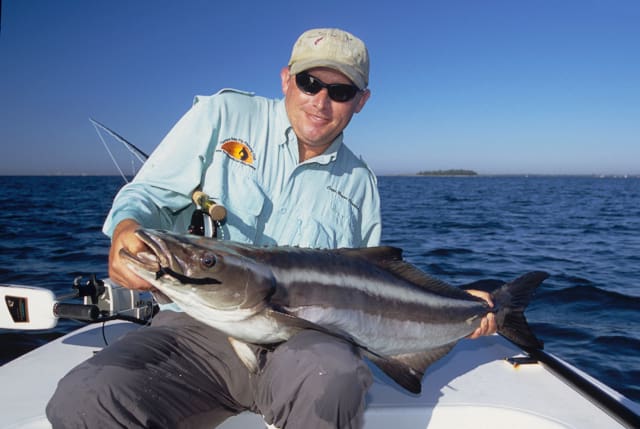
Chamberlin suggested a different pattern and I started to cut off the fly. For some reason, I waited a split second. Suddenly, a large brown shape morphed near the boat. Making a roll cast, I placed the fly 2 feet in front and watched as a large cobia inhaled the offering. This time I made a hard strip strike and relaxed my grip on the line as the fish bolted for the horizon. The cobia fought hard, making frequent head-shaking appearances at the surface followed by long runs into the backing. Thirty minutes later, Chamberlin lifted the 40-pound-plus fish for a few photos before we revived it and released it.

Unlike most fish, cobia are often easier to find and feed on a slack tide. When the tide is running hard, the rays feed on the bottom. When the tide starts to slow, the rays come back up to the surface and bring the cobia with them. Bright sunny days with light winds make for optimal conditions and could yield multiple shots.

This is definitely a hit-or-miss fishery, but it’s totally worth the effort when you have a chance at a 50-pound fish on a fly in Tampa Bay. Cobia can also be found along the beaches and over structure offshore in the fall. It’s a good idea to have a 10-weight outfit rigged and in the rod rack even if you’re not targeting cobia. They have a way of showing up suddenly and it’s an experience you won’t want to miss.

Reel Time: Catch and release redux

Reel Time: Catch and release redux

Catch and release is a term I haven’t heard much recently. I’ve actually seen postings on social media that make me wonder if maybe this important conservation tool needs to be revisited. Catch and release wasn’t commonly discussed in saltwater sport-fishing circles when I was growing up. It became prevalent when fish populations became stressed in the late 1980s and organizations like the Florida Conservation Association (now the Coastal Conservation Association) were being formed. Slowly, it caught on as an important tool to help flagging fisheries rebound.

Most anglers I know who practice catch and release have no problem with taking an occasional fish home for dinner. It’s more about enjoying the sport and trying to be proactive in helping it to remain healthy and viable. There are many species that have little or no food value that anglers seldom intentionally kill. But catch and release is not just about releasing fish that you don’t want, it’s also about releasing undersized and unwanted species. Catch and release is a wise use of the resource and that’s why it’s important that anglers know how to handle fish properly from hook set to release.

When we get cut or bruised, we can head for the local drug store, or in more extreme cases the emergency room. Not so for fish. In their world, it’s the sick and wounded that fall prey to predators. Releasing fish with a minimum of damage is important with a 6-pound trout, a 150-pound tarpon and everything in between.

Start by making sure you’re using the right tackle for the species being pursued. Trying to land a 100-plus pound tarpon on 20-pound tackle might be okay if you’re experienced, but to the uninitiated, it’s like announcing a free meal to sharks that ply local waters looking for weak or injured prey. You want to enjoy the action but land the fish as quickly as possible. Once you have the fish under control, it’s best to never take them out of the water.

It might be necessary to revive big fish. That’s best accomplished by slowly motoring forward while holding the fish underwater. They’ll let you know when they’re ready to be released.

The hook is another important consideration. Some anglers don’t like to bend their barbs down because they’re afraid of losing the fish. The key to keeping fish on a barbless hook is keeping a tight line. When you’re ready to remove the hook, use a de-hooker.

De-hookers will prevent you from having to handle your catch, keep your hands clean, prevent you from inadvertently harming the fish’s protective mucus membrane and come in various shapes depending on use. The simplest is J-shaped and removes hooks in or near the jaw. A circular-shaped longer version allows anglers to remove hooks that are deep in the throat of a fish. A set of pliers can also be used if the hook is easily accessible.

Anglers who fish for reef fish like snapper and grouper need to learn how to “vent” fish with inflated swim bladders. Bringing the fish up from deep depths quickly bloats their bladder, which has to be punctured to allow the fish to return to the bottom. For bigger, hard-to-vent fish like Goliath grouper, new technology uses a descender device to get them back down in good shape. Visit the Return ‘Em Right project web page to learn how to use the device and get one for free.

By being prepared, anglers can use proper catch and release methods to increase a fish’s chance of survival. Taking the time and having the tools and knowledge to release fish properly is a great way to help ensure healthy fish populations both now and in the future. Catch and release is an important concept that needs to be practiced and discussed among anglers.

Reel Time: The price of inaction

Reel Time: The price of inaction

Red tide. They’re probably the two words that nobody on or near Florida’s west coast wants to hear and I can understand why, sort of.

Someone who owns a resort hotel, has a restaurant on or near the beach or runs a business that takes people fishing or sightseeing depends on clean, healthy water for their livelihood. It’s easy for the average person to see that these businesses are negatively affected by red tide or even the mere mention of it.

What’s less obvious is that poor water quality affects everyone, from fishing guides to developers, realtors and builders, right down to the plumber sweating pipes in Lakewood Ranch. Humans seem to focus only on the things that directly impact us in the present, finding it easier to “kick the can down the road.” I suggest looking your children and grandchildren in the eye and asking yourself, “What part am I taking in creating and protecting the world they will inherit?”

We only must look back at the last five years for two haunting cases in point, starting with the harmful red tide algae bloom that devastated coastal waters from Naples to St. Petersburg and rendered Sarasota Bay a virtual wasteland. The result? In the last five years, Sarasota Bay lost most of the seagrass than had regrown in the past 20 years plus, if not more.

As if we needed another example, the disastrous release of over 200 million gallons of polluted process water from the legacy phosphate facility at Piney Point in late March 2021 led to the worst algae bloom in Upper Tampa Bay since the 1970s, killing thousands of tons of sea life. Piney Point is the perfect example of kicking the can down the road and running out of road.

Resident anglers have seen firsthand the decrease in water quality and the resulting loss of habitat, seagrass and its negative effect on local fisheries. Unfortunately, anglers and residents who recently relocated here see “the new normal.” Is it possible that we might consider what we’re leaving for future generations instead of how it affects self-interest in the here and now? This is not a new problem and I’m sure there were others saying the same thing when we first arrived here. But this is now and the time to act is slipping away.

If you want to see how the officials we elect represent us in enacting rules and regulations to protect our natural resources, consult the League of Conservation Voters.

The LCV is non-partisan and tracks the voting records of members of the Senate and Congress on environmental issues in its National Environmental Scorecard. This is a clear indication of how those tasked with representing our interests actually vote. Who we elect is critical to facing this problem. Politics is more divisive now than I can remember, but it’s critical that we elect politicians who represent our interests, not those with no vision who are concerned with division.

In the end, we all suffer the consequences. Vote, and consider joining and working with advocates like Suncoast Waterkeeper, Vote Water and Sarasota Bay Watch, groups working to educate the public, get them involved and hold politicians and municipalities accountable for their votes and action or inaction.

The time to act is the only time there ever is, right now. It won’t happen overnight, but it’s critical we begin now.

Reel Time: Guiding principals

Reel Time: Guiding principles

I have always been a great fan of fishing guides. They can provide a terrific initiation to the local waters and are indispensable when angling new destinations. Not only do you get the benefit of their extensive knowledge of where to find fish, but you’ll get a lesson in the natural world as a bonus.

Most guides not only take you to the action, but they will show you some of the area’s most beautiful natural areas. I know many experienced anglers who regularly fish with guides. They know that there is no substitute for the local knowledge gained from being on the water on a regular basis. They also appreciate the convenience of stepping on a boat, being taken to the fish, having the guide fillet fish if they decide to keep any, and not having to clean the boat.

While many people have the mistaken impression that guiding is an easy job, few people really appreciate the rigors of long days on the water. For anglers, an eight-hour day on the water translates into 10 or more hours for the guide. Not only do guides provide experiences that last a lifetime, many work tirelessly to protect the resources that we all too often take for granted.

My first introduction to guiding came in the 1980s when I was new to area waters. A friend invited me to fish with Holmes Beach guide Capt. Scott Moore. That first trip was a revelation to an angler new to the Gulf coast waters. Moore amazed us with his uncanny ability to find fish. He would literally say, “We’ll start over here and catch a trout, then move to that point and find snook and finally fish that mangrove edge for redfish.” And that’s just what we did. He introduced me to snook fishing, taught me lessons that have made me a better angler, and, most importantly, helped me appreciate the need to protect our marine resources.

I learned a lot of what I know fishing with guides, and they have saved me countless hours of frustration with their “tricks of the trade.” I learned how to remove a backlash from a spinning reel, how to find fish by looking for subtle signs, how to remove a hook from my hand, how to throw a cast net and so much more. Guides are not just anglers, but trained specialists that can help you find and catch fish on your own, if you listen and learn.

If you haven’t had the pleasure of a day on the water with one of the many professional guides in our area, I would encourage you to give it a try. When you do the math, it’s one of the wisest investments you can make for your fishing future. It’s also a great way to spend a day with friends and family and introduce kids to “catching.”  You’ll find information on local guides in the pages of The Sun every week, and I’ll share my experiences with the guides I still fish with regularly.

Reel Time: Never Stop Learning

Merriam Webster’s Dictionary defines learning as “knowledge or skill acquired by instruction or study.”

As most anglers will attest, that’s how we’ve gained the ability to successfully target (occasionally) different species of fish. That learning probably came from a plethora of sources. I count fishing guides, experienced anglers, the internet, television, books and magazines for a lot of what I’ve learned. If you’ve been around the water for any length of time, you’ve probably experienced that one of the best teachers of all is the mistakes we’ve made along the way.

I often vocalize the fact that “The more I know, the more I know how much I don’t know,” but recently that phrase came into sharper focus when I was fly fishing with an accomplished angler who is younger than I am. During several days on the water, he commented on several things I was doing that he thought, if changed, could improve my fishing. During that same time, I had a few critiques for him as well. At the time, both of us assumed we were right and the other was wrong. As it turned out he was right and so was I. I think in the end we both became better anglers as a result.

He criticized the fact that I trailed a few feet of fly line in the water when I was on the bow. I developed that habit as a way of getting a cast off quickly by being able to load the rod sooner, avoiding extra false casts. When I argued that the line being right beside the boat couldn’t possibly spook fish, in my mind I was right. As it turned out he was right and I was wrong, but for a different reason. As it turned out, not having that line in the water avoided getting it fouled with floating algae and grass and potentially blowing a shot at a fish. As it turned out, now that I have a few years of casting under my belt, I can get a cast off in plenty of time with less line. The trailing line wasn’t needed most of the time.

Stretching fly line before casting might not be necessary, but it’s a good idea to check for memory. – Rusty Chinnis | Sun

When he stepped up to the bow that same morning and didn’t stretch his fly line it was my turn for a critique. I make a habit of stripping off the line I think I’ll need and then cast it out and stretch it to be ready for a presentation. Most fly lines have what is called “memory” from sitting on the reel and form coils that can foul a cast in the guides if not stretched. The stretching relaxes the line. The day after that trip he texted me to say I would have laughed because he had chased a school of jacks on the beach and when he went to cast, the unstretched line fouled in the guides.

There are times when having a trailing line is useful, for example, when there’s poor visibility, and then only if you watch for floating debris. The same can be said for not stretching line when using a line with little or no stretch.

The lesson I learned in all of this is not to get fixed in doing something a certain way and becoming inflexible. Now I’ll attempt to listen first, reason, and argue later. The bottom line: Keep an open mind and never stop learning.

Reel Time on the Road: River of painted rocks

Reel Time on the Road: River of painted rocks

The river’s edge was garlanded with the lime green blush of early spring. Maples, oaks and sourwood trees lined the banks, punctuated with the blossoms of flowering dogwoods, eastern redbud and flame azaleas. The Creek Indians aptly named the river Chattahoochee, or river of painted rocks, a reference to the many colorful stones and rock outcroppings that occur in and along the banks of the river.

Wes McElroy paddled the raft through the shallow rapids, periodically dropping the anchor so Jimmy Harris and I could explore deep pockets on the river’s bottom where we worked flies and small jigs for shoal bass. This species of bass was only first described as a new species in 1999, having formerly been considered a redeye bass or a subspecies of the redeye bass. Resembling a smallmouth or spotted bass, shoal bass are found predominately in the Chattahoochee, Flint and upper reaches of the Apalachicola rivers, also known as the AFC Drainage that begins in the mountains of north Georgia and ends in the Gulf of Mexico.

This was my second time exploring this part of the river about 20 miles below the town of Helen, Georgia where McElroy manages and runs trips for Unicoi Outfitters, north Georgia’s premier fly shop. For many years I had fished the waters near the shop’s private waters on the Chattahoochee for trout. When I inquired about a new experience, McElroy encouraged me to try shoal bass fishing. I did my first trip with him in the fall of 2020, and although we hooked and lost several fish, the action was less than spectacular. When I asked him about shoal bass on my recent trip, he encouraged me to try again. According to McElroy the bass are preparing to spawn in late April and are easier to target in the areas they congregate prior to the spring ritual. Over the years I have developed a friendship with Harris, Unicoi Outfitters co-owner, and invited him to join us on the float.

Reel Time on the Road: River of painted rocks
Jimmy Harris, co-owner of Unicoi Outfitters, prepares to release a 20-plus inch shoal bass as Wes McElroy looks on. – Rusty Chinnis | Sun

We launched McElroy’s inflatable raft at the Route 115 bridge southeast of Cleveland, Georgia for a five-hour float to the pullout where the Duncan Bridge crosses the Chattahoochee. After dropping me off with the raft, McElroy took his truck to the takeout where he met Harris. The two then returned and we slid the raft down a steep embankment to the river’s edge. This trip we were rewarded with multiple shoal bass on fly and spin tackle and one of the most scenic float trips I have ever taken. The productive fishing was interspersed with slower-moving, less productive sections of “frog water,” where McElroy encouraged us to sit back and enjoy the scenery.

It took me a few missed strikes to get the hang of hooking these elusive bass as our guide coached me to feel for the tap, tap of a bite before setting the hook when the pressure was consistent. While not every section of the river produced fish, the ones we caught were “quality” fish, several ranging between 20 and 21 inches. In a run between two pools, I hooked a fish that peeled line off the reel in a number of hard surges, atypical of the more dogged fight of the shoal bass. As it turned out, I had hooked into one of the hard-fighting striped bass that also inhabit these waters. Over the course of the afternoon, we caught and landed numerous bass and had several doubles. This had been an excellent reintroduction to a completely different kind of fishing experience and I eagerly await a rematch.

McElroy can be reached at Unicoi Outfitters at 706-878-3083, and by visiting their website. If you’re looking for a great day on the waters of north Georgia, whether you’re seeking trout, stripers or shoal bass, the guides at Unicoi Outfitters can feed your passion.

Reel Time: Tie one on

Reel Time: Tie one on

I have to begin this article with a confession. I have known how to tie flies for a long time but have been too lazy to tie my own for far too long. First it was guide friends who tied them for me. After that I would tie out of necessity, or buy a few flies for a trip to the Bahamas or Belize. I found out how rewarding it was to tie a fly and then catch a fish on it a long time ago too, but it was my last trip to the Bahamas that changed all that.

As it turned out I had again hurriedly ordered some flies from a “reliable” source, choosing a few old classics as well as my current favorite, the Peterson Spawning Shrimp. As it turned out, the flies I ordered didn’t match my expectations, probably more a case of “operator error” on my part. Fortunately, two friends in my party offered me some of their flies. I got bailed out on that trip and despite some challenging conditions managed to catch some quality fish. Then and there I vowed that the next trip I took I’d have a box of my own home-tied creations. Fast forward to today, 10 days from my next trip to the Bahamas. This time I have seven flies tied and am on track to have a quiver of ammunition that I have confidence in. And confidence is key!

In my experience flies don’t have to be fancy to catch fish. They do have to resemble something a local species feeds on and appear natural in the water. Two of the most reliable patterns mimic baitfish and shrimp. Probably the most basic and one of the most effective and popular flies is the Clouser Minnow, created by Bob Clouser. This was the first fly I learned to tie and is still a favorite. Another favorite is the bendback, a streamer tied to be “weedless” and fished in shallow water. The bendback is also easy to tie and very effective when properly tied and presented. As mentioned, my current favorite fly and one that’s a lot more complicated to tie, the Peterson Spawning Shrimp, has gotten me tying flies and enjoying the process. Fly tying is like anything else, the more you do it, the better you get. Then suddenly you find yourself working a little harder than might be necessary to please both you and the fish.

The effort paid dividends locally when my friend Benny Parrish and I came in second in The Waterman Fly Fishing Tournament a benefit for Tampa Bay Waterkeeper. I caught all my fish on the Peterson Shrimp pattern I tie for bonefish. It was after that that I realized almost every species in both fresh and saltwater feed on shrimp, which further boosted my confidence in the pattern. If you currently tie, my advice is to master a fly you have confidence in and then work to make a fly your own. I’m constantly thinking of ways to improve the patterns I fish and finding my enjoyment of fly fishing enhanced by the experience.

I would strongly advise fly anglers to take up fly tying if they haven’t already. Start with a simple travel kit so once you’re committed you’ll be able to continue using it. Maybe then you’ll upgrade your equipment and even carve out a place dedicated to tying flies. Not only will you enjoy the experience more but you’ll have better quality flies at a much better price. Instruction on tying every imaginable fly is available on YouTube so please excuse me while I “tie one on.”

Reel Time: We’ll see

Recently I was intent on fishing an area that has become one of my favorite haunts.  Unfortunately, when I got there, another boat was anchored nearby. As I started working my way towards my intended target, yet another boat pulled up behind me, intent on heading in the same direction. My first reaction? Disappointment crept over me and I was thinking my carefully planned strategy had failed me.

Then I remembered a fable I had read in a book by Zen master Thich Nhat Hahn. In a parable from his book, “The Art of Living,” the poet, global spiritual leader and international peace activist tells the story of a farmer’s son who fell off his horse and broke his leg. His neighbors tell him how unfortunate that is. His response? “We’ll see, we’ll see.”  Two weeks later the military comes to conscript new recruits for a war and his son was not taken because of his broken leg. Once again, the neighbors chime in, this time saying how lucky he and his son are. His response, once again, is, “We’ll see… we’ll see.”

Suddenly my mindset changed and I saw this as an opportunity to maybe actually benefit from what had initially been my frustration. Although there wasn’t any catching involved, I fished a place close by and discovered some promising areas I had never explored. I’ll definitely return there again as I’ve learned over the years one certain fact about fishing (thank you Captain Scott Moore), “Fish move around!” How many times over the years have we as fishermen developed a plan that was altered by factors out of our control? Wind, rain, cold, heat, tides, competition for territory and a hundred other things conspire to alter and sometimes completely destroy a well-thought-out plan.

While it doesn’t always turn out to be advantageous, who hasn’t in hindsight looked and found perceived disruptions to be “blessings in disguise?” Over-optimistic, you say? Maybe, but I’d rather look for the proverbial “pony under there somewhere” than let disruption ruin my day.

Don’t get me wrong, I am totally a fan of having a plan for my fishing. I’ll check tides, wind and myriad other factors to try and develop a strategy to improve my odds of catching fish. Having said that, it’s good to have a backup plan that includes addressing the actual conditions you find on any given day. Maybe it’s the fact that I’m not really good at finding fish. I jokingly ”and fully in earnest” comment on the fact that fish and I don’t see things alike; the places I find that should hold fish don’t seem to appeal to them.

Then there’s the strategy of being persistent, definitely an advantage as fish get more spread out, pressured and spooky. Another seasoned fishing guide has a saying that resonates with me. Captain Steve Huff, arguably one of the best guides the Florida Keys ever produced, likes to tell anglers who seek his advice, “pole far enough and the fish will find you.” My advice? Go out with a plan but be willing to make a change. Will that strategy pay off?

We’ll see, we’ll see.

Reel Time: The Waterman

Reel Time: The Waterman

The second annual Waterman Fly Fishing Tournament was held last weekend. The two-day, fly-only redfish tournament and snook Calcutta had 114 two-member teams and three single-angler teams.

The fishing boundaries were wide, including the west coast of Florida from Crystal River to the southernmost tip of Sanibel Island. The photo submission format and the IAnglertournament App made it possible for fishermen in this entire range to participate. The tournament culminated in an awards banquet and prize-rich raffle at the Bradenton Yacht Club on Sunday evening that was made possible by a large number of generous sponsors. All proceeds from the Fly Fishing Tournament benefited Tampa Bay Waterkeeper, a non-profit organization that is dedicated to the protection, preservation and improvement of the Tampa Bay watershed.

Two-angler teams received two, long-sleeved microfiber tournament shirts, two Tampa Bay Waterkeeper hats, dinner for two anglers at the awards ceremony and one raffle ticket for each angler. Target species were redfish and snook. Scoring was done by the highest combination of the two longest redfish caught between Day 1 and Day 2. If a tie had occurred in any of the three top places, it would have been decided by a casting competition based on fly casting distance and accuracy.

Sponsors were pivotal to this event and the fishing community stepped up to support TBWK’s mission. Some of these included a $5,000 donation from Tampa-based primary care physician Antonio Castellvi MD and his wife, Christine, a Helios 3D Fly Rod 8wt. four-piece rod donated by Orvis, a Pro Dry jacket and pants donated by Simms Fishing Products, fishing trips by Capt. Derek Rust, Rusty Fly Charters, Capt. Greg Peterson, Head Shot Charters, Capt. Dustin Pack, Fly Tide Charters, Capt. Brian Jill, Lost Coast Anglers and Capt. Bucky Goldman.

Others included Two License Plate Fish Art pieces compliments of Cody’s Fish, fly lines by Cortland Line Company, gift cards from the Compound Board Shop, Sarasota’s go-to fly shop, a $250 gift card from Tampa Fishing Outfitters, a Tailing Redfish original acrylic on watercolor paper by internationally-recognized Florida Keys artist Tim Borski and an NRX + T2s 11wt. fly rod courtesy of G. Loomis. See the full list of sponsors at Tampa Bay Waterkeeper’s website.

Participants were greeted upon entering the yacht club with fresh oysters from Lost Coast Oyster Company, which aims to revitalize the lost industry along Florida’s Gulf Coast and become a leader in sustainable aquaculture practices.

Of the 117 teams that competed (only three of which were single-angler teams), some large redfish were landed during a close two-day event. In the end, the winners were Sean Kersting and Trip Saunders with two fish totaling 67.25 inches. My fishing partner, Benny Parrish, and I came in second with 64.75 inches. The team of Mike Rogel and Jeff Harrell won third place.

Anglers were pleased with the numbers of redfish that were spotted and landed but concerned with the condition of the bay. That sentiment was shared by tournament organizer and TBWK board member Adam Fernandez in his introduction at the evening’s awards ceremony and raffle. Other speakers included Maya Burke from the Tampa Bay Estuary Program and Justin Bloom, founder of Suncoast Waterkeeper. Kudos to all the sponsors, anglers and TBWK board members that made this event such a big success.

Reel Time: Before you go

Getting on the water can be challenging for the average angler. Life often gets in the way of your favorite pastime and finds you unprepared when opportunity arises. Maybe it’s the “chance” day off or an unexpected invitation that has anglers grabbing their gear, putting it on a boat and heading out. Being prepared before you go and after can guarantee a better chance at success on those special days.

One way to make sure you’re ready when opportunity arises is to create a checklist that you follow before you head out to make the first cast, and one that prepares you for your next outing. With a little due diligence, you can avoid the mistakes that cause you to lose opportunities and fish, mistakes that can be easily avoided.

Here are a few things I include on my checklist, before and after a trip. The hook is one of the smallest but most important components of an effective rig. It’s also one of the easiest things to forget to check. A hook that was razor sharp the last time you used it can become dulled in numerous and unnoticed ways. Contact with the rub rail of the boat, structure in the water, guides and many other objects can cause a hook to lose its edge. Check the hook on your fingernail, if you touch it there and it doesn’t slip, you’ll know it’s sharp enough. It’s always a good idea to have a hook sharpener on hand and touch up the point several times during your outing.

Having tackle and accessories ready before you go will increase your chances for a successful day on the water. – Rusty Chinnis | Sun

Knots are probably the second leading reason fish are lost. Even the best-tied knot will break if it’s not tightened. You may tie perfect knots but there’s a chance they could loosen between trips. Always make sure you moisten knots before tightening them, and draw them up very tight. The first place a leader will break is at a knot when it slips.
Checking the drag is, of course, one of the most important things you can do. Make sure your drag is smooth. I would suggest having the drag set so you don’t have to touch it while fighting a fish. Equally important, loosen the drag when not fishing, which prevents the drag washer from becoming compressed.

Checking leader and line for nicks and abrasion is another must. It’s easier to cut off a small section of leader and re-tie than to lose a good fish to an imperfect line. Fly anglers should always stretch their fly line before making the first presentation of the day. Fly line has memory and will come off the spool in small loops that can tangle easily, causing you to break off a fish. Strip off the line you’ll be casting, make a cast and gently stretch it as you retrieve it. It doesn’t hurt to repeat the process during the day.

Each time you step to the bow, make sure your knots are tight, the drag is properly set, hooks are sharp, leaders are abrasion free and fly line is stretched. It only takes a minute but might just save the day. On the trips when you find willing fish, your preparedness will turn opportunity into memories. While you’ll always lose fish, even when everything is right, you’ll definitely have a better chance if you develop and follow a simple check list.

Finally, consider keeping flies, lures, leaders, nippers and other essentials ready to go in a boat bag. Check the list, grab your rod, reel and pack and enjoy the fruits of preparing before you go. Tight lines!

Reel Time: Scallopalooza is ‘Clamtastic!’

On Saturday night, Feb. 12, Sarasota Bay Watch (SBW) held its 11th annual major fund-raising event, “Scallopalooza, It’s Clamtastic,” at the Sarasota Hyatt Regency Hotel. The yearly event was another sellout and at the time of this writing final totals are still being tabulated.

I was impressed at the overwhelming community support that was shown for Sarasota Bay Watch’s efforts and estimate that close to 400 people were in attendance. SBW’s event coordinator, Ronda Ryan, worked with volunteer Jen Zak, the SBW Board and Scallopalooza Committee Chairs Brian Jung, Al Jeffery, John Ryan and Ernesto Lasso De La Vega to organize an event that highlights the importance of, and support for, local nonprofits that stress the importance of clean water.

The evening began with live music, an open bar and a large silent auction including art work, event tickets and merchandise of every description as participants mingled to share their passion for Sarasota Bay. Event Chair Brian Jung welcomed the crowd and thanked them for their support while keeping everyone apprised of the auction items and encouraging them to visit the tables. Ernesto Lasso De La Vega gave an inspirational introduction to the clam restoration project, speaking about the scientific documentation that the group is currently involved in. John Ryan, a founding member of Sarasota Bay Watch, was next and explained the motivation and purpose of SBW’s many projects and emphasized the group’s non-partisan “fun” approach to conservation. Ryan cited SBW’s many activities including island and rookery cleanups, citizen and student education and much more.

Island entrepreneur and conservationist Ed Chiles took the podium after dinner and encouraged the attendees to support the efforts by turning dollars into clams and offered a substantial match to those who might join the effort. Another prominent Anna Maria Island business owner, Ben Webb, made a major contribution to the efforts that raised the funds to implement the ongoing “Clampaign” to stock 1.5 million clams in the coming year. WWSB TV’s Channel 7 weatherman Bob Harrigan, one of the area’s most popular and respected broadcasters, gave a rousing speech lauding the group’s efforts. Harrigan has been promoting those efforts since SBW’s first-ever Scallop Search in 2008.

The city of Anna Maria is currently considering a similar project to prove the efficacy of using clams to help mitigate red tide algae blooms and encourage the growth of threatened seagrass beds.

To get involved with the work SBW is doing to protect Sarasota Bay and support their mission, visit their website. As they say, “A Healthy Bay is Everybody’s Business,” literally and figuratively!