ANNA MARIA – Mote Marine’s contracted architect, Barron Schimberg, has begun work on the plans for a marine educational outreach center on the City Pier.
The center was originally expected to open in early 2022. In late April, the Anna Maria City Commission gave Mote Marine a lengthy extension that now anticipates the facility opening by March 2023.
During that April meeting, the commission gave Mote Marine until Aug. 13 to begin the long-delayed design and architectural work on the center, to be located in a city-owned building at the end of the City Pier and operated by Mote Marine. The commission also set an October deadline for those architectural plans to be completed and submitted to the city.
Mayor Dan Murphy provided the commission with a brief status update during the commission’s July 14 meeting.
“We have an assurance from Mote Marine that we’re on track. In fact, just yesterday, Mote Marine, along with the architect, were out on the pier taking measurements and doing reviews. That architectural process has already started. They have a signed agreement with the architect. October 10th is the delivery date back to the commission and that has been reinforced as well. I wanted to give you an assurance that we’re on track this time and things look good. If there’s any variance to that I’ll let you know. I feel comfortable that they’ll meet the deadline of October 10, maybe sooner,” Murphy told the commission.
ANNA MARIA – Five months after an apparent collision with a boat left him with multiple injuries, a rehabilitated green sea turtle nicknamed “Pierre” by Mote Aquarium staff was released back into the wild on July 5.
Pierre had been found on Jan. 31 floating on the water’s surface near the Anna Maria City Pier. He had suffered multiple fractures and a large piece of his carapace – or upper shell – was damaged, but there was no neurologic damage.
“Veterinary Surgery Center of Sarasota was kind enough to do a CT scan for us to determine the extent of the trauma,” Mote Sea Turtle Rehabilitation Hospital Aquarist Weston Spoon said.
Pierre had numerous fibropapilloma tumors, which were surgically removed. After a second surgery to remove a tumor on his eye in May, he continued to gain weight and eat well.
Following his successful recovery, workers from the facility released Pierre into the waters off Bayfront Park, a short distance from where he had been found.
“He was found stranded near the City Pier, so it’s best to release them near where they’re stranded,” Spoon said, adding that Pierre is expected to acclimate easily back into his watery environment.
“Studies have been done that show they will go about their lives just as before,” Spoon said.
Mote’s Sea Turtle Rehabilitation Hospital has admitted more than 650 sick and injured sea turtles since 1995.
“We aim to help all our turtle patients return to the wild and contribute to their populations for years to come,” according to the Mote website. “This matters greatly: All sea turtle species are threatened or endangered.”
While it was difficult to determine Pierre’s age, Spoon said he was a juvenile less than 10 years old. Green sea turtles have a life expectancy of up to 80 years, according to the U.S. Fish and Wildlife Service. They are far less common in the waters off Anna Maria Island than loggerheads, but both nest on area beaches from May through October.
ANNA MARIA – The city and Mote Marine Laboratory have agreed to a lease addendum formally establishing the deadlines for Mote to begin and complete the installation of its Anna Maria City Pier Marine Education Outreach Center.
In a 4-1 vote, the commission approved the requested lease addendum on Thursday, April 28, with Commissioner Mark Short casting the lone dissenting vote.
Mote’s requested project timeline extension was previously discussed and tentatively approved by the commission during a special meeting on Friday, April 22. Short also voted against the project at that time.
During that meeting, it was noted Mote Marine’s preferred architect, Barron Schimberg, had not yet begun the design and engineering work for the interior buildout of the city-owned pier building and the installation of the live marine exhibits, but had committed to starting that work on Aug. 18.
Deadlines established
The one-page lease addendum includes date-specific deadlines and milestones Mote must meet.
According to the approved lease addendum, the formal design and engineering process for the Mote outreach facility must begin on or before Aug. 18. The completed plans must be submitted to the city on or before Oct. 13. The interior buildout of the city-owned pier building and the subsequent installation of the live marine exhibits must begin seven days after the city issues Mote its needed building permits. Mote must apply for a certificate of occupancy no later than 12 weeks after the city permits are issued and the grand opening is to take place no later than four weeks after the city issues Mote Marine a certificate of occupancy.
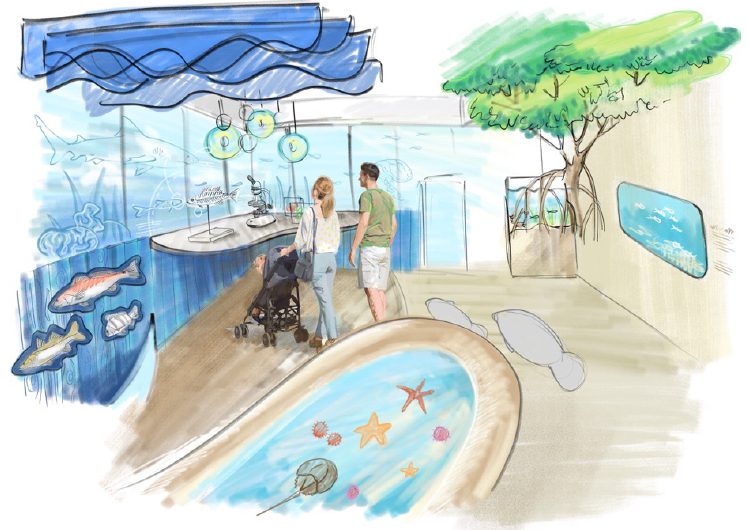
The Anna Maria City Pier Marine Education Outreach Center will feature live and virtual exhibits. – Mote Marine | Submitted
During the commission’s April 28 meeting, Mayor Dan Murphy said the agreed-upon deadlines are expected to result in a March 1, 2023, grand opening for the Mote Marine outreach center.
According to the lease addendum, “Mote shall comply in all respects with the following schedule as to the design and buildout of the premises. Mote’s timely performance of the above work and schedule is required as a condition of the lease, excluding ‘unavoidable delays’ as defined in Section 28 of the lease signed September 30, 2021.”
Section 28 of the original lease pertains to “impossibility of performance” and states: “For purposes of this lease, the term ‘unavoidable delay’ shall mean any delays due to strikes, lockouts, civil commotion, war or warlike operations, acts of terrorism, acts of a public enemy, acts of bioterrorism, epidemics, quarantines, pandemics, invasion, rebellion, hostilities, military or usurped power, sabotage, government regulations or controls, inability to obtain any material, utility or service because of governmental restrictions, hurricanes, floods or other natural disasters, acts of God or any other cause beyond the direct control of the party delayed.”
The lease addendum notes: “In the event of default on the part of Mote, the Anna Maria City Commission shall have the authority to cancel the lease at the reasonable discretion of such city commission.”
Funding
As approved by the Manatee County Commission in 2021, the county will provide the initial $500,000 for the interior buildout and exhibit installation using money from the county’s 5% tourist tax levied on lodging establishments, including vacation rentals, which operate within the county.
Mote is responsible for any initial buildout and installation costs beyond the county’s initial $500,000 investment. Mote will also provide, at its own expense, the staff members and volunteers needed to operate the outreach center. Mote will occupy the city-owned structure rent-free during the initial five-year lease period which also provides Mote with an option for a five-year extension. The city of Anna Maria will pay the utility expenses associated with Mote Marine’s use of the City Pier and pier building.
Live exhibits
On April 22, the commission majority accepted the conceptual exhibit plans presented by Mote Marine representative Kevin Cooper.
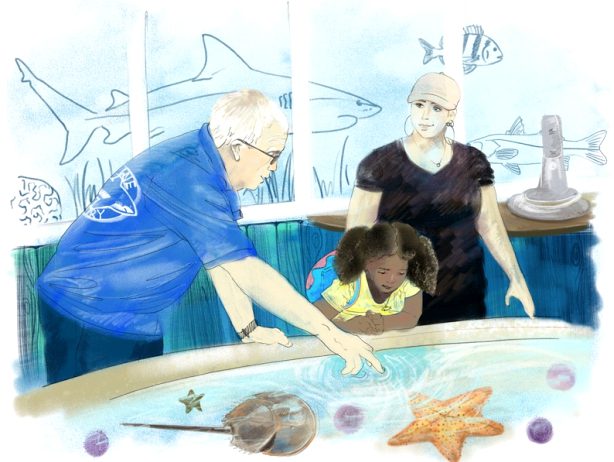
The invertebrate touch tank is the centerpiece of the proposed marine education outreach center. – Mote Marine | Submitted
The conceptual plans propose four separate live exhibits that include an invertebrate touch tank, a live mangrove exhibit, a live grass flats exhibit and a fourth live exhibit that will use cameras and an underwater hydrophone allowing visitors to see and hear the marine life and marine environment under the pier.
If and when the Mote Marine outreach center opens in 2023, admission will be free for the public.
ANNA MARIA – Mote Marine Laboratory now has until March 1, 2023, to complete its installation of the Anna Maria City Pier Marine Education Outreach Center.
While the project will be a year late, it will include live marine exhibits withdrawn from the original plan.
During a special meeting on April 22, the Anna Maria City Commission voted 4-1 in favor of granting Mote Marine an extension of the original 180-day interior buildout and exhibit installation timeframe. Mote and the city agreed to the six-month deadline in late September when the two parties entered into a rent-free, five-year lease agreement for Mote’s use of the larger of the two city-owned buildings at the T-end of the City Pier. The smaller pier building is occupied by the City Pier Grill & Bait Shop.
The marine outreach center will be installed in the pier building to the right of the breezeway. – Joe Hendricks | Sun
Commissioner Mark Short opposed the 11-month extension, which must still be formalized by an amended lease agreement to be approved by Mote and the commission at a future meeting. Because he was recently exposed to someone who tested positive for COVID-19, Short participated in Friday’s meeting remotely as a precautionary measure.
When the original lease agreement was signed in September, Mote Marine representative Kevin Cooper said he anticipated the outreach center opening in March. That March deadline passed without Mote submitting any detailed engineering plans for the interior buildout and exhibit installations.
Kevin Cooper presented Mote Marine’s extension request and latest conceptual plans. – Joe Hendricks | Sun
When requesting the extension on Friday, Cooper said Mote’s architect, Barron Schimberg, committed to starting the formal design and engineering process on Aug. 18. Schimberg previously engineered the City Pier for the city of Anna Maria.
Mayor Dan Murphy and the commission stipulated that once the design and engineering work begins on Aug. 18, Schimberg and Mote will have eight weeks to submit the finished plans for commission approval. If either design and engineering deadline is missed, the commission will consider terminating the project. Murphy noted the “drop-dead deadlines” will be formalized in the amended lease agreement.
Conceptual plans
During Friday’s meeting, the commission also reached majority consensus in support of the latest conceptual plans presented by Cooper. The conceptual plans consist of five colored renderings of Mote’s latest proposed exhibits, including four live exhibits that will collectively use approximately 1,000 gallons of circulating seawater.
The invertebrate touch exhibit is to be the centerpiece of the marine educational outreach center. – Mote Marine | Submitted
“The centerpiece is the invertebrate touch exhibit,” Cooper said. “What we’ve found in our experience is the best way to educate individuals about the importance of marine science, conservation and preservation is to bring them closer to it – and you simply can’t get closer than having your hands in the water touching the species. It’s fully interactive. The rest of the exhibits are visual.”
The conceptual rendering of the touch exhibit includes a horseshoe crab and starfish.
Cooper said the mangrove exhibit will feature a mangrove tree and live marine species inhabiting the mangrove’s submerged root system. The grass flats exhibit will feature marine species found near the City Pier, including Gulf killifish, mojarra, stone crab and more.
The grass flats exhibit will feature the type of marine life found near the City Pier. – Mote Marine | Submitted
The fourth live exhibit will use live cameras and a hydrophone that provide real-time sights and sounds of the actual marine life and environment under the City Pier.
The interactive and educational exhibits will also include microscopes, a puzzle-like fish identification exhibit that allows youngsters to hone their motor skills; a “Draw Alive” virtual exhibit that allows visitors to create digital marine life images projected on a display screen and an exhibit that allows visitors to create textured rubbings of fish and other marine life, which they can take home free of charge.
The proposed exhibits include an interactive game fish identification exhibit. – Mote Marine | Submitted
“Our goal is informal marine science education. We don’t want this to be something where someone comes in and looks around for two minutes. The mix of the live and interactive exhibits turns into a timely experience where they can come in and spend an hour or two learning,” Cooper said.
Cooper said the outreach center would accommodate 24 people at a time according to the state fire code. He said the outreach center would have up to three employees and/or volunteer docents present during school field trips and one or two staff members and/or volunteer docents present during normal operations.
Comments and feedback
Cooper said Mote Marine President and CEO Dr. Michael Crosby could not attend Friday’s meeting because he was visiting a Mote facility in the Florida Keys.
Cooper said he listened to a recording of the April 14 city commission discussion during which the mayor and commission expressed frustration with Mote’s ongoing delays. During that meeting, Commissioner Deanie Sebring expressed her concerns about the revised exhibit plans Mote submitted in January.
The revised plans proposed all virtual exhibits and none of the live exhibits Crosby originally presented in February and March of 2021 when the commission voted 4-1 to pursue the Mote outreach center.
The virtual exhibits were proposed in part due to concerns about the new pier being able to support the weight of the water-filled exhibit tanks. Those weight-bearing concerns have since been alleviated by third-party structural engineers.
On April 14, Sebring also questioned whether the proposed virtual exhibits were meant to simply serve as advertisements for the new aquarium Mote plans to build in Sarasota.
When addressing that concern, Cooper said, “I heard a concern that Mote was transitioning this partnership into a way to promote our aquarium. Nothing could be further from the truth. We are committed to operating and educating on this site free of charge. It’s much more likely that the Mote aquarium will support this project rather than the other way around.”
Cooper also addressed the delay-related frustrations expressed during the April 14 meeting.
“We share in that frustration. This process isn’t limited by Mote’s desires, determination or imagination. We’ve been limited largely by physics and third-party opinions, time frames and commitments. We’ve worked with four engineers and two architects. We’ve only been able to get one of those six committed to work on the project,” Cooper said.
During Friday’s meeting, Sebring was among those questioning Mote’s lack of progress.
“We’ve been sitting here for a year and no design has been done. I wonder what the heck has been going on?” she said.
She also noted many citizens have expressed similar anger and frustration on social media.
During public input, Anna Maria resident and retired marine biology Scott McGregor said the Mote outreach center may be a good idea, but not in the city-owned building that he and others would rather see leased to a restaurant operator.
Anna Maria resident Dan Devine said, “It’s been a year and this is what we have so far? We basically have rough drafts here. Why do we think it will only take eight weeks?”
Before voting against the extension, Short said, “I am very frustrated with how this has played out. The lease was signed at the end of September. This is the design we got, which doesn’t look too dissimilar from the concept that was provided to us a year ago. I understand certain things had to be done, but I’m really surprised the progress isn’t significantly further than where it is.”
ANNA MARIA – Dr. Michael Crosby and his Mote Marine Laboratory associates have until Friday to present the final conceptual plans for an educational outreach center on the City Pier.
Mote’s latest plans are expected to be presented during a special Anna Maria City Commission meeting on Friday, April 22 at 2 p.m. The commission is willing to abandon the project if Friday’s deadline is missed.
On Sept. 30, Mote and the city of Anna Maria entered into a five-year, rent-free lease agreement that would allow Mote to occupy the larger city-owned building at the T-end of the City Pier. The smaller pier building is occupied by the City Pier Grill & Bait Shop.
The pier building’s bayside windows provide a view of Tampa Bay. – Joe Hendricks | Sun
In September, Mote Marine staff member Kevin Cooper said he expected Mote to complete its interior buildout and exhibit installation by March and open the facility soon thereafter.
As of Thursday, April 14, Mote officials and their contracted architect, Barron Schimberg, had not yet submitted their final plans for the long-delayed facility. Schimberg previously served as the city’s contracted architect for the pier replacement project completed in 2020.
The original plans presented in early 2021 included live marine exhibits. – Mote Marine | Submitted
The original plans that Mote presented in early 2021 featured live marine exhibits. In January, Mote provided the city with an alternate plan that featured virtual exhibits instead. Murphy said then that the city commission would ultimately decide whether the Mote facility includes live exhibits, virtual exhibits or both.
Project update
On Thursday, April 14, Murphy provided commissioners with a project update.
“We’ve had numerous false starts. I anticipated having a proposal for you today. I also anticipated having a proposal for you two weeks ago and a month ago. None of those have happened. For various reasons, the goal post has been moved several times. We’re now at the point where there’s no more moving the goal post. I had a conversation with Dr. Crosby last night. I told Dr. Crosby how disappointed I was that we didn’t have a proposal ready. They have all the information necessary to put together a proposal. This latest delay was caused by the architect. He had all the information, but didn’t have the time to put it together,” Murphy said.
“We have a lease contract that we signed back in September and that lease contract gave them 180 days to produce and/or request an extension. I’m here today to give you two options. You can enforce the contract as it is and decide to not extend it any further. This is the end of it and we tell Mote farewell and move on. The other option is that they have a proposal to us by Friday of next week. I propose to you that we’ve gone this far and that we go one more week,” Murphy said.
Murphy expects Friday’s presentation to include visuals, live exhibit examples and non-negotiable start and completion dates.
Commission feedback
In September, Commissioner Mark Short opposed the commission’s 4-1 decision to pursue an educational outreach center rather than a full-service restaurant or open-air cantina.
Commissioner Mark Short expressed his frustration during the April 14 meeting. – Joe Hendricks | Sun
During the April 14 meeting, Short said, “This Mote exhibit was supposed to be done now and we don’t even have the final plans yet. There’s been delay after delay. There’s nothing to show a year after the commission agreed to move forward with Mote and 180 days after the lease was signed. I’m fine giving them another week, but I just don’t think this is the right path to go down.”
“It’s been an extreme disappointment,” Commissioner Deanie Sebring said.
Sebring said the proposed shift to virtual exhibits seems to be an attempt by Mote to use the City Pier to advertise the new Mote Science Education Aquarium being built in Sarasota.
“What they offered us was something that was going to be quite unique and incredible and it’s turned into nothing. It’s disheartening. I’m getting a bad taste in my mouth thinking they’re not going have any live exhibits,” Sebring said.
The alternate plans provided in January proposed virtual exhibits. – Mote Marine | Submitted
Commissioner Robert Kingan said, “I completely agree. I think we should give them one more week, but that’s it. They’ve had ample time to make preparations.”
“I kind of agree, but my vision is a little longer-range. I think this project has the potential to be fabulous. I’m happy to give them another week,” Commissioner Jon Crane said.
“I agree with all of you. I’m disappointed that it’s taking so long, but I do think it will be a good project,” Commissioner Carol Carter said.
Murphy told Mote officials the city doesn’t want virtual exhibits.
“What we signed up for was live exhibits,” he said.
“The commission has to decide: Do you fish or cut bait?” he added.
The commission unanimously agreed to give Mote until Friday to present its final plans.
County support
In June 2021, the Manatee County Commission agreed to provide $500,000 for the design, interior buildout and installation of the Mote facility, with Mote covering the remaining $40,000-$50,000 in estimated start-up costs. Mote also agreed to staff the facility at its own expense for the duration of the lease, with the city covering the utility expenses.
County Commission Chair Kevin Van Ostenbridge attended Thursday’s meeting. He left before the Mote discussion ensued, but he addressed the commission before departing.
County Commission Chair Kevin Van Ostenbridge encouraged city officials to continue supporting the proposed Mote Marine facility. – Joe Hendricks | Sun
“I know there have been a significant number of delays. I share your frustration, but I think the project is a great project. I advocated strongly for the project and I was able to get our board to unanimously approve a half-million dollars for the project. I think it will be worth the wait,” Van Ostenbridge said.
“I did speak with Dr. Crosby this morning and he assured me that Mote now has all the information they need to move forward with the engineering. They want to make sure the pier can hold what they put out there and withstand the weight of the exhibits. There will be aquariums. There will be live exhibits. It sounds like things are headed in the right direction,” he said.
ANNA MARIA – The community scientist program at The Center of Anna Maria Island is getting off to a great start thanks to some help from students at Eckerd College and Mote Marine Laboratory and Aquarium staff.
A volunteer takes a reading testing water temperature and pH levels. – Kristin Swain | Sun
Small groups of Eckerd College students are coming each Saturday morning to The Center to train with staff from Mote on the equipment they’ll be using. Part of the training involves how to take the water samples and video needed to observe the effects of the mini reefs from Ocean Habitats installed as a part of a fundraiser for the nonprofit. These students are the first of the community volunteers being trained to study the effects of the mini reefs on the local waters and marine life. Students will travel around the Island to the mini reef sites to conduct water testing and video the condition of the reefs. This also helps keep track of all of the reefs and observe any maintenance issues requiring attention. Community scientists will test the water for the presence of harmful algae blooms such as karenia brevis – red tide – keep track of water temperature and pH levels, and study the organisms making the mini reefs their home.
Once the program is better established, The Center’s Director of Development, Jim McDaniel, says he hopes to open it up to Island resident volunteers and others in the community.
The program is the brainchild of McDaniel, who said he hopes to expand it in the future while also providing an important resource in the fight to mitigate the effects of red tide, which can cause fish kills, skin irritation and breathing problems.
Currently, there are 166 mini reefs installed in the waters around Anna Maria Island and west Bradenton as a result of The Center’s partnership with Ocean Habitats.
BRADENTON – Manatee County commissioners have committed $5 million in Manatee County tourist tax funds to Mote Marine Laboratory in Sarasota County for marketing over the next five years.
Mote, which operates marine mammal and sea turtle rehabilitation facilities, an aquaculture facility, and conducts research into coral bleaching, red tide and other marine issues, previously requested $15 million to help build its planned Science Education Aquarium (SEA) at Nathan Benderson Park. However, Manatee County Attorney William Clague told commissioners at the time that Manatee County tourist tax proceeds can’t be used for construction projects outside the county, and commissioners declined the request, deciding to look for other ways to assist the organization.
The Manatee County Tourist Development Council (TDC) decided last month to recommend that county commissioners approve a reduced commitment of $1.25 million over 25 years, or $50,000 a year.
But county commissioners decided on Tuesday, Feb. 25 to raise that amount to $5 million, or $1 million a year for five years, earmarking the funds for marketing, not construction.
“I believe that right now we have an opportunity that we have not seen before and I’m not sure we’re going to see it again,” said County Commissioner and newly-appointed TDC Chair Misty Servia, who explained that she supports Mote as a means to improve water quality.
Reduced water quality could lead to reduced tourism, while improved water quality will support ecotourism, she said.
Commission Chair Betsy Benac agreed with Servia that supporting Mote is an “incredible opportunity.”
The board vote was unanimous in favor of the expenditure.
BRADENTON – Mote Marine Laboratory’s request for $5 million in Manatee County tourist tax funds was met on Monday with a recommendation to spend $1.25 million over 25 years instead.
The Manatee County Tourist Development Council (TDC) voted unanimously to let Manatee County commissioners know that it supports Mote Marine Laboratory as a priority, but that it would not recommend that commissioners approve the requested $5 million to promote the aquarium. Instead TDC members opted to recommend $50,000 a year for 25 years, totaling $1.25 million.
Last March, Manatee County commissioners voted unanimously to support the construction of Mote’s planned Science Education Aquarium (SEA) at Benderson Park, but Manatee County tourist tax funds can’t be used for capital construction outside of the county, said Elliott Falcione of the Bradenton Area Convention and Visitors Bureau (CVB).
The funds can, however, be used for marketing and outreach, and Mote President and CEO Dr. Michael Crosby asked the TDC on Monday to recommend the commission approve $5 million to support marketing and outreach at its current aquarium on City Island in Sarasota County.
Nearly half of the 320,000 to 350,000 visitors a year live outside the drive market, Crosby said, adding that Mote would provide free STEM (science, technology, engineering and mathematics) learning laboratories for Manatee County students at the new Mote SEA.
The two new members of the TDC, Misty Servia and Shirley Groover Bryant, disagreed on the issue.
Servia, the new TDC chair, said that she has long been a supporter of Mote, a marine research facility and tourist attraction.
“Water is the basis of life and the basis of tourism,” she said, calling water quality Florida’s most important issue.
She urged TDC members to “get past the competition between Sarasota County and Manatee County,” as Tampa/St. Petersburg has done. “It’s time we shift our thinking from ‘us and them’ into ‘we.’ We are getting too big to pay attention to political boundaries.”
“The convention center is the biggest priority for me,” said Groover Bryant, mayor of Palmetto, where the convention center is located.
A convention center hotel has been needed since 1984, and a Sheraton is now becoming a reality, Falcione said. “I just see that as an anchor to bring in more tourists.”
Mote needs to do more work before the TDC can make a decision, Groover Bryant said, suggesting that the funds could come from another source.
TDC member and Island restaurateur Ed Chiles voiced the majority opinion that the TDC supports Mote, but citing their fiduciary responsibility, he said, “We need to make sure about how we spend these budget dollars.”
Bradenton Mayor and TDC member Wayne Poston reminded Crosby that the board had previously asked for clarification of the details, and is still waiting.
“The devil is always in the details,” he said. “I’m on your side, but we have to make a decision and we need some time to make it.”
Poston also suggested that county commission decide the appropriate place for the funds to come from.
“I’m hearing that there is unified support for Mote but we don’t know what that looks like,” Servia said. “Are we going to decide to make Mote one of our top priorities or not?
“This is a financial decision as far as I’m concerned and the numbers are the numbers,” Chiles said after hearing Falcione detail the county’s CVB budget, funded by the tourist tax.
County officials already are considering allocating nearly $33 million in tourist tax funds to the following projects, Falcione said:
Additional airline incentive marketing program ($550,000)
World Baseball Championships in 2021 ($350,000)
Additional marketing funds for Netherlands/Scandinavian markets ($94,500)
Convention Center Expansion ($18 million)
Premier Sports Campus infrastructure ($8 million)
Conference Space in east Manatee County ($5 million)
Art Center – new facility capital improvements ($1 million)
“I’m not ready to do $5 million,” Chiles said, explaining that money needs to be set aside for emergencies.
“We’ve got to be prepared for those unforeseen circumstances if we get hit with a red tide. We need reserves and we may need a lot of reserves. I don’t think it’s prudent to put us in the red.”
Chiles made a motion to recommend that the commission consider spending $1.25 million in tourist tax funds to promote the new aquarium over 25 years beginning in 2023 when it is expected to open. Servia was the only member opposed.
MANATEE COUNTY – Mote Marine Laboratory and Aquarium’s leadership is hoping for some funds from the Manatee County Tourist Development Council but TDC members are unsure that they can meet the $5 million request.
Dan Bebak, vice president of Aquarium, Education and Outreach at Mote, appeared before TDC members during a Sept. 16 meeting to ask for $5 million in funding spread over three years. The request includes $2 million in fiscal year 2020, $1.75 million in fiscal year 2021 and $1.25 million in fiscal year 2022.
If TDC members vote to approve the funding, followed by a vote of approval from Manatee County Commissioners and the potential approval of a budget amendment for the TDC, Bebak said the funds would go toward proposed expenditures at the Mote City Island campus. The City Island campus is expected to become a science and learning center when the new Mote aquarium is built adjacent to Nathan Benderson Park near the University Town Center Mall in Sarasota.
Proposed expenditures include estuary excursions, environmental kayaking experiences, behind-the-scenes science education opportunities, classroom technology, digital learning access, the development of an augmented reality aquarium tour, animal and exhibit care, guest experience enhancement and other upgrades at Mote.
Manatee County Commissioner Carol Whitmore said she doesn’t believe that Manatee County has ever had much of a brand or advertising presence with Mote and it’s something that she’d like to see happen in the future. Before it does though, she said she’d like to see more detail from Mote concerning where the funds would be going. She also said that she’d like to see Manatee County represented in both the City Island science center on Longboat Key and in the new aquarium when it’s built.
TDC funds must be spent on specific endeavors to encourage tourism to Manatee County. One way in which funds can be spent is to buy advertising and another is to create an exhibit or event that drives people to the area. Either way, the TDC needs to see a return on the funds in the form of economic impact to Manatee County.
TDC member and Anna Maria Commissioner Doug Copeland said he questions spending $5 million on advertising to a group of people who are already in the area.
Bebak said that of Mote’s annual memberships, 58% come from Manatee and Sarasota counties with the remainder from other areas. Of the total attendance numbers, 13% come from Manatee County, 18% come from Sarasota County and 69% come from other areas. Of that 69%, 12% come from a drivable range of eight surrounding counties and 88% come from outside of that drivable area.
“In my heart, I support the cause,” Whitmore said, adding that she needs to see how the funds will benefit Manatee County to help her and other county commissioners to justify the expense to residents.
Bradenton Mayor Wayne Poston said he was also not prepared to vote on the funding request at the Sept. 16 meeting.
“I love the concept. We have a lot of asks right now,” he said. “The devil’s in the details and we need the details. Convince me.”
TDC members voted to have representatives from Mote come back at a future meeting to present a budget of how funds would be used and ideas on how those funds would benefit Manatee County tourism.
Sarasota Bay Watch (SBW) is excited that the clams they introduced into Sarasota Bay this past summer survived the recent red tide outbreak, an outbreak that included the highest concentrations of Karenia brevis ever recorded.
SBW originally focused its shellfish restoration efforts on scallops. Since it was formed in 2007, SBW has released over 21 million scallop larvae, and will continue its scallop restoration program.
Like bay scallops, southern hard clams (aka quahogs) were once abundant in our bays and waterways. Due to the same factors that affected scallops – overharvest, water pollution, sewage, dredge and fill and stormwater runoff – clams no longer thrive in local waters.
The decision to add clams to the restoration effort came about because of their ability to withstand red tide and their extended life cycle. Clams inhabit shallow flats and bays from Canada to Florida. They range in size from one to four inches wide and vary in color from gray to white. Depending on their size they are also known as cherrystone or littlenecks.
Unlike bay scallops, which have a maximum lifespan of 1.5 years and are sensitive to red tide, the southern hard clam lives up to 30 years and actually eats red tide, mitigating the harmful effects of the toxin. An adult can filter up to 50 gallons of water per day. In the filtering process, they also absorb assorted viruses, toxins and bacteria in the polluted water. Low levels of pollutants do not harm clams, and they are able to clean themselves when the pollutants are removed.
Scallops also are a favorite food for many marine animals and suffer from predation throughout their short life cycle. Adult clams feature a thick protective shell that is virtually predator-free (except for human harvesting).
These facts convinced SBW to mobilize its experience and team of enthusiastic volunteers to clam restoration as well. The program is now in full swing with plans to begin a fresh effort in 2019. START (Solutions to Avoid Red Tide) generously provided seed funding to create a matching challenge, while community funding rose to the task as well. These donations, along with a gift from the Disney Conservation Fund, provided the springboard to kick-start this effort.
This past Saturday, SBW did its fifth release in Sarasota Bay and provided clams to Mote scientist Jim Culter, who is documenting and monitoring the effort. The organization continues to gain experience and was assisted by Eagle Gulf Coast Distributors, which provided a refrigerated truck to transport the clams from Pine Island where they are being grown out. SBW partner, Larry Beggs, of Reef Innovations, once again provided his barge to assist in the transportation and distribution of the clams to their new home in Sarasota Bay. The effort was launched from the Sarasota Sailing Squadron, a longtime conservation partner.
SBW is excited by the prospect of clams improving our bays and increasing water clarity, which will in turn support healthier and more abundant sea grass. In addition, these adult clams will naturally reproduce. This will increase their stocks in our bays and waterways.
Sarasota Bay Watch is a grass-roots, non-profit, citizen-based organization dedicated to preserving and restoring Sarasota Bay’s ecosystem through education and citizen participation. You can become an active participant by volunteering in Sarasota Bay Watch’s on-going effort to protect and restore this valuable natural resource. Visit their site to learn more.
Dr. Cynthia Heil is the new director of Mote Marine Laboratory’s new Red Tide Institute, which focuses on studying and testing Florida red tide mitigation and control technologies to improve the quality of life in coastal communities.
The institute was established last month with a $1 million philanthropic investment from its founding donor, the Andrew and Judith Economos Charitable Foundation.
Mote, an independent, nonprofit marine science institution, has conducted research, monitoring and public outreach on the Florida red tide alga (Karenia brevis) with multiple partners for decades, particularly through a cooperative program with the Florida Fish and Wildlife Conservation Commission (FWC).
The Red Tide Institute at Mote will apply the significant knowledge gained on the ecological dynamics of red tide blooms to develop and test innovative, science-based technologies for attacking red tide blooms and reducing their impacts to the environment, economy and quality of life in local communities.
Dr. Cynthia Heil will join Mote Marine Laboratory as director of the Red Tide Institute. – BIGELOW LABORATORY FOR OCEAN SCIENCES | SUBMITTED
Dr. Heil will join Mote on Jan. 1 as senior scientist for the HAB Mitigation Research Program and director of the Red Tide Institute at Mote, applying her decades of laboratory and field experience studying K. brevis and other species of harmful algae. She comes to Mote from Bigelow Laboratory for Ocean Sciences in Maine, where she developed an independent research program focused on water quality, harmful algal blooms and ecosystem management.
By accepting this new position, she will renew her long-term focus on K. brevis research in Florida, where she previously served as senior research scientist and administrator and harmful algal bloom group leader for FWC’s Fish and Wildlife Research Institute, and led earlier algal bloom research at the University of South Florida’s College of Marine Science (USF).
Heil’s new HAB Mitigation Research Program will complement five ongoing and diverse Mote research programs working on Florida red tide. She also brings new expertise in mitigating a major Florida red tide impact – airborne toxins that cause respiratory irritation in humans. Working with both K. brevis and the freshwater cyanobacteria Microcystis, Heil and a collaborator at Bigelow are investigating substances that alter water surface tension and bubble formation with the goal of reducing algal toxins entering the air.
“I am absolutely thrilled to have the opportunity to work with the world-class Mote scientists on Karenia research again,” Heil said in a press release. “Through Mote’s new Red Tide Institute, I hope we can begin finding practical solutions to alleviate the impacts of Florida red tide and to safeguard human health and our marine environment.”
While the list of mitigation options to be tested by the Institute is still being considered, participating scientists have already begun to identify several promising mitigation technologies for preliminary laboratory testing prior to being considered for controlled, pilot-scale field testing. Mote scientists are also examining which approaches have been used by others around the world and how these might be adapted for the Gulf’s red tide.
“We cannot imagine a better choice for leadership of our new Red Tide Institute,” said Mote President and CEO Dr. Michael P. Crosby. “Dr. Heil is internationally renowned in the field of harmful algal bloom science, and her landmark contributions to the peer-reviewed research, including studies co-authored with our other world-class Mote scientists over the years, have helped the field advance to where it is today.
“Now we are launching the Red Tide Institute at Mote, armed with the knowledge, the experience and the philanthropic support to focus on developing, testing and deploying mitigation and control technologies much more systematically, strategically and comprehensively than ever before.”
Mote is seeking additional philanthropic support to expand and enhance the research capacity of its Red Tide Institute and leverage the generous support of its founding donor, the Andrew and Judith Economos Charitable Foundation. Those interested can contact Mote’s Development team at 941-388-4441, ext. 309.
Mote Marine Laboratory scientists and the Florida Department of Health are now taking air samples 8-10 miles from Sarasota County beaches to measure how far inland Florida red tide toxins travel.
The study will be expanded to surrounding counties, including possibly Manatee County, depending on where red tide is prevalent, Mote Ecotoxicology Program Manager and Senior Scientist Dr. Richard Pierce said.
Previous studies show that the neurotoxin from Florida red tide, called brevetoxin, can travel inland as far as 2.6 miles from the coast. But people have reported experiencing respiratory irritation even further from shore during the current bloom, which the new study will test.
“In this new effort, we will place air sampling instruments in a transect that reaches further inland than previous studies have covered, to see what concentrations of brevetoxins, if any, are traveling the distances at which these effects are being reported,” Pierce said.
Mote scientists are using 12 air samplers, deployed 6-12 hours at a time, that pull air through filters to collect aerosolized toxins for later analysis at the Sarasota lab.
Pierce said a written report will be presented to local health officials when the study is completed to provide improved public information to those sensitive to the toxins, particularly people with chronic respiratory conditions such as asthma.
Other red tide research
Researchers at Mote and the University of South Florida College of Marine Science also are using underwater gliders to collect data that can help scientists locate red tide blooms.
USF researcher Dr. John Paul has developed a red tide Tricorder that tests water samples for the algae. The hand-held device, named for a fictional Star Trek scientific instrument, tests for red tide in the field, saving the time needed to return to the lab and expediting local government decisions on closing beaches and shellfish harvesting beds.
Mote also is experimenting with clay and ozone to remove Karenia brevis algae from water.
Five whale sharks – the largest fish on Earth – were spotted about 40 miles off Anna Maria Island this weekend, and Mote Marine Laboratory scientists are asking people to report new sightings immediately.
The reasons for their rare visit are unknown, but whale sharks are thought to occasionally filter feed on local blooms of plankton or fish eggs, according to Mote.
Eight years ago this month, 10 whale sharks were spotted off Sarasota, about two months after the three-month-long April 20, 2010 Deepwater Horizon oil spill began. The unusual occurrence allowed Mote divers four hours to satellite tag several of them. Dr. Bob Hueter, director of the Center for Shark Research at Mote, told The Sun that the spill could have been the culprit: “We don’t know that the spill is pushing large animals into our waters, but this unusual grouping of whale sharks suggests that we should consider that hypothesis.”
Mote asks that boaters report any whale shark sightings in the Gulf of Mexico immediately from your boat or just after disembarking, within 24 hours at most, to Dr. Bob Hueter at Mote’s Center for Shark Research at 941-302-0976. Please note the number of whale sharks spotted, the date, time, location and exact GPS coordinates if possible.
If more whale sharks are reported, Hueter wants to attach a satellite tag to one or more of the gentle giants to collect data on their location and the temperatures and depths they encounter over a six-month period.
The tag trails behind the shark’s first dorsal fin on a short tether, and whenever the shark is at the surface, the tag transmits a precise location data. Retrieving the tag will yield extensive data, but if it cannot be recovered, the scientists will still receive real-time GPS signals from the tag, revealing where the shark is traveling, along with summarized data on depth and temperature.
“It’s important to understand where these sharks migrate, feed and carry out other key parts of their life cycles, so that resource managers can successfully protect them,” Hueter said in a press release. “We have placed satellite-linked tracking tags on numerous whale sharks at a major feeding aggregation off Mexico’s Yucatan Peninsula in the past decade, but it’s rarer that we can find and tag these huge fish off Florida’s Gulf Coast.”
Privacy choicesWe use Google Analytics to understand readership and improve the website. Analytics cookies are optional and can be accepted or declined.Privacy Policy