Tag: mangroves

FDEP educates officials on mangroves

FDEP educates officials on mangroves

HOLMES BEACH – Representatives from the Florida Department of Environmental Protection (FDEP) want to make sure that city leaders know what they’re getting into if they opt to take over mangrove regulation from the state agency.

Holmes Beach city leaders are considering partnering with Anna Maria, Bradenton Beach and Longboat Key officials to locally monitor and regulate mangrove trimming and removal under the authority of FDEP. Issues of unauthorized removal of mangroves, large-scale trimming and lot clearing have led local leaders to consider taking on the permitting and enforcement duties.

FDEP Environmental Administrator Hannah Westervelt visited city commissioners during a June 11 meeting to explain how mangroves are regulated by the state and what the limits of their power would be if commissioners opt to apply to take over regulations from the state.

Florida Statute 403.9321, the 1996 Mangrove Trimming and Preservation Act, states the intent for the government regulation – to protect mangroves from unregulated removal and destruction, protect uninhabited mangrove islands and conservation/preservation lands, give property owners a riparian right of view and encourage property owners to plant and maintain mangroves.

A lesser-known regulation that Westervelt stressed in her presentation is that the act doesn’t distinguish between living and dead mangroves, therefore it protects both and the same trimming and removal rules apply even if the tree is dead.

While she said that a local municipality can create a delegation to enforce mangrove protections and make their own rules regarding mangrove trimming and removal, they are limited by established exemptions, which they cannot change. Only state legislators can change the exemption qualifications for mangrove trimming, alteration and removal.

“There is the ability for local governments to apply and obtain the ability to regulate and enforce this act,” Westervelt said. To qualify, she said the local government must create a program, budget funds for running the program, and handle both permitting and compliance.

Exemptions are not required to have a permit from FDEP, Westervelt said, though they can have an exemption verification done if the work is questioned. She said all exempt trimming, defined by FDEP as “to cut mangrove branches, twigs, limbs and foliage; does not include roots; does not mean to remove defoliate or destroy the mangroves,” must occur only in a riparian mangrove fringe. The riparian mangrove fringe is where mangroves growing along a shoreline do not extend more than 50 feet waterward from the most landward mangrove trunk to the most waterward mangrove trunk.

Homeowner exemptions include trimming within the riparian mangrove fringe on land owned or controlled by the homeowner, including submerged land. Mangroves cannot exceed 10 feet tall before they are trimmed under an exemption, or be trimmed lower than 6 feet tall. All trimming should be done by a certified professional mangrove trimmer and within regulations determined by height and shoreline length. Any trimming or mangrove alteration that doesn’t fall within an established exemption should be discussed with the local governing authority before any work takes place to determine if the work can be legally done and if a permit is needed.

Westervelt also advised that anyone doing mangrove trimmings take before and after photos of the mangroves in case a question of a violation comes up when the mangroves are inspected. If a violation is found, she said both the owner and the person trimming the trees are liable and may be required to restore the mangroves or perform some kind of mitigation on the site.

Mangroves are protected in Florida due to the protection they provide for properties against erosion and flooding and their role as nurseries for sea life.

Longboat Key considers joint regulation of mangroves with AMI cities

LONGBOAT KEY – With an eye toward teaming up with the three Anna Maria Island cities to obtain Florida Department of Environmental Protection (FDEP) authorization to regulate mangroves, the Longboat Key Town Council invited FDEP Environmental Manager Hannah Westervelt to speak at its May 20 meeting.

“We’ve been discussing with the communities in Anna Maria Island possibly working to put together a joint program to preserve the mangroves on our two islands,” Longboat Key Town Manager Howard Tipton said.

Westervelt provided a slide presentation beginning with an overview of the Mangrove Trimming and Preservation Act (MTPA) of 1996.

“The legislative intent of the Mangrove Trimming and Preservation Act is to protect mangroves,” Westervelt said.

She noted that the MTPA protects both living and dead mangroves and does distinguish between the two, however, dead mangroves provide structure and habitat.

“Something to think about,” she said. “Don’t remove mangroves because they’re dead. Contact me first, please.”

Westervelt discussed the process for local governments to obtain FDEP delegation authority over mangroves.

“I know that’s been a topic of discussion here so I wanted to talk about that,” she said. “Local agencies are able to adopt delegation. Something that is important to note is that they’re not allowed to limit the exemptions if they do get that authority.”

Westervelt said it’s up to local government to apply for that authority and FDEP will assist in the process.

“We have pre-meetings before that application is submitted so we can assist wherever needed,” she said. “But essentially it is up to that local agency to determine if they have the needed number of resources and the budget available for this project.”

Anna Maria City Commission Chair Mark Short, commissioners Gary McMullen and Charlie Salem and Building Department General Manager Dean Jones attended the May 20 Longboat Key Town Council meeting.

During the May 23 Anna Maria City Commission meeting, Short said he reached out to Westervelt and asked if it’s possible for FDEP to notify the city before any FDEP-approved mangrove removals take place in Anna Maria.

“If a property owner wants to alter their mangrove – alter basically means to do anything other than trim – they have to go to DEP to get the permit. DEP has no requirement to inform the city that a property owner has made this request,” Short said.

“I asked her if the city of Anna Maria formally requested DEP to inform us if any such permit requests are made for a property in Anna Maria, they would inform us. She did not see any reason why they could not honor that but that would require approval at a level higher than she is. So, I have asked the mayor to work with the city attorney to draft such a request to send to FDEP,” he said.

“If it can be approved, then going forward we can have this ability when a property owner does request to alter the mangroves on their property,” Short said. “I’m not saying it’s going to make everything right, but it sure seems to make sense to me that we at least know what’s going on.”

– Sun Correspondent Joe Hendricks contributed to this story

Boat ramp being renamed in Moore’s honor

Boat ramp being renamed in Moore’s honor

MANATEE COUNTY – The Coquina North Boat Ramp in Bradenton Beach will be renamed the Captain Scott Moore Boat Ramp in honor of longtime Holmes Beach resident and well-known fishing guide and charter captain Scott Moore.

During the May 14 Manatee County Commission meeting, Moore gave a short presentation about the condition of the area’s local fisheries and the importance of preserving mangroves as fish habitats and breeding grounds.

After the presentation, Commissioner Kevin Van Ostenbridge surprised Moore by proposing the county attorney’s office draft a county resolution that, when adopted, will result in the Coquina North Boat Ramp being renamed in Moore’s honor. The nearby Coquina South Boat Ramp will be renamed as Coquina Boat Ramp.

MOORE PRESENTATION

When introducing Moore, Van Osten­bridge said, “He’s 50 years on the water and there’s no better expert.”

“He’s a legend,” Commission Chair Mike Rahm added.

As he began his presentation, Moore said, “Despite recent challenges with red ride, Piney Point issues and freezes, I’m pleased to report that our fish populations are recovering. There are reasons for this recovery and I’d like to highlight the crucial role that the mangroves play in our area.

Boat ramp being renamed in Moore’s honor
‘Captain’ Scott Moore is a fishing guide, charter captain, conservationist, educator and more. – Scott Moore | Submitted

“Throughout the years, decisions made by past commissioners and present regard­ing the preservation of mangrove areas such as Robinson Preserve and Emerson Preserve have significantly enhanced our fisheries. The leaf litter from the mangroves is essential for nurturing fish populations. The leaf litter that comes from them is so important, and it also affects our fishery in­shore and offshore, both recreationally and commercially. Protecting these mangrove habitats is paramount to sustaining our fisheries. It’s the most important thing that we have,” Moore said.

“While we still face water quality issues – and those solutions I’ll leave up to the scientists – safeguarding our mangroves is a step in the right direction. One particular area I want to emphasize is Rattlesnake Key, a vital fish-producing region,” Moore said.

Moore noted that in the Tampa Bay area, the waters at Emerson Point have histori­cally been a significant area for snook to spawn and preserving those mangroves has benefitted the area’s snook population and assisted in its recovery.

“Snooks really got hit. We had a freeze (in 2015) and it took out a lot of fish. It takes years. You have recruitment in these fish populations and it takes time for this to happen,” he said, also noting the past impacts of red tide.

He said the fish population would not have recovered as well without the mangroves and fish habitats available at Emerson Point Preserve, Perico Preserve and Robinson Preserve.

“Robinson Preserve is a big producer of redfish because of the inner shore area we have now,” he said, noting that Robinson Preserve serves as an important fish habitat and breeding area in addition to being a great place to bicycle, hike and enjoy other recreational activities.

Boat ramp being renamed in Moore’s honor
Rattlesnake Key is located near the Sunshine Skyway. – Google Maps | Submitted

Moore has long been a proponent of the state and/or county buying Rattlesnake Key and designating it as a park and preservation area.

In 2022, the Florida Legislature and Gov. Ron DeSantis earmarked $23 million to purchase the 671-acre island known as Rattlesnake Key and designate the property as a state park, with Manatee County contributing an additional $3 million to purchase the land. To date, that sale has not materialized and the ear­marked state funds are scheduled to expire in June. In April, the corporate owners of the Rattlesnake Key property and several surrounding properties collectively listed those properties for sale for $75 million.

Despite the decreasing likelihood that the state will buy Rattlesnake Key, Moore remains hopeful.

“Rattlesnake Point is a huge area that pro­duces fish commercially and recreationally,” he said. “As you drive south across the (Sunshine) Skyway entering Manatee County, what are you going to see? You’re going to see Rattlesnake Key. Consider the legacy we leave for generations to come. We need to preserve that.”

After noting that he’s a “little disap­pointed” with the state regarding the Rattlesnake Key purchase, Moore said, “Use our money wisely, but we want that done if you can do it.”

RENAMING BOAT RAMP

After Moore’s presentation, Van Ostenbridge noted that in addition to being a legendary fishing guide, Moore serves on fishery committees, has formed partnerships with scientists and other fishermen, has spent many hours educat­ing local students about the importance of conservation and has “enlightened countless individuals on the importance of sustainable fishing practices and the delicate balance of marine life.”

Van Ostenbridge noted Moore founded the Coastal Conservation Association in the 1980s and still sits on that board. He also said he’s earned many awards and honors in recognition of his work – including a $3 million donation that philanthropists Carol and Barney Barnett made to the Sarasota-based Mote Marine Laboratory in Moore’s name.

“We could go on and on and on for all the things that he has done for this county and the local waters around here. If there’s ever a person that was going to be memorialized or remembered for their contributions in their specific field and specific industry, I think Capt. Moore is somebody who deserves that kind of recognition,” Van Ostenbridge said.

Boat ramp being renamed in Moore’s honor
The North Coquina Boat Ramp will soon have a new name. – Joe Hendricks | Sun

“Out at Coquina, we have two boat ramps; one’s called Coquina North and one’s called Coquina South. I always thought that was kind of silly, so I move that we direct the county attorney’s office to draft a resolution for this board to name the Coquina North Boat Ramp the Captain Scott Moore Boat Ramp and the Coquina South Boat Ramp the Coquina Boat Ramp, Van Ostenbridge said.

In response, the surprised Moore said, “Wow. Thank you so much.”

Rahm seconded Van Ostenbridge’s motion and the commission voted unanimously in favor of having a resolution drafted that sets the renaming efforts in motion.

In closing Rahm said, “Thank you so much for what you do for our community.”

Related coverage: Scott Moore inducted into Agricultural Hall of Fame


Mangrove jurisdiction differs by county

ANNA MARIA – The outcome of the removal of 116 feet of mangroves to build a seawall at a Gull Drive home may have been different if the property had been located in Sarasota County instead of Manatee County.

A contractor removed some of the mangroves prior to receiving a federal permit, but had been granted an exemption from the state permit requirement by the Florida Department of Environmental Protection. After the U.S. Army Corps of Engineers granted the federal permit, the contractor removed the rest of the mangroves. No county permit was required.

“In Sarasota County, this wouldn’t happen” because the county has jurisdiction over mangroves under the 1996 Mangrove Trimming and Preservation Act. Suncoast Waterkeeper Executive Director Abbey Tyrna wrote in a March 7 email to The Sun. “If mangroves had to be removed to install a seawall, then mitigation would have had to take place.”

Under the act, “The department (FDEP) shall delegate its authority to regulate the trimming and alteration of mangroves to any local government that makes a written request for delegation.”

Sarasota is one of the few counties statewide, including Hillsborough, Pinellas, Miami-Dade and Broward, that have such authority.

Manatee County does not.

According to the act, most areas in which 5% or more of mangrove trees have been trimmed below 6 feet in height, destroyed, defoliated, or removed must be restored or mitigated.

“Restoration must be accomplished by replanting mangroves, in the same location and of the same species as each mangrove destroyed, defoliated, removed, or trimmed, to achieve within five years a canopy area equivalent to the area destroyed, removed, defoliated or trimmed,” according to the act.

The owner of the 111 Gull Drive property, Sharp Development, received a seawall exemption on Sept. 19, 2022 from the FDEP.

“There are multiple seawall exemptions in the Florida Administrative Code. One of the exemptions allows for construction of seawalls in artificially created waterways and within residential canal systems, which was the exemption used for the Gull Drive case,” FDEP spokesperson Brian Humphreys wrote in a Feb. 2 email to The Sun.

According to Florida law, a permit is not required for the construction of seawalls in artificially created waterways.

“The law is not protective of mangroves,” Tyrna said. “There’s no difference between mangroves on manmade canals versus on the natural waterways. Mangroves anywhere perform the same ecosystem services, including erosion control, water, cleanup, fish, habitat, etc.”

CONTRACTOR SPEAKS OUT

In a Dec. 18, 2023 email to The Sun from Anna Maria Mayor Dan Murphy, he wrote that a City of Anna Maria stop work order was placed on the property based on a neighbor’s complaints received earlier in December about mangrove removal. On Dec. 19, Murphy emailed The Sun identifying Mason Martin LLC as the contractor involved.

“How do you red tag something the city doesn’t govern? What did that paper really mean?” Contractor Frank Agnelli of Mason Martin said in a Feb. 27 telephone interview with The Sun.

FDEP inspectors conducted a site visit to the home on Dec. 22, 2023 and issued a report Jan. 11, 2024.

“DEP’s investigation has determined that the mangrove alteration/removal activities at this property are in compliance and within the footprint of their seawall exemption,” FDEP spokesperson Brian Humphreys wrote in a Jan. 11 email to The Sun.

However, the report said additional authorization was still required from the U.S. Army Corps of Engineers (USACE). The USACE permit was issued on Feb. 16.

“In a nutshell, the exemption from the FDEP was required to remove the mangroves, the Army Corps of Engineers permit was to fill in the area once the seawall is in place and the city issues the permit to build the seawall,” Agnelli said.

USACE did not respond to an email from The Sun requesting comment.

Agnelli said he had authorization from the proper authorities.

“I didn’t jump the gun to remove the mangroves, FDEP gave me an exemption,” he said. “I didn’t install the seawall without a permit.”

Agnelli said the mangroves at the property were not doing what they were supposed to do, and the area flooded during high tides.

“I’m 100% mangroves in Intracoastal waters,” Agnelli said. “They’re not needed in manmade canals. When this canal was built, it was dredged and the dirt was dumped on top of the mangroves.”

“The biggest impact of these differences is that the mangrove fringe is typically not as wide along manmade shorelines than natural ones,” Dr. Dave Tomasko, executive director of the Sarasota Bay Estuary Program, wrote in a March 7 email to The Sun.

Tomasko noted many benefits of mangroves including underwater hiding places for fish and crabs, attachment points for oysters and sponges that filter algae, mangrove forests that can filter out pollutants and shoreline protection.

“There are numerous benefits that mangroves provide – coastal resiliency to storms through flood and wind protection are chief among them. They are also the backbone of our fishing and tourist economy,” Tyrna wrote.

The home at 111 Gull Drive is under construction with a projected sale price of $6,195,000 according to the Sharp Development website.

“The current owner advertised that the new owner will be able to fish from the dock, but without habitat, there what fish are they going to catch? Are they relying on other homeowners to maintain their habitats so that this homeowner can fish? If everybody relies on someone else we will lose all mangrove habitat,” Tyrna wrote.

“If you live along the bay, why would you not want to have the wildlife value, water quality benefits and storm protection of mangroves?” Tomasko wrote. “If everyone removes their mangroves, or cuts them down to nubs, then you’ll likely have a better view of a more polluted bay – is that what you want?”

Feds issue approval for mangrove removal

Feds issue approval for mangrove removal

ANNA MARIA – Despite attempts by neighbors to put a stop to mangrove removal at a Gull Drive home under construction, the developer received final approval on Feb. 16 to remove mangroves and construct a seawall.

With the consent of both the Florida Department of Environmental Protection (FDEP) and the U.S. Army Corps of Engineers (USACE), mangroves have been removed and construction of a 116-foot seawall began along the waterline at 111 Gull Drive beginning the week of Feb. 21.

“I have lost this battle and I accept that, but we haven’t lost the war; we’ve gained awareness of our environment. I’ve pulled the fire alarm on this,” said Ronnie Leto, an environmentalist and self-described whistleblower who lives across the canal from the Gull Drive property. “The sad part is, it’s not a homeowner doing this. It’s a developer doing this for profit.”

The property is owned by Sharp Real Estate Development of Hingham, Mass.

According to the Sharp Development website, “The private lot sits at the end of a cul-de-sac on a wide, open waterway” and has an expected list price of $6,195,000.

The work there had been stalled since December when neighbors reported mangrove removal to the FDEP and the city of Anna Maria.

“I was in my front yard putting up Christmas lights when I heard the machines,” Leto said in December. “I went out back and saw a backhoe ripping out mangroves.”

In a Dec. 18 email from Anna Maria Mayor Dan Murphy to The Sun, Murphy wrote, “The City received a complaint from a resident on Dec. 4, 2023, regarding the extensive removal and alteration of mangroves at 111 Gull Drive. As a result of this complaint, city staff visited the property and confirmed that mangroves had been removed and fill dirt had been added in its place.”

A permit for seawall construction had not been issued by the city and a stop work order was posted on the property on Dec. 6, according to Murphy.

“On Dec. 13, 2023, staff received several complaints from residents that mangroves had been removed yet again, despite the stop work order,” Murphy wrote. “One of the complainants shared a video of workers removing the mangroves and noted that the complainant called the Manatee County Sheriff to the site on the eve of Dec. 12, 2023. City staff visited the site on Dec. 13, 2023, and observed workers actively removing mangroves.”

Murphy wrote the stop work order had been removed and staff reposted it.

“The City of Anna Maria has confirmed that Mason Martin LLC, the contractor for the construction of the house at 111 Gull, was the entity that removed the mangroves,” Murphy wrote in a Dec. 19 email to The Sun.

FDEP issued an exemption on Sept. 19 for the construction of an approximately 116-foot seawall with a 2-foot-wide concrete cap and 815 square feet of backfill to level the property.

Following complaints the agency had received on Dec. 13 about mangrove removal, FDEP inspectors conducted a site visit on Dec. 22.

The FDEP final inspection report on released on Jan. 11 stated in part: “The inspection revealed that construction had commenced and a portion of the mangroves on the property were removed within the exempt activity’s footprint. Erosion control devices were installed upon request after the inspection.”

According to that report, 67 feet of mangroves had been removed, leaving 49 feet of mangrove fringe.

“The canal system is considered Waters of the United States (WOTUS) and is within retained waters. Therefore, additional authorization is required from the U.S. Army Corps of Engineers (USACE),” the FDEP report stated. “The Department notified the property owner that they should continue to coordinate with USACE and to not continue construction until a USACE authorization is obtained.”

On Feb. 16, the USACE issued the required authorization, according to Army Corps spokesman David Ruderman.

“The authorization included a requirement that the applicant purchase mangrove credits from the Tampa Bay Mitigation Bank before construction of the proposed seawall,” Ruderman wrote in a Feb. 22 email to The Sun. “I don’t have any details on the dollar amount of the credit but have asked for that info and will pass it on if/when I get a response.”

The Army Corps of Engineers mitigation credits can provide wetland mitigation for impacts within its federal wetland mitigation service area, according to the Tampa Bay Mitigation bank website.

“Mitigation banking is a practice in which an environmental enhancement and preservation project is conducted by a public agency or private entity (“banker”) to provide mitigation for unavoidable wetland impacts within a defined region (mitigation service area),” according to the FDEP website. “The bank is the site itself, and the currency sold by the banker to the impact permittee is a credit, which represents the wetland ecological value equivalent to the complete restoration of one acre.”

Mitigation banks are authorized by a state permit, issued by either a water management district or the department, and by the U.S. Army Corps of Engineers as a Mitigation Bank Instrument (MBI), according to FDEP.

“The cost of a ‘credit’ often seems high at first look (initially listed at $100K-$150K per credit); however, the cost is often significantly lower than the cost of designing and permitting on-site mitigation projects taking into consideration land costs, consulting and engineering fees, and delays in project implementation,” according to the Tampa Bay Mitigation website.

FDEP: Mangrove removal requires additional approval

FDEP: Mangrove removal requires additional approval

ANNA MARIA – When contractors Mason Martin LLC removed 67 feet of mangroves at a canal-front home on Dec. 12, they did so without all of the required approval, according to the Florida Department of Environmental Protection (FDEP).

According to an FDEP final inspection report dated Jan. 11 following a Dec. 22 site visit to the property at 111 Gull Drive, the mangrove removal required – but did not receive – the approval of the U.S. Army Corps of Engineers.

The site visit was the result of several complaints the agency received about mangrove removal on Dec. 13, according to the FDEP report.

On Sept. 19, FDEP issued a letter verifying that the construction of an approximately 116-foot seawall with a 2-foot-wide concrete cap and 815 square feet of backfill was exempt from department authorization. However, FDEP noted that no further work should be continued until authorization from the U.S. Army Corps of Engineers was obtained.

“The inspection revealed that construction had commenced and a portion of the mangroves on the property were removed within the exempt activity’s footprint,” according to the FDEP report. “Erosion control devices were installed upon request after the inspection. In addition, the Department notified the property owner that they should continue to coordinate with USACE and to not continue construction until a USACE authorization is obtained.”

As of Jan. 8, USACE had not issued authorization for the project.

Approximately 67 linear feet of mangroves were removed, with approximately 49 linear feet of mangrove fringe remaining. The pre-impact height of the mangroves was more than 24 feet, according to the FDEP report, and consisted of 40% red, 35% black and 25% white mangroves.

“The canal system is considered Water of the United States (WOTUS) and is within retained waters. Therefore additional authorization is required from the U.S. Army Corps of Engineers,” the FDEP report states.

“No work should have commenced within jurisdictional ‘waters of the United States,’ which includes wetlands, without a permit,” attorney Justin Bloom, representing environmental group Suncoast Waterkeeper, wrote in an email to The Sun.

EXEMPTION CONCERNING

FDEP spokesperson Brian Humphreys emailed the following to The Sun on Jan. 11 with the report: “As you will see in this report, DEP’s investigation has determined that the mangrove alteration/removal activities at this property are in compliance and within the footprint of their seawall exemption. Under this exemption, limited mangrove alteration/removal is allowed within that footprint, per Rule 62-330.051(12) (a), Florida Administrative Code, and Chapter 403.9328 (5), Florida Statute.”

For environmentalist and self-described whistleblower Ronnie Leto, whose property is across the canal from 111 Gull Drive, the FDEP exemption raises concerns.

“This is the environmental protection agency,” Leto said. “What environment are they protecting?”

Leto noted that the property owner of 111 Gull Drive lives out of state and is readying the house for sale.

“This is all being done for profit and gain,” he said.

The listed property owner is Sharp Real Estate Development based in Hingham, Massachusetts.

Leto is concerned about what he said could be the domino effect of the project exemption.

“If other neighbors see this being done, they may want to do the same,” he said. “Responsible people always do the right thing. Would you rather live by a dead sea or a living sea?”

The mangroves have been nurturing the estuaries, which are teeming with fish and manatees, Leto said.

“The fight is ugly,” Leto said. “I want to see the outcome be for the betterment of the shoreline and our area.”

A third layer of approval, a seawall permit from the City of Anna Maria, also has not been issued. A stop work order was put in place by the city on Dec. 6 and as of Jan. 8 was still in effect.

“City staff visited the site on Dec. 13, and observed workers actively removing mangroves,” Anna Maria Mayor Dan Murphy wrote in a Dec. 18 email to The Sun. “During this visit, staff noted that the Stop Work Order had been removed from the property.”

City staff reposted the stop work order on the property.

Mangrove removal investigated, paused

Mangrove removal investigated, paused

Recent mangrove removal at 111 Gull Drive in Anna Maria, above, appears to comply with a Florida Department of Environmental Protection (FDEP) permit exemption allowing a 116-foot seawall to be built along the canal behind the property, but the property owner failed to obtain required authorization from the U.S. Army Corps of Engineers (USACE) before removing the protected plants, according to a report dated Jan. 5 at the FDEP’s website.

The mangroves behind the home under construction were removed in early December, according to a complaint received by the City of Anna Maria, which posted a stop work order on Dec. 6 that city officials say was taken down without authorization.

The report also notes that the property owner, Jackie Sharp of Sharp Developments LLC, failed to install erosion control measures before the mangroves were removed in December. Sediment barriers were installed after the fact, according to the report.

About 67 feet of mangroves were removed before a neighbor reported the activity, halting the project temporarily, according to the report. About 49 feet of mangroves remain that may be subject to removal under the FDEP permit exemption. However, the FDEP report notes that further work is prohibited until the property owner obtains USACE authorization and all other required federal, state and local authorizations.

The City of Anna Maria has not yet issued a building permit for the seawall, city officials said on Monday.

Reel Time: New Year’s resolutions

New Year’s resolutions are an annual ritual. It’s a time to look back and reflect on what matters most, how we feel about our lives, and what changes might improve our situation. It’s also a time to consider what positive actions and fresh adventures might be planned for the new year. Anglers can glean some valuable insight by reviewing their year in fishing, examining what they learned from their days on the water, what their experiences revealed and assessing how this knowledge might lead to improved success and enjoyment in 2024.

I’m not suggesting that we write down hard and fast resolutions that don’t give any wiggle room. Instead, think back on even the small things that when done differently might have had a bigger impact than you ever imagined. An example might be remembering when you hooked a nice fish only to lose it to a failed knot, that tell-tale squiggle on the end of your line where the hook used to be attached. This resolution might read, “Always remember to carefully tie my knots, inspecting and testing them before I start fishing.” The same applies to sharpening hooks, checking the drag, and inspecting the line for nicks and abrasions. Reflections like this can be the start of a general review of all your rigging, the state of your tackle and lures and the condition of the line you have on your reels.

Tackle and organization are certainly places to start but extend that same thinking to other equipment like your boat and motor, waders, push pole and trolling motor. Experience teaches us that it’s the little things that we overlook that come back to haunt us. On the water, consider thinking out of the proverbial box by altering your routine strategy. Many anglers go fishing with a plan and never deviate from it. They start at one spot and hit all the usual holes during the day. A different option is to try planning to fish in places you’ve never explored before. I’ve done this and been amazed at how many areas there are that have proven to be productive. Looking at the same place with new eyes can be revealing.

New Year's resolutions
A concerned Anna Maria resident reported this illegal, after-hours mangrove destruction at 111 Gull Drive, now under investigation by city, state and federal agencies. – Submitted

Also, consider trying a new destination. There are lots of beautiful and productive fishing adventures within a few hours’ drive of Anna Maria Island, both north and south. Drive two hours north and you can explore the Chassahowitzka National Wildlife Refuge and, just north of there, Homosassa, Crystal River and Withlacoochee Bay. Less than two hours south and you can discover Charlotte Harbor and Pine Island Sound. Don’t want to go that far? Anyone with a boat can leave Anna Maria Island and be fishing in fresh water in less than an hour. The Manatee River and Braden River provide anglers with a variety of fish from tarpon to catfish, redfish to bass. Both rivers also have numerous launch sites for boats, kayaks and paddleboards.

It might even prove useful to review how you approach fishing. If you’re a fly caster, look at ways you might improve your casting and consider learning how to cast with your non-dominant hand. Anglers who use conventional tackle might want to try artificial lures instead of always relying on live bait. No matter how long you’ve been fishing or what your level of competency there’s always room for improvement. A general review of tackle, techniques and the opportunities available to you can only improve your enjoyment of fishing moving into 2024.

Lastly and even more important, consider getting involved in protecting the resource that determines our fishing today and in the future. Fishermen have the most to lose by not addressing the degradation of our local waters and habitat. There are so many ways to make a difference no matter your circumstance. Keep an eye out and report illegal mangrove trimming and pick up trash on the water. Employ enlightened self-interest by vetting your local, state and national politicians on how they voted on matters that affect the water we drink and swim in and the fish we pursue. If we vote party line rather than on the issues that affect our fishing, we’re working against our self-interest. Write letters, attend commission meetings and join and donate to organizations like Sarasota Bay Watch, Vote Water and Suncoast Waterkeeper who work to protect our watery world. A resolution to act this year will protect what we value most for today and future generations. Happy New Year!

Mangroves removed before protective barrier installed

Mangroves removed before protective barrier installed

ANNA MARIA – More than three weeks after the removal of mangroves at 111 Gull Drive, a required protective water barrier was placed at the site, according to neighbors.

The Florida Department of Environmental Protection (FDEP) noted the absence of the barrier in its investigation of the mangrove removal on Dec. 13. FDEP’s Heather McClurg emailed others in the agency saying in part, “After viewing the photos though (of the property at 111 Gull Drive), I did note that they do not have proper BMP’s deployed and wanted to forward this over to compliance for review.”

A BMP (Best Management Practice) is a method used to prevent or control stormwater runoff and the discharge of pollutants, including sediment, into local waterbodies, according to the Environmental Protection Agency.

The mangroves at 111 Gull Drive, a canal-front home under construction, were removed in early December, according to a complaint received by the city, which posted a stop work order on Dec. 6. Neighbors complained again on Dec. 13 that more mangroves were removed.

Federal, state and local officials are investigating.

The protective material was installed on Dec. 28, according to Ronnie Leto, a neighbor with a view of the property.

On The Sun Facebook page, Jane Ingalls posted an aerial photo of the property at 111 Gull Drive showing the mangroves prior to their removal. In that photo, lush mangroves were present behind the canal front home. A second photo posted by Ingalls shows what she called a side view of the former mangroves at 111 Gull Drive in August. No mangroves remain at the property.

The FDEP previously issued a seawall permit exemption for a limited amount of mangrove removal to contractor Mason Martin LLC, but FDEP spokesperson Brian Humphreys said on Dec. 22 that the agency was investigating complaints about excessive mangrove removal and planned a site visit.

It was reported on Dec. 23 to The Sun by a neighbor that FDEP investigators conducted a site visit at the property. That visit has been unconfirmed by FDEP.

The Sun has requested a follow-up report from the agency, but it was not received by press time.

Mangrove removal triggers scrutiny

Mangrove removal triggers scrutiny

ANNA MARIA – A company identified by Mayor Dan Murphy in a Dec. 18 email as the contractor at a residential construction site where mangroves were removed was not the responsible party, he told The Sun the next day.

“The City of Anna Maria has confirmed that Mason Martin, LLC, the contractor for the construction of the house at 111 Gull, was the entity that removed the mangroves, not West Coast Marine Construction, LLC,” Murphy wrote in his Dec. 19 email. “It was not the intention of the City to imply that the seawall contractor, West Coast Marine Construction, LLC was responsible for the mangrove removal.”

In its Dec. 20 edition, which went to press before Dec. 19, The Sun quoted Murphy’s Dec. 18 email, which was also sent to other news outlets detailing the city’s response to mangrove removal at the property.

Murphy wrote on Dec. 18 that subsequent to a neighbor’s complaint on Dec. 4 “regarding the extensive removal and alteration of mangroves at 111 Gull Drive,” city staff visited the property and confirmed the mangrove removal.

“This scope of work is proposed by building permit ACC22-000153 which has not been issued and thus, is not permitted to commence,” Murphy wrote in the Dec. 18 email.

He wrote that a stop work order was issued and posted on Dec. 6 and emailed to James Annis of West Coast Marine Construction and property owner Jackie Sharp of Massachusetts-based Sharp Development LLC.

“On December 13, 2023, staff received several complaints from residents yet again, despite the Stop Work order,” the mayor’s email continued.

He wrote the Stop Work order posting had been removed from the property and city staff observed workers actively removing mangroves.

Murphy wrote the Stop Work order was reposted, adding in the email, “The actions of the contractor in ignoring the previously issued Stop Work order constitute the willfull violation of the building code, making the contractor subject to the jurisdiction of the City of Anna Maria’s Local Construction Regulation Board.”

Annis was the only contractor mentioned in the Dec. 18 email.

“I never did any work there,” Annis told The Sun. “We got DEP (Florida Department of Environmental Protection) approval to take some mangroves out, but then it goes to the Army Corps of Engineers. If they don’t approve it within a year it goes back to DEP. We’ve been so busy, I thought this job was dead in the water.”

Annis said having his name mistakenly attached to the mangrove removal caused him concern about the potential impact to his business.

“I think the mayor jumped the gun,” Annis said. “I’ve been doing this for 30 years, I know better.”

The Sun made a public records request on Dec. 21 to the City of Anna Maria for a copy of the Stop Work order, but it was not received by press time. City offices were closed from Dec. 22-25.

In his reply to a request for comment, Mason Martin LLC’s Frank Agnelli did not address the mangrove removal.

An email request to Murphy for comment as to how city officials determined that Mason Martin was the responsible contractor was not replied to by press time.

STATE, FEDERAL AGENCIES WEIGH IN

According to Dec. 20 correspondence received by The Sun from the Florida Department of Environmental Protection (DEP), the agency had issued a permit exemption for the construction of a seawall at the property. Under this exemption, limited mangrove alteration/removal is allowed within the footprint of the seawall.

“Last week, members of the community began reaching out to DEP with concerns about the work occurring at the site,” DEP spokesperson Brian Humphreys wrote in an email to The Sun. “In the coming days, DEP will send an inspector out to ensure any mangrove alterations (trimming/removal) are being done within the footprint of the site’s permit exemption.”

If it is determined that unauthorized mangrove alteration has occurred, DEP may pursue enforcement against all responsible parties, Humphreys wrote.

While the seawall permit exemption was granted by the DEP, Sarasota-based environmental attorney Justin Bloom, who represents Suncoast Waterkeeper, said it may have been granted without the agency having all the facts and a permit may have been required.

“The schematics sent to the FDEP didn’t show the mangroves,” Bloom said. “Had they done so, a permit would likely have been required.”

According to a Sept. 19 letter from DEP to Bradenton surveyor Jeffrey Hostetler, the applicant must obtain additional authorization according to the terms of the permit exemption.

“This letter does not relieve you from the responsibility of obtaining other federal, state, or local authorization that may be required for the activity,” he wrote.

In an email chain provided by Bloom, Anna Maria City Planner Ashley Austin emailed the following on Dec. 13 to Heather McClurg of the DEP: “The City of Anna Maria Building Department has received several complaints regarding the removal of mangroves at 111 Gull Dr in preparation of the installation of a seawall which has not received a City permit yet. Based on the complaint, the City has requested that a survey be provided by the applicant showing the preconstruction limits of the mangroves. In reviewing the file, I located the attached FDEP exemption letter. The survey located on page 6 of the attached exemption letter does not show any mangroves and thus, may not have been a part of FDEP’s review. Does this information change FDEP’s conclusion outlined in the attached exemption letter? Please let me know.”

McClurg wrote to others at the DEP, “I received this message from the City of Anna Maria yesterday. I responded letting them know that the applicant was authorized to alter the mangroves due to the activity being exempt. After viewing the photos though, I did note that they do not have proper BMP’s deployed and wanted to forward this over to compliance for review.”

A BMP (Best Management Practice) is a method used to prevent or control stormwater runoff and the discharge of pollutants, including sediment into local waterbodies, according to the Environmental Protection Agency.

Based on emails provided by Bloom, propety owner Jackie Sharp wrote the following in part on Dec. 13 to Tracy Hurst of the U.S. Army Corps of Engineers.

“I am unaware of the unauthorized activity you are referring to but look forward to working with you to resolve any issue that exists in a timely manner.”

Hurst responded by email on Dec. 13: “Ms. Sharp, As you are aware, the Corps is currently reviewing your request for a permit to construct a seawall. The attached pictures show a potentially unauthorized activity, that is, the removal of mangroves. I will be coordinating with our enforcement manager, but he is currently out of the office for the holidays. Please cease any additional work within waters of the United States, including but not limited to, mangrove removal. I will be in touch shortly.”

In a Dec. 21 email to Suncoast Waterkeeper, Hurst wrote, “We are just starting to look into this case and I will need to coordinate with our enforcement officer before further action is taken.”

The value of mangroves

Reel Time: The value of mangroves

Anglers know the value of the mangrove forests to provide habitat, food and protection for the snook, redfish, sheepshead and other species they pursue. For those who don’t fish but enjoy eating fish, it’s important to realize that over 80% of the most popular species like grouper depend on mangroves as juveniles

People come to the west coast of Florida to live because of the area’s unique environment. The natural world that forms the basis of that environment is often poorly understood and misrepresented. Case in point, mangroves. Recently a property on a canal on Longboat Key that was lined with a 35-foot stand of mangroves was listed in the Multiple Listing Service (MLS) with the line, “mangroves will be removed.”

A statement like this might signal to someone coming to the west coast of Florida for the first time that mangroves are not desirable, and are in effect a liability. They’re not understanding that mangroves help create what brought them here in the first place, and subsequently are protected by state law. This is a perfect case for helping homeowners understand and communicating to them how the environment (mangroves in this case) is an asset. When trimmed by a reputable mangrove company:

• The laws protecting mangroves are followed while the view is enhanced;

• The shoreline is protected from erosion;

• The maintenance cost is minimized;

• “Eye appeal” is created, enhancing the value of the property; and

• The cost of seawall construction (when allowed) and subsequent maintenance is avoided.

Mangroves that are windowed and trimmed to provide a view can function to protect the property from storms while enhancing the overall ambience of the property.

When laws protecting mangroves are violated, Florida’s Department of Environmental Protection must enforce these laws. Unfortunately, state regulators are not performing their duty promptly to protect the citizens and businesses of Florida, present and future. But it wouldn’t be fair to lay the blame only on the FDEP. People I have spoken with who deal with state regulators regularly fault prior Gov. Rick Scott for eviscerating the FDEP and spawning a mass exodus of the brightest and most committed regulators. The people I spoke to at the agency have been responsive to questions and concerns and ultimately addressed the issue when they were alerted. My feeling is the agency is struggling with a limited budget and staff, especially considering the rapid development taking place in coastal areas.

That’s where we the voters come in. It’s incumbent on the citizens of Florida and Manatee County to elect officials with a proven record of protecting our most important and vulnerable resources.

You can report mangrove trimming violations at the Suncoast Waterkeeper site using their new Eyes on the Suncoast initiative. If you’re a boater, request one of their stickers that has a QR code to take you to a form where you can make a report. If we don’t do it, who will?

New way to report mangrove violations

New way to report mangrove violations

SARASOTA – Environmental advocacy organization Suncoast Waterkeeper has a new program for citizens to report potential mangrove trimming violations.

Altering mangroves without a permit and excessive trimming of both dead and live mangroves may be reported at https://www.suncoastwaterkeeper.org/eyes_on_the_suncoast

Suncoast Waterkeeper also invites volunteers to “Become a Mangrove Ranger and help us inventory vulnerable mangroves,” according its website. “One of the most important ecosystems on our coasts is mangrove forests. Unfortunately, mangroves in Manatee County are under enormous development pressure. Using drones annually, we aim to map the extent and health of mangroves in vulnerable areas. We need your help!”

The organization is assembling three to five teams of four people to map mangroves. Each team will consist of a licensed drone pilot, a boat owner, a spotter (no experience necessary) and a data manager.

A training meeting will be held on Saturday, Jan. 20 from 9:30-11 a.m. at the Bahia Mar West Marina, 6918 14th St. W. Bradenton. Attendees will be assigned to a team and will be given instructions and a location for conducting the first mangrove mapping project, along with scheduling the first drone flight.

More details are available at https://www.suncoastwaterkeeper.org/mangrove_rangers

Before you trim

Mangrove trimming applications must be submitted to the Florida Department of Environmental Protection (FDEP) prior to mangrove trimming or alteration.

The 1996 Mangrove Trimming and Preservation Act defines a mangrove as any specimen of the species – white, red or black mangrove. The law doesn’t distinguish between living and dead mangroves so the same trimming regulations apply to each.

“Mangroves are important for many reasons, and mangrove trimming is regulated under the Mangrove Act,” according to the FDEP website. “Mangroves serve as a key ecological component in several ecosystems, including serving as a nursery for many game and sport fisheries.”

SW_ERP@FloridaDEP.gov is the southwest Florida email address to apply for mangrove trimming applications.

The full text of the Mangrove Trimming and Preservation Act is available at https://floridadep.gov/sites/default/files/mtpa96_0.pdf

Citizens who would like to report potential violations directly to the FDEP may do so at https://www.surveygizmo.com/s3/4931167/Citizen-Concern-Form.

Suncoast Waterkeeper christens new patrol boat

Suncoast Waterkeeper christens new patrol boat

Island residents have two opportunities to join in on the christening of Suncoast Waterkeeper’s new patrol boat and the launch of Eyes on the Suncoast, an improved citizen pollution and habitat monitoring program.

The 23-foot deck boat was purchased from Anna Maria Island Dolphin Tours. Suncoast Waterkeeper (SCWK) is grateful to the owner, Island entrepreneur Ben Webb, who has been a huge supporter of the group. According to Waterkeeper’s Executive Director Abbey Tyrna, “Webb gave us a great price on the boat, allowed us time to obtain a grant before final payment and donated a $7,000 trailer. It’s because of stakeholders like Webb that we can make a real difference protecting the water quality and habitat of Sarasota Bay.”

“It’s a win/win for both of us,” Webb said. “If we don’t all pitch in to protect the natural areas that fuel our passion and that are the basis of our economy, everybody loses. It’s only common sense.”

The first event will be held on World Mangrove Day, Wednesday, July 26 at Floridays Woodfire Grill and Bar, 12332 Manatee Ave. W., from 4:30-6:30 p.m. During the event, attendees will be educated about the new program and learn about the importance and function of mangroves. Besides the christening, there will also be live music and a raffle. Light appetizers will be served and each attendee will receive a free drink. Once again, Waterkeeper would like to give a shout-out to Floridays and partner James Brearley, staunch supporters of SCWK’s work.

The second event is planned for Saturday, July 29 from 9 a.m. to noon at the Sarasota Sailing Squadron on City Island. This is a family-friendly event that will have a host of exciting, water-centered activities including making sun prints, dip netting, stand-up paddleboard lessons, casting lessons, training, live music and a raffle. Food will be available from food trucks including Big Blue Grilled Cheese Company and Chill Mobile. Partners for this event include the Sailing Squadron, Florida Sea Grant, Around the Bend Nature Tours, Big Blue and Chill Mobile.

Come and learn about the efforts of SCWK and local partners to protect the water quality and habitat on the Suncoast and learn how you can be part of the solution. While you’re there, you’ll participate in the christening, meet some of the area’s most committed citizens and share some of the unique activities our waters provide.

FDEP seeks $8,500 for Aqua mangrove violations

FDEP seeks $8,500 for Aqua’s mangrove violations

MANATEE COUNTY – The Florida Department of Environmental Protection (FDEP) is levying an $8,500 penalty for the improper mangrove trimming and debris re- moval activities that occurred along the Aqua development shoreline in 2022.

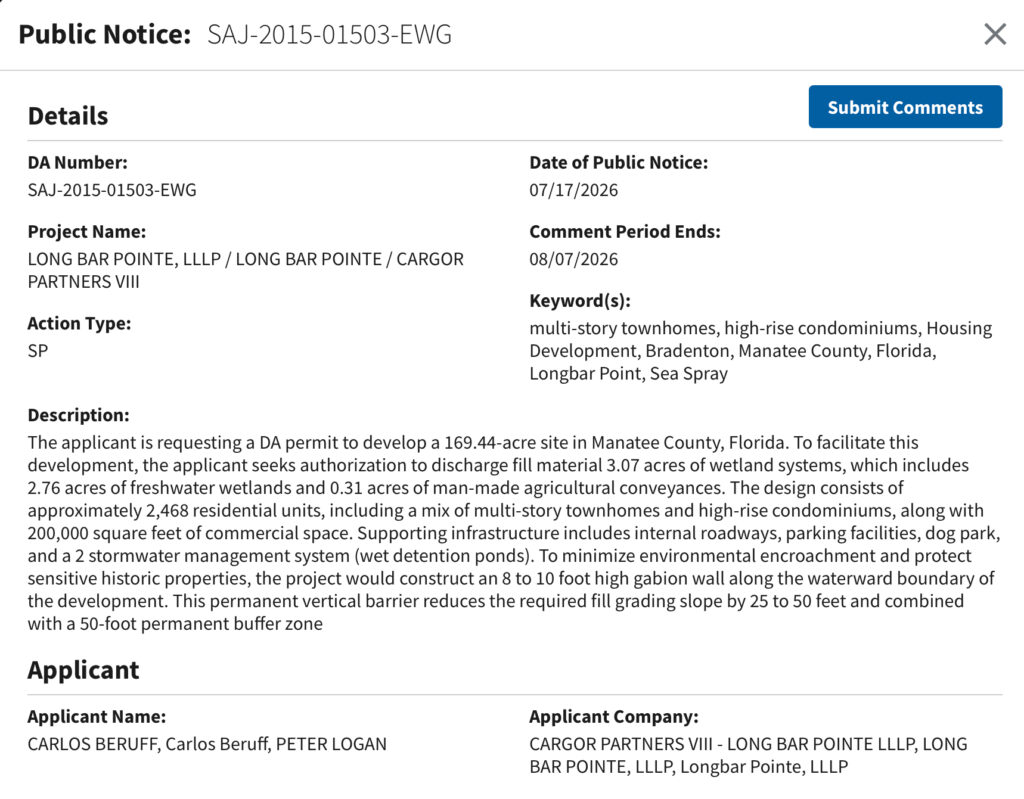
Located between Sarasota Bay and the El Conquistador Parkway in unincorporated Manatee County, the Aqua property (formerly known as Long Bar Pointe) being developed by Medallion Home includes hundreds of single-family and multi-family residential units currently being built during the initial construction phase.

On Dec. 22, FDEP Southwest District Director Kelley Boatwright sent an electronic letter and proposed consent order to Long Bar Pointe LLLP and Medallion Home representative Rob Bosarge. The letter was also sent to Medallion Home President and CEO Carlos Beruff, Medallion Home Manager of Land Development Chris Chavez, FDEP Environmental Specialist Derrick Hudson, FDEP Secretary Shawn Hamilton and Gov. Ron DeSantis.

The letter requested that Long Bar Pointe review, sign and return the proposed consent order by Jan. 3 if in agreement with the proposed terms, or to contact FDEP immediately if not in agreement.

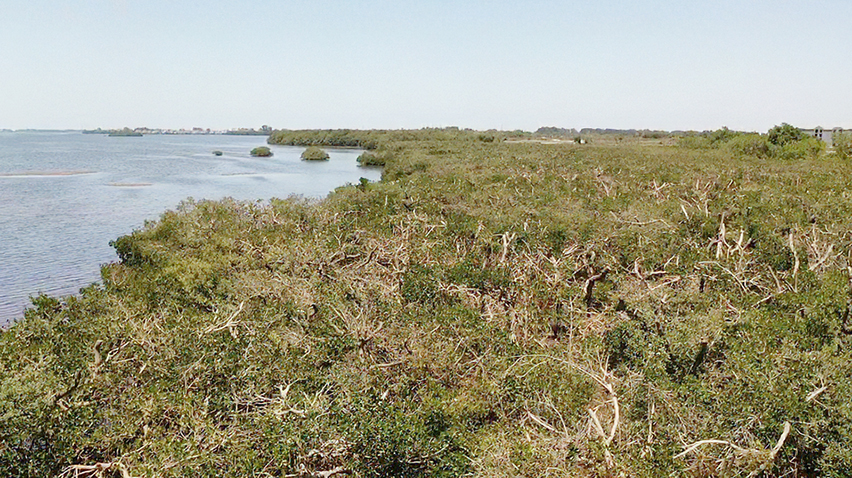
The consent order proposes a settlement between FDEP and Long Bar Pointe LLP. The order notes FDEP personnel inspected the Aqua mangroves on June 17 and Aug. 25 and improper trimming and removal activities were conducted in violation of the mitigation bank permit and general mangrove permit Long Bar Pointe was previously issued in accordance with Florida’s Mangrove Trimming and Preservation Act. Coastline Tree Service performed the mangrove trimming and debris removal activities in question.

According to the consent order, FDEP found the following violations occurred:

• Respondent did not properly remove and dispose of all mangrove trimmings over 3 feet long or over 3 inches in diameter.

• Respondent did not evenly distribute the remaining trimmings.

• Respondent reduced a portion of mangrove foliage more than the authorized amount of 25% annually on the waterward extent of the mangrove fringe.

• Respondent did not provide adequate pre- and post-photo documentation of the trimming event.

FDEP seeks $8,500 for Aqua mangrove violations
Taken in August, this photo shows the diameters of some of the mangrove trees and branches cut. – Rusty Chinnis | Sun

The consent order seeks an $8,500 penalty settlement that includes $1,000 for costs and expenses incurred during the investigation and the preparation of the consent order, $3,000 for reducing the mangrove heights by more than 25%, $3,000 for debris removal violations and $1,500 for improper documentation of the trimming activities. The check payment is to include a notation referencing the Water Quality Assurance Trust Fund.

The consent order includes an additional daily fine of $1,000 for each day Long Bar Pointe fails to comply with the consent order requirements. If FDEP is forced to file a lawsuit to recover the stipulated penalties, the agency can seek civil penalties greater than the $8,500 stipulated in the order.

Aqua response

On behalf of Long Bar Pointe, Chavez sent Hudson a Jan. 4 email that said, “Carlos Beruff is currently in Asia and is 12 hours ahead. We have emailed him so that he is aware of
the consent order. We cannot sign, or communicate that we are not in agreement, until he reviews.”

Chavez informed Hudson that Bosarge no longer works for Medallion Home and all future correspondence should be sent to Andy Kern.

When contacted on Jan. 6, FDEP Public Information Specialist Brian Humphreys said, “DEP has been in contact with staff at Aqua by the Bay. It is our understanding they are reviewing our consent order and we anticipate having their response soon.”

Suncoast Waterkeeper response

FDEP’s investigations were initially prompted by citizen complaints the agency received in early 2022 – with additional correspondence and photographs later received from the Suncoast Waterkeeper organization.

In August, the Suncoast Waterkeeper board sent a letter to FDEP officials that was critical of the agency’s initial inspection efforts and the lack of penalties imposed. That letter also expressed concerns about the significant amount of mangrove debris that had not been properly removed.

FDEP seeks $8,500 for Aqua mangrove violations
Taken in August, the photo reveals some of the trimming debris left behind. – Rusty Chinnis | Sun

Regarding the consent order, Suncoast Waterkeeper board member Rusty Chinnis said, “This would not have happened if we had not pounded it. They cut more of the mangroves than they were allowed to cut. FDEP initially reviewed the mangrove cuttings, said everything was fine and gave them a pass.”

Despite past criticisms, Chinnis, The Sun’s outdoors columnist, praised the FDEP staff members’ recent efforts.

“I think the people at FDEP care and they do a good job. They’re underfunded and I don’t think the powers that be are giving them the authority to do what they need to do. When Rick Scott was governor, he basically eviscerated it and allowed the developers to police themselves. We see where that got us,” Chinnis said.

“If done properly, mangrove trimming can create views while still protecting the mangroves, but that’s not being done. The enforcement is weak and $8,500 is the cost of doing business,” he said.

FDEP seeks $8,500 for Aqua mangrove violations
The FDEP graphic highlights some of Florida’s mangrove trimming regulations. – FDEP | Submitted

Regarding mangrove trimming in general, Chinnis said, “We have documented to FDEP the fact that people have been cited for mangrove violations and were not given any penalties; and a couple years later, the same people are caught again because there were no repercussions.”

Stand up for mangroves

Reel Time: Stand up for mangroves

Readers of this column are familiar with the rampant illegal mangrove trimming in Manatee County and the efforts of Suncoast Waterkeeper (SCWK) to address them. That frustration led to SCWK Executive Director Abbey Tyrna contacting the Florida Department of Environmental Protection (FDEP) expressing the group’s frustration and giving specific examples of policy failures. I’m printing that letter here because I couldn’t say it better.


First Place
Environmental
2023


Dec. 22, 2022

Florida Department of Environmental Protection

Compliance Assurance Program, S.W. District

RE:  Professional Mangrove Trimmer Accountability for Multiple Mangrove Trimming Violations in Manatee County

Dear FDEP District Staff,

Recently, there has been a ramping up of citizens’ complaints relating to mangrove trimming permit violations in Manatee County. In addition to the outstanding complaints at Long Bar Pointe, 223 41st Street N.E., and 10218 46th Ave. W. in Bradenton, there have been new complaints filed at 521 Broadway St. in Longboat Key and Mount Vernon Condominiums on Cortez Road at 27°27’11.0″N 82°39’22.0″W. Suncoast Waterkeeper has a substantial interest in mangrove regulation and enforcement in Sarasota Bay and beyond. Mangroves in Manatee County particularly concern Suncoast Waterkeeper, our members and the communities that rely on these precious coastal resources. Unlike neighboring Sarasota County, where approximately 80% of the natural shoreline and mangrove coverage has been hardened and removed, Manatee still retains significant and ecologically important mangrove coverage. We believe that the 1996 Mangrove Trimming and Preservation Act violations are commonplace.

In an effort to curb violations, Suncoast Waterkeeper investigated whether the mangrove trimmer at Aqua was licensed under state law to perform the work conducted in February 2022.  Unfortunately, the search did not yield the desired results because the department does not keep a database of all licensed mangrove trimmers. While in most professions, if a licensed professional breaks the law performing their job, their license is questioned, scrutinized and there is a formal process to hold the individual accountable for their poor job performance. Unfortunately, this is not the case in Florida, and we believe that a lack of accountability for the licensed professional will lead to more mangrove loss. Moreover, undertaking regulated actions without an appropriate license should, like other regulated occupations, have consequences for the individual trimming or removing mangroves in violation of the Mangrove Trimming and Preservation Act.

We fear that the lack of penalties for these numerous illegal actions will send a message to licensed professionals and their clients that mangroves can be illegally altered and removed without consequences. There are no better examples of this than FDEP’s recent findings from its inspection at 10218 46th Ave. W. in Bradenton and Long Bar Pointe.  Both properties have had previous enforcement cases. The property at 10218 46th Ave. W. had an enforcement case in 2013 for the same violation. In 2013, no penalties were enacted and the case was closed nearly two years later when a follow-up inspection concluded that the mangroves had recovered on their own. Without consequences, the homeowner once again hired a tree trimming service to alter the mangroves on her property illegally. This aggressive trimming is known to harm these protected tree species and was the impetus for the Mangrove Trimming and Preservation Act.

Long Bar Pointe also had an enforcement case in 2021 and closed without penalties in April of this year. Unfortunately, the second aggressive trimming event reported in January 2022 has led to a significant amount of tree debris in the estuary contributing to a localized harmful algal bloom in the spring. According to Sarasota Bay Estuary Program Director Dr. Dave Tomasko, “That portion of the bay has much more macroalgae than most of the rest of our bay, and a preliminary nitrogen loading estimate suggests that a localized nitrogen load [coming from the mangrove trimming debris] is likely playing a role in the problems we see in that part of the bay.” The summary letter issued to the FDEP by Long Bar Pointe on Oct. 7, 2022 noted that the mangrove trimmers did not know they were supposed to remove the debris from the water. According to that same letter, penalties are forthcoming. However, there have been no updates on Oculus since Oct. 7. Meanwhile, Sarasota Bay continues to be negatively impacted by decomposing mangrove material, and communities scarred by illegal trimming and removal are increasingly vulnerable to hurricanes and suffer a reduction in overall resilience.

Finally, the complaint filed on Oct. 14, 2022 for the property at 223 41st St. N.E. in Bradenton has no complaint or inspection report logged. Can you please provide us with a file or link to a complete set of documents in DEP’s possession related to 2022 trimming at Long Bar/Aqua, 223 41st St. N.E., and 10218 46th Ave. W.? We are not sure if there are other documents related to the trimming, investigating and penalties of these filed complaints.

We want to see the regulatory framework accomplish environmental protection in Manatee County and elsewhere. We hope that enforcement actions and penalties will be strong enough to incentivize future compliance with Florida law. We also want to see licensed and unlicensed trimmers who break the law held accountable for their actions.

We encourage DEP to consider this and all other pertinent information. We recommend that you follow through on appropriate actions to protect our local waterways and the integrity of our environmental laws and regulations.

Thank you,

Abbey Tyrna, Executive Director & Waterkeeper 

Rusty Chinnis, Board Chair                    

Justin Bloom, Founder & Board Vice-Chair

The damage to mangroves is a loss for every citizen in Manatee County, whether they are fishermen, restauranteurs, builders, realtors, homeowners or developers. These plants clean the water, protect every species that swims and feeds in local waters and are critical to protecting property from storm events like Ian. Get involved, call your commissioners and state representatives and demand accountability. If we don’t do it, no one else will. Happy Holidays.