

BRADENTON BEACH – On Monday, April 27, six Bradenton Beach police officers informed the mayor and city commission, in writing, that they would vote against unionizing the city’s police department.
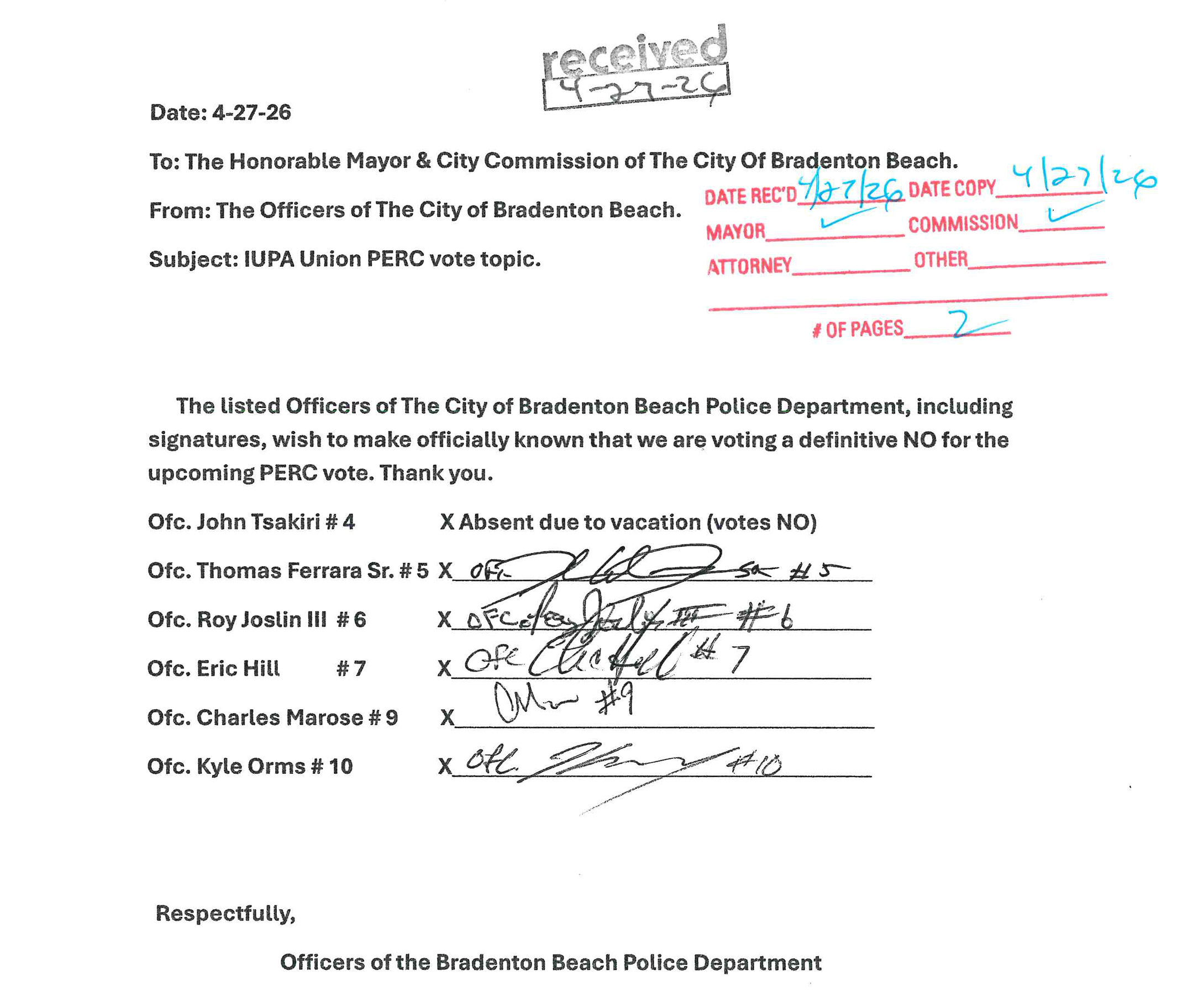
Addressed to the mayor and the city commissioners, the single-page document presented to the city says, “The listed Officers of The City of Bradenton Beach Police Department, including signatures, wish to make officially known that we are voting a definitive NO for the upcoming PERC (unionization) vote. Thank you.”
The six officers whose names are listed on the document are: Thomas Ferrara, Roy Joslin, Eric Hill, Charles Marose, Kyle Orms and John Tsakiri. All but Tsakiri’s name are accompanied by the officer’s signature. In the signature space next to Tsakiri’s name, it says, “Absent due to vacation (votes NO).”
Underneath the officers’ names and signatures, the letter says, “Respectfully, Officers of the Bradenton Beach Police Department.”
Officer Devon Straight and Sgt. Steve Masi’s names do not appear on the letter.
The proposed union bargaining unit included seven officers and one sergeant, with one officer’s position currently vacant due to the recent departure of Officer Jorge Castro. A union-represented bargaining unit would not include Police Chief John Cosby, Lt. Lenard Diaz and police department clerk and public information officer, ChrisAnn Allen. If a union was formed, Cosby, Diaz and Allen would not become union members due to their non-officer, non-sergeant status within the department.
When contacted by The Sun Monday evening, I.U.P.A. Business Agent and Field Representative Bill Bjork acknowledged that he also received a copy of the letter the six officers sent to the city officials.
According to the city’s labor attorney, Robert Eschenfelder, at least five potential union members would need to vote yes in order for the Bradenton Beach union to be formed. With six of the eight potential union members now expressing written opposition to unionization, the unionization of the police department now seems unlikely – but a final vote had not occurred as of Monday evening.
It is not yet known what impact, if any, the six officers’ opposition to unionization will have on the mayor and city commission’s pending decision as to whether the Bradenton Beach Police Department will remain intact and continue to provide the city’s police service, or eventually be disbanded and replaced with contracted law enforcement services provided by the Manatee County Sheriff’s Office.
Sheriff’s cost estimate
After discussing the potential police department unionization during a special city commission meeting held on Thursday, April 23, the mayor, commissioners, police chief and labor attorney also discussed contracting the Manatee County Sheriff’s Office to provide the city’s law enforcement services instead, with an estimated first-year cost savings of $628,000.
Regarding his communications with the sheriff’s office, Eschenfelder said, “Yesterday, I was informed by the sheriff’s office that their preliminary review of our staffing needs is that they would be able to perform that role for $1.5 million, and likely less. That is based upon eight deputies and one sergeant. When you look at your current budget of $2,128,000 for municipal policing, that’s a saving for the city of $628,000 a year.”
Regarding the potential cost savings, Mayor John Chappie said, “We have a fiduciary responsibility. We are sworn to maintain the health, safety and well-being of our community and the police department is the key to that. I think we need to continue the negotiations with the proposal from the sheriff’s department.”
Commissioner Debbie Scaccianoce said, “I love our guys, and I love our police department, but we really are in a crossroads here financially. It’s our duty as commissioners to at least look at that proposal from the sheriff.”
Commissioner Cole said, “I’m torn about this. I think we should keep all our options open.”
The commission agreed that more specific information was needed from the sheriff’s office – including more details about the additional policing that currently takes place in the Community Redevelopment Agency on weekends and certain weekday evenings. The CRA district includes Bridge Street. The additional CRA policing is paid for using separate CRA funds rather than the city’s general fund.
The mayor and commission also wants more detailed cost information about deputies’ overtime pay during special events and peak holiday periods.
The April 23 meeting ended with the commission unanimously approving a motion to approve continuing with a formal request for Sheriff Rick Wells to provide “an operational analysis to provide an agreement for the city of Bradenton Beach for the sheriff to take over the law enforcement activities of the city of Bradenton Beach.”
No final decision was made regarding who will provide the city’s future law enforcement services, and the commission is scheduled to meet next on Thursday, May 7, at 6 p.m. During the May 7 commission meeting, public input can be given regarding the commission’s pending decision as to which agency will provide the city’s law enforcement services.
The agenda for the May 7 meeting will be published later this week. If the proposed sheriff’s office agreement and other police matters are included as a specific agenda item, or items, public comment on those matters can be given at that time. If the sheriff’s office agreement and/or law enforcement services are not included on the May 7 agenda, public comment on non-agenda items can be given at the beginning of the meeting, with each speaker being given three minutes to speak.
Officers speak
None of the potentially impacted officers attended the April 23 meeting, but over the weekend, two officers spoke to The Sun on the condition that they remain anonymous.
One officer said unionization did not appear likely because a majority of the officers did not support it.
Another officer said, “The decision to unionize was never a matter of pay, but rather representation against threats and misconduct from the administration – the very kind now being disguised in public as financially motivated.”
This officer also referenced the April 21 cease-and-desist letter that union-affiliated attorney Bradley Rothman sent to the mayor, the commissioners, Chief Cosby, and Lt. Diaz.
Cease and desist letter
Rothman is a member of the Naples-based Weldon Rothman law firm. His letter includes the header: “Demand to cease and desist unlawful threats, interference and retaliation concerning protected union activity.”
“We represent the International Union of Police Associations (IUPA) in connection with the pending representation-certification petition that seeks to represent the city’s regular full-time sworn law enforcement officers employed in the rank of officer or sergeant,” Rothman’s letter says.
“This letter serves as a formal demand that the city of Bradenton Beach, its police department and all elected officials, supervisors, managers and agents immediately cease and desist from any threats, coercion, intimidation, interference, discrimination, retaliation or reprisals directed at officers because they have exercised protected rights to organize, to associate with one another, to seek union representation and to petition for collective representation.
“The city is already on notice of serious misconduct. The officers’ March 20 request for recognition recounts that during a March 12 department meeting, Lieutenant Diaz addressed reports of union activity by stating, among other things, ‘I dare you to pursue a union and you will feel our wrath,’ that ‘the city won’t go for it,’ and that “I will be here another three to five years and you won’t.’”
Regarding Diaz’s alleged comments, Rothman’s letter says, “That is not protected managerial opinion. It is an explicit threat of reprisal for protected activity, and it conveys unmistakably that officers who support unionization can expect retaliation affecting their tenure and future employment. The timing of the city’s current conduct raises an additional and deeply troubling inference of retaliation.
“After the filing of the PERC (Public Employees Relations Commission) petition, and after officers engaged in protected organizing activity, the city placed on a public agenda both a discussion of the PERC petition and a discussion of whether law enforcement services should be provided by the sheriff.
“The prospect of dissolving, transferring or outsourcing the department had not been seriously advanced before the officers sought representation. A public employer may not weaponize restructuring, review or operational considerations as a means of retaliating against employees who choose to organize,” Rothman stated in his letter.
“The city must also refrain from taking any action to abolish, transfer, outsource, reduce or otherwise undermine bargaining-unit work where the action is motivated in whole or in part by anti-union animus, or by a desire to defeat the pending representation effort,” Rothman wrote.
Unionization discussed
When discussing the potential unionization during the April 23 meeting, Eschenfelder said the unionization had not yet been formally voted on, but a number of officers had submitted “interest cards” expressing a desire to examine the opportunity to vote to create a union.
“Those have been signed and submitted to the Florida Public Employees Relations Commission (PERC). The next step is requiring the city to respond within a certain period of time as to whether the proposed bargaining unit is the appropriate bargaining unit,” Eschenfelder said.
He also said, “This does not mean the union is formed. There is a concept that PERC examines, which is called unity of interest. In this case, PERC wants to know what the city’s position is with respect to a sergeant being in the same bargaining unit as officers.”
The commission reached unanimous consensus to allow Eschenfelder to register no objection to the structure of the proposed union bargaining unit.
Eschenfelder said PERC would schedule an election and if at least five potential union members voted yes, the department would be unionized and the city would then be legally obligated to negotiate with the union on behalf of its new members.