Tag: Holmes Beach

Castles in the Sand

Real estate market disruption

Is there an algorithm in your future? If you’re planning on buying or selling a house, get ready for the future of real estate.

In a world where technology has remade everything from your morning coffee to tracking your investments, the real estate market has remained very old school. Reams of paperwork are the norm and interaction with local real estate professionals is the custom in most markets around the country. It wasn’t that many years ago when local real estate associations opened up multiple listing access to consumers making practically everyone an informed expert. If the availability of multiple listing properties to everyone was a big step, wait until you see what’s coming down the road.

iBuyer computer platforms have been gradually immersing themselves in the real estate market, offering buyers and sellers practically on-the-spot gratification. An iBuyer is a company that uses technology to make an offer on your home instantly. iBuyers represent a dramatic shift in the way people are buying and selling homes, offering a simpler, more convenient alternative to traditional home sales. Just search iBuyers and you’ll be amazed at the hits you get.

Companies like Knock and Zillow are betting big time on the success of these platforms in a world where everyone is too busy to complete traditional real estate transactions. Knock, for example, helps customers buy a new home, usually an upgraded one, and then stages the old home and gets it on the market right away. There are, of course, fees for this service but for many professional couples, it’s worth it.

Zillow and others buy the property after an appraisal and the sellers move on without the hassle of selling. So far Zillow is moving along with its business plan, buying more than 1,500 homes in the second quarter of the year.

Then we have startups who are offering people with good income but not so good credit a way to get into a home. Divvy Homes buys homes then rents the homes to their clients so they can have a place to live, pay rent and build equity towards eventual ownership. This is an idea that has its roots in the real estate industry known as rent with an option to buy, which was a private contract between two parties. It worked for many buyers and sellers in the pre-tech world, especially for difficult-to-sell properties.

Now Divvy and others like Flyhomes are offering high tech plans to fill a need aimed at first-time buyers who are probably already renters. It’s not uncommon for first-time buyers to be faced with student loan debt and little or no savings while they’re getting their careers up and running.

Divvy’s plan is to charge monthly rent with about 20% of the monthly payment going toward equity to buy the property. The monthly rent is higher than what the going rate for a similar rental would be, but equity is being built. Naturally, Divvy makes most of their money from the rent paid.

Flyhomes offers a full-service brokerage, buys the homes for cash giving their clients an edge and then underwrites the potential mortgage. Naturally, there are fees attached to this as well as traditional real estate brokerage commissions.

Ask five different real estate agents what your home is worth and you’ll get five completely different answers. Ask an algorithm what your home is worth and you’ll at least get one answer which may or may not be correct. No matter how you feel about technology getting involved in real estate, we can all agree that it’s definitely a disruption.

More Castles in the Sand:

Fee-fi-fo-fum, do I smell a recovery?

Order out of chaos

Luxury ain’t what it used to be

Officials hope for Spring Lake recovery

Officials hope for Spring Lake recovery

HOLMES BEACH – Spring Lake may still have some brown water for now, but newly appointed Director of Development Services Eran Wasserman is hopeful that continuing to aerate the lake will result in clean, clear water soon.

Wasserman said that he is observing the lake visually every day and providing updates to city commissioners. What he’s looking for in these observations is water clarity, fish kills, if there’s any odor and how strong the order is, if present.

Also, he is working with representatives from Aquatic Systems to determine what the best way forward is to monitor the water quality in Spring Lake. During a September meeting, commissioners instructed him to work with City Engineer Lynn Burnett and Aquatic Systems representatives to develop a comprehensive recovery plan for the lake.

“What we see is a tremendous improvement,” Wasserman said. “There are no more fish kills as of Tuesday (Sept. 24), I can say for sure.”

The fish kill that took place over the weekend of Sept. 20-22 Wasserman said was the worst that residents could have expected to happen. Now that it’s over and there are a few fish jumping in the lake, he said the focus is on getting the water clear.

Since it’s been almost two weeks since a fish kill was observed in the lake, Wasserman said he would be recommending to city commissioners to go from running the newly installed aeration system overnight to running it 24 hours a day to speed up the oxygenation process for the toxic water lurking on the bottom of the lake. After speaking with a representative from the Florida Department of Environmental Protection, he said he doesn’t believe there was anything more that could’ve been done to prevent the fish kill in September and that they’re on the best course of action to help clean up the lake. Though he did add that he’s open to considering any additional ideas to help clear the lake water, if it’s a method that would be approved by FDEP and if it can logistically be applied to Spring Lake.

“We are monitoring this, we do see improvement, but it’s unlikely to see a rapid improvement in water quality due to the fact that we are dealing with the lake and organic matter that was accumulated over there for the past 50 years or so,” he said. “So, this is where we are right now. So, all in all, we see a positive improvement and we are going to monitor this with our specialists that eventually will come up and will figure out whether there is an improvement and whether the aeration system works.” He added that among experts the aeration system is the best way to deal with the toxicity levels in Spring Lake. A contract for water testing with Aquatic Systems is expected to be presented to commissioners at a future meeting.

In the meantime, Wasserman did address two concerns from residents, one concerning the WaStop valve that prevents tidal waters from traveling from Grand Canal to Spring Lake via an outflow pipe and the second regarding the infiltration trenches surrounding the lake.

Wasserman said that the WaStop valve is still in place, but that Spring Lake receives tidal waters through two other smaller pipes coming into the lake. He said that the seawall where the WaStop valve is located is compromised, causing a safety hazard with accessing the valve. He said that he doesn’t know how many gallons of water come and go with the tides in the lake.

“This lake at this time is not completely sealed from the Bay,” he said.

To address resident concerns that the stormwater infiltration trenches around the lake are harming the lake water, Wasserman said it’s untrue.

The infiltration trenches were designed to capture stormwater runoff from the homes surrounding the lake. During a Sept. 24 commission meeting, one resident said that the trenches were having the opposite effect, filling with water and pushing stormwater and sediment into the lake.

Wasserman said that the concerns were unfounded and that he provided a letter to city officials stating that the type of infiltration trenches installed capture the pollutants that might otherwise find their way into the lake.

Another update on the condition of Spring Lake is expected at the Oct. 8 commission meeting, after press time for The Sun.

Related coverage

Problems plague Spring Lake residents

Aeration plans take shape for Spring Lake

Spring Lake cleanup options presented

Castles in the Sand

Fee-fi-fo-fum, do I smell a recovery?

Recovery, what recovery? That’s a word we left in our rearview mirror a long time ago. It’s true in Florida generally, and Anna Maria Island specifically has recovered nicely since the financial downturn. There are areas of the country that are still struggling, but August may have been the turn-around month.

According to the National Association of Realtors, August was the strongest month for sales of United States homes in nearly a year and a half. Sales of previously owned homes rose 1.3% in August with a median sale price of $278,200, up 4.7% from the previous August. Conversely, the availability of homes for sale fell in August further increasing prices. Add to this the average fixed-rate mortgage for a 30-year loan was 3.73% at the end of September.

Is this the beginning of the national real estate market starting to turn the corner? Real estate sales have been underperforming relative to jobs and the economy as a whole and economists are viewing the statistics for the past two months as a very good sign.

If you’re interested in how the national market compares to our local Manatee County market, keep reading.

Closed single-family homes were up 10.3% from last August and the median sale price continues to be strong at $317,000, 7.1% higher than last year. The average sale price for single-family homes was $408,738, up 4% from last year. The median time to contract is down by 4.5% to only 42 days and the month’s supply of available properties is 3.3 months.

Condos closed fewer properties down at 25.9%, however, the median sale price was higher at $205,000, up 7.9%. The average sale price was also up 13.1% to $251,339. The median time to contract was up 6.4% to 50 days and the month’s supply of condos is at 3.6 months.

Sales statistics are from the Realtor Association of Sarasota Manatee.

Our sales in both the numbers of properties sold and sale prices continue to perform well compared to the national statistics. Nationally, the median single-family sale price for August was $278,200 up 4.7% from last August, compared to Manatee County’s median of $317,000 up 7.1%.

Based on the above, it’s not a surprise that the southern region of the country ended August with an increase of 3.6% in sales, making it the largest annual growth in sales volume in the country. And this may be just the beginning, as more and more high-income residents of high taxed states are just beginning to feel the effects of the Tax Cuts and Jobs Act of 2017 and are taking refuge in the South.

There are 41 states that collect taxes on wages and salary, with California taking the highest percentage at 13.3%. The remaining nine states that are income tax-free are Alaska, Florida, Nevada, New Hampshire, South Dakota, Tennessee, Texas, Washington and Wyoming. If you’re a part-time resident of one of these states and are considering full-time residency, check out the individual state’s qualifications to establish permanent residency. Both the state you’re leaving and the one you’re coming to have strict and varied residency rules.

It looks like there will be big changes for Florida and other low tax states right around the corner. Nevertheless, don’t get too comfortable with what you see in the rearview mirror when it comes to real estate markets. You never know when that truck will start gaining on you.

More Castles in the Sand:

Luxury ain’t what it used to be

The fun and not-so-fun of selling a home

The fun and not-so-fun of buying a home

Problems plague Spring Lake residents

Problems plague Spring Lake residents

HOLMES BEACH – Residents turned out in force during a Sept. 24 commission meeting to protest the city’s plans to clean up the waters in Spring Lake after the installation of an aeration system resulted in brown water and a fish kill.

A long-planned bubbling aeration system was turned on with a test start for 30 minutes on Wednesday, Sept. 18, according to engineer Eron Wasserman. He added that when a smell was noticed during the test run from the water, it was decided to turn the aeration system on only for a short time during the early morning hours, working up to running it 24 hours per day. By Saturday morning, calls were coming into the city from the residents surrounding the lake that not only was there a smell, there also was water discoloration and hundreds of dead fish floating on the lake.

Wasserman said that once he received a phone call, he arrived at Spring Lake within an hour and called public works employees to remove the accessible fish from the lake, a task he said was completed on Monday.

The system was turned off until further direction could be received from city leaders.

Environmental expert Chris Byrne, a consultant who helped City Engineer Lynn Burnett develop the city’s remediation plan for Spring Lake, said that the ammonia on the bottom layer of the lake was 10 times higher than it should be and that there is no oxygen in the bottom layer. With the aeration system, the bubbles forced into the lake through the system push the toxic layer of water up to the surface where the toxins escape into the air and the water is oxygenated. By mixing the water column continuously, Byrne said the water would once again become the healthy lake it was before it was polluted by waste spills in 2015 and 2016 from a nearby lift station. In some instances, where the lake is as bad as Spring Lake, fish kills do happen, he said.

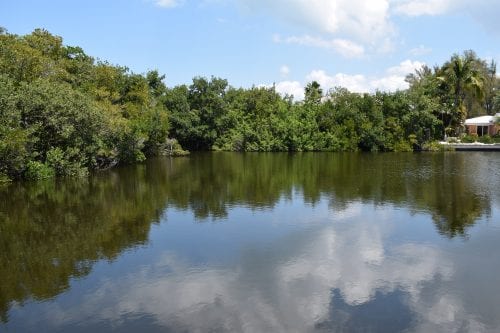
Holmes Beach Spring Lake prior condition
Prior to the installation of an aeration system, the waters of Spring Lake appeared clear, though an ammonia layer of water that lacked oxygen lurked beneath the surface. – Kristin Swain | Sun

“The bottom of the lake is a sewer,” resident Carol Grayson said, adding that she has asthma and the smell coming off the lake was causing breathing problems. Her husband, Boyd Grayson, suggested that city leaders take another look at the drainage trench dug around the lake to stop runoff from surrounding homes. He said that rather than help the situation, the trenches are making runoff problems in the lake worse.

Resident Tim Gibson said he wants a solution to the issues at Spring Lake and for it to once again be a thriving home to fish and other marine life.

“It was a beautiful, beautiful part of this Island,” he said, adding that he doesn’t feel the city’s engineers understand what the previous condition of the lake was before the sewage spills polluted the water.

Holmes Beach Spring Lake brown water
After an aeration system designed to help clear the water at Spring Lake was turned on, the rising toxins from the bottom of the lake turned the water brown and resulted in fish kills. – Kristin Swain | Sun

Commissioners agreed that something needs to be done to help lessen the impact on residents and restated their commitment to cleaning up Spring Lake.

Rather than slowly ramp up to a 24-hour run cycle for the aeration system, commissioners agreed to run the system for a longer period at night for up to two weeks, moving to a 24-hour run time, to expedite the circulation and oxygenation of the water on the bottom of the lake. They also requested daily updates from Wasserman and for the water to be tested weekly with a comprehensive plan on how to bring the water quality back to a clear, healthy condition. Additionally, once the water quality begins to return, Byrne said healthy bacteria will form or can be artificially introduced to the lake’s ecosystem that will slowly eat away at the organic “muck” on the bottom of the lake.

One question that remained for residents and city leaders alike is whether or not to remove the WaStop valve blocking Spring Lake from receiving tidal flows from Bimini Bay.

The valve was installed by Burnett to prevent flooding through the lake’s water rising due to abnormally high tide events, such as king tides. Nearby residents and Commissioner Rick Hurst questioned whether or not it would be a good idea to open the pipe back up and allow the seawater in to help flush out Spring Lake. Mayor Judy Titsworth said she didn’t think it would be a good idea to expose the bay to the toxic water in Spring Lake. Byrne and Wasserman both said they could not address the issue, with Wasserman adding that Burnett would be needed to provide an expert opinion.

Burnett did not respond to requests for comment.

“The aeration will take time,” Titsworth said to the assembled concerned residents. “It’s going to be bad, but we lived through red tide and we will live through this. We all want to make it right.”

Related coverage

Aeration plans take shape for Spring Lake

Spring Lake cleanup options presented

Deciding the future of Spring Lake

Castles in the Sand

Order out of chaos

Writing has been compared to bringing order out of chaos, something I try to do weekly on this page, and one of the most chaotic aspects of real estate is the mortgage process, which may be getting even more confusing to the average home buyer.

As confusing as the typical mortgage process is, the relationship of Fannie Mae, Freddie Mac, FHA and Ginnie Mae – entities that are also known as government-sponsored enterprises (GSEs) – to the mortgage market continually contribute to the chaos.

Before we go on, a quick review: Over 50 years ago Congress chartered the government-sponsored enterprises to provide liquidity to housing finance. The GSEs securitized and guaranteed mortgages, freeing up private lenders to provide more loans, making mortgages more readily available to the average home buyer. This created the 30-year, fixed-rate mortgage, which has been the gold standard of housing finance for all these years.

It was a great system until it went off the rails with sub-prime mortgage products partly encouraged by Congress leading to the bursting of the housing bubble and financial collapse in 2008. The American taxpayer was on the hook for $190 billion dollars to keep Fannie and Freddie floating and they have been in government conservatorship since then.

Now the federal government wants to gradually shrink the GSEs and start returning them to private hands. One of the suggested ways is to require them to have additional capital and underwriting standards comparable to private lenders. Will this happen? Maybe, but even if the wheels start to spin in that direction, it will be a long painful process which could turn on a dime subject to the outcome of a national election.

In the meantime, there is a new type of unconventional mortgage that has turned up. It’s called asset-depletion loans or asset-dissipation loans. Basically, they are designed for people who don’t have conventional paychecks, particularly retirees. As long as the borrower’s ability to draw on their assets is not overestimated, the loans can be fine.

Fannie Mae and Freddie Mac do make these loans but only based on a borrower’s 401k assets. However, Fannie and Freddie have eased up on standards for this type of loan, asking for smaller down payments and allowing more debt for borrowers. Again, this creates more risk for the American taxpayers.

So, what else do the gatekeepers of the American housing market have up their sleeve? Well, there is something that many Florida residents will be very interested in. Within the past year, they rolled out a program that would treat manufactured homes the same as it does site-built properties.

This means that a previous market that was difficult to obtain mortgaging for will now operate as a conventional mortgage market. They have also designed mortgages for manufactured homes at lower interest rates than buyers of these properties were previously able to obtain, as well as allowing appraisers to compare manufactured homes to those built on-site when determining value.

This may be a great program for many buyers of manufacturers homes, but in Florida, as we all know, manufactured homes are the most vulnerable in storms. Again, call me crazy, but do we as taxpayers need to assume more mortgage risk?

Fannie Mae and Freddie Mac, as well as all other GSE programs, will go on for a long time before any real change is made. It’s almost impossible to take away something that’s been in effect for so long. All I can do is try to bring order out of the mortgage processing chaos.

More Castles in the Sand:

Luxury ain’t what it used to be

The fun and not-so-fun of selling a home

The fun and not-so-fun of buying a home

WMFR approves budget, assessment rate

BRADENTON – West Manatee Fire Rescue (WMFR) has an approved budget and an approved assessment rate increase for the 2019-20 fiscal year.

Commissioners met at the district’s administrative offices Sept. 10 to host a public hearing for both the budget and the assessment rate. No members of the public chose to speak during the public hearing. Commissioners voted unanimously to certify the district’s tax roll, approve the budget and increase the fire assessment for both residential and commercial properties.

Residential property owners can expect to see a 1.65% increase, a $3.09 increase in the base rate bringing it to $190.57 for the first 1,000 square feet of a home. The rate for square footage over 1,000 square feet is being raised from $0.1106 to $0.1124. The total assessment rate for a 2,000 square foot home is increasing from $298.08 to $303, a difference of $1.92.

Residential homes make up the majority of the properties in WMFR’s district, which stretches from the Gulf of Mexico on the west, Tampa Bay to the north, Longboat Key to the south and city of Bradenton to the east. The district includes unincorporated Manatee County, Palma Sola, Cortez, Bradenton Beach, Anna Maria and Holmes Beach.

Commercial property assessment rates will be increasing 5% to help the district come in line with the rates charged by other surrounding fire districts. The base rate for commercial properties is increasing from $451.07 to $473.62 for the first 1,000 square feet of the building. The remaining square footage will be charged at a rate of $0.2051, totaling a $32.32 increase for a 2,000 square foot commercial building.

The increased assessment rates are estimated to bring in around $144,203 in increased revenue for the district. The funds are planned to be used to assist in launching the district’s non-transport advanced life support service at all three stations, purchase a new fire engine and begin work on the district’s new permanent administration building.

The district’s proposed total revenue for the coming fiscal year, beginning Oct. 1, is $7,660,461 with $74,900 used in impact fees and $1,910,873 used of reserves to total $9,646,234 in expenses with $4,329,953 left in reserves.

An expense carried to the district’s next board meeting is the matter of offering an honorarium to the chaplain. Commissioner David Bishop brought up the idea a month after the district’s new chaplain was sworn in during the August board meeting. After not having a chaplain for 12 years, he said he thinks an honorarium would be appropriate to demonstrate the importance of the position to district staff and firefighters.

“I think it’s a valuable resource,” he said. “I just think it’s the right thing to do.

Commissioner George Harris agreed, saying, “The chaplain’s role is essential,” to the district staff.

Commissioner Al Robinson suggested offering $100 per month. A decision is expected during the October board meeting.

Commissioners are also considering how they want to handle a new cancer bill that was recently passed by the state legislature and went into effect July 1, 2019. Under the new bill, any firefighter who is diagnosed with one of 21 different kinds of cancer within 10 years of leaving the fire service is eligible for a $25,000 cash payout and for their out of pocket treatment expenses to be covered by their fire district.

Commissioners discussed purchasing insurance at a cost of $70 per firefighter, totaling $3,000 annually, to cover any of the $25,000 payouts that the district might be required to pay. They also discussed extending the program to recent retirees, something that is not specified in the legislation. In order to qualify for benefits, firefighters must have served in the fire service for at least five years prior to diagnosis.

The discussion is expected to continue at the Oct. 15 board meeting.

Related coverage

WMFR celebrates life with Phoenix Awards

WMFR 2019-20 assessment rates set

WMFR board considers building construction

2019-20 budget jumps first hurdle

2019-20 budget jumps first hurdle

HOLMES BEACH – City leaders are one step closer to having an approved budget for the 2019-20 fiscal year beginning Oct. 1.

Commissioners voted unanimously to approve the first reading of the proposed budget and millage rate during a Sept. 11 special meeting. The final budget public hearing will be held on Tuesday, Sept. 24 at 6 p.m.

Though city leaders tried to keep the millage rate at the rollback rate of 2.1226 mills, city Treasurer Lori Hill said that with the city’s additional expenses in saving for Bert Harris cases, adding to the funds for stormwater and flooding prevention and other projects, she recommended commissioners approve a 2.25 millage rate.

Though the millage rate is the same as the previous year, it does result in a 6% increase over the previous year due to increases in property values in Holmes Beach.

With carryover and reserves, Hill said the budget ends up at a total of $16,967,913. Out of that number, $6,188,036 is in carryover and reserves with the remaining $10,779,877 in departmental expenditures.

Expenses for the mayor and commission are expected to top out at $184,106 with general government expenditures of $1,796,851. Expenditures for code compliance are budgeted at $476,464. Expenses for the police department are expected at $3,410,457 with public works budgeting $1,830,381, the building department at $912,279, stormwater utility expenses at $1,281,289, fifth-cent gas tax expenditures of $520,800, and the half-cent discretionary tax expenditures at $367,250. Several categories include a contingency fund which Hill said would be added to the carryover amount at the end of the year if the funds are not used.

Related coverage

Holmes Beach budget questions answered

Holmes Beach budget talks begin

Holmes Beach logo OLD

Holmes Beach adds monthly rentals to VRC

HOLMES BEACH – City commissioners may have dropped the business tax receipt requirement for residential rental homes and units, but they’re considering reclaiming some control by adding longer-term rentals to the vacation rental certificate program.

Under the city’s VRC program, short-term rentals, those rented for less than 30-day periods, typically seven days, are required to pay a fee and obtain a certificate to be posted at the rental property after passing an inspection from code compliance officers. Commissioners are moving forward an ordinance to add monthly rentals to that program as well.

Currently, vacation rentals must undergo an inspection and renewal of the rental certificate every two years. To lessen the blow to monthly rental property owners, Commissioner Carol Soustek, who owns a property that’s rented seasonally, suggested finding a way to make the program accessible to owners who may not make as much money from their properties as vacation rental owners. She said that with so few monthly rentals still available on the Island, she doesn’t want to push owners to move toward selling their properties or offering them as vacation rentals.

After a little back and forth between her fellow commissioners, Soustek suggested having monthly rental certificates renewed every three years instead of every two years.

Earlier in the evening, commissioners voted to approve an increase in cost for VRC initial inspections and renewals to $695. With monthly rentals included in the program, Mayor Judy Titsworth provided a cost analysis from city Treasurer Lori Hill that put those costs at $545 for monthly and vacation rentals.

City leaders estimate there are between 1,100 and 1,200 vacation rental properties and around 300 monthly rental properties in Holmes Beach. At $545, Hill estimated that the cost of the VRC program would be equal to the cost, $751,008 for two years.

Before commissioners move forward, they asked Titsworth to go back to Hill and make sure that the $545 fee could support the program with renewals for vacation rentals at two years and monthly rentals every three years.

Related coverage

Holmes Beach budget talks begin

Commissioners consider exemption for rental homes

Castles in the Sand

Luxury ain’t what it used to be

Did you ever feel sorry for the really wealthy real estate owners? Well, we’re at a point in time when there might be just cause for feeling sorry for them because like all sellers, when your market is slow everyone deserves some sympathy.

Wealthy buyers are pulling back from some of the most expensive housing markets in the country. Toll Brothers Inc., the nation’s largest publicly traded luxury-home builder said that purchase agreements fell 3% from a year earlier, worse than the expected 1% predicted.

A large slice of this decline is concentrated in California where homes under contract had an average price of $1.74 million in the last quarter. Toll Brothers further indicated their orders in California tumbled 36% from a year earlier.

Some of this decline in the luxury market, in California at least, is the Chinese buyers that are pulling back from the market combined with the federal tax overall limiting deductions for property taxes and mortgage interest. However, what happens in California may stay in California since Palm Beach, Florida recently had a record sale of over $100 million.

In addition, low interest rates, wage growth and record low unemployment rates are moving first time buyers into the market, creating a demographic shift in the lower price ranges. The luxury market is adversely affected by an improving lower end market since all real estate markets are interconnected.

That said, let’s take a look at the three-month analysis of properties selling over $1 million on Anna Maria Island and in Cortez for May, June and July. Closed sales are compiled from the Manatee County Property Appraisers Office and available properties from realtor.com as of this writing.

Cortez did not close any $1 million or over properties during May, June and July. In the prior analysis, there were two sales.

The city of Anna Maria closed 13 properties at $1 million or over, ranging from $3,395,000 to $1,075,000. The last three-month analysis showed 14 properties closed in this price range.

Finally, the combined cities of Holmes Beach and Bradenton Beach closed 14 properties $1 million or over during May, June and July, ranging from $3,725,000 to $1,000,000. The last analysis showed 19 closings.

Currently on the market or pending in Cortez, there are six $1 million or over properties. For the last analysis, there were five.

The city of Anna Maria has 48 properties either available or in contract ranging from $5,500,000 to just above $1 million. Besides the highest listing, there are two over $4 million, five over $3 million, 12 over $2 million and the balance below $2 million. The last analysis had 60 properties listed.

Bradenton Beach and Holmes Beach currently have 69 properties either available or in contract ranging from $599,000 to $1,149,000. Three are over $5 million, three are over $4 million, two are over $3 million, 15 are over $2 million and the balance are under $2 million. The last analysis had 68 comparable properties.

If the luxury market is falling off generally around the country price-wise, Anna Maria Island is not listening, at least not yet.

These continue to be pretty impressive numbers for a small island and an even smaller fishing village. And as noted in this paper previously, Cortez is the second least affordable place to live in Florida, according to a study by UnitedSatesZipCodes.org. First place goes to Boca Grande. To be fair, the rankings are determined by calculating several factors and Cortez being a small area with many high-priced homes certainly contributes to this calculation.

See you again in three months. In the meantime, it’s okay to feel sorry for the very wealthy – the little darlings.

More Castles in the Sand:

The fun and not-so-fun of selling a home

The fun and not-so-fun of buying a home

The challenges of inheriting a house

Bert Harris cases go back to court

Bert Harris cases go back to court

BRADENTON – Six Bert Harris cases against the city of Holmes Beach are awaiting a ruling on the city’s motion for judgment on the pleadings. Three more were part of a group of cases where the motion for judgment on the pleadings was denied but were given 90 days for additional discovery before a judge will rule on the property owners’ motion for partial summary judgment.

On Sept. 4, Manatee County Circuit Court Judge Charles Sniffen heard arguments from attorney Jay Daigneault, representing Holmes Beach, and attorney Aaron Thomas, representing the property owners. Daigneault argued that Sniffen should rule in favor of the city’s motion for judgment based on the pleadings in six Bert Harris cases against the city.

All of the cases argue that the city’s occupancy requirement of two people per bedroom or a maximum of six people per vacation rental unit places an inordinate burden on the property owners and causes a reduction in property value. They also stem from the city’s enactment of regulations governing vacation rentals in 2015 and the vacation rental certificate program enacted in 2016.

Holmes Beach Bert Harris Aaron Thomas
Attorney Aaron Thomas argues against the city of Holmes Beach’s motion for judgment on the pleadings for six Bert Harris cases. – Kristin Swain | Sun

Daigneault argued that the cases were filed prematurely by property owners. Thomas argued that because the city cannot give his clients a variance for occupancy due to the occupancy limit of two people per bedroom being in the Holmes Beach comprehensive plan since 2009, the city is denying his clients any relief from the vacation rental regulations.

Sniffen opted to reserve ruling on the case to issue a written order at a later date.

“Whichever way it goes, it’s just a part of the process,” Titsworth said after the hearing concluded. “I couldn’t be happier today.”

The previous week, on Aug. 28, Judge Edward Nicholas heard the same argument for five other Bert Harris cases against Holmes Beach and denied the city’s motion for judgment on the pleadings for all five.

On Sept. 9, Nicholas heard Thomas’s argument for partial summary judgment on three Bert Harris cases for properties owned by AMI Breeze LLC, Mojito Splash LLC and Coral Escape LLC, all cases where the city’s motion for judgment on the pleadings were denied.

Thomas argued previous use of property, where the properties were rented for several years to an unregulated number of occupants without the city’s interference and that the occupancy limits now imposed by city leaders have severely devalued his clients’ properties if they were to be resold as vacation rental properties. He said that all three of the properties are currently used solely as vacation rentals.

Daigneault argued on behalf of the city that a significant amount of discovery is still outstanding in the cases, particularly the city’s attorneys’ depositions of the property appraiser used to determine loss of value and the plaintiffs in the case.

The judge said that as a part of the discovery process he would like to see proof that the residences were rented to the higher-than-allowed number of occupants listed in the complaints against the city other than just the word of the rental managers to help prove the loss in value for the property owners.

Nicholas deferred his ruling for 90 days to allow the city to schedule depositions and continue the discovery process. He added he thinks there are several, if not all, of the issues in each case that could be ruled on by summary judgment and that he would be speaking with Sniffen to see if his fellow judge thinks that mediation between the parties would be beneficial.

If the judge denies the motion for partial summary judgment, the cases would go to a bench trial before the judge. A jury would later determine what compensation, if any, would be awarded.

Related coverage

It’s a Bert Harris win for Holmes Beach

Twenty-nine new Bert Harris claims come to Holmes Beach

Commissioners reject salary increase

Commissioners reject salary increase

HOLMES BEACH – With Commissioner Pat Morton absent, a motion to give city commissioners a $250 per month stipend raise failed on a tie.

At the suggestion of the 2019 Charter Review Commission, city Commissioner Carol Soustek brought up the idea of giving the city’s commissioners a small raise, bringing their monthly stipend up from $500 to $750. The stipend amount was last raised in 2007. Any change in the stipend amount wouldn’t affect what the sitting commissioners are compensated for the elected position. A current commissioner’s stipend would only be changed after he or she is re-elected. It would also affect any newly elected commissioners.

If the change in stipend amount had been accepted by commissioners, it would have resulted in an annual raise of $3,000 to $9,000 annually or $750 per month. Commissioners currently receive a monthly stipend of $500 for their service to the city.

“I think this is very warranted to those who take their job very seriously,” Soustek said. “It’s not a small job anymore; it’s a big job.” She added that increasing the stipend would show more respect for the hours commissioners spend researching and preparing for city meetings in order to make the best decisions they can for the residents.

“Commissioners are not just a face anymore,” she said. “It’s a job, and you have to do it if you really want to fulfill your promise as a commissioner.”

Commissioner Jim Kihm agreed with Soustek, adding that he felt the city should keep up with what other cities of their size are offering commissioners and that raising the amount of the stipend could encourage more people to run for a seat on the dais.

Commissioner Rick Hurst disagreed with the idea of increasing the stipend to encourage future commission candidates to run for elected office.

“My opinion on this is that I didn’t run for the money,” he said, adding that he doesn’t want to encourage future candidates to run based on the compensation they would receive if elected.

“I’m doing it strictly to serve the residents of Holmes Beach,” Commissioner Kim Rash said, agreeing with Hurst that he didn’t want people to run for office because of a financial incentive. “I just do it because I love Holmes Beach,” he said.

With Soustek and Kihm voting for the raise and Rash and Hurst voting against it, the motion to raise the commissioners’ stipend failed on a tie without Morton there to break it.

Related coverage

Four qualify in Holmes Beach

Commissioners approve election changes

City leaders consider stormwater fee increases

City leaders consider stormwater fee increases

HOLMES BEACH – With costs for stormwater improvements throughout the city ongoing and increasing, City Engineer Lynn Burnett proposed to commissioners that they consider an increase in stormwater utility fees.

Stormwater utility fees are paid by property owners based on the size of their property. Currently, a fee of $1.68 is charged per 100 square feet of property.

Burnett said city leaders had planned a gradual increase over several years of 25% per year. She said that option is still on the table with fees increasing from $1.68 to $2.10 per 100 square feet of property in 2020.

A second option is to raise rates in 2020 to the planned five-year amount of $4.10 per 100 square feet. The third option is to increase to the final planned amount of $4.40 per 100 square feet of property in 2020 and then hold the rate at that amount for as long as possible.

The third option would represent a nearly 262% increase in stormwater utility fees for property owners, but Burnett said that either the second or third option would help the city close the gap between the cost of resiliency and stormwater improvements and the funding currently planned to be received for those projects.

At the planned 25% increase to $2.10, she said the city would be carrying a deficit over the next several years until fees increased to the point where all of the costs would be covered. If city leaders opt for the third option, an increase to $4.40, she said the deficit would end in the coming fiscal year.

If city leaders agree to an increase, the funds would not be collected until the beginning of 2021. Burnett said stormwater fees are collected in arrears so a change taking effect for the new fiscal year wouldn’t appear on property owners’ trim notices until fall 2020 and would not be due until property taxes are paid in late 2020 and distributed to municipalities in early 2021.

With new stormwater infiltration trenches needed, outflow pipes underneath city streets failing and seawalls buckling that are beyond their serviceable years, Burnett said the city needs protection to lessen flooding from storms, rising sea levels and high tide events such as king tides.

She said the city has numerous projects that need completing now, not down the road when future funds become available. Once commissioners agree on a number for the stormwater utility fee increase, she said she could come back with a vulnerability assessment and a plan of attack to begin construction on the highest priority areas.

Commissioner Jim Kihm said he would like to see more information from Burnett with details of what projects need to be completed when before he commits to a fee increase. He said he also wants to determine what effect an increase will have on Holmes Beach property owners before making a decision.

Commissioner Rick Hurst added that he wants to see what the total expenses are that the city is looking at before funds are committed to the projects.

“I just can’t slam the residents with that kind of increase,” Commissioner Carol Soustek said, of taking the maximum increase to $4.40. “I just can’t do it.”

Mayor Judy Titsworth said the fees charged to property owners are based on a need, and she wants to see what need Burnett is planning for. If there is a shortfall, she said she doesn’t see the city going into debt and then having to charge property owners for the finance fees incurred on a loan. She said she’d like to see what projects can be covered by the $4.10 fee and which additional projects could be covered by the increase to a $4.40 fee. Commissioner Kim Rash agreed, saying that he wants to see an expense versus fee amount comparison report.

Burnett agreed to come back before commissioners at a planned Oct. 22 meeting with further details.

Related coverage

HBPD celebrates its own

Four qualify in Holmes Beach

Holmes Beach holds off on emergency declaration

Castles in the Sand

The fun and not-so-fun of selling a home

Last week we talked about the fun and not-so-much fun of buying a home. This week we’ll talk a little about selling your home, choosing the perfect realtor and not necessarily one you’re related to. But before we do that, let’s review the June and July Manatee County sales statistics as reported by the Realtor Association of Sarasota and Manatee.

In June, Manatee County closed 2.2% fewer homes than last year, not surprising for this time of year. In spite of that the median sale price, half above and half below, increased by 5% from last year to $315,000. The average sale price was $397,987, up 8.8%, and the month’s supply of properties is down to 3.6 months.

June’s condo sales increased for the number of sales by 6.1%, the median sale price was $210,000, up 14.3%, and the average sale price was $246,381, up 5.2%, all impressive numbers. The month’s supply of properties was 4.2%.

July single-family sales were down slightly by 1.8%, but the median sale price broke a record at $325,000 up 5% from last year. This is the highest median price since the housing crisis more than a decade ago and near historic levels. The average single-family home price was $391,049, up 2%, and the month’s supply of properties was down to 3.4%.

Condo sales were up by 8.7% with a median sale price of $191,000, down 4.1%. The average sale price for condos was $216,523, down 6.6% from last year and the month’s supply of properties was 3.7%.

Do these numbers give you incentive to find that perfect realtor and consider selling? Maybe, but remember statistics are only a snapshot in time and, although our sales and appreciation rates continue to go up every month, it could change in a heartbeat.

But just in case you’re ready to cash in, here are a few tips for choosing a realtor:

Although there are many questions you should ask a real estate professional before you turn over what may be your biggest asset to them, the two that are most important to me are how long have you been in residential real estate sales and what is your specific marketing plan?

Much of real estate experience is an on-the-job learning experience but choosing an agent who has accumulated a few designations or certifications shows a commitment to his/her profession. Certainly, you should ask if real estate sales are their full-time job. There are sales agents who get into the field thinking it’s a part-time job they can fit around their children’s school schedule. Trust me you don’t want this person.

As far as a marketing plan, the agent should be prepared to show you a written plan involving print advertising, open houses and digital participation. They may also include a pricing schedule suggesting a step-down pricing recommendation for 30, 60 or 90 days in the event offers are not coming in. As part of this plan, your agent should advise how frequently he/she will be in touch with you regarding showings and feedback.

It is also important for you to know how long homes in your area are taking to sell and the variation between the listing and final sales prices. I frequently note these statistics in my monthly updates for Manatee County because they are so important to the overall picture of the market.

Finally, giving your listing to a relative may look appealing since you already have a relationship and he/she may offer to reduce commission for you. However, it takes away the business aspect of the transaction and gets into the emotional aspect. My advice is don’t do it.

I’m looking forward to receiving the August Manatee County real estate numbers and hope you have a fun selling experience with a qualified broker.

More Castles in the Sand:

The fun and not-so-fun of buying a home

The challenges of inheriting a house

Uncovering a home’s defects

Holmes Beach logo OLD

Four qualify in Holmes Beach

HOLMES BEACH – Qualifying week is officially over, and four candidates are posed to fight it out in the polls Nov. 5 to see which of them will take the three commission seats up for grabs.

Incumbents Rick Hurst, Jim Kihm and Carol Soustek have all qualified and are hoping to retake their seats on the dais after the dust settles from the election. Challenging the incumbents is newcomer Terry Shaefer.

Four qualify in Holmes Beach
Commissioners Jim Kihm, Carol Soustek and Rick Hurst all hope to keep their seats on the dais after the November election. – Kristin Swain | Sun

If Shaefer’s name sounds familiar, it’s because he served in 2018 as one of eight members of a city-formed ad hoc committee studying Holmes Beach’s form of government. Ultimately, the committee determined that a city manager form of government, versus a strong mayor and commission government like the city currently has, would be in the city’s best interests.

After months of meetings and a presentation to city commissioners, the commission ultimately decided to place the decision of whether or not to put the city manager question on the ballot in the hands of the 2019 charter review commission. Charter review commissioners did not have the supermajority vote of members required to put the question on the November ballot.

If re-elected, this will be Kihm’s second term as a commissioner. He currently serves as the commission chair and legislative liaison, keeping his fellow commissioners apprised of what issues in Tallahassee may affect local regulations.

Re-election would also mean a second term for Hurst, who serves as the city’s liaison to The Center of Anna Maria Island, where he also volunteers as a youth sports coach, and Anna Maria Elementary School. Hurst also is a local business owner, having a partial ownership stake in The Freckled Fin restaurant in Holmes Beach. Hurst was first elected in November 2017.

For Soustek, re-election would mean her third full term on the dais. After first being appointed to the commission in November 2014 to fill the unexpired term of former Commissioner David Zaccagnino, she was elected to the commission in 2015 and again in 2017. Soustek currently serves as the commission’s code compliance liaison.

In addition to electing or re-electing commissioners, Holmes Beach voters also will have eight questions on the ballot proposed by the charter review commission. Each question represents a proposed change to the city’s charter.

Voters will go to the polls on Nov. 5. For more information about the election or to register to vote, visit the Manatee County elections office. 

Holmes Beach logo OLD

Holmes Beach holds off on emergency declaration

HOLMES BEACH – With Hurricane Dorian’s path uncertain, Holmes Beach Mayor Judy Titsworth is holding off on declaring an emergency in her city.

Titsworth said that she’s holding off until either Sunday, Sept. 1 or Monday, Sept. 2 before declaring a state of emergency for Holmes Beach until the path of the storm is more defined.

Manatee County and both of Holmes Beach’s neighboring cities, Anna Maria and Bradenton Beach, declared a state of emergency on Aug. 30. West Manatee Fire Rescue district also held an emergency board meeting Aug. 30 to declare a state of emergency.

In order to receive reimbursements from FEMA for funds spent during and after a storm, particularly for storm debris clean up, a municipality or district must officially declare a state of emergency. Once a state of emergency is declared, the declaration only lasts for 72 hours. With the timing of Hurricane Dorian’s landfall on the east coast uncertain, Titsworth said she preferred to delay the declaration. She said that the city’s departments are ready for the storm if it should come to our area.

In the meantime, she encouraged Holmes Beach residents to make their preparations for the storm, including gathering supplies and readying their residences for possible high winds and heavy rains.

Sandbags and sand are available to residents at Holmes Beach City Hall, 5801 Marina Drive, on the south end of the parking lot. Residents are asked to bring their own shovels.

For updates on the storm and the city’s preparations, Titsworth asked residents to visit the Holmes Beach Police Department’s Facebook page.

Related coverage

Dorian’s path veers away from west coast