I am writing in reference to the article in the Feb. 5 issue titled, “A Gulf by any other name.”
The so-called president can wield his Sharpie and declare that it’s the Gulf of America, but it has been the Gulf of Mexico for over 400 years and in researching, there are 3,545 miles of shoreline, over half of which borders Mexico. The southernmost part of the Gulf wraps around Mexico’s Yucatán peninsula, which so far is not a part of America.
Renaming geographical place names is the work of the U.S. Board on Geographic Names, which has the power to rename geographic places within the U.S… not the president. The board discourages name changes unless there is a compelling reason.
Also, changes would not necessarily be binding on the states bordering the Gulf or for other countries.
So, to the majority of Americans, in all of the countries around the world, it will remain in the Gulf of Mexico!
ANNA MARIA – On Jan. 23, Anna Maria City Commissioners adopted on second and final reading an ordinance the amends the city’s seawall regulations referencing the Gulf of Mexico.
The ordinance was adopted three days after President Donald Trump issued Executive Order 14172, an order declaring that the Gulf of Mexico would be renamed the Gulf of America.
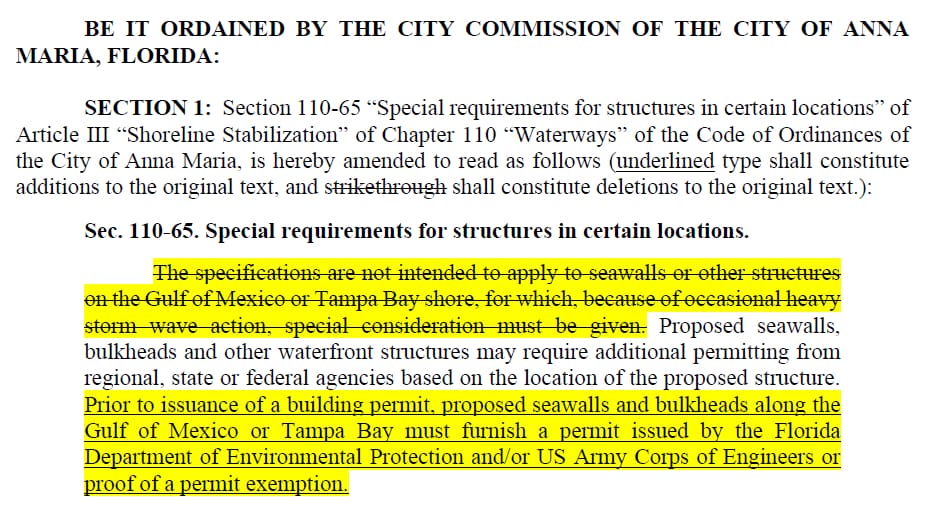
As recommended by the Anna Maria Planning and Zoning Board, Ordinance 24-938 says, “Prior to issuance of a building permit, proposed seawalls and bulkheads along the Gulf of Mexico or Tampa Bay must furnish a permit issued by the Florida Department of Environmental Protection and/or U.S. Army Corps of Engineers, or proof of a permit exemption.”
Ordinance 24-938 references the Gulf of Mexico. – City of Anna Maria | Submitted
The adopted ordinance includes new language that makes a determination by the building official or designee that a seawall is unsafe a violation of the city’s code.
At the recommendation of the Planning and Zoning Board, the adopted ordinance includes the following definitions: “Bulkhead means a shoreline stabilization structure separating land and water areas and retaining soil. Seawall means a shoreline stabilization structure separating land and water areas, retaining soil and intercepting wave action.”
The new language replaces previous language included in the Anna Maria code of ordinances that said, “The specifications are not intended to apply to seawalls or other structures on the Gulf of Mexico or Tampa Bay shore, for which, because of occasional heavy storm wave action, special consideration must be given.”
GULF OF AMERICA
“I am directing that it officially be renamed the Gulf of America,” the presidential order says. “As such, within 30 days of the date of this order, the Secretary of the Interior shall take all appropriate actions to rename as the ‘Gulf of America’ the U.S. continental shelf area bounded on the northeast, north, and northwest by the states of Texas, Louisiana, Mississippi, Alabama and Florida and extending to the seaward.”
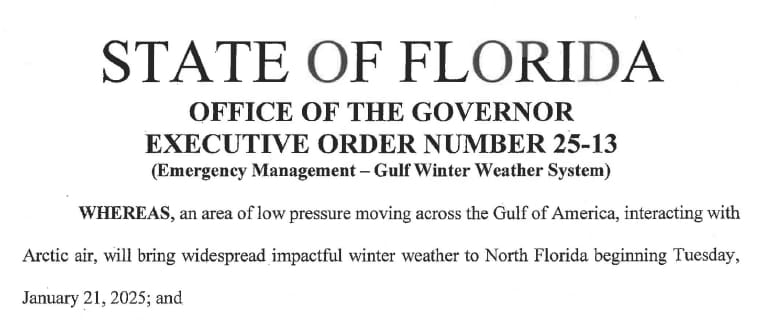
Gov. Ron DeSantis’ executive order references the Gulf of America. – Gov. Ron DeSantis | Submitted
During public input at the city meeting, City Attorney Becky Vose was asked if the ordinance would have to be amended or revised to reference the Gulf of America. Commissioner Gary McMullen said he wondered about that, too.
Vose said the adopted ordinance could later be revised administratively by city staff if so desired and doing so would not require a city commission-approved ordinance amendment because the revision would not change the intent of the ordinance.
Mayor Mark Short noted that Gov. Ron DeSantis, on Jan. 20, issued Executive Order 25-13, an executive order pertaining to a winter weather system expected to impact north Florida that used the new name.
“Whereas, an area of low pressure moving across the Gulf of America, interacting with arctic air, will bring widespread impactful winter whether to north Florida beginning Tuesday, Jan. 21…” the governor’s order says.
The mayor and commissioners made no additional comments about the presidential order or name to be used by the city.
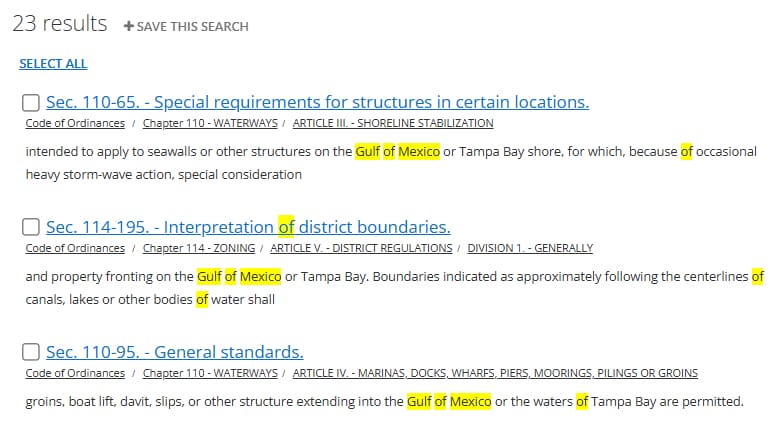
Anna Maria’s code of ordinances currently references the Gulf of Mexico 23 times. The Holmes Beach code of ordinances currently references the Gulf of Mexico 16 times and the Bradenton Beach code of ordinances currently references the Gulf of Mexico 10 times.
The Anna Maria code of ordinances includes 23 references to the Gulf of Mexico. – Municode | Submitted
Google Maps intends to refer to the body of water as the Gulf of America. On Jan. 27, Google issued a statement on the X social media platform that said, “We will update Google Maps in the U.S. to quickly show Mount McKinley and Gulf of America.”
As of Jan. 31, Google Maps still referenced the Gulf of Mexico and did not yet reference the Gulf of America.
President Donald Trump’s executive order renaming the Gulf of Mexico the “Gulf of America” is more than historically inaccurate, it is unnecessarily confusing and will no doubt cost taxpayers millions to implement, then reverse in the next administration.
Where to begin?
Well, there’s that bugaboo, history. The Gulf of Mexico has been called by that name since more than 200 years before there was a United States of America, according to “The Gulf, the Making of an American Sea,” by Jack E. Davis, who wrote, “The unknown maker of a 1541 map called it Seno de Mejicano, the ‘Mexican Gulf,’ ” noting that subsequent names were quickly tried and dropped, with mapmakers settling on Golfo de Mexico, or Gulf of Mexico.
Then there’s cultural sensitivity, or its reverse. The United States is not the only America. Remember Latin America, South America, North America?
Trump’s order states, “The area formerly known as the Gulf of Mexico (shades of Prince) has long been an integral asset to our once burgeoning Nation and has remained an indelible part of America,” then goes on to mention its oil and gas value, which gives a clue as to one reason for the name change.
The Associated Press said in a statement that it will continue using the “Gulf of Mexico” in its Stylebook, used by most U.S. newspapers, including The Anna Maria Island Sun.
Amanda Barrett, AP’s vice president of standards and inclusion, wrote, “The Gulf of Mexico has carried that name for more than 400 years. The Associated Press will refer to it by its original name while acknowledging the new name Trump has chosen. As a global news agency that disseminates news around the world, the AP must ensure that place names and geography are easily recognizable to all audiences.”
Barrett notes that other countries are not bound by the executive order.
And there are geographical precedents for calling the same body of water by two names. What Iran calls the Persian Gulf, Arab nations call the Arabian Gulf, according to the publication Al Jazeera, which notes that the sea that is bound by Japan and the Korean peninsula is called the Sea of Japan by Japan, while both North and South Korea call it the East Sea.
But what is the Town of Longboat Key going to call its main road, now known as Gulf of Mexico Drive?
The current AP Stylebook entry for the Gulf of Mexico is “inlet of the Atlantic on the southeast coast of North America bounded by the U.S., Mexico and Cuba.”
So why not the Gulf of Cuba?
The U.S. has ignored Cuba for the better part of the past 65 years, to the extent that for decades after its revolution succeeded in 1959, TV weather maps showed the island, but did not name it.
To this day, the U.S. embargo of Cuba remains in effect, punishing people who never knew their great-grandparents who fought the revolution and may only adhere to its politics publicly, by mandate.
We could take a cue from the brave Cubans who, in every generation, resist their Communist government and politicians.
Granma, the newspaper that calls itself the official voice of the Communist Party of Cuba Central Committee, would probably not cover such a resistance movement, at least until it was squelched, and has not yet mentioned Trump’s new name for the Gulf in print.
But Mexico says it will not recognize the new nomenclature.
The Sun stands with Mexico, and the AP – not to mention real, verifiable history – and will continue to call it what it is, the Gulf of Mexico.
Extending approximately 5 miles from Anna Maria Island to St. Petersburg, the mouth of Tampa Bay is fronted by the barrier islands of Egmont Key and Passage Key. The surrounding waters are beautiful, ecologically important and provide anglers with some excellent fishing opportunities. The history surrounding the islands is rich and, in the case of Egmont, goes back some 2,000 years. They seasonally hold some of angling’s prized species, including tarpon, snook and permit.
Egmont Key is a Florida State Park and a National Wildlife Refuge. Steeped in history, the entire island is listed on the National Register of Historic Places. Artifacts and pottery dating back two millennia have been found on the island. The first recorded landing there dates back to a Spanish explorer in 1757 and its recent history spans from the Spanish-American War to World War II. The island is home to the Tampa Bay Pilots and has miles of old brick roads, a holdover from a time when there were over 70 buildings and 300 people living there. It has a functioning lighthouse, rebuilt in 1857 after a hurricane destroyed the original structure. Ever changing, Egmont Key was once 50% larger than it is today.
Passage Key, the southernmost island, is uninhabited and also a National Wildlife Refuge. It was first established as a bird sanctuary in 1905 by President Theodore Roosevelt. At the time, it was a 60-acre island and had a freshwater lake. That all changed in 1921 when it was decimated by a hurricane and has never been the same. Over the past decade, Passage Key has been little more than a constantly changing sandbar but is building back. In the 1970s, the island was designated as a wilderness area. Together the islands hold nesting colonies of all Florida seabirds including the largest concentration of royal and sandwich terns in Florida.
In the spring and summer, schools of tarpon and permit can be sight fished on the vast clear white sand flats that surround Passage Key. During the warm months of the year, there are also schools of sharks and large houndfish on the flats. In the cooler months, trout, redfish and pompano can be found on the edges of the flats and the grass beds to the east side of the key. Houndfish, which resemble large needlefish, gather in schools and, while they are not often pursued by anglers, they’re great sport on flies and light tackle. Small white clousers and lures that resemble baitfish can elicit some explosive strikes.
Egmont Key has a much more varied habitat and also has excellent fishing for tarpon, snook, permit and sharks. Old structures, vestiges of the Spanish-American War, can be seen along the western side of the Key, many of which are submerged. They provide a perfect habitat for species including pompano, trout and sheepshead as well as other pelagic species that swim these waters. On the east side, the pilot’s dock holds sheepshead, black drum, trout and redfish. Extensive grass flats there are home to trout, pompano, Spanish mackerel and redfish. A ship’s channel north of the key provides access to Port Manatee and the Port of Tampa. This deep waterway holds a plethora of gamefish including kingfish, Spanish mackerel and little tunny. The exposed ledges along the channel are also home to mangrove snapper, grouper and sheepshead.
If you haven’t explored these historical islands, a trip there will be eye-opening, and, whether you’re swimming in the clear Gulf waters, exploring the rich history or angling for a trophy, you’ll find these islands enchanting.
This article originally appeared in Reel Time in 2018. It’s republished here, (with revisions) because I think the message it imparts has never been more relevant. Respect and action to protect this amazing marine biosphere that surrounds us have never been more necessary or compelling. This formative work of history made me see this land where I have lived for over four decades with new eyes. I wanted to share it again.
“The real voyage of discovery consists not of seeking new lands but of seeing with new eyes.” – Marcel Proust
As I read Jack Davis’s new novel, “Gulf, The Making of An American Sea,” the quote by the seminal French novelist Marcel Proust came to mind.
Having lived on Florida’s Gulf Coast for close to 40 years and been privileged to explore its rivers, bays and enigmatic estuaries, I have been captivated by its beauty and the fish that swim in its waters. Being immersed in this wonderland had to some extent clouded my sensibilities by a familiarity of place. Reading “Gulf” shined a clearer light on what we have, what we’ve lost and the importance of protecting its treasures for future generations.
Davis’s novel begins 150 million years ago when the geological forces of an evolving earth began shaping the Gulf we know today.In part one, he introduces us to the Calusa in Florida and the Karankawa who inhabited present-day Texas, original natives of “one of the largest estuarine regions in the world, encompassing more than 200 estuaries and occupying nearly 8 million acres.”
The book then traces the impact of the early Spanish explorers who led the way for the French and British. The descriptions of the vast schools of fish and flocks of birds that would “blacken the sky” hint at the incredible diversity and density of marine life and wildlife that once inhabited the Gulf and its estuaries.
In a chapter entitled, “The Wild Fish That Tamed the Coast,” Davis recounts how the tarpon, not warm weather and white sand beaches, brought the first tourists to Florida. The records are unclear about who took the first tarpon with a rod and reel. Some say it was New York Architect William Halsey Wood fishing in Pine Island Sound in 1885. Others claim it was Anthony Weston Dimock with a fish he caught at the mouth of the Homosassa River.
Whoever the angler, that first tarpon was the impetus that introduced wealthy adventurers, artists and, indirectly, a wave of tourists to the Gulf Coast.
In subsequent chapters, the influx of humans into the Gulf region begins a period of intense exploitation in the 1800s that continues to this day. Davis recounts records of armed tourist passengers on the Ocklawaha River that shot birds and wildlife indiscriminately for sport. At the same time, the plume trade was responsible for the killing of huge numbers of birds Gulf-wide. In 1902, one trade house reported an inventory of 50,000 ounces of feathers. At about that time, ornithologist Frank Chapman spent two afternoons walking Manhattan’s retail district counting 542 feathered hats representing 174 species of birds. During this same period, the harvesting of eggs from seabird nests exacerbated the decline of the once vast flocks of birds. Davis paints a picture with words that make it hard to overstate the effects of this dark period. Fortunately, this gloomy picture was illuminated by the outcry from conservationists and birders. As a result, bird sanctuaries were set aside by an executive order from President Theodore Roosevelt for the protection of birds and chapters of the National Audubon Society were born, including the Florida chapter in 1900. During that period, TR fostered the creation of 51 bird reservations, including Passage Key at the mouth of Tampa Bay.
As the history of the Gulf unfolded, the exploitation moved from birds to oil and then chemicals that devastated the coastal estuaries of Louisiana and Mississippi. Davis then recounts the effects of pulp mills, oil spills and hurricanes before the rush of development that resulted in massive dredge and fill operations. This rush to the Gulf’s coastal areas scoured seagrasses from bay bottoms and leveled thousands of acres of marshes and mangroves to create the islands and communities we know today as Marco Island, Cape Coral, Bird Key and Tierra Verde.
While much of the book centers on the degradation of the Gulf and its bays, estuaries and barrier islands, it also points out its resilience and serves as a cautionary tale of the importance of protecting, preserving and enhancing it today. “Gulf, The Making of an American Sea” opened my eyes to a paradise that still surrounds us, a paradise that’s beckoning us to see it with new eyes.
In a press release last week, Suncoast Waterkeeper and a coalition of ocean advocates announced their opposition to what they called a bait-and-switch permit application for the Velella Epsilon industrial finfish aquaculture facility 40 miles off the Sarasota coast. The press release explains, “Florida fishermen; homeowner association leaders; business owners; community and clean water advocates; other concerned residents, and visitors to the Gulf coast gathered today to protest a “bait-and-switch” on the terms of an Environmental Protection Agency (EPA) permit that was issued for wastewater discharge from the Velella Epsilon industrial finfish aquaculture facility. The open cage fish farm operation is planned for construction about 40 miles off the Sarasota County, Florida coast. Ocean Era, the company that requested the permit, recently informed EPA that it plans to swap out both the kind of fish to be raised and the type of facility to be constructed.”
Groups challenging the permit in ongoing litigation included Food & Water Watch, Center for Food Safety, Healthy Gulf, Recirculating Farms, Sierra Club, Suncoast Waterkeeper and Tampa Bay Waterkeeper. The parties sent a letter to the EPA on June 7 urging the agency to void the existing permit and do an entirely new impact assessment, with a public comment period. The letter states:
“…on May 10, 2023, Ocean Era expressly acknowledged that it does ‘not intend to implement the project as currently permitted (i.e., with almaco jack or a SPM net pen system)’ and instead requested to alter both the species of fish proposed to be raised by Ocean Era (changing from almaco jack to red drum) and the type of net pen system utilized for the facility (changing from a swivel-point mooring system to a grid mooring system).
“Accordingly, we hereby call upon EPA to exert its jurisdiction and authority under the Clean Water Act to revoke NPDES Permit FL0A00001 in its entirety, in light of Ocean Era’s explicit admission that it will not — indeed, as a practical matter, it cannot — implement the project as currently permitted.”
Justin Bloom, founder of Suncoast Waterkeeper, addresses attendees at the fish farm press conference. – Samantha Wassmer | Submitted
Attending the press conference, Justin Bloom, founder and board member of Suncoast Waterkeeper, stated, “Notwithstanding the major changes to the project proposal, this permit is flawed and not adequately protective of the environment and our coastal communities that rely on clean and healthy waters. The new changes are equivalent to an entirely new project and make it clear that the permitting agencies should require a new permit proposal.”
Also present was Dr. Neal Schleifer, vice president of the Siesta Key Condominium Council (SKCC), representing over 90 associations and 7,000 residences.
“The changes should result in revocation of the permit, which is widely opposed by residents and local municipalities as a danger to the environment and local economy,” Schleifer said. “The changes introduce new issues and question the credibility of previous company information. Imagine the potential problems if this facility existed during Hurricane Ian or the subsequent massive red tide outbreak.”
Dr. Larry Allan, Manatee-Sarasota Sierra Club steering committee member and wildlife photographer, repeated what so many in the crowd said in some form or another.
“It’s not aquaculture I oppose in general, but the proposed placement of this project – no matter what kind of fish or what kind of open cage – just offshore from an area plagued with annual red tide blooms makes absolutely no sense for anyone,” Allan said.
While the lawsuit is currently on hold pending an EPA review of the Velella Epsilon project changes, Marianne Cufone, director of recirculating farms, steering committee member of the Don’t Cage Our Oceans coalition and a Florida attorney on the lawsuit, was in Washington, D.C. at the time of the event discussing offshore finfish farming bills.
“EPA should withdraw the permit it issued for the Velella Epsilon industrial finfish aquaculture facility and do a full environmental review of the new plans, including meaningful opportunities for public input, to fully consider all the potential impacts and alternatives,” she said.
If you would like more information on the pending permit and project, contact Justin Bloom at 917-991-7593 or bloomesq1@gmail.com, Casey Streeter at 239-333-8832 or casey@floridawatermen.org, Cris Costello at 941-914-0421 or cris.costello@sierraclub.org and Shane Tan at shane.tan@berlinrosen.com.
MANATEE COUNTY – What goes up must come down, but in the release of celebratory helium-filled balloons, it’s the coming down that creates problems.
In addition to adding trash to the waters, deflated balloons can cause marine life to become entangled and die. The balloons also can be ingested by marine life.
In May, researchers from the Sarasota Dolphin Research Program (SDRP) spent five days offshore conducting dolphin research, but they found more than dolphins.
“We collected 76 balloons and other marine debris up to dozens of miles offshore, including two ghost crab trap lines with floats and a beach ball. Most of the balloons had Mother’s Day or birthday messages,” according to the SDRP website.
Mylar balloons are made of synthetic nylon with a metallic coating, are non-biodegradable and can travel long distances.
“They heavily contribute to oceanic waste and animals can become entangled in them or ill from ingesting whole balloons or pieces,” according to the SDRP. “Wayward balloons are also extra dangerous for sea turtles because they resemble jellyfish – one of turtles’ common prey items.”
The Florida Fish and Wildlife Conservation Commission (FWC) also warns against the release of balloons as being hazardous to marine life.
“Marine and coastal wildlife can become entangled or trapped in many items such as fishing line, crab traps, balloons with attached string, beach furniture and other types of marine debris. In addition, some of these items may be ingested, leading to further harm,” according to the FWC website. “Monofilament fishing line and other plastics (bags, deflated balloons, etc.) can drift into seagrass beds or snag onto floating vegetation – a sure path to a slow death if a manatee ingests any of these items and is not able to pass it through its digestive system.”
Florida Statute 379.23 prohibits the release of more than 10 balloons within 24 hours. Violation of the law can result in a $250 fine.
I heard my first whippoorwill almost three weeks ago. It’s one of my favorite times of the year and one of the most productive for anglers who fish with flies, artificial lures or live bait. I like to think of this time of the year as spring training. March and early April can be challenging months, but they can also be very productive. It’s a time when the changing seasons can bring clear skies and balmy breezes one day and high winds and late-season cold fronts the next. It’s a good time to keep an eye on the weather and water temperature.
Water temperatures that hover in the 70s bring fish out of their winter haunts. It doesn’t matter if it’s winter one day and spring the next. Even if the weather is unpredictable, anglers know to start watching for the signs of spring. They’ll keep an eye on the Gulf, looking for flocks of diving sea birds as they feast on schools of baitfish that gather off the beaches in their seasonal migration. They know from experience that schools of little tunny, Spanish mackerel, cobia and kingfish will be attracted by and feed around the schools of bait.
In the bay, trout, redfish and snook will be roaming the flats in search of pilchards, shrimp and glass minnows. Spring is the time when local anglers have a host of piscatorial choices and some of the best conditions, mostly. The weather, while always unpredictable during the changing seasons, seems to be warmer every year. Of course, it’s always possible that a late-season cold front can rile Gulf and bay waters. It’s a swing time and the kind of weather that can play with the emotions of the die-hard angler. But hope springs eternal and we know from experience that it won’t be long before spring is here. That’s why it’s time to be prepared, flies tied and tackle ready for that day when it’s no longer a question of when it will happen, but what species we’ll fish for!
I like this time of year even if it can be exasperating. One day the flats and Gulf can be barren and the next the action is red hot. When fishing the Gulf, having a rig on board that can handle a big cobia or kingfish makes good sense and having wire at hand in case toothy kingfish and Spanish mackerel make an appearance can make or break a day.
If you’re fishing the Gulf and bait isn’t showing on the surface, try fishing areas where they congregate, like artificial reefs, rocks, and ledges. I like to work a top water plug or fly-over structure and have often found fish where there was no outward sign of their presence.
In the bay, work the areas of the flats on the outside seams of grass flats and the edges and ends of sandy potholes. Pay particular attention to deep grass that’s often present at the end of a pothole and work your casts into the area by casting short and then progressing right over the hole. Top water plugs and flies are particularly effective when waters warm and can be an invaluable aid in finding action.
Whatever your fishing style or whether you like fishing the Gulf or bays, take advantage of this swing time and you might just be rewarded with the promise of spring.
The waters on the Suncoast need the protection of those who love them. You can help Suncoast Waterkeeper (SCWK) do that with a new program the nonprofit launched recently by keeping your “Eyes on the Suncoast” and reporting what you see.
Whether you’re boating, biking, swimming, fishing or walking, everyone on or near the water can help SCWK remind residents and visitors why the Suncoast’s marine ecosystem is worth protecting. Suncoast Waterkeeper can’t be everywhere at once, that’s why your contributions are vital to their efforts.
You can help Suncoast Waterkeeper by report- ing conditions such as this light-colored plume in area waters. – Rusty Chinnis | Sun
SCWK has designed a platform that makes it easy for you to submit and share what you see. Sharing what you see using your phone, social media and the hashtag #eyesonthesuncoast can be invaluable in efforts to preserve water quality and habitat.
Here are two ways you can report what you see:
1. Use the form on their website for bad conditions or pollution reports only. The form will let you post an image, add a description and give the location of the report.
2. Post to Facebook or Instagram. Here is the perfect place to post what you love about the Suncoast and why it’s important to help organizations like SCWK keep it sustainable. A YouTube video walks you through the process on the webpage. Follow these four easy steps to post to your social media platform:
• Upload a picture;
• Include a description of what you’re reporting;
• Provide the latitude and longitude for your location using your phone’s compass or by dropping a pin on a map app; and
• Add #eyesonthesuncoast.
Need a couple of tips on what to report?
Post the things that inspire and amaze you – wildlife sightings, clear/clean water, a special sunrise and/or sunset, healthy seagrass or marine scenery.
Post the things we need to be aware of like trash/debris, excessive mangrove trimming, including dead mangroves, fish kills, dead or sick aquatic animals, discolored, foamy
or foul-smelling water, sewage spills, algae blooms, gas, oil or grease spills, runoff from construction sites, direct pollution or chemical spills, invasive species as well as other concerns.
Don’t underestimate the impact that your contributions can make.
As Margaret Mead, the famous cultural anthropologist said, “Never doubt that a small group of thoughtful committed individuals can change the world. In fact, it’s the only thing that ever has.”
Fall is in the air. Most of our windows and doors are still closed and the AC is on, but the light and the cooling mornings hold the promise of change.
This is a change ushered in by cooler temperatures, shorter days and arguably some of the best nearshore angling opportunities we have. As water temperatures drop, schools
of bait should migrate inshore with pelagic species like kingfish, Spanish mackerel, false albacore (little tunny), cobia and tripletail hot on their trail.
Now is a great time to prepare for the fall season, getting tackle in order at home and keeping an eye to the sky for diving birds and the water for breaking fish when you’re on the water. All these species will take live bait, lures or flies and can be caught on spinning, bait casting or fly tackle. Except for larger king mackerel and cobia, most can be landed with light tackle, which adds to the challenge.
Rigging will depend on the species you’re targeting. Since it’s possible to encounter so many different species in a single outing, multiple outfits are a good idea. Rigging options include wire, monofilament, long shanked hooks, or a combination. It’s possible to catch a kingfish or Spanish mackerel without wire, but your odds aren’t good. Most species shy away from wire, especially in clear water and when the sun is high. That’s when it’s time to switch to a long shank hook or a heavy (60-pound) monofilament leader. Even then, it’s possible to get cut off but you’ll get more action. When using wire, an 8- to 12-inch trace can be tied to monofilament using an Albright special knot (best) or a swivel. If you use a swivel, use black as opposed to a silver one to prevent fish from mistaking it for forage. American Fishing Wire makes a product called Surflon Micro Supreme that is extremely flexible and kink resistant. This wire can be knotted to your lure, hook or fly like monofilament. It also provides greater flexibility and less stretch than monofilament. Umpqua makes a product that’s ideal for fly anglers. Their Re-Twistable Haywire Twist wire is reusable and will allow you to change flies in a snap. This is the quickest and most painless system to rig wire for toothy fish. It’s safe to switch to wire under low light conditions like early morning, overcast days and late in the day.
One of the most effective ways to find schooling fish in the fall is to look for surface action and diving birds in the inshore Gulf waters. But don’t assume fish aren’t present if there are no outward signs of them. Predators can often be found around structures, reefs and wrecks that attract bait.
When you find feeding fish, you can approach them by trolling, drifting or with the use of a trolling motor. Whatever method you employ, never let your boat pass through or get too close to the action. With more and more boats and anglers pursuing feeding fish, they are likely to sound and move away. The best bet is to stay outside the action but within casting distance. If trolling, make wide turns so only your lures pass through the action.
Live bait anglers target schooling fish in several ways. By anchoring up current from a likely area, they may deploy a chum bag and then toss wounded live baits to draw fish into casting range. This can be an extremely effective method. Those that prefer artificial lures find spoons particularly effective as well as jigs like the DOA CAL or the Berkley Gulp. One of the most exciting and effective types of lures are topwater models like the MirroLure Top Dog, the Heddon Zara Spook or Rapala Saltwater Skitter Pop. Not only is the strike visual and often explosive, but their action can attract target species.
Fly fishing is also an effective and exciting way to target fall species from cobia to tripletail, Spanish mackerel and even kingfish. The same rigging applies and topwater flies like the Crease fly or Garthside Gurgler can produce some memorable strikes. Clouser Deep Minnows are also a great choice for Spanish mackerel and false albacore. This is a good time of the year to have a 10- or 11-weight rod rigged with a big black fly should a migrating cobia make an appearance.
Whatever your fishing style, take advantage of the great action you’ll find in area waters this fall. If you’re new to the game, consider hiring a guide. This is a great way to learn the ropes and a great value when shared with a friend. Good fishing!
If storm forecasters are accurate, 2020 might not be remembered fondly.
As the world deals with a deadly virus raging around our planet, storm forecasters are predicting the likelihood of more than normal tropical storms and hurricanes this season.
The prediction, written by meteorologists Philip J. Klotzbach, Michael M. Bell and Jhordanne Jones, said, “We estimate that 2020 will have about eight hurricanes (average is 6.4), 16 named storms (average is 12.1), 80 named storm days (average is 59.4), 35 hurricane days (average is 24.2), four major (Category 3-5) hurricanes (average is 2.7) and nine major hurricane days (average is 6.2). The probability of U.S. major hurricane landfall is estimated to be about 130% of the long-period average. We expect Atlantic basin Accumulated Cyclone Energy (ACE) and Net Tropical Cyclone (NTC) activity in 2020 to be approximately 140% of their long-term averages.“
The team came to the conclusion based on a new extended-range early April statistical prediction scheme that was developed using 38 years of past data, according to the report.
Global warming could be involved. A weak La Nina could form during the summer; La Nina conditions allow storms to form more easily. The tropical Atlantic is warmer than normal, while the subtropical Atlantic is quite warm, and the far North Atlantic is anomalously cool. The anomalously cold sea surface temperatures in the far North Atlantic lead predictors to believe that more friendly El Nino conditions will be absent this season.
An updated report will be released on June 4.
The prediction ended with these words of wisdom.
“Coastal residents are reminded that it only takes one hurricane making landfall to make it an active season for them, and they need to prepare the same for every season, regardless of how much activity is predicted.”
BRADENTON – Bradenton resident Kelli Brown Whitehead was recently hospitalized and diagnosed with necrotizing fasciitis.
Whitehead’s family members suspect but have not confirmed that Whitehead’s illness is related to wading in the Gulf of Mexico.
On Monday, Nov. 4 Whitehead’s family gathered around her at Blake Medical Center for what they feared might be one of the final days of her life.
One week earlier, on Oct. 28, Whitehead’s mother, Joan Smart Brown from Memphis, Tenn., started a Kelli Brown Whitehead Facebook fundraising page for her adopted daughter.
“Kelli went wading in the Gulf of Mexico and got that flesh-eating bacteria. It spread fast and she lost all of her left leg and is on a ventilator and having kidney dialysis. She is in critical condition in a hospital in Florida. She and Robin (Kelli’s husband) are living off his disability check. Anything that you could contribute would help them out. It will be used to help him with his immediate living expenses and food,” Brown wrote at the fundraiser page.
As of Monday, 22 contributors donated $1,415 toward the initial $2,000 fundraising goal.
Family speaks
Brown spoke with The Sun on Saturday afternoon by text and telephone. She said she was told by another family member that her daughter was diagnosed with necrotizing fasciitis. Brown planned to travel to Bradenton on Tuesday, Nov. 5, but moved her travel plans up one day due to Whitehead’s rapidly worsening condition.
On Saturday, Brown said she was told Whitehead and her husband waded in the Gulf of Mexico north of Bridge Street in Bradenton Beach approximately two weeks ago.
“They were just wading around, they weren’t even swimming. And the next day or so, her foot began to hurt so bad,” Brown said, noting that Whitehead has had Type 1 diabetes all her life.
This photograph of Kelli Brown Whitehead and her daughter Brittany Burton was taken earlier this year. – Submitted | Brittany Burton
“When they got to the hospital it was eating her leg away. She lost her leg and the fear now is it might spread to the organs. It’s horrible,” Brown said.
On Sunday, The Sun spoke with Whitehead’s daughter, Brittany Burton, who lives in Bradenton.
“My mom is diabetic. She would only walk in the water a little bit. She must have had a cut. She thought she pulled a muscle and the pain started in her thigh,” Burton said.
Burton said her mom waited about a week before she was taken by ambulance to the emergency room at Manatee Memorial Hospital where, according to Burton, she was diagnosed with necrotizing fasciitis and transferred to Blake.
“She’s in very critical condition,” Burton said, noting that her mother’s organs were failing.
Burton said she asked the nurse if her mom was dying.
“He wanted to talk around it. I said, ‘Is my mom dying yes or no?’ He said yes,” Burton said.
“The Gulf that my mother loved so much is eating her alive. This has all taken place in eight or nine days at the most. It’s just unreal. It’s horrific,” Burton said.
Kelli Brown Whitehead, left, and her sister Amanda Fletcher. – Submitted | Amanda Fletcher
After recently visiting her sister and returning to Tennessee, Amanda Fletcher spoke to The Sun on Sunday. She and Whitehead are sisters by birth but were adopted and raised by different families and reconnected later in life.
Fletcher and Burton both questioned why the public isn’t made more aware of potentially harmful bacteria that exist in Florida’s waters. Fletcher said the fundraising efforts will help Robin Whitehead pay his rent and other living expenses and assist with the anticipated funeral expenses.
On Monday, Burton said her mother’s doctor told her that afternoon that the exact bacteria was staphylococcus, but the doctor could not confirm it was contracted while wading in the Gulf.
Reporting requirements
On Thursday, Oct. 31, a receptionist at Blake Medical Center in Bradenton confirmed Kelli Whitehead was currently a patient, but she could not comment on her condition or the cause of it.
The Sun then contacted Chris Tittel, communications director for the Florida Department of Health in Manatee County.
Kelli Brown Whitehead and her son Trey. – Submitted | Brittany Burton
Speaking by phone Thursday afternoon, Tittel said the health department had not received any notification from the Blake Medical Center regarding a case of Vibrio vulnificus, which he said is a specific bacteria medical providers are required to report.
Tittel sent a follow-up email to The Sun that included a response he received from a health department epidemiologist regarding The Sun’s inquiry.
“Necrotizing fasciitis would be the technical term for the symptom of decomposing flesh,” the epidemiologist wrote. “It depends on the bacteria that caused the necrotizing fasciitis. Vibrio is known to cause it and that is reportable, however, we had a lady in Ellenton a few months back pass away from necrotizing fasciitis. The bacteria she contracted was streptococcus, which is only reportable in children under the age of six.”
On Friday, Nov. 1, The Sun emailed Blake spokesperson Lisa Kirkland and asked if the hospital was treating anyone who came in contact with the Vibrio vulnificus bacteria or another type of bacteria, such as streptococcus, that could cause necrotizing fasciitis.
“I’m not at liberty to comment,” Kirkland responded.
Tittel said as of late Monday that the department had not received word from any health care provider confirming the cause of the illness is due to a condition reportable to the state, such as Vibriosis.
Tittel said the Florida Department of Health runs the “Swim It, Shore It, Dodge It” campaign, which discourages anyone with open cuts or wounds or weakened immune systems from entering open waters where infectious bacteria naturally occur.
A video associated with that campaign can be found online.
“The department sympathizes with family and friends over this tragedy,” Tittel said.
The U.S. House of Representatives passed two bills banning oil drilling off the Gulf Coast of Florida and in the Atlantic and Pacific oceans on Sept. 11.
The Protecting and Securing Florida’s Coastline Act (H.R. 205) amends the Gulf of Mexico Energy Security Act of 2006 to permanently block offshore oil and gas leasing off Florida’s Gulf Coast. The current moratorium, which protects waters up to 235 miles off the coast in the eastern Gulf, is set to expire in June 2022.
The Coastal and Marine Economies Protection Act (H.R. 1941) protects the Atlantic and Pacific oceans and the Florida Straits.
“Representatives (Joe) Cunningham (D-S.C.), (Francis) Rooney (R-Fla.) and (Kathy) Castor (D-Fla.) should be applauded for putting politics aside and coming together to protect our coasts from offshore drilling,” said Diane Hoskins, campaign director at Oceana, an international advocacy organization dedicated solely to ocean conservation.
Oceana representatives visited supporters in Holmes Beach last week, the day before the vote. The Anna Maria Island Chamber of Commerce, the Florida Gulf Coast Business Coalition and Oceana drew dozens of supporters to the Protect Our Coast Happy Hour at Waterline Marina Resort and Beach Club in Holmes Beach on Sept. 10.
“Write letters to your newspaper,” Robin Miller, president and CEO of the Tampa Bay Beaches Chamber of Commerce and Chair of the Florida Gulf Coast Business Coalition told the group, urging them to join the coalition at https://www.protectthegulfcoast.org/.
More than 90% of U.S. waters, including Florida waters, are in the federal programs slated for oil and gas drilling and leasing, Hunter Miller, Oceana campaign organizer for the Florida Gulf Coast, told the group, adding that the Florida delegation is united against the practice.
The cities of Anna Maria, Holmes Beach and Bradenton Beach, as well as the Manatee County Commission, have expressed their opposition to plans to expand offshore drilling by passing resolutions, joining nearly 100 cities and towns across Florida.
Oceana is now calling on the Senate to make the legislation a reality and permanently protect U.S. coasts from the threat of expanded offshore drilling activities.
The “vote to permanently ban offshore drilling underscores the strength of bipartisan opposition to President Trump’s radical drilling plan. Opening nearly all our waters to dirty and dangerous drilling is out of touch with every East and West coast governor,” Hoskins said in a press release.
“Offshore drilling threatens our fishing, tourism and recreation industries and everyone who calls the coast home. But the fight is not over, and we must not give up until permanent protections are established or President Trump’s plan is officially off the table.”
“I have consistently opposed drilling off the coast of Florida and was a co-sponsor of the bill that passed permanently banning all drilling off the Gulf Coast,” Rep. Vern Buchanan (R-Fla.) said in a press release.
“This bill also included my amendment to restore critical safety regulations adopted in response to Deepwater Horizon. As Floridians know all too well, an oil spill can devastate a regional economy and inflict long-term environmental damage. Southwest Florida is blessed with some of the world’s greatest natural treasures. We cannot allow our beaches, wildlife and way of life to be threatened by another oil spill.”
On Monday, Aug. 5, Sarasota Bay Watch received an award letter and grant agreement from the Sarasota based Charles & Margery Barancik Foundation. The $106,000 grant will support SBW’s efforts to continue restoring water cleaning southern hard-shell clams to Sarasota Bay. The population of these clams, traditional residents of the bay ecosystem, are at historic lows. The restoration’s goal is to help create a self-sustaining population into the future.
The grant provides funds for SBW to acquire 1,000,000 clam seeds (4 mm size/3 months old) from the Bay Shellfish Company shellfish hatchery, hire a professional clam farmer’s services to grow the clam seed for about two and a half months before flipping them into larger grow out gear before executing approximately 25 harvests. Each batch will consist of about 150 bushels weighing about 14,000 pounds (approximately 30,000 clams/harvest).
The grant also covers the costs to transport clam harvests to Sarasota Bay from Pine Island. Expenses include truck rental, ice and gasoline. Clam growing equipment including mesh bags, cover nets, stakes and underwater equipment needed for local clam grow out is also covered as well as webmaster services, social media, community education, outreach, engagement, and the marine stewardship and conservation awareness that supports the program.
Sarasota Bay Watch also received funds as part of the grant to hire a professional clam farmer as a consultant and project leader to seek a submerged lease from the state of Florida so Sarasota Bay Watch can grow clams locally. This would significantly lower costs and improve efficiency.
Sarasota Bay Watch former President Larry Stults, who headed the grant request for SBW, clearly sees the connection between the grant funds and a healthy bay.
“Clams live up to 30 years and can filter up to 24 gallons of water a day,” says Stults. “Do the math and you can clearly see the connection. That’s over a quarter of a million gallons of water over one clam’s lifetime.”
Sarasota Bay Watch began its clam restoration in 2016 by collecting adult native southern hard-shell clams for the spawn it needed to launch the effort. Once plentiful in local waters, the clams proved difficult to locate and that’s one of the reasons the program was launched.
Sarasota Bay Watch had entered into a partnership with Bay Shellfish Company, a commercial shellfish hatchery in Terra Ceia Bay on the southern shore of Tampa Bay, in 2008. Bay Shellfish owner Curt Hemmel had developed a method to grow algae allowing him to spawn and condition bivalves, including the scallops that Sarasota Bay Watch had been seeding into Sarasota Bay for the past decade.
Sarasota Bay Watch added Southern hard-shell clams to its restoration efforts in 2016 for several reasons. Like scallops, their numbers are critically low from historical averages. Unlike scallops that live only 1.5 years, clams can thrive for up to three decades. In addition, clams are more resistant to red tide and can actually eat low levels of the harmful algae.
Sarasota Bay Watch began its clam restoration project on March 1, 2017, when it purchased 330,000 seed clams from Bay Shellfish, each about the size of a little fingernail. Aaron Welch, a commercial Tampa Bay clam farmer, was hired to do the first round of what is called grow out in fine mesh bags anchored to seagrass beds. After 70 days they were transferred to larger mesh bags on the bay bottom and overlaid with a protective cover net.
Sarasota Bay Watch has partnered with Mote Marine Laboratory Senior Scientist and Benthic Ecology Program Manager Jim Culter to create a series of experimental plots alongside SBW’s clam release areas to test a range of variables – hand planting the clams vs. dropping them on the bottom without planting, cover netting vs. none, soft sand bottom vs. hard-packed sediment, grassy vs. sandy bottoms, etc. From these experiments, the partners hope to learn how to make future restoration cycles more successful.
With the help of the Barancik Foundation Grant, Sarasota Bay Watch can now scale up the operation and advance plans to introduce clams to Manatee County and Sarasota County waters in 2020 and beyond. Ultimately, it is Sarasota Bay Watch’s hope that the program can become self-sustaining and self-funding. In the end, Stults can clearly see the link between the clam restoration effort and a vibrant Sarasota Bay.
Check out Sarasota Bay Watch’s website for videos of the clam releases. Learn about the good works the Barancik Foundation does in Sarasota and beyond online.
Even though it addresses two entirely unrelated subjects – prohibiting oil drilling and indoor vaping – Florida Constitutional Amendment 9 will be included on the 2018 General Election ballot in November, the Florida Supreme Court has ruled.
The decision reverses a Leon County Circuit judge’s decision to remove the proposal and two others from the ballot because they combine unrelated issues in single proposed amendments.
In its Oct. 17 opinion, the state’s high court ruled that the Florida Constitution Revision Commission (CRC) can include multiple issues in single amendments, a practice criticized by opponents as a political ploy to defeat popular proposals by pairing them with unpopular proposals.
First Place
Environmental Writing
2018
Three justices, R. Fred Lewis, Barbara Pariente and Peggy Quince, agreed with the ruling but criticized the practice.
“When amending our Florida Constitution, voters should not be forced to vote ‘yes’ on a proposal they disfavor in order to also vote ‘yes’ on a proposal they support because of how the Constitution Revision Commission has unilaterally decided to bundle multiple, independent and unrelated proposals,” Pariente wrote.
“Bundling multiple, independent and unrelated proposals in this way makes the task of voting significantly more difficult for Florida’s citizens, requiring them to decide – in addition to weighing the independent merits of each proposal – whether voting in favor of one proposal they approve of is worth also approving a proposal they do not favor.”
Earlier this year, the CRC approved the proposal, which would prohibit drilling for exploration or extraction of oil or natural gas beneath all state waters between the mean high-water line and the outermost boundaries of the state’s territorial seas, about nine miles off the western and southern coastlines and at least three miles off the eastern coastline.
It also adds the use of vapor-generating electronic devices to the current prohibition of tobacco smoking in enclosed indoor workplaces.
Passing the amendment might signal to a federal government that advocates drilling in federal waters that Floridians oppose offshore drilling, according to the League of Women Voters, which supports the amendment along with the Florida Wildlife Federation, Gulf Restoration Network, American Cancer Society, Florida Policy Institute, Progress Florida, Southern Alliance for Clean Energy and Earthjustice.
The amendment is one of 12 that Florida voters will decide Nov. 6. Constitutional amendments require at least 60 percent of the vote to become law.
Privacy choicesWe use Google Analytics to understand readership and improve the website. Analytics cookies are optional and can be accepted or declined.Privacy Policy