

Tag: Florida

Pat Carlucci discusses ‘Baseball in Paradise’

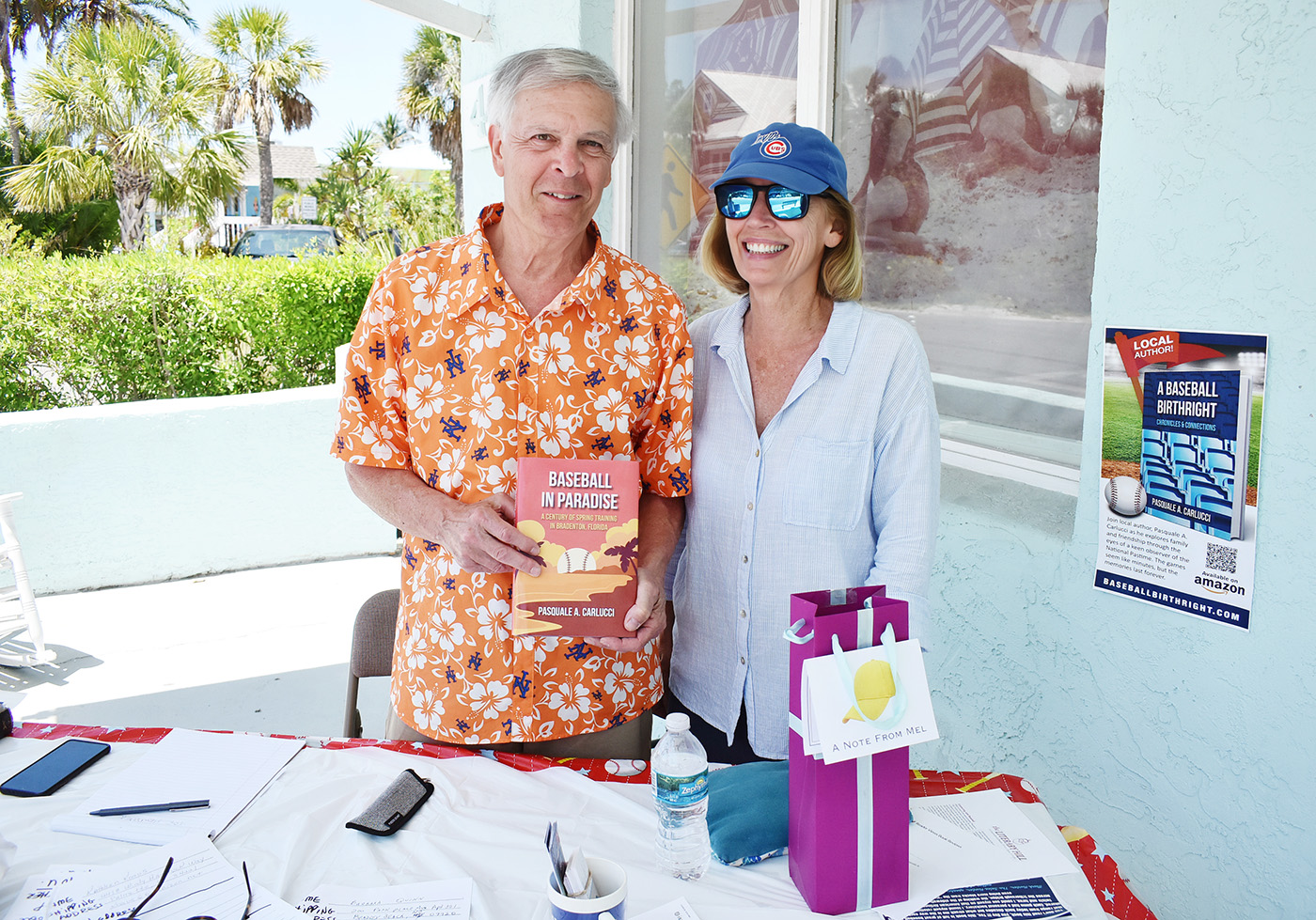
ANNA MARIA – Pasquale “Pat” Carlucci, the author of “Baseball in Paradise: A Century of Spring Training in Bradenton, Florida,” held a book signing event at the Anna Maria Island Historical Museum in Anna Maria on Thursday, April 30.

Within the first hour or so of the three-hour event held on the museum’s front porch, Carlucci, a part-time Bradenton Beach resident, quickly sold all 20 copies of the books he brought for the occasion. 

“I didn’t bring enough books,” he lamented. 
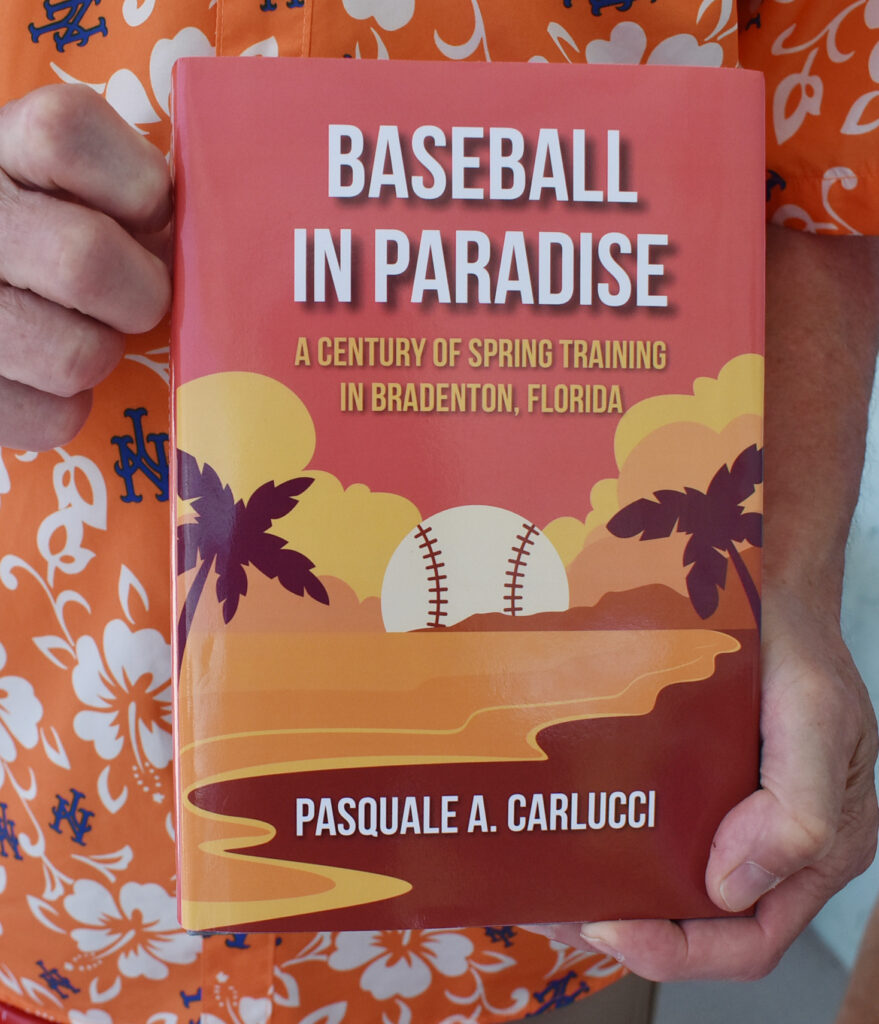
“Baseball in Paradise: A Century of Spring Training in Bradenton, Florida,” by Pasquale “Pat” Carlucci. – Joe Hendricks | Sun

Carlucci said he’ll drop off more copies to be sold inside the museum, where several other books that detail Anna Maria Island’s history are also sold. Published in 2025, “Baseball in Paradise,” and his previous book, “A Baseball Birthright: Chronicles & Connections,” published in 2022, can also be purchased at several online retailers, including Amazon, Wal-Mart and Barnes & Noble. 
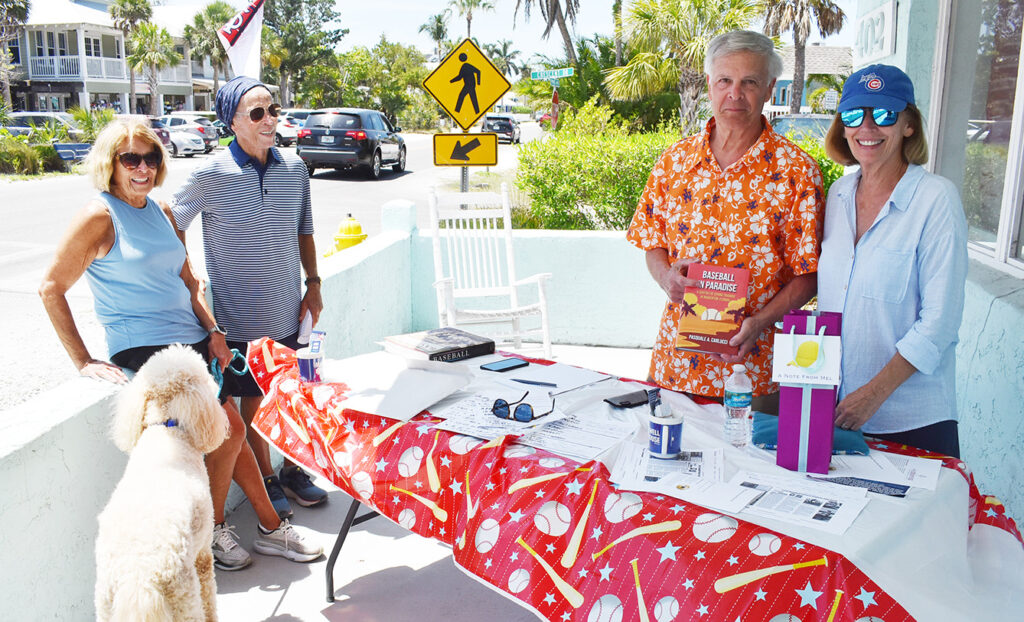
Sue Seiter and John Kolojeski chatted with author Pat Carlucci and historical society member Carolyn Orshak during the final hour of his book signing event. – Joe Hendricks | Sun

Even though he ran out of books, Carlucci stuck around for the entire three hours he was scheduled to be there. Shortly after noon, he chatted with longtime Anna Maria resident John Kolojeski and John’s wife, Sue Seiter. Seiter suggested Carlucci serve as a guest speaker during next year’s Friends of the Island Library lecture series.

Carlucci hails from New York, New York, and he wore a New York Mets shirt to the book signing.

“They really stink this year,” he said of his favorite team’s woeful start. 

Carlucci and his wife own a second home in Bradenton Beach and they and their family have been coming to the Island for the past 13 years. After living in Michigan for many years, Carlucci and his wife now live in Washington D.C., so they can be close to their grandchildren. 

While sitting on the museum porch, Carlucci said, “2023 marked 100 years of baseball in Bradenton and the gist of the book is a hundred years of spring training baseball in the Bradenton area. The first chapter is about how and why the book came to me and a lot of local people who helped me on my journey of discovery are named in the book.”

The book’s first chapter details how his latest book-writing journey stemmed in part from a conversation he had with his friend, Ken, who told him that many years ago he visited a spring training home in Anna Maria occupied by members of the 1979 World Series-winning Pittsburgh Pirates team and managed to get a baseball autographed by some of those legendary Pirates’ players. 

Carlucci chronicled how he was sitting on the beach one day and Googled “baseball and Anna Maria Island” and discovered a YouTube interview titled “Boys of Winter Baseball” conducted by the Anna Maria Island Historical Society.

Carlucci paid a visit to Bortell’s Lounge and learned the bar’s current fishing and boating décor had replaced the previous baseball-themed décor. He also discovered “Birdie” Tebbetts Field in Holmes Beach, which is named after former Major League Baseball player, manager and scout George “Birdie” Tebbetts.

For the book signing, Carlucci hung plastic pennants from the museum porch, representing the teams that conducted their spring training activities in Bradenton, starting with the St. Louis Cardinals. 

“The St. Louis Cardinals for two years. After that, it became the Philadelphia Phillies for three years. After that, it was the Boston Red Sox for two years. Then it became the Boston Bees, who were really the Braves, and the manager was Casey Stengel. Then the Second World War came and there was no spring training – although that period was interesting also, which in the book. Then Boston came as the Braves again and they were here for a long time because they were a premier powerhouse; and they have so much history here on the Island,” Carlucci said.

BRAVES ON AMI

The Braves’ past presence on Anna Maria Island is recognized by two statues of boys swinging baseball bats and a third statue of a boy pitching a baseball. The statues stand between the Gulf and a beachfront home on Cypress Avenue in Anna Maria.
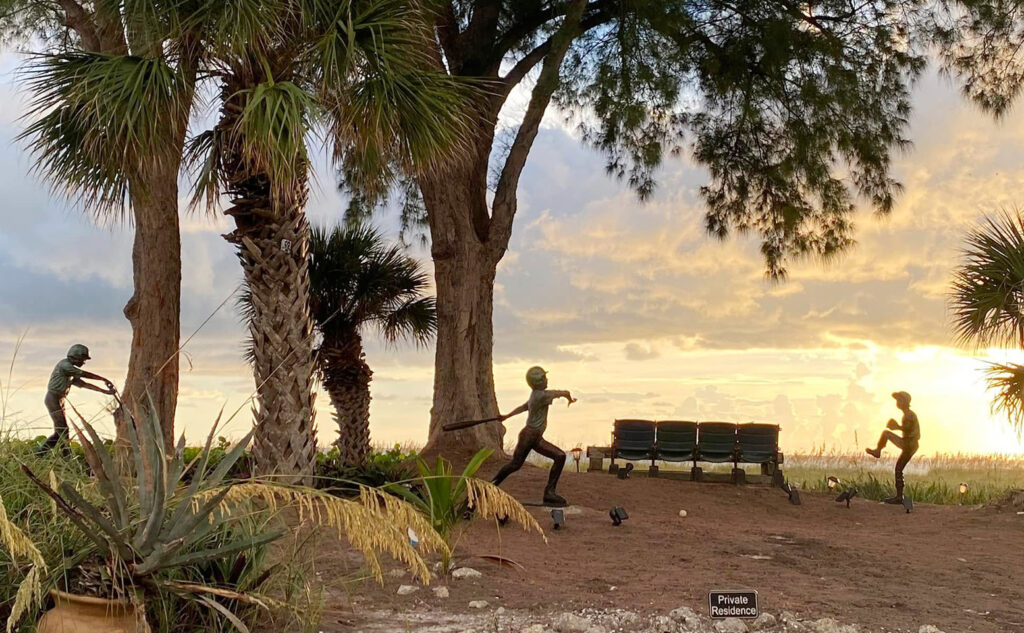
These baseball statues stand in front of a beachfront home in Anna Maria. – Kristen Bowles/Facebook | Submitted

The home was once owned by Braves’ Hall of Fame pitcher Warren Spahn, who later sold it to Braves’ Hall of Fame third baseman Eddie Mathews. Attached to the home’s gate are two baseball bats crossed like an X, with two baseballs placed above the bats and a replica of home plate bearing the signatures of Mathews and Spahn placed below the bats.
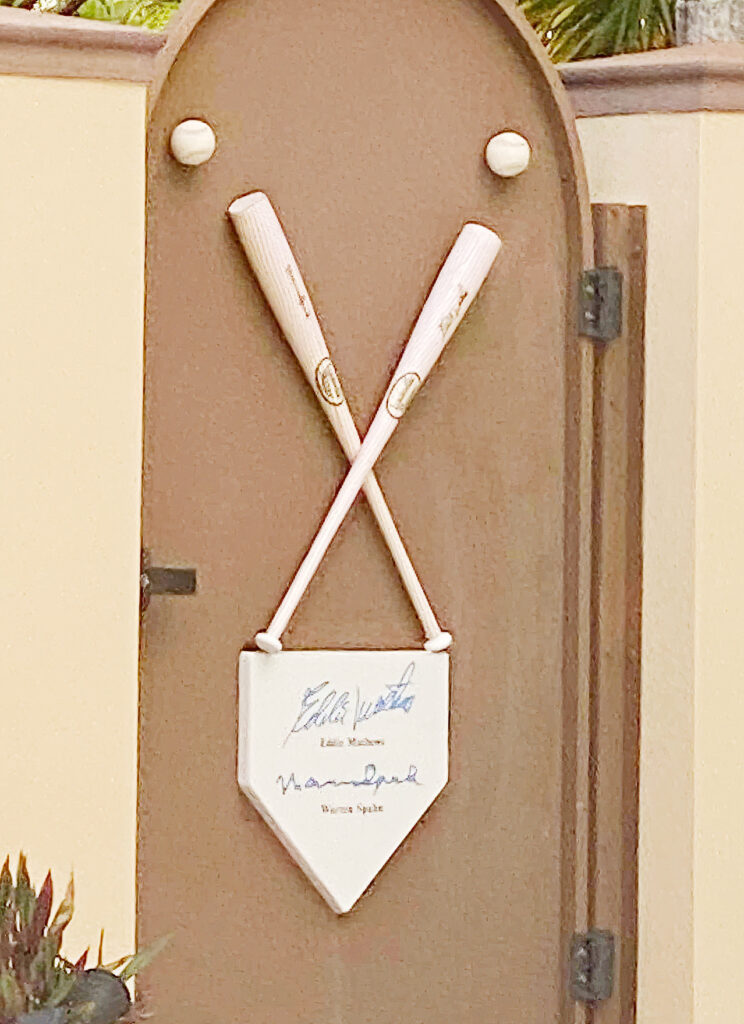
In 2022, Kristen Bowles shared this photo of the tribute to Warren Spahn and Eddie Mathews that hands outside a beachfront home in Anna Maria. – Kristen Bowles/Facebook | Submitted

“The Braves left in ’62, I think. They were followed by the Kansas City Athletics, who were here for six years and became the Oakland Athletics, owned by Charlie Finley. Guess who their hitting coach was for two years, which I never would have known if I hadn’t written this book? Joe DiMaggio, and the back story is in the book,” Carlucci said.

After the Athletics moved their spring training headquarters to Arizona, the Pittsburgh Pirates came to Bradenton in 1969.

When asked what he hopes people take from reading “Baseball in Paradise,” Carlucci said, “Baseball is more than baseball. It’s American culture and community. And the way the book is written, there’s a year-by-year template for a hundred years – whatever’s happening in the world and in Bradenton. Who was the team, who was the manager, who was the best player and how did they do during the season?”

Environmental groups push to return manatees to endangered status

Environmental groups push to return manatees to endangered status

Since the 2017 downlisting of manatees from endangered to threatened status – and with a record number of deaths of the marine mammals – a push is underway to seek restoration of the manatee’s endangered status and the protections that go along with it.

Last month, The Center for Biological Diversity, Harvard Animal Law & Policy Clinic, Miami Waterkeeper and Save the Manatee Club petitioned the U.S. Fish and Wildlife Service (FWS) to increase protections for West Indian manatees. The petition urges the wildlife service to reclassify the species from threatened to endangered under the federal Endangered Species Act (ESA).

“Since the service prematurely reduced protections in 2017, the species has declined dramatically,” according to a press release from The Center from Biological Diversity, a national non-profit conservation organization with a Florida office in St. Petersburg. “Pollution-fueled algae blooms sparked an ongoing mortality event that killed more than 1,110 Florida manatees in 2021 alone. This represents 19% of the Atlantic population and 13% of all manatees in Florida.”

As of October, 726 manatees have died in Florida so far this year. Officials estimate about 6,500 manatees live in waters of the southeastern U.S.

“West Indian manatees from Florida to the Caribbean are facing drastic threats from habitat loss, boat strikes, pollution, climate change and toxic algae blooms,” said Ben Rankin, a student attorney at the Harvard Animal Law & Policy Clinic. “The restoration of full Endangered Species Act protections is an essential first step in conserving this species everywhere it is found.”

Manatees had been protected as “endangered” since 1967 under the ESA. The 2017 reclassification came after the Pacific Legal Foundation, on behalf of Save Crystal River Inc., a recreational boating group, petitioned the FWS, saying the safety measures addressing the manatee’s endangered level of protection were bad for tourism and boating businesses.

Manatees are protected by the Florida Manatee Sanctuary Act, the federal Marine Mammal Protection Act and the ESA. They are listed as threatened under the ESA and designated as depleted under the Marine Mammal Protection Act.

It is illegal to feed, harass, harm, pursue, hunt, shoot, wound or kill manatees.

The West Indian manatee consists of two sub-species: the Florida manatee and the Antillean manatee. The average Florida manatee is about 10 feet long and weighs about 1,200 pounds. Florida manatees can live more than 65 years, however, among the manatees that reach adulthood, only about half are expected to survive into their early 20s, according to the Florida Fish and Wildlife Conservation Commission (FWC).

The pending petition is not the first call to restore the manatee’s endangered status. In June 2021, U.S. Rep. Vern Buchanan (R-Manatee) called on the FWS to upgrade the manatee from threatened to endangered under the ESA.

“Manatees are beloved, iconic mammals in Florida,” Buchanan said. “We should provide these gentle giants with the highest levels of federal protection.”

In Nov. 2021, the FWC and the FWS ad- dressed an unusual mortality event (UME) among manatees along Florida’s Atlantic coast.

“Researchers have attributed the UME to starvation due to the lack of forage in the Indian River Lagoon. Historically, the lagoon has provided essential habitat to manatees year-round, and during the colder winter months many manatees depend on warm water refuges in this area,” according to the FWC.

“Increasing protections for manatees with an endangered listing would provide immediate protection,” said Rachel Silverstein, executive director of Miami Waterkeeper. “With astounding losses of seagrasses around the state, we need to address water-quality issues to give the manatee a fighting chance to survive and thrive.”

FWS has 90 days to evaluate whether the petition to protect the manatee as endangered presents substantial information to indicate that the action may be warranted. If so, the agency must complete a thorough review of the species’ status within 12 months of receiving the petition.

COVID-19 sharply on the rise in Florida

The Florida Department of Health reported 73,199 new COVID-19 cases statewide during the week of July 16-22, a 61% increase from the previous week.

To reduce your risk:

  • Get a COVID-19 vaccine
  • Wear a mask
  • Wash your hands
  • Avoid crowds; social distance
  • Clean and disinfect surfaces

The Florida Department of Health in Manatee County and the Florida Division of Emergency Management offer COVID-19 testing and vaccination at the Palmetto Bus Station, 1802 Eighth Ave. W. in Palmetto from 9 a.m.- 4 p.m. weekdays. Testing (including both PCR and rapid testing) and vaccinations (Moderna) are free, and no appointment is necessary. Visitors are asked to bring proof of Florida residency such as a driver’s license or utility bill with a Florida address. For more information, call 941-242-6646.

Vaccinations are also available at CVS, Publix, Walgreens, Walmart and Winn-Dixie stores.

Anna Maria Island reaches 100 COVID-19 cases

ANNA MARIA ISLAND – The number of COVID-19 cases reported on the Island has reached 100.

The cases date back to the beginning of the pandemic in March through Monday, Nov. 16, according to the Florida Division of Emergency Management daily COVID-19 data report, which reports cases according to patients’ home zip codes.

2020 COVID-19 cases on

Anna Maria Island by month


March 0

April 2

May 2

June 16

July 36

August 52

September 59

October 76

November (to date) 100

As of Monday, there were 52 COVID-19 cases reporting in Holmes Beach, 36 in Bradenton Beach and 12 in Anna Maria since the pandemic began.

As of Nov. 9, there had been 84 COVID-19 cases reported on Anna Maria Island – with 41 cases reported in Holmes Beach, 34 cases reported in Bradenton Beach and nine cases reported in Anna Maria.

Between Nov. 9 and Nov. 16, 11 new cases were reported in Holmes Beach, two in Bradenton Beach and three in Anna Maria.

As of Monday, there had also been 50 total COVID-19 cases reported in the Manatee County portion of Longboat Key and eight in Cortez.

On Saturday, Nov. 14, 202 new COVID-19 cases were reported in Manatee County, according to the Florida Department of Health (FDOH) COVID-19 dashboard. As of Monday morning, 14,593 Manatee County residents and 179 nonresidents tested positive for COVID-19 since March.

According to the Nov. 14 Manatee County COVID-19 update shared by County Commissioner Misty Servia, 34 patients were currently hospitalized for COVID-19 as of Saturday, with 945 total COVID-19 hospitalizations to date, and 346 COVID-19 related deaths to date.

The most recent daily percent positive rate for those tested in Manatee County in one day was 7.81%.

Spike in COVID-19 cases follows reopenings

Manatee County had the highest spike in COVID-19 cases in a month on Thursday, June 11, with 56 new cases reported by the Florida Department of Health.

Statewide cases also spiked that day with 1,663 new cases.

The CDC ranks Manatee County fifth among Florida counties for the number of COVID-19 deaths.

The increases come within three weeks of the May 21 reopening of Florida vacation rentals from state-imposed closures intended to slow the spread of the coronavirus. Gov. Ron DeSantis reopened beaches, restaurants, retail stores and state parks on May 4, hair and nail salons on May 11, and gyms on May 18.

The incubation period for the coronavirus, or COVID-19, is up to 14 days, with more than 97% of people developing symptoms withing 11.5 days of becoming infected, according to the Centers for Disease Control and Prevention (CDC).

From May 13 to June 11, new cases of COVID-19 trended upward both countywide and statewide.

As of June 11, 1,309 people in Manatee County with the coronavirus have been reported, with 114 people who died from the disease.

The CDC ranks Manatee County fifth among Florida counties for the number of COVID-19 deaths.

No cases were reported in Anna Maria or Cortez and fewer than five were reported in Bradenton Beach and Holmes Beach combined.

Statewide as of June 11, there have been 70,971 people with COVID-19 in Florida, and 2,877 people have died from the disease – more than the number of people who died in the attack on the World Trade Center in New York City on Sept. 11, 2001, which killed 2,753 people, according to the Encyclopedia Brittanica.

The CDC predicts more than 3,500 more cases in Florida by July 1.

Nationwide, 2,038,344 cases of coronavirus have been reported, with 114,625 deaths.

Related coverage

State health officer: ‘Wear your mask’


Tips for staying safer from coronavirus

Groceries

Order groceries online or use curbside pickup. If you must shop in a store, stay at least 6 feet away from others, cover your mouth and nose with a cloth face covering, go during hours when fewer people will be there and if you are at higher risk for severe illness, find out if the store has special hours for people at higher risk and shop during those hours. People at higher risk for severe illness include adults 65 or older and people of any age who have underlying medical conditions or are immune compromised. Disinfect the shopping cart with disinfecting wipes if available. Do not touch your eyes, nose, or mouth. If possible, use touchless payment (pay without touching money, a card or a keypad). If you must handle money, a card, or use a keypad, use hand sanitizer right after paying.

Deliveries, mail and takeout

Use delivery services when possible, having bags of ordered food left on a home doorstep. Limit in-person contact if possible. Wash your hands or use hand sanitizer after accepting deliveries or collecting mail.

Banking

Bank online when possible. If you must go inside the bank, use hand sanitizer containing at least 60% alcohol after any deposit, withdrawal, exchange, drive-thru visit or use of an ATM.

Wash your hands thoroughly when you arrive home.

Getting gas

Use disinfecting wipes on handles and buttons before you touch them (if available). After fueling, use a hand sanitizer with at least 60% alcohol. Wash your hands for at least 20 seconds when you get home or somewhere with soap and water.

Source: Centers for Disease Control and Prevention

Vacation rental bills looming large

TALLAHASSEE – The Florida Legislature is getting closer to potentially taking away local governments’ ability to regulate short-term vacation rentals and vacation rental advertising.

And Anna Maria Mayor Dan Murphy and Commissioner Carol Carter are among those who are concerned that state legislators may finally succeed in their annual efforts to strip away cities’ home rule rights.

Similar in nature and intent, Senate Bill 1128 and House Bill 1011 are progressing toward possible final votes on the House and Senate floors.

As recently noted by Florida League of Cities Legislative Advocate Casey Cook, legislators who support the proposed legislation want to turn over the regulation of vacation rentals to the already understaffed and under-resourced Florida Department of Business & Professional Regulations.

And new this year, state legislators are including in their proposed legislation a requirement that all vacation rentals advertised through Airbnb, VRBO and other online platforms must be fully licensed and registered with the state. This is the legislature’s attempt to ensure that vacation rental-related taxes are remitted to county tax collectors, including the sale tax revenues to be remitted back to the state.

Originally filed by Sen. Manny Diaz Jr, R-Miami/Dade, SB 1128 passed through its second committee stop on Tuesday, Feb. 11. The Commerce and Tourism Committee ruled favorably on the amended bill by the 3-2 vote and committee chair Joe Gruters, R-Sarasota, was one of three senators who voted favorably on the bill.

The Senate bill has been referred to the Rules Committee for its third and final committee stop but it was not included on the agenda for the committee’s Wednesday, Feb. 26 meeting.

If SB 1128 passes through the Rules Committee, it is likely headed to the Senate floor for a final vote by the Republican-controlled Florida Senate.

Serving as the House companion, HB 1011 is co-sponsored by Rep. Jason Fischer, R- Jacksonville, and Rep. Mike LaRosa, R-St. Cloud.

HB 1011 passed through its third and final committee stop on Thursday, Feb. 20, when the Commerce Committee ruled favorably on the bill by a 14-9 margin. State Rep. Will Robinson Jr., a Republican from Bradenton, broke ranks with his party and opposed the legislation. The following day, Murphy sent Robinson an email expressing his appreciation.

“Thank you for voting no on HB 1011 concerning vacation rentals. Your stance on this critical issue is greatly appreciated and respected.  It was apparent that you were the only Republican who had the courage on the committee to stand up for what is in the best interests of the community. Your efforts have not gone unnoticed and will not be forgotten. We thank you for your continued support of the city of Anna Maria and your understanding of the impact of this proposed legislation,” Murphy’s email said.

HB 1011 now appears to be headed to the House floor for a final vote in the Republican-controlled House of Representatives.

If identical bills are adopted by the Senate and the House, the legislation would be sent to Gov. Ron DeSantis to sign into law or veto. The 2020 legislative session is scheduled to end on March 13.

Local concerns

On Friday, Murphy discussed his concerns and said he’s in daily contact with Chip Case, the city’s lobbyist.

“I’m very concerned about this legislation getting to the House and Senate floors. We need to keep the pressure on the Senate Rules Committee,” Murphy said.

“When Commissioner Carter and I were in Tallahassee two weeks ago, every person we visited, including Fischer, said we certainly got a lot email from your constituents. That’s important. It might be falling on deaf ears, but if we didn’t have that public pressure and we appealed to the governor, the legislators could say there’s been no public objection to this bill,” Murphy said.

“If it passes as written, we’re through regulating vacation rentals. Occupancy limits, inspections and registration would all be out the door. We would lose the ability to know, from a law enforcement point of view, who’s responsible for that house. Now we know who’s responsible because we make sure every vacation rental has a registered agent, a person we can contact 24 hours a day, seven days a week. That’s critical if there’s a fire, a burglary, an issue with noise or some other issue. Without registration, we have nothing. You’re not going to call anybody at Airbnb. Most of these homes are listed under an LLC and in many cases, it’s foreign ownership,” Murphy said.

“The annual inspections are good, and the occupancy limits are important too – Airbnb wants to cram 25 people in those houses – but the loss of knowing who’s responsible for that house and having that contact information is critical,” Murphy said.

On Monday, Feb. 24, Carter distributed an email that said HB 1011 could be headed for a final vote on the House floor as early as Thursday.

“Time to reach out to all house members to vote no,” she wrote.

She also noted SB 1128 could be on the Rules Committee’s March 3 agenda.
“Must keep up the pressure on our senators,” Carter wrote.
She urges concerned citizens to contact Republican Rules Committee members Lizbeth Benacquisto, Rob Bradley, Jeff Brandes, Anitere Flores, Travis Hutson, Tom Lee, Kathleen Passidomo, David Simmons, Wilton Simpson and Kelli Stargel.

Related coverage

Vacation rental bills progressing

Local vacation rental regulations under fire again

Castles in the Sand

Sunshine State population growth

There’s a reason that Florida is called the Sunshine State and it has nothing to do with sunshine.

What it does have to do with is people – people from other states – and here’s why.

According to a new federal census report from the U.S. Census Bureau, Florida was the second fastest growing state, adding more than 322,000 people last year. Only Texas scored higher than Florida, adding nearly 380,000 people during the same time frame. In addition, for the eight-year period between 2010 and 2018, Florida’s population increased 13.3 percent with Texas just above adding 14.3 percent in population. Nevada and Washington state came in third and fourth with approximately an increase of 12 percent each.

So why are we importing so many residents from other states? Obviously, in spite of the threat of hurricanes, which are frequently overblown, we do have a lot of sunshine and almost perfect weather for at least six months. And, for those of us who live here full-time, even the summers are a non-issue compared to the six months of horrible weather experienced in many other parts of the country. The car starts every day even if it’s 90 degrees and, in Florida, boots are a fashion statement rather than a life-saving essential.

And Florida has no state tax in a state friendly to business, which has created a booming business community. Although retirees keep coming, businesses are recruiting young workers in an effort to keep up with the expanding population. All of this is happening in Florida during a time when the United States population growth has fallen to an 80-year low because of declining birth rates.

Consequently, what goes up must come down and there are plenty of states that are losing some of the population coming to us. For the one-year period from July 2017 to July 2018, the top two states to lose population are New York, losing 48,510 people, and Illinois, losing 45,116.

These two states, in addition to Connecticut which also lost population, are some of the highest taxed states for both state tax and property tax. In addition, the implementation of the federal tax reform last year limits the deductibility of state and local taxes, hitting residents in these states particularly hard. It will be interesting to track the population shifts in a few years after residents have experienced several years of tax returns.

What this all means to Manatee County real estate can only be good. These are the December sales statistics from the Realtor Association of Sarasota and Manatee’s website:

Single-family homes in December maintained their benchmark at a $300,000 or over sale price again coming in at $309,000, 2.7 percent down from last year. The average single-family sale was $380,272, a 1 percent increase. The median time to sell was 90 days, about the same as last year, and the month’s supply of properties remains at about four months.

Condo sales were a median of $190,000, down 2.6 percent from last year, but the average was $236,606, up 7.2 percent. Median time to sell was 96 days, up from last year by 17.1 percent, and month’s supply of properties was four months, up slightly from last year.

I know the U.S. Census Bureau has its algorithms and fancy computer programs to analyze population growth, but I have my own personal methods. If the Cortez Bridge is backed up to the firehouse during the summer and the parking lot at Publix has zero spaces, that’s when I know July isn’t what it once was. Let the sunshine in.

More Castles in the Sand:

2019 tax nightmare

Is a piece better than the whole pie?

2019 real estate trends

November is Manatee Awareness Month

It’s been a tough couple of years for Florida manatees.

Coast Lines logo - border

So far this year, 714 manatees have died, compared to 538 in 2017, out of about 6,000 estimated to live in Florida waters, according to the Florida Fish and Wildlife Conservation Commission (FWC).

Red tide has been active in Gulf and inland waters in Southwest Florida since last October, killing 67 of the 714 manatees, with red tide suspected in the deaths of 121 others. Nine were found in Manatee County.

The red tide neurotoxin causes manatees to have seizures that can result in drowning. If rescued in time, most manatees can recover, so report a sick manatee (muscle twitches, lack of coordination, labored breathing, an inability to maintain body orientation) immediately to the FWC Hotline at 1-888-404-3922, or email Tip@MyFWC.com. Use VHF Channel 16 on a marine radio.

To survive, manatees in Florida waters also have to avoid eating red tide-poisoned seagrass, flee cold water, escape from people who climb on them and ride on their backs, and dodge boat propellers.

Last year, 107 manatees died from boat strikes in Florida last year, with 98 so far this year, according to the FWC.

Boats accidents prompted former Florida Gov. Bob Graham to make November Manatee Awareness Month in 1979.

As the official state marine mammals head from the Gulf of Mexico, rivers and bays to the warmer winter waters of springs, boaters should be careful to note speed zones that take effect in November.

To help protect manatees, follow these tips:

  • Obey posted signs for manatee slow-speed zones.
  • Wear polarized sunglasses to see manatees in your path.
  • If you observe a manatee mating herd – several manatees gathered as males vie to mate with a female – watch from at least 100 feet away. Coming any closer might disrupt the mating or endanger you; adult manatees typically weigh more than 1,000 pounds.
  • Never feed or water manatees as they will become habituated to people, which could put them at risk of injury.
  • Stow trash and line when underway. Marine debris that blows overboard can become ingested by or entangled around manatees.

Contact the FWC Wildlife Alert hotline at 1-888-404-FWCC (3922):

  • If you see a manatee with a pink or red (fresh) wound.
  • If the manatee is tilting to one side, unable to submerge or seems to have trouble breathing.
  • If you see someone separating a mother from her calf.
  • If you see a manatee calf by itself with no adults around for an extended period of time.
  • If you see someone harassing a manatee in any way.
  • If you see boaters speeding in a protected area.
  • If you see a manatee entangled in monofilament, crab-trap lines or other debris.
  • If you see a dead manatee.

Free shoreline property signs, boating banners, decals, waterway cards and educational posters are available at Save the Manatee Club.

Castles in the Sand

Why aren’t you moving?

Last week we talked about moving and the emotional and financial toll it can take on your family. This week we’re going to touch on why people aren’t moving as much, at least not for jobs.

It’s a new world out there; technology has made it possible to practically run a multi-million-dollar business from home in your pajamas. More employers are offering their staff the ability to work virtually from home, saving enormous amounts of corporate dollars. This could be part of the reason why, according to the U.S. census data, fewer people are relocating for jobs.

About 3.5 million people relocated for a new job or job transfer last year, which is a 10 percent drop from 2015, but there are other reasons as well. The once traditional family, where job transfers hinged on the primary breadwinner’s career, usually the husband, are almost gone. During the time I worked in the relocation business we had an awful expression for this, “the trailing spouse,” which conjured up nasty images. In the late 1980s, more than a third of job seekers relocated, and it has gone continually down to below 20 percent after 2000. The first half of this year shows only about 10 percent.

Thankfully these days, no one is trailing primarily because both spouses or partners generally contribute to the financials of the household, and job opportunities must be weighed very differently. In addition, with the high divorce rate and former spouses co-parenting their children, relocating presents logistical issues most employees don’t want to face.

Even for those willing to relocate, the previous generous incentives used to induce skilled workers to uproot themselves and their families have gotten smaller. Therefore, the cost of selling a property and moving to a different location is not being offset by companies as in past years. Add into this the low unemployment rate pretty much all over the country, enabling employees who may want to look for other opportunities to do it a lot closer to home.

Not only are job seekers unwilling to relocate but just regular people are deciding to stay put and renovate homes rather than give up a low mortgage rate and upend the family. Nationally, according to The National Association of Realtors, the sale of existing homes from June to July fell 0.7 percent. This represents the fourth straight month of declines. Compared with a year earlier in July of last year, sales were down 1.5 percent. Lack of inventory to sell is what is pushing sale prices up, keeping buyers out of the market, which depends on a continuing flow of new homeowners to keep it healthy.

We, however, in Manatee County are not having the same problems plaguing the rest of the country. Single-family sales for the month of July were up 19.2 percent from last year and up 10.1 percent for condos. Appreciation rates are also continuing their upward trend. This doesn’t mean we don’t have a shortage of inventory, we do, and in July it dropped a little further, but so far, the number of sales are being maintained.

Florida has never been a state that imported a lot of job seekers. That certainly has changed in recent years with so many younger people relocating from high priced, high taxed Northern states. However, for the most part, our incoming population consists of second-home buyers and retirees, and that’s what’s keeping the sales going.

So why aren’t you moving? Probably because Florida has lots to offer, not the least of which is a more relaxed way of life and sunshine. Have laptop, won’t travel.

More Castles in the Sand

Why are you moving?

We’re Americans; we borrow

Who’s entitled to title insurance?

Castles in the Sand

Why are you moving?

One of the first things we ask when a friend or relative decides to move is, “Why are you moving?” That’s a question that has dozens of answers. None of them are simple, and none of them come without emotional baggage.

Owning a family home especially one where you lived for many years, raised children, hosted parties, holidays and created memories and experiences, may be the most difficult thing we live through. It’s right up here with death and divorce and is frequently combined with these life-changing events. Making selling a home even more complicated is the fact that for most people it’s the biggest financial transaction they will experience in their lives. Emotions and finances meeting at the crossroads of our lives can put us over the edge, but it doesn’t have to.

Planning for a significant life transition is the best advice for selling your home and moving. Plan well in advance, make lists, develop a timeline and start throwing out. It also helps if you have a friend or close relative who can give you a hand if needed.

Staying centered and keeping a calm Zen-like state of mind will get you through the process when the worst happens, and it will. Remember why you’re moving, focus on the benefits of the move, financial and emotional. Is the house too big now that your family has moved on, will the property start needing major upgrades and renovations because of its age that may be more than you want to take on or is it just time to start fresh?

Americans are by nature transient. They move around the country frequently for school, jobs or retirement. For instance. maybe after living at the beach for years, it’s time to move inland. We’re seeing quite a bit of that particular transition on Anna Maria Island and other waterfront communities in our area. As new part-time residents and investors are purchasing on the Island keeping selling prices up, long time permanent residents are starting to think about moving off.

Some of this transition has to do with the aging of full-time Island residents and their homes. New construction is always a draw, especially for retirees, as I have recently heard from many of my friends and acquaintances. In addition, small cities and university communities are a big attraction for retirees. There has been a fair amount of migration to the Carolinas from Florida residents who want to be closer to families still in the Northeast or looking for a change of temperature from Florida’s warm summers. For instance, cities like Charleston, Charlotte and Ashville offer city life without the city hustle and bustle.

Finally, as stated, a home is most people’s largest investment, so selling it and moving on creates a dollar and cents stress like no other. Government regulations require realtors and closing agents to state clearly in black and white what your closing check will be and any other expenses related to the sale several days ahead of the actual closing.

For many years I worked in real estate corporate relocation in New York, and I can tell you the transition for these families coming from other parts of the country to the suburbs of New York City was staggering. The sticker shock reduced transferees to tears before they even got out of the realtor’s car, and this was even before the cultural differences kicked in.

So, when you make the decision to move after you answer all the questions about why you are moving, start making lists, stay centered, organized and look positively forward to the next of life’s challenges.

More Castles in the Sand

We’re Americans; we borrow

Who’s entitled to title insurance?

Are you underinsured?

hands along the water

Hundreds send positive message about the environment

The Gulf of Mexico was churning up more dead sea life and caustic smell Sunday morning, the result of the latest red tide outbreak. But that didn’t stop about 500 people who turned out at Coquina Beach not to protest but to show support for Florida’s fragile environment by participating in the Hands Along the Water event.

“I could not sleep when red tide came because of the smell and knowing what it was doing to the sea creatures,” event organizer Elizabeth Shore said. “I learned about Hands Along the Water and wanted to hold an event on Anna Maria Island.”

Shore, who owns Bunny and the Pirate Bazaar on Cortez Road West, said she didn’t want to protest anything, just show positive support for the environment.

Shore is a fifth-generation native of Manatee County and the daughter of the late R.B. “Chips” Shore, former Clerk of the Circuit Court.

Hands along the water masks
Tracy Powers and Teri Lennon pause for a selfie before departing.
Teri Lennon | Submitted

Noxious stuff

Red tide is an algae that emits a neurotoxin when it blooms. The toxin can kill sea life and seabirds that feed on them and sea turtles. The Island has had outbreaks in the past but not in such an abundance, according to long-time residents.

Hands Along the Water also shows support for ending the algae that fill rivers and canals around Lake Okeechobee in the southern part of Florida.

A group of visitors from southern Florida said they learned about Hands Along the Water from Facebook and are shocked at the way the green algae kills everything in the canals and rivers. They said they would support politicians who would want to protect the environment and improve the condition of Florida’s waterways and shores.

ManaSota-88’s 10 reasons not to drill for oil offshore of Florida

  1. National Security

Americans consume 25 percent of the world’s produced oil, but our nation holds less than 3 percent of the world’s proven oil reserves. As a matter of national policy, it seems strategically reckless to continue to deplete our nation’s very limited oil and gas resources. The more domestic oil we consume, the less oil we will have in the future. The less domestic oil we have in the future, the more dependent our nation will be on foreign countries and the less secure our nation will be.

  1. Oil Exports

The United States exports approximately 1.2 million barrels of petroleum products each day to foreign countries. The Department of Energy predicts that 200,000 barrels of petroleum could be produced per day at the height of offshore oil production in Florida in 2030. This is roughly 1/9th the amount of oil exported each day to foreign nations. At the current rate of oil exportation, we will have exported the equivalent of 40 percent of the oil reserves predicted to be offshore of Florida before the first barrel of oil is ever extracted.

  1. Oil Leases

90 million acres of federal lands are currently leased to oil companies. Less than a quarter of these lands are being used for oil and gas production. Flooding the market with huge area-wide lease offerings, offshore oil drilling will drive down the price of oil and gas leases and reduce competition. The American taxpayers will lose out on billions of dollars of oil revenues. The glut of oil leases being offered will provide the oil industry an opportunity to lease large blocks of publicly owned submerged lands at bargain basement prices.

  1. Florida’s Economy and Tourism

Florida’s economy is based on having clean beaches and a healthy environment, not oil refineries, storage tanks, oil platforms, and pipelines. The tourist industry employs about 1 million people living in Florida. Tourism generates about $65 billion a year for the state of Florida. Whatever oil revenues are realized is small when compared to the cost in damages one oil spill will have on Florida’s economy, environment, and job employment.

A proper economic assessment of offshore oil drilling can only be made when the following are considered: costs of the loss or recreation and tourism dollars, the irretrievable commitment of chemicals used in the separation and processing of oil and gas, the hazards associated with transportation of hazardous and volatile chemicals associated with oil exploration and processing, the increased costs associated with reduced national security, the costs of the health impacts associated with increased air and water pollution and the costs of the unavoidable impacts to Florida’s coastal and marine environment.

  1. Prices at the gas pump

Offshore oil drilling does not reduce gas prices at the pump. California produces more than 600,000 million barrels of oil per day, and Alaska produces more than 1,300,000 million barrels per day. Both states have higher gas prices at the pump than does Florida. Floridians can expect to pay more for gas at the pump because offshore oil drilling will give legislators the incentive to raise gasoline taxes in an attempt to balance the state budget.

The U.S. Energy Information Administration has stated that increasing “access to the Pacific, Atlantic and eastern Gulf regions would not have a significant impact on domestic crude oil and natural gas production or prices before 2030.”

  1. Oil Spills

The Deepwater Horizon Gulf of Mexico spill of 2010 lasted for more than 87 days. The environmental and financial impacts will last for decades to come. The Montara blowout of August 2009 lasted 10 weeks and permanently impacted the environmental health of the Timor Sea. Nearly 63,000 gallons of crude leaked from a cracked oil pipeline 30 miles off the Louisiana coast in 2009. The ability of the oil industry to respond effectively to such spills is questionable at best. In May 2007, corrosion in a pipeline off Louisiana spilled about 8,000 gallons of oil. In December 2006, approximately 36,000 gallons of oil spilled at the Galveston Lightering Area in the Gulf.

The impact from even a minor oil spill of 100 barrels or less can inflict significant environmental damage. Should oil reach the Florida coastline, it will render many areas uninhabitable to plants and animals, oil could remain for years, destroy egg and larvae of marine organisms and affect marine life and food chains. Petroleum hydrocarbons are extremely toxic even at very low concentrations.

  1. Hurricanes

Florida perhaps faces a greater potential for the occurrence of natural hazards than any other state. Florida ranks first in hurricane occurrences and is the most vulnerable to the devastating effects resulting from coastal storms. Hurricanes can and have caused oil spills both on and offshore. The U.S. Government’s Minerals Management Service states that Hurricanes Katrina and Rita damaged or destroyed 113 oil platforms, 457 oil pipelines and caused 124 offshore oil spills in the Gulf of Mexico, More than 9,000,000 gallons of oil were spilled from onshore tanks and pipelines as a result of the two storms. The U.S. Coast Guard reported that there were over 9 million gallons of oil released from six major and five medium spills. There is no reason to believe that future oil drilling will protect Florida’s economy and the environment from the potential serious environmental damage associated with offshore oil drilling and onshore oil spills associated with hurricanes.

  1. Onshore Health and Environmental Impacts

Offshore oil and gas operations require roads, storage tanks, pipelines, processing facilities and other industrial facilities. These can severely damage beaches, wetlands and coastal habitats, with consequences for coastal economies that depend on tourism, recreation, and fishing. Oil and gas processing plants can result in the degradation of air quality. Onshore gas processing activities typically emit constant levels of volatile organic compounds, nitrogen oxides, carbon monoxide, sulfur dioxide and total suspended particulates. Processing and oil separation require large volumes of water. The addition of one or several gas processing plants will have significant impacts on local water supplies.

The oil and gas industry should not be permitted to externalize the costs of the air, water, and land pollution they create at the expense of the environment and the public’s health.

  1. Energy Conservation

It is in the best interests of our environment, economy and national security to develop truly renewable energy resources such as solar, and the sooner the better. The best option, cheaper than any new energy supply and causing no increase in atmospheric greenhouse gas levels, is energy conservation and increased energy efficiency. Increasing the average U.S. auto efficiency to 40 miles per gallon would save 10 times the estimated oil and gas reserves off Florida. Improving home insulation across the country would save about five times the estimated reserves off the Florida Coast. Conservation is a cheaper and healthier way for the country to buy time to develop renewable energy sources than the measures that will have to be employed in the development of offshore oil reserves.

  1. Offshore Environmental Impacts

In addition to pipeline blowouts or leaks causing serious environmental problems, laying offshore pipes will cause increased turbidity of marine waters, destruction of seagrass beds and resuspension of contaminated sediments. Fish resources will be impacted by coastal and marine environmental degradation, pipeline trenching and offshore drilling discharges associated with routine oil and gas drilling operations. Oil drilling will place the eastern Gulf of Mexico, an area of high environmental sensitivity and marine productivity, at risk. Presently the region supports numerous species of wildlife, major commercial and recreational fisheries and several species of endangered animals.