Tag: fishing

A little tunny caught on fly tackle

Reel Time: Fall fishing frenzy

Shifting seasons bring welcome changes to the Gulf coast, especially those fall fronts that are the couriers of cooling temperatures and lower humidity. Local anglers, weary of the dog days of summer, welcome those changes. The arrival of massive bait schools in the passes and along the beaches are harbingers of the king mackerel, cobia, Spanish mackerel and little tunny that are never far behind.

While I love to fish for all these species, the little tunny (locally known as bonito) is my favorite to pursue. These members of the tuna family are notable for their stamina, long smoking runs and their ferocious feeding blitzes. Best of all, they attack top water patterns with a vengeance. Targeting these rockets with fins is at once easy and frustrating. They can be easily found when they turn the water’s surface white in a feeding frenzy. Wheeling and diving terns and pelicans signal their general location from miles away.

In the past, the method I used most often, once I found feeding fish, was what is referred to as the “run and gun.” The routine was to run on plane within casting distance of feeding fish, cut the engine and fire a cast into the melee before they sounded. That method worked, provided the angler is ready and can get off a quick cast. Fumble with the line or make too many false casts and the fish are notorious for disappearing and then reappearing where you originally ran from. Bait schools are generally spread over a wide area and the schools of little tunny appear suddenly, ferociously attack one school and then just as quickly sound and pop up on another school nearby. If they “stay up” long enough the run and gun works, but they more often bounce quickly from one school to another.

Over the years I’ve found that the best strategy when the fish show only for a short time is to watch the birds, get in the area they are patrolling and let the fish come to you. I can’t emphasize enough the need to make a quick cast, which will vastly increase your odds of a strike and hookup. Another method I’ve used over the years to entice fish to the fly (this works great with Spanish mackerel) is to get in an area where there’s action and slap the fly on the water and rip it off repeatedly before making a presentation. The disturbance on the water attracts feeding fish and can be very effective on the edges of bait schools when fish aren’t showing on the surface.

Little tunny can be caught on fly and spinning tackle as well as live bait but I prefer to fish them on fly with top water patterns. I use an 8-weight outfit with a 10-12-foot tapered leader and a 30-pound fluorocarbon bite tippet. The fluorocarbon leader sinks, which may seem counterintuitive with a top water pattern, but that actually creates more surface disturbance with the gurgler and crease flies I like to use. Little tunny don’t have sharp teeth, but the 30-pound bite tippet provides some protection from Spanish mackerel which are often mixed in the feeding fish. Early or late in the day when the sun is low, and on cloudy days or in turbid water, 40-pound bite tippet will provide a more robust defense.

As I write this column a front has blown in with 20-plus mile an hour winds and cool temperatures. By the time you read this, conditions should be perfect. But don’t wait too long – when water temperatures cool significantly, these schools of fish will move south in pursuit of migrating baitfish.

A hooked fish will put a smile on an angler's face. - Rusty Chinnis | Sun

A hooked fish will put a smile on an angler's face. - Rusty Chinnis | Sun

Little tunny are famous for long fast runs. - Rusty Chinnis | Sun

Little tunny are famous for long fast runs. - Rusty Chinnis | Sun

Casts have to be fast and accurate. - Rusty Chinnis | Sun

Casts have to be fast and accurate. - Rusty Chinnis | Sun

Birds hover over a school of feeding fish. - Rusty Chinnis | Sun

Birds hover over a school of feeding fish. - Rusty Chinnis | Sun

These are the small baitfish the feeding tunny attack. - Rusty Chinnis | Sun

These are the small baitfish the feeding tunny attack. - Rusty Chinnis | Sun

Baitfish scatter as little tunny attack. - Rusty Chinnis | Sun

Baitfish scatter as little tunny attack. - Rusty Chinnis | Sun

Little tunny slash through schools of baitfish with open mouths. - Rusty Chinnis | Sun

Little tunny slash through schools of baitfish with open mouths. - Rusty Chinnis | Sun

Fred and the fish-eating squirrel

Reel Time: Fred and the fish-eating squirrel

Most of Bradenton was asleep and dreaming when I pulled up to the locked gate that barred access to Jiggs Landing on the shore of Ward Lake (a/k/a Bill Evers Reservoir). Beeping my horn and flashing my lights, I knew I was signaling my presence to a small white Boston Whaler somewhere in the inky darkness. The lake is located south of State Road 70, approximately 6.5 miles from downtown Bradenton. It was created as a water source for the City of Bradenton in 1939 when a dam was constructed across the Braden River. The reservoir was expanded to almost 400 acres in 1986 and stores over 1.4 billion gallons of water.

Moments later, Andy “Doc” Lee appeared out of the darkness in his 13-foot Whaler, “Slow Poke.” Lee has been fishing the lake for 45 years and it would be safe to say that no one knows it better. I first met Lee in the late 80s when we formed the Manatee Chapter of the Florida Conservation Association (now CCA). Lee, who hails from upstate New York, started fly fishing at age 7 when his aunt gave him his first fly rod and a fly-tying kit. When he moved to the area in 1977, he called Bradenton Herald fishing editor Jerry Hill to learn about fly fishing locally. A friendship developed and Lee became a featured speaker and fly-tier at Hill’s Bradenton Herald Fishing College.

I did my first story on Lee for Florida Sportsman in 1996. That day we fished the Manatee River and caught an assortment of different species including a 15-pound snook, flounder, channel catfish, panfish and bass. The thing that attracted me to Lee in the first place, besides the fact he catches a lot of fish, was his innovative methods and handmade flies.

We fished for bluegills and redear sunfish (shellcrackers) on three-weight fly outfits. Lee rigged me up at the ramp with an 8-foot, 4-pound leader, strike indicator and a “flutter” fly he developed. After motoring to a nearby shoreline where the river enters the lake, he showed me how to fish the rig and soon we were catching hand-sized panfish. Over the four hours, Lee moved several times to areas of grass where the panfish congregate. He triangulates the spots from landmarks on shore and then verifies the location on a fish finder. While the fishing wasn’t “hot,” according to Lee, we did manage to land over a dozen fish that he would clean for dinner.

As we were headed in, Lee said I had a good chance of meeting Fred and the fish-eating squirrel back at the ramp. Noticing the puzzled look on my face, he explained. For the last few years, Lee has been greeted at the ramp by a red-shouldered hawk he named Fred who loves fish carcasses. Another frequent “greeter” was a squirrel that also loves the remains of the fish he cleaned. On cue, Fred was sitting on a nearby fence when we returned and waited patiently as Lee cleaned fish. When he was done, he flipped the remains on the ground and Fred swooped in for breakfast. The only thing missing that day was the fish-eating squirrel, but Lee invited me back for another chance. I accepted right away; after all, how often do you get to meet a fish-eating squirrel?

Reel Time on the Road: Yellowstone and the Madison River Valley

Reel Time on the Road: Yellowstone and the Madison River Valley, Part Two

When I planned my trip to Montana, visiting and photographing Yellowstone was one of my main objectives besides fishing. The day after fishing Lake Ennis and the Madison River, I returned to the park, this time exploring the diverse and magical landscapes of the geyser basins, Yellowstone Lake and the majestic “Grand Canyon of The Yellowstone,” where the Yellowstone River plunges 1,000 feet into a 20-mile multi-colored canyon. Once again, an early start was rewarded with relatively uncrowded roads and attractions where one could more fully appreciate the natural wonders of our first National Park. I was blessed throughout my trip with clear sunny skies and temperatures that ranged from the mid-30s to the low 80s.

The following day, I returned to the Lamar Valley with Ed Chiles and Bradenton attorney Jim Knowles to fish Soda Butte Creek near the eastern entrance to the park. This time I was afforded the luxury of being able to really absorb the wonders of the park as a passenger. The creek was accessed by hiking across an open sage prairie framed by towering mountains draped in verdant green forests. The amazing scenery there, arguably some of the most picturesque in the park, made it hard to concentrate on our dry flies but we all managed to land a number of cutthroat trout and brown trout. Chiles and Knowles each landed cutthroat trout to 18 inches.

On my last day, I elected to fish again on Lake Ennis with Captain Harrison King and this time we spent the day there. A mirror-smooth lake greeted us that morning as we targeted rainbow and brown trout that were taking insects from the surface. This was exciting and demanding fly fishing, requiring quick, long and accurate casts. The highlight of the day was filming King as he got out of the boat and stalked rising “gulpers” along a channel of the Madison that fed into the lake.  He deftly placed his dry fly just up current of a group of feeding fish, landing a beautiful rainbow trout we estimate at 20 inches. It was a fitting end to a memorable Montana vacation.

If you haven’t experienced the wilds of Montana, I highly suggest you do. I’ll always remember the days floating rivers and exploring soaring landscapes, of rounding a corner on a rushing river to see moose, wild turkeys and antlered mule deer drinking from the river and watching antelope, wolves, bison and elk roaming the vast western landscapes.

- Rusty Chinnis | Sun

- Rusty Chinnis | Sun

- Rusty Chinnis | Sun

- Rusty Chinnis | Sun

- Rusty Chinnis | Sun

- Rusty Chinnis | Sun

- Rusty Chinnis | Sun

- Rusty Chinnis | Sun

- Rusty Chinnis | Sun

- Rusty Chinnis | Sun


Reel Time on The Road: Yellowstone and the Madison River Valley

Reel Time on The Road: Yellowstone and the Madison River Valley, Part One

Rounding a corner outside of Virginia City, Montana, I pulled to the side of the road to marvel at the vista. From horizon to horizon the Madison River Valley stretched out below, an invitation to one of the most geologically and ecologically diverse regions on earth. For the next week I would be fishing and exploring an area anchored to the south by Hebgen Lake, Earthquake Lake and the Madison River flowing from Yellowstone National Park.

The world’s first national park and the largest in North America, Yellowstone sits atop North America’s largest volcanic field. The caldera (a large cauldron-like hollow) was formed when land collapsed following the last of three super-eruptions that took place over the past 2.1 million years. It’s a land of steaming springs, geysers, bubbling mud pots and soaring landscapes that almost defy imagination.

I began my adventure the next morning entering the park at West Yellowstone in the pre-dawn hours. I explored an area I had not ventured into in my past trips to the area, heading towards the Lamar Valley to the north. Usually crowded with tour buses and visitors in August, I was treated to large stretches of road and scenery devoid of cars and people, a rare and unexpected benefit of the pandemic. That morning felt like the first day of creation and I marveled at the vast volcanic-sculpted landscape, the fields of grazing bison, antelope, mule deer and soaring eagles. Over the next week I would visit the park two more times, but as I left the park that day, I was looking forward to exploring the fishing opportunities afforded by the Madison River and Lake Ennis.

This past summer I had spoken with Captain Harrison King, a friend based in Cortez who splits his time guiding locally and in Montana. When I told him I would be fishing near Dillon, he suggested I let him introduce me to fishing opportunities in the area near Ennis, Montana. Situated on the banks of the Madison River, and flanked on three sides by the Gravelly Range, the Madison Mountains, and the Tobacco Root Mountains, it’s one of the west’s most iconic fly-fishing destinations. I took him up on his offer on Monday and was joined by friend and local restaurateur Ed Chiles, who has a summer home in the area.

We began the day on Lake Ennis, a large impounded section of the Madison River where King specializes in targeting large brown and rainbow trout that cruise the lake, rising to the clouds of mayflies and other insects there. Known as “gulpers” for the sound they make as they feed, this is one of my favorite ways to catch trout. The wind was down as we started and we all were able to feed brown and rainbow trout as they picked from the surface. When the wind came up, King returned to the ramp and we trailered his drift boat to the Madison, where we fished a long segment of the river.

Once again, I spent quality time just sitting back and absorbing the amazing scenery. Although the fishing was a bit slow that day, Chiles managed to entice several quality rainbow and brown trout to his dry flies. At the end of the day we both agreed that the combination of experiences that day was one of the most unique adventures we had ever had.

During my visit I stayed at the Driftwaters Resort, just downstream from Earthquake Lake and facing the magnificent Gallatin Mountains. This RV park features six cabins and the Drift Wood Restaurant where I spent my evenings enjoying the scenery and the culinary creations of chef Tim Sylvester and the service and hospitality offered by his wife, Trudy.

The amazing scenery and fishing opportunities afforded by Montana’s vast wilderness should be on any angler’s bucket list.

For accommodations, contact Driftwaters Resort at 406-682-3088 and visit their website at www.driftwatersresort.com. For an expert introduction to the fishing opportunities in Montana or locally, contact Captain Harrison King at 941-525-8495. Check out King and his wife Laura’s Facebook Page at 941 Outfitters.

Next week: More fishing adventures in Montana

Reel Time: Courtesy

Reel Time: Courtesy

Some things bear repeating. I’m guessing that you, like me, have a passion for fishing and besides the excitement of catching, a lot of the experience centers around just “being there.” It’s an opportunity to decompress and get away from the everyday challenges we face.

Or it should be. These days, if you’re not careful, it’s easy to let inconsiderate anglers, boaters and Jet Skiers ruin your peace of mind. Over the years I’ve adopted a policy that I call, “Show them the courtesy they don’t show you.” My intention is to carry this in the back of my mind at all times. I found it necessary to do this because for so many years it was a knee jerk reaction to unload on anyone who got in my “space” while I was fishing. I’ve mellowed over the years after coming to the realization that I was the one who suffered the consequences of my actions. Most of the time after an outburst, I’d move on anyway, carrying with me a bit less serenity. At some point in time it dawned on me to keep my composure. After all, there’s a lot of water to fish.

When we’re fishing we have no idea what’s going on with the others we’re sharing the water with. They could be fishing to eat, indulging a passion, finding solace from a traumatic experience, enjoying a day with friends or family or just getting some relaxation. We all get caught up in our fishing at times and let our awareness drift as we stalk a school of fish or head to the next spot we’re going to target. Most anglers start out fishing areas where they’ve caught fish before, and these days it’s not uncommon to find someone there or nearby. There are lots of places to fish, so if you find someone else nearby, move on to another location. It could be a blessing in disguise.

Jet Skiers can be the bane of fishermen, especially those who stake out on the beach looking for tarpon. A successful angler knows the value of patience and can wait hours for fish to move down the beach. When fish finally show up, there’s nothing more frustrating than to have a Jet Skier running up and around the lane that fish are coming down. After years of yelling, I started calling them over and saying hello before explaining what I’m doing. In the vast majority of cases, they apologize and give me a wide berth.

Fishing schooling species like tarpon, Spanish mackerel, little tunny and kingfish is another time when anglers need to be considerate of each other. Savvy anglers make a stealthy approach, working the edges of a school where they know predators patrol for prey. They understand that a careful approach is their best chance of success.  Anglers who don’t know the ropes often troll right through schools of baitfish and breaking fish, causing them to sound and ruining the action for everyone. When anglers take the time to consider others on the water, everyone wins.

Fishing should be fun and with a little consideration, it can be. When you’re on the water, make it a habit to stay well away from other anglers and if you encounter someone who isn’t playing by those rules, say hello and educate them. If that doesn’t work, move on. Show them the courtesy they don’t show you.

Reel Time

Reel Time: Line, leaders and hooks

While rods, reels, lures and accessories are most often discussed when it comes to an angler’s resources, lines, leaders and hooks are an integral part of the equation.

Line connects the angler to the action and three choices are available – braid, monofilament, and fluorocarbon. While fluorocarbon, monofilament and braided lines were created to spool reels, fluorocarbon is most often used as a leader material. Each has its advantages and disadvantages and anglers should choose them based on their fishing style and use.

Monofilament has been around for decades and is probably the most commonly used line. It has many advantages and a few disadvantages that will affect the angler’s choice. Chief among its advantages are affordability and the fact that it sinks slowly and is more forgiving (stretches), making it less likely to break when shocked. Its disadvantages include the fact that it is less durable, has a larger diameter and can’t be cast as far.

Braided lines have made significant inroads since their introduction in the early ’90s. They are constructed of a special blend of polyethylene fibers. Some brands are wound loosely while others are fused. Braided lines are extremely durable, with no stretch. The unfused lines are generally suppler, while the fused ones are stiffer but less likely to wrap around guides and form knots during casting, one of the disadvantages of braided lines. When using braid, it’s important to be aware that no loops form on your reel, a sure sign of trouble to come. It’s also wise to raise the rod tip to tighten the line after a cast and before retrieving.

Braided lines are much stronger than mono lines, so pound for pound they have a much smaller diameter. In order to get the line to spool on the reel like mono it is necessary to choose a matching diameter, which will be much stronger than the equivalent an angler is used to. Most anglers choose to go with a matching line test (i.e. smaller diameter line) and add a base of mono on the spool. That way you don’t have to use extra braid that will never see the light of day.

The major advantage of braided lines is that they don’t stretch and are more sensitive, telegraphing subtle strikes. This makes it easier to feel a bite and to set the hook on a fish. This is a big advantage when bottom fishing and targeting fish like sheepshead and mangrove snapper.

Fluorocarbon lines are expensive, and while it was intended as a filler line, most anglers use it primarily for leaders. It has a number of advantages over monofilament line, the most important being that it is less visible in the water. In addition, it is denser, sinks faster and is more abrasion-resistant. It’s important to carefully seat all knots and this is especially true with fluorocarbon. Wet knots and draw them up tight with pliers. Knots break when they slip and a carefully tied knot won’t slip.

There are so many lines and variations on the market that it would take a book to cover them all.

There is a lot of information on the internet, but probably the best advice would be to seek out local knowledge from anglers and tackle shops and try the different lines to see which suits your fishing style. That may end up being a particular type of braid, monofilament or fluorocarbon.  Hooks are, as they say, where the “rubber meets the road,” and choosing the proper size for the fish you pursue is important. Having said that, the relationship between hook size and fish size isn’t necessarily linear. Fly anglers catch some very big tarpon on hooks as small as number 1 or 2. What is critical is the strength of the wire used to construct the hook. The most important consideration when considering hooks is that they are sharp. Most hooks today are chemically sharpened, are extremely sharp out of the package but can become dull with use or contact with boats or bottom. Test the hook regularly to make sure it hasn’t dulled and keep a hook hone handy at all times. This is particularly important when pursuing fish like tarpon with boney mouths. When you fill spools properly, tie proper leaders with tight knots and regularly sharpen hooks, you’ll maximize your time on the water and up your hookup odds!

Reel Time: Passing on the passion

Thinking back at the significance fishing and the outdoors has had on my life, I’m constantly reminded of the importance of protecting the resource so future generations have access to the same opportunities we’ve had. That’s why you read so much in this column of the need to get involved in issues revolving around water quality. What’s equally important is how we introduce children to the natural world and fishing.

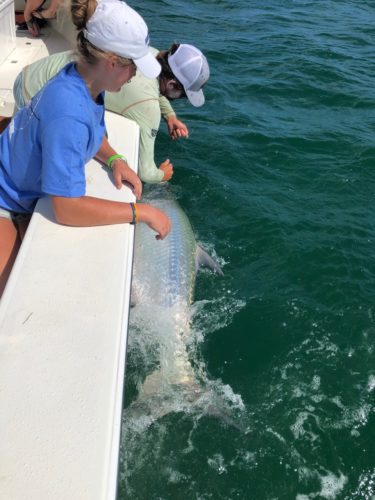
I was reminded of this last week when I was contacted by Chris Marsh. who is visiting the Island from Atlanta with his wife, Laura, and their two girls, Ruth and Rachel. The girls leave home for college this year and the parents had planned to take them to Montana on a “trip of a lifetime” fishing adventure. When the pandemic changed their plans, they decided to drive to Anna Maria, where they found Heron’s Landing, an accommodation they fell in love with. As so often happens in life, what appeared to be a setback turned into a fantastic adventure for parents and the girls. It began with a memorable afternoon fishing with Captain Logan Bystrom. In Chris’s words, “They now know the real thrill of sportfishing,” after jumping several tarpon and landing two.

Reel Time
Captain Logan Bystrom prepares to release a tarpon as Ruth Marsh looks on. – Rusty Chinnis | Sun

Chris originally called me thinking I was a guide but I was happy to introduce them to Jenny Moore and the Anna Maria Boat Company. The new company is run by Moore and her husband, Captain Justin Moore, who are longtime friends that I knew I could depend on to find a competent guide for the day. Not an easy task during the height of tarpon season. They didn’t disappoint and on Sunday Captain Kyle McWorther, who works with the Moores, introduced them to Anna Maria Sound and our fantastic inshore fishing.

Those first experiences on the water leave indelible memories and it was apparent that Chris and Laura had learned that lesson. His description of introducing the girls to fishing dovetailed with what I consider fundamental to transmitting the love of fishing.

First and foremost, we should strive to make fishing uncomplicated and as much fun as possible. Creating unrealistic expectations can discourage young anglers and be the difference between the kindling of a passion or an aversion to the activity.

The basics of fishing are not complicated to learn, are easy to teach children and don’t require expensive equipment. If there’s a cardinal rule to getting kids interested in fishing, it’s to make sure and keep them engaged. Children are naturally curious; they love to play in and on the water and are fascinated by the creatures they find there. Catching fish isn’t their main objective and you shouldn’t make it the focus of an outing. It’s important to plan a trip that includes other activities like swimming, wildlife identification and snorkeling as well as fishing.

Being on the water provides an excellent opportunity to teach kids about their environment and boating safety skills. It’s important to let kids be a part of the adventure, and getting them involved is a great way to interject a stealth lesson in responsibility in children. Give them things to be in charge of, such as making sure everyone knows where the safety equipment is.

Don’t start children out with cheap fishing rods and reels. Provide them with decent equipment that’s light and manageable. An ultra-light rig with 6-pound test line is a great way to start. Try and think like a kid when fishing. Children would rather catch a dozen pinfish in a half-hour than wait a half-hour for a chance at a bigger or better fish. Action is paramount; kids are easily bored and distracted.
Consider starting kids fishing with a small popping cork that they can watch for signs of action. If you can start teaching kids that the enjoyment of the adventure isn’t measured by the number or size of fish you catch, you’ll teach them an important lesson that many fishermen never learn. If you can make the experience interesting for them, even if they don’t catch anything, they are more likely to want to do it again. Kids might be more interested in collecting shells, counting crabs or looking for manatees or dolphin than fishing, so be sensitive to what’s bringing them pleasure.

It’s also important to emphasize safety, bending down the barbs on fishing hooks and making them aware of fish with sharp teeth and stingers like catfish and stingrays. These first experiences on the water are very important and you should consider a plan of action in advance in case the fishing isn’t great. The last thing you want to do is bore kids by sitting on a spot too long. Keep your eyes and ears open and you might learn a lesson or two from them!

The Marshes started their girls in stocked ponds initially hooking and landing the fish for them. According to Chris Marsh they quickly grew out of that and were fascinated by creatures large and small, including tadpoles, and even seaweed.

Those formative years were apparent when they told him, “Dad, you threw that cast net for hours at a time for us, that must have been so exhausting!”

Take your kids fishing, make it uncomplicated and fun and they’ll learn lessons and have memories that last a lifetime. Captain Logan Bystrom can be reached at 941-713-1265 and at his website. Contact McWorther and the Anna Maria Boat Company at 941-228-8973 and check out their website. Reservations are available at Heron’s Landing by contacting Maureen Kraker at 713-498-3549.

Reel Time

The quality of our fishing future

Fishing and the outdoors experiences that my love for the sport have occasioned have played a pivotal role in my life for almost seven decades. This infatuation has also made me passionate about working to protect the natural world that provides me with sport, inspiration and a desire to see future generations have some of the same opportunities that I’ve had.

That’s why I keep coming back to what I think is a crucial responsibility, being aware of how elected officials voted when it comes to the quality of the air I breathe, the water I drink and the water that the fish I love to pursue swim in. It’s become painfully apparent to me that the politicians we elect all too often have a different agenda than what they present to us when they want our vote. That’s why I have decided that I’m not a Republican or a Democrat. I don’t vote red or blue, liberal or conservative. What I am is an environmental voter.

What does that mean? It means I research how a politician who wants my vote has voted on issues, not what they promise. In this day of the internet, there’s really no excuse for not getting information based on facts instead of innuendo. A word of caution of course. All too often we make the mistake of looking for information that supports views we already hold rather than a search for the facts. Both are available in spades so be selective when choosing your sources and check to make sure they have no underlying (alternative) agenda. Here are a couple of resources you might want to explore.

Florida Conservation Voters has a scorecard that tracks how politicians have voted on important issues like clean water and clean air. Their mission is to elect lawmakers who protect our environment and healthy communities for everyone. Their vision resonates with mine: “Our vision for Florida’s future is one where our environment is recognized as the irreplaceable foundation of our economy, culture, and quality of life. It’s a future where our economic development, energy innovation, and conservation goals align. We envision a government that reflects the people it serves and lawmakers who vigorously fight for policies that protect our environment and create a healthy, sustainable future for all Floridians.”

There are also resources on the internet that, with a little research, will reveal how a senator or representative has voted on varying issues. Check them out at www.senate.gov and www.congress.gov.

Floridians, especially those who are blessed to live on a barrier island, can see firsthand the effects of poor policy and pollution on the waters that surround our homes. If you haven’t noticed, take a look at all the algae that is accumulating in our bays right now. Yes, some of that is a natural occurrence, but personally I’ve never seen so much so early in the season.

Bottom line, do a little homework going forward and see how those who claim to have your interests at heart actually voted and where their true allegiance lies. It’s a vital component of an informed electorate and will affect the quality of life and fishing we are leaving our children, grandchildren and future generations.

Reel Time: The cobia

Reel Time: The cobia

As local water temperatures fluctuate between seasons in the spring and fall, savvy anglers know to start looking for cobia in area waters.

Often mistaken for sharks whose shapes and coloration they resemble, cobia are long and streamlined with a broad, flattened head. Their upper body is brown with a dark lateral line that extends through the eye to the tail. The brown fades to white on the belly.

Cobia range up to 6 feet in length and can weigh more than 100 pounds. While most anglers target cobia in the Gulf, cobia range widely throughout local bays as well, particularly near local passes. They spawn in the spring and early summer and feed on crabs, small fish and squid.

Several changes to the management of cobia in state waters in the Gulf of Mexico went into effect Feb. 1. These changes were approved at the Florida Fish and Wildlife Conservation Commission (FWC) meeting last December.

The changes strive to enhance sustainable management of this fishery and were developed in coordination with anglers, charter captains and the Coastal Conservation Association, which had expressed concern about the fishery. The changes will apply to all state waters north of the Monroe-Collier county line. Those changes include:

  • Making the recreational and commercial bag limits for cobia in Gulf state waters the same by reducing the commercial limit from two to one fish per person.
  • Reducing the recreational and commercial vessel limit in Gulf state waters from six to two cobia per vessel, per day. The 33-inch minimum size limit changed to 36-inch fork measurement in March.

Cobia have a way of surprising anglers, so it’s wise to have a rig ready should you encounter one.

Fly anglers who target cobia opt for at least a 10-weight outfit, although it’s possible to land smaller cobia on lighter outfits. A favorite fly is a black bunny tied to resemble a small eel, one of their favorite foods. Anglers fishing conventional tackle most often use live baitfish and live crabs, another of their favorite foods. Cobia will also hit a variety of plugs and lures that imitate baitfish.

This is the beginning of tarpon season and anglers targeting tarpon should be on the alert for cruising cobia. Last week AMI Outfitters owner Steve Traves anchored his boat and jumped on my bow (following social distancing guidelines) on a sand bar bordering Tampa Bay. It wasn’t long before I spotted a cruising stingray with a nice cobia riding his back. Cobia use rays as camouflage darting off them to eat prey that rays spook. After positioning the boat ahead of the ray, Traves made a cast that landed just in front of the ray. He then stripped it to intercept the two fish and the cobia rushed over and ate the fly. Unfortunately, the cobia came straight at the boat and Traves was unable to set the hook.

Later that day I was anchored up along another edge when a manatee came cruising down the bar with a 30-pound plus cobia “glued” to his back. I made a cast to intercept the cobia but hooked the manatee instead. Fortunately, I was able to pull my anchor and get in front of the manatee, freeing my fly. I was able to get several casts to the cobia but this one wasn’t interested in eating.

Captain Justin Moore has been seeing cobia while tarpon fishing and advises anglers to pay attention to any floating objects like flotsam and buoys as well as structure including markers and artificial reefs. Cobia are a worthy adversary for local anglers. They can show unexpectedly and be hard to target but put up a terrific battle and the smaller ones make great table fare.

Reel Time: For the Birds

Reel Time: For the birds

Who hasn’t been stirred by the sight or song of a bird? The haunting sound of a nightingale signaling the arrival of spring, the flamboyant plumage of a spoonbill or egret and the elaborate rituals of herons, terns and other sea birds in breeding season. Have you ever marveled at the graceful flight of a formation of black skimmers, their bills tracing paths across the water’s surface at sunset?  Birds not only inspire and uplift us, they also provide a significant boost to Florida’s economy and are a major reason the state ranks as one as the nation’s top wildlife viewing destinations.

With all that birds provide us, it’s alarming to learn that specieswide, we’ve lost the equivalent of one in four birds in the last 50 years. The major reason is loss of habitat and the seabirds we treasure are particularly vulnerable due to the loss of mangroves for nesting and the practice of many seabirds to lay their eggs and raise their young just above a barrier island’s high-water line.

Birds need our help and there are specific things that anglers and outdoor enthusiasts alike can do to help them. One of the most heartbreaking things anyone can experience is a dead or dying bird garroted in the mangroves by an unsuspecting fisherman’s line. Anglers who fish the coastal waters of Florida will invariably come into contact with the seabirds that inhabit the estuaries of our state. Often that encounter is deadly to seabirds if anglers don’t know the basics of avoiding contact with or caring for hooked birds. Birds live here, it’s their home, and they aid savvy anglers as they search for food. The birds get into trouble when they come in contact with discarded fishing line in the mangroves, or they take line to their roosts after becoming hooked.

The incidence of anglers hooking birds can be reduced or eliminated by following a few simple rules. First, never feed birds. This trains birds to look for a handout and leads them to often unsuspecting anglers. Secondly, while you’re fishing, be aware of birds that might be eyeing your bait or lure. It’s easy to pull it out of harm’s way at the last second before a bird dives on it.
If you do hook a bird make sure that you fight them just like you would a trophy fish to prevent them from breaking the line. Trailing line can be a death sentence for the birds when they return to their roost at night. Care should be taken when handling birds due to their fragile, hollow bones and sharp beaks. First, place a towel over the bird’s head. This will calm them and protect the angler from sharp bills. You can then cautiously remove hooks and unwind line before releasing them.

During nesting season (peaking here May through June) birds are particularly vulnerable, especially those that nest on the beaches of our barrier islands. It’s crucial that humans avoid breeding colonies on public beaches and especially the few places designated as off-limits because of their critical nesting potential. Locally protected areas like Egmont Key and Passage Key are often threatened by unsuspecting and careless beachgoers who endanger eggs and young hatchlings. The birds don’t have a voice and it’s left to those of us who appreciate and benefit from them to be their advocates.

If while fishing you see a hooked or tangled bird in an active rookery, don’t approach them during nesting season. Our well-meaning intentions can cause more harm than good by causing startled young birds to fall from the nest.

Taking care of the environment that feeds our passion is everyone’s responsibility. Follow these simple guidelines: be aware of the presence of seabirds, take care in handling them, and never feed birds. If you see a bird in distress and it’s not nesting season, you can free them. If they swim or fly away on their own that’s all you’ll need to do. If you believe they are too weak to recover on their own, contact one of the local organizations that rescue and rehabilitate sea birds. On Anna Maria Island you can call Wildlife Inc. at 941-778-6324. To our south call Save Our Seabirds on City Island in Sarasota at 941-388-3010. Audubon’s Coastal Island Sanctuaries has an informative web site and can be reached at 813-794-3784. You can also join Sarasota Bay Watch’s Annual Fishing Line Cleanup in the fall.

Birds of all kinds are a critical component and bellwether of a healthy environment. Let’s all work together to create a vibrant and safe place – for the birds.

Reel Time: Scallopalooza, It’s Clamtastic

Reel Time: Scallopalooza, it’s clamtastic

Sarasota Bay Watch’s “Scallopalooza, It’s Clamtastic!” fundraising event is celebrating its 10th anniversary on Feb. 15, 2020.

SBW’s major fundraiser supports the many projects the organization is involved with including its ongoing shellfish restoration project.

After almost a decade at the Sarasota Yacht Club, this year’s event is moving to a larger banquet venue at Sarasota’s Hyatt Regency. At press time, over 300 participants are signed up for the event. Past events were capped at 200 due to space limitations at the Yacht Club.

Monies raised from past events have paid for the introduction of millions of scallop larvae and adult clams into Sarasota Bay from Bradenton to Sarasota with the hope of repopulating our Bay waters with these once-abundant species.

SBW’s restoration effort is growing exponentially, fueled by the interest and concern of the communities surrounding the Bay as well as the determination of its citizens to be part of the solution. The importance of this work has been made all the clearer from the water quality issues that have been plaguing area waters for years.

Hard-shell clam restoration has proven more suitable than scallops to challenging water quality issues while providing a sustainable approach to improving water quality. Sarasota Bay Watch’s restoration program has gained the attention of scientists and community leaders interested in the benefits of the clam’s natural filtration as well as the army of motivated volunteers that have backed the initiative.

This year the effort has been given a tremendous boost by a generous $106,000 donation from the Charles and Marjory Barancik Foundation. These monies are being used to plant one million clams in Sarasota Bay in 2020.

These million clams can filter huge amounts of water every day helping to clean our Bay waters and reduce excess nutrients that may contribute to red tide. They also provide a food source for a plethora of wildlife.

Our Bay and Gulf waters are the key to our robust economy and provide the environment that attracts people and commerce to this region. Sarasota Bay Watch is committed to protecting and preserving the Bay water and the animals that depend on it. Please, join us to help us raise the funds needed to maintain and drive this vigorous level of restoration.

The Scallopalooza event has enjoyed the continued support of the community, proof that the businesses and inhabitants of Manatee and Sarasota counties care about and are willing to tackle this long-term restoration project. Sarasota Bay Watch was initially formed with the mission of protecting and restoring Sarasota Bay’s ecosystem through community education and citizen participation. The spirit of the mission is reflected in the organization’s slogan, “A healthy Bay is everybody’s business.”

Come and join SBW on Saturday, Feb. 15, 2020, for an evening of camaraderie, great food, music and libations at one of Sarasota’s most spectacular venues. The event kicks off with 6 p.m. cocktails, followed by a silent and live auction. Dinner will be served at 7 p.m. The Sarasota Hyatt Regency is located at 1000 Boulevard of The Arts in Sarasota.

Tickets are $100 per person and tables are $850 for 10 people. Tickets can be purchased online. For additional event information contact Ronda Ryan at rondaryan@sarasotabaywatch.org or call (941) 232-2363.

More Reel Time:


Reel Time: Fishing bridges, piers and docks


Reel Time: The ups and downs of tides


Reel Time: We’ll See

Reel Time: The ups and downs of tides

Reel Time: The ups and downs of tides

The only thing I know for sure after almost four decades of fishing area waters is that I’ll never figure it out.

That’s in the context of finding fish and divining the conditions that make them want to eat my flies. That’s a good thing because contrary to what we might think, that would diminish the allure of the sport.

Actually, there are at least two things I know for sure. The other one? Having at least a good working knowledge of the incomprehensible conditions that affect the feeding patterns of fish will definitely up your game.

Paying attention to tides and the movement of water where you fish and wherever you travel will greatly increase your angling odds. Locally you can do that by experience and paying attention. When you travel that’s the advantage of having a professional guide
who’s been there done that. Actually, depending on how much time you have on the water, the same applies locally.

While I always like to follow the axiom, “The best time to go fishing is whenever you can,” understanding and being able to track tidal fluctuations is invaluable. Let’s start with a quick primer.

While there are myriad factors that influence the tides, basically it’s the gravitational pull of the moon on the earth and its oceans that’s the prime driver. This means that the oceans on opposite sides of the earth experience high tides as the water is pulled away from the earth. The other object in the solar system that influences the tide is the sun, which has approximately one half the influence of the moon.

When the sun and the moon line up at the full and new moon, their combined influence
create the greatest pull, creating what is known as spring tides. When the sun and moon are at right angles to each other, during the moon’s first and last quarter, they interfere with each other and we experience weak or neap tides. In addition, the tidal ranges are greater when the moon and sun are at perigee, or closest to the earth.

Wind is another factor that affects tides. In our area a strong east wind can push tides
lower and later, holding up a rising tide. A hard-west wind can do the opposite, pushing
in a rising tide and holding up a falling one.

Experience will teach the angler how to benefit from the myriad tidal dynamics that affect fish and their feeding patterns.

I learned a valuable lesson about tides on trips to the Bahamas in search of bonefish.
My first several trips were planned to coincide with a full or new moon in order to take advantage of the increased feeding activity that generally takes place during these times. Instead, I found that the bonefish I was stalking would disappear into the mangroves as the tide rose, giving me a shorter window to pursue them along the mangrove fringes. Based on that information I planned subsequent trips when neap tides slowed the progress and size of the tide providing many more opportunities for sight fishing.

Just the opposite is often true when I explore local waters. While I still fish whenever I have the opportunity, I target days of extreme high and low tides because I know they stimulate feeding and concentrate fish. Depending on the time of year and the temperature, you can use the tide to take advantage of the season. In the winter when the
waters chill down, I like to seek out locations where a late afternoon falling tide brings warm water off the flats. The holes, slues and channels the water drains into attract gamefish and can provide some excellent action.

When fishing the flats, working from the deep water to shallow on the falling tide and in reverse on the rising tide is a very effective way to target fish. Very low tides (during spring tides) provide an excellent opportunity to scan the flats for channels, slues and holes on the flats where fish congregate. Armed with this knowledge anglers can return when the flats are covered with water and benefit from that awareness.

Tide charts and apps are valuable because the tide can be varying heights depending on whether you’re fishing in the Gulf or far up a bay. Planning your day to take advantage of
these variations can make a real difference in action. No matter what species you target,
you’ll have a better chance at success if you understand and track the tides. They can tell
you where to concentrate your effort and help you avoid other less productive areas.

Pick up a tide chart at your local tackle shop or download one of a number of excellent apps on your smartphone. That way hopefully you’ll have more ups than downs.

Reel Time: We’ll See

Reel Time: We’ll See

Recently I was intent on fishing an area that has become one of my favorite haunts.

Unfortunately, when I got there another boat was anchored nearby. As I started working my way towards my intended target yet another boat pulled up behind me intent on heading in the same direction.

Third Place
Light Features
2020

My first reaction? Disappointment crept over me and I was thinking my carefully planned strategy had failed me. Then suddenly I remembered a fable I had read in a book by Zen master Thich Nhat Hahn. In a parable from his book, “The Art of Living,” the poet, global spiritual leader and international peace activist tells the story of a farmer’s son that fell off his horse and broke his leg. His neighbors tell him how unfortunate that is. His response? “We’ll see, we’ll see.”  Two weeks later the military comes to conscript new recruits for war and his son was not taken because of his broken leg. Once again, the neighbors chime in, this time saying how lucky he and his son are. His response, once again is, “We’ll see… we’ll see.”

Suddenly my mindset changed and I saw this as an opportunity to maybe actually benefit from what had initially been my frustration. Although there wasn’t any catching involved, I fished a place close by and discovered some promising areas I had never explored. I’ll definitely return there again as I’ve learned over the years one certain fact about fishing (thank you Captain Scott Moore), “fish move around!” How many times over the years have we as fishermen developed a plan that was altered by factors out of our control? Wind, rain, cold, heat, tides, competition for territory and a hundred other things conspire to alter and sometimes completely destroy a well thought out plan. While it always doesn’t turn out to be advantageous, who hasn’t in hindsight looked and found perceived disruptions to be “blessings in disguise.” Over-optimistic you say? Maybe, but I’d rather look for the proverbial “pony under there somewhere” than let disruption ruin my day.

Don’t get me wrong, I am totally a fan of having a plan for my fishing. I’ll check tides, wind and the myriad of other factors to try and develop a strategy to improve my odds of catching fish. Having said that, it’s good to have a backup plan that includes addressing the actual conditions you find on any given day. Maybe it’s the fact that I’m not really good at finding fish. I jokingly and fully in earnest comment on the fact that fish and I don’t see things alike. The places I find that should hold fish don’t seem to appeal to them.

Then there’s the strategy of being persistent, definitely an advantage as fish get more spread out, pressured and spooky. Another seasoned fishing guide has a saying that resonates with me. Captain Steve Huff, arguably one of the best guides the Florida Keys ever produced, likes to tell anglers who seek his advice, “Pole far enough and the fish will find you.” My advice? Go out with a plan but be willing to make a change. Will that strategy pay off? We’ll see, we’ll see.

More Reel Time:

Reel Time: Mars Bay Bonefish Lodge


Reel Time: Polarized glasses


Reel Time: Autres poisson

Scott Moore inducted into Agricultural Hall of Fame

Scott Moore inducted into Agricultural Hall of Fame

PALMETTO – Holmes Beach resident and charter fishing guide Scott Moore is the newest member of the Manatee County Agricultural Hall of Fame.

Family and friends, some of whom date back to Moore’s childhood, joined the 2019 inductee at the Hall of Fame luncheon at the Woman’s Club of Palmetto Thursday afternoon as part of the county’s Farm-City Week celebrations.

Moore’s wife, Karen, joined him at the head table. The couple’s daughters, Katie and Kelly, their son, Justin, and their sons-in-law, Ben Guth and Courtland Hunt, also attended the luncheon.

Scott Moore inducted into Agricultural Hall of Fame
The Moore family attended the Hall of Fame luncheon. Shown, from left, Courtland Hunt, Kelly Hunt, Karen Moore, Justin Moore, Scott Moore, Katie Guth and Ben Guth. – Joe Hendricks | Sun

Before the luncheon began, Moore’s lifelong friend, Lindsey Hopewell, recalled how they grew up together in west Bradenton.

“We lived on a dead-end dirt road. For miles, it was nothing but lakes and ponds and we fished them all. He’s the best fisherman I’ve ever known,” Hopewell said.

While Farm-City week presentations were made and awards were given to local students, attendees enjoyed pork barbeque and other southern dishes catered by the Hickory Hollow restaurant.

When introducing Moore, Florida Sea Grant agent Angela Collins said he moved to Manatee County when he was three months old, graduated from Manatee High School and since then has spent decades living and raising a family in Holmes Beach.

Collins said Moore set a world record in 1983 for the largest snook caught on 2 lb. test fishing line. That record was later broken, but Moore also guided the Tampa woman, Debbie Miller, who still holds the record for catching a 22-pound snook on 4 lb. test line.

“There’s no doubt Captain Scott is an excellent fisherman and an accomplished guide. For these things alone he deserves a ton of recognition, but we’re not here to talk about that. We’re here to recognize Captain Moore for his contributions to aquaculture,” Collins said.

She mentioned the economic importance of Florida’s fisheries and water resources and Moore’s intimate knowledge of them.

“His experience on the water and his passion for fish and our marine ecosystem is rivaled by probably no one. His concern for the health of our fisheries and the conservation of these resources led him down the path of advocating for good science, effective management and cooperation across the docks to reach a common goal, which is healthy, sustainable fish populations for future generations,” Collins said.

Collins said Moore spent the past four decades sharing his wisdom and concerns about the local ecosystems and environment with scientists, managers, commercial fishermen, fishing guides, his own charter patrons and anyone else who would listen.

Moore founded the Florida Guides Association and was later its first hall of fame inductee. He helped found the Coastal Conservation Association and still serves on that board.

Scott Moore inducted into Agricultural Hall of Fame
This photograph and plaque will be on permanent display at the Manatee County Agricultural Museum in Palmetto. – Joe Hendricks | Sun

Moore’s been recognized by the Florida Wildlife Federation, received the William R. Mote award, received the Florida Sportsmen’s Conservation Award, the Don Hansen Conservationist of the Year award and was involved with the Frank Sargeant Outdoor Expo for more than 25 years.

“Sarasota philanthropists Carol and Barney Barnett donated $3 million to Mote Marine Lab for their fisheries conservation and enhancement initiative. As part of the deal, the Barnetts established the Captain Scott Moore senior research scientist position,” Collins said.

Moore has appeared on TV and radio shows and is the subject of the book, “Captain Scott Moore’s Snook Fishing Secrets,” written by his close friend, the late G.B. Knowles. The book notes Moore was the first fishing guide in America to guarantee snook catches.

“It’s people like Scott Moore that bridge the gap between science, management and our angling public. And it’s passion like his that really moves the needle for the conservation of these resources that are so precious to us and to our children. Thank you Scotty for all the work you do,” Collins said when presenting him with a plaque commemorating his Hall of Fame induction.

Moore’s remarks

After receiving a standing ovation, Moore expressed thanks and appreciation for his family and friends.

“Being a professional fishing guide, a commercial fisherman or a recreational fisherman – if you’re harvesting fish, you’re still in the same boat. People need to understand that,” Moore said of the need for fishermen to work together.

Scott Moore inducted into Agricultural Hall of Fame
Captain Scott Moore discussed aquaculture and sustainable fisheries during his induction speech. – Joe Hendricks | Sun

Moore said the world record snook Collins mentioned was the first fish ever submitted to the International Angling Association after being certified and released as a live fish.

“That’s what made that so special,” he said.

Moore said his introduction to the aquaculture concept took place during a fishing excursion with shrimp packaging and processor Phil Alessi one day in the 1980s, when Alessi was expecting an important phone call.

“You know what he was buying? A million pounds of shrimp to process. And guess what? Some of that shrimp was farm-raised. He said down the road there’s no way we can keep up with wild-caught,” Moore said.

He also said he took Mote Marine founder William Mote fishing for many years.

“He promoted the commercial fishing industry. He saw the picture: you’ve got to take, you’ve got to give,” Moore said.

“It’s not just raising reds and snooks and trout, but commercially-raised fish too. You want to support the wild-caught, there’s nothing better, but they can only produce so much,” Moore said of Mote Marine’s ongoing aquaculture efforts.

“If you put oysters in the water, if you put clams in the water, it helps Cortez because you’re cleaning the waters and your promoting conservation, which brings the fish populations up,” he added.

In the early 1970s, Moore worked as a hook and line fisherman in Cortez. In 1979, he started his Moore Fishing charter service at the Cortez Fishing Center, which is now the Tide Tables restaurant.

Moore still captains his boat, the Primadonna, and remains very active in the fishing community.

Scott Moore inducted into Agricultural Hall of Fame
Hall of Fame luncheon attendees were treated to pork barbeque and other southern dishes catered by the Hickory Hollow restaurant in Ellenton. – Joe Hendricks | Sun
Reel Time: Polarized glasses

Reel Time: Polarized glasses

Polarized sunglasses are essential for serious anglers. They serve multiple purposes including protecting the eyes from damaging UV light, cutting the surface glare and keeping eyes from tearing in the wind while running. Enhancing the visibility below the waters’ surface is an indispensable advantage when looking for signs of fish while sight fishing.

Many anglers choose their glasses according to style, not realizing that the color of the lenses and other factors determine their real effectiveness. Color is important, but it’s just one of the choices that you will need to make to get the most from your sunglasses.
After choosing a frame that’s comfortable and fits your face, lens color is the most important component.

Anglers who fish blue water and spend long hours over the open sea generally prefer grey lenses. Grey provides natural contrast and minimizes color distortion in offshore waters. Brown/amber lenses are the common choice for flats fishermen who sight fish in shallow water. Brown/amber lenses offer a brighter field of vision, better visual acuity, and excellent color contrast. Many dedicated anglers own more than one pair of glasses. The color vermillion and light copper heighten visual acuity and enhance color in low and flat lighting conditions. When the sun is out and bright, they switch to the darker grey, brown or amber lens. Anglers also have the option of choosing sunglasses that feature interchangeable lenses.

The reduction of glare has another beneficial component. The eye functions like a camera and must adjust to varying light levels. On a bright day, the pupil constricts, muting light levels. Polarized lenses help eliminate reflected glare, so the remaining light falls in a much narrower range of intensity. The eyes can then relax, allowing greater depth perception and truer color contrast.

When choosing polarized glasses you have a number of options: cheap versus expensive, glass versus (polycarbonate) plastic, cast versus laminated polarized lenses and color. The lowest quality glasses are the so-called “rack glasses,” the kind you find in the local pharmacy. These are better than no sunglasses, but you should buy the best pair you can afford. As a rule, a quality pair of polarized sunglasses are expensive but they’re well worth the money.

One of the major decisions is choosing glass or polycarbonate (an advanced plastic) lenses. Glass lenses provide better visual acuity (clarity) than plastic and are more scratch-resistant. However, glass lenses are heavier and can fatigue the ears and nose after many hours. If you purchase glass lenses make sure you buy a quality pair with a broad, comfortable nose piece.

Whether you choose glass or plastic lenses, your primary considerations will be frame style and lens color. Choose a frame that is comfortable and one that helps block out extraneous light. Some glasses wrap around the side of the face, while others have separate side shields.

Several of the top manufacturers of sunglasses feature technologies that further increase the effectiveness of polarized lenses. Some offer photochromic lenses that lighten or darken as light levels vary during the day. Lens coatings are another consideration. High-quality sunglasses often come with some type of coating. Hydrophobic coatings repel water so that the occasional water droplet doesn’t affect your vision. Lenses may also be coated with a chemical to make it fog proof. These options can be particularly valuable for humid environments. Some brands also include flotation assuring the glass will float, a good option for your considerable investment.

If you wear prescription lenses with or without bifocals, make sure your sunglasses have them too. Trying to tie on a lure or fly after gazing at the water for a long time can be frustrating and put you at a distinct disadvantage. You can get prescription lenses with bifocals in both glass and polycarbonate.

When you choose a pair of polarized glasses, follow the guidelines above while experimenting to find the color that works best in your fishing situation. By choosing a quality product with the proper color you’ll greatly expand your fishing horizon while protecting your most valuable asset, your vision.

Some of the more popular brands you might want to consider are made by Smith Optics, Costa Del Mar and Amphibia. Choose your sunglasses carefully; they’re one of the angler’s most valuable tools!

More Reel Time:

Reel Time: Autres poisson

Reel Time: A home away from home

Reel Time: Spain – Seville and Andalusia