Tag: awards

White and brown pelicans

Law needed to help pelicans, turtles

HOLMES BEACH – After a year of trying to educate fishermen not to cut fishing lines that entangle pelicans and other wildlife, Jeannie Bystrom wants Island officials to emulate Naples and pass ordinances prohibiting certain fishing gear.

Over the past year, she and her friends and veterinarian husband have saved more than 100 pelicans with wings hooked to their feet, fishing line tethering them to mangroves in Bimini Bay, and worse, mostly due to sabiki rigs with multiple hooks, and fishing lures with treble hooks, she said.

Second Place

Outdoor and Recreation Reporting

2014

“The law we have to have is no multiple hooks,” said Bystrom, whose “Don’t Cut the Line” public education campaign is published in The Sun. “I’m going to bring it up in Holmes Beach and hope we can get Anna Maria and Bradenton Beach to follow suit.”

To support Bystrom’s efforts, Manatee County Commissioner Carol Whitmore recently alerted the state legislative delegation to the problem and said she plans to meet with them before next year’s Legislative session to form proposed legislation.

Hooked pelicans are frequent guests at Wildlife Education and Rehabilitation Inc. in Bradenton Beach, whose facebook page documents a Key Royale rescue last week of two pelicans tied together with fishing line, the live bird trailing the dead bird. A Wildlife Inc. volunteer also saved a pelican on Bradenton Beach last week that washed up on the beach entangled and unable to fly.

Fishing line is not just a pelican problem; it also entangles sea turtles and other species, Mote Marine Laboratory spokesman Nadine Slimak said.

Between 2000 and 2010, more than 20 percent of the 633 sea turtles recovered by Mote’s Stranding Investigations Program showed signs of being affected by a human interaction. Of those, 72 percent were boat-related and 22 percent – or 29 sea turtles – were fishing gear-related, with the rest involving ingestion of balloons or marine trash and impacts with cars, she said.

Anna Maria Island Turtle Watch and Shorebird Monitoring volunteers will soon begin keeping data on wildlife impacted by fishing lines with their regular sea turtle and shorebird data, director Suzi Fox said last week.

Naples law passed for pelicans, people

The Naples City Council passed an ordinance two months ago restricting the use of fishing equipment on the city-owned pier to a single hook on a single shank to protect pelicans and people, said Roger Jacobson, harbormaster and code enforcement manager for the city of Naples.

The Conservancy of Southwest Florida, a 50-year-old grassroots environmental group in Naples that pushed for the ordinance, spent $100,000 on pelican surgeries last year, he said, adding that people also are sometimes injured by fishermen casting with multiple hooks.

The ordinance is not intended to generate citations, but to educate the public, he said.

The city is flush with funds from beach parking fees, which pay for a fulltime, seven day a week pelican patrol on the pier to educate fishermen and rescue hooked pelicans. Parking fees also pay for a fulltime beach patrol to cruise the beaches on an ATV looking for safety and environmental violations, such as fishing without a permit, Jacobson said.

“We have excess revenue from the parking fund every year,” he said, adding that residents get free parking passes.

After some initial resistance from fishermen, the tackle issue died down quickly, he said, adding that it’s too early to tell if the law is saving pelicans.

If you hook a pelican, slowly and carefully reel it in and cover the bird with a towel, avoiding the tip of its beak, and remove the hook, or call Wildlife Inc. at 941-778-6324.

Black skimmers

Flippers and Feathers

Florida Press Association logo

  • Turn off outdoor lights visible from the beach from sundown to sunrise, and close drapes and blinds; lights can fatally disorient nesting and hatching sea turtles.
  • Do not aim camera flashes or cell phone cameras at sea turtles.
  • Do not use flashlights or fishing lights on the beach at night.
  • Do not trim or remove trees and plants that shield the beach from lights.

Second Place

Outdoor and Recreation Reporting

2014

  • Remove chairs, umbrellas, sand anchors, tents, grills, boats and all objects from the beach from sundown to sunrise, and remove anchor buoys or rafts from the water; they can keep nesting sea turtles from hatching and keep hatchlings from reaching the water.
  • Fill in holes dug in the sand; they can trap nesting and hatching sea turtles.
  • If you see sea turtles nesting or hatching, keep silent and still and watch from a distance. Never touch a sea turtle.
  • On a boat or personal watercraft, watch for sea turtles and manatees; if you spot them, slow down and veer away.
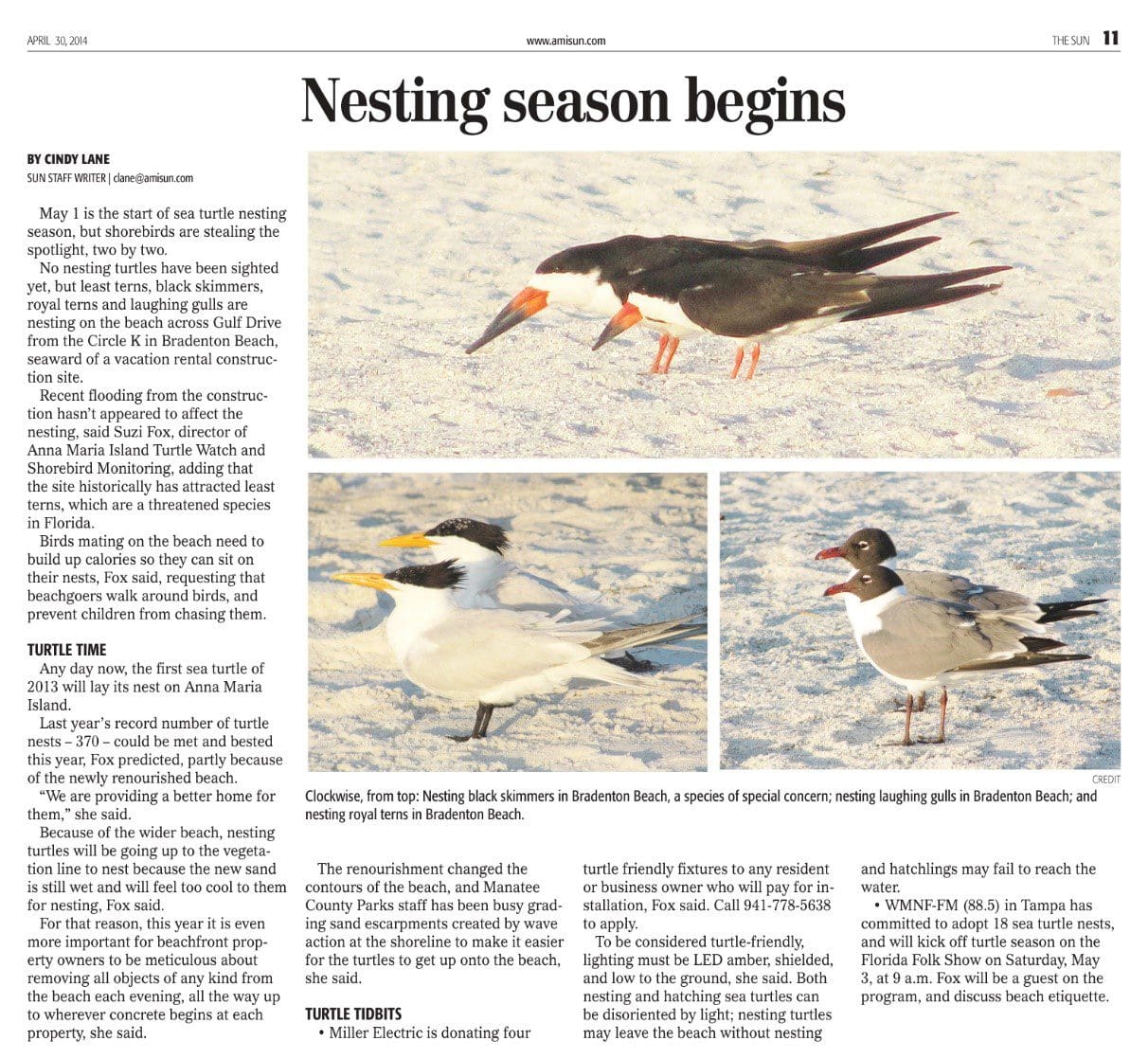
  • Stay away from staked bird nesting areas to avoid frightening the parents off the nests and leaving the eggs vulnerable to heat and predators; if birds are agitated, you are too close.
  • Do not chase or herd birds; they need their energy for nesting.
  • Do not feed birds; it can lead to malnourishment, illness and aggression, and scraps can attract predators.
  • Dispose of fishing line, hooks, nets, six-pack holders, plastic bags and other trash; it can entangle and injure sea turtles and birds.
  • Don’t release fireworks, helium balloons or sky lanterns from the beach; the debris is dangerous to sea turtles, birds and other wildlife.
  • To protect sea turtle habitat, don’t use fertilizer from June 1 to Sept. 30.
  • For sea turtle and bird emergencies, call Anna Maria Island Turtle Watch and Shorebird Monitoring at 941-778-5638, or the Florida Fish and Wildlife Conservation Commission’s Wildlife Alert hotline at 888-404-FWCC (3922), #FWC or *FWC on your cell phone or text Tip@MyFWC.com.

Coast Lines: Respect the manatee’s river

There is a good reason for the Manatee River’s name – manatees live there.

So do sea turtles – one laid a nest at DeSoto National Park recently. So do dolphins, and other animals that don’t get all the press focused on endangered and threatened marine mammals and turtles.

“Respect the manatee’s river” expressed concerns over the course chosen for a power boat race in the Manatee River. The route was scheduled to cut directly through an area where manatees mate. After the column was published, the course was altered to avoid the area. Judges commented: “This column dealt with a hot local subject and offered alternatives and solutions.”

Running a 125-mile-an-hour powerboat race through a natural habitat, an idea initiated by county tourism officials and preliminarily approved by the Bradenton City Council, is the worst idea ever, and prompts many questions.

Second Place

Serious column

Sally Latham Memorial Award

2014

How do county tourism promoters reconcile touting the area as an eco-friendly destination, with Snooty at the museum and manatee-spotting kayak rentals and dolphin-spotting sunset boat tours, at the same time that they’re planning an event that will unquestionably disrupt, and possibly injure or kill, endangered manatees and other wildlife in the Manatee River?

Will they suspend the manatee zone laws in the river for the race? Both banks of the river are slow speed zones. How can we expect recreational boaters to abide by the manatee laws when the laws are ignored for a claimed $8-10 million economic boost?

Manatees cannot outswim a boat going 125 miles an hour, or even 25 miles an hour. If observers are stationed to watch for them, will they have the authority to call the race off if they spot a manatee? How long would it take them to get the message to the boats? How long would it take for the boats to come to a stop from full speed?

Only 4,831 manatees were spotted from the air in the waters of Florida during the most recent aerial survey this year. In Florida, 829 manatees died in 2013, more than in any of the past 40 years, according to the Florida Fish and Wildlife Conservation Commission. Of those, 72 were from boat strikes. In Manatee County, three died from boat strikes.

None of the boats were going 125 miles an hour.

Bradenton City Councilman Gene Gallo has said the manatees are at the Tampa Electric power plant warm water outflow in Apollo Beach in January, when the race is planned.

That’s not necessarily so, according to Save the Manatee Club’s director of science and conservation, Katie Tripp, who says that if January turns out to be warm, which often happens, manatees will still be in the river.

Aerial surveys of the Manatee River show manatees in the river in January and February, according to Florida Fish and Wildlife Conservation Commission (FWC) maps. The agency can issue a permit for a boat race on certain conditions, if the county’s ordinances allow it and “upon a showing of justification of need by the applicant and a finding by FWC that issuance is not likely to create a serious threat to manatees,” according to FWC rules. Conditions can be placed on the permits, including aerial and water surveying of the race area before and during the race to ensure that no manatees are present, use of manatee observers at strategic points to look for manatees during all race-related activities and limitations on the number of vessels.

Permits must also be acquired from the U.S. Fish and Wildlife Service, U.S. Coast Guard and other agencies, but that may not pose much of a problem, she said, adding that the club unsuccessfully opposed a similar race in Stuart.

“It’s clearly an important manatee area,” she says. “There’s no good reason to do this inshore.”

So many questions should be asked and answered by local officials before considering approval of this proposal.

Why not run the race offshore in the Gulf of Mexico, where manatees are less likely to be?

Why not be consistent with the county’s ecotourism message and plan a kayak race in the Manatee River?

Why not apply common sense to a tourism promotion planned for an already overcrowded time of year that could kill manatees that are advertised to attract tourists?

Why not?

Explore the Gulf Coast Heritage Trail

Looking for something new to do on Anna Maria Island?

The Gulf Coast Heritage Trail winds through the Island on its route from St. Petersburg’s Sunshine Skyway Bridge south to Englewood Beach.

Accessible by car, motorcycle, trolley, bicycle or on foot, 12 of the trail’s 117 stops are here on the Island, showcasing cultural, historic, and scenic areas.

Second Place

Feature Story

Non-Profile

2013

Here are the stops from north to south:

Anna Maria

  1. The path to Bean Point Beach at North Shore Drive and North Bay Boulevard marks the spot where the Island’s first homesteader, George Emerson Bean, settled 100 years ago.
  2. Rod n’ Reel Pier, 875 North Shore Drive, was built in 1947 and offers fishing, a restaurant and views of Egmont Key and the Sunshine Skyway Bridge.

    Rod & Reel Pier
    Rod & Reel Pier – Cindy Lane | Sun
  3. The Anna Maria City Pier at 100 Bay Blvd. in Anna Maria was built in 1911 as a dock for excursion boats from Tampa. It’s now under reconstruction, but you can enjoy the views of Egmont Key and the Sunshine Skyway Bridge from the beach.

    Anna Maria City Pier from Bayfront Park – Cindy Lane | Sun
  4. Bayfront Park on North Bay Boulevard in between the two piers features a playground and picnic tables. 
  5. The Anna Maria Island Historical Society Museum at 402 Pine Ave. features exhibits of Island life, the Belle Haven Cottage, formerly attached to the Anna Maria City Pier, and the Old City Jail, built in 1927.

    Belle Haven cottage – Cindy Lane | Sun
  6. The Island Players at 10009 Gulf Drive N., founded in 1948, stages dramatic and musical productions.

    Island Players – Cindy Lane | Sun

Holmes Beach

  1. The Artists’ Guild of Anna Maria Island, 5414 Marina Drive, features an art gallery and free art demonstrations.(CLOSED)
  2. Manatee Beach at Manatee Avenue and Gulf Drive has indoor and outdoor dining areas, a gift shop, restroom facilities with showers, lifeguards and beach equipment rentals.

    Manatee Beach – Cindy Lane | Sun

Bradenton Beach

  1. Historic Bridge Street once was connected to the mainland by the old Cortez Road bridge, now the Bradenton Beach Pier.

    Bradenton Beach Pier
    Bradenton Beach Pier – Cindy Lane | Sun
  2. Coquina Beach, on the southern end of Anna Maria Island on the Gulf of Mexico, has lifeguards, picnic tables and covered pavilions, grills, shaded parking, restroom facilities with showers and a concession stand with outdoor dining.

    Coquina Beach – Cindy Lane | Sun
  3. Coquina Baywalk at Leffis Key, across Gulf Drive from Coquina Beach, is a 30-acre waterfront park featuring shell hiking paths, mangrove-shaded boardwalks and scenic overlooks on Sarasota Bay. Coquina Bayside Park to the south has a boat ramp and restroom facilities.
Leffis Key – Cindy Lane | Sun
Regina marker

Explore the Regina

BRADENTON BEACH – While visiting Anna Maria Island, divers may want to visit the wreck of the Regina, a state underwater archaeological preserve, marked by buoys off the 800 block of Bradenton Beach.

According to records at the Anna Maria Island Historical Society, the Regina’s story goes like this:

On March 8, 1940, decades before the American embargo against Cuba began, the Cuban tugboat Minian was towing the 300-foot barge Regina from Havana to New Orleans with a boiler on board that was used to turn Cuban sugar cane into molasses at sea on the way to market.

Second Place

Feature Story

Non-profile

2013

As it passed by Egmont Key that day during a storm, it was laden with 350,000 gallons of molasses and was pitching with the waves. Rough seas broke the towline between the vessels. The Minian made for Egmont Key, but the wind and waves drove the Regina south toward Bradenton Beach, where it grounded on a sandbar.

The St. Petersburg Coast Guard station couldn’t send a boat because night was falling and the storm was too severe. Bystanders lit fires on the beach to encourage the stranded crew throughout the night.

The next morning, the Coast Guard’s seaplane dropped life jackets, most of which were swept away. In desperation, the ship’s cook, Severino Canisares, and the boat’s mascot, a German shepherd, attempted to swim to shore, but drowned.

Two crewmen made it to shore with the help of a volunteer, Cortez resident Clayton Adams, who swam out to help them with a rope tied to his waist.

The Coast Guard sent a truck from St. Petersburg equipped with a gun to shoot a lifeline to the barge, but it didn’t work. Volunteer Furman Smith took a dinghy out to the Regina and got a rope to the crew, who tied it to the barge. The other end was secured on shore.

Coast Guardsman Barney Barnett attached a boatswain’s chair to the rope, took the chair out to the barge and helped the remaining five crewmen into the chair one at a time with the assistance of volunteer Jim Parker. Men on the beach pulled the chair down the rope to shore.

In all, seven of the eight crewmen survived.

And one chicken was saved, discovered on the barge’s wreckage after the ordeal.

What’s left of the Regina, which is in pieces, is marked with a bronze plaque, and is visible even to snorkelers on a clear day.

Coast Lines: Bye bye, reef

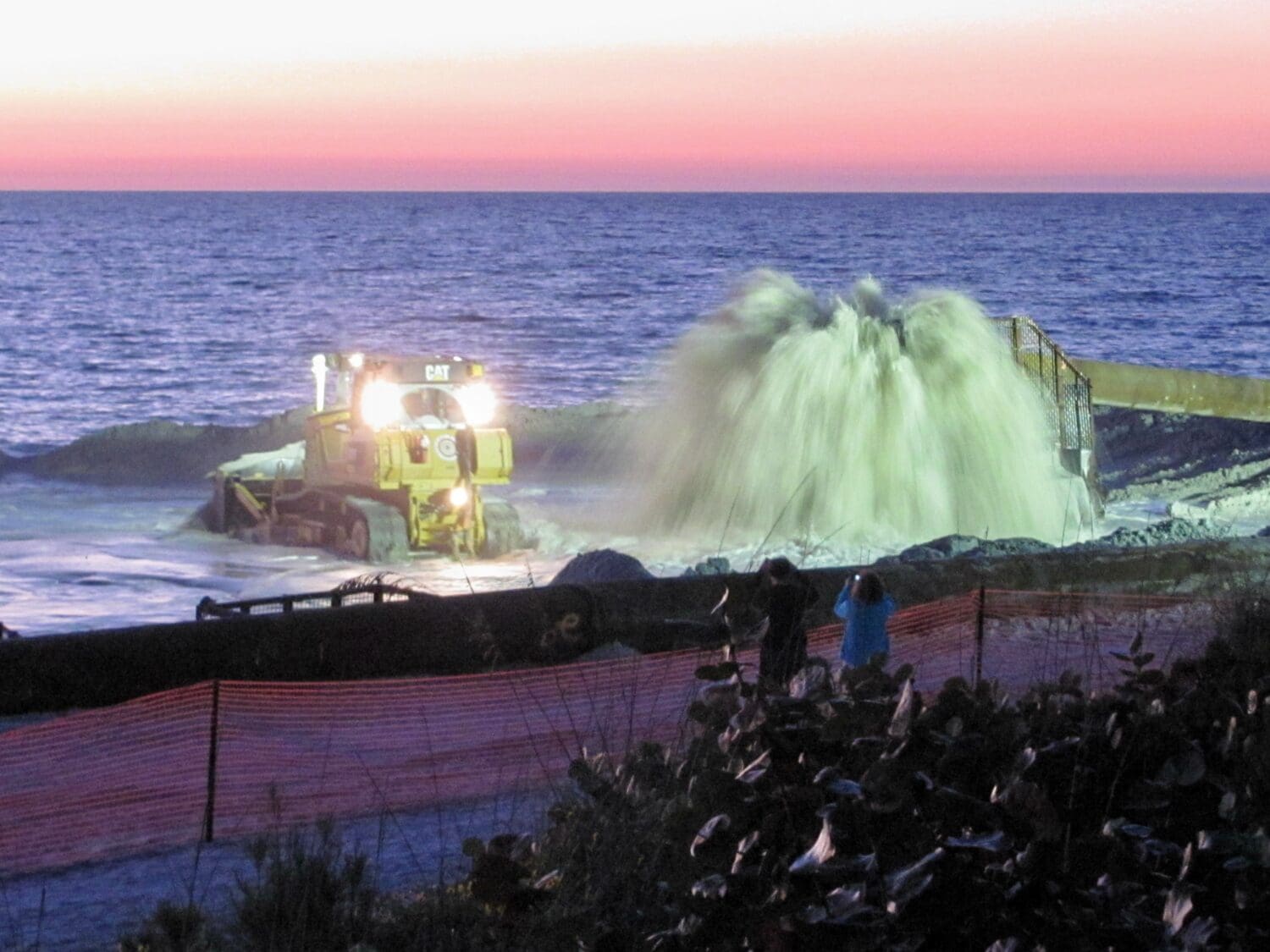
Just for the record, there’s no question that we need the beach renourishment that’s planned to begin shortly to make room for the profusion of new visitors who daily discover Anna Maria Island.

Also for the record, Charlie Hunsicker is the Elvis Presley, the Patrick Swayze, the Bruce Lee and the Laird Hamilton of government natural resources administrators, singing, dancing, fighting and conquering the ocean to get us the sand to make our beach wider.

Second Place

Commentary Writing

2014

Still, when the new sand is installed seaward of the existing beach, it will be a sad day for snorkelers, surfers, stone crabbers and other fans of the rock reef that intermittently runs parallel to the Island in the Gulf of Mexico.

The county’s beach engineers say that the marine life will be “displaced;” meaning that the fish, lobsters, starfish, stingrays, sand dollars, crabs and other creatures on the reef will find new homes, not be buried with the rocks.

Granted, we don’t have coral reefs like the ones off Australia or the Caribbean, or even the Florida Keys, with vast forests of hard corals in stunning shapes, but our humble rock reef is pretty remarkable.

On it grow colorful soft corals in yellow and orange and purple. Hiding in tunnels created by rocks are some sizeable fish, most of the ordinary silver variety, but – like farther south, in the tropics – some are striped, some are bright yellow, some sport bright blue and yellow, and one, a cowfish, changes its colors from yellow to green to blue, like a chameleon.

The rocks also grow vegetation that manatees munch, and Manatee County’s mascot is often seen dining on the reef.

The rocks cause the waves to break in patterns that make for good surfing; that will be over when the new beach is completed. Fishermen also frequent the reef, casting in between the swimmers and paddleboarders.

Some of the rocks on the reef were once on the beach, in erosion control groins that ran straight out from the buildings into the water, before people realized that the perpendicular groins caused erosion rather than preventing it, creating coves in between the groins.

Some of the rocks aren’t rocks at all, but the concrete bottoms of stone crab traps wrecked on the reef during storms, as identified by a marine archaeologist in “The case of the suspicious submerged squares,” published in Coast Lines on July 13, 2011.

Some are concrete blocks that boaters have dropped over the years so they could tie up and fish. Some of the blocks have turned into fish duplexes, with one or two fish on each side, like the old one-story duplexes in Holmes Beach used to be before investors displaced residents and replaced them with multi-bedroom vacation rentals.

But despite weeks of big pipes, bulldozers with backup alarms, all-night lights and the burial of the reef, beach renourishment is a good thing.

There will be more room for visitors to pitch their tents, and property owners won’t have to worry quite so much about the Gulf rearing up on its hind legs and walking into the living room.

And in a couple of years, when Mother Nature decides to put the furniture back where she wanted it, the rocks will begin to peek out, then seem to grow as our bought-and-paid-for sand recedes, and the fish will come back, and Charlie will have to do his magic all over again.

All because we didn’t follow the lead of the original Native American settlers, who used Anna Maria Island as a fishing camp and built their homes inland.

If you want to see the reef, go now, or – for at least a couple of years – hold your peace.

AMI: Filled to the gills?

HOLMES BEACH – Anna Maria Island has exceeded its capacity for absorbing tourists, Island leaders told the Manatee County Tourist Development Council on Monday.

Judges said the reporter “reported well and completely on the impact of tourism on the local economy.”

The county’s success in marketing the Island worldwide as a tourist resort has started a vicious cycle fed by greed, Anna Maria Mayor SueLynn told the council – more visitors, who generate more resort tax, which the county spends on more marketing, attracting more visitors, who create a demand for rental units, causing residents to sell their homes and move off the Island, their homes replaced by rental units, whose owners demand more visitors.

First Place

Local Government Reporting

2013

“The TDC’s success has destroyed the standard of living on the Island,” she said, blaming noisy, rude tourists, some who use yards as toilets, for driving off “neighbors who wanted to stay and live out their lives in Anna Maria.”

“It’s just too many people, she said. “Where is the agenda item that discusses and acknowledges the devastation of our quality of life? Where’s the balance?”

The Island has limited parking, no room to widen roads, and infrastructure that can’t stand up to booming tourism, she said, including the two piers in Anna Maria and Bradenton Beach advertised to tourists.

“Before long we will be Disney World,” TDC member and Holmes Beach Commissioner Jean Peelen said, adding that while she supports SueLynn’s views, she is unsure what the TDC can do, since state law limits how the council spends resort tax funds.

SueLynn renewed her request for the TDC to provide resort tax funds to help repair the Anna Maria city pier.

The county attorney’s office advised in June that the funds could be spent on piers. The county’s 5 percent resort tax raised $8.3 million in 2012.

“Why do I have to come to you and ask? Four of you live on the Island,” she said. “You know there is a problem.”

Bradenton Beach Mayor John Shaughnessy also asked the TDC to “seriously consider investing in the future of Bradenton Beach” by contributing to the Bridge Street Pier renovation. Damaged by storms, it is only half open, with an empty restaurant up for lease.

“We are at the tipping point,” TDC chair Carol Whitmore said, promising that the TDC will consider using resort taxes for piers in future budgets.

“We don’t want to wreck what we have,” she said. “It’s not that we’re not listening. We have to go through the process and we are.”

Statistics back observations

Tourism in Anna Maria was up 54 percent in June, according to the county’s most recent resort tax collections.

In the second quarter of 2013, tourism increased in Manatee County by 6.5 percent over last year to 141,600 visitors, according to Research Data Services (RDS). Occupancy rates were nearly 70 percent.

“I do understand the sensitivity of the very fragile Island communities,” said Walter Klages, of RDS. But until occupancy rates reach 100 percent, “There is still room in the inn,” he said.

In 2012, nearly 538,000 people visited Manatee County, according to RDS. Manatee County’s estimated census count in 2012 was 334,000.

Not so bad

“I don’t believe the sky is falling,” said Micheal Coleman, a partner in the redevelopment of Pine Avenue. “I believe we are at or near or slightly beyond capacity on the Island, but that’s a good thing.”

“We’re making progress,” he said, with Anna Maria and Holmes Beach attempting to limit the size of new construction and property managers working to address complaints.

Holmes Beach has instituted living area ratios (LAR) in its code and is finalizing a daytime noise ordinance to address tourist issues, Mayor Carmel Monti said.

“It’s not acceptable to say, ‘I’m here on vacation and I paid $10,000 and I’m disregarding the law,’ ” he said, adding that the city’s new police chief is committed to bringing visitors into compliance with local laws. “We can’t throw the baby out with the bathwater and say we don’t want tourism.”

TDC member Ed Chiles, of the Chiles Group, said that day trippers, not tourists staying for two weeks, cause the problems, and once parking lots at public beaches are full, they should go elsewhere.

Bradenton Area Convention and Visitors Bureau Director Elliott Falcione said that Island governments bear the responsibility for addressing issues with tourists.

“We are a small component of that,” he said.

“We’re doing what we’re asked to do,” said TDC member Barbara Rodocker, a Bradenton Beach hotelier who hires police on weekends to patrol her parking lots. “I would not like to see the Island turning into something uncontrollable, and we’re close to that right now.”

Oil spill leaves residue of uncertainty

ANNA MARIA ISLAND – Three years ago this week, just about everyone on Anna Maria Island was wondering whether they would wake up and see oil washing up on the beach from the Deepwater Horizon oil spill, which began on April 20, 2010, in the northern Gulf of Mexico.

As oil continued to spill for three months, unprecedented sightings of deepwater whale sharks in shallow local waters, fish covered with lesions, strange odors in the air and peculiar tastes in the water fueled fears about tourism, layoffs, business failures, health problems and a devastated environment.

Such fears, realized in north Florida, dispersed here as time passed, especially after the oil well was capped on July 15 and no oil had been spotted on local beaches.

Judges said the reporter “… did a fine follow-up story on the Deepwater Horizon oil spill… she showed readers how much was left undone three years later.”

First Place

Agricultural and Environmental Reporting

2013


Since then, high tourism numbers show that tourists have regained their confidence that Anna Maria Island beaches were not hit by the oil. Local businesses and employees have collected money from the disaster at the oil rig, owned by Transocean Ltd. and under contract to BP, for economic losses from cancelled trips based on tourist misperceptions. Commercial fishermen have netted cash for not being able to fish during and after the spill in parts of the Gulf. Local men and women who traveled north to help in the cleanup have received compensation for health problems resulting from exposure to the oil.

But no one really knows the full picture of what the spill did and is still doing to the environment, and what long-term effects may be coming.

Many species affected

Research shows that the oil and the chemical dispersant Corexit used to make the oil mix with water – which keeps it from coming ashore but makes it impossible to clean up – have created a dead zone on the floor of the northern Gulf, killing marine life from microscopic organisms right up the food chain to apex predators like dolphins.

Dolphins are still dying in high numbers in the areas affected by oil, according to Doug Inkley, senior scientist for the National Wildlife Federation and lead author of the report, “Restoring a Degraded Gulf of Mexico: Wildlife and Wetlands Three Years into the Gulf Oil Disaster.”

Ongoing dolphin deaths are a strong indication that “there is something amiss with the Gulf ecosystem,” he wrote in the report, which states that dolphin deaths in the area affected by oil have been above average every month since the spill.

The report also cites a National Oceanic and Atmospheric Administration study that called the dolphin deaths “unprecedented,” and ruled out the most common causes of previous dolphin die-offs.

Mote Marine Laboratory scientists in Sarasota are monitoring local dolphin populations for signs of oil effects, taking samples of their skin and testing for environmental contaminants.

They also are doing similar research on sharks, tunas, billfish and loggerhead sea turtles, a threatened species that nests on Anna Maria Island beaches from May through October. Loggerheads with satellite tracking devices showing they swam through the oil spill nested on local beaches.

Coral colonies also have been affected, according to Mote researchers, who have concluded that coral larvae common in the Florida Keys die sooner when exposed to the oil and Corexit.

University of South Florida scientists have discovered that even smaller creatures, called foraminifera, were killed by the oil, possibly affecting the rest of the food chain.

Some of the record high manatee deaths in the state were attributed to the spill by the Florida Fish and Wildlife Conservation Commission; manatees that frequent local waters migrated to and from the northern Gulf after the spill.

Local bird life also has been affected, with North Dakota State University researchers discovering Corexit in dead eggs of white pelicans, a northern bird that winters near the Island in Cortez.

BP and affiliated Deepwater Horizon companies currently are on trial in federal court for violations of environmental laws in connection with the disaster, which killed 11 people.

Manatee County and all three Island cities have prepared lists of environmental projects they will submit to the state for a share in the expected recovery if the verdict is guilty as expected.