Tag: Anna Maria Island beaches

Court ruling allows openly carried guns in public places

Court ruling allows openly carried guns in public places

ANNA MARIA ISLAND – A recent court ruling now allows rifles, shotguns, holstered sidearms and other firearms to be openly carried in public throughout Florida, with certain exceptions, prompting wide-ranging reactions from local law enforcement officials.

On Anna Maria Island, firearms can now be openly carried at Manatee Beach, Coquina Beach and all other public beaches, at Bayfront Park and City Pier Park, at public boat ramps, while strolling Bridge Street, Pine Avenue and the Island’s other business and restaurant districts, in churches and anywhere else not prohibited by Florida law.

When contacted on Sept. 19 and asked if openly carried firearms are now allowed on the Island’s county-owned public beaches, Manatee County Sheriff’s Office Public Information Officer Randy Warren said, “Yes, under this ruling, firearms are allowed on the beach.”

In 2023, the Florida Legislature and Gov. Ron DeSantis eliminated the requirement to obtain a permit to carry a concealed weapon; the recent open carry ruling provides additional allowances for Florida gun owners.

The ruling

On Sept. 15, the Florida Police Chiefs Association (FPCA) distributed the open carry guidance memorandum prepared by FPCA General Counsel David Marsey.

“On Sept. 10, 2025, the First District Court of Appeal struck down Florida’s ban on the open carry of firearms, finding Section 790.053, Florida Statutes, unconstitu­tional. Although a previous Florida Supreme Court case held that Florida’s ban on open carry was constitutional, the recent McDaniels case was the first to consider the constitutionality of Florida’s open carry ban under intervening Supreme Court case law which clarified the rights protected by the Second Amendment,” Marsey’s memo says.

Marsey noted the McDaniels ruling is now the law of the state and the appellate court’s opinion is binding on all Florida trial courts until another appellate court or the Florida Supreme Court renders a contrary opinion.

“Nothing in the McDaniels case prohibits the enforce­ment of Florida’s reckless display of a firearm statute, the ban on possession of firearms by convicted felons or the enforcement of the ban on the carrying of firearms in otherwise prohibited places, whether open or concealed,” Marsey’s memo says.

“Because the ban on open carry is currently uncon­stitutional, Florida’s law enforcement officers should immediately discontinue enforcement of the statute and Florida’s chiefs and law enforcement executives should take immediate action to prevent arrests for a violation of this statute. Arrests for open carrying of firearms in light of McDaniels most likely exposes officers and/or agencies to civil liability,” Marsey wrote.

The FPCA memo included a link to the Sept. 15 guidance memo issued by Florida Attorney General James Uthmeier.

Uthmeier’s memo references Florida Statute 790.06(12)(a) and the restrictions set forth there now also apply to openly carried firearms. Prohibited locations include law enforcement facilities, courthouses and courtrooms, elec­tion polling places, a meeting place of any city or county government, public school district or special district, a meeting place of the Florida Legislature, any elementary or secondary school or college facility, administration build­ing or career center, any school, college or professional athletic event not related to firearms and any portion of an establishment licensed to dispense alcoholic beverages for on-premise consumption as its primary business activity.

Uthmeier’s memo notes that private property owners (including business owners) maintain the legal right to compel individuals carrying firearms to leave their premises, and any person carrying a firearm who violates the private property owner’s warning to depart will commit armed trespassing, a third-degree felony.

Island law enforcement reaction

When contacted on Sept. 19 and asked about the open carry ruling, Holmes Beach Police Chief Bill Tokajer said, “Just because the law says you can do something doesn’t mean you should do it. It doesn’t mean the beach is the right place to come with a rifle or a shotgun. We’re hoping common sense prevails and we need people to be mindful that there are still places you cannot carry a firearm, openly or concealed.”

When asked if he’s concerned about the open carry ruling, Tokajer said, “I am not. I don’t see that being a concern for the residents of Holmes Beach. I don’t think we have that many people that will push the envelope.”

As for walking the beach or any other public place while carrying a shotgun or rifle, Tokajer said, “The statute says you can’t carry in a menacing or threatening fashion, which means the barrel of the gun should always either be pointed directly straight up or straight down. If you’re car­rying in a manner that points the gun towards somebody, intentional or not, that’s an arrestable charge.”

When asked if the ruling presents additional concerns for his officers, Tokajer said, “I don’t believe so. As a police officer, when you respond to any incident you’re bringing a gun with you, which always makes it an armed encounter. You always have to be cautious.”

Sgt. Brett Getman from the Manatee County Sheriff’s Office Anna Maria Unit said, “We are going to enforce the law as it’s written. We have been given guidance by our sheriff and legal department.”

Bradenton Beach Police Chief John Cosby said, “This is a huge concern. This is going to be a problem.”

AMI prepares for another crowded, extended holiday

AMI prepares for another crowded, extended holiday

ANNA MARIA ISLAND – As Americans wish the United States a happy 248th birthday, many people will choose to celebrate on the Island, hitting the beaches, shops, restaurants and bars with enthusiastic patriotism.

On Thursday, July 4, be prepared for festivities that will last four days or more, as many will arrive as early as they are able, taking the celebration through the weekend. Last year, many Island officials believed it was one of the busiest holidays the Island has ever seen, and this year, due to the four-day weekend, they say it could be just as busy or more so.

Tourism officials note a slight leveling off of tourism after the boom that occurred after the COVID-19 pandemic, when Florida became one of the few states that opened for business quickly after the COVID lockdown, but recent holiday weekends have been the exception.

“It’s going to be busy, but planning and patience will make it enjoyable for everyone,” Holmes Beach Police Chief Bill Tokajer said. “We issued more than 100 parking-related tickets last year, but I drove around our city’s public parking spots and there was never a time there weren’t spots open, people just need to keep a lookout for them.”

Tokajer said the City of Holmes Beach’s website has an extremely useful page that uses Google Earth to show where every legal parking space in the city is located. All a user has to do is go to www.holmesbeachfl.org and click on the “I want to” tab, then select “Find parking.” Tokajer says this is a great way to find the public parking spaces many don’t bother to seek out. Using this resource can help visitors get to the beach faster, and maximize their time on the beach rather than sit in traffic at the Manatee Beach parking lot that is usually full by 10 a.m. during busy holiday peak times.

The parking situation is amplified in the City of Bradenton Beach, where despite more than 50 no-parking signs being erected along Gulf Drive South, people simply don’t seem to care.

“Over Memorial Day weekend, our officers wrote more than 400 tickets for illegal parking at Coquina Beach and Cortez Beach, and there were still plenty that probably got away with it,” Bradenton Beach Police Lt. Lenard Diaz said.

Both Tokajer and Diaz believe that some people feel it’s worth the price of a ticket to park illegally and get on with their beach day, a sentiment echoed by many people The Sun has spoken to regarding parking.

“We were told the price of a parking ticket at Coquina Beach was $75, but these paid parking lots that have recently popped up are $20 an hour,” Joanne Stover, of West Virginia, said. “It’s a heck of a lot cheaper to pay a ticket than pay that for the day, if my math is right.”

Restaurant wait times over the weekend are expected to be excessive, and travel to and from the Island will be slow-going, but there will still be plenty of sand, sea and sun to make the Island a great place to wish America a happy birthday.

A few things to keep in mind so that everyone will have a safe and enjoyable July Fourth include knowing what is not permitted on any Island beach:

• Motor vehicles;

• Fires;

• Grills (except where public grills are provided);

• Pets;

• Alcohol;

• Harassment of wildlife (shorebirds and sea turtles are nesting, admire from a distance);

• Fireworks.

“I have three important reminders for the upcoming July Fourth holiday weekend,” Tokajer said. “First, you are vacationing in a residential area, so please keep noise to a minimum. Second, be respectful of your surroundings and leave it cleaner than you found it. Third, always park with all tires off the road. Parallel parking is parking with the flow of traffic. Saying you didn’t see the sign or were not aware will not get a ticket voided. Also, fireworks are not permitted on the beach and our department will be out strictly enforcing this.”

Holmes Beach police, along with Bradenton Beach and the Manatee County Sheriff’s Office, which patrols the City of Anna Maria, all remind the public that the laws prohibiting fires, grills, alcohol and pets are strictly enforced.

All three departments plan to increase the number of officers on patrol for the busy holiday weekend.

“Remember to not put yourself in a position to be a victim of a crime of opportunity,” Diaz said. “Lock your car and don’t leave valuables in plain sight on car seats or places that entice criminals. Also, don’t bring valuables to the beach. Just bring what you need so you can relax and enjoy yourself.”

While violent crime is uncommon on AMI, a heavy influx of tourists will naturally bring out a few people with bad intentions. Simply taking common sense precautions can help assure a fun and safe day at the beach.

Water quality advisory in effect at Palma Sola

PALMA SOLA – The Florida Department of Health in Manatee County (DOH-Manatee) has issued a water quality advisory for Palma Sola South due to high bacteria levels.

Tests on May 6 and 8 indicate that the water quality at Palma Sola South does not meet the recreational water quality criteria for Enterococcus bacteria recommended by the Florida Department of Health.

Palma Sola South is at the east end of the Palma Sola Causeway and the north side of Manatee Avenue West.

DOH-Manatee advises against any water-related activities at this location due to an increased risk of illness in swimmers. Sampling conducted during water quality monitoring showed that the level of bacteria exceeds the level established by state guidelines.

Water testing on May 6 also showed a bacterial water quality level of “poor” at Coquina Beach North, but no advisory was issued. Test results on May 8 show a “moderate” level of the bacteria at both Coquina Beach North and South, one step below “good.”

Enterococci are enteric bacteria that normally inhabit the intestinal tract of humans and animals. According to DOH-Manatee, “The presence of enteric bacteria can be an indication of fecal pollution, which may come from stormwater runoff, pets and wildlife and human sewage. If they are present in high concentrations in recreational waters and are ingested while swimming or enter the skin through a cut or sore, they may cause human disease, infections or rashes.”

The advisory at Palma Sola South will continue until bacteria levels are below the accepted health level. Test results are available at FloridaHealth.gov/HealthyBeaches. For more information, call 941-714-7596 or visit Manatee.FloridaHealth.gov.

Oysters, past and future

Oysters, past and future

ANNA MARIA – Damon Moore outlined his vision for local oyster habitat restoration during a Feb. 21 presentation at The Center of Anna Maria Island.

Moore, the founder and executive director of Oyster River Ecology Inc., began with the historical abundance of oysters in local waters and their subsequent decline.

“The oldest reference I could find to the Manatee River was in 1792,” Moore said, when explorers referred to the river as the “River of Oysters.”

From 1876 to 1897, he said the waters went from “oysters, oysters, everywhere to totally depleted” due to the commercial oyster trade.

“It gets worse. A lot worse. Manatee Avenue was originally a sandy road which was paved with oyster shells which were taken from the river,” Moore said. “For several months after, the oyster meat rotted and Manatee Avenue was the most odiferous street in the whole United States.”

From 1931 to 1962 the Bradenton Dredging and Shell Company removed more than 650,000 cubic yards of shell from the Manatee River, he said.

Moore said the current decline in the oyster population is due to water quality issues including water pollution, altered freshwater flows and increased erosion and sedimentation.

“When you put a big dam on the Manatee River that changes how much fresh water comes in, I call it the Goldilocks zone of salinity,” Moore said. “When you’re an oyster, if it’s too fresh, you close up and you don’t open, you will starve to death. If it’s too salty, you’re fine with that but so are all of your predators.”

Moore said the problem locally was overharvesting of hard material that oysters need to thrive and create oyster beds.

“What restoration projects generally consist of is returning that hard material into the water column to allow them to grow,” Moore said. “We don’t have to seed them. We’re lucky there’s enough of an existing population growing in mangrove roots. There’s plenty of larval oysters.”

“When I’m talking about restoration I’m talking about restoring a population of oysters that existed in the Manatee River,” he said, adding that restoration can take place through both community-driven and contract-driven projects.

“Vertical oyster gardens are very popular,” he said. “This is something you can do on your own dock. The docks on Anna Maria Island, you’re in really high salinity waters. If on docks or seawalls, the predators can’t jump which gives the oysters an extra level of protection.”

A vertical oyster garden is typically a string of recycled shell which can be hung from a dock where oysters can grow. Once they’ve reached a certain size, they will fall off into the water and coalesce into an oyster reef, Moore said.

He compared barge and backhoe placement of 6 inches of limerock at a per acre cost of $635,000 to the $216,000-per-acre cost of 12-inch metal pin vertical oyster gardens.

“That’s a significant savings,” Moore said.

“Restoration targets are 300 acres by 2050 for Tampa Bay in the 2020 Tampa Bay Estuary Habitat Management Plan,” he said. “For 300 acres, the cost is $190,680,000 for barge and backhoe compared to $64,947,960 for 12-inch metal.”

Bioluminescence dazzles AMI beachgoers

Bioluminescence dazzles AMI beachgoers

ANNA MARIA ISLAND – The bioluminescent glow coming off the water in recent nights may be related to the aftermath of Hurricane Idalia, according to one local expert.

“This could be related to the nutrient pulse from Idalia,” said Dr. Dave Tomasko, executive director of the Sarasota Bay Estuary Program. “The water came up and much of the grass clippings and yard debris on our landscape got dragged back out into the bay as the water receded. So our water took a little bit of a hit.”

Tomasko said there are several types of organisms that could be responsible for the glowing flashes in local waters.

“It seems most likely to be a dinoflagellate called gonyaulax,” he said. “That’s a type of single-cell organism that’s known to cause California red tide, but not here. Our red tide here is caused by a different organism.”

Another organism, noctiluka, which comes from the Latin meaning “shines by night,” could also possibly be the cause of the glow, Tomasko said.

Tomasko said the organisms are not harmful to humans.

“It’s thought that this lighting is a protection against predators,” he said.

“The neat thing about these organisms is they create light from an enzyme they have that takes chemical energy and turns it into light,” he said. “It has to be there in a high enough amount to see the glow. It’s a neat little show.”

The best time to see the phenomenon is when the sky is darkest, he said.

Tomasko said the bioluminescence has often been seen south of Coquina Beach in Longboat Pass.

“One way to stir them up is to kick at the water, or the waves from a boat will do it,” he said. “I would not advise swimming at night though.”

Idalia erodes Island beaches

Idalia erodes Island beaches

ANNA MARIA ISLAND – Hurricane Idalia’s storm surge eroded the Island’s renourished beaches, but the full extent of the damage and when it will be repaired is not yet known.

“It could be months before any decision on what efforts will be undertaken is made,” Manatee County spokesman Bill Logan said in a Sept. 8 email to The Sun.

The first step of the process – evaluation by the U.S. Army Corps of Engineers (USACE) – has been completed.

“Jacksonville District completed preliminary damage assessments of all federal shore protection projects Sept. 1-3,” according to David Ruderman of the USACE Jacksonville Corporate Communications Office.

“Non-federal sponsors of federally authorized and constructed coastal storm risk management projects which sustained damages resulting from Hurricane Idalia have until Oct. 1 to apply for rehabilitation assistance under Public Law 84-99,” Ruderman said in an email to The Sun.

As of Sept. 15, Ruderman said requests have been received from Manatee and Pinellas counties.

During the Aug. 29 hurricane, storm surge reached 3-4 feet in coastal areas in Manatee County.

“This is the beginning of what I am told is a long process whereby the beaches are hand-measured, staked-out and surveyed for damage estimates from the storm and what measures may be needed to renourish any impacted areas,” Logan said in the Sept. 8 email.

Sarasota Bay Estuary Program (SBEP) Director Dr. Dave Tomasko evaluated the impact from Hurricane Idalia on the SBEP website.

“With Idalia, even though it was about 100 miles offshore, we were on its strong side, and thus we got the storm surge, even though we mostly experienced just tropical storm level winds,” he wrote. “This storm surge came a few hours before the peak of the full moon high tides.”

Water levels were retreating as the tide was coming up, Tomasko wrote.

“So, the dreaded ‘high tide on top of a storm surge’ did not happen,” Tomasko wrote. “That is lucky, because that could have added another foot or two. Still, water levels were about 3’ higher than they would have been otherwise.”

The last major beach renourishment locally was the 2021 Coquina Beach Storm Damage Restoration project, which placed approximately 74,805 cubic yards of sand at Coquina Beach.

“Beach renourishment projects not only provide recreational beach width for the benefit of residents and visitors, but during storm events, the sand also provides critical protection for structures and infrastructure landward of the beach. In addition, the beach provides critical habitat and nesting areas for protected species such as sea turtles and shorebirds,” according to Manatee County’s website.

Since 1992, Manatee County has participated in eight beach nourishment projects.

Approximately 6.9 million cubic yards of sand from offshore borrow areas have been placed as a result of the county’s and USACE’s beach preservation efforts.

Avoid disturbing sea turtles, nests

Avoid disturbing sea turtles, nests

ANNA MARIA ISLAND – It’s been a good week for sea turtles as nest numbers continue to climb, according to Anna Maria Island Turtle Watch and Shorebird Monitoring Executive Director Kristen Mazzarella.

However, the group has documented several disturbances to nests on Island beaches.

“There were lots of large holes on the beach,” she said, thanking Manatee County’s beach cleaning staff for filling them in. “It’s best if people fill in their holes before they leave the beach. That way, they are not hazards to nesting sea turtles and their hatchlings at night.”

The holes also are hazards to people who walk the beach at night.

Mazzarella also reminded people to keep beaches dark at night to avoid disturbing nesting turtles.

“Lights are prohibited on the beach and can disturb turtles that may be nesting a long distance from a light source,” she said. “Several of our nesting females traveled a long distance out of their way because they were following lights instead of using the brightness of the night sky to find the ocean.”

This year, Turtle Watch is using backup stakes to find or remark nests in case a storm washes away existing stakes.

“They are placed in the dunes but sometimes in the middle of the beach,” Mazzarella said. “We urge people to avoid these stakes and leave them in place. Please call code enforcement or the Florida Fish and Wildlife Conservation Commission if you see someone disturbing these nests or a nesting site.”

Letter to the Editor: Beach forecast

According to current science, rising sea levels will go up more than a foot by 2050. That’s 27 years from now.

That means the beaches will be about gone. Gone!

There won’t be much reason to go to the beach, or to have a parking garage, or to have big bridges to nowhere.


Thanks,

Tom Matheson

Local crews keeping beaches clean

Local crews keeping beaches clean

ANNA MARIA ISLAND – After more than three weeks of west winds pushing red tide and subsequent dead fish toward local Gulf of Mexico beaches, an easterly wind shift on Thursday gave some beachgoers a slight respite.

“We’ve been fighting the west wind for weeks,” said Mark Taylor, Manatee County Natural Resources employee and the operator of a mechanical beach-cleaning rake. “We appreciate a little break, the east wind is our friend.”

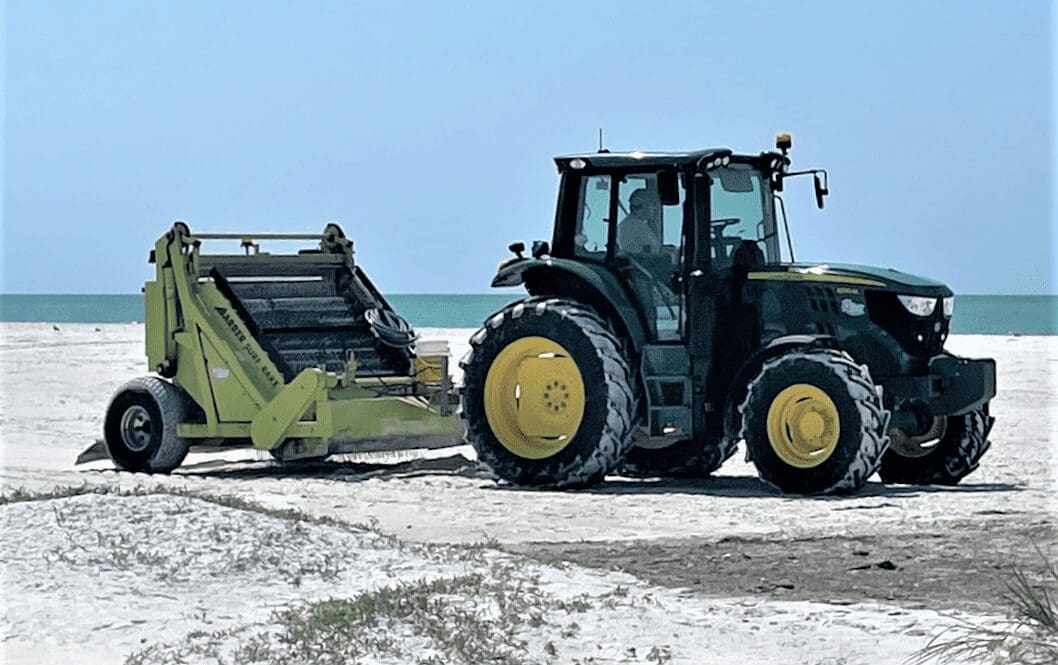
The beach rake that Taylor drives along the beaches has a spring-loaded conveyer with stainless steel tines that scratch the surface of the sand and pick up debris, including dead fish.

“We try to do the public beaches first,” he said. “That’s our priority always. They populate early with fish and it’s been a heavy amount of them.”

The fish go up the belt and are dumped into a 2-yard hopper on the back of the apparatus.   When the hopper is full, Taylor backs up the vehicle to dumpsters at Manatee Beach, Coquina Beach and Bayfront Park and empties the load.

Rather than doing his normal run along Manatee and Coquina beaches, Taylor was sent to the northwest end of Anna Maria Island on Thursday, where the beaches were littered with dead fish.

“The wind is pushing it in today to Bean Point from the rocks and to Bayfront Park,” he said Thursday.

The predominant types of fish Taylor is seeing on the shore are catfish, pinfish and baitfish.

“The eels, the catfish and the baitfish come first,” Taylor said. “I’m seeing Spanish mackerel, pelagic, and grouper. Today I dumped a load of fish and one large grouper was in there, probably about 3-foot long.”

At Bean Point on Thursday, dead fish were scattered from the shore to the dune lines more than 60 feet away.

“The full moon we had recently and the huge tides washed the fished up to about a 100-foot span,” said Liza Click, supervisor of the Manatee County Property Management Grounds Division. “We’re seeing sheepshead, trout, catfish, dogfish, a lot of mullet and an occasional big grouper washed up on the sand.”

The county has four rakes to cover the local beaches and has been operating three of them recently.

“This past Sunday we had three beach rakes going off,” Click said on Thursday. “Winds play a big part in our day. Today was a great day.”

Click, who operates a beach rake, said her day begins at 4:30-5 a.m.

“The good thing is, we’re not in turtle season so I can get out there early,” she said. “I start at Coquina and once I get to Cortez, I’m closer to the buildings and I can get done by 6 or so.”

Click said the dumpsters where the fish are disposed of are emptied three times a week, and the county is getting ready to put down lime under the dumpsters to alleviate the odors of dead fish.

Taylor said that so far the fish kills are less than he saw during the heavy red tide of 2018.

“It’s not as bad as ’18 was,” he said. “In ’18 we had much larger quantities of fish on the beach.  We’re able to manage right now. We had to bring everybody out in ’18. I worked 28 12-hour nights and days then.”

In 2018, Taylor said there was a run of dead horseshoe crabs along with the fish.

“What’s interesting is at Bayfront is primarily bay species. It’ll be mullet and trout and sheepshead,” he said. “And then out front (in the Gulf), you’ll get the grouper and the mackerel and maybe a pompano even.”

Taylor said thus far, the fish cleanups have been manageable for county crews.

“At some point, we have the beach clean each day right now,” he said.

Red tide intensifies

For the first time this year, some local waters are showing high levels of red tide.

Water samples taken on March 10 at Longboat Pass showed high concentrations of the red tide organism Karenia brevis, according to the Florida Fish and Wildlife Conservation Commission (FWC). High levels can cause respiratory irritation, shellfish harvesting closures, probable fish kills, water discoloration and detection by satellite.

Red tide levels were reported as medium at Kingfish Boat Ramp on Anna Maria Sound just east of Anna Maria Island and at the Rod and Reel Pier in Anna Maria. Medium levels can cause respiratory irritation, shellfish harvesting closures, probable fish kills and detection by satellite.

Palma Sola Bay registered low levels of red tide.

According to the FWC, red tide was observed at low to high concentrations in 12 samples collected in Manatee County, background to high concentrations in 38 samples collected in Pinellas County and background to high concentrations in 51 samples collected in Sarasota County.

For updated information on red tide, visit the Red Tide Respiratory Forecast at RedTideForecast.com, which tells beachgoers what red tide impacts are expected to be at individual beaches at different times of the day. The forecast is also available in Spanish at PronosticoMareaRoja.com.

Beachgoers also can get updates at visitbeaches.org, the Mote Marine Laboratory beach conditions reporting system, which documents respiratory irritation and fish kills at local beaches.

Call 866-300-9399 from anywhere in Florida to hear a recording about red tide conditions throughout the state.

Letter to the Editor: What is AMI’s carrying capacity?

The Florida Department of Environmental Protection (DEP) under the Division of Recreation and Parks has the responsibility of planning the use and management of Florida’s public lands and water areas. Governments are tasked with development and management strategies and plans for the quality of recreation experiences and protection of the natural areas which are directly affected by the implementation of the site plans, or land use plans. As we write our state legislators regarding the current hot topic of the “garage,” perhaps we should encourage a study using the DEP Carrying Capacity Guidelines.

Carrying capacity is the maximum population that can be sustained by a specific environment. Carrying capacity computations are vital to the planning of new use sites, alterations of existing use sites and continuous management of all areas of the system. To prevent overcrowding and resource deterioration, the collection of data is fundamental to assessment.

Carrying capacity for a given site governs the number of parking spaces, the size of restrooms and all quantities of support facilities to be provided. Surveys on tourists’ perspectives have shown that in addition to beach cleanliness, safety, information availability and habitat management, overcrowding is considered as a very significant criterion by potential tourists.

Without becoming too technical, these are the broad capacities:

  • Economic – maximum number of tourists that an area can support;
  • Biophysical – damage to the natural environment exceeds the habitat’s ability to regenerate;
  • Social – Reduced visitor enjoyment and increased crime/indicators of when the social carrying capacity has been exceeded;
  • Environmental – ecological and physical parameters, the capacity of resources, ecosystems and infrastructure.

Doug Lansky, an international tourism advisor, has a great YouTube video on tourism, “a new model for success in tourism that emphasizes sustainable growth, protecting local assets, and enhancing life for the locals while maximizing the local economic impact.”

The area of Anna Maria Island is less than a half of a percent of the total area of Manatee County. A $45 million parking garage for 1,500 is not a panacea. Encourage legislators to use smart and sensible planning strategies and studies for the benefit of residents, visitors, and the environment.

Margie Motzer

Holmes Beach

Onshore winds, strong currents stir up red tide on AMI

Onshore winds, strong currents stir up red tide on AMI

HOLMES BEACH – What a difference a few days and some strong winds can make.

While red tide reports from several days earlier showed low concentrations of Karenia brevis, the organism that causes red tide blooms, conditions changed on Sunday.

With winds out of the west at more than 23 mph churning up the blooms in the Gulf of Mexico and pushing them toward Anna Maria Island beaches, the unmistakable smell – and feel – of red tide permeated a largely empty Manatee Beach.
One visitor from New York was coughing profusely as she left the beach Sunday morning.

“I wanted to see the beach, but I have asthma and I couldn’t stay long,” she said. “I started coughing almost immediately. This is too much for me.”

Some people experience respiratory irritation (coughing, sneezing, tearing and an itchy throat) when red tide is present and winds blow onshore, according to the Florida Fish and Wildlife Conservation Commission (FWC), while offshore winds can keep respiratory effects experienced by those on the shore to a minimum.

Red tide produces toxins capable of killing fish, birds and other marine animals. The toxins can also cause health problems in humans, including respiratory irritation when wave action breaks open red tide cells and the toxins become airborne, according to the FWC.

The Florida Department of Health advises people with severe or chronic respiratory conditions, such as COPD, emphysema or asthma, to avoid areas with red tide.

Please, don’t feed shorebirds

Please, don’t feed shorebirds

ANNA MARIA ISLAND – Humans disturbing birds is one of the key hazards to threatened shorebird and seabird populations, according to the Florida Fish and Wildlife Conservation Commission Florida Shorebird Alliance (FSA).

When attempting to nest and raise chicks on local beaches, breeding birds spend energy avoiding human threats, leaving chicks and eggs vulnerable to the elements and predators, according to the FSA’s annual report.

“Research has demonstrated that chronic disturbance from human activities at a site can negatively affect reproductive outcomes, local abundance, and ultimately statewide populations,” according to the FSA report. Kathy Doddridge, a volunteer with Anna Maria Island Turtle Watch and Shorebird Monitoring, offered some tips on reducing human interaction and dis- ruption to the local shorebird population.

“Walk around bird colonies so as not to disturb them, prevent children (and adults) from running through a resting colony in order to get that perfect selfie or video,” she said. “Feeding gulls bread is equivalent to feeding your children styrofoam peanuts. When the gulls become reliant on beach scraps, they are more inclined to stay around and then prey on chicks and eggs. One of the primary predators of nesting birds is the local cat population. Keep your cats inside and your dogs off the beach.” Manatee County law prohibits dogs on beaches.

FSA, a statewide network of local partnerships committed to advancing shorebird and seabird conservation in Florida, focuses on beach-nesting birds that are state-listed as threatened – the American oystercatcher, black skimmer, least tern and snowy plover. The Wilson’s plover is listed as a species of greatest conservation need.

Doddridge conducts a twice-monthly shorebird survey of Anna Maria Island and last week said she saw thousands of laughing gulls as well as migrating red knots, American oystercatchers, ring-billed and lesser black-backed gulls and smaller sandpipers.

“This past Sunday it was cold, windy and far fewer numbers of birds. So cold fronts play a big part in what we see on the beach,” she said. “In the summer months, we have black skimmers, least terns and American oystercatchers frequent the Island. This past year we did not have any nesting seabirds or shore- birds. However, other barrier islands had very large colonies. Gulls nest on Egmont Key, Passage Key and the spoil islands of Hillsborough Bay. Why do they prefer one area over another? People and predators.”

Gulls, terns, oystercatchers, skimmers and sandpipers use AMI beaches to rest during peak migration periods. Skimmers and least terns nest in colonies and rely on the group to protect them from people, crows and laughing gulls, she said.

“Skimmers gather near the water to cool off during the heat of the summer. Imagine wearing a black coat as you sit on the sand in the middle of July,” Doddridge said.

The 2022 Florida Shorebird Alliance Monitoring Data at Work annual report is now available at flshorebirdalliance.org. The report highlights trends and strategies to improve nest- ing outcomes and reduce human disturbance.

“Ever-increasing human populations mean continuing challenges in reducing human disturbance, managing predation and regulating coastal development that impacts beach-nesting birds,” according to the FSA report.

Posting signs and roping off areas around nesting habitat are tools routinely used by FSA partners. Posted Designated Critical Wildlife Area signs are disturbance reduction tools for birds.

FWC law enforcement patrol efforts have grown from 629 patrols in 2018 to up to 1,500 proactive patrols statewide each year. Law enforcement is an important aspect of species protection, according to the FSA site.

In another method of monitoring the local bird population, for the past 123 years, from Dec. 15 through Jan. 5, the Audubon Christ- mas Bird Count has been conducted.

“Teams of people count individual birds to establish a snapshot of what is happening within their circle. A circle is a 15-mile diameter circle,” Doddridge said. “There are two circles that cover Manatee County. I am the compiler for the Bradenton Circle which goes only as far as the Intracoastal (Waterway). AMI is covered by the Fort DeSoto circle, with only the northern end of AMI (north of Anna Maria Elementary) covered in the circle.”

Red tide affects Manatee County waters

ANNA MARIA ISLAND – The Florida Department of Health in Manatee County has issued an alert for the presence of red tide in local waters.

Based on samples taken Nov. 7, a red tide bloom in varying degrees was shown at Bayfront Park, Coquina Beach South, Longboat Pass/Coquina Boat Ramp and Rod & Reel Pier in Anna Maria.

The Florida Fish and Wildlife Conservation Commission (FWC) red tide status map on Nov. 17 showed a range in concentrations from very low at Rod & Reel Pier to medium at Longboat Pass.

Red tide is a type of algal bloom caused by high concentrations of Karenia brevis, a microscopic algae found in the Gulf of Mexico.

Wind and wave action can break open K. brevis cells and release toxins into the air, according to the health department. People should monitor conditions and use caution when visiting affected water bodies. Those in coastal areas can experience eye, nose and throat irritation during a red tide bloom. Some individuals with chronic respiratory conditions, like asthma or chronic lung disease, might experience more severe symptoms.

Red tide typically forms naturally offshore, commonly in late summer or early fall, and is carried into coastal waters by winds and currents. Once inshore, nutrient sources may fuel growth, according to the health department.

Soon after Hurricane Ian hit, some areas to the south of Manatee County experienced high levels of the toxic algae and local water quality experts were uncertain whether or not it would spread to the north.

“I never predict,” Dr. David Tomas- ko, executive director of the Sarasota Bay Estuary Program, told The Sun in October. “Hopefully, this doesn’t get bigger. The wind is out of the west pushing water toward shore – that’s not going to help us.”

According to the FWC on Nov. 17, “Reports of fish kills suspected to be related to red tide were received over the past week in Southwest Florida in Manatee, Sarasota, Charlotte and Lee counties.”

Also on Nov. 17, the FWC website stated that respiratory irritation suspected to be related to red tide was reported over the past week in southwest Florida in those same areas.

“Red tide toxins can also affect the central nervous system of fish and other marine life, which can lead to fish kills and increased wildlife strandings or mortalities,” a DOH press release stated. “Eating contaminated seafood can cause neurotoxic shellfish poisoning in humans.”

“Please note that it is safe to eat shellfish that are commercially harvested and sold in fish markets, restaurants and other outlets,” the Mote Marine website states. “Florida has a well-established monitoring program for all commercial shellfish beds and these beds are closed when affected by red tide or other environmental conditions.”

For local shellfish harvesting status results, visit the Florida Department of Agriculture and Consumer Services.

The FWC collects and analyzes red tide samples and results are updated daily. Status updates are issued twice weekly during blooms.

To hear a recording about red tide conditions throughout the state, call the toll-free hotline at 866-300-9399.

To report fish kills, contact the Florida Fish and Wildlife Research Institute on the FWC reporter app, call 1-800-636-0511, or report online.

The DOH warns the public to take the following precautions in and around affected areas:

• Look for informational signage posted at most beaches.

• Stay away from the water.

• Do not swim in waters with dead fish.

• Those with chronic respiratory problems should be especially cautious and stay away from affected locations as red tide can adversely affect your breathing.

• Do not harvest or eat shellfish, distressed or dead fish from affected locations. If caught live and healthy, finfish are safe to eat as long as they are filleted and the guts are discarded. Rinse fillets with tap or bottled water.

• Wash your skin and clothing with soap and fresh water if you have had recent contact with red tide.

• Keep pets and livestock away from and out of the water, seafoam and dead sea life. If your pet swims in waters with red tide, wash your pet as soon as possible.

• Residents living in beach areas are advised to close windows and run the air conditioner, making sure that the A/C filter is maintained according to manufacturer’s specifications.

• If outdoors near an affected location, residents may choose to wear masks, especially if onshore winds are blowing.

To get answers to questions about red tide and its effects, contact the health department in Manatee County at 941-748- 0747.

Erosion expected to resolve naturally

Erosion expected to resolve naturally

ANNA MARIA ISLAND – While the Island missed a direct hit from Hurricane Ian, the effects of the Sept. 28 storm included beach erosion, primarily on the north end of the Island.

The good news for Manatee County, however, is that the sands are expected to return over the next several months without county intervention.

“For Anna Maria Island, the majority of beach sands were blown or drawn into a shallow sand bar directly offshore of the beaches along North Shore Drive and are expected to return over the next six to nine months with seasonal onshore winds and wave currents,” according to Charlie Hunsicker, Manatee County National Resources Department director, in an email to The Sun.

Hunsicker said the majority of Gulf-facing beaches along the Island saw little or no effects of erosion at all.

“Manatee County participates in the state’s critically eroded beach program requiring an annual survey of beach conditions to track how the beach is approaching the time when renourishment is needed to continue to provide storm protection,” Hunsicker said. “We have already commissioned this year’s annual survey and will await its findings to determine how far along in years we are to the next erosion event, keeping in mind that a strong hurricane at any time has the potential to quickly remove vast stretches of beach, sacrificing it and the protection it provides to save residential and commercial structures and evacuation roadways upland from the beach.”

In 1992-93, the first beach nourishment of Anna Maria Island was commenced to protect upland infrastructure. Since then, approximately 6.9 million cubic yards of sand from offshore borrow areas have been placed by U.S. Army Corps of Engineers contractors.

Only private property owners who have given permission through a state-approved process that sets a seaward Erosion Control Line (ECL) are eligible for publicly-funded renourishment efforts, Hunsicker said.

“In Manatee County, property owners from approximately 79th Street North in Holmes Beach all the way south to Longboat Pass have given this permission, along with a one-half mile length of beach bordered roughly between Magnolia and Elm streets in the city of Anna Maria. Residents outside these limits in the city of Anna Maria have not given their consent to the establishment of an Erosion Control Line, especially along North Shore Drive, and are not eligible for county, state or federal renourishment programs,” he said.