The old expression “follow the money” can be applied to several different aspects of life. Sometimes it’s as simple as tracking trades in the stock market and sometimes following the money can disclose corruption in government at all levels. But for the sake of this column, we’ll follow the real estate money – and it’s taking a new, surprising turn.
As we briefly discussed last week, the housing market, with some exceptions, is slow all over the country. The much-anticipated spring selling season has become a complete dud and everyone in the industry is pinning their hopes on a large interest rate cut in September.
Nevertheless, single-home investors are alive and well and are dominating the real estate market so far this year. The interesting thing is the profile of investors has changed significantly. Previously, investment buyers were predominantly large private equity firms, however, the majority of buyers for these properties now are small investors; small investors are defined as owners with 100 or fewer properties.
According to Cotality, a property analytics firm, so far in 2025, investors have made up about 30% of purchases of both existing and newly built single-family homes, the highest share on record. In addition, in the first half of the year, small investors made up about 25% of investment home purchases, while large investors accounted for about 5%.
The question is, why is this happening? Obviously, small investors are not deterred in spite of high prices and high interest rates; they still see a pathway to maximize their investment. Smaller investors also have the ability to take more risk since they are making their own decisions without the oversight of a board of directors. It also works for them since so many traditional homebuyers have stepped back waiting for some signal that the market is improving.
Based on what is going on with the condo market across the country, some of those investment buyers would be smart to take a look at advantageous buying options on condo properties. Condo sellers haven’t faced a market this weak in more than a decade. Prices are down, supply is up and sellers often feel lucky to get an offer.
This is particularly true in the south and naturally, Florida condos – which play a major role in our housing market – are being impacted the most. The Florida condo market accounts for 16% of all home sales compared with just 10% of home sales nationwide. Coastal condos, as we know, are hurting the most as home insurance and new safety regulations have increased HOA fees.
All of this is true and there is no denying it. However, although I don’t have statistics to prove my theory, I do believe the east coast of Florida is suffering more with condo sales than the west coast. This, I believe, is a reflection of the Surfside building collapse in 2021 and also the age of the buildings and the deferred maintenance on so many of the oceanfront properties. I hear much less about condos in our area failing the milestone structural inspections mandated by the state and ones that have appeared to be on a smaller scale.
Even though single-family homes are selling at a stronger pace than condos, remember, Florida loves condo living – it’s why people came here. Certainly, marketing a strong, storm-survived condo building will be beneficial to your sale and of course should be on your listing information.
Follow the money, and the money is with small investors. Watch what they’re buying and keep an eye on those condos.
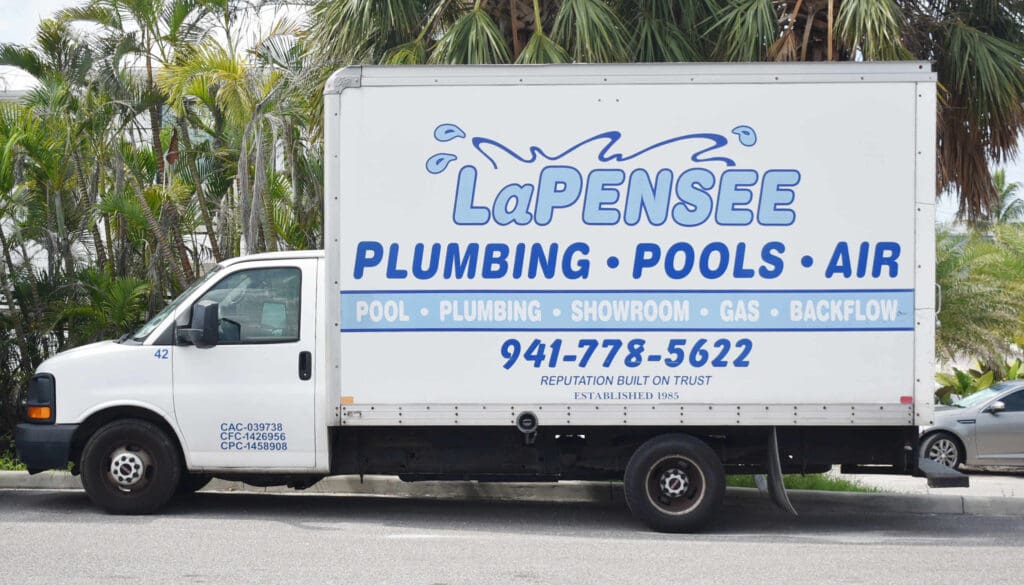
HOLMES BEACH – LaPensee Plumbing, Pools and Air celebrated its 40th anniversary on Aug. 1.
Speaking by phone the following day from her summer home in Jasper, Georgia, semi-retired company president Karen LaPensee said, “I’m so proud that this business has been a true part of the Island community for the last 40 years. The employees stayed with us long term and they helped us build this business into what it is. I couldn’t be more proud of them.”
Karen’s husband, Mike LaPensee, founded LaPensee Plumbing in 1985.
Karen and Mike LaPensee founded LaPensee Plumbing and enjoyed 47 years of marriage before Mike’s passing in 2024. – Karen LaPensee | Submitted
“Mike had been a plumber for many years. He hurt his back and as his injury got chronically worse he got to the point where he didn’t want to work for other people. He really wanted to start his own business,” Karen said. “I was pregnant with Shawn and about six months after she was born I joined him in the business. He had this cute little blue Datsun truck that was just the right size for him and the products he used. Our hope was to have a good family business that could support us and allow Mike to have a successful career. I was working in nursing and the business allowed me to stay home and raise the children.”
Mike LaPensee drove this Datsun truck when he started his plumbing business in 1985. – Shawn Shields | Submitted
The couple operated their upstart plumbing company from their Anna Maria home for 2½ years before moving into the Holmes Beach Business Center, where they stayed for about eight years. Then then moved across the street to a space in the S&S Plaza now occupied by AMI Health & Fitness.
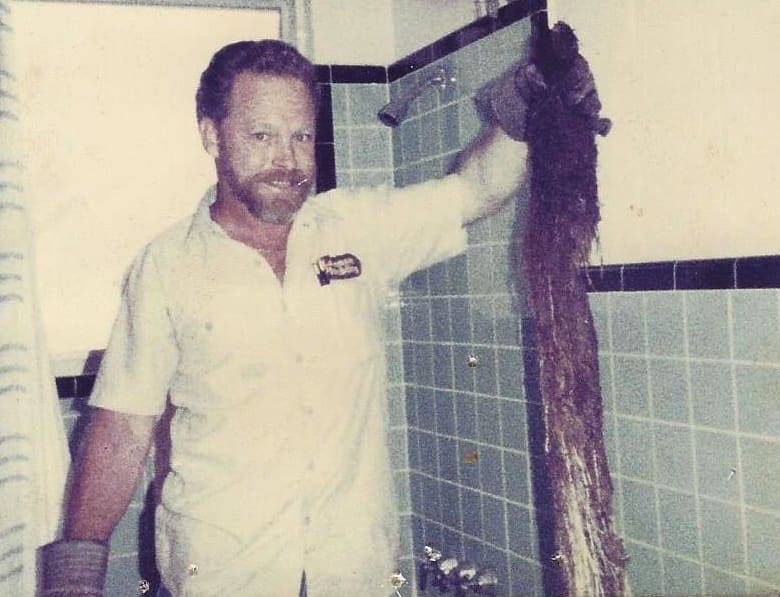
Mike LaPensee loved being a plumber. – Shawn Shields | Submitted
In 2008, LaPensee Plumbing moved to its current company headquarters and product showroom at 401 Manatee Ave. in Holmes Beach. The company began offering swimming pool remodeling, resurfacing, repair and maintenance services in 2008; and for a time, offered pool construction services. LaPensee Plumbing and Pools added air conditioning services and repairs in 2015 and they also offer water heater sales and installations.
LaPensee Plumbing, Pools and Air services Anna Maria Island, Bradenton, Lakewood Ranch, all of Manatee County and northern Sarasota County and also serves as a plumbing subcontractor for other custom home builders.
After Mike retired in 2009, Karen and their son, Greg LaPensee, ran the company until Greg passed away in 2021 due to complications from the COVID-19 virus. Mike then passed away in 2024.
Shawn Shields and General Manager/Vice-President Chad Schweitzer now oversee the company’s daily operations, with Todd McCollum guiding the air conditioning department and Karen still weighing in on high-level decisions as needed.
Regarding the milestone anniversary, Karen said, “The customers have made us what we are. We have some truly loyal business and residential clients that have been very supportive. It makes me proud that we have good friends that are also our clients. Supporting the community has also always been extremely important to us and the community center (The Center of Anna Maria Island) has always been a big focus for us.”
The company’s support of The Center includes hosting the annual fundraising Greg LaPensee Bowling Tournament that will take place on Saturday, Sept. 6, and again benefit The Center – with Karen in attendance.
Next generation
As a small token of appreciation, the LaPensee employees were treated to lunch catered by Mission BBQ on Friday. While sitting in her office before lunch was served, Shields discussed the family business.
General Manager/Vice-President Chad Schweitzer and Shawn (LaPensee) Shields now lead the LaPensee Plumbing, Pools and Air operations. – Joe Hendricks | Sun
Serving as the company secretary, Shields assumed many of the duties previously handled by her mom, including employee payroll and benefits, property management and more. She first worked in the family business from 2008 through 2011 and then got married and moved to the Caribbean for a few years. She returned to the area and the family business in 2015 and later this year she’ll celebrate her own 40th birthday.
“The business and I are the same age. It’s a big year for both of us,” she said.
Regarding the changes that occurred in recent years, Shields said, “Greg’s passing was a shock and that took some readjustment. My dad was already retired and Greg and my mom were running the business. We had to get used to some new normals without Greg being here. Chad’s been with us for 18 years. He was Greg’s right hand and he oversaw the plumbing division, so it was a natural choice to move Chad into the role of general manager. He handles all the day-to-day operations regarding the personnel, issues in the field and issues with customers. He also holds our pool license and our plumbing license – and plumbing is still our bread and butter.”
LaPensee Plumbing, Pools and Air serves Anna Maria Island and all of Manatee County. – Joe Hendricks | Sun
LaPensee Plumbing, Pools and Air currently has 53 employees and Shields said they’d be fully staffed with 60.
“We couldn’t do it without our employees. They are our backbone. Without good employees, you won’t make it far,” she said.
Faucets and toilets on display in the LaPensee showroom. – Joe Hendricks | Sun
While standing in the showroom area that features a wide variety of sinks and faucets, Schweitzer said, “I’m impressed with the overall growth of the business and by how much the company has done for the community during the past 40 years. I’ve been here for 18 years and when I started it was at the other location, next to Minnie’s (Beach Café). Call us for any and everything that has to do with plumbing, pools and air.”
“We’re thankful and grateful to this community for keeping us going for 40 years and here’s to another 40,” Shields said.
Learn more about LaPensee Plumbing, Pools and Air at www.lapenseeplumbing.com or call 941-778-5622.
Greg, Shawn, Karen and Mike LaPensee received the Manatee County Chamber of Commerce’s Small Business of the Year award in 2011. - Shawn Shields | Submitted
Shawn, Mike, Karen and Greg LaPensee in 2015. - Shawn Shields | Submitted
Tile and other coverings on display in the LaPensee showroom. - Joe Hendricks | Sun
Sinks and fixtures on display in the LaPensee Plumbing, Pools and Air showroom. - Joe Hendricks | Sun
MANATEE COUNTY – The Florida Department of Government Efficiency (DOGE) is auditing Manatee County’s finances.
Gov. Ron DeSantis announced the audit during his July 24 visit to Bradenton, during which he mentioned the steep property tax increases in Manatee County in recent years.
The same day, Manatee County Commission Chairman George Kruse received a letter from DOGE that began by saying, “The Florida DOGE team, in partnership with Chief Financial Officer Blaise Ingoglia and the Office of Policy and Budget, have identified Manatee County for further review and an on-site visit. Although Manatee County has taken steps to reduce the county-wide millage rate in recent years, rising property values have pushed annual property tax collections up by over $200 million since 2019, according to your published budgets. This increased burden on property owners has helped Manatee County increase the county’s net annual budget by almost $600 million since 2020 – an increase in spending of 80% during that period.”
County Administrator Charlie Bishop was copied as a recipient of the DOGE letters. Hillsborough County, Pinellas County, the city of Orlando and the city of Jacksonville are among the other Florida counties and cities that recently received similar DOGE letters.
In addition to paying county property taxes, Anna Maria, Bradenton Beach and Holmes Beach property owners also pay annual city property taxes at a much lower millage rate than the county’s millage rate. Property owners in Bradenton, Palmetto and the northern portion of Longboat Key also pay city and county property taxes. Property owners in unincorporated areas, including Cortez, don’t pay city property taxes.
“Having entrusted their governments with the power to tax, the citizens of Florida have a right to expect that their elected officials will spend the collected funds responsibly, not recklessly, and on truly necessary programs,” the DOGE letter says. “Through the DOGE effort, Gov. DeSantis has charged us to identify and report on this type of excessive spending at the county and municipal level.”
The letter also says, “We hereby request access to your county’s physical premises, data systems and responsive personnel on Aug. 5 and Aug. 6, at the county administration building and such other locations that you identify as necessary to comply with these requests. You should note that financial penalties may accrue for your failure to comply with each of the following requests for access on those dates.”
The letter is signed by Ingoglia, DOGE Team Leader Eric Soskin and Office of Policy and Budget Director Leda Kelly.
On July 31, county commissioners voted 5-1 in favor of setting the county’s tentative millage rate at the same 6.0826 mills in effect for the current fiscal year. Subject to revision before final adoption in September, Manatee County’s $2.54 billion 2026 fiscal year budget currently includes $1.38 billion in newly generated revenues, including property tax revenues. The $2.54 billion total also includes debts and other financial obligations being carried over from the 2025 fiscal year that ends on Sept. 30.
DOGE requests
The two-page DOGE letter was accompanied by six pages of specific requests for detailed financial information, including capital expenditures, operating costs and funding sources for the county-contracted Gulf Islands Ferry service that operates between downtown Bradenton and Anna Maria Island, the Riverwalk Day Dock in downtown Bradenton and the Bradenton Beach Pier in Bradenton Beach that currently serve as ferry stops. Because of the hurricane damage that Hurricane Milton inflicted on the City Pier in 2024, ferry service in Anna Maria remains suspended until a new City Pier walkway is built.
The DOGE letter also requests information about the county’s property management efforts and the purchase or sale of any public-owned property, specifically, the county’s recently announced $24 million purchase of an existing building in Lakewood Ranch to be used for expanded county government operations. The July 24 letter was received before county commissioners’ unanimous July 29 decision to buy the 39-acre Mixon Fruit Farms property and wedding venue in east Bradenton for $13.5 million.
DOGE also seeks detailed information about:
county procurement processes and policies;
contracts awarded in excess of $10,000 and the vendors awarded those contracts;
compensation paid to county employees;
the county utilities system;
the county’s diversity, equity and inclusion programs and efforts;
county expenditures related to climate change, emissions reduction or carbon reduction, including the purchase of battery-powered electric vehicles;
grants and matching grants received by the county;
the county’s rules and policies regarding government vehicle allowances, including a list of all county personnel making use of a take-home vehicle;
the county’s Government Relations department, including job descriptions and departmental expenditures to date;
project descriptions, budgeted costs, actual costs and cost overruns or savings for county transportation-related capital projects that began, remain ongoing or have been completed since Jan. 1, 2023;
the installation, initial costs and maintenance costs and estimated life cycle for all traffic calming devices, included but not limited to speed tables, speed humps, raised intersections, curb extensions and chokers; and
homeless services provided by the county, the effectiveness of those efforts and any grant funds provided to other agencies that assist the homeless.
HOLMES BEACH – Prior to the start of the new school year on Monday, Aug. 11, new speed zone cameras have been installed near Anna Maria Elementary school.
According to Police Chief Bill Tokajer, the automated speed detection devices will only be operational when the yellow caution lights are flashing during the morning and afternoon student drop-off and pickup periods. Tokajer said a 30-day grace period will be in effect to give motorists time to adjust to the new automated speed detection activities. During the grace period, warning notices will be issued. After the 30-day grace period expires in early September, violators who exceed the posted 15 mph speed limit by 10 mph or more will be issued speeding tickets that carry a $100 fine.
Speed zone cameras and new fences were recently installed at Anna Maria Elementary in Holmes Beach. – Joe Hendricks | Sun
The Florida Legislature’s adoption of House Bill 657 in 2023 authorized the use of speed detection systems to ticket drivers exceeding the school zone speed limit by more than 10 mph.
In August 2024, the Manatee County Commission-approved school speed zone camera program was launched but speed cameras were not installed at Anna Maria Elementary. In February, public outcry about the speed cameras being operational during the entire school day prompted county commissioners to adjust the program’s operational hours to 30 minutes before and 30 minutes after the start and end of regularly scheduled school sessions. On March 4, county commissioners voted to end the speed camara program entirely. The program ended on March 6 and all citations issued through March 5 remained valid.
The Anna Maria Elementary school zone speed limit is 15 mph when the yellow caution lights are flashing. – Joe Hendricks | Sun
According to the county press release, the county’s school speed zone program resulted in 55,243 notices of violation being issued to motorists. As of March 4, 22,292 drivers paid the $100 fine. At the time, 4,051 violations were still awaiting law enforcement review and 45 violations were to be addressed during a special magistrate hearing held later that month.
New fencing
New security fencing now surrounds the AME property at 4700 Gulf Drive. Most of the fencing installed along the front of the school property is black metal rail fencing that stands between waist and chest high.
Black rail fencing was installed along most of the front of the Anna Maria Elementary property. – Joe Hendricks | SunBlack chain link fencing was installed at the north end of the Anna Maria Elementary property. – Joe Hendricks | Sun
The north end of the front of the school property features higher, black metal chain link fencing. The rest of the property is surrounded by higher, silver, chain link fencing. According to Tokajer, the Parent Teacher Association helped fund the more decorative rail fencing installed along the front of the school property.
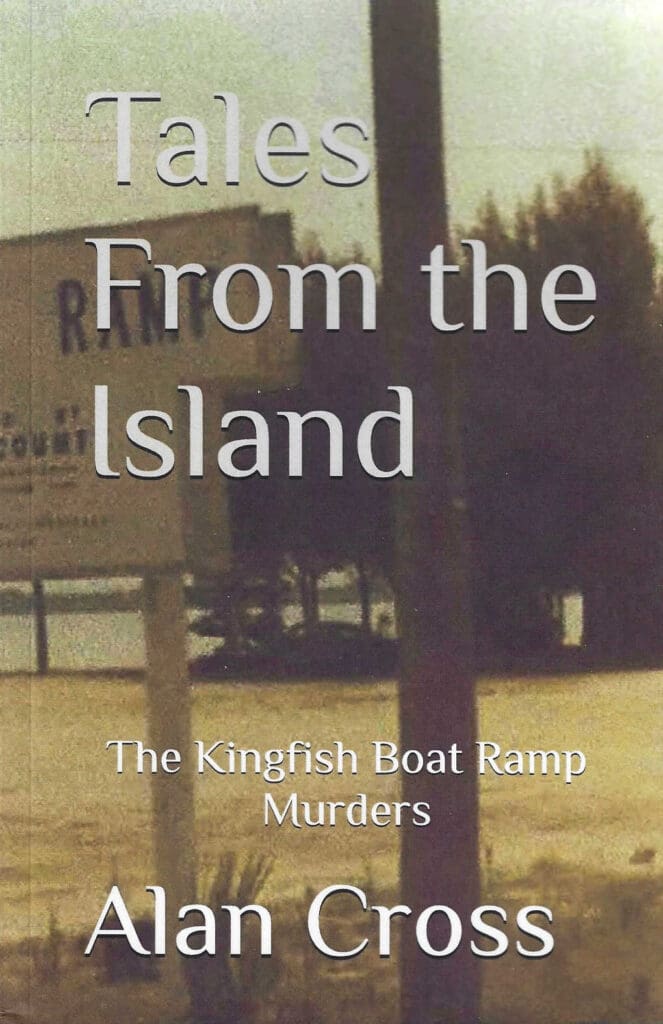
HOLMES BEACH – On the 45th anniversary of the unsolved Kingfish Boat Ramp murders, Bradenton resident Alan Cross released his self-published non-fiction book, “Tales from the Island: The Kingfish Boat Ramp Murders.”
Released on Aug. 1, Cross’s book is available locally at Ginny’s and Jane E’s Café in Anna Maria, The Beach Shop in Cortez, Three Island Monkeys in Longboat Key and online at Amazon.com.
“Tales from the Island: The Kingfish Boat Ramp Murders” is for sale locally and can also be purchased at Amazon.com. – Alan Cross | Submitted
Cross’s book examines the Aug. 1, 1980, murders of Tampa physician Dr. Juan Dumois, 47, his sons Eric, 13, and Mark, 9, and the shooting of his brother-in-law Raymond Barrows, who was visiting from Miami, survived being shot and later provided an eyewitness account of what happened. Not related to the Dumois family, retired Air Force Col. Robert Matzke encountered the shooter minutes later at the nearby Foodway supermarket – where Publix is now located – where he was shot and killed before the shooter escaped in a car driven by an accomplice.
The shootings
According to Cross’s book, the Tampa-based Dumois family was vacationing in Holmes Beach when the shootings occurred and Dumois’ wife, Maria, and their two other children, Anna Maria and Juan Dumois III, decided to not go fishing that fateful day. When interviewed on July 31, Cross said Maria, now in her 80s, and Dr. Juan Dumois III, a practicing infectious disease physician, still live in Tampa but he didn’t have the heart to contact them about the murders of their loved ones.
According to the book, when the Holmes Beach Police Department interviewed Barrows at Blake Hospital in Bradenton, Barrows said they were pulling Dumois’ boat from the water when a stranger approached and said he’d injured his ankle and needed a ride to a nearby condominium. After placing his bicycle in the boat, the stranger took a seat in the back of Dumois’ station wagon. As Dumois drove west on Manatee Avenue toward Manatee Beach with Barrows in the passenger seat, it’s believed the shooter first shot Barrows from behind, then shot the two boys in the back seat and then shot Dr. Dumois as he drove and turned around to confront the gunman.
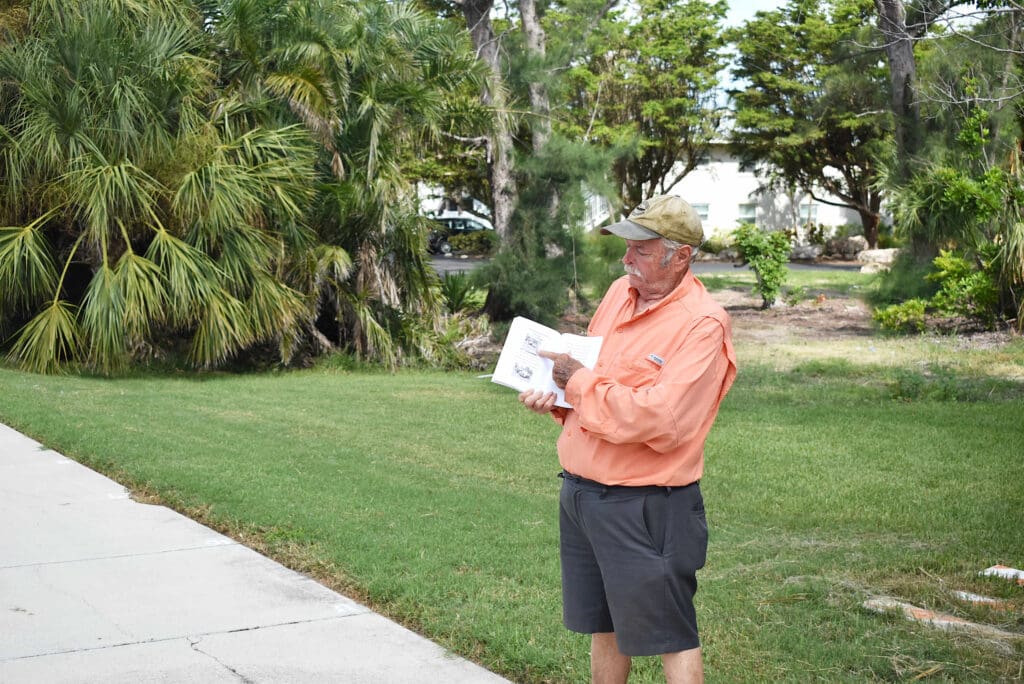
Holding his new book, Alan Cross points to 1980 crash scene photos taken near the entrance of the Westbay Cove condominium complex near where the shooting victims’ car crashed. – Joe Hendricks | Sun
After Dr. Dumois was shot, the station wagon crashed into a tree along the north side of the road by the entrance of the nearby Westbay Cove condominiums and the boat trailer came to rest jack-knifed against the car. According to the book, the killer fled across the street to the Foodway supermarket on his bicycle, where he encountered Matzke, who confronted him but then tried to flee in his Fiat convertible when he saw the man was armed. The gunman shot Matzke in the back of the head as he drove away and Matzke’s car crashed into another vehicle. Police said the crime scene evidence was completely compromised by bystanders and those who tried to assist the shooting victims.
Cold case
Cross, a retired respiratory therapist, first heard about the fatal shootings when a local TV station did a mini-documentary about 10 years ago and he also read newspaper stories that revisited the 1980s shooting spree. Approaching it like a college research paper, he started his research about two years ago and spent endless hours on the internet, searching library and historical records, reviewing police interview transcripts and eyewitness accounts, reading old newspaper stories and viewing old newspaper photos. Cross said there’s a lot of information out there about the shootings and his book is an attempt to compile that information in a single source.
Featured in Alan Cross’s book, this old wanted poster features an artist’s rendering of the suspected shooter. – Alan Cross | Submitted
Holmes Beach Police Chief Bill Tokajer, Det. Josh Fleisher and Holmes Beach resident and city commissioner Carol Whitmore are among those acknowledged at the front of the book. Cross said Whitmore helped him gain access to Holmes Beach Police Department evidence box that still contains evidence from the 1980 shootings. He was allowed to view, but not open, the sealed evidence bags. He was also allowed to access folders and photographs contained in the evidence box and he said the police department provided him with a flash drive containing additional information.
“They were very helpful,” Cross said.
He said the heinous nature of the shootings didn’t really hit home until he examined the evidence box: “That made it very real. Seeing the evidence shut me down for about a week. I had to process it all.”
Cross also obtained photos from the Florida Department of Law Enforcement and other sources. His book also includes crime scene sketches, autopsy report diagrams and a copy of a wanted poster that featured an artist’s rendering of the shooting suspect.
The book details and theorizes about the investigative efforts that ensued to no avail, including Holmes Beach Police Chief Tom Shanafelt turning to a psychic and a hypnotist for assistance.
In 1982, Barrows died of a heart attack in the Miami area and the book addresses the possibility of drugs and mob involvement playing a role in the shootings.
“There’s a mob connection, a connection with the ‘cocaine cowboys’ of the 80s and there was speculation of a drug connection,” Cross said.
According to the book, in 1993 the Manatee County Sheriff’s Office received a tip that lead them to interview confessed and incarcerated mafia hitman Donald Frankos. The book includes a transcript of the interview conducted by the sheriff’s office, during which Frankos provided the names of the Cuban men he said ordered and carried out the Holmes Beach shootings because Barrows allegedly stole 55 kilos of cocaine. That interview did not lead to any arrests. Cross’s book doesn’t attempt to solve the murders but it does express his belief that the murders were a targeted attack and Barrows was the likely target.
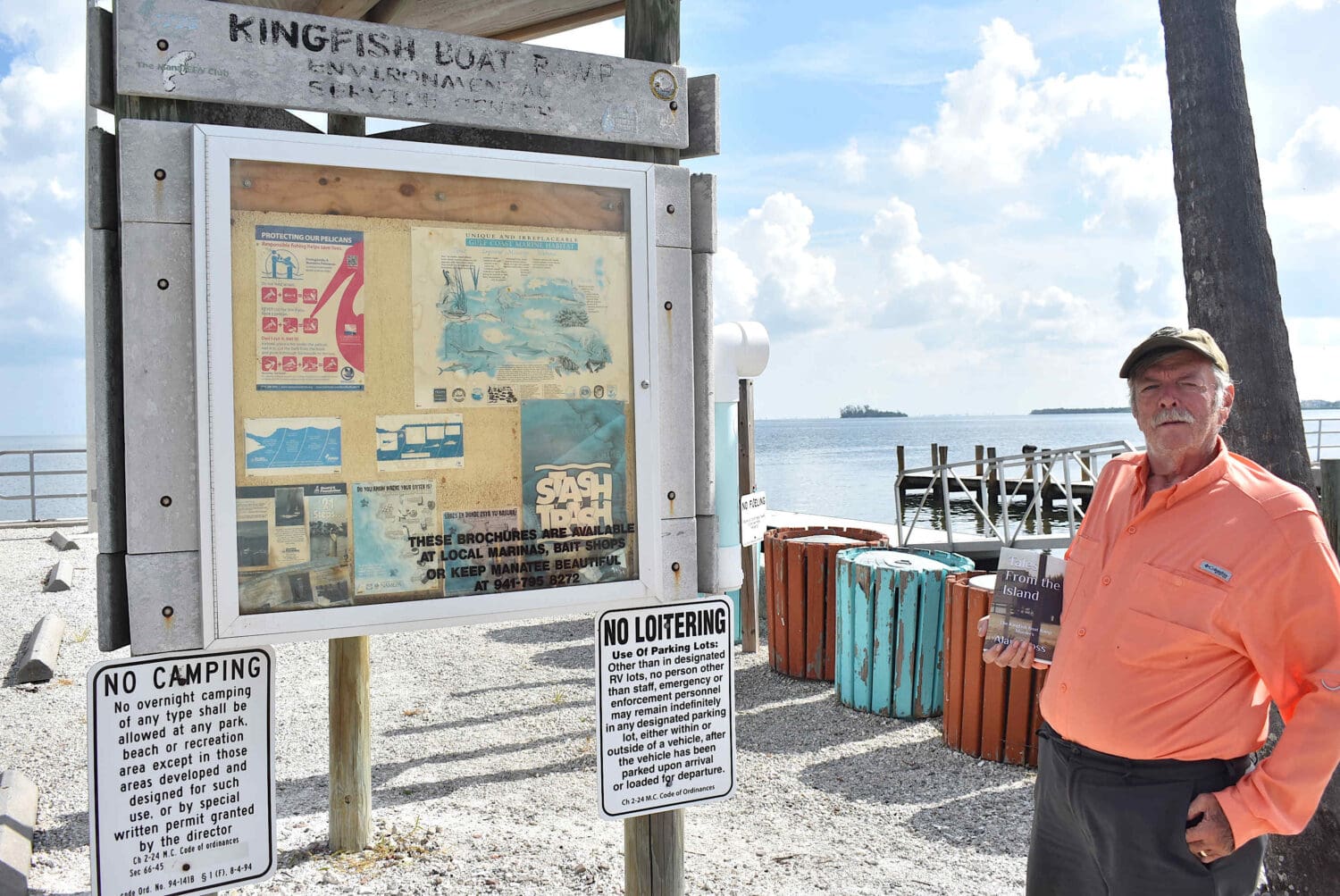
On Aug. 1, Cross met The Sun at the Kingfish Boat Ramp for a photo session and he retraced approximately where the initial encounter with the killer occurred, the scene of the shootings and the crash scene that followed.
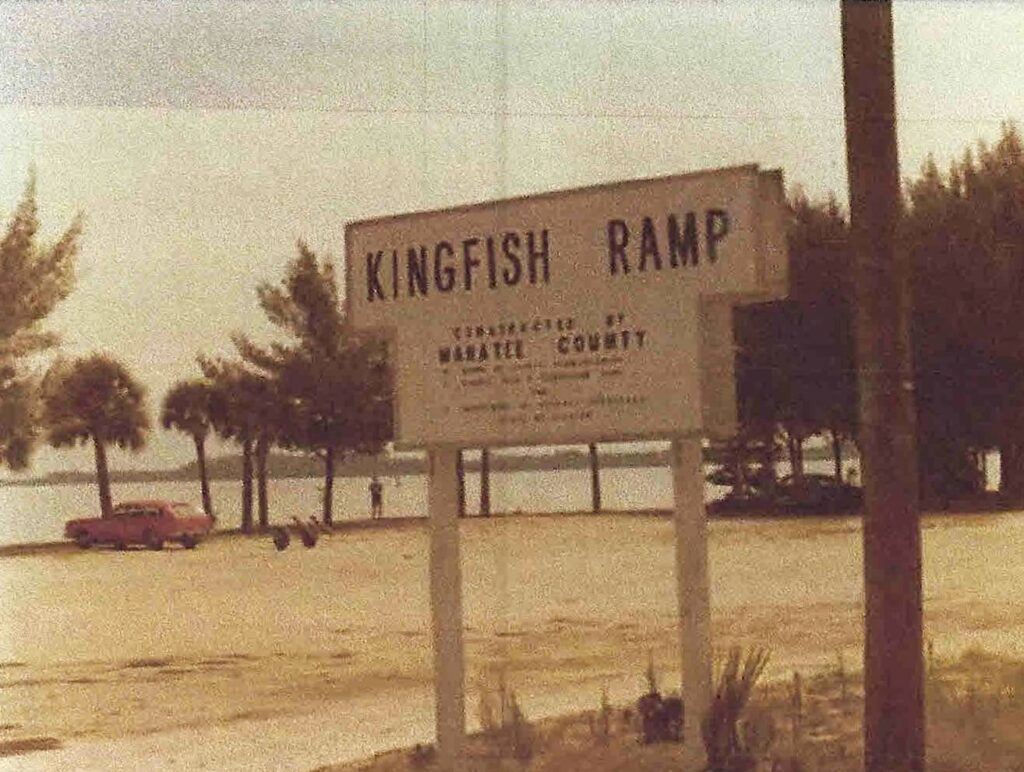
This old photo of the “Kingfish Ramp” appears in Alan Cross’s book. – Alan Cross | Submitted
The “Kingfish Boat Ramp Murders” is the second book in Cross’s “Tales of the Island” series. The first is “Tales of the Island: The Naming of the Ugly Grouper and Other Lies From Anna Maria Island.” Available at the same sales points, the first book offers Cross’s whimsical and fictional takes on how the Holmes Beach restaurant got its name, how his son, Adam – a local bartender – got his nickname, “Duck,” and other re-imaginings of Island lore.
BRADENTON BEACH – Attorneys for Luper Enterprises and the city of Bradenton Beach presented their opposing cases at a July 29 appeal hearing of a city commission’s decision banning resort fee-based parking at the Bungalow Beach Resort.
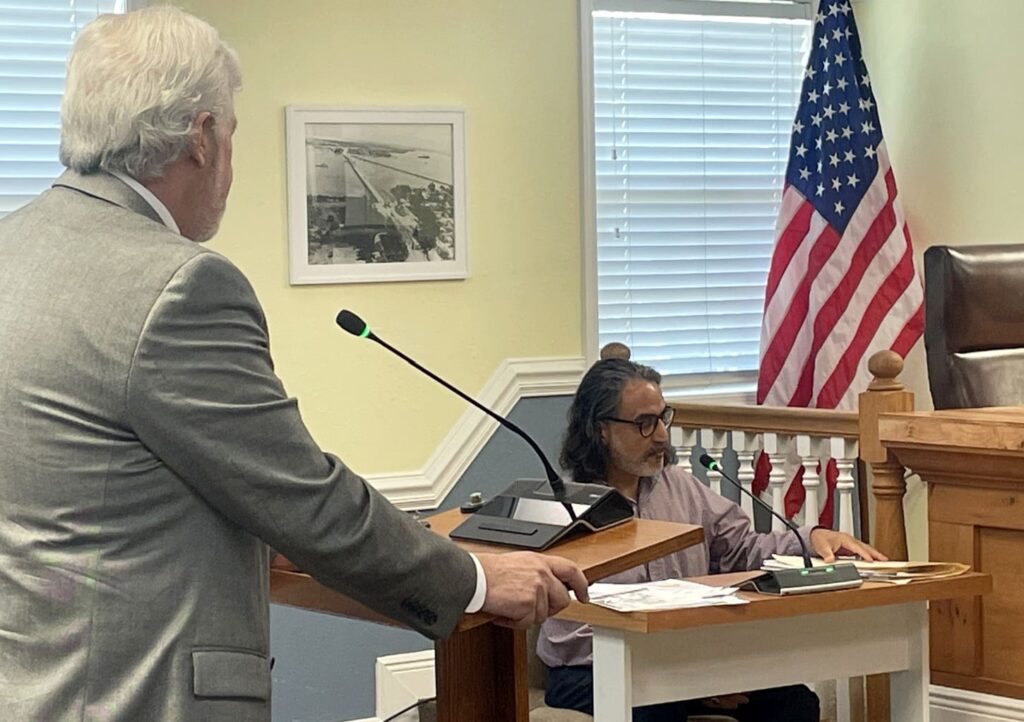
Special Master Marisa Powers presided over the quasi-judicial hearing and has 15 days from that date to make a decision and issue a written order on the appeal.
Special Master Marisa Powers presided over the quasi-judicial hearing. – Leslie Lake | Sun
The appeal was based on the April 17 city commission decision to require Gayle Luper, the owner of Bungalow Beach Resort, to obtain a temporary use permit for parking with several restrictions. Luper maintains that despite the bungalows being destroyed in Hurricanes Helene and Milton last year, the resort’s other two parcels were continually operational and that she is entitled to sell resort passes that include parking, as she said she did prior to the hurricanes.
Timeline
Hurricane Helene reduced the original older cottages at Bungalow Beach Resort to rubble. The buildings were condemned.
By Feb. 1, the razed parcels were cleared of debris.
Luper was advised by the city that she must file a parking permit to continue to charge a resort fee for parking. Luper said that City Planner Luis Serna advised her that a permit was not necessary.
On March 14, a portion of the parking lot was reopened for parking at the rate of $50 per car per day. City Code Enforcement Officer Evan Harbus told the Lupers that all parking at the razed parcels must cease as they were in violation of the city code.
On March 16, Luper applied for temporary parking.
At an April 17 hearing, the city commission placed the following stipulations on the property:
Parking at the razed parcels (the lot where the bungalows were) is permitted for a period of one year or 30 days from the issuance of a building permit;
Parking at the razed parcels is limited to 17 parking spaces per TPLE (Transient Public Lodging Establishment) license;
No trailers, recreational vehicles, campers, or buses are allowed to park at the razed parcels, and no tailgating, overnight parking, or paid parking shall be conducted;
Only employees, agents, or registered guests of the resort are allowed to park at the razed parcels; and
Parking at the razed parcels is limited to 7 a.m. to 9 p.m. enforced by a towing service secured by Luper.
Luper Enterprises filed a lawsuit against the city of Bradenton Beach on April 25 and the city filed a request for dismissal of that lawsuit on May 21.
Opening statements
“We had a city commission meeting that occurred on April 17 on the question of a parking permit that was going to be a temporary permit,” said attorney John Anthony of Tampa-based Anthony and Partners, representing Luper. “Our client requested of (Bradenton Beach City Planner) Luis Serna to opine or whether or not it was required because as a practical matter under the Land Development Code where involuntary destruction occurs like the hurricanes you can build back so long as you haven’t stopped continuous activity We originally heard verbally that was not going to be a problem and why the city went back on that, we don’t know, but it should not have.”
Anthony said the resort website never went down and the duplex continued to have guests.
“She spent all the money to clear that rapidly with the idea that she was going to park there,” Anthony said. “It wasn’t just parking for parking sake, but parking to keep the business going. To say you need a permit to do what you’ve already been doing, that to me is capricious and inconsistent.”
He said the city commission has an “irrational fear” that the parking lot will remain permanently.
“The Luper parties have obtained the financing, have gotten the plans, have even run the plans as far back as 2017 in the event of a hurricane,” Anthony said. “They did everything they could to secure build back better before there was even a hurricane.”
Attorney Robert Lincoln and City Planner Luis Serna spoke on behalf of the city. – Leslie Lake | Sun
Attorney Robert Lincoln, representing the city, characterized Bungalow Beach Resort as “marketing fiction that encompasses the way that they are marketed and operation that spans multiple properties and parcels with different uses and different licensing.”
“The two parcels at 2000 Gulf Drive are licensed by the state as a hotel, the two units that are in the structure at 2104 Gulf Drive are licensed by the state as a transient apartment and the duplex across the street is licensed by the state as a vacation rental. The single-family parcel that is north at 2108 is licensed by the state as a transient apartment,” Lincoln said. “You have a situation where it’s not only physically separated but in the case of the duplex parcel, it’s physically separated and has a different zoning classification.”
Lincoln said the distinction is important because nothing has continued to operate on the razed parcels.
“All the structures were seriously damaged by the hurricanes and then demolished,” he said. “There isn’t a resort for zoning purposes. The code is clear; you don’t get to use your land when it’s vacant. There are no accessory uses to a vacant parcel of land. There are no primary uses to a vacant parcel of land so there’s no right to park there as an accessory use to the prior hotel activities.”
“They were told clearly by staff you need a temporary use permit to use the property. They don’t like the conditions. The conditions are reasonable and need to be upheld,” Lincoln said. “What their argument comes down to is we want to make money off the property while there’s no resort running on it and we want to assert we have a right to do that.”
Public comment
Angela Rodocker, owner of hotels at 100 Bridge St. and 1301 Gulf Drive N., read from a statement that stated in part: “As a hotelier on Bradenton Beach, I see this decision regarding Bungalow Beach Resort as potential for future concern for any hotelier located in a R3 Zone, which are many.”
Rodocker noted that the Bungalow Beach Resort has never stopped operating and intends to continue operating as a hotel over all parcels of land and said other hotels on and around Anna Maria Island sell day passes to guests without rooms.
“I believe that the commissioners, with the city’s best interest at heart, made a terrible mistake.”
She said the resort fee parking is critical for the Bungalow Beach Resort at a time when the beachside buildings are obviously not bringing in income.
Approximately 40 emails were sent to the city clerk in support of Luper. Runaway Bay resident Marilee Erickson spoke in favor of maintaining the city’s April decision.
Luper testifies
Luper said that prior to the hurricanes, every resort guest has been charged a resort fee.
She described the devastation from Hurricane Helene to the waterfront bungalows.
“We found parts of our hotel five or six blocks away, it just devastated the buildings,” Luper said. “All the sand went into the bungalows to the point if you pulled the sand out the buildings would have fallen down.”
She said she let her staff know that she had submitted plans to the city in 2017 to rebuild in the event of a hurricane and that she would now complete those plans.
Luper said she planned to continue the resort fees she had been charging to generate income to help with salaries and rebuilding.
She said she was first told by the city permit clerk that a parking permit was needed and then was told by the city planner that she didn’t need one.
“We opened parking March 14 for just a couple hours and Evan Harbus shut us down,” Luper said.
The commission’s April 17 decision by default precludes Luper’s family and friends from using the parking area, Luper said.
Luper estimated she lost about $200,000 in resort fee parking that would have been used toward rebuilding.
City staff testimony
Harbus said that upon seeing the paid parking sign on the property, he told Luper’s son, Jason, that he needed to clear the property of cars and he would need to come down to city hall and apply for a temporary use permit.
Harbus said he has enforced similar parking violations in unpermitted paid parking lots.
Anthony: “Do you write the code?”
Harbus: “No.”
Anthony: “Do you construe the code like a lawyer?”
Harbus: “I follow the city ordinance and land development code and property maintenance code.”
Anthony: “You were asked whether or not you did the same thing for this property as you do for other properties that are in a code violation. Give an example of a code violation where you towed or shut down a property.”
Harbus: “We’ve had numerous pop up paid parking lots appear in the city in the past and we’ve had to shut them down. I’ve dealt with that with the old building official before Bill Palmer.”
City Planner Luis Serna testified that he didn’t recall granting approvals or giving specific direction.
“They’re seeking to redevelop the site,” Serna said. “They made the major development application; it hasn’t been reviewed.”
There are all kinds of issues that can arise between signing a contract for sale and the actual closing. Realtors always say don’t spend your commission ‘til the check is in your hand, and that is good advice.
The first thing as both a seller and buyer you should do if the buyer has a mortgage contingency is to get a full prequalification of the buyer’s financial position and their ability to get a mortgage. The next stumbling block is the property appraising, again if there is a mortgage contingency. Lenders will not loan money for a property that does not have the value that was agreed upon between the buyer and seller. If this happens, a compromise can be reached by the buyer upping their down payment or the seller reducing the price of the home.
The dreaded home inspection applies to all sales and is where everyone in the transaction holds their breath. Licensed inspectors are checking primarily for structural damage to the property, wood destroying organisms and mold. In addition, home inspectors also check systems including septic, electrical, plumbing, heating and air conditioning and appliances. Frequently issues that come up in a home inspection are the result of deferred maintenance.
Usually, an agreement can be made between buyer and seller to either repair the defect or to give the buyer the funds to do the repairs. However, if an agreement can’t be reached, the transaction is canceled and the parties go their separate ways. It’s not uncommon for sellers to obtain their own home inspection at the time the property is placed on the market as an enhanced marketing tool and a heads up for sellers if there are potential problems.
The final step prior to closing is purchasing title insurance. There are two types of policies: One is the owner’s policy, which protects the owner if there are any future title issues, and the other is the lender’s policy protecting the lender, required if you are getting a mortgage. The premium for title insurance is a one-time fee issued only after the title company has conducted a search of the public records and cleared the title for any liens or restrictions that would affect ownership.
After you’ve finished the closing dance, the closing paperwork will be concluded, the deed recorded and the new owner usually walks away with the keys to the property and takes possession immediately. Like every aspect of a property sale, it sounds more complicated than it is. There are a variety of professionals along the way to help and advise you, and the majority of the time everything goes smoothly.
A final note about the national sales statistics for June reported by the National Association of Realtors. The number of properties sold were at a nine-month low, completely decimating the spring sales season. However, sale prices rose to $435,300, a record in data going back to 1999. As a comparison, Manatee County single-family home median home sale price for June was $440,000, down 15.2% from last June.
With the home prices high and interest rates not moving, buyers are sitting back and not making purchasing decisions. The one glimmer of hope is a possible rate cut in September at the Federal Reserve’s next meeting.
Meanwhile, if you are fortunate enough to be in contract on a property, be aware of all the pitfalls that can creep up before you get to the closing table. And if you’re not, chill out at the beach.
On a trip to Cape Cod for a family wedding in July, my wife, Christine, and I were invited by Jeanne Leszczynski to tour the Center for Coastal Studies in Provincetown. Leszczynski, a friend from Longboat Key, is a longtime supporter of the Center and serves on the executive committee.
Founded in 1976 by Dr. Graham Giese, Dr. Charles “Stormy” Mayo, and Dr. Barbara Shuler Mayo, the three scientists brought together their expertise in geology and marine biology to establish a member supported nonprofit dedicated to understanding, preserving, and protecting marine ecosystems and coastal environments through applied research, education and public policy.
The Center grew from a small attic-based science program in 1971 to a 12,000-square-foot state-of-the-art marine laboratory that employs 40 staff members and is sustained by dozens of adjunct and citizen scientists today.
During that time the Center has branched out from wave and erosion studies to seabed mapping, whale biology, seal and fisheries monitoring, water quality monitoring, marine debris response and entanglement rescue. Some of the CCS’s premier focus is currently on whale research and includes:
Humpback Whale Studies: One of the world’s longest-running baleen whale monitoring programs;
Right Whale Ecology: Critical work studying North Atlantic right whales, a species with critically low population numbers (fewer than 372 individuals). They see 80% of them annually in Cape Cod Bay;
MAER (Marine Animal Entanglement Response): Globally recognized whale-and-sea-turtle disentanglement team operating 24/7; they train other nations’ responders and design tools used worldwide; and
Marine Debris and “Ghost Gear” Removal: CCS coordinates cleanups across Cape communities, tracks trash via “Beach Brigade” volunteers and received $2.7M NOAA funding for debris recovery across the Gulf of Maine.
Another focus of the Center is on education and community engagement. They offer guided nature programs like “Science in the Harbor” aboard Dolphin Fleet boats blending sonar mapping, marine wildlife, habitat data and coastal history. They also host public outreach events (e.g. Massachusetts Right Whale Day), winter lecture series, school programs and hands-on field walks reaching over 20,000 people annually.
The tour was led by the Center’s Development Director Sue Nickerson, who has been very instrumental in the organization’s outreach and growth. “As luck would have it” Suncoast Waterkeeper’s newest board member and the new development committee chair Tom Waite (who has a summer home in Mashpee) was able to join us for the tour.
The Center, located at Five Holway Avenue in Provincetown, houses the Hiebert Marine Laboratory and features an impressive 37-foot skeleton of a humpback whale named Spinnaker. The whale, which was found dead after being disentangled multiple times by the Center’s staff is a poignant reminder of the Center’s critical work.
During the tour we got an inside look at the Center’s current work and were hosted by the lead scientists in the different departments. Everyone was impressed by the dedication of the those working there and the science being done. If you’re on the Cape, a visit to the Center is an experience you won’t soon forget, one that will inspire you to be part of the effort to preserve our marine world for current and future generations.
MANATEE COUNTY – The Florida Department of Health (DOH)-Manatee County is reporting one confirmed case of vibrio vulnificus, commonly known as flesh-eating bacteria, in Manatee County this year.
Two deaths from the bacteria were reported in Manatee County, one in 2023 and one in 2024.
The DOH warns against entering the water if you have fresh cuts or scrapes, as vibrio vulnificus can cause an infection of the skin when open wounds are exposed to warm seawater; these infections may lead to skin breakdown and ulcers.
“The bacterium can invade the bloodstream, causing a severe and life-threatening illness with symptoms like fever, chills, decreased blood pressure (septic shock) and blistering skin lesions. Vibrio vulnificus bloodstream infections are fatal about 50% of the time,” according to DOH.
Individuals who are immunocompromised – for example, those with chronic liver disease, kidney disease or a weakened immune system – should wear proper foot protection to prevent cuts and injury caused by rocks and shells on the beach, according to DOH.
A recent study showed that people with these pre-existing medical conditions were 80 times more likely to develop vibrio vulnificus bloodstream infections than healthy people.
Wound infections may be more serious in people with weakened immune systems. The wound may heal poorly and require surgery. Sometimes an amputation may be needed for recovery.
Between 1988 and 2006, the Centers for Disease Control and Prevention (CDC) received reports of more than 900 vibrio vulnificus infections from the Gulf coast states, where most cases occur.
People can also get infected with vibrio vulnificus when they eat raw shellfish, particularly oysters.
The DOH offers the following tips to prevent infection:
Do not eat raw oysters or other raw shellfish. Cook shellfish thoroughly.
For shellfish in the shell, either a) boil until the shells open and continue boiling for five more minutes, or b) steam until the shells open and then continue cooking for 9 more minutes. Do not eat those shellfish that do not open during cooking. Boil shucked oysters at least three minutes, or fry them in oil at least 10 minutes at 375°F.
Avoid cross-contamination of cooked seafood and other foods with raw seafood and juices from raw seafood.
Eat shellfish promptly after cooking and refrigerate leftovers.
Avoid exposure of open wounds or broken skin to warm salt or brackish water, or to raw shellfish harvested from such waters.
CORTEZ – Manatee County Sheriff’s Office (MCSO) detectives are investigating a shooting incident that resulted in the death of 76-year-old Cortez resident Andrew “Drew” Douglas on Tuesday, July 29.
Deputies responded to a report of a shooting inside a home in the 12300 block of Baypointe Terrace shortly before noon. Upon arrival, they encountered 35-year-old Ian Douglas rendering aid to his father, who had been shot once in the neck, according to MCSO.
Emergency medical personnel attempted lifesaving measures on Andrew Douglas, but he could not be revived and was pronounced dead at 12:20 p.m.
Ian Douglas reportedly told deputies he was showing his father a handgun when it accidentally went off. After further investigation, detectives charged Ian Douglas with manslaughter by culpable negligence. He was booked into the Manatee County Jail.
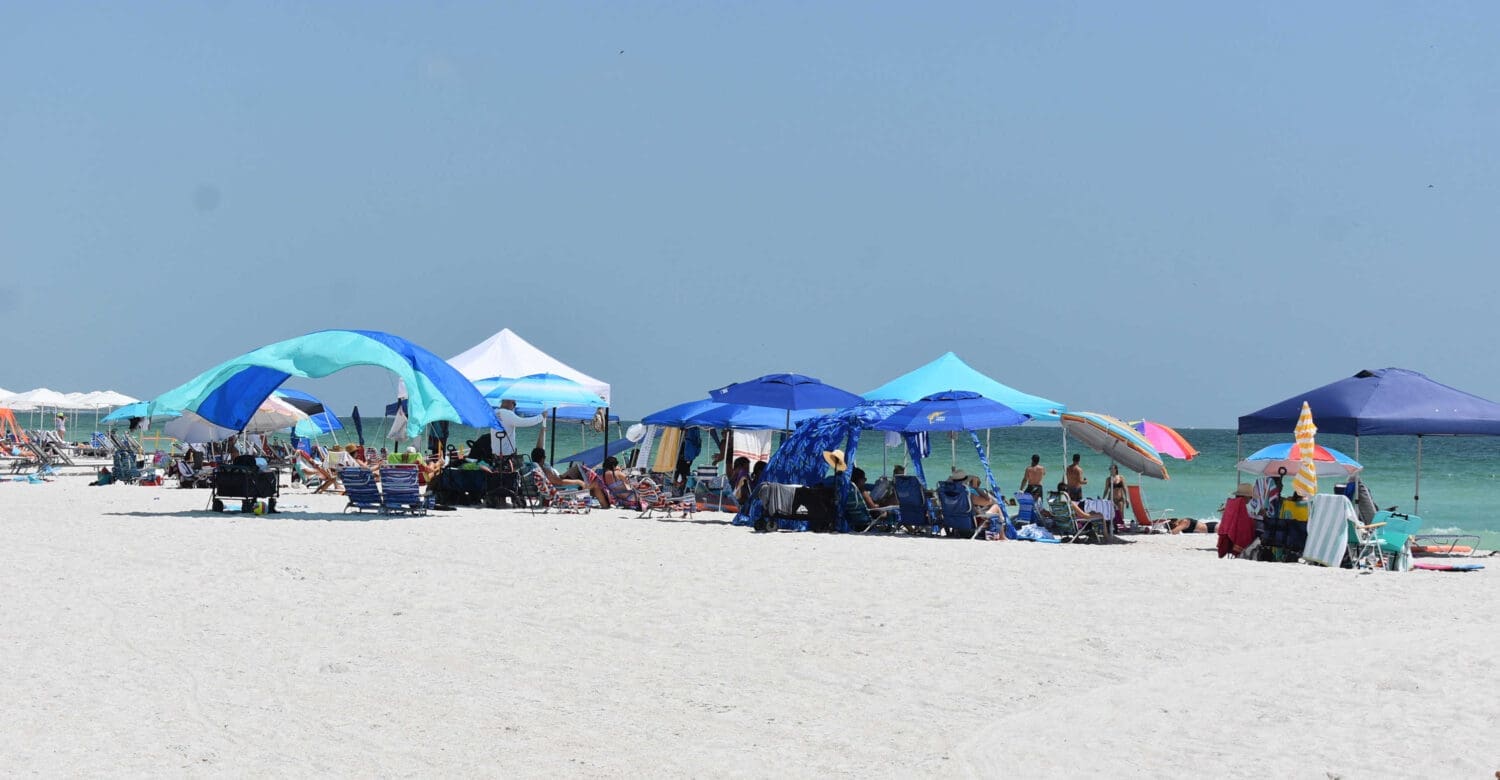
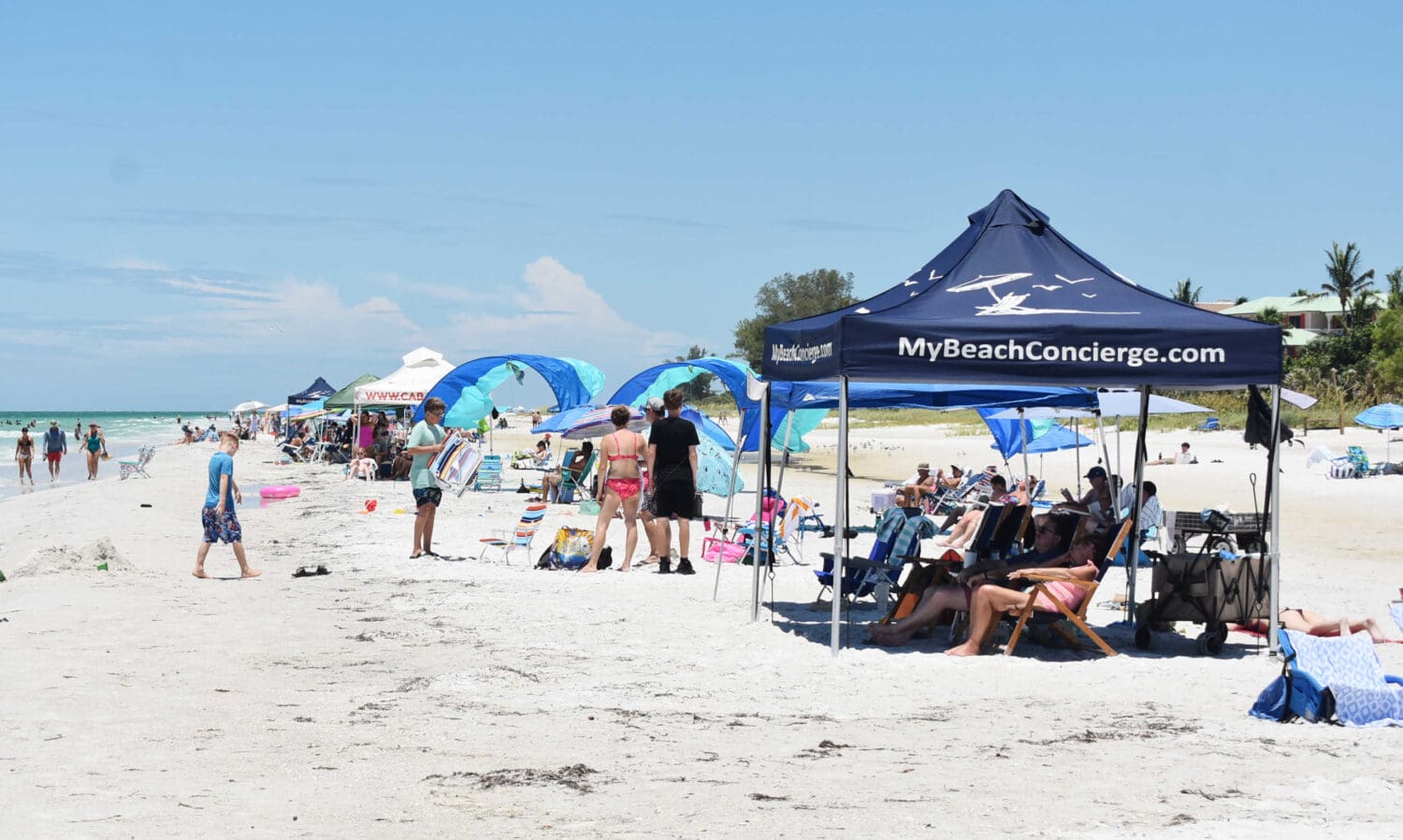
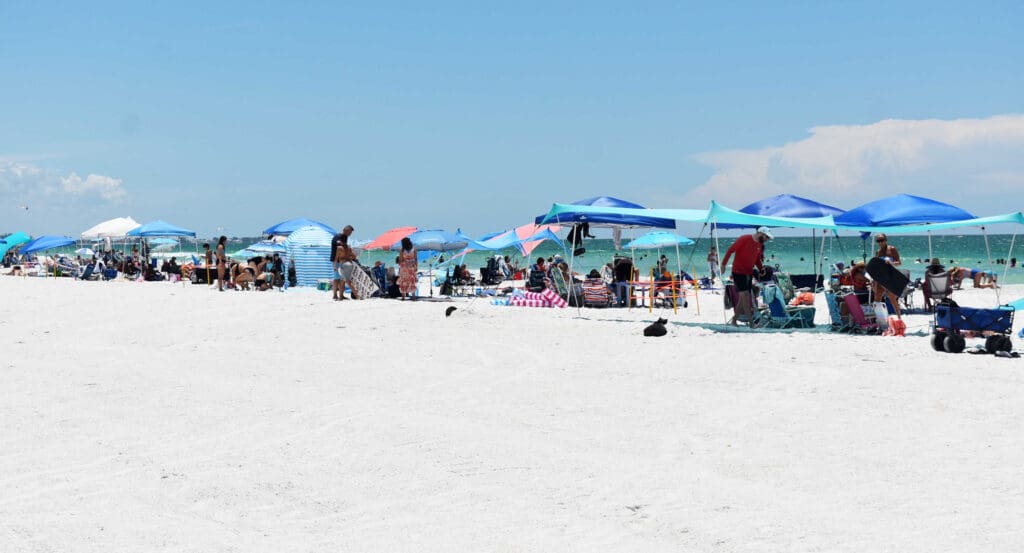
HOLMES BEACH – Concerns about advertising and logos placed on rented beach cabanas have been addressed to the mayor’s satisfaction and the city is not taking any additional steps to regulate cabana rentals.
At the request of Commissioner Carol Whitmore, cabana rentals and commercial beach activities were discussed during the Holmes Beach commission’s July 25 meeting as a follow-up to a previous discussion Mayor Judy Titsworth initiated on June 24.
During the June meeting, Titsworth said city’s code compliance officers asked the beach cabana rental companies to remove all advertisements and signage from their cabanas because the city’s sign ordinance prohibits advertising on the beach. The cabana companies were given until June 27 comply. Titsworth also expressed concerns about some cabana rental companies staking out prime beach areas by setting up cabanas that had not been reserved and in advance offering them for rent, and about commercial activity on public lands in general.
When the July 25 discussion began, Whitmore said she wanted to get a better understanding of how the cabana rental companies operate. She also questioned whether the city’s sign ordinance could be amended to assist businesses that provide a beneficial service to beachgoers.
“I think we’re trying to fix a problem that’s not broken,” Commission Chair Dan Diggins said. “I don’t like the idea of putting all these restrictions on people. We don’t do this to the golf cart folks. We don’t do it to Uber Eats. We don’t do it to anybody else, so why would we do it here? It’s a thriving business. They provide a great service to the community and tourism. The equipment is outstanding and most of it’s better than the crap people buy at Walmart and leave in the trash container or leave on the beach for somebody else to clean up.”
Regarding her previously stated beach advertising concerns, Titsworth said, “It’s fixed. We don’t have an issue with renting equipment and putting it on the beach. It was the signs. We have a sign ordinance that doesn’t allow advertising on the beach. They just can’t stake out ground ahead of time with their signs and QR codes saying, ‘rent me.’ ”
Mayor Judy Titsworth said her beach cabana advertising concerns have been addressed. – Joe Hendricks | Sun
When addressing the many cabana company owners and employees in attendance, Titsworth said, “You can ruin something by too much of a good thing and I think we’ve all seen that. It’s one thing to have one cabana company that promises not to advertise and start putting stuff out (unreserved). It’s another thing when you walk the beach and see every single company with tents galore. Get rid of the advertising. We’re OK if you’re out there, but the minute you take it too far we’re going to have residents saying ban all tents on the beach. Everyone needs to try to reel it in. Let’s try not to graffiti the beaches.”
Commissioner Terry Schaefer said, “There’s never been opposition to the service. The whole issue was about advertising and pre-placement.”
He noted at least one cabana rental company was recorded placing unreserved cabanas on the beach.
“Not only do I see a benefit, I see providers who really want to engage,” Commissioner Steve Oelfke said.
He questioned if there’s more the city can do to ensure that those who have insurance and properly secure their cabanas aren’t negatively impacted by those who don’t. He also suggested a future commission work session discussion about the bigger issue of commerce on the beach and how to possibly preempt future unwanted beach commerce activities.
“I’m not touching that sign ordinance,” Commissioner Carol Soustek said, and she agreed with Oelfke about a beach commerce work session discussion and discussing how other coastal cities address those activities.
During public input, My Beach Concierge owner Perry Heldreth restated some comments he made a day earlier at the Anna Maria city commission meeting. He said the cabana rental company he and his wife Rebecca operate island-wide has a business license, a retail sales certificate, a multi-million dollar liability policy and workers’ compensation insurance.
“We try to do everything aboveboard,” he said.
Heldreth said the My Beach Concierge logo is nationally trademarked, similar to Tommy Bahama, and he questioned whether that allows their logo to remain on their Holmes Beach cabanas.
When addressing that question later, Development Services Director Chad Minor said, “If it’s commercial advertising, by ordinance, it’s prohibited on our beach.”
AMI Cabanas owner Sarah Moreno addressed the mayor and commission.
Unable to wait for the cabana discussion because she had to get to her full-time job in Tampa, AMI Cabanas owner Sarah Moreno spoke during general public comment at beginning of the meeting. Moreno said she’s an Island native and AMI Cabanas is a family business with only 10 cabanas. She supports de-branding rented cabanas and requiring cabana rental companies to be licensed and insured.
“There are some yahoos out there doing it wrong,” she said. “We are an LLC. We’re licensed. We have insurance. We do it right and we just ask that we are able to continue do it right.”
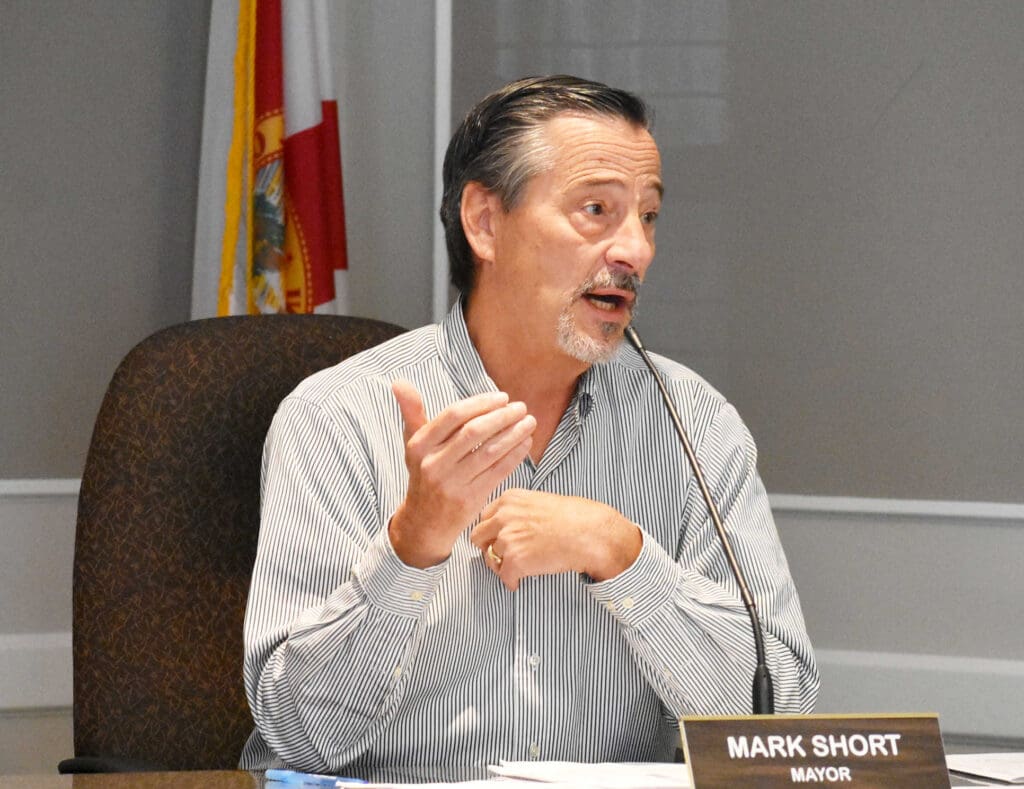
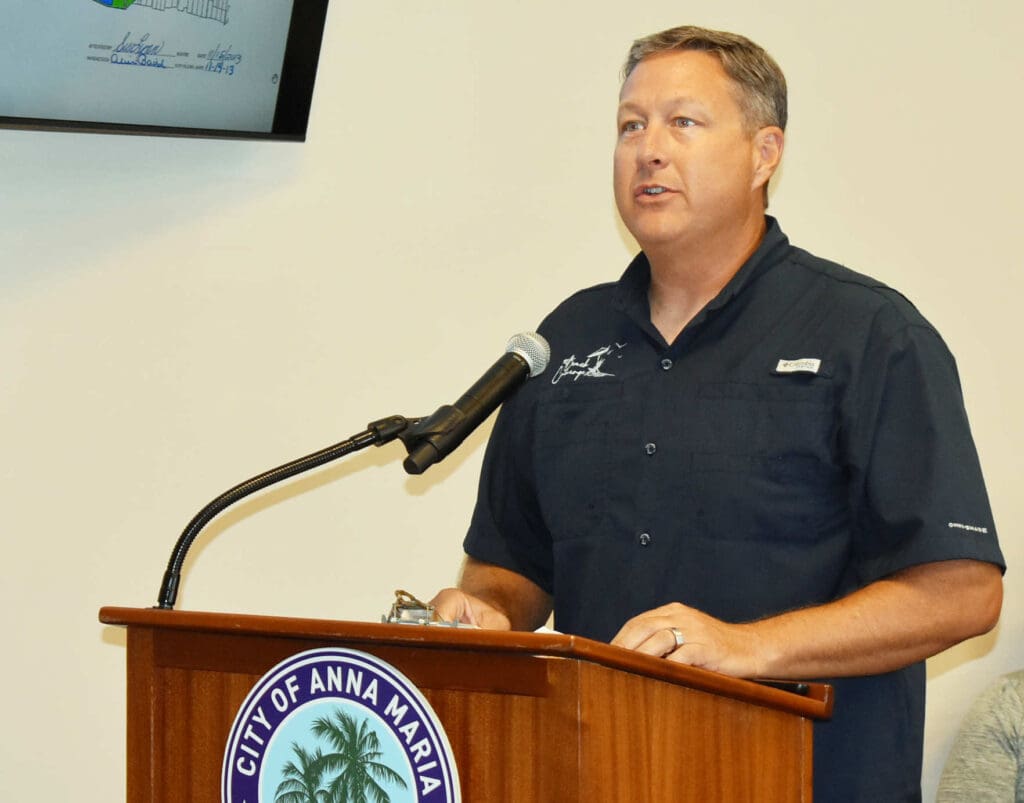
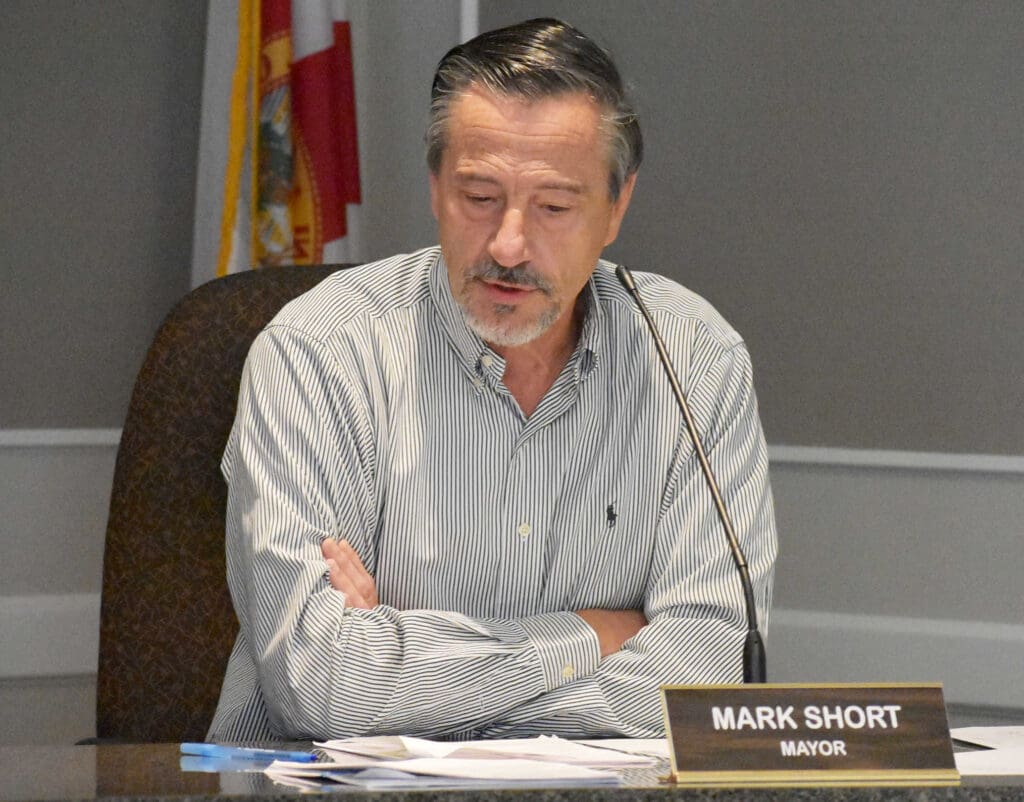
ANNA MARIA – While discussing beach cabana rentals and other commercial activities occurring on public beaches, Mayor Mark Short said city code prohibits all commercial activity in beach areas that carry the city’s coastal conservation or recreation open space zoning designations.
During the July 24 Anna Maria City Commission meeting, commissioners, cabana rental company owners and employees and the public were also informed that multi-legged cabanas and tents of any kind, commercial or personal, are not allowed in coastal conservation-zoned areas.
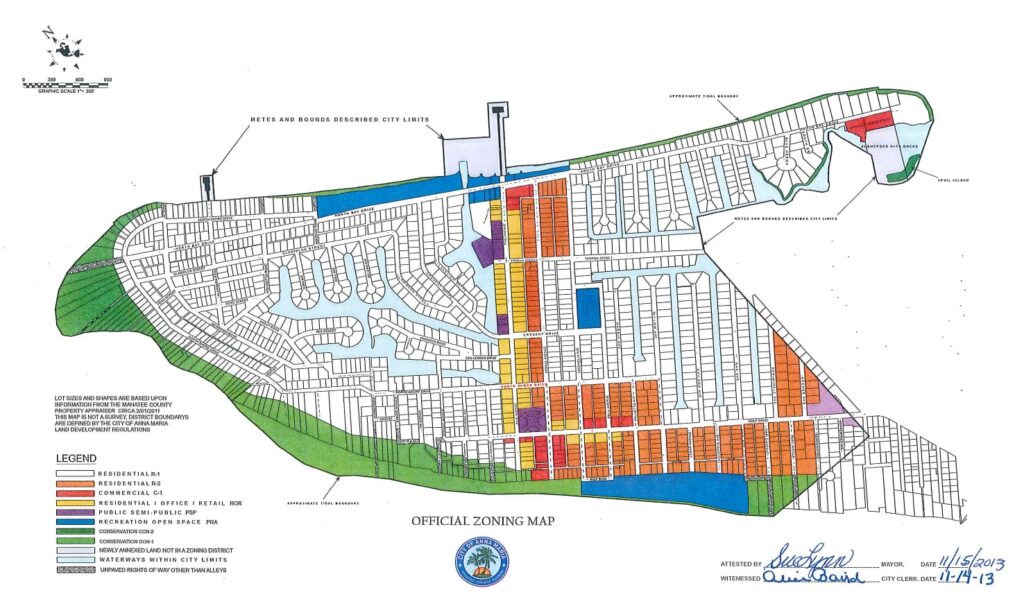
According to the color-coded zoning map included in the meeting packet, the coastal conservation zones highlighted in green include the entire public shoreline from Magnolia Avenue to the northern tip of Bean Point. The recreation open space zones highlighted in blue include the Bayfront Park and City Pier shorelines.
The areas highlighted in green are zoned coastal conservation and the areas highlighted in blue are zoned recreation open space. – City of Anna Maria | Submitted
“We have an ordinance on the books that addresses what is permitted in the blue and green areas. The ordinance does not provide for the conduct of any commercial activity in either the coastal conservation zone area or the recreational zone area,” Short said.
Mayor Mark Short doesn’t want Anna Maria’s beaches to resemble the commercial-heavy Palma Sola causeway along Manatee Avenue. – Joe Hendricks | Sun
Participating by phone, City Attorney Becky Vose said the city controls the public beaches and state and federal laws don’t restrict a city’s ability to regulate commercial activities. In regard to privately-owned beaches not regulated by the city, Vose said the upland property owner owns the land up to the mean high-water line and rented or personally-owned tents and cabanas can be set up on privately-owned beachfront property.
Vose said her law firm represents six beach communities throughout the state and each one regulates commercial beach activities differently. She said the city of Cocoa Beach allows a limited number of beach vendors to enter into 7-year agreements with the city and if they don’t comply with the city’s insurance, operational and cleaning requirements, those agreements are nullified and offered to another vendor.
Regarding city-regulated beaches, Vose said the city has a great deal of flexibility and can pretty much do what it wants.
“Right now, you do not permit any commercial activity,” she said. “The city has not been enforcing those requirements, but that doesn’t mean you couldn’t start. You need to decide how you want to handle these and give direction to staff. We can either draft new ordinances or we can enforce what we have. There is no compulsion under state law or city code to allow any commercial uses on the beach.”
Commissioner Charlie Salem asked Vose to explain any restrictions that apply specifically to the coastal conservation-zoned areas. Vose said the only shelter-like item allowed in a coastal conservation zone is a single-pole umbrella or something similar. She said multi-legged tents and cabanas are not allowed in coastal conservation zones but that’s something the commission could change.
Current city code prohibits tents and cabanas in beach areas with coastal conservation zoning designations. – Joe Hendricks | Sun
Regarding commercial activity, Vose said any changes desired by the mayor and commission need to be clearly written to continue prohibiting any unwanted commercial activity such as food vendors and other types of rentals.
“You can regulate all of those things and you can prohibit them also,” Vose said.
Participating by phone, Commissioner John Lynch said, “We have a multi-layer problem that we’re trying to solve. We’re not current enforcing the current code, so I think there’s a bunch of work we need to do.”
When opening the discussion for public input, Salem said, “Think of this as your opportunity to help us start thinking about the issues involved on any side of this issue.”
In response to a question from city resident Wendy Smith about boat-based vendors, Short said the city’s jurisdiction only extends 10 feet into the water, with the exception of the vessel exclusion zone offshore of Bayfront Park where motorized vessels are prohibited.
My Beach Concierge owner Peery Heldreth addressed the mayor and commissioners. – Joe Hendr
Addressing a concern previously raised in Holmes Beach, My Beach Concierge owner Peery Heldreth said none of the cabana vendors in the commission chambers that day are setting up cabanas that aren’t reserved in advance. Heldreth said his company has a state license, pays monthly sales taxes, carries liability insurance and workers’ compensation insurance. Peery said his company doesn’t set up cabanas on Bean Point. He said his cabanas are commercial grade and he pays his employees $20 an hour, plus tips. He requires his employees to pick up any trash they see on the beach and they’re instructed to stay clear of sea turtle nests. Heldreth asked the mayor and commission to allow the current cabana rental activities to continue while the commission works through these issues.
Anna Maria resident David Ridley said cabanas and tents help protect people from getting skin cancer.
Commissioner Gary McMullen said the city is not enforcing the ordinances on the books and the city hasn’t prevented anyone from putting up a cabana or a tent, but the commission now needs to decide if the existing regulations will be enforced or changed. Short said the commissioners must first decide at a future meeting if they want to keep the current regulations.
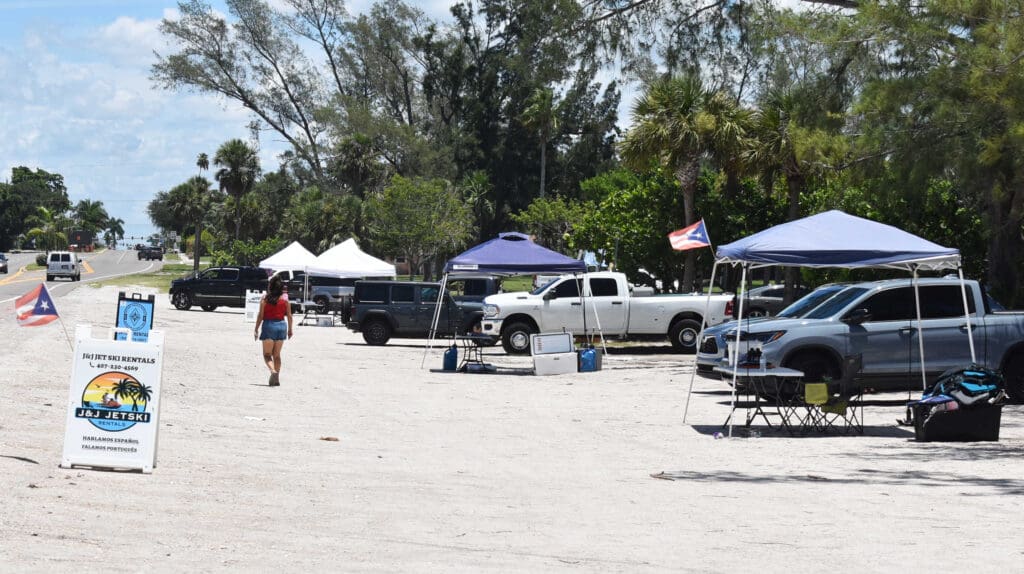
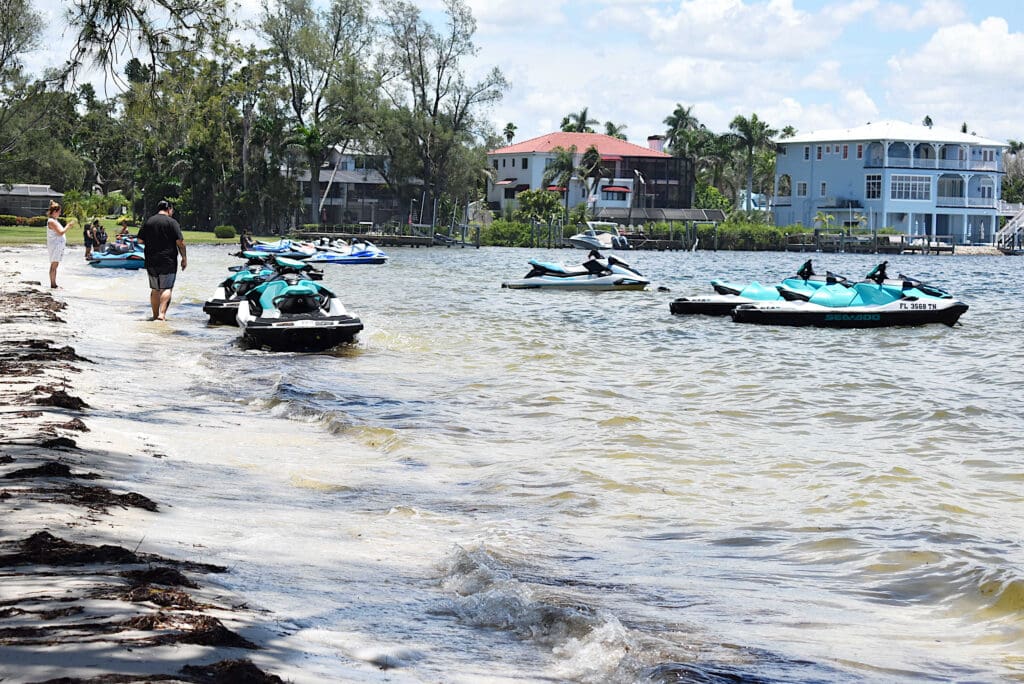
The Palma Sola causeway in west Bradenton is a popular place for beach vendors. – Joe Hendricks | SunSeveral vendors offer Personal watercraft rentals at the Palma Sola Causeway in west Bradenton. – Joe Hendricks | Sun
“I do want to be clear about one thing. This is not about just the cabanas. This is about commercial activity in general on the beaches,” Short said. “I don’t want our beaches to turn into the Manatee Avenue causeway. I don’t want horses on the beach. I don’t even want dogs on the beach.”
Dogs are not allowed on Anna Maria Island beaches.
HOLMES BEACH – Divided and passionate about both critical funding decisions, city commissioners voted to increase the property tax millage rate and not increase the annual stormwater utility fee.
The millage increase decision was made during the commission’s July 25 special meeting, when the 2.1812 maximum millage rate was adopted for the 2025-26 fiscal year that begins on Oct. 1. The stormwater fee decision was made during the regular commission meeting that followed.
Millage rate
The proposed 2025-26 fiscal year budget prepared by City Treasurer Julie Marcotte anticipates $23.9 million in matching city expenditures and revenues – a $1.3 million decrease from the $25.2 million listed in the current fiscal year budget.
Applying the 2.1812 maximum millage rate, Marcotte anticipates the city receiving $6.73 million in ad valorem property tax revenues in the coming fiscal year – a slight increase from the $6.7 million in the current fiscal year.
Increasing the millage rate from the current 1.99 mills to 2.1812 mills will offset the 8.33% decline in aggregate property values experienced in Holmes Beach. Property owners will pay $2.18 per every $1,000 of assessed property value and due to lower property values, most property owners will pay about the same next year as they did this year.
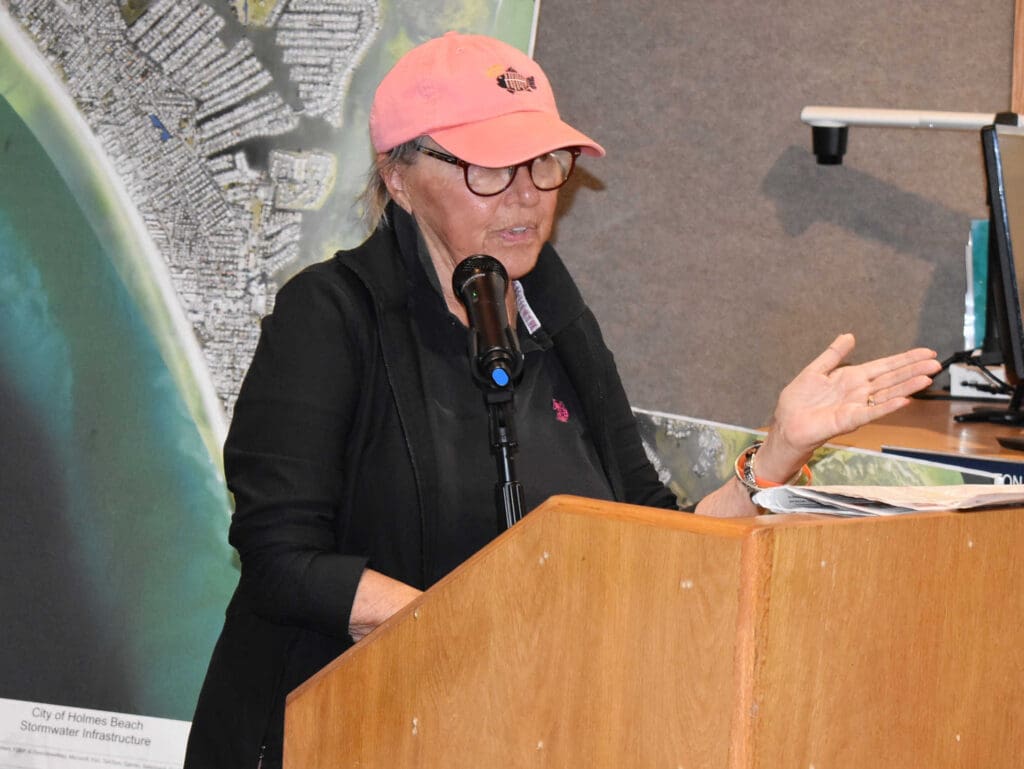
During public input, resident Margie Motzer said the city budget increased 212% between 2012 and 2024.
Resident Nancy Deal encouraged the mayor and commissioners to listen to the residents’ desires. – Joe Hendricks | Sun
Resident Nancy Deal said the city of Bradenton Beach isn’t raising its current 2.3329 millage rate and is delaying projects and personnel hirings to help offset the decreased property values and property tax revenues. Deal said she lost a car during the 2024 hurricanes and would like to buy a new one but that purchase must wait. She suggested the mayor and commission take a similar approach to their budgetary decisions.
“I hope you can listen to what the residents have to say about how hard it is right now,” she said.
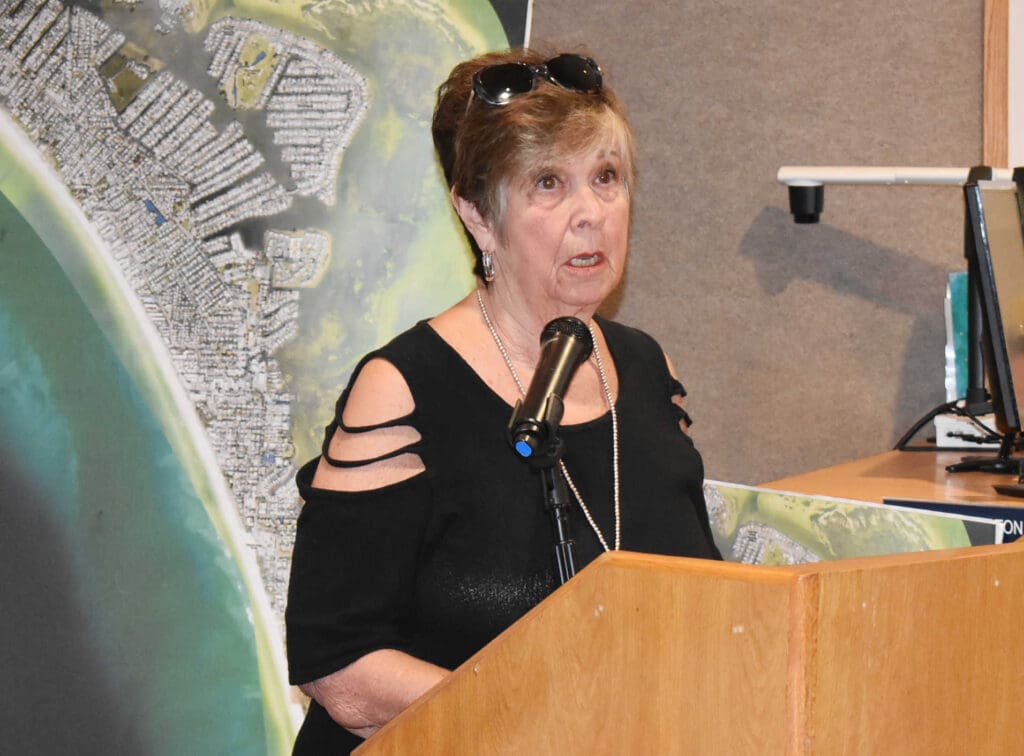
Resident Renee Ferguson said the mayor and city commissioners need to tighten their belts when managing the city’s finances. – Joe Hendricks | Sun
Resident Renee Ferguson said, “As far as the millage is concerned, it just doesn’t seem appropriate to raise it now. People are suffering. A lot of us had to go into our pensions and our savings because the insurance companies didn’t cover a lot of the expenses we incurred. Asking the people to tighten their belts seems unfair. I think the city really has to think about tightening theirs.”
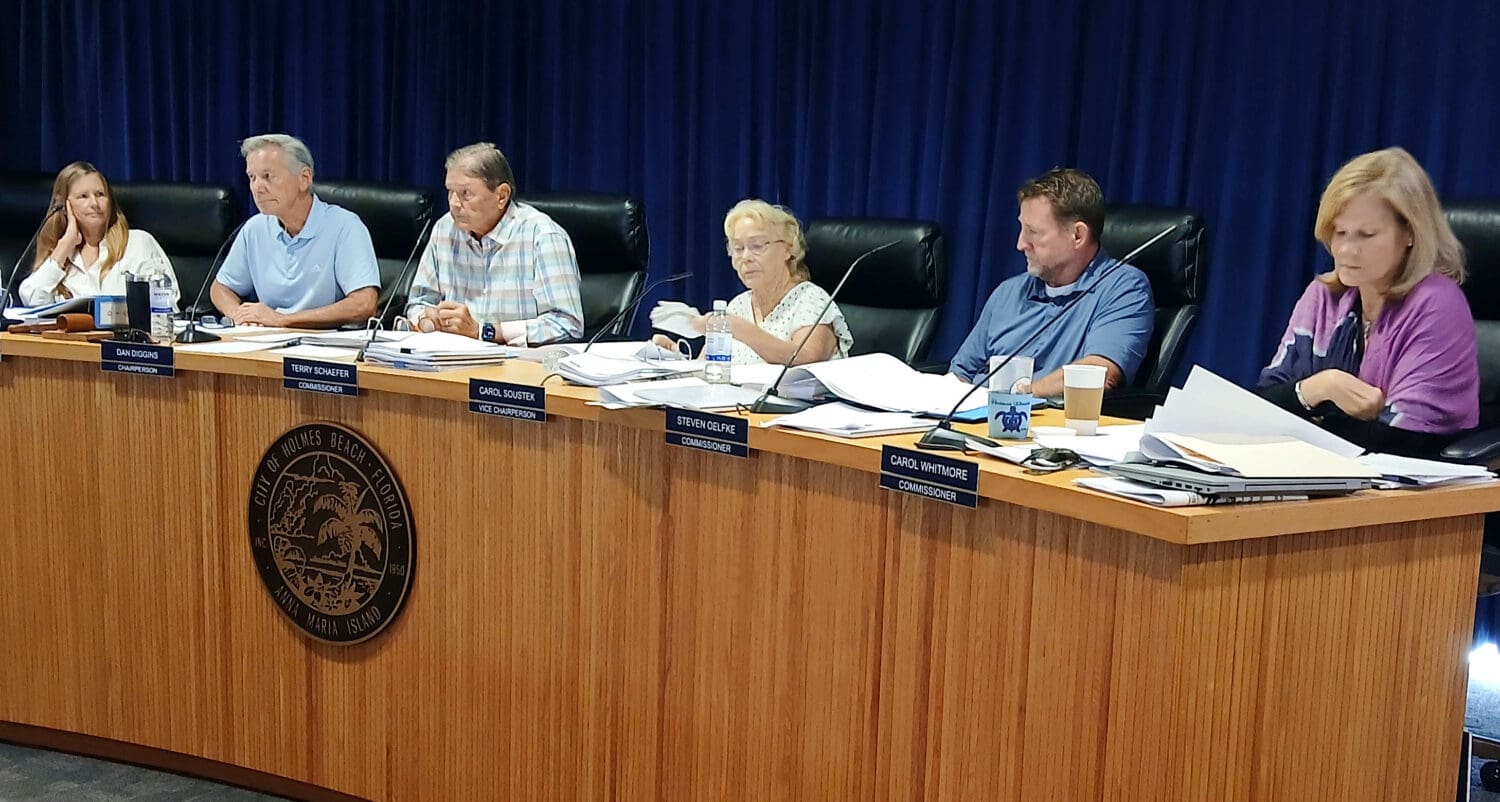
Commissioner Carol Whitmore opposed both proposed increases. – Joe Hendricks | Sun
Regarding the proposed millage increase, Commissioner Carol Whitmore said, “The citizens can’t handle it. I can’t handle it. I had to break into my IRA to get an air conditioner. I don’t have insurance because I can’t afford it. We’ve all been through hell. We can’t do this to our citizens this year. We have to be more conservative.”
Commissioners Dan Diggins, Terry Schaefer and Carol Soustek noted the maximum millage rate could still be lowered before the final budget adoption occurs in September, but Mayor Judy Titsworth said the proposed budget is based on the 2.1812 millage rate.
Soustek, Schaefer and Commissioner Steve Oelfke voted in favor of setting the maximum millage rate at 2.1812 mills and Whitmore and Diggins opposed it.
Stormwater fee
Schaefer and Diggins supported the proposed $2 stormwater fee increase and Oelfke, Soustek and Whitmore opposed it.
In June, Public Works Director Sage Kamiya proposed increasing the annual stormwater fee from $2.95 per 100 square feet of property to $4.95 or $9 per 100 square feet. He said the $9 rate would help fund $21.9 million in complaint-driven drainage and stormwater projects over the next five years, with matching grants provided by other agencies covering a significant share of those costs.
Public Works Director Sage Kamiya sought a $2 stormwater fee rate increase for the coming fiscal year. – Joe Hendricks | Sun
During the July 25 commission meeting, Kamiya proposed tiered annual increases that would begin with an increase of $2 per 100 square feet in the coming fiscal year, potentially followed by additional $2 increases during the next two fiscal years and $1-per-year increases during the two years after that.
According to Kamiya, the current $2.95 rate will generate an estimated $862,453 in stormwater fee revenues during the coming fiscal year and a signification portion of that money will be used to maintain the existing stormwater system. Not increasing the fee will limit the city’s pursuit of drainage and stormwater improvements and matching grants and some projects included in Kamiya’s $21.9 million potential projects list will be delayed or discarded.
“Stormwater management is important when you live on a barrier island,” Titsworth said. “That $800,000 isn’t going to buy you very much.”
Oelfke said the city needs to do what it can to support and retain the permanent residents that help create the city’s heritage and culture.
“If it saves one homeowner from moving, it’s worth holding off,” he said of the proposed increase.
Schaefer said the owner of a 5,000-square-foot property currently pays a $147 annual stormwater fee. He said a $2 increase would result in a $247 stormwater fee; and the owner of a 7,500-square-foot property would see their stormwater fee increase from $221 to $371.
Regarding the stormwater-related recommendations made by Kamiya and the city’s contracted stormwater engineer, Herb Raybourn, Schafer said, “I believe we’d be remiss if we didn’t pay attention to these warnings.”
Schaefer said the city should stop spending money on consultants if the commission isn’t going to follow their advice.
After saying she respects Kamiya’s expertise and understands the importance of the city’s stormwater system, Soustek said, “This year, I have had a very hard time, along with everybody else. It’s taken a tremendous amount of insurance money and private money and I can’t, right now, give any more money.”
When expressing his opposition to the stormwater fee increase, resident Win Bishop said the mayor and commissioners need to be more financially responsible by decreasing expenditures and using reserve funds to pay for stormwater improvements.
“There isn’t that many of us that still live on the Island, but you might want to consider what we want,” he said.
ANNA MARIA – The mayor and city commissioners plan to maintain the current 1.65 property tax millage rate for the 2025-26 fiscal year that begins on Oct. 1 and they’re leaning toward increasing the annual stormwater utility assessment fee from $2 per 100 square feet of property to $4.
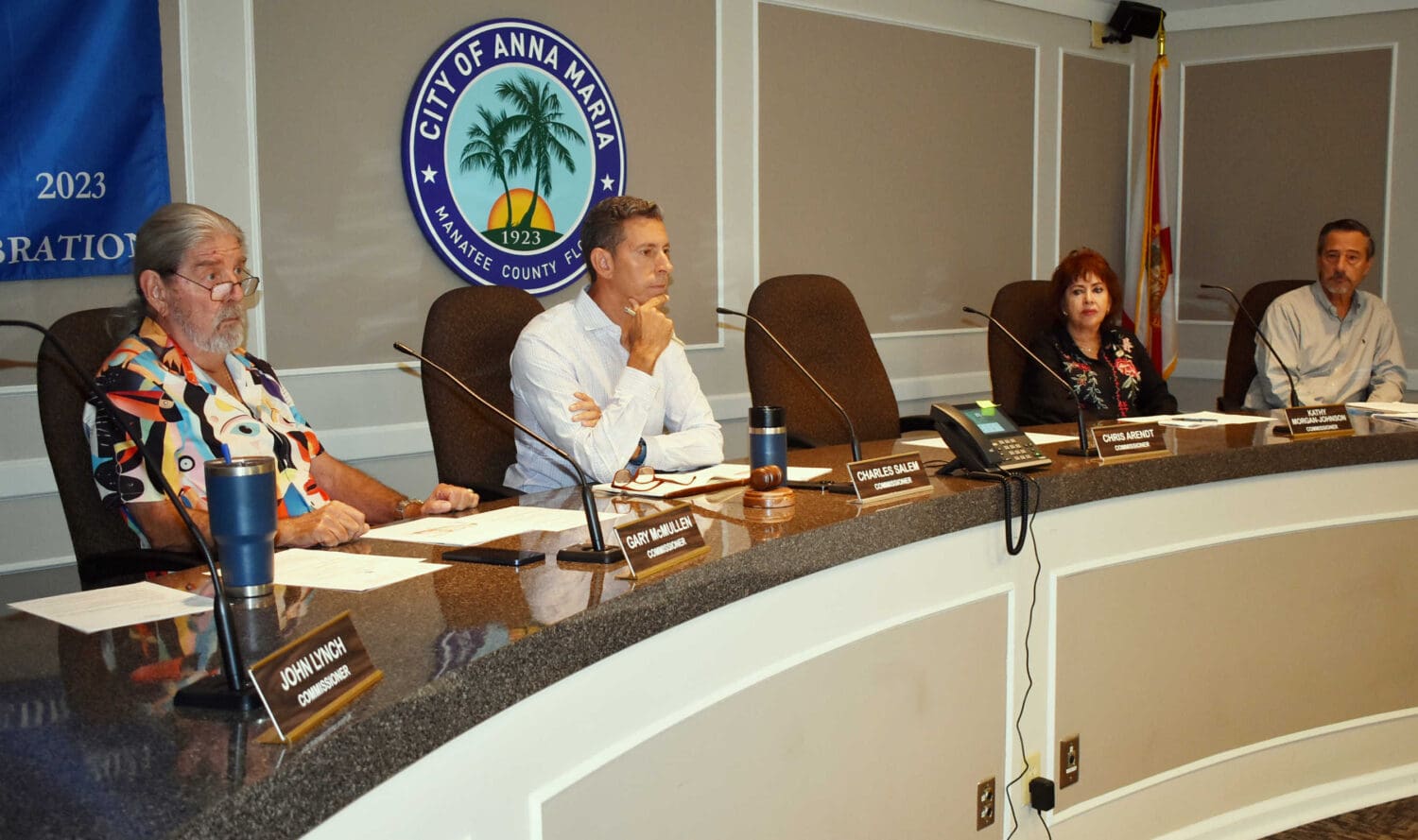
Anna Maria Mayor Mark Short presented these budget considerations to city commissioners on July 24. Commissioners Kathy Morgan-Johnson, John Lynch (participating by phone), Gary McMullen and Charlie Salem unanimously supported Short’s recommendation to adopt a tentative maximum millage rate of 1.65 mills for the coming fiscal year. Commissioner Chris Arendt was vacationing and didn’t attend the meeting.
The adopted tentative maximum millage rate can be lowered before the final millage rate is adopted during two budget hearings in September, but the 2025-26 fiscal year budget being crafted by the mayor and city staff is based on maintaining the current 1.65 millage rate for another year.
At 1.65 mills, Anna Maria property owners will again pay $1.65 per every thousand dollars of assessed property value – after homestead exemptions and other tax-reducing exemptions are applied. Because the total assessed property values in Anna Maria increased cumulatively by 3%, most Anna Maria property owners will experience a slight property tax increase at the same millage rate.
Stormwater fee
When proposing increasing the stormwater utility fee from $2 to $4 per 100 square feet of property, Short said it would result in the stormwater fee for a 7,500-square-foot residential property increasing from $150 to $300, with the city’s anticipated stormwater utility fee revenues increasing from $328,000 to $656,000. Stormwater fee revenues are used to maintain and improve the city’s drainage and stormwater systems and they also provide matching funds for the stormwater grants that help fund those projects.
Short said Public Works Manager Dean Jones has identified more than $15 million in stormwater and drainage projects and improvements that need to be done.
“We have significant stormwater work we need to do, just like every other city on this Island. Some of that needs to be done now, some of that can be done later,” Short said.
A formal vote was not taken on the stormwater fee increase, but commissioners Johnson, Lynch and McMullen voted in favor of directing City Clerk Amber LaRowe to use a third-party firm to distribute letters to all potentially impacted Anna Maria property owners informing them of the proposed increase. Salem opposes increasing the stormwater fee when many residents and property owners are still recovering from the 2024 hurricanes. A formal vote on the proposed increase will occur later in the budgeting process.
Revenues, debt
Short presented a one-page summary of the city’s total projected revenues of $27.2 million for the coming fiscal year – an increase of nearly $10 million from the $17.8 million listed for the 2024-25 fiscal year that ends on Sept. 30.
Mayor Mark Short is preparing his first city budget. – Joe Hendricks | Sun
Maintaining the 1.65 millage rate is expected to generate $3.96 million in ad valorem city property tax revenues in the coming fiscal year, a slight increase from the $3.85 million listed for the current fiscal year.
Short anticipates the city receiving $8.6 million in FEMA reimbursements, but he’s noted on several occasions that those federal funds are not guaranteed and it’s not known when they’ll be received.
Short, a retired accounting executive, noted the projected revenue summary includes $4 million in anticipated debt financing needed to cover the city’s up-front costs while waiting for reimbursement from federal and state agencies. The anticipated reimbursements include FEMA reimbursement for the money the city spent recovering from Hurricanes Helene and Milton, future FEMA assistance to help rebuild the hurricane-damaged City Pier and FEMA reimbursement for some emergency stormwater work the mayor and staff felt was desperately needed. Florida Department of Transportation (FDOT) reimbursement is anticipated to help complete the Pine Avenue sidewalk installation project.
“To accomplish what I hope we will accomplish in this next year, we’re going to need to float some cash to pay for it while we are waiting on reimbursement. The city is in process of setting up $4 million to be available to help us fund the cash flow for these projects while we wait on the reimbursements,” Short said.
The projected revenues include $5.9 million in various grant funds.
After being elected last fall, Short is leading the city’s budget creation process for the first time and Jones and City Treasurer LeAnne Addy thanked him for seeking staff input in the creation of the budget.
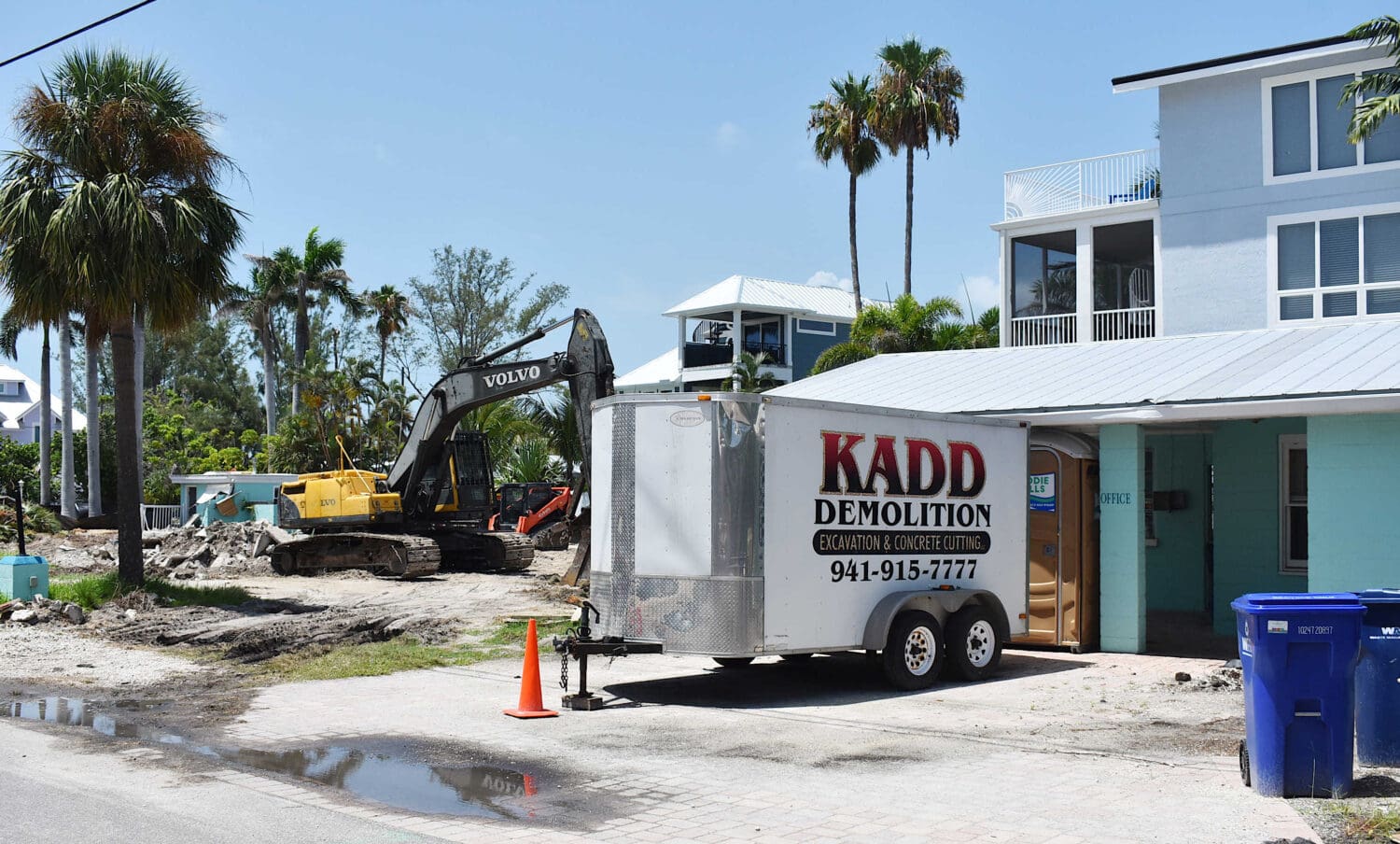
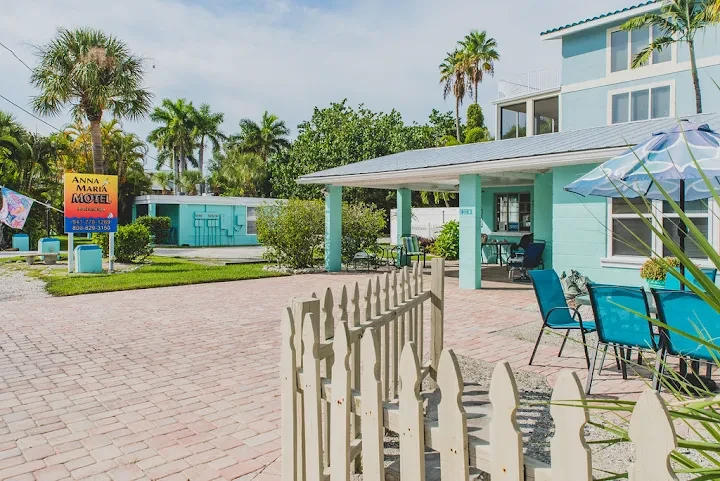
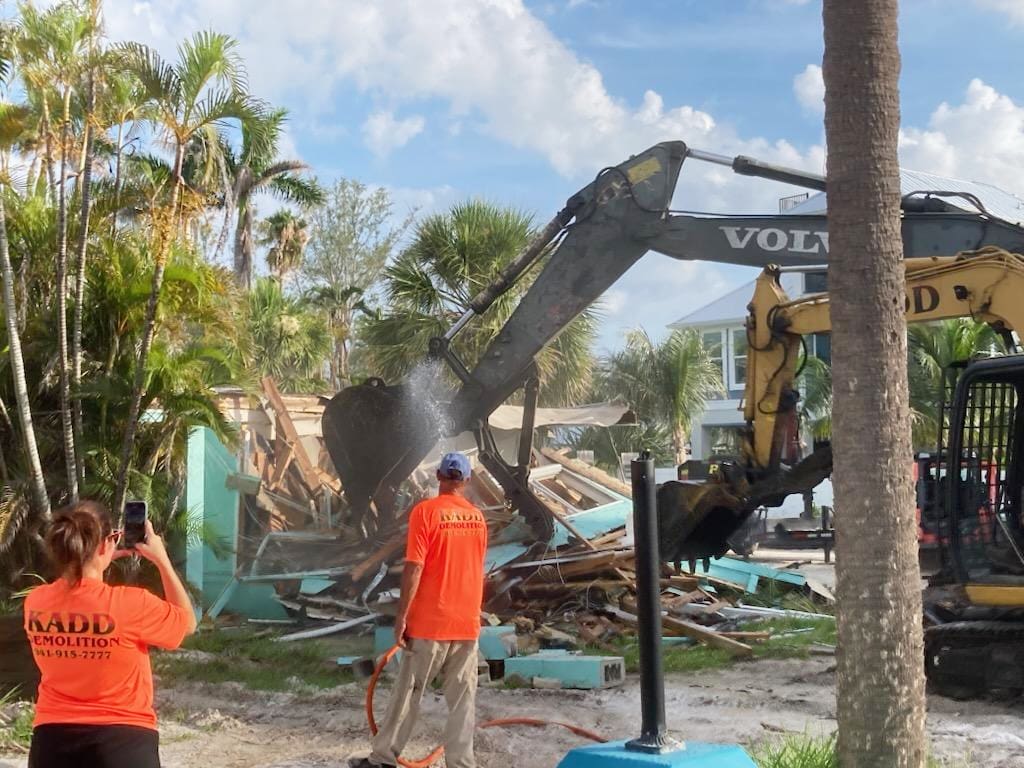
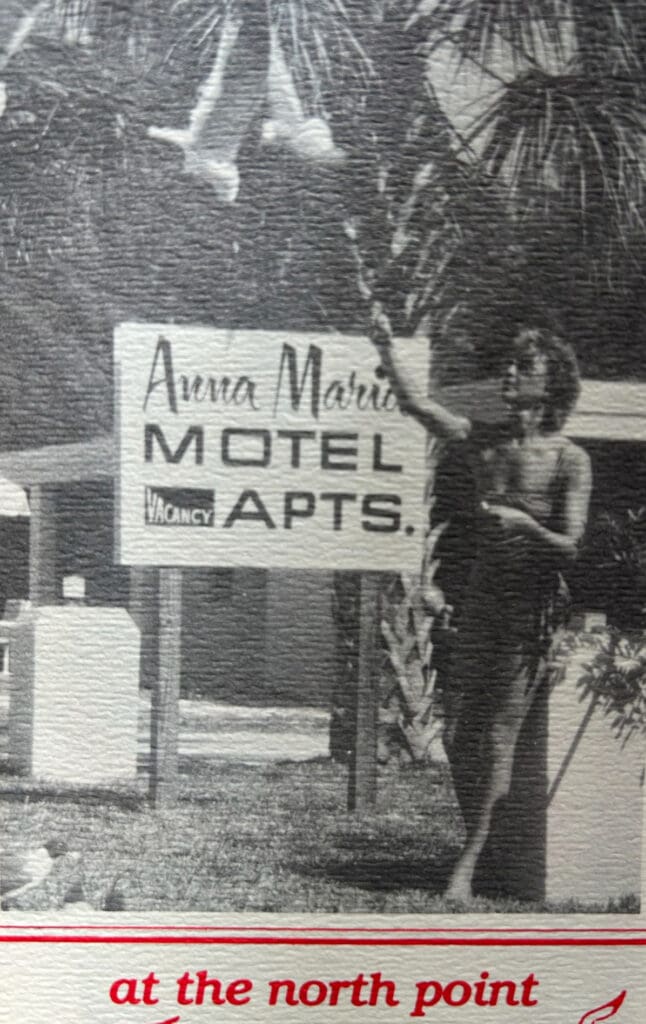
ANNA MARIA – The demolition of the old Anna Maria Motel at 808 North Bay Blvd. in Anna Maria began on July 21.
Dan and Christine Horvat bought the motel in 2001 and bought a home in Anna Maria before that. Dan passed away in 2020, Christine passed away in 2023 and the motel and property are currently part of a family trust shared by four siblings.
The Anna Maria Motel pre-dated short-term vacation rental homes. – Facebook | Submitted
When contacted by phone at her Champaign, Illinois home on July 26, one of the siblings, Maria Horvat, shared her thoughts and emotions on her parents’ vintage, nine-unit motel being demolished. Horvat, a physician, also owns a small, two-bedroom cottage in Anna Maria and plans to visit Anna Maria this week.
“My family’s been coming to the Island since 1958,” she said.
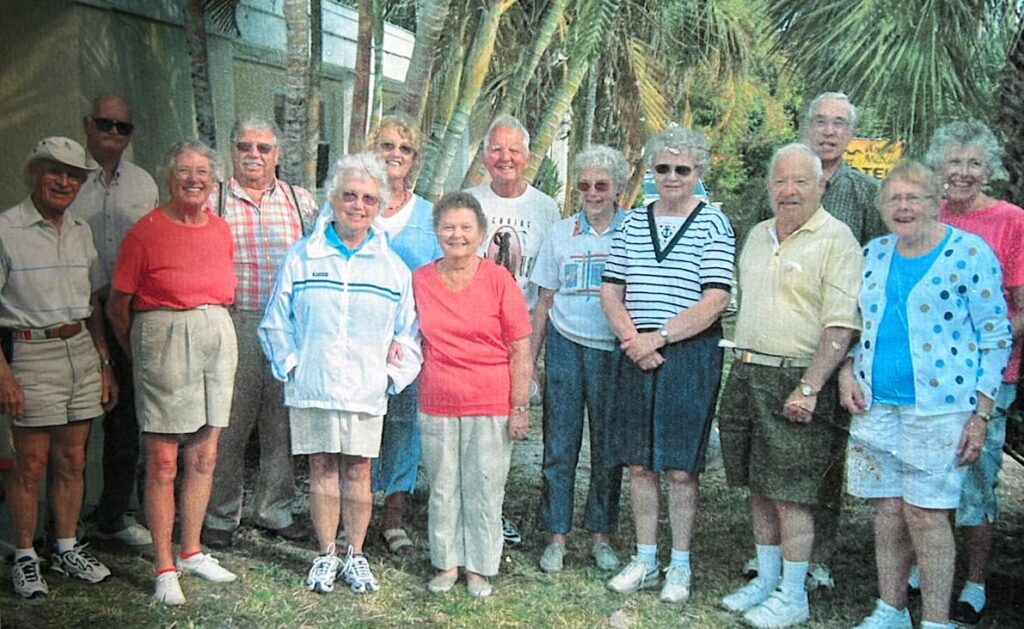
Dan and Christine Horvat (second and third from left, back row) were friends with many of the Anna Maria Motel guests. – Maria Horvat | Submitted
Horvat thinks the motel dates back to the 1940s. She said the motel sustained significant flood damage during Hurricane Helene in 2024, when the storm surge rose to chest level inside the ground-level units.
“The hurricane was just devastating and we didn’t have flood insurance. I went down there immediately afterwards. I had just renovated and replaced all the kitchens and the bathrooms,” Horvat said.
She said repetitive flooding in that low-lying area also occurred several times in the past and flood prevention door guards had been installed. Due to the hurricane damage sustained, the repair and replacement costs, FEMA regulations and other contributing factors, it just wasn’t practical or cost-efficient for the family trust to repair the motel and resume the motel operations. After the demolition is complete, the four vacant lots will be sold and Duncan Real Estate will handle the sale of those properties.
The demolition of the Anna Maria Motel began on July 21. – Doug Copeland – Submitted
“It’s sad. It’s the end of the Anna Maria Motel. This is a very emotional thing to have this hotel coming down,” Horvat said. “Unfortunately, it will probably be more big mansions. It breaks my heart.”
She praised and thanked Office Manager Lori Calderone for the past 12 years she spent running the motel.
“She put her heart and soul into it,” Horvat said.
The Anna Maria Motel was located within close walking distance of Bean Point. – Maria Horvat | Submitted
Horvat said a couple people expressed interest in buying the motel and continuing the motel operations but the numbers simply didn’t work in the Island’s current economic landscape.
“We had a lot of interesting guests and the motel was doing well. We’re devastated. All the siblings are upset but we have to move on,” Horvat said.