Tag: Sarasota Bay

Beleaguered area waters still producing miracles

Coast Lines: Beleaguered area waters still producing miracles

With all the bad news this year about water quality due to red tide and Piney Point, the Sarasota Dolphin Research Program has some much-needed very good news – the birth of 15 new dolphin calves in area waters.Coast Lines logo - border

The bouncing baby marine mammals have been born over the past four months – one in April, six in May, five in June and three in July – including three births to first-time dolphin mothers.

One July calf is really special – the daughter of mom F233 is the sixth generation of dolphins documented since the program began studying her maternal lineage in the 1970s.

Program scientists are continuing their photographic ID surveys in southeast Tampa Bay around Piney Point and Port Manatee, where more than 215 million gallons of polluted water from a decommissioned phosphate plant was released into the bay in March and April, feeding an ongoing bloom of toxic red tide.

During the initial surveys just after the spill, scientists noted they were not seeing the numbers of dolphins in the area normally expected, and concluding they were fleeing the pollution. But sightings have been increasing recently, indicating that dolphins may be moving back.

Still, red tide continues to stress local dolphins by depleting their food source as it kills fish. When fish are scarce, dolphins can feed aggressively near anglers as they both vie for the few remaining fish, leading dolphins to ingest and become entangled in fishing lines and become hooked by fishing gear.

The dolphin research program, operated by Mote Marine Laboratory in Sarasota and the Chicago Zoological Society, is developing a new app to collect reports of human-dolphin interactions and is seeking volunteers to test it.

Recreational and commercial anglers and fishing guides are invited to register at https://dolphin.report. When a dolphin approaches you or your gear, steals your catch or damages your gear, you can use the report form to inform program scientists, who aim to track dolphin behaviors of concern and develop mitigation strategies.

The best approach is to avoid dolphins when possible, especially during this time of year when distracted moms are busy taking care of naïve newborns, often in shallow water where they can’t dive beneath a boat.

If you see a dolphin or other marine life in distress, report it to the Florida Fish and Wildlife Conservation Commission at 1-888-404-FWCC (3922). From a mobile phone, use #FWC or *FWC. Text a report to Tip@MyFWC.com. When reporting a stranded, sick or dead animal, please take a GPS reading so that responders have the greatest chance of finding the animal.

Dolphin Tips

DO

  • Stay at least 50 yards away from dolphins when viewing from a vessel or watercraft.
  • Limit time spent observing dolphins to 30 minutes or less.
  • Avoid making loud or sudden noises near dolphins.
  • Move away slowly if a dolphin’s behavior indicates the animal is stressed or disturbed.
  • Look Before You Book! Book wild dolphin viewing tours with businesses that responsibly view dolphins in the wild and help dolphin conservation. See Facebook “Don’t Feed Wild Dolphins” and “Dolphin SMART.”
  • Put your vessel’s engine in neutral if in the close vicinity of dolphins.
  • Call for help if you hook a dolphin on a fishing line or see a stranded or injured dolphin – Mote Marine’s Stranding Investigations Program, 941-988-0212.

DON’T

  • Pursue, swim with, pet or touch wild dolphins, even if they approach you.
  • Feed or attempt to feed wild dolphins.
  • Encircle or entrap dolphins with vessels.
  • Direct a vessel or accelerate toward dolphins with the intent of creating a pressure wake to bow or wake-ride.
  • Separate mother/calf pairs.
  • Drive watercraft through or over groups of dolphins.

Reel Time: Sarasota Bay Watch releases clams

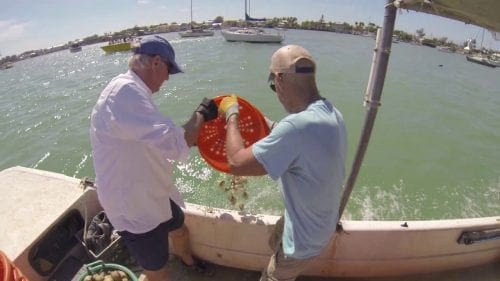
Sarasota Bay Watch conducted its first post-COVID-19 clam release on Saturday, Sept. 26. SBW board members and volunteers gathered at the Sarasota Sailing Squadron in the morning to transfer clams to Sarasota Bay. The clams were raised by clam farmer Carter Davis in Pine Island Sound.

Volunteers unload clams from Eagle Distributors truck.
Volunteers stand by to transfer clams to Reef Innovation’s barge. – Rusty Chinnis | Sun

Gulf Coast Eagle Distributing’s John Saputo provided a refrigerated truck to transport the clams and Mike Welch from Eagle drove the truck. Once at the Sailing Squadron, the clams were loaded on a barge provided by Larry Beggs of Reef Innovations.

Barging clams to their new home in Sarasota Bay.
The barge is loaded and ready to transfer clams to Sarasota Bay. – Rusty Chinnis | Sun

Twenty high school students from Riverview, Venice and the Sarasota Military Academy received community service hours for their work. Community service is required for graduation, but has been hard to come by during the pandemic. Volunteers also provided 11 boats to the effort. Science partners including the Gulf Shellfish Institute, Mote Marine, Florida Sea Grant and Florida Atlantic University benefit from the deployment. They are conducting studies on predation and aquaculture. Whelks and rays, the main predators of clams, are being acoustically monitored at the release site.

Students deploy clams from the Reef Innovations barge
Clams head for a new home in Sarasota Bay. – Rusty Chinnis | Sun

CDC guidelines were followed during the event. All participants had their temperatures taken and were required to wear masks and social distance. SBW is scheduled to release more than 750,000 clams in 2020 and 2021.

Reel Time: Trouble in paradise

Have you ever driven down the Gulf beach and seen flags flying on the lifeguard stands? We’ve worked out a system to alert people who use the local beaches of potential hazards. A green flag signifies that all is well, whereas a double red or purple flag alerts people that the water is not safe to swim in.

Unfortunately, there’s no such system to alert people of dangers in our bays. If there were, purple flags would be flying! In just the last two months there’s been a multi-thousand-gallon sewage spill in Manatee County, a potentially multi-million-gallon discharge from a broken sewer line from Longboat Key to the mainland and a persistent lyngbya bloom (a potentially toxic algae) that is becoming explosive in Anna Maria Sound and surrounding waters.

Worst of all, these are just the major insults that are but a part of the larger problem. I’m concerned about these issues because I am a fisherman and have seen the effects of declining water quality on fishing. Sure, water quality is a concern for everyone who lives here, fishes here or visits here. What’s less well understood is the fact that the quality of local waters is directly related to the economic health of the region.

What seems to be missing is an understanding of what we’re leaving for our children and grandchildren, as well as future generations that will follow. While this has been a theme of my columns, it really hit home when I received this letter from 12-year-old Brice Claypoole:

Who wants to swim in sewage water?

By Brice Claypoole

This week we had a sewage leak into Sarasota Bay. Millions of gallons of sewage water leaked out of a pipe going from Longboat Key to the mainland. This isn’t the first time a sewage spill like this has happened and if we don’t change things, it won’t be the last.

So why is this such a big deal? Well, for starters, who wants to swim in sewage water? Personally, I don’t. But that’s not the only reason this is so concerning. The nutrients from sewage spills can fuel harmful algal blooms, like red tide. In 2017 and 2018, hundreds of marine animals died and millions of dollars were lost in areas like tourism and fishing because of red tide. So, the problem is that millions of gallons of sewage is a lot of red tide and bacteria fuel.

Being a kid, I have another reason to be concerned: I love this island and I love the bay. They’re my home. In 40 years, I want to be able to take my kids out into the bay and have dolphins jump by and find giant whelks and watch roseate spoonbills on mangrove islands. There’s nothing we can do about this sewage spill now. All we can do is hope nothing happens, but I fear this will not be the case; I fear fish will die and people in the area will not be able to swim for a while. We can and must stop sewage spills from happening in the future. More spills will certainly happen if we do nothing.

The pipe that leaked was 50 years old; it should have been replaced years ago, before this happened. We need to tell town and state officials that we want old pipes upgraded. We need to tell them that we are upset about this and disappointed that they did not take steps to stop this from happening. And those of you who can vote need to vote for people that will protect our environment. We need to do all these things to protect our amazing bay and all its beautiful inhabitants (spoonbills, dolphins, herons and more) forever.

Reel Time: Scallop Search Aug. 24

Sarasota Bay Watch’s annual Scallop Search, its signature and longest-standing event, is slated for Saturday, Aug. 24, at the Sarasota Sailing Squadron on City Island. This free event engages the public in what has been called citizen science because it assists scientists with monitoring the scallops in Sarasota Bay. The search is a boating event, but Sarasota Bay Watch (SBW) will try to place non-boaters on boats when possible.

Over the years this event has been conducted in cooperation with other groups in Tampa Bay, Charlotte Harbor and Pine Island Sound to assess the health of scallops in southwest Florida. This year, Sarasota Bay Watch will also be assessing our local clam population after the successful release of 250,000 clams last year. The bay is still recovering from last year’s devastating red tide, so your participation will help answer the question “How’s our bay today?”

Over the last several years, SBW has gotten invaluable support from The Anna Maria Island Sail and Power Squadron (America’s Boating Club of the Bradenton area). The Squadron’s focus is boating education and civic service to groups like SBW. It is currently creating a life preserver loan program for boaters and conducts vessel safety checks.

Janet Razze, the commander of the group, has organized the squadron and other volunteers to monitor Palma Sola Bay and north Sarasota Bay. Razze and the group begin early, actively looking for scallops and clams in a two- to three-week window before the actual event. This allows more people to be involved as it allows them to work around weather and people’s availability. They then have their data ready to share on the 24th. If you would like to participate with the squadron give Razze a call at 941- 779-5477. Participants will still need to go online to register.

To assess populations, a grid is constructed that covers the bay and volunteers snorkel transects for scallops and clams to document their presence. The Scallop Search was originally initiated with support provided by Tampa Bay Watch. The goal of the event is to monitor and document the health and status of scallops, clams and the bay in general. Data goes to the Florida Wildlife Research Institute.

This event is a perfect family activity. Searching requires swimming and snorkeling abilities. It is done over the grass flats usually in six feet of water or less. There will be a complimentary lunch for volunteers after the search at the Sarasota Sailing Squadron on City Island. This is a No Harvest event.

Participants will need to bring a mask and snorkel, sunscreen, water, and (optional) a weight belt. Fins are helpful, and divers should bring a dive flag if they have one. The only other requirements are good eyes and a great spirit! Registration is required, so go to www.sarasotabaywatch.org for more information.

More Reel Time:

Reel Time: Grant boosts SBW clam restoration effort

Reel Time: Cameras – catch and release digitally

Reel Time: Success – opportunity meets preparedness

Reel Time: Grant boosts SBW clam restoration effort

On Monday, Aug. 5, Sarasota Bay Watch received an award letter and grant agreement from the Sarasota based Charles & Margery Barancik Foundation. The $106,000 grant will support SBW’s efforts to continue restoring water cleaning southern hard-shell clams to Sarasota Bay. The population of these clams, traditional residents of the bay ecosystem, are at historic lows. The restoration’s goal is to help create a self-sustaining population into the future.

The grant provides funds for SBW to acquire 1,000,000 clam seeds (4 mm size/3 months old) from the Bay Shellfish Company shellfish hatchery, hire a professional clam farmer’s services to grow the clam seed for about two and a half months before flipping them into larger grow out gear before executing approximately 25 harvests. Each batch will consist of about 150 bushels weighing about 14,000 pounds (approximately 30,000 clams/harvest).

The grant also covers the costs to transport clam harvests to Sarasota Bay from Pine Island. Expenses include truck rental, ice and gasoline. Clam growing equipment including mesh bags, cover nets, stakes and underwater equipment needed for local clam grow out is also covered as well as webmaster services, social media, community education, outreach, engagement, and the marine stewardship and conservation awareness that supports the program.

Sarasota Bay Watch also received funds as part of the grant to hire a professional clam farmer as a consultant and project leader to seek a submerged lease from the state of Florida so Sarasota Bay Watch can grow clams locally. This would significantly lower costs and improve efficiency.

Sarasota Bay Watch former President Larry Stults, who headed the grant request for SBW, clearly sees the connection between the grant funds and a healthy bay.

“Clams live up to 30 years and can filter up to 24 gallons of water a day,” says Stults. “Do the math and you can clearly see the connection. That’s over a quarter of a million gallons of water over one clam’s lifetime.”

Sarasota Bay Watch began its clam restoration in 2016 by collecting adult native southern hard-shell clams for the spawn it needed to launch the effort. Once plentiful in local waters, the clams proved difficult to locate and that’s one of the reasons the program was launched.

Sarasota Bay Watch had entered into a partnership with Bay Shellfish Company, a commercial shellfish hatchery in Terra Ceia Bay on the southern shore of Tampa Bay, in 2008. Bay Shellfish owner Curt Hemmel had developed a method to grow algae allowing him to spawn and condition bivalves, including the scallops that Sarasota Bay Watch had been seeding into Sarasota Bay for the past decade.

Sarasota Bay Watch added Southern hard-shell clams to its restoration efforts in 2016 for several reasons. Like scallops, their numbers are critically low from historical averages. Unlike scallops that live only 1.5 years, clams can thrive for up to three decades. In addition, clams are more resistant to red tide and can actually eat low levels of the harmful algae.

Sarasota Bay Watch began its clam restoration project on March 1, 2017, when it purchased 330,000 seed clams from Bay Shellfish, each about the size of a little fingernail.  Aaron Welch, a commercial Tampa Bay clam farmer, was hired to do the first round of what is called grow out in fine mesh bags anchored to seagrass beds. After 70 days they were transferred to larger mesh bags on the bay bottom and overlaid with a protective cover net.

Sarasota Bay Watch has partnered with Mote Marine Laboratory Senior Scientist and Benthic Ecology Program Manager Jim Culter to create a series of experimental plots alongside SBW’s clam release areas to test a range of variables – hand planting the clams vs. dropping them on the bottom without planting, cover netting vs. none, soft sand bottom vs. hard-packed sediment, grassy vs. sandy bottoms, etc. From these experiments, the partners hope to learn how to make future restoration cycles more successful.

With the help of the Barancik Foundation Grant, Sarasota Bay Watch can now scale up the operation and advance plans to introduce clams to Manatee County and Sarasota County waters in 2020 and beyond. Ultimately, it is Sarasota Bay Watch’s hope that the program can become self-sustaining and self-funding. In the end, Stults can clearly see the link between the clam restoration effort and a vibrant Sarasota Bay.

Check out Sarasota Bay Watch’s website for videos of the clam releases. Learn about the good works the Barancik Foundation does in Sarasota and beyond online.

More Reel Time:

Reel Time: Cameras – catch and release digitally

Reel Time: Success – opportunity meets preparedness

Reel Time: Line and leaders

Reel Time: Cleanup celebrates World Ocean Day

Reel Time: Cleanup celebrates World Ocean Day

Sarasota Bay Watch and ninety-one community volunteers from Sarasota and Manatee County conducted their annual New Pass underwater cleanup Saturday, June 8, at Ken Thompson Park in Sarasota.

Thirty divers, a dozen kayakers and paddle boarders, and Girl Scout Troup 9 from Phillippi Shores Elementary assisted. The Girl Scouts helped rescue stone crabs, fish, shrimp, a sea horse and assorted mollusks from the collected debris, gleefully releasing them back into the pass. The City of Sarasota provided two police boats to help assure the divers’ safety.

Reel Time New Pass cleanup
Volunteers inventory debris collected by divers. – Rusty Chinnis | Sun

Other partners who helped make the event possible include Scuba Quest, Aqua Lung, the Reef Rovers, Aqua Ventures, Jet Ski Siesta LLC, police department and the Sarasota Sailing Squadron.

Student volunteers earned 48 service hours and helped the other team members collect and recycle almost 300 pounds of derelict fishing tackle and cast nets. When all the debris was totaled and weighed, the effort removed almost 800 pounds of debris from Bay waters.

The event was held in conjunction with World Ocean Day.

Sarasota Bay Watch is part of a marine debris reduction group that works in conjunction with NOAA to bring awareness to the unseen threat to marine life and health.

The debris breakdown included a wide array of objects, including the following:

Derelict fishing gear: nets, lead from nets, bait bucket, four fishing poles, three fishing reels, 157 feet of rope and two bait nets.

Miscellaneous finds: 10 feet of boat rail, a pair of channel locks, two beach balls, two bike tires, a spark plug, sunglasses, four knives, a cellphone in a case with a driver’s license and credit cards, a gas cap and a pipe.

Other entangling debris: 210 feet of electrical wiring, 27 feet of PVC poles, metal cylinders, a window from a boat and a box cutter.

Live animals freed from debris: Four stone crabs, 65 crabs, a mussel, a clam, four fish, one shrimp, eight jellyfish and 17 corals.

Dead animals: Four fish and two crabs.

Ronda Ryan, SBW’s event coordinator, would like to thank all volunteers and encourage other interested community members to check SBW’s website www.sarasotabaywatch.org for upcoming events.

More Reel Time:

Reel Time: The elephant in the bay

Reel Time: Dragonfly on the Soque

Reel Time: Stripers on the Hooch

Reel Time: The elephant in the bay

Reel Time: The elephant in the bay

It’s not with any pleasure that I sit down and write an outdoors column on water quality issues and red tide at one of my favorite times of the year. I’d rather be spending this time talking about tarpon, snook, redfish, trout and the plethora of other fish that swim area waters. Unfortunately, there’s an elephant in the bay.

Although area waters are clear again and the red tide is currently absent, we don’t seem to have made any significant progress in addressing the problems that plagued us last year and pose a threat into the future. It’s hard to fathom that after last year’s unprecedented killing field event that featured daily images of dead fish, dolphin, turtles and manatees, policymakers failed to act to address the core problem.

Third Place
Environmental news
2020

In fact, the Florida legislative session that just ended was characterized as “a disaster for our environment,” by the public interest group Florida Conservation Voters. If it takes numbers to convince you, consider the bottom line. This year’s environmental funding is only 0.003 percent more than last year.

This isn’t a red vs. blue issue as major initiatives (blocked by leadership) were advanced from both sides of the aisle. Three of these blocked bills were championed by local politicians Rep. Will Robinson (R-Bradenton), Rep. Margaret Good (D-Sarasota) and Sen. Joe Gruters (R-Sarasota).

If you live on or anywhere near the Gulf and are a homeowner, business owner or tourist, last summer’s explosion of red tide and blue-green algae was a blunt wake-up call. At risk is everything we value including our marine environment, quality of life and businesses. Florida Conservation Voters reminds us, “Democracy isn’t a spectator sport; it requires participation to work.” It also cautions that “Legislators regularly sponsor bills that seek to limit, restrict or hinder many of the principals we hold most dear.”

A case in point: This past session a bill was passed by both chambers that would make it much more difficult for voters to exercise their constitutional right to pass a citizen’s imitative. I don’t know about you, but I want to have the ability to pass a ballot initiative if necessary to protect my property, my business and the marine environment that has sustained me for the past three decades.

If there’s a bright spot in this bleak session, it’s another record year for Everglades funding and other associated water quality projects up and down the coasts, funding made possible by the voter-approved 2014 Water and Land Conservation Amendment (Amendment One). Unfortunately, the Legislature once again severely underfunded the state’s most important suite of land conservation programs, commonly referred to as Florida Forever. The leadership decided to spend only $33 million on a program that had received $300 million for decades.

We as citizens of a barrier island surrounded by water cannot afford to let this become yet another out of sight, out of mind event. Legislators are touting the $3 million a year that was allocated to study red tide for the next five years. Those familiar with the causes and effects know that the real answer is to limit the nutrients that fuel severe and extended blooms.

Unfortunately, interests opposed to addressing the root cause because of financial impacts continue to sway legislators. Meanwhile, the blooms are more frequent and severe and will cost us far more in the future for our failure to act now in any significant way. While the bay and Gulf have a remarkable ability to recover, my three-plus decades point to a diminishing resource that’s less resilient and taking much longer to recover than in the past.

The bottom line is that we have too much at stake to hope for a good result. We all need to lobby our legislators to resist the special interests for which the bottom line is today and next year. They were elected to serve the residents who live, work and raise families here.  There’s an elephant in the bay, one we can’t wish away. Let’s all work together to protect this special place we call home.

More Reel Time:

Reel Time: Dragonfly on the Soque

Reel Time: Stripers on the Hooch

Reel Time: Exploring the Ten Thousand Islands

Reel Time: When opportunity meets preparedness

Out there!  It’s where we all want to be, and where we get so few chances to actually spend time. Whether it’s stalking permit in Belize, poling a flat in Florida for tailing redfish, wading into the northeast surf for stripers, or casting for sea-run rainbows on the west coast, we actually spend more time wishing than fishing. When we do get a chance to pursue our passion, we face the unpredictable forces of a whimsical natural world that can send us hurricanes, fronts, wind storms, clouds and floods. Golf anyone?

While the world of fishing in general, and fly fishing in particular, presents us so many challenges, it’s just these tests that make it so appealing. That’s why we stalk fish with these inventive combinations of feathers, fur, synthetics and tinsel. The excitement of making a presentation to a feeding game fish, fooling it into taking a fly, and then feeling the elemental power transferred through graphite and cork makes all the preparation, time, money and past disappointments moot.

Reel Time Preparedness
If you pursue permit, the “Holy Grail” of fly fishing, you’ll have to be prepared to fish in the wind on open flats. – Rusty Chinnis | Sun

With so many unavoidable pitfalls facing the fly angler there is often a propensity to just hope for the best, and then take what the gods give you. How many of us have waited for months to take that trip of a lifetime, had perfect conditions and then found our casting abilities no match for our prey?  The old saying that luck is “opportunity meeting preparedness” is especially true for fly fishers. Why not develop the mindset that everything you do, (on the water and off), contributes to turning odds into opportunities?

Preparation comes in many forms, and the most important components are practiced throughout the year. By being prepared, I mean having your tackle in top form, as well as knowing how to tie proper knots and flies that imitate the food of your prey. Casting skills are developed over a lifetime, and practice should not be saved for fishing trips, or even the days leading up to a trip. The best practice is on grass, throwing to targets (dinner plates or hoops) placed at different distances. Don’t make the mistake of judging your casting ability by how long a line you can throw. Learn to make a tight, accurate 40-foot cast first, and then work on distance.

While I’ve been privileged to learn from some of the industry’s leading experts over the years, I’ve also found that perhaps the best instructor has been experience. One of the first and most important lessons I’ve learned is to see the wind as friend not foe. If you’re new to the game, don’t put off a fly fishing trip because the wind is daunting. I’ll never forget my first trip to the Bahamas when I was face to face with a large school of bonefish just 40 feet away…. into a 25 mph headwind! All those days of avoiding the wind meant that I didn’t have the skills to get the fly to them!  Now I can appreciate the windy days because I know that if I can surmount the challenge I can benefit from the conditions. I know that fish are far less spooky and will more readily take the fly I put in their path and that waves on a riffled surface can provide windows into the water.  As a bonus, if I can make a good presentation into a 15-knot wind I’ll be golden on those rare days when the wind is in my favor.

Mental preparedness is equally important and often overlooked. Having the proper mental attitude is a critical skill of top fly fishers. Visualization, or guided imagery, is an art that is practiced extensively by all top athletes but is seldom mentioned in fly fishing. It’s the ability to form a mental picture of the outcome you desire by seeing the quarry in exquisite detail and imagining yourself making the perfect presentation, setting the hook, feeling the line and the pressure on the rod as the fish streaks for the horizon. The “top guns” know how to make a plan and visualize their outcome. They’re prepared when an opportunity presents itself as “luck.” So the next time you have a chance to go fishing don’t let the wind dissuade you. The fishing might actually be better and at the worst, you’ll get some practice that will pay dividends in your fishing future.

More Reel Time:

Reel Time: Homosassa, river of fishes

Reel Time: Mentors chart course

Reel Time: Clear water hides looming problem

Clams restored in Sarasota Bay

BRADENTON BEACH – Seventy bushels of hard-shelled (Mercenaria mercenaria) quahog clams were delivered and dispersed near the historic Bradenton Beach Pier today.

The Bradenton Beach Community Redevelopment Agency (CRA) spent approximately $36,000 to purchase 200,000 clams as the initial phase of its ongoing efforts to create a living shoreline project along and near the historic pier.

The CRA authorized CRA member and local restaurant owner Ed Chiles to head up this portion of the living shoreline project that may also one day include finger docks, reef balls, educational kiosks and more. Clams are an important component of the living shoreline project because they naturally filter out waterborne pollutants and Karenia brevis, the red tide organism. Clams also promote seagrass growth.

Chiles turned to Chiles Group Chief Operating Officer Robert Baugh to help lead the efforts. Using the Chiles Group truck, Baugh and his son, Elijah, drove down to Pine Island this morning to retrieve the clams raised by clam farmer Carter Davis. The Baughs delivered the clams to the South Coquina Boat Ramp about 1 p.m.

Aaron Welch III, from Two Docks Shellfish, was among the local clam farmers who helped transport the clams by boat to the designated release areas near the pier, assisted by volunteers from the Sarasota Bay Watch organization. Sarasota Bay Watch acting Past President Larry Stults helped coordinate the volunteer efforts.

Chiles was on hand Saturday, as was Charlie Hunsicker, director of Manatee County’s Parks and Natural Resources Department, and Bradenton Beach Mayor and CRA member John Chappie.

“Being out there on the boat and watching the clams spiral down into the water column was so cool,” Chiles said.

The clams delivered today make up just a portion of the total number of clams to be dispersed near the pier. Baugh said another delivery is scheduled for Saturday, March 9 and will be followed by as many additional Saturday shipments as needed. Chiles guessed it might take six trips to complete those efforts.

Big clams

Chiles said the clams purchased for the CRA project are much larger than the clams typically used for clam restoration projects. He also said the harvesting of clams is regulated and harvesting restrictions are enacted during red tide outbreaks in order to keep the clams in the water where they naturally filter out the red tide and other pollutants.

“It’s been worse down there and his clams get too big,” Chiles said of Davis’ clams.

“The market is for consumption clams – middlenecks, littlenecks, topnecks. Once they get too big and too heavy, they lose a lot of value. These clams have grown during that time of the forced harvesting closure and he hasn’t been able to get them off the bottom. He hasn’t been able to sell them because they’re too big. Those big fat, heavy, hard, mature clams are too heavy to be valuable to restaurants. You don’t sit around and eat a bowl full of large quahogs – you chop them up and put them in stuffed clams. But that calcium-carbon shelled, big, heavy, predator-proof clam, brood stock quahog clam will live another 33 years and produce multiple spawns a year with millions of larvae,” Chiles said.

Davis told Chiles that each of the large clams delivered to Bradenton Beach will filter approximately 20 gallons of water per day, compared to five gallons per day for a littleneck clam.

Chiles said he first became interested in clam restoration about a dozen years ago after reading a newspaper story about Curt Hemmel, the founder of the Bay Shellfish Co. bivalve hatchery in Terra Ceia. In 2015, Hemmel, Chiles and others formed the Gulf Shellfish Institute to help promote the use of best practices for aquaculture projects throughout Florida and the Gulf region.

The Chiles Group truck brought 22,000 clams to the Coquina South Boat ramp today to plant them in Sarasota Bay. - Cindy Lane | Sun

The Chiles Group truck brought 22,000 clams to the Coquina South Boat ramp today to plant them in Sarasota Bay. - Cindy Lane | Sun

Clams are offloaded from the Chiles Group truck on their way to Sarasota Bay. - Cindy Lane | Sun

Clams are offloaded from the Chiles Group truck on their way to Sarasota Bay. - Cindy Lane | Sun

Ed Chiles, John Chappie and Larry Stults helps carry clams to the Coquina South boat ramp today to plant them in Sarasota Bay. - Cindy Lane | Sun

Ed Chiles, John Chappie and Larry Stults helps carry clams to the Coquina South boat ramp today to plant them in Sarasota Bay. - Cindy Lane | Sun

Charlie Hunsicker, director of the Manatee County Parks and Natural Resources Department, hauls clams to the boat at the Coquina South boat ramp. - Cindy Lane | Sun

Charlie Hunsicker, director of the Manatee County Parks and Natural Resources Department, hauls clams to the boat at the Coquina South boat ramp. - Cindy Lane | Sun

Aaron Welch of Two Docks Shellfish gets ready to launch. - Cindy Lane | Sun

Aaron Welch of Two Docks Shellfish gets ready to launch. - Cindy Lane | Sun

Charlie Hunsicker, director of the Manatee County Parks and Natural Resources Department, Bradenton Beach Mayor  John Chappie and Aaron Welch of Two Docks Shellfish take the clams out into Sarasota Bay. - Cindy Lane | Sun

Charlie Hunsicker, director of the Manatee County Parks and Natural Resources Department, Bradenton Beach Mayor John Chappie and Aaron Welch of Two Docks Shellfish take the clams out into Sarasota Bay. - Cindy Lane | Sun

These clams found a new home in Sarasota Bay today. - Cindy Lane | Sun

These clams found a new home in Sarasota Bay today. - Cindy Lane | Sun

Reel Time: Clams restored to Manatee County waters

Sarasota Bay Watch capped a two-year clam restoration effort in January. Despite windy conditions and a choppy bay, board members and volunteers placed 7,000 pounds, or about 52,000 clams, at two sites in Manatee County. This brings the total to just over 250,000 clams placed as a part of the restoration project.

At one of the sites, the water was crystal clear and Al Jeffrey and diver Ian Kayea, an underwater videographer and Scuba Quest employee, got excellent footage of the clams in their new home.

Sarasota Bay Watch has a second round of about 750,000 clams growing as we speak under the watchful eye of Curt at the Bay Shellfish hatchery.

While much of the restoration has been focused on sites in Sarasota County, SBW President Steve Martin made it clear that the nonprofit is dedicated to restoring clams to all the waters of Sarasota Bay.

“Sarasota Bay extends to all of Manatee County’s bay waters from mid-Longboat Key to Tampa Bay. In 2019, we’ll be introducing more clams to Manatee County waters and holding events there like the Sister Keys clean up and island invasive plant control in conjunction with Longboat Key Public Works,” Martin said.

“Sarasota Bay Watch is a grassroots, nonprofit, citizen-based organization dedicated to preserving and restoring Sarasota Bay’s ecosystem through education and citizen participation. SBW would like to thank Reef Innovations, Gold Coast Eagle Distributing, Sarasota Sailing Squadron, and their many wonderful volunteers for making the restoration effort possible,” he added.

Sarasota Bay Watch works with a set of core values to guide their activities. Their goal is to initiate innovative and effective action grounded in selfless and comprehensive planning to assure the sustainability of Sarasota Bay, its stakeholders and all its inhabitants.

Action

It is our objective to establish collaborative relationships with other environmental organizations, scientists and NGOs. We strive to forge partnerships that allow Sarasota Bay Watch to accomplish its goals while enhancing the effectiveness of every person and group that benefits from the natural assets of the Bay system.

Commitment

We are committed to accomplishing our mission because of a shared love of the estuarine environment, knowing full well that it supports our economy, our health and an ineffable legacy for future generations. It is our belief that sustainable ecosystems are essential for the well-being of human communities, and that our goals can be accomplished through citizen action that is guided by sound science.

Integrity

Sarasota Bay Watch is committed to openness and honesty, fostering a culture of sincerity and trust. We strive to attain tangible and measurable results through relationships and methods that hold to the highest ethical and financial standards.

Respect

We vow to respect the opinions of our members, volunteers, donors and co-workers.  We will also respect the views of those with whom we may disagree, and strive to reach consensus through dialogue, transparency and collaboration.

Sustainability

We believe a sustainable ecosystem to be one that most closely resembles its natural state absent of human influences and, to the greatest extent possible, one that maintains its balance of species and habitat quality in harmony with human communities. This requires both the education and active stewardship of our human communities.

You can become an active participant by joining as a member and volunteering in Sarasota Bay Watch’s on-going effort to protect and restore this valuable natural resource. Donate your time or help fund our efforts at our website.

More Reel Time:

Reel Time: Push poles – a must in skinny water

Reel Time: A new direction for Florida’s marine environment

Reel Time: The miracle of Matlacha

reel time Seagrass

Reel Time: Sarasota Bay seagrasses take a big hit

I don’t have to remind anyone of the devastation the red tide wrought in our bays and Gulf. Images of dumpsters stuffed with fish, dead dolphins, manatees and sea turtles have filled the news and been displayed across social media for the last four months.

What we don’t see and what as yet may prove to be the most damaging aspect is the death and dieback of seagrasses. These underwater ecosystems have been referred to as the rainforests of the sea and function to support the marine environment in numerous ways. Most importantly, perhaps, is their importance to water quality.

“Seagrasses help trap fine sediments and particles that are suspended in the water column, which increases water clarity. When a seafloor area lacks seagrass communities, the sediments are more frequently stirred by wind and waves, decreasing water clarity, affecting marine animal behavior, and generally decreasing the recreational quality of coastal areas.

Seagrasses also work to filter nutrients that come from land-based industrial discharge and stormwater runoff before these nutrients are washed out to sea and to other sensitive habitats such as coral reefs,” Florida Fish and Wildlife Conservation Commission.

Seagrasses unlike much of our sea life are mostly hidden from view. Unfortunately, the old adage, “Out of sight out of mind” might apply here. Just last week, I took my boat out to see first-hand the condition of local seagrasses. What I saw at once encouraged me and gave me pause. I am no scientist and this information is, of course, anecdotal, but from the Sister Keys south to Long Bar in mid-Sarasota Bay, I found large areas of bottom previously covered in grass that were essentially bare. Other areas did have full grass coverage but to my eye looked considerably less vibrant.

The good news is that this grass will recover, and the bare areas probably have living roots that will regenerate when the waters clear and they can properly photosynthesize. Unfortunately, the current condition when extrapolated bay wide portends a marine environment that will be much less productive.

The current condition of the bay and Gulf is undeniably impaired and should be a call to action to all who live near and appreciate this magical resource. Fortunately, the natural world is incredibly resilient and with our help can regenerate.   If you’re looking for a bright spot and an opportunity to help, you don’t have to go far. Sarasota Bay Watch, known for its scallop restoration is now reseeding clams, another dynamic water filterer into Sarasota Bay.

The non-profit will have released close to a quarter million southern hard-shell clams into Sarasota Bay by years end and has ambitious plans for planting a million in 2019. Its efforts were embraced by the public and volunteers community-wide, including corporate partners like Gettel Toyota and Gold Coast Eagle Distributing.

This is what SBW co-president Larry Stults calls “proof of concept” anchored by the fact that its clams survived the current red tide. When you consider that clams can filter close to 50 gallons of water a day and live for 30 years the positive impact of the project is clear. We can make help make that possible. For every dollar donated to Sarasota Bay Watch, it will plant 10 clams in Sarasota Bay. That’s 50 gallons of water a day for just the first year or 18,300 gallons of water. Not bad for a $1 investment. To become involved, visit the organization’s website.

More Reel Time:

Reel Time: Kids for Clean Water

Reel Time: Master your knots

Reel Time: Sarasota Bay Watch clams survive red tide