

Tag: fly fishing

Fly casting fundamentals explained

I’ve heard anglers say, “It’s just like riding a bike.” That’s true in the sense that it’s a learning experience that has to be practiced to be mastered. When we learned to ride a bike we often forget that we fell off a few times but persisted until we ditched the training wheels and someone to steady the bike. Then we were on that bike every chance we got and in so doing are able to ride to this day without giving it much thought. In neuroscience, it’s referred to as Hebb’s Rule and states that neurons that fire together wire together, and that’s how we build habits, good and bad.

That’s why it’s important to learn and practice proper casting techniques. The basic casting stroke consists of the rod being held in the dominant hand at the base of the fingers with the thumb on top of the cork. The stroke is a combination of moves of the wrist, the forearm and the upper arm. In the “ready” position with the thumb on the cork, the wrist is straight and the butt of the rod is at a 45-degree angle to the forearm. The wrist travels from this “straight” position to a 45-degree down angle then returns to a straight position. The forearm and the upper arm complete the motion.
Fly casting fundamentals explained
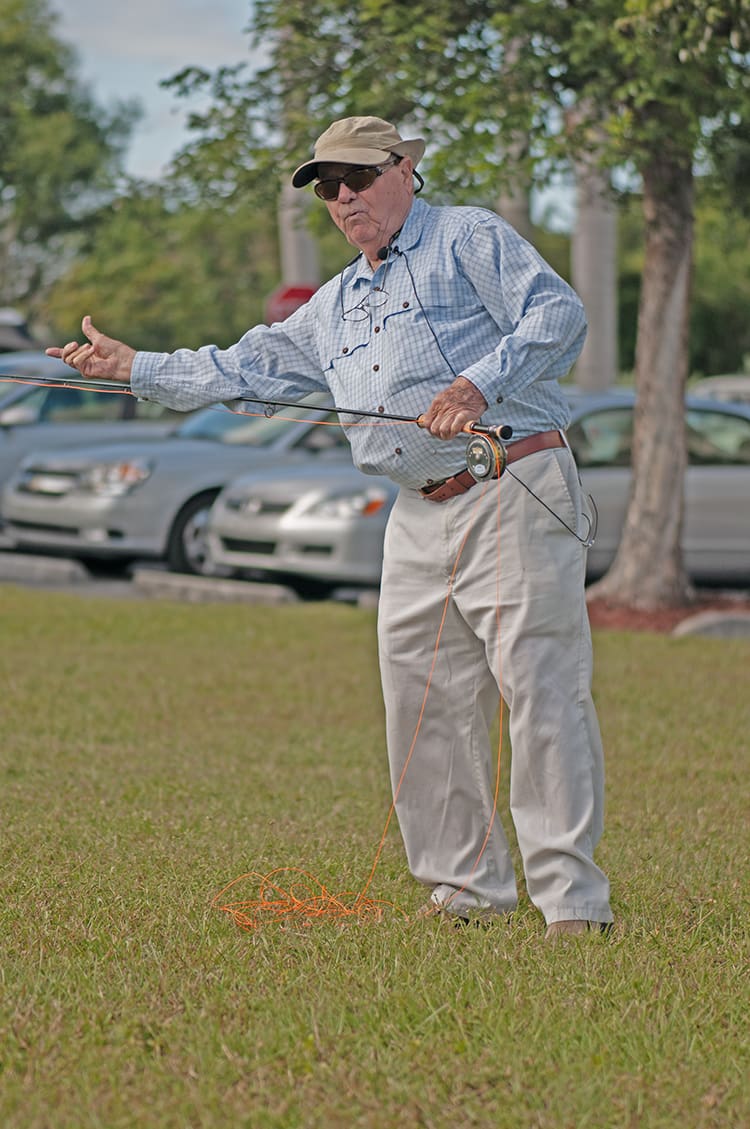
The late Lefty Kreh, a fly casting legend, was a master at teaching novices the art of fly-casting. – Rusty Chinnis | Sun

There are five basic movements that are considered essential:

1. There must be a pause at the end of each casting stroke, which varies in duration with the amount of line beyond the rod tip. This allows the line to straighten for the next cast. “Watch your back cast until you’ve mastered the timing.”

2. Slack line should be kept to an absolute minimum. Slack line prevents the rod from loading and applying the proper power to the cast. The most common mistake that creates slack line happens when the rod is started too high, forming a belly in the line between the rod tip and the water. To prevent this, start your cast with the rod tip pointing at the water.

3. In order to form the most efficient, least air resistant loops and to direct the energy of the cast toward the target, the rod tip must move in a relatively straight line. Practice tracing a horizontal line like a roof eve.

4. The length of the casting stroke must vary with the amount of line past the rod tip. If you are making a short cast there is only a small amount of line needed (which only weighs a small amount). As the length of line increases, the stroke must be increased to load the rod.

5. Power must be applied in the proper amount at the proper place in the stroke. In general, the power is applied slowly at first, gradually increasing to a peak at the end of the stroke. There should be a crisp stop at the end of the stroke, forcing the rod to come out of its bend. This is commonly referred to as the “speed-up and stop.”

Like riding a bike, playing tennis or golf, the only way to master fly casting is to practice on a regular basis. Create a practice schedule that you can stick to. Start by practicing short sessions on a regular basis. Regular practice is more important than the amount of time you spend and will build a good habit. Commit to five minutes every day. Any additional time will be a bonus, but the importance of a regular practice schedule cannot be over-emphasized.

We never get as much time on the water as we want and can spend months anticipating a special trip to destinations like the Bahamas, Argentina and Montana. Spending time to master fly casting will pay dividends when you see that fish of a lifetime and raise your rod to make a cast.

Brigadoon

Brigadoon

The legend of Brigadoon is the story of a mythical village in the Scottish Highlands. It’s a tale of a place that became enchanted long ago and has remained unchanged and invisible to the outside world except for one special day when it can be seen and visited by outsiders. Those lucky outsiders then spend an enchanted day immersed in joy and celebration. This past May, I had the good fortune of spending a day on the enchanted waters of the Brigadoon Lodge, not in Scotland but in the highlands of Northeast Georgia and not far from where we vacation in Sautee Nacoochee.

I first experienced this stretch of water when a trip I planned with my friend Bob Seegar, who had relocated from Longboat Key to Blue Ridge, Georgia, and his grandson, David, was unexpectedly canceled. Fortunately, a friend who lives nearby saved the day when he hooked us up at the lodge through a friend who oversees the guides there.

The lodge sits on a beautiful tract of land where the storied Soque River runs through the Chattahoochee National Forest. It’s one of a few tracts of private land along the river that’s designated non-navigable and where no public access is allowed. It’s appeared in many magazines and hosted the likes of President Jimmy Carter and Ted Turner, founder of Turner Broadcasting System.

On this occasion, Seegar and I were joined by our friend, Michael Riter. The two had arrived at our cabin the night before when we dined at the nearby Harvest Habersham, a new farm-to-table restaurant that serves some of the most delicious and unique dishes I’ve ever tasted.

The next morning, we drove the winding and scenic route 197 that follows the Soque through the Blue Ridge foothills to the Brigadoon Lodge. We were met there by our guide, Doc, and fitted with waders and boots for our day on the river. Over eight hours, we fished several of the river’s “beats” where we all landed numerous large rainbow trout on a fly. We fished mostly nymph patterns under a strike indicator but were also treated to some of the mix of native and stocked trout on dry flies. It was truly an immersive experience that with a slight narrowing of the eyes became the Brigadoon of lore. If you’re ever in the area, a trip to this beautiful river and lodge is unforgettable.

Explore the options at www.brigadoonlodge.com.

Watch the video: https://youtu.be/EewyBNpjGCc?si=ARpe9_pRydEB15Jj

Reel Time on the Road: Andros North Bight

“Strip, long strip, stop, short strip, stop, strip,” Harry Neymour called out as I watched the bonefish home in on my fly. Neymour had spotted three fish as they hunted a shoreline in the Dressing Room, a vast shallow mangrove-lined bay on Andros North Bight. The experience I’ve gained over the years combined with the coaching paid off as I lowered the tip of my rod to the water’s surface and set the hook with a short strip strike. The bonefish accelerated immediately, causing the fly line to create a rooster tail of water as it headed for the perceived safety of deeper water. I instinctively took my eyes off the fish, separated my hands and concentrated on clearing the line that lay at my feet on the deck. As the line disappeared through the guides, I guided it onto the reel and gave two more sharp jabs of the rod to make sure the barbless hook was secure.

In what seemed like a split second, the fish was on the reel and deep into the backing on its first scorching run. After the first run of 100 yards, the bonefish turned and raced back towards the boat faster than I could recover line. I dipped the rod into the water so the tension would prevent the hook from coming loose and reeled as fast as I could. After catching up and having the fish on the reel again, I marveled as it made three more runs, each progressively shorter than the last but still strong and fast. Then I was able to work the fish back to the boat where my fishing partner Bill Partridge lifted it from the water for a quick picture and release.

This was the fourth day of a six-day fishing trip that had an inauspicious beginning. We had departed the Ft. Lauderdale Executive Airport on a Makers Air flight as a disturbance approached that would generate one of the heaviest rainfall events in the last 11 years. The approaching weather made for a bumpy ride and landing, causing cloudy skies and high winds for the first two days of our trip. We were staying at Frankie’s Two Boys Inn on the edge of North Andros’s legendary North Bight. It was here on Cargill Creek at Bering Point where some of the first anglers chased bonefish with a fly rod and where the Bahamian guide and inventor of the Crazy Charlie lived and fished. The Nemours are an extended family of guides that are regarded as some of the Bahamas’ best and my experience fishing with Frankie and his nephew, Harry, bore that out.

Reel Time on The Road: Andros North Bight
Anna Maria’s Bill Partridge with an average Andros bonefish he caught fishing the Dressing Room with Harry Neymour. – Rusty Chinnis | Sun

We had planned on fishing for six days because, in my almost three decades of fishing in the Bahamas, it was routine to have at least two days of weather, clouds and/or wind that resulted in poor fishing. This trip was no different and I didn’t even make a cast for the first two days. That all changed on the third day when fishing with Frankie Neymour. As the conditions and the fish settled down and the skies cleared, we estimated that Partridge and I each caught 15 bonefish, including several doubles. The next day we fished again with Frankie Neymour with similar results in places like Charlie Alley and Bight Landing. On that day I caught my largest bonefish (7 pounds) while wading a point as school after school of bones departed the adjacent bay in waves.

On the last two days, we sight-fished with Harry Neymour, who put us on singles, doubles and trios of fish that required a well-placed fly and a nuanced presentation, my all-time favorite type of fishing. Harry is quickly surpassing the prowess of his father, Charlie, and Uncle Frankie with the energy of a new generation perfecting their style of angling.

Andros, the largest and least populated of the Bahamian archipelago, boasts some of the largest bonefish (November-February) to be found anywhere. Frankie’s Two Boys Inn is quickly becoming one of my favorite bonefishing haunts. It’s one of the most reasonably priced lodges in the Bahamas, is a short run to fishing, and boasts one of the most expansive areas to explore. You must pay for your liquor, make your lunch and fish maybe one hour less a day, but at half the price of most lodges, it’s the best deal and fishing I’ve found in almost three decades of pursuing the grey ghost.

To book a trip, visit Frankie’s Two Boys Inn online. If you are a flyfisher and haven’t fished for bonefish, you have one of angling’s greatest adventures to look forward to!

Reel Time: Learn how to tie your own flies

When I first started fly fishing, I would buy my flies from local fly shops and occasionally, guide friends would supply me with the flies I was using. Eventually, through necessity, I started tying flies and quickly found out how rewarding it was to catch a fish on a fly I had tied myself. While I tied the flies I used locally, I still ordered flies that I would take on my trips to the Bahamas. That habit changed too on a bonefishing trip a couple of years ago.

I had ordered some flies the lodge I was visiting recommended from a “reliable” source, choosing a few old classics as well as a current favorite, the Peterson Spawning Shrimp. As it turned out, the flies I ordered didn’t match my expectations. Fortunately, two friends in my party offered me some of their flies. I got bailed out on that, vowing then and there that the next trip I took I’d have a box of my own home-tied creations. Fast forward to today and it’s less than a month from my next trip. This time I’ll have the flies I have confidence in. And confidence is key!

Reel Time: Learn how to tie your own flies
The Peterson Spawning Shrimp, one of the most dependable flies for bonefish, is adaptable for a host of other saltwater species. – Rusty Chinnis | Sun

In my experience, flies don’t have to be fancy to catch fish. They do have to resemble something a local species feeds on and appear natural in the water. Two of the most reliable patterns mimic baitfish and shrimp. Probably the most basic, and one of the most effective and popular flies, is the Clouser Minnow, created by Bob Clouser. This was the first fly I learned to tie and is still a favorite. Another favorite is the bend back, a streamer tied to be weedless and fished in shallow water. The bend back is also easy to tie and very effective when properly tied and presented. As mentioned, my current favorite fly, one I tied originally for bonefish and now use locally for redfish, tripletail and snook, the Peterson Spawning Shrimp, has me immersed in tying flies and I’m enjoying the process more than ever. Fly tying is like everything else, the more you do it, the better you get. As in fly casting, golf, tennis and any other endeavor, repetition is key, so it’s better to tie often instead of for long periods of time.

If you currently tie, my advice is to master a fly you have confidence in and then work to make a fly your own. I’m constantly thinking of ways to improve patterns I fish and finding my enjoyment of fly fishing enhanced by the experience.

I would strongly advise fly anglers to take up fly tying if they haven’t already. If you want to explore tying but aren’t fully committed, start with a simple but quality travel kit that you’ll be able to use even after setting up a place to tie at home. I think you’ll find that you enjoy the fly-fishing experience even more and, as a bonus, you’ll have better quality flies at a much better price. Instructions on tying every imaginable fly are available on YouTube.

Reel Time: Fly casting mastery

Teaching fly casting has taught me some valuable lessons. Chief among them is the fact that it’s most often easier to learn from scratch using the fundamentals (physics) of the cast than it is to correct bad habits that have been developed over time. That became apparent to me when I gave lessons to someone who had been fly casting for a long time but who had ingrained bad techniques. When I showed them how to properly move the rod tip in a straight line to form a tight, wind penetrating loop, they understood the concept immediately. The eye opener for student and teacher was when they tried to repeat the proper casting stroke and their ingrained bad habit overpowered their new understanding.

This isn’t bad news for long-time casters who have been using improper techniques, but points out the necessity of practice to reteach the brain how to move the rod. The same applies to proficient casters who are learning to cast with their non-dominant hand. Try this and you’ll see what I mean instantly. If you’re a right-handed caster, putting the rod in the left hand is like handing it to your clone where the fundamentals of the cast are understood but the body doesn’t cooperate. The good news is that by learning the fundamentals of the cast and practicing them regularly anyone can become adept.

Besides learning and practicing the essentials of fly casting, it’s important to realize that there is no right or wrong casting style. Casting is governed by physics and there are some essentials that every fly caster must master, no matter what their individual skills or styles. This is the difference between the art (style) and science (physics) of the cast.

Reel Time: Fly casting
Fly fishing legend Joan Wulff demonstrates the casting stroke. – Rusty Chinnis | Sun

Fly casting is a lifelong learning experience that you can practice at 9 or 90. Different people learn at a different pace. Some people pick up casting quickly and then plateau. Others start slow, but when they finally get it, they’ve got it. It can be compared to learning how to ride a bike. To become a good caster you need to practice, but that practice will reward you with a lifetime of pleasure and provide the opportunity of the company of good friends.

Fly casting differs from spin or bait casting where the weight of the lure or bait loads the rod. The rod then transfers the stored energy of the rod to the lure or bait, which carries it to the target. In fly casting, the weight of the line loads the rod, and the line takes the leader and flies to the target.

The basic casting stroke consists of the rod being held in the hand at the base of the fingers with the thumb on top of the cork. The stroke is a combination of moves of the wrist, the forearm and the upper arm. In the ready position with the thumb on the cork, the wrist is straight and the butt of the rod is at a 45 degree angle to the forearm. The wrist travels from this straight position to a 45 degree down angle then returns to straight position. The forearm and the upper arm complete the motion.

There are five basic movements that make up what is referred to as the essentials:

  1. There must be a pause at the end of each casting stroke, which varies in duration with the amount of line beyond the rod tip. This allows the line to straighten for the next cast.
  2. Slack line should be kept to an absolute minimum. Slack line prevents the rod from loading and applying the proper power to the cast. The most common mistake that creates slack line happens when the rod is started too high, forming a belly in the line between the rod tip and the water. To prevent this, start your cast with the rod tip pointing at the water.
  3. To form the most efficient, least air-resistant loops and to direct the energy of the cast toward the target, the rod tip must move in a straight line. Practice tracing a horizontal line like a roof eve.
  4. The length of the casting stroke must vary with the amount of line past the rod tip. If you are making a short cast, there is only a small amount of line needed (which only weighs a small amount). As the length of line increases, the stroke must be increased to load the rod.
  5. Power must be applied in the proper amount at the proper place in the stroke. In general, the power is applied slowly at first, gradually increasing to a peak at the end of the stroke. There should be a crisp stop at the end of the stroke, forcing the rod to come out of its bend. This is commonly referred to as the speed-up and stop.

In my experience, the only way to master fly casting is to practice consistently, preferably committing to two to five minutes every day to train or retrain your brain. Any additional time will, of course, be a bonus, but the importance of a regular practice schedule cannot be over-emphasized. There are lots of resources on the internet to help you perfect your cast and lessons with a caster trained by the Fly Fishers International can be invaluable. Some of the best videos to search for online are those by master casters and instructors Joan Wulff and Lefty Kreh. Locally, anglers can research rods and tackle at AMI Outfitters on Anna Maria Island. There are also some excellent casting videos on YouTube from Orvis and Rio. Learn and apply the fundamentals of fly casting consistently and you’ll be on your way to mastering the cast.

Bigfoot Snook Tournament coming in July

The Fifth Annual Bigfoot Snook Tournament is coming soon to a beach near you. The tournament was the brainchild of Compound Board Shop owner Jacob Shields.

“My idea was to help level the tournament playing field so younger kids and less experienced fly fishers had a good chance of competing against more experienced fly fishers,” Shields said. “The format also allows kids with a bike to be able to get to a spot as easily as someone with an expensive skiff. All our events are free, so there’s no reason not to participate. Many fly-fishing tournaments are about pride and ego, and I guess this one boasts that the main objective is to get the community together. After a fun night at the captains’ meeting, anglers are off to walk the beaches and bays on Saturday. I love the relationships that have been formed through our shop and I feel this event is just another way to become friends with other people that share the same passion.”

Bigfoot Snook Tournament coming in July

The tournament organizers assemble great prizes from their sponsors and will be giving away over $1,000 in cash as well as prizes. There are no boundaries with the tournament, so people from all over can participate in the event. The only requirement for anglers is that they must attend the captains’ meeting as well as the weigh-in event where they will show pictures of their catch.

The mandatory captains’ meeting will be held on Friday, July 7 at 6:30 p.m. at the Compound Board Shop in Sarasota. It’s essential that competing anglers are present to secure their spot in the competition. The challenge is exclusively for those who prefer to go fishing on foot. Vessels can be used to reach a favorite spot, but the catch must be made on foot, no fishing is allowed from a floating craft. The best part may be the fact that there is no entry fee. It won’t cost anglers a dime to participate!

Shields commented, “We believe in spreading the joy of fishing to all passionate souls. Anglers should mark their calendars for Saturday, July 8 when the tournament officially runs from 7 a.m. to 3:30 p.m. It’s a chance to showcase your skills, embrace the camaraderie of fellow anglers, and compete for over $1,000 in cash and prizes for the first-place winner.” To sign up, visit the Compound Board Shop website.

Reel Time – Mentors: The permit whisperer

Fly fishermen, and fishermen in general, are always seeking ways to improve our enjoyment of the sport. And while that ultimately boils down to learning ways to be more successful at catching fish, it’s not really numbers that drive a fly fisher’s passion. It’s more personal than that. If it were a numbers game, we would still be fishing with live bait and waiting for the fish to find us. Our path to success is paved with mentors and milestones that redefine our personal passage through a life of fly fishing. It’s experiencing and seeking to understand the natural world and the fish that swim its waters that makes the fly fishing journey so special.

I first picked up a fly rod over 30 years ago and, over three decades, I’ve had many memorable days on the water. When I look back, some of my fondest memories are not about the fish that I’ve caught but the people I’ve met along the way, the personalities I’ve encountered and the friendships fostered. Fly fishers seem to possess a quality that attracts, entertains and enlightens us. No matter where you are in your evolution as a fly angler, I’m sure you’ve had or will have the same experiences. Over my years of fly fishing, one of the most charismatic individuals I’ve encountered in my time was a Belizean named Lincoln Westby.

I met Westby over a decade ago on a blustery morning in March outside my motel in Hopkins, Belize. Due to a strong cold front that had blown through the day before, my transfer to his Blue Horizon Lodge had been delayed. When he asked if I was going to the lodge, I wasn’t sure if he was a guide, the owner or merely a taxi driver. Little did I know that this unassuming man would, in less than a week, teach me more about permit fishing than I had assimilated in over 10 years of stalking this “holy grail” of fly fishing.

Westby’s spry demeanor and sparkling eyes belied his six-plus decades. A Belizean by birth, he has fished the coastal waters of Belize since he was a child. He began his fishing career as a commercial diver and fisherman before following his brothers, Joel and David, as guides to American spin anglers in the late 60s. Except for a stint in the British Army from 1961-67 and two years working on a research ship in Bermuda, he has dedicated his life to learning the ways of the permit, tarpon and bonefish. After working as a guide and manager at nearly every lodge on the Belize coast, Westby had the passion to have his own lodge. With the help and counsel of Will Bauer (now deceased), a longtime permit angler and former Belize lodge owner, the vision of the Blue Horizon Lodge was born.

Westby and his common-law wife, Pearline, leased a small mangrove island from the government with an option to buy. The island was inundated with water on high tides and it took over six months and more than 10,000 boatloads of sawdust and sand to create enough upland to build the first building. Finally, in 1997, Bauer brought the first group of anglers to the lodge and Westby’s dream became a reality.

On my trip to the Blue Horizon, I had the good fortune to pick a week when Bauer was at the lodge and I was able to fish with Westby on six consecutive days. Each day I was immersed in an endless world of multi-dimensional coral patch reefs that hosted school after school of permit. And while there were few spells of more than 45 minutes between fish, it was Westby’s intimate knowledge of the terrain and the permit that held me spellbound. I fished for four and a half days (and spent a day observing and photographing Bauer and Westby) and landed five permit. The number of opportunities was phenomenal and, while these permit were less pressured than in other locations I’ve fished, that didn’t change their basic nature.

Westby fished by the tides (high rising, high and high falling) and not by time. Keen eyes allowed him to slow motor along the edge of flats looking for fish. A mentor takes you to a new level, reminds you of the complexity of the natural world and feeds your desire to learn.

Mentors: The permit whisperer
Lincoln Westby finessed this reluctant permit to eat his crab fly on his fifth presentation. – Rusty Chinnis | Sun

On the day I photographed Westby, he left the boat to stalk a school of feeding permit and I was able to experience a master at work. He made a high looping cast that sent the fly softly to the water’s surface just two feet short of the feeding fish. Not once, but five times, the permit rushed the fly only to turn off at the last minute. Each time Westby waited (when I would have attempted to set the hook) until the fish had just turned off the fly and then gave a three-inch strip that teased the fish back to the fly. On the fifth look, the permit took the fly.

If I had to condense the knowledge I learned in my days with Westby into a short paragraph, it would be that permit are moody, and every presentation and opportunity will be influenced by many factors. The angler must judge the mood of the fish, know where the fly is at all times and take into account the tides, weather, availability of food, wind, structure of the bottom, sun angle and much more. Permit fishing is incredibly demanding, and therein lies its appeal. Quantum leaps in fly fishing can be built up with years of experience or, on occasion, by having the good fortune to learn from a mentor. It keeps it fresh and vital and makes us keen for our next adventure.

Results in from the 2023 Waterman

Reel Time: Results in from the 2023 Waterman

The third annual Waterman Fly Fishing Tournament was held this past weekend. The two-day, fly-only redfish tournament with a Snook Calcutta (an award for the longest snook of the tournament) was a sellout with 126 anglers registered. The fishing boundaries were wide-ranging, including the west coast of Florida from Crystal River to the southernmost tip of Sanibel Island. The photo submission format and the angler tournament app made it possible for fishermen in this entire range to participate. The tournament culminated in an awards banquet and prize-rich raffle at the Bradenton Yacht Club on Sunday evening, an event that was made possible by a large number of generous sponsors. All proceeds from the tournament benefited Tampa Bay Waterkeeper, a non-profit organization dedicated to the protection, preservation and improvement of the Tampa Bay watershed.

The 63 two-angler teams received a collared long-sleeve tournament shirt, Tampa Bay Waterkeeper hats, dinner for two at the awards ceremony and one raffle ticket for each angler. Target species were redfish and snook. Scoring was done by the highest combination of the two longest redfish caught between day one and day two. If a tie had occurred in any of the three top places, it would have been decided by a casting competition based on fly casting distance and accuracy.

Sponsors were pivotal to this event and the fishing community stepped up to support TBWK’s mission. A full list of sponsors is available on the Tampa Bay Waterkeeper website.

Some quality redfish were landed, but among the anglers I spoke to there was concern with the overall abundance of fish as well as the condition of the bay. That sentiment was shared by tournament organizer and TBWK Board member Adam Fernandez in his introduction at the evening’s awards ceremony and raffle. A total of 82 fish were weighed in during the two-day tournament including nine snook, the biggest at 25.5 inches.

Seventy-two redfish were entered in the tournament. The biggest, at 34 inches, was caught by Pierson Monetti of the first-place team Crawl Mode with Josh Glidden. The team entered two fish totaling a combined 65 inches. Monet- ti’s company, MRIC Spatial, was a platinum sponsor of the tournament. Second place was claimed by Team Not Ready with Leigh West and Brandon Chircop. Their two fish totaled 62.5 inches. Third place was awarded to Team Bar Fly with a two-fish total of 54 inches.

There was great camaraderie, a dinner, a raffle with many fine products and an inspirational presentation by Bill Horn. Horn is vice-chair of the Bonefish and Tarpon Trust (BTT) and former assistant Secretary of the Interior for Fish, Wildlife and Parks. He is the author of “Seasons on the Flats,” “On the Bow” and many other literary works. Bill has been deeply involved in Everglades restoration for the last 20 years. He’s been a major force behind BTT’s work on water quality, fisheries management and federal policy. In his speech, he mentioned BTT’s recent study of pharmaceutical drugs in bonefish. The study was expanded to include redfish in Florida waters to show the problem was more widespread than the Florida Keys. Tampa Bay was one of the regions sampled and the redfish were found to have some of the highest levels of pharmaceutical drugs, including antidepressants, blood pressure medications, painkillers and a host of other compounds. Horn finished by saying that the technology exists to remove these compounds and emphasized the critical need to implement them before the drugs enter the environment further. Organizations like Tampa Bay Waterkeeper are on the front line of the defense of our littoral environment and deserve the support of anglers and all those who appreciate the threatened coastal ecosystem. The challenge is to make decision-makers aware of the concerns and have them address them at the state and national levels. Your vote is critical to making this a reality. See how your local, state and federal representatives have voted on these issues at the League of Conservation Voters website. As Horn mentioned in his closing statement, “if we don’t do this, this might be the last generation of anglers to have the opportunity.” Join Tampa Bay Waterkeeper and be a part of the solution.

Compete in the Waterman Fly Fishing Tournament

Reel Time: Compete in the Waterman Fly Fishing Tournament

No one has more vested interest in water quality and the protection of our local marine habitat than anglers. That fact is clearly evident for those that make a living from the bays and estuaries that define the Suncoast, making it one of the country’s most desirable locations to visit and live. It’s easy to understand that fishing guides, waterfront restaurants, marinas and resort accommodations like hotels, motels and marinas, benefit from a robust and sustainable environment. What’s less well appreciated by the public at large is the impact of a healthy environment on the economy at large.

Fortunately, local anglers, through advocacy groups like Suncoast Waterkeeper and Tampa Bay Waterkeeper, are getting that message to a wider audience through the media, legal actions and events like this week’s Third Annual Waterman Fly Fishing Tournament. The event, a sellout this year, is a two-day, fly fishing-only, catch-and-release redfish tournament with an optional Snook Calcutta that awards the winner a 50/50 cash payout. The event will be held on Saturday and Sunday, Feb. 4-5. The tournament has a full field of 50 teams with 100 anglers.

All proceeds from the photo submission, all release formats including entry fees, 50% of the Snook Calcutta and raffle ticket purchases directly benefit Tampa Bay Waterkeeper, a 501(c)(3) non-profit. The fishing boundaries are the west coast of Florida from the southern tip of Sanibel Island to the southern edge of the Crystal River Power Plant main channel. The target species are snook and redfish. The Waterman tournament culminates on Feb. 5 with an awards banquet at the Bradenton Yacht Club and features a raffle made possible by our generous sponsors. A limited amount of guest tickets to the awards banquet are available for purchase for $50.

Locally, we are blessed to receive the benefit of two Waterkeeper groups. Suncoast Waterkeeper concentrates its efforts on the waters of Manatee County and Sarasota County, primarily Sarasota Bay. Tampa Bay Waterkeeper focuses its efforts on the waters of Tampa Bay and its surrounding estuaries. Local anglers know that there are no distinct boundaries between these areas and both organizations work together on broader issues, like Piney Point and the proposed fish farm off New Pass. While the tournament is sold out this year, I’ll report back on the results and would encourage everyone to support these groups’ advocacy efforts through donations, advocacy and volunteerism. Their work supports everything we value locally.

Reel Time: The secret to fly casting

Everything we learn to do in life is learned by repetition. The act of repeating an action over and over actually trains neurons in the brain to fire together, eventually creating neural pathways that, in time, allow us to act without thinking about it.

Consider learning to ride a bike. Did anyone just get on their bike and effortlessly ride? I know I didn’t. It required falling and getting up repeatedly. Now I get on a bike and ride without even thinking about how to balance, steer or anything else that allows me to stay upright. Teaching fly casting reminds me of those things I now take for granted, like riding my bike, driving my car and fly casting. It’s also shown me why it’s harder for people who have been fly fishing for a long time to master the fundamentals (physics) than for some initiates. Those same pathways that assure success also store bad habits that have been developed over time. This first became apparent to me when I gave lessons to someone who had been fly casting for a long time but who had ingrained bad techniques. When I showed them how to properly move the rod tip in a straight line to form a “tight” wind penetrating loop they understood the concept immediately. The eye-opener for student and teacher was when they tried to repeat the proper casting stroke and their ingrained bad habits overpowered their new understanding.

Reel Time: The secret to fly casting
Joan Wulff demonstrates one of her unique, and effective techniques for mastering the casting stroke. – Rusty Chinnis | Sun

This isn’t necessarily bad news for long-time casters but does require them to “retrain” their brain. The same applies to proficient casters who are learning to cast with their non-dominant hand. Try this and you’ll see what I mean instantly. If you’re a right-handed caster, putting the rod in the left hand is like handing it to someone whose mind knows the cast, but has a body that doesn’t cooperate. The good news is that by learning the fundamentals of the cast and practicing them repeatedly, anyone can become an excellent fly caster with time.

Although we’ve established that practice is the key to mastering the cast, there’s another “secret” to supercharging your progress – the frequency of the repetition and establishing a habit. Create a realistic practice schedule that you can stick to. It’s much more effective to practice every day for a few minutes than to practice once a week for hours. Start by practicing at least four to five times a week for 10 minutes. Any additional time will, of course, be a bonus, but the importance of a regular practice schedule cannot be overemphasized. There are lots of resources on the internet to help you perfect your cast and lessons with a caster trained by Fly Fishers International can be invaluable. Some of the best videos I’ve found online feature master casters and instructors like Joan Wulff and Lefty Kreh. Orvis also has excellent resources. Locally, anglers have a great resource in AMI Outfitters on Anna Maria Island. They have complete outfits for beginners and rods and reels that will appeal to the most discriminating fly fisher. Visit them and try different outfits to see what fits your style and your pocketbook. Learning and apply- ing the fundamentals of fly casting and practicing them often will help you avoid learning bad habits or help you overcome them. It’s the secret to fly fishing and a path to an exciting fishing future.

Reel Time: Guiding principals

Reel Time: Guiding principles

I have always been a great fan of fishing guides. They can provide a terrific initiation to the local waters and are indispensable when angling new destinations. Not only do you get the benefit of their extensive knowledge of where to find fish, but you’ll get a lesson in the natural world as a bonus.

Most guides not only take you to the action, but they will show you some of the area’s most beautiful natural areas. I know many experienced anglers who regularly fish with guides. They know that there is no substitute for the local knowledge gained from being on the water on a regular basis. They also appreciate the convenience of stepping on a boat, being taken to the fish, having the guide fillet fish if they decide to keep any, and not having to clean the boat.

While many people have the mistaken impression that guiding is an easy job, few people really appreciate the rigors of long days on the water. For anglers, an eight-hour day on the water translates into 10 or more hours for the guide. Not only do guides provide experiences that last a lifetime, many work tirelessly to protect the resources that we all too often take for granted.

My first introduction to guiding came in the 1980s when I was new to area waters. A friend invited me to fish with Holmes Beach guide Capt. Scott Moore. That first trip was a revelation to an angler new to the Gulf coast waters. Moore amazed us with his uncanny ability to find fish. He would literally say, “We’ll start over here and catch a trout, then move to that point and find snook and finally fish that mangrove edge for redfish.” And that’s just what we did. He introduced me to snook fishing, taught me lessons that have made me a better angler, and, most importantly, helped me appreciate the need to protect our marine resources.

I learned a lot of what I know fishing with guides, and they have saved me countless hours of frustration with their “tricks of the trade.” I learned how to remove a backlash from a spinning reel, how to find fish by looking for subtle signs, how to remove a hook from my hand, how to throw a cast net and so much more. Guides are not just anglers, but trained specialists that can help you find and catch fish on your own, if you listen and learn.

If you haven’t had the pleasure of a day on the water with one of the many professional guides in our area, I would encourage you to give it a try. When you do the math, it’s one of the wisest investments you can make for your fishing future. It’s also a great way to spend a day with friends and family and introduce kids to “catching.”  You’ll find information on local guides in the pages of The Sun every week, and I’ll share my experiences with the guides I still fish with regularly.

Reel Time: Fishing with Captain Kevin Wessel

My pliers were in one hand and a fly was in the other as I prepared to cut the leader and change flies. Pausing, I looked up to check with Capt. Kevin Wessel before committing.

“Tarpon coming at 11 o’clock,” he said. When I asked if I had time to change the fly, he shook his head “no.”

Stepping up to the bow, I saw the fish about 50 feet away and made a cast, leading them about 10 feet. After pausing to let the fly sink, I put the cork handle under my arm and started stripping with both hands to bring the fly to “life.” Three strips later and the line came tight as the second tarpon in the string broke ranks to inhale the worm pattern. I set the hook with a quick, sharp strip strike and moved the rod to my hands as fly line leaped from the deck, wrapping around my left hand in the process. Luckily, I was able to shake it free just as the fish bolted away from the boat.

Reel Time: Fishing with Capt. Kevin Wessel
Capt. Kevin Wessel, an accomplished photographer, captured this awesome image of a leaping tarpon. – Capt. Kevin Wessel | Submitted

This was a big, hot fish and his first run took all my fly line and about 150 yards of backing. The run was interrupted only briefly as the tarpon made a spectacular head shaking jump just feet from Mike Adno, a friend who was fishing to the north of us. After the jump, the fish went around Adno’s anchor line and made a hard left, heading west. Fortunately, he was able to disconnect and release the line as I slackened my drag to prevent a possible break-off.

Looking back at Wessel I suggested we chase the fish as I noticed that half of my backing had disappeared from the reel with no sign of the run ending. Quickly releasing the anchor, he started the motor and we followed as I furiously reeled in backing. When I had the fly line back on the reel, I started to work the tarpon, swinging the rod right, then left, applying maximum pressure trying to throw the fish off balance.

This trip was turning out to be very rewarding on many levels. My friend Andy Grosso had won the trip in a raffle at the Compound Boardshop in Sarasota during the annual Fly-Fishing Film Tour event. Hosted by The Mangrove Coast Fly Fishers, the funds raised went to the environmental group Suncoast Waterkeeper.

After about 20 minutes and several jumps, I had the leader in the guides (considered a catch) for the fourth time when I applied additional pressure, parting the 16-pound class tippet (the weakest link). After high fives, I cracked a celebratory beer and Grosso – who had jumped and broken off a tarpon earlier – stepped to the bow. Moments later, a distant rain cloud obscured the late afternoon sun, making spotting fish impossible until they were right under the boat. It was after 6 p.m., so we decided to call it a day.

Although it’s always hard to leave tarpon when they’re feeding, we had experienced a great day of fishing. Capt. Wessel had correctly guessed, based on over two decades of experience, that it would be an afternoon bite, coinciding with a strong outgoing tide. We had started at 1 p.m. and found schools of fish everywhere in super clear water. It was beautiful to behold and good target practice, but it wasn’t until the tide was in full retreat that the fish began feeding.

In five hours, we had thrown at hundreds of tarpon, jumped two, landed one, and had multiple looks, leans and follows. Capt. Kevin Wessel can be reached for charters by calling 941-915-9514. Check out his website and book online.

Reel Time: Never Stop Learning

Merriam Webster’s Dictionary defines learning as “knowledge or skill acquired by instruction or study.”

As most anglers will attest, that’s how we’ve gained the ability to successfully target (occasionally) different species of fish. That learning probably came from a plethora of sources. I count fishing guides, experienced anglers, the internet, television, books and magazines for a lot of what I’ve learned. If you’ve been around the water for any length of time, you’ve probably experienced that one of the best teachers of all is the mistakes we’ve made along the way.

I often vocalize the fact that “The more I know, the more I know how much I don’t know,” but recently that phrase came into sharper focus when I was fly fishing with an accomplished angler who is younger than I am. During several days on the water, he commented on several things I was doing that he thought, if changed, could improve my fishing. During that same time, I had a few critiques for him as well. At the time, both of us assumed we were right and the other was wrong. As it turned out he was right and so was I. I think in the end we both became better anglers as a result.

He criticized the fact that I trailed a few feet of fly line in the water when I was on the bow. I developed that habit as a way of getting a cast off quickly by being able to load the rod sooner, avoiding extra false casts. When I argued that the line being right beside the boat couldn’t possibly spook fish, in my mind I was right. As it turned out he was right and I was wrong, but for a different reason. As it turned out, not having that line in the water avoided getting it fouled with floating algae and grass and potentially blowing a shot at a fish. As it turned out, now that I have a few years of casting under my belt, I can get a cast off in plenty of time with less line. The trailing line wasn’t needed most of the time.

Stretching fly line before casting might not be necessary, but it’s a good idea to check for memory. – Rusty Chinnis | Sun

When he stepped up to the bow that same morning and didn’t stretch his fly line it was my turn for a critique. I make a habit of stripping off the line I think I’ll need and then cast it out and stretch it to be ready for a presentation. Most fly lines have what is called “memory” from sitting on the reel and form coils that can foul a cast in the guides if not stretched. The stretching relaxes the line. The day after that trip he texted me to say I would have laughed because he had chased a school of jacks on the beach and when he went to cast, the unstretched line fouled in the guides.

There are times when having a trailing line is useful, for example, when there’s poor visibility, and then only if you watch for floating debris. The same can be said for not stretching line when using a line with little or no stretch.

The lesson I learned in all of this is not to get fixed in doing something a certain way and becoming inflexible. Now I’ll attempt to listen first, reason, and argue later. The bottom line: Keep an open mind and never stop learning.

Reel Time: The Mayfly Project

Reel Time: The Mayfly Project

I discovered The Mayfly Project when a child therapist reached out to me to find a mentor for a young man in St. Petersburg. Like so many young men and women, he loves to fish but has no one to coach him. My first thought was to reach out to my friend and former Florida Outdoor Writer’s Association President Bill AuCoin. AuCoin is a member of and produces a newsletter for the Suncoast Fly Fishers (SCFF), a St. Petersburg-based fly club. SCFF is a non-profit 501(c)(3) organization that is also a charter member of the Fly Fishers International group.

The day after I reached out to AuCoin, he sent me an email introduction to Scott Russell, a fly club member who is heading up a project to mentor foster children through a unique program called The Mayfly Project. The Mayfly Project is a 501(c)(3) national organization that uses fly fishing as a catalyst to mentor and support children in foster care. The website describes the mission of The Mayfly Project: “To support children in foster care through fly fishing and introduce them to their local water ecosystems, with a hope that connecting them to a rewarding hobby will provide an opportunity for foster children to have fun, build confidence, and develop a meaningful connection with the outdoors.”

When I went to The Mayfly Project website and read the story of how the founders, Jess and Laura Westbrook, were inspired to form the organization, I was “hooked.”  Jess Westbrook’s idea to use fly fishing as a tool to support children in foster care was derived from how he used fly fishing as a therapeutic tool to manage his own anxiety. In 2014, Jess and wife Laura’s son, Kase, was born. Soon after, Jess started experiencing intense anxiety attacks, which he had never had before. In a six-month period, he lost 30 pounds, was missing work frequently and distancing himself from loved ones. Even though Jess had been fly fishing since he was 6 years old, everything changed for him when a friend stepped in to help.

“A friend that I admired kept getting me out on the river to fish and I found that when I was on the river, I forgot about everything but fishing,” explained Jess. All his worries and anxious thoughts seemed to disappear as soon as he stepped into the water. “When we are fly fishing, we are so concentrated on casting, mending, presenting good drifts, etc., that we forget about everything else around us.”

During this time, Jess was introduced to mentoring children in foster care through an organization at church. The timing was perfect. He was looking for a way to give back to the community through fly-fishing, a sport that had helped him over some very tough hurdles.

“It broke my heart learning more about what foster children go through and that they needed the community to support them during their difficult journey,” Jess said.

When I reached out to Russell about a mentor, he related his own story. “My wife and I are very familiar with the challenges foster youth struggle with. Many of them that struggle with controlling their emotions frankly have days that are full of being ‘corrected’ by the adults (e.g. teachers, parents, foster home staff, etc.) in their lives. Our project is meant to just be a break from everything. As mentors in the program, we’re not there to try to fix things that aren’t going right in their life, we are only there to spend time with them, have fun, and teach them about fly fishing. Similar to how fly fishing has been found to be great therapy for veterans through the Healing Waters program, we hope that fly fishing can be a great escape for these kids from their normal routine. I know for me, even just tying flies or practicing casting is a great way to get my mind off of all the ’stuff’ going on in my life. It’s also a nice opportunity for them to learn about conservation and how it will help preserve the natural resources we enjoy. These youth need all the help our community can provide.”

Westbrook and Russell’s story is inspirational to me and resonated because fishing in general, and fly fishing in particular, had been so helpful to me when I experienced my own bout with anxiety and depression. I credit a large part of my recovery to the friends and family who supported me. I had experienced the same relief that Jess and Scott had on the water.

There are many programs like The Mayfly Project that use fishing to help disadvantaged children, breast cancer survivors, soldiers and others navigate the inevitable traumas that life brings. What better way for us to use our passion to assist others who need a helping hand.

Reel Time on the road: Dillon, Montana

Reel Time on the road: Dillon, Montana

This past week I fished the Big Hole, Madison and Beaverhead Rivers in Montana with a group of anglers hosted by Captain Rick Grassett at Montana’s Medicine Lodge, a working ranch near Dillon, Montana.

Over five days we fished the three rivers from drift boats, casting dry flies and nymphs. This is Grassett’s 20th year hosting the trip and the second time I’ve joined the group in what is evolving into an annual event. We fished with Dave King Outfitters, based in Dillon. Grassett fished with King as a guide for many years at another lodge that eventually closed. After the closure of that lodge, King decided to become an outfitter and hooked up with Grassett and Montana’s Medicine Lodge, which provides a unique western working ranch atmosphere.

The group of seven anglers fished with King’s guides, changing partners and guides each day. On the first day, I fished with Dennis Kinley, who I first met 15 years ago in the Bahamas on a bonefishing trip. Dennis is a regular with the group. Our guide was Jake Heinecke, a fishing and hunting guide who teaches school in Dillon when he isn’t guiding. Over the day we landed a number of brown trout, including some quality fish from 16-19 inches. During our float we watched thunderstorms build over the mountains, eventually overtaking us in a downpour about a half-hour before our float ended at 4 p.m.

Reel Time on the road: Dillon, Montana
Anglers pause for lunch along the Madison River. – Rusty Chinnis | Sun

Because we had an odd number of anglers, each angler fished solo one day. On the second day float on the Madison, I volunteered and fished again with Heinecke. I took the opportunity to learn from Jake and was fascinated with his mastery of the fly rod. In particular, I asked him to help me with my mend and reach casts that feed fly line up current to assure a drag-free float of the fly. He actually combined the two into a cast he calls the reach-mend. The fishing was a bit slow that day but the weather and scenery were spectacular and I managed to hook and land a 20” brown trout on a dry hopper imitation.

On my third and fourth day, I fished with Nick Delledonne, from Pennsylvania, and Grassett on one of my favorite rivers in Montana, the Big Hole. We launched both days at about 7,000 feet, where the temperature hovered in the high 40s and floated two of the river’s most scenic stretches. Our guide both days was Mark Moreni, who guides for King during the summer season and teaches high school history in the winter. Although the fishing was a bit slow both days, we did get a chance to fish the Trico hatch, where millions of these small-winged insects emerge from the river in a buffet of food for the local trout. During this brief (about an hour) time, fish go on a feeding frenzy allowing anglers a chance to target rising fish with small dry fly imitations.

After fishing each day, anglers returned to the ranch where chef Annie Walz Kubiac had hors d’oeuvres ready to accompany cold beverages and cocktails on the outside deck. It was a perfect place for anglers to unwind and recount “tails” of the day. Dinners each evening featured chef Kubiac’s scrumptious special side dishes that accompanied the entrees like prime rib, elk meatloaf, baby back ribs and shrimp.

On the last day of the trip, I fished with Grassett on a different stretch of the Beaverhead with Heinecke. The morning started with cloud cover and the promise of much-needed rain. We dodged all but brief showers and spent the day fishing streamers along the fast-moving river. Action was a bit slow but we managed a few nice brown and a couple of rainbow trout to 16 inches. The float took us through some beautiful scenery and ended near the landmark “Pipe Organ.” We were lucky that we missed much of the hot weather that had plagued the region earlier in the summer and only got a haze from fires burning to the west. As we parted company on Saturday morning, everyone was already talking about a return trip in 2022. For information on joining one of Grassett’s yearly trips (Montana and the Bahamas), contact him at 941-350-0318. Next week, Big Sky and  Red Lodge.