

Tag: Coast Lines

So long, farewell

Coast Lines: So long, farewell

Memorial Day marks exactly eight months since Hurricane Helene flooded Anna Maria Island.

Many friends have left the Island since then, and it was not anyone’s first choice, nor did any leave on their own terms.

My friends, mostly older, had a variety of reasons.

Their kids were concerned about them evacuating before the next storm and staying alone in a hotel for days, weeks or months. Many friends moved closer to their adult children, which is often inevitable – but many left before they were ready.

Some left because it proved too hard to evacuate for days and weeks with dogs or cats or birds; in some cases, there were pet casualties.

Some left because of the likelihood of huge impending homeowners association assessments to pay for damage, and the inevitability of higher monthly dues, forcing out those on fixed incomes.

Some left because a developer shut down their trailer park.

Some left because developers have been snapping up distressed properties after the storm and intend to build three stories on both sides of neighbors who don’t want to live in a shadowy concrete canyon.

Many had so much damage to their homes they couldn’t afford to pay for it, leading to further gentrification on AMI. Everyone has heard the insurance companies’ 2024-25 mantra, “It’s not covered,” followed by citations to obscure policy provisions that no one ever reads before signing, because everyone was just happy to be able to qualify for any flood insurance on a barrier island.

Even some investors I know are planning to leave, because while they were safe and sound with all their possessions in their northern homes during Helene, they were terrified of losing their investment properties watching national news about AMI.

Most people I know made a list of pros and cons before deciding to leave.

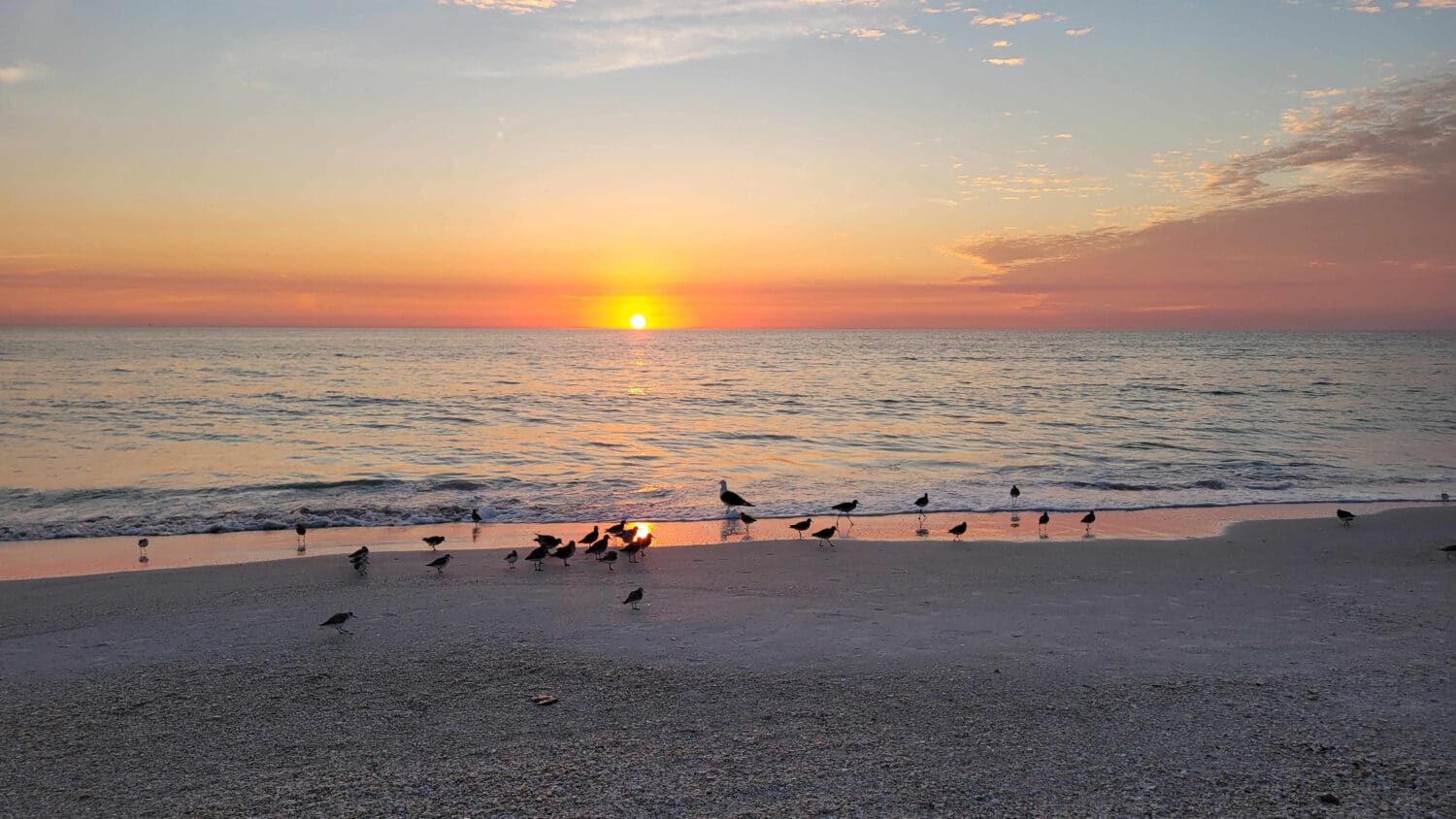
On the pro side, there’s the beautiful, sparkling, magical Gulf of Mexico with its dolphins and manatees and sunsets, its sea turtles, shorebirds and coquinas, its reef fish, waves and clouds, its moonsets, peace and beauty.

On the con side, there’s the raging, unpredictable, fierce Gulf of Mexico, with its floodwaters pushing several feet of sand into our homes, its theft of protective sand dunes, leaving the beaches flat and unappealing, its slaughter of sea oats and sea grapes and palm trees and saw palmettos and yellow beach sunflowers and purple railroad vines, its insidious approach closer to beachfront properties – and that’s not an optical illusion.

Many of us spent a lot of time trying to identify all the lesser cons to justify our decisions to leave – the Island’s horrible traffic problems during season, the loss of Old Florida to mega-mansions, the red tide, the difficulty getting and paying for insurance, the already-dwindling supply of friends and neighbors.

But let’s not kid ourselves. All of that pales in comparison to the trauma that everyone experienced to one degree or the other, according to our temperaments and the extent of our bad luck, after Helene and Milton, which – in case we missed the prophecy of Helene – came two weeks later to underline it.

When you boil it all down, it’s hurricanes making everyone flee the Island.

Including, after 23 years on the beach, me.

I was the last person in the world my neighbor thought would ever leave, and she was the last person in the world I thought would ever leave, but, to our mutual surprise, both of us are leaving.

The Gulf looms in my mind as a potential danger now, not the haven it always was since my childhood, when crossing the Manatee Avenue bridge to the Island and watching the pelicans glide over the bridge’s edge always promised a happy day of surfing, sunbathing and fun with friends ahead.

Now, it’s a blackhearted lover who lulled us into a false sense of security while planning a malicious betrayal behind the scenes that left us in pieces.

The Gulf never promised us anything, but we decided that it was good and true and beautiful and could never harm us. We wanted it to be so with all our hearts and thought that our faith and deep love for it would make it so.

But in its depths, it held the power to destroy our lives, homes and businesses, and with the dispassionate approach of an executioner, with no opportunity to have a trial, plead for mercy, or even say goodbye, it did.

So goodbye, beach, with your wild, creative and destructive beauty; goodbye, lifelong dream of a lifelong beachfront cottage; goodbye backyard surfing and swimming and sunsets.

We who reluctantly leave graduate on to the next thing, whatever that may be, as survivors – stronger in some ways, weaker in others – but always, always Island girls and boys in our hearts.

Piney Point spill critics take aim at sewage dumping

When local waters contain enterococci bacteria, which comes from sewage, The Sun publishes a water quality report listing affected beaches to warn swimmers to stay out of the water.

This week, all the local beaches tested negative for the bacteria (in addition to being free of red tide for the second time in two weeks). But the water quality report makes it into print more than anyone would like.

The good news is that the same environmental coalition that sued Piney Point and the Florida Department of Environmental Protection (FDEP) this year for dumping wastewater into Tampa Bay, causing red tide, is now suing the city of Bradenton for dumping sewage in the Manatee River and other waterways.

These lawsuits may never be won in court, but they likely will be a win for the environment, pushing regulators and municipal officials to be accountable after decades of passing the buck.

That’s a win for every resident and tourist who turns on a faucet or flushes a toilet.

Suncoast Waterkeeper, Our Children’s Earth Foundation, ManaSota-88 and Tampa Bay Waterkeeper have put the city of Bradenton on notice for violations of the federal Clean Water Act, claiming that the city “has repeatedly sent raw and partially treated sewage into the Manatee River, storm drains, streams, neighborhoods and local waters including Wares Creek, Palma Sola Creek, and Palma Sola Bay which flow into Lower Tampa Bay, Sarasota Bay and the Gulf of Mexico.”

“Bradenton’s sewage woes are unfortunate and follow a familiar pattern of municipalities neglecting critical environmental infrastructure,” said Justin Bloom, founder and board member of Suncoast Waterkeeper. “We hope that Bradenton will follow the path of the other municipalities that we’ve sued and focus their attention on fixing the problems and reducing the sewage pollution that plagues our waterways.”

The notice cites the city’s reports that within the last four years, over 160 million gallons of raw and partially treated sewage was dumped into the Manatee River, bypassing the city’s treatment plant, resulting in high levels of fecal coliform and enterococci bacteria in the Manatee River.

The discharges contribute to red tide, according to Glenn Compton, chairman of ManaSota-88.

“We just endured an incredibly difficult summer, where we witnessed red tide kill large quantities of marine life. If we don’t fix these problems, we’re likely to endure more pain in perpetuity. Red tide and contamination is hurting our local economy, much of which relies on our waterways,” he said. “We have to do better for our quality of life and for future generations.”

The environmental coalition has also petitioned the receiver for Piney Point, the former phosphate plant at Port Manatee, to ensure the remaining wastewater at the site is clean enough to inject into a deep well under the Floridan aquifer, the source of Florida’s drinking water. FDEP is in the process of permitting the well.

“The permit application admits that Manatee County does not know the precise geologic strata in the location of the proposed well, and instead is guessing that the ‘anticipated geologic strata’ is similar to a well located five miles away,” according to the Nov. 10 letter to Tampa lawyer and Piney Point receiver Herbert R. Donica. “The permit application further admits that Manatee County does not know the precise location where the underground drinking water source begins or ends… a thorough analysis of the wastewater must be completed before billions of gallons of dangerous pollution is injected beneath the Lower Floridan aquifer.”

Coast Lines: First, do no harm

Coast Lines: First, do no harm

A recent visit to the Mulberry Phosphate Museum was fascinating, with its finds of prehistoric giant ground sloths, mammoths, sharks, manatees and crocodiles, and even a 3000-year-old dugout canoe, all unearthed by equipment used in phosphate mining.Coast Lines logo - border

Wall murals show how mining companies in Florida restore the land after the mines are exhausted, even to the point of hosting threatened Florida scrub jays and gopher tortoises.

Missing from the diorama is what happens when it all goes wrong.

Lining gypsum stacks with material that wasn’t supposed to deteriorate and filling them with wastewater from the Piney Point phosphate mine never sounded like the best idea, but it likely was the most cost-effective idea.

Now that there’s a breach, and the ongoing discharge of hundreds of millions of gallons of wastewater into local waters to avert a worse breach, we’re faced with the prospect of an environmental disaster unseen since the Deepwater Horizon oil spill began in April 2010.

Why can’t the wastewater be pumped into containers at Port Manatee instead of into our precious, beautiful and interconnected waterways, where nitrogen and phosphorus from the wastewater is undoubtedly going to feed red tide, and where other toxins may kill fish even before the red tide gets them?

Containers could be stored indefinitely, or transported to a treatment plant, which, by the way, could have been mandated on site when the mine was permitted.

Surely there is emergency money for such a solution in the state’s budget, if not the Florida Department of Environmental Protection’s budget.

If state leaders are not able to come up with a better solution to this crisis than dumping phosphate mining wastewater into the pristine waters that attract our visitors, why continue to spend money on advertising for tourists?

Especially this time of year – when it’s spring, and we’re just peeking out from the pandemic – it’s heartbreaking to realize that in the coming weeks, we may see vacations ruined by red tide, fish kills and respiratory symptoms, and maybe things even worse than red tide. We may see vacation rental cancellations and businesses floundering, just when they’re about to regain normalcy from the pandemic.

Thanks to a lack of responsibility, wisdom, foresight and possibly even concern among government officials, visitors and residents will likely be avoiding the beaches this summer – the one place where we almost felt comfortable during the year of the coronavirus.

To the families evacuated from their homes just before Easter Sunday, to the people who have spent decades volunteering to plant seagrasses and count scallops and create oyster beds in area waters, to those who make their livings on the water, to the marine life, and to all the people of Tampa Bay, mine owners and state officials owe more than mitigation and an apology.

They must choose a solution to this crisis that does no further harm.

Earthy ideas from The Sun

Earthy ideas from The Sun

Odette Katrak was sitting at her computer in Bengaluru, India Googling “Imagine There’s No Plastic,” a song based on John Lennon’s “Imagine” that she had recently recorded and posted on YouTube.Coast Lines logo - border

What popped up was The Anna Maria Island Sun’s Coast Lines column headlined “Imagine there’s no plastic,” published July 24, 2018.

She reached out from the other side of the Earth and wrote to us.

We both noted how interesting it is that ideas often pop up at the same time across the universe.

“So delighted to read your article titled ‘Imagine there’s no plastic’ which I chanced upon just now,” she wrote. “I too am bothered about the untold amounts of plastic in our lives.”

Third Place
Commentary
2019

While Bengaluru (Bangalore) and Bradenton Beach are quite different – the former has 12 million people, for starters, and it only seems like that many here during tourist season – it turns out that we also have quite a lot in common.

Earthy ideas from The Sun
Odette Katrak, co-founder of Beautiful Bengaluru.

Bengaluru has water shortages, just as we do in Florida.

Called an eco-warrior by her local newspaper, the Deccan Chronicle, Odette’s response to water shortages was to send out one message a day during March about saving water.

India also has plastics washing up on the beaches of the Indian Ocean and the Bay of Bengal, just as we do on the beaches of the Gulf of Mexico and Palma Sola Bay, including plastic pieces of an oil rig that appeared on Bradenton Beach in 2015.

That was the year Odette co-founded Beautiful Bengaluru, a group working for “a clean, green, safe city and a greener planet.”

She’s a lot like the subject of The Sun’s story, Capt. Bill Brooker, who picks up plastic from Sarasota Bay during his lessons and charters.

“Today, one of my core raison d’etre’s is to eliminate plastic  – not from my life (it’s gone already and we are a zero-waste family) – but from the lives of people who don’t even realize it is harming them,” she wrote.

Beautiful Bengaluru will be publishing a new website soon that will include a startling poster with a piece of plastic covering a bird’s head and long neck. The photo was taken by American photographer John Calcolosi, who gave Odette permission for it to be used for the “Imagine there’s no plastic” video.

“This is fortunate, as this stunning visual sends out a powerful message on a vital worldwide environment theme. It will be one of many teaching tools “relevant to any city in the world,” she wrote.

Earthy ideas from The Sun
This “Imagine There’s No Plastic” poster will be one of many on the forthcoming Beautiful Bengaluru website.

Maybe someday we can keep our plastic trash from washing up on each other’s shores, with a little help from our friends.

Earth Day

A good day to pick up plastic trash from the beach is Monday, April 22, Earth Day.

Back in 1970 when Earth Day was founded, few had any earthly idea about the things that were about to happen to the Earth. Climate change. The Exxon Valdez. Melting glaciers. Fracking. Repetitive red tides. Blue-green algae.

Deepwater Horizon.

April 20 marks the ninth anniversary of the Deepwater Horizon explosion and oil spill, the worst environmental disaster in the history of the Gulf, which killed 11 people, injured 17, and killed millions of fish, marine mammals, sea turtles and shorebirds. An estimated 4.9 million barrels of oil leaked into the Gulf of Mexico, treated with a chemical dispersant that broke down the oil, but did not eliminate it.

While we didn’t see any oil wash up on local beaches, Manatee County qualified for RESTORE Act funding, fines that BP paid for the disaster.

Local RESTORE Act projects include the Gulf Shellfish Institute Sea Farm to Table project for research on shellfish production and the Coastal Watershed Management Program to address flooding and drainage problems, including nutrient runoff in local waters that worsens red tide.

To observe the Deepwater Horizon anniversary and Earth Day, help “restore” a beach and pick up some plastic from a local patch of sand.

And enjoy the Earth.

Sail

Imagine there’s no plastic

Coast Lines logo - borderWhen Capt. Bill Brooker takes the Chomsky out on Sarasota Bay for a lesson or a charter, he watches the clouds for rain. He watches the sails for wind. And he watches the water for trash, particularly plastic trash.

It may take an extra tack or two, but going after plastic bottles, straws and other flotsam and jetsam is all part of being a good sailor, according to the sailing instructor and former psychologist, who sails out of Sara-Bay Sailing School and Charter, 4134 Gulf of Mexico Drive, Longboat Key.

[embedyt] https://www.youtube.com/watch?v=1s3K6VKOuPc[/embedyt]

Brooker is joining the American Sailing Association (ASA) in launching “Operation Plastic Pollution Purge” to encourage boaters to clean up trash from waterways.

The public service campaign aims to raise awareness of plastic pollution to encourage people to recycle and properly dispose of plastic.

All summer, the association is asking boaters to bring a trash bag onboard and pick up any garbage they see, whether it’s on the water’s edge or in the water.

Sail
A cormorant perches on a channel marker in Sarasota Bay. Birds can become fatally entangled in plastic fishing line. – Cindy Lane | Sun

Boaters can post photos of themselves and their crews picking up trash on the ASA Facebook page.

“Plastic pollution is not an ocean, river, lake or stream problem, it’s a people problem,” said Lenny Shabes, CEO and founder of the ASA, the world’s largest sailing organization and America’s sail education authority.

“We must do our part to discourage everyone from trashing our waterways with plastic bottles, bags, cups, utensils and plates,” he said. “If we all do our part, we can make a difference by raising awareness to help stop this tidal wave of plastic threatening all of us.”

Plastic fishing line is one of the biggest sources of plastic pollution and wildlife entanglement and strangulation, Brooker said, despite recycling stations stationed at several area piers and boat ramps.

Monofilament fishing line can stay in the water for 600 years, according to the Florida Fish and Wildlife Conservation Commission, which suggests that anglers can make their own onboard fishing line storage bins by cutting an “X” in the lid of a tennis ball container or coffee can to keep it from blowing overboard.

But most plastic trash in the water comes from land, not boats, Brooker said, such as plastic bags that people take to the breezy beach, and which sea turtles mistake for yummy jellyfish.

According to a University of Georgia study, 18 billion pounds of plastic waste blows into the ocean each year, the equivalent of five grocery bags of plastic trash sitting on every foot of coastline around the world, according to the ASA.

– Cindy Lane | Sun

It’s one of several reasons for the campaign, including these:

  • The Great Pacific Garbage Patch in the Pacific Ocean between Hawaii and California, one of five plastic islands worldwide, has grown to twice the size of Texas.
  • One million seabirds die annually from getting tangled in and/or eating plastic.
  • One hundred marine mammals die annually from getting tangled in and/or eating plastic.
  • S. residents use almost one plastic bag each, every day, compared to Denmark residents who each use an average of four plastic bags a year.
  • Americans each throw out an average of 10 plastic bags every week.
  • The plastic problem is growing at such a rapid pace it’s the equivalent of dumping one New York City garbage truck full of plastic into the ocean every minute of every day.

For more information, visit ASA.

Visit Capt. Brooker or call him at 941-914-5132.

And please take the time to pick up plastic trash.

Coast Lines logo - border

Earth Day cloudy, with silver lining

A few storm clouds are gathering over Earth Day this year, but there’s a silver lining.

Manatees

The U.S. Fish and Wildlife Service downlisted manatees under the U.S. Endangered Species Act from endangered to threatened status in March.

Florida manatees should have been exempted from this downlisting, which was based on studies of manatees in Puerto Rico, Mexico, Central America, northern South America and the Greater and Lesser Antilles.

Florida survey counts show increasing population numbers, but ignore the inequitable comparison of single day/single aircraft counts in years past with multi-day/multi-aircraft counts in recent years, which likely resulted in counting animals moreEarth Day than once, both by the same and different spotters.
The agency also did not consider the anticipated loss of artificial winter warm water habitat – primarily power plant closures – on which more than 60 percent of the Florida manatee population depends, nor did it consider the increasing popularity of recreational boating in Florida that further endangers the animals, few of which escape propeller cuts in their lifetimes.

EPA cuts

The Environmental Protection Agency will have less ability to protect the environment with budget cuts announced in March that will reduce staff and cut funding for programs including water and air quality programs, environmental education programs, environmental law enforcement and five programs affecting Florida and the Gulf of Mexico, “returning the responsibility for funding local environmental efforts and programs to state and local entities,” according to a March 21 EPA memo.

BP oil spill

April 20 is the seventh anniversary of the Deepwater Horizon oil spill, which killed 11 people and spilled 200 million gallons of oil over three months into the Gulf of Mexico from Florida to Texas.

The 1.8 million gallons of chemical dispersant used to break up the oil into microscopic particles did not remove the oil from the Gulf, but made it invisible, and is thought by some scientists to be causing as much damage to marine life reproduction and health as the oil itself.

But one light on the horizon is a program by the National Oceanic and Atmospheric Administration (NOAA) and the National Fish and Wildlife Foundation, funded with restoration money provided by BP.

Seven Louisiana longline fishermen were chosen from about half of the 45 eligible vessel owners in the Gulf, some from Florida, who applied for a pilot project to voluntarily use alternative gear for a four-month pilot period ending June 30. If the gear works, a voluntary ban on longline fishing with traditional gear will be implemented six months of each year for the next 5-10 years to allow affected fish species to recover from the disaster.

A silver lining

Local folks have taken to heart the idea of Earth Day founder David Brower in 1970, “Think globally, act locally,” by planting trees and cleaning up Manatee County.

Keep Manatee Beautiful (KMB) is keeping the torch lit with the Great American Cleanup from 9 a.m. to noon on Earth Day, Saturday, April 22, in several locations, including Anna Maria City Hall, 10005 Gulf Drive, Kingfish Boat Ramp on State Road 64 West at the drawbridge in Holmes Beach, and the FISH Preserve, 11601 Cortez Road W. Adopt-A-Highway, Road and Shore groups will be doing cleanups at their adopted sites, including Palma Sola Causeway and Anna Maria Island beaches.

Volunteers on the Island, in Cortez and on the causeway will be thanked with an Earth Day Party at Manatee Public Beach, 4000 Gulf Drive, Holmes Beach, compliments of the Anna Maria Island Beach Café.

KMB also will host National Arbor Day ceremonies on Friday, April 28, when it will plant trees countywide.

In Pope Francis’ encyclical, “Laudato Si, On Care for Our Common Home,” he writes that in damaging the environment, we damage each other and future generations, and invites everyone to make a difference in small ways such as these.

To volunteer, visit https://manateebeautiful.com and www.arborday.org.