BRADENTON – At a time when red tide levels recently increased in Anna Maria Island waters and a Bradenton man recently lost his leg to flesh eating bacteria (vibrio vulnificus) after wade fishing in Sarasota Bay, the city of Bradenton discharged an estimated 825,000 gallons of partially treated or raw wastewater and/or sewage into the Manatee River in November.
The city of Bradenton also discharged more than 2,000 gallons of raw wastewater into Wares Creek.
Past events
In August, during and after Tropical Storm Debby, the city of Bradenton’s water reclamation facility discharged an estimated 25 million gallons of partially treated or raw sewage into the Manatee River. The neighboring city of Sarasota discharged an estimated 18 million gallons of partially treated or raw sewage into Sarasota Bay. Combined, the Bradenton and Sarasota water reclamation facilities discharged an estimated 43 million gallons of partially treated or raw sewage into local waterways.
Recent events
According to the Wastewater Digest website, the headworks of a wastewater treatment plant is the initial stage of a complex process. According to the noncompliance report posted at the city of Bradenton website, on Nov. 6, the emergency stop button or switch was hit at the headworks at the water treatment facility (WTF) at 17th Avenue West triggering an alarm in the supervisory control and data acquisition system. The alarm was acknowledged but not investigated. When the evening operator did the plant check, it was found the headworks was overflowing. The overflow occurred for about 15 minutes. The operator reset the panel and everything started working. The area affected was a grassy area at the headworks and the roadway at 17th Avenue West, including the storm drain. According to the report, at least 6,000 gallons of wastewater were discharged into the Manatee River via the storm drain.
On Nov. 17, there was a period of high chlorine demand due to a backwash and the operator on duty reacted incorrectly, resulting in the residual chlorine falling below the limit in contact chamber #2. The effluent (wastewater) was not fully disinfected during that time. The incoming operator noticed it and corrected the issue by putting the bleach back into the automated system. The total estimated volume of partially treated wastewater discharged into the Manatee River at the water reclamation facility outfall was 297,000 gallons.
On Nov. 21, there was again a period of high chlorine demand due to a backwash and the operator on duty again reacted incorrectly, resulting in the residual chlorine falling below the limit in contact chamber #2. The effluent was not fully disinfected during that time. The incoming operator noticed it and corrected the issue by putting the bleach back into the automated system. The estimated volume of partially treated wastewater discharged into the Manatee River at the water reclamation facility outfall was 525,000 gallons.
“This was an operator error in their response to the high chlorine demand. The WRF (water reclamation facility) acting superintendent/chief operator created a troubleshooting SOP (standard operating procedure) for these types of instances. The city has contracted with Jacobs Engineering to provide on-the-job training to all operators. This will help in ensuring that all operators have similar base knowledge,” according to the noncompliance report.
On Nov. 24, Lift Station #7, near Eighth Avenue West, had a variable frequency drive and radio malfunction due to the uninterruptible power system faulting which caused the lift station to stop functioning but did not trigger an alarm. There are three manholes at the crossing of Eighth Avenue West and 17th Street West and citizens called to report the manholes were overflowing. The estimated volume of raw wastewater that spilled into Wares Creek was 2,000 gallons.
The noncompliance information posted at the city of Bradenton website is also posted at the Florida Department of Environmental Protection’s Pollution Notice webpage, along with other pollution-related incidents reported statewide.
BRADENTON – During and after what was then Tropical Storm Debby, the city’s water reclamation facility discharged an estimated 25 million gallons of raw and partially treated sewage into the Manatee River, according to department officials.
The neighboring city of Sarasota discharged nearly 18 million gallons of raw and partially treated sewage into that city’s stormwater system, which connects to Sarasota Bay, according to department officials.
In total, the Bradenton and Sarasota water reclamation facilities discharged nearly 43 million gallons of sewage into local waterways.
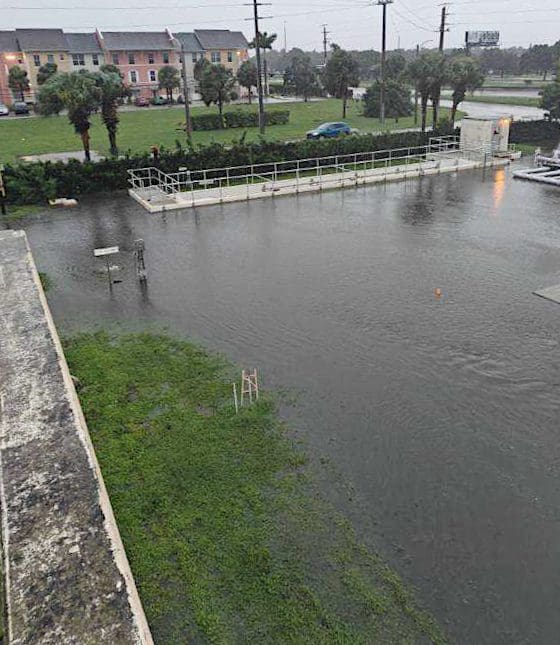
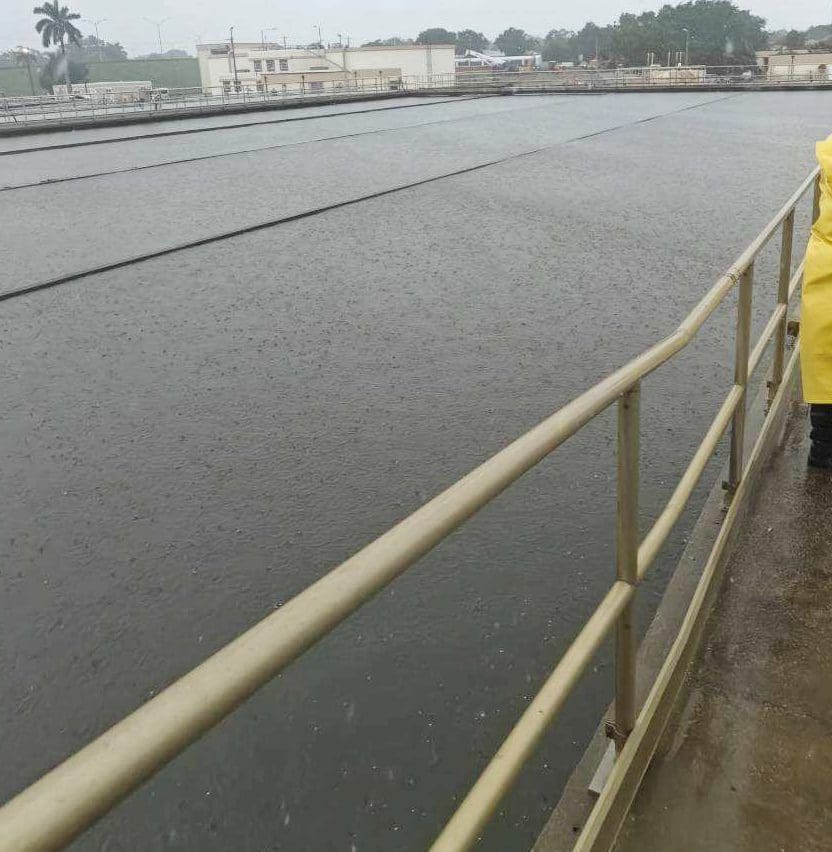
The rain associated with Tropical Storm Debby exceeded the Bradenton water reclamation facility’s storage capacities. – City of Bradenton | Submitted
Despite the influx of sewage into waters surrounding Anna Maria Island, the enterococcus bacteria levels in most areas were deemed “good” when last tested by the Florida Department of Health (FDOH) on Aug. 13.
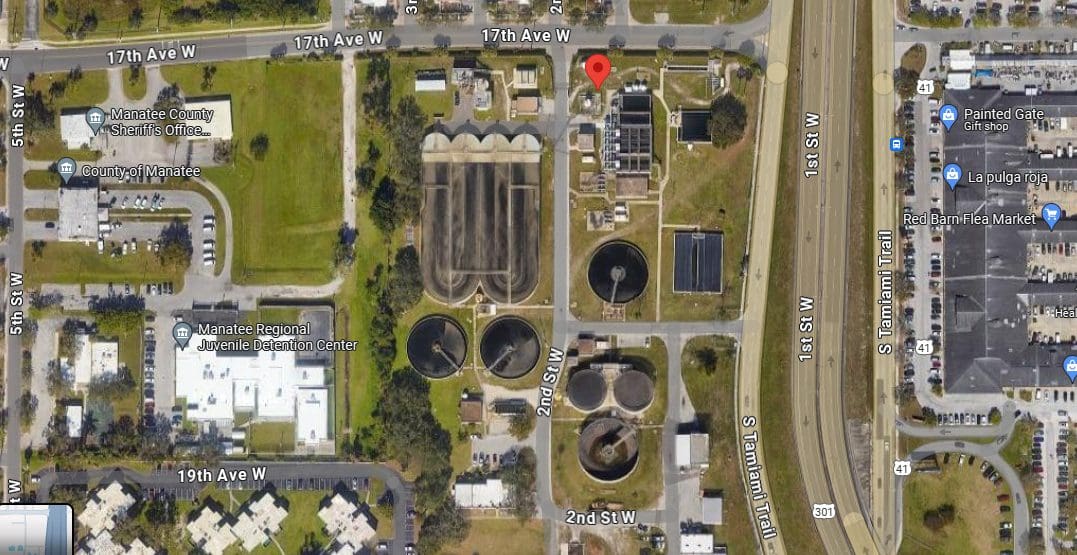
The Bradenton water reclamation facility is located across the street from the Red Barn Flea Market. – Google Maps | Submitted
According to the city’s report, “It’s estimated that the total volume bypassed from 08/04 – 08/07 was 25MG (million gallons).”
When contacted by The Sun on Aug. 12, Suncoast Waterkeeper board member and attorney Justin Bloom said, “According to the city’s own records, in which they’re reporting sewage spills to FDEP (the Florida Department of Environmental Protection), they discharged, directly to the Manatee River 25 million gallons of sewage between August 4th and August 7th. Suncoast Waterkeeper is concerned about the impact this significant amount of sewage will have on the Manatee River.”
The Bradenton water reclamation facility was overwhelmed by rain associated with Tropical Storm Debby. – City of Bradenton | Submitted
The mouth of the Manatee River empties into Tampa Bay near the northern tip of Anna Maria Island.
The city’s report states, “The event was caused by the heavy rain and high flow associated with Hurricane Debby and was unavoidable. As with utilities state-wide, the WRF staff did everything possible to not have to bypass, but with between 17-19 inches of rain during the storm it was unavoidable.”
The city’s report also includes the following information:
“On 08/04, the aerators were taken offline at 2 p.m. in anticipation of high flow.
On 08/04, the WRF experienced extremely high flow into the plant beginning around 17:00. By 18:30, the aerators, headworks, clarifiers, and filters began overflowing and bypass began.
On 08/05, the WRF bypassed the filters and wet well due to continual heavy rain and high flow.
Manatee River spill sample collection began on 08/06.
On 08/06, the plant experienced random high flow events causing the outfall and clear well to overflow.
On 08/08, two aerators were turned back online.”
In addition, report notes: “Sample collection is ongoing, preliminary results from 08/06 have been received but no official laboratory report has been. The city will continue to update FDEP as data is received and upon the conclusion of sampling.”
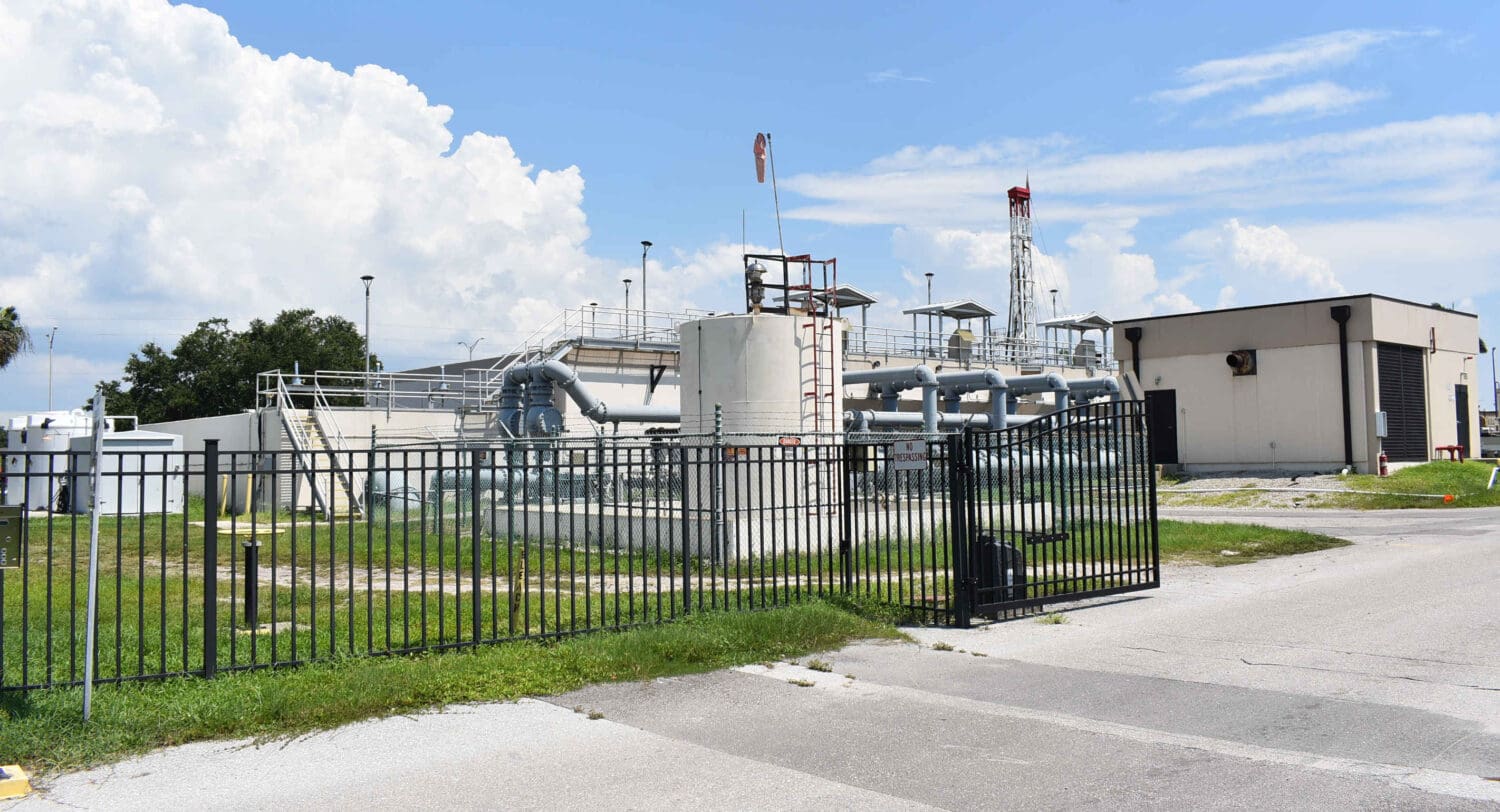
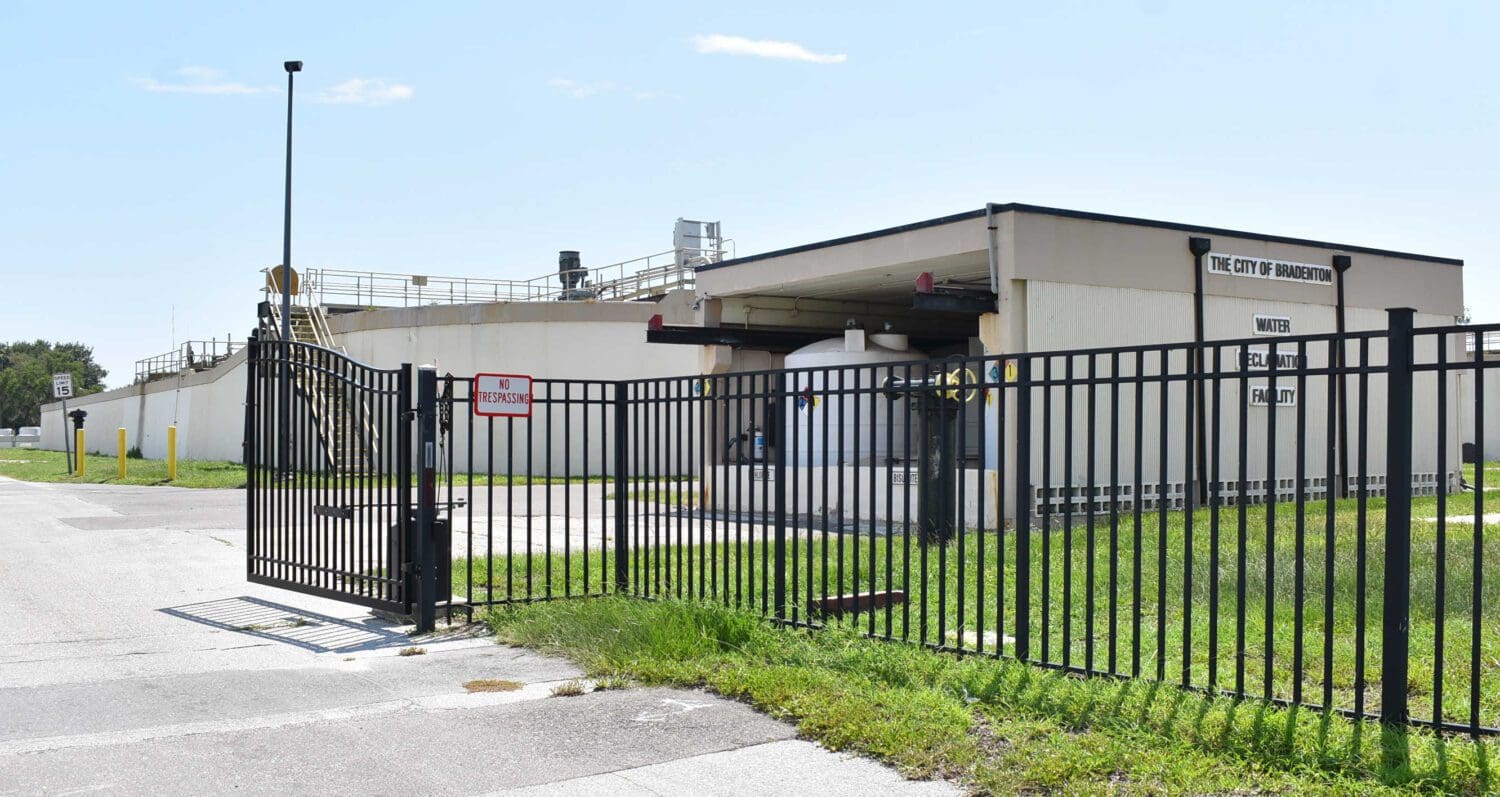
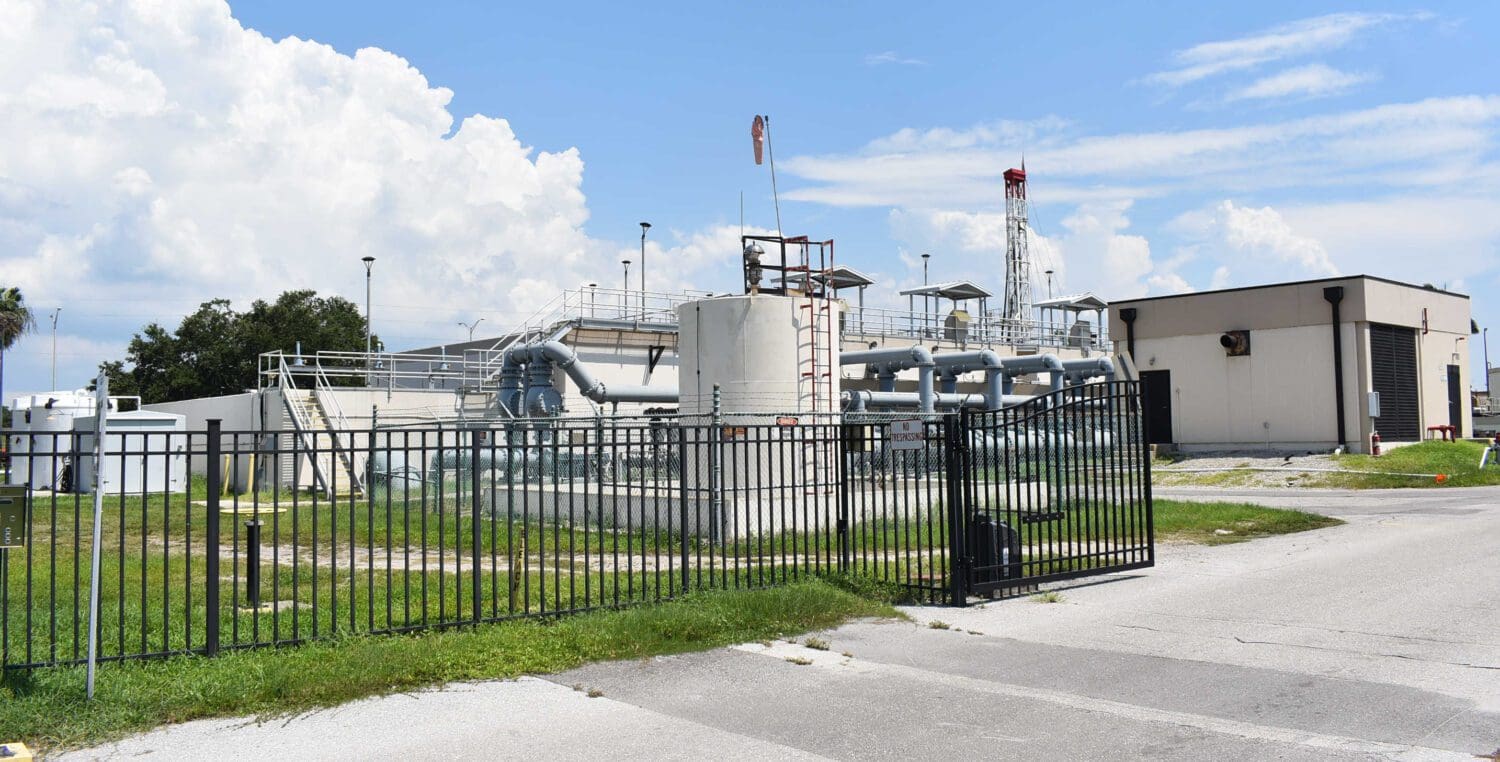
Bradenton’s water reclamation facility features numerous wastewater treatment and storage components. – Joe Hendricks | Sun
In an email exchange with Bradenton resident and concerned citizen Ernie Vanderwalt, FDEP Southwest District Office Director Kelley Boatwright acknowledged the sewage discharge.
“Department staff confirmed that the city of Bradenton had sanitary sewer overflows that total approximately 25,000,000 gallons due to Hurricane Debby. Staff are tracking the reports, evaluating the data, and will determine next steps,” Boatwright stated in his Aug. 12 email to Vanderwalt.
Sarasota overflow
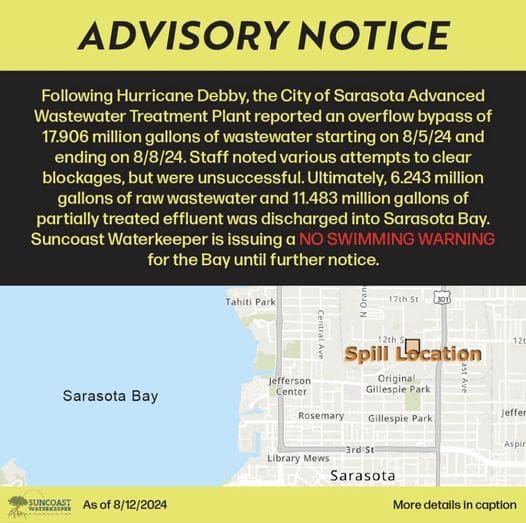
According to the incident description report provided by the city of Sarasota, “During the event, approximately 6.243 million gallons of raw wastewater was discharged to Sarasota Bay. In addition, approximately 11.483 million gallons of partially treated effluent was discharged to Sarasota Bay. Samples will be collected.”
According to the incident description, “The city of Sarasota’s advanced wastewater treatment plant was severely impacted by excessive flow from Hurricane Debby. Operations staff did everything in their power to control the flow coming into the facility. Due to the incredible flow volume coming to the plant, up to 44.29 MGD (million gallons daily) in a single day, plant staff were unable to prevent spills from the headworks at the treatment plant. Staff made every effort to contain and control the spill, but the volume was too significant to avoid the mixture of rainwater and untreated sewage entering the stormwater collection system.”
Water quality tests
According to the FDOH website, “Enterococci are enteric bacteria that normally inhabit the intestinal tract of humans and animals. The presence of enteric bacteria can be an indication of fecal pollution, which may come from stormwater runoff, pets and wildlife and human sewage. If they are present in high concentrations in recreational waters and are ingested while swimming, or enter the skin through a cut or sore, they may cause human disease, infections or rashes.”
FDOH analyzes water samples for total bacteria counts and rates the results as good, moderate or poor.
Good: 0–35.4 enterococci per 100 milliliters of marine water
Moderate: 35.5–70.4 enterococci per 100 milliliters of marine water
Poor: 70.5 or more enterococci per 100 milliliters of marine water
If the results indicate poor water quality, FDOH issues public notices and may post warning signs at impacted beaches that state swimming or other water activities are not recommended.
According to FDOH water quality testing results, the enterococcus levels in the water at Bayfront Park in Anna Maria were listed as good for Aug. 7, 11 and 13. Before Tropical Storm Debby, the enterococcus levels at Bayfront Park tested poor on July 22, July 29 and July 31. FDOH issued a water quality notice for Bayfront Park on July 31 but has not issued any additional Bayfront Park notices.
On Aug. 7, 11 and 13, the enterococcus levels at Manatee Beach in Holmes Beach were listed as good. When tested on Aug. 7, 11 and 13, the enterococcus levels at Coquina Beach North, Coquina Beach South and Cortez Beach (all in Bradenton Beach) were all listed as good.
When tested on Aug. 7, 11 and 13, the enterococcus levels at the Broadway Beach Access in Longboat Key were listed as good.
When tested on Aug. 7, 11 and 13, the enterococcus levels at Palma Sola Causeway South were listed as poor on each of those days, and also on July 29 and July 31. FDOH advisories were issued on July 31 and Aug. 7, 11, and 13.
According to FDOH, several locations in Sarasota were tested on Aug. 12 and the enterococcus levels at those locations were listed as good.
On Facebook, some Island residents and visitors reported strong odors and possible human waste discovered in the waters along some Anna Maria Island beaches.
On Aug. 12, the Suncoast Waterkeeper organization issued a “No Swimming” warning for Sarasota Bay that was to remain in effect until further notice.
On Aug. 12, The Suncoast Waterkeeper organization issued a no-swim advisory for Sarasota Bay. – Suncoast Waterkeeper | Submitted
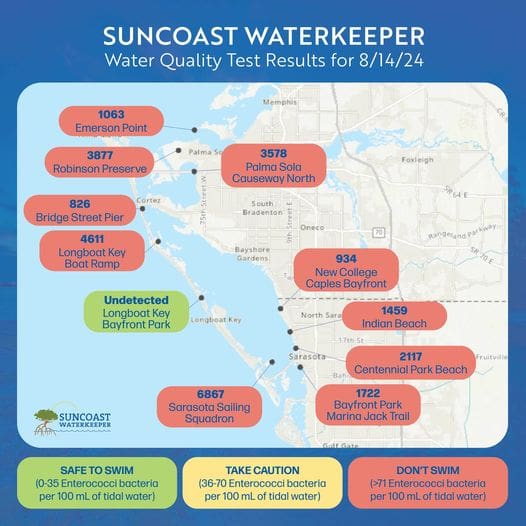
On Aug. 16, Suncoast Waterkeeper posted a Facebook message that said, “On August 14th, the enterococci survey was conducted during a falling tide. Salinity levels ranged from 18-29 ppt. The impact from Debby was still evident in the water quality on Wednesday and will likely continue throughout the weekend.”
Suncoast Waterkeeper released this water quality test results map on Aug. 16. – Suncoast Waterkeeper | Submitted
The Aug. 16 Facebook post was accompanied by a water quality test result graphic that indicated 10 locations in Bradenton, Anna Maria Island and Sarasota that Suncoast Waterkeeper considered to be “Don’t Swim” areas, including the Bradenton Beach City Pier on Bridge Street, Palma Sola Causeway North, Robinson Preserve and the Longboat Key boat ramp.
As of Aug. 19, The Sun was unable to obtain any additional water quality testing results from FDEP.
BRADENTON – Shortly after noon on Feb. 28, the City of Bradenton’s water reclamation facility experienced an operational failure, causing 1.2 million gallons of partially treated wastewater to be discharged into the Manatee River, according to a Florida Department of Environmental Protection (FDEP) pollution notice.
The mouth of the Manatee River flows into the Intracoastal Waterway and the Gulf of Mexico at the north end of Anna Maria Island.
According to FDEP, the filter system at the facility at 1810 First St. W. had a blockage, causing the bypass of the water into the river. The bypass was closed at 5:10 p.m. and river water sampling was started.
City staff cleaned the areas affected and normal operation resumed, according to FDEP.
A Feb. 29 City of Bradenton Instagram post stated: “City of Bradenton’s Wastewater Treatment Facility faced an operational failure, leading to a 90-minute tank overflow due to blockages. A seized bypass valve was manually reopened, and the surrounding curb and gutter area on 17th Avenue, approximately 200 yards, swiftly returned to normal after cleaning and treatment. The city is investigating the system malfunction and collaborating with environmental agencies on discharge and drainage issues.”
“At a time when cities are working to reduce nitrogen overflow into the waters to curb red tide and algae blooms, this spill of partially treated wastewater is high nitrogen water filled with bacteria entering a public water body,” Suncoast Waterkeeper Executive Director Anney Tyrna said.
In 2022, Suncoast Waterkeeper and other environmental groups sued the City of Bradenton following a prior spill. The settlement stipulated that the city improve the wastewater treatment system.
“The city is working toward improving the infrastructure so this doesn’t happen again,” Tyrna said. “The infrastructure is old and in need of repair. Repairs are long overdue, but it takes time to make these repairs.”
Tyrna said with the latest spill, and based on the 2022 settlement terms of the lawsuit, there may be stipulated penalties due from the city to the Tampa Bay Estuary Program.
ANNA MARIA – Public Works Manager Dean Jones has accepted a position as the new assistant director of Public Works and Utilities for the city of Bradenton.
Mayor Dan Murphy announced Jones’ pending departure in an email sent to city commissioners and others on July 5.
“Please join me in wishing Dean Jones well in his new position as Assistant Director of Public Works and Utilities with the city of Bradenton. His resignation is effective July 16. Dean has served as public works manager for the city of Anna Maria since 2015. Effective immediately, Ryan Wieland, assistant public works manager, will assume Dean’s responsibilities as public works manager on a temporary basis. Ryan began his career with our city in 2018 and was appointed assistant manager of public works in 2019. A permanent replacement for Dean will be named in the near future.”
Ryan Wieland is now serving as the public works manager on an interim basis. – City of Anna Maria | Submitted
When contacted later in the week, Murphy said, “I’m happy for Dean and I think this is a great opportunity for him. I know he’ll do well working for the city of Bradenton. They are getting a well-trained guy who gets things done. Ryan is taking Dean’s place on a temporary basis for right now, until a permanent appointment can be made, which I expect to get done in the next week or so.”
Jones has worked in Anna Maria’s Public Works Department for the past seven years and he served as public works manager for most of his tenure. His last day on the job will be Friday, July 15.
“I started out as one of the guys, got promoted to assistant manager and shortly thereafter I was promoted to manager. I love the city of Anna Maria. The mayor and the rest of the staff are incredible. I’m sure my assistant, Ryan Wieland, will do very well. I just hope I did a good job and I hope I helped,” Jones said.
“It’s been a wonderful life experience. While working for the mayor, I developed a completely new set of skills than I had when I started. Dan’s an incredible and amazing person to work for and I can’t thank him enough for all the experience he’s given me. He helped me elevate myself to this next position,” Jones said.
Regarding his new position with the city of Bradenton, Jones said, “I’ll be overseeing the golf course, the ball fields, G.T. Bray Park and the water plants – pretty much everything in the city of Bradenton. And like I did in Anna Maria, I’ll try to make it a better place.”
When local waters contain enterococci bacteria, which comes from sewage, The Sun publishes a water quality report listing affected beaches to warn swimmers to stay out of the water.
This week, all the local beaches tested negative for the bacteria (in addition to being free of red tide for the second time in two weeks). But the water quality report makes it into print more than anyone would like.
The good news is that the same environmental coalition that sued Piney Point and the Florida Department of Environmental Protection (FDEP) this year for dumping wastewater into Tampa Bay, causing red tide, is now suing the city of Bradenton for dumping sewage in the Manatee River and other waterways.
These lawsuits may never be won in court, but they likely will be a win for the environment, pushing regulators and municipal officials to be accountable after decades of passing the buck.
That’s a win for every resident and tourist who turns on a faucet or flushes a toilet.
Suncoast Waterkeeper, Our Children’s Earth Foundation, ManaSota-88 and Tampa Bay Waterkeeper have put the city of Bradenton on notice for violations of the federal Clean Water Act, claiming that the city “has repeatedly sent raw and partially treated sewage into the Manatee River, storm drains, streams, neighborhoods and local waters including Wares Creek, Palma Sola Creek, and Palma Sola Bay which flow into Lower Tampa Bay, Sarasota Bay and the Gulf of Mexico.”
“Bradenton’s sewage woes are unfortunate and follow a familiar pattern of municipalities neglecting critical environmental infrastructure,” said Justin Bloom, founder and board member of Suncoast Waterkeeper. “We hope that Bradenton will follow the path of the other municipalities that we’ve sued and focus their attention on fixing the problems and reducing the sewage pollution that plagues our waterways.”
The notice cites the city’s reports that within the last four years, over 160 million gallons of raw and partially treated sewage was dumped into the Manatee River, bypassing the city’s treatment plant, resulting in high levels of fecal coliform and enterococci bacteria in the Manatee River.
The discharges contribute to red tide, according to Glenn Compton, chairman of ManaSota-88.
“We just endured an incredibly difficult summer, where we witnessed red tide kill large quantities of marine life. If we don’t fix these problems, we’re likely to endure more pain in perpetuity. Red tide and contamination is hurting our local economy, much of which relies on our waterways,” he said. “We have to do better for our quality of life and for future generations.”
The environmental coalition has also petitioned the receiver for Piney Point, the former phosphate plant at Port Manatee, to ensure the remaining wastewater at the site is clean enough to inject into a deep well under the Floridan aquifer, the source of Florida’s drinking water. FDEP is in the process of permitting the well.
“The permit application admits that Manatee County does not know the precise geologic strata in the location of the proposed well, and instead is guessing that the ‘anticipated geologic strata’ is similar to a well located five miles away,” according to the Nov. 10 letter to Tampa lawyer and Piney Point receiver Herbert R. Donica. “The permit application further admits that Manatee County does not know the precise location where the underground drinking water source begins or ends… a thorough analysis of the wastewater must be completed before billions of gallons of dangerous pollution is injected beneath the Lower Floridan aquifer.”