Tag: Anna Maria Island fishing

Fishing for fun

When we introduce children to fishing, we should make the experience uncomplicated and as much fun as possible. Creating unrealistic expectations can discourage young anglers and be the difference between kindling a passion for fishing or an aversion to the activity. The basics of fishing are easy to teach and don’t require expensive equipment. If there’s a cardinal rule to getting kids interested in fishing, it’s to keep them engaged. Children are naturally curious; they love to play in and on the water and are fascinated by the creatures they find there. Catching fish isn’t their main objective and you shouldn’t make it the focus of an outing. It’s important to plan a trip that includes other activities like swimming, wildlife identification and snorkeling as well as fishing. Being on the water provides an excellent opportunity to teach kids about their environment and boating safety skills. It’s important to let kids be a part of the adventure and getting them involved is a great way to interject a lesson in responsibility. Let them drive the boat even if they’re just sitting on your lap while you steer. Introduce them to navigating the Intracoastal Waterway and give them things to be in charge of such as making sure everyone knows where the safety equipment is.
Fishing for fun
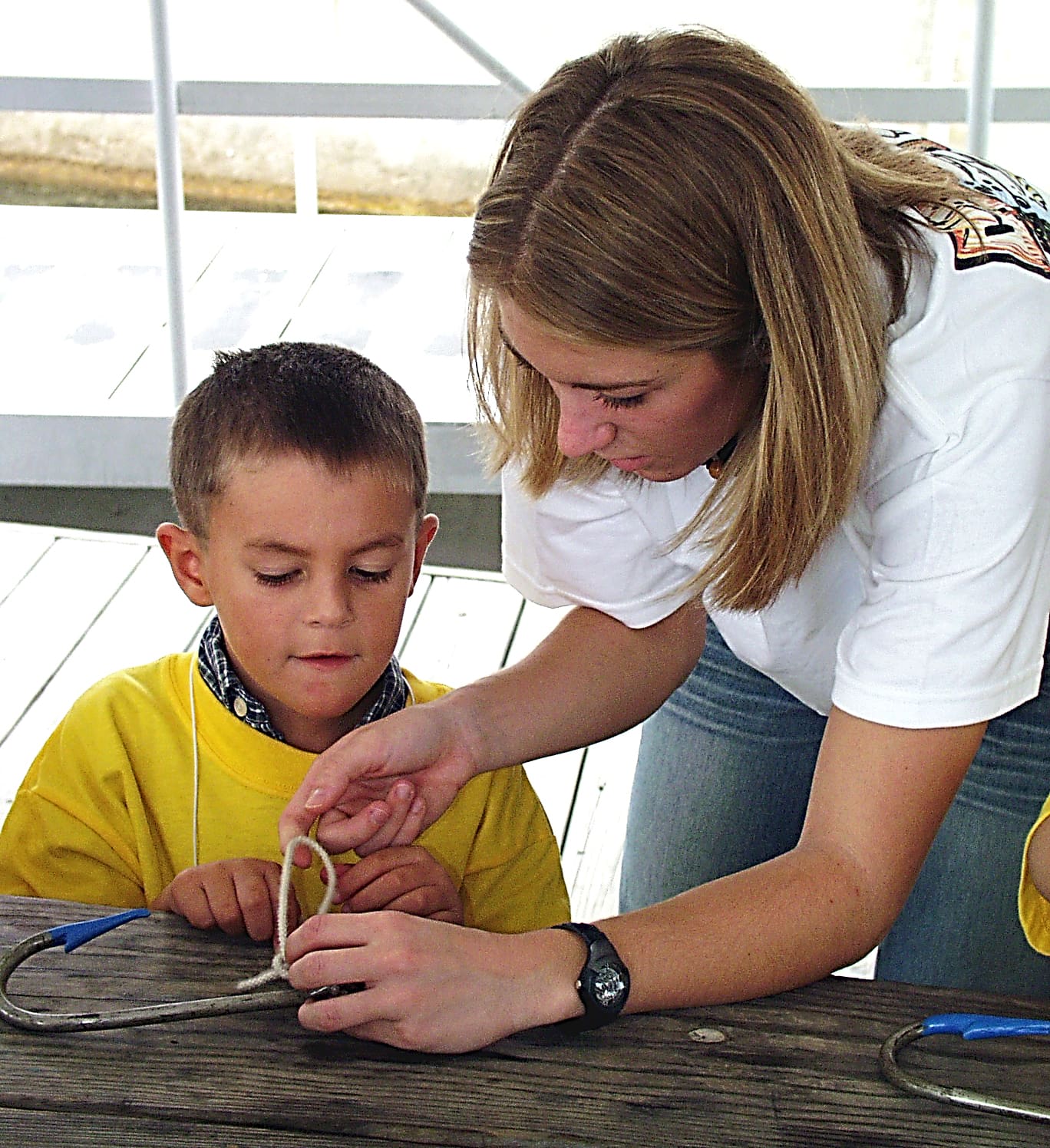
Learning about fishing doesn’t have to be limited to the water. Knot tying skills are an important component. – Rusty Chinnis | Sun

Don’t start children out with cheap fishing rods and reels. Provide them with decent equipment that’s light and manageable. An ultra-light rig with 6-pound test line is a great way to start. Try and think like a kid when fishing. Children would rather catch a dozen pinfish in a half hour than wait hours for a chance at a bigger or better fish. Action is paramount; kids are easily bored and distracted. Consider starting kids fishing with a small popping cork that they can watch for signs of action. If you can start teaching kids that the enjoyment of the adventure isn’t measured by the number or size of fish you catch, you’ll teach them an important lesson that many fishermen never learn. If you can make the experience interesting for them, even if they don’t catch anything they are more likely to want to do it again. Kids might be more interested in collecting shells, counting crabs or looking for manatees or dolphins than fishing, so be sensitive to what’s bringing them pleasure.

It’s also important to emphasize safety, bending down barbs and making them aware of fish with sharp teeth and stingers like catfish and stingrays. These first experiences on the water are very important and you should consider a plan of action in advance in case the fishing isn’t great. The last thing you want to do is bore kids by sitting on a spot too long. Keep your eyes and ears open and if you’re lucky, you might learn a lesson or two from them!

In praise of guides

My first experience fishing with a guide was when I moved to the Suncoast and met Bobby Lee, a neighbor and avid angler. Lee had been chartering for Capt. Scott Moore and would invite me to join him on multiple occasions. It was Moore who showed me a whole new universe of fishing and ignited the flame that burns bright to this day. It was also Moore who sparked my advocacy when our worries about the state of gamefish populations led us to form the Manatee Chapter of The Florida Conservation Association (FCA) with another local guide, Capt. Jim O’Neill.

A writing career was fostered through my work with the FCA. Fishing guides became a trusted source for ideas, techniques and information that I share with my readers to this day. Guides were valued colleagues when my advocacy moved from the fish to the habitat and waters that sustain them. Like his father, Scott, Capt. Justin Moore has a passion for fishing and a conservation ethic he inherited from his dad and G.B. Knowles (the first outdoor editor of The Anna Maria Island Sun). He and other local guides have been “eyes on the water” for Suncoast Waterkeeper and have helped protect acres of mangroves and seagrass habitat.

Now many of these dedicated watermen are suffering from many factors not of their making. If you haven’t fished with a guide, this is an excellent time to experience some of the dedication, expertise and humor that I have found invaluable for four decades.

Recently, I was talking to Anna Maria guide Capt. Dave White about these challenges and asked him to put his feelings down in his own words. He responded, “The charter fishing industry is undeniably a ‘feast or famine’ profession, heavily influenced by unpredictable variables. Challenges such as red tide, shifting weather patterns, economic instability, FWC regulations, major hurricanes and even global events like COVID-19 have all left their mark, often threatening our livelihood. Yet, for many of us who call this coast home, giving up isn’t an option. Commercial fishermen and charter guides remain steadfast, clinging to a way of life that embodies the spirit of resilience and connection to the sea. For the true ‘lifers’ of the area, this work is more than just a profession – it’s a tradition, a passion and a legacy worth preserving. Of course, as in any industry, there are those who come and go, drawn in by the allure but unprepared for the reality. But for those who stay, the connection to our waterways and estuaries runs deep. By choosing local guides, practicing sustainable fishing, and protecting our natural resources, you help ensure this cherished way of life endures for generations. Together, we can safeguard the waterways and traditions that define our coastal heritage.”

These professionals take you to places you might never venture to on your own and have the knowledge to make memories that last a lifetime. A guided fishing trip is a win-win-win experience for the angler, guide and the waters they love and work to protect.

Fly casting for beginners

Fly casting and fly fishing are lifelong learning experiences that you can participate in whether you’re 9 or 90. They will introduce you to a whole new way of approaching fishing and a cadre of enthusiasts who love, like traditional anglers, to share their techniques, experiences and perspectives. In addition, you’ll be introduced to a segment of anglers that create their own flies (lures). If you’re thinking of getting into fly fishing or just need to develop your casting skills, consider exploring the Fly Fishers International website. While there’s a wealth of good fly-casting videos on the internet and YouTube, there are also videos that can confuse or misdirect budding fly fishing enthusiasts. The FFI will provide you with videos and information vetted by some of the best fly casters in the world.

Fly casting for beginners
The Fly Fishers International website has a wealth of information on all things fly fishing and casting. Here you’ll find answers to your questions that have been vetted by some of the world’s most respected practitioners. – Submitted

Giving fly casting instruction taught me that being a newcomer to the sport has its advantages. Learning from scratch using the fundamentals (physics) of the cast is often easier than correcting the bad habits of long-time casters. For someone who has been fly casting for a long time but has ingrained, incorrect techniques, it can be harder to correct.

The good news is that long-time casters who have been using improper techniques can “retrain” the brain with dedicated practice sessions.

Besides learning proper technique and practicing, it’s important to realize that there is no right or wrong “casting style.” Casting is governed by physics and the repetition of a correct casting stroke builds what has been called “muscle memory” although wiring neurons into patterns is a more proper characterization. Science has shown that it’s more effective to practice often for short periods than long sessions.

There are essentials that every fly caster must master, although they may have individual skills or styles. This is the difference between the art (style) and science (physics) of the cast. Different people learn at a different pace. Some people pick up casting quickly and then plateau.

Others start slow, but when they finally “get it” they’ve “got it.” The only common requirement is practice. It can be compared to learning how to ride a bike. When we first start, we fall off and are unsteady. When the activity is practiced repeatedly it becomes second nature, like when we jump on that bike and ride off without thinking of the components required to stay upright and move forward. It’s the same with fly casting. To become a good caster you need to practice, but that practice will reward you with a lifetime of pleasure and provide the camaraderie of good friends.

Next Week: The Fundamentals

Winter sight fishing

Winter sight fishing

Sight fishing is my favorite way to target fish since I like to see the whites of their eyes. Last week I was reminded of how rewarding this method can be. While fishing Sarasota Bay with my friend, Capt. Rick Grassett, we landed three flounder, sheepshead, a redfish and had numerous shots at trout in very shallow water. All of these except the flounder were sight fished.

Most anglers spend a large portion of their time on the water throwing live bait, flies and artificial lures at likely-looking spots. That might be a grass edge, a pothole, a disturbance on the surface, or bird activity. Sight fishing, as the name implies, involves visually locating a fish, a shadow, a shape, or a push (a fish moving just under the surface) before making a cast. Being able to actually see the fish requires sun, clear water, or visual cues. Winter is a time of the year when we have low tides, clear water and often all of these cues.

Three methods of sight fishing are generally employed locally – wading, standing on the bow of a boat while someone poles you along, or using a trolling motor to work across a flat. Of the three, wading allows you to get closest to fish, but the downside is that the low angle makes them harder to spot. Fishing from a boat either on the bow or a raised platform improves the visibility but requires staying further away and making a longer cast to avoid spooking the target. When using trolling motors, the same applies, because fish are much warier in shallow water and the sound of the motor can alert fish to your presence. Use the trolling motor to position yourself for a drift when fish are spooky. Whatever method is employed, a pair of polarized glasses, a hat with a dark underbill and an accurate cast are key. Sight fishing is effective and rewarding when using fly tackle, artificial lures or live bait.
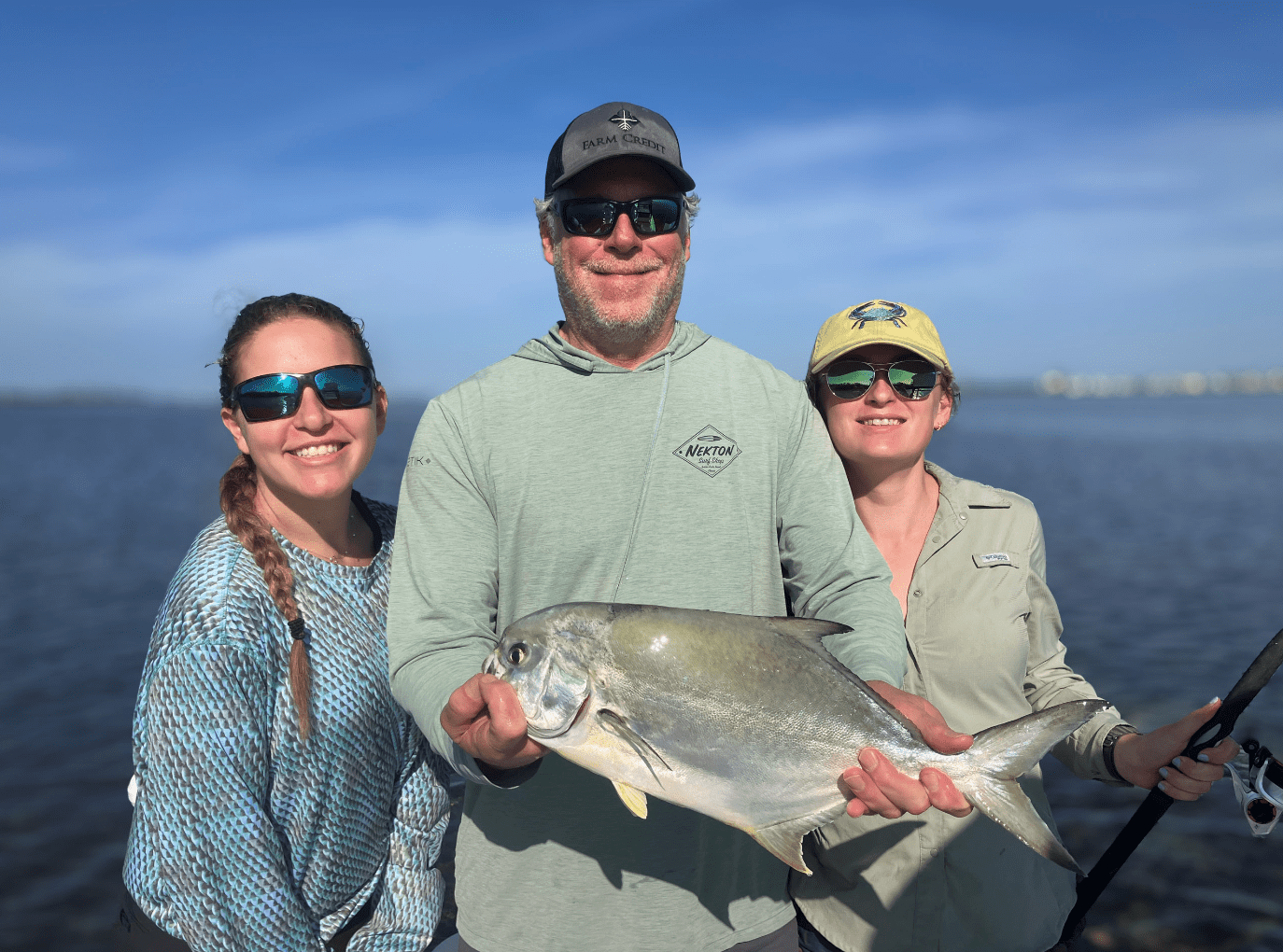
Fish are normally located by moving slowly across a flat. If they’re particularly spooky, it can be effective to station yourself within range of a pothole or other visible edge and wait for them to cross the sand where they can easily be spotted. This requires patience but can pay dividends. To increase your chances, station the boat or stand off to the side in the grass so that you don’t cast a shadow. When you see signs of a fish, make as long a cast as possible. When fly fishing, make sure that the fly lands lightly and never too close. Anglers using artificial lures and live bait can cast well past the target, bringing it back to a position the fish can see. In both cases make sure your presentation never moves towards your target, tripletail excepted.

If you’re wading, make sure you have proper footwear and shuffle your feet as you move across the bottom. Many anglers abandon wading in the winter, but this can be one of the best times of the year. The chances of the water being clear are greater and you’re likely to have less competition. Fish can be extremely wary when the sun is high and the water clear. Wading helps lower your profile, allowing a stealthier approach.

Note: Never wet wade if you have an open wound.

Whatever your fishing style, give sight fishing a try. Not only is it effective, but it’s exciting when you enter the fish’s domain. Remember, always release any fish you won’t be eating fresh and handle them with care, keeping them in the water if possible.

Using a Power-Pole

Using a Power-Pole

I have a confession to make. When I first saw a boat with the novel (at the time) Power-Pole, I remember thinking, “That will never get off the ground.” Boy, was I wrong. Not only are these mechanical “anchors” present on most inshore fishing boats, now there’s also one on my boat! The originator of this game-changing accessory for anglers was John Oliverio, a Sarasota native. The concept was hatched one day in 1998 when he was fishing Sarasota Bay’s Longbar with Sweet Lady Vidalia, his dog and favorite fishing partner. He noticed that when he spotted fish, they often spooked before he could stop his boat with an anchor or push pole. According to Oliverio, “I wanted something I could lower from anywhere on the boat without taking my eye off the fish.” It didn’t take Oliverio long to also realize the environmental benefits of his invention too. A friend who was monitoring seagrass on popular flats areas had noticed that anglers’ anchors dragging in those beds had left scars.

In 2008, Power-Pole added a new innovation to their invention that was quickly catching on with tournament anglers in salt and fresh waters alike. Oliverio had the environment in mind again with his next advancement of the product. The original Power-Pole was designed never to leak, but Oliverio realized that it was inevitable that with continued use in all conditions, the petroleum-based hydraulic fluid that powers the device would find its way into the water.

“I was thinking we needed to do the right thing here,” Oliverio said. “These guys using Power-Poles are in the best places to fish. The worst thing that could happen would be to spill out a quart of hydraulic fluid in your favorite fishing hole.” He made the decision to develop a bio-degradable fluid that wouldn’t harm the environment if a Power-Pole did begin to leak hydraulic fluid.

Since their introduction, Power-Pole anchors have had a huge impact on inshore fishing, first in saltwater and then in fresh water. Produced by JL Marine Systems in Tampa, Power-Pole anchors are available through over 3,500 dealers, retailers and boat manufacturers.

But don’t expect to hear from Oliverio about how he alone made this concept so successful. “I didn’t bring this company to the level of success we enjoy today all by myself,” he said. “It’s been with the efforts of all the employees associated with the company. Everyone has worked together to make Power-Pole anchors a leader in the marine industry.”

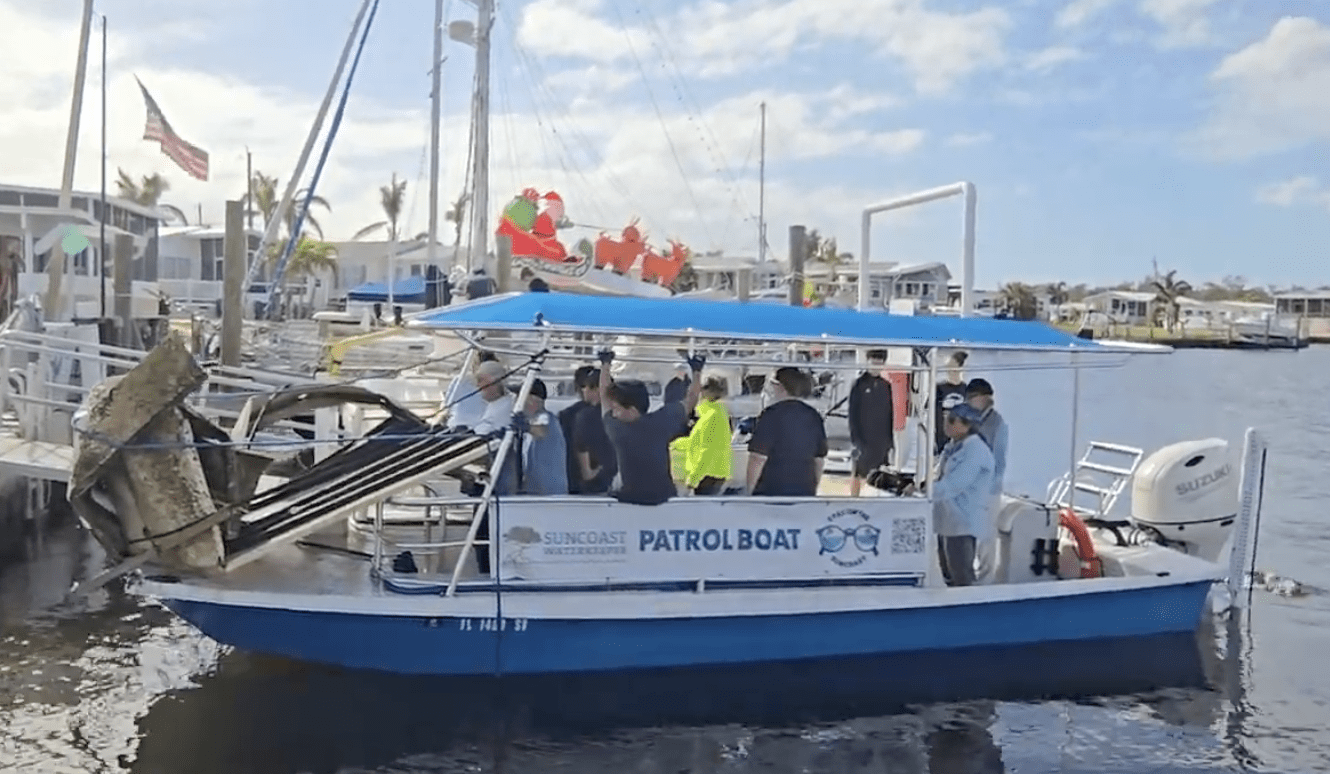
When Suncoast Waterkeeper obtained its patrol boat, the board quickly recognized the value of an innovative “green product” like Power-Pole. Much of the organization’s work is done on the shallow grass beds around Sarasota Bay. Whether it’s monitoring water quality, conducting debris cleanups after storms, flying drones to assess mangrove health or participating with Kids for Clean Water to monitor sea grass health, the Power-Pole is the perfect partner. Ever the environmental ambassador, Power-Pole provided us with an anchor. That’s what led me to see the benefits of the device and put one on my boat. I highly recommend this innovative accessory for the ease of use and practicality and its value to protecting the angler’s greatest resource, our grass flats. To learn more about this product and get one for your boat, check out a dealer near you.

Fishermen report slow mullet season

Fishermen report slow mullet season

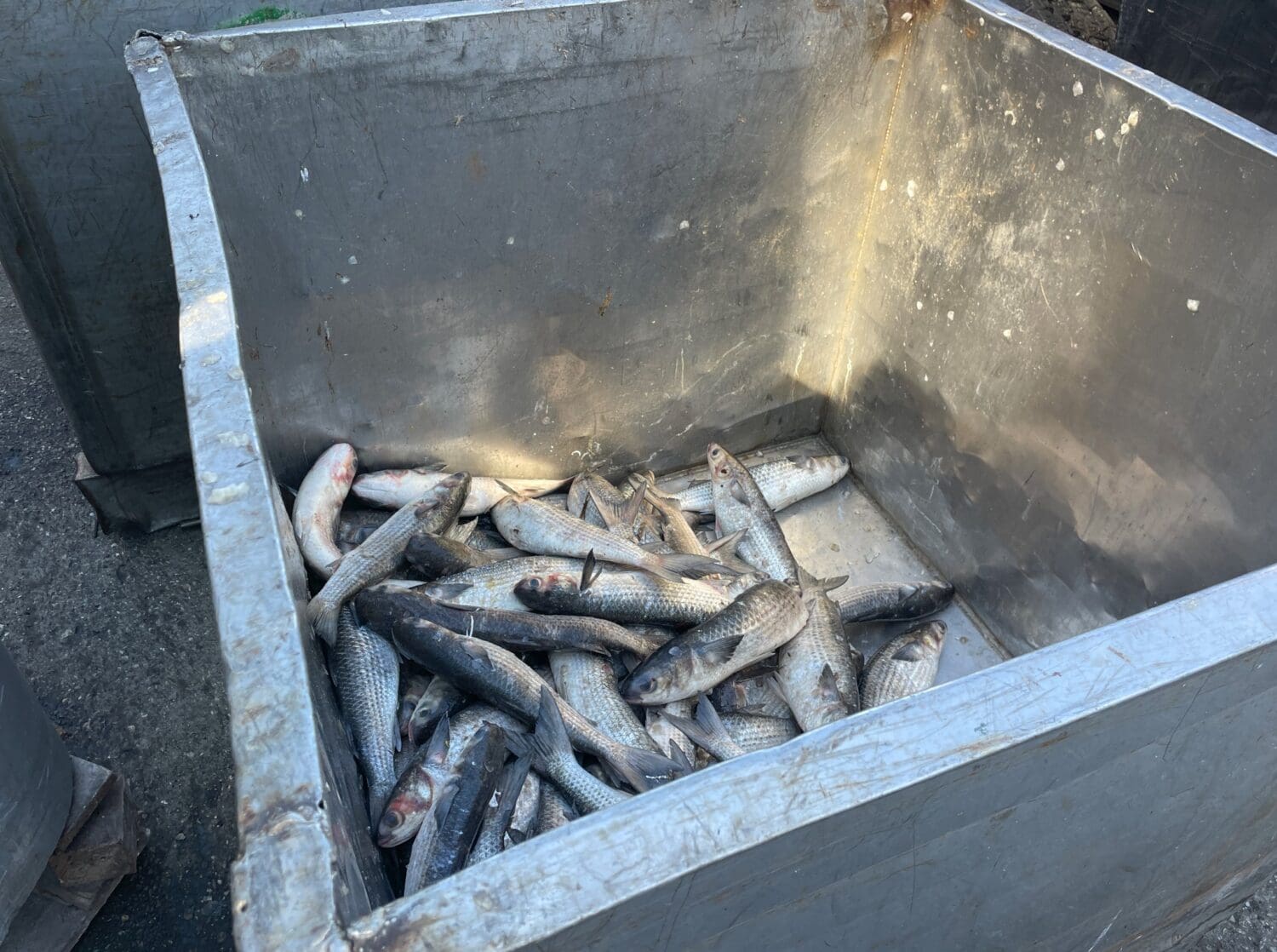
CORTEZ – With peak mullet season winding down, local fishermen hoping to cash in by selling their catches at the fish houses are reporting a lesser harvest than in recent years.

“We’ve had one good day in the last two weeks,” said one fisherman, who asked not to be identified. “I don’t know what it is that’s killing the seagrass, but the three of us have been everywhere and the fish just aren’t there.”

According to the University of Florida IFAS website, “Mullet can tolerate a wide range of salinities and can be found in fresh or saltwater. Their diet consists of bacteria and single-celled algae found attached to plants. They pick at the bottom, and scrape seagrasses consuming these.

Sarasota Bay Estuary Program Executive Director Dave Tomasko weighed in on possible factors that could account for a slow fishing season.

“There have been quite a few recent hits to our water quality along with those living resources that depend on adequate water quality,” Tomasko wrote in a Dec. 26 email to The Sun.

He said Sarasota Bay was impacted by four events that adversely affected the bay.

“In June, we had the highest amount of hourly rainfall on record (going back 50 years) due to a tropical wave (not even an organized storm),” he wrote. “The amount of rainfall was thought to be so rare as to only occur every 500 years or so.”

Tomasko wrote that in August there was another “one in 100-year” rainfall event during Hurricane Debby, which caused widespread flooding in Manatee and Sarasota counties.

“In September, we had Hurricane Helene, which gave us the biggest storm surge recorded in Sarasota and Tampa Bay’s history – in most places,” he wrote. “Then, in October, we had a Category 3 hurricane (Milton) hit us. Those storms brought us massive amounts of stormwater runoff, particularly that June rain event, and then with Debby.”

Tomasko noted that in 2024, there was more rainfall than average in a series of intense storms.

“That may be indicative of conditions that are more likely to occur over the next 30 years than was the case in the last 30 years,” he wrote. “Our air is warmer now and so is our water temperature. Both of those are expected to produce conditions that are more likely to cause intensification of tropical weather. Which means we need to get our wastewater and stormwater infrastructure to be more resilient to a changing climate, because summers like 2024 are more likely to occur over the next few decades than was the case in the last few decades.”

New Year’s resolution: Vote water

New Years Resolution: Vote Water

I’ve reported frequently about concerns for our coastal waters in Manatee County and beyond. Loss of seagrass, lyngbya blooms, sewage releases, more frequent and stronger hurricanes and hundred-year rain events, months apart.

These insults to Florida’s environment point to the lack of political will to effect the changes that are necessary to preserve our environment and the economy it supports. Until recently, former Manatee County commissioners even voted to let developers build closer to our wetlands.

Now facing an uncertain political future when climate issues are likely to fall farther down on the national agenda, the recent election of pro-environment Republican Manatee County commissioners is a bright spot that highlights an important point. The health of the environment shouldn’t be a partisan issue. Economic realities aside, we all need clean air and water to survive and prosper.

That’s why you’ll find a Vote Water bumper sticker on the front of my car. I vet candidates not by party but by the actions (votes) they’ve taken on issues that affect the quality of the air that I breathe, the water I drink and the fish I pursue. Unfortunately, unscrupulous politicians separate us from the things we all depend on using wedge issues that may matter but pale in comparison.

If you’re looking for a way to source information on candidates and how they’ve voted, and join concerned anglers and voters, check out the “Vote Water” Initiative. The efforts dovetail perfectly with issues that groups like Suncoast Waterkeeper, Captains For Clean Waters and others are seeking to address.

This advocacy is a continuation of Florida Sportsman magazine’s long involvement in protecting Florida’s angler’s interests. Founder Karl Wickstrom and the magazine have been in the forefront in lobbying for common sense rules and regulations.

In Wickstrom’s words, “If you had to pick one reason for the lack of success in protecting our state’s water from continual degradation, it would have to be lack of political will from our elected officials to get something done.”

“What we have in the state of Florida (and the nation as a whole) is a political problem, not a party issue, but when it comes to fixing the state’s water, the political problem requires a political solution. Democracy isn’t a spectator sport. If you truly want to have clean air, clean water and public officials that represent the public interest instead of the special interest, the people that vote need to be informed.”

That’s the same argument I’ve used on these pages pointing out the shared responsibility we as voters have to effect much-needed change.

The VoteWater team highlights politician’s votes but also the amount of money they accepted from special interests. “The Dirty Money part of the Voter Guide is definitely something we want to spend more time on in 2025 and beyond,” VoteWater board member Wil Revehl said. “As the adage says, you have to follow the money. It’s clearly the case in politics.

“In order for people to be represented, to have a true democracy, we need to help make taking money from a special interest, such as the phosphate industry, toxic,” emphasized Revehl.

Once again, those who love Florida’s natural treasures and anglers can thank Florida Sportsman for taking a major role in effecting the change that our elected officials have avoided. I encourage you to learn about and to support the effort by joining the coalition, volunteering, spreading the word, donating to the cause and voting for politicians that have a track record of voting for clean water and healthy fisheries. Don’t be fooled into believing what candidates promise, check their voting record.

What better resolution to adopt this New Year? Vote Water. The future of fishing, Florida’s natural wonders and the economy hang in the balance.

Fall and winter wading

Many anglers think that wade fishing is a warm water activity, but fall and winter wading can produce some fantastic results and gives you many advantages over anglers fishing from a boat. Getting in the water puts you in the fish’s realm, giving you the advantage of a silent approach. This can be particularly important when area waters cool and clear up, making fish especially wary. Wading allows you to keep a low profile and make a stealthier approach.

On clear “blue bird” days when fish are particularly spooky or hard to see, try standing still and waiting for them! When fish see you just before you see them it’s a good time to try this approach. Anchor well away from the area you intend to fish, get out of the boat and stake out a pothole or sandy area where you have the best visibility. By staying a long cast away, you can often see fish when they enter a hole or pass across a white sand bottom. Position yourself off to the side in the grass where you’re less visible, keep a low profile and be still. Just waiting them out gives you a big advantage when targeting reds, trout, snook and other game fish as they wander the flat. When you make a presentation, don’t make any quick moves, and make your casts low and slow. It takes patience but can be very productive.

Fall and winter wading
Anne and Mike McCarthy, of Pennsylvania, with one of the reds they caught in a fantastic two days of fishing with Capt. Tom Stephens in Sarasota Bay last week. – Rusty Chinnis | Sun

When wading, you won’t need heavy tackle unless you’re fishing docks or other structure. Spin and bait casting leaders should have a 30-pound bite tippet. In clear water, you might want to downsize leaders. This will often fool wary trout, but you’ll risk being cut off should you encounter a big snook.

Since the last two hurricanes, local guides are reporting some of the best action they’ve seen in years. Recently Capt. Tom Stephens reported that anglers who fished with him last week in Sarasota Bay had phenomenal success.

“We caught 32 reds, 30 snook, tons of trout all on fly in two days,” he said.

Capt. Justin Moore reports he’s seeing more reds than in many years.

The key to productive and comfortable winter wading as waters cool is to stay warm and dry. A good pair of waders, wading boots, sweatpants (on coldest days) and warm socks will do the trick. Add a pair of polarized glasses, a hat with a dark under-brim, a wade vest or pack, and you’re in business.

When wading in winter or summer, it’s important to make sure you’re not exposing any open cuts or wounds to saltwater. A bacteria called vibrio which is present naturally in area saltwater can cause serious complications and even be fatal. While it’s not often that this happens, it could be exacerbated by water quality issues. According to information from the Florida Department of Health, vibrio vulnificus normally lives in warm seawater and is part of a group of vibrios that are called “halophilic” because they require salt. Vibrio infections are rare, but just recently an angler wading Long Bar in Sarasota Bay contracted the disease, which required an amputation. According to the department web site, “Water and wounds do not mix. Do not enter the water if you have fresh cuts or scrapes.”

Give winter wade fishing a try. It gets you out of the boat and provides some exercise and excellent angling opportunities.

Bradenton man loses leg to flesh-eating bacteria

Bradenton man loses leg to flesh-eating bacteria

BRADENTON – A 66-year-old Braden­ton resident had his leg amputated on Nov. 11 after coming in contact with flesh-eating bacteria (vibrio vulnificus) at a time when confirmed vibrio vulnificus cases are on the rise statewide.

The man came in contact with the flesh-eating bacteria while wading and fishing in Sarasota Bay, near the IMG Academy Golf Club along El Conquistador Parkway in Bradenton.

According to a family member, the longtime Bradenton resident went fishing in Sarasota Bay on Nov. 3 and his shoe or boot rubbed his skin on the back of his leg raw, creating an open wound near his Achilles tendon. The man fished in that location again on Nov. 5.

On Nov. 9, he began experiencing uncontrollable diarrhea, vomiting, severe leg pain and skin discoloration between his ankle and his knee. After being hospital­ized, his leg was amputated on Nov. 11. As of Friday, Nov. 15, he was recovering but he remained unconscious and faces a long recovery process, the family member said.

CASES INCREASE

According to the Florida Department of Health (FDOH) website that is updated every Friday, vibrio vulnificus is a naturally occurring bacteria found in warm, brackish saltwater. The flesh-eating bacteria enters the body through the direct ingestion of contaminated water or through open wounds, cuts or scrapes.

Confirmed cases of vibrio vulnificus increased after Hurricane Helene passed through Florida in late September.

According to the FDOH website, “In 2024, Citrus, Hernando, Hillsborough, Lee, Pasco, Pinellas and Sarasota Counties experienced unusual increase due to the impacts of Hurricane Helene. In 2022, Collier and Lee Counties experienced unusual increase due to the impacts of Hurricane Ian.”

According to FDOH, 81 cases of vibrio vulnificus have been confirmed in Florida so far in 2024, with 16 reported deaths. In 2023, 46 cases were confirmed statewide, with 11 deaths.

In 2022, there were 74 confirmed cases and 17 deaths.

There’s been one confirmed case of vibrio vulnificus in Manatee County in 2024 and two in Sarasota County, with no vibrio-related deaths in either county. In 2023, there was one confirmed and fatal case in Manatee County and six cases and two fatalities in Sarasota County. This year, Pinellas County leads Florida with 15 confirmed cases and three deaths.

FDOH INSIGHTS

On Friday, FDOH Communications Director Jae Williams provided some additional insights and information about the flesh-eating bacteria.

Williams said the increase in confirmed 2024 cases and deaths is specifically correlated to Hurricane Helene. He noted there was also a spike in reported cases in 2022 after Hurricane Ian.

“Hurricanes bring a ripe environment for vibrio. They bring storm surge and rain and then we have that brackish water that vibrio needs. Hurricanes bring a lot of contamination and it’s not just debris and household materials. We have sewage lines ruptured and garbage cans spilling over. There’s a lot of opportunity for this standing water to become contaminated. When the storm surge recedes and the rain goes away, you still have standing water baking in the Florida sun for several days. That’s where vibrio’s able to develop. Vibrio is not necessarily in floodwater, but it’ sin contaminated water. Regardless of the contamination source, it’s warm, shallow, brackish, stagnant water. That’s where you’re going to find it. You’re not going to find it in the middle of the Gulf ,the middle of Lake Okeechobee or in the middle of a moving river,” Williams said.

“With hurricanes, not only is the environ­ment more conducive to vibrio, but people often find themselves needing to wade through standing floodwater. There are many reasons to stay out of floodwater… but the scariest would be vibrio,” Williams said.

Regarding the Bradenton man, Williams said, “If he was fishing in the (first) week of November, that would not be attributed to either of the hurricanes. Unfortunately, this is just one of those regular cases we see throughout the year.”

Williams said Florida averages about 35 confirmed vibrio vulnificus cases and 10-12 deaths per year. FDOH doesn’t test Florida waters for vibrio vulnificus or issue vibrio vulnificus advisories when a confirmed case is reported because the harmful but short-lived bacteria usually washes away or dissipates before the area can be tested.

“There’s no way for us to go back and find it,” Williams said, noting that each confirmed case is reported to the health department. “Vibrio vulnificus is a reportable disease in Florida. If a health care facility diagnoses someone with vibrio vulnificus, that facility is required by law to report that to the Department of Health.

“It’s rare, but it’s scary and its serious. It’s unfortunate that this man’s leg was amputated, but he’s very lucky they got it before he died,” Williams said. “If you wade in standing water and develop severe flu-like symptoms, get medical attention immediately.”

Williams was asked if vibrio presents a risk to dogs and other animals.

“Certainly,” he replied. “If they ingest it or have open wounds, they are at risk the same way a human would be. Pets shouldn’t be in shallow, standing water either.”


Annie's Bait and Tackle

Annie’s Bait and Tackle working to rebuild

CORTEZ – Back-to-back hurricanes may have left Annie’s Bait and Tackle badly battered, but its ownership expects to be back up and running soon.

“I’m hoping we can be back open by Thanksgiving,” Annie’s co-owner Bruce Shearer said.

Annie’s, a waterfront landmark just north of the Cortez Bridge, first sustained water damage from Hurricane Helene followed by wind damage from Hurricane Milton.

The docks are gone and a blue tarp covers an opening on the west wall where part of the docks came through.

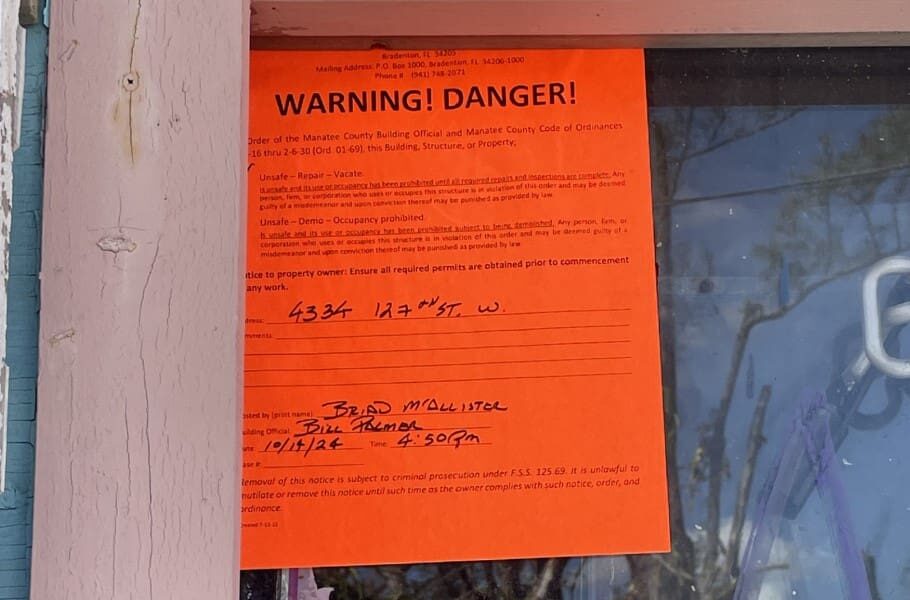
A red tag on the building from the Manatee County Building Department posted on a window states in part: “It is unsafe and its use or occupancy has been prohibited until all required repairs and inspections are complete.”

“I’m working on getting any permits we need,” Shearer said. “We are definitely going to reopen.”

Annie’s, which has been in existence since the 1950s, has been owned by Shearer and Kim Shepherd for more than 20 years. The shop sells bait and tackle, beer, ice, gas, and food.

“Our motto is ‘if we don’t have it, you don’t need it,’” Shearer told The Sun in May. “There really is nothing else like this. Once it’s gone, it’s gone.”

Annie’s is part of the Seafood Shack parcel that Manatee County is in the process of purchasing for $13 million.

The property consists of seven upland parcels totaling approximately 5.9 acres along with two submerged land leases of 2.9 acres.

The Manatee County Board of Commissioners unanimously approved the purchase at a Sept. 5 land use meeting. The property is anticipated to be used as a public boating access facility with a boat ramp, dry storage facility, and marina.

“I assume the board will act as a landlord and essentially create a revenue source by leasing slips and continue to lease space to those businesses that are already there,” Commissioner Kevin Van Ostenbridge said at the Sept. 5 meeting.

Prior to Hurricanes Helene and Milton, the scheduled closing date for the sale was Oct. 7.

“That closing had to get pushed back because of the hurricanes,” Shearer said.

Manatee County spokesperson Bil Logan stated in an Oct. 23 email to The Sun he could not confirm a closing date for the Seafood Shack sale.

Eviction notices from current owner Vandyk Properties advised business owners that the properties, including Annie’s, must be vacated by Sept. 30. Hurricane Helene, however, struck the local area on Sept. 27.

“The current landlord (owner Vandyk Properties) would not agree to a sale date extension to allow the buyers (Manatee County) an opportunity to evaluate the current leases prior to closing, so the current tenants must vacate their locations per the current landlord’s requirements,” Logan wrote in a Sept. 20 email to The Sun.

Water matters

Water matters

Two years ago, I had the honor of meeting Dr. John Bowden, who was collecting samples in the area for a study of PFAS (forever chemicals) in local waters. Bowden is an associate professor at the University of Florida who works on measuring emerging pollutants in a wide variety of matrices. He was a guest speaker at a Suncoast Waterkeeper fundraising banquet and I volunteered to help him leading up to the event.

Recently, the report, PFAS in Florida Surface Waters, was peer-reviewed and published in Environmental Science and Technology: Water. Bowden also published a paper looking at PFAS in Florida springs.

While Bowden was in the area, he was commissioned to conduct a study of drinking water on Anna Maria Island by Holmes Beach Mayor Judy Titsworth and the Holmes Beach Clean Water Committee.

According to Titsworth, “Growing up and living on the water my entire life, I have witnessed a decline in water quality. It is more important than ever for everyone to decrease their impacts on the water.”

To learn more and be part of the solution, go to islanders4cleanwater.com.

Now there’s an opportunity to help Bowden with a new study that should be of importance to all Island residents. Currently, he has a Ph.D. graduate student working on a project to measure emerging pollutants in fish muscle. To date, they have an extensive set of fish samples but are looking to expand the study. They are hoping to connect with anglers and fishing guides to see if they can obtain a small piece of fish muscle harvested when fish are cleaned for their study. They only need about 1-2 grams from each fish.

If you can help, all data will be shared with participants, and you will be anonymous in any publication. If interested, please share an address and they will send tubes that the small muscle plugs can be put into to send back to them. They have a FedEx account for the shipment of the samples.

Their goal is to generate data that will allow them to help determine the safest fish to consume and better fish consumption advisories.

While they are open to receiving samples from all types of fish, these are the fish species they are most keen on getting samples from (species in bold represent ones they have no samples for yet): Mahi, sailfish, snapper, grouper, tuna, amberjack, wahoo, monkfish, tilefish, swordfish, hogfish, flounder, striped mullet, American red snapper, triggerfish, sheepshead, tripletail, barrelfish, kingfish, cobia, grunts and drum, as well as any others that are available. They are interested in some freshwater fish as well, including catfish, bass, etc.

This is a great opportunity for local guides and anglers to help identify the safest species for consumption. For more information and to participate, contact Dr. John Bowden at john.bowden@ufl.edu.

Reel Time on the Road: Magic on the mesa

Two weeks ago, I reported that my wife, Chris, and I were traveling to Colorado, occasioned by an invitation from friends. Two weeks in Durango with side trips to Mesa Verde and a vintage train ride to Silverton through the majestic San Juan mountains gave us a unique perspective. The soaring stratified cliffs and mountains whose faces were forever altered by mining less than two centuries ago stood juxtaposed with remnants of ancient civilizations. The sight provided me with a vastly different perspective on the passage of time.

As we once again crossed the San Juans, we would experience another side of southwest Colorado where we would be wowed by the scenery and meet some very special new friends. Due to a fortunate miscalculation, we were the first visitors to a magical home situated on a mesa at close to 7,500 feet between Ridgeway and Telluride. Jimmy and Kathy Harris’ daughter and son-in-law, Addie and Scott Bowen, had constructed their vacation home on a 30-acre lot with magnificent views of the nearby Uncompahgre Mountains. That first night we reveled in the elegance of the accommodations, soaked in the hot tub and lay outside marveling under a star-filled sky that stretched from horizon to horizon in this rare dark sky region with little to no light pollution.

Reel Time on the Road: Magic on the mesa
Angler Rusty Chinnis found some time to do a little fishing while on a trip through Colorado. – Submitted

The next morning after a tour and lunch in nearby Telluride, we returned to greet the Harrises and the three other couples that we would share a week of adventures with. Harris, the owner of Unicoi Outfitters in Helen, Georgia, and his wife, Kathy, had invited us to the recently finished Sanctuary on the Mesa, a stunning home worthy of a spread in Architectural Digest. The five-bedroom, five-and-a-half-bath home has a state-of-the-art kitchen, a large outside covered porch, hot tub and flat-screen TVs in every room. One would never have to leave the property except for the amazing natural wonders, skiing and fishing the area has to offer. Over the week we explored and fished the Black Canyon of the Gunnison National Park, did a float trip on the lower Gunnison with Rigs Fly Shop in Ridgeway, explored Ouray, described as the Switzerland of America, and rode E-bikes over scenic and sparsely traveled nearby roads.

The accommodations, the scenic surroundings and the multitude of opportunities for every lover of the outdoors are unmatched in my experience. Sanctuary on the Mesa is a destination I look forward to visiting again and is a wonderful venue to share with fishermen, family and friends. To book your piece of paradise, email sanctuaryonthemesa@gmail.com.

Reel Time: On the road

Reel Time: On the road

When my wife, Christine, and I got an invitation to fish a part of Colorado we had never visited, we jumped at the chance. Our good friend, Jimmy Harris, owner of Unicoi Outfitters in Helen, Georgia, invited us and three other couples to join him and his wife, Kathy, at his daughter and son-in-law’s newly-constructed Sanctuary on The Mesa in Placerville, Colorado. Located just a short distance between Ridgeway and Telluride, the home sits on a mesa with stunning views of the Uncompahgre Mountains in the distance.

Since we were making the long trip from Florida, we decided to travel two weeks early and visit Durango, Colorado. Located on the south side of the scenic San Juan Mountain Range and accessible by the famous “Million Dollar Highway,” SR 550, Durango had been recommended by several fishing friends from Florida and we were not disappointed.

Eager to explore the fishing in the Durango area, I started searching YouTube for suggestions when I had the idea to see if there might be another casting instructor in the area. A quick search of the Fly Fishers International website put me in touch with Berris Samples, an instructor in Durango. When I contacted Samples, he graciously invited me to float the San Juan River just over the border in New Mexico. We met in the outskirts of Durango where I parked my car and joined Samples for the drive south.

We started the day wading a section of the river where we caught and released several rainbow trout from 12-16 inches. There was no question that there were bigger fish in the section of river as they would swim almost to our wading boots as we stirred up nymphs from the bottom. Catching them was another story, but I did hook a rainbow that I estimated to be over 20 inches. The big fish took the small nymph pattern I was fishing along the bottom, but the hook pulled on the first run.

In the afternoon, we floated a section of the river, stopping at a couple of spots to wade. Once again, we saw large fish working the riffles and runs but they weren’t in a feeding mode. Of the several drift boats we saw that afternoon, we only saw two fish landed. Still, the float was totally enjoyable with scenic vistas at every turn. The two weeks we spent in Durango were memorable, with side trips to historic Mesa Verde National Park and a train trip on the vintage Durango to Silverton Train. Durango is highly recommended, surrounded by stunning wilderness areas, soaring mountains and spectacular canyons.

Catch and release

Taking care when we release fish we don’t intend to keep has never been more important. While most anglers are aware that fish populations are vulnerable and not the endless resource we once thought them to be, shrinking habitats and fish populations make the process all the more important. Fishermen who fish mostly for fun have been criticized because many see catching and releasing fish as playing with fish. Anglers, unlike hunters, can pursue their passion and release their prey. Both hunters and anglers are generally great champions of their respective passions and invest their time and money in protecting the habitat and well-being of fish and animals.

Most anglers I know who practice catch and release have no problem with taking an occasional fish home for dinner. It’s more about enjoying the sport and trying to be proactive in helping it to remain healthy and viable. There are many species, notable among them, tarpon, that anglers seldom, if ever, kill. Catch and release is not just about releasing fish that you don’t want, it’s also about safety releasing undersized fish or species that aren’t valued at the table. Catch and release in any form is a wise use of the resource, but unfortunately, many anglers don’t know how to properly handle fish.

When we get cut, bruised or battered, we can head for the local drug store or in more extreme cases, the emergency room. Not so for fish. For them, it’s heal or die, and in their world, it’s the sick and wounded that first fall prey to predators. What a shame to do the right thing, releasing a big, speckled trout full of roe, only to have it eaten by a shark, barracuda or other predator because it wasn’t handled properly.

The first step I would suggest is to make sure you match your tackle to the fish you are pursuing. Trying to land a big tarpon on a 20-pound tackle might be okay if you’re experienced, but to the uninitiated, it’s like announcing a free meal to the sharks that ply local waters looking for weak or injured quarry. Enjoy the action but land the fish as quickly as possible. Once you have the fish subdued, the best course is to never take them out of the water. If you’ve been fighting them for a long time (think tarpon) make sure you revive them properly. If you can reach the water over the gunwale, slowly move the boat forward while holding the fish firmly but lightly. This forces water and oxygen through their gills and helps them recover from oxygen depletion. They’ll let you know when they’re ready to go.

Catch and release
It’s illegal and bad practice to remove big tarpon from the water. Here Andy Mill measures a tournament fish as his guide, Doug Kilpatrick, holds it by the jaw before releasing it. – Rusty Chinnis | Sun

The hook is probably the next most important consideration. Either a circle hook or a barbless hook is usually best for anglers and their fish. The key to keeping fish on a barbless hook is to keep the line tight. Circle hooks are recommended for inexperienced anglers and on fish that tend to swallow the hook, like speckled trout. When you do handle a fish, understand and respect their vulnerabilities. Fish secrete a protective coating that covers their scales and skin. This slime coat acts as a defense against invasion by bacterial, parasitic and fungal pathogens. Whatever hook you use, a de-hooker will keep your hands safe and clean, preventing you from inadvertently harming the fish’s protective slime coat and protecting hands from sharp gills and teeth. De-hookers come in various shapes depending on how they’re used. The simplest is J-shaped and removes hooks in or near the jaw. A circular-shaped longer version allows anglers to remove hooks that are deep in the throat of a fish or the jays of a big fish like a barracuda. Anglers who fish for reef fish like snapper and grouper need to learn how to “vent” fish with inflated swim bladders. Bringing the fish up from deep depths fast bloats the bladder, which must be punctured to allow the fish to reach the bottom. A good presentation of the process is available online.

Anglers that release a trophy-sized fish may want to take home a picture. Here are a few tips that will help you record your catch. Set your exposure in advance and have an idea where in the boat you want to take the picture. The best picture for the fish would be when it’s still in the water, but if you do remove the fish, hold it horizontally with one hand near the head and the other hand under the fish’s belly to support its weight. Holding a fish vertically puts a strain on the internal organs and can potentially dislocate its jaw. This is particularly important with large fish. Lastly, eliminate any extraneous objects like rods and focus on the subject.

By being prepared we can get the fish back in the water fast, thus ensuring its chances of survival. Taking the time and having the tools and knowledge to release fish mindfully is a great way to help ensure we have a healthy population of fish now and into the future.

Brigadoon

Brigadoon

The legend of Brigadoon is the story of a mythical village in the Scottish Highlands. It’s a tale of a place that became enchanted long ago and has remained unchanged and invisible to the outside world except for one special day when it can be seen and visited by outsiders. Those lucky outsiders then spend an enchanted day immersed in joy and celebration. This past May, I had the good fortune of spending a day on the enchanted waters of the Brigadoon Lodge, not in Scotland but in the highlands of Northeast Georgia and not far from where we vacation in Sautee Nacoochee.

I first experienced this stretch of water when a trip I planned with my friend Bob Seegar, who had relocated from Longboat Key to Blue Ridge, Georgia, and his grandson, David, was unexpectedly canceled. Fortunately, a friend who lives nearby saved the day when he hooked us up at the lodge through a friend who oversees the guides there.

The lodge sits on a beautiful tract of land where the storied Soque River runs through the Chattahoochee National Forest. It’s one of a few tracts of private land along the river that’s designated non-navigable and where no public access is allowed. It’s appeared in many magazines and hosted the likes of President Jimmy Carter and Ted Turner, founder of Turner Broadcasting System.

On this occasion, Seegar and I were joined by our friend, Michael Riter. The two had arrived at our cabin the night before when we dined at the nearby Harvest Habersham, a new farm-to-table restaurant that serves some of the most delicious and unique dishes I’ve ever tasted.

The next morning, we drove the winding and scenic route 197 that follows the Soque through the Blue Ridge foothills to the Brigadoon Lodge. We were met there by our guide, Doc, and fitted with waders and boots for our day on the river. Over eight hours, we fished several of the river’s “beats” where we all landed numerous large rainbow trout on a fly. We fished mostly nymph patterns under a strike indicator but were also treated to some of the mix of native and stocked trout on dry flies. It was truly an immersive experience that with a slight narrowing of the eyes became the Brigadoon of lore. If you’re ever in the area, a trip to this beautiful river and lodge is unforgettable.

Explore the options at www.brigadoonlodge.com.

Watch the video: https://youtu.be/EewyBNpjGCc?si=ARpe9_pRydEB15Jj