

BRADENTON BEACH – Due to audio difficulties at the April 3 city commission meeting, a Special Emergency City Commission meeting was held on April 8 to place into the record items previously discussed.
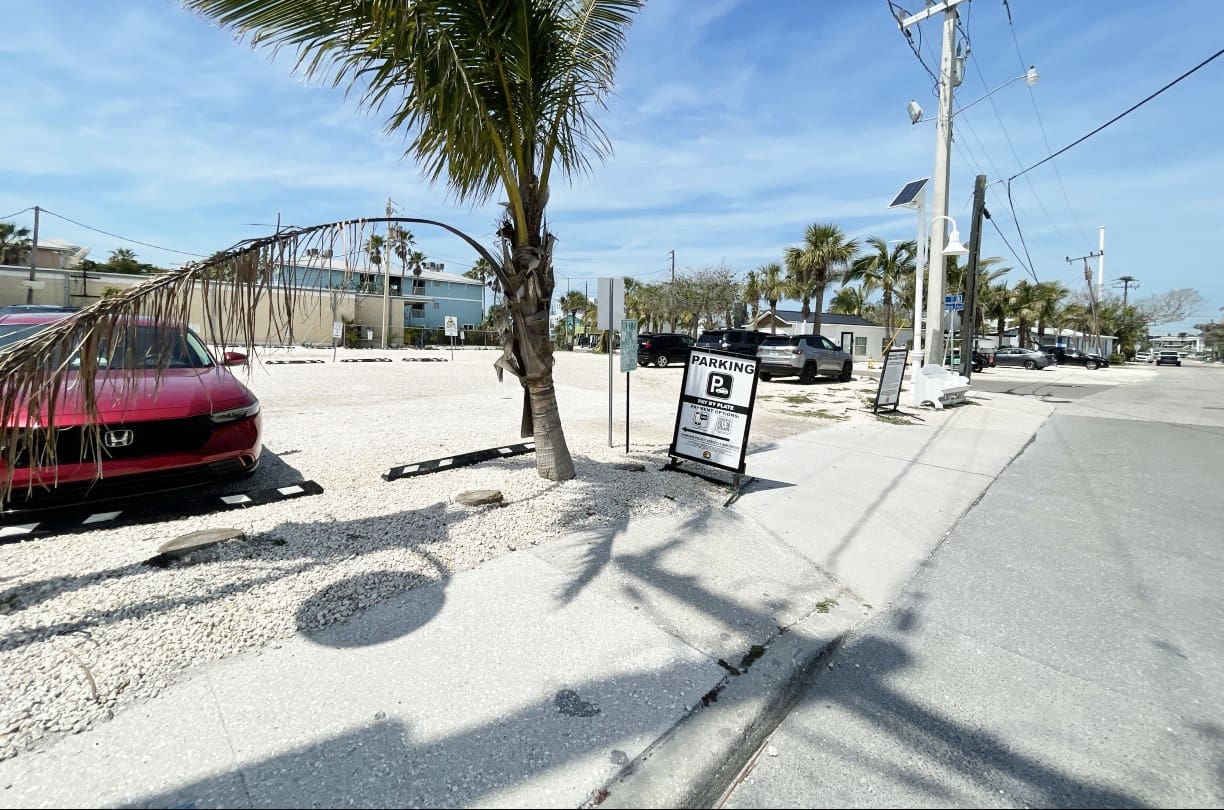
One of the topics that was revisited was a discussion of the former Pines Trailer Park parking lot at 201 First St. N. That parking lot was converted to paid public parking in January by the Pines owners.
Commissioners discussed the conversion and its non-conformity with the city’s Land Development Code, its historical use as a parking lot and whether the commercial lot created an increase in density and intensity as compared to its former use, and came to a consensus to invite parking lot owner Shawn Kaleta to speak at the next city commission meeting.
City Attorney Ricinda Perry had been asked by the commission to research the parking lot. She said the lot is zoned C-1 commercial, is within the overlay of Bridge Street and is part of the CRA district.
“This is important because it is the most intensive commercial area within the city of Bradenton Beach and the city commission has articulated over the course of the past couple years that they would encourage alternative parking options for parking within the CRA district and specifically within the C-1 zoning,” she said.
Perry said it is unclear as to whether standalone or commercial parking is allowed without a principal use or whether it can be an accessory use on its own. Prohibited uses are multi-level parking structures or facilities.
“When you look at the property issue you will see there is no building on the site, therefore it does not meet the definition of a parking facility or parking structure as a prohibited use under C-1,” she said.
Permitted uses in the zoning district include institutional, public, semi-public, libraries, community centers, public parks, playgrounds and recreational facilities. Additionally, Perry said planned development, professional offices, residential as well as retail stores and sales offices and service establishments as well as special permit uses may be allowed.
Perry raised the question as to whether or not there would be some type of non-conforming use which can be allowed by the city.
“That is going to have to be an interpretation by the commission,” she said. “I will say the commission looked at recreation uses previously and determined that parking can be associated with a recreational use and parking was permitted as standalone parking lots around the CRA district as temporary use permits.”
Perry showed a 1977 historical aerial photo of the parking lot which appeared to show vehicles parked on the site, and she also referenced a 1971 photo from the Florida Department of Transportation.
“The commission did agree that there was some form of parking, at least, going back to 1971,” Perry said. “The question then becomes whether or not the use itself has been enlarged, expanded, increased or intensified as of 2016. That increase would not be permitted, it’s an expansion of that use so you would have to compare that to what would have been allowed.”
The ordinance for the C-1 district was effective on March 9, 2016, Perry said. Any use prior to that date is a grandfathered, non-conforming use.
“If you can establish that there was a use on a property that exists and has not been abandoned, the city cannot interfere with that use if it meets the definition of a non-conforming use,” Perry said. “Often you hear interchangeably that a non-conforming use is a grandfathered right.”
Perry said it rests with the commission and code enforcement to determine if paid parking constitutes an enlargement, increase, expansion or intensity in use.
“I think it’s a logical conclusion the commercial is a higher density, higher intensity in uses. I think a paid parking lot is more intense than a non-paid parking lot that is specifically designated for one thing,” Mayor John Chappie. “I think we all want to try to get more information.”
“It’s also been brought to my attention that the Pines residents got parking passes to park in that lot when they moved there, so if they were given parking passes by Mr. Kaleta’s organization when they bought the trailer so they could park in that lot, they are agreeing that that parking lot is a Pines resident parking lot,” Commissioner Deborah Scaccianoce said.
Scaccianoce also questioned whether the current paid parking lot meets the city’s requirements for ADA compliance, width of lanes and ingress and egress.
“It’s being changed to invite the general public in, which to me, creates a whole different issue of rules and regulations,” Chappie said. “Others had to submit plans to meet the standards that are in our land development regulations.”
The commission had decided by consensus at the April 3 meeting to invite the property owner – Kaleta or a representative – to attend the next commission meeting.
“The consensus was by changing it to paid parking, we’re telling him that’s an increase,” Commissioner Scott Bear said. “We can’t do that without them first having their say.”
“If you’re going to make this kind of decision that impacts somebody’s property rights that you should invite that individual to attend that meeting so that their opinion can be heard,” Perry said.
The next city commission meeting is scheduled for Thursday, April 17 at noon in the Katie Pierola Commission Chambers, 107 Gulf Drive N.
Related coverage:
Pines Trailer Park parking lot converted to public paid parking