


Beach renourishment

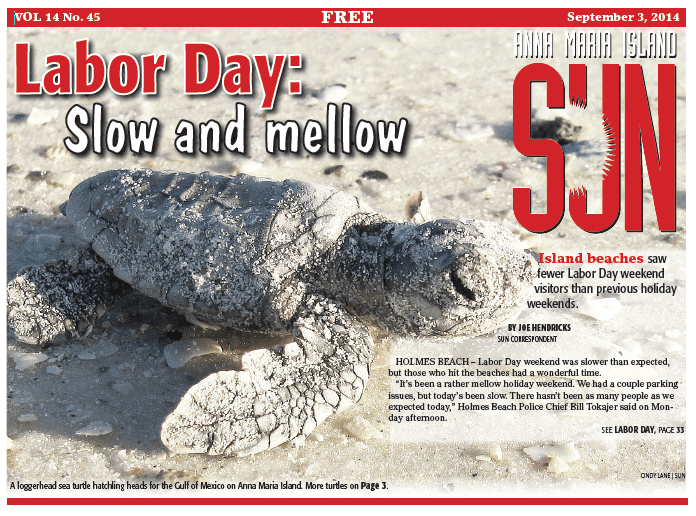
First Place
News Photo
2014



First Place
News Photo
2014

Second Place
Photo Illustration
2014

- Cindy Lane | Sun

- Cindy Lane | Sun

- Cindy Lane | Sun

- Cindy Lane | Sun

- Cindy Lane | Sun

- Cindy Lane | Sun

- Cindy Lane | Sun

- Cindy Lane | Sun

- Cindy Lane | Sun

- Cindy Lane | Sun

- Cindy Lane | Sun

- Cindy Lane | Sun


- Cindy Lane | Sun

Mottled ducks at Neal Preserve - Cindy Lane | Sun


A snowy plover has made its nest on Anna Maria Island, the first on Florida's west coast this year. - Cindy Lane | Sun


Third Place
Portfolio Photography (The Robert J. Ellison Award)
2014



The Manatee County Commission has toughened an ordinance targeting resort tax evaders.
 Under its provisions, a property owner who fails to pay resort taxes on a short-term vacation rental may now be served a warrant by a sheriff.
Other sanctions include liens placed on the property, preventing its sale until payment is made, garnishment of personal property and wages to pay the tax, a 10 percent fee on unpaid amounts, a 5 percent fee for bounced checks and a three-year recordkeeping requirement.
First Place
State and Local Tax Reporting
The Florida TaxWatch Award
2014
Violations are a first degree misdemeanor, with a $1,000 fine and up to one year in jail.
Under the ordinance, the tax collector can investigate several types of evidence, including records of condominium or homeowners associations, property management companies, and guest gate entry or parking passes and guest golf or tennis membership records.
The ordinance was spearheaded by Manatee County Tax Collector Ken Burton Jr., who said he foresees using it sparingly, primarily against European investors who advertise high-end rentals to tourists overseas. It strengthens the previous 25-year-old law that has been revised only twice, Burton said, adding, “Our goal is to keep a level playing field.”
Commissioner and former Holmes Beach Mayor Carol Whitmore said that tourists paying $25,000 a month for a home on the Island “need to pay the tax. This is not the little guy. This is someone who rents their house out for a business.”
Tax dollars that are going back to Europe “should stay here,” commissioner and former Bradenton Beach Mayor John Chappie agreed.
Burton’s staff works to track tax evaders door to door and online – about 81 percent of the county’s 6,600 properties subject to the resort tax are single family homes or condos, often advertised on do-it-yourself vacation rental websites, he said, adding, “Educating new and existing property owners is a challenge.”
Manatee County’s 5 percent resort tax, or tourist development tax, is required to be paid to the county by owners of accommodations rented for six months or less, who charge the tax to their guests. With the state’s sales tax of 6.5 percent, tourists pay a total tax of 11.5 percent on lodgings.
The resort tax requirement is detailed on flyers included in every property tax bill mailed to property owners in the county, Burton said.
By state law, resort tax proceeds can only be used for certain tourism-related projects, including beaches, fishing piers, sports arenas and tourism advertising.
About 53 percent of the county’s 2014 anticipated resort tax collections are budgeted for tourism marketing efforts by the Bradenton Area Convention and Visitors Bureau (CVB), with about 10 percent allocated to beach renourishment, according to the CVB.
Of the $4.3 million in resort taxes generated on Anna Maria Island from January through October, $2.1 million have been allocated to projects benefiting the Island, according to statistics from the Manatee County Tax Collector and the CVB.
Anna Maria Island generated an average 47 percent of Manatee County’s 2014 resort tax revenues from January through October, the last month for which statistics are available. Holmes Beach consistently leads the Island’s three cities in generating resort tax revenues.
A provision of the ordinance states that owners who rent out their vacation properties must report individually to the tax collector on their resort tax collections. “This requirement shall apply equally to individual property owners, realtors, property managers and other persons who hold themselves to represent multiple properties for benefit,” the ordinance states.
Some property owners charge the tax to tourists but keep it, said Sue Sinquefield, a senior staff member in the tax collector’s office.
An Anna Maria property owner who wished to remain anonymous wondered if some rental agencies collect the resort tax then keep it, and intends to ask for three years’ worth of records to be sure.
A critic of the ordinance told commissioners that it does not address the practice of “lending” a vacation rental to family or friends and accepting a “donation” to escape the requirement of paying the resort tax.
“There’s under-the-table transactions all the time and you’re never going to collect it all. Unless we get tipped or get lucky, it’s very difficult,” Burton said.
The ordinance should encourage people to use a professional to manage their property, said Larry Chatt, of Island Real Estate, adding that he hopes the county will not enforce the ordinance too harshly against new, inexperienced buyers of rental property and will focus on those who are intentionally evading the tax.
“Lots of owners can handle owning a vacation rental, but others shouldn’t even try,” he said. “Those that know they don’t have the time to run a business should hire a professional.”
The ManaSota League will not include vacation rental law reform or returning tourist tax funds to municipalities in its 2015 Legislative priorities.

SARASOTA – Amending the tourism development tax law to allow one cent of the five cents-per-dollar tax revenues to be repaid to the municipalities that generated them will not be a 2015 legislative priority for the ManaSota League of Cities.
The board decided on Nov. 6 to continue to discuss the issue next year, but declined to include it as one of its legislative priorities.
Manatee County’s 5 percent resort tax is collected from owners of accommodations rented for six months or less who charge the tax to their renters, in most cases, tourists. The majority of the tax is allocated to Bradenton Area Convention and Visitors Bureau tourism marketing efforts, with one of the five pennies allocated to beach renourishment.
First Place
State and Local Tax Reporting
The Florida TaxWatch Award
2014
About 43 percent of Manatee County’s September resort tax revenues (the last month available) were generated in Anna Maria Island’s three cities, according to the Manatee County Tax Collector’s office.
“Our concern is that none of that money comes back to cities that are affected most by increasing tourism,” said Holmes Beach Commissioner Jean Peelen, also a Manatee County Tourist Development Council member.
“We get one cent for beach renourishment, but that doesn’t necessarily benefit us in handling the burdens,” she said. “Most of the funds go to increasing tourism in our county. But we have increasing issues with the burden, with police, with keeping our beaches clean, with waste management, code enforcement… the burden on our roads is getting ridiculous.”
“It’s about fairness,” she said. “These funds are being generated by our municipalities and we get nothing back to deal with the increased burden.”
“We have to put up infrastructure, we have police problems, we contribute a lot of this money and we have to put up with controlling the crowds,” Bradenton Beach Mayor Bill Shearon said, adding that spectators and participants who come for the 2017 World Rowing Championships at Nathan Benderson Park, near the Sarasota/Manatee county line, will flood the beaches.
“We’re congested, we’re overpacked and we have to handle that,” he said.
The issue does not belong on the priority list yet, League President Jack Duncan said.
“This could be another piece of legislation like vacation rentals. It truly, truly, truly needs revision,” he said, asking members to begin putting together a proposal for 2016.
The Manatee County tourism brochure says “Come to Manatee County,” but lists Anna Maria Island and Longboat Key as the prime attractions, he said.
“We’re the drawing card, but with that comes expense,” he said, adding that a proposal must be worded in a way that supports tourism.
To League members who deny that the issue is a problem, Peelen warned, “There will be an increased need for short term vacation rentals around the whole Bradenton/Sarasota area, and it may be more important to you then than it is now.”
The League also decided against including further vacation rental law reform on its priority list.
The state Legislature passed a law in 2011 prohibiting municipal regulation of vacation rentals, including minimum stays and frequency, causing city governments to complain that they could not address noise, parking and trash problems at vacation rental properties.
Last year the Legislature tweaked the law, allowing municipalities to regulate rentals for health and safety.
“None of the cities on the Island have taken advantage of the change made last year,” Peelen said, adding that the League may consider the issue again after cities act.
Duncan congratulated outgoing Anna Maria Mayor SueLynn’s progress on the vacation rental issue, which he said he had “thought was DOA.”
The League also decided not to oppose state support for beach renourishment being linked to beach parking access.

WASHINGTON – Some U.S. Supreme Court justices question whether a law designed to prevent documentary evidence destruction passed in the wake of the Enron scandal should have been used to convict and jail Cortez commercial fisherman John Yates for catching undersized fish.
The court heard oral arguments on Nov. 5 in the case, stemming from Yates’ 2011 conviction of destroying evidence in a 2007 federal investigation of 72 undersized grouper discovered on his boat at sea by fisheries officers.
Third Place
Breaking News Story
2014
According to trial testimony, he ordered his crew to dispose of undersized grouper at sea, and officers calculated that three illegal grouper were missing when the boat docked at Cortez.
“What kind of a mad prosecutor would try to send this guy up for 20 years or risk sending him up for 20 years?” – U.S. Supreme Court Justice Antonin Scalia
The latter charge was based on the so-called “anti-document shredding” provision of the Sarbanes-Oxley Act, which makes it a crime to “knowingly alter, destroy, mutilate, conceal, cover up, falsify or make a false entry in any record, document or tangible object with the intent to impede or obstruct an investigation.”Yates, 62, was convicted and jailed for 30 days for disposing of evidence to prevent seizure and destroying evidence to impede or obstruct a federal investigation.
Yates’ attorney, John Badalamenti, argued that the provision should not extend to grouper, saying “The phrase ‘record, document or tangible object’ is confined to records, documents and devices designed to preserve information, the very matters involved in the Enron debacle.”
Former Ohio congressman, Michael Oxley, who sponsored the law, filed a friend-of-the-court brief in support of the position.
“If you look against the backdrop of the Sarbanes-Oxley Act, there is plenty of support that Congress was targeting businesses, corporations and publicly traded companies,” Badalamenti said, to which Justice Ruth Bader Ginsburg replied, “Isn’t running a fishing vessel a business?”
“It doesn’t change the fact that ‘tangible object’ doesn’t mean everything,” Badalamenti said.
A grouper is a tangible object, attorney Roman Martinez argued for the government, and the missing grouper were evidence in the investigation, and were knowingly destroyed, according to trial testimony.
“Mr. Yates was given an explicit instruction by a law enforcement officer to preserve evidence of his violation of federal law. He directly disobeyed that. He then launched a convoluted cover-up scheme to cover up the fact that he had destroyed the evidence. He enlisted other people, including his crew members, in executing that scheme and in lying to the law enforcement officers about it,” Martinez said.
“You make him sound like a mob boss or something,” Chief Justice John Roberts said, getting a laugh.
The court grilled Martinez on whether the law would apply to a recreational fisherman who throws a trout into a lake when approached by an officer, or a camper who extinguishes an ember from a prohibited fire, or a hiker who picks a protected wildflower and throws it away.
Prosecutors have discretion whether to charge suspects, he replied. In Yates’ case, prosecutors did not object to a 30-day sentence, a fraction of the potential 20 years the offense carries.
“But he could have gotten 20 years. What kind of a sensible prosecution is that?” Justice Antonin Scalia asked. “What kind of a mad prosecutor would try to send this guy up for 20 years or risk sending him up for 20 years?”
Martinez said that federal justice department guidelines authorize prosecutors to charge the most severe penalty possible for an offense. Scalia responded that Congress should be more careful about the reach of its laws.
“But the point is that you could,” Roberts said, “and the point is that once you can, every time you get somebody who is throwing fish overboard, you can go to him and say, ‘Look, if we prosecute you, you’re facing 20 years, so why don’t you plead to a year,’ or something like that. It’s an extraordinary leverage that the broadest interpretation of this statute would give federal prosecutors.”
“But I think the key point is Sarbanes-Oxley prohibits the destruction of fish,” Martinez replied, “and if you stop someone on the street and ask them ‘Is a fish a tangible object?,’ the answer would almost certainly be, would be ‘Yes.’ ”
The justices also probed the attorneys on how far the law might reach, debating whether other things could be considered “objects” under the act, from a photographic print of a fish or a catch log recording a fish’s catch to information stored in the cloud.
At the end of Martinez’ argument, Justice Anthony Kennedy quipped, “Perhaps Congress should have called this the Sarbanes Oxley Grouper Act,” prompting laughter.
It’s no joke to John Yates, who has not been able to make a living commercial fishing since the day in 2007 his boat was boarded.
He did not attend the hearing, but talked about things on Saturday that have always bothered him about the case.
The fish were not properly measured, he said, citing a difference between measuring them from the lower lip or the upper lip, and saying that the officer pushed on the mouths of the fish, making them appear shorter. He also has maintained that the fish measured shorter on the dock after being on ice than they were when they were measured at sea.
Yates said he doesn’t understand why he could be convicted for throwing fish overboard when the lower court found him not guilty of a third charge, lying to a federal officer about throwing fish overboard.
He suspects the credibility of a witness that testified that Yates ordered the crew to throw fish overboard because the witness said during proceedings that he didn’t want to go to jail.
Yates said he no longer fishes because “There’s a target on my back.” He runs a shop with his wife in Cortez called “Off the Hook.” The appeal is not costing him anything, he said, because he’s represented by a federal public defender.
Yates’ wife, Sandy Yates, and their daughter attended the hearing.
Sandy Yates said her impression after seeing the court in action was that the justices were “indignant” when Martinez spoke about “throwing the book” at her husband.
“The whole court seemed livid,” she said, adding that it seemed the case may go their way. “By the tone of it, I can’t see it going any other way, but you never know. You can’t predict them.”
A decision is expected by spring/summer 2015.

PASSAGE KEY – Now a peaceful bird sanctuary, Passage Key was a bombing and aerial gunnery range during World War II, and the military plans to explore it for unexploded munitions within the next year.
The U.S. Army Air Corps at MacDill Field (later called the U.S. Air Force at MacDill Air Force Base), used Passage Key as a target during World War II, leaving behind several items that were discovered in 1998 that interested the Army, said Amanda Parker, public affairs officer with the U.S. Army Corps of Engineers, declining to disclose what the items are.
Second Place
Community History
2014
The key – visible from the north end of Anna Maria Island in Tampa Bay – was underwater until recently, and its reemergence has made the site accessible to the Army Corps, although the public is still prohibited from landing on the key, which is a National Wildlife Refuge.
The Army Corps will work with the U.S. Fish and Wildlife Service during the project to avoid injuring or killing birds, Parker said.
If you find munitions on the beach, or anywhere, practice the three “R”s – Recognize, Retreat and Report to 911.
Passage Key is one of about 800 defense sites in Florida under investigation by the Army, which will begin digging on the key and searching its underwater perimeter within a year, she said, adding that public meetings will be scheduled on the project in the future. A meeting last week on the project, scheduled at the Anna Maria Island Community Center, was relocated and closed to the public and the press.
In 1757, when Tampa Bay was called Bahia del Espiritu Santo (Holy Spirit Bay), the Spanish named Passage Key “Isla de San Francisco y Leon” (Saints Francis and Leo Island). The English renamed it “Burnaby Island” in 1765; it was also known as “Pollux Key.”
In 1783, it was renamed again, to “Cayo del Paseje,” or Passage Key.
In the early 1830s, Capt. William Bunce operated a fishing rancho on the key. In 1836, the U.S. schooner Grampus and the cutters Washington and Jefferson anchored at its small dock.
In the 1850s, a survey estimated the key’s land area at about 100 acres, Parker said.
It was only 60-plus acres by Oct. 10, 1905, when Pres. Theodore Roosevelt, at the urging of the National Audubon Society, established Passage Key National Wildlife Refuge as a sanctuary for seabirds and shorebirds.
At the time, the key had a freshwater lake and the largest population of royal terns and sandwich terns in the state.
In 1910, Capt. Asa Pillsbury and his family, who homesteaded on Passage Key in 1908, reported 102 species of birds on the key. Pillsbury worked for the Audubon Society as the part-time warden of the key until it was destroyed by the hurricane of 1921, before hurricanes were named.
Natural sand flow rebuilt the key in time to be used as a bombing range during World War II in the 1940s.
In 1970, Passage Key was designated a wilderness area, and remains one of the only undeveloped barrier islands in Tampa Bay. More than 50 species of birds roost and nest on the key, now a 4-acre sandbar.
Since 1991, Passage Key has been closed to the public, although photography and fishing are allowed outside the boundaries of the refuge, much of which is underwater. Boaters routinely violate the law, contributing to erosion with boat wakes, boat beachings and hiking.

ANNA MARIA – The vacation rental issue has sprouted new branches, but new state legislation may be necessary next session to keep them trimmed, according to local officials.
Online vacation rentals, such as Vacation Rentals By Owner (VRBO), airbnb and HomeAway, are depriving the community of resort tax funds, Anna Maria Mayor SueLynn told the Barrier Island Elected Officials last week.
Other tax evaders are residents who rent out rooms in their homes to tourists, and group homes for recovering alcoholics, drug addicts and gamblers, sometimes called “sober” homes, she said.
First Place
State and Local Tax Reporting
The Florida TaxWatch Award
2014
SueLynn said there are at least two airbnb rentals in Anna Maria, and between five and seven in Holmes Beach and Bradenton Beach; other estimates show at least 50 rentals are advertised on airbnb Islandwide.
They are not easy to identify, even for the experts, said Sue Sinquefield, tax analyst and auditor for the Manatee County Tax Collector’s office, where the staff combs websites for vacation rentals in Manatee County that may be evading the five percent resort tax.
“There has been a lot of litigation in the state” about online vacation rentals, but “judges feel there isn’t enough teeth in the statutes, which were written before reserving rooms online took place,” she said.
“Usually what happens is the judges rule in favor of the online transaction,” she said, adding that courts say that legislation is needed before they can enforce the resort tax against online rental companies.
For that reason, the tax collector’s office has had conversations with VRBO, but has not started a campaign to collect yet, Sinquefield said, adding that the staff has not yet registered on airbnb.com to investigate.
Other revenue evaders – sober homes – are not licensed or regulated, Holmes Beach Commission Jean Peelen said, adding that there is a home for recovering gamblers on the Island.
“Investors buy run-down homes, fix them and run them as boardinghouses” with no staff, SueLynn said.
“It’s déjà vu,” said Anna Maria Commissioner Dale Woodland, suggesting that if the cities don’t regulate sober homes now, the Legislature may take away their ability to do so, as happened with vacation rental regulation in 2011.
Commissioners Dale Woodland and Chuck Webb disagreed on whether group homes are allowed in Anna Maria, with Webb stating they are not allowed.
Code enforcement is looking into whether group homes in Holmes Beach have business tax receipts, Peelen said.
Officials discussed the difficulty of identifying when a residence has changed into a group home or a vacation rental.
“We have 70 percent more rentals than we knew existed,” Longboat Key Vice Mayor Jack Duncan said, adding that the city only finds out about it when someone complains about noise, trash or parking.
With no relief in sight from the 2011 state vacation rental law that prohibits municipal regulation of rentals, Peelen urged officials to regulate what they can – health and safety violations, which were allowed under an amendment to the law last year.
“I don’t want us to throw away the opportunity,” she said.
Peelen said she will ask state Legislators this month to allow the county to return one fifth of the five percent resort tax to the three Island cities, which consistently produce more than half the county’s tax receipts each year.
At least one legislator is considering the proposal, SueLynn said.
County commissioner Carol Whitmore mentioned that a bill that that would have allowed northwest Florida counties to use tourist tax funds to pay lifeguard salaries was voted down last year.
Holmes Beach Mayor Carmel Monti suggested that cities are “sitting on potential revenue” by not charging for parking, adding, “I don’t think you’re going to lose any tourists, but we’ll have a million dollars.”
“This won’t ease congestion,” Peelen said.
The issue could be a subject of the upcoming Urban Land Institute study, he suggested.
SueLynn told the BIEO that the ULI study may be rescheduled from February to April or May, prompting Peelen to say, “Too bad; we wanted it to be in season so they could see what it looks like.”
The three Island cities had asked for the ULI study, which was recently funded by the Manatee County Commission with beach concessions funds.
At a recent Council of Governments meeting, SueLynn said she hopes the ULI study will show people “how huge the problem is,” referring to oversized vacation rentals and the resulting congestion.
“We don’t have a problem with people coming but you cannot push the residents out. They don’t realize how ticked off people are,” she told the council. “If it continues as it’s going, this Island will be a hotel destination and there won’t be a community. You’re going to lose your churches and schools and citizens who work in the community.”
Anna Maria commissioners are scheduled to discuss the issue on Thursday, Oct. 23 at its regular board meeting, she said.
To anonymously report a rental owner who may not be paying the resort tax, call 941-741-4809 or visit www.taxcollector.com.


Third Place
Spot News Photo
2014

In an effort to save pelicans from fishing hooks, Manatee County Commissioner Carol Whitmore is asking local government officials to consider passing an ordinance similar to one used in Naples, publicized by The Sun in May, shortly after it was enacted.
“Reporter Cindy Lane is a true friend of nature. Her fine reporting spotlights important protection awareness issues for readers,” the judges wrote.
Whitmore said she plans to raise the issue at a Barrier Island Elected Officials meeting scheduled on Wednesday, July 16, at 2 p.m. at Holmes Beach City Hall, 5801 Marina Drive in Holmes Beach.
In a letter to county commissioners and local city mayors, Whitmore said she is responding to an outcry from local citizens and organizations rescuing pelicans and other birds entangled by and ingesting fishing lines with multiple hooks.
Second Place
Outdoor and Recreation Reporting
2014
The efforts of Wildlife Education and Rehabilitation Inc. in Bradenton Beach and of Holmes Beach resident Jeannie Holmes Bystrom and her family and friends have been featured in The Sun, which also publishes Bystrom’s “Don’t Cut the Line” public education campaign.
At Whitmore’s request, Assistant Manatee County Attorney Bill Clague researched Naples ordinance 14-13439, which prohibits the use of “fish hooks, lures and bait having two or more hooks sharing a single shank.” The ordinance applies only to the Naples-owned fishing pier, probably because Florida Statutes 379.2412 gives the state the power to regulate the taking or possession of saltwater fish, he wrote Whitmore in an e-mail.
According to Clague, the statute generally prohibits local governments from regulating saltwater fishing – except on property owned by the local government, such as piers, parks or preserves.
“If the county wished to impose a regulation like the one established by the City of Naples, it could legally do so for fishing on county-owned property, such as the beach parks on Anna Maria Island and the county-owned preserves,” Clague wrote. “The rules governing fishing in county parks are set forth in subsection 2-24-6(3) of the County Code of Ordinances, which can be amended by ordinance to incorporate the regulation.”
“If there is a way we can look at something like what they are doing in Naples on a smaller scale, we may be able to save birds from something we may have never thought can kill so much wildlife,” Whitmore said.
Fishing line also entangles and is ingested by sea turtles, dolphins and other species.
The Conservancy of Southwest Florida, an environmental group, pushed for the Naples ordinance after spending $100,000 on pelican surgeries last year, according to Roger Jacobson, code enforcement manager for the city of Naples.
Naples funds the enforcement of the ordinance with non-resident beach parking fees, which pay for a seven-day-a-week pelican patrol on the city pier to educate fishermen and rescue hooked pelicans. Parking fees also pay for a fulltime ATV beach patrol to enforce safety and environmental violations, such as fishing without a permit, he said.
Whitmore said she has notified members of the state legislative delegation, Sen. Bill Galvano and Reps. Jim Boyd, Greg Steube and Darryl Rouson, about the problem, adding that she plans to meet with them before next year’s Legislative session to form proposed state legislation.

HOLMES BEACH – After a year of trying to educate fishermen not to cut fishing lines that entangle pelicans and other wildlife, Jeannie Bystrom wants Island officials to emulate Naples and pass ordinances prohibiting certain fishing gear.
Over the past year, she and her friends and veterinarian husband have saved more than 100 pelicans with wings hooked to their feet, fishing line tethering them to mangroves in Bimini Bay, and worse, mostly due to sabiki rigs with multiple hooks, and fishing lures with treble hooks, she said.
Second Place
Outdoor and Recreation Reporting
2014
“The law we have to have is no multiple hooks,” said Bystrom, whose “Don’t Cut the Line” public education campaign is published in The Sun. “I’m going to bring it up in Holmes Beach and hope we can get Anna Maria and Bradenton Beach to follow suit.”
To support Bystrom’s efforts, Manatee County Commissioner Carol Whitmore recently alerted the state legislative delegation to the problem and said she plans to meet with them before next year’s Legislative session to form proposed legislation.
Hooked pelicans are frequent guests at Wildlife Education and Rehabilitation Inc. in Bradenton Beach, whose facebook page documents a Key Royale rescue last week of two pelicans tied together with fishing line, the live bird trailing the dead bird. A Wildlife Inc. volunteer also saved a pelican on Bradenton Beach last week that washed up on the beach entangled and unable to fly.
Fishing line is not just a pelican problem; it also entangles sea turtles and other species, Mote Marine Laboratory spokesman Nadine Slimak said.
Between 2000 and 2010, more than 20 percent of the 633 sea turtles recovered by Mote’s Stranding Investigations Program showed signs of being affected by a human interaction. Of those, 72 percent were boat-related and 22 percent – or 29 sea turtles – were fishing gear-related, with the rest involving ingestion of balloons or marine trash and impacts with cars, she said.
Anna Maria Island Turtle Watch and Shorebird Monitoring volunteers will soon begin keeping data on wildlife impacted by fishing lines with their regular sea turtle and shorebird data, director Suzi Fox said last week.
The Naples City Council passed an ordinance two months ago restricting the use of fishing equipment on the city-owned pier to a single hook on a single shank to protect pelicans and people, said Roger Jacobson, harbormaster and code enforcement manager for the city of Naples.
The Conservancy of Southwest Florida, a 50-year-old grassroots environmental group in Naples that pushed for the ordinance, spent $100,000 on pelican surgeries last year, he said, adding that people also are sometimes injured by fishermen casting with multiple hooks.
The ordinance is not intended to generate citations, but to educate the public, he said.
The city is flush with funds from beach parking fees, which pay for a fulltime, seven day a week pelican patrol on the pier to educate fishermen and rescue hooked pelicans. Parking fees also pay for a fulltime beach patrol to cruise the beaches on an ATV looking for safety and environmental violations, such as fishing without a permit, Jacobson said.
“We have excess revenue from the parking fund every year,” he said, adding that residents get free parking passes.
After some initial resistance from fishermen, the tackle issue died down quickly, he said, adding that it’s too early to tell if the law is saving pelicans.
If you hook a pelican, slowly and carefully reel it in and cover the bird with a towel, avoiding the tip of its beak, and remove the hook, or call Wildlife Inc. at 941-778-6324.


Feature Writing
2014


Second Place
Outdoor and Recreation Reporting
2014

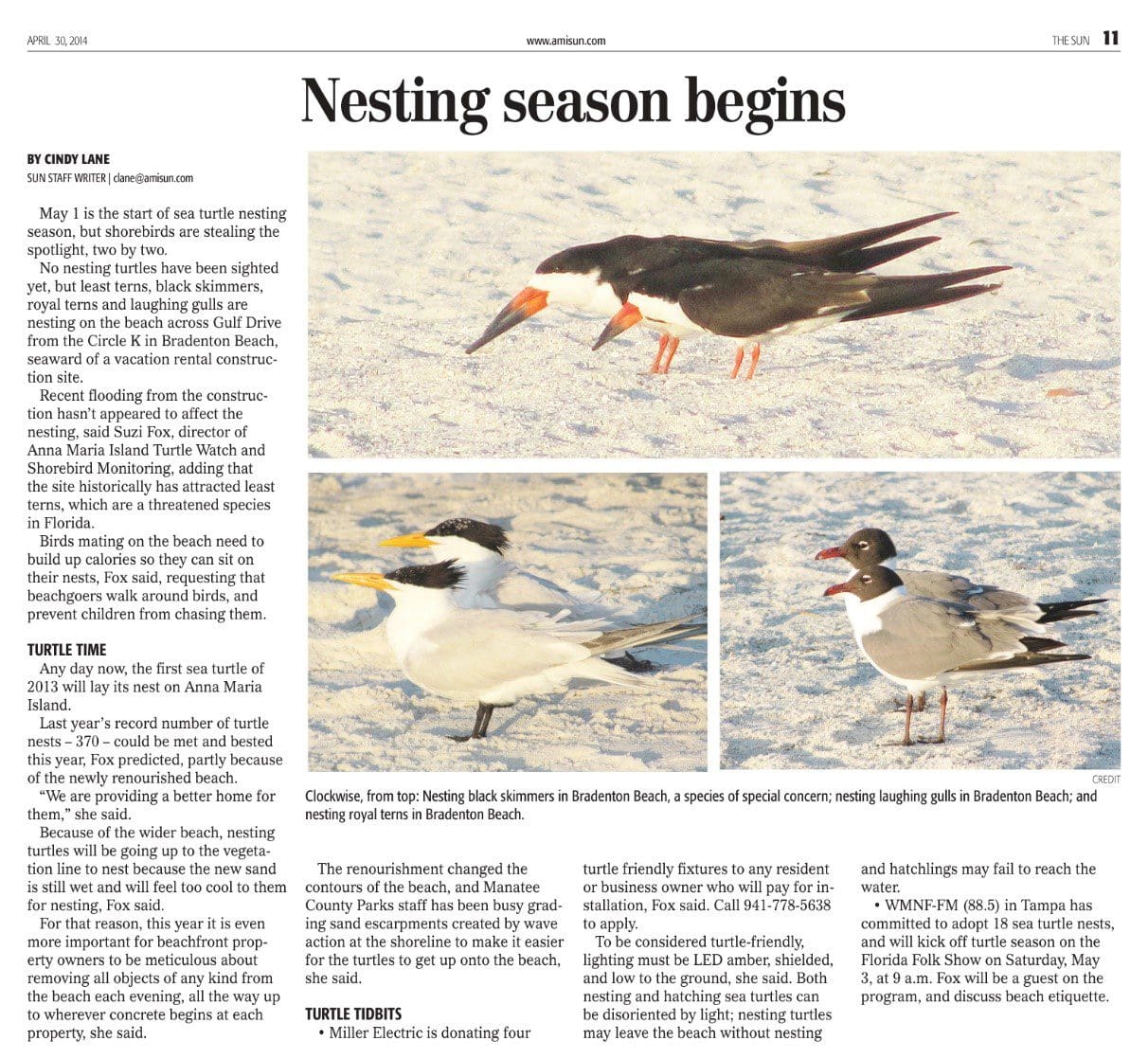
Photo Illustration
2015

First Place
Editorial
Cartoon
2015