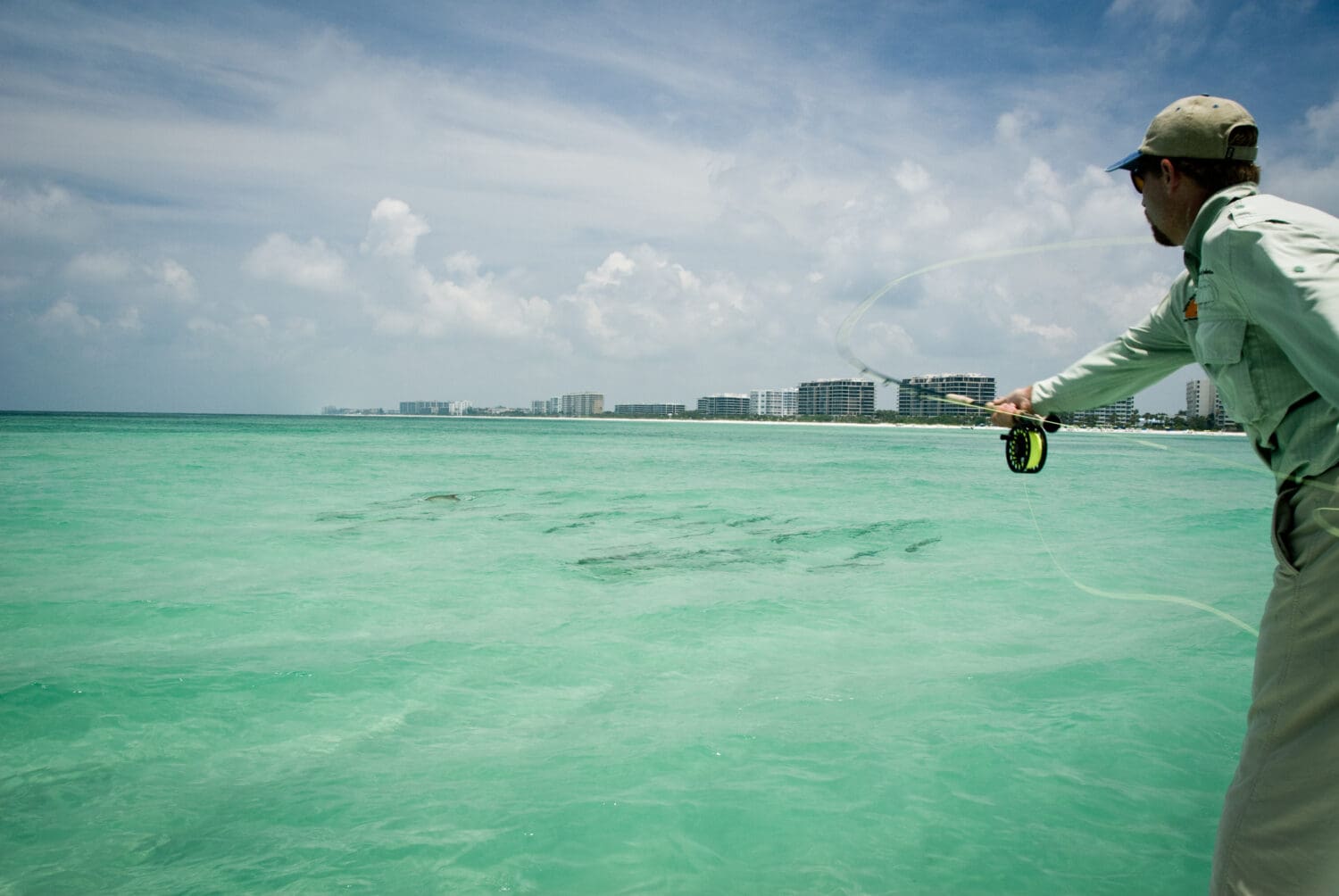
Tarpon, the premier gamefish that swim local waters in late spring and summer, can weigh over 200 pounds and average from 80-100 pounds. While most anglers pursue them on conventional tackle, a growing number of fly fishers are targeting them in Tampa Bay along the shallow Gulf coast and the local sandbars that bookend the local passes. Tarpon on fly tackle isn’t a game of numbers and the anglers who pursue them often spend hours on the bow in the hot summer sun for a chance at a hookup.
Fly tackle should be stout enough to challenge these powerful gamefish that are renowned for their spectacular aerial acrobatics and long fast runs. Serious anglers hoping to land one opt for an 11- or 12-weight outfit and carefully tied leaders with 60- to 80-pound bite tippet. While it might seem like a difficult task to land a tarpon on the fly, someone who knows the limits of their tackle can actually land a tarpon in a surprisingly short time. The key is to apply maximum pressure from the hookup and never let up. Too many anglers “baby” their tarpon in a misguided attempt to land them. The truth is that the longer you fight a tarpon the better chance you have of losing them.
A properly tied tarpon leader usually runs between 10-12 feet and is tapered. It includes a class tippet from 16-20 pounds that is doubled at both ends to soften the (shock) impact of the larger leader (40-60 pounds) it’s tied to. Flies vary from the classic splayed feather “Key’s” style to more complex designs like the “Toad,” and the wildly popular Palolo worm fly. Although the worm hatch is a Florida Keys phenomenon, tarpon everywhere seem attracted to them. This fly and many others are best presented to a tarpon with a two-handed strip. Some fly anglers are not concerned with actually landing a tarpon, preferring to just enjoy the hunt, the hook up and the jumps that usually follow the hook set. They use light bite tippets which allow the tarpon to work through the leader with their abrasive mouths. The key to getting the bite is a properly tied fly that tracks naturally and the accuracy of the cast. The fly must be placed perfectly, move in a precise direction relative to the fish and be at the proper (fishes’) depth. Even when all of these factors come together, there’s still about a 50% chance that the tarpon will reject the fly.
Patience is another critical factor when fly fishing for tarpon. The most successful anglers find the edge of a sandbar or other underwater feature that tarpon track, deploy a release anchor in casting range and wait. Sometimes tarpon come at a steady rate, but just as often there are long periods of time when the only thing to look at is the water and the bottom. This really separates the great anglers from the good anglers. There are times when you need to move but knowing when and where is a skill that is developed, if ever mastered. There are times when poling might be more effective but experience has taught me to only move when a school of fish requires a short distance off anchor for a shot. Next week: Part Two.
My pliers were in one hand and a fly was in the other as I prepared to cut the leader and change flies. Pausing, I looked up to check with Capt. Kevin Wessel before committing.
“Tarpon coming at 11 o’clock,” he said. When I asked if I had time to change the fly, he shook his head “no.”
Stepping up to the bow, I saw the fish about 50 feet away and made a cast, leading them about 10 feet. After pausing to let the fly sink, I put the cork handle under my arm and started stripping with both hands to bring the fly to “life.” Three strips later and the line came tight as the second tarpon in the string broke ranks to inhale the worm pattern. I set the hook with a quick, sharp strip strike and moved the rod to my hands as fly line leaped from the deck, wrapping around my left hand in the process. Luckily, I was able to shake it free just as the fish bolted away from the boat.
Capt. Kevin Wessel, an accomplished photographer, captured this awesome image of a leaping tarpon. – Capt. Kevin Wessel | Submitted
This was a big, hot fish and his first run took all my fly line and about 150 yards of backing. The run was interrupted only briefly as the tarpon made a spectacular head shaking jump just feet from Mike Adno, a friend who was fishing to the north of us. After the jump, the fish went around Adno’s anchor line and made a hard left, heading west. Fortunately, he was able to disconnect and release the line as I slackened my drag to prevent a possible break-off.
Looking back at Wessel I suggested we chase the fish as I noticed that half of my backing had disappeared from the reel with no sign of the run ending. Quickly releasing the anchor, he started the motor and we followed as I furiously reeled in backing. When I had the fly line back on the reel, I started to work the tarpon, swinging the rod right, then left, applying maximum pressure trying to throw the fish off balance.
This trip was turning out to be very rewarding on many levels. My friend Andy Grosso had won the trip in a raffle at the Compound Boardshop in Sarasota during the annual Fly-Fishing Film Tour event. Hosted by The Mangrove Coast Fly Fishers, the funds raised went to the environmental group Suncoast Waterkeeper.
After about 20 minutes and several jumps, I had the leader in the guides (considered a catch) for the fourth time when I applied additional pressure, parting the 16-pound class tippet (the weakest link). After high fives, I cracked a celebratory beer and Grosso – who had jumped and broken off a tarpon earlier – stepped to the bow. Moments later, a distant rain cloud obscured the late afternoon sun, making spotting fish impossible until they were right under the boat. It was after 6 p.m., so we decided to call it a day.
Although it’s always hard to leave tarpon when they’re feeding, we had experienced a great day of fishing. Capt. Wessel had correctly guessed, based on over two decades of experience, that it would be an afternoon bite, coinciding with a strong outgoing tide. We had started at 1 p.m. and found schools of fish everywhere in super clear water. It was beautiful to behold and good target practice, but it wasn’t until the tide was in full retreat that the fish began feeding.
In five hours, we had thrown at hundreds of tarpon, jumped two, landed one, and had multiple looks, leans and follows. Capt. Kevin Wessel can be reached for charters by calling 941-915-9514. Check out his website and book online.
Tarpon were the sirens that lured the first tourists to Florida, and their mystique is still in full sway today.
While fly fishing for tarpon holds a mystique of its own, the vast majority of anglers pursue them with conventional tackle. The go-to bait for spin anglers is a live crab. Small blue crabs can be purchased at most bait shops during tarpon season and pass crabs can be dipped from the local passes on a falling tide. Other effective baits include pinfish, threadfin herring and pilchards. Artificial lures like the DOA Bait Buster and the 4- and 6-inch shrimp, jigs and even top water plugs can be effective.
Patience is a critical factor when fishing for tarpon, especially when fly fishing. The most successful anglers find the edge of a sand bar or other underwater feature that tarpon track, anchor in casting range and wait. Sometimes tarpon come at a steady rate, but just as often there are long periods of time when the only thing to look at is the water and the bottom. This really separates the great anglers from the good anglers. There are times when you need to move but knowing when and where is a skill that is developed, if never mastered.
Once set up, the angler must be able to make a 40- to 50-foot cast to a location the size of a dinner plate. Placement of the fly cannot be overemphasized, because tarpon will seldom vary a foot or two from their path to eat a fly. Although there is always the rare exception, a fly must never travel in a path towards the intended target. A tarpon’s prey species wouldn’t survive long if it moved toward its aggressor, and tarpon know it. Besides moving away from the fish, the fly must move at the proper pace, be at the proper depth and never slow down when a tarpon is tracking it. Conversely, you can’t move the fly too fast, taking it out of a tarpon’s range.
Conventional anglers usually look for rolling fish in the near-shore Gulf and motor well ahead of them to intercept their path. Trolling motors can be effective for following a school in deep water but will spook them in the shallows. Knowledgeable guides that have “mastered” multiple presentations to a school of moving fish provide their clients some spectacular results. One thing that all tarpon anglers should practice is courtesy. Often a boat has been working long and hard to get properly set up for a shot and a boat running up on the fish will spoil the day for everyone.
Fortunately, once a tarpon decides to eat, there’s no need to make a lightning-fast hook set. The right set is called a “strip strike” in fly fishing, which involves letting the line come tight and immediately setting the hook with a combination of the line hand and the rod. Conventional anglers should also have the patience to let the line come tight before attempting to hook the fish. Then the angler must at once work to set the hook in the cement-like jaw while being ready for the fish to bolt away from the boat. Tarpon are not trout, and attempting to raise the rod to set the hook is a cardinal mistake.
After a fly angler sets the hook, attention must go immediately to clearing the line (getting the loose line off the deck). In most cases, the angler has been stripping in line when the fish bites and the hook is set. That line can easily foul on the angler, the rod or the reel. Disciplined anglers (successful ones) take their attention from the fish to the line at your feet. They know to hold the rod away from their body and let the excess line pass through their stripping hand with a circle made with the thumb and the forefinger. Once the line is “on the reel,” the hook is set again with several more strip strikes. Conventional anglers often use circle hooks, which don’t require a hook set. Conventional hook sets also require letting the line come tight with the addition of several quick jabs to set the hook. In all cases, the tarpon cannot be aware of the angler before the hook set.
While it’s important to exert maximum pressure on the tarpon during the fight, anglers must yield on jumps. On the jump, the standard maneuver is to thrust the rod forward to relieve pressure on the line. This prevents the tarpon from breaking off if it lands on a taut line. This maneuver is known as “bowing to the king.”
It’s customary to start the engine and get as close to the tarpon as possible after the initial and subsequent long runs. This allows the angler to apply maximum pressure. If a tarpon is a hundred yards from the boat, the stretch of the line makes it impossible to apply any real pressure. Keep the pressure on throughout the fight, but don’t clamp down and try to force the fish to the boat.
The thought that these next few months, the highlight of mine and many other angler’s year, might be sacrificed to the onslaught of a harmful algae bloom is a painful reminder. While there are many bad actors to blame for this misfortune, if we don’t speak up and act, nothing will change until after a disaster. Piney Point is the perfect example. Call your elected officials, attend commission meetings, write letters to the editor, and more importantly, become an active advocate.
Perhaps the best strategy of all is to get excited about, look forward to and get ready for a magical time of the year. While we’re at it, we’ll let the passion fuel our determination to protect it.
Tarpon season is one of the most anticipated times of the year on local waters. While I’ve encountered tarpon occasionally most every month of the year, April through July is the time eager anglers turn their sights to these silver-armored adversaries. Their arrival in numbers worth pursuing is generally water temperature-dependent. The magic number is debatable, but when water temperatures reach into the 70s, ardent anglers take notice. When that number reaches the high 70s to 80s they take action. Hopefully, there will be a season.
I thought long and hard about the subject of this week’s article. The condition of local waters has worried me the past few years as regular readers of this article will no doubt be aware. The resilient marine ecosystem that has amazed me in the past has not recovered after the 2017-18 red tide. On top of this, the disaster at Piney Point puts massive amounts of nutrients into Tampa Bay just as waters start to warm and red tide reports creep up the coast. But let’s be optimistic.
We are blessed with some of the best tarpon fishing in the world and the local bars and inshore waters host some of the finest fly and spin fishing to be found anywhere. For most anglers this isn’t a numbers game, it’s the hunt and the action that keep them pinned to the bow in the sizzling summer sun.
Tackle should match the size of the quarry with most anglers opting for a 20- to 30-pound spin outfit and/or 11- to 12-weight fly outfit. A heavy bite tippet is required because of the size of tarpon and their rasp-like mouth. Fly anglers generally use 60- to 80-pound tippet while spin anglers choose 70- to 100-pound test. While it might seem like a difficult task to land a tarpon on the fly, or any tackle for that matter, an angler who knows the limits of her gear can actually land a tarpon in a surprisingly short period of time. The key is to apply maximum pressure from the hookup and never let up. Too many anglers “baby” their tarpon in a misguided attempt to land them. The truth is that the longer you fight a tarpon the better chance you have of losing it.
A properly (IGFA approved) tied tarpon leader used by fly fishers usually runs between 10 and 12 feet and is tapered to accurately deliver the fly. The leader includes a class tippet (weakest link) from 16 to 20 pounds that is doubled at both ends to soften the (shock) impact to the class tippet and bite tippet. Key to the whole equation is to have a very sharp hook, as tarpon have extremely tough mouths. Conventional leaders vary from angler to angler, but a doubled standing line tied to a leader and then to the bite “tippet” with a blood knot or Albright Special won’t fail you.
Flies vary from the classic splayed feather “Key’s” style to more complex designs like the “Toad,” various baitfish imitations and worm flies. Some fly anglers are not concerned with landing a tarpon, preferring to just enjoy the hunt, the hookup and the jumps that usually follow the hook set. They use light bite tippets which allows the tarpon to work through the leader with their abrasive mouths. The key to landing tarpon on the fly is accuracy. The fly must be placed perfectly, move in a precise direction relative to the fish and be at the proper (fishes’) depth. Even when all of these factors come together, there’s still about a 50% chance that the tarpon will reject the fly, assuming that the condition of local waters doesn’t repel them first.
It’s happened before and while some would have you believe it’s natural and there’s nothing to be done, if there’s any silver lining in all this, it’s that it wakes us up to what we can and must do to protect our passion. But more on both fronts next week. To learn more and lend support visit Suncoast Waterkeeper.
Tarpon could be said to be angling’s Holy Grail. I’ve heard top Keys guides refer to catching a tarpon on fly as the apex of angling. While most Floridians think that it was crystalline blue water and white sugar sand beaches, coupled with the mild winters that attracted people to the state in the first place, it was actually anglers seeking tarpon.
As early as the late 1800s tarpon tournaments were hosted on Useppa Island. In those days anglers with button down suits and ties fished from rowboats towed to Boca Grande and Captiva passes. Anglers are no longer wearing suits and rowboats have given way to technical skiffs and tower boats, but great schools of tarpon still invade local waters in May, June and July.
The spectacular jumps of tarpon have held anglers spellbound since the 1800s. – Rusty Chinnis | Sun
Ninety miles to the north the Gulf flats that front the sleepy town of Homosassa were and are home to some of the most prolific tarpon fisheries in the world. Homosassa’s love affair with tarpon could be said to have started in 1882 when Anthony Weston Dimock hooked a tarpon in the Homosassa River.
“At first I thought the wonderful being was a mermaid,” Dimock recounted. “As I noted her fierce display of activity and strength, I pitied the merman who came home late without a better excuse than a meeting of the lodge.”
Winslow Homer, (1836-1910) the great American sporting artist, also came under the spell of Homosassa. In 1904, Homer painted at least 11 watercolors during a stay there. In a letter to his brother Arthur, Homer described Homosassa as, “The best fishing in America as far as I can find.” In the 21st century, many have experienced a love affair with the mermaids of Homosassa. While the history of the region runs deep with redfish, trout, cobia, grouper and hundreds of other species, it is the tarpon that have made Homosassa a legendary fly fishing destination. A quick look at a map makes it clear why this region has been such a magnet for tarpon and the anglers that pursue them. It’s still one of Florida’s most pristine areas with thousands of islands, clear spring-fed rivers and a habitat rich in marine life.
While Homosassa has been the place most mentioned in tarpon lore, it was actually a large area from Crystal River to Pine Island, near Bayport where the anglers fished. The greatest concentrations of tarpon were located between Chassahowitzka’s Black Rock and the flat known as Oklahoma near Pine Island.
It was Black Rock, Lower Rack, Upper Rack (dilapidated net drying racks) and Oklahoma that dominated discussions both on and off the water. The first anglers that pursued tarpon from Crystal River to Pine Island used conventional tackle, but they undoubtedly led the way for fly anglers who discovered one of the world’s greatest fly fisheries. Eustace Locklear, a native of Homosassa and a man remembered by everyone who fished the area with a fly, learned to fish for tarpon from Jonnie Elmer, of Crystal River. Elmer caught his tarpon by trolling the river with an inboard boat.
Although anglers have been fishing for tarpon since the 1800s, it was Harold LeMaster and Kirk Smith, of St Petersburg’s L&S Lure Company (MirrOLure), and Dee Mitchell, their friend and doctor, that can be credited (unintentionally) with introducing the fly fishing world to Homosassa.
The three anglers regularly fished plugs for tarpon near Honeymoon Island. On a day when the tarpon weren’t showing, they topped off their tank and headed north in search of fish. When they reached the area north of Pine Island they ran into schools of tarpon that would forever change the history of fly fishing.
Fly fishing legend Lefty Kreh was introduced to Homosassa by Mitchell, LeMaster, and Smith after he moved to Largo from Miami in 1971. Kreh became the outdoor editor of the St. Petersburg Times after heading the prestigious MET Tournament in Miami. By all accounts, Kreh caught the first tarpon on a fly in the Homosassa area. Kreh introduced these anglers to fly fishing.
“LeMaster wanted to learn how to cast, although he always preferred plug casting,” says Kreh, who remembers him being a good caster and led him to a 100-pound tarpon on fly at Homosassa.
LeMaster and Smith also introduced Clearwater homebuilder and rod maker Gary Marconi to Homosassa during the early 1970s. Marconi fly fished the area with his college buddy Norman Duncan from Miami. Duncan, the creator of the Duncan Loop, was one of Florida’s original saltwater fly fishers.
Marconi made Captain Dan Malzone aware of the area’s phenomenal tarpon fishing. Marconi was building fly rods for Malzone in the early 1970s when he learned that Malzone had built a house on Pine Island, south of Chassahowitzka.
“Marconi turned white as a sheet when he realized where the house was,” says Malzone. “I had built a house overlooking one of the area’s most famous flats, one that Marconi and Duncan had been secretly fishing for several years.
“He then asked me when the house would be ready, and when I told him May, he said that would be perfect. As it turned out we slept in the house with no furniture along with Marconi and his friends Neil Sigeartsen and Pete Centerrno.”
To say the fishing was spectacular is a bit of an understatement according to Marconi, who kept a log book in the early days. His best day, April 29, 1975, shows that he and Duncan jumped 56 tarpon by noon.
Captain Dale Perez, a Tampa native and Keys guide, heard about Homosassa from Duncan.
“Captain Steve Huff and I were having breakfast at Stout’s in Marathon when Norman Duncan came in and showed us a picture of a huge tarpon he had caught in Homosassa,” says Perez. Duncan was one of the early anglers who made the Keys guides aware of Homosassa’s fly fishing potential.
Perennial tarpon angler Tom Evans remembers a day soon after this encounter when he was fishing with Huff in the Keys.
“The weather was terrible,” Evans relates, “and Huff asked me if I wanted to go check out a place on the west coast of Florida that he had heard about.” We spent two days there and had terrible weather,” says Evans. “Despite the conditions, we saw enough big tarpon to realize the area’s potential.”
Stu Apte was another angler who had heard about Homosassa well before it became a destination.
“Ray Donesberger, one of my best clients, had stopped by Homosassa on his way to the Keys to fish. While he was there he went out with Eustace Locklear and four other anglers.
“When Locklear spotted a school of tarpon he would position the boat with a paddle and cast a MirrOLure to the fish. He had given everyone a number and when he hooked up he would set the hook and say Number one, your turn.”
Apte next heard about the area from Lefty Kreh.
“He’s the one that really lit my fire,” says Apte. “I made my first trip to Homosassa in the early ’70s.”
Apte never guided at Homosassa, choosing instead to share poling and fishing with his good friend Captain Ralph Delph. One of Apte’s fondest memories is the day he landed two world records on one day.
Privacy choicesWe use Google Analytics to understand readership and improve the website. Analytics cookies are optional and can be accepted or declined.Privacy Policy