

Tag: St. Augustine National Cemetery

St. Augustine National Cemetery

Under Egmont 4: Egmont cemetery mysteries put to rest

BRADENTON – Mark Green stands at a grave marker at the Fogartyville cemetery, refers to an old, hand-drawn map and walks a few paces, ducks under a moss-draped tree, passes a bench and several headstones, finally reaching a patch of grass near the roadway that meanders through the historic graveyard.

There are no flowers, no inscriptions, not even a headstone or marker, but according to the map, it must be the place.

Third Place
Investigative Reporting
2015
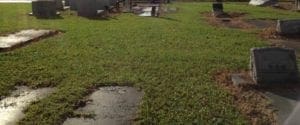
Fogartyville Cemetery, Bradenton
The probable resting place of Azaline Bahrt at the Fogartyville Cemetery, Bradenton. – Cindy Lane | Sun

Green, the family historian for the Cortez Green and Fulford families, thinks it’s the grave of several Fulford family members, including Capt. Carl William Bahrt, a ship captain from Key West, born in Denmark in 1835.

It’s been a long road to Fogartyville, beginning at a historic cemetery on Egmont Key, an island off the north end of Anna Maria Island that was once a military fort, but is sparsely inhabited today by a lighthouse keeper and on-duty Tampa Bay harbor pilots.
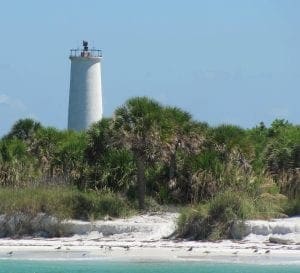
Egmont Key lighthouse - Cindy Lane | Sun
Egmont Key lighthouse – Cindy Lane | Sun

Earlier this year, the Anna Maria Island Sun uncovered the history of many of the people buried on Egmont Key in the late 1800s whose remains were relocated in 1909 to the St. Augustine National Cemetery in northeast Florida. They included “Indian (Unknown),” thought to be a Seminole chief, one of Teddy Roosevelt’s Rough Riders, so-called “colored” military hospital workers, a Tampa man’s formerly long-lost great-great-grandfather, Azaline M. Bahrt, the daughter of an Egmont Key lighthouse keeper named Coons, and her daughters, Marie Bahrt and infant Carlotte Bahrt.

Online in Washington state, William Bahrt saw the names of the three Bahrt family members in one of the stories in the series, prompting a call to The Sun and a renewed effort to learn more about his family history, including sorting out the identities of the family’s two Azaline Bahrts.

Related coverage

Under Egmont 3: Found

Under Egmont 2: Unearthing Egmont Key’s mysteries

Under Egmont 1: History’s mysteries persist at Egmont Key

“Azaline Bahrt is a mystery, and I have been looking since 2007 and can find hardly anything about her or her family,” William Bahrt wrote in an e-mail to his relative, Mark Green.

“One mystery is exactly who the Azaline Bahrt was that had daughters buried on Egmont Key,” Green wrote.

The Sun shared evidence uncovered in the series that Azaline Bahrt and her two girls likely died from yellow fever on Egmont Key, where William Bahrt fondly recalls spending his childhood summers in the 1930s with his harbor pilot father and their family.

Grateful for the new information, Bahrt was inspired to resume researching the whereabouts of the grave of the man he thinks was Adaline’s husband, Capt. Carl William Bahrt.

“I am still mystified by the story of Carl Bahrt and his connection with Azaline Marie Coons, the daughter of the Egmont Key lighthouse keeper,” he wrote Green, who shouldered the quest this year during visits to Cortez to see his mother, Mary Fulford Green.

After some research, Green concluded that the captain was buried at his home in 1899 and his remains later relocated to the Fogartyville cemetery in Bradenton, along with several other family members. But none of the graves in the Fogartyville cemetery list the Bahrt name.

Green located a 1920s survey map of the cemetery that showed a plot for the Bahrt family near some plots that are marked with early Bradenton family names, including Fogarty.

He invited The Sun to help him canvass the graveyard, following the map like Indiana Jones.

“This must be it,” he said, pointing to an empty area that corresponds with the Bahrt plot on the survey map, bringing to rest the search for the captain’s grave, at least until more information is uncovered.

In a nutshell years in the making, “We think Capt. Bahrt married Azaline Coons, she got sick from yellow fever and died with her two girls on Egmont Key, they were buried on Egmont and moved to the St. Augustine cemetery. He later married my grandmother, Catherine Davison, and they had a daughter they named Azaline Marie, after the first Azaline, and he and Catherine were buried in Fogartyville,” Bahrt said from his Washington home last week. “That second Azaline Marie Bahrt is my aunt, who ended up an O’Brien in California, and that’s all I know. I would love to be able to follow up on that line in the family.”

But it’s Christmas, and the doorbell is ringing, and the dog is barking, and as the descendants of the Bahrts of Egmont Key gather for their holiday celebrations, there’s no time to dwell on Auld Lang Syne just yet.

“Gotta go, the family’s here,” Bahrt said. “Merry Christmas!”

Rob Whitehurst at St. Augustine National Cemetery

Under Egmont 3: Found

ST. AUGUSTINE – When Rob Whitehurst began looking for the grave of his great-great-grandfather, the Internet was new, with scant information, and research was challenging.

When he learned that John Alexander Whitehurst was buried on Egmont Key in the cemetery next to the lighthouse, it was like striking gold. He recorded his findings on a website, Findagrave.com and laid his search to rest.

Third Place
Investigative Reporting
2015

Years passed. Then in 2015, research by The Sun about the people buried in the Egmont Key cemetery uncovered a handwritten ledger on Ancestry.com showing that 12 people, including Spanish-American War soldiers, an “Indian (Unknown),” and Whitehurst’s great-great-grandfather, had been relocated in 1909 from Egmont Key to the St. Augustine National Cemetery.

St. Augustine National Cemetery Egmont Key records
St. Augustine National Cemetery records about Egmont Key grave relocations.

The website also pointed to Findagrave.com, and “Rob,” no last name, who was listed as the author of a brief biography of his ancestor. A 50-50 shot that his last name was Whitehurst paid off, and one Google search and two e-mails later, Rob Whitehurst felt like he had struck gold again.

His family had always heard the story that a family member’s remains had been moved, he said, but Whitehurst thought it was probably Daniel Scott Whitehurst, who died in 1862 in Pinellas County at the hands of Confederate forces who attacked him and his cousin, John Whitehurst – both Union sympathizers – while they were getting provisions on the mainland to take back to Egmont Key.

In the attack, John Whitehurst was wounded, escaped to his boat and was rescued at sea two days later and taken to Egmont Key, where he had been living with his family under the protection of the Union Navy that occupied the island.

He died from his wounds and was laid to rest in the Egmont Key cemetery, until 106 years ago.

Reunion

The St. Augustine National Cemetery and its dead lie enclosed within a low, white stone wall in the historic Old Town section of the oldest city in the U.S.

Like a mini-Arlington, uniform white headstones make straight rows under the shade of moss-draped oaks.

The American flag whipped briskly in the breeze off the Matanzas River as Whitehurst walked down the central sidewalk one chilly day last week, getting his bearings. The Google Earth image he had consulted showed the back of most of the headstones, with the inscriptions on the opposite side, but he knew the grave was in section A, and he had a landmark to navigate by.

Three pyramids and an obelisk drew Whitehurst toward the south end of the cemetery. The monument is the resting place of Major Francis L. Dade and most of his regiment, killed in the Second Seminole War in 1835. Fort Dade, on Egmont Key, was named for him.

Walking toward the monument, Whitehurst called off numbers on the headstones, walking faster as he neared the number he sought. A headstone without a number, naming John O’Neil, stalled him for a moment. Then, he stopped.

He bent down to read 248, and the name, and placed his right hand on his great-great-grandfather’s headstone.

“Here he is,” he said.

Neighbors

The simple stone’s only inscription is “Whitehurst.”Whitehurst grave marker in St. Augustine

To the right of the grave is a newer headstone, which replaced one like Whitehurst’s.

Both have shields traced around the inscription, like others in the cemetery. According to the headstone, Trooper John O’Neil, of New Mexico, fought with the 1st U.S. Volunteers cavalry regiment, E Troop, in the Spanish-American War, with Teddy Roosevelt’s Rough Riders.

During the war, O’Neil was transported by ship from Cuba to Egmont Key for medical treatment, but there was a lack of medical facilities on the island and he was sent back to the ship, where he died, according to the book, “Egmont Key: A History.” His remains were among the 12 burials relocated to St. Augustine. The Tampa-based Rough Riders organization placed the new headstone in 2004.Rough Rider grave in St. Augustine

That gave Whitehurst the idea to investigate replacing John Whitehurst’s headstone, but he discovered the cost would be prohibitive without assistance from a historical organization, he said.

Still, Whitehurst’s headstone has more information than some of the other relocated Egmont Key dead.

Many headstones in the St. Augustine cemetery read “unknown” or are blank. “Indian (Unknown),” as listed on the St. Augustine cemetery ledger, is nowhere to be found. Neither is Azaline M. Bahrt, of the Egmont Key lighthouse keeper’s family, whose name is listed on a plaque at the Egmont Key cemetery, although her daughter, Marie Bahrt, is recorded at No. 316 and a related infant, Carlotte Bahrt, is at No. 287.

Private J.A. Brainerd, Company A, 26th Michigan Infantry, is at No. 283. Infantryman James Shannon, listed as Joseph Shannon on the Egmont Key plaque, is at No. 274. Seaman Robert Bentson, of the U.S. Lighthouse Tender “Laurel,” listed as Benton on the St. Augustine ledger, is at No. 276.

Like “Indian (Unknown),” “Colored Soldier (Unknown)” is nowhere to be found. Charles Williams, at No. 279, was listed as a “colored” soldier on the Egmont Key plaque, but may have been misidentified; his name appears on the St. Augustine ledger directly above the entry “Colored Soldier (Unknown);” the two lines appear to have been mistakenly combined on the Egmont Key plaque.

A few steps away from Whitehurst, at No. 256, is William Rull, who is listed as Rull/Ruth in the St. Augustine ledger, and is identified as a “colored” hospital attendant with the U.S. Marine Hospital Service on the Egmont Key plaque. Southern cemeteries in the 20th century often separated black and white burials, but not here. Whitehurst said his great-great-grandfather, a Southern resident who was a Union sympathizer and scouted for the Union Army, “was right about slavery.”

John Whitehurst’s dying wish was that his three sons, 12, 8 and 6, enter the naval service, according to a report by Lieutenant J.C. Howell, who ordered his burial. The older two were accepted the month after his death, but his youngest, Harney Butler Whitehurst, was not. He became the great-grandfather of Rob Whitehurst.

Whitehurst has visited a dozen or so cemeteries to visit family members’ graves, but this one is special.

“I didn’t really think about it until now,” Whitehurst said, looking at the headstone. “If it wasn’t for him, I wouldn’t be here.”