

Tag: Sarasota Bay Estuary Program

Reel Time: A New Winter Strategy

Reel Time: A New Winter Strategy

Winter can have a chilling effect on local anglers and limit their quarry, but those who know how to mine the riches of any season turn their attention to the species that actually thrives in cold water.

The best example locally are known for their bait stealing prowess and the stripes they dress in. Sheepshead, while shunned by some anglers, are hard fighting, challenging to hook and excellent to eat. Savvy anglers’ target sheepshead around structures like bridges, hard bottoms, oyster bars and dock pilings, where they feed on barnacles, crabs and other crustaceans. They know to use small, stout, sharp hooks; and for best success, they (tongue in cheek) advise to set the hook a split-second before they bite!

As a fly angler, I’ve caught a few sheepshead over the years, all accidentally while fishing for other species. The times I’ve seen them and actually made a presentation, they never seemed to respond to my efforts.

When Ryan Gandy, the new executive director of the Sarasota Bay Estuary Program, recently mentioned he targeted them with a tiny fly I was slightly skeptical and all ears. Last week, Gandy and his son, Kyle, joined me for a day on the water and a chance for him to show me his technique.
Reel Time: A New Winter Strategy
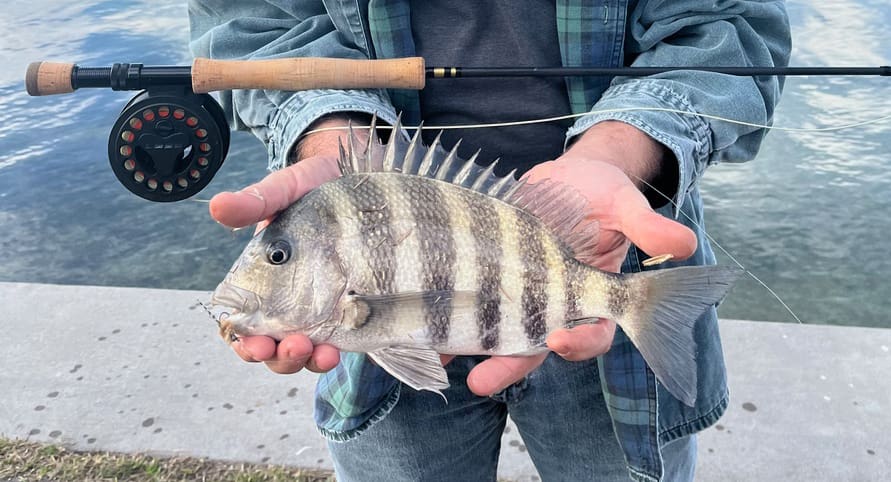
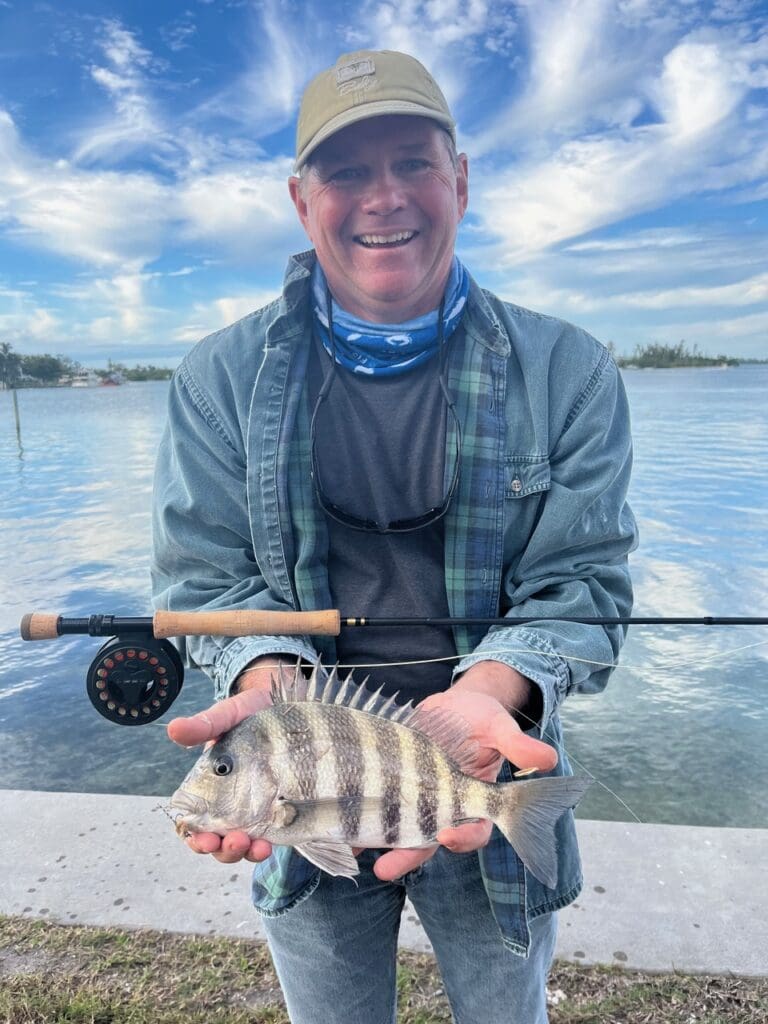
Ryan Gandy with proof that his fly fishing concept works. – Rusty Chinnis | Sun

We started the day fishing the edge of Long Bar Point in Sarasota Bay, but a south wind had roiled the water, making it off-color and hard to spot fish. The tide was low and incoming all day, so we moved north where the water along the eastern shoreline was clear. For the next four hours, we were plagued by scudding clouds that made spotting fish hard, but we still managed three redfish and a trout.

The sheepshead we did find were spooky, and most were not seen until we were so close Gandy had to make a roll cast presentation. While we did get a few follows, the sheepshead that seemed interested were spooked by the boat before making a commitment.

After fishing a number of spots, I mentioned that I had seen some sheepshead in shallow water just off a seawall near where I launched the boat, so we decided to try and make that a learning opportunity.

Luckily, the sheepshead were obliging; and after two casts, Gandy got a take and landed a sheepshead just as he had predicted. In the process, I was given a first-hand demonstration of his technique. Key to his strategy was making a cast close enough so the sheepshead could spot the fly, but not too close to avoid spooking them. He mentioned what good eyesight they had and how they could spot a fly at a distance.

He demonstrated this by casting about three feet past the intended target and then slow stripping it until the sheepshead spotted it. When the fly was spotted, it rushed over to inspect the perceived prey and that’s when the next critical move, or lack thereof, was employed. Stopping the fly and letting it sink to the bottom mimicked a crab trying to hide from a predator it knew it couldn’t outrun. When the sheepshead rushed over and tipped up on to the fly, Gandy moved it with a small strip. Doing this allowed him to determine if the fly had been taken; and if not, would mimic a crab that had been discovered and was attempting to flee. This happened twice, and on the third strip the sheepshead was hooked.

This was a perfect opportunity to see his strategy in practice; and it reminded me of how a fly angler teases a permit, which is one of the hardest fish to entice to a fly. It also made me aware that sheepshead are predators; and, like when fishing for permit, patience and persistence are key.

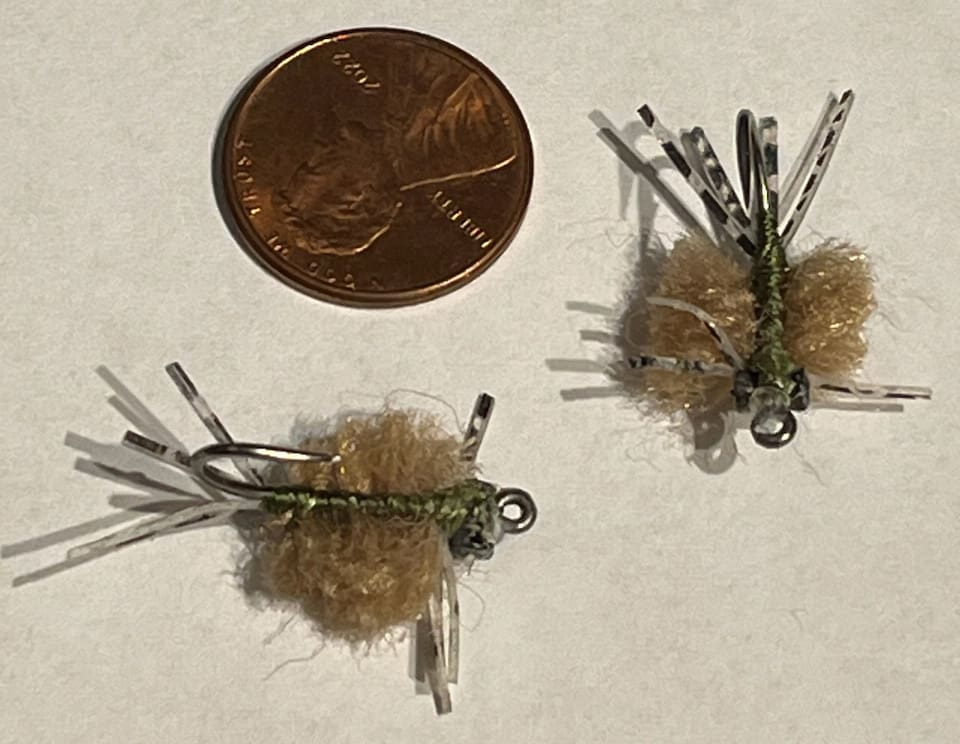
Gandy ties a small version of the Merkin (a time-tested permit fly) on a #4 hook. Other flies, like the Alphlexo crab, are also effective.
Reel Time: A New Winter Strategy
A penny gives perspective on the size of Gandy’s sheepshead merkin. – Rusty Chinnis | Sun

It great to get insight on a new angle on sight fishing after so many years of fly fishing. If you haven’t been targeting sheepshead with a fly, I encourage you to give this technique a shot. I saw it in action and can’t wait to give it a try. Use your senses, experiment, be persistent and you can experience a whole new challenge during our cooler winter months.
Reel Time: Partners grants good for bay

Sarasota Bay Partners grants are competitive awards for projects in the Sarasota Bay watershed that promote habitat and water quality restoration, environmental education, community involvement and stewardship to improve the overall quality of Sarasota Bay and its tributaries.
Stormwater runoff, sewage spills, leaking septic tanks and a thousand other insults threaten the health of Sarasota Bay. Add to this warming temperatures, rising sea levels and altered weather patterns, all of which will continue to impact our natural and built environments.
I’m often asked what an individual or a group can do to be part of the solution instead part of the problem. One way to make a difference is to take advantage the Sarasota Bay Estuary Programs Bay Partners grants. The SBEP was formed with the aim to protect Sarasota Bay and its environment, the economic engine of the region and the reason most of us live here. Local actions like this help prepare our communities and estuary for these changing conditions. There are many opportunities to engage. These include but are not limited to:
• Planting shade trees in highly paved urban areas;
• Installing rain gardens and bioswales to filter runoff from impervious surfaces;
• Diverting gutter downspouts from impervious surfaces to planter boxes, garden beds or other permeable areas, or to rainwater harvesting systems like rain barrels and cisterns; and
• Implementing living shorelines or seawall modifications that will allow mangroves to migrate upslope.
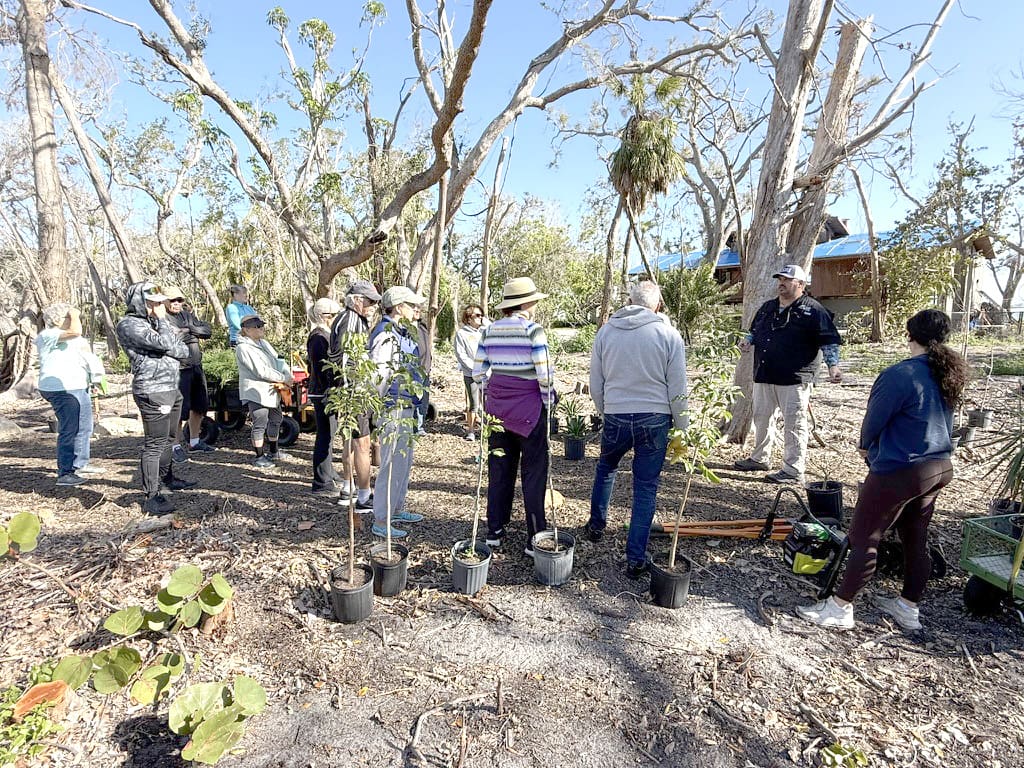
Recently, Banyan Bay on Longboat Key took advantage of a grant to turn an area they had nicknamed the “swamp” into a vibrant area that beautified the grounds, created a natural pollinator garden for birds and insects and helped protect Sarasota Bay, which fronts the property.
The project was led by residents Dr. Jeff and Terri Driver. Their experience and the outcome are best expressed in Terri’s words: “We had some uncertainty about whether our proposed project would fit the requirements for a grant from SBEP Partners. A friend recommended we call SBEP and simply ask if they would look at our space and situation and see if it was appropriate for a grant proposal. On a very tight timeline and on short notice (because the proposal was due in about two and 1/2 weeks, SBEP grant manager Darcy Young visited our property and evaluated our proposed site, agreeing that it was exactly what would help Sarasota Bay if re-planted to native species. SBEP was very helpful in response time and providing guidance to complete our grant application. SBEP recommended a couple of native plant nurseries, but Annie Schiller at Florida Native Plant Nursery was very responsive. On very short notice, Annie visited, evaluated our proposed renovation area and very quickly provided a list of plant species and number to be planted specific to our wet and dry areas. She also reminded us about mulch requirements. We called Annie the morning our proposal was due to make changes, and Florida Native Plants Nursery provided updated estimates two hours before our proposal was due. They were very responsive to changes. Once we received the grant (yay!), Florida Native Plant Nursery brought the plants in and helped with recommended placement. Our community members planted all 134 plants, creating a new native forest at The Banyan Bay Club.”
On Feb. 27, members of the press and the association attended a ribbon-cutting ceremony to dedicate the new space and celebrate their investment in protecting Sarasota Bay while improving the condominium grounds, a true win/win experience.
Although the next grant deadline is March 2, now is an excellent time to plan how you can take advantage of this program and make a difference while enhancing your place in the bay’s watershed. For more information and to apply for a grant, go to https://sarasotabay.org/get-involved/apply-for-a-grant/.

FISH Preserve opens this week

FISH Preserve opens this week

CORTEZ – The vision that FISH (Florida Institute for Saltwater Heritage) members had more than 20 years ago to preserve the environmental integrity of coastal land on Sarasota Bay has come to fruition.

The preserve, on 100 acres of coastal wetland between Cortez Road and Sarasota Bay, will open with a ribbon-cutting ceremony on Friday, Nov. 3 at 10 a.m.

The sold-out event will feature speeches from U.S. Environmental Protection Agency (EPA) Region 4 Administrator Jeaneanne Gettle and Manatee County Commissioner Kevin Van Ostenbridge.

The FISH Preserve borders the historically significant Cortez commercial fishing village and the waters of Sarasota Bay. It is one of the only untouched waterfront properties on the bay.

The preserve underwent years of environmental restoration which removed exotic vegetation and added waterways to connect to Sarasota Bay and restore aquatic habitats.

“The FISH Preserve came close to getting paved over by developers, however, the community came together to purchase the property in the nick of time,” according to the FISH website. FISH raised the initial funds for the protection of the land in 2000, buying parcels one at a time ever since.

Funding for the first $60,000 mortgage payment on the land was raised from donations from citizens and conservation-minded companies. Years of proceeds from the annual Cortez Commercial Fishing Festival each February and donations from members and friends allowed FISH to pay off their original mortgage.

A major grant was provided by the Southeast Aquatic Resources Partnership, which led to the creation of a tidal stream system. That grant allowed for the creation of new wetland areas and the removal of invasive plants.

“The water quality in Sarasota Bay is improving. Large-scale restoration projects like the FISH Preserve build on that progress to help restore our fish and wildlife populations,” said Dave Tomasko, executive director of the Sarasota Bay Estuary Program.

The preserve is fully restored, but public recreation is currently limited to a few foot trails. FISH and its partners are looking at adding boardwalks, trails and signage.

Restoration of the preserve was a collaborative effort between FISH, the Sarasota Bay Estuary Program, the Florida Fish and Wildlife Conservation Commission, the Southwest Florida Water Management District, the EPA, the Southeast Aquatic Resources Partnership and the National Oceanic and Atmospheric Administration.

Reel Time: Sarasota Bay Partners Grants offer environmental win/win

Reel Time: Sarasota Bay Partners Grants offer environmental win/win

Sarasota Bay Partners Grants are competitive awards for projects in the Sarasota Bay watershed that promote habitat and water quality restoration, environmental education, community involvement and stewardship to improve the overall quality of Sarasota Bay and its tributaries. Stormwater runoff, sewage spills, leaking septic tanks and a thousand other insults threaten the health of Sarasota Bay. Add in warming temperatures, rising sea levels and altered weather patterns, all of which will continue to impact our natural and built environments.

I’m often asked what an individual or a group can do to be part of the solution instead of part of the problem. One way to make a difference is to take advantage of the Sarasota Bay Estuary Program’s Bay Partners Grants. The SBEP was formed with the aim to protect Sarasota Bay and its environment, the economic engine of the region and the reason most of us live here. Local actions like this help prepare our communities and estuary for these changing conditions. There are many opportunities to engage. These include but are not limited to:

  • Planting shade trees in highly paved urban areas;
  • Installing rain gardens and bioswales to filter runoff from impervious surfaces;
  • Diverting gutter downspouts from impervious surfaces to planter boxes, garden beds or other permeable areas, or to rainwater harvesting systems like rain barrels and cisterns; and
  • Implementing living shorelines or seawall modifications that will allow mangroves to “migrate upslope.”

Recently, Banyan Bay Condominium on Longboat Key took advantage of a grant to turn an area they had nicknamed the “swamp” into a vibrant area that beautified the grounds, created a natural pollinator garden for birds and insects and helped protect the section of Sarasota Bay that fronts the property. The project was led by residents Terri and Dr. Jeff Driver. Their experience and the outcome are best expressed in Terri’s own words. According to Driver, “We had some uncertainty about whether our proposed project would fit the requirements for a grant from SBEP Partners. A friend recommended we call SBEP and simply ask if they would look at our space and situation and see if it was appropriate for a grant proposal.

“On a very tight timeline and on short notice (because the proposal was due in about two and a half weeks), SBEP grant manager Darcy Young visited our property and evaluated our proposed site, agreeing that it was exactly what would help Sarasota Bay if re-planted to native species. SBEP was very helpful in response time and providing guidance to complete our grant application.

“SBEP recommended a couple of native plant nurseries, but Annie Schiller at Florida Native Plant Nursery was very responsive. On very short notice, Annie visited, evaluated our proposed renovation area and very quickly provided a list of plant species and number to be planted specific to our wet and dry areas. She also reminded us about mulch requirements. We called Annie the morning our proposal was due to make changes and Florida Native Plant Nursery provided updated estimates two hours before our proposal was due. They were very responsive to changes. Once we received the grant, Florida Native Plant Nursery brought the plants in and helped with recommended placement. Our community members planted all 134 plants, creating a new native forest at The Banyan Bay Club.”

On Feb. 27, members of the press and the condo association attended a ribbon-cutting ceremony to dedicate the new space and celebrate their investment in protecting Sarasota Bay while improving the condominium grounds, a true win/win experience.

Although the next grant deadline is a year away (2024), now is an excellent time to plan how you can take advantage of this program and make a difference while enhancing your place in the bay’s watershed. For more information and to apply for a grant, go to https://sarasotabay.org/get-involved/apply-for-a-grant/.

Water quality key to tourism

Water quality key to tourism

ANNA MARIA – While Sarasota Bay is healthier than it was in the 1970s and 1980s, it’s not as healthy as it was 15 years ago. 

That little-known fact is a serious concern to Dave Tomasko, executive director of the Sarasota Bay Estuary Program. 

“We are the only estuary program whose number one goal is to protect water clarity,” Tomasko said during the December meeting on the Island of the Manatee County Tourist Development Council. “People want to throw out the anchor on their boat, jump in the water and see their feet.”

Tomasko said there are three main reasons to worry about water quality in Sarasota Bay. One of them is quality of life, since people don’t like spending their time in murky water or covered in algae. Both locals and tourists choose this area because of optimal swimming and boating conditions. Tomasko stressed how much the quality of the water has to do with our economy.

“People pay a premium to live here,” Tomasko said. “If you want to have cheap waterfront communities, go to Merritt Island. You’ll pay a lot less per square foot than you will here or on Siesta Key or Longboat Key. The water is not good there.”

There are 20,000 jobs associated with the bay, he said, including not just the fishing industry, but service industry people like bartenders and servers, bayfront businesses and their owners and staff. The list goes on, he added, saying that water quality is a major factor in keeping these people employed.

“The final thing is Florida’s wildlife heritage. This is the worst year on record for manatee deaths in the state of Florida,” said Tomasko. “Over a thousand dead, and halfway through this year we were already in the worst year. The previous worst year was a red tide year in 2013.”

According to data gathered by Tomasko and the program, the reason for the manatee deaths is very simple; they’re starving to death. Decreased water quality has caused the seagrass meadows, which are the primary food source for manatees, to die off by at least 60% in the Indian River Lagoon. To help save the starving manatees, for the first time ever, the Estuary Program is going to pay people to feed them romaine lettuce. While Sarasota Bay has not reached that level, it has lost 22% of its seagrass and could be headed in that direction sooner than later.

The Piney Point wastewater spill last spring was cited as a major concern and may be doing more damage than just the red tide outbreak in 2021, he said, and the ripple effect could cause problems that the bay has yet to see.

Related coverage

Florida loses record number of manatees in 2021

Piney Point crisis averted, environmental concerns grow

Piney Point crisis averted; environmental concerns grow

PALMETTO – The wastewater discharge into Tampa Bay from a breached Piney Point retention pond near Port Manatee stopped Friday, April 9, but concerns are growing regarding the potential environmental impacts to Tampa Bay and other area waterways.

“We’re already seeing signs of an algae bloom in that area, captured through satellite imagery,” Sarasota Bay Estuary Program (SBEP) Executive Director Dave Tomasko told Holmes Beach Mayor Judy Titsworth in an email last week. “There does appear to be an algae bloom about 10 square miles in size and it’s centered around Piney Point. We just don’t know where it’ll go, how big it will get and how long it will last.”

On Thursday, April 8, the Anna Maria and Bradenton Beach city commissions declared preemptive local states of emergency in anticipation of potential environmental impacts of the Piney Point discharge, which occurred less than 20 miles from Anna Maria Island. The city of Holmes Beach is expected to enact a similar declaration this week.

Last week, city, state and federal officials continued their response to the breached Piney Point phosphogypsum stack, which contains a retention pond that until recently held approximately 480 million gallons of water containing high levels of phosphorus and nitrate.

Formerly the site of a phosphate plant that first opened in 1966, Piney Point was purchased by HRK Holdings in 2006. In addition to the retention pond, the property also contains two additional compartments that contain 400 million gallons of more heavily polluted water.

The long-term plan is to treat the remaining water and build a nearby deep water injection well that in a few years will be used to inject the treated water deep into the Earth.

According to the Sunday, April 11 FDEP update on Piney Point, “Yesterday, 217 million gallons remained in the NGS-South compartment (the breached containment pond). The site received 0.6 inches of rain, thus increasing the volume in the compartment to 221 million gallons.”

According to the Saturday, April 10 update, “DEP deployed diving companies and submersible cameras that identified a seam separation on the east wall of the NGS-South. Dive operations have strategically placed a steel plate on the seam separation to temporarily repair this identified source of concentrated seepage. To date, 215 million gallons were discharged to the port.”

During a Tuesday, April 6 press conference, acting County Administrator Scott Hopes said,

“This is very much under control now. The risk has been lessened to the point that people will be able to return to their homes.”

Environmental concerns

The SBEP, Suncoast Waterkeeper and Tampa Bay Waterkeeper are among the organizations monitoring the potential environmental impacts.

“We are in the early stages of this, but it has the potential to be the worst environmental impact to our local waters in my career, which dates back to the 1980s,” SBEP’s Tomasko wrote Titsworth. “Early model runs suggest that over the next few days to weeks, the waters being discharged will make their way down along the southern shoreline of Tampa Bay and it is expected to enter into Terra Ceia Bay, the Manatee River, northern Anna Maria Sound and even Palma Sola Bay,” he wrote.

“Preliminary data from the discharges has given us nitrogen concentrations that are about 100 times as concentrated as urban stormwater runoff and about 10 times as concentrated as raw sewage. Just in the first few days, the load of nitrogen to the bay was equivalent to about 40,000 bags of fertilizer,” Tomasko wrote.

When contacted Saturday, Tomasko said the fertilizer equivalency was now closer to 70,000 bags of fertilizer.

Tomasko said he’s more concerned about other forms of algae blooms than he is about a potential red tide outbreak at this time. He said the algae blooms he’s most concerned about impact water clarity and water quality and could potentially lead to more manatee deaths and the potential loss of fishing habitats.

On April 7, the Suncoast and Tampa Bay Waterkeeper organizations issued a joint statement that in part said, “The current discharge of water is far exceeding water quality standards for the Tampa Bay Estuary and delivering excess nitrogen and phosphorus to bay waters. Both nutrients are known to fuel harmful algae blooms such as red tides. This disaster was preventable. Permit conditions were ignored, water accumulation was not addressed when state funds were available to remedy the conditions.”

FDEP updates and water quality sampling data can be found online.

State committee meeting

On Wednesday, April 7, FDEP Secretary Noah Valenstein appeared before the Florida House of Representatives’ Pandemics and Public Emergencies Committee to discuss Piney Point. He participated via web conferencing from the Emergency Operations Center in Bradenton and Hopes traveled to Tallahassee in person.

Regarding FDEP’s initial response, Valenstein said, “The department immediately set up intense monitoring for nearby freshwater bodies as well as Tampa Bay. That allowed us to have a very detailed baseline of water quality in the area to ensure that we can hold HRK fully accountable for any impact to our resources.”

In regard to holding HRK responsible, Valenstein said, “We are actively looking at our litigation options.”

When asked what lessons can be learned from the Piney Point crisis, Valenstein said, “Piney Point has a history as a legacy site of the state recognizing that it needs to come in, and that it’s the party with the funds to clean the site up. There’s always been sort of a partial clean-up, but not closure by the state. The first lesson is when you have the opportunity you need to close the site. This legislature, this department and this administration has the opportunity to make the decision to close the site fully and be done with it, as opposed to a partial closure and possible reinvention of the site with continued risk.”

Hopes shared a less optimistic view and said, “It’s unlikely a company like this has not structured themselves in a way that with Chapter 11 and Chapter 7 (bankruptcy) it’s going to be very difficult,” he said. “In the meantime, we have to be the parties that solve this problem permanently.”

Related coverage


Piney Point spill may have ripple effect on tourism


Reel Time: An unfolding tragedy


County says Piney Point crisis is “under control”


Coast Lines: First, do no harm


Reel Time: The price of inaction


Additional leaks suspected at Piney Point