
Tag: rezoning

Rezoning request anticipated for Gloria Dei property

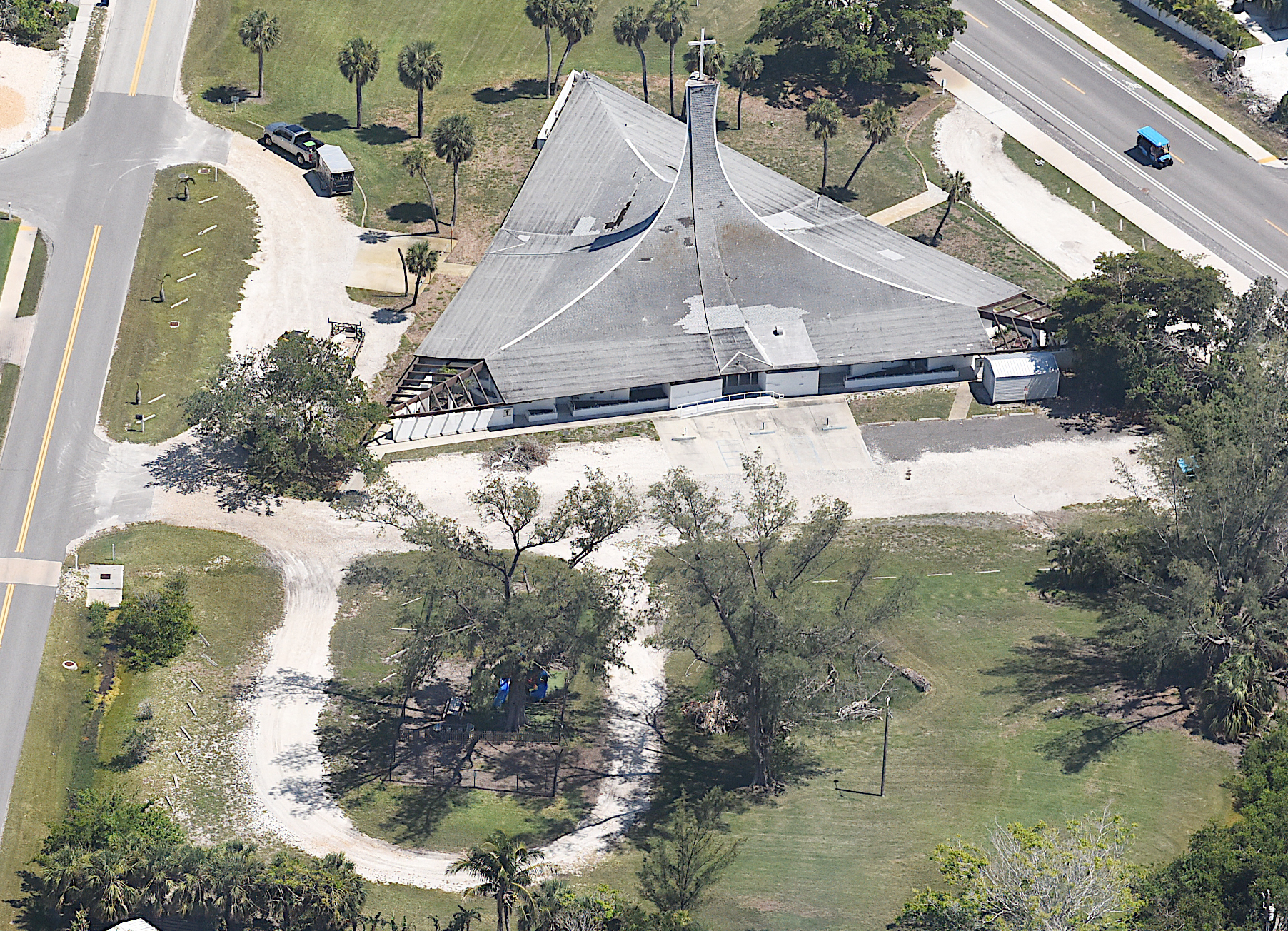
HOLMES BEACH – Preliminary discussions have occurred regarding the possible rezoning of the Gloria Dei Lutheran Church property for residential development. 

The church operations ceased in January 2025 and the Manatee County Property Appraiser’s Office still lists Gloria Dei Evangelical of Anna Maria Island as the property owner. In June, the Florida Bahamas Synod Council that’s overseeing the sale of the church property declined the city of Holmes Beach’s $3 million offer to purchase the three-parcel, 2.96-acre property at 6608 Marina Drive. 
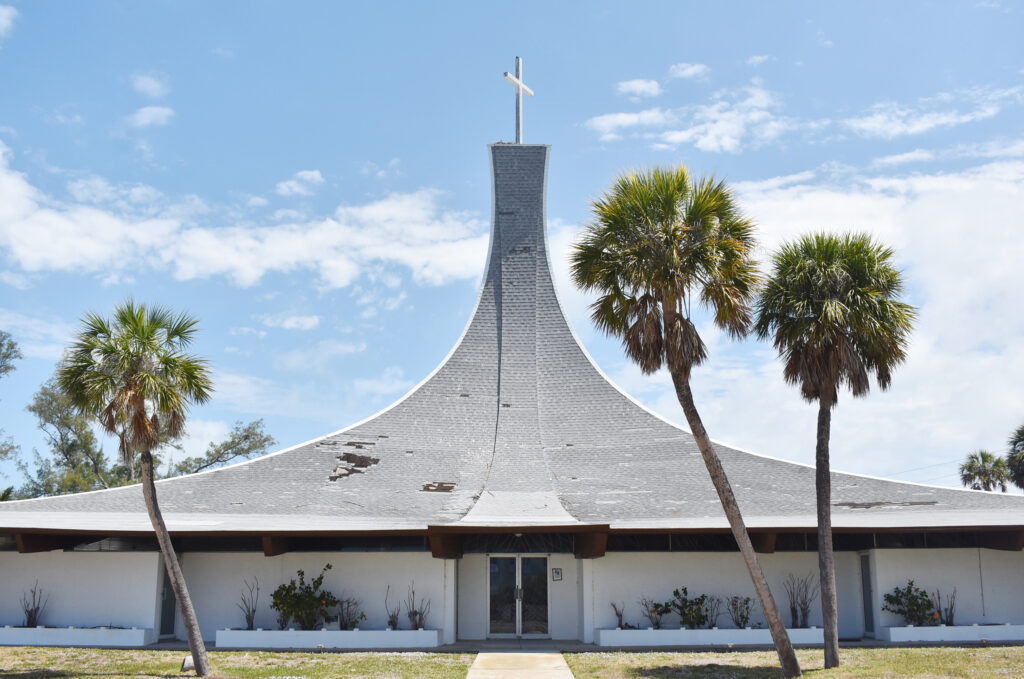
The iconic Gloria Dei Lutheran Church building faces likely demolition if the church property is rezoned for residential development. – Joe Hendricks | Sun

The church property parcels carry the Public/ Semi-Public (PSP) zoning designation and a similar Public/Semi-Public future land use map designation in the city’s comprehensive plan. The PSP zoning designation and future land use designations do not allow for residential or commercial development. 

In accordance with the current zoning designation, the mayor and commission hoped to preserve and repurpose the iconic, triangular-shaped church building and the spacious property that surrounds it for public use and public green space.

REZONING DISCUSSIONS

On Friday, May 1, Holmes Beach Director of Development Services Chad Minor confirmed that on Feb. 24 he, Mayor Judy Titsworth, Public Works Director Herb Raybourn, Development Services Coordinator Kim Charron and the potential applicant’s representative, Marshall Robinson, participated in a pre-application discussion regarding the potential rezoning of the Gloria Dei property. Robinson is a land planner for the Grimes Galvano law firm in Bradenton. Minor said he, Raybourn and Robinson also participated in a follow-up phone discussion pertaining to a traffic study.

Minor confirmed the preliminary rezoning discussions when responding to an email inquiry received from The Sun. Minor said he doesn’t know for certain if Robinson is representing the current property owners, a potential buyer or both. He also said he doesn’t know for certain whether there’s a pending offer for the purchase of the Gloria Dei property. 
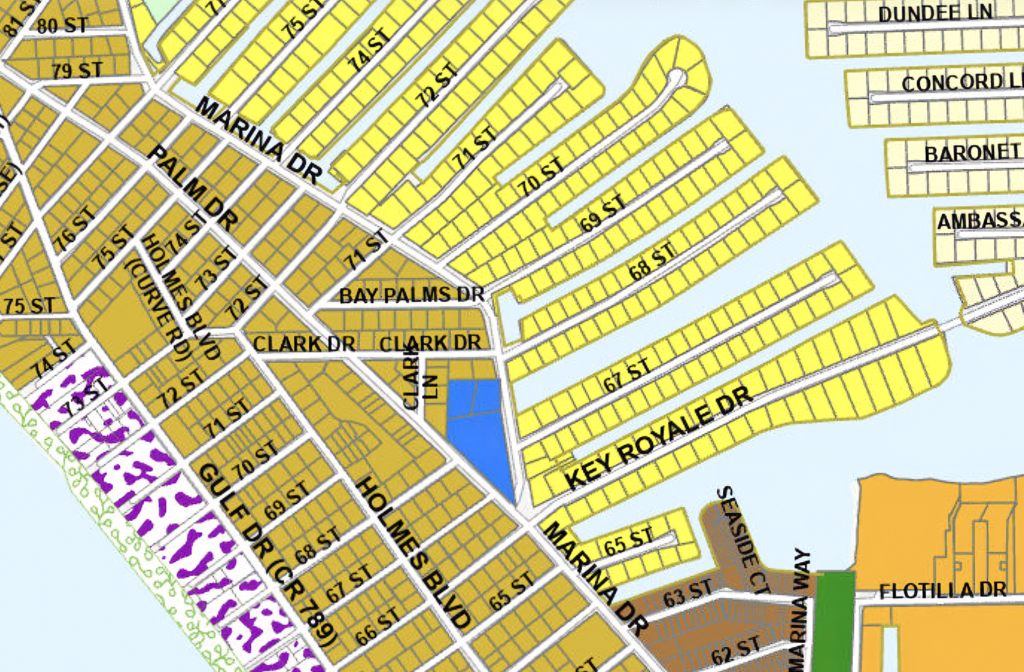
On the Holmes Beach zoning map, the Gloria Dei property (shaded in blue) is surrounded by R-2-zoned properties (shaded in gold) and R-1-zoned properties (shaded in yellow). – City of Holmes Beach | Submitted

According to Minor, Robinson’s client, or clients, desire a R-1 (single-family residential) zoning designation. According to the city’s land development code, the R-1 zoning designation requires a minimum parcel size of 7,510 square feet and allows 5.8 dwelling units per gross acre of land. The R-1 zoning designation allows rentals of 30 days or more and does not allow for weekly or shorter-term rentals. 

The properties directly east of the church property carry the R-1 zoning designation and the low-density residential future land use map designation set forth in the comp plan. The Gloria Dei property is surrounded to the north, west and south by residential properties that carry the R-2 (two-family residential) zoning designation that allows up to 10 dwelling units per acre and rental stays of seven consecutive days or more. Those properties carry a medium-density residential future land use designation.

When asked if the city commissioners must consider the zoning and future land use designations for the surrounding properties when considering a rezoning application, Minor said, “Yes, compatibility is something that the commission considers.”

When asked if the city expects to receive a Gloria Dei rezoning application at some point, Minor said, “Yes.”

As of May 1, the city had not received a rezoning application for the Gloria Dei property.

REZONING PROCESS

Minor said the applicant initiates the rezoning application and then follows the rezoning processes outlined in Section 2.13 of the city’s land development code.

City code requires rezoning applications to be reviewed and voted on during publicly noticed public hearings that allow for public input. Section 2.13 of the code says, “Four members of the city commission shall constitute a quorum and not less than three affirmative votes shall be required for commission adoption of any ordinance amending this ordinance or rezoning of property.”

According to city code, “No amendment rezoning any parcel may be granted unless the city commission finds that such amendment is consistent with the comprehensive plan of the city of Holmes Beach.”

City code says, “In determining whether to approve the rezoning of property or substantial changes in permitted use categories in zoning districts, the city commission shall consider the following criteria:

• “Whether the proposed change is in conformance with all applicable requirements of this land development code;

• “Whether there has been a change in the conditions upon which the original zoning classification was based;

• “Whether the proposed change is consistent with development patterns and is a logical expansion of adjacent zoning districts;

• “Whether the proposed change will increase population density or development intensity in a manner that will have an adverse impact on traffic patterns, public facilities and services, or other infrastructure;

• “Whether the proposed change is compatible with existing development patterns in the area;

• “Whether the proposed change will adversely affect any historic resources or environmentally sensitive lands;

• “Whether the proposed change will adversely affect the health, safety or welfare of the adjacent properties, or of the city of Holmes Beach in its entirety;

• “Any other matters which may be appropriate.”

If submitted to the city, a rezoning application would also be reviewed by the Holmes Beach Planning Commission for compliance with the city’s comprehensive plan. 

According to the comprehensive plan amended and adopted in 2022, “The Public/Semi-Public future land use category recognizes identifiable areas of the community which support public, municipal and semi-public center, community services and facilities – i.e., churches, schools, both public and private.” 

PAST EFFORTS 

In 2016, city commissioners denied a comprehensive plan amendment sought by church officials who wanted to change the future land use designation to R-2 (multi-family residential) for the two undeveloped parcels and rezone those parcels in the same manner. Church officials hoped to sell the rezoned parcels for development by someone else and use the proceeds to fund the church operations. 

In 2018, city officials discussed purchasing the undeveloped portions of the church property, but not the church building, but that potential $1.3 million sale never transpired. 
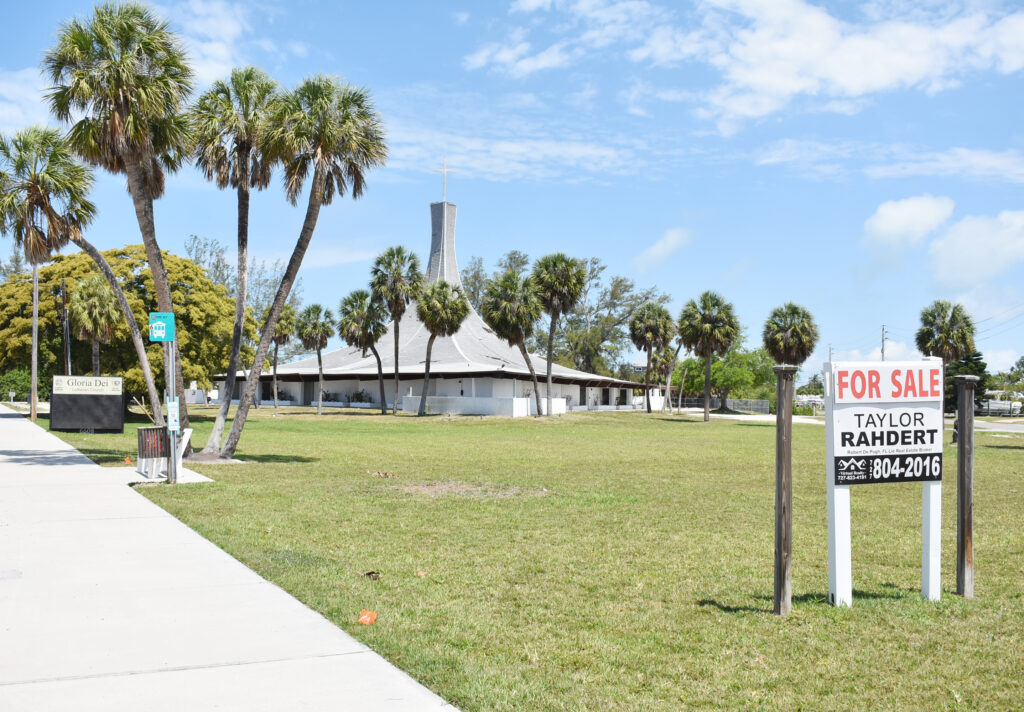
Last year, the Gloria Dei property was put on the market for $9.95 million. – Joe Hendricks | Sun

The city’s $3 million purchase offer in 2025 was based on two value appraisals that assumed the property would continue to carry the PSP zoning designation. To date, the city has not made another offer on the property. 

After the city’s $3 million offer was declined, St. Petersburg-based Virtual Realty Inc. real estate agent Taylor Rahdert listed the church property for $9.95 million – an asking price based on a value appraisal that assumes the church property would be rezoned for future development. 

Bradenton Beach commission nixes rezoning efforts

Bradenton Beach commission nixes rezoning efforts

BRADENTON BEACH – Commissioners are abandoning the city’s efforts to rezone 23 residentially-zoned properties north of Bridge Street and south of the Cortez Bridge.

Instead, to address inconsistencies between the city’s zoning and future land use maps, city officials may redirect their efforts to amending the future land use map designations for those properties instead.

The city commission rejected Building Official Steve Gilbert and City Planner Luis Serna’s recommendation on Oct. 20 to rezone those properties from their current Multiple Family Dwelling District (R-3) zoning designation to a Mixed-Use District (MXD) zoning designation.

The commission also rejected the Planning and Zoning Board’s contrary recommendation to rezone those properties to R-2 (two-family dwelling) and change the future land use map designation to Medium Density Residential.

A letter sent to the commission and signed by planning board Chairman Ken McDonough noted five potentially impacted property owners oppose any commercial use in that residentially zoned area. The letter suggests the city poll all 23 potentially impacted property owners to get their input on these matters.

Working in unison, the zoning and future land use maps designate which type of development is allowed on a property. More than a year ago, the city commission directed Gilbert and Serna to begin addressing long-stand- ing inconsistencies that have existed between the maps.

Gilbert, Serna and the planning board have repeatedly discussed and debated city staff’s recommendations to rezone several properties throughout the city. In most instances, the planning board disagreed with the staff’s proposed rezoning recommendations.

City staff’s proposed mixed-use rezoning of these specific properties would have made their zoning designations consistent with the existing Retail/Office/Residential (ROR) future land use map designation.

The mixed-use zoning would have allowed ground-level commercial activities in what has traditionally been a residential area. The proposed mixed-use zoning would have restricted residential use for new construction to no more than 50% of a property’s buildable space while allowing no more than 80% non-residential use of the buildable space.

Bradenton Beach commission nixes rezoning efforts
The now-discarded rezoning considerations applied to the properties shaded in orange that contain the number 4. – City of Bradenton Beach | Submitted

City Attorney Ricinda Perry told the commission downzoning those properties from R-3 to R-2 as proposed by the planning board could be considered a taking of existing development rights, which could potentially diminish property values and expose the city legal action, including the filing of Bert Harris claims seeking compensation for the diminished property values and/or loss of future revenues. Perry also said the existing inconsistencies between the zoning map and the future land use map could expose the city to legal challenges.

The zoning and future land use map issue is further complicated by the plans of the Chiles Hospitality group that owns the BeachHouse restaurant. Chiles Hospitality owns the currently undeveloped property at 109 Third St. N. The perimeter of that vacant lot is currently used for unregulated parking. In September, Chiles Hospitality applied for a special use permit that would allow that property to be converted into a private parking lot to be used predominantly by their employees. The R-3 residential zoning designation prohibits standalone parking facilities.

Public input

When addressing the commission, Chiles Hospitality Facilities Director Brooks O’Hara said, “We strongly urge you to support this rezoning to mixed-use and support giving the property owners more freedom in decisions regarding their property, and not less. We reserve the right to protect our rights legally and could consider a more restrictive zoning as taking, so we would be concerned about that.”

Perry said “spot-zoning” the vacant Chiles Hospitality property with a different zoning designation might be a potential solution to that concern.

Bradenton Beach commission nixes rezoning efforts
In September, Chiles Hospitality submitted this proposed parking configuration for its property at 109 Third St. N. – City of Anna Maria | Submitted

Evelyn Stob owns the single-family home at 105 Third St. that sits between the vacant Chiles Hospitality property and the Chiles Hospitality parking lot to the west that now provides paid public parking. Stob expressed her support for retaining the existing R-3 zoning designation for the residential properties in question.

At the conclusion of Thursday’s lengthy discussion, the commission rejected the proposed rezoning ordinance and directed staff to revisit these matters with the planning and zoning board and the potentially impacted property owners.

Planning board rejects proposed rezoning ordinance

Planning board rejects proposed rezoning ordinance

BRADENTON BEACH – Planning and Zoning Board members have rejected a rezoning ordinance that would change some residential properties to mixed-use, asking that it be rewritten to reflect the board’s previous consensus to rezone to two-family residential (R-2).

The ordinance that Building Official Steve Gilbert and City Planner Luis Serna presented on June 15 proposed rezoning more than 20 properties from Highland Avenue to Gulf Drive and from Second Street North to Cortez Road. The properties are zoned R-3 (multi-family residential) and city staff recommends rezoning them to mixed-use (MXD).

Planning board rejects proposed rezoning ordinance
Building Official Steve Gilbert and City Planner Luis Serna hope to make the city’s zoning and future land use maps consistent with each other. – Joe Hendricks | Sun

The building department is requesting the rezoning to create better consistency between the city’s zoning maps and the future land use maps contained in the city’s comprehensive plan. Gilbert stated previously that the existing map inconsistencies could potentially create legal issues for the city.

The current R-3 zoning designation allows for up to 18 residential units per acre, but those same properties also carry the ROR (residential/office/retail) future land use map (FLUM) designation implemented when the city’s comprehensive plan was amended in 2008. The zoning map was never amended to bring it into agreement with the amended future land use map.

According to Gilbert, the ROR FLUM designation allows for a small store or retail operation, a takeout restaurant or an attorney’s office on the ground level with residential units above. The current R-3 zoning designation does not allow for those commercial uses. Gilbert and Serna recommend maintaining the existing ROR FLUM designation and rezoning those properties to mixed-use consistent with the FLUM designation.

Planning board rejects proposed rezoning ordinance
The properties highlighted in orange on the city’s zoning map currently carry a R-3 zoning designation. – City of Bradenton Beach – Submitted

Planning board rejects proposed rezoning ordinance
The properties highlighted in light purple on the city’s future land use map currently carry a Retail/Office/Residential designation. – City of Bradenton Beach | Submitted

During preliminary discussions in May 2021, the board recommended rezoning those properties to R-2 (two-family residential) with an amended medium-density FLUM designation.

The R-2 zoning designation allows one-family dwelling units, two-family dwelling units (duplexes), group homes, foster care facilities with less than five residents, family day care homes and private parks that include playgrounds and preservation and conservation uses. The R-3 designation allows one-family dwelling units, two-family dwelling units, multi-family dwelling units, group homes, foster care facilities and family day care homes.

“The mixed-use would allow for in- creased lot coverage and increased total impervious surface coverage. Mixed-use provides for residential over retail, so this would give the opportunity to put small shops on the ground,” Gilbert told the board.

Board members John Burns, Ken Mc Donough, Fred Bartizal and Dan Morhaus expressed their collective desire that the ordinance eventually presented to the city commission for adoption, modification or rejection should reflect the board’s 2021 consensus.

Serna cautioned that downzoning those properties from R-3 to R-2 could expose the city to future legal challenges – including Bert Harris claims seeking compensation for the loss of the development rights currently granted by the R-3 zoning.

Ordinance opposition

Burns adamantly expressed his oppostion to Ordinance 22-541 as presented during Wednesday’s meeting and he questioned why it didn’t reflect the board’s 2021 consensus.

“What I don’t understand is that we had a consensus. We had a clear recommendation. What I would
be looking for is an ordinance that implements that consensus recommendation,” Burns said.

Regarding the proposed mixed-use zoning designation, Burns said, “The MXD zoning district has allowances for a couple other things. Instead of 35% lot coverage, it goes to 70% – twice the lot coverage. Any time you increase the lot coverage you decrease the spacing between the structures and that affects the general appearance of the area;
and it can or cannot affect property values, as can placing a ROR bottom story retail/office down- stairs. Seventy percent lot coverage changes the character of the area as well. It’s expansion of, essentially, a commercial district. In addition, the maximum lot coverage plus impervious (surface) goes from 40% to 85%, which decreases the greenspace and affects the entire area in a different fashion.”

In defense of the ordinance language presented that day, Gilbert said city staff was originally charged with bringing the city’s zoning designations into agreement with the city’s existing FLUM designations, and the ordinance presented reflected that city commission directive.

Public input

A handful of potentially impacted residents and property owners attended Wednesday’s meeting. During public input, homeowner Herman Fernandez expressed concerns that mixed-use zoning would create additional parking issues and lead to the commercialization of those residential areas. He said staff’s proposed rezoning would not be a positive move for the permanent residents living in those areas.

Planning board rejects proposed rezoning ordinance
Resident Herman Fernandez is concerned about the proposed mixed-use rezoning. – Joe Hendricks | Sun

“What is our goal here? I know things change as time goes on, but I’m not sure this is a good move,” Fernandez said.

Property owner Evelyn Stob said she likes the board’s proposed R-2 zoning designation better than city staff’s proposed mixed-use zoning designation.

Fernandez’s neighbor, Mark Heller, said he doesn’t want bars and restaurants being located in areas currently zoned for residential uses.

Gilbert said he doesn’t think the commission’s intent in 2008, before his arrival, was to allow for more bars and restaurants, but to allow for ground-level retail operations with residential units above.

In response to the board’s request for a revised ordinance, Gilbert said he’s not comfortable rewriting the ordinance without first discussing it with the city attorney. He also said changing the current FLUM designation from ROR to medium density residential would require a second and separate ordinance.

BB seal

Rezoning would allow residential units above commercial

BRADENTON BEACH – The city is considering rezoning several residential properties between Second Street North and Cortez Road from multi-family residential to mixed use.

Building Official Steve Gilbert said the proposed rezoning would impact about two-thirds of the properties from Highland Avenue west to Gulf Drive, and from Second Street North to Cortez Road.

The Planning and Zoning Board will hold a public hearing on the proposed rezoning of those properties on June 15 at city hall at 1 p.m. The meeting is open to the public, with public input accepted.

The hearing will be followed by a public hearing before the city commission on Thursday, July 21. The proposed rezoning to be discussed at these hearings would require city commission approval.

Public notices were mailed to all property owners whose properties could potentially be rezoned. Notices were also sent to all property owners located within 300 feet of the properties proposed for rezoning. The notice references lot numbers but not specific addresses and includes a map that indicates where the potentially-impacted properties are located.

City’s rezoning efforts could impact dozens of property owners
The properties located within the dotted lines on this map could potentially be rezoned from multi-family residential to mixed use. – City of Bradenton Beach | Submitted

“If your lot is inside the dotted line, those are the properties affected. It’s not changing anything other than those 20 to 30 lots listed on the notice,” Gilbert told The Sun.

Gilbert said the properties currently have multi-family residential (R-3) zoning designations that allow up to 18 residential units per acre.

“This is first step in getting our Zoning Map to be consistent with the Future Land Use Map that was adopted in 2008 when the comprehensive plan was revised. It’s taken this long to get to the point where we’re starting down the road of making our zoning map consistent with the Future Land Use Map,” Gilbert said.

“Back in 2008, when the city adopted the 2020 comprehensive plan, the Future Land Use Map set all of those lots aside to be retail/office/residential. You could have a little store, a pizzeria or a lawyer’s office on the ground level with residential above. Back when they were talking about this stuff, they wanted to make the downtown area a walkable community. How do we do that? We put mom and pop shops on the ground and somebody can live upstairs or rent a place upstairs. You don’t need to bring your car to go to Bridge Street. You can go downstairs and get a bite to eat and go back upstairs if you want. Currently those properties are all multi-family residential, and commercial and retail uses are not allowed,” Gilbert said.

The proposed rezoning from R-3 to Mixed Use would give property owners choices.

“It allows for the stand-alone residential use to continue in this district, even a new residential structure built according to FEMA’s flood plain and elevation requirements. Nobody’s losing the right to continue that use, but if you had a ground-level structure you’d have to rebuild with an elevated structure. There’s no way around that with FEMA,” Gilbert said.

“The developer could do a single-family dwelling or do what the Mixed Use zone district contemplates: A small commercial space on the ground, parking in the front, side or back and two stories of residential units upstairs. The alternate scenario is a developer buys four lots with old houses on them, tears all four houses down and can now do a storefront with multi-family residential units upstairs,” Gilbert said.

“There’s no impact to existing uses and existing owners. They can continue to use their property as is. Within the limits of the land development code, they can still renovate, repair or remodel their homes. There’s nothing prohibiting them from the continued use of the property as it currently sits and nothing takes this away as long as they own the property. And it should not affect resale values because the Mixed Use zoning gives the buyer more flexibility in whatever fashion best suits their investment needs or the return on their investment,” Gilbert said.

“If anybody has questions about how their property might be impacted, I encourage you to call the building department at 941-778-1005, ext. 210, and ask for Steve or Luis; or send an email to stevegilbert@cityofbradentonbeach.com. We’ll be happy to help you out,” Gilbert said.