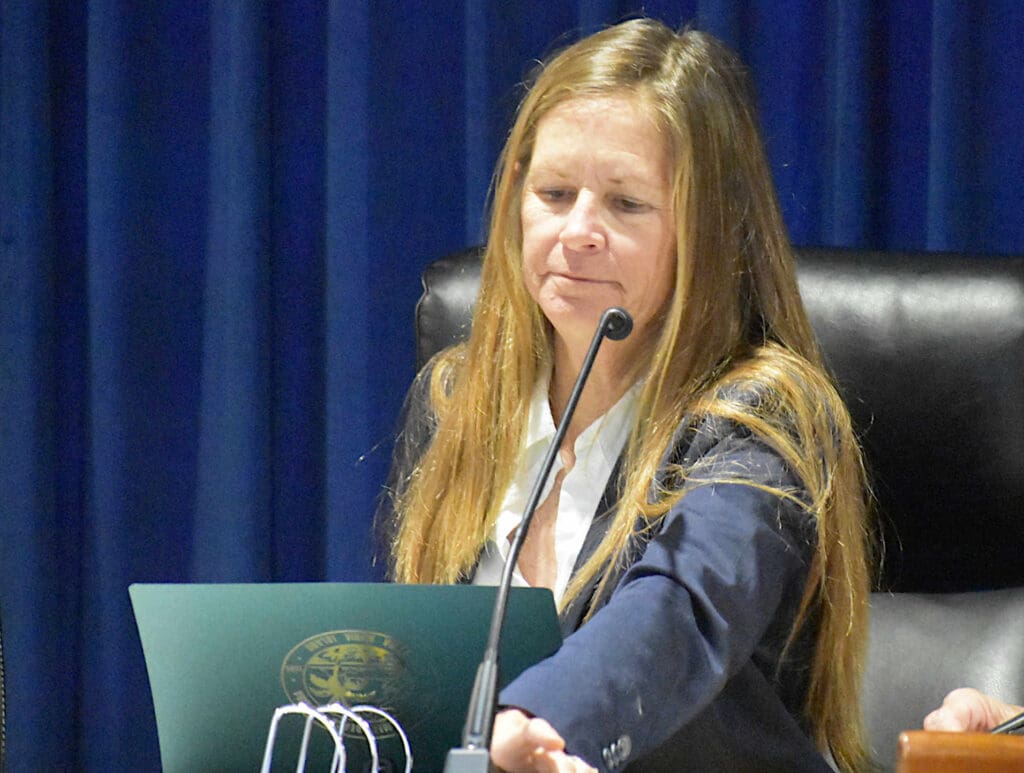
ANNA MARIA – The mayor and city commissioners kicked off their multi-meeting budget adoption process with a budget workshop on Thursday, July 16.
Mayor Mark Short and City Treasurer Randy Maxon presented the proposed 2026-27 fiscal year budget, which currently anticipates matching revenues and expenses totaling $16.8 million.
The presentation included in the meeting packet notes a $493,338 deficit if the current millage rate is maintained and the budget is adopted as is for the 2026-27 fiscal year, which begins Oct. 1.
According to Maxon, the total taxable value of all Anna Maria properties increased to about $2.61 billion this year, compared with about $2.38 billion last year.
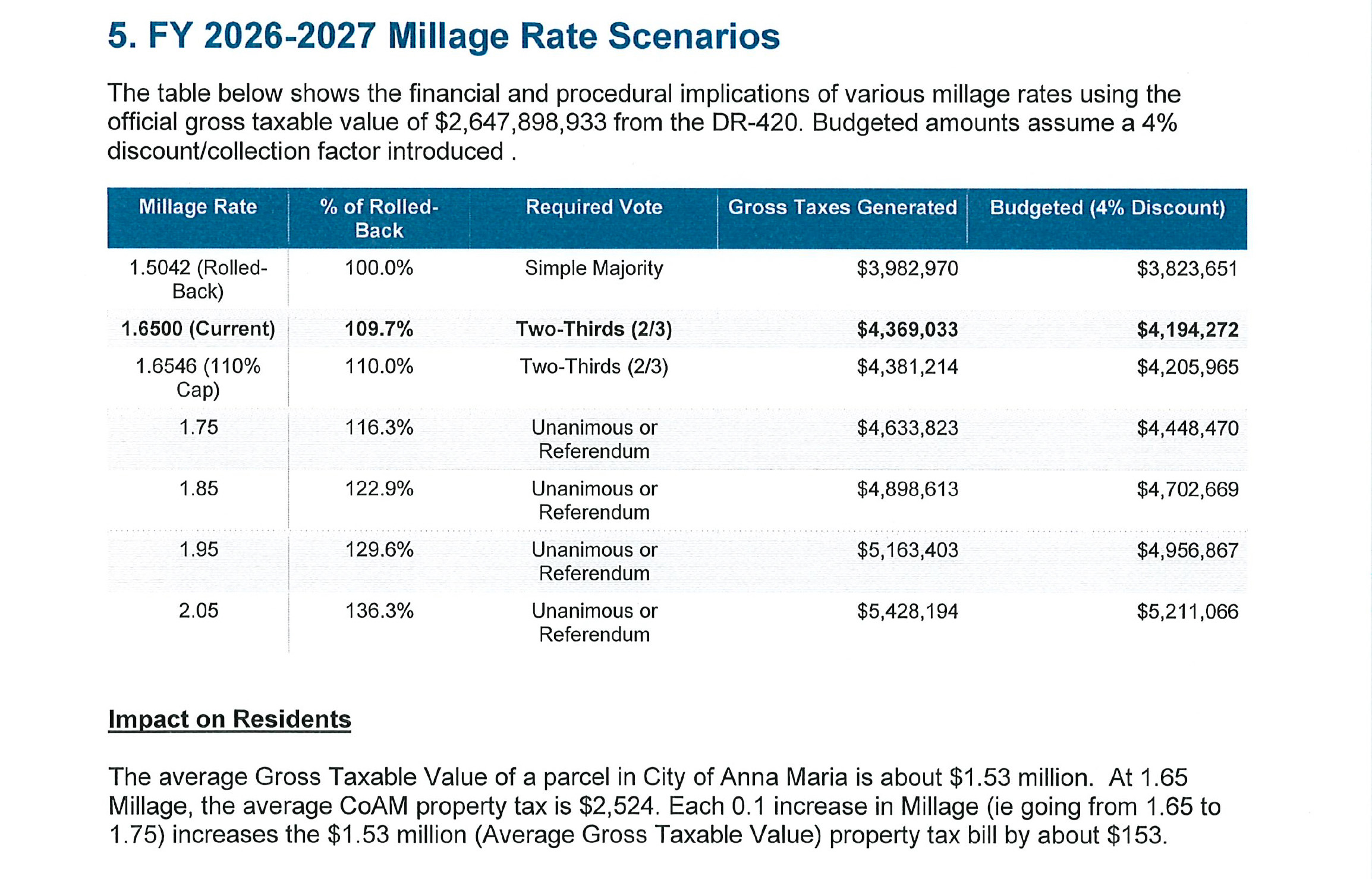
The proposed budget anticipates the city receiving $4.19 million in ad valorem property tax revenues this year if the current 1.65 millage rate is maintained. A return to the previous 2.05 millage rate would generate $5.2 million in property tax revenues for the city.
In 2023, the commission lowered the longstanding 2.05 millage rate to 1.65 mills. At the current rate, Anna Maria property owners are levied $1.65 for every $1,000 of taxable assessed property value, minus homestead exemptions and other exemptions that lower the property’s taxable value.
The commission must set its tentative maximum millage by Aug. 4. The adopted tentative millage rate can be reduced before final adoption during two public hearings in September, but it cannot be increased.
During the budget workshop, the commissioners discussed potentially increasing the millage, in part to help restore the city’s depleted reserve fund. According to the presentation included in the meeting packet, the city currently has just over $1 million in unencumbered reserve funds. The presentation notes the reserve fund was much higher when a past commission lowered the millage rate in 2023.
The city has also incurred expenses associated with Hurricanes Helene and Milton since then.
According to the one-page budget report included in the presentation, the largest projected city expenditures include $6.6 million for capital projects and outlay — some of which likely includes reconstruction of the hurricane-damaged City Pier, which is expected to reopen in November. The budget report lists $1.79 million for public safety, most of which entails contracted law enforcement services provided by the Manatee County Sheriff’s Office; $641,000 for code enforcement; $2.77 million in debt service; and $910,000 for staffing and operation of the public works department.
It was noted during the workshop that the city is obligated to cover up to $4.2 million for hurricane-related pier damage, and the city has about $1.6 million in claims to date. The county has already provided the city with $1.3 million for the pier reconstruction project. It was also noted that a $4 million loan was taken out to help finance pier reconstruction while awaiting future reimbursement.
The presentation also included an update on the city’s hurricane recovery efforts. The presentation addresses what the city did well and what it did not do well. As for what was not done well, the presentation notes there was a lack of competitively bid debris contracts and incomplete photographic documentation of storm damage.
The commission did not take any formal action during the initial workshop, and the next budget workshop is scheduled for Thursday, July 23, at 9 a.m., with projected city revenues as that day’s focus.
Two weeks ago, we celebrated the 250th anniversary of the Declaration of Independence. Much of the conflict between Great Britain and the colonies was over taxation. Two hundred and fifty years later, the state of Florida is still fighting over taxation, only this time it’s property taxes, not tea.
In November, Florida residents will be asked to vote on a change to the property tax system that would significantly overhaul the current system. If passed, many homeowners would have their taxes lowered at the potential expense of local government. The governor removed the elimination of funding for schools, making it more acceptable to voters. However, 60% of voters will need to vote for the change before it is adopted.
As property values rose in Florida, tax bills also became larger for homesteaded homeowners – and even higher for non-homesteaded homeowners. Property taxes for homesteaded properties represent 35% of the property taxes paid. Non-homesteaded properties represent 65% of the taxes paid.
The constitutional amendment would increase the assessment exemption on homesteaded property from the current $50,000 to $150,000 the first year, $250,000 the second year and leave the door open for potential future cuts. Non-homesteaded properties would also get a reduction on the cap on the annual increase in assessments to 5% from 10%, reducing their taxes as well.
Since Florida already benefits from an attractive real estate market because of a favorable tax policy, it’s likely if this constitutional amendment passes it will enhance that benefit substantially. But what about the hit that local government budgets will be taking with reduced revenue from property taxes?
Some residents will say too bad the local governments spent money irresponsibly when property values were zooming, without giving any thought to the future. That might have some truth to it but the local governments still need to pay the bills for essential services like roads and fire rescue facilities, not to mention maintenance of our beautiful beaches and parks.
So, get ready for higher fees for construction and renovation improvements which could backfire on the real estate market. The fear for local government is that they will be forced to ask the state for financial assistance risking their independence.
To complicate matters more, Gov. Ron DeSantis has announced he will not campaign to pass an amendment reducing property taxes in the state because the measure approved by the legislature is not the amendment he proposed. He says he will vote for the measure, but he will not spend any time in his remaining months as governor encouraging others to follow his lead. He goes on to say that he thinks most people are going to be supportive of the amendment even though it does not contain his vision for a larger historic change to the property tax system.
When it comes to politics, no one is ever completely happy, including the governor of the state with the third-largest population in the country. DeSantis is fond of saying homeowners are paying increasing rent to the state in the form of property taxes on homes they already own and it’s time to put the brakes on.
No one likes to pay taxes – not us and not our forefathers. We’ve been fighting this war for 250 years and I doubt it will end this November. Most people vote for a change in their own best interest, that is why I think this amendment will pass but be careful what you wish for.
It’s been an interesting month, but then, December usually is. Lost in the gay atmosphere of the holidays, it’s easy not to notice that business goes on as usual, and this December didn’t disappoint.
Gov. Ron DeSantis’ property tax elimination plan was back in the news and this time I read it. There are several house joint resolutions that are being considered for the 2026 ballot. All of them to some degree are aimed at abolishing property taxes on properties that are homesteaded. These are the key proposals:
• HJR 201: Eliminates non-school property taxes for homesteads entirely;
• HJR 203: Gradually phase out non-school property taxes over 10 years by increasing exemptions annually;
• HJR 205: Exempt residents 65 and over from non-school property taxes;
• HJR 207: Add a 25% homestead exemption on assessed value for non-school taxes; and
• HJR 209: Add a $100,000 exemption for insured homesteads.
The governor is in favor of eliminating all property taxes on primary homes, viewing them as paying “rent to government.” The legislative approaches favor a menu of options for voters on the ballot.
The impact of any one of these options could raise home values by 7% to 9%, which could be a boom for current owners but harder for first-time buyers and renters. Governments would need new revenue to replace lost property tax and even if school property tax is preserved, other taxes could be eliminated, impacting overall budgets.
The next step for these constitutional amendments is passing the Legislature and then being approved by Florida voters in the November 2026 general election.
The other piece of December business-as-usual is the meeting of the Federal Reserve on Dec. 10. At that meeting, rates were reduced by a quarter of a percent, which was the third straight cut this year. However, the vote was not unanimous, and the indication is that it could be the last rate cut for a while.
As usual, when the Feds cut rates, it does not always translate into lower mortgage rates, but it does give an overall feeling of stability in the country’s financial position.
So, let’s take a look at the November Manatee County sales statistics released by the Realtor Association of Sarasota and Manatee:
Single-family homes closed 13.7% fewer homes this year compared to last year. The median sale price was $487,233, up 13.3% from last year, and the average sale price was $653,655, up 9% from last year. The median time to contract was 59 days this year compared to 45 days last year. Active listings are up 8.4% compared to last year and the month’s supply of properties is 4.2 months, up 7.7%.
Condos closed 16% more properties this year compared to last year. The median sale price was $308,000, down 0.6% this year compared to last year, and the average sale price was $332,602, down 3.6% compared to last year. The median time to contract was 74 days compared to 53 days last year and there were 3.4% more listings this year compared to last. The month’s supply of properties was 6.5 months, down 1.5%.
It’s pretty clear that the Manatee housing market is still struggling from last year’s hurricanes; so far there is no clear narrative or direction. Buyers and sellers will be faced with ups and downs in the early part of the new year and hopefully find their footing going forward.
If Florida is successful in passing almost any type of property tax relief, I agree it would be a boom to real estate. Watch what goes on in the Legislature as the new year progresses.
Wishing everyone a wonderful holiday season enjoying celebrations with friends and family.
HOLMES BEACH – City officials are already paying attention to the possible elimination of property taxes proposed but not yet defined by Gov. Ron DeSantis and state legislators.
Holmes Beach City Commissioner Carol Whitmore initiated a brief property tax discussion during the commission’s March 25 meeting. After noting that DeSantis recently mentioned eliminating property taxes, Whitmore pointed out that property taxes are the primary funding source for city and county governments, whereas sales taxes and other taxes fund the state government.
Commissioner Terry Schaefer said the Florida League of Cities held a March 24 call-in session that addressed several proposed pieces of legislation that the League is monitoring as the 60-day 2025 legislative session in Tallahassee reached its halfway point.
Commissioner Terry Schaefer is concerned about the state trying to eliminate cities. – Joe Hendricks | Sun
Regarding the elimination of property taxes, Schafer said, “No one at the meeting felt there was a reasonable alternative to this. We all know property taxes are local and here you have the governor stepping in to eliminate property taxes without any vision, without any determination, as to what would replace that revenue.”
Holmes Beach Mayor Judy Titsworth hopes voters are paying attention to the property tax elimination discussions. – Joe Hendricks | Sun
Mayor Judy Titsworth said, “When you take funding away from local governments and county governments what does that do? Well, you cease to exist and then the state is in charge of everything. If this does go to a referendum, I hope people are paying attention.”
“We will fight it,” Whitmore added.
“There’s seemingly a direction to minimize the number of cities from our current state administration,” Schaefer said.
“It’s a strange world we live in right now,” Titsworth said.
Schaefer said only 12-13% of the total property taxes paid by the owner of a homesteaded primary residence in Holmes Beach are remitted to the city. The rest goes to the county, the school board, the West Manatee Fire Rescue District, the West Coast Inland Navigation District, the Southwest Florida Water Management District, the Mosquito Control District and other taxing districts. Holmes Beach property owners also pay an annual stormwater assessment fee that’s included on their property tax bill.
“We deliver a pretty good return on investment to our taxpayers,” Schaefer said of the city’s ad valorem property tax collections and expenditures.
Using tax bills posted at the Manatee County Property Appraiser’s website, The Sun examined the 2024 property tax bills for six randomly selected residential properties in the R-1 zoning district behind Holmes Beach City Hall. Those property tax bills ranged from $5,925, $7,959 and $9,507 to $15,628, $17,800 and $20,353. The taxes varied according to the property’s assessed taxable value and whether the property was taxed as a homesteaded primary residence or as a non-homesteaded property used as a second home, a vacation home, a rental home of 30 days or more or for some other purpose.
According to the Manatee County Tax Collector’s Office, “The homestead exemption is a constitutional guarantee that reduces the assessed value of residential property up to $25,000 for qualified permanent residents. In 2008, Florida voters approved an additional homestead exemption of up to $25,000 for homeowners whose homes have an assessed value of more than $50,000.”
Elimination study
To date, neither DeSantis nor the state Legislature has provided specific details as to how property taxes would be eliminated or how those lost tax revenues would be recouped. But on Feb. 18, Sen. Jonathan Martin, R-Fort Myers, and Sen. Jason Pizzo, D-Hollywood, co-introduced Senate Bill 852. The bill proposes that the Office of Economic and Demographic Research conduct a study to establish a framework to eliminate property taxes and replace property tax revenues through budget reductions, sales-based consumption taxes and locally determined consumption taxes authorized by the state Legislature. The bill sets forth the proposed study requirements and an Oct. 1 deadline for the study to be presented to the Senate president and the Speaker of the House.
SB 852 states: “The study must include, at a minimum, all of the following: An analysis of the potential impact of eliminating property taxes on public services, including education, infrastructure and emergency services; an assessment of potential housing market fluctuations, including changes in homeownership rates and property values; an evaluation of whether a shift to consumption-based taxes would make Florida more attractive to businesses compared to other states; an analysis of the potential impact of eliminating property taxes on overall economic stability, consumer behavior and long-term economic growth.”
As of March 28, SB 852 had not passed through any of the three Senate committees assigned to discuss the bill and similar legislation had not been introduced in the House of Representatives. The adoption of proposed legislation requires matching bills to be supported respectively by the majority of the Senate and House members.
State Rep. Ryan Chamberlin, R-Ocala, recently filed House Bill 357, which proposes increasing the $25,000 homestead exemption to $100,000. HB/HJR 357 proposes placing the $100,000 homestead exemption on the 2026 general election ballot. If then adopted by Florida voters, the $100,000 exemption would take effect on Jan. 1, 2027.
“Florida’s population has been continuously overburdened by constant increases in property taxes throughout the past several years. The property tax increases are based, unfairly, on unrealized gains for the paper value of our homes,” Chamberlin says in a “Why I filed this bill” statement posted at the House website.
Sen. Blaise Ingoglia, R-Spring Hill, filed SB 1016, a bill that seeks to increase the $25,000 exemption to $75,000.
Foreseeable consequences
The Florida Policy Institute website addresses the foreseeable consequences of eliminating property taxes.
“If policymakers continue to pursue eliminating property taxes outright without a cohesive plan to raise taxes in a progressive manner, some of the consequences are clear:
Households with low to moderate income, including both property owners and renters, will end up paying more in taxes, as a percentage of their earnings, compared to wealthy residents if sales taxes increase to make up the lost revenue.”
“Local governments would lose fiscal autonomy as they would no longer collect property taxes, and they would become dependent on the state for funding – whether it is for schools or other public services like police and fire services.”
“Individuals who currently claim a property tax deduction in their federal income tax returns would lose the deduction; meaning their personal income taxes could potentially increase.”
“The state government would have to weigh local funding needs alongside statewide services, leading to competition and underfunding if the state’s tax base – presumably sales tax base – shrinks.”
ANNA MARIA – Mayor Dan Murphy proposes lowering Anna Maria’s current 2.05 millage rate to the 1.8245 rollback rate, or lower.
The rollback rate is the rate needed to generate the same ad valorem property tax revenues generated during the current fiscal year, with increased property values producing the same revenues at a lower millage rate.
When presenting his final city budget before leaving office later this year, Murphy proposed the millage reduction during the Anna Maria City Commission’s June 27 budget meeting. Focused on projected revenues, Thursday’s meeting was the first of three preliminary budget meetings scheduled for the preparation of the 2024-25 fiscal year budget that takes effect on Oct. 1.
Regarding the millage rate, Murphy said, “We’re not going to go in at 2.05. We’re actually going to start at the rollback rate which will yield $4.24 million (in ad valorem property tax revenues). I think we can actually bring it in under the rollback rate and provide all the services we need to provide for the residents of this city, so the property owners and the homeowners of our city could experience a tax reduction. I hope that you could share that goal with me as we go forward with the budget.”
The commission expressed preliminary support for the proposed millage reduction.
Murphy said a budget based on a lower millage rate would be “lean and mean” while still providing the services and benefits residents and property owners expect.
“It’s not like we’re going to live in austerity,” he said. “We maintain or improve our quality of life, yet we do it with less money because we do things more efficiently and we utilize what we’ve got in terms of the carryover from projects we couldn’t finish.”
At 1.8245 mills, Anna Maria property owners would pay a city property tax of approximately $1.82 per every $1,000 of assessed property value after homestead exemptions and other tax exemptions are applied.
According to the Manatee County Tax Collector’s 2024 Preliminary Taxing Authority Report, the taxable value of Anna Maria’s 1,707 real properties is $2.32 billion.
Anna Maria’s current 2.05 millage rate has historically been the lowest on Anna Maria Island and the lowest in Manatee County.
In 2022, the Holmes Beach City Commission lowered its 2.15 millage rate to 2.07 and in 2023 they lowered it again to 2.05 for the current fiscal year. The Bradenton Beach millage rate has remained at 2.3329 for several years.
Anna Maria property owners also pay Manatee County property taxes and the county’s 2023 millage rate was 6.2326. Manatee County property owners also pay taxes and assessments levied by the Manatee County School Board, fire and rescue districts, stormwater management districts, mosquito control districts and the West Coast Inland Navigation District.
City revenues
Murphy said the city received slightly more than $10.1 million in total revenues for the current 2023-24 fiscal year that ends on Sept. 30 and he projects the city receiving $18.1 million in total revenues during the 2024-25 fiscal year that begins on Oct. 1.
The $8 million increase includes $6 million in unspent project-related funds to be carried over into the new fiscal year. Murphy said $12.8 million is already earmarked for specific projects and expenditures and the remaining $5.3 million is not yet earmarked for specific expenditures.
Murphy said $1.28 million of the projected $3 million in stormwater revenues is carryover from the current fiscal year. He said some stormwater and drainage projects couldn’t be completed this year because the contractor didn’t have the needed labor resources.
Stormwater revenues are received from the Southwest Florida Water Management District, FEMA and the stormwater assessment fees the city levies annually on Anna Maria property owners.
Regarding the stormwater and drainage projects to be included in the new budget, Murphy said, “When this is completed, the whole city is covered with vertical infiltration and stormwater treatment.”
The projected revenues include a previously approved $2.6 million state appropriation for the Reimagining Pine Avenue safety improvement project and an additional $185,094 in remaining American Rescue Plan funds that will be used to install new Pine Avenue streetlights.
The Anna Maria City Commission and Mayor Dan Murphy have begun their fiscal year 2024-2025 budget planning process. – Joe Hendricks | Sun
Murphy noted that Gov. Ron DeSantis recently vetoed the city’s $475,000 state appropriation request for the construction of a stand-alone public comfort station (public restrooms) near the public parking lot by city hall and the Island Players.
Murphy said Bradenton Area Convention and Visitors Bureau Executive Director Elliott Falcione supports the city seeking $288,000 in tourist development tax revenues to help fund the comfort station project.
“I feel optimistic that we can convince the county commission to give us that money,” Murphy said. “It’s an excellent investment in the city – a comfort station near the beach, with a diaper changing station and an outdoor shower. It’s a good use of tourist development money.”
Senior discount
Commissioner Mark Short mentioned the tax exemptions given to Manatee County property owners. According to the tax collector’s office, permanent residents qualify for a $25,000 homestead exemption and those whose assessed property value exceeds $50,000 are eligible for an additional $25,000 exemption. Senior citizens who are at least 65 years old and meet the income threshold are eligible for an additional $25,000 exemption.
“We have the ability, through ordinance, to change that to $50,000,” Short said in regard to increasing the city’s senior citizen tax exemption to the full $50,000 allowed by the state.
“As we move forward, I would like to take that into account,” Short said. “It doesn’t affect a lot of people who live in the city, but it does affect some.”
Budget meetings
The mayor and commission will discuss operating expenses on Thursday, July 18. Capital project and improvement expenses will be discussed on Thursday, July 25 and the tentative millage rate will also be set during that meeting. Both July budget meetings will start at 5 p.m. The commission will set the final millage rate on Thursday, Sept. 12 and adopt the final millage rate and 2024-25 budget on Thursday, Sept. 26.
ANNA MARIA ISLAND – Holmes Beach Mayor Judy Titsworth said she was told the city of Bradenton will be included in the Anna Maria Island consolidation study being conducted by the Florida Office of Program Policy Analysis and Government Accountability (OPPAGA).
On Nov. 8, Titsworth had her first study-related virtual meeting with OPPAGA representatives. Later that day, she contacted The Sun and said OPPAGA Staff Director of Government Operations Emily Leventhal told her the city of Bradenton will be included in the consolidation study and will be considered as one of several potential annexation options if the three Island cities and city governments are to be eliminated by the state.
Titsworth said she was told that Bradenton Mayor Gene Brown would soon receive a letter from OPPAGA informing him that the city of Bradenton will be included in the consolidation study and may be considered as an annexation option. Titsworth said there were two other witnesses in the room with her during her meeting with OPPAGA representatives.
The following day, Titsworth posted a lengthy consolidation study-related statement at the city of Holmes Beach’s Facebook page titled “The Future of Anna Maria Island: The Fate of Our Cities Are at Stake.”
“In continuing to keep our Holmes Beach residents, property owners and friends informed on issues facing our city, it is important to share with you updated information on the OPPAGA study initiated by our state leaders, and specifically what I learned during yesterday’s OPPAGA Entrance Conference,” Titsworth stated.
“Legislative leadership has tasked this research team, with the support of the entire Manatee Delegation, to conduct an immediate study and to review the potential benefits of consolidation of municipal services and/or government structures for Anna Maria Island.
“During the conference, it was revealed that the city of Bradenton and Manatee County are also included in this study, though they have not yet received correspondence from the research team. There will be large record requests starting next week that the cities will need to respond to, along with more tailored follow-up requests, interviews and potential site visits that will be conducted along the way.
Titsworth
“The research team is anticipating a completion date for July 2024 to present their results to legislative leadership. These recommendations will then be presented to the senior leadership person, most likely (state Representatives) Will Robinson or Jim Boyd. If leadership decides that the report should be published, it will then be available to the cities and the public. Otherwise, the findings and recommendations remain confidential and exempt from public disclosure. It is anticipated that the data gathered and analyzed will provide state leaders with the information needed to determine the fate of our cities,” Titsworth stated.
“The biggest concern I have with this study is that neither the residents nor city officials asked for it. They were not consulted about the development of the scope and remain unaware of the motivations behind this emboldened act of the Legislature. It is my understanding that we are the only coastal cities in Florida being threatened by consolidation, though we may not be the last as there have been more than 80 bills passed by the state Legislature in recent years that have greatly diluted home rule.
“It is unclear what the path forward looks like if state leaders move to consolidate, especially when it is an act not supported by the cities and citizens which are directly impacted. Is a referendum by the people even necessary when the decision is made at the state level? Is the governor tasked to appoint a board to write a new charter, zoning districts, comprehensive plan and land development codes? Is a new charter even needed, or will one city absorb the others; and if so, which city?
“Will the new board respect current density and height restrictions? If there is a new charter, are the grandfathered minimum length of stay restrictions for resort housing to be preserved or will they be removed, turning neighborhoods into motels?
“I urge all citizens to pay attention to decisions being made at the local and state level. Do these leaders have your best interests at heart? These decisions will have a profound effect on quality-of-life issues. Our unique small-town identities and a century of history could soon be lost to consolidation and to the neighboring city of Bradenton,” Titsworth stated.
Anna Maria Mayor Dan Murphy and City Commission Chair Mark Short participated in their first virtual meeting with OPPAGA representatives on Nov. 7.
When asked about that meeting later in the week, Murphy said, “Commissioner Mark Short and I did indeed meet with OPPAGA representatives this week. I feel obligated to first inform our city commissioners as to the status of the study. I will discuss what was covered at our next city commission meeting on Thursday, Nov. 16.”
Last week, Bradenton Beach Mayor John Chappie also participated in his first virtual meeting with OPPAGA representatives. As of Monday afternoon, Chappie had not responded to The Sun’s requests for comment on his meeting with OPPAGA officials.
Study requested
OPPAGA serves as the research and analysis arm of the Florida Legislature and supports the Legislature by providing data, evaluation, research and objective analyses used to make legislative decisions.
Since the AMI consolidation study was first requested in January by the Manatee County legislative delegation, the general assumption was if the cities of Anna Maria, Bradenton Beach and Holmes Beach were consolidated by the Florida Legislature, the three Island cities would either be consolidated into one Island city and city government, or the three cities would be annexed into Manatee County and the three existing city governments would be eliminated. The possibility of the three Island cities being annexed into the city of Bradenton adds a new twist to the ongoing consolidation discussions.
The delegation consists of Sen. Jim Boyd (R-Bradenton), Rep. Will Robinson Jr. (R-Bradenton), Sen. Joe Gruters (R-Sarasota), State Rep. Tommy Gregory (R-Lakewood Ranch) and State Rep. Mike Beltran (R-Apollo Beach).
Boyd
Touted in part as a means to reduce property taxes for Anna Maria Island property owners, the study pertains to the potential consolidation of the similar services currently provided separately by all three Island cities and/or the possible consolidation of the three cities or the elimination of the three cities and their respective city governments.
The delegation put the study request on temporary hold to provide the three Island mayors time to discuss and devise potential areas of consolidation services with potential cost savings to be identified with law enforcement, code enforcement, public works, building departments and permitting and other services currently provided by all three cities. Those mayoral consolidation discussions produced no tangible results.
On Aug. 21, Boyd and Robinson sent letters to three Island mayors informing them of the delegation’s renewed pursuit of the OPPAGA consolidation study.
On Oct. 31, Murphy and Short received a letter from OPPAGA Coordinator P.K. Jameson; Titsworth and Chappie received similar letters.
In her letter to Murphy and Short, Jameson wrote, “As directed by the Legislature, the Office of Program Policy Analysis and Government Accountability is reviewing the potential benefits of consolidating municipal services and government structures for Anna Maria Island.
“OPPAGA expects to begin this review immediately. To assure the least disruption to your agency, OPPAGA staff would like to meet with you or your representative to discuss the procedures for this review. Your office will be contacted in the near future to establish an appropriate time and place for the meeting. Thank you for your cooperation. If you have any questions, please contact Emily Leventhal.”
Additional responses
On Nov. 9, The Sun emailed Leventhal seeking confirmation that she told Titsworth the city of Bradenton would be included in the study and considered as a potential annexation option. That email also contained questions about the actual implementation of any consolidation or annexation actions.
Later that day, The Sun received a phone call from OPPAGA General Counsel Janet Tashner.
“Unfortunately, we’re not able to comment; and I can tell you it’s a little early for these questions. The study just began,” Tashner said.
Tashner was asked if she could at least confirm whether the city of Bradenton will be considered as one possible annexation option.
“They’re not going to know what those possibilities are until the study’s complete,” Tashner said.
On Nov. 9, The Sun emailed Bradenton Mayor Gene Brown and Public Information Officer Jeannie Roberts inquiring as to whether Brown had yet received any correspondence from OPPAGA, Boyd or Robinson regarding the consolidation study.
Roberts responded with an email that said, “The city of Bradenton is advising media to contact the offices of Rep. Will Robinson or Sen. Jim Boyd, as this is a state initiative.” The Sun again asked Roberts or Brown to provide a copy of any OPPAGA-related correspondence Brown received or receives.
On Monday morning, Bradenton Records Management Liaison Officer Bill Ackles acknowledged The Sun’s records request. As of Monday afternoon, no consolidation study-related correspondence was yet provided and Brown had not responded to The Sun’s inquiry.
On Nov. 9, The Sun emailed Boyd seeking his insight on the city of Bradenton being included in the consolidation study. As of Monday afternoon, Boyd had not responded.
Robinson response
On Nov. 9, The Sun emailed a similar inquiry to Robinson. On Nov. 10, Robinson called The Sun and spoke briefly about the consolidation study. He said the city of Bradenton is one of many possible consolidation/annexation options. The other options could also include no consolidation or annexation at all, consolidating the Anna Maria Island cities into one Island city or annexing the Island cities into Manatee County.
“To make the most complete decision, the delegation has asked that the OPPAGA study analyze each and every option, including doing nothing,” Robinson said later via text message.
On Nov. 10, Robinson provided The Sun with a lengthy written statement regarding the OPPAGA study and what prompted it.
Robinson
“Growing up, my mom and dad would take me to Anna Maria Island a lot. We would visit for the day, go to the beach and bring a bagged lunch, as we didn’t have a lot of money. I still enjoy to this day going out there. It is paradise. My public battle on beach parking and access is solely focused on allowing all families the chance to enjoy our great beaches, including those that cannot afford to live on the Island or pay the high weekly vacation rental fee,” Robinson stated.
His statement addressed the state legislation adopted and approved by Gov. Ron DeSantis earlier this year which allows Manatee County to build a three-story parking garage at Manatee Beach in Holmes Beach despite the city’s continued opposition.
“Unfortunately, roadblock after roadblock was put up by the city of Holmes Beach to reasonably solve this issue and the Legislature was forced to act. That (parking garage) bill passed unanimously – all Republicans and all Democrats in both the House, 116-0, and the Senate, 39-0. The mayor of Holmes Beach blamed the Legislature for not understanding the issue. Believe me, they did.
“Many members could not believe the restrictions put in place by Holmes Beach to take away parking that had existed for decades, with the goal of making it more difficult to allow anyone to visit the Island. In that battle, many residents on the Island reached out to ask that we look at the political structure of the Island. Because of the over-regulatory policies, traffic and ability to sell homes at a high price, residents are fleeing the Island.
“About a year ago, the Manatee County legislative delegation unanimously requested a study from OPPAGA to analyze all the political options for the Island. Senator Boyd and I met with the three Island mayors earlier this year and they asked for us to pause the OPPAGA study so they could work on coordinating services. The delegation paused the study, in good faith, to allow that important work to continue. Unfortunately, the mayor of Holmes Beach blocked any progress, fearing that would lead to consolidation. Senator Boyd and I sent another letter to the mayors asking them to work on coordination. Mayor Chappie outlined wonderful suggestions and Mayor Murphy committed to find ways to save taxpayer money. Unfortunately, the mayor of Holmes Beach once again offered no help or coordination. Left with no option, the independent state agency, OPPAGA, has begun work on the study. The Island cannot function long-term with residents fleeing, selling their homes and creating more vacation rentals, budgets souring with out-of-control regulation – like in Holmes Beach restricting reasonable beach parking.
“The study will look at all options available to make the Island stronger and more efficient. On a 7-mile stretch of land, do we really need three police departments? Do we need three building departments or public works departments all with different standards and ways of doing things? Do we need three city commissions and three mayors with never-ending rising revenues but a plummeting resident population?” Robinson stated.
“I don’t have all the answers to any of these questions because we don’t have the data, and I have not heard from all the residents. The OPPAGA study will look at all options, including doing nothing. The study will take several months to complete and it is my strong opinion that if a change is made, the (existing) building height on the Island should be 100% legally protected from going any higher, as that is critical to the charm and quality of life on the Island,” Robinson stated.
“Even though the mayor of Holmes Beach continues to block progress and any reasonable coordination, I urge the mayors to get back in a room and find ways to save taxpayer money. I am happy to play whatever role you need and offer any help. The Legislature is forced to proceed with this study because residents have asked us for help and some have told me they are scared to speak up for fear of repercussions from the city of Holmes Beach.
Robinson noted none of the 2023 city commission races on the Island were contested and all eight incumbent commissioners seeking reelection ran unopposed. He noted there hasn’t been a contested commission on the Island since 2021.
He noted that as of 2023, Bradenton Beach had 644 registered voters, Anna Maria had 925 and Holmes Beach had 2,638.
“As the voting population continues to dwindle, will there be enough eligible islanders to fill all of the mayor and commission seats? Overall, the Island has lost a significant amount of its voter population in 15 years, even as Florida has exploded in growth. Over the last 20 years, the Island has exploded in vacation rental growth, while the resident and voting population has plummeted. That trend does not seem to be ending. And, just to the north, the town of Longboat Key has more population than all three Island cities combined and is on a bigger island,” Robinson stated.
“Now, more than ever, we need to make the Island stronger and more efficient to bring down taxes, reduce unnecessary regulation and preserve our beautiful beaches for everyone. This study will provide invaluable data that will allow us to review every feasible option available for the Island. It is imperative the Island gets on a better path that reduces taxes, unnecessary and burdensome regulations and is more welcoming to all residents, most especially in greater Manatee County, who also pay taxes to support our beautiful beaches,” Robinson stated.
Titsworth has consistently maintained that her city government is not attempting to restrict parking.
Financial impacts
Consolidating the three Island cities into one Island city or annexing the three cities into the city of Bradenton or Manatee County would have significant financial impacts. If the three Island cities were consolidated into one Island city, the annual property tax revenues currently received by each respective city would be controlled by the Island’s newly-created governing body.
If the three cities were annexed into the city of Bradenton, that city would then receive those property tax revenues. If the three Island cities were annexed into Manatee County, the county would receive those property tax revenues.
For the current tax year, the taxable value of all properties in Holmes Beach is $3.14 billion. The total taxable value in Anna Maria is $2.03 billion and $981 million in Bradenton Beach.
A property owner’s tax bill is calculated using the annual millage rate established by each specific governing body. Anna Maria and Holmes Beach’s current 2.05 millage rates are the lowest in Manatee County. The millage rate in Bradenton Beach is 2.3329 mills. The millage rate in Bradenton is 5.8351 mills and Manatee County’s 2023-24 millage rate is 6.2326 mills.
One mill equals $1 in property taxes owed per $1,000 of assessed taxable property value.
The millage rate calculation formula is: Taxable value divided by 1,000 multiplied by the millage rate equals the property tax owed.
HOLMES BEACH – Mayor Judy Titsworth has tasked department heads to “sharpen their pencils” to reduce budget requests in order to try to lower the millage rate, giving a break to taxpayers.
During a July 11 budget work session, department heads presented their proposed budgets to commissioners. City Treasurer Cindy Dunham-Tozer created the proposed city budget for the 2023-24 fiscal year at a 2.0677 millage rate. The millage rate is the amount taxed per $1,000 in assessed property value. At 2.0677 mills, ad valorem taxes in the city are estimated to bring in $6,165,117, an increase of $716,549 over last year’s $5,448,568. Dunham-Tozer said that property values in the city increased about 13% from the previous year.
During the budget discussion, they agreed to set the maximum rate at 2.25 mills, though the final millage rate adopted in the fall during two public hearings on the budget is not expected to be that high.
The maximum millage rate is the rate that commissioners cannot exceed when setting the final millage rate for the tax year, though they can go lower. And while the city treasurer used a 2.0677 reduced rate to create the budget, Titsworth said she’d like to go even lower if possible.
Commissioners planned to meet to set the maximum millage rate on July 18, after press time for The Sun.
It’s almost tax time again so why not talk again about Florida’s advantageous tax position and the influx of new residents. I like to tie in our growing population with real estate sales statistics since it’s my opinion there’s a direct correlation between the two. I’ll also report the January sales in this column.
But first, it’s been two years since the new tax law was signed and we’re just starting to see the effects. Local economies and housing markets are motivating residents of high tax states to relocate to more tax-friendly states like Florida with no state income tax. Even though the tax overhaul resulted in many people experiencing lower taxes, homeowners in high tax states are being seriously hurt and when many of these high-end individuals move, it has a ripple effect on the economies of that state.
If you remember, part of the new law capped how much homeowners can subtract from their federal taxes for the payment of local property and income taxes. The cap is set at $10,000 which, in states like New York, New Jersey and Illinois to name a few, is far below what most homeowners pay in property tax and state tax combined.
The average property tax in the United States in 2018 was about $3,500 according to a national data real estate firm. However, this is far below what much of the northeastern states pay in property tax. In Westchester County in New York State, the average property tax was more than $17,000, the highest in the country. In addition, the law also lowered the size of mortgages for which new buyers can deduct the interest to $750,000 from $1 million, just adding to the high tax and high property value states’ misery.
Not everyone is moving because of taxes exclusively, some were considering a move already and many were near retirement and just needed a little push. Whatever the reason, Florida is one of the beneficiaries of the movement with increased sales and rising property values.
These are the January sales statistics for Manatee County from the Realtor Association of Sarasota and Manatee: Single-family homes closed 22.4% more homes in January compared to last January. The median sale price was $329,500, an increase of 6.6%, and the average sale price was $420,775, an increase of 8.7%. Condos closed 47.7% more properties this January compared to last year. The median sale price was $210,000, up 7.7%, and the average sale price was $236,687, down 1.8%.
An ongoing problem continues to be a lack of inventory, with 3.4 month’s supply for single-family properties and 4.7 month’s supply for condos. These numbers are either down double digits from last year or even. As the Realtor Association of Sarasota and Manatee headline reads in its press release “Home Sales Out-Pace Supply.” Not a great place to be.
For those who want to change your address to one in Florida, make sure you establish a legitimate residency. States are known to conduct residency audits to verify you’re really leaving their state. This happens a lot when people own two homes in different states and want to move their residency. Florida wants you to get a driver’s license, obtain Florida license plates and auto insurance, file a declaration of domicile, apply for Florida homestead exemption, register to vote and open a bank account. Floridians should get ready for this influx to continue.
As with most changes, there’s always a good and a bad aspect and we’re sure to experience both.
The Christmas tree is put away, the leftover food and holiday cookies are hopefully gone, and the gifts have been returned to the mall – so what’s next? The day has arrived, the day that some Americans have been dreading for over a year, the day we have to start thinking about filing 2018 tax returns.
A couple of weeks ago I received an email from my mortgage lender labeled Important Tax Documents Enclosed. I knew what it was and, as with all other important tax documents received this time of the year, it immediately switched me into denial mode. Since the tax returns for 2018 will have significant changes, particularly to homeowners, I thought I would do you the favor of being one of the first to put you in the “I hate tax time” mood.
The Tax Cuts and Jobs Act that passed last year is the first major change to the American tax system in 30 years. The changes will help some individuals more than others but all of us will be affected, particularly homeowners.
There are a couple of major changes for property owners and they all have to do with mortgage interest and state and local taxes. First of all, the mortgage interest deduction can only be taken on mortgage debt of up to $750,000, which is down from $1 million prior to 2018 for mortgages on all properties. However, this only applies to mortgages taken after Dec. 15, 2017. Preexisting mortgages are grandfathered in. In addition, the mortgage interest deduction on primary and second homes, not investment properties, was saved and still can be taken.
However, interest on home equity debt can no longer be deducted at all, whereas previously up to $100,000 in home equity debt could be considered. There is an exemption to this if the home equity loan can be proven to be used substantially for home improvements.
The next really big homeowner issue is what is commonly known as SALT, which stands for state and local taxes. The new tax law puts a cap on this deduction of $10,000, including all owned properties. So, if the combination of state, property tax and sales tax is $15,000 for the year, you can only deduct $10,000. Naturally, this is a very big issue in states that have high state income taxes and even higher property taxes. Fortunately, Florida is not one of those.
Contributions are mostly the same, but medical expense deductions have been reduced from 10 percent of adjusted gross income to 7.5 percent of adjusted gross income. There are a few other things that can no longer be deducted like tax preparation expenses, moving expenses and others.
The standard deduction increase, however, is probably the biggest change to the tax code which involves everyone. The standard deductions for individuals and married couples have just about doubled from previous years to $12,000 for individuals and $24,000 for married couples. For many households, the increase in the standard deduction may not make it worthwhile to itemize your tax return. For example, a married couple pays $8,000 in mortgage interest, makes $4,000 in charitable contributions and pays $5,000 in state and local taxes totaling $17,000 in deductions. With a $24,000 standard deduction, it may not be worthwhile for this couple to itemize. Since everyone’s tax returns are different, a tax professional should always be consulted.
Good mood, bad mood, yours depends on your unique tax situation. But in the long run, it’s only money and there are always more important things, so get out of the denial mode.
It’s the holiday season and time to concentrate on family, friends and good cheer for all. There’s also one more thing that starts working its way into the deeper recesses of our brains in December – taxes.
Last year’s substantial tax overhaul resulted in a lot of people being not too happy, especially property owners. Caps on mortgage interest and local and state property taxes have homeowners and investors holding their breath waiting to see what their 2018 tax returns are going to look like. However, one of the favorite tax breaks for investors was not touched and that’s the 1031 Exchanges.
A 1031 Exchange allows you to exchange or reinvest proceeds from your original property and defer the capital gains on the profits from the sale. The exchange only applies to properties held for business or investment, therefore, your personal and primary residence is not eligible for the benefits of the exchange.
Prior to the tax overhaul properties could be exchanged for like-kind properties, which included all real property including artwork and valuable collectibles. Now, however, that part of the law has been amended to allow for only real estate to be recognized as an exchange.
Although the 1031 Exchange benefits big investors, it also can be an advantage for small investors and second home and vacation homeowners who take the time to establish their property as a rental income producing property. It’s possible to trade up your vacation home to a larger one by converting your second home from personal to business use by renting it for a specific number of days for at least two consecutive years. This is a nice way to defer the capital gains on your vacation property, which typically does not qualify for a capital gains exemption since it’s not your primary home, while still giving you the ability to purchase a larger home for your family.
There are certain criteria you have to meet to qualify for the exchange. You have 45 days from the date of the sale of the old property to identify potential replacement properties. In addition, you must acquire the new property no later than 180 days after the sale. It sounds a little complicated, but individuals use this tax break successfully multiple times and just keep rolling over the capital gains into another property. This can also be used to preserve wealth invested in real estate, which is a little more complicated.
As with any tax questions and changes, you need a competent CPA and/or tax attorney to review your particular situation before undertaking this process. And remember, your primary home is not eligible for an exchange and is subject to and also benefits from a whole different set of IRS regulations. Certainly, I have no way of knowing if 1031 Exchanges are used for investment properties and second homes on Anna Maria Island, but my guess is that the Island and its ever-increasing property values is prime for one of the IRS’s most popular exemptions.
So, while you’re sipping the eggnog and wrapping gifts, start thinking about April 15. If you plan ahead, Santa may leave you a very substantial gift in your stocking in a couple of years. Now that’s what I call a stocking stuffer.
HOLMES BEACH – Property owners won’t receive a shock when they receive trim notices the third week in August, but they will see a slight increase in property taxes.
Commissioners voted unanimously to keep the city’s maximum millage rate at 2.25 mills for the 2018-19 fiscal year. Though this is the same rate as last year, property value increases bring city taxes up 6.83 percent over the 2.1062 mills rollback rate, which would bring in the same amount in revenue for the city as last year. The increase brings up the city’s revenue from ad valorem taxes from $3,946,331 in the current fiscal year to $4,255,843 in the 2018-19 fiscal year, which begins Oct. 1.
The millage rate is the amount charged to property owners per $1,000 of taxable property value. Forms submitted to the Manatee County Property Appraiser’s Office show the city with an adjusted taxable value of $1,950,802,312.
After adjustments were made following two public workshops on the budget, City Treasurer Lori Hill presented commissioners with a revised draft budget totaling $15,450,809 including more than $7 million in carryover and reserves.
Two public hearings will be held to discuss and take a commission vote to approve the new fiscal year budget at 6 p.m. on Sept. 13 and 25 at city hall, 5801 Marina Drive.
Privacy choicesWe use Google Analytics to understand readership and improve the website. Analytics cookies are optional and can be accepted or declined.Privacy Policy