

Tag: Piney Point spill

Former Piney Point owner fined for 2021 dumping

Former Piney Point owner fined for 2021 dumping

ST. PETERSBURG – A federal judge has found HRK Holdings LLC liable for the intentional dumping of wastewater from Piney Point into Tampa Bay in 2021.

The discharge from the former phosphate processing facility was linked to a widespread red tide and fish kill. More than 215 million gallons of wastewater were discharged into the bay to avert the potential collapse of a phosphogypsum stack that supported a pond where the waste was stored.

The Sept. 18 ruling in a lawsuit filed by five conservation groups imposed a fine of $846,900.

“As a result of the lawsuit, the Florida Department of Environmental Protection separately agreed to fund independent monitoring of the Piney Point disaster’s ongoing harm to Tampa Bay’s water quality,” according to a press release from one of the plaintiffs, the Center for Biological Diversity.

“The court’s ruling exposes the reckless gamble Florida regulators took by letting this toxic waste facility operate without a permit for more than 20 years,” said Ragan Whitlock, a Florida-based attorney at the Center for Biological Diversity. “This outcome can’t undo the terrible harm done to wildlife and Tampa Bay’s water quality, but it should help state regulators see that trusting corporate polluters to oversee their own toxic waste is asking the fox to guard the henhouse.”

Following the 2021 spill, HRK Holdings declared bankruptcy. U.S. District Judge William Jung issued a default judgment finding that HRK had violated the Clean Water Act by discharging pollutants into Tampa Bay without a lawfully issued permit.

“State and local officials knew for years that HRK lacked the financial and operational resources to safely close Piney Point, yet watched this disaster unfold without intervention,” said Daniel C. Snyder, lead counsel for the plaintiffs and director of Public Justice’s Environmental Enforcement Project.

Following the dumping, Tampa Bay experienced a red tide event that killed more than 600 tons of marine life in Pinellas and Hillsborough counties, according to the press release.

“During the 2021 wastewater release, Tampa Bay received more nitrogen – nearly 200 tons – than it usually receives from all other sources in an entire year. The red tides that have plagued Florida are fueled by nitrogen,” the press release stated.

“It’s the communities that rely on these coastal waters who are left holding the bag, forced to deal with the lasting damage caused by HRK’s negligence,” said Abbey Tyrna, executive director of Suncoast Waterkeeper, one of the plaintiffs. “Suncoast Waterkeeper and our partners have stepped up to enforce the laws that the state should have been upholding all along. There is still so much work to be done to clean up after this disaster, and the responsibility to protect our waters needs to be shared between the state and the community.”

“It should be noted too that presently there are no federal, state or local regulations that adequately protect the public from hazards associated with phosphogypsum, and no regulations to require the industry to make final disposition of phosphate wastes in an environmentally acceptable manner,” said Glenn Compton, chairman of ManaSota-88, one of the plaintiffs.

Other plaintiffs are Tampa Bay Waterkeeper and Our Children’s Earth Foundation, represented by Public Justice’s Environmental Enforcement Project, the Center for Biological Diversity, and the law offices of Charles M. Tebbutt.
Piney Point 2024

Piney Point withstands Debby

PALMETTO – Severe weather associated with then-Tropical Storm Debby passed over the Piney Point site on Aug. 4-5, producing high winds and more than 9 inches of rain, according to the Florida Department of Environmental Protection (FDEP), which says the rainfall was well within the plant’s storage capacity of 90 inches.

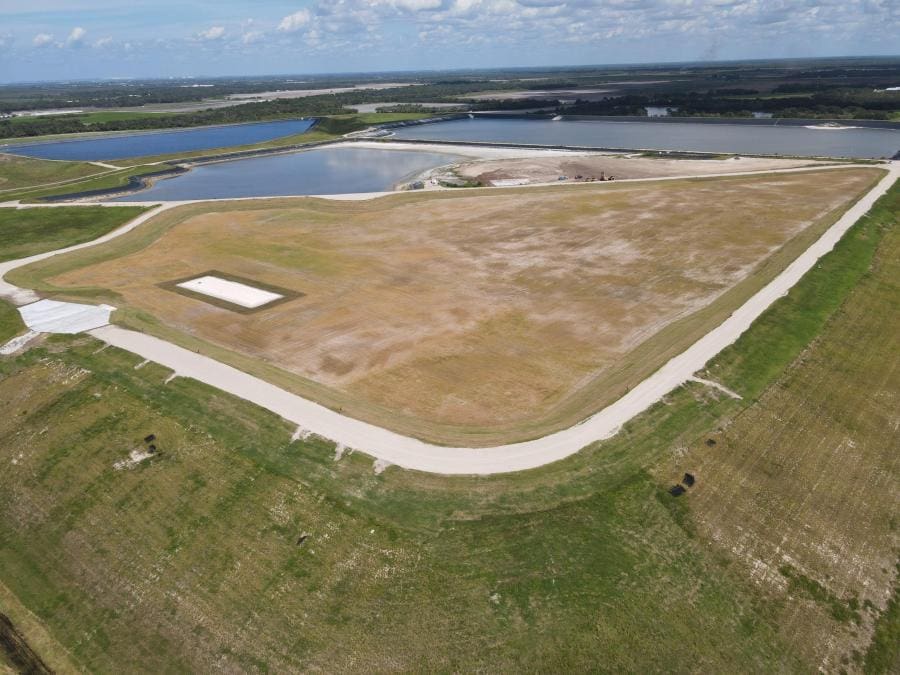
The Piney Point property is the site of a former phosphate processing plant closed for several years. Wastewater holding ponds were built on the crest of phosphogypsum stacks at the site, less than two miles from Tampa Bay and near two state aquatic preserves.

In April 2021, a breach in the outer wall of one of the retention ponds resulted in approximately 215 million gallons of water containing high levels of nitrogen and phosphate being intentionally discharged into nearby waters to avoid flooding nearby homes and businesses. The discharge worsened a bloom of the toxic algae red tide that lasted six months, causing fish kills and respiratory irritation.

Afterwards, a 3,300-foot-deep well was built near Piney Point at 3105 Buckeye Road to permanently store the wastewater being drained from the stacks, a process still in progress.

In an Aug. 9 FDEP status update, it was reported that:

• The site has received 9.55 inches of rain so far this month, including approximately 9.5 inches from Hurricane Debby. Piney Point has received approximately 44.49 inches of rain since Jan. 1.

• The storage capacity for additional rainfall at the site is over 90 inches. This capacity is expected to change with rainfall amounts and adjusted water management activities at the site.

• Approximately 160.2 million gallons are currently held within the NGS-South compartment. Pond level readings are expected to fluctuate due to a host of factors, including wind/associated waves in the pond, rainfall and water management activities.

“FDEP has been in contact with the court-appointed receiver and confirmed there is no identified damage to the compartment systems and there are no other water management concerns,” according to the Aug. 9 update. “FDEP is working closely with the court-appointed receiver to continue site evaluations and manage water levels. A full site inspection is underway to assess any post-storm impacts.”

In July, FDEP reported that final closure procedures for Piney Point are moving forward.

“Forgen LLC, the project contractor, has completed the liner installation on top of the OGS-South compartment and is now working with court-appointed receiver Herb Donica to complete the final details for closure, including placing soil cover and grass over the area so that it will no longer accumulate rainwater,” according to the July update.

Residents can find the latest information on the status of the site, response activities and water quality at ProtectingFloridaTogether.gov/PineyPointUpdate.

Piney Point contamination extends to Tarpon Springs

Piney Point contamination extends to Tarpon Springs

PALMETTO – A recent study shows the contaminated water from the 2021 Piney Point spill, which contributed to algae blooms and red tide in Tampa Bay waterways, traveled farther than originally thought.

According to the Sarasota Bay Estuary Program (SBEP), a chemical signature from the spill was found more than 30 miles away, in St. Joseph Sound near Tarpon Springs.

Immediately after the spill in 2021, SBEP partnered with the Florida Department of Environmental Protection (FDEP), the Tampa Bay Estuary Program, Manatee, Hillsborough and Pinellas counties, the Florida Fish and Wildlife Conservation Commission (FWC), the National Oceanic and Atmospheric Administration (NOAA), the University of Florida and the University of South Florida to set up a series of sites to monitor existing conditions and determine the extent of the spill’s impact, according to the SBEP.

Results of that collaboration among agencies showed evidence of algae blooms and high concentrations of red tide in the months following the spill.

“A chemical signature, unique to the Piney Point effluent, was also found at a location in St. Joseph Sound, originally chosen to be a reference site, as it was assumed to be far enough away from the spill to avoid impact,” according to the SBEP website. “This was not the case as evidence of the Piney Point spill was also found at this location.”

In 2021, FDEP authorized the intentional emergency discharge of 215 million gallons of wastewater from the former phosphate plant into Tampa Bay to avoid a potential flood after a leak was discovered in the waste storage system. Surrounding homes and businesses were evacuated.

From March 30 to April 9, 2021, the wastewater poured into the bay, adding an estimated 186 metric tons of nitrogen, exceeding typical annual nitrogen loads in a matter of days, according to a report released by the Tampa Bay Estuary Program. The nitrogen worsened toxic cyanobacteria blooms that peaked in June, followed by a bloom of toxic red tide algae that caused fish kills, triggering the cleanup of more than 1,600 metric tons of dead fish, according to the report.

Last March, Manatee County Utilities crews began disposal of those waters into a permitted injection well.
The well, drilled to a depth of 3,300 feet below land surface, was completed by Fort Myers-based Youngquist Brothers Inc., working with consultants ASRus of Tampa and Manatee County Utilities staff. By collaboratively working with the FDEP, crews were able to expedite the well work, which was completed in late 2022.

The well holds Piney Point’s process water in a confined saltwater aquifer over a half mile below the surface under the Floridan aquifer, the state’s drinking water source.

The phosphate process water will continue to be drained from the reservoirs atop nearby phosphogypsum stacks as the plant is permanently closed, and will be pre-treated before injection.

Piney Point well to begin operations

Piney Point well to begin operations

PALMETTO – Two years after an intentional discharge of contaminated water stored in ponds atop the Piney Point phosphogypsum stacks, Manatee County utilities crews will begin disposing of the remaining wastewater in a new deepwater injection well.

Operations will begin next week, according to a March 28 statement from Manatee County Information Officer Bill Logan.

The well will hold Piney Point’s process water in a confined saltwater aquifer over a half mile below the surface under the Floridan aquifer, the state’s drinking water source. The phosphate process water, which will be drained from the reservoirs atop nearby phosphogypsum stacks, will be pre-treated before injection. Work on the pre-treatment facility has been underway since earlier this year, according to Logan.

Local environmental group ManaSota-88 opposes the deep injection well on several grounds, including that wells are subject to failure, and that leaks of the contaminated water – which is also slightly radioactive – could poison the state’s drinking water.

ManaSota-88 is among five environmental groups, including Sarasota-based Suncoast Waterkeeper, that sued the Florida Department of Environmental Protection (FDEP) and Piney Point owner HRK Holdings LLC on June 24, 2021 seeking to hold both responsible for negligence in managing the site. A pretrial conference is scheduled on July 12 in the U.S. District Court for the Middle District of Florida in Tampa; a trial is scheduled for Aug. 7.

In a separate lawsuit, HRK Holdings was sued by FDEP in Manatee County Circuit Court in 2021, a case that remains open with no hearings scheduled.
In 2021, FDEP authorized the emergency discharge of 215 million gallons of wastewater from the former phosphate plant into Tampa Bay to avoid a potential flood after a leak was discovered in the waste storage system. Surrounding homes and businesses were evacuated.

From March 30 to April 9, 2021, the wastewater poured into the bay, adding an estimated 186 metric tons of nitrogen, exceeding typical annual nitrogen loads in a matter of days, according to a report released by the Tampa Bay Estuary Program. The nitrogen worsened toxic cyanobacteria blooms that peaked in June, followed by a bloom of toxic red tide algae that caused fish kills, triggering the cleanup of more than 1,600 metric tons of dead fish, according to the report.

The well, drilled to a depth of 3,300 feet, was completed by Fort Myers-based Youngquist Brothers Inc., working with consultants ASRus of Tampa and Manatee County utilities staff. By working with FDEP, crews were able to expedite the well project.

“The cooperation and collaboration with the DEP have been key in getting this project fast-tracked,” Manatee County Utilities Director Evan Pilachowski said. “We are so pleased that we are to this point in the process already.”
“We are excited to write the final chapter of this Piney Point story,” Manatee County Commission Chair Kevin Van Ostenbridge said. “The teamwork involved in this important project – from the receiver to the DEP, to the consultants and our hard-working staff – have brought this to fruition.”