






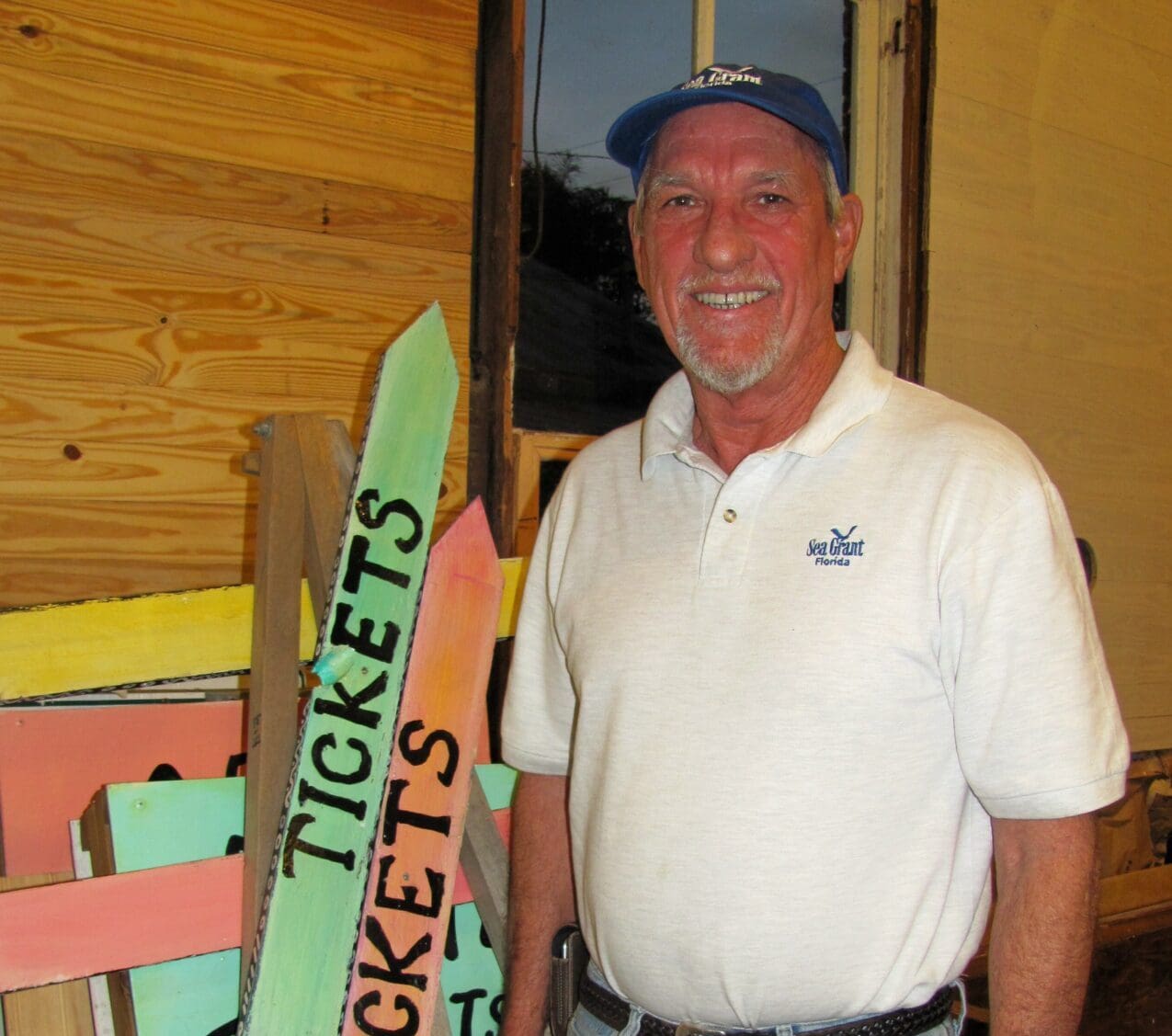
Person of the Year: John Stevely a force for nature
CORTEZ – Habitat preservation is thriving in Cortez due in large part to the commitment of the late John Stevely.
A founding member of the Florida Institute for Saltwater Heritage (FISH) and an early advocate for the FISH Preserve, the Anna Maria Island Sun names Stevely as one of its two 2023 Persons of the Year.
“When we lost John, FISH and the village not only lost a long-time board member, but a good friend and an advocate for FISH, the preserve and the village,” FISH Treasurer Jane von Hahmann said. “He was a founding member of FISH and instrumental in the initial purchase of the preserve property.”
Stevely passed away on May 27, 2022 at the age of 72 while walking with his wife, Dr. Theresa Bert, at Robinson Preserve. His work was recognized at the newly-completed 98-acre FISH Preserve ribbon-cutting ceremony on Nov. 3.
“There’s one person that could not be with us today,” von Hahmann said at the FISH Preserve dedication. “This is a gentleman who was part of the original purchase of this program, who was part of the original board that was FISH in 1992, he was part of Sea Grants and sat on the board. And we lost him last year to a battle with cancer.”
Von Hahmann then asked Stevely’s widow to accept a plaque on behalf of her late husband.
“In memory of John Stevely, without his dedication to, and passion for, the FISH Preserve and the village of Cortez, the FISH Preserve restoration project never would have been accomplished. Gone but not forgotten,” the plaque reads.
“I think I have a surprise for you guys perhaps,” Bert said. “In John’s and our will, we put $50,000 to be willed to the FISH Preserve. What I want to do is donate that $50,000 to the FISH Preserve now, specifically for trails and bridges. So this will help build those.”
Stevely’s friend for more than 20 years and fellow scientist, Dale Beaumariage, remembered him as a visionary for the protection of the environment.
“All of us biologists knew habitat was key for the survival of animals, especially fish,” Beaumariage said. “John recognized early on that the habitat was important to a productive shoreline which was being degraded by people.”
Beaumariage said Stevely was dedicated to Cortez and its people.
“John recognized Cortez village consisted of people who were independent and worked for a living,” Beaumariage said. “They were producing food, and he knew protecting the habitat was essential when you’re harvesting for food.”
He called Stevely an adventurer.
“He liked diving and fishing,” Beaumariage said. He was also a surfer.
“He and Terry traveled to exotic places to dive. He was an adventurer; he enjoyed the adventure.”
A longtime marine extension agent at the University of Florida Sea Grant Program, Stevely was replaced in that role by Angela Collins.
“John was most proud of Angela as a legacy,” Beaumariage said.
“We miss him so much,” Collins said. “Even though he’s not here with us, his presence is felt every single day.”
Collins noted that Stevely had served on the board of the Sarasota Bay Estuary Program and was a staunch advocate for local fisheries.
“John was an integral player in the initiation of FISH and the preserve,” Collins said. “He was incredibly passionate about the ecosystem, Cortez and the working waterfront.”
Collins said Stevely was one of the founders of the first Cortez Commercial Fishing Festival in 1981 and continued to promote Cortez and the festival throughout his life. Proceeds from the annual festival are used to purchase and maintain the FISH Preserve.
“When there was a giving challenge, John was pounding the pavement to find support for Cortez and to raise money for the FISH Preserve,” Collins said.
“In 2000, FISH and community members came together in a grassroots effort to raise the money to purchase 95 acres of land immediately adjacent to the village of Cortez. This parcel of land is now referred to as the “FISH Preserve” and it is one of the only untouched waterfront properties on Sarasota Bay,” according to the FISH website. “This habitat supports one of the last true working waterfronts in the state of Florida. The FISH Preserve came close to getting paved over by developers, however, the community came together to purchase the property in the nick of time. “
Karen Bell and Linda Molto worked with Stevely on the initial purchase of the preserve property in 2000.
“He was instrumental in all of it, FISH, the preserve and Cortez,” Bell said. “He was always one of the biggest supporters. He worked at the festival every year, which, along with private donations, is how we funded the preserve.”
Bell added, “He was someone who never got upset. He was just a really good person.”
Stevely dedicated his long and illustrious career to science and research.
He earned a Bachelor of Science degree in biology from Gettysburg College in Pennsylvania and a Master’s degree in marine science from the University of South Florida. He went on to be selected as a Smithsonian Research Fellow and a member of USF’s Outstanding Alumni.
During his career as a Marine Extension Agent, Stevely served as a University of Florida Sea Grant scientist and coauthored 15 scientific research publications. Following retirement, he became an Agent Emeritus. Among the nearly 20 awards and commendations he received, he was a Gulf Coast Guardian Award recipient, and in 2015, he was inducted into the Manatee County Agricultural Hall of Fame.

