Tag: Guthrie

State seeks contempt ruling in net camp case

State seeks contempt ruling in net camp case

CORTEZ – The Florida Department of Environmental Protection (FDEP) is continuing to tenaciously pursue the enforcement of a 2019 judgment against Raymond “Junior” Guthrie to remove his net camp off the coast of Cortez in Sarasota Bay.

According to the judgment, the state of Florida owns the submerged land under the net camp.

In a March 28 filing in the 12th Judicial Circuit Court, FDEP Assistant General Counsel Cameron Polomski asked the court to find Guthrie in civil contempt of the court order and impose sanctions that could include incarceration.

Guthrie had a deadline of March 5 to either remove the structure or show cause why the final judgment ordering its removal should not be enforced. According to court records, he has not done so.

Polomski asked the court in his motion to “impose appropriate sanctions including, but not limited to the incarceration in the county jail for no more than six months or until defendant purges the contempt by completing the removal of the structure or any other remedy this court deems just and appropriate.”

The attorney also wrote that a site inspection was conducted by FDEP on March 15 and “At the time of the inspection the structure was still present, no effort to remove the structure was apparent.”

A court hearing is scheduled for Wednesday, May 1.

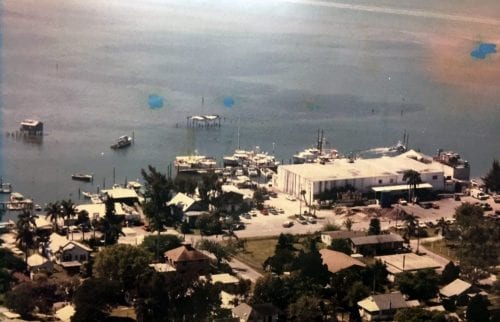
Long before monofilament nets made cotton fishing nets obsolete, historical photos show dozens of wooden net camps dotting the waters off Cortez. Cortez commercial fishermen used net camps – structures built on pilings in the water – to mend, clean, store and dry cotton fishing nets.

Guthrie’s net camp, built in 2017, is one of two such structures off Cortez.

The civil suit against Guthrie began on Feb. 6, 2018 when the FDEP claimed that Guthrie had constructed an unauthorized enclosed docking structure on sovereign submerged lands in Sarasota Bay, and asked for its removal.

Guthrie maintained that his family previously had a net camp in that spot and the structure was protected under the 1921 Butler Act, which awards title of submerged lands to adjacent waterfront property owners who made permanent improvements on the submerged lands.

On May 4, 2023, 12th Judicial Circuit Court Judge Edward Nicholas signed an order dismissing the case due to failure to prosecute, but on Nov. 2 it was reopened at the request of FDEP, which claimed it had not been given proper notice.

The second net camp in Cortez, known as the Curt Johns net camp, is owned by John Guthrie. It is scheduled for refurbishment by the non-profit Florida Institute for Saltwater Heritage (FISH) and is part of Organized Fishermen of Florida’s April 20 coastal clean-up initiative.

Civil case in net camp dispute dismissed

Civil case in net camp dispute dismissed

CORTEZ – A civil suit filed in 2018 by the Florida Department of Environmental Protection (DEP) against Raymond Guthrie, Jr. over his net camp building in Sarasota Bay has been dismissed.

Net camps were wooden shacks used by fishermen to hang hemp and cotton fishing nets to dry. According to historic photographs, there were dozens of net camps on the bay off Cortez.

“Net camps are small simple structures and provide space to store nets and other fishing gear,” according to the Florida Maritime Museum.

In a motion initiated by 12th Judicial Circuit Court Judge Edward Nicholas on Feb. 23, parties were notified that since no filings in the case had been made in more than 12 months, the case would be dismissed if no stay is issued or approved prior to the expiration of a 60-day period.

On May 4, Nicholas signed a Motion and Notice/Order of Dismissal.

Listed as lawyer for the plaintiff (DEP), Bradenton-based Attorney Robert C. Schermer, declined to comment on the dismissal via email on May 13.

DEP did not respond to a request for comment.

The civil case was filed Feb. 6, 2018, to have Guthrie remove the 1,200 square-foot structure.

The DEP complaint claimed Guthrie built the structure without permission on sovereign state submerged lands. Guthrie contended that his family previously had a net camp in that spot and the structure was protected under the 1921 Butler Act.

In May of 2018, A.P. Bell Fish Co., north of the structure, filed suit against the Florida Department of Environmental Protection (FDEP) asserting its ownership of both the net camp and the submerged lands.

Bell claimed the structure has existed since at least the early 1900s and, with the submerged lands, is protected by the Butler Act, which awards title of submerged lands to adjacent waterfront property owners who made permanent improvements on the submerged lands. The law was repealed in 1957 but continues to affect title to submerged lands improved prior to its repeal.

Guthrie was widely supported by Cortez residents and legislators, many of whom recalled net camps along the coast in years past.

The Manatee County Commission voted in March 2018 to support Guthrie’s effort to keep the structure standing.

“Given historic photos documenting the presence of multiple net camp structures, the reconstruction of this single structure to recapture the essence of the historic Cortez fishing community should be supported with the appropriate state permits,” the commission wrote to Florida DEP Secretary Noah Valenstein.

An April 15, 2021 letter from the Manatee County Board of Commissioners to Valenstein and signed by chairperson Vanessa Baugh, stated in part “The net camp has played an inseparable part of the gill and stop net fisheries with the historical village and is referenced in the National Register of Historic Places. Preservation of this structure will help preserve the essence of the Cortez fishing community and the understanding of the cultural context of the village.”

Bell Guthrie aerial

Bell submits Butler Act evidence

CORTEZ – The A.P. Bell Fish Co. submitted 44 pieces of evidence on Friday to the Florida Department of Environmental Protection (DEP) that a net camp built by Raymond Guthrie Jr. in May 2017 on submerged land is protected by the Butler Act.

The DEP ordered Guthrie to demolish the 1,200-foot structure last summer, saying it was built on state submerged lands without a permit.

When he did not, the DEP sued him, requesting in February that the 12th Judicial Circuit Court in Manatee County issue an injunction requiring him to remove the structure and pay $16,500 in penalties plus attorney fees and court costs.

The A.P. Bell Fish Co. sued DEP in May asserting its ownership of both the structure, which Guthrie calls a net camp or fish camp, and the submerged land under the structure, which lies just offshore of the fish house. The camps were used for cleaning, drying, mending and storing cotton nets, now obsolete, and sometimes served as homes for fishermen.

Bell also filed a motion to intervene in DEP’s case against Guthrie, claiming that the structure dates to at least the early 1900s, and, with the submerged land, is protected by the 1921 Butler Act.

The act awards title of submerged lands to adjacent waterfront property owners who made permanent improvements on the submerged lands. The law was repealed in the 1950s but continues to affect title to submerged lands that were improved with construction prior to its repeal.

“We have to prove under the Butler Act that the camp existed before May of 1951,” said Joanne Semmer, president of Ostego Bay Environmental Inc. of Fort Myers, a consultant for Bell in the case.

Semmer’s submission, made on Bell’s behalf, contains historic aerial photographs and passages from books showing that a net camp existed in the same place as Guthrie’s as far back as the 1920s, she said. She added that the exhibits also include surveys documenting its existence through the 1940s.

Guthrie historic net camp
An historic photo of the remains of the previous net camp, far right, facing south. – A. P. Bell Fish Co. | Submitted

The Butler Act does not apply even if the structure was built before the repeal of the act because the net camp was never “continuously connected to the upland property,” according to Marianna Sarkisyan, DEP senior assistant general counsel, in her June answer to Bell’s lawsuit.

Semmer says that’s not so, and that the camp was connected to the Bell fish house by a dock, according to her research.

DEP also claims that the “unauthorized enclosed docking structure in dispute is not the original ‘Guthrie Fish Camp,’ ” but a “newly constructed unauthorized structure,” making Bell’s lawsuit a “sham pleading.” Under the Florida Rules of Civil Procedure, a plea is considered a sham when it is “palpably or inherently false, and from the plain or conceded facts in the case must have been known to the party interposing it to be untrue,” according to the document.

While the net camp was rebuilt differently each time it was damaged by a storm, depending on available materials and finances, it remained in the same place and is subject to the Butler Act, Semmer said.

The DEP’s answer also charges that Bell is trespassing on state submerged land and asks the court to enjoin Bell from further trespass, eject Bell from the submerged land and rule that the state owns the submerged land.

Hearings have not yet been set in the cases.

Related Coverage

Bell claims ownership of disputed Guthrie property

Guthrie denies DEP allegations

County supports Guthrie net camp

Guthrie ordered to remove building in bay