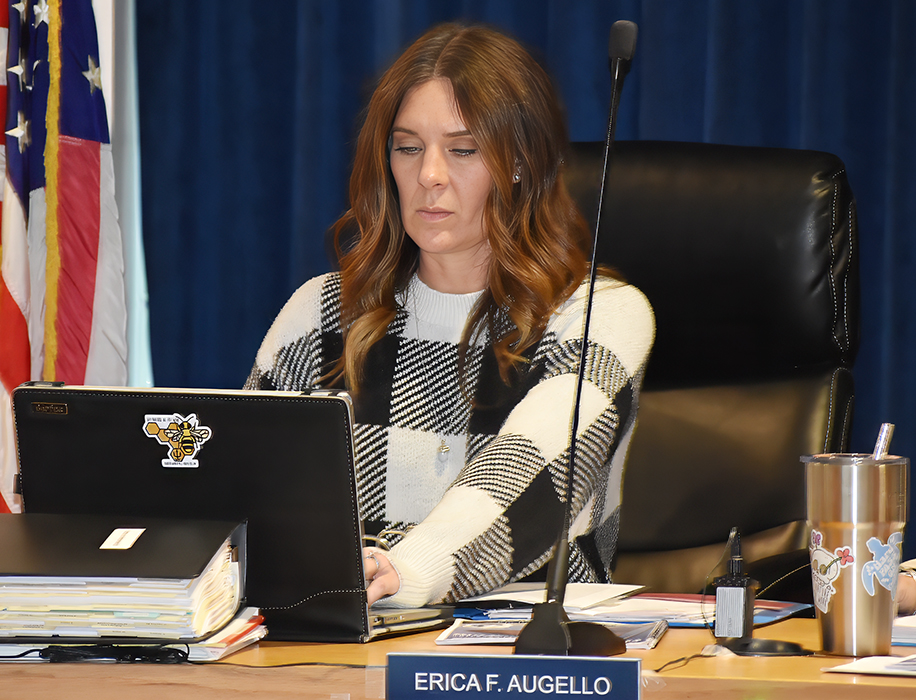
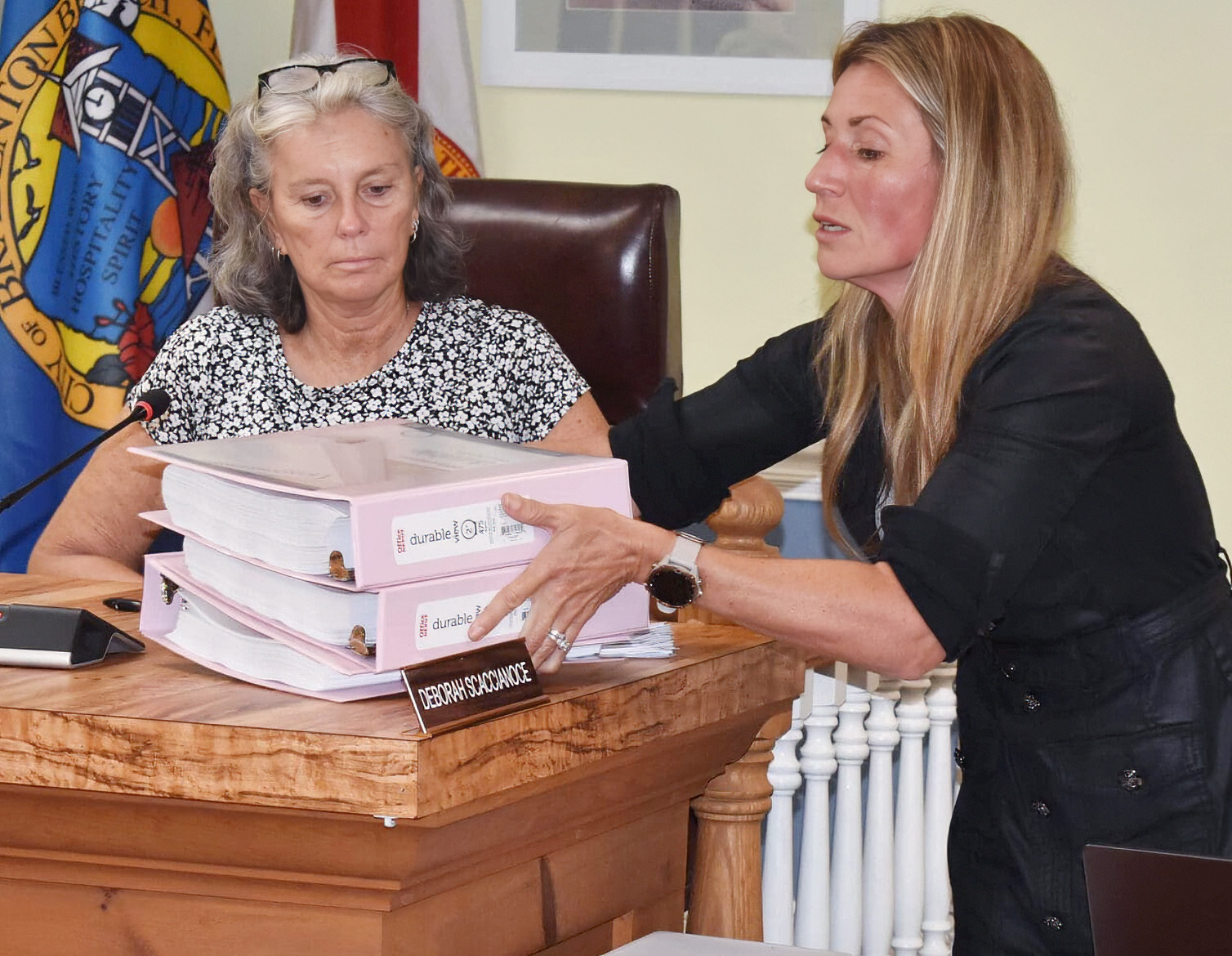
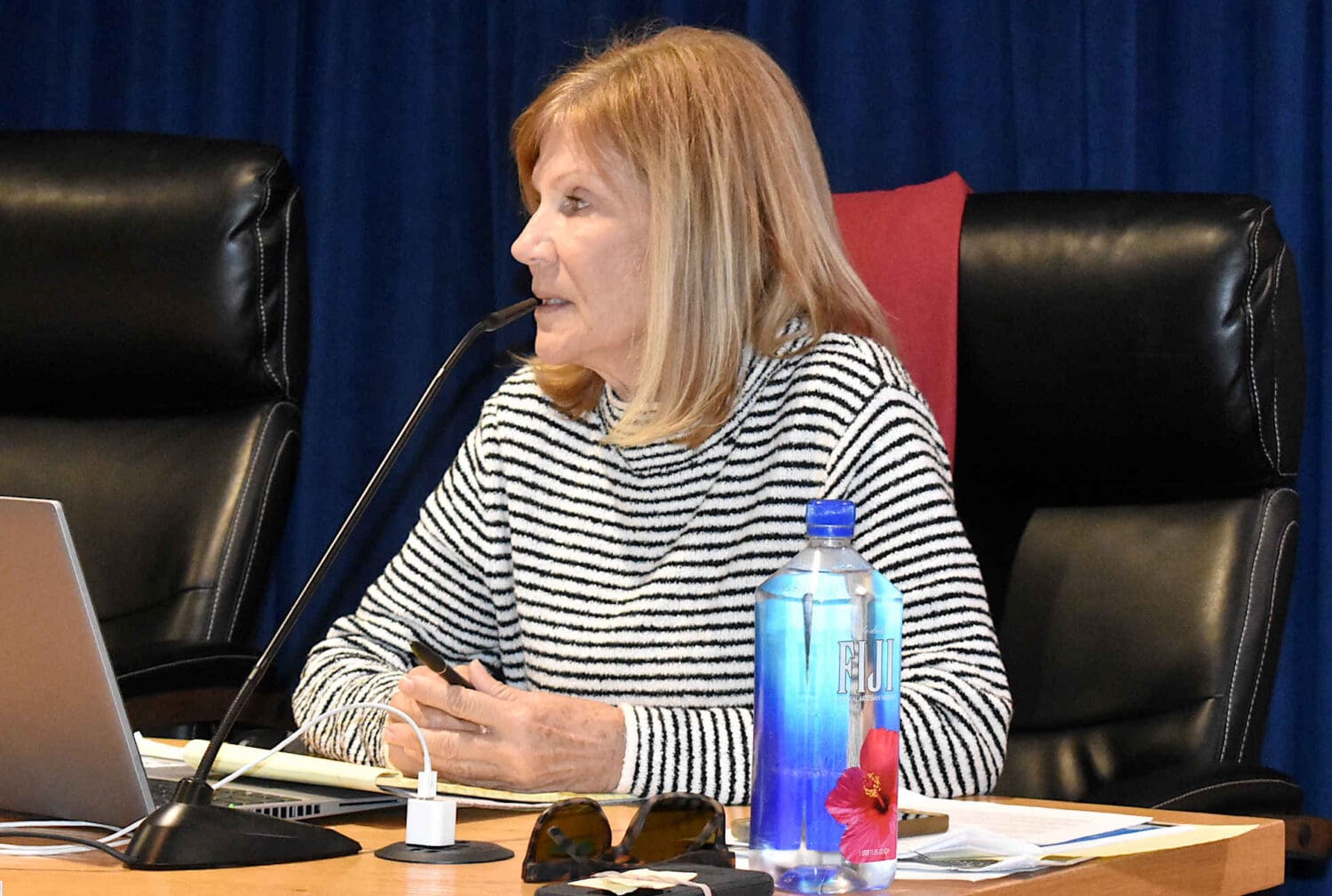
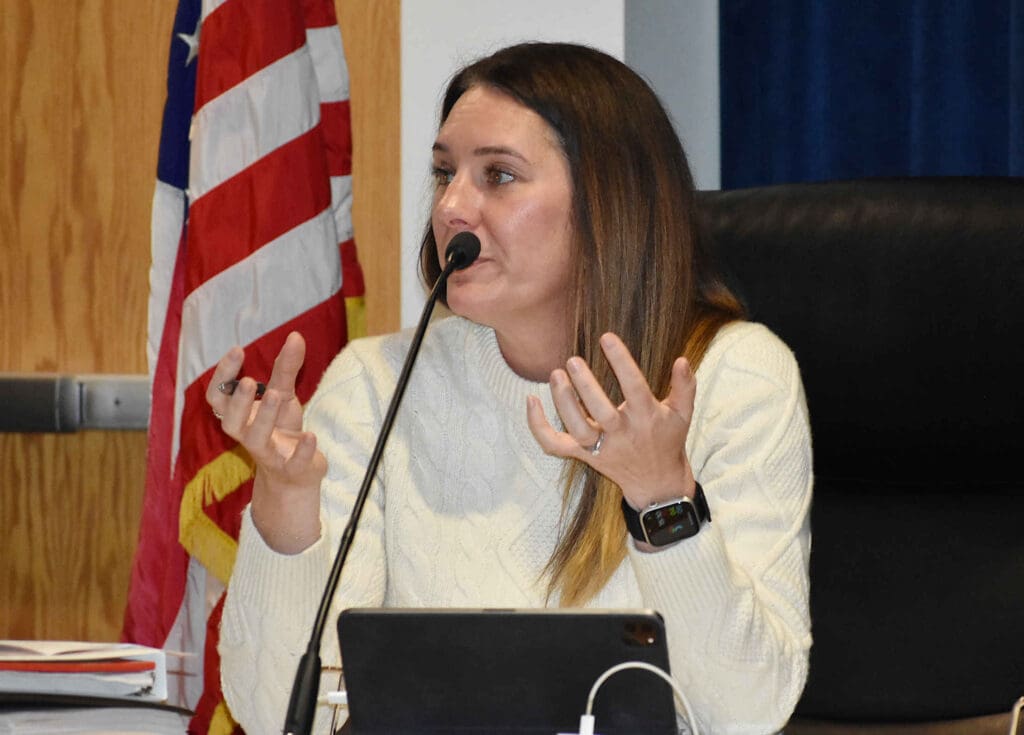
BRADENTON BEACH – City commissioners approved a contract to retain City Attorney Erica Augello on a permanent basis.
In October, the city commission approved a short-term contract with the Trask Daigneault firm in which Augello is a partner. That initial contract secured Augello’s services as interim city attorney for up to six months in the wake of then-city attorney Ricinda Perry’s immediate retirement.
Attorney Robert Lincoln represented the city during the gap between Perry’s Sept. 18 retirement and Augello being named interim city attorney in October.
During the April 16 city commission meeting, Augello said, “We are on our six months and it’s about time to decide if you’d like for me to continue services as an interim and put it out to bid for another city attorney or would you like to secure my firm’s services as city attorney, or something in the middle of that?”
“No middle of the road for me,” Mayor John Chappie responded. “I want to sign you up.”
Commissioner Scott Bear asked if the city has the right to terminate the contract with Trask Daigneault if an attorney other than Augello provides the city’s legal services.
“The contract is not with me, it’s with my firm,” Augello said. “I can add a provision in there that lists me as the principal on the contract, and if there’s a change it needs to be approved by the commission.”
Bear said he would like Augello named in the contract as the city’s principal legal representative.
The commissioners unanimously approved the contract with Trask Daigneault, with the stated changes.
In October, Augello was approved to serve as the Bradenton Beach city attorney on an interim basis for up to six months, or until a permanent replacement for Perry was selected.
Augello was already serving as the Holmes Beach city attorney when she was named Bradenton Beach’s interim city attorney, but plans were already being formulated for her to vacate the Holmes Beach position to accommodate the law firm’s overall scheduling needs.
Perry’s 21-year tenure as city attorney came to an end on Sept. 18, when she announced her immediate retirement during that day’s city commission meeting.
Perry’s retirement announcement came after city commissions met on Sept. 16 to evaluate her job performance following allegations that she had incorrectly named a Bridge Street business owner as the source of an FDEP complaint allegedly filed against a neighboring business.
FDEP later confirmed that no complaint had been filed, which triggered the Sept. 16 job performance review meeting.
BRADENTON BEACH – Five months after former City Attorney Ricinda Perry retired, the city seeks the return of all public records still in her possession.
When Perry retired on Sept. 18, she turned over three binders of city documents, but the city does not believe that represents the full production of all public records in her possession.
“There was the demand to the former city attorney for public records,” City Attorney Erica Augello said during the Feb. 5 city commission meeting. “Under statute, she was required to do it upon resignation. After the demand, she was required to do it within 10 business days.”
City Attorney Erica Augello discussed the demand for the return of public records from former city attorney Ricinda Perry. – Leslie Lake | Sun
Augello said she believes Perry is amenable to returning the public records to the city, but she is apparently working to determine what constitutes a public record.
“She was doing a lot of business from her personal accounts, which does not make them not public record,” Augello said. “I have a phone call scheduled with her tomorrow (Feb. 6). Hopefully, we can come up with a reasonable time. If not, then I will be back before you to see what we need to do next. It might just be we need to file an action in court, which has an attorney’s fees provision in it, to compel the return of those records from a public official because those are rightfully belonging to the city.”
DEMAND LETTER
On Jan. 12, Augello sent Perry a formal demand letter which stated, in part, “This letter serves as a formal demand for the immediate return and production of all records in your possession, custody or control that constitute public records of the city of Bradenton Beach. As you are aware, Florida’s Public Records Act defines ‘public records’ broadly, including, but not limited to, all documents, papers, letters, maps, books, tapes, photographs, films, sound recordings, data processing software or other material regardless of physical form, characteristics or means of transmission made or received in connection with the transaction of official business.”
Augello’s letter further stated the demand includes all public records, whether maintained on personal or professional devices, accounts or platforms, including, but not limited to, emails (including attachments), text messages, messaging applications, voicemails, electronic documents, drafts, memoranda, notes and correspondence, hard copy documents and files, cloud-based storage records, records maintained on personal computers, mobile phones, tablets or external storage devices and communications with city consultants, vendors or members of the public relating to city business.
“Please return all such public records within 15 calendar days, from the date of this letter to the city clerk. Please be advised that failure or refusal to comply with the Public Records Act may subject you to statutory consequences, including but not limited to civil and criminal penalties and potential referral to the Florida Bar and the Florida Commission on Ethics,” Augello’s letter stated.
PERRY’S RESPONSE
“I intend to cooperate in good faith to ensure that any city public records not already in the city’s possession, custody or control are appropriately returned,” Perry stated in her Jan. 21 letter to Augello.
She noted that prior to resigning, she presented three binders of relevant work, communications and draft documents to the city.
“Your demand, as written, presents two threshold issues that must be addressed before any meaningful production can occur: (1) the letter’s arbitrary 15-day deadline and (2) the scope of the request,” Perry wrote.
Perry stated any good faith retrieval and return process requires a reasonable amount of time to identify records, segregate city records from non-city records and ensure records are returned without disclosure of non-responsive or personal materials.
“Accordingly, to the extent the city expects my office to perform extensive search, retrieval, compilation and production efforts responsive to this demand, the city will be assessed a special service charge as authorized by section 119.07(4)(d), Florida Statutes,” Perry wrote. “Before undertaking any unusually time-intensive collection and production work, I will provide a written estimate of the anticipated special service charge and will require written confirmation that the city agrees to pay that charge.”
Perry said she has retained paralegal Michael Barfield, of Denovo Law Services, to assist in the production of materials. She directed future communications be sent to Barfield.
AUGELLO’S RESPONSE
Augello said she reviewed the three binders Perry referenced in her letter and sent the following response to Perry on Jan. 30: “The contents of these binders is not consistent with the breadth of this definition (by statute),” Augello wrote, noting that the binder contents do not include emails, text messages or notes.
Augello’s letter also stated Perry has a statutory obligation to return all public records to the city.
“Under the law, you were required to deliver them to the city within the 10 days allotted in the statute. At this point, you unlawfully possess public records, as you have admitted in your response that you have such public records in your care, custody and control,” Augello wrote. “I would suggest you either seek the advice of counsel on this matter or return the public records in your possession immediately.”
Augello stated Perry is responsible for returning all public records regardless of the scope or burden. She also stated the city will not be paying any records retrieval fees and Perry does not have the authority to charge such fees.
“I think you have misconstrued the demand for the return of public records to the agency to which they belong with a request for public records to an agency which maintains such records,” Augello wrote. “The city is demanding you, as former city attorney, return the records in your possession that belong in its possession as public records, as is required by Florida law.”
Augello closed her letter by stating, “The city demands that you return the public records immediately. Absent such production, the city is prepared to avail itself of all available legal remedies. Please govern yourself accordingly.”
Following her Feb. 6 phone call to Perry, Augello sent The Sun an email that said, “She was very accommodating and reasonable. She indicated she has many records but needs to review them to determine if they are public records.”
HOLMES BEACH – Erica Augello’s tenure as the Holmes Beach city attorney is coming to an end and a familiar face, Randy Mora, is expected to succeed her.
On Tuesday, Dec. 16, Mayor Judy Titsworth will seek city commission authorization to appoint Mora as Augello’s successor, effective Jan. 1. The city charter requires city commission approval to hire a city attorney, city clerk, city treasurer or police chief.
Augello and Mora are both partners in the Clearwater-based Trask Daigneault law firm that requested the change. On Nov. 13, Augello sent Titsworth a memo that formally requested the proposed change she and the mayor previously discussed.
“It is with great sadness that I must inform you that due to the business needs of my firm, I will no longer be able to serve as the city of Holmes Beach’s appointed city attorney. That being said, I will not be stepping away from the city entirely and will continue to serve as the city’s primary attorney for all code enforcement matters and wherever else I may be needed,” Augello stated in her memo.
“Though I will no longer be the city’s appointed city attorney, I hope that you will appoint and welcome my esteemed partner, Randy Mora, into that role. You, most of the commission, and city staff are well acquainted with Mr. Mora and I have no doubt that he will serve the city well in this role,” Augello wrote.
In October, the Bradenton Beach Commission appointed Augello to serve as that city’s interim city attorney for at least the next six months due to Ricinda Perry’s sudden retirement in September.
When speaking to The Sun on Nov. 21, Augello was asked if the Bradenton Beach assignment played a role in her pending departure as Holmes Beach’s city attorney.
“No, absolutely not. It has everything to do with availability and conflicting schedules with some of our other clients in Pinellas County – specifically with the city of Pinellas Park,” Augello said. “That is the only reason and that’s why I’m staying as code enforcement attorney in Holmes Beach. I truly enjoy serving that community but we are a team at Trask Daigneault and this is something I needed to do for my team. I’ve truly enjoyed my time sitting at the dais and serving the Holmes Beach community,” Augello said.
“The quality of service is not going to go down. The city is familiar with Randy. He was an instrumental part of the team that helped with the (Bert) Harris Act cases. He was also an integral part in successfully bringing the treehouse case to a close for the city. Our firm will continue to serve the city of Holmes Beach in every way we can,” Augello said.
Titsworth expressed a similar sentiment when contacted by The Sun on Nov. 20 and asked if Augello’s departure was related to her new Bradenton Beach assignment.
“Absolutely not. I was perfectly fine with her representing both cities and I think she’ll be great for Bradenton Beach,” Titsworth said.
Regarding the conversations that occurred before Augello formally requested the attorney change in her memo, Titsworth said, “I said we’d OK with Randy. He’s been helping the city for a long time. He’s well known by the city. He was part of the treehouse lawsuit. He also does our ethics training, so most of the commissioners already know him.”
Regarding Augello’s tenure as city attorney, Titsworth said, “She has been a tremendous asset to us and she’ll be a tremendous asset for the city of Bradenton Beach. I wish her well and we’ll still see her representing us at special magistrate hearings.”
Titsworth will present Mora’s appointment to city commissioners on Dec. 16 and Augello and Mora are both expected to attend the commission’s last meeting of 2025.
Augello began her tenure as Holmes Beach city attorney on Jan. 1, 2022, succeeding Patricia Petruff in the role. At the time, Augello already served as the city’s code compliance attorney.
Mora’s background
According to the updated résumé that Mora provided to the city and The Sun on Nov. 20, Mora served as the Indian Rocks Beach city attorney for the past 10 years – an assignment he ended in June when he chose not to renew his contract with the city.
Randy Mora is expected to serve as Holmes Beach’s next city attorney. – Trask Daigneault | Submitted
In recent years, Mora assisted the Indian Rocks Beach city commission with the adoption of an occupancy-based short-term vacation rental ordinance that prompted multiple lawsuits filed by vacation rental owners.
Mora served as the Pinellas Park city attorney from January of this year until November. He previously served as the Belleair Beach city attorney for three years and the Kenneth City town attorney for nearly eight years. He’s served as the town of Indian Shores’ special magistrate since 2020.
Rate increase
In her Nov. 13 memo to Titsworth, Augello also proposed increasing the hourly rate for city attorney services from $200 to $285 per hour.
“This rate not only meets with the current market but also reflects the value of the services that the city is receiving from the firm,” Augello stated in her memo.
BRADENTON BEACH – Community Redevelopment Agency (CRA) members discussed hiring a separate CRA attorney at an Oct. 20 meeting after learning that the city could be out of compliance with statutory requirements.
CRA Chair Scott Bear, Police Chief John Cosby and city Treasurer Shayne Thompson attended a Florida Redevelopment Association meeting from Oct. 14-17 in West Palm Beach.
“First and probably foremost, one of the things they told us is it is probably not a good idea, in fact in one session, it was also suggested that it was illegal, to have the city attorney be the CRA attorney,” Bear said. “So, we need to look for a CRA attorney through Trask. My understanding is they do have a CRA attorney who can help us, so we need to engage that person really quickly.”
The CRA board discussed compliance with statutory requirements at the Oct. 20 meeting. – Leslie Lake | Sun
The city has retained the Trask Daignault LLC law firm on an interim basis with Erica Augello as lead attorney. Retired City Attorney Ricinda Perry formerly represented both the city and the CRA.
“We’re finding out that we need specific knowledge attorneys for certain things,” Cosby said. “One size fits all is out the window, so I 100% agree with chairman Scott, we have to get this person on as fast as possible. I asked Terri (City Clerk Terri Sanclemente) while we were there to call the firm, and she spoke with Erica.”
Cosby said the Trask firm has an attorney that specializes in CRAs and expressed an interest in meeting with them once the agreement with the firm is signed, which was scheduled at the Oct. 23 commission meeting.
Bear said that there were two statutory updates, one in 2019 and one in 2024, that impact the CRA board.
“We need to do a couple things,” Bear said. “The update required that as of Dec. 1 this year every CRA must submit a status report. We’re going to need to work with the CRA attorney, once that person is under contract to get on that report, because we’ve got about a month to put it together and then brought back to this board for approval.”
Bear said the 2024 update stipulates there cannot be events in the CRA without a specific plan.
“The other thing is, during an event, you have to have a table set up with a handout that you provide to people that are there explaining how the event helps with the redevelopment of the CRA,” Bear said. “So, we’re going to have to pretty quickly work with someone to get that together and then figure out how we’re going to man a booth and do the handouts and explain it. That’s going to be a big issue for events within the CRA going forward. It could result in some really ugly actions if it were proven not to be consistent with that statute.
“One of the other things that I took away was in 2019 there was legislation that said every CRA will sunset in 2039 regardless of what is in the plan,” Bear said. “So, our current CRA plan has us going into 2046 or 47. That doesn’t matter, the legislation sunsets us in 2039, unless and this was the thing I took away, unless we do a resolution from the CRA to the city commission requesting approval to extend the sunset beyond 2039. So, we’re going to need to get that resolution done quickly.”
Bear said the legislation set a date of March 1, 2026 to have the resolution approved and in place.
“The last thing I took away is, there are very specific things that need to be included in the CRA plan and also on the website,” Bear said. “We do have a CRA page on the city website, so we’re OK there. One of the first things I think we need to do is get the CRA attorney to review our plan and make sure it’s complying with the legislation.”
“I think the three of us have a clear path forward, we just have to get the right people into place and move forward,” Cosby said.
“Some of the presenters have availed themselves to help us,” Thompson said. “One had been the CRA director in Palmetto, and Delray Beach has expressed an interest to help us as we move forward.”
The Bradenton Beach CRA district extends from the south side of the Cortez Bridge to the southernmost property lines along Fifth Street South.
BRADENTON BEACH – The city commission unanimously approved Mayor John Chappie’s recommendation that Erica Augello as lead attorney and the Trask Daigneault LLP law firm be appointed as interim city attorney for up to six months.
Augello, also the city attorney for Holmes Beach, did not attend the Oct. 23 commission meeting.
City officials sought an interim city attorney to serve before they choose a permanent replacement for retired City Attorney Ricinda Perry.
Following an interview by commissioners at an Oct. 7 emergency special work meeting, Chappie made the recommendation to contract with the Clearwater-based Trask Daigneault LLP law firm with Augello as lead city attorney.
“In going through the proposal material, you have the whole gamut of areas of law that we need help on,” Chappie said. “I think it will be very beneficial not to have just one attorney but to have a team.”
Augello said at that interview that she would be the first point of contact and the person who attends city meetings.
Commissioners questioned Augello and attorney Robert Eschenfelder at the Oct. 7 meeting about topics that included potential conflicts between Holmes Beach and Bradenton Beach, Community Redevelopment Agency (CRA) experience, fees and the role of city attorney.
“I’m not entirely comfortable with Erica because of her role in Holmes Beach,” Vice-Mayor Deborah Scaccianoce said at the Oct. 23 meeting. “I do like the law firm, but we do have six months to work through this and make sure everything goes smoothly, so I’m open minded.”
Chappie said he thought there could possibly be some issues at times.
“If any issue arises and you have that concern, I would identify it as soon as you can and bring it up to Miss Augello and I’m sure she will respond appropriately to the concern,” said attorney Robert Lincoln, who has been representing Bradenton Beach since Perry’s retirement.
BRADENTON BEACH – Holmes Beach City Attorney Erica Augello will serve as the Bradenton Beach city attorney on an interim basis for up to six months or until a permanent replacement for retired City Attorney Ricinda Perry is selected.
Following an interview process by commissioners at an Oct. 7 emergency special work meeting, Mayor John Chappie made the recommendation to contract with the Clearwater-based Trask Daignault LLP law firm with Augello as primary city attorney.
“In going through the proposal material, you have the whole gamut of areas of law that we need help on,” Mayor John Chappie said. “I think it will be very beneficial not to have just one attorney but to have a team.”
“The way that our firm works, the city attorney is a charter position, so you would have a named city attorney. In this case the proposal names me as the city attorney,” Augello said. “I’ll be the first point of contact. I will be the person that shows up at all your meetings.”
Commissioners questioned Augello and attorney Robert Eschenfelder about topics that included potential conflicts between Holmes Beach and Bradenton Beach, Community Redevelopment Agency (CRA) experience, fees and the role of city attorney.
“In my capacity as city attorney for Holmes Beach, I have worked with the former city attorney, Ricinda (Perry), as well as some of the staff when there are issues that come up to craft interlocal agreements through the hurricanes,” Augello said. “While I do serve as city attorney of Holmes Beach, I’m very much aware that every city is unique.”
Eschenfelder said the law firm serves 14 municipalities, including four beach cities in Pinellas County, and he serves as village attorney for village of Estero and town attorney for the towns of Redington Beach and Redington Shores. He was with the Manatee County Attorney’s office for 16 years.
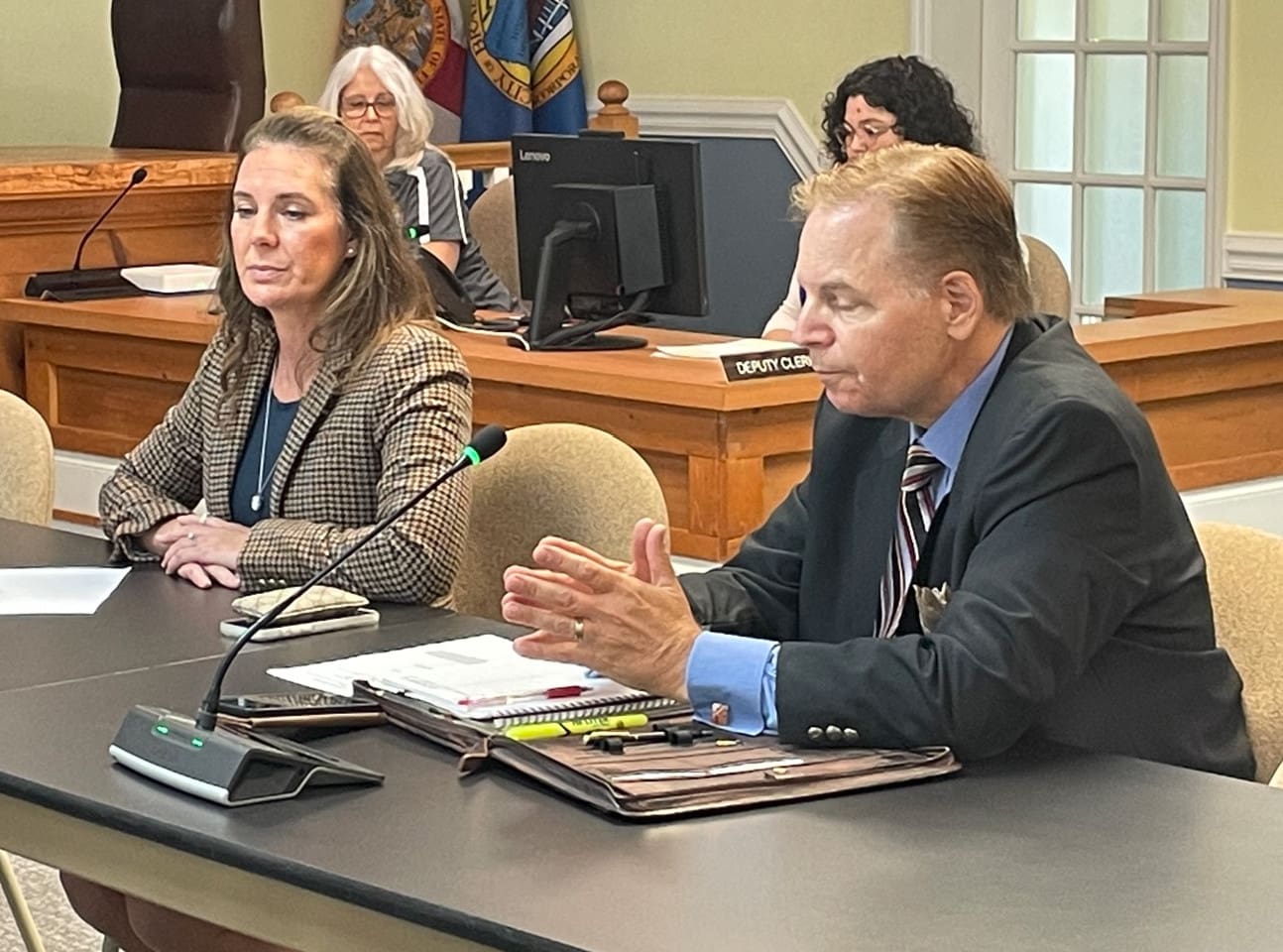
Commissioners questioned attorneys Erica Augello and Robert Eschenfelder, right. – Leslie Lake | Sun
Commissioner Scott Bear asked how any potential disputes between Bradenton Beach and Holmes Beach would be handled.
“If there comes to pass a time when Bradenton Beach needs to sue one of its neighbors for some reason, there obviously will be a conflict so conflict counsel would need to be picked for that one thing,” Eschenfelder said. “We were the city attorney to Tarpon Springs, they have a CRA. We handle conflict for the city of Bradenton CRA board, so we do have in-house experience.”
Augello said that happens very infrequently.
Bear asked about the attorneys’ familiarity with grant applications.
“If I do get involved with the grant applications, it’s very rare,” Augello said. “Our position is we’re not drafting the grant applications for you, but we can certainly help as much as is necessary until you get to the point where you’re able to do that on your own.”
Commissioner Ralph Cole stated that Bradenton Beach uses department heads to lead projects, which has included Perry.
“Our positions are to advise; we will never be the final decision makers on things. If it’s from a legal point of view, 100%, but if it’s a purely staff issue, I have no problem saying this is not my position, let me point you in the direction of where you may get assistance on that,” Augello said. “Our role as attorneys and charter officials is fairly narrow. If I’m doing more than giving you legal advice, in my opinion, I’m not doing my job properly and I’m doing you a disservice.”
Cole asked about the firm’s fees.
“We have specialized skills that other municipal firms don’t have. We find that our $285 rate is cost effective for the quality of what you’re getting,” Augello said.
“One of the things you had with your previous attorney, very likely she had to do a lot more work to come up with whatever work product she came up with, whereas we share our work product,” Eschenfelder said.
“I do want to say as diplomatically as I can, when you look at the spend that this city has had for a city attorney over the prior years as I understand it, your city attorney became the city manager in many ways, and billed you attorney time for that,” Eschenfelder said. “We are not going to be your city manager. I think it’s a dangerous role for your lawyer to be so involved. Because if a lawsuit happens, that lawyer is going to be potentially named as a defendant, and won’t be able to represent you, so we intend, if you retain us, to draw a real distinction.”
“I bet you next year at this time you will have spent less on lawyer fees because we confine ourselves to what we’re supposed to be doing,” he said.
A Request for Proposal (RFP) for a permanent city attorney will be issued toward the end of the six-month interim period. Augello said her firm will submit a proposal for the permanent city position.
“I think we heard a lot of great things that we needed to hear today, particularly not getting out of your lanes and that’s key because it’s so easy to slip and that’s what’s happened over the decades,” Chappie said.
Augello said one of the first things she would do is schedule meetings with staff and commissioners to learn what issues are facing the city.
“I am all for a firm, I have been asking for this for quite some time, especially over the last couple of years,” Police Chief John Cosby said.
City Clerk Terri Sanclemente said, “We need more input with different specialties and different attorneys. I think it would be beneficial for our city.”
The city charter states that the mayor nominates the city attorney.
“The mayor can make that nomination informally, if it is the consensus of the commission to move forward with that,” said Robert Lincoln, who is temporarily serving as city attorney. “I can prepare a resolution for the meeting on the 16th that will recite the mayor has made the nomination and the resolution is to implement it by the commission’s approval of appointment of the firm as the interim attorneys until such time as the city commission makes an appointment for a permanent city attorney.”
HOLMES BEACH – At the advice of City Attorney Erica Augello, city commissioners plan to deny the planning commission’s request to conduct preliminary reviews of major site plan applications.
Augello also advised that major site plan applications not be preliminarily discussed during non-quasi-judicial city commission work meetings.
A site plan is a diagram that illustrates a proposed development, redevelopment or significant improvements desired by a property owner.
Augello dispensed her legal advice on Jan. 14 while Holmes Beach city commissioners and Director of Development Services Chad Minor discussed proposed changes to the city’s site plan application review processes. The proposed changes are set forth in Ordinance 25-02 and the ordinance was presented on first reading that day. Adoption is expected during the second and final reading on Tuesday, Jan. 28.
Currently, the planning commission does not review major site plan applications before the city commission conducts an evidence- and testimony-based quasi-judicial public hearing on the proposed site plan.
When initially reviewing the proposed ordinance last year, the planning commissioners recommended inserting additional language that would allow them conduct public hearings to review major site plan applications for consistency with the city’s comprehensive plan and land development code. This would be done before the city commission conducts its quasi-judicial public hearing on the site plan application.
The planning commission’s recommended language was included in the ordinance presented to city commissioners on Jan. 14.
“The city planning commission shall hold a properly noticed public hearing to review the site plan application and based on the evidence presented provide a recommendation to the board of commissioners as to whether the application is consistent with the city’s comprehensive plan and land development code.
“The city planning commission may also provide advisory comments to the applicant regarding site design recommendations to increase compatibility of the site with adjacent uses and the surrounding area. After review by the planning commission, the planning and zoning administrator or designee shall prepare a staff report, findings and recommendation for submittal to the city commission for review at a public hearing, including any recommendations provided by the planning commission,” the ordinance said at that time.
Regarding the proposed inclusion of the planning commission in the site plan application review process, City Commissioner Carol Whitmore said, “I don’t support this. This is not a planning commission role. This is one of the biggest jobs of the commission and we should be taking the responsibility for it.”
Whitmore said the planning commission’s role is to ensure compliance with the city’s comprehensive plan and allowing them to conduct public hearings to review site plan applications would subject the city to additional attorney fees.
“I respect the planning commission and I love what they do, but this is our job and I don’t feel like giving my job up to another board,” Whitmore said.
City Attorney Erica Augello advised against the planning commission reviewing major site plans. – Joe Hendricks | Sun
Augello noted the planning commission is an advisory board, not a decision-making body. When conducting a quasi-judicial public hearing, the city commission could not use any evidence or testimony given at a planning commission hearing.
Augello agreed that a planning commission hearing would provide another layer of public input but it could also create additional legal complications if the city commission denies a site plan application and the applicant appeals the decision. Augello said the applicant could allege the city commission made its decision based on the planning commission review rather than the evidence and testimony presented directly to the city commission.
Augello said planning commission review of a site plan application could also create a “conflict in record evidence.” If something was presented at the planning commission hearing and not at the city commission hearing, that could create a potential deviation of information. Augello advised avoiding a “dual review” process for site plan applications and she suggested a similar approach for rezoning requests.
Commissioner Carol Soustek serves as the city commission’s planning commission liaison. She expressed her respect for the planning commission and their desire to review site plans but she agrees with Whitmore regarding the avoidance of additional attorney fees.
Commissioner Terry Schaefer noted subjecting site plan applications to a single public hearing provides the public with only one opportunity to provide their input.
The commission unanimously agreed to remove the planning commission’s recommended language and move forward toward final adoption of the ordinance as amended that day.
In a related action meant to solicit greater input from the city’s advisory boards, the commission agreed to place monthly advisory board reports on future commission meeting agendas.
After the city commission meeting, Minor sent a revision version of the ordinance to City Clerk Stacey Johnston, with the planning commission’s recommended language deleted.
Planning Commission Response
On Jan. 15, when reviewing the ordinance as amended the previous day, the planning commissioners expressed disappointment with the city commission’s decision, but they acknowledged the city attorney’s legal concerns. After much discussion, the planning commissioners unanimously agreed to reinsert the deleted language as a symbolic reiteration of their desire for greater transparency in the site plan review process – knowing the city commission will delete that language again before the ordinance is adopted on second reading.
Minor said he would never present a site plan application to the city commission that doesn’t comply with the city’s comprehensive plan and land development code. At the request of the planning commission, Minor agreed to post a notice at the city website when a major site plan application is received so the public has as much advance notice as possible.
ANNA MARIA ISLAND – A Florida law firm plans to file a lawsuit challenging the recently expanded Form 6 financial disclosure requirements that now also apply to elected city officials.
Anna Maria, Bradenton Beach and Holmes Beach city commissioners recently discussed the pending lawsuit, but none of the Island cities are so far joining the lawsuit as plaintiffs.
On Jan. 9, city attorneys throughout Florida received a group email from attorney Jamie Cole, a longtime attorney with the Weiss Serota Helfam Cole and Bierman law firm’s Fort Lauderdale office. According to the firm’s website, Cole “represents local officials and governments in matters that help to improve their communities and preserve home rule power.”
In his email to city attorneys, Cole stated, “As I know you are all aware, the Florida Legislature last year passed a law that requires all municipal elected officials to complete a Form 6 rather than a Form 1 financial disclosure form as of Jan. 1, 2024. Over a hundred municipal elected officials have resigned rather than fill out the new form, which requires them to disclose their exact net worth, income and asset values.”
Former Bradenton Beach Commissioner Jake Spooner and Longboat Key Town Council Member Debbie Murphy were among the city officials statewide who resigned rather than be subjected to the same annual financial disclosure requirements that have long applied to elected state and county officials.
The expanded financial disclosure requirements also resulted in candidates John Kolojeski, Pat Olesen and Susan Stephen withdrawing their applications for potential appointment to the Anna Maria City Commission.
In his email, Cole stated, “Numerous city officials have contacted us regarding the filing of a lawsuit for declaratory and injunctive relief. Our firm has decided to file such a lawsuit if at least 10 municipalities sign on as plaintiffs. Attached is a form resolution that can be used by cities and their elected officials to join the lawsuit. Our legal theories are set forth in the resolution and are based upon the right to privacy and free speech.”
The resolution notes each city joining the lawsuit will be charged a $10,000 flat fee that covers the litigation of an initial court trial, but not a subsequent appeals process.
As of Jan. 18, the 11 cities joining the lawsuit were Golden Beach, Indian Creek, Miami Springs, Lighthouse Point, the Town of Palm Beach, North Bay Village, Bal Harbor, Weston, Delray Beach, Cooper City and Safety Harbor, according to Cole. He expects to file the lawsuit in February, after allowing more time for additional cities to potentially join in the suit.
The resolution claims the Form 6 disclosure requirements are unconstitutional and are not the least restrictive means to carry out the state Legislature’s desired financial disclosure requirements. It also says requiring unpaid or low-paid elected city officials to disclose their net worth, income and assets does not serve any compelling public interest and may potentially make them targets of burglary, identity theft and extortion while deterring other qualified citizens from seeking elected city office.
“Even the President of the United States and members of the U.S. Congress are not required to make such extensive disclosures,” the resolution states.
Elected city officials were previously required to file the significantly less intrusive Form 1 which doesn’t require the disclosure of net worth, income earned or tangible assets.
Elected city officials in office as of Jan. 1 must now file a Form 6 disclosure form by July 1, and future mayoral and city commission candidates must file a Form 6 when qualifying to run for office. Form 6 requires elected officials to report their net worth, income sources, income earned from each source, real estate holdings, bank accounts and account balances, stock holdings, tangible assets valued at more than $1,000 and debts owed.
Once filed, Form 6 becomes a public record that can easily be viewed and downloaded at the Florida Commission on Ethics website.
LOCAL DISCUSSION
Holmes Beach commissioners discussed the proposed lawsuit on Jan. 11 when Commissioner Terry Schaefer provided a recap of the Form 6 discussion that occurred earlier that day at the ManaSota League of Cities meeting. Schaefer said Florida League of Cities President and Cooper City Mayor Greg Ross is not in favor of the proposed lawsuit.
On Jan. 9, the Cooper City Commission voted 3-1 to join the proposed lawsuit and the three supporting commissioners will be named individually as plaintiffs acting on behalf of the city. Ross, an attorney, voted against Cooper City joining the lawsuit.
Holmes Beach City Attorney Erica Augello said she and her fellow attorneys at the Trask Daigneault law firm are not advising any of their municipal clients to join the lawsuit.
“Whatever decisions are made are going to impact you one way or another, so save your money,” she said. “It’s going to be an uphill battle.”
Holmes Beach City Attorney Erica Augello doesn’t recommend joining the lawsuit. Sun File Photo | Joe Hendricks
Commissioner Dan Diggins said, “I would really like us to stop talking about Form 6. It’s law. Let’s live with it. Let’s move on.”
Schaefer noted that anyone still in office as of Jan. 1 had the opportunity to resign before the expanded disclosure requirements took effect.
Anna Maria City Attorney Becky Vose told The Sun she received Cole’s email, however, she did not mention the email or the lawsuit during the Anna Maria Commission’s Jan. 11 meeting.
During that meeting, Commissioner Jon Crane provided some general comments on the Form 6 requirements and said, “I think it’s more home rule terrorism, stomping a foot on the neck of little cities. I’ve been talking to the mayor about having our lobbyist talk to the legislators about an exception for smaller cities, or something else that would take that pressure off of us. I also understand there might be a lawsuit being filed.”
Anna Maria Commissioner Jon Crane equates the expanded financial disclosure requirements to “home rule terrorism.” – Joe Hendricks | Sun
Commission Chair Mark Short noted Form 6 was discussed at the ManaSota League of Cities meeting, but the Florida League of Cities is not taking any action in opposition to the expanded disclosure requirements.
On Jan. 18, Bradenton Beach City Attorney Ricinda Perry initiated a commission discussion on the proposed lawsuit. She said she agrees with the legal argument that the expanded disclosure requirements are a violation of the right to privacy.
Bradenton Beach City Attorney Ricinda Perry agrees with the Weiss Serota law firm’s legal analysis. – Sun File Photo | Joe Hendricks
Perry said it’s unfair to subject elected city officials to financial disclosure requirements that were not in effect when they took office, some of whom own businesses and would have to disclose information that could be used by their competitors.
“I tend to agree with the attorneys who are putting this lawsuit together. There are other means of getting to where the legislators wanted to be,” Perry said.
Mayor John Chappie said, “As a county commissioner for eight years, I filled out the Form 6. Do I like doing it? No, not at all, but it is what it is. I’m not in favor of being part of the lawsuit.”
Commissioner Ralph Cole said he understands the Form 6 disclosure requirement being applied to higher-paid state and county elected officials, but not to a Bradenton Beach commissioner who earns $4,800 per year for serving.
Cole noted the disclosure requirements were expanded without grandfathering in city officials elected before the expanded disclosure requirements took effect. He said determining one’s net worth and the value of tangible assets could be challenging. Chappie agreed that determining the value of some assets, including works of art, can be difficult.
None of the Island city commissions took formal votes on joining the lawsuit.
ATTORNEY INSIGHTS
The Sun spoke with Cole by phone on Jan. 10 and Jan. 18.
“In the long run, if we win the case and get a declaration that the law’s invalid, I think it will benefit everyone,” he said. “But that’s not going to be for a while, so we’re going to try to get a temporary injunction that would only run in favor of the plaintiffs – the individuals who are actually named in the lawsuit. Just because a city joins that’s not going to be enough. The individuals who are named plaintiffs are the ones who would benefit from the temporary injunction and the cities would be paying for their fees.”
Cole thinks the expanded disclosure requirements are going to have a bigger impact in Florida’s smaller cities.
“Big and small cities are both concerned, but to some extent, it could be a bigger problem in smaller cities where everyone knows each other, and some people feel it’s a bigger invasion of their privacy. Some small cities are going to have problems filling their commissions,” Cole said.
Cole said the Florida Legislature can revisit the 2023 legislation and enact less invasive disclosure requirements for elected city officials, or all elected officials in Florida.
“They certainly could fix this and it doesn’t have to be all or nothing. It doesn’t have to be Form 1 or Form 6. It could be something in between. They could also change the rules for themselves because it’s not really clear why the net worth of county commissioners or state legislators needs to be disclosed,” Cole said.
He said the Florida Legislature could also research how other states handle their financial disclosure requirements.
“If you were to do that, you will find that none of them require their officials to disclose their net worth, their income and every single asset they own,” Cole said, noting there are some states that require disclosure reporting in dollar ranges rather than specific dollar amounts.
Cole said the Form 6 disclosure requirements provide teenage and adult children the means to look up their parents’ net worth and earnings. He said some city officials resigned because their employers don’t allow them to disclose their salaries and others may be involved in legal disputes or family issues in which disclosing financial assets could be detrimental.
“There’s so many different scenarios that people can’t or don’t want to disclose their financial information. It’s a huge intrusion into their privacy and it forces them to speak in a way that don’t want to speak – and that clearly violates fundamental constitutional rights,” Cole said.
He noted paying an accountant to assist with a Form 6 filing can cost $2,000 or more.
HOLMES BEACH – The city is amending its sign ordinance to ensure compliance with a 2015 U.S. Supreme Court ruling that protects free speech, specifically, words on signs.
The City Commission on first reading unanimously voted in favor of the amended sign ordinance drafted by City Attorney Erica Augello and presented by Development Services Director Chad Minor on Nov. 14.
Development Services Director Chad Minor said the sign ordinance is the culmination of numerous previous city discussions. – Joe Hendricks | Sun
The sign ordinance, last amended in 2007, will be reviewed by the Planning Commission before being brought back to the City Commission for second reading and final adoption.
During the Nov. 14 meeting, Minor said the amended ordinance presented that day represented the culmination of 15 to 20 commission workshops that occurred over the last year to a year and a half.
City Attorney Erica Augello provided a summary of the freedom of speech protections pertaining to signs. – Joe Hendricks | Sun
He said the amended ordinance pertains in part to political signs placed on residential properties being treated similarly to residential “for sale” or “for rent” signs.
In response to a question posed by The Sun, Augello provided a brief summary of the proposed sign ordinance amendments.
“Several years ago, the Supreme Court of the United States made a decision (in Reed v. Town of Gilbert, Arizona) that had to do with free speech, commercial speech, political speech and regulating signs. The Supreme Court of the United States says you can’t regulate speech on signs, but you can regulate their size, you can regulate where they’re placed, you can regulate the material they’re made of, but you can’t regulate what’s located on them. Cities throughout the country have been amending their sign codes to make them enforceable and to make sure we are not regulating the content of the signs,” she said.
She also noted commercial speech on signs is not as protected as the personal free speech of individuals.
The 45-page ordinance also includes numerous definitions and regulations pertaining to different types of signs, sign allowances and sign prohibitions.
Amendment specifics
The proposed sign ordinance includes several “whereas” clauses pertaining to free speech protections. One clause notes that one intent of the amended ordinance is to reaffirm that the city’s sign standards and regulations are not designed to censor speech or regulate the viewpoint of the sign’s message.
Another clause notes that until 2015, federal court opinions were not clear as to what constituted content-based sign regulations versus content-neutral sign regulations. That question was clarified in Reed v. Town of Gilbert, Arizona case in which the U.S. Supreme Court addressed the constitutionality of a local sign ordinance that had different criteria for different types of temporary, noncommercial signs.
“The city recognizes that in Reed v. Town of Gilbert, the Supreme Court held that content-based regulation is presumptively unconstitutional,” one clause in the Holmes Beach sign ordinance states.
Another clause notes that the case clarified that municipalities still have the authority to enact and enforce reasonable sign regulations that are not content-based, including the regulation of sign size, the locations in which signs may be placed, rules that distinguish between freestanding signs and those attached to buildings, between lighted and unlighted signs, between signs with fixed messages and electronic signs with messages that change, between the placement of signs on private and public property, between the placement of signs on commercial and residential property, between on-premises and off-premises signs, rules restricting the total number of signs allowed per mile of roadway and rules imposing time restrictions on signs advertising a one-time event.
Additional clauses reference several other examples of case law pertaining to sign regulations.
HOLMES BEACH – The fight between city leaders and the ownership of the Bali Hai Beach Resort is continuing, with the Holmes Beach special magistrate levying fines in excess of $1,000 per day against the beachfront property, topping $176,000 so far with no end in sight.
Special Magistrate Michael Connolly vacated an order imposing fines against the property during a November hearing due to an issue with the proceedings not being recorded at a mid-2021 hearing. At a Jan. 19 code compliance special magistrate hearing, Connolly ruled against the resort in seven separate cases with hefty fines assessed.
In a case alleging change of use on the property – the operation of a bar/lounge without an approved site plan from the city – Connolly ruled in the city’s favor, imposing a $500-per-day fine from Oct. 12, 2021, until the property is brought into compliance by either obtaining an approved site plan, including the bar/lounge as an approved use on the property or demolishing the bar/lounge and returning it to its previous state. As of Jan. 30, the fines had reached $54,500. Connolly also assessed $127.24 in administrative costs.
Speaking on behalf of the property’s ownership, which includes local developer Shawn Kaleta, was attorney Louis Najmy. Najmy argued that the bar/lounge wasn’t a change of use, that it had been an existing use on the property, and therefore wouldn’t require a site plan approval.
In late 2021, Najmy took a site plan before the Holmes Beach city commission, requesting that it be approved to include the bar/lounge and the installation of a spa for the use of hotel guests. While commissioners approved a site plan, it didn’t include the bar/lounge requested by Najmy. That site plan approval has since expired due to not being accepted, signed and recorded by the property owners, meaning that the site plan approval process would have to begin again before it could potentially be approved by commissioners.
The conditional site plan approval is being used as an example of the city’s alleged “blackballing” against Kaleta and his business dealings in the city in his ongoing federal lawsuit.
Other code compliance cases heard by Connolly during the Jan. 19 hearing include repeat violations of work done without permits and work done in violation of a stop-work order.
In the case of work being done without permits, Najmy said, “The Bali Hai’s hands are tied” by the city because after-the-fact permits for the work on the property cannot be issued until a site plan is approved by commissioners.
Speaking on behalf of the city, attorney Erica Augello said that Najmy was “asking for forgiveness instead of permission” and argued that if his client had gone through the proper channels before doing construction work at the Bali Hai, neither party would be in this place where fines were being assessed. She also noted that the resort’s ownership had the opportunity to accept an approved site plan from the city and refused.
Connolly assessed fines of $500 per day from June 11, 2021, until the property is brought into compliance, which is $116,500 as of Jan. 30, plus administrative fees of $127.24.
In the repeat violation case of doing construction in violation of a stop-work order, Connolly ruled that the violation was irreparable because the work has already been completed, assessing a flat $5,000 fine, the maximum allowed under city codes for an irreparable code violation, and $127.24 in administrative fees.
In the case of operating a bar/lounge and spa without a business tax receipt (BTR) issued by the city, Connolly also found a violation. Since it wasn’t a repeat violation, Connolly didn’t assess a fine but ordered that the property come into compliance and receive its BTRs for the two uses by Jan. 31 or face future fines. He did assess administrative costs of $127.24.
The issue that Najmy noted with receiving the BTRs from the city is that the property cannot have any outstanding code violations and receive a BTR. Connolly said he wouldn’t hold on fines due to any pending litigation.
“The cost of doing business in Holmes Beach is complying with the law,” Augello said.
“I really just want this to end,” Najmy said, arguing that the city has placed his client in an impossible situation.
Augello said that if the resort’s owner wants issues with the city to end, they should comply with city codes and cease operations of the bar/lounge and spa until they fix the code issues on the property and can receive the BTRs.
In three cases concerning electrical, plumbing and A/C work done without a permit, Connolly ruled that there was a violation and gave the Bali Hai’s ownership until Jan. 31 to obtain the three required permits or face additional fines at an upcoming code compliance hearing. He assessed $127.24 in administrative costs in all three cases.
For those keeping score, that’s the city of Holmes Beach at seven with the Bali Hai at zero, though Najmy has more than one court case pending appealing the decisions of the city’s representatives and alleging wrongdoing against Kaleta.
Connolly said that while he did assess fines against the resort and its ownership, he doesn’t believe that continuing to assess fines is going to remedy the issues between the city and the resort. He encouraged both parties to meet and try to work out a feasible way forward that would remedy the code violations instead of both sides continuing to pursue the matter through hearings.
Privacy choicesWe use Google Analytics to understand readership and improve the website. Analytics cookies are optional and can be accepted or declined.Privacy Policy