Tag: Ed Chiles

Chiles Hospitality selling Sandbar, Beach House, Mar Vista

ANNA MARIA ISLAND – Ed Chiles, the owner of Chiles Hospitality, is selling the Sandbar Seafood & Spirits restaurant in Anna Maria, the Beach House Waterfront Restaurant in Bradenton Beach and the Mar Vista Dockside Restaurant & Pub in Longboat Key to the Pinellas County-based Beachside Hospitality group.

Beachside Hospitality is also buying the Anna Maria Bake House and Chiles Hospitality’s events department. No sales price was disclosed.

Beachside Hospitality owns and operates Crabby’s Bar & Grill, Crabby’s Hideaway, Crabby’s On The Pass, Crabby’s Dockside, The Salty Crab Bar & Grill and Salty’s Island Bar & Grille in Pinellas County. The group also owns and operates similarly-themed restaurants in Daytona Beach, New Smyrna Beach, St. Cloud, St. Augustine, Fort Pierce and Fort Myers Beach.

Chiles Hospitality announced the pending sale in a July 17 press release. The sale is scheduled to close on July 29, with Colliers International representing Chiles Hospitality in the sale.

“This has been a difficult decision, but I know it’s time for me to move on. I am passing the torch to new owners who understand the value of our employees and who will carry on the legacy that our team has built together,” Chiles said in the press release. “I leave knowing that the work our team has done together is one of the greatest experiences of my life and we have made a measurable and positive impact in our community.”

Chiles founded Chiles Hospitality in 1979 when he, his father – former Florida Gov. Lawton Chiles – and two partners bought the Sandbar restaurant in Anna Maria. Chiles Hospitality acquired and later renovated the Mar Vista Dockside Restaurant in Longboat Key in 1989 and the Beach House Waterfront Restaurant in Bradenton Beach in 1993. Chiles Hospitality established the Anna Maria Bake House scratch-artisan bakery within the Beach House in 2018.

The Sandbar Restaurant in Anna Maria. – Cindy Lane | Sun

The press release notes the majority of Chiles Hospitality’s 350 restaurant employees have been asked to continue in their current roles.

The Beach House Waterfront Restaurant in Bradenton Beach. – Cindy Lane | Sun

Chiles Hospitality itself is not being sold and the press release notes Chiles Hospitality will continue to operate the 26-acre Gamble Creek Farms organic farming operations in Parrish.

Beachside Hospitality’s plans

This map shows where the Beachside Hospitality Group’s restaurants are located. – Beachside Hospitality Group | Submitted

The press release notes that Beachside Hospitality has over 20 years of experience in the restaurant business and currently oversees 13 restaurants in eight Florida cities. This is the group’s first business venture in Manatee County.

Julia Cassino serves as the Beachside Hospitality’s director of marketing and events. When contacted by The Sun today, she said Beachside Hospitality has not yet issued a press release or an official statement regarding the pending purchase and plans to do so after the sale is finalized on July 29.

“We are excited about this amazing new venture and coming into Manatee County, Anna Maria Island and Longboat Key,” she said.

“We do not have any current plans to change anything regarding the names or the styles of the restaurants. They are each established entities and each have their own feel. We have no plans to change that. Ed has done a fantastic job building these businesses into what they are today and we have no plans to change any of that. We want to continue the legacy he’s created,” Cassino said.

“We’re keeping the staffs and we have two long-tenured members of our team who are currently overseeing locations in Pinellas and Volusia counties who are moving to the area to oversee the transition,” she added.

“We’re looking forward to seeing what we can continue on with Ed’s brand and how we can possibly elevate it into something even better. We do not plan to make any drastic changes. The guests will not notice the changes and it should be a smooth transition,” Cassino said.

Chiles speaks

Ed Chiles has spent 45 years operating waterfront restaurants on Anna Maria Island and Longboat Key. – Chiles Hospitality | Submitted

Chiles was 25 when he, his dad and two partners bought the Sandbar. Forty-five years later, he’s moving on.

During a phone interview with The Sun today, Chiles addressed his decision to sell and his future plans.

“Forty-five years of being in this business feels about right. I started thinking about this seriously about a year and a half ago and I came to the realization that I shouldn’t try for 50. I have my health. I’m really proud of what we’ve done. I’ve got a new grandson who’s 2 1/2 years old that I want to spend more time with. It’s just time,” Chiles said.

“I know it’s the right thing to do. I will miss it terribly. I will miss the people, the staff, our teams and I will miss the guests and the generations of families we’ve served and formed friendships with. I’ll miss being there on the beach ‘conducting the orchestra,’ getting in the chef’s way, working with the food and developing recipes. There’s so many different aspects of this,” Chiles said.

“The Post-COVID era has made a tough business even tougher, but during the last six months our company has never run better, our leadership teams have never been stronger, our numbers have never been better and it feels great to go out on top.

“I’d love to be around to open the retail operation at the Sandbar, where we’re tripling the size, and the take-out section and the renovation we’re doing on the southside is going to be so exciting with the empanadas, the menu, and the drinks we’ll serve there, but it’s time. I love the idea of going out on top. It feels right, even though there’s a whole lot of emotions,” he said.

“I’m really going to miss the people, but a door shuts and another one opens. I want my last lap to be about building soil. I want to be working at the farm. I want to be working on the environment, coastal resiliency, the bivalves (oysters and clams), seagrass and promoting sustainable seafood and I’ve got some new things I’m taking on in those regards.

“I don’t want to fret about the next hurricane, red tide or pandemic or election. It’ll be nice to have that weight off my shoulders. I don’t know what that will feel like because I’ve been so used to it. My step will be a little lighter. We’re on the edge of the world where we are and that comes with things that can bite you. I won’t have to worry about that anymore,” Chiles said.

Varied plans

Chiles remains involved with multiple cannabis businesses in Tennessee and with a group opening a restaurant in Nashville this week. He remains a partner in the Poppo’s Taqueria businesses originally founded in Anna Maria, he’s a partner in a mushroom business and he’s exploring other sustainability-related business endeavors.

Chiles Hospitality will still own and operate the paid parking lot along Gulf Drive in Anna Maria. Chiles will continue to own and lease out the old post office plaza on Gulf Drive and he also has two commercial properties on Pine Avenue.

“There’s 17 properties that I’ll still own, not including the farm. There’s plenty of stuff to still look after,” he said. They’re not buying Chiles Hospitality. They’re buying the assets, the restaurants and the land. Chiles Hospitality will keep going with the farm and the other things we work on.”

Longtime Chiles Hospitality group CEO Chuck Wolfe will continue serving in that role.

“Chuck’s my CEO and he will stay with me. Chuck’s the guy that navigated all this (the sale). The new owners are taking virtually everybody else and I’m delighted. I think our folks can learn some things from the new owners and I hope they can learn some things from our team about our culture, our work with sustainable seafood and our work in the community. I’m optimistic about that.”

Chiles and his wife, Tina, will remain Anna Maria residents.

“I don’t have any plans to leave Anna Maria Island. I love it here. I don’t remember ever not being in Anna Maria. I was here in utero. We came here every summer from Lakeland. I’ll spend parts of the summer in Montana, in August and September when it’s not fit to be in Florida. I’ll be hip-deep in a trout stream. I’ll be traveling, spending more time with my grandson and ‘Ms. Tina’ and pursuing the sustainable initiatives with bivalves, seagrass and with the farm, building soil,” Chiles said.

In closing, Chiles said, “I’m a lucky guy who got out of school with a political science degree and had to find a way to make a living. My dad approached me about putting a group together to buy a restaurant in Anna Maria, where we had always spent our summers.

“Before buying the Sandbar, I spent a season working in the kitchen at the legendary Joe’s Stone Crab restaurant in Miami Beach in 1978. A month later, we bought the Sandbar. I worked under a manager for six months and then I took over. Since then, I’ve been in paradise doing what I love: serving people.”

Chiles Hospitality loses a dear friend

Chiles Hospitality loses a dear friend

ANNA MARIA ISLAND – Retired Chiles Group Chief Financial Officer Martha Wright passed away on Oct. 20.

Martha retired a few years ago and in recent years experienced some lingering health issues. During her time with the Chiles Group (now known as Chiles Hospitality), she played a pivotal role in the success of the Sandbar restaurant in Anna Maria, the BeachHouse restaurant in Bradenton Beach and the Mar Vista Dockside Restaurant & Pub in Longboat Key.

“I had the privilege to work with Martha Wright for 33 years,” Chiles Hospitality founder Ed Chiles said. “If I had to pick one person who was the most responsible for the success we have had for over four decades in this business, it would be Martha. Generations of locals and guests to our area have enjoyed our unique locations and Martha’s passion, dedication and professionalism were instrumental in making that possible.”

Former Chiles Group Marketing Director Caryn Hodge said, “Martha and I worked together for many years at the Chiles Group. She championed me for the position of marketing director. We were not just colleagues, but true friends. We bonded over our shared love and passion for helping homeless pets. We became even closer after she retired, keeping in touch with each other up until her passing. To me, she was a mentor – someone who was a great listener and advice-giver with such patience and love. She was a loyal friend and confidant, and I will miss her so much. The one thing that gives me solace is knowing she is now with her beloved dog and soul mate, Ringo.”

Former Chiles Group Office Manager Lynda Bailey said, “Martha always made me want to do better at work and as a person. I will miss her a lot.”

“Martha’s door was always open,” former Chiles Group IT Manager Lisa Castro said. “She was kind and generous. I’m grateful for her friendship and the time we spent together, and I will miss her dearly.”

Cheryl Wade runs the Gulf Shore Animal League, which Wright was heavily involved in.

“Martha gave generously of her time to volunteer as Gulf Shore Animal League’s treasurer for the past 16 years,” Wade said. “Martha was a compassionate soul and she had a deep love of animals, especially cats. She never looked the other way when there was an animal in need. We are grateful for her enduring friendship, lifelong advocacy for animals and tireless dedication to support our mission to reduce the population of homeless cats in Manatee County through our Trap-Neuter-Return program. Martha’s generous heart and spirit of kindness will stay with us always.”

A celebration of life will be held at The Pavilion at the Sandbar in Anna Maria on Friday, Nov. 17 at 2 p.m.

Commission approves Chiles Group’s paid parking

Commission approves Chiles Group’s paid parking

ANNA MARIA – The city commission has approved an amended site plan that allows the Chiles Group’s Sandbar restaurant to continue to use one of its parking lots for paid public parking.

The commission approval granted on July 14 is for the parking lot already being operated at 9902 Gulf Drive, between Magnolia Avenue and Spring Lane.

As he did during the preliminary Planning and Zoning Board review on June 27, City Planner Chad Minor said the site plan approval process was initiated after the city’s code enforcement department discovered in February that the parking lot was being used for paid parking, which was not an allowable use of that property.

Minor said the paid parking lot is one of nine parking lots the Chiles Group owns or leases to serve the Sandbar. He added that the lot is located in the residential/office/retail zoning district where paid parking is allowed. The commission-approved site plan brings those 28 paid parking spaces into compliance with city code and those spaces will continue to provide paid parking for beachgoers and other visitors.

Commission approves Chiles Group’s paid parking
The parking fee is $5 an hour or $30 for eight hours. – Joe Hendricks | Sun

The automated payment kiosk installed in February is provided by the Sarasota-based Easy Parking Group owned and operated by Joshua LaRose. LaRose recently told The Sun the fee to park there is $5 an hour or $30 for eight hours.

Commission discussion

During Thursday’s meeting, Commissioner Jon Crane said, “This is gonna be the first time we’re going to have a paid parking lot in the heart of the city. I would have liked a more full-throated debate focused generally on whether we want paid parking in our city, rather than a site plan amendment that kind of makes that a side-door issue. Having said that, I’ve got no objection to this particular site plan amendment.”

Commission Chair Carol Carter asked Crane if he wanted the commission to discuss paid parking in general at a future meeting.

“No, I think once the camel gets his nose under the flap of the tent it’s over,” Crane said. “If we allow paid parking on a piece of private property in the ROR district it’s going to be harder to deny it and there are a lot of properties that might be affected. I think we’ve already kind of made the decision if we approve this site plan amendment.”

Regarding other properties being used for paid public parking, Minor said those properties would have to meet and maintain their city-imposed parking requirements before offering any additional paid parking to the public.

“I think they would be far and few between,” Minor said. “This one is unique in that they’re able to serve the needs of their property and they have an excess of parking spaces. If they did not meet the parking standards for the Sandbar itself, I wouldn’t be in front of you today.”

Public input

During public input, city resident Kris Wisniewski noted the Sandbar is required to have 129 parking spaces and with one parking lot now being used for paid parking still has 161 parking spaces for its patrons.

“Year-round, this seems like a pure money-making parking lot. Only during season would you get close to using that,” Wisniewski said.

Commission approves Chiles Group’s paid parking
The paid parking lot provides 28 parking spaces for the general public. – Joe Hendricks | Sun

Commissioner Deanie Sebring said, “I’m excited they decided to have paid parking and have it available for people that want to come to the beach. Everybody knows I would like to get rid of parallel parking on Pine and it would be wonderful if these people could park there.”

“This is a practical way to solve a huge problem we have on the Island, which is parking,” Chiles Group representative Brooks O’Hara said.

“Now we can provide 28 additional parking spots. It just makes too much sense,” Commissioner Mark Short said.

“It’s a good thing. It just has to be done right,” Mayor Dan Murphy added.

Minor said if the restaurant fails to maintain the required number of parking spaces, the paid parking lot would become non-compliant with the city code.

Roser parking

Public input from city resident and Roser Memorial Community Church trustee Dan Devine triggered additional discussion regarding the past, current and future use of the church parking lots for paid parking.

“We’ve got records going back 12 years documenting paid parking at our church. We have four lots that are ROR. I see no reason why (Ed) Chiles should not be able to use his lots for paid parking as long as he’s meeting his regulations. Paid parking is one of two options. The second option is for the city to buy property to provide public parking,” Devine said.

In February, the city commission adopted revisions to the city’s off-site parking requirements. At that time, it was noted the church has parking agreements with several nearby businesses that use the church parking lot. Roser trustee Dave Cheshire told the commission those parking agreements are based on donations from each business rather than a specific fee sought by the church.

Commission approves Chiles Group’s paid parking
Several nearby businesses have parking agreements that allow them to use the Roser Memorial Community Church parking lot. – Joe Hendricks | Sun

“I was told by one of your trustees just a few months ago that you were not offering paid parking, that you were taking donations. If you’re offering paid parking that’s a change of use,” Murphy told Devine.

“No, it’s a grandfathered, legal, non-conforming situation,” Devine responded. “We are grandfathered in and it becomes a taking if you deny it. We have the same rights. I believe Chiles has every right to rent his parking spots and I feel the church has no problem with that as well.”

“Dave Cheshire came here and said it was not operating a paid parking lot, and he’s a representative of the church,” Murphy replied. “I specifically asked him if Roser is offering paid parking and the answer was ‘no we are not.’ There’s nothing grandfathered.”

Commission approves Chiles Group’s paid parking
Thursday’s discussion prompted additional debate about paid parking at the Roser Church.

Minor said city staff is not aware of the Roser parking lot being used for paid parking. He said the church has to first meet its own parking requirements but would have the same right to use its excess parking spaces for paid parking.

Bradenton Beach Commission to discuss paid parking

Bradenton Beach commissioners to consider charging for parking

BRADENTON BEACH – City commissioners plan to discuss the possibility of charging for parking in some city-owned parking lots.

During the July 7 city commission meeting, Commissioner Jake Spooner requested that a city commission workshop be scheduled to discuss potential paid parking.

“I was going to ask the board if there’d be any appetite to have a workshop on the possibility of paid parking in the city lots,” he said.

“I think that would be wonderful,” Commissioner Jan Vosburgh said.

“I agree,” Mayor John Chappie added. “We briefly discussed it a little while back and I know you’ve been working with the (police) chief.”

Chappie asked Spooner to work with City Clerk Terri Sanclemente to schedule the requested commission workshop, which will also include insight from Police Chief John Cosby.

He noted the scheduling of a commission workshop does not mean the commission is already committed to the idea of paid parking.

“We’re going to hear what Commissioner Spooner has prepared, and discussion with the chief, and see where we’re at,” Chappie said.

Past discussions

Spooner has suggested paid parking in the past. During the June 1 Community Redevelopment Agency (CRA) meeting, he suggested paid parking in city-owned parking lots as a means of generating additional revenue to help subsidize the CRA-funded Old Town Tram program; and to also help fund additional policing within the CRA district that extends from the Cortez Bridge to Fifth Street South. In response, Chappie said he didn’t want to see paid parking lots located all over the city.

More than a year ago, when discussing the potential replacement of the aging city hall building, Spooner suggested building a new city hall/police department building near the existing police department and public works buildings and converting the existing city hall property into a paid parking lot. Spooner estimated this would generate enough revenues to pay off the new city hall complex in 10 years and continue to provide the city with additional revenues after that.

In response to that suggestion, Chappie and Vosburgh expressed opposition to converting the city hall property located across the street from the Gulf of Mexico into a paid parking lot.

A new trend?

On Thursday, July 14, the Anna Maria City Commission is expected to approve a site plan amendment that will formalize the existing paid parking in a lot owned by Ed Chiles and the Sandbar restaurant ownership group.

Located near the Sandbar, the automated paid parking kiosk provided by Joshua LaRose’s Easy Parking Group charges $5 per hour or $30 for eight hours of paid public parking that is open to anyone on a first-come, first-served basis. Parking in that lot is not restricted to Sandbar restaurant patrons only.

Bradenton Beach Commission to discuss paid parking
One of the Sandbar restaurant’s parking lots now offers paid public parking. – Joe Hendricks | Sun

LaRose’s company also provides paid parking kiosks in downtown Sarasota and in Siesta Key. He is also the service and equipment provider for the Bradenton Beach CRA’s Old Town Tram service.

The anticipated approval of the Sandbar’s paid parking program may inspire other private and public property owners to follow suit as a means of generating additional revenues while also providing more public parking on Anna Maria Island.

Related coverage


Planning board recommends paid parking approval

Planning board recommends paid parking approval

Planning board recommends paid parking approval

ANNA MARIA – Sandbar restaurant owner Ed Chiles is one step closer to having his paid public parking lot formally approved by city officials.

The Anna Maria Planning and Zoning Board unanimously recommended on June 2 that city commission approval of an amended site plan would bring the existing paid parking operations into compliance with city code.

The Chiles Group/Weld Inc.-owned parking lot at 9902 Gulf Drive has long served as an overflow parking lot for the Sandbar restaurant. The paid parking lot is located between Spring Lane and Magnolia Avenue. In February, the city’s code enforcement department became aware of paid parking occurring there without the city’s approval.

Planning board recommends paid parking approval
The paid parking lot is located along Gulf Drive, between Spring Lane and Magnolia Avenue. – City of Anna Maria | Submitted

“This is before you today as a result of a code enforcement case that was brought forward to the property owner,” City Planner Chad Minor told the planning board.

Minor said the automated payment kiosk and paid parking signs were installed in February and paid parking began without the knowledge of city staff. The kiosk also references a cell phone app. Minor said the Chiles Group was informed that the city would not pursue further code enforcement action if the ownership group submitted an amended site plan to be reviewed by the planning board and approved by the city commission.

The property has been used for parking since the mid-1960s and will continue to provide overflow parking for the Sandbar restaurant, while also providing paid public parking for beachgoers and those visiting other restaurants, businesses and destinations, he said.

Planning board recommends paid parking approval
The paid public parking is available to restaurant patrons, beachgoers and others. – Joe Hendricks | Sun

Minor said city staff was initially concerned that using that lot for paid public parking might eliminate some of the parking required for the restaurant operations. He said the site plan amendment process gave city staff the opportunity to review the potential impacts of the paid parking lot and staff determined the restaurant parking requirements would still be met. Minor recommends approval of the site plan application that conforms with the city’s ordinances and comprehensive plan.

Board member Barbara Zdravecky asked Minor if the approval of the Sandbar site plan would set a precedent for other paid parking lots. Minor said any property proposing to offer paid parking would have to go through the same site plan approval process. He said he’s not aware of any other property owners currently pursuing paid parking, but they are afforded that ability through the city code.

Brooks O’Hara, the director of real estate for the Chiles Group and the applicant for the amended site plan approval, attended the planning board meeting and answered questions posed by the board members.

Planning board recommends paid parking approval
The paid parking options include an automated payment kiosk and a cell phone app. – Joe Hendricks | Sun

When asked how the automated paid parking is enforced, O’Hara said the Chiles Group uses the same vendor (Joshua LaRose’s Easy Parking Group) that provides the city of Sarasota’s paid parking kiosks on Main Street. O’Hara said enforcement is mainly voluntary, but if a violation occurs, a notice can be placed on the offending vehicle. If the violation continues, a wheel lock or windshield bar can be placed on the vehicle.

“We haven’t had to do that,” O’Hara said.

When asked about the overnight parking and RV parking, O’Hara said the parked vehicles are usually gone by 10 p.m. and he’s not aware of any overnight parking or RV parking taking place in that lot. He said the parking spaces are not large enough to accommodate RV parking and the lot could be closed off after hours if needed.

Minor said the city code includes provisions that address overnight parking and RV parking.

When asked why the Sandbar ownership group wasn’t issued a code enforcement violation citation, Minor said, “Our goal is to work for compliance.”

O’Hara said the parking lot in question has historically been used for paid parking, but with a parking lot attendant collecting cash payments.

“For years, this was out of compliance then?” board member Bob Carter asked.

Mayor Dan Murphy attended the meeting and provided some historical context on the past use of the parking lot. Murphy said Sandbar patrons used to pay $25 when parking there, but in exchange received a $25 voucher to use at the restaurant. Murphy said the city did not consider that to be paid parking, but the installation of an automated payment kiosk signified a switch from restaurant customer parking to paid public parking.

Murphy said O’Hara’s assertion that paid parking was previously allowed in that parking lot was not accurate.

“The reason we let you do what do is because you had a voucher system for eating at your restaurant. That made it customer parking,” Murphy said.

The amended site plan will now be presented to the city commission for final approval.

Proposed clam restoration project withdrawn

Proposed clam restoration project withdrawn

ANNA MARIA – Proponents of clam and seagrass restoration projects have withdrawn their $50,000 funding request for projects proposed in and around the city.

The money will instead be used on a water filtration-related maintenance project for the multi-use trail that runs along Gulf Drive from the entrance of the city to Willow Avenue.

The group seeking $50,000 of the city’s $850,000 in federal American Rescue Plan (ARP) funds included local restaurateur and All Clams on Deck initiative founder Ed Chiles, Diatom Initiative founder and Terra Ceia-based clam hatchery operator Curt Hemmel, Gulf Shellfish Institute Executive Director Stephen Hesterberg, Sea & Shoreline aquatic restoration firm President Carter Henne and Dr. Angela Collins from the Sea Grant Florida program.

A final vote on the funding request was expected during the City Commission’s March 24 meeting. Based on previous commission discussions, there did not appear to be commission majority support for the funding request.

Proposed clam restoration project withdrawn
Clam hatchery operator Curt Hemmel was among the funding request presenters during the Jan. 13 meeting. – Joe Hendricks | Sun

On March 18, Hemmel sent a letter to Mayor Dan Murphy and others withdrawing the $50,000 request.

“After input from commissioners, I find our proposal is not suitable for the American Rescue Plan funding opportunity. Although filter feeding bivalves are missing in our environment, in need of restoration, consume red tide and provide numerous documented ecosystem services, I gather the main focus of the ARP funding is for red tide mitigation and not for general environmental improvement. Moreover, a portion of our proposal was intended to advance our knowledge of shellfish biology and ecology, a research endeavor. It was made apparent that research is not the intended use of ARP funding.”

None of the group representatives attended Thursday’s meeting.

Prolonged consideration

In July 2021, Chiles first floated the idea of a city-funded clam and seagrass restoration project. Mayor Dan Murphy noted the commission already earmarked $50,000 in ARP funds for a potential red tide mitigation/water quality improvement project.

On Jan. 13, the group presented its $50,000 request to the commission. Chiles said community support and additional matching funds could produce up to an additional $100,000 for the proposed projects. He also mentioned the ongoing pursuit of state and federal funds for additional clam restoration projects.

Chiles and some of the other presenters claimed clams remove red tide molecules (Karenia brevis) and other harmful elements from the water in which they live, while also enhancing seagrass restoration. Hesterberg said the proposed restoration projects would also provide important research opportunities for marine scientists.

Commissioner Jon Crane said, “I am told that clams and oysters do generally clean water but there is no evidence that clams or oysters remediate red tide.”

Crane requested the funding decision be delayed until the commission heard from Kevin Claridge, vice president of Mote Marine Laboratory’s sponsored research and coastal policy programs. Crane also noted he received a letter from retired marine biologist Dr. Randy Edwards.

Proposed clam restoration project withdrawn
Commissioner Jon Crane is not convinced that clams remove red tide from the water they live in. – Joe Hendricks | Sun

In his letter, Edwards stated, “Although this request has good intentions, it is very unlikely to have much or any positive impact on protecting and conserving the bay. This is particularly true with regard to any impacts on reducing red tide or improving water quality in Sarasota Bay or Tampa Bay.”

Hesterberg then sent a letter to the mayor that stated, “It is empirically well supported that filter-feeding, bivalve shellfish improve water quality, support adjacent marine habitats and eliminate the organism that causes red tide.”

On Jan. 27, Claridge discussed with the commission Mote Marine’s red tide research efforts, but he said he was not qualified to comment on the effectiveness of clams filtering out red tide molecules.

On Feb. 10, Edwards told the commission there is no documented scientific research that indicates clams remove red tide from the water. Edwards recommended using the federal funds on a project that removes algae-enhancing nitrates, phosphates and other nutrients from the rainwater discharged into the surrounding natural waters through the city’s stormwater system.

The commission later discussed using the earmarked ARP funds to build more stormwater infiltration trenches but took no formal action on doing so.

During Thursday’s meeting, Commission Chair Carol Carter said she attended a Holmes Beach Clean Water Ad Hoc Committee meeting on March 8 and heard a presentation given by Dave Tomasko, Executive Director of the Sarasota Bay Estuary Program.

According to Carter’s meeting notes, which she provided to the city clerk’s office, Tomasko suggested property owners use less fertilizer and reroute their rain gutters into the ground. He also feels the public needs to be better educated about the proper disposal of grass clippings and dog droppings.

According to Carter’s notes, a committee member asked Tomasko about the effectiveness of clams regarding seagrass restoration. In response, Tomasko referenced 600,000 clams previously placed in the waters near Port Manatee and said there was no measured difference of seagrass restoration in the test areas where clams were placed and not placed.

The commission voted 5-0 to use the $50,000 to refurbish the drainage system along the multi-use trail. This will include replacing the surface-level lime rocks that get crushed and compressed over time, which reduces their drainage and filtration capacities.

Edwards’ reaction

When addressing the commission Thursday evening, Edwards said he drove for an hour to attend the meeting, spent several hours preparing for it and felt the public should have been notified that the request had been withdrawn.

Proposed clam restoration project withdrawn
Dr. Randy Edwards addressed the commission during Thursday’s meeting. – Joe Hendricks | Sun

Edwards said the claims that clams remove red tide were “scientifically false” and he noted Chiles is among those involved in the pursuit of up to $2.5 million in state funds and $15 million in federal funds for additional clam restoration projects. Edwards said those funding pursuits are based on a “false premise” and lack scientific merit.

State budget

The proposed budget that state legislators submitted to Gov. Ron DeSantis in early March includes a $2.5 million appropriation request sponsored by Sen. Jim Boyd and Rep. Will Robinson Jr. The request form lists Chiles as the requestor and The Gulf Shellfish Institute as the requesting organization for clam and seagrass restoration projects in three southwest Florida estuaries.

“We’re encouraging people to write a letter to the governor and express their support for these important projects that will improve the coastal water quality and help mitigate the nutrient load,” Chiles told The Sun on Monday.

The proposed state budget also includes a $950,000 appropriations request sponsored by Boyd and Robinson and requested by Charlie Hunsicker on behalf of the Manatee County government. The county request is for a water quality improvement project using oysters and clams.

As of Sunday, DeSantis had not approved the budget as presented or vetoed these two line item budget requests.

Final vote pending on proposed clam, seagrass projects

Final vote pending on proposed clam, seagrass projects

ANNA MARIA – A final city commission vote on a $50,000 funding request for proposed clam and seagrass restoration projects is expected on Thursday, March 24.

During the Anna Maria City Commission’s March 10 meeting, Mayor Dan Murphy said he expects to receive by Friday, March 18 a final, formal written proposal from local restaurateur, businessman and environmental activist Ed Chiles and the group that includes representatives from the Gulf Shellfish Institute, The Diatom Initiative and Sea & Shoreline.

The group seeking the funds believes the projects would significantly improve the water quality in the offshore and inland waters where they would be conducted.

Regarding the final proposal and pending commission vote, Murphy said, “We’ve been talking about this for quite some time and it’s time to come to a conclusion.”

First presented to the commission on Jan. 13, the funding request that Chiles said could produce up to an additional $100,000 in matching funds from private donors has been met with continued opposition from Commissioner Jon Crane. Crane questions the effectiveness of clams when it comes to filtering red tide (Karenia brevis) and other harmful elements from the natural waters in which they’re placed.

Final vote pending on proposed clam, seagrass projects
Commissioner Jon Crane opposes the $50,000 funding request. – Joe Hendricks | Sun

The group’s original proposal called for a total of 20,000 southern hard clams and sunray Venus clams to be placed in the proposed project areas in Tampa Bay and Bimini Bay. On Jan. 26, Diatom Initiative founder and clam hatchery operator Curt Hemmel proposed placing 1-2 million southern hard clams in those waters instead, with sunray Venus clams no longer part of the proposal.

Final vote pending on proposed clam, seagrass projects
Retried marine biologist Randy Edwards appeared before the commission in February. – Joe Hendricks | Sun

When appearing before the commission in early February, retired marine biologist Randy Edwards expressed his opposition to the expenditure of American Rescue Plan (ARP) funds for a clam restoration project. Edwards’ opposition is based on his belief that clams possess limited water filtration capabilities and effectiveness.

As an alternative, Edwards recommended using $50,000 in ARP funds on a nutrient removal project that would target nitrates and phosphates from rainwater and tidal waters before they enter the water.

At the request of Commissioner Robert Kingan, the commission later discussed using the $50,000 to install additional vertical infiltration drainage trenches, but no final decision was made regarding the use of federal funds to do so.

Commissioner Deanie Sebring has expressed her continued support for the proposed restoration projects and the funding request.

The March 24 commission meeting will begin at 6 p.m.

Related coverage


Anna Maria Commission discusses nutrient removal project


Marine biologist opposes clam restoration project


Commission considering clam, seagrass restoration request

Anna Maria Commission discusses nutrient removal project

Anna Maria Commission discusses nutrient removal project

ANNA MARIA – The City Commission is considering committing $50,000 in federal American Rescue Plan (ARP) funds for a nutrient removal project.

At the request of Commissioner Robert Kingan, a potential nutrient removal project was discussed in general terms on Feb. 23. Kingan previously suggested the commission hear from the city’s contracted engineers about alternatives to the $50,000 clam and seagrass restoration project proposed by restaurateur and businessman Ed Chiles and his restoration project associates.

The commission has not made any final decisions regarding how the $55,000 in ARP funds earmarked for an environmental/water quality project will be spent.

Wednesday’s discussion began with Mayor Dan Murphy noting the city has spent millions of dollars in the last several years installing vertical infiltration trenches – many of which are located in city rights of way alongside the streets of Anna Maria.

Murphy said the infiltration trenches help improve drainage, but their primary purpose is to filter nutrients and other pollutants from rainwater eventually discharged into Tampa Bay, Anna Maria’s residential canals and other bodies of water.

The limestone-covered trenches are filled with granite rocks and man-made filtration mesh that help filter the rainwater that passes through the trenches and into the city’s stormwater system and the soil and groundwater below.

Murphy noted that in addition to the cost of installing the trenches, there’s also the ongoing cost to maintain them – which he believes is a good investment, even though the periodic maintenance needs increase as more trenches are installed.

Engineering insight

Participating in Wednesday’s meeting by phone was Quinn Duffy, project engineer with Infrastructure Solution Services. He provided the commission with his insight on the effectiveness and value of infiltration trenches.

Duffy said the city’s past two phases of infiltration trench projects, and a current third phase, have been paid for by equal cost-sharing funding cooperatives with the Southwest Florida Water Management District at a total shared cost of slightly more than $2 million.

Duffy said the city has installed tens of thousands of linear feet of infiltration trenches. He said the trenches collectively remove about 600 pounds of nitrates per year, 107 pounds of phosphorus per year and have removed about 9.3 tons of suspended sediments. He said infiltration trenches remove 50-60% of the nutrients that pass through them, which he feels is a good return on the city’s investment.

Infiltration trenches cost an average of $63 per linear foot, he said, which are a cost-efficient means of treating stormwater on an Island that, in some places, has an elevation of three feet above sea level. He also said there are more costly and complicated stormwater treatment and drainage methods the city could explore.

Commissioner Jon Crane opposes the proposed clam restoration project because he’s not convinced clams filter red tide organisms and other harmful elements from the natural waters to the degree that Chiles and others claim.

“We’re charged with spending federal taxpayer money to do something good. The clams may or may not be good, but right now there’s no proof. I would rather put money into something we know works,” Crane said.

Anna Maria Commission discusses nutrient removal project
Commissioner Jon Crane opposes the proposed clam restoration project. – Joe Hendricks | Sun

Crane asked Duffy if he had any insight on the effectiveness of clams in terms of water filtration.

Duffy said he’s aware of studies conducted around the state, especially those conducted by the University of Florida. He said it would be possible to use those studies to compare the costs and benefits of a clam restoration project versus an infiltration trench project. He said the number and size of the clams would need to be factored into that comparison.

Duffy said infiltration trenches filter the water before it reaches the bay and other natural waters, while clams help filter the water they live in. Without doing more research, Duffy would not speculate as to the effectiveness of clams versus infiltration trenches.

Commissioner Mark Short noted the commission recently doubled the annual stormwater fees assessed to Anna Maria property owners. Those fees help fund stormwater and drainage improvements and maintenance.

Kingan made a motion to use $50,000 in ARP funds for a project that uses methods proven to remove nutrients, but his motion fell by the wayside without a vote as the discussion continued.

Anna Maria Commission discusses nutrient removal project
Commissioner Deanie Sebring supports the proposed clam restoration project. – Joe Hendricks | Sun

Commissioner Deanie Sebring expressed continued support for the clam restoration project. She said $50,000 is a “drop in the bucket” and the city should do something to help clean the local waters, even if the proposed project is experimental in terms of proven results.

Jim McDaniel serves as The Center of Anna Maria’s director of development. In recent years, The Center has embarked on environmental efforts that included mini-reef installations as part of its ongoing “Go Green” campaign. During public input, McDaniel said he is on a clean water committee in Holmes Beach and he encouraged the commission to consider all options.

Anna Maria Commission discusses nutrient removal project
Jim McDaniel encouraged the commission to consider all options. – Joe Hendricks | Sun

“Doing the ditches is so important, but I don’t see it as binary. I don’t think it’s one or the other. I stopped using ‘but’ when I write and I change it to ‘and.’ Try it. I think we need to do this and this and this. Together, we come up with better solutions,” McDaniel said.

Wednesday’s discussion concluded without any decisions being made and Murphy said the ARP project funding discussions would continue at a future meeting or meetings.

Related coverage


Marine biologist opposes clam restoration project


Decision still pending on clam, seagrass restoration funds


Commission considering clam, seagrass restoration request


Marine biologist opposes clam restoration project

Marine biologist opposes clam restoration project

ANNA MARIA – Clams are not the solution to red tide pollution, retired marine biologist Dr. Randy Edwards told city commissioners who are considering a proposed clam restoration project in and around Anna Maria.

Having heard from Edwards during the Feb. 10 city commission meeting, the Anna Maria Commission has not yet made a final decision regarding a $50,000 funding request for clam and seagrass restoration projects recently proposed by local restaurateur Ed Chiles and representatives of The Gulf Shellfish Institute, The Diatom Initiative and Sea & Shoreline.

Led by Chiles, that group seeks $50,000 of the approximately $850,000 in American Rescue Plan (ARP) funds the city has and will receive from the federal government over a two-year period.

Edwards’ appearance at the Feb. 10 meeting served as a follow-up to the letter he previously sent Commissioner Jon Crane. In that letter, Edwards addressed Crane’s concerns regarding the degree to which clams remove red tide cells (Karenia brevis) from the waters in which they live. The toxic algae can cause respiratory irritation, shellfish poisoning and fish kills during its bloom phase.

Marine biologist opposes clam restoration project
City Commissioner Jon Crane has expressed doubts about the effectiveness of clams mitigating red tide. – Joe Hendricks | Sun

After hearing Edwards’ scientific positions and personal views on clams’ impact on red tide mitigation, Commissioner Robert Kingan suggested, and the commission supported, directing city engineers to research potential stormwater mitigation/nitrate reduction runoff improvements as possible alternative uses of the $55,000 in ARP funds included in the city’s current fiscal year budget for water quality/environmental projects.

Edwards’ views

Edwards, a Bradenton resident, told the commission he has nearly 50 years of experience in marine biology and ecology. He said he holds a master’s degree in marine science and earned a Ph.D. based on his study of nutrient dynamics in Florida’s estuaries.

Edwards said he served as a research scientist at the University of Miami, where he directed a large aquaculture/fish species project that included a saltwater fish stocking program. He said he was then hired by Sarasota-based Mote Marine Laboratory to lead Mote’s fish stocking program.

He said he later focused his efforts on research pertaining to the ecology of fish and fish habitats in Florida’s bays and estuaries and directed studies for the Sarasota Bay Estuary Program, multiple Florida water management districts, the Florida Fish and Wildlife Conservation Commission, the National Marine Fisheries Service and the U.S. Geological Survey.

“I have no dog in the fight. I’m free to speak the truth because I have no strings attached,” he said when noting he has no financial stake in the proposed restoration projects.

“I do believe that locally environmentally concerned citizens that have been involved in promoting clams as a way to mitigate red tide and nitrogen pollution actually do so out of very good intentions. The same applies to local organizations such as START (Solutions To Avoid Red Tide) and Sarasota Bay Watch. Almost all really believe that they are doing something very good for the environment. However, the scientific realities are that they have somehow become misinformed, or at least under-informed, and there seems to be some involved partially because of self-interest,” Edwards said.

“But clams are not the solution to pollution. The scientific fact is that even large populations of clams will not remove significant amounts of nitrogen. In some specific situations, clams could increase nitrogen and have negative impacts,” Edwards said, noting that clam waste contains ammonia that other organisms can convert into nitrogen.

“The main problem that we have facing our waters is the increasing nitrogen pollution in our bays, estuaries and coastal waters – nitrogen loading that continues to increase because of man-made increases mainly due to population growth and inadequate pollution control. That nitrogen increase causes severe ecological changes to our bays and estuaries, including increased phytoplankton blooms that shade out seagrasses and reduce water quality. The nitrogen also stimulates the growth of microalgae and seaweeds. That nitrogen increase surely contributes to red tides becoming more frequent and more severe,” Edwards said.

“I can say this with scientific confidence: There has been no scientific validation or evidence that stocking clams can or may significantly impact ride tide. There’s no science behind it. There is no evidence yet that clams have or will provide substantial mitigation. They won’t reduce red tide, they won’t reduce nitrogen,” Edwards said, when calling into question whether the proposed restoration projects are an appropriate use of the federal funds.

Edwards also addressed the assertion that a single clam can filter 4.5 gallons of water per day. He estimated there are approximately 100 billion gallons of water in Sarasota Bay, Anna Maria Sound and the local areas of Tampa Bay. For mathematic simplicity, he postulated that if a single clam could filter and clean 10 gallons of water per day, 10 billion clams would be needed for adequate filtration purposes in those local waters.

He cautioned that placing a large number of clams in Bimini Bay and its surrounding canals could act as a trap for the organic matter clams produce as waste products.

“I don’t think people really want that,” Edwards said.

In reference to Edwards’ comments, Commissioner Kingan said later in the meeting, “Having heard Dr. Edwards today, and knowing the other proposal that we had, it seems to me pertinent to consider talking to our own city engineers and seeing what they might propose for environmental mitigation and runoff treatment. We could ask the mayor to engage with them and see if they have a proposal that would be efficient, effective and something we could do to use this money we have.”

The commission reached consensus in support of Kingan’s suggestion.

Gulf Shellfish Institute Executive Director Stephen Hesterberg attended Thursday’s meeting but did not address the commission. Chiles did not attend the meeting. The group’s funding request was not included on the meeting agenda so no action was taken.

Related coverage


Decision still pending on clam, seagrass restoration funds


Reel Time: All Clams On Deck


Commission considering clam, seagrass restoration request

Decision still pending on clam, seagrass restoration funds

Decision still pending on clam, seagrass restoration funds

ANNA MARIA – A city commission decision on a $50,000 funding request for proposed clam and seagrass restoration projects has been further delayed as opponents voice concerns.

The additional delay is partially due to revisions made to the proposals that Ed Chiles and his associates previously presented to the city commission on Jan. 13, when Chiles and representatives from the Gulf Shellfish Institute, The Diatom Initiative and Sea & Shoreline requested $50,000 for the proposed restoration projects.

The money sought would come from the approximately $850,000 in American Rescue Plan (ARP) funds the city of Anna Maria will receive from the federal government. The city’s 2021-22 fiscal year budget earmarked $55,000 in ARP funds to address red tide/environmental issues.

The funding decision is also being delayed pending an appearance before the commission by 35-year Manatee County resident and retired marine ecologist Dr. Randy Edwards, who opposes the plan. Edwards will address the commission during the Thursday, Feb. 10 meeting that begins at 2 p.m.

On Jan. 13, Chiles told the commission a group of unnamed private donors would match dollar for dollar up to $50,000 in additional funds donated by the community at large. Chiles said this could turn a $50,000 effort into a $150,000 effort.

The group’s original proposal called for 20,000 southern hard and sunray venus clams to be placed in the Tampa Bay waters offshore of Anna Maria and in local canals. The proposal also calls for a seagrass restoration project in Bimini Bay – an interior body of water located in both Anna Maria and Holmes Beach.

Decision still pending on clam, seagrass restoration funds
Local restaurateur and businessman Ed Chiles, standing, is enthusiastic about using clams to improve water quality. – Joe Hendricks | Sun

Citing lingering concerns as to whether clams help remove red tide cells from the water, Commissioner Jon Crane requested the commission delay its funding decision until first hearing from Kevin Claridge regarding Mote Marine Laboratory’s red tide research and mitigation efforts. Claridge is vice president of Mote Marine’s sponsored research and coastal policy programs.

“I am told that clams and oysters do generally clean water, but there is no evidence that clams or oysters remediate red tide,” Crane said on Jan. 13.

He also questioned whether the red tide cells removed from the water by clams are redeposited into the water via the clams’ excrement.

On Wednesday, Jan. 26, Mayor Dan Murphy received a revised proposal from Diatom Initiative founder and clam hatchery operator Curt Hemmel. The proposal increases the number of clams from 20,000 southern hard and sunray venus clams to 1-2 million southern hard clams, with no sunray venus clams, which are often harvested for dining purposes.

Decision still pending on clam, seagrass restoration funds
Diatom Initiative founder Curt Hemmel has provided the city with a revised clam restoration proposal. – Joe Hendricks | Sun

Hemmel’s revised proposal was accompanied by a letter of support from Gulf Shellfish Institute Executive Director Stephen Hesterberg.

“It is empirically well supported that filter-feeding, bivalve shellfish improve water quality, support adjacent marine habitats and eliminate the organism that causes red tide. Although it is true that some nutrients delivered to the sediments are resuspended, a substantial amount of nitrogen can also be rendered inert by bacteria or utilized by beneficial submerged aquatic vegetation such as seagrass. Numerous peer-reviewed studies demonstrate that bivalves can facilitate seagrass production through improved water clarity and nutrient transfer,” Hesterberg stated in his letter.

Decision still pending on clam, seagrass restoration funds
Gulf Shellfish Institute Executive Director Stephen Hesterberg believes the proposed restoration programs would provide additional research opportunities. – Joe Hendricks | Sun

“The exciting technologies being developed at Mote Marine Laboratory, such as clay application and ozonation/cavitation/oxidation, should absolutely be included in our arsenal of means to mitigate red tide. However, it is important to clarify these methods are reactive to when red tide blooms arise, and do not prevent or address the root causes of harmful algal blooms. In other words, such tools fight a wildfire once it is raging, but do not lower the risk of one starting,” Hesterberg stated in his letter.

Mote presentation

When appearing before the city commission on Thursday, Jan. 27, Claridge provided an overview of the red tide research being conducted by Mote Marine and its research partners.

Decision still pending on clam, seagrass restoration funds
Mote Marine’s Kevin Claridge addressed the city commission on Jan. 27. – City of Anna Maria | Submitted

He said the potential red tide mitigation methods being researched include natural algaecides, ozonation, clay disbursement, UV light rays and more. Claridge said tiered testing of these potential mitigation strategies is taking place in inland test tanks before being introduced to the natural waters.

Claridge noted this research pertains to red tide mitigation rather than habitat and marine life restoration. He also noted Mote Marine is not directly involved in studying the effectiveness of clams and other bi-valves regarding their ability to filter out red tide cells.

Additional comments

Crane addressed a point raised in a letter he received from Edwards, who listed his past associations with Mote Marine, the U.S. Geological Survey and the University of South Florida. Crane asked if the 20,000 clams originally proposed would equate to a “drop in the bucket” in terms of addressing water quality issues.

In his letter, Edwards stated, “20,000 clams would filter an infinitesimally small volume of the bays. Their filtration effect would be so small, compared to the volume of water in the bays, to be totally insignificant and would have no meaningful positive impact. The question is what better could be done with the $50,000 by the city; it would be far better to invest it in reducing stormwater nitrogen runoff to the bay.”

Commission Chair Carol Carter noted Mote Marine is not seeking any project funding from the city and that Claridge appeared at the city’s request.

Carter noted both restoration projects propose restoration efforts in and offshore of Anna Maria and Holmes Beach. She suggested the group either seek some of the funding from the city of Holmes Beach or limit the scope of the restoration projects to Anna Maria. Carter also noted the city has not yet received a formal written proposal regarding a funding request and she recommended one be submitted. Murphy also recommended a more formal written proposal be submitted.

Reel Time: All clams on deck

Reel Time: All Clams On Deck

This past Saturday, Jan. 15, I attended a press conference at the Mar Vista Dockside Restaurant on Longboat Key for the All Clams on Deck clam restoration initiative hosted by restaurateur and Anna Maria environmental leader Ed Chiles.

This initiative aims to support ecosystem sustainability and resilience by attempting to restore imperiled seagrass meadows and planting native clam populations. The pilot project hopes to demonstrate that clams will improve water quality, reduce algal blooms and create healthier habitats while supporting commercial and recreational fisheries along Florida’s Gulf coast. Its focus is two-fold, including a way for clam farmers’ products to be used for restoration purposes when water quality events, including red tide, prevent them from selling their products for human consumption.

This project will focus on restoration initiatives that, over the pilot project period of 3-5 years, will provide the research and proof of concept needed to support the use of bivalves for reducing nutrient loading. The innovative approach aims to fund critical science that can be applied to large-scale water quality improvements and inform ongoing efforts to restore and protect estuarine ecosystems. Supporters point to the sobering note that in 2021, more than 1,100 manatees perished – more than twice the number that typically die annually. A big contributor to this year’s mortality has been starvation from lack of sufficient seagrass. These critical seagrass beds have been declining statewide due to degraded water quality in Florida’s bays and estuaries.

The organization’s website points out that fishing, tourism and recreation on Florida’s Gulf coast supports 304,000 jobs and a $17.5 billion economy. Looking statewide, about 47% of the economy is reliant on coastal tourism, generating significant tax dollars that fund a full continuum of public infrastructure, schools, roads, health and community services that in turn are essential for keeping the region’s economy humming. The continued health and prosperity of the region is at serious risk from incidents like the release of 215 million gallons of phosphoric acid-contaminated water from Piney Point into the Gulf on April 20, 2021. Unfortunately, that was just one of many insults that create dangerous public health risks and portend an economic crisis that threatens the “golden goose” of tourism on Florida’s shores, and specifically in the Gulf region.

Officials attending the event included Florida State Rep. Will Robinson and Florida Sen. Jim Boyd. Also in attendance were Manatee County Administrator Scott Hopes, Longboat Key Mayor Ken Schneider and Vice Mayor Mike Haycock as well as Curt Hemme, owner and managing director of Bay Shellfish Company in Terra Ceia, and other stakeholders. For more information visit All Clams on Deck.

Related coverage


Commission considering clam, seagrass restoration request

Commission considering clam and seagrass restoration request

Commission considering clam, seagrass restoration request

ANNA MARIA – The Anna Maria City Commission has deferred for two weeks a decision on a $50,000 funding request for proposed clam and seagrass restoration projects.

The previously discussed request, spearheaded by local restaurant owner Ed Chiles, was presented in more detail to the commission on Jan. 13. Chiles and his associates are requesting the city contribute $50,000 from the approximately $850,000 in federal American Rescue Plan (ARP) funds the city will receive over a two-year period.

Commission considering clam and seagrass restoration request
Local businessman Ed Chiles is passionate about clam and seagrass restoration projects. – Joe Hendricks | Sun

Chiles said a group of private individuals has committed to a dollar-for-dollar match for up to $50,000 in additional funds if donated by community members and others in support of the proposed projects. Chiles said $50,000 from the city combined with $50,000 in community donations and $50,000 in matching funds could turn the city’s $50,000 investment into a $150,000 project, with the Sea Grant Florida program potentially providing some additional funding.

The fundraising efforts for the proposed local restoration projects coincide with the group’s pursuit of state and federal funds for larger-scale bivalve and seagrass restoration projects.

Gulf Shellfish Institute Executive Director Stephen Hesterberg presented the funding request with assistance from Chiles, Sea & Shoreline President Carter Henne, Terra Ceia-based clam hatchery operator, Diatom Initiative founder and Gulf Shellfish Institute co-founder Curt Hemmel and Angela Collins from the University of Florida Sea Grant Florida program.

Hesterberg said clams and other bivalves help filter and clean the water they live in. He said seagrass beds provide habitats for fish and other marine life, support commercial fishing industries and help counteract global warming by sequestering carbons.

Commission considering clam and seagrass restoration request
Gulf Shellfish Institute Executive Director Stephen Hesterberg presented the funding request. – Joe Hendricks | Sun

The presentation included maps that indicate where the clam and seagrass restoration efforts would occur.

The group proposes the Diatom Initiative be contracted to place a total of 20,000 southern hard clams and sunray venus clams in various locations along the Tampa Bay shoreline of Anna Maria and Holmes Beach, including Bimini Bay, which is located near the Anna Maria-Holmes Beach border and encompasses both cities. The clam restoration efforts would include the installation of protective predator netting and quarterly monitoring and reporting for one year.

The group proposes Sea & Shoreline be contracted to place 803 seagrass units and 1,250 sediment tubes in Bimini Bay, including acquiring the necessary permits and three years of monitoring.

The non-profit Gulf Shellfish Institute would disburse the funds and provide third-party oversight and long-term monitoring and evaluation.

Clam restoration

City Public Works Manager Dean Jones asked if the clams could be poached from their new environments. Hemmel said the clams would be subject to predators, including humans, but most would be placed at depths where they can’t be easily removed.

Hemmel also said, “You have one of the few sunray venus clam populations in the country. I would assume thousands of people have gone out and pulled sunray venus clams because they taste so delicious. We propose putting some of those back where the population used to be significantly larger.”

Hemmel said he’s worked with townships in Northeastern states that place clams in the water for residents, visitors and commercial fishers to harvest.

Commission considering clam and seagrass restoration request
Curt Hemmel is considered one of Florida’s pre-eminent clam hatchery operators. – Joe Hendricks | Sun

Commissioner Mark Short asked if the 20,000 clams would breed and produce significantly more clams. Hemmel estimated 5,000 to 15,000 would likely survive, but the long-term goal is to keep those clams reproducing at an exponential rate. Hesterberg said the surviving clams will filter more water as they become larger and help provide sustainability for a growing clam population.

Red tide mitigation

Commissioner Carol Carter asked what impact the proposed projects would have on lessening the impacts of red tide.

Hesterberg said red tide is “a very complex issue” but water quality and clarity are directly tied to making Anna Maria more resilient to red tide. He noted red tide is a microscopic organism that exists naturally in the water column and is filtered out by filter-feeding bi-valves, including clams.

Henne said drift algae also gets into canals and reduces the oxygen in those areas for fish and other marine life.

“Is it going to fix red tide completely? No, but it will reduce the effects by absorbing nutrients and extracting algae out of the water column and reducing the sore spots,” Henne said.

Hesterberg said the Anna Maria projects could serve as a learning ground and a research area for future restoration projects elsewhere in the state and beyond.

Chiles said he hopes some of the funds acquired from additional donors could be used to help Sarasota-based Mote Marine design an exhibit for the pending Mote Educational Outreach Center on the Anna Maria City Pier that highlights the importance of clams and seagrass.

Chiles said the city of Bradenton Beach previously funded a clam restoration project and he hopes the city of Holmes Beach will too.

Crane’s concerns

Commissioner Jon Crane requested the delay of the vote. The meeting packet included a Dec. 24 email he sent to Mayor Dan Murphy regarding Mote Marine’s ongoing red tide remediation efforts.

“I am told that clams and oysters do generally clean water, but there is no evidence that clams or oysters remediate red tide. Before voting on Ed Chiles’ proposal, I strongly suggest that we invite Kevin Claridge of Mote to speak to the commission,” Crane stated in his email.

Commission considering clam and seagrass restoration request
Commissioner Jon Crane sees merit in the proposed projects but questions the red tide mitigation elements. – Joe Hendricks | Sun

During Thursday’s meeting, Crane reiterated his desire that Claridge address the commission before a decision is made regarding the $50,000 request.

“This is a great water quality and restoration project, but I’m told – and we can bring in Mote people to confirm this – that there’s no proof, no evidence, that red tide is mitigated at all in this process,” Crane said.

Crane said Claridge is willing to attend the Jan. 27 commission meeting to discuss Mote Marine’s red tide mitigation and research projects.

Crane noted the commission previously designated $50,000 in ARP funds for red tide mitigation and he asked whether those ARP funds could be used for the proposed restoration projects that may or may not help mitigate red tide.

Murphy said the red tide mitigation designation included in the city’s ARP spending plan was a commission decision and the city is not bound to use the federal funds specifically for that purpose. He said the commission could amend its spending plan to include a water quality project instead.

While agreeing to delay the funding decision, Commissioner Deanie Sebring said she’s researched the positive impacts of clam and seagrass restoration projects. She expressed her enthusiastic support for the proposed projects and the commission as a whole was receptive to the proposed restoration projects.

Related coverage


Reel Time: All Clams on Deck

Chiles Group hosts Christmas party for underprivileged kids

Chiles Group hosts Christmas for Kids

ANNA MARIA – The Chiles Group’s 26th Annual Lawton Chiles Christmas for Kids Party brought holiday joy to 60 youngsters, many of whom were making their first visit to Anna Maria Island.

The annual Christmas celebration took place in and around the Sandbar Restaurant’s outdoor pavilion on Dec. 15 from 11 a.m. until 2 p.m.

The children and parents invited to this year’s party are affiliated with RCMA Palmetto and Step Up Suncoast’s Head Start and Early Head Start programs. The children enjoyed two bounce houses that were set up on the beach, and some simply enjoyed playing in the beach sand. The festivities included face painting, craft making, photo ops with volunteers and staff members dressed as cartoon characters, Christmas music played by event DJ Chuck Caudill and a buffet lunch of chicken tenders, French fries, macaroni and cheese, salad, fruit and lemonade – and for the adults, the option of an additional vodka pasta dish also prepared by the Sandbar’s kitchen staff.

After lunch, Santa arrived in a red, 1930s-era Ford Model A replica car that has long belonged to the family of Island Photography’s Dara Caudill, who photographed the event for the Chiles Group.

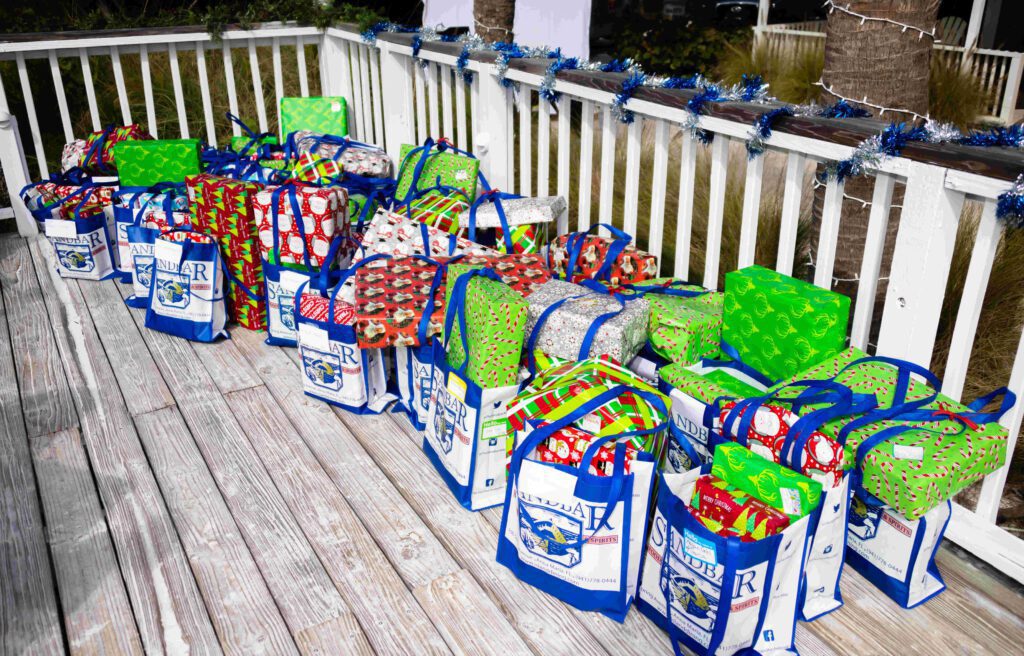
The party concluded with the youngsters being called up one by one to receive a gift bag from Santa and his helpers. Containing a new clothing outfit, a pair of shoes and a toy to open on Christmas, each gift bag was tailored specifically for that child.

Donations from the community helped fund the annual children’s party that honors Sandbar owner Ed Chiles’ late father, Lawton Chiles, who served as Florida’s governor from 1991-98, and his late mother, Rhea Chiles.

Spreading holiday joy

As the party got underway, Ed Chiles said, “It’s the Christmas season. It’s a time of year when you want to reach out and help folks and appreciate your community. It’s a wonderful tradition for our staff members who volunteer their time, including shopping for and wrapping the presents. Thanks to every single one of the staff members and volunteers that helped make this happen. It’s always been about reaching out to the community and helping the kids. And personally, this always gets me in the Christmas spirit.”

Chile’s wife, Tina Chiles, said, “It’s a wonderful celebration this time of year with very special families we look forward to hosting. It helps us remember the true meaning of Christmas.”

The children awaited their turn to visit with Santa.  - Joe Hendricks | Sun

The children awaited their turn to visit with Santa. - Joe Hendricks | Sun

Santa arrived in a replica of the 1930s-era Ford Model A. - Joe Hendricks | Sun

Santa arrived in a replica of the 1930s-era Ford Model A. - Joe Hendricks | Sun

The party activities included face painting. - Joe Hendricks | Sun

The party activities included face painting. - Joe Hendricks | Sun

The Christmas party included a buffet lunch prepared and served by the Sandbar staff. - Joe Hendricks | Sun

The Christmas party included a buffet lunch prepared and served by the Sandbar staff. - Joe Hendricks | Sun

Santa and his helpers brought joy to the youngsters and received joy in return. - Joe Hendricks | Sun

Santa and his helpers brought joy to the youngsters and received joy in return. - Joe Hendricks | Sun

Children, parents and staff members from Step Up Suncoast’s Head Start and early Head Start programs enjoyed some beach time near the bounce houses. - Joe Hendricks | Sun

Children, parents and staff members from Step Up Suncoast’s Head Start and early Head Start programs enjoyed some beach time near the bounce houses. - Joe Hendricks | Sun

The staff and youngsters from RCMA Palmetto enjoyed the party. - Joe Hendricks | Sun

The staff and youngsters from RCMA Palmetto enjoyed the party. - Joe Hendricks | Sun

A gopher tortoise crashed the Christmas party.  - Joe Hendricks | Sun

A gopher tortoise crashed the Christmas party. - Joe Hendricks | Sun

This young lady had fun in the bounce house.  - Joe Hendricks | Sun

This young lady had fun in the bounce house. - Joe Hendricks | Sun

Faith and Kelly Moore enjoyed the lunch provided by Ed Chiles and his staff. - Joe Hendricks | Sun

Faith and Kelly Moore enjoyed the lunch provided by Ed Chiles and his staff. - Joe Hendricks | Sun

As the event DJ, Chuck Caudill played Christmas songs and let the children know Santa was on his way. - Joe Hendricks | Sun

As the event DJ, Chuck Caudill played Christmas songs and let the children know Santa was on his way. - Joe Hendricks | Sun

Santa and his Chiles Group helpers distributed gift bags to each child. - Joe Hendricks | Sun

Santa and his Chiles Group helpers distributed gift bags to each child. - Joe Hendricks | Sun

Sandbar restaurant owner Ed Chiles warmed up Santa’s seat for him. - Joe Hendricks | Sun

Sandbar restaurant owner Ed Chiles warmed up Santa’s seat for him. - Joe Hendricks | Sun

Many members of the Chiles Group staff participated in the kids’ Christmas party. - Joe Hendricks | Sun

Many members of the Chiles Group staff participated in the kids’ Christmas party. - Joe Hendricks | Sun

The children enthusiastically greeted Santa when he arrived at The Sandbar restaurant. - Joe Hendricks | Sun

The children enthusiastically greeted Santa when he arrived at The Sandbar restaurant. - Joe Hendricks | Sun

Josie Gracia is an early childhood specialist with RCMA Palmetto – the Manatee County affiliate of the Redlands Christian Migrant Association formed in southwest Florida in 1965.

“We’ve been doing this for a couple years now. The children and staff all look forward to this. It’s like a dream come true for most of the children. We serve low-income families and they don’t have the means to experience all this. For some, this is the first time they get to see the beach. It’s like a mini-Disney here for them, and the food is amazing. And to top it all off, they get to see Santa,” Gracia said.

Serving low-income families and the children and families of migrant workers, the RCMA Palmetto child development center serves 68 children of various ages, some of whom attended Wednesday’s party.

“It’s very holistic. We include child support services, family support services, health services, vision, hearing and developmental screenings. We have high school curriculum in place. We provide transportation for the families that live in more remote areas. The parent support program is very strong. We do training for the parents, parenting classes, support groups. It’s very comprehensive,” Gracia said.

“Those who are migrants face the challenge of leaving every year and going up north to work for part of the year and then coming back. There’s always this transition, going back and forth, and it’s really hard traveling and leaving people behind. And for the parents, agricultural work is hard work, and we’ve been losing agricultural fields, so some of the families have to travel to remote areas to work and then come back every day. There’s also all the other risks involved with this kind of work. They’re exposed to chemicals and pesticides and they earn low wages. It’s not very pleasant, but they’re hard-working and they’re appreciative of the opportunity to work,” Gracia said.

“Due to COVID, it’s been harder to get volunteers. It’s nice to have people come and hold the babies, spend time with the children and read them stories. Donations are always welcome and they don’t have to be brand new items. Sometimes we get gently used items and toys. We have ladies from a community group that bring blankets that they make. There’s many different ways to support the programs.”

To assist RCMA, please call 941-723-4563.

Step Up Suncoast’s Head Start and Early Head Start programs provide early childhood education and family engagement services focused on closing the achievement gap for children throughout Manatee County.

“Step Up Suncoast provides Head Start and early Head Start programs for Manatee County –from 8 weeks old into kindergarten,” said Jill Gass, Step Up Suncoast’s director of philanthropy.

Regarding the party, Gass said, “It’s a wonderful event that brings a lot of smiles to the organization and families who have been struggling more than ever in the past couple years. We appreciate more than ever the support the Chiles Group provides to us every year. We’re excited that they’re able to bring it back.”

Last year’s party was canceled due to the COVID-19 pandemic.

“This gives the families the opportunities to come do something they wouldn’t otherwise have the opportunity to do. We have a lot of kids that have never been to the beach. They just don’t come out here. It’s a nice opportunity to have fellowship with other friends and family engagement between the different families. The kids know each other, but the parents maybe don’t. It’s another opportunity of engagement for them,” Gass said.

Chiles Group hosting annual kids’ Christmas party

Chiles Group hosting annual kids Christmas party

ANNA MARIA – The Chiles Group will host the 26th Annual Lawton Chiles Christmas for Kids Party on Wednesday, Dec. 15 from 11 a.m. to 2 p.m. at the Sandbar restaurant.

Last year’s event was canceled due to the COVID-19 pandemic. The annual celebration honors restaurant owner Ed Chiles’ late father, Lawton Chiles, who served as Florida’s governor from 1991-98, and as a U.S. Senator representing Florida from 1971-89. It also honors Ed Chiles’ late mother, Rhea Chiles.

Chiles Group hosting annual kids’ Christmas party
Lawton Chiles served as a U.S. Senator before serving as the Florida governor. – Wikipedia | Submitted

“The Christmas party was very close to the hearts of the event’s namesake, former Governor Lawton Chiles and his wife, Rhea,” according to a press release issued by the Chiles Group. “Their legacy lives on, inspiring employees across all The Chiles Group entities. Staff is involved in the planning and execution of the day, as well as shopping for and wrapping the gifts.”

The theme for Wednesday’s Christmas party is “A Candyland Christmas.” Sixty children from the RCMA non-profit childcare organization in Palmetto and the Bradenton branch of the Head Start Early Rise and Shine program have been invited to attend the holiday event.

Wednesday’s festivities will include bounce houses, face painting, gingerbread man ornament-making and other kids’ crafts.

Chiles Group hosting annual kids’ Christmas party
This year’s event will again include face painting. – Island Photography/Dara Caudill | Submitted

The invited children will meet Santa Claus and Santa will send each child home with a new outfit of clothing, a pair of shoes and a toy to open on Christmas morning. The meet and greet characters will also include Woody (from Toy Story), Elmo, SpongeBob SquarePants and Dora the Explorer.

Chiles Group hosting annual kids’ Christmas party
Each invited child will receive a gift bag that includes new clothes and shoes. – Island Photography/Dara Caudill | Submitted

The children will also be treated to lunch catered by The Sandbar.

“The happy faces of the kids when they see the decorations and characters is priceless. It’s the most beautiful thing and really humbles you,” Chiles Group Retail Manager Marilyn Ortiz stated in the press release.

Chiles Group hosting annual kids’ Christmas party
Kids of all ages enjoy the visiting cartoon characters. – Island Photography/Dara Caudill | Submitted

The annual party also serves as a fundraiser that this year will benefit RCMA and the Head Start Early Rise and Shine program.

“The Chiles Group thanks those who have generously given in the past and to those who have done so this year. Those who donate to this year’s event are invited to come by for lunch and see the joy on the children’s faces for themselves. The Chiles Group is still accepting financial contributions to assist with these charitable efforts that bring hap­piness to children and families in need,” the press release states.

Contributions can be made by sending a check payable to Dine on Pine Inc. and mailed to Dine on Pine Inc., P.O. Box 1478, Anna Maria, FL 34216. Please include a note that states the donation is for the Lawton Chiles Christmas for Kids Party.

Chiles Group commissions turtle-themed mural

Chiles Group commissions turtle-themed mural

ANNA MARIA – Featuring an image of a giant sea turtle, a new seascape-themed mural now graces an exterior wall of the old post office plaza in Anna Maria.

Located near the intersection of Gulf Drive and Spring Avenue, the mural, painted by Lakeland-based studio and mural artist Gillian Fazio, covers the rear walls of the plaza spaces leased to Anna Maria Rocks and Anna Maria Life vacation rentals.

Replacing a previous shark-themed mural, the new mural features a giant sea turtle in a seascape that includes coral reefs, tropical fish, starfish, a giant clam and the hull of a small boat that represents the human presence on local waters.

Chiles Group commissions turtle-themed mural
The Chiles Group mural is located at the corner of Spring Avenue and Gulf Drive. – Joe Hendricks | Sun

Ed Chiles owns the plaza, located just a short walk from the Chiles Group-owned Sandbar restaurant at the end of Spring Avenue. The Chiles Group commissioned the mural after Chiles made his team aware of Fazio’s talents.

“My daughter, Christin Masters, introduced me to her work. I saw the murals she was doing over in Lakeland and Polk County and I was like, ‘Wow, I would love to have one of those someday.’ I sent that on to our people, but I was actually surprised when I found out we were having one done. I saw the mockup and I was really impressed. It’s a nice addition to the Island,” Chiles said.

Fazio started painting the mural on Tuesday, Oct. 25 and finished it late in the day on Thursday, Nov. 4.

“The Chiles Group happened to be the perfect client and collaborator to work on this with. I was talking to Ed Chiles’ daughter, Christin, and she asked why the Chiles Group didn’t have any of my artwork,” Fazio said as she completed the mural Thursday afternoon.

“It’s inspired by healthy waters, the surroundings here and the Chiles Group’s marine reclamation projects. We also wanted to highlight our sea life and the beautiful sunsets the Sandbar is famous for,” Fazio said.

“I designed everything on Photoshop and then we went back and forth with the Chiles Group and made small adjustments until everybody loved what we ended up with,” she explained.

Using Sherman Williams resilience level paint made to withstand the sun, heat and other elements, Fazio first used a sprayer to paint the bottom half of the wall blue and the top half orange.

“I started with the base colors and slowly added in more details,” she said, noting that she sketched the male turtle on the wall before painting it.

Chiles Group commissions turtle-themed mural
Michigan residents Josie and Daphne Schneider joined the artist for a photo-op. – Joe Hendricks

Before putting some final touches on the turtle’s gullet Thursday afternoon, Fazio signed the bottom left-hand corner of the mural, signifying the project was essentially finished. While adding those final strokes to the turtle’s gullet, two young visitors from Holly, Michigan – Josie and Daphne Schneider – stopped to admire her work as they passed by.

Chiles Group commissions turtle-themed mural
Gillian Fazio finished the mural Thursday afternoon, before Friday’s rainy weather arrived. – Joe Hendricks | Sun

Fazio shared her thoughts on the attraction of murals.

“They’re bright and beautiful and not just a plain old wall. I love murals because they bring communities together and give everybody a sense of ownership of their mural wall. When people come to Anna Maria you can bring them to this wall. It becomes a thing to do as well as something nice to look at. The hope is that this new mural becomes a popular photo opportunity for visitors and we’ll come up with a name for the turtle soon,” she said.

Fazio has worked as a professional muralist since graduating from the University of Florida in 2017 with a bachelor’s degree in fine art. Some of her past work was commissioned by local businesses and government agencies in and around Lakeland and Lake Wales.

“I’m from Lakeland and most of my work is in Lakeland, Tampa and the surrounding areas of Central Florida. I have some massive walls over there that are inspired by the citrus industry. Some of them are two stories high and a hundred feet long. This one is 10 feet tall and 63 feet long. I also do smaller murals and selfie walls that provide photo ops for businesses,” she said.

Chiles Group commissions turtle-themed mural
Gillian Fazio painted the mural for the Chiles Group and plaza owner Ed Chiles. – Joe Hendricks | Sun

The Chiles Group mural is her first on Anna Maria Island but she has family ties to the city and the Island and hopes to do more work here.

“My grandparents had a place on White Avenue before they passed away. A lot of people from Lakeland come to Anna Maria. I’m happy to be here and I hope to be back soon,” she said.

Fazio will paint her next mural for an appliance showroom in Lakeland.

“They want an engagement wall for their office,” she said.

Fazio’s work can be viewed on Instagram and at www.gfazioart.com. She can be contacted by email at gfazioart@gmail.com.