
Tag: coconut palms

Mayor accepts responsibility for misplacement of palms

Mayor accepts responsibility for misplacement of palms

BRADENTON BEACH – At the June 5 Community Redevelopment Agency (CRA) meeting, Mayor John Chappie accepted responsibility for the Florida Department of Transportation-mandated removal of the newly planted coconut palm trees on Gulf Drive.

“I did make a mistake at the beginning when we had the 19 palms that were planted in the FDOT right-of-way and that’s all on me,” Chappie said.

The trees were planted the week of April 24 on the Gulf Drive South roundabout and traffic islands as part of a CRA-approved project that included Bridge Street. The $50,000 coconut palm project is a public-private partnership between the city and developer Shawn Kaleta’s Beach to Bay Investments LLC.

That portion of Gulf Drive South is a state road and falls under the jurisdiction of the FDOT. The city was notified by FDOT that coconut palm trees are not allowed on state roads due to safety concerns about visibility, along with falling fronds and coconuts.

“Darryl (FDOT Scenic Highway Coordinator Darryl Richard) was very kind and very efficient with trying to get ahold of us,” Chappie said. “Once he got ahold of us I was out of town for a week at the hurricane conference, but within 24 hours, I considered it an emergency situation that those needed to get out of the right of way because they were concerned that it doesn’t meet their standards.”

Chappie said the city would have to fill out a permit form and go through the FDOT process to plant in the traffic islands and roundabout.

“He (Richard) did say, the rule is four inches in circumference,” Chappie said. “The Alexander palms (which were previously in the roundabout) were four inches in circumference but apparently, 10 years ago or whenever it was, there wasn’t needed permission from FDOT to put them in. So my thought was on trying to replace those, they didn’t look very healthy and that’s all on me of course.”

According to Chappie, four of the 19 palms were taken back to landscaper M&F Lawn Care’s yard. Chappie said the trees may be relocated to Lou Barolo Park or the city police department.

Chappie said he will be meeting with Miguel Mancera of M&F Lawn Care and city attorney Ricinda Perry to determine what is needed to finish the project.

Chappie then spoke about the trees along Bridge Street.

“There were a total of 60 palms that have been delivered. We planted 56 palms on Bridge Street, on First Street and the pier dock area,” he said.

Chappie said that four or five of the smaller palms were leaning and didn’t appear to have a good connection with the root ball.

“Miguel assured us that he was guaranteeing everything that was planted,” Chappie said. “I talked to him yesterday. We need to get together to go over everything, to continue to do some of the beautification that we like.”

IRRIGATION PURSUED

Chappie brought up an irrigation system installation on Bridge Street which had received CRA approval for a cost of up to $7,500.

Police Chief John Cosby, who is currently serving as interim public works director following the resignation of Tom Woodard, weighed in.

“I don’t think the amount of money that’s budgeted is going to cover it,” Cosby said. “In order to run the line down the entire street on both sides we’re going to have to lift the bricks out of the crosswalks to put the pipe underneath it, otherwise we’re going to have to bore and boring is very expensive so that brick would have to be removed and the lines run so the whole street has irrigation. I don’t know that $7,000 is going to cover it but we’ll get some estimates and bring those back and we’ll go from there.”

MAYOR RESPONDS

At the June 6 city commission meeting, Chappie responded to press coverage of the city’s lag in producing a fully-executed agreement between the city and developer Shawn Kaleta ensuring Kaleta’s assumption of responsibility for newly-planted coconut palm trees on Bridge Street.

The Sun’s news coverage included a timeline of events, including emails from the city, that showed that a signed agreement for the coconut palms between the city and Kaleta was not in place until May 28 – more than a month after the trees were planted the week of April 24. The Sun also published two editorials criticizing the process and the project.

Chappie did not name The Sun and did not refute any of the facts in the stories.

“As everybody knows, we’re five people up here and we are a weak mayor form of government, we are equal, and we assign people to oversee on certain projects,” Chappie said. Ricinda (City Attorney Ricinda Perry) has gotten the brunt of a lot of projects to do and unfortunately has gotten a lot of the brunt of the criticism.”

Editorial: Signed palm tree agreement better late than never

The now-signed maintenance, indemnification and hold harmless agreement for the flawed Bridge Street coconut palm tree planting project lists April 1 as the project commencement date, which fittingly coincides with April Fool’s Day.

But Mayor John Chappie and the city’s witness, City Clerk Terri Sanclemente, didn’t sign and fully execute the agreement until May 28 – nearly two months after the listed commencement date.

On May 15, City Attorney Ricinda Perry told The Sun a “signed agreement” existed but a copy couldn’t be provided until Sanclemente returned from vacation on May 28. Local developer and project partner Shawn Kaleta might have signed the agreement on behalf of his Beach to Bay Construction Limited Liability Corporation in mid-May, as Perry’s emails indicate, but the agreement wasn’t legally enforceable until Chappie and Sanclemente signed it.

We appreciate Sanclemente promptly providing a copy of the fully executed agreement upon her return. We thank her for acknowledging that she and Chappie signed the agreement that day and for providing additional project-related documents and answers to our questions. Sanclemente did her job, while others associated with the project failed miserably.

Of the 70 coconut palms planted on and around Bridge Street, one already fell on a Bridge Street sidewalk and 22 others were removed from Gulf Drive South and replanted elsewhere along Bridge Street because FDOT doesn’t allow coconut palms and their falling coconuts and palm fronds along state-owned roads. Bradenton Beach leaders apparently don’t share similar safety concerns about city-owned Bridge Street.

During the month-long gap between the plantings and the mayor’s signature, would the city have been solely responsible for any palm tree-related deaths, injuries or property damage that occurred before the agreement became legally binding?

The Perry-drafted agreement includes indemnification language designed to protect the city from project-related lawsuits. An indemnification clause doesn’t prevent the city from being named in a lawsuit. It simply means the city can try to recoup its lawsuit-related losses from Kaleta and his roster of attorneys. That’s a risky proposition for a city financially desperate enough to sign over control of city-owned assets in exchange for shared project costs.

Perry and her elected accomplices are taking liberties with taxpayer assets that might get them removed by shareholders if they sat on a private sector board of directors. A misguided tree-planting project isn’t the worst sin a local government can commit, but the city attorney shouldn’t be leading the lackadaisical mayor and commissioners by their noses in her efforts to broker questionable public-private partnerships.

This fiasco prompted some Sun readers to call for Perry’s termination and Chappie’s resignation. Neither of those scenarios are likely, but maybe the light shined on this botched affair will cause all involved to think twice before pursuing another partnership with Team Kaleta.

Palm tree landscaper awaiting payment from city

Palm tree landscaper awaiting payment from city

BRADENTON BEACH – Since April 24, Miguel Mancera’s landscaping crews have been busy laying stone, planting and, in some cases, removing and replanting multiple coconut palm trees on and around Bridge Street.

Mancera, the owner of M&F Lawn Care in Bradenton, sent an invoice to the city on April 19 for a $25,000 down payment toward the $50,000 cost of the trees and landscaping work, and as of May 30, he said he has not received payment.

“I have payroll to meet every week,” Mancera said, adding he has 12 employees. “They haven’t paid me yet. I called Ricinda (City Attorney Ricinda Perry) and she is supposed to talk to Thompson (City Treasurer Shayne Thompson).

Mancera said he paid for the stone and trees out of pocket in anticipation of payment by the city.

“I don’t know the exact amount, but it cost more than half (of the $50,000),” he said. “There was more than 20 yards of rock, so that was $6,000 just for the rock.”

M&F Lawn Care was hired by the city to plant up to 80 coconut palm trees on and around Bridge Street, as well as to lay white river rock.

The tree planting project is a city partnership with developer Shawn Kaleta. According to the city clerk, Kaleta made his agreed-upon donation of $10,000 toward the project on April 10.

Palm tree landscaper awaiting payment from city
Some of the coconut palm trees that were removed from Gulf Drive South were replanted along the approach to the Bradenton Beach Pier. – Leslie Lake | Sun

Mancera, who has done work for both the city and Kaleta, said he had been contacted by Perry and Kaleta for the tree project.

“They called me up and I met them a couple of times on Bridge Street so they could show me where to plant the trees,” he said.

On May 24, Mancera’s crews were back to remove what he said were 22 of the coconut palms that they had planted in the roundabout and traffic islands of Gulf Drive South as part of the project.

The trees were removed after the Florida Department of Transportation (FDOT) informed the city that coconut palms were not allowed on state roads due to safety concerns about sight lines along with falling palm fronds and coconuts. That section of Gulf Drive South falls under the jurisdiction of the FDOT.

“We took out 22 trees and we replanted 18,” Mancera said. “Some were replanted on Bridge Street, some in front of the parking lot at the Pines Trailer Park and some along the pier across from the oyster restaurant (Anna Maria Oyster Bar). I don’t know about the other four.”

The city clerk sent The Sun a copy of the April 19 M&F Lawn Care invoice which showed a total cost of $50,000 for the landscaping and planting of the palm trees. M&F had requested a $25,000 down payment which was due within 30 days or subject to a 1.5% late charge.

The invoice was marked with a handwritten: “OK to pay. JRC (Mayor John Chappie’s initials).” The city clerk confirmed by email on May 30 that payment had not been made.

Editorial: Signed palm tree agreement better late than never

City releases signed coconut palms agreement

Editorial: Palm trees and other shady endeavors

FDOT: Wrong trees, wrong place

Expert outlines optimum coconut palm maintenance

Signed palm tree agreement remains elusive

Editorial: Palm trees and other shady endeavors

Someone once posed the question: “If a tree falls in a forest and no one hears it, does it make a sound?”

The Sun poses a similar question: If the city attorney says there’s a signed agreement for the ill-fated Bridge Street palm tree planting project but nobody has seen it, does the agreement really exist?

In early April, the Bradenton Beach Community Redevelopment Agency (CRA) that includes the mayor and city commissioners approved planting 80 coconut palm trees along Bridge Street. According to City Attorney Ricinda Perry, the CRA was to contribute $40,000 toward the project and developer Shawn Kaleta and/or one of his LLCs would kick in another $10,000.

Perry told the CRA members there would be a signed maintenance, indemnification and hold harmless agreement in place before the trees were planted. The trees were planted in late April with no signed agreement in place.

A couple of weeks ago, one of the new palms toppled onto a Bridge Street sidewalk and had to be replanted.

Last week, FDOT told the city to remove the new palms planted in the Gulf Drive-Bridge Street roundabout.

Gulf Drive is a state road and FDOT doesn’t allow coconut palms to be planted along state-owned roads because they limit visibility and contain large falling objects like coconuts and palm fronds.

You’d think someone with the city or the city’s often-contracted landscaper would have known about this pesky little state rule – or at least checked to see if there was such a pesky little state rule. But that kind of foresight doesn’t mesh with the city’s “You can do it right when you do it over” approach to project management.

So now we know that coconut palms aren’t cool along a state road but they’re still OK standing alongside the highly-traveled, highly-populated city-owned Bridge Street.

To date, Perry and the city have not provided The Sun with a copy of the signed agreement, despite the multiple public records requests made during a two-week period. Perry told us we had to wait until the city clerk returns from her vacation on May 28 before we can see the elusive signed document.

The Florida Public Records Act says the city has to promptly acknowledge public records requests, respond in good faith and make “reasonable efforts” to figure out who has the requested document and where it’s stashed. City officials who break the state law can be fined $500 or removed from office if they try really hard to hide or withhold the requested document.

Perry and Mayor John Chappie were copied on our multiple and still ongoing requests for a signed agreement. Perry gave us an incomplete and unsigned draft version of the agreement that didn’t mention the project partner’s name. She also sent us some emails that showed us how hard she tried to collaborate with Team Kaleta’s lawyers to make this deal happen.

According to the unsigned version of the agreement, Team Kaleta is supposed to maintain the palm trees at their expense for the next 30 years. The unsigned agreement doesn’t specifically mention coconuts or palm fronds and it doesn’t specifically require Team Kaleta to pluck those pesky buggers from the trees before they drop on some unlucky person’s head, child or 1962 Corvette.

The unsigned agreement does however require Team Kaleta to comply with reference Exhibit A – a blank space that calls for a yet-to-be-seen site plan that shows specifically where each new tree was planted – and Exhibit B: “Guidelines for the Management of Coconut Palms.”

The “Guidelines” inform us that coconut palms can grow to be over 100 feet tall, may live 100 years and “regularly shed coconuts and large fronds, which may expose people and property to injury and damage.”

The all-knowing ‘Guidelines” also say, “To minimize this risk, coconuts and fronds must be regularly removed prior to their fall. In certain instances, coconut palms may possess structural defects that increase the risk of failure of a portion or all of the palm.”

Thank you, wise city leaders. What could go wrong?

The “Guidelines” say any coconut palms that show serious defects, conditions or weather damage must be removed (by Team Kaleta) within 14 days of being told to do so. Given that one tree already toppled onto a Bridge Street sidewalk on a sunny day, what’s the over/under on how many palms are going down during our upcoming “more active than usual” hurricane season?

In the absence of the signed agreement, it appears the first tree likely fell before the agreement was signed and dated by Chappie and Team Kaleta. If that first falling tree injured a person, place or thing with no signed agreement yet in place, who would have been liable – the city, Kaleta or both?

The unsigned agreement is also supposed to indemnify (lawyer-speak for “protect”) the city and the CRA against any future liabilities and lawsuits associated with the troublesome palm trees. If someone or something gets clocked by a falling tree, frond or coconut, that unfortunate soul gets to do battle with Team Kaleta’s army of lawyers, while the city sits on the sideline screaming, “Leave us alone, we’re indemnified!”

Mayor Chappie frequently laments the negative impacts that super-sized short-term vacation rental homes, aka “party houses,” have on Bradenton Beach’s residential neighborhoods, but he’s OK taking project money from the Island’s biggest developer of “party houses.”

Instead of sharpening their pencils and wisely managing CRA and city funds for future projects, the mayor and city commissioners are taking the lazy and easy way out by enabling Perry to pursue funding partnerships with Team Kaleta.

In the past year or so, Perry proposed the CRA or city partner with Team Kaleta to improve the city-owned parking lot near the Team Kaleta-owned marina. She also suggested the city partner with Team Kaleta for a Team Kaleta-controlled mooring field near the pier.

In early April – the same day she proposed the ill-advised, poorly-executed palm tree project – Perry proposed the CRA partner with Team Kaleta to install a waterfront pedestrian path that runs from Team Kaleta’s marina, past Team Kaleta’s mobile home park and ends at the city-owned pier.

Who is Perry working for? The city or Team Kaleta? When proposing these public-private partnerships, she sings the praises of a developer good-hearted enough to help fund CRA and city projects, but what she, the mayor and the city commission are really doing is selling the city down the Intracoastal Waterway.

Somehow, the sister cities of Anna Maria and Holmes Beach manage to fund their capital projects without financial aid from Team Kaleta. And in both those cities, the city attorneys focus on the basics – providing legal advice and legal services to their respective city leaders and city staff.

In most cities, a city attorney’s sole job is to dispense legal knowledge. City attorneys don’t usually serve as de facto city managers, project managers and project initiators. But in Perry’s defense, she’s just filling the leadership void created by Bradenton Beach’s weak mayor form of city government, and the weak mayor and weak commission gladly let her do it.

With the threat of state-imposed consolidation looming over the three AMI cities, there’s chatter in local political circles that Chappie wants to serve as the Island-wide mayor if that happens. That leadership scenario might scare some folks, but Island Mayor Chappie and Island Attorney Perry could then partner with Team Kaleta to plant coconut palms and other seeds of dissent throughout the rest of the consolidation fiefdom.

No signed agreement released on palm trees

No signed agreement released on palm trees

BRADENTON BEACH – After multiple requests by The Sun to the city for the release of a signed agreement in a city partnership with developer Shawn Kaleta for the installation and maintenance of coconut palm trees on Bridge Street, the nearly three-week-long waiting game for the document has thus far come up empty.

The installation of 80 coconut palm trees on and around Bridge Street was approved at an April 3 Community Redevelopment Agency (CRA) meeting following assurances by City Attorney Ricinda Perry that a maintenance, hold harmless and indemnification agreement signed by Kaleta would be in place prior to planting in which Kaleta would assume responsibility for maintenance and liability for any damage caused by the palm trees.

The trees were planted the week of April 24.

The first request from The Sun for the signed agreement was made by email on May 6 and received no response. Subsequent email and in-person requests by The Sun were made on May 7, May 15, May 17 and May 23.

The May 15 email request to the agreement received an “out of office” reply. The same day, The Sun emailed Perry requesting a copy of the signed and fully executed agreement.

City Clerk Terry Sanclemente, Mayor John Chappie and Police Chief/Interim Public Works Director John Cosby were among those copied on The Sun’s email request.

In her response, Perry wrote, “I’ll see if the deputy clerks can access the signed agreement. If not, we’ll have to wait until Terri gets back.”

Sanclemente is expected to be back in the office on May 28, after press time for The Sun. She was, however, in the office the week of May 6.

Perry provided a copy of an unsigned, blank draft version of the agreement which did not identify the other party involved with the project and did not include any details regarding the cost of the project or the manner in which the material, installation and maintenance costs would be shared. The agreement is for 30 years.

When asked by The Sun that day for a signed and fully executed copy of the agreement, Perry wrote, “There is a signed agreement. The clerk is out of the office and can provide further documents upon her return.”

The agreement and any other project-associated documents are subject to the Florida Public Records Act and Florida’s Government-in-the-Sunshine Law.

The lingering question remains as to who would be liable for any damage or injuries caused by the trees.

Since the planting of the trees during the week of April 24, things haven’t gone smoothly with the palms.

On May 15, a post on Facebook showed that one of the newly-planted palms apparently had fallen over on Bridge Street. It was replanted on May 17 and secured with a string tied to a metal stake.

On May 24, all the palms that had been planted on Gulf Drive South (State Road 789) were removed due to the trees not being allowed by Florida Department of Transporta­tion (FDOT) regulations. FDOT spokesperson Darryl Richard said coconut palms are not allowed on state roads due to safety concerns about visibility and falling coconuts and limbs.

Chappie was on-site during the tree removal and The Sun asked him about the whereabouts of the palm tree agreement. He responded by deferring questions about the agree­ment to Perry.

OTHER RECENT PARTNERSHIPS PROPOSED

Other public/private partnerships with Kaleta have been proposed this year.

At a Feb. 1 City Commission meeting, Perry presented an offer from the Kaleta-owned Bradenton Beach Marina to act as the city’s harbormaster for a proposed city-owned mooring field near the Bradenton Beach Pier.

“So today the marina said, ‘Would you be interested in us helping you with the mooring balls? And what we can do is basically act as your harbormaster, provide the pump-out service and deal with the people that are paying and something else to think about is the amount you charge people, which they would enforce for us.’ Which would make it so a particular clientele would be able to afford that mooring ball,” Perry said at the meeting.

She described the offer as a potential public/private partnership to protect the city’s dinghy docks and to control derelict vessels.

“I was approached today by the marina, who said, ‘Why don’t you throw mooring balls out there?’ ” Perry said at the Feb. 1 meeting.

Metropolitan Property Ventures LLC purchased the Bradenton Beach Marina from the Bazzy family in 2023. The warranty deed associated with that sale lists Kaleta as the mortgagor and as the president of the Bazzy Marine Corporation. In city meetings, Kaleta is referred to as the marina owner.

Perry said the city doesn’t have the resources or staff to monitor the mooring field. If the marina would be willing to work with the city, the mooring field would be a revenue source for the city, as well as for the marina and would potentially clean up the area.

Derelict vessel removal has been a priority for the Bradenton Beach Police Department and over the years, they have removed dozens of them.

In March, the city commission considered a bid from Kaleta-owned Bridge to Bay Investments for a partnership in a city-wide paid parking contract. Bridge to Bay was one of two bidders with SP Municipal Services as the second bidder.

Under the bid, the proposed paid parking would have included all of Bridge Street, an after-hours parking lot to the east and west side of the police department, the city hall parking lot, the area around the pickleball court on Highland Avenue (with free passes to pickleball players), the shared parking lot with Angela Rodocker at First Street North, Gulf-side parking spaces near the Moose Lodge and future options at the Tingley Library if the building is raised to create additional parking.

At a subsequent meeting, when a decision between the two bids was expected to be made, the city did not accept either bid but instead announced it would consider having city-managed paid parking.

In April, Perry proposed that the CRA partner with Kaleta in the installation of a waterfront pedestrian path running from his marina to Bridge Street on the Pines Trailer Park property he recently purchased. The marina has a new bar the city permitted after it was built and in operation.

The next CRA meeting is scheduled on Wednesday, June 5 at 9:30 a.m. The next city commission meeting is scheduled on Thursday, June 6 at 6 p.m.

Meetings are open to the public and will be held at the Katie Pierola Commission Chambers, 107 Gulf Drive N.

Related coverage: 

Editorial: Palm trees and other shady endeavors

FDOT: Wrong trees, wrong place

Expert outlines optimum coconut palm maintenance

Signed palm tree agreement remains elusive


FDOT: Wrong trees, wrong place

FDOT: Wrong trees, wrong place

BRADENTON BEACH – In what Mayor John Chappie characterized as a “mistake,” the city learned the hard way that coconut palm trees are not allowed by the Florida Department of Transportation (FDOT) on Gulf Drive South (State Road 789).

The coconut palm trees that were planted the week of April 24 along the Gulf Drive roundabout and traffic islands at the end of Bridge Street were removed on May 24 after it was determined by FDOT that planting the species was not in compliance with state regulations.

“There’s a right tree in the right place, but this is the wrong tree in the wrong place,” FDOT District One Scenic Highway Coordinator Darryl Richard said on May 24.

That section of Gulf Drive falls under the jurisdiction of FDOT.

“The city didn’t apply for a permit, but even if they had, coconut palms are a species that are not allowed there based on FDOT standards and public safety,” Richard said.

Richard said coconut palms violate sight line and vertical clear zone regulations, making them a safety issue for motorists. Another safety concern with the tree is falling coconuts, he said.

“Palm fronds that would fall into the roadway as well as vertical clearance are safety issues,” Richard said. “Coconuts are also one of the safety factors that could present problems.”

Richard said all his correspondence with the city has been verbal and he met with the mayor earlier in the week.

“He (Mayor Chappie) realized the mistake and decided to remove the palms,” Richard said.

FDOT: Wrong trees, wrong place
Mayor John Chappie, left, is on Bridge Street as the coconut palm trees are removed on Gulf Drive South. – Leslie Lake | Sun

Chappie was on-site during tree removal and spoke to The Sun.

“I won’t make that mistake again,” Chappie said. “FDOT has been really great about explaining and working with us to take care of this.”

The trees were moved by a loader and placed in piles at the paid parking lot owned by Shawn Kaleta at the corner of Bridge Street and Gulf Drive.

FDOT: Wrong trees, wrong place
The removed trees were transported to a temporary resting place. – Leslie Lake | Sun

Chappie didn’t know the exact number of trees being relocated but, according to a site plan prepared by City Attorney Ricinda Perry, there were more than 15 trees.

“We have to be careful of the location because FDOT rules and regulations are pretty strict about sight vision. And that’s what we’re doing,” Chappie said.

Chappie said the trees that were removed will be replanted on Bridge Street.

“We’re just filling everything in,” Chappie said. “If we want to plant some trees, we have to fill out a plan submittal for anything over 24 inches.”

Pictures of the trees being removed and the circumstances surrounding their removal were posted on May 24 on the Anna Maria Island Sun Facebook page, and the coconut telegraph was busy.

“People are already trying to dodge palm fronds to be able to walk down Bridge Street. Should be interesting to see when the coconuts start falling,” Gay Rosnett wrote.

Jeremy Williams wrote, “This whole thing is an embarrassment. The mayor should resign. Lotta funny business mixed up in here.”

FDOT: Wrong trees, wrong place
The removed coconut palms were initially placed in a nearby paid parking lot. – Leslie Lake

The trees that were removed were among the 80 coconut palm trees that were planted in the Bridge Street area in April.

The installation of the trees and a private/public partnership with developer Shawn Kaleta were approved at an April 3 Community Redevelopment Agency (CRA) meeting following assurances by Perry that a maintenance, hold harmless and indemnification agreement signed by Kaleta would be in place prior to planting in which Kaleta would assume responsibility for maintenance and liability for any damage caused by the palm trees.

As of May 26, after multiple Sunshine Law public records requests by The Sun for a copy of the agreement beginning on May 6, the city has not provided the document.

The question remains as to who would be liable for any damage or injuries caused by the trees.

On May 24, while at the site of the tree removal, Chappie was asked again about the whereabouts of the signed agreement. He deferred questions to Perry.

Related coverage: 

Editorial: Palm trees and other shady endeavors

No signed agreement released on palm trees

Expert outlines optimum coconut palm maintenance

Signed palm tree agreement remains elusive

Signed palm tree agreement remains elusive

Signed palm tree agreement remains elusive

BRADENTON BEACH – A newly-planted coconut palm tree that fell over on Bridge Street last week has raised questions about whether the city obtained a signed indemnification agreement prior to planting it and 79 other trees.

At the April 3 Community Redevelopment Agency (CRA) meeting, members unanimously approved the installation of 80 coconut palm trees along Bridge Street in a city partnership with developer Shawn Kaleta.

The approval was based on assurances by City Attorney Ricinda Perry that a maintenance, indemnification and hold harmless agreement with Kaleta would be in place prior to planting the trees, with Kaleta taking re­sponsibility for tree maintenance and indemnifying the city against liability for any damage caused by the trees.

The palm trees were planted the week of April 24. On May 15, a Facebook post showed that one tree had fallen over from unknown reasons, causing no known dam­age. Bridge Street workers have reported seeing people picking coconuts from the newly-planted trees.

As of May 19, after multiple Sunshine Law requests to the city from The Sun, no signed and fully executed agreement had been produced by the city. That docu­ment is a public record and subject to the Florida Sunshine Law.

In the absence of a signed con­tract between the city and Kaleta, liability for damage that could be caused by the trees is in question.

Signed palm tree agreement remains elusive
A newly-planted coconut palm tree on Bridge Street that fell on May 15 and was subsequently replanted is being supported by string tied to a piece of metal. – Leslie Lake | Sun

A May 15 Facebook post shows one of the new palms near 120 Bridge St. laying on the ground, apparently having been uprooted. By May 17, the fallen tree had been replanted and was being supported by a string tied to a metal stake.

AGREEMENT ELUSIVE

On April 25, One of Kaleta’s attorneys, Sean Kelly, sent Perry and Kaleta an email that said, “Shawn asked me to finalize this agreement for the coconut palms on Bridge Street. Will you please send me the Exhibit A site plan and the dollar amount for the CRA’s contribution? Then I can update the document and have Shawn sign.”

This email exchange occurred the same week the trees were being planted.

On May 6, The Sun emailed the city clerk asking for a copy of the agreement between the city and Shawn Kaleta (or his business entity) showing the maintenance and indemnification agreement for the newly-planted palms on Bridge Street. The email was sent to city clerk Terri Sanclemente, Perry and Mayor John Chappie. No response was received.

On May 7, a Sun reporter went to city hall to obtain a copy of the contract and was told by the city clerk that it was not there and she had been told it was still being worked on. Another email was sent to Perry that day requesting a copy of the agreement and no response was received.

On May 9, Perry sent an email to Kaleta and attorney Sean Kelly that said, “It took me a bit to find a way to document in a ‘site plan’ the palms and to make sure we knew exactly where Miguel was planting everything.” Kelly responded that day to Perry in an email that said, “Do you have the dollar amounts to insert for contributions from the city and from Shawn?”

Perry wrote that the CRA was contributing $40,000 toward the tree planting project and Kaleta was to contribute $10,000.

On May 14, another Kaleta attorney, Rainier Altiere sent Perry an email that said, “Here is the completed maintenance agreement. The only thing missing is the start date. Please provide me with that and let me know if this is OK for us to have Shawn sign.”

On May 15, Perry sent Kaleta, Kelly and Altiere an email in which she wrote, “This corp (corpora­tion) named in the document was set up at the end of last month. Is it just a ‘shell company’ with no assets or insurance to cover the harm/damage caused by a falling coconut? At a minimum, the company will need an insur­ance policy naming the city that actually covers damage caused by the coconuts. I can’t just have a piece of open (missing word) with no actual protection for the public. Ideas?”

A May 15 email request to the city clerk for a copy of the signed agreement received an “out of of­fice” reply. The same day, The Sun emailed Perry requesting a copy of the signed and fully executed agreement.

Sanclemente, Chappie and Police Chief/Interim Public Works Direc­tor John Cosby were among those copied on The Sun’s email request.

In her response, Perry wrote, “I’ll see if the deputy clerks can access the signed agreement. If not, we’ll have to wait until Terri gets back.”

Perry did, however, provide a copy of a blank draft version of the agreement, which did not identify the other party involved with the project and did not include any details regarding the cost of the project or the manner in which the material, installation and mainte­nance costs would be shared. The agreement is for 30 years. She also provided copies of some of the emails referenced in this story.

When asked by The Sun that day for a signed and fully executed copy of the agreement, Perry wrote, “There is a signed agree­ment. The clerk is out of the office and can provide further docu­ments upon her return.”

On May 17, a Sun reporter attempt­ed to obtain the document in person from the city clerk’s office and was told the contract was not there. That day, The Sun emailed Perry, Kaleta and Kelly asking Kaleta or Kelly to provide The Sun and/or Perry a copy of the signed agreement. As of May 20, The Sun had not received a response to that request.

The email exchanges indicate there was no signed agreement in place when the trees were planted in late April. As of May 20, the city and Perry had not provided any documents that confirmed that a signed and fully executed agree­ment existed that day.

In order for the agreement to be fully executed it must be signed and dated by Chappie, who was out of town for the Governor’s Hurricane Conference taking place in Palm Beach County May 12-17, according to the clerk’s office.

(Sun reporter Joe Hendricks contributed to this story)

Related coverage:

Irrigation system to be installed on Bridge Street

Eighty new coconut palms line Bridge Street


Bradenton Beach logo

Irrigation system to be installed on Bridge Street

BRADENTON BEACH – The 80 newly-planted palm trees on Bridge Street will need a regular watering schedule, and on May 2, the Community Redevelopment Agency (CRA) unanimously approved the expenditure of up to $7,500 to have an irrigation system installed along both sides of the road.

CRA members discussed the cost of the irrigation system versus the $3,500 three-week rental cost of a water truck.

“The CRA has looked at installing more landscape irrigation on Bridge Street. There’s been a lot of trees installed and some additional bushes,” Perry said. “It’s always become an irrigation issue when we come into that dry spell when we’re not getting rain.”

Water trucks come at a high cost, she said, adding that some water meters already exist on Bridge Street.

“And now we’ve invested the funds for trees which we can continue to water and they should be fine once they take,” Perry said. “In the event we come into a dry streak, I would hate to come into the expense of a water truck when we could get an irrigation system for close to what we would pay for a one-time water truck use.”

Irrigation system to be installed on Bridge Street
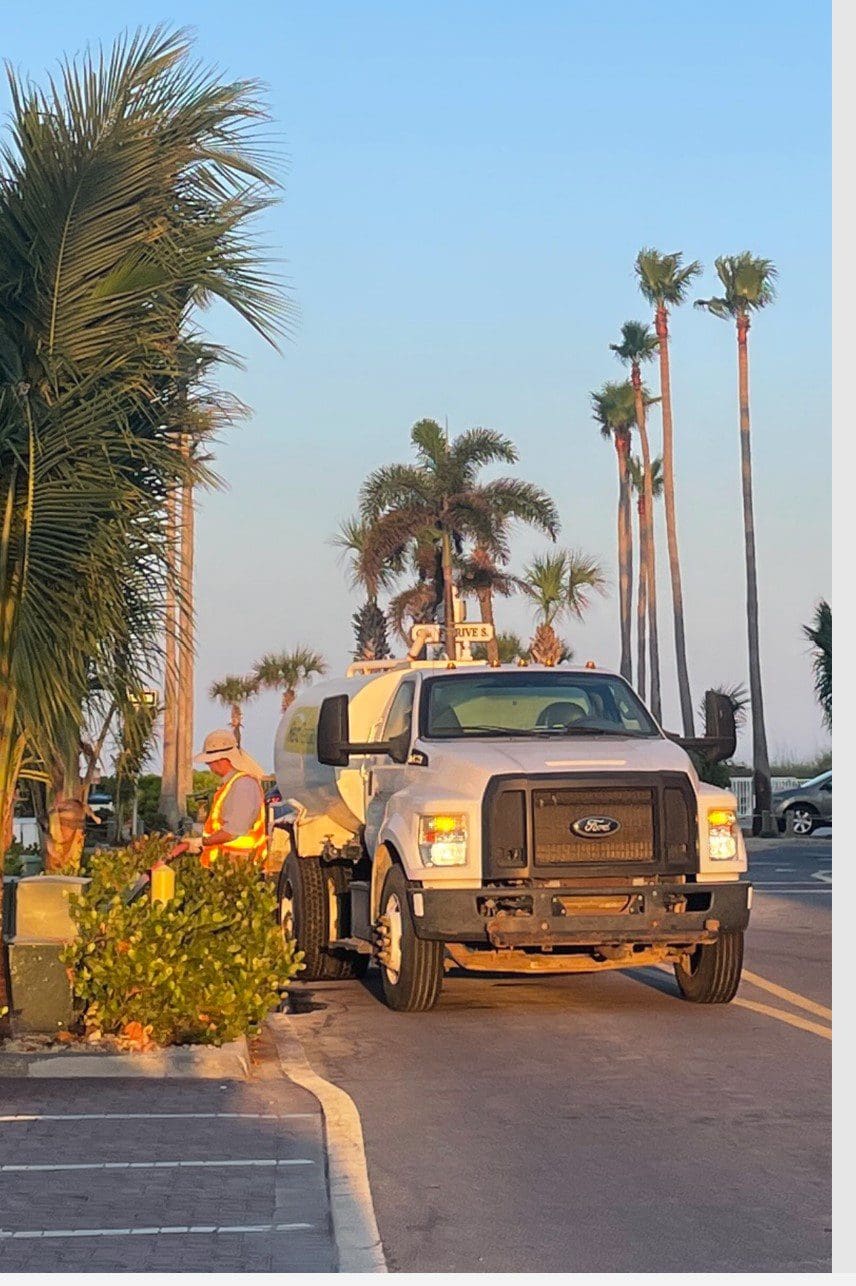
A rental water truck operator waters the newly-planted coconut palm trees along Bridge Street early Sunday morning. – Leslie Lake | Sun

Perry said she received an estimate of about $5,000 from M&F Lawn Care for the installation of an irrigation system.

“To me that’s a no-brainer to get that infrastructure in place and we know that we’re investing in the pergola and we will probably be doing some plantings in there,” she said. “I’m looking for an opportunity to strengthen and protect what we’ve invested and I saw this as an opportunity.”

Eighty coconut palm trees were planted in late April along Bridge Street and the Gulf Drive roundabouts in a city partnership with developer Shawn Kaleta. Kaleta agreed to accept responsibility for the maintenance of the trees as well as donate $10,000 toward the $50,000 cost of the palms and white river rock. The balance came from CRA funds.

Mayor John Chappie said that one of the things he looked at was doing the irrigation in the most efficient and cost-effective way.

“We can remove the pavers and dig down in the paver row and then put in the irrigation without cutting into any asphalt,” Mayor John Chappie said. “I would really recommend we do this; it will make a big difference and save us some money.”

CRA member Deborah Scaccianoce said it made sense from a financial perspective to install the irrigation system.

CRA member Ed Chiles made a motion with a second by member Jan Vosburgh to approve the installation of an irrigation system by M&F Lawn at a cost not to exceed $7,500.

There was no public comment and the motion passed unanimously among board members.