

Tag: CNOBB

Judge rules CNOBB members violated Sunshine Law

Judge rules CNOBB members violated Sunshine Law

BRADENTON – Manatee County 12th Circuit Judge Edward Nicholas ruled Friday that former Planning and Zoning Board members Reed Mapes, John Metz, Patty Shay and Bill Vincent, and former Scenic WAVES Committee members Tjet Martin and Rose Vincent violated the Florida Sunshine Law.

The Sunshine Law violations occurred at Concerned Neighbors of Bradenton Beach (CNOBB) meetings in June, July and August of 2017.

The potential Sunshine Law violations were first reported by The Sun on Aug. 2, 2017.

The city of Bradenton Beach and co-plaintiff Jack Clarke filed the civil lawsuit on Aug. 11, 2017. The lawsuit sought a judge’s determination as to whether the advisory board members violated the Sunshine Law by discussing advisory board business at CNOBB meetings.

The non-jury trial took place at the Manatee County Judicial Center in downtown Bradenton and began on Monday, July 15. When the testimony and legal arguments concluded on Thursday, July 18, Nicholas said he’d issue his ruling Friday morning.

Judge rules CNOBB members violated Sunshine Law
The defendants and defense attorneys awaited the judge’s ruling Friday morning. – Joe Hendricks | Sun

Attorney Robert Watrous represented the city and Clarke in the case, assisted by paralegal Michael Barfield and City Attorney Ricinda Perry.

Attorneys Thomas Shults and Jodi Ruberg represented Metz – and to a lesser degree the five pro se defendants who previously discontinued the services of their shared attorney.

“I am hoping to some extent the conclusion of this trial may help close the wound that has been so open and so raw out in Bradenton Beach for so long,” Nicholas said before issuing his ruling.

Judge’s ruling

When issuing his detailed ruling, Nicholas first cited the Florida Constitution and the Sunshine Law contained within it.

“We begin with Article 1, Section 24 of the Florida Constitution that reads: ‘All meetings of any collegial body of the executive branch of the state government, or of any collegial body of any county, municipality, school district or special district at which official acts are to be taken, or at which public business of such body is to be transacted or discussed shall be open and noticed to the public,’” Nicholas said.

Judge rules CNOBB members violated Sunshine Law
Judge Edward Nicholas ruled all six former advisory board members violated the Florida Sunshine Law. – Joe Hendricks | Sun

Nicholas noted the defendants were all duly sworn advisory board members who acknowledged participating in Sunshine Law training.

During the trial, Watrous established that each defendant took an oath of office as an advisory board member and swore to protect the United States Constitution and the Florida Constitution. Watrous said those oaths followed the advisory board members wherever they went, including CNOBB meetings.

“The Sunshine Law prohibits discussions of public business. Public business was discussed at every CNOBB meeting.” – Edward Nicholas, Manatee County 12th Circuit Court Judge

In their testimony and/or pre-trial depositions, Metz, Mapes, Shay and Bill Vincent expressed their beliefs that CNOBB’s parking garage discussions did not violate the Sunshine Law because the city’s comprehensive plan prohibited parking garages and it was not reasonably foreseeable that one could ever be built.

Nicholas noted City Planner Alan Garrett testified the comp plan only prohibited parking garages in two of the city’s 11 zone district designations in 2017.

“A parking garage could theoretically be built in nine designated areas within the city,” Nicholas said of the comp plan as it existed in 2017.

Compliance concerns

Nicholas noted Perry sent an email to the Planning and Zoning board members on July 25, 2017, notifying them of the potential Sunshine Law implications of their CNOBB meetings and email exchanges.

Nicholas noted Perry also emailed then-Mayor Bill Shearon two days later, and Shearon forwarded that email to the planning board members. That email also expressed concerns about advisory board members attending CNOBB meetings in violation of the Sunshine Law.
Judge rules CNOBB members violated Sunshine Law
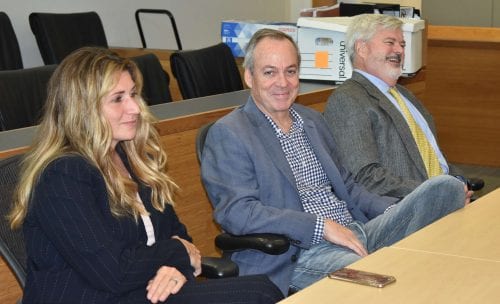
City Attorney Ricinda Perry, paralegal Michael Barfield and attorney Robert Watrous successfully presented the city’s case.

The trial included extensive discussion about the 2017 correspondence Bill Vincent had with the Florida Commission on Ethics and the Florida Office of the Attorney General regarding advisory board members participating in CNOBB meetings.

The Commission on Ethics response advised Vincent to review the Sunshine Law manual at the Attorney General’s website and possibly consult with private counsel. The Attorney General Office’s response advised Vincent to consult with the city attorney.

“The defendants never got answers to those questions. The defendants continued to meet despite their concerns, despite not getting answers to these very important questions. Had they contacted Ricinda Perry, she would have answered: ‘Yes, the Sunshine Law applies.’ Had they contacted any attorney in the state of Florida they would have said, ‘Yes, the Sunshine Law applies,’ ” Nicholas said.

Constitutional rights

During the trial, Shults, Metz, Mapes and Vincent expressed their opinions that state law allowed the advisory board members to discuss city issues that pertained to the possible pursuit of citizens’ initiatives.

Judge rules CNOBB members violated Sunshine Law
Attorney Thomas Shults, left, was unsuccessful in his defense of John Metz and the five pro se defendants. – Joe Hendricks | Sun

“The defendants attempt to characterize these violative meetings as ballot initiative meetings pursuant to Section 166.031 (Florida Statute) is simply not persuasive. This ballot initiative defense strikes this court as an after-the-fact attempt to justify or otherwise rationalize what were otherwise clear and unequivocal violations of the Sunshine Law. It is a clever explanation for such violations, but it is not a compelling or persuasive one,” Nicholas said.

“The efforts to characterize their violative meetings as the right to assemble and speak freely as guaranteed by the First Amendment also is not persuasive. Every citizen has the right to assemble and has the right to free speech. However, when an individual joins a government advisory board the Sunshine Law still applies. If that were not the case, every county commission, every city council, every advisory board could hold secret meetings and simply say I have a First Amendment right to do so. That would largely make the Sunshine Law meaningless and void,” Nicholas said.

Meeting recordings

During the trial, Nicholas heard audio recordings of entire CNOBB meetings and audio excerpts from CNOBB meetings.

“It’s certainly unusual that we have tapes of at least some of the meetings that took place outside of the Sunshine,” Nicholas said.

He then recited some of the statements made at CNOBB meetings:

  • “I have concerns about how the CRA (Community Redevelopment Agency) is functioning;”
  • “We need to prohibit the construction of a parking garage in the city of Bradenton Beach;”
  • “It is on the CRA list;”
  • “Parking garage could easily come before Planning and Zoning;”
  • “That whole strip over there would be a parking garage;”
  • “We need to specify a municipal parking garage;”
  • “It would be a huge building;”
  • “We need to prohibit construction of a parking garage in Bradenton Beach, it doesn’t matter if it’s by a municipality or a huge corporation;”
  • “Horrendous traffic problems with a parking garage.”

Nicholas then said, “Those were all quotes. That is the very definition of a discussion about public business. And it wasn’t just parking garage discussions: CNOBB discussed ropes and bollards, sidewalks, parking issues, the Bridge Tender (Inn) land swap, Bridge Street planters – all issues that had come before Planning and Zoning or Scenic WAVES.”

Judge rules CNOBB members violated Sunshine Law
The judge ruled that former Planning and Zoning Board members Reed Mapes and Bill Vincent violated the Sunshine Law. – Joe Hendricks | Sun

“The Sunshine Law prohibits discussions of public business. Public business was discussed at every CNOBB meeting. Public business was discussed every time CNOBB met. That was largely the point of the organization,” Nicholas said.

“Also, there were at least four CNOBB meetings that were not recorded early on as the group was becoming organized. What was discussed at those meetings? Who attended those meetings? These questions point to the obvious need for Sunshine Law compliance,” Nicholas said.

Nicholas said the defendants’ passionate and firmly held beliefs regarding city issues caused them to abdicate their obligation to follow the law.

“My finding that all the defendants clearly and unequivocally violated the Sunshine Law does not in any way suggest that they are bad people. I do not agree with the suggestion that the defendants attempted to form a secret government or a shadow government, or that their meetings were surreptitious or clandestine in any way,” Nicholas said.

Judge rules CNOBB members violated Sunshine Law
The judge ruled that former advisory board members Rose Vincent, Patty Shay and Tjet Martin violated the Sunshine Law. – Joe Hendricks | Sun

“Do these individuals have a right to assemble? Absolutely. Do these individuals have a right to free speech? Absolutely. Do these individuals have a right to be concerned about their beloved city? Of course. But once you choose to become part of the government by becoming a member of a government advisory board you are no longer just a spectator. Rules apply, laws apply. The defendants simply did not follow those rules. The defendants simply did not follow those laws. This is not a close call,” Nicholas said.

“Judgment is in favor of the city. The court finds that all the defendants, as members of Planning and Zoning and members of the Scenic WAVES Partnership Committee were subject to Article 1, Section 24 of the Florida Constitution and Section 286.011 of Florida Statute,” Nicholas ruled.

Additional comments

Nicholas said a post-trial hearing will be scheduled to address potential sanctions. These include the city’s request to be reimbursed for a portion of its legal fees that now exceed $250,000.

“We agree with everything the judge said,” Watrous said after he left the courtroom.

“The Sunshine Law has been vindicated,” Barfield said.

“We agree with the judgment and look forward to the city moving forward and healing. The city does not wish to sue any of its board members, and it’s unfortunate this wasn’t settled earlier, but the Sunshine Law is important. It provides the city and its citizens with an open government,” Perry said,

“Obviously, I’m pleased with the verdict,” Clarke said.

“Government in the sunshine is why we are here. It’s as simple as that, it’s as important as that. It’s the foundation of what good government is built on; openness, transparency and accountability. Anything less is just not acceptable and now’s the time to heal,” Mayor John Chappie said.

“I’m very pleased with the judge’s ruling and I would like to thank everyone involved for presenting a clear case to the court. This was an unfortunate circumstance the city commission was put in to uphold our oaths to protect the laws of the state and to protect the city from litigation. I wish this would’ve been resolved through our previous settlement offers for a less expensive and earlier conclusion,” Vice Mayor Jake Spooner said.

Judge rules CNOBB members violated Sunshine Law
Co-plaintiff Jack Clarke, Vice Mayor Jake Spooner (second row), Mayor John Chappie, City Attorney Ricinda Perry, paralegal Michael Barfield and attorney Robert Watrous await the judge’s arrival Friday morning. – Joe Hendricks | Sun

In March, all six defendants rejected a settlement offer from the city that proposed a collective admission that mistakes were made regarding Sunshine Law compliance and a $500 payment from each defendant. The defendants rejected the settlement offer that required them to acknowledge non-compliance with the Sunshine Law.

In May, Metz and the other defendants submitted counter proposals that sought significant financial reimbursement from the city. Metz’s offer also expressed a willingness to subject the city to a future appeals process.

City prevails in preliminary Sunshine hearing

City prevails in preliminary Sunshine hearing

BRADENTON – Twelfth Circuit Court Judge Edward Nicholas has ruled in favor of the city of Bradenton Beach, denying three legal actions sought by Sunshine Law lawsuit defendant John Metz.

Nicholas denied Metz’s request to disqualify City Attorney Ricinda Perry as the city’s co-counsel in this case. Nicholas also denied Metz’s request to make public the transcript and audio recording of the city’s private attorney-client shade meeting in September 2017.

In addition, the judge denied Metz’s request to be told what he said and heard during a Concerned Neighbors of Bradenton Beach (CNOBB) meeting discussion about parking garages.

Nicholas also denied Metz’s requests to be awarded attorney fees for the individual legal actions he sought during the Friday, May 3 hearing at the Manatee County Judicial Center in Bradenton.

The judge ruled in favor of the city’s proposed compromise regarding Metz’s request to continue and complete Perry’s pre-trial deposition.

Attorney Jodi Ruberg represented Metz at the hearing. His primary attorney, Thomas Shults, was on vacation. Attorney Robert Watrous represented the city and Perry was assisted by paralegal Michael Barfield.

The civil lawsuit filed in 2017 by the city and co-plaintiff Jack Clarke seeks a judge’s ruling as to whether Metz, Reed Mapes, Tjet Martin, Patty Shay, Bill Vincent and Rose Vincent violated the Florida Sunshine Law when discussing parking garage prohibitions and other city business during CNOBB meetings while serving as members of the city’s Planning and Zoning Board or Scenic WAVES Committee.

The case is scheduled for a non-jury trial before Nicholas beginning July 15.

Perry deposition

A deposition is testimony given under oath in the presence of a court reporter who provides a verbatim written transcript for the judge and others to review.

On March 20, Shults deposed Perry for more than five hours. He spent much of that asking Perry about her education, legal qualifications and another lawsuit filed against the city by the Keep Our Residential Neighbors (KORN) political action committee formed by Mapes and Metz.

When deposing Clarke in January, Shults alleged Clarke, Perry and the city acted in bad faith and filed the lawsuit because of Metz’s contentious history with the city and its officials. When deposing Perry, Shults did not pursue that line of questioning.

“Ms. Perry’s testimony will also be utilized for a bad faith component of this suit,” Ruberg said during Friday’s hearing.

Watrous said he originally objected to the deposition being continued but later offered to limit it to three additional hours.

“The entire morning of deposition was spent on items not relevant to this case. Why didn’t Mr. Shults ask the appropriate questions at the first deposition?” Watrous said.

“Mr. Shults is simply going to have to do the best that he can and focus his questions a bit more pointedly,” Nicholas said when issuing his ruling.

Perry disqualification

When seeking Perry’s disqualification as co-counsel, Ruberg cited case law and said, “Ms. Perry cannot be both an advocate and a witness.”

Watrous said Perry will not act as a trial attorney and will simply assist him during the trial. As a witness for the city, Perry will provide fact-based testimony regarding the type of issues presented to the Planning and Zoning Board – and whether parking and parking garages are something that could foreseeably come before that board.

“Reasonable foreseeability is the crux of the case,” Ruberg said.

When issuing his ruling, Nicholas agreed it’s highly unusual for an attorney also to be called as a witness. He said if this was going to be a jury trial he would be inclined to agree with the defense that jurors might have difficulty determining whether Perry was stating facts or her legal opinion.

Shade meeting request

Ruberg alleged compliance technicalities when arguing that the shade meeting transcript and recording be made public.

Watrous said the opening and closing portions of the shade meeting were conducted in public, the private session was conducted in compliance with state requirements and Metz and his attorneys already have the transcript for the public portions of that meeting.

“This is an attempt by Mr. Metz to invade attorney-client privilege,” Watrous said.

“The request for the transcript is not well-taken and is denied,” Nicholas said when issuing his ruling, noting this was not a close call for him to make.

CNOBB discussion

When contesting Metz’s request to be told exactly what he said and heard during the July 25 CNOBB meeting, Watrous said Metz has a copy of the meeting recording posted at the CNOBB website and the court reporter’s transcript.

“We’re going to play the actual tapes at the trial,” Watrous said.

During that July 25 meeting, Mapes proposed a charter amendment initiative seeking a prohibition on parking garages. Mapes asked CNOBB members if they shared his desire and whether such a prohibition would apply only to a city-owned paid parking garage and still allow a privately-owned parking garage.

In response to Mapes’ suggestion, Metz said, “I say that we do and that we put it more that no parking garage built for public paid parking or something like that. It doesn’t matter whether if it’s by the municipality or some huge corporation.”

Regarding Friday’s hearing, Barfield said, “Mr. Metz’s actions wasted approximately $15,000 of attorney time and taxpayer funds and three hours of court time. The city continues to urge the defendants to give due consideration to the favorable settlement offers made.”

CNOBB webmaster deposition raises more Sunshine questions

CNOBB webmaster deposition raises more Sunshine questions

BRADENTON – The deposition of former webmaster Michael Harrington has uncovered emails that raise additional questions about possible Sunshine law violations by members of the Concerned Neighbors of Bradenton Beach (CNOBB) group.

The City of Bradenton Beach and resident Jack Clarke are co-plaintiffs in a 2017 lawsuit seeking a judge’s ruling as to whether the city advisory board members violated the Florida Sunshine Law by discussing past and potentially foreseeable board and committee business during CNOBB meetings.

During the deposition, Harrington said under oath that he thought he deleted all CNOBB-related emails from his Gmail account, only to discover they were never fully deleted.

The suit names former Bradenton Beach Planning and Zoning Board members Reed Mapes, John Metz, Patty Shay and Bill Vincent and former Scenic WAVES Committee members Tjet Martin and Rose Vincent as defendants. All six defendants were members of the now-disbanded CNOBB group when the alleged violations occurred.

A July 25, 2017 CNOBB meeting included a recorded discussion about a proposed citywide ban on parking garages. CNOBB members have also discussed the revised Community Redevelopment Agency (CRA) plan and other city matters.

With his wife, Carol, sitting next to him on Jan. 23, the 81-year-old former Bradenton Beach resident – who is not a defendant in the suit – was deposed under oath by attorney Robert Watrous for nearly six hours. Paralegal Michael Barfield assisted Watrous.

The deposition was part of the discovery phase of the suit, scheduled for a mid-March trial. A court-ordered mediation is scheduled for Feb. 25 and two more depositions are scheduled for February.

Email trail

In response to a subpoena, Harrington recently provided Barfield with a flash drive containing approximately 10,000 emails and documents obtained from his computer. Harrington said he meant to turn over 325 emails pertaining to CNOBB and the lawsuit, but the additional emails and documents were inadvertently included.

“We didn’t get all of the emails. Some of them you might have been successful in deleting.” – attorney Robert Watrous

During the deposition, Harrington said under oath that he thought he deleted all CNOBB-related emails from his Gmail account, only to discover they were never fully deleted.

Toward the end of the deposition, Watrous referenced an October 2017 email from Mapes to Harrington suggesting they communicate by phone instead of email. Watrous and Barfield presented 24 of those documents as exhibits during the deposition.

Watrous said that email also included a request from Mapes to delete two previous emails he sent Harrington. Those emails were not among those provided to Barfield.

This flash drive provided by Michael Harrington contained hundreds of emails and documents pertaining to the CNOBB group and its members. – Submitted

“We didn’t get all of the emails. Some of them you might have been successful in deleting,” Watrous said.

Harrington said his old Gateway computer died approximately two months ago and when he took it to the technicians at Best Buy, he was told it would cost $250 to repair. Harrington said he told the technicians to dispose of the computer and destroy the hard drive.

Harrington said he bought a new laptop computer about four months before the Gateway died. Watrous found it interesting that Harrington had the foresight to buy a new computer before the computer he’d been using died.

Because of this, Watrous said he was not terminating the deposition and he would consider seeking a judge’s order for a forensic investigation of Harrington’s computer and email records.

During one of the breaks, Watrous said, “Every time we ask for discovery, we get things we haven’t seen before. A lot of this we’ve never seen before.”

He also noted that those subpoenaed are required by law to produce all documents requested.

Additional exhibits

Watrous produced a June 2017 email exchange among Harrington, Bill Vincent and Mapes in which Mapes questioned whether the CNOBB website forum page should be public or private.

“Here again is the issue of Sunshine violations,” Mapes wrote.

Watrous produced a July 24, 2017 email Mapes sent to Harrington and others requesting to be allowed to respond to a CNOBB forum post called “Nix the Parking Garage.”

He also produced two emails and the attached documents that Martin sent CNOBB members regarding the CNOBB mission statement and proposed charter amendment initiatives.

Martin’s July 23, 2017 document listed five charter initiatives that included a citywide parking garage prohibition. Harrington said he was asked to post that document at the CNOBB website.

“I think you are agreeing to the fact that there was a sunshine violation. I would hate for the four of us to have you say that.” – defendant Reed Mapes

On July 25, Martin distributed a revised document that no longer referenced the parking garage prohibition.

On July 26, Mapes sent Harrington an email that said, “Please delete the item about the parking garage. Since we decided it might one day be a P n Z issue we decided to drop it for now.”

Watrous produced a letter to the editor addressed to Bradenton Beach residents which Harrington had drafted and sent to several CNOBB members on Aug. 12 seeking their feedback.

“The very brief mention of a ‘parking garage’ was in front of four of the Planning and Zoning Board (members) in attendance. That mistake was quickly realized and the subject was dropped,” Harrington’s letter said.

Harrington said he was asked not to publish the letter, but he could not recall who made that request.

Obtained previously by Barfield, Harrington distributed another email that same day containing Mapes’ response.

“I don’t want you to say we made a mistake. I think you are agreeing to the fact that there was a sunshine violation. I would hate for the four of us to have you say that,” Mapes wrote.

Related coverage

Sunshine lawsuit depositions continue

Trial date set for Sunshine lawsuit

Commissioner deposed regarding Sunshine lawsuit

Bradenton Beach commissioner deposed

Commissioner deposed regarding Sunshine lawsuit

BRADENTON BEACH – City Commissioner Randy White has been deposed as part of the discovery process for the city-initiated 2017 lawsuit that alleges six city advisory board members violated the Sunshine Law.

White is not a defendant in the lawsuit and has not been accused of any wrong-doing in connection with the lawsuit filed before he took office in November 2017. White was the first non-defendant to be deposed in this lawsuit.

First Place

First Amendment Defense

Jon A. Roosenraad Award

2019

Representing the city of Bradenton Beach and co-plaintiff Jack Clarke, attorney Robert Watrous told White the Wednesday, Nov. 14, deposition would pertain only to events that transpired before he became a city commissioner. Paralegal Michael Barfield assisted Watrous with the deposition.

White was represented by attorney Hunter Norton. The deposition took place in the conference room at the Vincent M. Lucente & Associates court reporting services building in Bradenton.

Clarke attended the deposition. So did defendant Reed Mapes and his attorney, Jim Dye; defendant John Metz and his attorney, Thomas Shults; and defendants Tjet Martin, Patty Shay, Bill Vincent and Rose Vincent. All six defendants are former city advisory board members and former members of the now-defunct Concerned Neighbors of Bradenton Beach (CNOBB) political action committee.

Former Bradenton Beach Mayor Bill Shearon and former city commissioner and CNOBB member Janie Robertson also attended the deposition.

The 2017 civil lawsuit alleges four Planning and Zoning Board members and two Scenic WAVES Committee members violated the Sunshine Law by discussing past and potential board business – including a prohibition on parking garages – via private email exchanges and during CNOBB meetings that were not properly-noticed city meetings.

The questions Watrous posed, the answers given and the documents reviewed during the deposition did not indicate any wrong-doing by White.

During the deposition, White confirmed that the handwritten notes he previously turned over to the city clerk’s office in June were written by him. City Attorney Ricinda Perry requested the notes White had on the dais with him during a commission meeting discussion regarding payment of an invoice from Watrous and a same-day discussion about four charter amendments proposed by Mapes, Metz and their Keep Our Residential Neighborhoods (KORN) political action committee.

White has been the only commissioner to oppose payments to Watrous and the only commissioner to support KORN’s unsuccessful request to have its proposed charter amendments placed on the ballot for the recent city elections.

White said the notes he turned over in June were all written by him during his campaign and before he was elected.

Watrous asked White about his handwritten note that said, “Can I talk about CNOBB meetings and state for the record that you guys did not break any Sunshine laws that I witnessed in CNOBB meeting?”

White said that note was written in preparation for a candidate’s debate and as a response to a potential media questions.

“If it comes up, I will state for the record I personally believe they didn’t break any laws,” White said.

Watrous asked White if any concerns about Sunshine Law compliance were voiced at the CNOBB meetings he attended.

“The Sunshine Law was spoke of at the beginning of a meeting. I don’t think there was concern whether it was followed or not. I guess it was assumed it was followed. I didn’t know anything about it, I was just ‘John Q Public’ who showed up at these things,” White said.

Watrous asked White if he recalled any discussion about parking garages during CNOBB meetings.

“Yes, it was brought up,” White said.

White’s two-hour deposition and the emails received from him and others as part of the pre-trial discovery process also shed light on White’s relationships with the defendants, CNOBB and the support he received from them during his 2017 campaign.

“CNOBB was founded by people I know very well, people I’ve known for years,” White said.

He then acknowledged that some of those people were currently sitting in the conference room.

“It kind of started with Mayor Shearon and then I met the Vincents and went from there,” White said.

Related coverage

Sunshine lawsuit depositions continue

Mapes and Martin deposed in Sunshine lawsuit

Press conference sheds light on Sunshine lawsuit

CNOBB dissolving

CNOBB coming to an end

BRADENTON BEACH – Despite voter approval of its three citizens initiatives on the November ballot, the Concerned Neighbors of Bradenton Beach (CNOBB) is dissolving due to philosophical differences among members.

The debate centers around whether CNOBB is a grassroots advocacy group or a political action committee (PAC).

CNOBB chair Bill Vincent initiated the dissolution discussion at the Tuesday, Nov. 14, general membership meeting.

Florida Elections Commission complaints that former Mayor Jack Clarke filed against several CNOBB members were cited as another reason to dissolve.

Six CNOBB members are also named individually as defendants in a Sunshine Law lawsuit filed in August by Clarke and the city of Bradenton Beach.

Members agreed the “CNOBB” name is tainted. Vincent said the organization is “unsalvageable.”

The members unanimously agreed to dissolve CNOBB, but its bylaws require 10 days notice to members before a final dissolution vote occurs. CNOBB records list 31 paid members, but only about 15 regularly attend meetings.

After the holidays, Vincent plans to form a new group modeled after his original vision for CNOBB. He doesn’t want the new group initiating ballot measures that require registration as a PAC. Member John Metz said a new and separate PAC could be formed.

Citizens group or PAC?

When Vincent founded CNOBB in July, he envisioned a citizens group that provided information to residents and encouraged broader participation in city government, but some founding members wanted it to be a full-fledged political committee.

On Oct. 24 – two weeks before the city elections ended – CNOBB filed a statement of organization declaring it a PAC, with Vincent as chair and Metz as treasurer.

At last week’s meeting, Vincent said, “There are philosophical differences on the steering committee, and probably in the general membership, with what Concerned Neighbors of Bradenton Beach should be. It goes to the heart of what we thought we were as a neighborhood association, and what maybe inadvertently, or expectedly, became a political action committee. I believe the mission statement and my feelings about the association are incompatible with that. I will have no part of a political action committee.”

In a Nov. 13 e-mail sent to members, he wrote: “After the remarkable success of passing three citizens initiatives how did this situation come to be? At the Nov. 9 CNOBB steering committee meeting, a vigorous and sustained discussion of the very fundamental nature, direction and philosophy of the organization occurred. Opinions ranged from a more passive, educational, advocacy, citizens group to a more active, even aggressively involved, PAC. There is and was deep concern as to whether some of the objectives are consistent or compatible with the CNOBB mission statement and/or goals and objectives.”

Failures and successes

The elections complaints Clarke filed in mid-October allege that CNOBB failed to file a statement of organization after initiating its charter amendment petition drive and failed to file the required financial reports. CNOBB later filed those documents after the complaints were filed.

“The financials were filed in time, relative to when the organization registered. Unfortunately, the organization didn’t register as timely as they probably should have,” Metz told members.

Vice-chair Tjet Martin said she was unaware the group had not properly registered until she was contacted by The Sun.

“The whole intent was to educate the residents of Bradenton Beach and right off the bat we got shot down by lawsuits and complaints,” said CNOBB webmaster Michael Harrington.

Rose Vincent said the group had good intentions and can learn from its mistakes.

Former Bradenton Beach Commissioner Janie Robertson said her fellow members should be proud of their accomplishments, including going door to door and persuading residents to vote “yes” on the charter amendments CNOBB placed on the ballot.

Robertson described CNOBB as a bridge between residents and the city government. Vincent said it would be an injustice to not continue those efforts with a new group.

Clarke comments

Clarke did not attend the meeting, but he later said, “The complaints and lawsuit were not made out of malice. They were made because the group and its members appear to have broken multiple state statutes. CNOBB accomplished many of its initial goals and initiatives, but they still have to abide by the laws.”

– Staff reporter Cindy Lane contributed to this story.
Chappie wins

Chappie and White win Bradenton Beach elections

BRADENTON BEACH – City voters have spoken: Former Mayor John Chappie will take over the mayor’s seat held by Bill Shearon.

Randy White will take over the Ward 3 commission seat held by Ralph Cole; and the city charter will be amended to incorporate all three charter amendments proposed by the Concerned Neighbors of Bradenton Beach (CNOBB) political committee.

In the mayor’s race, Chappie received 232 votes (59.95 percent) of the vote and Shearon received 155 votes (40.05 percent).

When asked about his victory, Chappie said he was happy that he won and one of his top priorities is to encourage the commission and the city residents to work together.

Elections White Wins
First-time candidate Randy White won the Ward 3 seat in Tuesday’s elections. – Joe Hendricks | Sun

In the Ward 3 race, White received 205 votes (54.81 percent) and Cole received 169 votes (45.19 percent).

Amendments

City voters supported the Amendment 1 proposal to eliminate the four voting wards and make all four commission seats at-large races beginning in 2018. The vote was 207 (54.76 percent) in favor and 171 (45.24 percent) opposed.

Voters also supported the Amendment 2 proposal to reduce commission candidates’ residency requirements from two years to one year, and to also eliminate the requirement that candidates be registered city voters. The vote was 212 votes (54.92 percent) in favor and 174 (45.08) votes in opposition.

City voters also supported the Amendment 3 proposal to limit the city commission’s ability to interpret the city charter through commission-initiated ordinances and resolutions by a 243 (64.46 percent) to 134 (35.54 percent) vote margin.

Running unopposed, Ward 1 Jake Spooner retained his commission seat and will serve another two-year term in office.

Chappie and White will be sworn in at City Hall on Monday, Nov. 20, at 1 p.m.

BB Elections Chappie Wins
John Chappie will return to the mayor’ s seat he held before spending eight years as a county commissioner, which made his friend and supporter Betsy Sillars happy. – Joe Hendricks | Sun

The reconfigured commission that also includes Ward 2 Commissioner Marilyn Maro will now appoint someone to fill the remaining year of the Ward 4 commission term Chappie will now vacate due to his previously designated resign-to-run status.

The appointment process likely will commence at the commission’s Thursday, Dec. 7 meeting. If majority consensus is reached that night a new commissioner will be named. If the commission vote produces a 2-2 tie, the commission will try again at its next meeting. If the second vote also produces a tie, cards will be cut and the nominee who draws the highest card will be the new Ward 4 commissioner.

All five commission members will also sit on the seven-member Community Redevelopment Agency currently chaired by Cole, and a new chair will be named.

The unofficial results are still subject to final certification by the Supervisor of Elections office. The election concluded at 7 p.m. Tuesday, Nov. 7.

Bradenton Beach CNOBB filings insufficient

 CNOBB filings deemed insufficient

BRADENTON BEACH – The statement of organization and campaign treasurer’s report recently filed by the Concerned Neighbors of Bradenton Beach (CNOBB) both contain insufficiencies, according to the city clerk and city attorney.

CNOBB filed a statement of organization with the clerk’s office designating the neighborhood group as a political committee on Oct. 24, and filed its first campaign treasurer’s report on Oct. 30.

Both filings prompted City Clerk Terri Sanclemente and City Attorney Ricinda Perry to send letters to CNOBB addressing procedural or statutory insufficiencies.

“I sent them a certified letter sharing what I found to be potential deficiencies they may want to address. If a complaint is filed, it’s up to another governmental body to determine if the filing is compliant with state election law,” according to Sanclemente.

Sanclemente’s letter noted that CNOBB filed its statement of organization and appointment of a registered agent and treasurer more than 10 days after the group was organized, possibly a violation of state law.

“Each political committee that receives contributions or makes expenditures during a calendar year in an aggregate amount exceeding $500, or that seeks the signatures of registered electors in support of an initiative, shall file a statement of organization within 10 days after its organization,” according to Chapter 106.03 of the Florida Statutes.

CNOBB adopted its bylaws on June 27. In early August, CNOBB initiated a petition drive to get three charter amendment questions placed on this year’s city ballot. In mid-October, CNOBB mailed out postcards seeking support for its charter amendments.

The statement of organization declares the group’s special interests to be “charter initiatives and educating the public.” Bill Vincent is designated as the political committee’s registered agent and chairperson and John Metz is the treasurer.

Perry said CNOBB’s statement of organization fell short of requirements by failing to provide the names, addresses and positions of any other principal officers; failing to declare if the group intends to continue as a political committee after the city elections; and failing to provide a statement as to when CNOBB was formed as an electioneering communications organization that distributes campaign-related materials.

CNOBB’s initial campaign treasurer’s report covers a self-created reporting period from Aug. 15 to Oct. 27. Bradenton Beach City Commission candidates filed six date-certain campaign treasurer’s reports during that same time frame.

Chapter 106.07 of the Florida Statutes states: “Any candidate or political committee failing to file a report on the designated due date is subject to a fine for each late day.”

On Nov. 2, Sanclemente sent Metz a letter pertaining to his treasurer’s report.

CNOBB member Tjet Martin
CNOBB member Tjet Martin signed a financial report the city clerk said should have been signed by the CNOBB chairperson. – Joe Hendricks | Sun

“I have received your campaign treasurer’s report summary and I have found two insufficiencies.

1. Tjet Martin has signed as chairperson on the treasurer’s report you submitted, however Mr. Vincent is listed as the chairperson on the DS-DE 41 (form) submitted on 10/24.
2. The spending of funds before registering as a committee,” the letter said.

When asked about the letter, Sanclemente said the financial report needed to be amended to address the insufficiencies she cited.

Former Mayor Jack Clarke had already filed complaints with the Florida Elections Commission against CNOBB and its steering committee members by the time the overdue statement of organization and campaign treasurer’s report were filed with the city.

CNOBB finances

The campaign treasurer’s report lists $4,430 in loans and contributions and $3,812 in expenditures.

The report lists 24 $10 or $20 membership fees received between Aug. 15 and Aug. 23; and four more received on Oct. 10. On that same day, CNOBB member and Bradenton Beach Marina President Mike Bazzy contributed $1,070 and Martin loaned CNOBB $1,000. Martin is Mayor Bill Shearon’s life partner and personal caregiver.

On Oct. 23, Metz and CNOBB member Reed Mapes each loaned the political committee $1,000. If the political committee disbands after the elections, any money remaining from the three loans could be reimbursed to those who made them.

The only contribution or loan received after CNOBB filed its statement of organization on Oct. 24 was the $50 former City Commissioner Janie Robertson donated on Oct. 26.

The reports states the Kirkland and Harrison law firm was paid $3,000 on Oct. 23 for legal services associated with CNOBB’s efforts to get their charter amendments placed on the ballot. The $396 expenditure for campaign postcards and $154 expenditure for postage are dated Oct. 10. The $80 reimbursement to CNOBB member Carol Harrington for a post office box is dated Aug. 22.

The only expenditure dated after the statement of organization was filed is the $179 reimbursement made to CNOBB member Joanne Keir (misspelled Kerr on the report) for newsletters.

CNOBB ill-advised efforts

Ill-advised efforts

In 1969, famed New York columnist Jimmy Breslin wrote a novel called “The Gang That Couldn’t Shoot Straight.” In 2017, Breslin’s catch-phrase could be aptly applied to the Concerned Neighbors of Bradenton Beach (CNOBB).

CNOBB is an extension of Bill Vincent’s well-run but unsuccessful bid for the Ward 4 Commission seat claimed by John Chappie in 2016. Vincent originally envisioned a citizens group that would increase interest and involvement in city politics and advocate for policies and projects beneficial to the community. Unfortunately, he allowed those good intentions to be taken over for less altruistic purposes.

When CNOBB went public in July, its members were cautioned early and often about the perils of Sunshine Law compliance for a group consisting primarily of Planning and Zoning Board and Scenic WAVES Committee members. These members are legally bound to refrain from discussing board and committee business outside of properly noticed city meetings.

On July 25, CNOBB members discussed parking garage prohibitions and CRA district boundaries, with passing references also made to the city’s comprehensive plan and future land use map – issues that had or could come before them as city board members.

In August, six CNOBB members were named as defendants in a Sunshine Law lawsuit initiated by the Bradenton Beach City Commission and a city resident. The accused quickly resigned from their city positions in an attempt to cure the alleged Sunshine violations after the fact; and Vincent was the only city board member to stand before the commission and acknowledge the mistakes made and the compliance challenges CNOBB faced from the start.

Other CNOBB members have engaged in a public relations campaign that portrays the accused as community-minded civil servants being unfairly prosecuted by the city they served.

Nothing could be further from the truth.

The city requires all board and committee members to participate in mandatory Sunshine Law training and most of the accused are well-versed in the rules of city politics.

City commissioners had three choices: ask Police Chief Sam Speciale to conduct a criminal investigation; hire an attorney and file a lawsuit seeking a judge’s civil ruling; or do nothing and put the city at financial risk by turning a blind eye to potential Sunshine violations captured on audio recordings.

The civil lawsuit defendants could have saved themselves and city taxpayers a lot of money by admitting their mistakes, accepting the consequences and avoiding the need for a future court ruling.

Claims of naiveté are further diluted by e-mails later obtained by attorney Robert Watrous and paralegal Sunshine Law expert Michael Barfield. These e-mails reveal Mayor Bill Shearon’s early involvement in a group he claims to have no direct ties to, although his significant other is a core member. Watrous referred to Shearon as a “founding force” in CNOBB’s formation. And one e-mail exchange between CNOBB members revealed a shared desire to give the mayor the unchecked authority to fire any city employee – including the city attorney that keeps the mayor and his friends in check. Other e-mails referenced parking garages, the CRA district and other advisory board business.

In September, CNOBB threatened to file a lawsuit if city commissioners did not place three ill-advised charter amendment questions on this year’s ballot. CNOBB claims the amendments are an exercise in democracy that will produce more commission candidates, but the true intent is to take control of the city government.

CNOBB can’t even get the simple things right. Several CNOBB members are now named in complaints filed with the Florida Elections Commission for the failure to file the statement of organization form and financial reports required of groups engaged in political causes and campaigns.

While some may attempt to laugh off the actions of this group, there’s nothing funny about CNOBB’s failure to comply with basic rules and regulations. It will be up to Bradenton Beach voters to determine if this brand of politics is wanted in their city.

The Sun’s voter recommendations for the Nov. 7 elections in Bradenton Beach, Holmes Beach and Anna Maria will be listed in the Nov. 1 edition.

CNOBB amendments

Amendments remain source of debate

BRADENTON BEACH –  City commissioners and commission candidates have weighed in on three charter amendments proposed by the Concerned Neighbors of Bradenton Beach (CNOBB).

CNOBB used a petition initiative and the threat of a lawsuit rather than the standard charter review process to get their amendment questions on the ballot.

Amendment 1 looks to eliminate the four commission wards designated in the city charter. Amendment 2 looks to reduce commission candidates’ residency requirement from two years to one, and to remove the requirement that candidates must also be registered to vote in Bradenton Beach. Amendment 3 looks to limit the commission’s ability to interpret the charter with ordinances and resolutions.

Mayor Bill Shearon and Vice Mayor John Chappie are competing for the mayor’s seat. Randy White is challenging incumbent Commissioner Ralph Cole for the Ward 3 seat. Ward 1 Commissioner Jake Spooner is running unopposed, and Chappie’s soon-to-be-vacated ward 4 seat will be filled by appointment.

Shearon and White shared their positions during a CNOBB forum last week at the Annie Silver Community Center. Chappie and Cole did not participate due to concerns about Sunshine Law compliance and a Sunshine lawsuit involving CNOBB members. Spooner was not invited because he’s running unopposed. Ward 2 Commissioner Marilyn Maro is not up for reelection, but her input was also sought during separate interviews conducted last week.

Ward elimination

CNOBB claims replacing commission wards with citywide at-large seats would produce more candidates and result in fewer seats being filled by commission appointment.

“By eliminating the wards, that increases the chances for more people to run. There should always be two people running for office. I’m a strong proponent of eliminating the wards,” Shearon said.

“The criticism is we can’t have four people from the same city block, but I’d rather have four people elected from the same city block than four people appointed from the same voting bloc,” White said.

Earlier that day, Chappie said, “It creates an interesting discussion as to whether you’d get more people to run. I’m not convinced it would. I like the wards. What concerns me most is certain areas would dominate representation in the city and there’s a difference between the north and south end neighborhoods.”

“You have a representative from each part of the city who knows what’s going on,” Cole said. “Without wards you could have all your commissioners living on one street. Sometimes you don’t have more candidates because people are happy with their commissioner.”

“I like the neighborhood form of government,” Spooner said. “I wish more people would run, but what they’re proposing doesn’t seem to remedy anything.”

“I want the wards kept because you know more people in your ward, and they know you. If the commissioners all come from one part of town, it could create problems,” Maro said.

Residency and registration

Amendment 2 is inspired by 1993 case law that supported a Sarasota County candidate’s challenge to a two-year residency requirement. Bradenton Beach voters adopted a two-year residency requirement in 2015 and reaffirmed it in 2016.

“Somebody wouldn’t have to necessarily be a registered voter. As long as he’s a resident and can prove his residency, I feel he’s a candidate. We need to make that as easy as possible,” Shearon said.

“Whether or not they voted in the past, why should that come into play when you’re running for office?” White said.

“You need to know the community before running for office, and if you want to take part in determining the future of the community, you should also be a registered voter in the community,” Chappie said.

“There’s case law that says two years is too long, but that’s what our voters wanted,” Cole said. “They want someone who’s been here for a while; and I think you should be a registered voter to serve on the commission.”

“Residency should go to 12 months, but this shouldn’t pass the way it’s worded because it says you don’t need to be a registered voter,” Spooner said.

“I’m for two years, and I think they should be registered to vote in Bradenton Beach,” Maro said.

Charter interpretation

In 2014, commissioners adopted a resolution they felt clarified Mayor Shearon’s duties and supervisory authority as a weak mayor. In 2016, commissioners adopted an ordinance they felt provided additional clarification. CNOBB members claim these interpretive actions changed the charter, but the charter can only be changed by city voters.

“I have some real concerns, especially when it’s a resolution. An ordinance requires two public readings, the resolution doesn’t. Before, it was the charter was the charter, but now there seems to be these gray areas. I strongly support this,” Shearon said of amendment 3.

“The charter is kind of like the constitution. Why get in the way of that?” White added.

“I’m a firm believer that our city charter is the bottom line,” Chappie said. “The resolution 2014 and the ordinance in 2016 didn’t have to happen because the charter provides a simple description of authority and who does what. A lot of people don’t understand this initiative the way it’s written, and it should be turned down for that alone.”

Cole maintained his support for the ordinance he requested in 2016 and said, “There is a charter review process to get the charter changed. Just getting a certain number of signatures to put it on the ballot puts all our laws in jeopardy.”

“You can’t interpret the charter in a way that is totally different from what it says; that’s a moot point,” Spooner said.

“I think they should leave the charter alone unless they have a charter review committee,” Maro said.

CNOBB Charter Amendment Mailed

Residents review charter amendments

BRADENTON BEACH – City property owners are getting their first look at detailed information about three charter amendments proposed by the Concerned Neighbors of Bradenton Beach (CNOBB).

“This resolution shall be mailed to each member of the city of Bradenton Beach electorate in a timely fashion prior to the Nov. 7 election,” says section 3 of Resolution 17-881.

The resolution adopted by the city commission in early September formalized CNOBB members’ petition-supported demands to place three charter amendment questions on the city ballot.

“Enclosed is important information for all residents/property owners in Bradenton Beach,” the cover sheet says.

The enclosed information includes the 13-page city resolution that recaps in detail the debate that ensued about the proposed charter amendments. It also includes the CNOBB petition initiative that circumvented the city’s traditional charter review process.

The resolution references numerous legal and procedural insufficiencies and concerns raised by City Attorney Ricinda Perry and City Clerk Terri Sanclemente. These include concerns about the petition signature gathering process, the amendment language and alleged Sunshine Law violations by CNOBB members who served on a city board or committee.

The mailed document also contains 13 pages of exhibits pertaining to ballot language revisions and the CNOBB petition forms. The final ballot language will first appear on the vote by mail ballots distributed by the Supervisor of Elections Office on Friday, Oct. 6. The final fate of the proposed amendments will be known at the conclusion of the city elections on Tuesday, Nov. 7.

Ward elimination

Charter amendment 1 seeks to eliminate the four city commission wards that require one elected or appointed commissioner from each of the four geographically designated wards. CNOBB members have stated their views that eliminating wards would produce more commission candidates, fewer candidates running unopposed and fewer commissioners being appointed to vacant commission seats.

“Our objective is to maximize the possibility of having multiple candidates on the ballot,” says the CNOBB website.

Commissioners John Chappie, Ralph Cole, Marilyn Maro and Jake Spooner have expressed support for the wards and opposition to their elimination.

Eliminating wards would make all commission seats at-large seats and make it possible for the five-member commission to contain three or more members from the same street, block, neighborhood, condominium complex or trailer park.

Anna Maria and Holmes Beach do not have commission wards.

Residency requirements

Charter amendment 2 seeks to reduce commission candidates’ residency requirement from 24 months to 12. The ballot language also seeks to remove the requirement for candidates to be “registered in the city of Bradenton Beach,” it does not specify whether this pertains to being a registered city voter, as currently required by the city charter.

In 2016, 59 percent of Bradenton Beach voters supported maintaining the 24-month residency adopted by 67 percent of city voters in 2015. Anna Maria and Holmes Beach have two-year residency requirements.

Charter interpretation

Charter amendment 3 seeks to limit the city commission’s ability to interpret the city charter with ordinances and resolutions. The ballot language seeks new charter language that says any ordinance shall be consistent with the charter and controlled by the charter in the event of an inconsistency.

Resolution 17-881 claims this amendment would prevent the commission from interpreting its ordinances and laws and it says, “Florida courts have long recognized that is a role of a local government.”

CNOBB members have referenced ordinances and resolutions adopted by past commissions that sought to clarify the commission’s interpretations of the city charter regarding the weak mayor’s limited supervisory authority and the weak mayor’s limited role in creating and controlling meeting agendas.

E-mail exchanges obtained during the Sunshine Law investigation included CNOBB members Reed Mapes and John Metz expressing a desire for a stronger mayor who has the authority to terminate city employees, including the contracted city attorney.

Bill Shearon

Charter amendment e-mails revealed

In their efforts to form the Concerned Neighbors of Bradenton Beach (CNOBB) group, several e-mails were exchanged that expressed an intent to empower Mayor Bill Shearon and others by getting three proposed charter amendments placed on the November ballot.

Last week, six CNOBB members were named as defendants in a Sunshine Law lawsuit. Subsequent public records requests made by paralegal Michael Barfield indicate CNOBB members are concerned that Vice Mayor John Chappie might use the state’s resign-to-run provision and challenge Shearon in the November election.

CNOBB members also expressed concerns about the legality of the charter amendment process they initiated with a petition drive last week.

Stronger mayor?

On June 10, CNOBB founder Bill Vincent sent an e-mail to future CNOBB member Reed Mapes that said, “I had a lengthy telephone conversation this morning. Mayor Shearon suggested I contact (you) regarding an initiative I am pursuing. Both the mayor and I believe you might be interested and would certainly be of value to our group.”

On June 24, CNOBB member John Metz sent an e-mail response to Mapes about empowering the mayor with a charter amendment that addresses charter interpretation and/or a strong mayor amendment.

“If we are giving the mayor back his power, I would include the power to hire and fire any employee or contract person without limit,” Metz wrote.

“Giving him back the powers he has under the charter should not be hard and will give us some working time and allow us to get rid of the lawyer (City Attorney Ricinda Perry) and then change the form of gov’t,” Mapes wrote.

Bradenton Beach’s weak mayor form of government prevents Shearon or any other mayor from firing any contracted, salaried or hourly city employee. By majority vote, the commission can terminate a department head or a charter official such as the city clerk, city attorney or police chief. Only a department head can terminate a regular employee.

One of CNOBB’s proposed charter amendments seeks to prevent the city commission from adopting ordinances and resolutions that interpret the city charter. This is aimed at commission-initiated proposals adopted in recent years supporting the commission’s stance that the charter says department heads answer to the commission as a whole and not to the mayor exclusively. In 2016, the commission adopted a resolution preventing the mayor from controlling meeting agendas. CNOBB members have discussed rescinding these past commission actions.

Opposing Chappie

On July 23, Mapes and CNOBB members Janie Robertson and Michael Harrington exchanged e-mails about Chappie challenging Shearon.

The qualifying period begins Aug. 28 and ends Sept. 1. If Chappie challenges Shearon, his current Ward 4 commission seat will become vacant immediately after the election, whether he wins or loses. That seat will then be filled by a commission-appointed replacement who would serve the remaining year of Chappie’s two-year Ward 4 term.

On Jul 22, Robertson wrote, “If Chappie were to challenge for mayor, he should not be allowed to hold his ward seat past the qualifying date and not allow Bill V. (Vincent) to qualify to fill it at the election. This could happen this election and then someone such as (Jan) Vosburgh or (Jim) Lynch could be appointed over Bill V. I fear this move is already in the works. Diabolical. Consult with Metz on this.”

On July 23, Robertson added, “This is a huge problem we have.”

In response, Mapes wrote, “One option would be to not allow a sitting commissioner to run for mayor. I’m not sure that would be legal, but respect for their position would be to complete their term.”

The initiative process

CNOBB’s efforts to amend the city charter without following the normal charter review process includes asking city voters to eliminate the city’s four geographical commission wards and reducing candidate residency requirements from two years to one.

On Aug. 1, Mapes e-mailed several CNOBB members and attorney Bob Hendrickson about the charter amendment process.

“There is legal court precedence requiring the city to do this, and even if what we want is illegal, it must go on the ballot and fight it in the courts afterwards if it passes,” he wrote.

On Monday, City Clerk Terri Sanclemente delivered the signed CNOBB petition signatures to the Supervisor of Elections office for signature verification. Supervisor of Elections Mike Bennett was also presented with a 14-page memo that addresses the city’s concerns about legality and procedural compliance. These concerns will be addressed at the Thursday, Aug. 17, commission meeting.

The CNOBB e-mail exchanges have not been error-free. On July 25, Martin sent an e-mail to CNOBB members that said, “Oh my God I just did a ‘reply all’ and you had Terri and Ricinda on the list. Please if you’re going to communicate with them do it in a separate format do not include us in it. God only knows how they’ll take this.”

Petition drives start in Bradenton Beach

The Concerned Neighbors of Bradenton Beach (CNOBB) group is conducting a petition drive in hopes of getting three charter amendment questions placed on the November ballot.

CNOBB members want city voters to eliminate the four geographically-defined city commission wards that require one commissioner come from each ward in addition to an at-large mayor. They also want to reduce candidate residency requirements from two years to one.

The third proposed amendment addresses the City Commission’s ability to interpret, define or clarify the city charter. The charter serves as the city’s constitution in terms of how the city is governed. The charter can only be amended by city voters.

During the Thursday, Aug. 3, CNOBB steering committee meeting at the Pines Trailer Park, member Reed Mapes provided copies of the petition forms to be finalized and distributed to as many registered city voters as possible.

Voting wards to be eliminated

CNOBB
CNOBB steering committee member Reed Mapes presents petition initiative forms to his fellow committee members. – Joe Hendricks | Sun

The ballot summary for eliminating voting wards says: “In recent elections, several wards have been unable to produce any candidates for commissioner. This amendment will produce more qualified and interested candidates for commission races.

“All wards would be eliminated. Commissioners would be elected at large as terms expire or vacancies occur. The candidate receiving the highest number of votes will be elected first; the candidate with the second highest number of votes will be elected second, and so on, until all vacancies are filled.”

Eliminating commission wards could result in the City Commission consisting of multiple members from the same neighborhood, mobile home park, condominium complex or end of town.

Residency requirements shortened

The ballot summary for reducing residency requirements says: “Reducing the residency requirement for candidates will provide more qualified candidates for city offices. In recent elections, we have had few candidates available; and in some cases, no candidates at all. A one-year residency requirement has been held constitutional by a Florida court.”

Last year, city voters supported increasing the residency requirement from nine months to two years.

Charter interpretation clarified

The ballot summary language pertaining to charter interpretation by the City Commission is the most opinionated of the three: “The charter is our local constitution. Occasionally, commission majorities seek to redefine or interpret the charter to advance their own objectives without regard to a public consensus of the public good.”

This proposed amendment is partially inspired by a commission-initiated ordinance adopted by 3-1 vote in 2016. The ordinance clarifies the commission’s understanding of the charter as it pertains to the mayor and commission’s supervisory authority over city department heads in a weak mayor form of government.

Procedural steps

Mapes said 604 city voters participated in last November’s city elections, which means the group needs at least 61 (10 percent) verified signatures from registered city voters for each petition initiative to move forward. To be safe, Mapes encourages members to collect at least 100 signatures for each petition initiative. The signatures will be presented to the Manatee County Supervisor of Elections Office, which will verify or reject each signature received.

According to City Attorney Ricinda Perry, the ballot language must also be reviewed to ensure constitutional compliance with the city charter. If the proposed amendments meet constitutional standards, city voters will have the opportunity to accept or reject them in November.

Mapes said Assistant Supervisor of Elections Scott Farrington told him that he was not aware of any previous attempts to amend a city charter by citizen initiated referendum in Manatee County.