
Tag: Bahamas

Reel Time: Double digits

Fly anglers generally don’t need to catch a lot of fish to consider a trip satisfying. Permit legend Del Brown said it best when I interviewed him in the Florida Keys. He told me never to let the number of fish you catch determine your enjoyment of the day. That was great advice, and while numbers aren’t so important, fly anglers do want to catch that “special” fish. For some fly anglers, it might be a tarpon over 100 pounds, a permit over 30 pounds or a bonefish over 10 pounds.

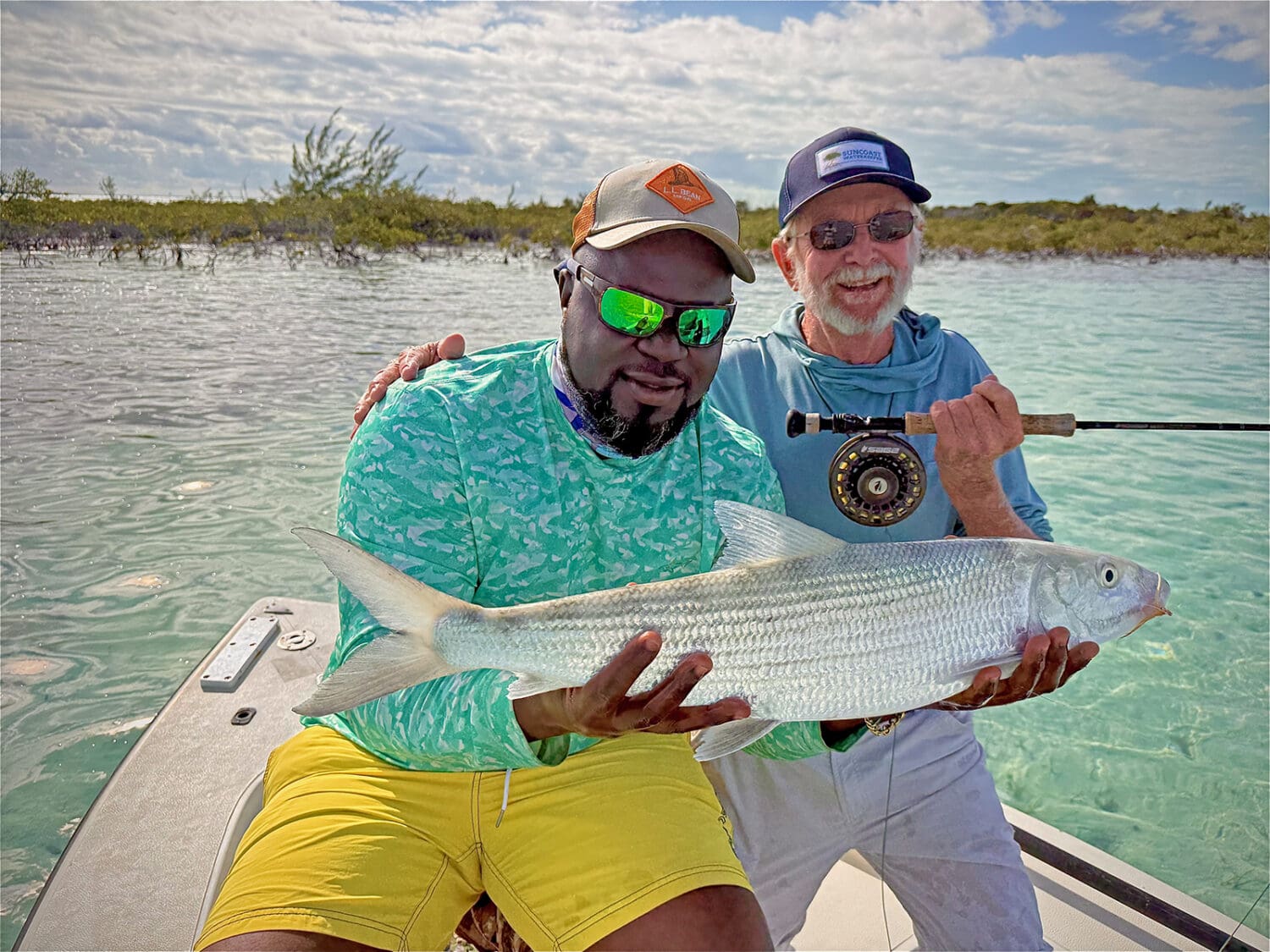
In my opinion the “holy grail” is landing a bonefish over 10 pounds. I’ve landed a few tarpon over 100 pounds, and a permit that pushed 40 pounds, but I had never managed to land a bonefish over 10 pounds. That all changed this past November when I fished the Middle Bight of Andros with Capt. Harry Neymour on a trip to Frankie’s Two Boys Inn.

Neymour’s roots run deep in the lore of bonefishing. His father, Charlie, uncle, Frankie, and grandfather, Ivan, have guided fly anglers in the waters near Behring Point for generations. Harry represents the new generation of the renowned family of fishing guides. On our fourth day of a six day trip, Harry and I were joined by Tampa angler and friend Leigh West.

As we rounded the bend from Cargill Creek onto the flats near Behring Point, Harry made the decision to head south and fish a small island in the middle bight, one he hadn’t fished in over a year. The weather was perfect with a 10-mph northeast breeze in a cloudless sky. Harry poled the boat along the edge of Big Lloyd Cay and after spotting and missing a couple of smaller fish, I heard Harry whisper, “Massive bonefish, 60 feet, one o’clock.”
As I swung my rod in that direction two large bonefish materialized about 40 feet away. Taking a deep breath, I raised my rod to the side to avoid spooking them and after one false cast, launched my fly, which landed about 15 feet from the cruising bones. As the fish approached, I waited for Harry to give me the word to start stripping. While I could see the fish, the Bahamian guides know just when to start a strip to make sure it’s close enough for the bonefish to see but not close enough to spook them. As the fish approached, it was hard to resist starting a strip, but I waited for Harry’s instructions. “Strip, strip, stop.”

There’s nothing more exciting than hearing those words and watching as the bonefish spots the fly and rushes over to inspect the perceived prey. “Strip, strip, stop – he’s got it!” came rapid fire as I did a strip strike and watched as the bone raced away, line and water flying from the spool. In short order, the bonefish was well into my backing as it suddenly changed course and headed for the mangrove shoreline. I applied as much pressure as I dared and used the drag and the rod to keep the fish out of the mangroves. Fortunately, the tide was just low enough to prevent the bonefish from running in or around the twisted roots and after several failed attempts it raced away from the structure towards deeper water. Then it was just a matter of applying constant pressure and working the fish to the boat. As I held my rod high, Harry reached down and expertly lifted the bonefish into the boat, proclaiming it to be close to 13 pounds. Finally, I had my first double-digit bonefish!

If you haven’t fished the Bahamas, I highly recommend the experience. While I’ve had the pleasure to fish multiple locations throughout the Bahamian archipelago, I can’t think of any place I would recommend for new and experienced anglers than Frankie’s Two Boys Inn. While you’re there make sure to ask for a day with Capt. Harry Neymour!

Reel Time on the Road: Frankie's Two Boys Inn

Reel Time on The Road: Frankie’s Two Boys Inn

Wakes rippled the water’s mirror-smooth surface, revealing the school of bonefish as they worked their way off the vast shallow flat. Moving towards open water on the quickly falling tide, they were tracking a coral edge that fed into the middle bight of Andros Island, the largest and least populated of the 700 islands in the Bahamas. When they were 30 feet away, I launched a roll cast, made one false cast, and landed my Peterson’s Spawning Shrimp 2 feet ahead of the school. I started my retrieve with a long, smooth strip that got the lead fish’s attention. As soon as it changed direction to intercept the fly, I paused, letting the fly dive for the bottom. When the bonefish got close and started to “tip” down on the fly, I made another long strip that was quickly intercepted. A short, sharp, strip strike set the barbless hook and I immediately prepared for the laser-fast reaction I knew was coming. True to form, the bonefish streaked to deeper water, making the fly line “rooster tail” across the surface in what must be one of the most electrifying experiences in fly fishing. The first long run went 50 yards into the backing before the fish reversed course and raced back towards me faster than I could recover the line. I thrust the tip of the rod in the water to prevent slack from forming that might loosen the barbless fly and left it there until I was able to “come tight” again.

The first run was followed by three more, each a bit shorter but equally thrilling before I was finally able to get the bonefish’s head above water and work it to the boat. Reaching into the water, I lifted it belly first, causing it to quiet down for a quick posed photograph and release. Wave after wave of fish poured from the flat that morning on what would be my best day of bonefishing ever. My companion, Rallis Pappas, and I took turns landing fish until I decided to get out and wade. Rallis and I were able to land close to 20 bonefish between us before the falling tide emptied the flat. In the water I had shots at multiple schools of fish, allowing me to land three and hook a fourth in quick succession. This was Pappas’ first time bonefishing, and I was quick to let him know what an amazing first day he was experiencing.

I was fishing with a group of friends out of Frankie’s Two Boys Inn in the Behring Point settlement on Cargill Creek, situated on the southern edge of Andros’s northern island. The “middle bight,” a vast and pristine wilderness of mangrove-lined cays surrounded by azure channels and seemingly endless flats, is just a short ride from the lodge’s docks. On days with good weather and tides, anglers can elect to make the hour-long run to the West Side National Park, arguably one of the most remote and unspoiled areas in the Bahamas chain. Having fished South Andros for many years I made my first trip to Frankie’s last March and the experience led to this return trip. Andy Grosso, a friend from Sarasota, and I made that first trip where we met Greg Huffman from Sarasota and Dana Fogle from Deland. This year they joined us again with friends, Michael Riter and Jimmy Harris, owner of Unicoi Outfitters in Helen, Georgia. We were joined mid-week by my brother from another mother and father, (stepbrother) Rallis Pappas from Atlantic Beach, Florida.

Readers of this column know of my love of bonefishing in the Bahamas, an experience I was eager to share with new fly anglers Riter and Pappas. Harris and I have fished the rivers of north Georgia on multiple occasions over the years and he has introduced me to many memorable experiences hunting for trout, stripers and bass on his home waters. During our week at Frankie’s, owners Melinda and Frankie, the guides, and lodge staff looked after our every need and although we experienced some rainy and windy days (typical of all my fishing trips) everyone had outstanding fishing for bonefish. While the fishing was the “main course,” afternoons and evenings around the bar and dining room table were memorable for the hilarious jokes and camaraderie.

Frankie’s is a great value and while it isn’t on the water and doesn’t have amenities for the family, everything a dedicated bone fisher needs is provided. If you’ve never fished for bonefish or are a dedicated angler, Frankie’s is a great choice. Getting there was quick and easy flying from Ft. Lauderdale Executive Airport with Makers Air. For more information, check out Frankie’s Two Boys Inn.

Reel Time: Make the wind your friend

Reel Time: Make the wind your friend

Whether stalking bonefish in the Bahamas, poling a flat in Florida for tailing redfish, wading into the Northeast surf for stripers, or casting for sea-run rainbows on the West Coast, anglers spend the majority of their time in anticipation. When we do get on the water, we face the unpredictable forces of weather that can throw hurricanes, fronts, windstorms, clouds and various adverse conditions at us.

If you want to catch permit on a fly, you’ll need the advantages a windy day provides. While the world of fishing in general, and fly fishing in particular, present us with many challenges, it’s these challenges that make success all the sweeter. That’s why we hunt gamefish with imaginative mixtures of feathers, fur, synthetic and tinsel. The excitement of making a presentation to a gamefish you’ve stalked, enticing it to take a fly, and then connecting with your prey through graphite and cork makes all the preparation, time, money and past disappointments worthwhile.

With so many challenges facing a fly angler there is good reason to be as well prepared as possible. Too many anglers wait for months to take the “trip of a lifetime,” encounter willing targets under less than ideal conditions (most often the case) and find their casting proficiency severely tested. The old saying that “luck is opportunity meeting preparedness” is especially true for fly fishers. Why not develop the mindset from the beginning that everything we do (on the water and off) contributes to turning odds into opportunities?

Preparation comes in many forms, and the most important components are practiced throughout the year. That means having tackle in top form, as well as knowing how to tie proper knots and flies that imitate your prey’s food. Casting skills are developed over a lifetime, and practice should not be saved for fishing trips, or even the days leading up to a trip. If you can’t get your fly to the fish, all other factors are rendered moot. The best practice is on grass, throwing to targets placed at different distances and angles. Don’t make the mistake of judging your casting ability by how long a line you can throw. Learn to make a tight (in saltwater), accurate, 40-foot cast first, and then work on distance.

While I’ve been blessed to learn from some top fly casters, I’ve found the best instructor of all is having a compelling reason. That’s what leads successful fly fishers to learn the basics and practice.

One of the first and most important lessons I’ve learned is to see the wind as friend, not foe. If you’re new to the game, don’t put off a fly fishing trip because the wind is blowing. On my first trip to the Bahamas, I was face to face with a large school of bonefish just 40 feet away, into a 25 mph headwind! All those days of avoiding the wind meant that I didn’t have the skills to get the job done! Now I appreciate the windy days because I know that if I can be successful then, I’ll be golden on the nice days. Wind-generated waves provide windows into the water and fish are far less spooky and more readily take a fly. If you can make a short, accurate cast into a 15-knot wind, you’ll excel on those rare “perfect” days.

Practiced fly anglers who are mentally prepared and visualize their outcome (just like top athletes) have a definite advantage. They’re primed when opportunity presents itself as “luck.” The next time you have a chance to go fishing, don’t let the wind dissuade you; make the wind your friend. It will pay dividends in your fishing future.

Where's Bortie Too

Where’s Bortie Too? In first place!

SOMEWHERE NEAR THE EVERGLADES – Bortie Too has caught her second wind, rocketing into first place from 10th place over the past week in the Sea Turtle Conservancy’s 12th Annual Tour de Turtles.

After a fast sprint to Key West from west Florida’s Gulf waters, she focused on the mantra “Just keep swimming” and headed straight for the Bahamas, then changed course back towards Key West, racking up 447 miles since the race began on Aug. 1.

Bortie Too nested twice on AMI this year; she was tagged and released after nesting on Coquina Beach on June 21, then nested a second time on the Island before beginning the race.

The loggerhead sea turtle is participating in the race to raise awareness of light pollution, which can disorient nesting and hatching turtles, a problem on Anna Maria Island.

The annual event is part of the Conservancy’s research project tracking satellite-tagged turtles to determine where and how far they migrate. The group uses satellite telemetry to track turtles released from beaches in Florida, Costa Rica, Panama and Nevis.

Bortie Too is sponsored by the Conservancy, Anna Maria Island Turtle Watch and Shorebird Monitoring, Waterline Marina Resort in Holmes Beach and Bortell’s Lounge in Anna Maria, for which she is named.