

HOLMES BEACH – Sea turtle hatchlings face an uphill battle to reach adulthood with obstacles including disorientation caused by artificial lights, becoming trapped in holes in the sand, predators and ingested litter.
The Anna Maria Island Turtle Watch and Shorebird Monitoring organization is offering weekly seminars to educate the public about sea turtle nesting in hopes of increasing the turtles’ chances for success – not only for the tiny hatchlings, but for their nesting mothers too.
Turtle Talks are held each Monday from 10 to 11 a.m. at Holmes Beach City Hall, 5801 Marina Drive. They are free and open to the public.
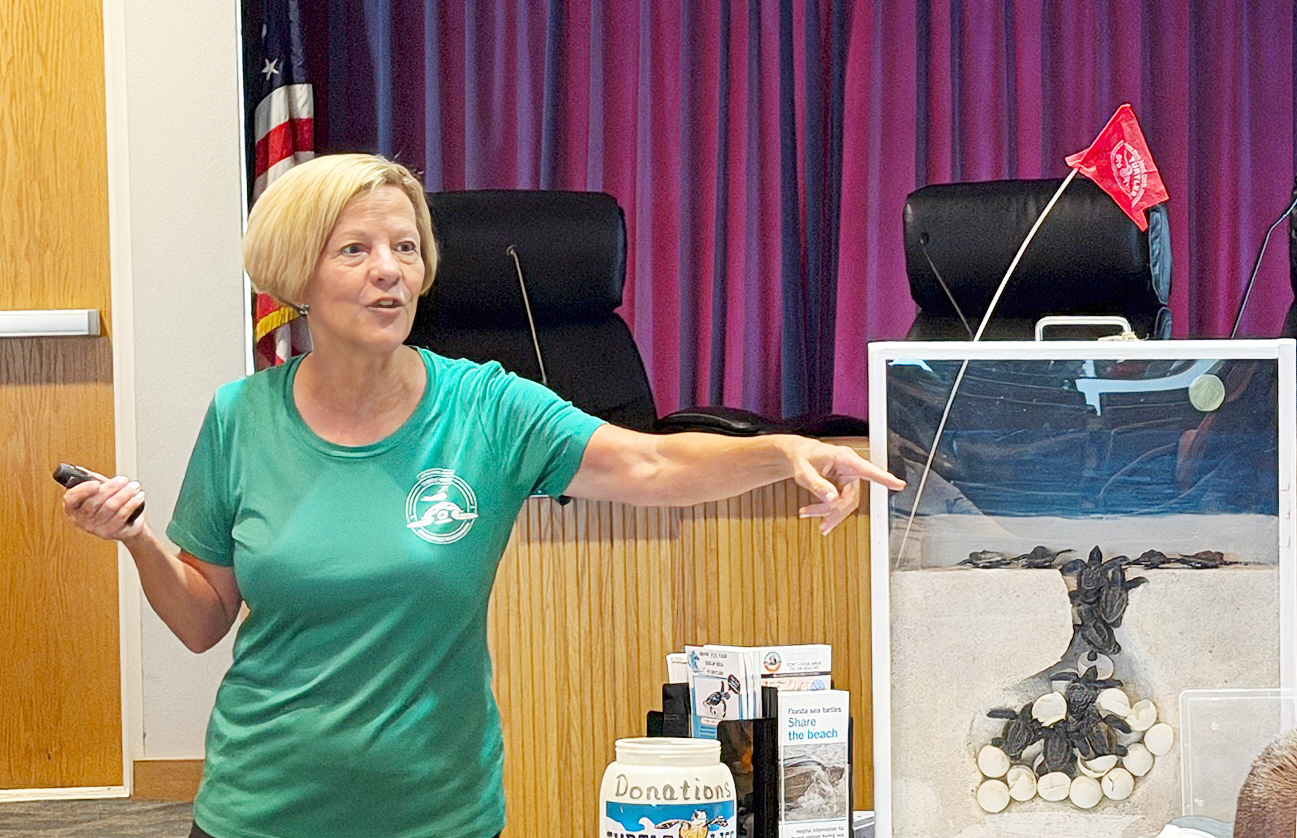
“What we hope to do today is to provide you with some fun facts and some interesting information about our sea turtles and our shorebirds and to increase awareness of the threats that they face,” Turtle Watch volunteer Peggy Welch said during the May 11 presentation.
The primary sea turtles that nest on Anna Maria Island are loggerheads, which at adulthood weigh between 200 and 300 pounds. They nest between April and August and their hatchlings appear from July to October.
“Sea turtles have been around for 110 million years. They outlived the dinosaurs,” Welch said. “Now they’re facing threats. There are threats in the water with boat strikes and marine debris. On land, there’s habitat loss from storms. There are obstacles on the beaches, holes in sand, predators and artificial lighting.”
Welch said trash is a huge problem.
“They will eat anything that looks like it could be food source. Plastic bags floating look like jellyfish and they eat jellyfish,” she said.
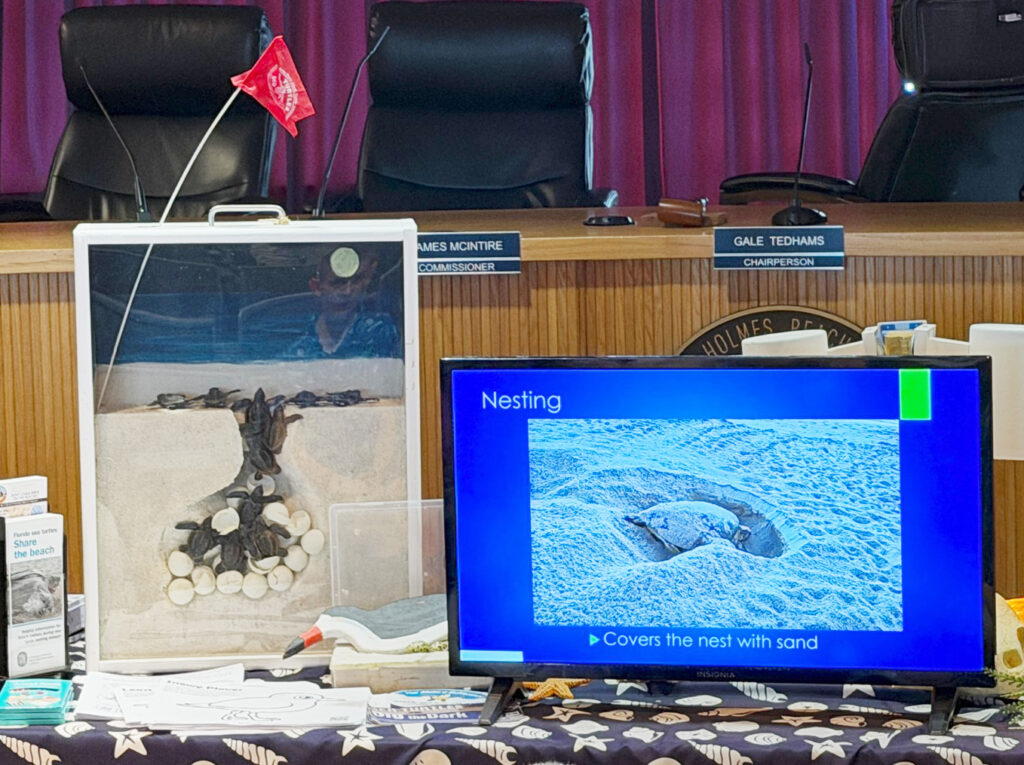
She described the nesting process, which typically happens at night.
“The moms want it dark and quiet. It cuts down on predators and it’s also cooler at night,” she said.
Welch said it may take a sea turtle between one and a half to three hours to nest and deposit an average of 100 eggs.
“It’s only the females that come out of the water. When she’s finished, she’ll go back to the water,” Welch said, noting the mother turtle carries an additional 200 eggs and will come up and nest every two weeks or so during nesting season.
“She won’t come back to nest again for another 2-3 years. It’s a huge process for her. Turtles we get this year are not the ones from last year,” Welch said.
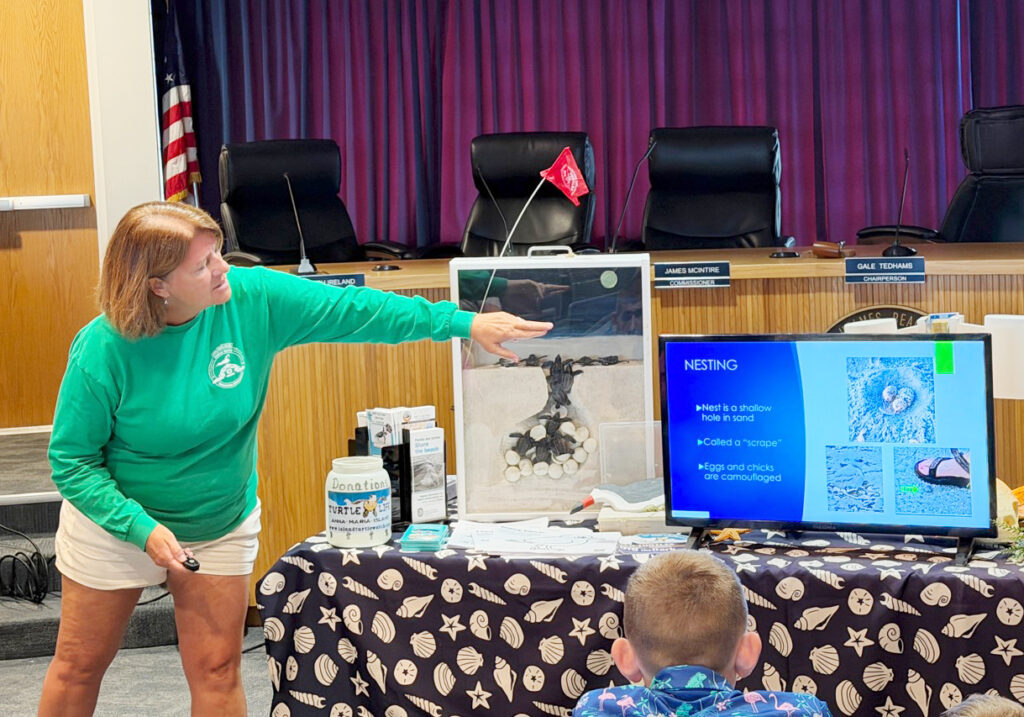
Turtle Watch volunteers are on the beaches 30 minutes before the sun rises, looking for turtle crawls and nests. The nests are marked and documented.
“Turtle tracks tell us a lot,” Welch said. “We don’t like to see tracks that show us turtles have been disoriented and go back to the water before nesting. We call that a false crawl. That could be caused by lights, noise or animals.”
She said nesting sea turtles and hatchlings are very sensitive to bright light.
“They’re looking for the reflection of the moon and the stars on the water – that should be the brightest horizon,” Welch said. “When there’s bright lights in the background that can disorient them. They’re not as sensitive to that orange-red part of the spectrum, so we hope businesses and homeowners use turtle-friendly amber lighting.”
Related coverage: First loggerhead sea turtle nest of season found