

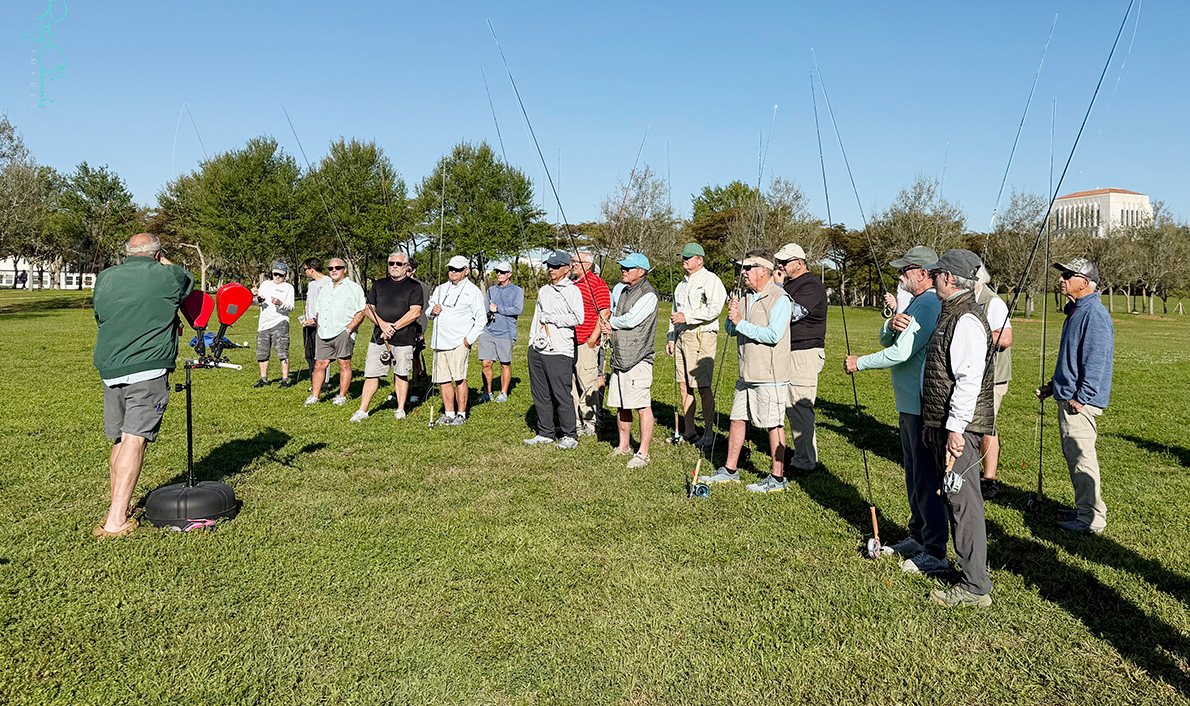
On Saturday, March 21, the Mangrove Coast Fly Fishers club, a charter club of the Fly Fishers International (FFI) organization, sponsored a free fly-casting clinic. The annual event attracted close to 30 participants from both the club and the public at large.
I participated as an instructor and was joined by FFI instructors Captain Pete Greenan, Captain Rex Gudgel, Captain Rick Grassett, Jim Cannon and Pat Jones. The event was held at Payne Park in downtown Sarasota from 9 a.m. to noon.
The morning started with an introduction by Cannon, who went through the fundamentals of a proper cast. While fly casting can be said to be an art, there are physics at play that must be observed. They are referred to as the five essentials and are as follows:
1.) There must be a pause (to let the fly line fully unwind) at the end of each casting stroke, which varies in duration with the amount of line beyond the rod tip.
2.) Slack line should be kept to an absolute minimum in the casting stroke. Slack line prevents the rod from loading and applying power to the cast. Common mistakes include not anchoring the line against the rod or with the rod hand; movement of the line by outside forces like wind and water; starting the cast too high; rough, jerky application of power; and poor timing between the forward and back cast. Of these, the most common comes from starting with the rod too high, which forms a belly in the line between the rod tip and the water. To prevent this, start with the rod tip pointing at the water.
3.) To form the most efficient, least air-resistant loops, and to direct the energy of the cast toward the target, the caster must move the tip in a straight line.
4.) The size of the casting arc must vary with the length of line past the rod tip. If you are making a short cast there is only a small amount of line needed and only a small casting arc is necessary to load the rod in a straight line. As the length of line increases, the stroke must be increased to load the rod. Participants were reminded, short cast-short stroke, long cast-long stroke.
5.) Power must be applied in the proper amount at the proper place in the stroke. In general, the power is applied slowly at first, gradually increasing to a peak at the end of the stroke. There should be a crisp stop at the end of the stroke, forcing the rod to come out of its bend. This is commonly referred to as the speed-up and stop.
After discussing the fundamentals, the participants broke into groups and the instructors worked with the individuals according to their needs and what the instructor determined would help their casting. While many of the group knew the fundamentals of the cast, the instructors worked to help them tighten their loops, control their line and double haul. Instructors also helped the participants work on how to make the most efficient cast when dealing with injuries to an arm, elbow or shoulder.
The event was a big success, judging by the performance of the casters before and after the clinic. While there was much improvement, instructors were adamant that the fly casters practice often to improve their skills.
If you are interested in joining the Mangrove Coast Fly Fishers or attending their meetings, check out their website. The club meetings are held on the fourth Wednesday of the month at the Sarasota Garden Club. Casting and fly tying begin at 6 p.m. The meeting begins at 7 p.m. and usually includes a presentation on some aspect of fly fishing.