

CORTEZ – The recent hurricanes took their toll on the 98-acre FISH (Florida Institute for Saltwater Heritage) Preserve.
Allen Garner, a retired landscape architect who has been working on the preserve for many years, gave a report on the post-hurricane impact at a Jan. 6 FISH meeting.
“The hurricanes were just the beginning in a whole new era in our history as far as the preserve goes. The amount of devastation plus what’s carrying through into other things has been very significant,” Garner said.
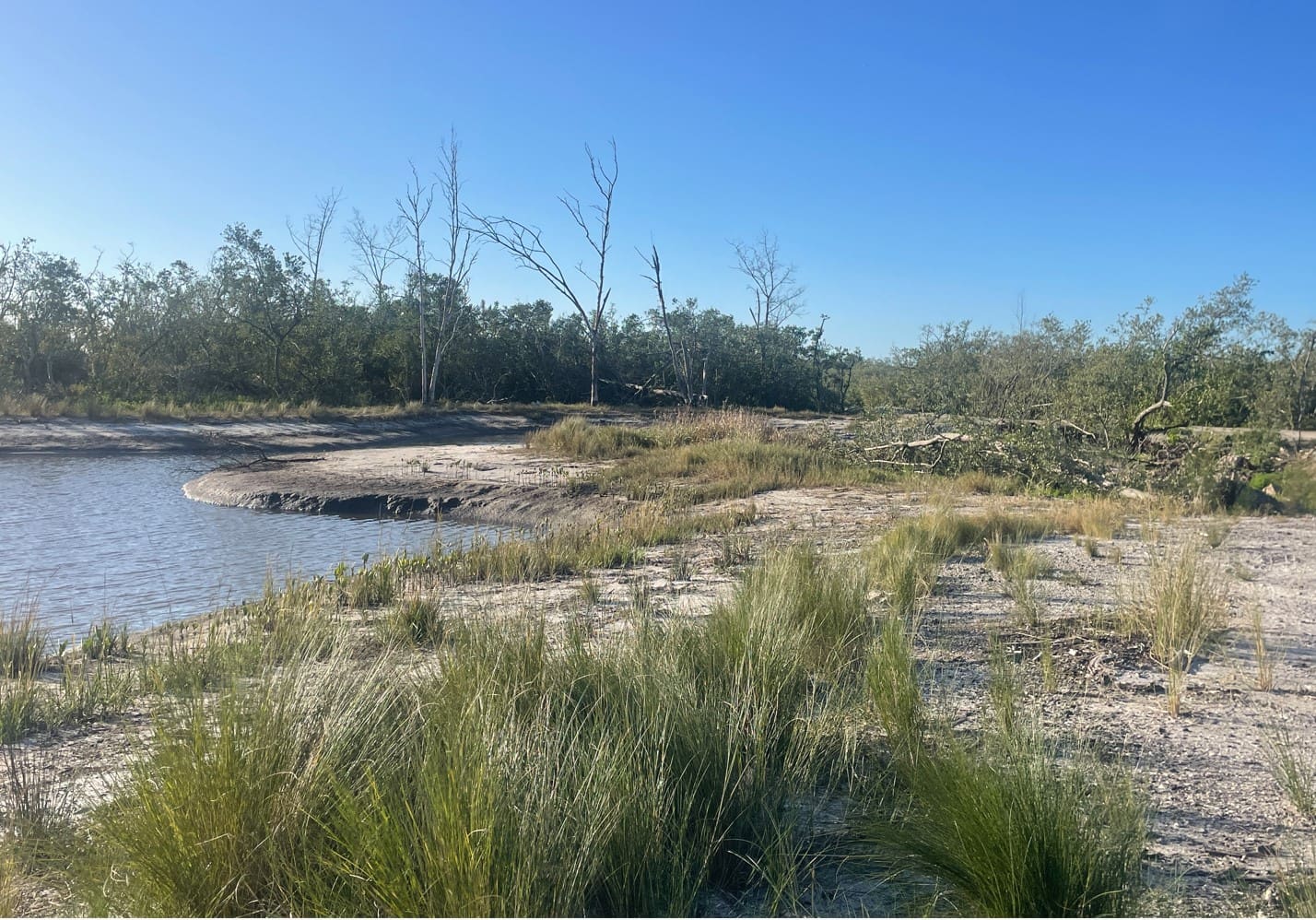
He said the trees have thinned out to such an extent that very few shady areas remain.
“You might be able to find some shade in some patches of the mangroves, but it’s very sunny out there,” Garner said.
He said the preserve is losing weakened native pine trees due to an infestation of beetles.
“The native pine trees in the preserve, we’re losing nearly all of those, and the reason for it is because of a little beetle called an ips beetle that’s always around and they bore into the trees and lay their eggs,” he said. “In a healthy pine tree, the sap is toxic basically to the water bug, it kills it off. But if the tree’s weakened from sitting in salt-saturated soil and it’s too weak, then the larva win.”
He said mature pine trees are turning brown.
“The pines didn’t die from the salt water,” Garner said. “They got weakened and the beetles moved in and that’s what’s killing them off. They’re dying now rather than three months ago.”
Due to the abundance of sunlight reaching the soil, there has been a proliferation of seed distribution.
“Everything is starting to sprout, both good and bad,” he said. “The two things that have significantly started sprouting are the Australian pines and the mangroves. The mangrove seeds got everywhere. They’re sprouting on top of hills, between two crab traps, in our yards, in shell parking lots, all over.”
Garner had been working on removing the remaining Australian pines over the past several months.
“One of the things we’re going to have happening as we go into spring are the Brazilian pepper trees, the carrotwoods, all the invasive things. It’s going to be an overwhelming number and it’s going to be this year,” Garner said.
He suggested FISH hire one or two people to go through the preserve weekly over the next four or five months and pull out seedlings of the invasive species. Garner said spraying is not an option.
“The problem with spraying is we’re going to have all the good stuff sprouting too and we want to pull out the pepper trees and not pull out the native things,” he said. “Spraying becomes a bad overkill approach.”
He said by summer, the seedlings will be too big to pull out by hand.
Garner said he would have to train potential subcontractors, and he recommended FISH allocate funds for the new few months for the seedling removal project.
A motion to spend up to $1,500 a month for the next six months to pay one or two people to pull the unwanted seedlings was approved unanimously by the board.
Garner said for the past three months he has been doing mostly restoration of the preserve following the storms, but is making progress on the work funded by the Barancik grant.
In June of 2024, the FISH board approved a proposal by Garner to complete the public accessibility project at the FISH Preserve in fulfillment of a grant from the Barancik Foundation.
Garner is working on the following projects:
• Design and build two new bridges; one sufficiently strong and sized to accommodate both pedestrians and maintenance vehicles and the other for foot traffic;
• Grade and create 12,000 square feet of shell trails;
• Build a portable information kiosk;
• Create and install a FISH Preserve entrance sign, four education signs, four orientation signs and 12 trail markers;
• Build two picnic shelters;
• Provide and install four picnic tables and six benches; and
• Provide construction support for completion of the Bradenton Kiwanis-funded bridge.
“We have been putting pilings in and probably finish up the pilings tomorrow or the next day for the bridge,” he said at the Jan. 6 meeting.
Garner began the grant project in July.
The total budget for the project is $180,000 with the grant amount being $165,000 and FISH providing the additional $15,000. The grant application for the FISH Preserve Enhanced Public Access Project was approved on Feb. 9, 2024.