Tag: Suncoast Waterkeeper

Piney Point pollution spreading, affecting dolphins

Piney Point spill leads to lawsuit

TAMPA BAY – Five conservation groups issued a notice today saying they intend to file a federal lawsuit over the intentional discharge of “hundreds of tons of pollutants into Tampa Bay” earlier this year.

The Center for Biological Diversity, Tampa Bay Waterkeeper, Suncoast Waterkeeper, ManaSota-88 and Our Children’s Earth Foundation announced a forthcoming lawsuit against the Florida Department of Environmental Protection (DEP), the Manatee County Port Authority and HRK Holdings, the owner of Piney Point, for violations of the Clean Water Act, Resource Conservation and Recovery Act and Endangered Species Act.

They claim the defendants are liable for “endangering the public and harming marine ecosystems and endangered species” by failing to maintain the gyp stacks and the waste storage ponds built into them at the closed Piney Point phosphate plant in Palmetto.

In a Notice of Intent to Sue, the conservation groups note that protected marine species including loggerhead sea turtles and manatees make their home in waters that are currently affected by the plume of pollution spreading from Piney Point.

After a leak in a gyp stack was discovered on March 26, officials ordered the emergency evacuation of hundreds of nearby Manatee County homes and intentionally discharged 215 million gallons of water into Tampa Bay at Port Manatee to take pressure off a compromised stack, avoiding its collapse and a potentially more serious spill.

A retention pond on top of a gyp stack at Piney Point. – Submitted

The discharge ended April 9, leaving a pollutant plume containing what DEP calls “mixed sea water,” an acidic blend of saltwater and debris from a Port Manatee dredge project, stormwater runoff, rainfall and “legacy process water” – wastewater from phosphate processing that contains nutrients such as phosphorus and nitrogen that feed toxic algae blooms.

“Phosphate companies have had over 70 years to figure out a way to dispose of the radioactive gypsum wastes in an acceptable manner; they have yet to do so,” Glenn Compton, chairman of ManaSota-88, Inc., said in a press release.

Faulting DEP for allowing the storage of dredge waste in gyp stacks that the Army Corps of Engineers warned had structural issues, and for authorizing HRK Holdings to discharge the polluted water, the conservation groups charge that “Piney Point presents an imminent and substantial danger to human health, our drinking water, the regional economy and the environment.”

“Piney Point was and still is a ticking timebomb,” Justin Bloom, Suncoast Waterkeeper founder and board member, said in a press release. “Instead of appropriately closing this toxic waste site when they had the chance, the DEP allowed the site to become even more perilous, knowing full well the risk of collapse and catastrophic contamination.”

The plume of water continues to spread, according to scientists at the University of South Florida College of Marine Science in St. Petersburg, which developed a forecasting model of where the polluted water will be on any given day. On May 19, the forecast predicts it will be swirling around both ends of Anna Maria Island, into Palma Sola Bay and Terra Ceia Bay, into the Manatee River, around both sides of St. Petersburg Beach, into Tampa Bay and up the Little Manatee River.

Red tide

The Florida Fish and Wildlife Conservation Commission reports that low concentrations of red tide were detected at the Rod & Reel Pier in Anna Maria and in Sarasota Bay at the Longboat Pass boat ramp in Bradenton Beach last week.

Red tide produces a neurotoxin called brevetoxin that can cause respiratory irritation, coughing, and more serious illness for people with severe or chronic respiratory conditions such as asthma, emphysema or COPD, according to the Florida Department of Health. It can also cause fish kills and poison shellfish, making it unfit for human consumption.

If the plume of nutrient-rich water from the Piney Point discharge reaches the red tide, “… it’s like adding gasoline to a fire,” Sarasota Bay Estuary Program Executive Director Dave Tomasko said.

Blue-green algae

DEP is monitoring area waters for blooms of blue-green algae. No cyanotoxins – the neurotoxins that are produced by blue-green algae – were detected in May 11 water samples. Results taken from samples on May 13 are pending.

However, widespread blooms of the blue-green algae Lyngbya have been reported in Anna Maria Island waters and at Robinson Preserve, the Intracoastal Waterway, Sarasota Bay and Tampa Bay, according to a report by Manatee County environmental scientists distributed to county commissioners by Acting County Administrator Scott Hopes earlier this month.

Contact with Lyngbya can result in itching, burning, pain, rash, blisters and cell death, resulting in loss of superficial layers of the skin, according to the report. Airborne toxins from the algae can cause eye and respiratory irritation. Excessive growth of Lyngbya can result in damage to seagrass beds and oyster bars, foul odors, oxygen depletion in the water and fish kills.

Related coverage


Piney Point pollution spreading, affecting dolphins


Piney Point wastewater spreading


Blue-green algae bloom clogging bays, ICW

Piney Point crisis averted, environmental concerns grow

Piney Point crisis averted; environmental concerns grow

PALMETTO – The wastewater discharge into Tampa Bay from a breached Piney Point retention pond near Port Manatee stopped Friday, April 9, but concerns are growing regarding the potential environmental impacts to Tampa Bay and other area waterways.

“We’re already seeing signs of an algae bloom in that area, captured through satellite imagery,” Sarasota Bay Estuary Program (SBEP) Executive Director Dave Tomasko told Holmes Beach Mayor Judy Titsworth in an email last week. “There does appear to be an algae bloom about 10 square miles in size and it’s centered around Piney Point. We just don’t know where it’ll go, how big it will get and how long it will last.”

On Thursday, April 8, the Anna Maria and Bradenton Beach city commissions declared preemptive local states of emergency in anticipation of potential environmental impacts of the Piney Point discharge, which occurred less than 20 miles from Anna Maria Island. The city of Holmes Beach is expected to enact a similar declaration this week.

Last week, city, state and federal officials continued their response to the breached Piney Point phosphogypsum stack, which contains a retention pond that until recently held approximately 480 million gallons of water containing high levels of phosphorus and nitrate.

Formerly the site of a phosphate plant that first opened in 1966, Piney Point was purchased by HRK Holdings in 2006. In addition to the retention pond, the property also contains two additional compartments that contain 400 million gallons of more heavily polluted water.

The long-term plan is to treat the remaining water and build a nearby deep water injection well that in a few years will be used to inject the treated water deep into the Earth.

According to the Sunday, April 11 FDEP update on Piney Point, “Yesterday, 217 million gallons remained in the NGS-South compartment (the breached containment pond). The site received 0.6 inches of rain, thus increasing the volume in the compartment to 221 million gallons.”

According to the Saturday, April 10 update, “DEP deployed diving companies and submersible cameras that identified a seam separation on the east wall of the NGS-South. Dive operations have strategically placed a steel plate on the seam separation to temporarily repair this identified source of concentrated seepage. To date, 215 million gallons were discharged to the port.”

During a Tuesday, April 6 press conference, acting County Administrator Scott Hopes said,

“This is very much under control now. The risk has been lessened to the point that people will be able to return to their homes.”

Environmental concerns

The SBEP, Suncoast Waterkeeper and Tampa Bay Waterkeeper are among the organizations monitoring the potential environmental impacts.

“We are in the early stages of this, but it has the potential to be the worst environmental impact to our local waters in my career, which dates back to the 1980s,” SBEP’s Tomasko wrote Titsworth. “Early model runs suggest that over the next few days to weeks, the waters being discharged will make their way down along the southern shoreline of Tampa Bay and it is expected to enter into Terra Ceia Bay, the Manatee River, northern Anna Maria Sound and even Palma Sola Bay,” he wrote.

“Preliminary data from the discharges has given us nitrogen concentrations that are about 100 times as concentrated as urban stormwater runoff and about 10 times as concentrated as raw sewage. Just in the first few days, the load of nitrogen to the bay was equivalent to about 40,000 bags of fertilizer,” Tomasko wrote.

When contacted Saturday, Tomasko said the fertilizer equivalency was now closer to 70,000 bags of fertilizer.

Tomasko said he’s more concerned about other forms of algae blooms than he is about a potential red tide outbreak at this time. He said the algae blooms he’s most concerned about impact water clarity and water quality and could potentially lead to more manatee deaths and the potential loss of fishing habitats.

On April 7, the Suncoast and Tampa Bay Waterkeeper organizations issued a joint statement that in part said, “The current discharge of water is far exceeding water quality standards for the Tampa Bay Estuary and delivering excess nitrogen and phosphorus to bay waters. Both nutrients are known to fuel harmful algae blooms such as red tides. This disaster was preventable. Permit conditions were ignored, water accumulation was not addressed when state funds were available to remedy the conditions.”

FDEP updates and water quality sampling data can be found online.

State committee meeting

On Wednesday, April 7, FDEP Secretary Noah Valenstein appeared before the Florida House of Representatives’ Pandemics and Public Emergencies Committee to discuss Piney Point. He participated via web conferencing from the Emergency Operations Center in Bradenton and Hopes traveled to Tallahassee in person.

Regarding FDEP’s initial response, Valenstein said, “The department immediately set up intense monitoring for nearby freshwater bodies as well as Tampa Bay. That allowed us to have a very detailed baseline of water quality in the area to ensure that we can hold HRK fully accountable for any impact to our resources.”

In regard to holding HRK responsible, Valenstein said, “We are actively looking at our litigation options.”

When asked what lessons can be learned from the Piney Point crisis, Valenstein said, “Piney Point has a history as a legacy site of the state recognizing that it needs to come in, and that it’s the party with the funds to clean the site up. There’s always been sort of a partial clean-up, but not closure by the state. The first lesson is when you have the opportunity you need to close the site. This legislature, this department and this administration has the opportunity to make the decision to close the site fully and be done with it, as opposed to a partial closure and possible reinvention of the site with continued risk.”

Hopes shared a less optimistic view and said, “It’s unlikely a company like this has not structured themselves in a way that with Chapter 11 and Chapter 7 (bankruptcy) it’s going to be very difficult,” he said. “In the meantime, we have to be the parties that solve this problem permanently.”

Related coverage


Piney Point spill may have ripple effect on tourism


Reel Time: An unfolding tragedy


County says Piney Point crisis is “under control”


Coast Lines: First, do no harm


Reel Time: The price of inaction


Additional leaks suspected at Piney Point


New executive director joins Suncoast Waterkeeper

Suncoast Waterkeeper (SCWK) is pleased to announce Samantha (Sam) Gentrup as the group’s new executive director.

Gentrup comes to Suncoast Waterkeeper with an extensive background in education and grassroots environmental movements. After almost two decades of empowering children and young adults to use their skills and passion to make a difference in the world, Gentrup said she is excited to make environmental activism her primary focus.

Gentrup has been a public speaker, grassroots co-leader, environmental speechwriter, and organizer for local and statewide events. Her passion centers on raising awareness about the challenges that face the region’s fragile marine ecosystems. Gentrup understands the interconnectivity of the issues that face the Suncoast and will bring passion and energy to Suncoast Waterkeeper’s environmental protection movement.

Gentrup will be participating in Sarasota Bay Watch’s (SBW) Annual Sister Keys Cleanup this Saturday, March 6, 2021. Suncoast Waterkeeper (SCWK) is teaming up with Sarasota Bay Watch this year and in the future on this longstanding event. The cleanup is a collaboration with the  Town of Longboat Key and the Chiles Group. The event will kick off starting with registration at 8 a.m. on the bayfront at the Mar Vista Restaurant at 760 Broadway St., Longboat Key. Volunteers will work for four hours on the island and around the mangrove fringes collecting trash and recyclable items.

The Sister Keys were originally slated for development in the early 60s and were once again threatened in 1989 when they went on sale for $1 million. That spurred a group of citizens to form the Sister Keys Conservancy in an attempt to buy and preserve the islands as a nature preserve. The Town purchased the islands in 1994 with a stipulation that the keys would never be developed. The islands underwent a million-dollar mitigation in 2007 that removed all invasive species, planted native flora and created a two-acre wetland.

The Longboat Key Marine division will be patrolling the intercoastal waterway to slow boaters. Kayakers and those without a boat will be ferried to the island by volunteers. Larry Beggs, owner of Reef Innovations Inc., will once again help the effort with a barge where volunteers can offload their trash.

This year, due to the pandemic, a light box lunch will be served, courtesy of the Mar Vista Restaurant. Anyone not willing to mask for the event or those who are still uncomfortable with groups can still participate during the following week. Through an arrangement with Longboat Key Public Works, volunteers can do a cleanup on their own and deposit bags at the town dock for pick up between March 6 and March 14. Registration is required and participants can sign up on the Sarasota Bay Watch website.

The Sister Keys Clean Up is just one of many projects that SBW is involved in. In 2020 SBW planted more than 750,000 clams in the bay in an ongoing restoration effort. Other cleanups are conducted at various locations throughout the bay as well as an annual monofilament cleanup and much more.

Suncoast Waterkeeper is a Sarasota-based advocacy nonprofit committed to protecting and restoring Florida Suncoast’s waterways through enforcement, fieldwork, advocacy and environmental education for the benefit of the communities that rely upon these precious coastal resources. Their efforts have been responsible for major initiatives that hold municipalities responsible to mandates established in the landmark 1982 Clean Water Act. In addition, SCWK also conducts bi-monthly water testing of inland coastal waters.

Reel Time: COVID-safe Sister Keys cleanup

Suncoast Waterkeeper is teaming up with Sarasota Bay Watch this year for the Annual Sister Keys Cleanup on Saturday, March 6. The event is a collaboration with the Town of Longboat Key and the Mar Vista Dockside Restaurant. Volunteers will work for four hours on the island and around the mangrove fringes collecting trash and recyclable items.

The Sister Keys were originally slated for development in the early ’60s and were once again threatened in 1989 when they went on sale for $1 million. That spurred a group of citizens to form the Sister Keys Conservancy in an attempt to buy and preserve the islands as a nature preserve. The Town purchased the islands in 1994 with a stipulation that the keys would never be developed.

The islands underwent a million-dollar mitigation in 2007 that removed all invasive species, planted native flora and created a 2-acre wetland. Today, mature mangroves dominate the waterways, which are rich with crustaceans, minnows, juvenile finfish and wading birds. Native species planted on uplands, first created from the dredging of the Intracoastal Waterway in the late 1800s, have matured, making the islands one of the best examples of a thriving native marine environment in coastal Florida.

The cleanup is part of a continuing two-pronged effort to clean the islands of trash and the resurgence of invasive species.

The Longboat Key Marine division will be patrolling the Intracoastal Waterway to slow boaters. Kayakers and those without a boat will be ferried to the island by volunteers. Larry Begs, owner of Reef Innovations Inc., will once again help the effort with a barge where volunteers can offload their trash.

Back at the Longboat Key Town Boat Ramp, volunteers will load the debris into a truck provided by the Town of Longboat Key. All recyclable items will be collected in separate green bags provided by Sarasota Bay Watch.

Anyone not willing to mask for the event or those who are still uncomfortable with groups can still participate during the following week. Through an arrangement with Longboat Key Public Works, volunteers can do a cleanup on their own and deposit bags at the town dock for pickup. A map showing landing areas and trails will be available online at www.sarasotabaywatch.org and www.suncoastwaterkeeper.org.

The Sister Keys Cleanup is just one of many projects that SBW is involved in. In 2020, SBW planted over 750,000 clams in the bay in an ongoing restoration effort. Other cleanups are conducted at various locations throughout the bay as well as an annual monofilament cleanup and much more. Suncoast Waterkeeper is a Sarasota-based advocacy non-profit committed to protecting and restoring the Florida Suncoast’s waterways through enforcement, field work, advocacy and environmental education for the benefit of the communities that rely upon these precious coastal resources. Their efforts have been responsible for major initiatives that hold municipalities responsible to mandates established in the landmark 1982 Clean Water Act.

Suncoast Waterkeeper also conducts bi-monthly water testing of inland coastal waters. For more information on their mission, go to www.suncoastwaterkeeper.org. To sign up for the event, go to sarasotabaywatch.org.

Reel Time: Engage and defend

This week as I watched the tribute to John Lewis, the American politician and civil rights leader, being eulogized by past presidents of both parties, I was inspired anew by the message of this great American. Lewis encouraged people to speak up and more importantly do something when they see wrongs that need to be righted. While Lewis will be remembered for his bravery in the face of incredible hostility and hatred centered on human rights, I take his message to heart in the threat to our local waters and the habitat that supports it.

Reel Time
Water quality is a continuing problem in local waters. – Rusty Chinnis | Sun

The love of coastal habitats has played a defining role in my life. Memories and friendships forged while fishing have led to my determination to speak to others (like you). We need to marshal our resources to protect these irreplaceable treasures so that future generations might have the same opportunities we’ve had.

I’ve written often about the pressures on our fisheries and more recently about the insults that water quality and habitat destruction pose. Recently I’ve become even more alarmed at what I’m seeing on the waters that surround our homes. I fear that there’s actually a possibility of a collapse of the natural systems that support the fish we seek. If you live near the water you’ve experienced the massive blooms of lyngbya (a dangerous cyanobacteria) that have choked canals and boat basins in our island communities as well as the unprecedented bloom that recently blanketed the shore from Perico Bayou to Palma Sola Bay and beyond.

I’m no scientist but it doesn’t take a degree in biology to recognize that we are surrounded by troubled waters. Sarasota Bay Watch (SBW) was formed after the devastating harmful (red tide) algae bloom of 2005 that lasted for 13 months. SBW is involving citizens in the region in the health of our Gulf, bays and estuaries. The organization has done an excellent job through initiatives that seek to bring water-filtering shellfish back to healthy populations, remove fishing line from bird rookeries, remove trash and invasive plants from coastal islands and educate future stakeholders.

Other organizations like the Coastal Conservation Association (CCA), long champions of protecting fisheries stocks, have begun partnering with groups like SBW and supporting their efforts to stock clams in Sarasota Bay. They also have a robust program of raising and releasing redfish in an attempt to counter the effects of the even more destructive red tide bloom of 2018.

I have supported both organizations since their founding but recently had an epiphany. While I will continue to support groups that work to restore fish and bivalves, it dawned on me that if we don’t address the root problem, i.e. water quality, all other efforts will ultimately lead to failure. This realization led to my involvement with Suncoast Waterkeeper, an organization that addresses these issues. Through outreach, education and advocacy, Waterkeeper groups around the world defend communities against anyone who threatens their right to clean water, from polluters to unresponsive government agencies. The local group founded by Sarasota environmental attorney Justin Bloom has been effective in forcing municipalities from St. Petersburg to Sarasota to adhere to the laws set down in the landmark Clean Water Act. The legislation signed into law in 1972 establishes the basic structure for regulating discharges of pollutants into the waters of the United States and regulating quality standards for surface waters. Locally the law has allowed Suncoast Waterkeeper to force municipalities to address and redress the release of wastewater that has raised nutrient levels in local waters to dangerous levels. Recently, some high-profile sewage spills in Manatee County and Longboat Key, exacerbated by antiquated infrastructure and exploding population growth have been front page news. Unfortunately, these releases are just contributions to a much larger problem. While the root of the problem is too many people, that is an issue that we must accept and find a way to ameliorate.

Recently both Sarasota and Manatee County have contributed millions of dollars to build a world class aquarium near I-75. While I understand the educational principle behind such a project, it seems to me that the money would be better spent fixing the infrastructure that is threatening our “natural aquarium.” Hopefully, we won’t be using aquariums to show our children and future generations what our natural waters “were” like.

Fortunately, it’s not too late to save these precious resources. Sarasota County, in a settlement with Suncoast Waterkeeper, is transitioning to an advanced wastewater system and committed to supporting clean water. To their credit, Manatee County commissioners recently approved a Conservation Referendum that will appear on the November ballot. Voting yes on the referendum would mean approving a property tax increase to create a conservation fund. This will cost the average homeowner about $29 a year, equivalent to 12 McDonalds hamburgers. The “Water Quality, Fish and Wildlife Habitat Preservation and Parks” funding will allow the county to issue bonds of up to $50 million.

Do your part by voting for proposals and leaders both locally and federally that support clean water and clean air. Check their voting record at the League of Conservation Voters  www.lcv.org. Join with Suncoast Waterkeeper to help with local clean water initiatives at www.suncoast waterkeeper.org. Learn about Sarasota Bay Watch and its shellfish restoration program at www.sarasotabaywatch.org.

Next week, let’s go fishing when Reel Time on the Road goes to Dillon, Montana.

Protecting paradise

I don’t think it’s a stretch to call where we live paradise. I hear first-time visitors say that all the time. Many, including me, never leave and that’s part of the problem that can and needs to be part of the solution.

Pulitzer Prize-winning author to speak

When I read Jack Davis’ book “Gulf, The Making of an American Sea,” I was amazed to learn what a paradise this was at one time. After reading Davis’ book, one might at first change their opinion of the area to “paradise lost” if not for the message of hope that it portrays. Consider the fact that some areas of the Gulf coast including Tampa Bay at one time had lost over 80% of their vital seagrass habitat. That was due mostly to wastewater discharges from sewage plants and dredging for ports and residential waterfronts. Today the seagrasses have recovered to almost historical levels. That’s the good news; the bad news is that the trend is starting to reverse. That’s concerning, especially when you consider that some 2.3 million people live in the counties bordering Tampa Bay (including Anna Maria), nearly six times the 1950 population of around 400,000 people. The current population has increased by 13% in just 10 years and is projected to increase at a faster rate.

Protecting paradise
Pulitzer Prize-winning author Jack Davis addresses “Brunch For The Bay” supporters. – Rusty Chinnis | Sun

That’s why I was attending Suncoast Waterkeeper’s yearly fundraiser, “Brunch for The Bay,” on Sunday, March 8 at the Bradenton Yacht Club. Suncoast Waterkeeper (suncoastwaterkeeper.com) is a Sarasota-based organization that is leading the way in helping to hold polluters of our coastal waters accountable. Davis was the event’s guest speaker and his talk echoed the message of the book. If I had to sum it up in a few words it was there’s hope, but only if the people who call this paradise home get involved. That’s just what Suncoast Waterkeeper’s “Sick of Sewage” campaign is doing. In the last three years the organization, founded by environmental attorney Justin Bloom, has successfully filed lawsuits holding municipalities including Sarasota, St. Petersburg and Safety Harbor accountable under the statutes of the Clean Water Act.

The problem now is the aging infrastructure that has resulted, in Sarasota County’s case, in the release during the last decade of over a billion gallons of partially-treated, nitrogen-rich wastewater into Philippi Creek and Sarasota Bay. When confronted with the issue, the county did the right thing settling with the stipulation that they would convert to an advanced wastewater system and contribute to organizations like the Sarasota Bay Estuary Program that work to enhance and protect the bay.

One of the big takeaways I got from listening to Davis speak was that we should all refrain from using the term red tide and instead refer to it as what it is, a harmful algae bloom. The term red tide has been used to dismiss these devastating events as natural and therefore attempting to absolve those responsible for the increased nutrients that have led to over a 500% increase in the number of blooms, their intensity and duration since 1950. That’s a number directly proportional to the population growth, according to marine researchers.

The take-home message was that we all need to get involved in protecting paradise. The solution begins at home by limiting the use of fertilizers and pesticides and eliminating grass on our lawns. At the same time, we should all support groups like Suncoast Waterkeeper, which are holding polluters accountable, initiating water testing in public waterways used by the public and committing to environmental education. The same goes for Sarasota Bay Watch, an organization with plans to release 1 million clams in the bay in 2020 that work to clean our waterways and bay islands. Their motto, “A Healthy Bay is Everybody’s Business,” rings true. Paradise lost should never be an option.

Reel Time: Pulitzer Prize winning author to speak

Reel Time: Pulitzer Prize winning author to speak

On March 8, Suncoast Waterkeepers (SWK), a local environmental group whose mission is to protect and restore the Florida Suncoast’s waterways through enforcement, fieldwork, advocacy and environmental education, will hold its annual fundraiser Brunch for the Bay at the Bradenton Yacht Club.

The group uses the funds to advance its water quality enforcement and “Sick of Sewage” campaigns. SWK has been effective in educating the public about man-made pollutants (stormwater and sewage) and enforcement with legal challenges to municipalities in Tampa Bay and surrounding waters.

After a series of horrific sewage spills in 2016 despoiled Tampa Bay and other local waters, SWK and partners brought suit against the cities of St. Petersburg and Gulfport to stop serious and ongoing violations of the federal Clean Water Act. It focused its efforts on achieving four key goals for municipal wastewater systems: to de-politicize the issues by agreeing to court oversight of overdue infrastructure maintenance and improvements; to provide certainty via mandatory long-term commitments and deadlines; protect local waterways and to ensure public transparency along the way.

During the course of the hard-fought two-year litigation against St. Pete and Gulfport, Suncoast Waterkeeper began investigating sewage spills in Sarasota County. The investigation of Sarasota County’s sewage system revealed a shocking pattern of longstanding, systematic infrastructure failures and disregard for public health and water quality in area waters. In a race to consolidate its far-flung sewage system, the county decommissioned two tertiary, or Advanced Wastewater Treatment (AWT), plants to better centralize its operations. However, the remaining plants that it increasingly relied upon employed only secondary treatment, leaving billions of gallons of highly nitrogenated wastewater as a byproduct.

At the same time, demand for the reclaimed irrigation water from the county was disappearing as developers, in managing nitrogen in stormwater runoff, turned to less polluting options, such as well water or highly treated reclaimed water from the city of Sarasota. To date, spills from the Bee Ridge facility have totaled over a billion gallons since 2013 on at least 394 separate days, adding over 65 tons of nitrogen into bay waters.

Meanwhile, the extensive sewage collection system was deteriorating and poorly maintained in a piecemeal fashion, resulting in periodic spills of dangerous raw sewage throughout Sarasota County. In early 2019, the environmental groups initiated a federal lawsuit under the Clean Water Act.

According to SWK’s lead attorney Justin Bloom, “to their credit, the Sarasota County Commission showed a willingness to immediately work towards a solution and to avoid protracted litigation.”

You can help support the group’s efforts and learn about its ongoing campaigns in Sarasota and Tampa Bay by attending the fundraising event. Not only will you be treated to a wonderful brunch at the scenic Bradenton Yacht Club, but you’ll hear a presentation by University of Florida history professor Jack Davis.

Davis’s book, “The Gulf,” garnered numerous literary accolades including the Pulitzer Prize for history, the Kirkus Prize for non-fiction, was a finalist National Book Critics Circle Award (nonfiction) and was a New York Times Notable Book of the Year, just to name a few. I’ve lived here for close to 40 years and the book caused me to see the place I live with new eyes. I highly recommend it and this is a chance to get your own signed copy.

Suncoast Waterkeeper is a group that has earned the support of anyone that values and is willing to work to protect the amazing marine ecosystem surrounding our local islands, and that is vital to the region’s local economy. Anglers, in particular, can learn how the group’s efforts are supporting an environment conducive to healthy fisheries, now and for future generations. Learn more at the Suncoast Waterkeeper website. Tickets can be purchased for the brunch online.

I hope to see you there.

More Reel Time:

Reel Time: Scallopalooza, It’s Clamtastic

Reel Time: “Fish farm” proposal troubling

Reel Time: Get in on the hot winter action

City responds to Suncoast Waterkeeper water pollution concerns

City responds to Suncoast Waterkeeper pollution concerns

BRADENTON BEACH – On Monday, Feb. 17, the city of Bradenton Beach issued a press release in response to concerns raised in a Friday, Feb. 14 press release issued by the Suncoast Waterkeeper organization.

The Suncoast Waterkeeper press release pertained to higher than usual bacteria levels discovered in the bay waters near the Bridge Street Pier and along Bay Drive South.

“On Friday, February 14, the city was informed by Joe McClash and Andy Mele that Suncoast Waterkeeper performed two water samplings somewhere in the Gulf Intracoastal Waterway Class 3 body of water adjacent to Bay Drive South. The city was told that the test result identified the presence of Enterococcus. Enterococci are normally present, as colonizers, in the intestinal tract of human beings and animals, and can be recovered from feces in large quantities,” the city’s press release said.

“Mayor John Chappie has been in communication with Tom Larkin at the Manatee County Health Department. Mr. Larkin was made aware of the boating community activities in the waters tested, the Manatee County force main construction activities adjacent to that area and recent boring activities for the undergrounding of utility lines on Bridge Street. Mr. Larkin indicated he was also in communication with the Florida Healthy Beaches Program in Tallahassee regarding this matter.

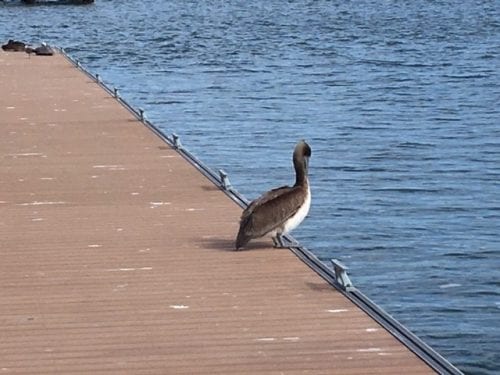
“Mayor Chappie has asked the Bradenton Beach Public Works Department to conduct local inspections at and around the Bridge Street Pier. It was noted a recent CRA (Community Redevelopment Agency) meeting that there have been higher counts of pelican fecal matter on the pier and floating dock, which may be the contributing cause for the recent water samplings collected by Suncoast Waterkeeper,” the city press release stated.

The press release also mentioned environmental projects previously pursued and currently being pursued by the city and/or the CRA.

“The city of Bradenton Beach has partnered with the Southwest Florida Water Management District and invested in the development and creation of a customized stormwater management plan to clean the water going into the water table and the water bodies.

“The city, through the Community Redevelopment Agency, has invested substantial funds to develop a living shoreline and use nature to promote an environmentally friendly aquaculture.

“The CRA recently authorized $5,000 to monitor the water quality impacts of the 2019 clam restoration project conducted in the waters near the pier. That authorization also includes the installation of seagrass cages that promote seagrass growth.

“The CRA also authorized $10,000 for the purchase and installation of 14 of the larger-sized Mini Reefs to be placed in the waters off the east end of the Bridge Street Pier through the Center of Anna Maria Island’s Go Green initiative,” according to the press release.

“The city has partnered with Mote Marine, S.T.A.R.T., Oceans Habitats Inc., Sea and Shoreline LLC and local restaurants and local fishermen for these projects. The city also supports the clam mitigation efforts proposed to the Florida Legislature in House Bill 3829,” the press release said.

Mayor’s thoughts

On Monday, Chappie also discussed these matters with The Sun.

He said city officials inspected the pier on Friday and looked for any possible sources for the bacteria.

He said the Public Works Department pressure washes the pier and floating dock every Friday and he noted that during a January CRA meeting Public Works Director Tom Woodard commented on the inordinate amount of pelican feces accumulating on the new floating dock.

Chappie said those weekly cleaning efforts may be a contributing factor to the higher bacteria levels.

City responds to Suncoast Waterkeeper water pollution concerns
The floating dock in Bradenton Beach is a popular destination for pelicans. – John Chappie | Submitted

“This is something we’re going to continue to follow. We want to find out what the source is,” he said.

Chappie also said the city commission recently reached consensus to add twice-yearly E. coli testing to the water monitoring being done as a follow-up to last year’s clam restoration project.

Related coverage


Higher enterococcus levels cause for concern

High enterococcus levels in Bradenton Beach waters cause for concern

High enterococcus levels cause for concern

BRADENTON BEACH – “Extremely high” pollution levels have been discovered at the Bradenton Beach bayfront, according to Suncoast Waterkeeper Executive Director Andy Mele and board Chair Joe McClash.

According to their Friday, Feb. 14 press release, “Over a period of two weeks, enterococcus levels exceeding 24,000 colony-forming units (CFU) per liter have been discovered twice along the waterfront at Bridge Street and Bay Dr. South in Bradenton Beach, an area intensively used by tourists throughout the year. Other samples reached 1,670 cfu/L and 4,884 cfu/L.”

According to the Florida Department of Health website, “Enterococci are enteric bacteria that normally inhabit the intestinal tract of humans and animals. The presence of enteric bacteria can be an indication of fecal pollution, which may come from stormwater runoff, pets and wildlife and human sewage. If they are present in high concentrations in recreational waters, and are ingested while swimming or enter the skin through a cut or sore, they may cause human disease, infections or rashes.”

The Suncoast Waterkeeper press release states that the Florida Department of Health’s threshold for beach closure advisories is 70 cfu/L and that Bradenton Beach bayfront samples have ranged from 24 to 340 times higher than the levels the state regards as unsafe for direct human contact.

“Bay Drive is home to a dinghy beach for people coming ashore from boats in the anchorage, a waterfront restaurant and a number of docks and private piers with small beaches. Bridge Street is Bradenton Beach’s main commercial hub, linked to the bayfront at Bay Drive and the historic pier. The area is frequently accessed by boaters and frequented by recreational paddlers,” according to the press release.

The press release does not cite any suspected sources for the higher-than-usual enterococcus levels.

For several years now, Bradenton Beach residents, business owners and city officials have expressed concerns about liveaboard boaters in that area dumping untreated human waste into those waters. It is not known if the liveaboard boating activities in the unmanaged anchorage south of the Bridge Street Pier contributed to the recently higher enterococcus levels.

High enterococcus levels in Bradenton Beach waters cause for concern
Several liveaboard boaters populate the unmanaged waters south of the Bridge Street Pier. – Joe Hendricks | Sun

Suncoast Waterkeeper is also monitoring 11 other sites on a weekly basis for enterococcus along Sarasota Bay and its adjacent waters.

“The Florida Department of Health monitors public beaches weekly and biweekly, so Suncoast Waterkeeper makes no attempt to duplicate their efforts, but to monitor other areas used recreationally that are representative of our inshore coastal waters. Other sites exceed the advisory level of 70 cfu by orders of magnitude, but the two Bradenton Beach bayfront sites are by far the worst,” the press release states.

According to the press release, Mayor John Chappie said, “We are aware we had a problem and we are about to start testing ourselves so we can get to the bottom of it. You know we believe in the importance of clean, healthy waters. We have the clam project and living shoreline in progress.”

The Suncoast Waterkeeper samples were analyzed by Benchmark EnviroAnalytical Inc. an accredited and certified laboratory in Palmetto.

“We are not pointing fingers here,” Mele said in the press release. “We are concerned that there could be a public health problem and we will be working with the Manatee County Department of Health and the Bradenton Beach government to help identify the sources and resolve the problem.”

The Feb. 12 sampling data can be viewed in its entirety at the Suncoast Waterkeeper website.

Anchorage enforcement

Officer Eric Hill, Det. Sgt. Lenard Diaz and Lt. John Cosby from the Bradenton Beach Police Department are among those who play active roles in the ongoing and increased enforcement efforts taking place in the unmanaged waters south of the pier.

When contacted Sunday, Cosby said, “As time goes on, I believe some of that will clear up. We’ve reduced the amount of liveaboards there by half. Six months ago, we had 58 boats out there. We’ve got 24 right now. And the ones we have removed were the ones we were having the most issues with.”

Cosby was asked if the city is having issues with liveaboard boaters dumping human waste into those waters.

“We don’t know, because we would have to physically see them dump it, and we have not seen that. Obviously, if we’re out there they’re not going to do it in front of us,” Cosby said, noting it could possibly happen at night.

Regarding vessel inspections, Cosby said, “We have the Coast Guard help us with that, but the boat has to be operational. If the boat is derelict and the boat doesn’t run, the pump system doesn’t work so the Coast Guard can’t test it. So, that’s part of this derelict enforcement that we’re doing.

“They have to get the boat up and running and be able to demonstrate that it has power, steering and is seaworthy. And FWC just came out with a new course that boaters have to navigate in order to show us the boat is maneuverable. Before, it used to be a guess. Now a sailboat or powerboat has to run to demonstrate to us that the boat is able to be steered and has enough power to propel itself,” Cosby said.

“The big thing out there is continued enforcement. That’s the only thing that’s going to keep that under control, and that’s what we plan on doing,” he added.

Cosby noted the city has a newly-amended ordinance, Ordinance 19-509, that addresses vessels moored in the unmanaged anchorage. The amended ordinance now limits the space available for liveaboard boaters to leave their dinghies at and near the city-owned ‘dinghy dock’ next to the Bridge Tender Inn’s Dockside Bar.

High enterococcus levels in Bradenton Beach waters cause for concern
A newly amended city ordinance allows beached dinghies to be removed from the area at the dinghy owner’s expense. – Joe Hendricks | Sun

“That’s going to help a lot. We’re having signs made that say you can’t beach your dinghy anymore in that area.  If there’s not enough room to put their dinghy on the dinghy dock, then they’re out of luck. They’ve been beaching them on that little cove where the dinghy dock is. They’re not allowed to do that anymore. Once the signs are up, we’re actually allowed to seize the dinghy, charge a $100-a-day storage fee and also charge them what it costs for Public Works to remove it,” Cosby said.

The amended ordinance prepared by City Attorney Ricinda Perry also addresses the rafting of multiple vessels and/or floating platforms and other prohibited acts and anchorage-related concerns.

High enterococcus levels in Bradenton Beach waters cause for concern
A recently amended ordinance also addresses the rafting of multiple vessels and/or floating platforms. – Joe Hendricks | Sun
Reel Time: Waterkeeper Alliance holding polluters accountable

Reel Time: Waterkeeper Alliance holding polluters accountable

The Waterkeeper Alliance is the largest and fastest growing nonprofit that is exclusively focused on clean water. The Alliance works to preserve and protect water by uniting local Waterkeeper organizations and affiliates worldwide. Their goal is to assure drinkable, fishable and swimmable water for everyone.

The organization was created by a band of commercial fishermen on New York’s Hudson River in 1966 to hold industrial polluters accountable for destroying their way of life. Their brand of hard-hitting, grassroots activism sparked a miraculous recovery of the river and inspired others to launch Waterkeeper groups around the world. There are now more than 300 Waterkeeper organizations and affiliates on the frontlines of the global water crisis. With their volunteers, they are guarding and defending more than 2.5 million square miles of rivers, lakes and coastal waterways on six continents.

Today Florida’s Gulf Coast is one of those critically endangered frontlines faced with devastating red tide events and blue-green algae outbreaks, sewage spills and willful discharges into impaired waters that are feeding unprecedented amount of nitrogen and other pollutants into local waters. Our area is fortunate to be under the auspices of Suncoast Waterkeeper. The Suncoast Waterkeeper organization focuses its efforts in an area that includes the coastal waters of Manatee and Sarasota counties, a watershed that includes all of the Sarasota Bay Estuary, the southern reaches of Tampa Bay (lower Tampa Bay and Terra Ceia Bay) and the Manatee River.

Suncoast Waterkeeper’s former Executive Director and Founder Justin Bloom is an environmental lawyer who believes in the organization’s mission statement: “To protect and restore the Florida Suncoast’s waterways through enforcement, fieldwork, advocacy, and environmental education for the benefit of the communities that rely upon these precious coastal resources.”

According to Bloom, they are more aggressive than other groups in that they are likely to litigate against those corporations, organizations and individuals that threaten water quality. Waterkeepers in general and Suncoast Waterkeepers, in particular, are small but streamlined and able to act quickly. Maybe most importantly they follow through on what they say and persevere.

“It can be personally frustrating,” says Bloom. “People have the misconception that we have unlimited resources and time. The reality is that we are tiny in comparison to the challenges we face and operate on a shoestring.”

Having said that, Bloom reiterates that the organization has been able to accomplish a lot. While he wants to see Suncoast Waterkeeper grow, he embraces the model of a small but active group that relies on volunteers and contributors.  Bloom worked for the Hudson Riverkeeper, the original and archetype Waterkeeper organization when he was in New York. One of the signature characteristics of a Waterkeeper group comes from the Hudson Riverkeeper.

The current Interim Director of Suncoast Waterkeeper Andy Mele started his environmental career in New York’s Hudson Valley with the group known as Hudson River Sloop Clearwater that was formed by Pete Seeger, the famous folk singer and social activist. There he inherited a 30-year battle with General Electric, which was responsible for dumping over a million pounds of carcinogenic PCBs into the Hudson at two GE plants.  Mele helped develop the strategy that led to the EPA forcing GE to sign a consent decree for the cleanup.

Mele sees many similarities between the way GE avoided its environmental liabilities and local municipalities and corporations like Mosaic that mine phosphate on Florida’s west coast. Mele and other partners were instrumental in preventing Mosaic from mining in the Charlotte Harbor watershed.

Mele relates, “When Suncoast Waterkeeper joined with two national groups to sue St. Petersburg and Gulfport and won, we did more to remove nutrients from coastal waters than the entire state legislature.”

Suncoast Waterkeeper recently presented a notice of intent to sue directed at Sarasota County, which they accuse of releasing hundreds of millions of gallons of partially-treated, nutrient-rich wastewater into Sarasota Bay over almost a decade.

According to Mele, “this is important because, despite the federal and state statutes that are supposed to be protective of the environment and human health, politics and special interests intervene and enforcement lags. That’s exactly what happened when former Governor Rick Scott fired most of the state’s environmental enforcement staff within the first month of his tenure. The ferocious episodes of red tide and thick mats of toxic cyanobacteria have been the predictable result.”

Suncoast Waterkeeper depends on volunteers and contributions from local communities to do its important work. This is a critical juncture for the nation, Florida, and west coast communities like Anna Maria Island. Our way of life and an economy that depends on clean water is at stake.

To lend your physical and financial support, contact Suncoast Waterkeeper at P.O. Box 1028, Sarasota, FL 34230. The organization also can be reached by phone at 941-275-2922, by email at jbloom@suncoastwaterkeeper.org and amele@suncoastwaterkeeper.org, or visit the website.

More Reel Time:

Reel Time: Dog days strategies

Reel Time: Tarpon primer

Reel Time: The morning run