

Tag: Senate Bill 180

Manatee County among plaintiffs in suit against state officials

Manatee County among plaintiffs in suit against state officials

LEON COUNTY – Manatee County is among several municipal plaintiffs filing suit seeking declaratory and injunctive relief from a controversial hurricane recovery-related state law enacted earlier this year.

Signed into law by Gov. Ron DeSantis on June 26, the new law created by the Florida Legislature’s adoption of Senate Bill 180 and its matching bill in the House of Representatives prohibits city and county governments from adopting land development regulations that are more cumbersome or restrictive than the regulations in place as of Aug. 1, 2024.

Fort Lauderdale-based Weiss, Serota, Helfman, Cole and Bierman attorney Jamie Cole filed the lawsuit on Sept. 29 in the Second Judicial Circuit Court in Leon County.

The lawsuit seeks a court order declaring that the enactment of SB 180 violates the Florida Constitution and the Florida Statutes that codify local home rule powers, deems the preemptions in the new state law to be impermissibly vague and invalid and prohibits the state from enforcing the new law.

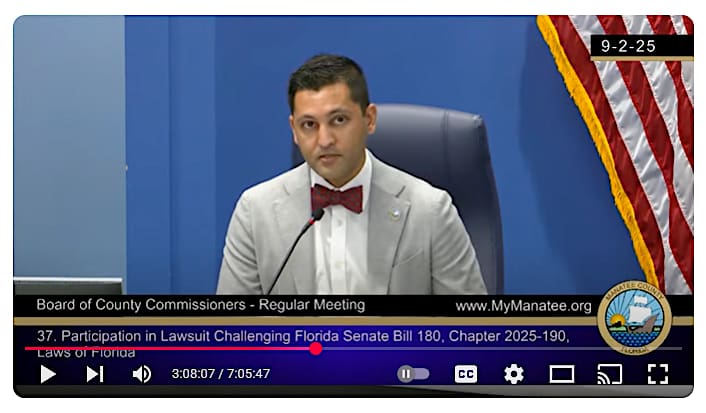
On Sept. 2, Manatee County com­missioners voted 6-1 in favor of the county joining the lawsuit.

In addition to Manatee County, the named plaintiffs include city of Destin, the city of Lake Alfred, the town of Windermere, the city of Delray Beach, the city of Deltona, the city of Weston, the city of Alachua, the city of Stuart, Orange County, the town of Mulberry, the city of Naples, Miami Shores Village, the town of Lake Park, the city of Fort Lauderdale, the town of Jupiter, the city of Edgewater, the city of Pompano Beach, the town of Dundee, the town of Cutler Bay, the village of North Palm Beach, the village of Pinecrest, the city of Margate, the town of Palm Beach and the city of Homestead.

The lawsuit names as defendants Florida Secretary of Commerce Alex Kelly, Executive Director for the Florida Division of Emergency Management Kevin Guthrie, Florida Commissioner of Agriculture Wilton Simpson, Florida Department of Revenue Executive Director Jim Zingale and Florida Chief Financial Officer Blaise Ingoglia.

The complaint cites Section 28 of the new Florida Statute that states, “Each county listed in the federal disaster declaration for Hurricane Debby, Hurricane Helene or Hurricane Milton, and each municipality within one of those counties, may not propose or adopt any moratorium on construction, reconstruction or redevelopment of any property damaged by such hurricanes; propose or adopt more restrictive or burdensome amendments to its comprehensive plan or land development regulations; or propose or adopt more restrictive or burdensome procedures concerning review, approval or issuance of a site plan, development permit or development order before October 1, 2027, and any such moratorium or restrictive or burdensome comprehensive plan amendment, land development regulation, or procedure shall be null and void ab initio. This subsection applies retroactively to August 1, 2024.”

A case overview provided on page two of the 46-page complaint says, “This is an action by a large number of

Florida municipalities and counties challenging Senate Bill 180, a law that was enacted in the 2025 legislative session that represents the largest incursion into local home rule authority in the history of Florida since the adoption of the Florida Constitution in 1968. SB 180 purports to be ‘an act relating to emergencies’ supposedly designed to assist people rebuild properties that were damaged in hurricanes. But, as the result of a last minute amendment, and in a classic example of log rolling and stealth legislating, SB 180 goes much further, freezing all local land development regulations and comprehensive plans in place on August 1, 2024, declaring that any ‘more restrictive or burdensome’ amendments to such regulations that were enacted by any of the 67 counties or 411 municipalities in Florida between August 1, 2024, and October 1, 2027, are ‘void ab initio.’”

The complaint says, “SB 180 should be declared invalid and the defendants should be enjoined from enforcing it.”

Manatee County referenced

Earlier this year, due to concerns about potentially violating the new state law, Manatee County commissioners delayed voting on reverting back to the county’s previous and more restrictive wetland buffering regulations.

The complaint notes some local governments received letters from Florida Department of Commerce advising them that certain planning and zoning regulations are in direct conflict with Section 28 of the new state law.

The complaint says, “Manatee County received such a letter on April 15 regarding two proposed comprehensive plan amendments, in which Florida Commerce states it previously declared the proposed comprehensive plan amendments ‘null and void’ and that Manatee County, nonetheless, thereafter continued to move toward final adoption. The letter states the proposed ordinances may be violative of Section 28 for being a ‘restrictive or burdensome’ procedure for obtaining a development permit after a disaster – without purporting to identify what it was more restrictive or burdensome than, or to whom it was more restrictive or burdensome. The letter also states the proposed amendments may violate Section 3 of SB 180 regarding impact fees.”

Although the Island cities of Anna Maria, Bradenton Beach and Holmes Beach are not plaintiffs in the lawsuit, Holmes Beach city attorney Erica Augello recently said the outcome of the SB 180 lawsuit will impact every Florida city and county one way or another.
Manatee County joining SB 180 legal challenge

Manatee County joining SB 180 legal challenge

MANATEE COUNTY – Manatee County is joining a soon to be filed lawsuit that will challenge the new state law created by the Florida Legislature and Gov. Ron DeSantis’s adoption and enactment of Senate Bill 180 earlier this year.

On Sept. 2, county commission­ers voted 6-1 in fav or of joining legal challenge at an initial cost of $10,000, which additional costs anticipated if a judge’s order is issued and then appealed.

Originally intended to prevent city and county governments from making it more difficult for property owners to repair, rehabilitate and rebuild their hurricane-damaged structures, the far-reaching state law prohibits city and county governments from adopt­ing land use regulations that are more restrictive or cumbersome than those that existed on Aug. 1, 2024.

The new law’s potential implica­tions recently caused county commissioners to delay voting on returning the county’s wetland setback requirements to the more stringent requirements that were in place before the previous county commission weakened them in a manner more favorable to developers.

A memo included in the Sept. 2 county commission meeting packet says, “SB180 is overbroad and over­reaching. It has been used by develop­ers to put a choke hold on Manatee County and on home rule. Manatee County looks to challenge SB180 in the court of law in order to remove the section that prevents Manatee County from taking necessary steps to mitigate flooding and damage. The section should only apply to property damaged in an emergency caused by the emergency.”

When providing public input before the commissioners discussed joining the lawsuit, county resident Dalton Nelson said the new law undermines home rule authority and strips local gov ernments of the flexibility needed to respond to overdevelopment, flooding, infra­structure planning, environmental protections and other challenges.

“To the make matters worse, Mr. DeSantis has gone so far as to threaten removing commissioners who do not fall in line with these laws. That is not democracy. That is intimidation. When commissioners govern out of fear of removal instead of in the best interests of the residents the entire system of local government is weakened,” Nelson said.

County resident Anthony Shulo said the new law fails to make distinctions between disaster recovery and future land use decisions, which he said are two very different scenarios: “Without official clarification, the door is already open misapplication and misinterpretation – something that should concern every resident of this county.”

County resident Glen Gibellina noted every state legislator in the Manatee County Legislative Delega­tion voted in favor of the new law, including Sen. Jim Boyd and state representatives Will Robinson Jr. and Bill Conerly.

District 3 commissioner Tal Siddique doesn’t oppose all the provisions set forth in SB 180 but he said it contains some “bad language” and some developers are already actively looking to litigate in court the definitions of “more restrictive” and “burdensome.”

“That’s operating in bad faith,” Siddique said.

“This notion that we’re restricting homeowners from rebuilding is just ridiculous. It’s false. I welcome us joining this lawsuit. I think it’s the only way to make our voices heard,” Siddique said. “I’ve yet to receive one call from any builder about how we can make it easier to let property owners rebuild their homes – and I represent the most hurricane-damaged part of the county (Anna Maria Island).”

Commissioner Carol Ann Felts said, “It’s not easy to convince someone that they’ve made a mistake by hitting them over the head. This is just part of the American way. We have a law that is made, we abide by that law and then we legally find ways to change that law if they don’t work or us. This is how our democratic republic works. I don’t want the lawsuit being seen as antagonistic. It’s just not a good law.”

Mike Rahn was the only commissioner who opposed joining the lawsuit at this time.

“Why do we need to join now?” he said. “We took a breather on moving forward with the wetland rollback and repealing (land use policy) 2.1.2.8. We’re poking a pretty big bear here. We’ve already felt appropriations get withdrawn or vetoed.”

Rahn said the lawsuit could take 3-4 years to resolve and he prefers to instead work with state legislature in hopes of amending the law during the state legislators’ 2026 legislative session.

“I’d rather build consensus with other counties and say this is what we want, rather than slapping a lawsuit on the state of Florida. There will be retribution, I’m telling you. We’re feeling it now over 2.1.2.8. and the wetlands,” he said.

Related coverage:
Holmes Beach officials discuss SB 180


Holmes Beach clarifying dock, mooring regulations

Holmes Beach clarifying dock, mooring regulations

HOLMES BEACH – Director of Development Services Chad Minor presented planning com­missioners with a draft version of a new docking and mooring ordinance to review during their Aug. 6 meeting.

When presenting the first draft of proposed Ordinance 25-06, Minor said, “Before you today is a completely new draft of the or­dinance. We’ve essentially taken the existing dock code and ripped it apart and put it back together again – much like we did with the sign code, the fence code, the pool code. We essentially deleted everything and started over fresh using some of the concepts in the original code, but making it more readable,” Minor said.

Minor said it’s been challenging for the current city staff, and previous city staffs, to administer the dock ordinance as currently written.

“It’s time to address some of the deficiencies our current code has and create a comprehensive ordinance that addresses not just one of the dock scenarios in the city, but all of the docking scenarios in the city. We have quite a few,” he said.

Holmes Beach clarifying dock, mooring regulations
The wide canal that ends at Marina Drive, across the street from the Gloria Dei Lutheran Church property, is known as the “grand canal.” – Joe Hendricks | Sun

Minor said many provisions included in the draft ordinance were taken from the city’s existing dock and mooring regulations and some were inspired by regulations in effect in the city of Marco Island.

“There’s some really good provisions in here that aren’t in violation of Senate Bill 180. We’re not making things more restrictive. This is just clarifying our standards,” Minor said in reference to a new state law created by the Florida Legislature earlier this year that prohibits hurricane-impacted local governments from enacting more restrictive or burdensome building regulations.

Going page by page, Minor guided Planning Commission Chairperson Gale Tedhams and attending planning commission­ers Richard Brown, Tom Costan­tini, Jim McIntyre and Lisa Pierce through the first draft of the proposed 21-page ordinance that will be subject to additional planning commission and city commission reviews before being presented to city commissioners for final adoption.

Sec. 66-112 of the draft ordinance includes definitions for access dock, boat lift, dock, live-aboard vessel, main access dock, mooring area, per­sonal watercraft, riparian rights, shoreline, shared dock, terminal platform, vessel, watercraft, wet slip and more.

According to Sec. 66-113, “Docks, boat lifts and mooring facilities shall be permitted as an accessory use on any waterway lot for which the boat dock facility is customary and incidental to the proposed use of the property.”

According to Sec. 66-116, “A city building permit must be obtained prior to the construction, installa­tion, modification or replacement of any boat docking facility.”

Sec. 66-117 specifies that an ex­isting docking facility, pier, piling or private slip deemed unsafe by the building official shall be posted as unsafe for use and the user will be notified and given a reasonable time to bring the unsafe conditions into compliance.

According to Sec. 66-119, no vessel shall be docked or anchored adjacent to residential property in a manner that causes it to extend beyond the required setback lines; all docking facilities shall have coinciding house numbers at least 4 inches tall facing outward toward the water; docks in residential districts shall be used only for recreational, non-commercial activities; and no dock projecting into a waterway shall be more than 4 feet above the mean high-water line.

City code does not and will not allow boat houses or dock canopies.

The revised code will continue to limit the length of a dock to 60 feet unless otherwise permitted by the Florida Department of Environmental Protection (FDEP), and a dock with more than 500 square feet of total area requires FDEP approval.

For waterfront properties with more than 65 feet of shoreline frontage, Minor proposes reducing the current 25-foot setback requirement to 20 feet to make it less difficult to install a code-compliant platform, dock and boat lift in the allowed space.

Holmes Beach clarifying dock, mooring regulations
Shared docks might be allowed in the Seaside Gardens community where space is tight for some property owners. – Joe Hendricks | Sun

Minor proposed, and the planning commissioners support, allowing shared docks in the Seaside Gardens community where many properties feature duplexes built on small lots that may not provide enough space for two code-compliant separate docks.

The draft ordinance includes aerial photos that illustrate the different and unique docking scenarios that exist throughout the city, including docking in various residential canals and “dead-end canals” and docking at boat slips owned by the city and leased to boat owners.

Holmes Beach clarifying dock, mooring regulations
This stranded sailboat rests near the end of the dead-end canal just north of the Marina Drive and 77th Street intersection. – Joe Hendricks | Sun

Minor said he’d make the minor changes proposed by the planning commissioners and bring the draft ordinance back for a second planning commission review on Wednesday, Sept. 3 at 3:30 p.m. The proposed ordinance will then be presented to city commissioners for their preliminary review during a commission work session.

SB 180

On Tuesday, Aug. 26, City At­torney Erica Augello is expected to provide city commissioners with a detailed overview of the potential consequences the city faces due to a new state law that applies for a one-year period to any municipality located entirely or partially within 100 miles of the track of a storm declared to be a hurricane by the National Hurricane Center.

During that one-year period, a local government may not propose or adopt a moratorium on construction, reconstruction or redevelopment of any prop­erty; may not propose or adopt a more restrictive or burdensome amendment to its comprehensive plan or land development regulations; and may not propose or adopt a more restrictive or burdensome procedure concern­ing review, approval or issuance of a site plan, development permit or development order.

Concerns have already been raised about the one-year restrictive period being extended for another year every time the city falls within a hurricane storm track, which has become a frequent occurrence in recent years.